
1. Underwrite the payment system, not the concrete
A water asset has limited standalone recovery value if the concession, water-purchase agreement or service contract does not survive enforcement. A desalination plant is location-specific, energy-intensive and integrated with intake, outfall, transmission and distribution systems. A wastewater plant depends on influent quality, collection networks, discharge standards and sludge routes. A pipeline or reservoir depends on connection, dispatch and system operation. The lender therefore underwrites a legal and operating system rather than a collection of equipment.
The credit file should start with the project boundary. It should state which entity owns land or lease rights, plant, pipelines, storage, grid connection and intellectual property; which public body grants the concession; which entity purchases capacity or output; which parties provide power, feedwater, influent, chemicals and access; and which contractor accepts construction and operating obligations. Every boundary creates an interface risk.
Repayment should be written as a sequence of evidenced transitions. The project company secures land and permits. The engineering design becomes construction-ready. Construction reaches mechanical completion. The plant passes performance tests. The public counterparty issues acceptance. Accepted capacity becomes available service. Service creates an invoice. The invoice becomes controlled cash. A financing structure should identify evidence, responsible party, cost, long-stop date and remedy for each transition.
This approach explains the limits of a headline tariff. A low levelised water price can reflect efficient technology, scale, cheap capital, long tenor, public support or aggressive assumptions. It does not reveal the treatment of power cost, change in law, feedwater quality, curtailment, force majeure, inflation, tax, payment delay, performance deductions or termination. Those variables determine how much of contracted revenue can safely service debt.
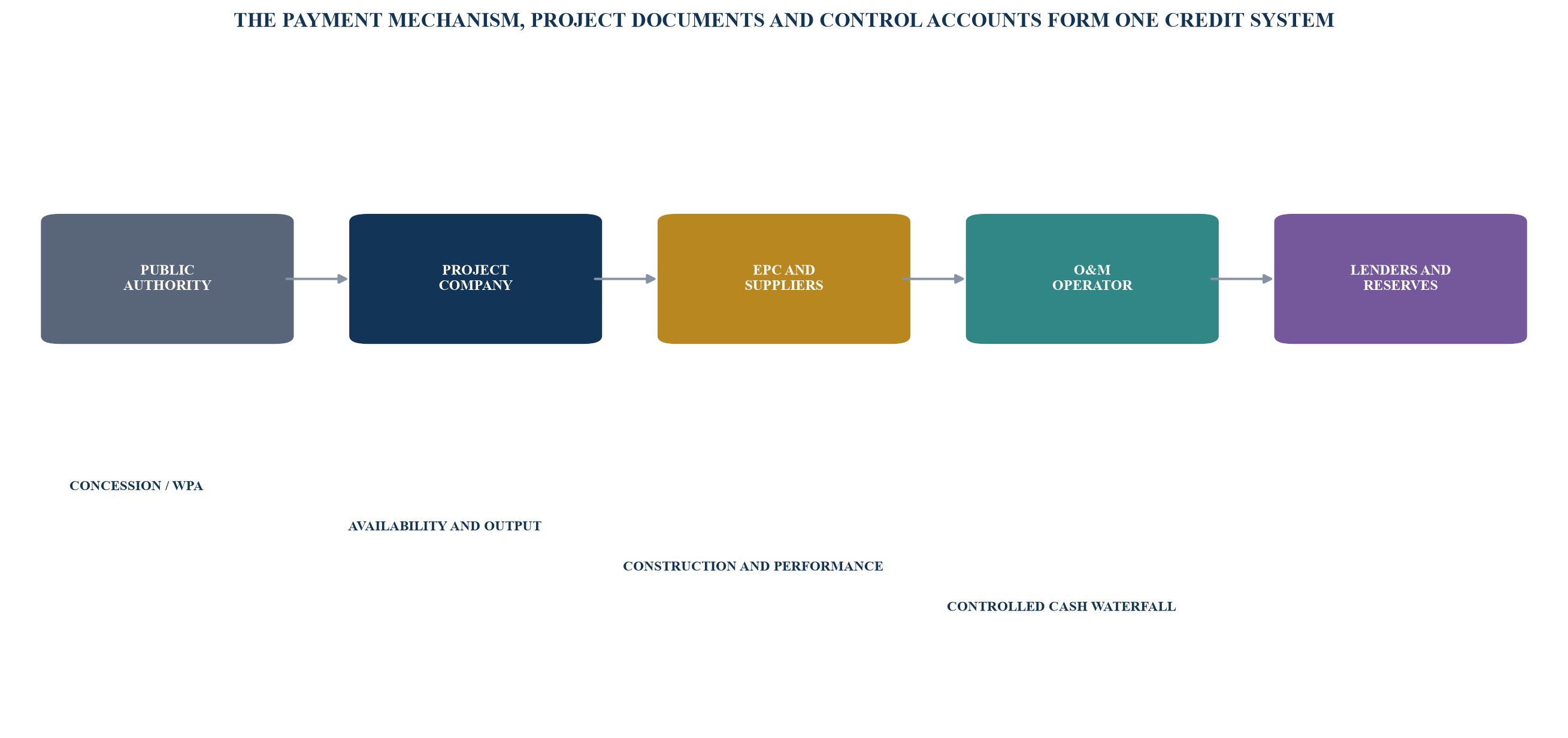
Contractual revenue reaches lenders only after the asset, service and payment chain performs.
2. Choose the revenue model before sizing debt
Water projects can earn revenue through consumer tariffs, bulk-water tariffs, volumetric payments, capacity or availability payments, minimum offtake commitments, connection charges, treatment fees or combinations of these. The labels are less important than the risk allocation. A lender should identify who pays, what triggers payment, what volume or capacity is protected, which costs are indexed and which deductions can reduce cash.
In a retail-tariff concession, the project or utility may bear demand, collection and affordability risk. The model should test customer growth, non-revenue water, billing efficiency, arrears, tariff-setting procedures, subsidy, political intervention and enforcement. Consumer tariffs may be regulated below full cost, with the funding gap met through subsidy or public transfer. The legal route and budget source for that support are part of credit quality.
In a bulk offtake model, a public utility or procurement company purchases water or treatment capacity under a long-term contract. World Bank guidance notes that a BOT water project may receive a minimum payment when the facility can deliver service, plus a volumetric payment for additional output.[7] This can shift demand risk to the offtaker while retaining availability, performance and deduction risk with the project company.
Oman's 2026 bulk supply tariff illustrates a fixed and variable architecture: a fixed charge for desalination capacity or pre-commercial-operation output and a variable charge linked to delivered water, with time-of-day differentiation.[8] That public tariff is not a project-level finance contract, but it demonstrates why capacity and output components must be separated.
The lender should create a payment bridge from contractual formula to cash. Start with available capacity, apply tested reliability, contracted fixed charge, indexed cost components, expected dispatch, volumetric rate, deductions, tax and payment timing. The result is cash available before financing. Debt should be sized on the protected portion of that bridge, with downside cases for deductions, delay and temporary unavailability.
Table 1. Revenue-model allocation matrix
| Payment model | Primary payer | Risk retained by project | Key lender evidence | Typical structural response |
|---|---|---|---|---|
| consumer tariff | households, businesses or utility customers | demand, collection, tariff and affordability | tariff order, billing history, subsidy law and collection data | conservative collection case, liquidity reserve and tariff covenant |
| volumetric bulk payment | public utility or procurement company | dispatch, delivered quantity and quality | offtake agreement, dispatch rules and meter protocol | minimum offtake, deemed delivery and working-capital reserve |
| capacity or availability payment | public authority or utility | availability, performance and deduction | acceptance test, availability formula and deduction schedule | cure bands, deduction cap and debt-service headroom |
| blended fixed and variable | public utility | fixed-capacity performance plus volume and cost exposure | complete payment model and indexation schedule | separate fixed-cost and variable-cost coverage tests |
| concession plus subsidy | users and public budget | collection, tariff gap and appropriation | concession, subsidy agreement and payment history | escrow, support agreement and termination compensation |
| industrial bilateral supply | corporate user | customer concentration and termination | customer credit, take-or-pay and replacement market | concentration cap, LC or guarantee and cash sweep |
The matrix converts payment labels into the risks that must be modelled and documented.
3. Convert tariff risk into explicit sensitivities
A tariff sensitivity should not be a single percentage reduction applied to revenue. It should isolate the contractual mechanics. The analysis should test the base tariff, fixed and variable components, inflation index, electricity or energy pass-through, chemical and membrane costs, foreign-exchange exposure, tax, performance deductions, change-in-law relief, rebasing and payment delay.
DEWA reported a lowest levelised tariff of USD 0.365 per cubic metre for the 180-MIGD alternative proposal in the Hassyan procurement.[9] Such a competitive tariff becomes credible to a lender only when the cost base, indexation and performance assumptions are reconciled to the signed agreement. A very low bid can increase sensitivity to power price, utilisation, construction delay or operating underperformance if those risks are not passed through.
Power deserves its own bridge because it is normally the largest variable operating cost for desalination. The contract should identify supplier, tariff, connection, curtailment, grid loss, renewable attribute, backup arrangement and pass-through. The technical case should reconcile specific energy consumption, recovery ratio, feedwater temperature and salinity, membrane degradation, pumping head and cleaning cycle. An efficiency guarantee has value only when test conditions and measurement protocols match real operations.
Inflation protection should be mapped cost by cost. Domestic labour, imported membranes, chemicals, insurance and professional services may follow different indices and currencies. A general consumer-price index can leave basis risk. The lender model should apply contractual indexation dates, caps, floors and lags rather than assume perfect pass-through.
Payment deductions should be converted into a matrix by duration and severity. Temporary quality failure, reduced capacity, unplanned outage, reporting breach and safety event can have different consequences. Debt sizing should recognise recurring deductions and the potential interaction of multiple failures. An aggregate cap can protect cash, but the lender must confirm exceptions and termination thresholds.
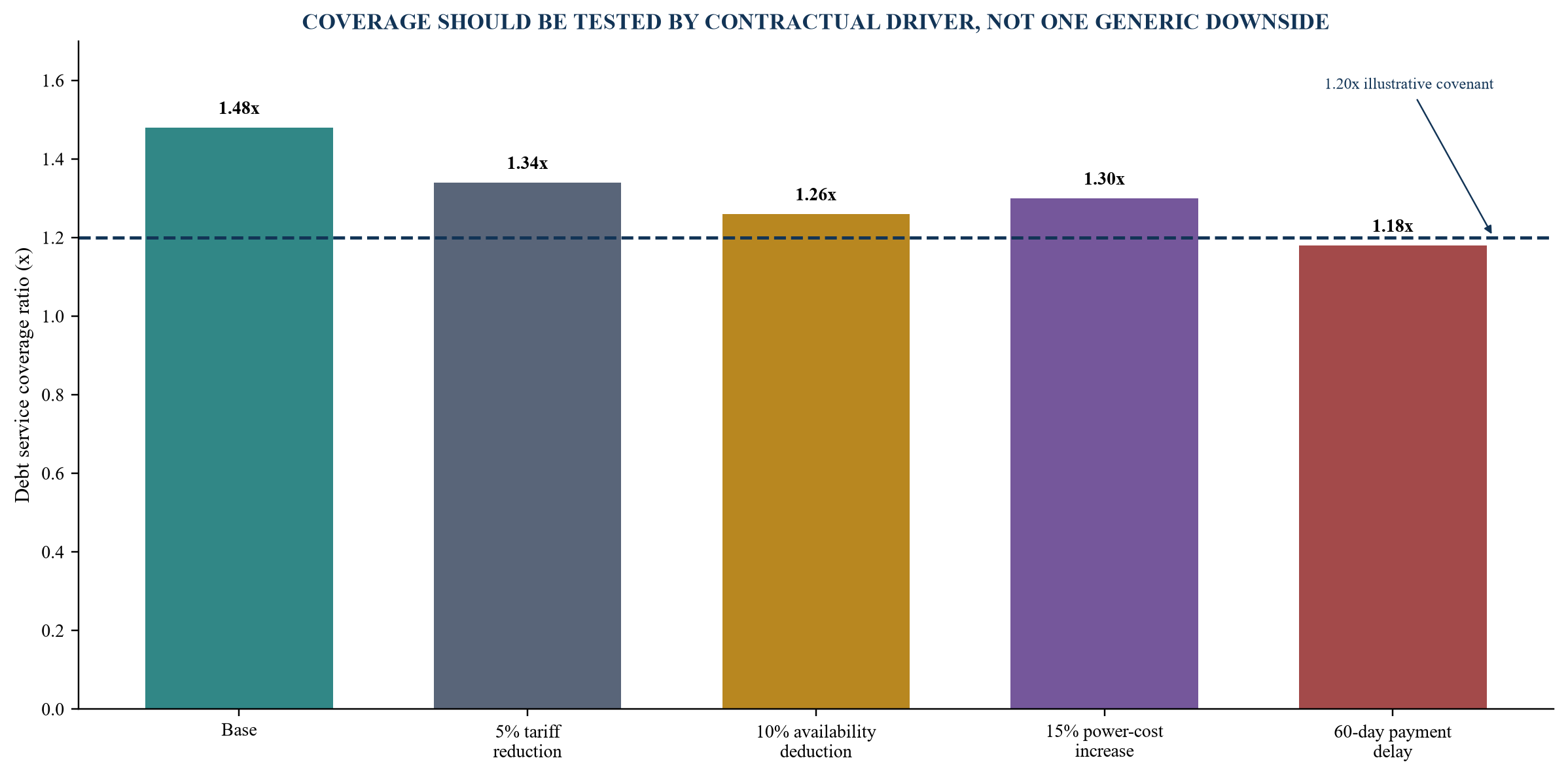
Values are illustrative management assumptions and show how distinct revenue drivers affect coverage.
4. Build the construction risk matrix before financial close
Construction risk begins before notice to proceed. Land access, environmental approvals, marine works, geotechnical conditions, intake and outfall design, grid connection, owner-provided interfaces, long-lead equipment, logistics, labour, commissioning water and public-network readiness can determine the completion date. The credit file should not compress them into an EPC completion guarantee.
A fixed-price, date-certain EPC contract is valuable when its scope matches the concession requirements. The lender should reconcile every output specification, interface and acceptance test across the concession, EPC, O&M, power-supply and equipment documents. Scope gaps can make the project company responsible even if each contractor performs its own contract.
The EPC security package should include appropriate performance security, advance-payment security, retention, delay liquidated damages, performance liquidated damages, warranties, insurance, parent support and direct-agreement rights. The amounts should be compared with the actual debt exposure and estimated consequences. A liquidated-damages cap may be exhausted by delay before performance defects are resolved.
The programme should include critical-path float and a concession long-stop bridge. The scheduled completion date must precede the offtake long-stop by enough time to absorb testing and cure. Debt maturity, interest reserve, hedge start and commitment expiry must match that schedule. An offtake agreement that survives to 2055 offers little comfort if the construction facility expires before acceptance.
Independent technical advisers should report against measurable evidence: design completion, procurement, manufacturing, shipment, civil progress, mechanical completion, energisation, wet commissioning, reliability test and acceptance. Progress should be assessed against earned value, critical path and forecast cost to complete. Percentage complete alone can conceal delayed interfaces.
Table 2. Construction and interface risk matrix
| Risk | Evidence required | Primary allocation | Lender control | Escalation trigger |
|---|---|---|---|---|
| land and access | title, lease, easements and handover certificate | public authority or project company | condition precedent and access covenant | unresolved access on critical path |
| permits and environmental | issued approvals, conditions and monitoring plan | project company with authority obligations identified | permit register and no-draw condition | permit expiry, challenge or unpriced condition |
| marine and geotechnical | surveys, design basis and contractor relief regime | EPC contractor for defined conditions | technical review and contingency | differing condition beyond contractual envelope |
| power connection | executed supply and connection documents | utility, authority and project company by interface | milestone, direct agreement and reserve | grid works later than wet commissioning need |
| long-lead equipment | purchase orders, factory schedule and logistics plan | EPC contractor and key suppliers | vesting, inspection, security and replacement plan | missed manufacturing or shipping milestone |
| network interface | connection design and downstream readiness | authority or utility | coordinated programme and deemed-availability protection | plant ready before network acceptance |
| performance testing | protocol, reference conditions and cure procedure | EPC and O&M contractors | independent witness and staged acceptance | repeated failure or insufficient liquidated damages |
| cost overrun | committed budget, contingency and sponsor support | sponsor and EPC contractor | funded cost-to-complete test | sources below forecast remaining cost |
The responsible party must have contractual scope, financial capacity and a remedy that survives default.
5. Make cost to complete the draw governor
Construction facilities should not advance simply because invoices are due. Each draw should satisfy a cost-to-complete test. Remaining committed sources, including undrawn debt, funded equity, available contingency, enforceable contractor security and permitted insurance proceeds, should exceed forecast remaining project cost plus required reserves and an agreed buffer.
The numerator should include only sources that are legally and practically available. Uncalled sponsor equity requires a binding commitment, evidence of capacity and a draw mechanism. Contractor claims should not be treated as recoverable cash until accepted or backed by liquid security. Future operating revenue should be excluded before contractual acceptance unless early-production payments are documented and controlled.
The denominator should include unpaid contract value, approved changes, forecast claims, owner costs, financing costs, hedge cost, taxes, remaining contingency, testing, initial spares, operating ramp and reserve funding. The technical adviser, model auditor and facility agent should use a common cut-off date. Differences between accounting accruals, certified work and cash payment must be reconciled.
Equity should normally fund early and remain subordinated. A pro rata equity mechanism can be acceptable if the remaining equity is secured and the lender retains a stop-draw right. Cost overruns should be funded before further debt advances when the completion case is impaired. The structure should define when contingency may be used and who approves transfers.
A delayed-draw private-credit facility can fund specific gaps: a development-to-construction bridge, contingency tranche, reserve facility, VAT or receivables timing, sponsor-support replacement or post-completion ramp. Its draw conditions should match the risk it funds. A flexible tranche that is available without milestone discipline can increase total leverage before the asset is ready.
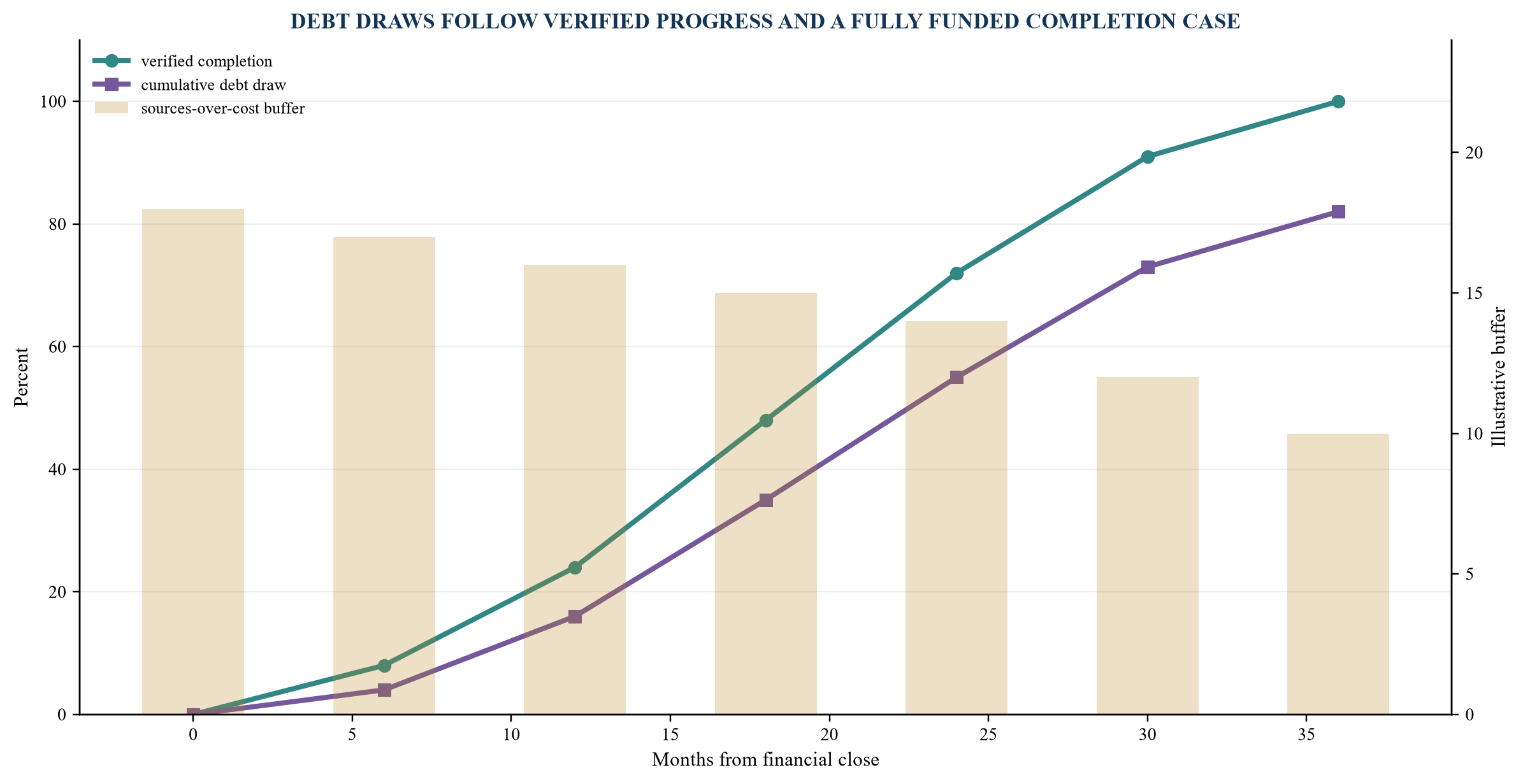
Figures are illustrative management assumptions; debt availability follows verified progress and remaining-source coverage.
6. Separate provisional acceptance from bankable operations
Commercial operation is not one universal event. Project documents may distinguish mechanical completion, provisional acceptance, initial commercial operation, partial capacity, final commercial operation and final acceptance. Each milestone should identify the tests passed, remaining defects, revenue entitlement, deduction regime, contractor liability and release of security.
The acceptance protocol should match the payment formula. If revenue depends on available capacity, the test must measure sustainable capacity under agreed feedwater, temperature, salinity, power and quality conditions. If the offtaker controls dispatch, deemed-availability rules should protect the project when the plant is ready but not called. Measurement equipment, sampling, laboratory procedure and dispute resolution should be defined.
Ramp risk belongs in the financing model. Membrane conditioning, biological process stabilisation, operator training, chemical optimisation and public-network integration can take time. The project may pass a short performance test while still experiencing elevated operating cost or outages. A post-acceptance liquidity reserve and enhanced monitoring period can bridge that uncertainty.
Release of EPC security should be staged. A portion may release at provisional acceptance, with retention, performance security or warranty support continuing through final acceptance. Outstanding punch-list items should be valued, dated and secured. The lender should confirm that release does not remove leverage needed to remedy latent or recurring defects.
The first refinancing opportunity typically arises after construction risk falls, revenue has been demonstrated and remaining concession tenor is long. World Bank PPP guidance observes that institutional investors can be better placed to refinance projects after construction risk has been removed and a service-performance history exists.[10] The private-credit maturity and amortisation profile should preserve that takeout window.
7. Score the public counterparty and payment security
A government-related offtaker should not be treated as risk-free without analysis. The lender should identify legal form, ownership, statutory mandate, revenue source, budget process, borrowing and guarantee authority, payment history, dispute mechanism, immunity, enforcement route and support arrangements. A state-owned company can have commercial obligations that are legally distinct from the sovereign.
Payment security can include an escrow account, letter of credit, liquidity facility, government support agreement, guarantee, budget undertaking, termination payment, deemed payment, assignment of receivables and direct debit from a protected revenue source. Each instrument should be tested for amount, tenor, replenishment, draw conditions, governing law, expiry and interaction with default remedies.
The project should model invoice timing from service month to cash receipt. Certification, meter validation, deduction notice, dispute and payment periods can create working-capital needs even when no default occurs. A 30-day contractual payment may produce a 60-day cash cycle after certification. The debt-service reserve and working-capital facility should reflect observed administration and downside delay.
Termination compensation is a separate credit layer. The formula should distinguish authority default, project-company default, prolonged force majeure, change in law and voluntary termination. It should state how senior debt, break costs, hedge termination, equity and insurance proceeds are treated. Payment timing and appropriation risk matter as much as the formula amount.
The World Bank recommends that governments balance bankability with contingent-liability discipline.[11] Lenders should seek clear support for risks the public party controls while avoiding a structure that depends on vague expectations of rescue. Documented obligations create a financeable contract; political importance alone does not.
Table 3. Public-counterparty and payment-security scorecard
| Dimension | Strong evidence | Moderate evidence | Weak evidence | Credit response |
|---|---|---|---|---|
| legal obligation | unconditional executed payment obligation | obligation subject to defined certifications | policy statement or unsigned support | exclude unsupported cash and require execution |
| payer capacity | funded procurement entity with transparent accounts | public entity with budget dependence | thinly capitalised project offtaker | guarantee, escrow or liquidity support |
| payment history | timely comparable contract performance | limited history or occasional delay | arrears, disputes or restructuring | larger reserve, LC and tighter distribution test |
| tariff and subsidy | lawful formula with automatic funding | periodic administrative reset | discretionary or politically constrained | downside tariff case and support agreement |
| termination payment | defined debt-protective formula and timing | formula with valuation or appropriation uncertainty | unclear or heavily subordinated recovery | lower leverage and legal condition precedent |
| enforcement | waiver, arbitration and executable security | process subject to local approvals | immunity or uncertain recognition | local-law opinion and alternative support |
| direct agreement | notice, standstill, cure and substitution | limited cure rights | no lender recognition | draw conditioned on acceptable direct agreement |
Scores are a diligence tool, not a credit rating.
8. Design the reserve waterfall around failure modes
Reserve design should follow the project's failure modes. A debt-service reserve covers temporary cash shortfall. A maintenance reserve funds scheduled major maintenance and membrane replacement. An operating reserve supports working capital, chemical inventory and ramp. A construction reserve funds defined contingency. A payment-delay reserve addresses offtaker administration. An environmental or decommissioning reserve may be required by permit or concession.
Cash should enter controlled accounts. Taxes and essential operating costs are paid first. Senior debt service, hedge payments and required reserve top-ups follow. Approved maintenance and lifecycle expenditure should be funded before distributions. A cash sweep can accelerate amortisation when coverage is strong or completion savings arise. Distribution should depend on historic and forward-looking coverage, reserve sufficiency, no default and an updated lifecycle plan.
The debt-service reserve can be funded in cash, by letter of credit or through a committed facility. Each form has different counterparty, expiry and draw risk. An LC should include replacement triggers and a funded fallback. A revolving reserve facility should remain available during stress and not share the same default trigger as the payment it supports.
Lifecycle funding deserves attention because a long concession can outlast key equipment. Membranes, pumps, pressure exchangers, electrical systems, instrumentation, pipelines and structures have different maintenance cycles. The independent engineer should validate the lifecycle model and annual reserve curve. Deferring maintenance may improve near-term coverage while impairing future availability.
Reserve release should be rule-based. A reserve may step down after final acceptance, completion of a performance period, achievement of a rating or coverage threshold, or refinancing. The release should not occur while claims, defects, deductions or material maintenance are unresolved.
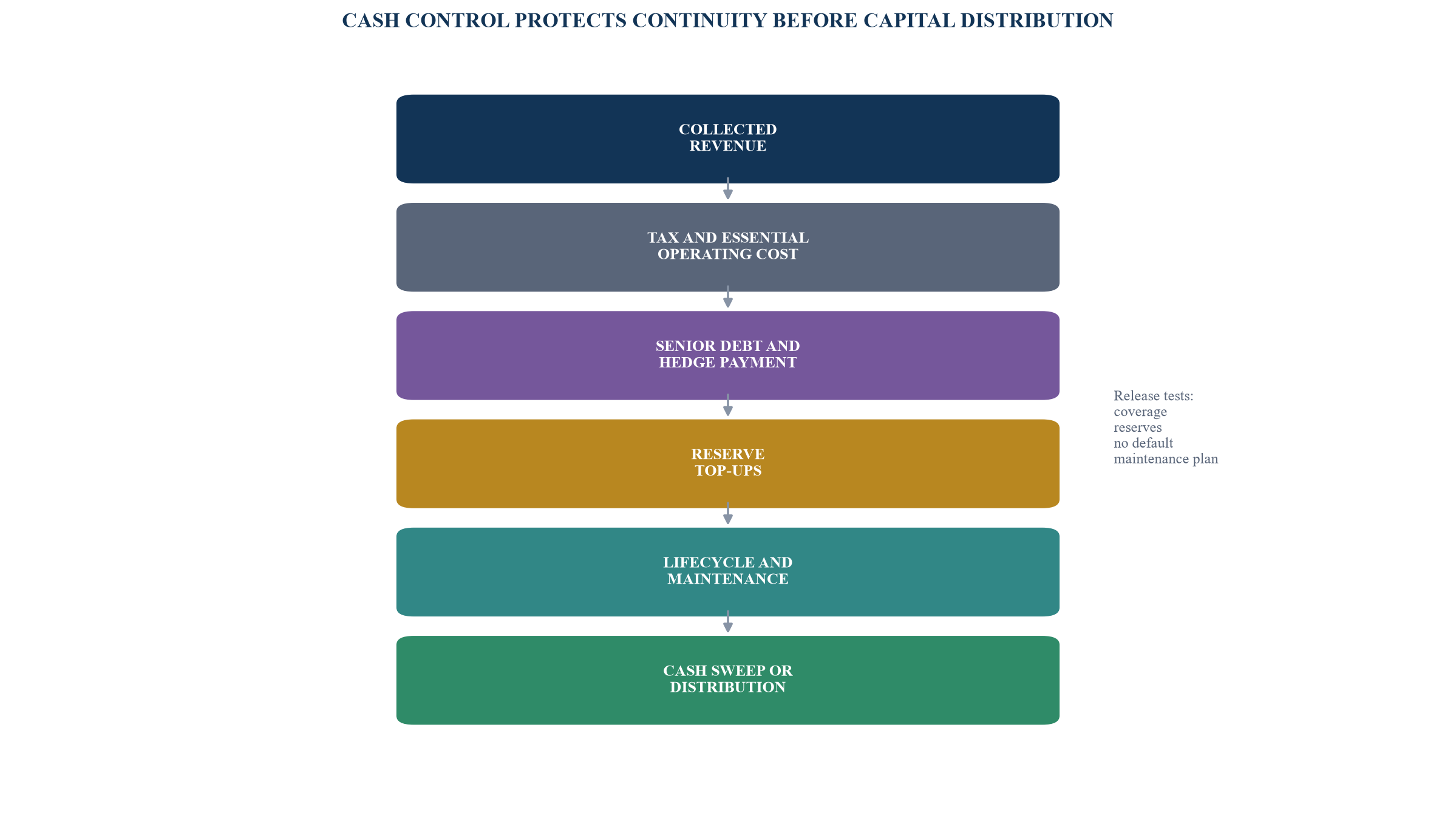
Distributions occur only after operating, debt-service and lifecycle obligations are funded.
9. Use private credit for defined gaps
Private credit can complement bank project finance rather than duplicate it. A private lender may accept bespoke draw mechanics, delayed funding, junior security, subordinated cash flow, a shorter maturity, payment-in-kind accrual, a contingency commitment or a concentrated exposure that does not fit a bank syndicate. That flexibility has value when the financed gap and repayment route are precise.
Possible uses include development expenditure before bank financial close; acquisition of a permitted project or sponsor interest; equity bridge pending capital calls; construction contingency; standby cost-overrun support; VAT or receivables timing; a working-capital reserve; refinancing of a maturing bridge; or capex for an operating asset. Each use has a different security and takeout case.
The structure should prevent leakage into unidentified cost overrun. A development loan may convert or be repaid at financial close. A contingency tranche should draw only after base contingency and sponsor commitments are used according to an agreed order. A reserve facility should fund only specified accounts. A refinancing bridge should have mandatory prepayment from the identified takeout.
Priority must be transparent. Senior banks may restrict additional debt, liens, distributions and amendments. Intercreditor terms should cover payment blockage, enforcement standstill, turnover, voting, cure, purchase option and release of security. A junior lender should understand whether it can influence a waiver that preserves enterprise value without disrupting essential-service continuity.
BIS research reported that global private-credit assets under management exceeded USD 2.5 trillion and identified infrastructure among the hard-asset categories used in asset-based lending.[12] That scale does not make every water exposure suitable for a fund. Asset-specific expertise, long tenor, construction monitoring, public-contract analysis and patient workout capability remain necessary.
Table 4. Private-credit instrument menu
| Instrument | Defined financing need | Primary repayment | Essential controls | Principal risk |
|---|---|---|---|---|
| development loan | permits, design and bid expenditure | sponsor equity or bank financial close | milestone budget, sponsor support and conversion terms | failure to reach financial close |
| equity bridge | timing of committed sponsor capital | documented capital calls | pledge, call rights and investor eligibility | investor delay or commitment dispute |
| contingency tranche | defined construction overrun | project cash flow or refinancing | cost-to-complete test and draw hierarchy | adverse selection after base risk deteriorates |
| reserve facility | DSRA, working capital or lifecycle reserve | operating cash after senior debt | controlled account and limited use | facility unavailable during stress |
| subordinated term loan | fill capital-structure gap | residual contracted cash flow | intercreditor rights and cash sweep | low recovery after senior enforcement |
| receivables facility | certified-payment timing | assigned offtaker invoices | eligibility, dilution and account control | certification dispute or payer delay |
| refinancing bridge | maturity before long-term takeout | bank, bond or institutional refinance | amortisation, takeout milestones and mandatory prepayment | market closure or performance shortfall |
Pricing and sizing depend on the actual transaction; the table identifies structural purpose only.
10. Build a lender step-in path that can operate
Step-in rights protect continuity when termination would destroy value. They should give lenders notice of project-company default, a standstill period, the right to cure, the ability to appoint a representative or substitute entity, and a route to novate project rights to a qualified replacement. The rights should apply before the authority terminates the concession or water-purchase agreement.
World Bank guidance describes three levels of intervention: cure, step-in and novation or substitution.[13] Cure rights may address a payment or documentary breach. Step-in allows a lender representative to control remediation while the contract remains alive. Substitution transfers the project to a replacement that meets technical, financial and legal requirements. Each level needs a timetable and decision standard.
The direct agreement should reconcile the rights of the public authority, project company and secured lenders. It should identify notices, cure periods, confidentiality, access, liabilities during step-in, procurement or qualification requirements, transfer consent, step-out, continuing obligations and termination. Local counsel should confirm enforceability under concession, procurement, insolvency, security and public-law rules.
Step-in must extend through the operating chain. Direct agreements with the EPC contractor, O&M operator, power supplier, key equipment vendors, landlord and material interface parties may be needed. The lender should have notice before termination, a cure opportunity, rights to assign or novate, and access to warranties, technical records and intellectual property. A preserved concession is insufficient if the operator or essential supplier can terminate immediately.
The lender should identify a practical substitute. Qualification criteria, licences, experience, financial strength, conflict rules and authority consent can narrow the pool. A pre-agreed process is more useful than an abstract right. The workout plan should list potential operators, advisers, budget, decision rights and the maximum period available before service or public-health consequences escalate.
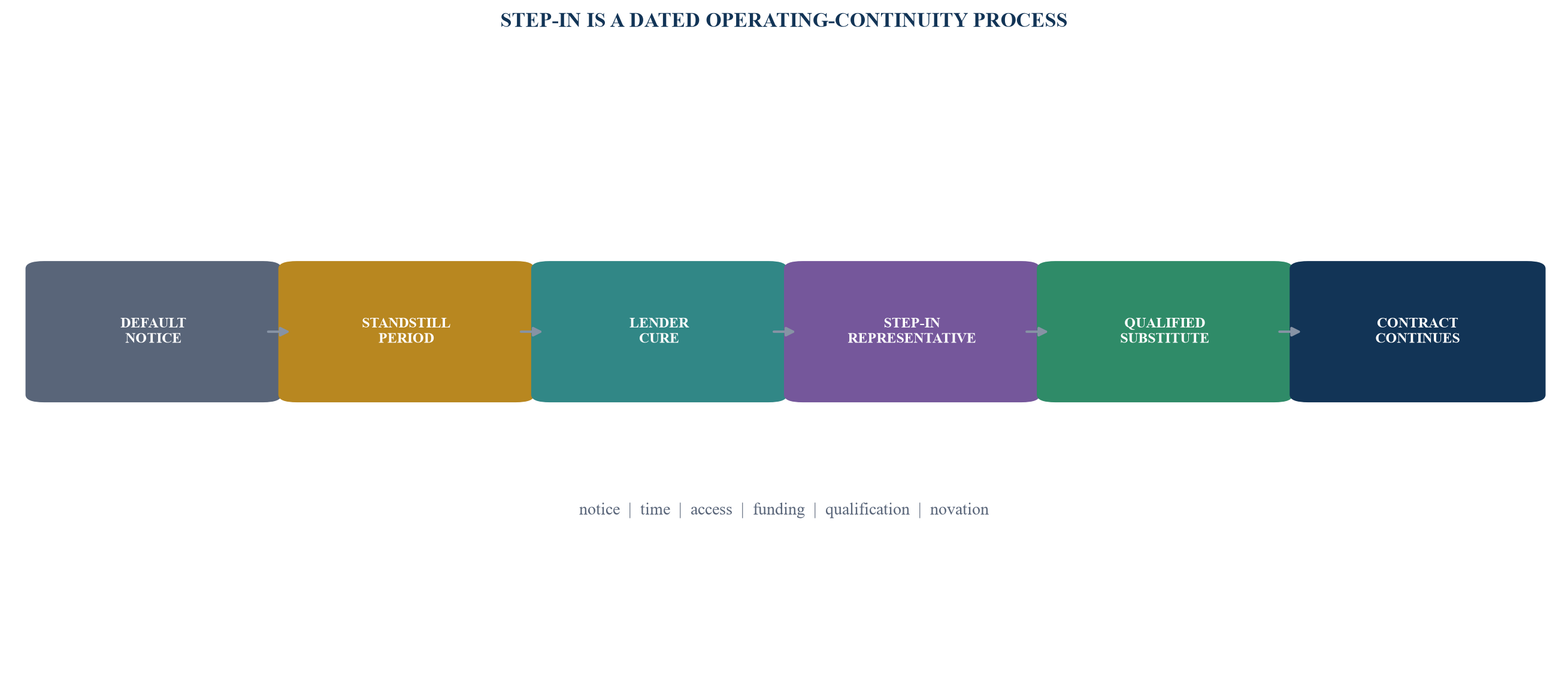
The path preserves service and contract value before termination becomes irreversible.
11. Align security with the concession structure
Security should cover the rights that produce cash while respecting public ownership and transfer restrictions. The package may include share pledges over the project company, assignments of concession and offtake receivables, security over bank accounts, insurances, material contracts, movable equipment, claims and permitted land or lease interests. The authority's consent can be required for assignment or enforcement.
The security review should distinguish creation, perfection, priority and enforcement. A contractual assignment may transfer receivables without transferring the underlying concession. A pledge over shares may still require authority approval before control changes. Security over public land or infrastructure may be prohibited or limited. Legal opinions should address the actual asset and governing law.
Account control is central. Revenue, insurance, liquidated damages, compensation and disposal proceeds should flow through the agreed waterfall. Cash held by an operating bank should be protected from set-off where feasible. Account-bank downgrade, replacement and insolvency provisions should be documented.
Insurance should name appropriate lenders and loss payees. Construction cover can include builder's risk, marine cargo, delay in start-up, third-party liability and professional indemnity. Operating cover can include property damage, machinery breakdown, business interruption, environmental liability, cyber and public liability. Coverage exclusions, deductibles, delay period and reinstatement basis should match the downside model.
Material contracts should remain accessible after enforcement. The lender needs copies, amendments, notices, claims, warranties, intellectual-property rights and technical data. Restrictions on disclosure, assignment or transfer should be resolved before closing. A security schedule without the consents needed to use the asset gives false comfort.
12. Model climate, environmental and resource risk
Water assets face physical and transition risks that affect availability and cost. Desalination projects depend on source-water quality, temperature, salinity, marine ecology, intake fouling, harmful algal blooms, discharge limits and power. Wastewater projects depend on influent volume and quality, collection networks, treatment standards, sludge disposal and reuse demand. Conveyance projects face route, pumping-energy, leakage, geotechnical and right-of-way exposure.
The environmental and social file should contain current impact assessments, permits, monitoring obligations, community commitments, biodiversity measures, discharge standards and incident procedures. Construction and operating budgets should include mitigation and compliance. An obligation that has no funded owner becomes a completion or operating risk.
Energy efficiency directly affects cost and emissions. Reverse osmosis can reduce energy intensity relative to thermal desalination, while pumping and source conditions remain material. The contract should allocate changes in electricity tariff, grid carbon policy, renewable-energy requirements and curtailment. Where the project includes dedicated renewable capacity, the lender should analyse its construction, intermittency, grid and replacement-power arrangements.
Climate scenarios should influence engineering and reserves. Sea-level change, storm surge, extreme heat, flooding, drought, source-water variation and coastal events can affect physical design and downtime. The technical adviser should identify design standards, remaining uncertainty, insurance availability and adaptation expenditure. A generic resilience statement is insufficient.
The World Bank's 2024 water-security work emphasises financial viability and climate resilience, while the joint MDB report records substantial public and multilateral financing for the sector.[6][14] Private capital can complement that support when environmental obligations and public-service outcomes are measurable and enforceable.
Table 5. Environmental, operating and lifecycle risk schedule
| Risk | Operating consequence | Evidence | Financial response | Monitoring trigger |
|---|---|---|---|---|
| source-water variation | reduced output or higher treatment cost | multi-season sampling and design envelope | performance margin and operating reserve | condition outside tested envelope |
| power cost or interruption | lower margin or unavailable capacity | supply contract, tariff and resilience plan | indexation, pass-through and backup reserve | unpassed cost or outage above threshold |
| membrane and equipment degradation | efficiency loss and replacement capex | vendor curves, operating history and spares plan | lifecycle reserve and warranty | specific consumption or availability variance |
| discharge and biodiversity | permit breach, remediation or shutdown | environmental permit and monitoring programme | funded mitigation and insurance | exceedance, incident or regulator notice |
| wastewater influent variance | process instability or quality failure | influent specification and network data | relief regime and process contingency | quality outside contractual band |
| pipeline leakage or route failure | lost volume, repair and service interruption | integrity plan, easements and inspection data | maintenance reserve and business interruption cover | pressure, loss or condition threshold |
| extreme weather | construction delay or operating outage | site-specific resilience assessment | contingency, adaptation capex and insurance | design-basis event or changed hazard map |
Each risk needs an evidence owner, quantified consequence and funded response.
13. Set covenants that lead to action
Covenants should identify deterioration while there is time to intervene. Construction reporting should cover permits, critical path, earned value, procurement, claims, contingency, cost to complete, equity funding, health and safety, environmental compliance, insurance and disputes. Operating reporting should cover available capacity, output, quality, energy, chemicals, downtime, deductions, receivables, maintenance, reserves, cash flow and coverage.
Financial covenants can include historic and forward-looking debt-service coverage, loan-life coverage, reserve sufficiency, leverage, minimum liquidity and distribution tests. Calculation definitions must match the payment mechanism. Cash available for debt service should exclude disputed, overdue or non-cash revenue and deduct required lifecycle expenditure.
Project covenants should address amendments, waivers, claims, budget changes, additional debt, liens, material contracts, change of control, operator replacement, related-party transactions, settlements and asset disposal. Consent thresholds should be calibrated so ordinary operations continue while material risk allocation cannot change without lender review.
The remedy ladder should be proportionate. A watch threshold increases information and adviser involvement. A control threshold can trap cash, block distributions, require a remedial plan, increase reserves or reduce further availability. A default threshold can stop draws, accelerate or trigger enforcement. Automatic acceleration may be inappropriate where essential-service continuity and public-law obligations require a managed process.
Early-warning indicators should have owners and deadlines. Examples include construction float erosion, cost-to-complete compression, reserve underfunding, repeated test failure, availability deductions, rising energy intensity, delayed public payment, disputed invoices, operator weakness, permit non-compliance and missed refinancing milestones. The monthly report should link each indicator to a defined response.
Table 6. Covenant and remedy ladder
| Indicator | Watch response | Control response | Escalation response |
|---|---|---|---|
| construction float | updated critical path and cause analysis | distribution block and additional contingency | stop draw until completion route is funded |
| cost-to-complete coverage | independent forecast refresh | sponsor top-up before next advance | default if deficit remains unresolved |
| performance testing | witnessed cure and retest plan | retain EPC security and add liquidity | contractor replacement or step-in review |
| availability deductions | root-cause and operating plan | cash trap and enhanced reserve | operator substitution or restructuring |
| offtaker payment delay | invoice and budget escalation | draw payment support and block distributions | support enforcement and liquidity action |
| lifecycle reserve | updated maintenance forecast | mandatory top-up | protective advance and controlled procurement |
| environmental compliance | corrective action and regulator dialogue | funded remediation and independent monitoring | stop affected operation or invoke step-in path |
| refinancing milestone | market sounding and data-room review | adviser appointment and cash sweep | asset sale, extension or recapitalisation process |
Thresholds are illustrative and must be calibrated to the signed contracts and financial model.
14. Pre-wire refinancing before construction ends
The takeout should be defined before the construction facility is committed. Potential capital providers include local and international banks, Islamic financiers, infrastructure debt funds, insurers, pension capital, development finance institutions and project-bond investors. Each group has requirements for operating history, rating, contract tenor, leverage, coverage, concentration, security and documentation.
Private credit can shorten the initial execution timetable or hold risks that a long-term lender will accept only after completion. The bridge maturity should allow construction, cure, operating seasoning, diligence and documentation. A maturity that coincides with initial acceptance leaves little room for a failed test or market disruption.
The refinance sizing model should use remaining concession tenor, protected cash flow, lifecycle expenditure, reserves, tax, debt service and terminal obligations. It should recognise that availability revenue can be reduced by deductions and that long-dated payment depends on counterparty and contract continuity. The model should test rate, margin, amortisation and tenor rather than assume an unchanged capital market.
Transaction evidence supports long-tenor financing where contracts are mature. The Ras Mohaisen financing announced in December 2025 had a reported 29.5-year tenor and included sponsor support for equity commitment, debt-service coverage, early-production revenue, reserve capital and a restricted account.[15] Those disclosed elements illustrate how contract tenor, reserves and sponsor obligations can support long-dated debt. They should not be copied without analysing the actual project.
Refinancing preparation should assemble final permits, completion certificates, test results, as-built drawings, warranties, operating data, payment history, audited accounts, tax records, insurance, reserve balances and compliance reports. A clean evidence trail can reduce diligence time and execution risk.
15. Define downside operation before default
A water project cannot be evaluated solely through liquidation value. The public service, concession obligations and physical integration usually make continued operation the primary recovery route. The lender should know how the plant can remain safe, staffed, powered, insured and compliant while a cure or substitution occurs.
The downside budget should cover payroll, chemicals, energy, laboratories, maintenance, critical spares, environmental monitoring, insurance, cyber, security, advisers and authority liaison. Protective advances should have clear approval and priority. The debt documents should permit spending needed to preserve health, safety, environment and asset value.
Operator replacement is a central scenario. The file should identify qualification requirements, access to manuals and software, spare-parts ownership, staffing transfer, licences, intellectual property, vendor support and mobilisation time. The concession and O&M direct agreement should preserve the authority's service standards while allowing an orderly transfer.
Termination recovery should be modelled by cause. Authority default may support a debt-protective payment. Project-company default may expose lenders to deductions, retender value or a percentage of debt. Prolonged force majeure can create a different formula and payment timing. Insurance, liquidated damages and reserve balances should be applied without double counting.
The expected recovery is the lower of legal entitlement and executable cash. Budget approval, valuation disputes, arbitration, sovereign immunity, currency transfer, enforcement delay and contract set-off can reduce or postpone receipt. Local counsel, insurance advisers and technical experts should validate the downside route.
16. Run a twelve-day bankability diagnostic
Days one and two establish entities, authority, concession, land, asset boundary, project stage and requested use of proceeds. Days three and four rebuild the construction programme, interface matrix, permits and critical-path evidence. Days five and six reconstruct the payment formula, invoice cycle, tariff indexation, deduction schedule and counterparty support.
Days seven and eight test the committed sources, cost to complete, liquidity, reserve waterfall and coverage cases. Days nine and ten review security, direct agreements, step-in, insurance, environmental obligations and downside operation. Days eleven and twelve present the funding structure, conditions, covenant ladder, takeout route and decision.
The minimum evidence pack includes concession and procurement documents; land and permits; engineering, construction and O&M contracts; technical-adviser reports; equipment and supply agreements; payment formula; public-counterparty financial and legal evidence; financial model; existing debt and security; insurance; environmental records; claims; disputes; and all material approvals.
The diagnostic should produce a one-page decision summary, concession cash-flow map, tariff sensitivity, construction risk matrix, cost-to-complete test, counterparty scorecard, reserve waterfall, direct-agreement map, step-in path, covenant ladder and refinancing plan. Every material exception should identify amount, date, owner and remedy.
Green items have current evidence and acceptable allocation. Amber items require a condition, reserve, haircut, sponsor commitment, adviser conclusion or document change. Red items prevent reliance or funding. The committee should see how each issue changes draw availability, completion, debt service and recovery.
The outcome is proceed, proceed after specified evidence, restructure or decline. A conditional proceed should state what must be true before term sheet, credit approval, financial close, each draw, provisional acceptance, final acceptance and distribution.
17. Apply a 100-day financing execution plan
Days one to twenty establish governance, data room, document register, model version, project budget, schedule, evidence owners and open issues. The team reconciles technical, contractual, financial and public-counterparty definitions. All advisers use the same cut-off date.
Days twenty-one to forty-five complete technical, legal, insurance, environmental, tax, model and counterparty diligence. The independent engineer updates cost to complete and critical path. Counsel confirms concession, payment, security, direct agreements, step-in and enforcement. The model auditor verifies tariff, deductions, indexation, reserves and debt service.
Days forty-six to seventy align commercial terms and documents. Facility amount, draw schedule, equity, pricing, amortisation, maturity, reserves, accounts, security, intercreditor, hedging, covenants, defaults, cures, protective advances, transfer and termination should agree with the credit case. Unresolved points remain in a dated conditions schedule.
Days seventy-one to ninety rehearse operations. The parties test a draw request, engineer certificate, invoice, payment-support draw, cash waterfall, reserve top-up, deduction case, construction delay, environmental incident and step-in notice. The rehearsal exposes process gaps before material utilisation.
Days ninety-one to one hundred transfer governance into monitoring. Weekly construction and liquidity review continues until acceptance. Monthly reporting updates progress, cost, safety, environment, performance, payment, reserves and covenants. Quarterly review refreshes counterparty, lifecycle, downside and refinancing evidence.
18. Conclusion
GCC water infrastructure can support long-dated finance when the contract converts an essential service into reliable and enforceable cash. The physical asset remains important, but repayment depends on the payment mechanism, acceptance process, public counterparty, operating continuity and legal rights that preserve the concession.
The framework in this paper joins six disciplines. Revenue analysis separates tariffs, volume and availability. Construction analysis maps every interface and makes cost to complete the draw governor. Counterparty analysis tests obligation, capacity, support and termination. Reserve design follows actual failure modes. Direct agreements create a cure and substitution path. Refinancing begins before construction ends.
Private credit can add useful flexibility through development, bridge, contingency, reserve, subordinated or receivables facilities. Each tranche should fund a defined gap and have a documented priority, security, cash-control and takeout route. Flexibility without those controls increases leverage while leaving the underlying risk unresolved.
The central credit question is practical: after construction, deductions, operating cost, lifecycle expenditure, payment delay and every remaining condition, how much controlled cash is available to repay debt, and which rights preserve that cash during stress? A project that answers the question with current evidence can translate water security into bankable private capital.
References
- Saudi Water Partnership Company. 2024 Sustainability Report. https://www.swpc.sa/wp-content/uploads/2025/09/SWPC-2024-Sustainability-Report-Digital.pdf
- Saudi Exchange. ACWA Power Announces Signing of a Water Purchase Agreement with Saudi Water Partnership Company, 5 February 2025. https://www.saudiexchange.sa/wps/portal/saudiexchange/newsandreports/issuer-news/issuer-announcements/issuer-announcements-details?anCat=1&anId=85074&locale=en
- Dubai Electricity and Water Authority. Hassyan Seawater Reverse-Osmosis Project, updated 14 April 2026. https://dewa.gov.ae/en/about-us/strategic-initiatives/hassyan
- ENGIE, TAQA and EWEC. Financial Closing for Mirfa 2 Reverse Osmosis Desalination Plant, 31 May 2023. https://engiemiddleeast.com/media/engie-taqa-and-ewec-announce-financial-closing-for-mirfa-2-reverse-osmosis-desalination-plant/
- World Bank Group. Private Participation in Infrastructure 2024 Annual Report. https://ppi.worldbank.org/content/dam/PPI/documents/PPI-2024-Annual-Report.pdf
- World Bank. Water Security Financing Report 2024. https://www.worldbank.org/en/topic/water/publication/water-security-financing-report-2024
- World Bank Public-Private Partnership Resource Center. Concessions, Build-Operate-Transfer and Design-Build-Operate Projects. https://ppp.worldbank.org/agreements/concessions-bots-dbos
- Nama Power and Water Procurement Company. Water Bulk Supply Tariff 2026. https://omanpwp.om/public/BST/wMIS%26Sen.html
- Dubai Electricity and Water Authority. Lowest Water Levelised Tariff for the Hassyan Project, 23 May 2023. https://dewa.gov.ae/en/about-us/media-publications/latest-news/2023/05/dewa-receives-the-lowest-water
- World Bank. PPP Reference Guide, Version 3. https://ppp.worldbank.org/sites/default/files/2024-08/PPP%20Reference%20Guide%20Version%203.pdf
- World Bank Public-Private Partnership Resource Center. Considerations for Government. https://ppp.worldbank.org/considerations-government
- Bank for International Settlements. The Global Drivers of Private Credit, BIS Quarterly Review, March 2025. https://www.bis.org/publ/qtrpdf/r_qt2503b.htm
- World Bank Public-Private Partnership Resource Center. Key Issues in Developing Project Financed Transactions. https://ppp.worldbank.org/financing/issues-in-project-financed-transactions
- World Bank. Global Water Security and Sanitation Partnership 2024 Annual Report. https://www.worldbank.org/en/topic/water/publication/the-gwsp-2024-annual-report
- Saudi Exchange. ACWA Power Announces Financial Close for Ras Mohaisen Independent Water Project, 25 December 2025. https://www.saudiexchange.sa/wps/portal/saudiexchange/newsandreports/issuer-news/issuer-announcements/issuer-announcements-details/?anCat=64&anId=92237&cs=2082&locale=en
- International Finance Corporation. Aqaba-Amman Water Desalination and Conveyance Project Disclosure, 2025. https://disclosures.ifc.org/project-detail/SII/47924/aqaba-amman-water-desalination-conveyance-aawdc
- Emirates Water and Electricity Company. Statistical Report 2024. https://ewec.ae/uploads/mediakit/0.91096900%201756961868/Statistical%20Report%202024.pdf
- World Bank Public-Private Partnership Resource Center. Termination Provisions. https://ppp.worldbank.org/termination-provisions
