

1. Define the financing problem before choosing the instrument
An engineering company can report a large order book and still face a cash crisis. The order may require an advance performance guarantee before mobilisation. Imported equipment may need a letter of credit. Site labour and subcontractors may be paid monthly while customer certification occurs later. Certified bills may be paid after deductions, and a portion of each bill may be retained until completion or the end of the defects-liability period. Revenue, profit, receivables and cash therefore move on different clocks.
The financing question should begin with a named economic gap. One company may need mobilisation capital for a newly awarded contract. Another may need to fund the period between measured work and receipt of a running-account bill. A manufacturer may need inventory and supplier finance against a confirmed export order. An EPC contractor may need additional guarantee lines rather than more cash debt. A mature company may need to refinance a fragmented bank consortium and release trapped collateral. Each problem requires a different structure.
Private credit is most useful when it finances a bounded cash cycle and the lender can observe the evidence that converts work into cash. A facility should not be sized from headline order value. It should be sized from contract quality, remaining cost, expected margin, billing gates, customer acceptance, eligible receivables, retention release, guarantee usage, concentration, liquidity, debt service and a credible repayment path. The lender must understand how the company performs the work, earns the right to bill, obtains certification and collects.
India's engineering sector is economically significant and diverse. The Department of Commerce reported that engineering exports represented 26.87 per cent of merchandise exports during April to November 2024, with engineering exports of US$75.47 billion over that period.[1] Its Trade Intelligence and Analytics portal reports current engineering-goods trade using Directorate General of Commercial Intelligence and Statistics data.[2] Sector scale creates financing opportunity, but it does not remove company-level execution and collection risk.
All company figures, advance rates, reserves, pricing, covenant thresholds, forecasts and transaction scenarios in this paper are illustrative management assumptions. They do not describe a financing offer or a particular borrower. Readers should obtain current legal, tax, accounting, regulatory, credit and investment advice and review the executed contracts, security, guarantees and facility documents before acting.
2. Build a seven-layer financing system
The framework has seven connected layers. Layer one tests whether the order is executable and authorised. Layer two tests project economics and remaining cost. Layer three establishes the evidence required for billing and certification. Layer four classifies receivables and retentions by legal and commercial eligibility. Layer five maps guarantee and letter-of-credit capacity. Layer six sizes funded debt through a borrowing base and cash forecast. Layer seven governs collections, covenants, reporting and intervention.
The sequence matters. A prestigious customer cannot cure an unpriced scope gap. A certified invoice may remain unsuitable when it is disputed, subject to material set-off, already assigned or payable into an uncontrolled account. A strong receivables ledger cannot support a large draw when the next two months require substantial mobilisation and guarantee cash margins. A viable central case cannot support debt when a single project delay breaches minimum liquidity.
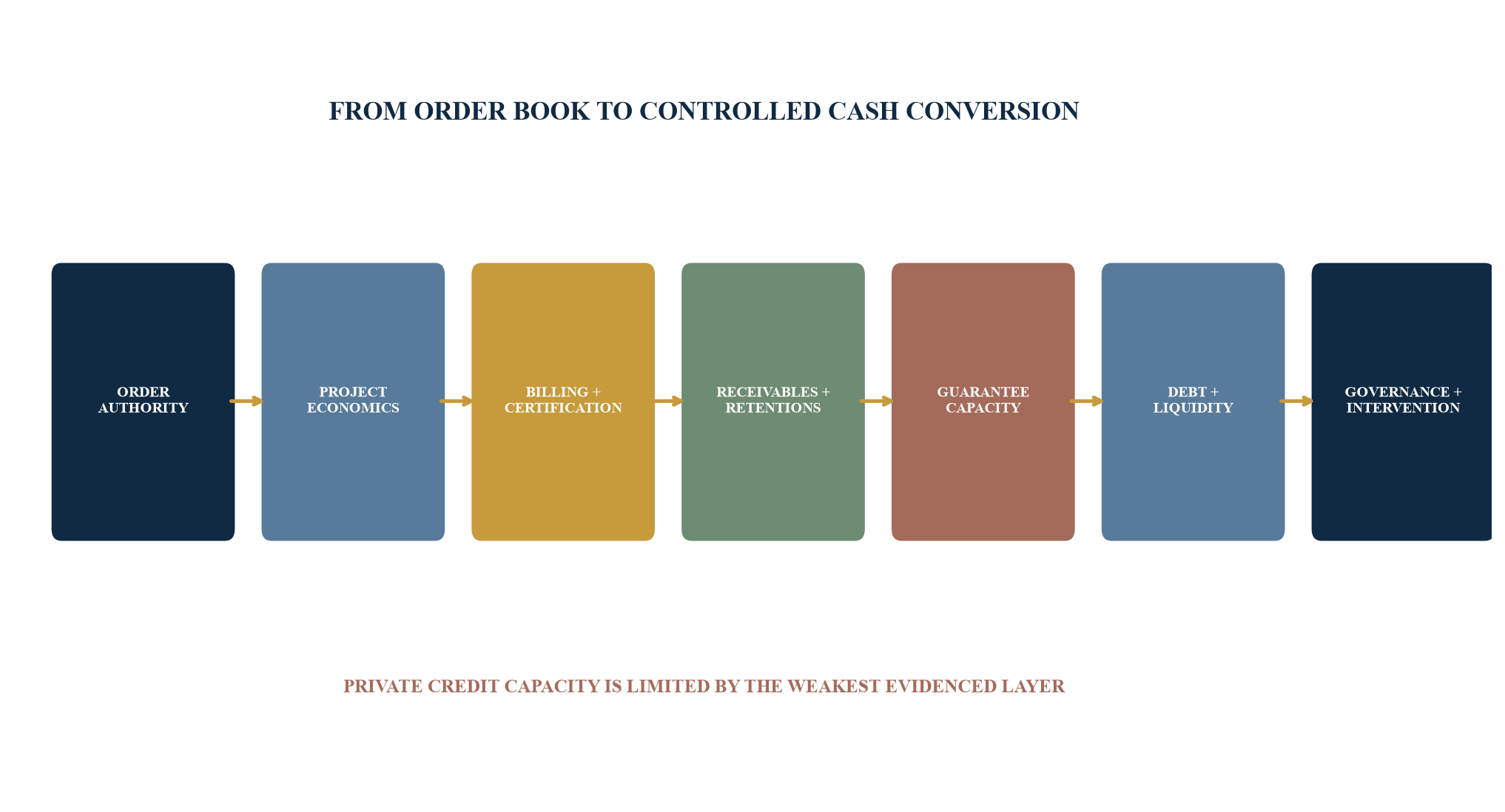
The framework is a decision sequence; every layer requires borrower-specific evidence.
The system creates a common language for the board, finance team, project leaders, lenders, trustees, security agents and advisers. It also defines the monthly record. Every material order should have a current contract summary, cost-to-complete view, billing schedule, certificate status, receivables allocation, retention schedule, guarantee register and cash forecast. Exceptions should be visible before the lender certificate is signed.
3. Test order quality rather than order-book size
Order quality begins with the contracting parties and authority. The lender should identify the legal entity that won the work, the entity performing it, the paying customer, any government or group relationship and the person authorised to certify. The executed contract, letter of award, purchase order, technical scope, bill of quantities, amendments and side letters should agree. Conditions precedent and mobilisation obligations should be recorded.
Scope clarity and price protection are central. Fixed-price work can create margin risk when design is incomplete, specifications change, quantities vary or input costs move. Escalation clauses, change-order procedures and customer-caused delay rights should be understood. The model should identify unpriced work, claims, liquidated damages, performance deductions and the evidence required to preserve contractual rights.
Customer quality extends beyond name recognition. The exact payer, procurement route, budget authority, project funding, certification chain, payment history, dispute behaviour and set-off rights matter. A public-sector or investment-grade customer may reduce default probability while administrative delay still creates liquidity pressure. A strong parent name may have no legal payment obligation.
Execution capacity should be tested against simultaneous commitments. The lender should compare required engineers, site managers, skilled labour, equipment, working capital and guarantee capacity across projects. A new order can weaken the credit when it diverts scarce resources, requires aggressive subcontracting or creates a peak cash need before older projects collect.
The commercial review should also distinguish original contract margin from current forecast margin. Original bid assumptions may have been based on supplier quotes, wage rates, design maturity and productivity estimates that no longer apply. The latest forecast should identify committed procurement, unplaced orders, foreign-currency exposure, subcontractor claims, rework, customer-caused delay and recoverable variations. Management should state which recoveries are contractually submitted, certified, agreed or only expected. Debt capacity should exclude unapproved claims unless the lender has specifically accepted a conservative value supported by legal and commercial evidence.
Portfolio interaction creates another layer of risk. Engineering companies often move people, equipment and cash between contracts. A profitable project may temporarily support a delayed project, while an urgent mobilisation may draw resources away from a contract approaching certification. The lender should test whether project cash is freely transferable, whether customer advances are restricted to a named project, and whether joint-venture or consortium arrangements limit access to collections. The monthly review should identify cross-subsidies and determine whether they remain within approved limits.
Table 1. Contract-quality matrix for an engineering order
| Dimension | Evidence | Strong condition | Warning condition |
|---|---|---|---|
| authority | executed contract, award and approvals | parties and signatories verified | award remains conditional or authority unclear |
| scope and price | specifications, quantities and change procedure | measurable scope and priced variation path | unpriced design development or disputed quantities |
| customer | payer, budget, funding and payment record | identified payer with reliable history | dependency on uncovenanted affiliate or delayed budget |
| execution | programme, resources and critical path | capacity reconciled across projects | labour, equipment or approvals exceed available capacity |
| billing | milestone and certificate process | objective evidence and dated workflow | subjective approval or incomplete measurement records |
| collection | invoice route, due date and deductions | traceable portal and payment history | repeated deductions, set-off or unexplained ageing |
| exit | completion, handover and retention release | release events and evidence defined | open-ended defects or acceptance conditions |
Scores and thresholds should be approved for the actual portfolio; low scores require exclusions, reserves or conditions.
4. Convert the order book into an evidence bridge
The gross order book should be separated into completed and billed work, completed but uncertified work, certified but uninvoiced work, invoiced receivables, future committed work, options and management pipeline. Only committed scope belongs in the contractual order book. Options, probable variations and bids should remain outside unless a lender expressly admits them under defined rules.
The bridge should deduct executed revenue and identify the remaining order value. Remaining cost should be rebuilt from quantities, procurement commitments, labour, subcontractors, equipment, overhead allocation, taxes and contingency. Expected margin should be reconciled to the latest project forecast and approved changes. A positive contract margin does not equal financing capacity because cash may be needed before the margin is realised.
Project forecasts should show monthly physical progress, earned value, billing, certification, invoice, collection and retention. The model should preserve the lag between each event. It should identify mobilisation advances and their recovery, retention deductions, taxes, back charges and performance penalties. It should also show the cash cost of letters of credit, bank-guarantee commission and margin deposits.
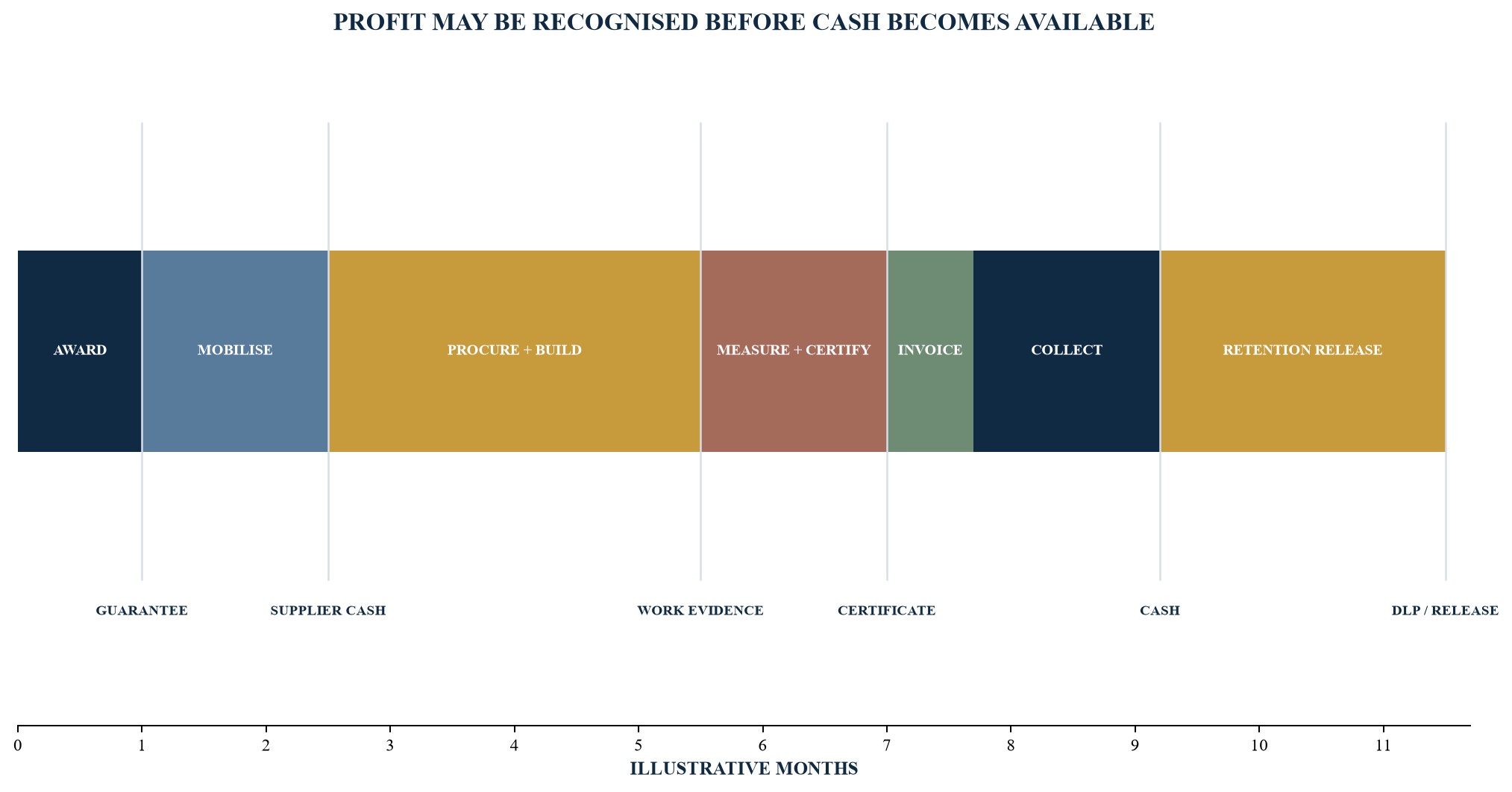
Timing is illustrative; the contract, certification process and observed customer behaviour control the actual dates.
An order-book reconciliation should be signed monthly by project controls, commercial and finance. New awards, cancellations, variations, executed revenue, forecast margin and remaining cost should be traced to source documents. The lender should receive a controlled summary rather than an unsupported pipeline slide.
5. Model cash conversion by project and event
Working capital begins with the project event schedule. Materials and subcontractors may require deposits or short payment terms. Customer advances may arrive only after an advance guarantee is issued. Progress bills may require joint measurement, engineer certification or portal approval. Taxes may become payable before collections. The company should model these events at project level before aggregating them.
A 13-week cash forecast provides near-term control. It should start with bank-confirmed unrestricted cash and show receipts by named invoice or certificate. Payments should be grouped by payroll, critical suppliers, subcontractors, taxes, debt service, guarantee margin, capital expenditure and discretionary expenditure. Each receipt and major payment should have an owner, evidence and confidence level.
The monthly model should extend through project completion, retention release and debt repayment. It should distinguish central, delayed-certification, slower-collection, cost-overrun, guarantee-invocation and contract-termination cases. Mitigations need lead times and decision rights. An assumed equity injection, claim recovery or asset sale should remain outside available liquidity until committed and executable.
Cash conversion should be measured through operational indicators. Useful measures include days from work performed to measurement, measurement to certification, certification to invoice, invoice to cash, retention percentage, retention age, disputed value, unbilled work, supplier days and guarantee utilisation. Trends should be reported by customer and project.
Forecast accuracy should itself become a control metric. The finance team should compare forecast receipts and payments with actual outcomes each week, classify the variance and update the next forecast. Receipt variances should distinguish incomplete performance, missing certificate, invoice rejection, customer processing delay, deduction and genuine credit deterioration. Payment variances should identify procurement acceleration, quantity change, supplier pressure, tax timing and emergency site expenditure. Persistent optimism should lead to larger liquidity buffers and lower availability.
Working-capital needs should be separated into permanent, seasonal and project-specific components. Permanent working capital may be supported by a revolving facility or stable capital. Seasonal peaks can use committed short-tenor capacity with a clean-down expectation. Project-specific mobilisation can be linked to a delayed-draw tranche and milestone tests. This separation prevents short-term borrowing from becoming a permanent substitute for undercapitalisation and helps the board see which cash gaps should be funded with equity.
6. Separate funded and non-fund requirements
Engineering businesses depend on a capital stack that includes cash credit, working-capital demand loans, bill discounting, factoring, term loans, equipment finance, export credit, supplier finance and private credit. They also rely on non-fund instruments such as bid bonds, performance guarantees, advance-payment guarantees, retention guarantees and letters of credit. A financing plan that addresses only funded debt may fail at the first guarantee requirement.
The guarantee register should record beneficiary, issuing bank, applicant, contract, type, amount, currency, issue date, expiry, claim period, margin, commission, counter-guarantee, security and release condition. Guarantees should be linked to project milestones and forecast releases. Automatic-extension clauses and delayed return of originals should be identified.
The Indian Contract Act defines a contract of guarantee and the roles of surety, principal debtor and creditor.[3] The actual guarantee wording, underlying contract, governing law and judicial treatment require legal review. The cash model should not assume that a disputed invocation can be prevented or rapidly reversed. An invocation case should show the cash, debt, cross-default and project consequences.
Table 2. Guarantee stack and financing implications
| Instrument | Commercial purpose | Principal cash risk | Control |
|---|---|---|---|
| bid bond | supports tender commitment | invocation if bid obligations are breached | bid authority and expiry diary |
| performance guarantee | secures performance obligations | on-demand payment and cross-default pressure | contract compliance and claim monitoring |
| advance guarantee | supports customer mobilisation payment | advance recovery and invocation overlap | segregated use and recovery schedule |
| retention guarantee | substitutes for cash retention | guarantee remains live through defects period | completion evidence and release chase |
| letter of credit | supports equipment or material purchase | crystallisation into funded exposure | shipment, acceptance and repayment matching |
| financial guarantee | supports debt or payment obligation | direct payment claim | board authority, cap and beneficiary control |
Legal enforceability, invocation risk and release conditions require document-specific advice.
7. Treat retentions as conditional assets
Retention money represents cash withheld from certified amounts or final consideration until specified performance conditions are satisfied. The conditions may include practical completion, testing, handover, final certificate, defects rectification, expiry of a defects-liability period, submission of as-built documents, statutory approvals or replacement with a retention guarantee. Each retention balance should be linked to the exact contract clause and evidence.
The retention schedule should separate current, due, extended and disputed amounts. It should show original deduction, cumulative retention, cap, first release event, second release event, forecast date, required certificate, open defects, set-off rights, customer confirmation and collection account. Release timing should follow observed evidence rather than accounting classification alone.
Retention receivables may have value as collateral, but lenders should apply stronger eligibility tests than for ordinary certified invoices. Work completion may be clear while the release condition remains unfulfilled. A customer may assert defects, damages or other set-off. The retention may sit behind an unresolved final account. A long-dated balance may be economically subordinated to project completion risk.
Table 3. Retention eligibility and reserve framework
| Retention state | Required evidence | Illustrative treatment | Reason |
|---|---|---|---|
| certified and due | release certificate, no dispute, confirmed amount | potentially eligible with haircut | payment right has matured |
| completion achieved | completion certificate and quantified punch list | limited eligibility with reserve | defects and final-account risk remain |
| defects period running | contract, retention ledger and service record | usually excluded or deeply reserved | release timing remains conditional |
| final account open | agreed work value but unresolved variations | exclude disputed component | quantum and set-off are uncertain |
| customer dispute | notice, claim and legal analysis | exclude | collectability is not evidenced |
| overdue release | due evidence, correspondence and action plan | case-specific reserve or exclusion | ageing may signal enforcement risk |
Advance rates are illustrative management assumptions and do not describe market terms.
The MSMED Act establishes payment protections for eligible micro and small enterprises, including provisions on buyer payment, interest and recovery through facilitation councils.[4] The Ministry's delayed-payment guidance explains the maximum 45-day period and facilitation process.[5] These rights can strengthen the enforcement context, but eligibility, procedure, dispute facts and recovery timing require case-specific advice. Statutory interest should not be treated as immediate liquidity.
8. Establish receivables eligibility and priority
Receivables eligibility should be defined in the facility agreement and operational certificate. Common tests include a valid underlying contract, completed performance, required certification, a correct invoice, an identified debtor, no dispute, no material set-off, acceptable ageing, supported currency, no prior assignment, no duplicate finance and payment into a controlled account.
The Factoring Regulation Act governs assignment of receivables and the rights and obligations of relevant parties.[6] RBI's 2022 regulations address registration of assignments financed through TReDS with the Central Registry.[7] The financing team should obtain legal advice on assignment restrictions, notice, consent, registration, priority, existing security and the interaction with bank facilities.
TReDS provides an electronic platform for financing MSME trade receivables through multiple financiers. RBI's FAQ describes factoring units, counterparty acceptance, financier bidding and settlement; transactions processed through TReDS are without recourse to the MSME seller.[8] RBI publishes entity-level TReDS statistics, which provide market evidence on registered sellers, buyers, financiers and financed factoring units.[9] Platform eligibility and buyer acceptance remain distinct from a broader private-credit borrowing base.
The receivables ledger should reconcile to the general ledger, invoices, certificates, tax records and bank collections. Credit notes, deductions, contra balances and unapplied cash should be allocated. The company should provide a prior-assignment and security schedule to prevent double financing. RBI has specifically referred to controls intended to avoid double financing of factored receivables.[10]
9. Build a concentration-adjusted borrowing base
The borrowing base converts eligible assets into supported availability. Gross receivables should be reduced for unbilled work, uncertified value, retention not meeting the policy, disputes, overdue amounts, related parties, unsupported currencies, prior assignments, contra balances and other exclusions. Advance rates are applied to the remaining classes. Concentration limits and specific reserves then reduce availability.
The facility amount should be the lower of committed limit and borrowing-base availability, subject to minimum cash and covenant tests. A reserve can address expected deductions, project cost-to-complete, supplier claims, taxes, guarantee exposure, defects or customer concentration. Reserves should have definitions, evidence, approval authority and release conditions.
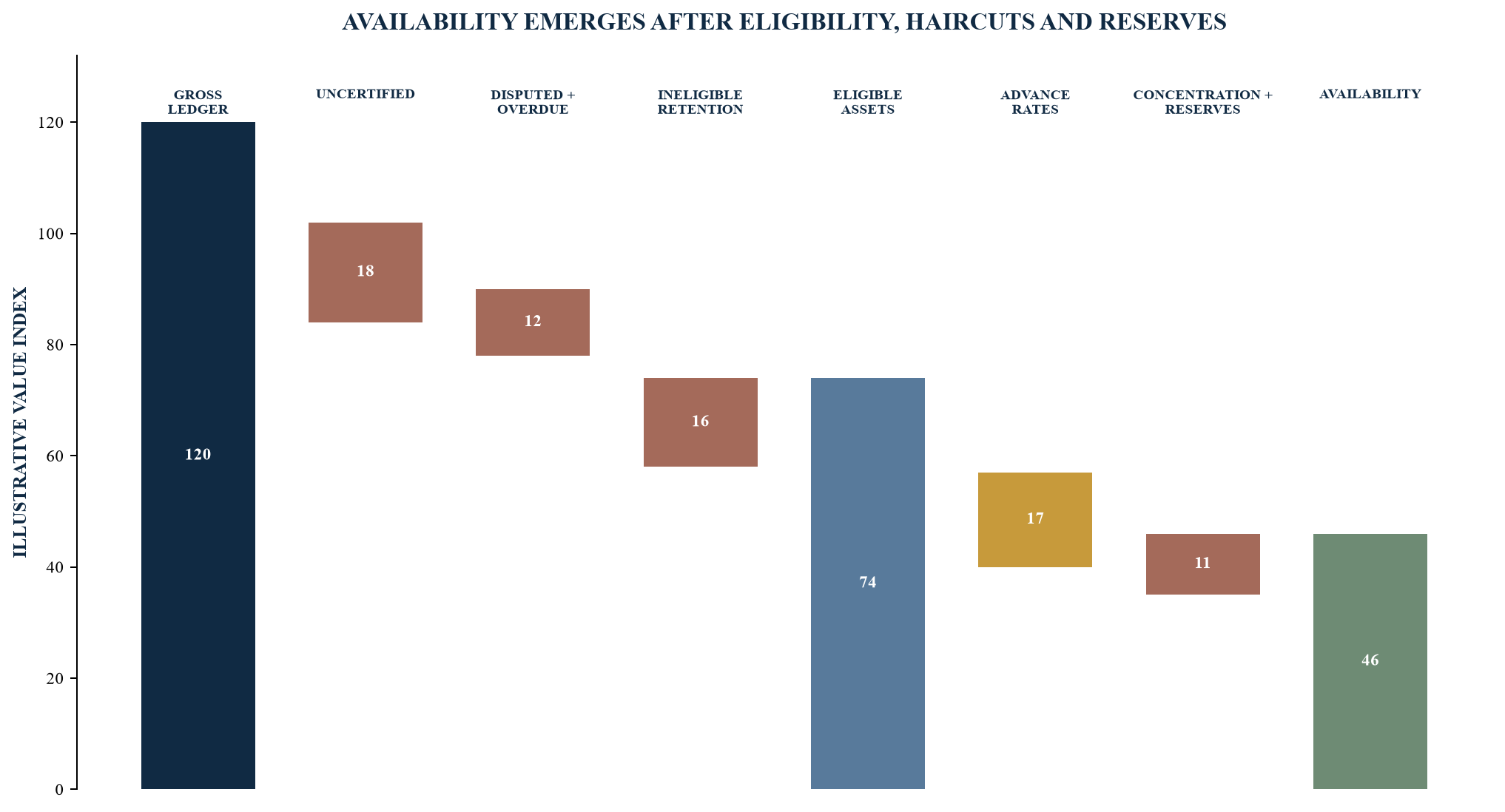
Values are illustrative management assumptions; actual eligibility and advance rates belong in executed facility documents.
Table 4. Illustrative borrowing-base calculation
| Asset class | Gross amount | Eligibility adjustment | Illustrative advance | Supported amount |
|---|---|---|---|---|
| certified domestic receivables | 48 | 8 | 75% | 30.0 |
| accepted export receivables | 24 | 4 | 70% | 14.0 |
| due retention receivables | 14 | 6 | 40% | 3.2 |
| inventory tied to confirmed orders | 18 | 8 | 35% | 3.5 |
| uncertified work and other assets | 16 | 16 | 0% | 0.0 |
| subtotal before concentration and reserves | 120 | 42 | mixed | 50.7 |
| concentration and specific reserves | (4.7) | |||
| illustrative availability | 46.0 |
Amounts and advance rates are illustrative management assumptions.
10. Size debt to the weakest capacity constraint
Borrowing-base availability is only one constraint. Debt capacity should also be tested against the 13-week liquidity trough, monthly debt service, interest coverage, fixed-charge coverage, guarantee headroom, project concentration, minimum cash, cost-to-complete and repayment at maturity. The supported debt amount is the lowest amount that passes all approved tests.
A project can add eligible receivables while consuming more cash than it produces. A guarantee-heavy order can use scarce non-fund capacity. A high-margin order can still create a near-term liquidity trough. A large debtor balance can concentrate the facility in one customer. The model should therefore show asset support and cash support side by side.
The liquidity constraint should be tested at the daily or weekly level around known peaks. Monthly models can conceal a guarantee-margin payment, payroll date or supplier milestone that arrives before a large customer collection. The model should also reflect restricted cash, lien-marked deposits, margin accounts and balances held in joint ventures. Only cash that is legally and operationally available to the borrower should support minimum-liquidity compliance.
Repayment capacity should be tested beyond the contractual maturity. A bullet facility may appear affordable because current interest is covered, while the company still depends on refinancing or a future equity raise for principal. The board should identify the primary repayment source, a credible secondary source and the decision date for launching a refinance. Where amortisation follows collections, the structure should preserve enough cash to complete the projects that generate those collections.
Private credit may include a revolving receivables tranche, a delayed-draw term tranche, a guarantee-support tranche, an acquisition or equipment tranche and a funded interest or payment-in-kind feature. Each component should have a clear use, draw test, maturity and repayment source. The structure should avoid masking recurring cash deficits with repeated capitalisation of interest.
11. Design the collection and cash-control architecture
Collections should flow through accounts that support traceability and agreed lender control. The structure may use designated collection accounts, escrow, cash dominion, account-bank acknowledgements, payment notices, sweeps and a controlled waterfall. The exact arrangement should respect customer contracts, existing banking relationships, tax requirements and applicable law.
The waterfall should first preserve critical operating continuity and statutory obligations under the negotiated documents. It can then fund debt service, minimum liquidity, approved project costs and permitted distributions. Blocked-account mechanics should be understood by the operating team before closing. A structure that prevents the company from performing funded contracts can destroy the collateral value it was meant to protect.
Customer communication requires care. Assignment notices and payment instructions should be legally effective and commercially controlled. The financing team should identify customers whose procurement systems cannot change account details quickly. Portal registration, vendor master changes, acknowledgement and test payments should be included in the implementation plan.
12. Integrate export and domestic finance
Indian engineering companies may serve domestic customers, export equipment, perform overseas EPC work or supply projects financed by development institutions. The financing map should separate domestic receivables, export orders, foreign-currency costs, overseas collections, project guarantees, political risk and currency exposure.
RBI's export-credit framework describes pre-shipment and post-shipment finance and links packing credit to evidence of an export order or letter of credit.[11] Exim Bank provides project-export facilities, including pre-shipment and post-shipment credit for Indian engineering and capital goods and related services.[12] Exim Bank's Lines of Credit support overseas buyers of Indian projects, equipment, goods and services on deferred-credit terms.[13]
ECGC provides credit-insurance products, including domestic credit insurance for eligible non-payment risk.[14] Insurance terms, exclusions, buyer limits, claim procedures and waiting periods should be mapped to the facility. Insurance can change loss severity, but it does not create immediate cash when a payment is delayed or a claim is disputed.
Currency matching belongs in the cash model. The company should identify the currency of revenue, materials, labour, debt and guarantees. Hedging, natural offsets and contractual pass-through should be documented. A facility denominated in a foreign currency can appear cheaper while exposing the borrower to a larger repayment obligation when collections are in rupees.
13. Create covenants that detect deterioration early
Covenants should measure the credit thesis rather than rely solely on annual leverage. Useful tests include minimum liquidity, borrowing-base coverage, debt-service coverage, tangible net worth, total leverage, fixed-charge coverage, order-book concentration, certified-billing conversion, receivables ageing, retention ageing, cost-to-complete coverage, guarantee utilisation and restrictions on additional security.
Reporting definitions should match the model and certificate. The company should know whether debt includes letters of credit that have crystallised, lease liabilities, guarantees, supplier finance, discounted receivables with recourse and related-party loans. EBITDA adjustments, exceptional items and permitted acquisitions should be precisely defined.
Information covenants deserve the same care as financial covenants. The lender may require monthly management accounts, project reports, receivables and retention ageing, borrowing-base certificates, guarantee registers, bank statements, tax status, litigation updates and board materials. Delivery dates should match the company's close process. A certificate prepared under deadline pressure from unreconciled systems creates governance risk. The company should perform at least one complete dry run before signing.
Negative covenants should protect the agreed collateral and capital structure while preserving ordinary-course execution. Restrictions on additional debt, security, asset sales, acquisitions, distributions, related-party payments and material contract changes need negotiated baskets and thresholds. Project teams should understand which actions require lender consent. A consent calendar and escalation protocol can prevent an operational decision from becoming an accidental default.
Table 5. Covenant and early-warning dashboard
| Metric | Illustrative threshold | Evidence | Early-warning response |
|---|---|---|---|
| minimum unrestricted cash | at least 8 cash units | bank statements and forecast | freeze discretionary spend and escalate |
| borrowing-base coverage | at least 1.20 times drawn debt | monthly eligibility certificate | reduce draw or add eligible collateral |
| largest-customer concentration | no more than 35% of eligible assets | debtor and project ledger | concentration reserve and collection plan |
| overdue eligible receivables | no more than 12% | ageing and dispute register | exclude assets and engage customer |
| guarantee utilisation | no more than 85% of approved capacity | bank confirmations and register | secure releases or incremental line |
| cost-to-complete headroom | positive in every funded project | quantity and procurement forecast | project reserve and board review |
| debt-service coverage | at least 1.25 times | integrated cash model | block distributions and prepare waiver plan |
Thresholds are illustrative management assumptions and should be negotiated from the actual downside model.
The cure process should be operational. A warning may trigger weekly cash reporting, new-draw suspension, customer calls, cost controls or additional equity planning before a formal breach occurs. Waivers should address the cause, duration, information, compensation and revised milestones. Repeated waivers signal that the original structure needs redesign.
14. Build a lender data room around traceability
The data room should allow a lender to trace the financing thesis from board authority to contract, delivery, certificate, invoice, receivable, cash and repayment. Corporate materials should include group structure, ownership, authority, debt, security, guarantees, litigation, tax and statutory records. Financial materials should include audited accounts, current management accounts, bank statements, forecasts and reconciliations.
The commercial section should contain the full contract register, top executed contracts, amendments, change orders, billing schedules, project forecasts and customer history. Project evidence should include programmes, measurement records, engineer certificates, completion documents, defects lists and claims. Receivables evidence should include invoices, ageing, credit notes, disputes, retentions and bank allocations.
The guarantee section should reconcile bank confirmations to the guarantee register and project obligations. The security section should identify existing charges, assignments, pari passu rights, negative pledges and release requirements. The information should be version-controlled and dated.
Consistency is a diligence test. Order book, revenue, unbilled work, receivables, retentions, collections, cost-to-complete and forecasts should use stable definitions. Differences should be explained in a reconciliation. A controlled explanation is stronger than a polished presentation whose figures cannot be reproduced.
The lender should be able to select a sample invoice and trace it backward to contract authority and forward to cash. The backward chain includes scope, measurement, certification, tax treatment and invoice approval. The forward chain includes ageing, collection, allocation, any deduction and release of related borrowing-base capacity. The same test should be performed for a retention balance and a guarantee. Breaks in the chain should enter a remediation register with an owner and date.
Data-room access should follow confidentiality, customer consent and data-minimisation requirements. Engineering contracts can contain sensitive designs, security information, personal data, pricing and government restrictions. Access should be staged, role-based and logged. Redaction should preserve the lender's ability to verify material rights and economics. Where disclosure requires consent, that dependency should appear in the financing timetable rather than being discovered late in diligence.
15. Compare instrument structures on executable economics
The borrower should compare bank working capital, TReDS, factoring, export credit, private credit, equipment finance, customer advances, supplier credit and equity. The comparison should include committed amount, actual availability, tenor, amortisation, cash interest, fees, security, guarantees, covenants, reporting, prepayment, execution timing and flexibility.
Headline interest cost is incomplete. The model should include arrangement fees, commitment fees, monitoring fees, legal and diligence expenses, trustee and security-agent costs, guarantee commission, cash margin, hedging, prepayment premium and any equity participation. It should also value undrawn commitment and the cost of trapped collateral.
RBI's MSME lending directions cover credit access, working-capital support and restructuring for eligible enterprises.[15] The 2025 priority-sector directions set the current framework for bank classification of eligible lending.[16] India's revised MSME classification increased investment and turnover thresholds from April 2025, affecting which enterprises may qualify for related programmes and treatment.[17] Eligibility should be verified against current rules and the borrower's registration and financial data.
Private credit should earn its place by solving a gap that ordinary instruments cannot address efficiently. Examples include a complex collateral pool, a rapid bridge to collection, a combination of receivables and term debt, a refinancing with covenant reset, guarantee support, cross-border complexity or a special situation requiring close monitoring. The board should approve the instrument based on executable value and downside protection.
16. Run project-specific downside scenarios
Downside cases should begin with identifiable contract events. Certification may move by 60 days. A customer may deduct liquidated damages. A supplier may stop delivery without payment. A letter of credit may crystallise. A performance guarantee may be invoked. A project may require additional cost to complete. A retention release may move beyond maturity. A large customer may enter insolvency.
The Insolvency and Bankruptcy Code defines operational debt and the position of operational creditors within its framework.[18] Recovery rights, disputed debt, limitation, insolvency proceedings and priority require legal advice. The cash model should assume that enforcement takes time and should not rely on a rapid recovery unless evidenced.
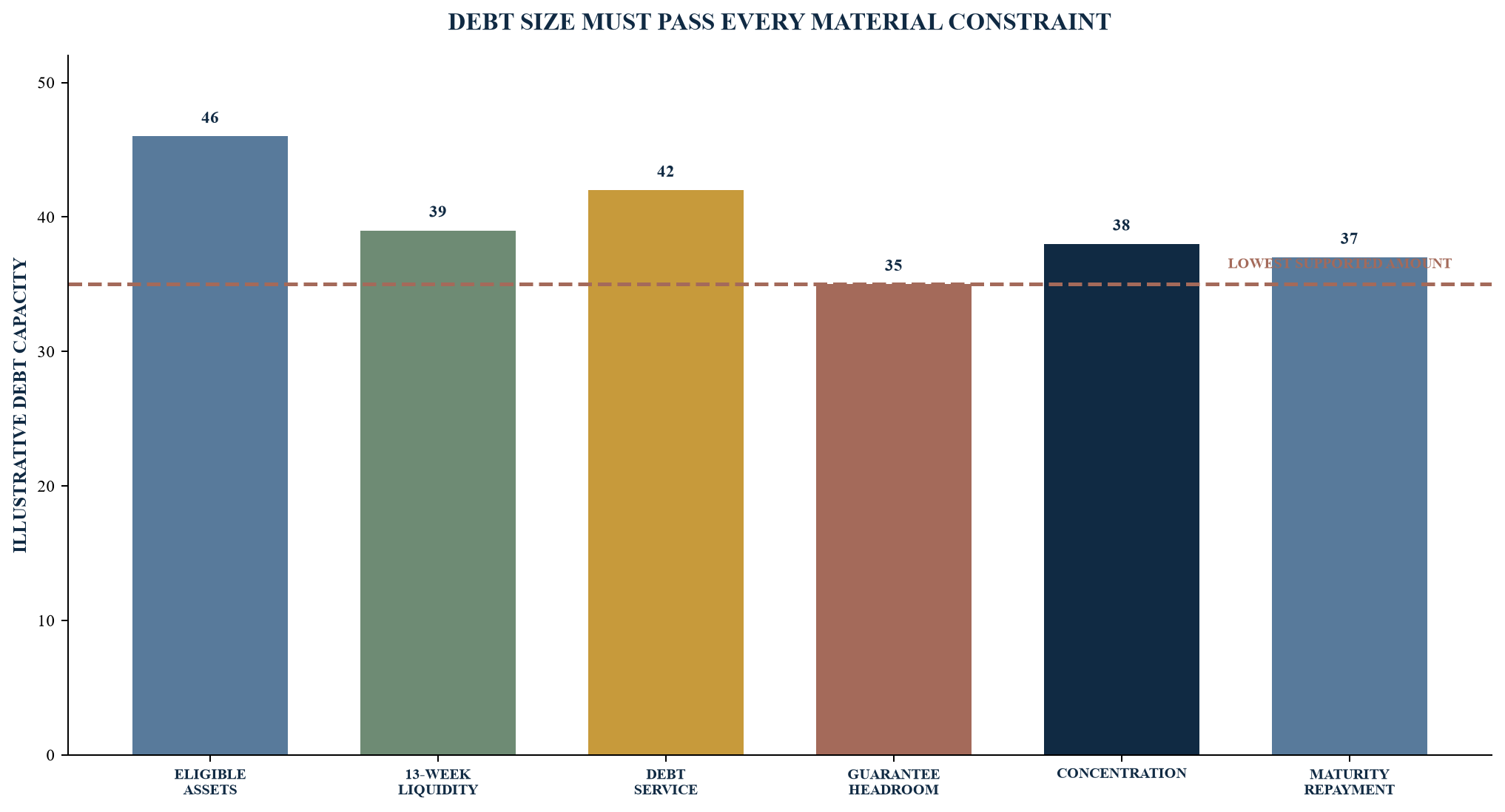
Each bar is an illustrative supported-debt estimate; the lowest evidenced constraint governs.
Table 6. Downside cases and financing responses
| Case | Operational event | Collateral effect | Liquidity response | Financing decision |
|---|---|---|---|---|
| central | work, certification and collection follow controlled dates | normal eligibility and reserves | planned draws and minimum cash | proceed within approved limits |
| certification delay | engineer approval moves by 60 days | unbilled and uncertified value remains excluded | defer discretionary spend and accelerate evidence | suspend next delayed draw |
| cost overrun | procurement or subcontract cost rises | project reserve increases | reprice, claim or add sponsor cash | reduce availability until funded |
| retention delay | release certificate moves beyond maturity | retention becomes ineligible | extend liquidity plan and pursue release | refinance or amortise from other cash |
| guarantee invocation | beneficiary presents a demand | contingent exposure becomes funded debt | activate legal and cash response | block distributions and test cross-default |
| customer insolvency | major payer stops paying | debtor assets excluded | preserve cash and pursue alternatives | amendment, equity or restructuring |
Cases are illustrative and should be rebuilt from the actual contract portfolio.
17. Execute through a 100-day financing process
Days 1 to 15 establish the mandate, financing objective, authority and source record. Management should reconcile cash, debt, security, guarantees, order book, project forecasts, receivables, retentions and collections. The board should approve minimum liquidity, communication rules and accountable owners.
Days 16 to 30 build the contract-quality matrix, order-to-cash model, retention schedule, guarantee forecast, borrowing base, 13-week cash view, monthly model and downside cases. Legal advisers should review assignment, security, priority, guarantee and customer-notice issues. The output is a financing brief with supported quantum, target structure and fallbacks.
Days 31 to 50 prepare the lender universe, information memorandum, data room and management presentation. Lenders should be selected for product fit, cheque size, Indian security capability, sector experience, speed, guarantee coordination and ability to support future needs. Outreach should use controlled materials and confidentiality.
Days 51 to 75 cover meetings, diligence, site or project review, customer analysis and proposal comparison. Every proposal should be normalised for amount, availability, pricing, security, guarantees, covenants, reporting, conditions, prepayment and execution certainty. Actual terms should replace management assumptions in the model.
Days 76 to 100 cover approvals, documentation, security perfection, account control, customer notices, conditions precedent, draw readiness and reporting mobilisation. The company should dry-run the borrowing-base certificate, covenant certificate and cash waterfall before closing. Post-close owners and escalation procedures should be active before the first draw.
18. Govern the facility as an operating system
Closing begins the credit-management cycle. The monthly process should reconcile order book, project progress, cost-to-complete, billing, certification, receivables, retentions, collections, guarantees, cash, debt, borrowing base and covenants. Finance, commercial, project controls, procurement, legal and treasury should review exceptions before the board pack and lender certificate are finalised.
The board dashboard should show eligible and ineligible assets, availability, drawn debt, unrestricted cash, minimum-cash headroom, customer and project concentration, unbilled work, certification delays, ageing, disputes, retention releases, guarantee utilisation, margin deposits, cost-to-complete and the next decision date. Observed results should be separated from management assumptions.
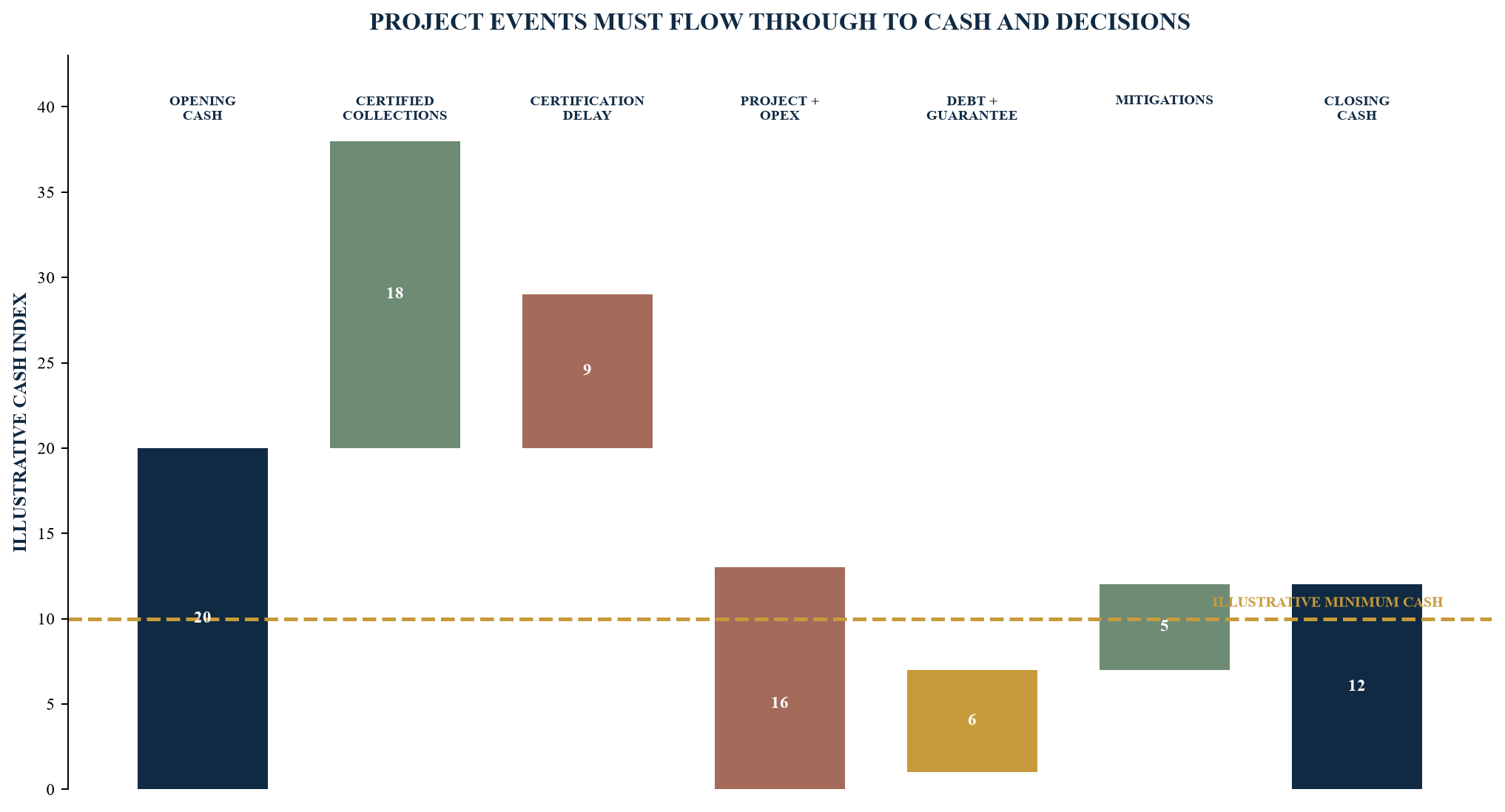
Values are illustrative management assumptions; mitigations require owner, timing and execution evidence.
Certificates should be produced from controlled data and reviewed before submission. Source files, calculations, approvals and lender correspondence should be retained. Errors should be corrected under the transaction documents. The facility should be reconsidered when project mix, customer concentration, guarantee usage, margin, cash conversion or refinancing assumptions change materially.
The governing principle is practical: private credit should expand the company's capacity to execute profitable orders while preserving enough liquidity, guarantee headroom and decision time to manage adverse events. A transparent contract-to-cash operating system supports both enterprise value and lender protection.
Governance should extend to post-completion recoveries. Final accounts, claims, retentions, tax refunds, security deposits and released margin can remain material after physical work is complete. Each recovery should have a documented basis, expected date, owner and escalation route. The board should avoid treating an old balance as cash merely because it remains recorded as an asset. Age, dispute status and enforcement cost should influence both valuation and financing treatment.
The annual financing review should compare actual facility value with its full cost. Management should measure utilised and unused commitment, interest, fees, guarantee savings, collateral released, dilution avoided, execution benefits, reporting burden, waivers and refinancing dependence. The review can support renewal, refinancing, downsizing or a shift toward receivables finance, bank debt or equity. The objective is a capital structure that continues to match the operating evidence.
References
- Department of Commerce, Government of India. (2025). Annual Report 2024-25. https://www.commerce.gov.in/wp-content/uploads/2025/08/Commerce_AR-2024-25-English-1.pdf
- Department of Commerce, Government of India. (2026). Trade Intelligence and Analytics Portal: Engineering Goods. https://trade-analytics.commerce.gov.in/public/commodity?KPI_ID=6
- India Code. The Indian Contract Act, 1872, sections 126-147. https://www.indiacode.nic.in/handle/123456789/12845?view_type=browse
- India Code. Micro, Small and Medium Enterprises Development Act, 2006. https://www.indiacode.nic.in/handle/123456789/12875
- Ministry of Micro, Small and Medium Enterprises. Delayed Payment to Micro and Small Enterprises and MSE Facilitation Councils. https://ramp.msme.gov.in/ramp/pdf-documents/scheme-guidelines/msefc.pdf
- India Code. Factoring Regulation Act, 2011, as amended. https://www.indiacode.nic.in/bitstream/123456789/2116/4/a2012-12.pdf
- Reserve Bank of India. (2022). Registration of Assignment of Receivables Regulations, 2022. https://www.rbi.org.in/Scripts/NotificationUser.aspx?Id=12223
- Reserve Bank of India. Trade Receivables Discounting System Frequently Asked Questions. https://www.rbi.org.in/scripts/FAQView.aspx/FAQView.aspx/FAQView.aspx?Id=132
- Reserve Bank of India. Entity-wise TReDS Statistics. https://www.rbi.org.in/Scripts/TREDSStatisticsView.aspx?TREDSid=25
- Reserve Bank of India. (2016). Priority Sector Lending Status for Factoring Transactions. https://www.rbi.org.in/commonman/English/scripts/Notification.aspx?Id=1850
- Reserve Bank of India. Export Credit and Customer Service to Exporters. https://www.rbi.org.in/CommonPerson/english/scripts/Notification.aspx?Id=1583
- Export-Import Bank of India. Project Exports. https://www.eximbankindia.in/project-exports
- Export-Import Bank of India. Lines of Credit. https://www.eximbankindia.in/lines-of-credit
- ECGC Limited. Domestic Credit Insurance Policy. https://main.ecgc.in/english/wp-content/uploads/2023/12/Domestic-Credit-Insurance-Policy.pdf
- Reserve Bank of India. Master Direction: Lending to Micro, Small and Medium Enterprises Sector. https://systemhealth.rbi.org.in/Scripts/BS_ViewMasDirections.aspx_id%3D11060.html
- Reserve Bank of India. (2025). Priority Sector Lending: Targets and Classification Directions, 2025. https://rbi.org.in/Scripts/NotificationUser.aspx/NotificationUser.aspx?Id=12799
- Ministry of Micro, Small and Medium Enterprises. (2025). Revised MSME Classification Criteria. https://msme.gov.in/sites/default/files/MarchNewsletter2025.pdf
- India Code. Insolvency and Bankruptcy Code, 2016. https://upload.indiacode.nic.in/showfile?actid=AC_CEN_2_11_00055_201631_1517807328273&filename=a2016-31.pdf&type=actfile
About the Author
Chennakeshav Adya is an independent researcher and Managing Partner of Matchpoint Partners. His work focuses on corporate finance, transactions, private capital, strategic execution and the operating systems required to convert financing into measurable enterprise value.
Appendix: Appendix A. Contract-to-cash diligence checklist
Corporate and authority
Confirm the borrower, contracting entities, project special-purpose vehicles, ownership, board authority, delegated signing limits, existing debt, charges, guarantees and related-party arrangements. Reconcile legal entities across contracts, invoices, bank accounts, tax registrations and financial statements.
Contract and order book
Confirm the executed contract, award, purchase order, technical scope, quantities, price, escalation, change orders, claims, liquidated damages, termination, assignment, governing law and dispute process. Classify order value as committed, optional, varied, completed, billed, uncertified or pipeline. Reconcile remaining order value and cost to complete.
Delivery and certification
Confirm mobilisation, programme, resources, procurement, subcontractors, critical path, measurement, tests, customer acceptance, engineer certificates, completion documents, defects and open punch-list items. Link evidence to billing and retention release.
Receivables and retentions
Confirm invoice, tax, certificate, debtor, due date, ageing, dispute, set-off, credit note, currency, assignment, security, collection account and expected credit loss. Link each retention to the contract clause, deduction, cap, release event, required certificate and expected collection date.
Guarantees and letters of credit
Confirm instrument type, beneficiary, applicant, issuer, amount, currency, margin, commission, expiry, claim period, automatic extension, release condition, counter-guarantee and underlying obligation. Reconcile the register to bank confirmations and the cash forecast.
Facility and governance
Confirm eligibility, advance rates, concentration, reserves, availability, debt, interest, fees, minimum cash, covenants, reporting, draw conditions, security, cash control and repayment. Retain certificate calculations, approvals and source evidence. Record exceptions with owners, actions and expiry dates.
Appendix B. Board financing decision record
The board record should state the financing purpose, approved uses, supported amount, instrument comparison, minimum liquidity, project concentration, contract and customer risks, receivables eligibility, retention treatment, guarantee capacity, cost-to-complete, security, cash control, covenant headroom, downside cases, repayment path, delegated authorities and reporting calendar. It should identify professional advice received and unresolved conditions.
The decision paper should distinguish observed source evidence from management assumptions. It should show the first date on which a delay, overrun, deduction, guarantee invocation or customer default requires action. It should be refreshed before a material draw, acquisition, new project, waiver or amendment and whenever the financing case changes materially.
