

1. A portfolio transfer begins with an objective that can be tested
A bank may sell loans for several reasons. It may want to reduce a sector or single-name concentration, release risk-weighted assets, exit a product, improve operational focus, accelerate resolution of watchlist cases or create room for new lending. A private-credit buyer may want seasoned yield, diversified deployment, access to borrowers or an origination relationship with the bank. The transaction works when those objectives can coexist within one enforceable perimeter and one credible servicing model.
The objective determines the diligence standard. A clean sale of performing exposures requires evidence that contractual rights, borrower payments, security and reporting can move without weakening the asset. A mixed performing and watchlist portfolio requires separate credit, restructuring and enforcement pathways. A risk-transfer transaction designed to achieve regulatory capital relief requires analysis of applicable prudential rules. A partnership in which the bank continues to originate or service loans creates ongoing counterparty, conduct and incentive risks.
Private credit has become an important source of finance for middle-market companies. The International Monetary Fund describes the sector as non-bank corporate credit supplied through bilateral or small club arrangements, commonly to middle-market borrowers and through long-term pools of capital [1]. The Federal Reserve notes that these instruments are often senior secured, floating rate and held to maturity because a liquid secondary market is limited [2]. Those characteristics make bank-to-fund portfolio transfers commercially plausible, while the absence of frequent trading raises the importance of asset-level evidence.
A transfer committee should approve a short decision statement before data extraction begins. The statement should identify the seller's objective, the buyer's return and risk constraints, the proposed legal form, the treatment of servicing, the acceptable exception threshold and the conditions that must be met at closing. It should also state what would cause the parties to reprice, remove assets, defer closing or stop. A broad aspiration to sell a portfolio is insufficient for governing a complex transfer.
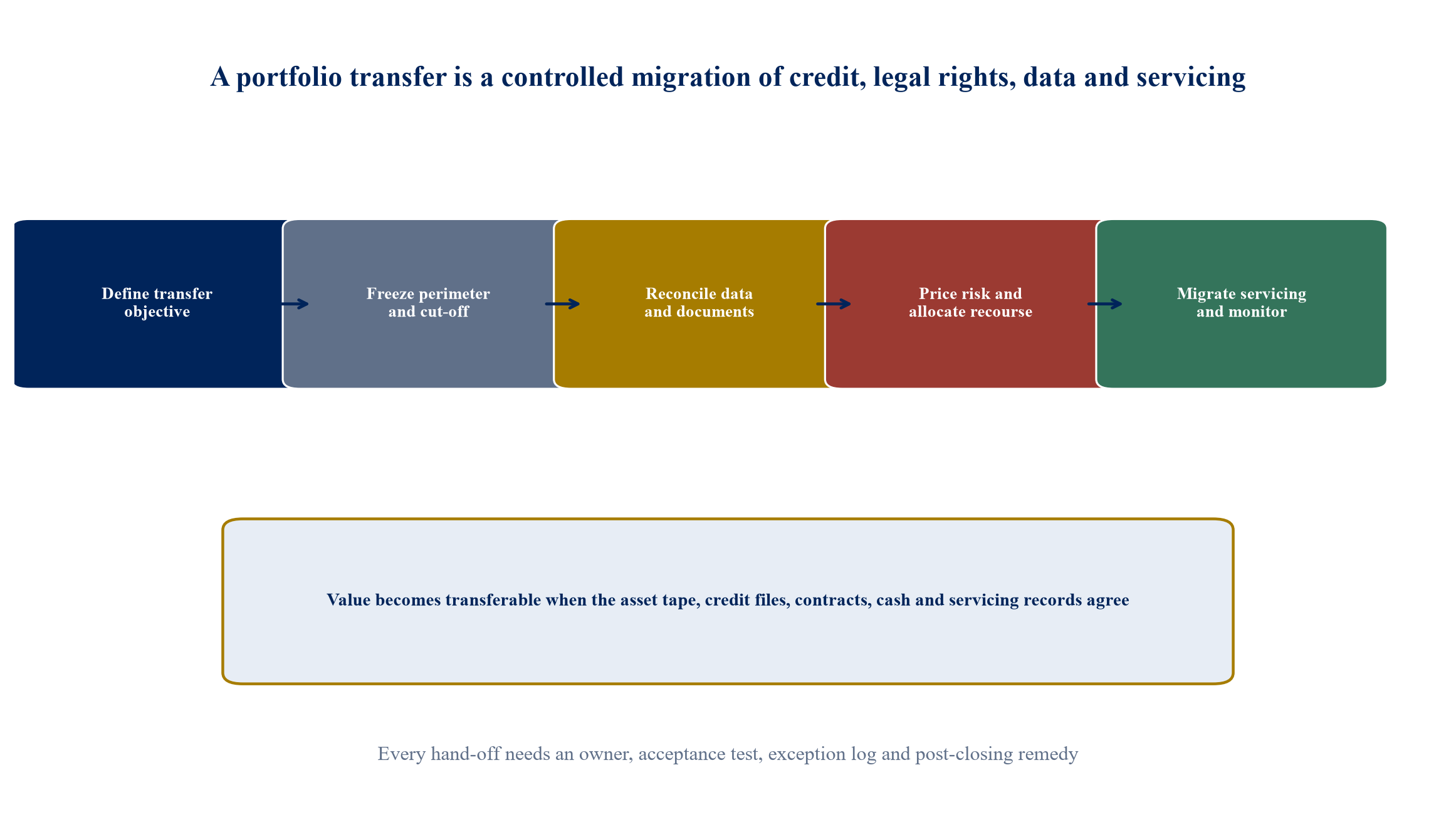
Author-designed framework. Legal form, regulatory treatment and execution steps require transaction-specific advice.
2. Choose the legal and economic form before building the data room
A whole-loan sale transfers the lender's rights under the credit agreement, subject to the governing law, contractual restrictions and required perfection steps. A novation may replace the lender of record with the buyer and can require borrower or obligor consent. An assignment may transfer rights without transferring every obligation. A participation can leave the bank as lender of record while passing an economic share to the participant. A synthetic risk transfer may move credit risk through a guarantee or derivative while the underlying loans remain on the bank's balance sheet. Securitisation places exposures into an issuing structure and adds a separate regulatory and disclosure framework.
These forms produce different control, accounting and operational outcomes. A buyer that needs direct voting, enforcement and amendment rights may reject a participation. A seller that wants borrower continuity may prefer to remain lender and servicer. A bank seeking derecognition must analyse whether contractual cash-flow rights have transferred and whether it has transferred or retained substantially all risks and rewards under IFRS 9 [10]. A prudential capital objective requires an independent regulatory analysis because accounting derecognition and capital recognition are distinct tests.
The perimeter must identify facilities, drawings, commitments, guarantees, hedges, ancillary products and related security. Mid-market borrowers often use revolving facilities, overdrafts, letters of credit or bilateral hedges alongside term loans. Selling a term loan while leaving a revolver, cash-management relationship or hedge with the bank can divide control and cash. Intercreditor, set-off, netting, cross-default and shared-security provisions may connect products that the initial asset tape treats separately.
The data room should therefore follow the chosen structure. A whole-loan sale needs executed agreements, amendments, security, perfection evidence and consent analysis. A participation also needs the participation agreement, payment mechanics, information rights, voting and insolvency treatment of the grantor. A synthetic structure needs protected events, settlement, attachment and exhaustion points, collateral, replenishment and termination. Structure is a substantive decision rather than a wrapper applied after pricing.
3. Freeze the perimeter and cut-off mechanics
Portfolio composition changes every day. Borrowers draw and repay revolvers, interest accrues, fees are charged, covenants are tested, waivers are issued and security is released or added. The parties need a defined reference date and a mechanism for changes between that date and closing. Without a frozen perimeter, diligence results cannot be reconciled to the assets ultimately transferred.
The asset schedule should use stable facility and borrower identifiers. It should distinguish committed amount, drawn principal, accrued interest, unpaid fees, cash collateral, undrawn availability and contingent exposure. It should identify currency, rate basis, maturity, amortisation, ranking, security, guarantee, internal risk grade, arrears, forbearance, covenant status and watchlist status. Each field needs a definition, source system, extraction time and owner.
Eligibility criteria convert the transaction thesis into rules. They may exclude loans with unresolved consent requirements, sanctions or anti-money-laundering issues, material documentation gaps, pending litigation, unsupported security, expired insurance, recent payment default, excessive sector concentration or borrower dependency on a product remaining with the seller. Exclusions should be measurable. A rule such as “acceptable documentation” needs a checklist and an authority to decide exceptions.
Movement controls should cover repayments, prepayments, amendments, new drawings, defaults and substitutions during the interim period. The seller should notify the buyer of specified events and provide an updated tape. Closing balances should reconcile from the reference tape through a movement schedule. Purchase price, accrued interest, fees and cash receipts need cut-off rules that prevent duplication or leakage. The servicing agreement must explain how misdirected payments are identified and remitted.
4. Build a data tape that can be traced to books and records
An asset tape is credible when every material field can be traced to a controlled source and reconciled to the bank's books. The European Banking Authority's non-performing-loan transaction templates provide a useful example of loan-level standardisation. They cover counterparty, contractual, collateral, guarantee, enforcement and historical collection information [7]. Those templates apply within a defined European regulatory scope for non-performing loans. A performing mid-market portfolio sale may fall outside that scope, yet the data categories illustrate the level of detail required for valuation and diligence.
The buyer should receive a data dictionary with field definitions, permitted values, units, currency conventions, date logic and missing-data codes. Blank, zero and “not applicable” must have different meanings. The extraction process should be version-controlled. Changes between tape versions should be explained by a bridge rather than overwritten. The seller should retain the source queries and approval record.
Reconciliation begins with control totals. Drawn principal by legal entity, currency, product and general-ledger account should agree to the relevant books after explained adjustments. Accrued interest and fee balances should reconcile to servicing systems. Historical cash should agree to bank statements or controlled payment records. Security and guarantee indicators should agree to legal and collateral systems. Internal risk grades and provisioning fields should agree to approved credit records.
The buyer can run population-wide tests before selecting files. Tests include duplicate identifiers, impossible dates, negative balances, maturity before origination, inconsistent currency, rate reset outside contractual terms, missing covenant tests, collateral values older than policy limits, guarantees below recorded coverage and payment histories that do not reproduce balances. Exceptions should be classified as data defects, documentation defects, servicing defects or genuine credit events. Each category has a different price and remedy implication.
Table 1. Core portfolio data domains and control tests
| Data domain | Minimum decision use | Population control | Material exception |
|---|---|---|---|
| Borrower and group | Aggregate connected exposure and concentration | Stable identifiers, legal name and group mapping agree | Duplicate borrower, missing guarantor or incorrect group |
| Facility economics | Reproduce contractual cash flow | Principal, rate, margin, reset, fees and maturity reconcile | Tape cash flow cannot be derived from executed terms |
| Performance | Measure arrears, cures and volatility | Payment history rolls to current balance | Unexplained arrears, capitalised interest or manual override |
| Covenants | Identify control and early-warning rights | Test dates and results match certificates | Waiver missing, calculation inconsistent or test overdue |
| Security | Estimate control and recovery | Asset, perfection, priority and valuation linked | Unperfected charge, prior ranking or released collateral |
| Guarantees | Map obligor support | Guarantor, cap, expiry and conditions verified | Guarantee expired, limited or unavailable after transfer |
| Credit status | Segment expected loss and monitoring | Grade, watchlist and provision agree to approved record | Grade override, stale review or inconsistent forbearance |
| Servicing | Plan cash and data continuity | Standing instructions and account mapping tested | Payment route, borrower notice or mandate cannot migrate |
The table is an author-designed diligence aid. Required fields depend on transaction structure, governing law and portfolio characteristics.
5. Stratify before calculating an average
Portfolio averages conceal distribution. Weighted-average margin, leverage or maturity can look acceptable while a small number of borrowers drive most downside. Stratification should precede sampling and price. It should show exposure by borrower group, industry, geography, sponsor status, product, origination vintage, risk grade, leverage, interest coverage, covenant headroom, maturity, payment performance, security type and relationship manager.
Concentration should be measured through several lenses. The largest ten exposures reveal single-name dependency. Industry and geography show correlated operating risks. Sponsor concentration can connect borrowers through common ownership or refinancing behaviour. Maturity concentration shows when refinancing needs cluster. Rate floors, floating-rate exposure and hedge status reveal sensitivity to base rates. Shared collateral or guarantee providers can create less obvious dependency.
Risk migration matters as much as current grade. The buyer should compare origination, prior-year and current grades, together with watchlist entry, covenant waivers, amendments and payment behaviour. A stable headline performing classification can hide repeated waivers or weakening coverage. The EBA's loan-origination and monitoring guidelines emphasise creditworthiness assessment, lifecycle monitoring, collateral valuation and adequate data systems [8]. A buyer of seasoned loans needs evidence that those controls operated through time.
The seller's internal grades should not be accepted without translation. The buyer should map grade definitions, probability-of-default ranges, override rules, approval authorities and default definitions to its own framework. Back-testing by grade and vintage can reveal whether the seller's system discriminates risk. Where history is short or definitions changed, the buyer should increase uncertainty allowances rather than manufacture precision.
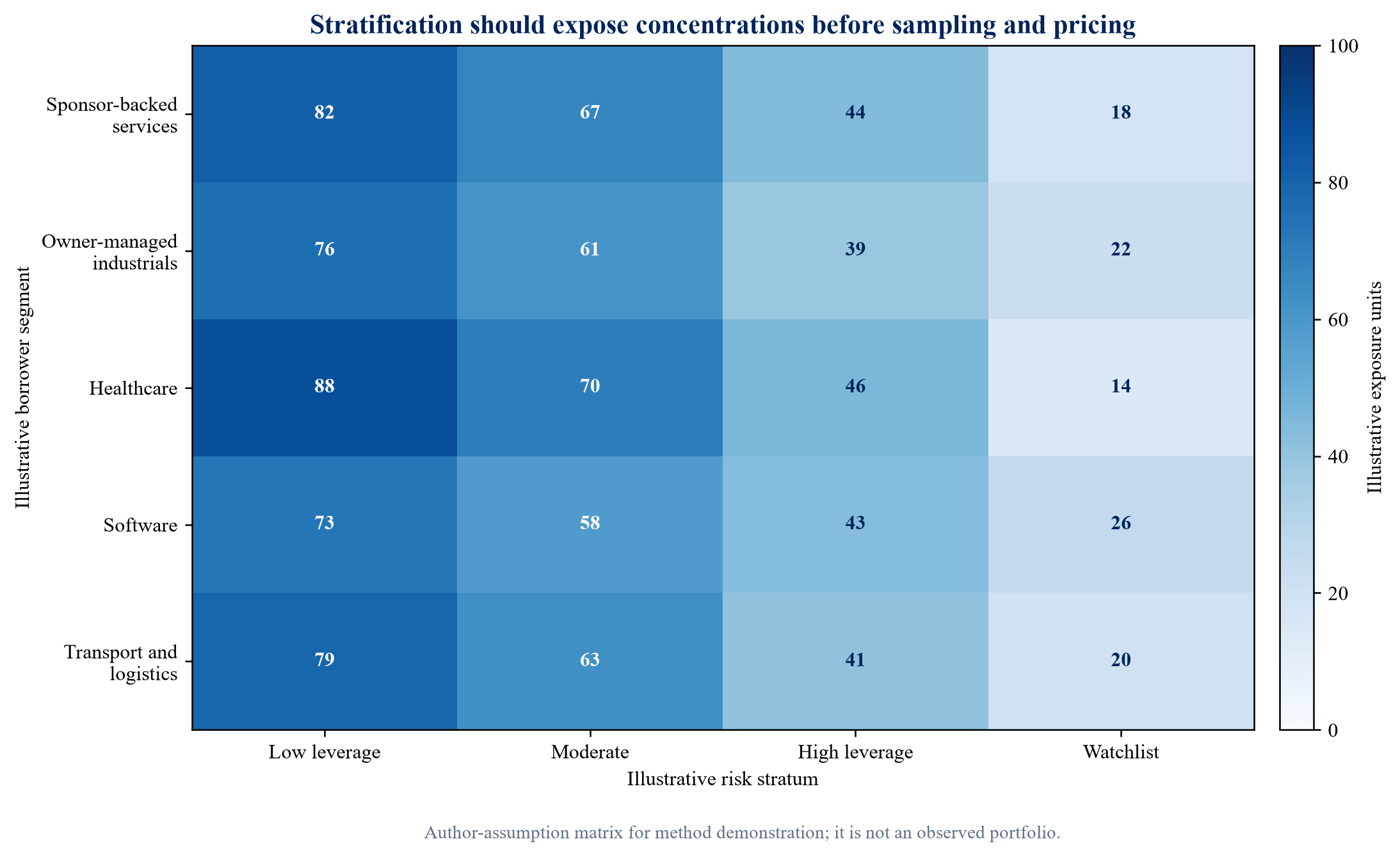
Author-assumption matrix for method demonstration. It is not an observed bank portfolio or market dataset.
6. Design a sample that answers the transaction questions
A file sample cannot prove every asset is correct. It can test whether controls operated, identify exception patterns and estimate the likely prevalence and severity of defects. The design should combine full-population analytics, judgemental selection and representative stratified selection. The sample size follows portfolio heterogeneity, data quality, expected exception rate, materiality and the buyer's tolerance for residual uncertainty.
Judgemental selection should include the largest exposures, watchlist names, recent restructurings, covenant waivers, high leverage, low coverage, unusual pricing, large collateral reliance, missing data, manual overrides and facilities near maturity. Stratified selection should represent material sectors, vintages, products, grades and relationship teams. Random selection within strata reduces conscious selection bias. The sample should not be described as statistically representative unless the method and confidence assumptions support that claim.
Each file should be reviewed against one standard checklist. The reviewer should compare the tape with executed agreements, approval memorandum, credit review, financial statements, covenant calculations, payment history, security, guarantees, valuation evidence, insurance and correspondence. Exceptions need consistent severity levels. A missing administrative document differs from a defect that defeats security or changes cash flow.
Expansion rules should be agreed before review. If a covenant exception appears in several files from one origination team, expand that stratum. If the tape repeatedly disagrees with contracts, increase population reconciliation and sample size. If a security defect is systemic, analyse the entire affected class. Expansion continues until the parties can estimate prevalence, severity and remedy with acceptable confidence.
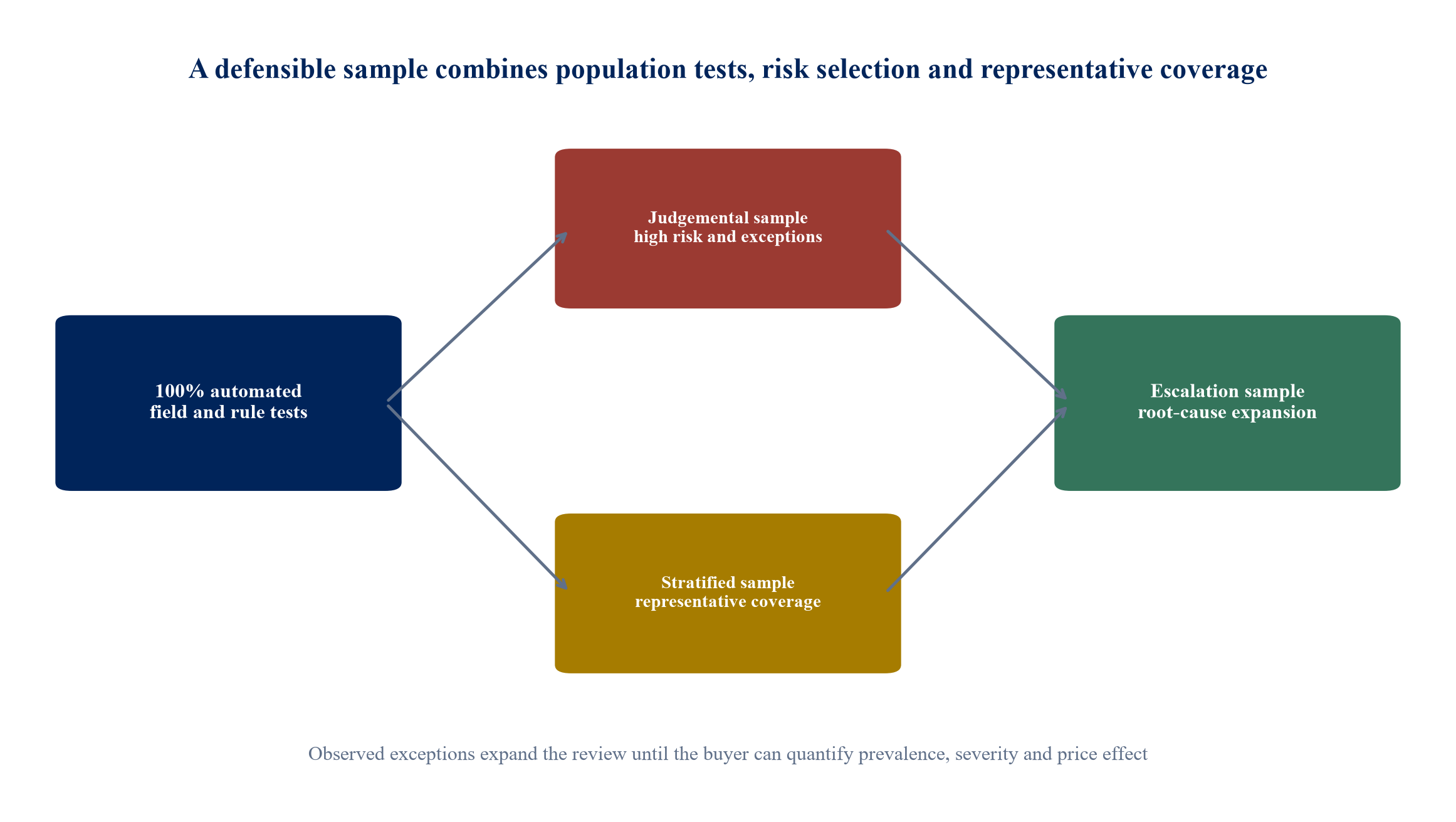
Author-designed framework. Sample design should be tailored by qualified diligence professionals to the portfolio and decision.
Table 2. Hypothetical forty-file initial sample
| Stratum | Portfolio loans | Initial files | Selection logic | Expansion trigger |
|---|---|---|---|---|
| Largest exposures | 15 | 15 | Review all material single-name positions | Any cash-flow or enforceability defect |
| Watchlist and modified | 12 | 10 | High expected severity and judgement | Two related control exceptions |
| High leverage performing | 24 | 6 | Stratified by industry and vintage | Exception rate above agreed threshold |
| Secured asset-heavy | 29 | 5 | Test valuation, perfection and priority | Defect affecting a security class |
| Lower-risk performing | 40 | 4 | Random selection across teams | Tape or servicing inconsistency |
| Total | 120 | 40 | Combined risk and coverage design | Root-cause expansion by affected stratum |
Counts and selection proportions are author assumptions. They demonstrate method and do not prescribe a statistically valid sample.
7. Re-underwrite credit instead of relying on the seller's label
The buyer should form an independent view of each material borrower and each sampled exposure. Re-underwriting begins with the legal obligor and group, business model, ownership, industry position, customer and supplier concentration, management, financial performance, cash conversion, leverage, liquidity, debt service, capital expenditure and contingent liabilities. Sponsor support should be treated through enforceable commitments rather than reputation.
Financial statements need consistency. Adjusted EBITDA should be reconciled to reported results and tested for recurring, cash-generative quality. Pro forma synergies, annualisation, add-backs and capitalised costs require evidence. Cash flow should account for working capital, tax, maintenance capital expenditure, leases, interest and distributions. Debt calculations should include permitted incremental debt, guarantees, factoring and other obligations where relevant to the covenant and recovery analysis.
The buyer should reconstruct covenant headroom under the contractual definitions. A seller's monitoring spreadsheet may contain interpretation choices, stale figures or manual adjustments. The executed agreement, amendments and waivers control. The review should test cure rights, equity cures, frozen accounting principles, ratio baskets, permitted acquisitions, restricted payments, debt incurrence, asset sales and change of control. Covenant protection has value only when the buyer can monitor and enforce it.
Scenario analysis should focus on the sources of loss. Revenue decline, margin compression, customer failure, delayed collections, base-rate changes, refinancing cost and collateral value can interact. The buyer should estimate default timing, exposure at default, recovery timing and cost. Private-credit loans are illiquid and often unrated, which makes outside valuation difficult [1]. The Federal Reserve's research also highlights weaker interest coverage and limited secondary trading in parts of the market [2]. The transaction model should make uncertainty visible.
8. Test transferability, consents and lender control
Executed loan documents determine whether rights can move. Transfer provisions may require borrower consent, consultation, notice, minimum assignment amounts, eligible-lender status, tax qualifications or regulatory licences. They may restrict transfers to competitors, distressed investors or specified jurisdictions. Some agreements allow assignment after default on different terms. A data-tape field stating “transferable” should never replace legal review.
The legal analysis should cover every facility and related document. It should identify the governing law, transfer method, consent party, notice requirement, timing, form, fee and consequence of non-compliance. Guarantees and security may transfer automatically, require accession or need new perfection. Shared-security arrangements may require agent approval. Hedging, account-bank and ancillary obligations may not move with the loan.
The buyer must also qualify as a lender. Banking, credit, servicing, foreign-investment, sanctions, tax and licensing rules can affect eligibility. The EU Credit Servicers and Credit Purchasers Directive creates requirements for purchasers and servicers of certain non-performing credit agreements and includes borrower-treatment and information obligations [9]. Its precise application depends on scope and national implementation. Performing corporate portfolio transactions in other jurisdictions require their own analysis.
Voting and amendment rights need explicit treatment where the bank retains exposure or servicing. Decisions on waivers, enforcement, acceleration, collateral release and restructuring can affect both parties. Participation structures may leave the buyer dependent on the grantor. A whole-loan transfer within a syndicated facility subjects the buyer to agent and majority-lender arrangements. Control should align with the economic risk actually transferred.
9. Validate security and recovery as an operating system
Security is a chain of documents, registrations, assets and controls. The buyer should identify the chargor, secured obligations, asset, governing law, creation, perfection, priority, expiry, release mechanics and enforcement route. It should confirm that the security supports the transferred loan and remains effective after assignment or novation. A security flag without this chain has little diligence value.
Collateral value should be separated from security enforceability. Real estate, receivables, inventory, equipment, shares and intellectual property have different valuation and recovery dynamics. The EBA guidelines call for clear valuation approaches, monitoring frequencies and adequate systems for collateral data [8]. A buyer should review valuation date, valuer independence, method, assumptions, legal title, insurance, condition, senior claims and time to realise.
Recovery analysis requires costs and timing. Gross appraised value is not cash recovery. Enforcement stays, insolvency priority, employee and tax claims, asset-specific licences, maintenance, buyer depth and sale cost can reduce proceeds. Working capital collateral may turn quickly but also fluctuate or be disputed. Equipment may be specialised and costly to remove. Share security can give corporate control while leaving operating permits or customer contracts exposed to change-of-control clauses.
Exceptions should link to remedies. Curable filing defects may be completed before closing. Uncertain priority may require exclusion, a price reserve or specific indemnity. Collateral dependent on seller-controlled accounts may require a transition arrangement. If recovery cannot be underwritten, the loan should be priced as unsecured or removed. Security descriptions should not be used to create comfort unsupported by enforceable rights.
10. Treat servicing continuity as part of credit quality
Payments, notices, covenant reporting, rate resets, fees, waivers and borrower contact continue through closing. A servicing failure can create arrears, missed notices, incorrect interest, conduct breaches or lost control even when the borrower remains healthy. The buyer should decide whether the seller, an independent servicer or the buyer will service, and whether the arrangement is temporary or permanent.
The servicing scope should cover boarding, account setup, payment routing, reconciliation, interest and fee calculation, borrower statements, covenant monitoring, document custody, collateral monitoring, insurance, tax reporting, complaints, amendments, watchlist management, enforcement and data delivery. Service levels need measurable timelines and evidence. A generic “commercially reasonable efforts” obligation is difficult to price or enforce.
Migration should use parallel testing. The new system should reproduce balances, accruals, next-payment dates, rate resets, covenants and standing instructions from the seller's system. Sample borrower communications should be approved. Cutover needs a freeze window, exception log, reconciliation and rollback plan. Misdirected cash should be held on trust or otherwise protected as advised under applicable law, then remitted within a defined period.
The European framework for certain NPL transfers recognises that purchasers often outsource servicing and defines servicing agreements and activities [9]. The EBA outsourcing guidelines provide broader principles for governance, access, audit, information security, business continuity and exit planning in regulated outsourcing [19]. Applicability differs by party and jurisdiction, but the control questions remain useful. The buyer needs access to records and the ability to replace a failing servicer.
Table 3. Servicing transition controls
| Control | Seller or incumbent | Buyer | Independent evidence | Failure response |
|---|---|---|---|---|
| Opening balances | Extract and certify cut-off tape | Reconcile and accept | General ledger and cash bridge | Holdback until difference is resolved |
| Payment routing | Maintain legacy collection path | Establish new accounts | Bank-account and remittance test | Daily sweep and exception escalation |
| Interest calculation | Supply contractual setup | Reperform sample and population rules | Agreement, rate source and accrual report | Correct, notify and compensate |
| Borrower notice | Provide approved contacts | Approve legal form and timing | Delivery record and returned-mail log | Repeat notice and preserve rights |
| Covenant monitoring | Transfer history and waivers | Load tests and owners | Certificate-to-system reconciliation | Manual control until system accepted |
| Document custody | Inventory originals and copies | Confirm receipt and gaps | Custody certificate and sample inspection | Specific retention or remediation |
| Business continuity | Maintain service during migration | Test alternative process | Incident simulation | Step-in or replacement servicer |
The allocation is illustrative. Parties should define responsibilities, service levels and regulatory obligations in transaction documents.
11. Convert diligence findings into representations and remedies
Representations allocate information and condition risk. They should address authority, title, existence, enforceability, balance, payments, defaults, amendments, waivers, security, guarantees, litigation, compliance, data and servicing where material. A representation should use defined knowledge, materiality and date standards. Broad language without disclosure mechanics can create disputes instead of protection.
The seller's liability is shaped by caps, baskets, de minimis thresholds, survival periods, knowledge qualifiers, exclusive-remedy clauses and claim procedures. Fundamental matters such as title may receive different protection from data-tape fields or credit performance. A buyer should avoid using a general representation to cover a known exception. Known issues should be cured, priced, excluded or addressed through a specific indemnity or holdback.
Credit risk after the cut-off normally belongs to the buyer in a clean sale. Seller recourse tied to borrower default can weaken the intended risk transfer and may affect accounting or regulatory treatment. Seller responsibility can remain appropriate for breaches of representation, pre-closing servicing errors, undisclosed amendments, title defects or cash leakage. The boundary between credit recourse and breach remedy should be precise.
Evidence and causation matter. The claims process should define notice, access to documents, mitigation, defence of third-party claims, calculation of loss, recovery from collateral, insurance and double recovery. The buyer needs operational ownership of claim deadlines. Deferred consideration or escrow can make remedies more collectible, subject to insolvency and set-off analysis.
12. Price the portfolio through cash flow, loss and uncertainty
Price should be derived from contractual cash flows adjusted for prepayment, default, recovery, fees, servicing cost, funding, tax, liquidity and the buyer's required return. Par, carrying value, expected credit loss and fair value answer different questions. The seller's accounting allowance is informative but does not determine transfer price. The buyer's funding and portfolio constraints also affect value.
IFRS 13 defines fair value as a market-based measurement and provides a hierarchy for inputs [11]. Private loans generally rely on significant judgement because observable secondary prices are limited. The FCA's review of private-market valuation practices found that robust processes demonstrate independence, expertise, transparency and consistency; it also highlighted conflicts around asset transfers and the need for ad hoc valuation triggers [13]. A transfer committee should document methods, input changes, conflicts and challenge.
Expected-loss modelling should identify probability of default, exposure at default, loss given default and timing. Historical seller data require consistent definitions and segmentation. Forward-looking scenarios should be plausible and weighted through an approved method. Recovery assumptions need collateral, seniority, jurisdiction, cost and time. Prepayment can reduce upside on discounted loans or accelerate capital return, depending on contractual fees and reinvestment conditions.
Uncertainty can be allocated through price and structure. Missing data may justify a reserve until files are delivered. Disputed security may lead to an asset exclusion or specific holdback. Future performance uncertainty belongs mainly in the buyer's credit price. Servicing transition risk can be covered by a service-level reserve. Deferred consideration can bridge a valuation gap when measurement and payment rules are objective.
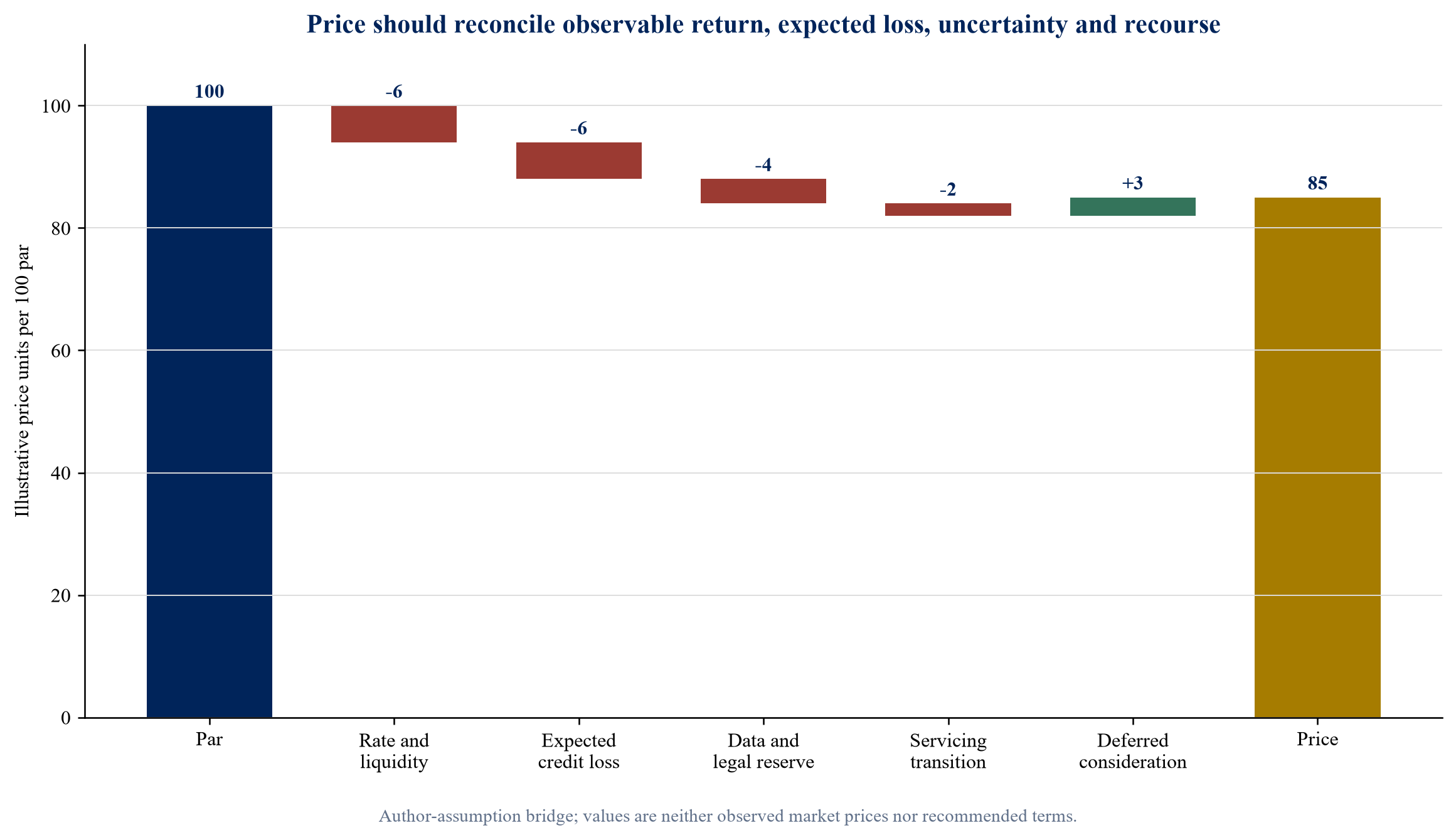
Author-assumption bridge. Values are neither observed transaction prices nor recommended commercial terms.
13. Apply the framework to a hypothetical portfolio
Consider an illustrative portfolio with USD 1.0 billion of par exposure across 120 mid-market borrowers. The author assumes 92 percent of drawn balance is reported performing, 8 percent is watchlist or modified, weighted-average remaining maturity is 3.4 years and the ten largest borrower groups represent 31 percent of exposure. The assumed portfolio includes sponsor-backed services, owner-managed industrials, healthcare, software and transport businesses. These are analytical assumptions and do not describe an actual bank.
The seller's objective is assumed to be concentration reduction and balance-sheet capacity. The buyer seeks a seasoned senior-secured portfolio with direct lender rights and continued servicing by the bank for twelve months. The proposed legal form is a whole-loan transfer, subject to asset-specific consent and perfection. Revolver commitments remain with the seller unless the buyer expressly accepts them. Loans that cannot be separated from ancillary products enter an exception schedule.
Population testing identifies assumed exceptions in 14 loans. Five show covenant test dates inconsistent with source certificates. Four have collateral valuations older than the seller's policy threshold. Three have guarantee amounts recorded above contractual caps. Two include transfer restrictions requiring borrower consent. The initial forty-file sample then identifies three missing waiver letters and two security-registration discrepancies. These results trigger expansion of the affected origination-team and secured-loan strata.
The expanded review determines that one security discrepancy is a data error and one requires re-registration before closing. Two waiver letters are recovered from email archives and one cannot be evidenced. The related asset is excluded. The guarantee-cap errors are corrected in the model. Consent-dependent loans remain conditional assets and transfer only after valid consent. The closing tape reconciles principal, accrued interest and interim cash through a movement schedule.
The author assumes an initial indicative price of 88 per 100 of par. Re-underwriting and current required-return assumptions produce a six-unit reduction for rate and liquidity, six for expected credit loss, four for unresolved data and legal uncertainty, and two for servicing transition. Three units are restored through objectively measured deferred consideration payable if specified files, consents and servicing tests are completed. The resulting illustrative price is 85. Every amount and adjustment is an author assumption rather than a market observation or recommendation.
14. Use a price and loss waterfall that can be administered
The purchase agreement should translate the economic model into a settlement waterfall. It should define par, eligible accrued interest, unpaid fees, interim collections, prepayments, charge-offs, recoveries, expenses and excluded amounts. The parties need one calculation agent, a dispute process and access to supporting records. A simple headline percentage cannot settle a portfolio whose balances move before closing.
Deferred consideration needs a measurement period and objective tests. It may depend on delivery of original documents, perfection of identified security, receipt of consents, successful servicing migration or performance of a defined cohort. Credit-performance earn-outs can blur risk transfer and create disputes if the seller controls servicing. The parties should analyse accounting, regulatory and conduct implications before using them.
Loss allocation should avoid double recovery. A buyer claiming for an overstated balance should account for later borrower payments or collateral recovery. Insurance, guarantor and third-party recoveries should be credited under agreed rules. Costs, taxes, funding and lost opportunity should be included only if the contract provides. Claims reserves should be released through a clear timetable.
Table 4. Hypothetical price and remedy allocation
| Component | Units per 100 par | Primary evidence | Allocation mechanism |
|---|---|---|---|
| Starting par reference | 100 | Closing asset tape and ledger reconciliation | Purchase-price base |
| Rate and liquidity adjustment | -6 | Current curve, loan cash flows and exit assumptions | Upfront price |
| Expected credit-loss adjustment | -6 | Re-underwriting and scenario model | Upfront price |
| Data and legal uncertainty | -4 | Exception log and unresolved documents | Price reserve or asset exclusion |
| Servicing transition | -2 | Migration plan and acceptance tests | Holdback with service-level release |
| Deferred consideration | +3 | Completed consents, files and servicing tests | Conditional post-closing payment |
| Illustrative resulting price | 85 | Agreed settlement statement | Cash consideration before later true-ups |
Values are author assumptions for analytical demonstration and are not observed market terms.
15. Match acquisition funding to portfolio cash and liquidity
A private-credit fund may purchase with investor capital, a warehouse, an asset-backed facility, subscription finance or a combination. Funding should match the portfolio's currency, duration, prepayment and draw profile. A levered buyer must model margin calls, borrowing-base exclusions, concentration limits and covenant triggers. Loans that are illiquid to the fund may also be ineligible or heavily discounted to its lender.
The Federal Reserve reports growing bank credit to private-credit vehicles and notes that facilities often have collateral-linked borrowing capacity [3]. The Bank of England identifies interconnectedness, leverage, concentration and opaque valuation as relevant private-market vulnerabilities [6]. Acquisition leverage can amplify a modest asset markdown into a funding call. The buyer should stress asset value, default, recovery delay, revolver draws, lender advance rates and investor liquidity together.
The warehouse agreement should define eligible assets, advance rates, concentration limits, valuation agent, dispute rights, cash waterfall, cure periods, margining and enforcement. The purchase agreement and warehouse should use consistent asset definitions. A loan accepted by the buyer but rejected by the warehouse creates an immediate funding gap. Borrower prepayments can reduce collateral and force deleveraging unless the facility permits substitution or reinvestment.
Fund governance also matters. The acquisition should fit mandate, concentration, leverage, valuation and related-party rules. Conflicts may arise if the manager operates several vehicles, has an origination partnership with the seller or transfers assets between funds. Allocation policy and independent valuation challenge should precede closing. Investor reporting should explain portfolio composition, leverage, valuation and material exceptions.
16. Satisfy accounting, prudential, conduct and data obligations
The seller should obtain separate accounting and prudential analyses. IFRS 9 requires assessment of whether contractual rights have expired or transferred, whether risks and rewards have moved, and whether control or continuing involvement remains [10]. Retained servicing, guarantees, repurchase obligations, deferred consideration and participations can affect the conclusion. The buyer separately determines classification, measurement and expected-credit-loss treatment.
Prudential recognition depends on the regulated entity, jurisdiction and transaction form. A bank may need to demonstrate genuine risk transfer, appropriate governance, valuation and capital treatment. Synthetic transactions and securitisations have specific frameworks. The EU Securitisation Regulation imposes due-diligence, risk-retention, transparency and other requirements within its scope [23]. A bilateral whole-loan sale should not be called a securitisation without legal analysis.
Confidentiality and data protection begin before the data room opens. Borrower financial information, personal data, bank secrecy and privileged material require a lawful disclosure basis, access controls, minimisation, retention and deletion. The EU General Data Protection Regulation provides principles for lawfulness, purpose limitation, data minimisation, accuracy, storage limitation, security and accountability where it applies [22]. Cross-border transfers and post-closing notices require jurisdiction-specific advice.
Borrower treatment should remain fair and consistent. A transfer should not create incorrect statements, lost payments, aggressive collection or undisclosed changes. Complaints and vulnerable-customer controls may apply even when a portfolio is primarily corporate. Sanctions, anti-money-laundering, know-your-customer and beneficial-ownership records need transition plans. Legal and compliance approvals should be conditions to data access and closing.
BCBS 239 sets principles for effective risk-data aggregation and reporting at banks [15]. Its formal scope is specific, but the disciplines of accurate, complete, timely and adaptable risk data are relevant to portfolio transfers. The buyer should require evidence that key fields are sourced, controlled and reproducible. A data warranty cannot compensate for a process that cannot explain its own numbers.
17. Execute a ninety-day transfer-readiness programme
Days one to fifteen should establish governance, objective, perimeter and structure. The parties appoint transaction, credit, legal, tax, accounting, regulatory, operations, data and servicing leads. They approve the reference date, eligibility criteria, data dictionary, confidentiality protocol, diligence materiality and stop conditions. The seller produces control totals and a first exception log. The buyer confirms mandate, funding and concentration capacity.
Days sixteen to thirty-five should reconcile the asset tape and build stratification. Population tests identify missing, inconsistent and unusual fields. The buyer maps the seller's credit grades and default definitions, selects the initial file sample and begins re-underwriting. Legal teams classify transfer mechanics, consents, security and product links. Operations teams document current servicing and the target model.
Days thirty-six to sixty should complete file review, expand affected strata and quantify exceptions. The parties agree remediation owners and deadlines. The buyer updates cash-flow, default, recovery and required-return assumptions. Draft purchase, servicing, data and transition documents incorporate the observed issues. Funding providers test eligibility and advance rates against the actual tape.
Days sixty-one to seventy-five should lock the eligible perimeter and price architecture. Identified defects are cured, excluded, reserved or indemnified. The closing tape and movement bridge are rehearsed. Servicing migration runs parallel calculations and sample borrower communications. Accounting, prudential, tax, compliance and data-protection sign-offs are documented.
Days seventy-six to ninety should complete conditions precedent, consents, custody, cash-routing tests and settlement statements. The closing committee reviews unresolved exceptions and has authority to remove assets or defer closing. After settlement, balances and cash are reconciled daily until stable. Deferred-consideration tests, representations and claim deadlines enter an owned control calendar.
18. Build a market through repeatable evidence
Seasoned-loan transfers can help banks manage concentrations and capital while giving private investors access to diversified mid-market credit. The transaction creates value when evidence survives the hand-off. A reconciled tape, traceable documents, independent credit view, enforceable rights, controlled servicing and transparent price bridge reduce uncertainty that would otherwise become a wider discount.
Repeat programmes can improve execution. Stable data dictionaries, eligibility rules, document standards, file indexes, servicing interfaces and post-closing reports lower preparation cost and make cohorts comparable. The ECB's AnaCredit framework demonstrates the analytical value of granular credit data for identifying and aggregating corporate exposures [17]. A private transfer programme can apply the same discipline within contractual and legal boundaries.
Standardisation should preserve asset-specific judgement. Mid-market loans remain heterogeneous. Borrower quality, covenants, security, consent and servicing can differ materially even within one product label. The buyer should retain authority to re-underwrite, expand samples and remove assets. The seller should treat exception trends as feedback into origination, documentation and monitoring.
The final investment decision should state the selected assets, expected return, downside loss, leverage, liquidity, legal rights, servicing dependency and residual uncertainty. It should distinguish observed evidence from author or management assumptions. Post-closing performance should be compared with underwriting, including defaults, migrations, amendments, recoveries, prepayments and data defects. That feedback turns one transaction into a governed transfer capability.
References
- International Monetary Fund. Global Financial Stability Report, Chapter 2, The Rise and Risks of Private Credit. April 2024. https://www.imf.org/en/publications/gfsr/issues/2024/04/16/global-financial-stability-report-april-2024
- Board of Governors of the Federal Reserve System. Private Credit: Characteristics and Risks. 23 February 2024. https://www.federalreserve.gov/econres/notes/feds-notes/private-credit-characteristics-and-risks-20240223.html
- Board of Governors of the Federal Reserve System. Bank Lending to Private Credit: Size, Characteristics, and Financial Stability Implications. 23 May 2025. https://www.federalreserve.gov/econres/notes/feds-notes/bank-lending-to-private-credit-size-characteristics-and-financial-stability-implications-20250523.html
- Bank for International Settlements. Annual Economic Report 2024. June 2024. https://www.bis.org/publ/arpdf/ar2024e.pdf
- European Central Bank. Private markets: risks and benefits from financial diversification in the euro area. Financial Stability Review, May 2025. https://www.ecb.europa.eu/press/financial-stability-publications/fsr/focus/2025/html/ecb.fsrbox202505_06~b9e8afc409.en.html
- Bank of England. Financial Stability Report. December 2025. https://www.bankofengland.co.uk/financial-stability-report/2025/december-2025
- European Banking Authority. Final report on draft Implementing Technical Standards on NPL transaction data templates. 16 December 2022. https://www.eba.europa.eu/sites/default/files/document_library/Publications/Draft%20Technical%20Standards/2022/EBA-ITS-2022-05%20ITS%20on%20NPL%20transaction%20data%20templates/1045969/Final%20report%20on%20draft%20ITS%20on%20NPL%20transaction%20data%20templates.pdf
- European Banking Authority. Guidelines on loan origination and monitoring. 29 May 2020, compliance table updated 30 July 2025. https://eba.europa.eu/activities/single-rulebook/regulatory-activities/credit-risk/guidelines-loan-origination-and-monitoring
- European Union. Directive (EU) 2021/2167 on credit servicers and credit purchasers. 24 November 2021. https://eur-lex.europa.eu/legal-content/en/TXT/?uri=CELEX:32021L2167
- IFRS Foundation. IFRS 9 Financial Instruments. https://www.ifrs.org/issued-standards/list-of-standards/ifrs-9-financial-instruments/
- IFRS Foundation. IFRS 13 Fair Value Measurement. https://www.ifrs.org/issued-standards/list-of-standards/ifrs-13-fair-value-measurement/
- IFRS Foundation. IFRS 7 Financial Instruments: Disclosures. https://www.ifrs.org/issued-standards/list-of-standards/ifrs-7-financial-instruments-disclosures/
- Financial Conduct Authority. Private market valuation practices. 5 March 2025. https://www.fca.org.uk/publications/multi-firm-reviews/private-market-valuation-practices
- International Organization of Securities Commissions. Principles for the Valuation of Collective Investment Schemes. May 2013. https://www.iosco.org/library/pubdocs/pdf/IOSCOPD413.pdf
- Basel Committee on Banking Supervision. Principles for effective risk data aggregation and risk reporting. January 2013. https://www.bis.org/publ/bcbs239.pdf
- Basel Committee on Banking Supervision. Principles for the Management of Credit Risk. September 2000. https://www.bis.org/publ/bcbs75.pdf
- European Central Bank. AnaCredit. https://www.ecb.europa.eu/stats/ecb_statistics/anacredit/html/index.en.html
- Financial Stability Board. Global Monitoring Report on Non-Bank Financial Intermediation 2025. https://www.fsb.org/2025/12/global-monitoring-report-on-non-bank-financial-intermediation-2025/
- European Banking Authority. Guidelines on outsourcing arrangements. 25 February 2019. https://www.eba.europa.eu/regulation-and-policy/internal-governance/guidelines-on-outsourcing-arrangements
- European Banking Authority. Guidelines on management of non-performing and forborne exposures. 31 October 2018. https://www.eba.europa.eu/regulation-and-policy/credit-risk/guidelines-on-management-of-non-performing-and-forborne-exposures
- World Bank Group. A Toolkit for Public Asset Management Companies. 2021. https://documents.worldbank.org/en/publication/documents-reports/documentdetail/099245012142121825
- European Union. Regulation (EU) 2016/679, General Data Protection Regulation. 27 April 2016. https://eur-lex.europa.eu/eli/reg/2016/679/oj
- European Union. Regulation (EU) 2017/2402 laying down a general framework for securitisation. 12 December 2017. https://eur-lex.europa.eu/eli/reg/2017/2402/oj
- Board of Governors of the Federal Reserve System. Financial Stability Report. November 2024. https://www.federalreserve.gov/publications/November-2024-financial-stability-report.htm
- European Central Bank. Systemic risks in linkages between banks and the non-bank financial sector. Financial Stability Review, November 2025. https://www.ecb.europa.eu/press/financial-stability-publications/fsr/special/html/ecb.fsrart202511_02~e2f82a64bf.en.html
