

1. Define the capital problem before selecting the debt instrument
An engineering group can possess valuable intellectual property, a strong order book and long-standing customer relationships while remaining difficult to finance. Cash may be absorbed by raw materials, work in progress, skilled labour, testing, customer acceptance and warranty obligations. A newly acquired business may carry separate systems, guarantees and facilities. A factory upgrade can interrupt production before it produces savings. A maturity due within eighteen months can compress all of these operating issues into a single refinancing deadline.
The board should begin with a named use of capital and a dated repayment source. Maintenance capex preserves current earnings. Growth capex requires an evidenced demand case and commissioning plan. Acquisition debt relies on a combined-business cash flow and an integration programme. Working-capital facilities revolve with inventory and receivables. Refinancing debt replaces an existing obligation and therefore needs a credible maturity exit from the first day. Combining every requirement into one undifferentiated loan can obscure the risks and create the wrong amortisation profile.
The macroeconomic and sector setting strengthens the case for disciplined underwriting. The Office for National Statistics estimated that UK manufacturing output increased by 1.0 per cent in the three months to June 2026, while monthly manufacturing output fell by 0.5 per cent in June.[1] The Bank of England maintained Bank Rate at 3.75 per cent in July 2026 and described uncertainty from energy prices and financial conditions.[2] The July 2026 Financial Stability Report identified refinancing exposure in riskier credit markets and noted that a substantial portion of UK private debt originated in 2021 was due to refinance in the coming year.[3]
Private credit can provide bespoke tenor, delayed-draw capex tranches, acquisition certainty and covenant structures tailored to operational complexity. The facility still needs a bounded economic purpose. Debt cannot safely fund an indefinite margin shortfall, unsupported acquisition synergies or a factory programme without an executable completion and repayment plan.
All company data, facility sizes, interest rates, advance rates, covenant thresholds, valuations and transaction scenarios in this paper are illustrative management assumptions. They do not describe a financing offer or a particular borrower. Current legal, tax, accounting, regulatory, credit and investment advice is required for an actual transaction.
2. Use five connected underwriting gates
The framework has five connected gates. Gate one establishes the quality and cash conversion of contracted backlog. Gate two tests the economics, schedule and funding profile of capital expenditure. Gate three tests acquisition price, integration and post-close liquidity. Gate four sizes debt against cash flow, collateral, covenants and minimum liquidity. Gate five establishes a refinancing route with dated milestones and contingency options.
The sequence prevents a persuasive growth narrative from overriding cash evidence. A large backlog does not support leverage when contracts can be cancelled, margins are unverified or delivery requires substantial pre-funding. Attractive automation savings do not support debt when installation causes an unmodelled shutdown. A strategically coherent acquisition does not create debt capacity until integration costs, working-capital needs and customer dependencies have been measured. A central-case DSCR does not prove refinanceability when the maturity wall arrives before the benefits are established.
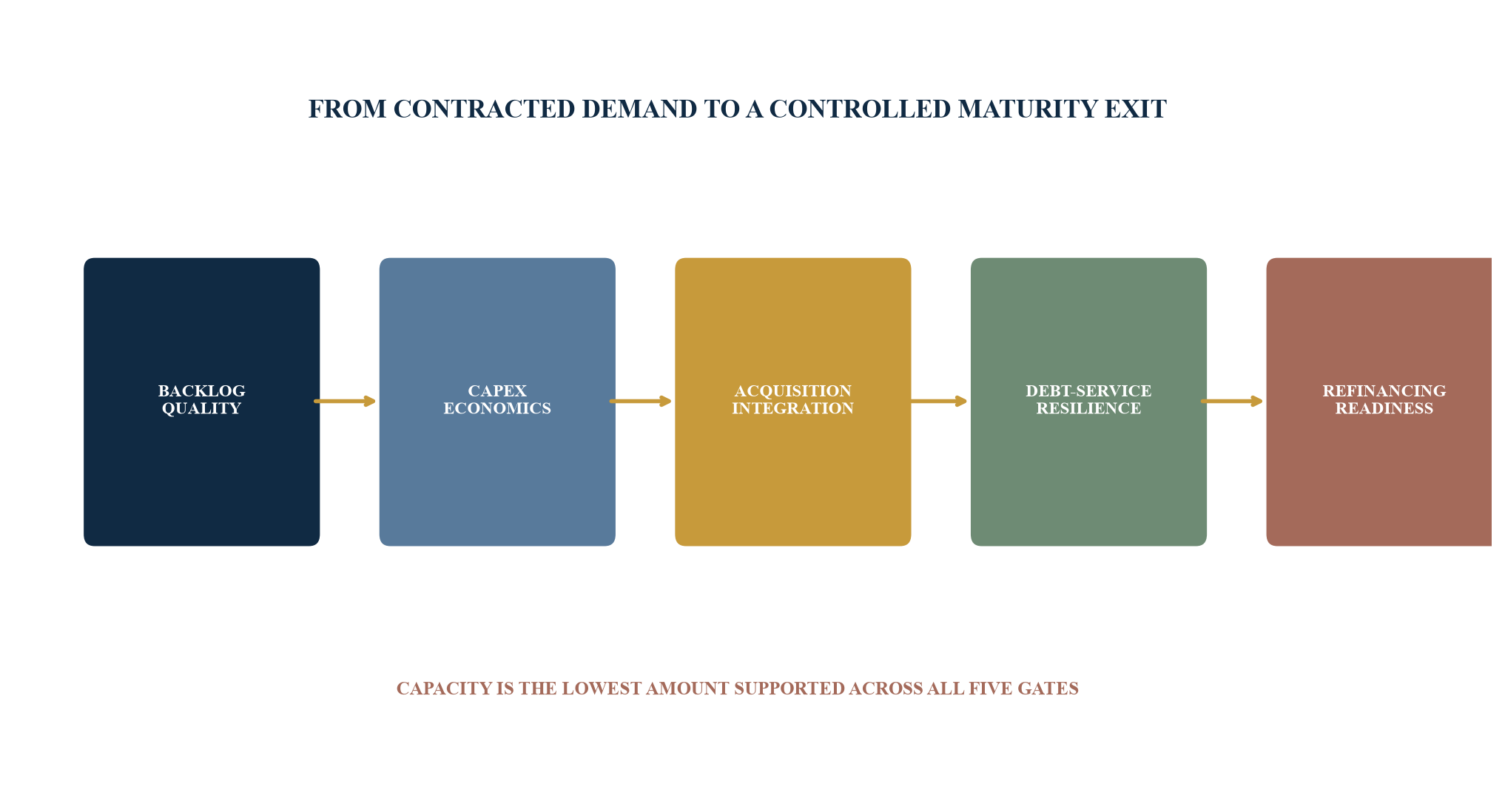
Every gate requires borrower-specific evidence; failure at one gate reduces capacity or changes structure.
The five gates create a common monthly record for management, the board, lenders and advisers. The record should contain a contract-level backlog register, capex portfolio, acquisition integration dashboard, 13-week cash forecast, covenant certificate and maturity action plan. Exceptions should be visible before they become payment events.
Governance also needs a clear data hierarchy. Executed agreements, bank records and independent certificates should sit above management forecasts. Forecasts should identify the source date, owner, confidence level and next evidence event. Board judgements should be recorded separately from contractual facts. This hierarchy prevents a promising commercial discussion, unsigned variation or proposed grant from being treated as available cash.
The monthly cycle should begin with operational close, continue through finance reconciliation and finish with a decision meeting. Project managers update delivery, procurement, customer acceptance and warranty data. Finance reconciles revenue, cash, debt and covenant definitions. Treasury updates facilities, hedges, guarantees and maturities. Management then approves exceptions, mitigations and lender communications. The system becomes useful when it leads to dated decisions rather than a static report.
3. Rebuild backlog as a credit asset
Backlog is frequently presented as the value of orders not yet recognised as revenue. Credit analysis needs a narrower definition. The lender should identify the contracting entity, paying customer, executable scope, price basis, termination rights, delivery schedule, customer acceptance, remaining cost, warranty exposure and expected cash profile. Framework agreements, options, bids and unsigned change orders should remain outside committed backlog.
Contract terms can materially change economic value. A customer may terminate for convenience, vary volumes or defer delivery. Fixed-price contracts can transfer inflation, design and productivity risk to the supplier. Milestone payments may depend on factory acceptance tests, site commissioning or third-party certification. Liquidated damages, warranty claims and set-off can reduce collections. A strong customer name does not remove project execution risk or administrative delay.
The backlog bridge should start with gross committed value, deduct revenue already recognised and identify remaining contracted revenue. It should then reconcile remaining direct cost, allocated engineering cost, contingency, warranty reserve and expected margin. Cash requirements should be mapped by month, including supplier deposits, inventory, subcontractors and testing. The lender should distinguish accounting margin from cash available for debt service.
Customer and programme concentration require explicit treatment. A portfolio dominated by one aerospace platform, energy project or automotive customer can show high visibility and still carry correlated delay risk. Concentration limits should consider customer group, end market, programme, geography, currency and delivery site. The assessment should also identify customer approvals that control invoicing and any restrictions on assignment or collection accounts.
Table 1. Contracted-backlog quality matrix
| Dimension | Evidence | Strong condition | Warning condition |
|---|---|---|---|
| authority | executed contract, amendments and signatory evidence | legal parties and approvals verified | conditional award or inconsistent documents |
| cancellation | termination rights and compensation formula | committed volume or clear recovery | convenience termination without adequate recovery |
| economics | latest cost-to-complete and procurement status | margin supported by committed cost | design gap, unplaced procurement or negative variance |
| billing | milestone, certificate and invoice procedure | objective evidence and dated path | subjective acceptance or incomplete records |
| collection | payer, due date, history and set-off | traceable payment record | repeated deductions, disputed invoices or long ageing |
| concentration | customer, programme and end-market mix | diversified cash contribution | single programme controls liquidity and debt service |
| warranty | reserve, claims history and service plan | reserve supported by observed outcomes | emerging defect or unquantified field obligation |
Scores, exclusions and reserves should be calibrated to the actual portfolio and legal documents.
4. Measure backlog quality as a cash-conversion score
A score should support judgement rather than replace it. Each material contract can be assessed across commitment, margin evidence, milestone objectivity, customer behaviour, concentration, cash conversion and warranty exposure. Scores should be tied to actions. A low score may produce exclusion from forecast receipts, a liquidity reserve, a lower advance rate or a condition requiring customer confirmation.
The score should change when evidence changes. An order can improve after design freeze, committed procurement and customer acceptance of a milestone plan. It can deteriorate after a schedule slip, input-cost increase, disputed variation or customer budget delay. Monthly movements should be explained by named owners, and management should reconcile the score to the cash forecast.
Portfolio interaction creates a second-order risk. A group may transfer engineers, specialist machinery and cash among programmes. One profitable contract can subsidise another that is delayed, while a new order can consume the resources needed to complete an older milestone. The credit review should identify shared resources, restricted customer advances, joint-venture cash, bonding requirements and cross-defaults. A monthly programme map should show which contract depends on which people, machines, approvals and facilities.
External capacity should be tested alongside internal capacity. Critical castings, electronics, software, certification laboratories and specialist subcontractors can determine delivery even when the borrower has available plant. Supplier concentration, financial health, lead times, currency exposure and substitution rights should be mapped for each material programme. A lender may require contingency inventory or a supplier reserve where delay would prevent a major acceptance milestone.
The order-intake process is itself a credit control. Commercial teams should not accept a project whose mobilisation, bonding, working capital or technical obligations exceed approved capacity. A bid review should test downside margin, payment terms, warranty, liquidated damages, intellectual-property rights and customer acceptance. Approval thresholds should reflect peak cash exposure and programme concentration rather than revenue value alone.
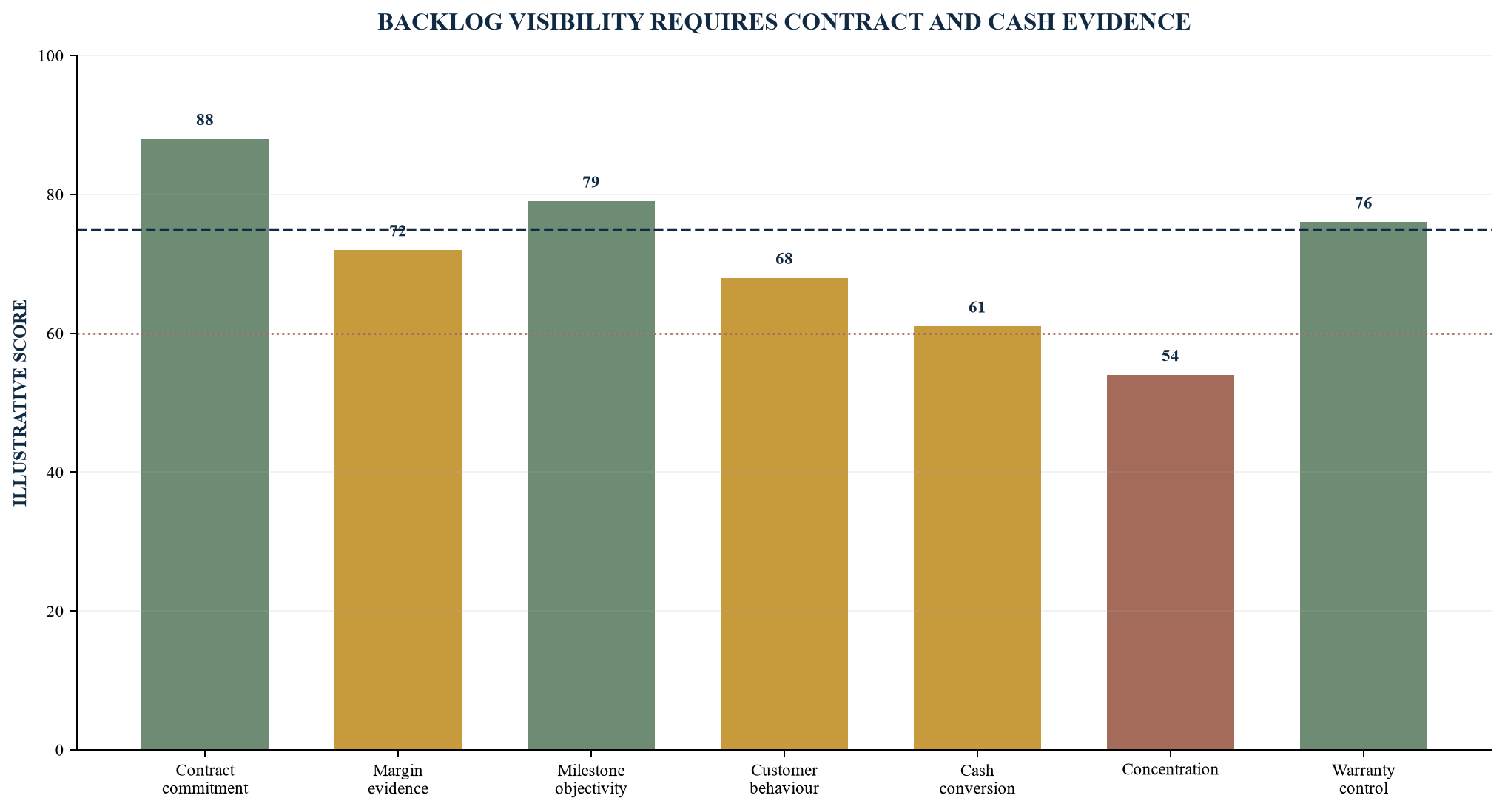
Scores are illustrative management assumptions; actual weights and thresholds require portfolio-specific calibration.
The scorecard should feed three outputs. The revenue forecast should include expected delivery based on operational evidence. The liquidity forecast should include cash receipts based on milestone and customer evidence. The debt model should use a more conservative cash case and exclude unsupported recoveries. Keeping these outputs separate reduces the risk that one optimistic assumption propagates through the whole financing case.
5. Segment capex by economic purpose
Capital expenditure should be divided into maintenance, compliance, productivity, capacity, product development and acquisition-related investment. Maintenance capex preserves existing output and should be treated as a recurring cash requirement. Compliance capex may be unavoidable but may not create incremental earnings. Productivity capex can support debt when savings are measurable, timed and owned. Capacity capex requires contracted or strongly evidenced demand. Product-development expenditure carries technical and commercial uncertainty. Acquisition-related capex should sit inside the integration budget.
The UK Advanced Manufacturing Sector Plan sets an ambition to increase annual business investment in the sector from £21 billion to £39 billion by 2035 and describes public support for research, development and growth capital.[4] Public support can improve project economics, yet each grant, guarantee or programme has eligibility, timing and conditionality. The debt case should rely on committed support and executable claims rather than anticipated awards.
Every capex project should have a baseline scope, supplier contract, installation plan, commissioning test, production ramp, contingency and benefit owner. Imported equipment creates currency, logistics and customs risk. Integration with legacy systems can delay acceptance. A factory shutdown can reduce cash generation during installation. The model should reflect payments before delivery, retention, acceptance and warranty terms.
Table 2. Capex category and funding structure
| Capex category | Repayment source | Potential structure | Principal control |
|---|---|---|---|
| maintenance | recurring operating cash | revolving cash or amortising term debt | minimum annual maintenance floor |
| compliance | protected licence to operate | term debt aligned to useful life | completion and regulatory acceptance |
| productivity | evidenced cost savings | delayed-draw capex tranche | supplier milestones and savings verification |
| capacity | incremental contracted demand | term debt with draw conditions | customer evidence and ramp-up reserve |
| equipment | asset use and residual value | asset finance or lease | title, insurance and maintenance |
| product development | future product cash flow | equity, grant or risk capital | stage gates and loss limits |
| acquisition integration | combined-business synergies | acquisition tranche or sponsor equity | integration budget and synergy tracking |
Instrument choice depends on ownership, useful life, cash generation, security and lender appetite.
6. Build a capex funding stack around milestones
The funding stack should match the life of the asset and the timing of cash benefits. Supplier deposits and early engineering may require borrower equity or a committed delayed-draw tranche. Asset finance may suit identifiable machinery with clear title and resale value. A term loan can fund installation and ramp-up where the cash benefit emerges over several years. Working-capital facilities should fund inventory and receivables generated by the new capacity, rather than the machinery itself.
The draw schedule should be linked to evidence. Conditions can include board-approved scope, fixed or capped supplier pricing, planning permission, grant confirmation, insurance, equity contribution, independent engineer reports and milestone certificates. A cost-overrun mechanism should identify the first source of additional funding and the point at which the project pauses. Interest during construction, commitment fees and VAT timing belong in the sources-and-uses model.
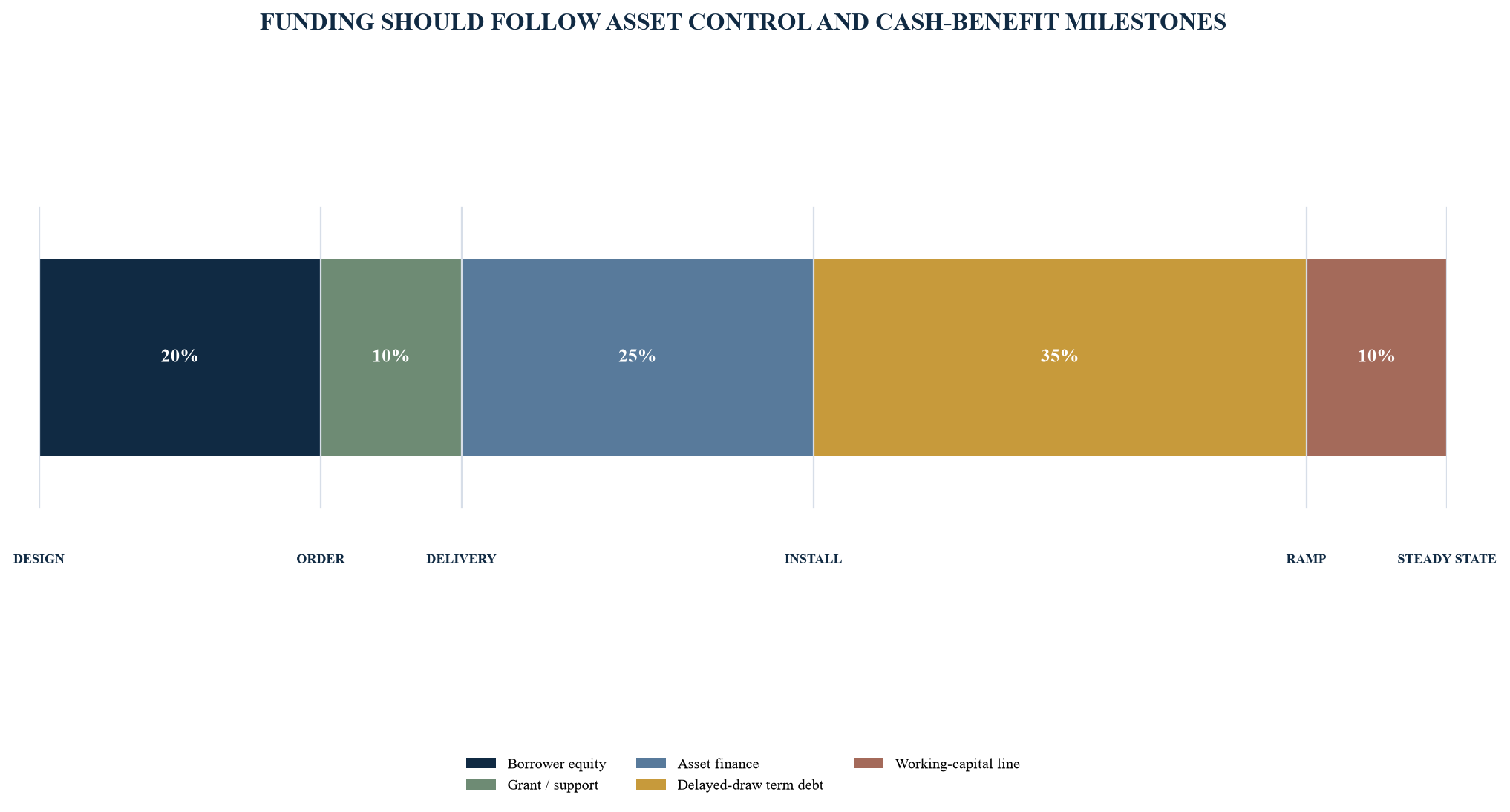
Percentages are illustrative management assumptions; actual structure depends on the asset, sponsor and lenders.
The board should approve a capex portfolio rather than isolated projects. Multiple programmes can compete for engineering resources, outage windows, supplier capacity and cash. A portfolio view identifies peak draw, overlapping commissioning risk and the amount of discretionary expenditure that can be deferred in a downside case.
Benefits should be measured in operational units before they are translated into cash. Automation may reduce cycle time, scrap, rework, energy use or direct labour while increasing software, maintenance and technical-support costs. Capacity investment may improve throughput only after bottlenecks elsewhere have been removed. The investment case should identify the constraint being addressed, the baseline measurement, the commissioning acceptance test and the date on which the benefit can enter the debt model.
Capex contingency should be allocated explicitly. A central contingency can be consumed by the first project and leave later projects unprotected. Each material project should therefore have a technical contingency, price contingency and schedule allowance. Management should show which risks remain with the supplier, which sit with the borrower and which are insured. Debt draw conditions should recognise that risk transfer changes through design, manufacture, delivery, installation and acceptance.
7. Underwrite acquisitions as an integration programme
Acquisition finance should begin with the strategic capability being acquired and the cash evidence supporting the price. Revenue synergies are often delayed and difficult to control. Cost synergies may require redundancy, systems migration, site consolidation or procurement changes before savings appear. The base debt case should distinguish contracted savings from management opportunities and assign each item an owner, cost, date and evidence standard.
Quality of earnings should address customer concentration, project accounting, work in progress, provisions, capitalised development, warranty, pensions, environmental liabilities and normalised working capital. Engineering targets may use percentage-of-completion accounting or carry long-term contract estimates that change after close. The lender should reconcile historical cash conversion to reported EBITDA and model the combined entity on a consistent accounting basis.
The acquisition bridge should include enterprise value, debt-like items, cash, normalised working capital, transaction cost, integration cost, capex catch-up, hedging and contingent consideration. The day-one liquidity view should show acquisition consideration, refinancing of target debt, fees, minimum cash and working-capital headroom. A facility that closes with little liquidity can convert a manageable integration variance into a covenant problem.
Separation planning may be as important as integration. A carved-out engineering business can depend on the seller for systems, facilities, procurement, intellectual property, licences, quality certifications and customer contracts. Transition services should have scope, price, duration, exit milestones and contingency. The debt case should include duplicated cost during migration and should avoid credit for savings that require an untested system cutover.
Regulatory analysis belongs on the critical path. The National Security and Investment Act can apply to acquisitions involving sensitive sectors and assets, while competition review depends on jurisdiction and transaction facts.[15][16] Regulatory conditions can affect closing date, financing certainty and long-stop provisions. Counsel should confirm the applicable route, and the financing timetable should preserve liquidity if approval takes longer than the central case.
Management retention deserves a cash and governance plan. Engineering value can depend on customer relationships, design authority, programme knowledge and specialist accreditations held by a small number of people. The integration budget should include retention arrangements where justified, alongside succession, delegated authority and documentation. Lenders should understand whether key-person departure could interrupt delivery or customer acceptance.
Table 3. Acquisition underwriting bridge
| Component | Evidence | Debt-case treatment | Control |
|---|---|---|---|
| purchase price | signed SPA and funds flow | fixed cash requirement | completion statement |
| target debt and leases | payoff letters and contracts | refinanced or retained by agreement | release and ranking evidence |
| normalised working capital | monthly history and seasonality | cash adjustment and liquidity need | completion accounts |
| integration cost | workplan and supplier quotes | funded use with contingency | monthly budget variance |
| cost synergies | named action, owner and timing | phased after evidence | synergy tracker |
| revenue synergies | customer and pipeline evidence | excluded or heavily discounted | separate upside case |
| contingent consideration | earn-out formula and scenarios | reserved or subordinated | payment block and cap |
| liabilities | diligence, warranty and indemnity | reserve, price adjustment or exclusion | claim process |
The bridge should be supported by diligence and transaction documents; treatment is transaction-specific.
8. Design the first 100 days before signing
Integration planning should start before completion and remain within competition-law and information-sharing boundaries. Day-one priorities include cash authority, bank mandates, payment controls, insurance, customer communications, supplier continuity, cybersecurity and employee retention. The first thirty days should establish a combined 13-week cash forecast, contract register, capex plan and covenant model.
The next phase should reconcile systems, chart of accounts, project margins, working capital and debt reporting. Operational integration should preserve customer delivery while eliminating duplication. The board should receive a short dashboard covering revenue retention, order intake, margin variance, cash conversion, integration cost, savings delivery, capex, liquidity and covenant headroom.
Private-credit documentation can support discipline through delayed draws, permitted-acquisition criteria, integration milestones and information covenants. Excessive prescription can impair management flexibility. The structure should focus on the few events that protect cash and repayment: control of acquisitions, distributions, additional debt, material capex, asset disposals, security and reporting.
9. Reconcile the maturity wall early
A maturity wall is a sequence of contractual cash obligations, lender decisions and operational dependencies. The register should include drawn loans, revolving commitments, overdrafts, leases, guarantees, hedges, supplier finance, earn-outs and shareholder instruments. For each item, management should record maturity, amortisation, extension options, notice periods, financial covenants, security, ranking, portability and repayment source.
The Bank of England's July 2026 Financial Stability Report states that risky credit markets remain vulnerable to tighter financing conditions. It also reports that half of the private-credit loans in its private-markets exploratory exercise reach contractual maturity by 2030, while near-term maturities vary by data set and portfolio.[3] These findings support preparation and scenario testing; they do not prove that every borrower faces the same wall.
Refinancing should begin while the borrower can present audited information, stable trading and multiple options. Eighteen months before maturity, management should validate debt data, business plan, quality of earnings, security and lender universe. Twelve months before maturity, it should seek indications and resolve diligence gaps. Six months before maturity, documentation, consents, hedging and funds flow should be advanced. Contingencies should have decision dates, not remain generic alternatives.
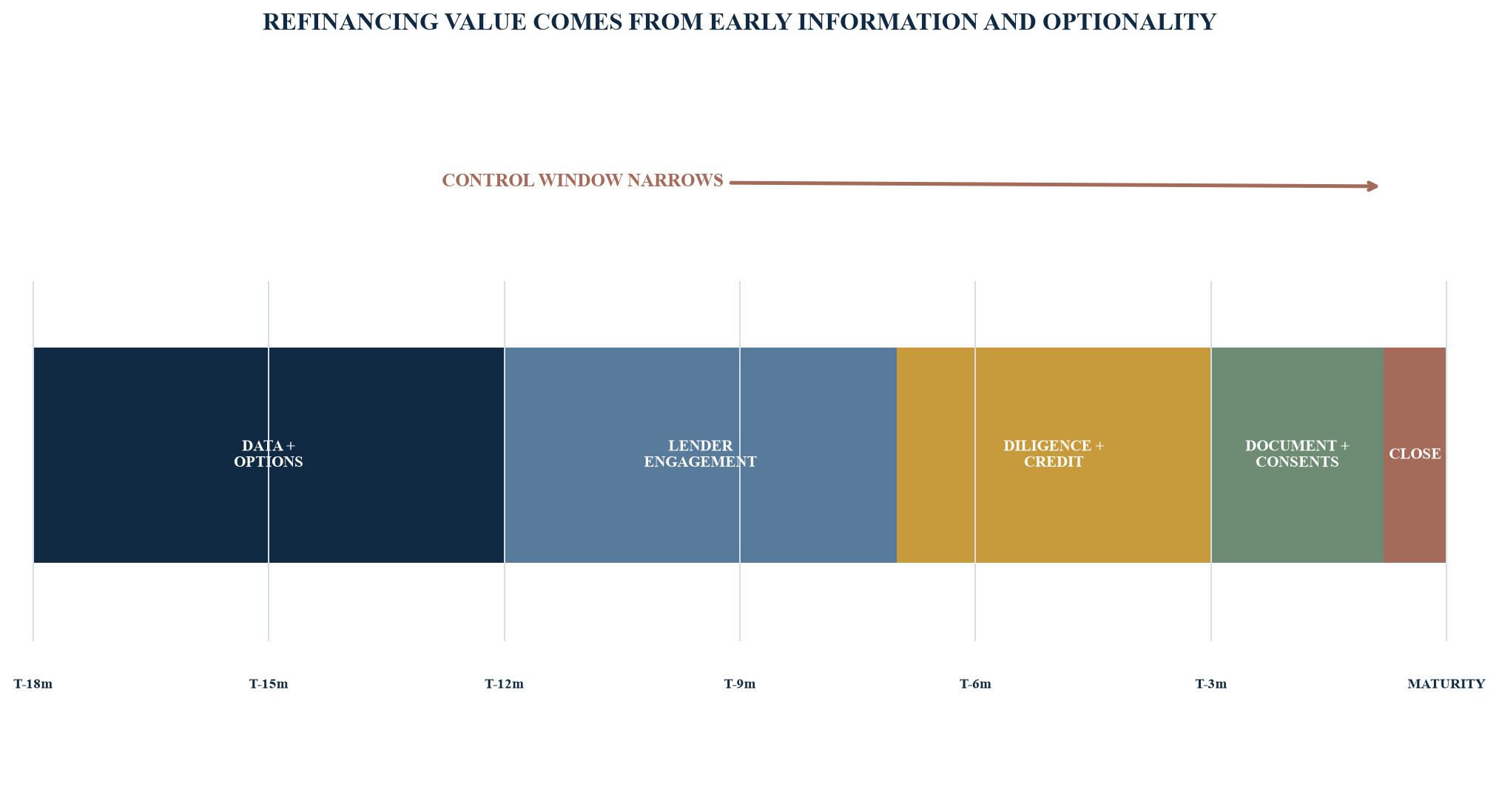
Timing is illustrative; contractual notice periods, market conditions and transaction complexity determine the actual timetable.
10. Build a refinanceability case rather than a maturity hope
The refinancing case should answer who could lend, how much, on what evidence and by what date. Potential routes include incumbent amendment, bilateral or club bank debt, private credit, asset finance, receivables finance, sale and leaseback, minority equity, sponsor capital, asset disposal and strategic transaction. Each route has a capacity, cost, execution period, security requirement and dependency.
The base case should rely on recurring cash earnings after maintenance capex, cash taxes and working-capital needs. Adjustments to EBITDA should be limited, transparent and timed. Synergies and run-rate savings should receive credit only when actions and costs are evidenced. Customer losses, margin normalisation, wage pressure and energy sensitivity should be reflected in downside cases.
The maturity plan should include a liquidity bridge from today to closing. Even a viable refinancing can fail when the borrower cannot fund fees, hedging break costs, minimum cash or a seasonal working-capital peak. A minimum-liquidity covenant or reserve can preserve time, while a delayed contingency decision can destroy it.
Lender selection should reflect the next strategic period. A borrower planning acquisitions may value committed acquisition capacity and portable documentation. A capital-intensive group may require delayed draws and flexible asset-finance intercreditor terms. A company approaching a sale may value prepayment flexibility and change-of-control certainty. The lender's sector knowledge, decision authority, hold size, follow-on capacity and behaviour in underperformance can be as important as initial pricing.
Refinancing materials should explain variance transparently. A lender will compare prior forecasts with actual outcomes and test whether misses arose from market conditions, customer events, integration, execution or weak controls. Management credibility improves when it identifies the cause, cash consequence and corrective action. Unsupported adjustments, changing definitions or omitted downside history can slow credit approval and reduce capacity.
A contingency route should be executable with independent evidence. Asset disposal requires valuation, buyer interest, consent and time. Equity support requires an identified provider and approved amount. Amend-and-extend depends on incumbent alignment. A strategic sale may trigger regulatory, pension, customer and change-of-control issues. The plan should set the last responsible date for each route and the decision authority that activates it.
11. Size debt through the lowest supported constraint
Debt capacity should be triangulated rather than derived from a single leverage multiple. The cash-flow test measures debt service under central and downside scenarios. The collateral test considers receivables, inventory, equipment, property and shares after eligibility, priority and enforcement costs. The liquidity test protects a minimum cash buffer. The concentration test limits reliance on one customer or programme. The capex test preserves completion funding. The refinancing test assesses the amount a future lender or repayment event could reasonably support.
Table 4. Debt-capacity constraint matrix
| Constraint | Core calculation | Evidence | Structuring response |
|---|---|---|---|
| recurring cash flow | EBITDA to cash after working capital, tax and maintenance capex | historical cash conversion and forecast | amortisation and cash sweep |
| downside debt service | cash available divided by interest and principal | integrated downside model | lower leverage, reserve or longer tenor |
| collateral | eligible value less prior claims and enforcement haircut | valuation, ageing and security diligence | borrowing base or asset tranche |
| minimum liquidity | unrestricted cash plus committed availability | bank data and 13-week forecast | liquidity covenant and draw controls |
| concentration | share of cash contribution from major exposures | contract-level portfolio analysis | cap, reserve or customer diversification |
| capex completion | remaining committed cost plus contingency | contracts and engineer review | equity-first funding and cost-overrun support |
| maturity exit | supported refinance or repayment capacity at exit | lender feedback and exit assumptions | amortisation, cash sweep and early process |
Thresholds are illustrative and require borrower-specific credit, legal and valuation work.
The approved commitment should be the lowest amount supported after reserves. Draw availability can be lower than commitment when conditions have not been met. This distinction allows a lender to commit to a capex or acquisition programme while releasing funds only after the borrower supplies agreed evidence.
12. Model DSCR under operating and financing stress
Debt-service coverage should use cash available for debt service, not unadjusted EBITDA. The numerator should deduct cash tax, maintenance capex, working-capital needs, pension contributions and other recurring obligations. The denominator should include cash interest, scheduled principal, lease payments where relevant, hedging cash flows and fees. Bullet principal requires a separate maturity test even when periodic DSCR is strong.
Engineering groups need combined shocks. Backlog delay can reduce revenue while keeping labour and overhead. Margin compression can arise from material, energy or subcontractor costs. A customer delay can increase receivables and revolver use. Capex delay can add cost while deferring savings. Acquisition integration can consume cash and management attention. Refinancing stress can increase margin, fees and amortisation simultaneously.
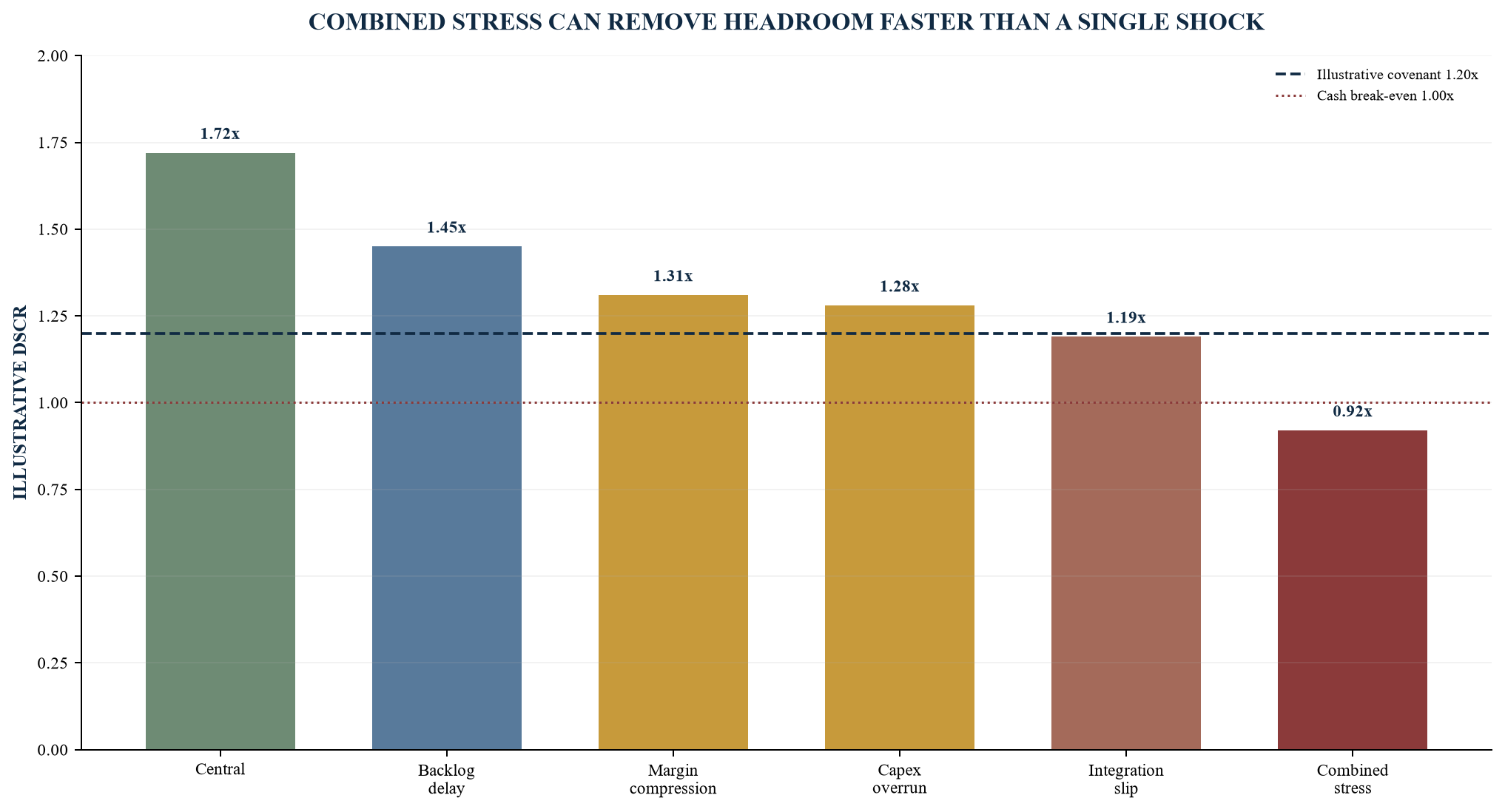
Values are illustrative management assumptions and are not a forecast or financing recommendation.
Management should define actions for each stress level. Early actions may freeze discretionary capex, accelerate collections and reduce inventory. Deeper actions may require sponsor equity, asset sale, acquisition deferral, lender waiver or restructuring. The model should show when each action must begin to preserve cash and avoid an uncontrolled process.
13. Protect liquidity through a 13-week control system
The 13-week cash forecast should begin with bank-confirmed unrestricted cash and committed undrawn availability. Receipts should be named by customer, contract, milestone and expected date. Payments should distinguish payroll, suppliers, tax, capex, integration, interest, principal and discretionary items. Large receipts and payments need owners and documentary evidence.
Forecast accuracy should become a governed metric. Weekly variance analysis should identify whether a receipt missed because work was incomplete, acceptance was delayed, an invoice was rejected or the customer paid late. Payment variances should separate schedule acceleration, supplier pressure, quantity changes and unplanned failures. Persistent optimism should produce larger liquidity reserves and tighter draw controls.
The liquidity model should connect to the borrowing base and capex schedule. A receivables facility can increase availability when invoices become eligible, while capex debt may release only after milestone certification. The forecast should avoid assuming both sources before their conditions are satisfied. Cash trapped in subsidiaries, joint ventures or restricted accounts should be separated from available liquidity.
14. Structure security and intercreditor rights for the real cash flows
The security package should follow the assets and cash that support repayment. Potential collateral includes shares, bank accounts, receivables, inventory, equipment, property, intellectual property and intra-group claims. Companies House guidance explains the registration process for charges created by UK companies and the statutory filing timetable.[5] Actual validity, priority, perfection and enforcement require transaction-specific legal advice.
Engineering groups frequently have existing asset financiers, overdraft providers, receivables financiers, pension obligations, landlords and guarantee banks. Intercreditor arrangements should address ranking, turnover, enforcement standstill, payment blocks, release mechanics and access to shared collateral. A private-credit lender may rely principally on cash-flow covenants while an asset financier controls named machinery. The documentation should reflect the actual value and operational importance of each asset.
Security should not interrupt the business model. Receivables assignments may require notice or customer consent. Intellectual property security can interact with licences and government contracts. Equipment may be essential to fulfil customer obligations. An enforcement analysis should test whether the business can continue operating and whether value depends on people, accreditations, software, customer approvals or integrated sites.
Structural subordination should be measured through cash access. Debt at a holding company may depend on dividends from operating subsidiaries. Those dividends can be restricted by law, distributable reserves, covenants, minority interests, tax, pensions or local facilities. The model should show the legal and practical route by which operating cash reaches each debt-service account. A guarantee cannot substitute for missing cash-transfer capacity.
Pension obligations may influence leverage, distributions, security and transaction proceeds. The borrower should provide current actuarial information, contribution schedules, trustee agreements and known events. Specialist advice is required where a refinancing, acquisition or security package affects the pension position. The debt model should include agreed cash contributions and should separate any management estimate from trustee-approved obligations.
Insurance should be linked to the operating and collateral map. Property damage, machinery breakdown, business interruption, product liability, professional indemnity, cyber risk and marine transit can affect delivery and repayment. Policy limits, exclusions, deductibles, named insureds, loss-payee provisions and claims history should be reviewed. Insurance proceeds should flow through a documented reinstatement or prepayment regime.
15. Use covenants as an intervention system
Covenants should provide early evidence of reduced repayment capacity and a defined route to action. Financial covenants may include leverage, interest cover, DSCR, fixed-charge cover and minimum liquidity. Operational covenants may address backlog quality, customer concentration, capex variance, acquisition integration and reporting. Information covenants should specify the monthly pack and deadlines.
Table 5. Covenant and early-warning dashboard
| Indicator | Measurement | Early-warning trigger | Potential response |
|---|---|---|---|
| minimum liquidity | unrestricted cash plus availability | forecast headroom falls below buffer | cash committee and spending controls |
| leverage | net debt to agreed EBITDA | headroom narrows before test date | acquisition and distribution block |
| DSCR | cash available to scheduled debt service | downside below agreed threshold | amortisation review or reserve |
| backlog quality | weighted score and movement | contract downgrade or cancellation | receipt exclusion and revised forecast |
| customer concentration | share of revenue and cash receipts | dependency exceeds limit | reserve, diversification or consent |
| capex variance | cost, timing and benefit delivery | contingency consumed or commissioning slips | additional equity or pause gate |
| integration | retention, cost and synergy milestones | missed action or cash overrun | remediation plan and tighter reporting |
| refinancing | dated milestone completion | lender process misses critical date | activate contingency route |
Definitions, thresholds, cure rights and testing periods require facility-specific agreement.
Definitions matter as much as thresholds. EBITDA add-backs, permitted debt, cash netting, capex classification and acquisition treatment should be unambiguous. Equity cures and covenant waivers should address the underlying liquidity problem rather than only changing a calculation. Reporting should arrive early enough for action.
16. Run a 100-day financing and refinancing process
The process can be organised into four workstreams: evidence, structure, market and execution. Evidence includes financial statements, contract register, backlog bridge, quality of earnings, capex plan, integration dashboard, cash forecast, tax and legal diligence. Structure converts those facts into sources and uses, debt capacity, security, covenants and intercreditor principles. Market identifies suitable lenders and presents a consistent credit story. Execution covers diligence, credit approvals, documentation, consents, hedging and funds flow.
Table 6. Illustrative 100-day execution roadmap
| Period | Evidence and analysis | Lender process | Decision gate |
|---|---|---|---|
| days 1-15 | debt map, liquidity, backlog and capex baseline | lender universe and information protocol | approve objectives and red lines |
| days 16-35 | integrated model, downside, QofE and security map | initial approaches and management materials | approve capacity range and route |
| days 36-55 | diligence responses and management session | indications, term-sheet comparison | select lead and contingency |
| days 56-75 | confirmatory diligence, intercreditor and covenant definitions | credit papers and documentation | approve final structure |
| days 76-90 | conditions precedent, consents and hedging | documentation and funding mechanics | closing readiness review |
| days 91-100 | funds flow, payoff and reporting baseline | closing and first compliance calendar | release funds only after evidence |
Complex acquisitions, regulatory approvals or distressed situations may require longer; management should set a borrower-specific timetable.
The borrower should maintain one controlled data room and a questions log. Management answers should reconcile to the model and source documents. Changing definitions across lenders can create execution errors. A designated finance lead, operational lead, legal counsel and adviser should own the critical path.
Term sheets should be compared through lifetime economics and operating constraints. The analysis should include cash interest, base-rate floor, original-issue discount, arrangement fees, commitment fees, prepayment costs, hedging, amortisation, mandatory prepayment, covenant headroom, reporting burden, acquisition flexibility and security releases. A nominally cheaper facility may reduce strategic flexibility or create a costly refinancing dependency. Management should model the economics under expected, early-prepayment and downside cases.
Execution discipline also requires a claims log. Diligence issues should be classified as information gaps, valuation issues, legal conditions, cash uses or documentation points. Each issue needs an owner, required evidence, lender consequence and deadline. This prevents unresolved matters from appearing late in the credit committee or conditions-precedent process. The log should remain active through closing and the first compliance period.
17. Board decisions and value creation
The board should receive a short decision pack rather than a volume of disconnected reports. It should show the capital objective, five-gate assessment, central and downside liquidity, debt capacity, refinancing options, key documentation terms and critical milestones. The pack should distinguish facts, assumptions, management judgements and unresolved diligence.
Value creation comes from allocating capital to projects and acquisitions that improve durable cash generation. A capex project should have a post-investment review comparing promised and realised output, labour savings, scrap, downtime and working capital. An acquisition should have a benefit ledger and customer-retention view. Refinancing should protect strategic flexibility through appropriate tenor, amortisation, covenant headroom and permitted baskets.
The same evidence can improve lender confidence and operational decisions. Contract-level backlog analysis reveals pricing and customer risk. Capex discipline identifies weak projects before cash is committed. Integration reporting highlights customer or employee loss. A maturity plan creates options before deadlines remove them.
The board should set explicit risk appetite for leverage and execution. A maximum leverage ratio alone is insufficient. Risk appetite should cover minimum liquidity, single-customer cash contribution, committed capex, acquisition integration capacity, refinancing lead time and permitted use of short-term facilities. Management proposals should state which limits they consume and how capacity is restored.
Incentives should reinforce cash delivery. Commercial teams can be measured on signed order quality and realised margin, project teams on milestone and cash conversion, capex owners on commissioned benefit, and integration leaders on customer retention and verified savings. Incentives based solely on revenue, EBITDA or deal completion can encourage commitments that weaken liquidity and future refinanceability.
Independent review is valuable at decision gates. A quality-of-earnings provider can test cash conversion and adjustments. Technical advisers can assess capex scope, completion and asset condition. Legal counsel can map contracts, security and regulatory requirements. Insurance, pension, tax and environmental specialists address risks outside the core model. The board should define the question each adviser must answer and reconcile findings to the financing case.
18. Conclusion
Private credit can finance growth, resilience and ownership transition in UK engineering groups when the facility is built around how the business converts contracted work into cash. The decisive work occurs below the headline leverage ratio: contract commitment, cost-to-complete, capex commissioning, acquisition integration, liquidity, security and the maturity route.
The five-gate framework provides a practical sequence. Rebuild backlog as a credit asset. Segment capex and fund it against milestones. Underwrite acquisitions through cash integration. Size debt to the lowest supported constraint. Begin refinancing while evidence and options remain under management control. A disciplined monthly governance system then keeps the transaction connected to operating reality.
The practical objective is controlled optionality. A borrower with reconciled evidence, visible liquidity and a dated action plan can approach lenders before urgency determines the outcome. The same preparation can support an incumbent amendment, a new private-credit facility, asset finance, receivables funding, equity support or a strategic transaction. Management should preserve more than one executable route until the selected facility is documented, funded and capable of supporting the next operating cycle.
References
- Office for National Statistics. (2026). Index of Production, UK: June 2026. https://www.ons.gov.uk/economy/economicoutputandproductivity/output/bulletins/indexofproduction/june2026
- Bank of England. (2026). Bank Rate maintained at 3.75%: July 2026 Monetary Policy Summary and Minutes. https://www.bankofengland.co.uk/monetary-policy-summary-and-minutes/2026/july-2026
- Bank of England. (2026). Financial Stability Report: July 2026. https://www.bankofengland.co.uk/financial-stability-report/2026/july-2026
- Department for Business and Trade. (2025). Advanced Manufacturing Sector Plan. https://www.gov.uk/government/publications/advanced-manufacturing-sector-plan
- Companies House. Register a charge (mortgage) for a limited company. https://www.gov.uk/guidance/register-a-charge-mortgage-for-a-limited-company
- British Business Bank. (2026). Small Business Finance Markets Report 2026. https://www.british-business-bank.co.uk/about/research-and-publications/small-business-finance-markets-report-2026
- Insolvency Service. (2026). Company insolvencies, July 2026. https://www.gov.uk/government/statistics/company-insolvencies-july-2026
- UK Parliament. Companies Act 2006. https://www.legislation.gov.uk/ukpga/2006/46/contents
- UK Parliament. Insolvency Act 1986. https://www.legislation.gov.uk/ukpga/1986/45/contents
- UK Parliament. Corporate Insolvency and Governance Act 2020. https://www.legislation.gov.uk/ukpga/2020/12/contents
- Financial Conduct Authority. Private market valuation practices. https://www.fca.org.uk/publications/multi-firm-reviews/private-market-valuation-practices
- Financial Stability Board. (2026). Vulnerabilities in private credit. https://www.fsb.org/2026/05/vulnerabilities-in-private-credit/
- Office for National Statistics. (2026). Business investment by industry and asset. https://www.ons.gov.uk/economy/grossdomesticproductgdp/datasets/businessinvestmentbyindustryandasset/current
- Bank of England. (2026). Financial Policy Committee Record: April 2026. https://www.bankofengland.co.uk/financial-policy-committee-record/2026/april-2026
- UK Parliament. National Security and Investment Act 2021. https://www.legislation.gov.uk/ukpga/2021/25/contents
- Competition and Markets Authority. Mergers: guidance on the CMA's jurisdiction and procedure. https://www.gov.uk/government/publications/mergers-guidance-on-the-cmas-jurisdiction-and-procedure
- Financial Reporting Council. UK Corporate Governance Code 2024. https://www.frc.org.uk/library/standards-codes-policy/corporate-governance/uk-corporate-governance-code/
- HM Treasury. (2025). Modern Industrial Strategy. https://www.gov.uk/government/publications/industrial-strategy
About the Author
Chennakeshav Adya is an independent researcher and Managing Partner of Matchpoint Partners. His work focuses on corporate finance, private capital, mergers and acquisitions, strategic transactions and the operating evidence required to convert complex business objectives into financeable decisions. This paper is independent research for general information and does not constitute legal, tax, accounting, investment or credit advice.
Appendix A: Minimum lender evidence pack
The minimum pack should contain legal-entity structure, statutory accounts, management accounts, bank statements, debt and security schedule, covenant history, tax status, pension obligations, insurance, litigation, customer and supplier concentration, contract-level backlog, order intake, cost-to-complete, receivables ageing, inventory, capex register, acquisition documents, integration plan, 13-week cash forecast, integrated monthly model, downside cases, covenant calculations and refinancing timetable.
Every material number should have an owner, source date and reconciliation. Contract data should agree to executed documents. Forecast receipts should tie to milestones and customer evidence. Capex draws should tie to supplier and commissioning milestones. Acquisition adjustments should tie to diligence. Debt balances should tie to lender statements and facility documents.
Appendix B: Monthly board and lender dashboard
The monthly dashboard should report opening liquidity, forecast accuracy, available facilities, debt service, leverage, DSCR, minimum-liquidity headroom, backlog value, backlog quality, order intake, book-to-bill, customer concentration, cost-to-complete variance, working-capital days, overdue receivables, capex spend, commissioning milestones, acquisition integration, realised savings, covenant headroom and refinancing milestones.
Exceptions should include a named cause, cash consequence, accountable executive, corrective action, decision date and escalation threshold. The dashboard should preserve a clear audit trail from contract and bank evidence to management judgement and board action.
