

1. Underwrite the whole route from site to lender cash
A development loan finances a sequence rather than a static asset. At closing, value may sit in land, an existing building, a planning permission, design work, construction progress or pre-agreed occupational demand. At repayment, value must have become sale proceeds, refinancing proceeds or controlled operating cash. Every stage between those points introduces an evidence requirement, a funding requirement, a responsible party and a possible delay.
The first discipline is to identify the current asset state accurately. A site with an outline permission, unresolved reserved matters, unexecuted section 106 obligations and an uncertain utility programme differs materially from a site with a lawful and implementable detailed consent. A structurally complete building awaiting a higher-risk-building completion certificate differs from an income-producing asset that can be occupied and refinanced. Reported percentage completion does not reconcile those distinctions.
The underwriting memorandum should therefore contain a dependency map. It should list property rights, planning conditions, building-control stages, construction packages, utility connections, environmental obligations, insurance, leasing or sales milestones, valuation events, refinancing conditions and maturity. Each item should state the source document, current status, long-stop date, cost, decision owner and remedy if delayed. Dependencies with no funded remedy should reduce availability or prevent closing.
Six tests organise the analysis. Test one establishes legal, planning and building-control readiness. Test two proves the cost to complete and the timing of available cash. Test three shows that senior, stretch-senior, mezzanine and sponsor capital operate as one coherent stack. Test four sizes and controls the interest reserve. Test five measures realistic take-out capacity. Test six establishes an executable exit with alternatives and decision dates. Failure in an earlier test limits reliance on later value.
Primary and secondary repayment routes must remain distinct. Primary repayment may come from a stabilised refinance, contracted investment sale, unit disposals or asset sale. Secondary repayment may come from a recapitalisation, sponsor support, consensual extension, enforcement or sale in an incomplete state. The same rent, sale proceeds or contingency capital cannot be counted in more than one use. The model should identify exactly when cash becomes available to the lender and what documents control its application.
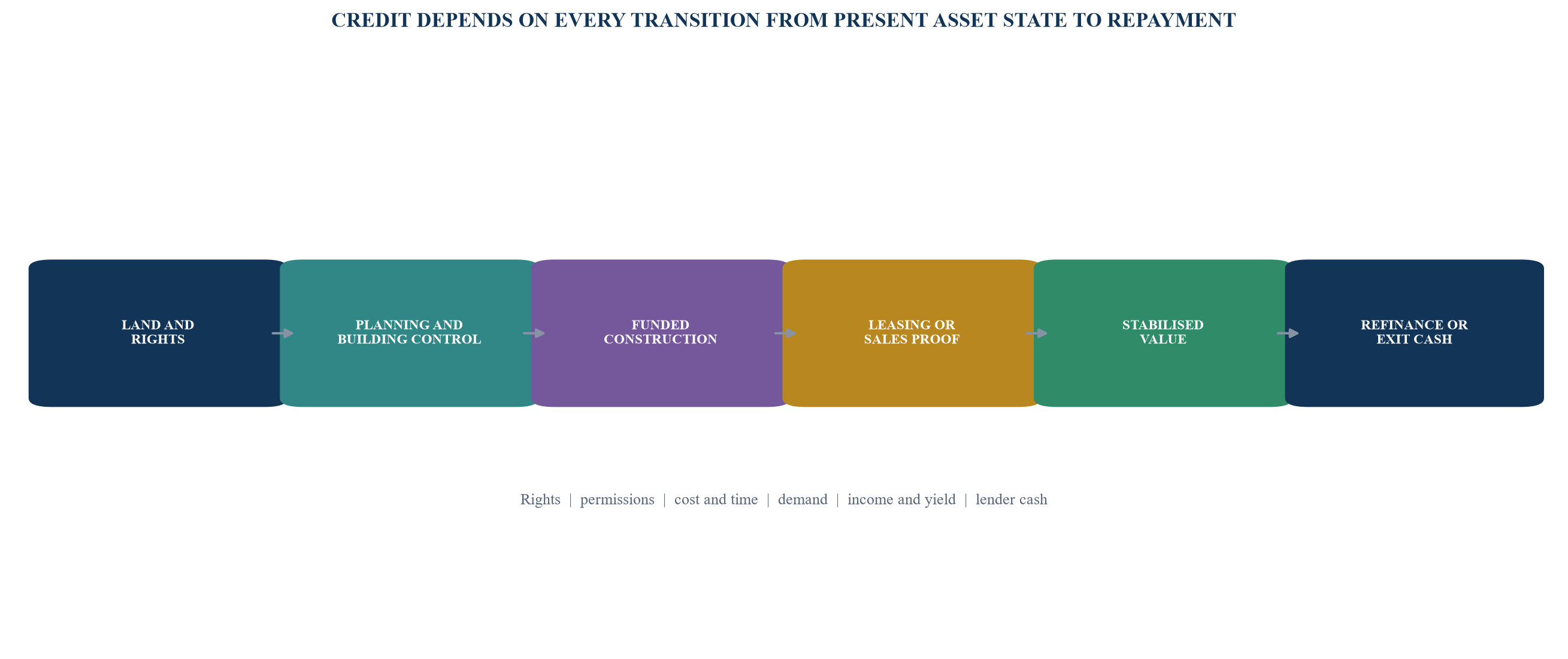
Each transition requires current evidence, sufficient committed funding and a dated decision owner.
2. Establish the property right and jurisdiction
The security analysis begins with the exact estate or interest being financed. The file should reconcile the registered title, title plan, tenure, proprietorship, restrictions, notices, easements, covenants, charges, options, overage, rights of light, access, service media and any occupational interests. Leasehold development requires examination of term, rent, forfeiture, alienation, development rights, mortgagee protection and superior-landlord consents. A borrower holding a contractual development right through another group company needs enforceable rights and security across the relevant entities.
England and Wales, Scotland and Northern Ireland have distinct property, security, insolvency and planning systems. This paper uses England-specific examples where it discusses Companies House charge registration, the National Planning Policy Framework and Law of Property Act receivers. A transaction in another UK jurisdiction requires a separate legal map. The credit paper should name the jurisdiction and avoid treating a UK label as a substitute for that analysis.
Security can include a legal mortgage or standard security over the property, fixed and floating charges over the borrower, share security, assignments of development contracts, warranties, insurances, rents and sale proceeds, account control, and sponsor undertakings. Companies House states that registrable charges should generally be delivered within 21 days beginning the day after creation; late filing ordinarily requires a court order and failure can affect the charge against an administrator, liquidator or creditor.[10][11] The closing checklist should align execution, Companies House filing, Land Registry applications, notices and control arrangements.
Priority requires more than a list of documents. The lender needs the register position, existing finance releases, subordination, permitted security, landlord or counterparty consents, intercreditor mechanics and any statutory claims that affect cash. A debenture over a special-purpose borrower does not automatically transfer a building contract or guarantee that a replacement developer can complete. Step-in, novation, copyright licences, collateral warranties, professional indemnity cover, contractor solvency and access to project information determine whether control has operational value.
The downside analysis should distinguish appointment power from recovery power. Land Registry guidance describes the statutory powers of a receiver appointed under section 109 of the Law of Property Act 1925 and notes that a lender may extend powers through the mortgage deed.[12] The security review should ask whether a receiver can operate, complete, lease, sell, insure, employ professionals, use project accounts and deal with development contracts. Transaction counsel and insolvency advisers should confirm the route for the actual structure.
Table 1. Property-right and security-control register
| Dimension | Minimum evidence | Credit question | Response when unresolved |
|---|---|---|---|
| ownership and tenure | registered title, plan and underlying lease or transfer | does the borrower hold the financed right for the required period? | exclude unsupported value or restructure ownership |
| restrictions and obligations | register entries, covenants, options, overage and consents | can the intended development, charge and exit occur? | consent condition, reserve, redesign or no draw |
| access and utilities | easements, adoption status and connection agreements | can the asset be built, occupied and sold? | funded works and dated completion condition |
| project contracts | appointments, warranties, licences and step-in rights | can a replacement party complete after default? | direct agreement and deliverable information pack |
| charge perfection | executed security, filing and registration evidence | is the lender protected against third parties? | closing counsel ownership and post-closing deadline |
| cash control | rent, sales, insurance and disposal account terms | can repayment cash reach the agreed waterfall? | blocked or controlled account before reliance |
| enforcement | appointment powers, receiver scope and sale mechanics | is there an executable route to stabilisation or sale? | enhanced powers, contingency plan and haircut |
The register should be completed with current official records and transaction-specific legal advice.
3. Convert planning into a dated credit schedule
Planning status affects scheme, timing, cost and value simultaneously. The file should identify the operative permission, approved drawings, conditions, reserved matters, implementation evidence, section 106 agreement, Community Infrastructure Levy position, highways obligations, environmental requirements and judicial-review exposure. Each condition should be classified as pre-commencement, pre-occupation, ongoing or dischargeable after completion. The lender should understand which conditions prevent lawful construction, occupation or sale.
The revised National Planning Policy Framework was published on 17 August 2026.[3] National policy does not remove local-plan, site-specific or statutory requirements. The NPPF's decision-making guidance states that policy-compliant applications should be assumed viable and that viability assessment is generally linked to specified circumstances; published guidance also promotes standardised, transparent viability evidence.[6] A financing model should therefore begin with the obligations embedded in the permission and plan rather than assume that later viability negotiations will restore economics.
Planning conditions become credit events when they affect the critical path. A pre-commencement condition awaiting evidence can delay contractor mobilisation. A pre-occupation condition can postpone rent commencement or unit completion. A section 106 payment can become due at implementation, start on site, occupation or another trigger. The model should convert every material obligation into date, cash amount, evidence and responsible owner.
Change control matters because value engineering can alter the planning basis. Construction savings that depart from approved materials, unit mix, public realm, affordable housing or environmental commitments may require non-material amendment, section 73 application or a new consent. The cost plan and permission schedule need one change-control forum. No saving should be credited until its design, planning, building-control, contract and programme effects are documented.
Judicial review, call-in, planning appeal and third-party agreements can create long-tail uncertainty. The lender should record relevant limitation periods, counsel conclusions and any reliance conditions. Insurance may address defined risks, although policy terms, exclusions and claims conditions require specific review. A planning-risk allocation should state which risks are retained by sponsor equity and which can be funded under the facility.
4. Treat building control as a financing condition
Building-control approval and planning permission are separate. For higher-risk buildings in England, the Building Safety Regulator operates gateway controls during design and construction. Its 2026-27 strategic plan describes Gateways 1, 2 and 3 and sets an operational objective of reducing determination times for non-complex Gateway 2 applications to 18 weeks or less by March 2027, alongside a target approval rate of 65%.[4] Those objectives are operating targets rather than contractual completion dates for a financed project.
A higher-risk-building programme should show gateway application readiness, regulator information requests, design-team ownership, change-control procedures, mandatory occurrence reporting, golden-thread records and completion-certificate requirements. The facility should distinguish physical completion from lawful occupation. Rent commencement, purchaser completion and refinance may depend on approvals that follow construction activity.
For all relevant projects, the lender needs an accountable design and compliance process. The file should state building-control route, dutyholders, competence evidence, fire and structural strategy, product information, inspection records and change approvals. The project monitor should report regulatory status alongside cost and programme. A percentage-complete certificate should not imply regulatory readiness unless the report expressly covers it.
The Building Safety Levy is scheduled to operate from 1 October 2026 and applies to specified new residential development and certain changes of use in England, subject to scope, exemptions and detailed rules.[5] Guidance identifies major development thresholds including 10 or more dwellings or at least 30 purpose-built student accommodation bedspaces. The cost plan should determine applicability, measurement, collection-stage cash timing and responsibility. The paper's illustrative exhibits do not estimate a levy for an unidentified scheme.
Regulatory delay belongs in the base and downside programmes. The interest reserve, contractor preliminaries, insurance, security, marketing and professional fees should extend through the evidence milestone that releases cash. A completion certificate or occupation permission can be the true financing critical path even when the construction contract records practical completion earlier.
Table 2. Planning and building-control financing schedule
| Control item | Required evidence | Financial exposure | Facility treatment |
|---|---|---|---|
| operative planning permission | decision notice, drawings and legal agreement | scheme scope and value | condition precedent and no unapproved departure |
| pre-commencement conditions | discharge notices and supporting reports | mobilisation delay and preliminaries | no affected draw until discharged |
| planning obligations | payment and delivery schedule | contributions, affordable housing and works | funded source and milestone reserve |
| building-control approval | accepted plans and approval record | redesign, delay and rework | monitor confirmation and change control |
| higher-risk-building gateway | complete submission and regulator decision | occupation and refinance delay | dedicated long-stop and liquidity buffer |
| levy and statutory charges | applicability analysis and assessment | additional development cost | cost-to-complete inclusion before commitment |
| completion and occupation | certificates, testing and golden-thread record | rent, sales and take-out timing | repayment model uses cash-releasing milestone |
The schedule links permissions to cash, programme and draw control.
5. Build a cost-to-complete that closes twice
The cost-to-complete is the amount required to reach the defined repayment-ready state, not merely the remaining value of the building contract. It should include land obligations, demolition, remediation, construction, infrastructure, utilities, professional fees, planning obligations, statutory charges, insurance, finance cost, leasing or sales cost, taxes where relevant, contingency, defects, retention, commissioning and close-out. It should also include delay cost and the expense of preserving the project through the exit period.
The analysis starts with an independent monitoring surveyor's report and reconciles that assessment to the borrower's ledger, approved budget, contracts, certificates, variations, claims and committed purchase orders. Costs should be separated into paid, certified-unpaid, committed, forecast and contingent. Recoveries, claims against contractors or expected insurance receipts should remain separate unless both liability and collection are sufficiently evidenced.
The first closing test is committed sources. Legally available sponsor equity, lender commitments and other permitted sources must cover remaining cost, interest, fees and contingency. Land value does not pay a contractor. Uncontracted asset sales and future deposits should be recognised only through evidenced probability, timing and control. The second closing test is liquidity timing. A monthly model and rolling thirteen-week cash forecast should prove that each obligation is funded before due date.
Equity funding mechanics can be equity-first, pari passu, minimum-equity-maintained or milestone-based. Each choice reallocates risk. Equity-first creates early lender protection while leaving the lender exposed to later-phase completion. Pari passu retains aligned funding through the programme while demanding tighter verification. A minimum-equity approach can respond to cost increases. The facility agreement should define eligible equity, timing, evidence and treatment of shareholder loans.
Contingency should be risk based. Early-stage design, ground conditions, refurbishment, occupied construction, specialist façades, long-lead equipment and single-source packages may require different protection. A single percentage can hide the source and timing of risk. The register should allocate contingency by risk family and release it only after evidence that the relevant uncertainty has reduced.
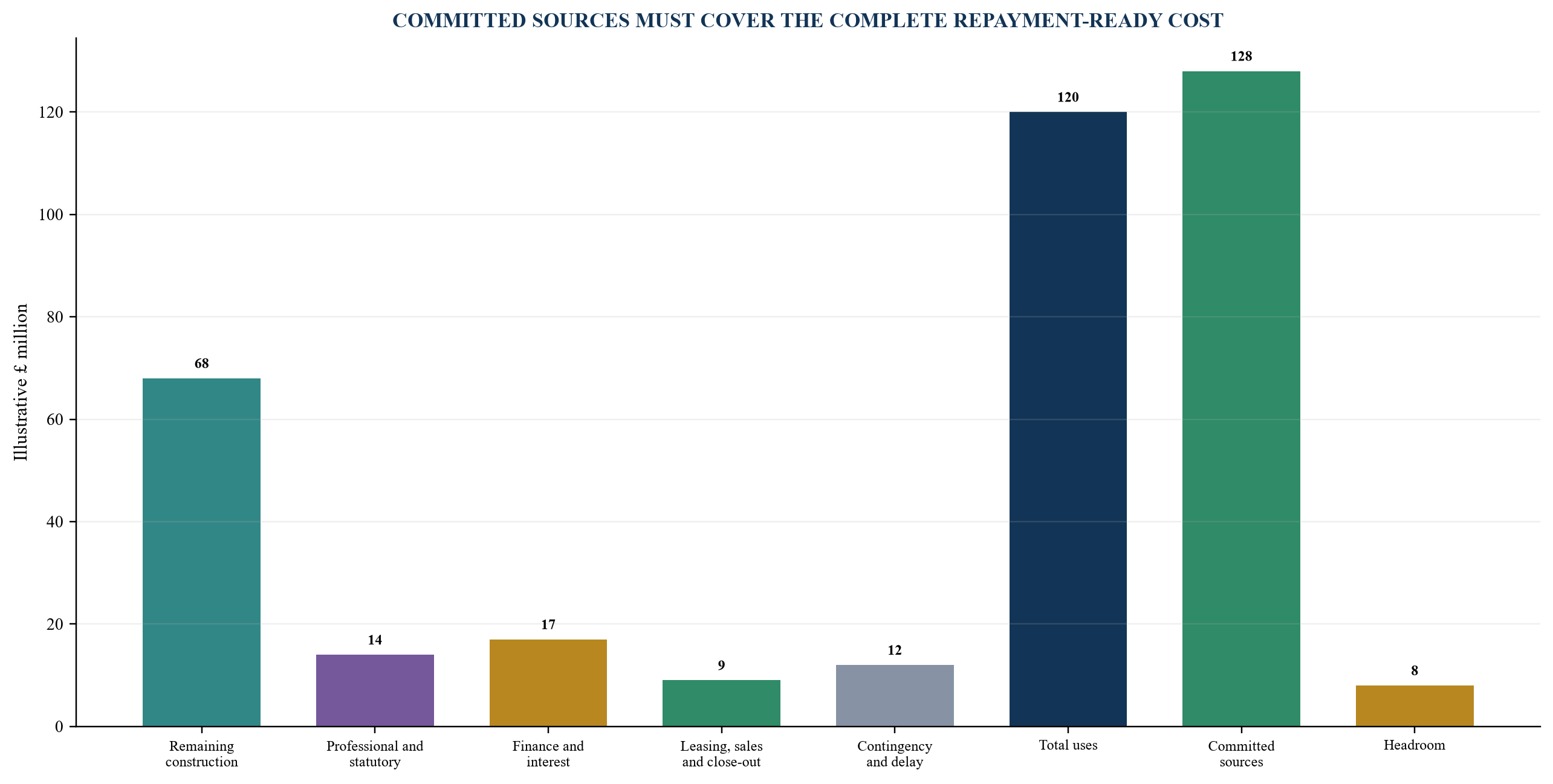
Amounts are illustrative management assumptions and do not represent an identified project.
Table 3. Illustrative cost-to-complete and funding test
| Item | Remaining use | Timing exposure | Primary evidence |
|---|---|---|---|
| construction and infrastructure | £68m | monthly certificates and long-lead deposits | contracts, programme, monitor report and variation register |
| professional and statutory | £14m | design, planning, building control and utilities | appointments, obligations and fee schedules |
| finance and interest | £17m | rate, utilisation and delay sensitive | facility model and hedging evidence |
| leasing, sales and close-out | £9m | completion and disposal dependent | agency terms, incentives and close-out plan |
| contingency and delay | £12m | released only as risks retire | quantified risk register |
| total remaining uses | £120m | must pass commitment and timing tests | reconciled development model |
| committed sponsor and lender sources | £128m | availability conditions must be satisfied | executed commitments and controlled accounts |
| illustrative headroom | £8m | available after all defined uses | sources less uses |
Amounts are illustrative management assumptions; a transaction requires current quantity-surveyor and legal evidence.
6. Make monitoring a funding control
Independent monitoring should verify more than certificate arithmetic. Each report should cover title or rights changes, planning and building-control status, programme, physical progress, construction quality, health and safety observations within scope, contracts, procurement, payment, claims, forecast final cost, contingency, insurance, sales or leasing, and the requested draw. Exceptions should state amount, date, owner and effect on completion and exit.
Reported progress can differ across cost incurred, certified value, physical quantity and elapsed programme. Materials may be paid before installation. A contractor may complete work before certification. Accounting accruals may lack lender-eligible evidence. The facility should define the measure used for valuation, draw, covenant and reporting purposes and require a bridge when measures diverge.
Draw mechanics should follow the approved budget and critical path. The lender can require monitor certification, evidence of prior draw use, equity contribution, no default, updated cost-to-complete, insurance, planning and building-control compliance, and direct payment for selected packages. The process needs sufficient speed to avoid creating contractor delay. A published draw calendar and standard information pack can combine control with operational continuity.
The variation register should separate approved, pending, disputed and potential items. It should show gross cost, savings, programme effect, contingency allocation, design and regulatory approvals, responsible party and expected resolution. A forecast saving should not offset a live claim until evidence supports both. The lender should receive trend data before a formal budget breach occurs.
Contractor health is part of development liquidity. Monitoring should cover payment conduct, subcontractor claims, retention, performance security, parent guarantees, supply-chain concentration, key package progress and signs of distress. The remedy plan can include direct agreements, replacement capacity, vesting arrangements, off-site-material control and a funded stabilisation budget. These measures require project-specific legal and technical advice.
7. Structure the capital stack as one system
Senior, stretch-senior and mezzanine labels have no universal economic meaning. The transaction should be described through priority, security, cash interest, payment-in-kind interest, amortisation, maturity, voting, enforcement standstill, cure, purchase rights and control of new money. The debt quantum should then be tested against current value, total cost, completed value and executable exit.
A stretch-senior facility may simplify documentation and decision-making while pricing the lender for a higher attachment point. A separate mezzanine tranche can preserve a lower senior advance and allocate risk to a subordinated provider, although intercreditor complexity can become decisive during delay. Preferred equity can absorb more risk but may create consent, return-accrual and control issues. Sponsor equity must remain sufficient and available to respond to cost increases.
Intercreditor terms should be modelled under the actual downside. Who can stop draws, waive covenants, approve variations, fund protective advances, extend maturity, appoint a receiver, sell the asset or acquire another lender's position? How are enforcement proceeds, insurance, rent and sale cash applied? Can a junior lender cure and, if so, within what period? A theoretical priority can lose practical value when parties cannot act within the construction timetable.
The structure should preserve new-money capacity. When a project needs completion funding after a breach, value can depend on rapid access to senior protective advances or a pre-agreed rescue tranche. Documents should address priority, approval, cap, permitted use and reporting for that capital. Assuming the original sponsor will always cure creates an unsupported dependency.
Table 4. Capital-stack decision matrix
| Dimension | Senior | Stretch-senior | Mezzanine or preferred capital | Credit decision |
|---|---|---|---|---|
| attachment | first-loss protection from sponsor capital | higher advance within one facility | subordinated or structurally distinct | measure against stressed value and funded completion |
| return | cash interest and fees | higher cash or blended return | cash, payment-in-kind or preferred return | include all accrual in exit debt |
| control | primary security and draw control | usually consolidated control | consent and cure rights | create one executable decision protocol |
| maturity | aligned to completion and exit | may include extension mechanics | should not force premature senior default | align all long-stop dates |
| new money | protective advances and completion funding | facility accordion where committed | rescue capital subject to priority | agree priority before distress |
| enforcement | first-ranking route subject to law | consolidated lender action | standstill, cure or purchase right | test action under a delayed project case |
Terms are transaction-specific; labels do not establish legal or economic priority.
8. Size the interest reserve through a monthly waterfall
Capitalised interest is a cash use. The reserve should be calculated from monthly opening debt, expected utilisation, contractual cash and payment-in-kind margins, base-rate assumptions, fees, hedging, commitment charges and the anticipated repayment date. It should extend beyond physical completion through regulatory approval, leasing, sale or refinance. A simple percentage of facility size can miss both utilisation timing and delay.
The Bank of England held Bank Rate at 3.75% on 30 July 2026.[2] Market pricing, facility margins and hedging costs require transaction-date evidence. The reserve should use a base case and explicit rate and delay stresses. Where interest is payable from rent, the model must bridge gross rent to collected net operating cash after vacancy, incentives, operating expenditure, tax and required reserves.
The waterfall should allocate available funds in a defined order. Typical uses can include statutory and safety-critical costs, insured preservation, approved construction, lender fees and interest, taxes, professional fees and other budget lines. The order depends on documents and project needs. Protecting collateral sometimes requires construction expenditure before scheduled debt service; that decision should be governed rather than improvised.
Reserve control requires thresholds. A minimum months-of-interest test, projected shortfall date, reserve-replenishment trigger, cash-trap threshold and draw-stop threshold can create early action. The test should use projected debt and rate rather than current interest alone. Recalculation follows every material cost, programme, leasing, sale or funding change.
Interest reserve and construction contingency serve different risks. Combining them can hide erosion. A draw that pays interest from contingency reduces the funds available to complete. Separate ledgers, permitted transfers and approval rules preserve transparency. The credit committee should see the projected completion headroom and interest headroom together.
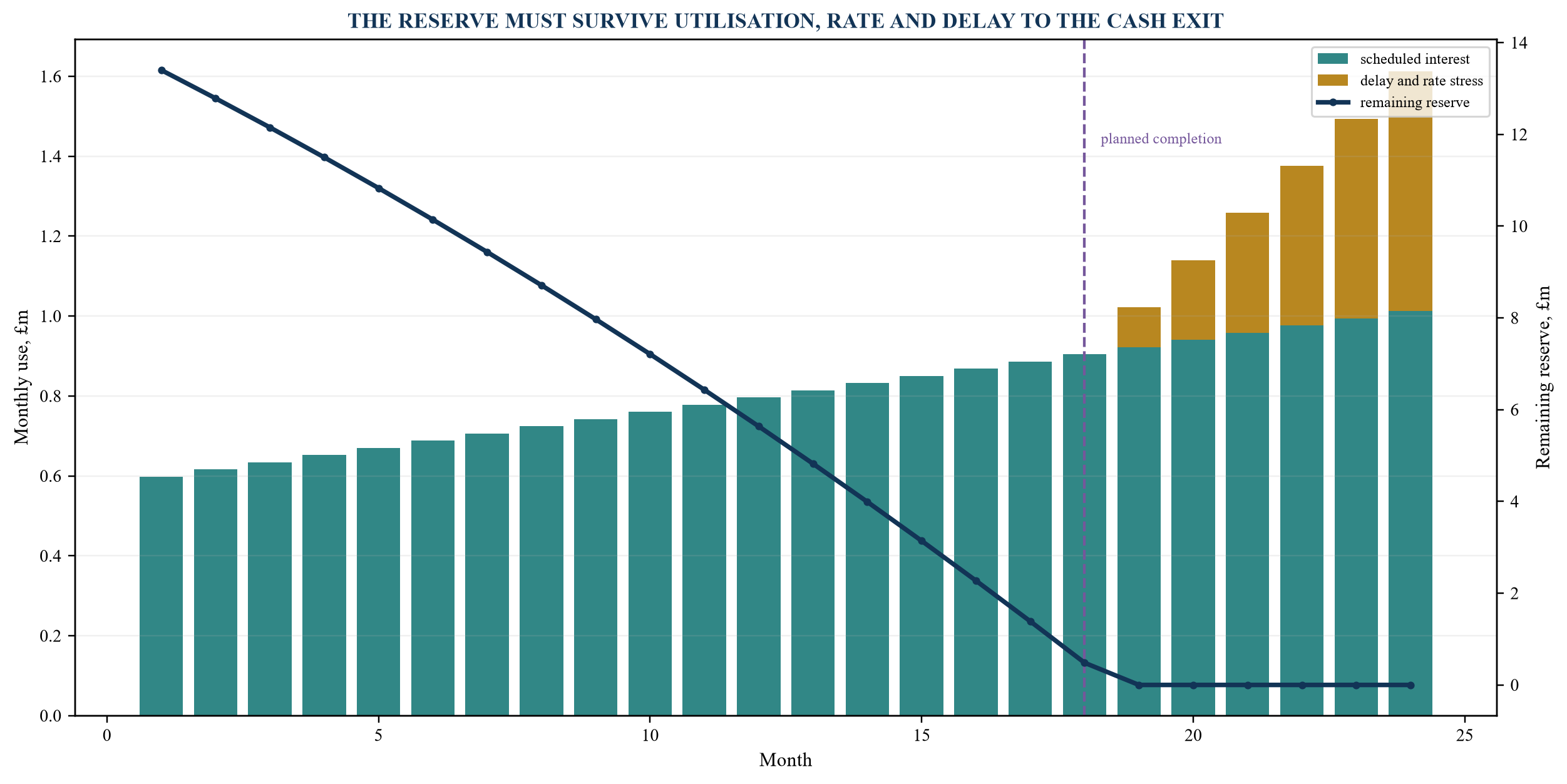
Amounts are illustrative management assumptions and exclude transaction-specific tax, hedging and fee effects.
9. Prove demand before relying on stabilised value
The exit case should use evidence appropriate to the asset. For investment property, the leasing schedule should show unit or area, tenant, covenant, rent, incentives, break, review, service charge, fit-out, deposit or guarantee, lease status and expected commencement. Heads of terms, agreements for lease and completed leases carry different certainty. The model should distinguish contracted, under offer, actively negotiated and assumed occupancy.
For residential or other unit sales, the schedule should show unit, price, deposit, contract status, conditions, purchaser funding, completion date, cancellation rights and expected net proceeds. Gross development value does not equal lender cash. Sales commissions, incentives, taxes, defects, retentions, purchaser claims and debt-release mechanics need a net and timed waterfall.
Demand evidence should be reconciled to current comparable transactions, competing supply, absorption, tenant or buyer concentration, incentives and finance availability. The underwriting team should record the data period and limitations. A valuation provides an independent opinion within defined assumptions; it does not replace the lender's analysis of cash timing and debt capacity.
Stabilisation needs a contractual definition. It can require a minimum occupancy, weighted-average lease term, tenant-quality threshold, collection history, completed incentives, operating-cost evidence and absence of material arrears. A refinance model that uses full rent on the day of practical completion compresses lease-up and operating evidence into an unsupported assumption.
The downside case should model slower lease-up or sales, lower rent or price, higher incentives, tenant failure, delayed occupation and longer disposal. These stresses interact with interest and value. A three-month delay increases debt while postponing income. A higher exit yield reduces value precisely when the debt balance is larger.
10. Size take-out capacity from income, value and coverage
Refinance capacity is the lowest amount permitted by several constraints. The first is loan-to-value against an independent valuation under appropriate assumptions. The second is debt-service coverage against sustainable net operating income and the take-out lender's interest and amortisation. The third is debt yield or another income-based policy limit. The fourth is lender appetite, asset eligibility, concentration, sponsor and market liquidity at the future date.
Net operating income should be bridged from contracted gross rent through vacancy, rent-free periods, incentives, bad debt, non-recoverable service charge, operating expenditure, management, insurance and maintenance reserves. One-off income and speculative rent should be separated. The analysis should state whether the metric is in-place, passing, contracted, stabilised or market-based.
Valuation sensitivity should combine net operating income and yield. A yield shift affects value directly; a delay or leasing shortfall affects income and may also influence the yield. The facility's exit debt includes drawn principal, capitalised interest, payment-in-kind accrual, exit fee, hedging break cost and unpaid expenses. Refinance headroom is take-out proceeds less that complete debt amount and transaction cost.
The Bank of England's July 2026 Financial Stability Report noted that some private-debt borrowers from the 2021 lower-rate vintage would need to refinance in the coming year and could face tighter conditions.[1] This observation supports early maturity preparation. It does not establish pricing or availability for an individual real-estate transaction.
Refinance diligence should begin well before maturity. The borrower needs clean title, permissions, completion evidence, leases, operating statements, valuation, tax and insurance records, environmental information, building-safety documentation, corporate records and a lender-ready model. A credible timetable should allow lender selection, credit approval, valuation, legal diligence, documentation and drawdown, with a contingency route if a requirement slips.
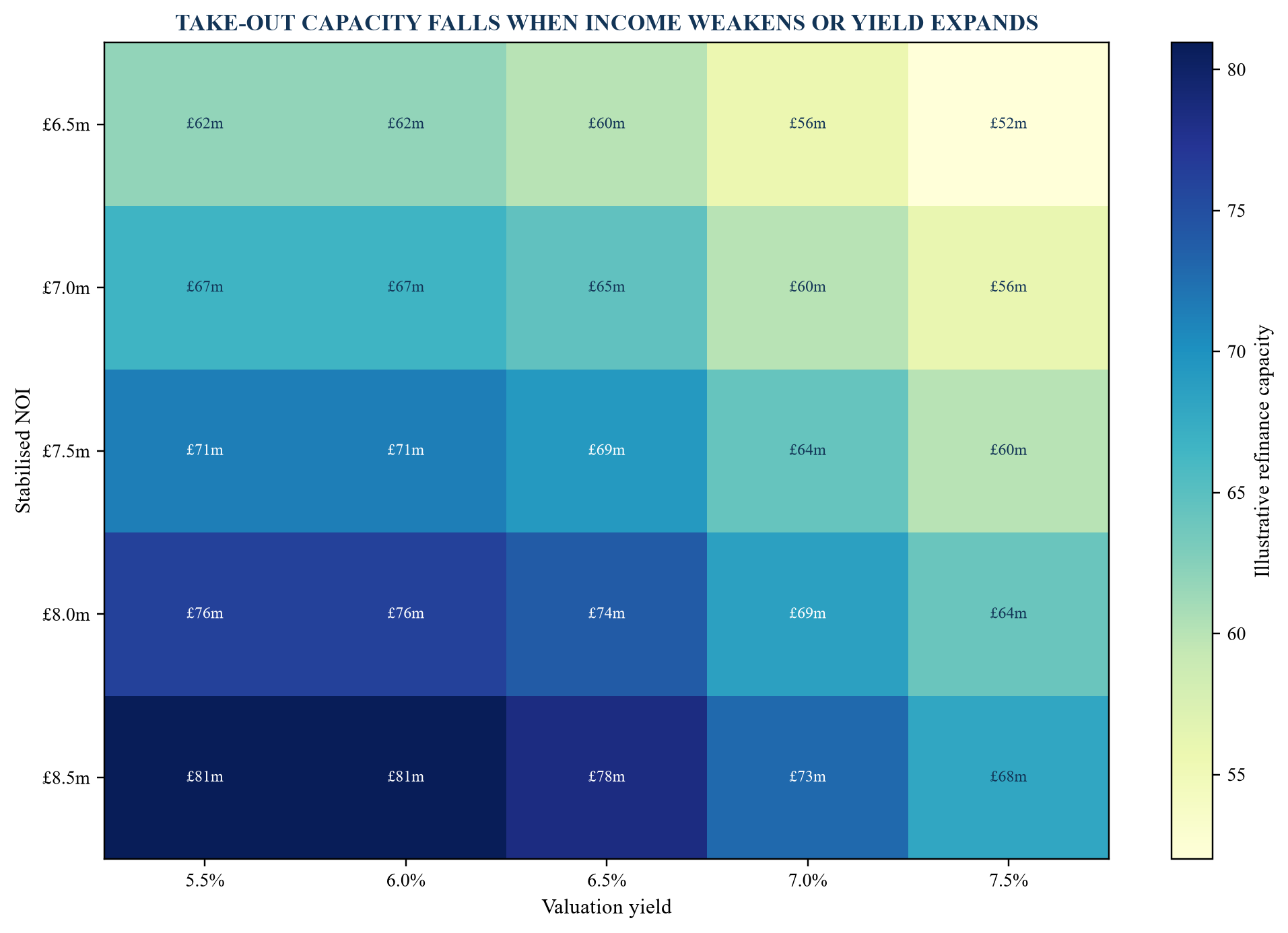
Capacity is the lower of a 60% loan-to-value limit and a 1.50x interest-coverage limit at an illustrative 7.0% all-in interest rate; figures are management assumptions.
Table 5. Illustrative refinance bridge and combined stress
| Case | Stabilised NOI | Valuation yield | Implied value | Constrained take-out | Exit debt | Headroom or shortfall |
|---|---|---|---|---|---|---|
| base | £8.0m | 6.0% | £133m | £76m | £69m | £7m |
| leasing delay | £7.0m | 6.0% | £117m | £67m | £71m | (£4m) |
| yield expansion | £8.0m | 7.0% | £114m | £69m | £70m | (£1m) |
| combined downside | £6.5m | 7.5% | £87m | £62m | £73m | (£11m) |
| recovery action | £7.4m | 6.75% | £110m | £70m | £68m | £2m |
Values are illustrative management assumptions; actual take-out terms require future lender evidence.
11. Treat valuation as a governed process
The valuation instruction should identify property, interest, valuation date, purpose, basis of value, information, assumptions, special assumptions, development status and intended reliance. Development property often requires a residual analysis in addition to comparison or investment methods. The Royal Institution of Chartered Surveyors publishes guidance on valuation of development property, and International Valuation Standards provide the overarching standards framework.[17][18]
Residual value is highly sensitive to completed value, construction cost, time, finance and developer return. The lender should obtain the valuer's sensitivity and reconcile it to the credit model. Differences can arise from measurement, rental assumptions, incentives, purchaser costs, profit, programme and treatment of committed expenditure. A reconciliation is more useful than selecting the more favourable number.
Private-market valuation governance also offers relevant discipline. The Financial Conduct Authority's review of private-market valuation practices emphasised governance, independence, documented methodology, ad hoc valuation triggers and backtesting.[16] A real-estate lender can apply those controls through a valuation policy, approved panel, conflict process, review triggers and comparison of realised outcomes with prior marks.
Ad hoc triggers can include planning change, gateway delay, material cost increase, contractor distress, insurance event, leasing shortfall, tenant failure, market transaction, covenant breach or maturity proximity. The facility should define when an updated valuation is required and who bears the cost. A valuation update needs enough time to inform action before a covenant or maturity date.
Value should be presented in layers: current as-is value, value subject to defined assumptions, completed value, stabilised investment value and net realisable value under an accelerated or constrained sale. The credit decision should state which layer supports each covenant and repayment route. Gross value should never be treated as net cash without cost, time and priority deductions.
12. Build covenants around leading indicators
Traditional loan-to-value and loan-to-cost covenants remain important, yet they often respond after a project has weakened. Leading indicators can identify pressure earlier. These include planning or gateway slippage, forecast cost increase, contingency consumption, unpaid certificates, programme float, procurement delay, contractor concentration, reserve runway, leasing conversion, sales cancellation, tenant concentration and refinance milestones.
A covenant architecture should connect information, threshold and remedy. A watch threshold increases reporting or requires a meeting. A cash-control threshold traps proceeds. A draw-stop threshold prevents additional exposure. A cure threshold requires equity, cost reduction, leasing progress or other evidence. Default and enforcement thresholds should remain proportionate to the project and documents.
The lender dashboard should reconcile approved budget, current forecast, draw history, physical progress, programme, planning, building control, interest reserve, leases or sales, valuation, debt and exit. Every figure should have a data owner and as-of date. Exceptions require narrative, amount, decision and next evidence. Repeated unexplained model overrides are themselves a governance signal.
Information rights should survive pressure. The lender may need access to the borrower, sponsor, project monitor, valuer, property manager, contractor and advisers, subject to contractual and legal boundaries. Data rooms should preserve executed documents, current models, certificates, correspondence and approvals. A downside handover file is easier to build during normal operation than after a control dispute.
Table 6. Leading-indicator covenant ladder
| Indicator | Watch response | Control response | Escalation response |
|---|---|---|---|
| planning or gateway delay | updated critical path and adviser report | reserve increase and draw condition | funded cure plan or stop affected works |
| forecast cost increase | independent validation | equity injection or scope solution | default if completion funding remains deficient |
| contingency erosion | weekly exception reporting | restricted release and sponsor top-up | revised facility decision |
| interest runway | monthly recalculation | cash trap and replenishment | extension or recapitalisation process |
| leasing or sales gap | evidence-based recovery plan | controlled incentives and disposal mandate | alternative exit activation |
| refinance milestone slip | lender pipeline and data-room review | appoint debt adviser and commence sale preparation | execute fallback route before maturity |
| contractor distress | supply-chain and replacement assessment | direct payment or protective advance | step-in, replacement or consensual stabilisation |
Thresholds must be calibrated to the actual project, facility and legal documents.
13. Design the exit option tree before closing
Exit liquidity is the capacity to complete a defined repayment transaction within available time and cost. A projected maturity value is not liquidity. The borrower may need months to stabilise income, prepare information, obtain valuation, satisfy lender diligence, negotiate documents and close. Sale can require preparation, marketing, bidder diligence, planning or title remedies and transaction execution. The facility timetable should work backwards from maturity.
The option tree can include stabilised refinance, investment sale, unit or phased disposals, portfolio sale, partial recapitalisation, sponsor take-out, consensual extension, loan sale, appointment of a receiver or administrator, completion with new money and incomplete-project sale. Each option has an information requirement, decision owner, lead time, cash result and execution risk.
Option value declines when decisions are delayed. A refinance pursued exclusively until weeks before maturity can leave insufficient time for an orderly sale. The governance schedule should set objective decision dates. For example, failure to reach a specified occupancy or term-sheet threshold by a defined date can trigger dual-track sale preparation. The actual dates depend on the project and facility.
Transaction costs and release mechanics must enter the proceeds waterfall. Agents, lawyers, tax, hedging, remediation, tenant incentives, purchaser deductions, senior debt, junior debt and other claims reduce cash. Asset sale and company sale may produce different diligence, tax, consent and liability outcomes. The lender should avoid assuming that the economically highest headline offer produces the highest or earliest controlled cash.
The enforcement option requires specialist advice. Administration, receivership and fixed-charge receivership can have different powers, objectives and practical effects.[13][14] HMRC also publishes specific guidance on VAT and Law of Property Act receivers.[15] The downside plan should identify appointment conditions, information, insurance, operational control, funding, tax, stakeholder communication and sale authority before a default occurs.
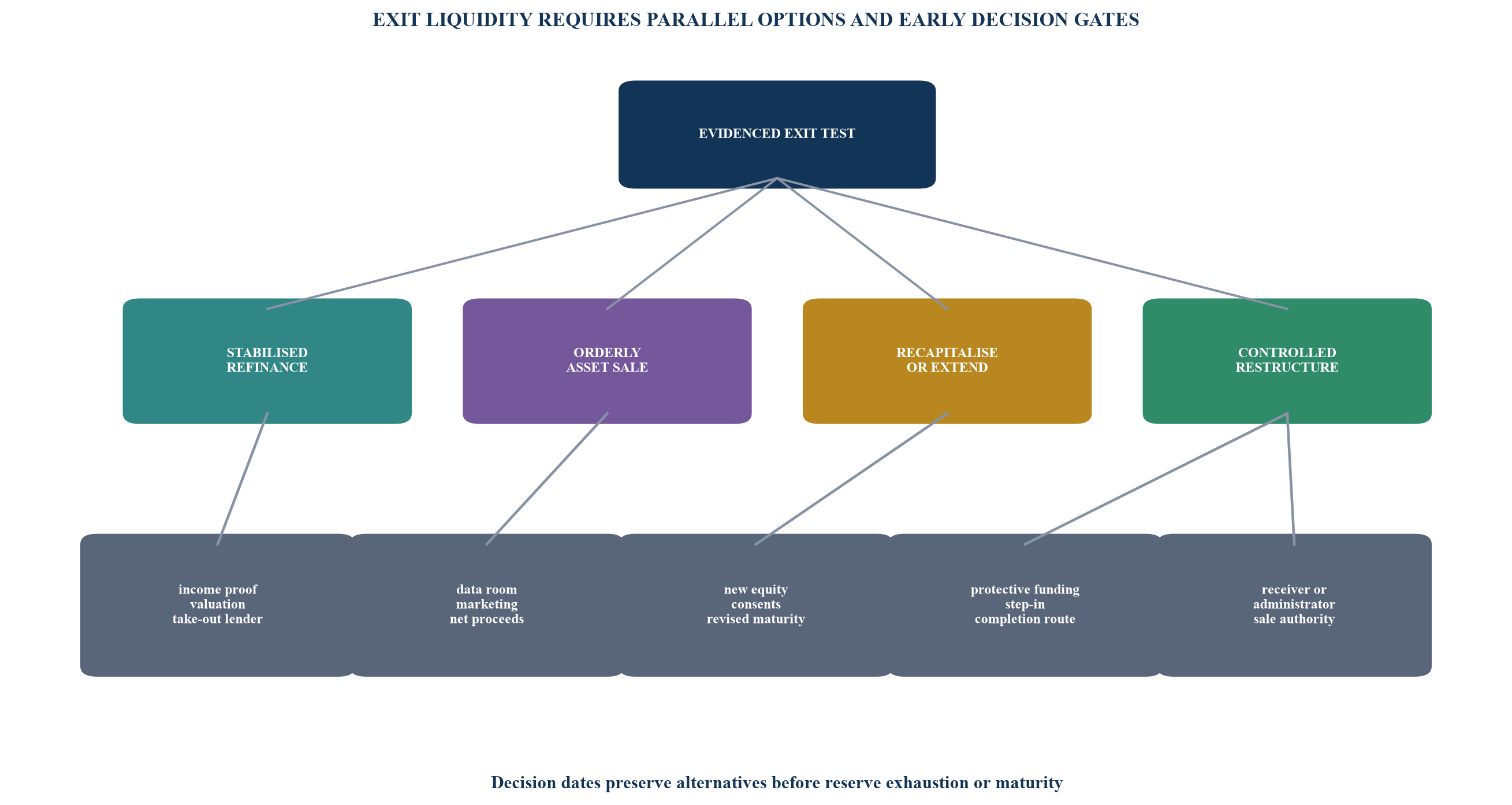
The selected route should be supported by dated evidence, a responsible decision owner and sufficient liquidity runway.
14. Run a ten-day underwriting diagnostic
A focused diagnostic can establish whether the project merits full underwriting. Days one and two reconcile the borrower, sponsor, ownership, title, facility request, existing finance and use of proceeds. Days three and four map planning, building control, contracts, programme and critical permissions. Days five and six rebuild cost-to-complete, committed sources, monthly liquidity and interest reserve. Days seven and eight test demand, valuation, refinance capacity and sale proceeds. Days nine and ten align security, intercreditor, covenants, conditions and exit options.
The output should include a one-page decision summary, issue register, evidence index, sources-and-uses bridge, liquidity forecast, sensitivity, security map and proposed terms. Every unresolved item should be classified by amount, timing and remedy. A red item blocks financeability. An amber item requires a condition, reserve, haircut, covenant or priced risk acceptance. A green item has current evidence and an accountable owner.
The diagnostic should preserve independent challenge. Sponsor forecasts, contractor schedules, agent views and valuation assumptions are inputs. The lender's case should reconcile them and document differences. Site visits, adviser calls and primary documents provide context that a data-room inventory alone cannot supply.
The process should avoid false precision. A cost estimate without design maturity, a rent assumption without lease evidence or an enforcement period without counsel input should be described as an assumption and given a decision path. Numerical sophistication cannot compensate for missing rights, approvals or control.
At the end of ten days, the decision can be proceed to terms, proceed subject to specified evidence, restructure the request, or decline. A rapid and transparent decline can preserve borrower time. A conditional proceed should list evidence owners and deadlines before credit committee or closing.
15. Use the first 100 days to convert conditions into control
After signing, the first 100 days establish the operating discipline of the facility. Days one to ten complete perfection, notices, account control, data-room baseline and reporting calendar. Days eleven to thirty validate budget, programme, procurement, planning and building-control schedules with the independent monitor. Days thirty-one to sixty test the first draw, equity contribution, payment control and variance process. Days sixty-one to one hundred review reserve runway, critical-path progress and exit milestones.
Conditions subsequent should have named owners and escalation. Land Registry completion, document delivery, insurance endorsements, warranties, consents and project information can remain outstanding after funding for practical reasons. The tracker should show due date, evidence and consequence. Repeated waiver without a dated cure weakens the original credit structure.
The baseline model should be locked and versioned. Changes to cost, programme, funding, interest, leasing, sales and exit should be recorded through a controlled forecast. The lender should receive both original and current cases. Variance analysis should explain what changed, why, cash effect, covenant effect and required decision.
The exit workstream begins during this period. The team should establish the future refinance data room, valuation milestones, lender universe, sale fallback, regulatory evidence and sponsor decision process. Waiting until construction completion transfers avoidable preparation into the maturity window.
The 100-day review should confirm whether risk has reduced as expected. If planning, cost, programme or demand has weakened, the lender can act while liquidity and alternatives remain. Early action may include additional equity, scope change, contractor intervention, leasing strategy, extension conditions, partial sale or a dual-track exit.
16. Separate scenario assumptions from observed evidence
Every decision model combines observed facts, contractual facts, professional opinions and management assumptions. The model should label the source and as-of date of each critical input. Title entries, executed contracts, regulator decisions, certified work and bank statements are evidence of defined matters. A valuation is a professional opinion under its stated scope. Future rent, cost, interest, time and exit are assumptions even when supported by market evidence.
Base, downside and severe cases should change connected variables. A planning or gateway delay increases professional fees, contractor preliminaries and interest while postponing rent or sale. A leasing shortfall reduces income, affects valuation and can constrain refinance. Contractor distress can increase cost and delay. A yield expansion can coincide with lower lender advance and higher interest cost. Independent single-variable sensitivities can understate those combinations.
Management actions belong in a separate column. Cost reductions need design, planning, building-control and contract feasibility. Additional equity needs evidence of capacity and commitment. Faster leasing may require incentives that reduce net income. Asset sale needs a marketing period and net proceeds. Actions should enter the case only after their preconditions, cost and ownership are stated.
Backtesting improves future underwriting. At completion or repayment, the lender can compare actual cost, programme, utilisation, interest, rent, value, proceeds and recovery with the original and latest cases. The analysis should identify estimation error, process failure and unforeseeable events separately. Findings should update policy, information requirements and stress calibration.
17. Practical questions for credit committee
Credit committee should be able to answer a short set of questions from the evidence pack. What exact property right is financed and perfected? Which permission or certificate releases construction, occupation and exit cash? What is the independently verified total cost to the repayment-ready state? Are committed funds sufficient, and does cash arrive before every obligation? What happens if completion is six months late?
The committee should understand which capital-stack constraint binds. It should see senior and junior priority, accrued returns, protective-advance capacity and decision rights. It should know the projected date when interest headroom reaches each threshold and the sponsor's funded cure obligation.
The take-out case should show sustainable income, value, exit debt and the lower of all refinance limits. It should include a combined downside and a recovery case whose actions are executable. Any reliance on a future lender term sheet should identify its conditions and expiry.
The exit tree should identify the last responsible decision date for each route. A sale fallback needs a data room, adviser route, valuation and net-proceeds view. A restructure route needs funding and control. An enforcement route needs legal powers, operational capability and a preservation budget.
The final decision should state the principal risks in plain language, the evidence supporting acceptance, the controls that reduce exposure and the events that trigger action. Pricing can compensate for risk only when the risk remains measurable, financeable and within mandate. Missing authority, completion funding or exit control can make a high return irrelevant.
18. Conclusion
Private credit can finance UK real-estate development when the structure recognises the project as a chain of rights, approvals, construction obligations, cash uses, demand evidence and exit decisions. The lender's protection comes from proving and governing each transition.
The six tests provide a repeatable discipline. Legal and planning readiness establish what can be built and secured. Cost-to-complete integrity proves both committed funding and cash timing. Capital-stack coherence aligns priority and control. The interest-reserve waterfall protects the period to cash generation. Refinance sensitivity measures realistic take-out capacity. The exit option tree preserves alternatives before maturity pressure removes them.
The result is a facility that can respond to change. Current evidence, independent monitoring, leading indicators, controlled cash and early exit work allow lender and borrower to address cost, delay, demand and market risk while options remain. That operating system is the central credit asset.
References
- Bank of England. Financial Stability Report, July 2026. https://www.bankofengland.co.uk/financial-stability-report/2026/july-2026
- Bank of England. Monetary Policy Summary and Minutes, July 2026. https://www.bankofengland.co.uk/monetary-policy-summary-and-minutes/2026/july-2026
- Ministry of Housing, Communities and Local Government. National Planning Policy Framework, 17 August 2026. https://www.gov.uk/guidance/national-planning-policy-framework
- Building Safety Regulator. Strategic Plan 2026 to 2027. https://www.gov.uk/government/publications/building-safety-regulator-strategic-plan-2026-to-2027/building-safety-regulator-strategic-plan-2026-to-2027
- Ministry of Housing, Communities and Local Government. Building Safety Levy Guidance. https://www.gov.uk/guidance/building-safety-levy-guidance/section-1-introduction
- Ministry of Housing, Communities and Local Government. National Planning Policy Framework: Decision-making. https://www.gov.uk/guidance/national-planning-policy-framework/4-decision-making
- Ministry of Housing, Communities and Local Government. National Planning Policy Framework: Making Effective Use of Land. https://www.gov.uk/guidance/national-planning-policy-framework/11-making-effective-use-of-land
- Building Safety Regulator. Building Control Approval Application Data, March to May 2026. https://www.gov.uk/government/publications/building-safety-regulator-building-control-approval-application-data-march-to-may-2026/building-safety-regulator-building-control-approval-application-data-march-to-may-2026
- Office for National Statistics. Construction Output in Great Britain, March 2026. https://www.ons.gov.uk/businessindustryandtrade/constructionindustry/bulletins/constructionoutputingreatbritain/march2026newordersandconstructionoutputpriceindicesjanuarytomarch2026/pdf
- Companies House. Register a Charge for a Limited Company. https://www.gov.uk/guidance/register-a-charge-mortgage-for-a-limited-company
- Companies House. Form MR01: Register Particulars of a Charge. https://www.gov.uk/government/publications/register-particulars-of-a-charge-mr01
- HM Land Registry. Practice Guide 36A: Receivers Appointed under the Law of Property Act 1925. https://www.gov.uk/government/publications/dispositions-executed-by-law-of-property-act-receivers-pg36a/practice-guide-36a-receivers-appointed-under-the-provisions-of-the-law-of-property-act-1925
- HM Land Registry. Practice Guide 36: Administration and Receivership. https://www.gov.uk/government/publications/administration-and-receivership-pg36/practice-guide-36-administration-and-receivership
- Insolvency Service. Insolvency Practitioner Handbook: Types of Insolvency. https://www.gov.uk/guidance/insolvency-practitioner-s-handbook/2-types-of-insolvency
- HM Revenue & Customs. Insolvency Practitioner Handbook: Law of Property Act. https://www.gov.uk/guidance/insolvency-practitioner-s-handbook/17-law-of-property-act
- Financial Conduct Authority. Private Market Valuation Practices. https://www.fca.org.uk/publications/multi-firm-reviews/private-market-valuation-practices
- Royal Institution of Chartered Surveyors. Valuation of Development Property. https://www.rics.org/profession-standards/rics-standards-and-guidance/sector-standards/valuation-standards/valuation-of-development-property
- International Valuation Standards Council. International Valuation Standards. https://ivsc.org/standards/
