

1. Portfolio finance begins with project-level cash evidence
Renewable-energy platforms are often presented through aggregate capacity: megawatts operating, under construction, contracted or in a development pipeline. Capacity is a useful industrial measure. Debt is repaid from cash. The underwriting bridge must therefore begin below the platform headline and trace every material rupee from an operating asset to the account from which interest and principal are paid.
For each project, the evidence chain should cover ownership and operating rights; land or roof access; grid connectivity; commissioning and commercial-operation status; technology and equipment; metering; the power-purchase or sale arrangement; tariff; generation; invoices; receivables; operating cost; taxes; debt service; distribution restrictions; and cash transfer to the financing group. A weakness at any link can interrupt cash even when equipment is producing electricity.
India's renewable portfolio is increasingly diverse. Utility-scale projects sell through central or state procurement programmes. Commercial and industrial projects may use captive, group-captive, open-access or rooftop structures. Hybrid projects combine wind, solar and storage. Some assets rely on market sales or renewable attributes. These arrangements differ in counterparty, tenor, settlement, grid charge, curtailment, scheduling and change-in-law exposure. Portfolio finance should preserve those differences rather than compress them into one average tariff and one average plant load factor.
The first lender deliverable should be an asset register that reconciles technical, contractual and financial records. It should identify which legal entity owns each asset, which accounts collect revenue, which contracts are assignable, which liabilities rank ahead of portfolio debt and which cash can legally move upstream. The register becomes the control surface for eligibility, valuation, covenants, reporting and enforcement.
A platform can then be divided into three perimeters. The operating perimeter contains commissioned assets with cash history. The migration perimeter contains assets approaching commercial operation or refinancing eligibility. The pipeline perimeter contains development opportunities and acquisition candidates. Scheduled debt service should rely primarily on operating-perimeter cash. Migration and pipeline value can support growth options after objective gates are satisfied.
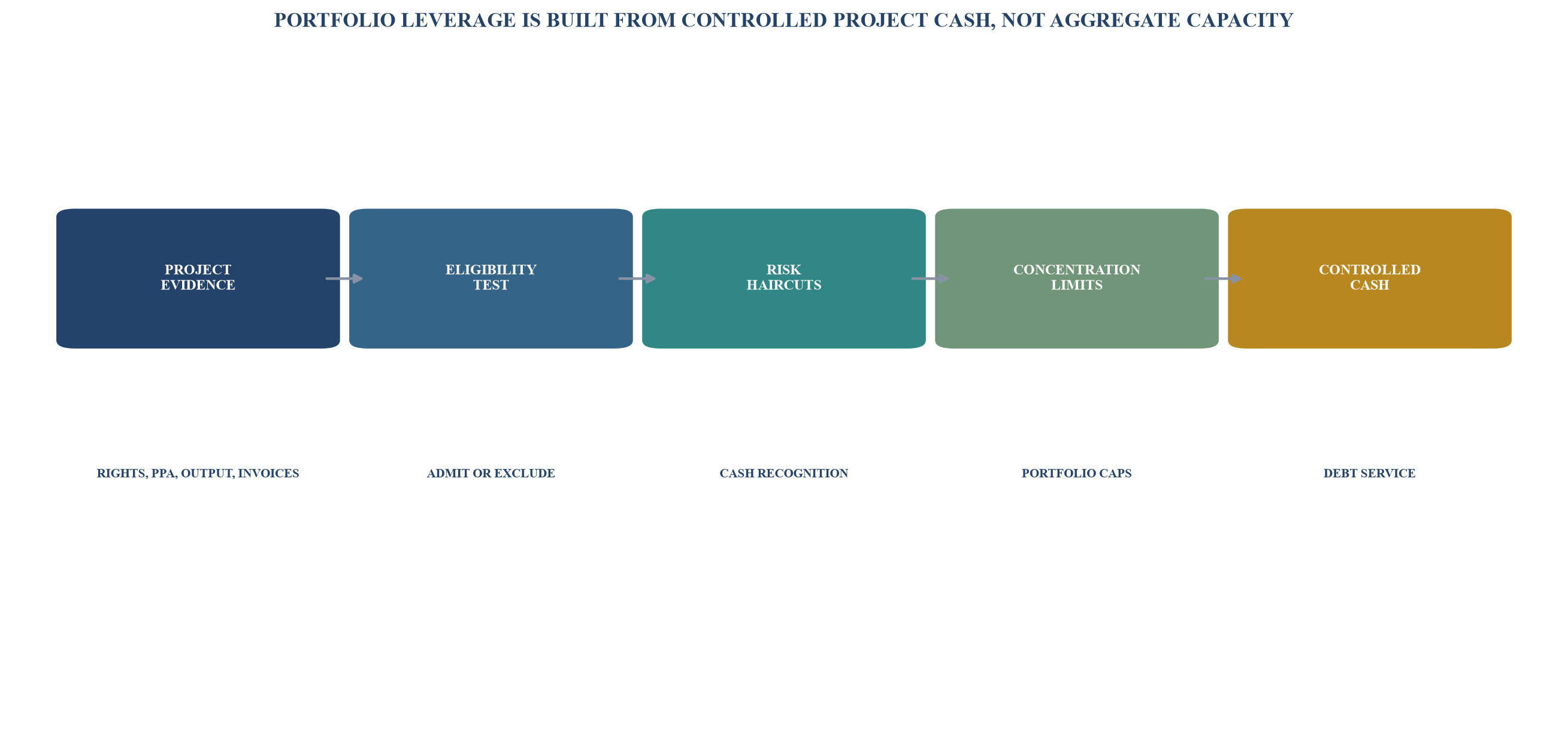
Portfolio debt capacity is assembled from verified project cash after eligibility, concentration and control tests.
2. Define the consolidation and security perimeter
The accounting group, operating group and security group may differ. A consolidated platform can include projects whose shares or assets cannot be pledged, projects with existing lenders, joint ventures with minority rights, or assets subject to contractual restrictions. A debt model that consolidates their cash without recognising those barriers can materially overstate available support.
The financing perimeter should be drawn entity by entity. For each project company, diligence should identify shareholders, minority protections, existing debt, permitted distributions, security, account arrangements, tax leakage and regulatory approvals. Cash should enter the portfolio model only when the lender can establish its legal availability and the conditions for transfer.
Ring-fencing can improve credit by separating eligible operating assets from development liabilities. It can also create rigidity. A strict security group may be unable to support a new project before admission. A broad group may expose operating cash to construction claims, tax liabilities or cross-defaults. The appropriate boundary depends on whether the facility is intended to refinance stable assets, fund acquisitions, bridge construction or provide all three functions.
Three common structures deserve comparison. A hold-company loan relies on distributions from project companies and may sit structurally behind local creditors. A common-terms platform facility can create coordinated security and cash controls across eligible projects. A borrowing-base facility advances against a changing pool subject to admission, valuation and concentration tests. Each structure should state how assets enter and leave, how cash is trapped, how debt is allocated and what happens when one project underperforms.
Security should follow the cash and control analysis. It may include project-company shares, receivables, bank accounts, material contracts, insurance proceeds and movable assets, subject to local law and existing restrictions. Direct agreements can protect continuity under PPAs, operation contracts and key permits. Enforcement analysis should consider whether a replacement owner or operator can retain licences, land access, grid rights and contractual benefits.
3. Standardise the project data before aggregating it
Portfolio models fail when project data uses inconsistent definitions. One asset may report generation at the inverter; another at the settlement meter. One project may classify grid outage as curtailment; another as availability loss. Receivable days may be measured from invoice date, due date or recognition date. A central data dictionary is therefore a credit control, not an administrative convenience.
The platform should define capacity, commercial operation, availability, deemed generation, contracted generation, net generation, billed energy, collected revenue, operating expenditure, maintenance capex, project free cash flow and cash available for debt service. It should specify units, cut-off times, source systems, adjustments, sign-offs and restatement rules. Historical data should reconcile to meter statements, invoices, bank accounts and audited financial records.
Monthly data is usually the minimum useful frequency. Solar output has strong seasonality; wind profiles vary by monsoon and region; hydro depends on water; corporate demand changes with operating cycles. Annual averages hide periods when debt service is tight. The model should capture at least one full seasonal cycle and preferably several years of operating history for mature assets.
Data quality should affect eligibility. An asset with missing meter data, unresolved invoice reconciliation or unexplained output variance may remain economically valuable but receive a lower advance rate or temporary exclusion. This creates an operational incentive: improving data, collections and contract records can release debt capacity without increasing headline leverage.
Centralised reporting also supports early warning. Variance dashboards should compare actual generation, tariff, billing, collection, operating cost and cash transfer with budget. They should separate technical underperformance from grid events, counterparty delay and accounting timing. A covenant breach discovered at quarter end is late; a financing platform should detect the driver within the monthly reporting cycle.
4. Score power-purchase and sale arrangements
The term PPA can conceal very different credit. A central procurement agreement, a state-distribution-company contract, a corporate offtake arrangement, a captive structure and market exposure allocate price, volume, curtailment, settlement and termination risk differently. The lender needs a scored contract register rather than a binary contracted or merchant label.
The scorecard should cover obligor credit, remaining tenor, tariff mechanics, indexation, minimum purchase or availability obligation, deemed-generation treatment, curtailment allocation, scheduling and deviation costs, change in law, invoicing, payment security, payment history, termination compensation, assignment, lender cure and dispute process. Scores should be supported by executed documents and operating evidence.
Payment security deserves specific attention. The SECI standard short-term PPA provides an example of a revolving letter of credit sized to weekly energy and drawable after a stated payment delay.[5] A lender should examine the actual contract in each project: amount, validity, automatic renewal, draw conditions, issuing bank, replenishment and relationship with late-payment rules. An instrument that is difficult to draw, undersized or allowed to lapse should not receive full credit.
Corporate offtake can diversify away from distribution-company exposure while creating concentration in industrial sectors and sponsors. The analysis should combine legal commitment with business durability, electricity-use profile, operating location, alternative supply, security and replacement value. A high-quality customer under a cancellable short-term arrangement may be weaker than a moderate-quality counterparty with strong termination payment and security.
Table 1. PPA and sale-arrangement scorecard
| Dimension | Strong evidence | Watch condition | Weak condition | Financing response |
|---|---|---|---|---|
| counterparty | durable credit, audited capacity and established payment record | concentrated sector or moderate delay | stressed payer or unresolved arrears | haircut cash, add reserve or exclude |
| tenor | maturity extends beyond debt with clear renewal value | limited tail after debt | expiry before debt maturity | shorten tenor or require amortisation |
| revenue | fixed or formula-based payment with defined indexation | partial volume or market exposure | unbounded price and volume risk | conservative floor and cash sweep |
| curtailment | compensation or clear allocation | capped compensation | broad uncompensated curtailment | generation haircut and reserve |
| payment security | funded reserve, evergreen LC or credible guarantee | renewal or draw complexity | absent, expired or disputed | covenant cure before advance |
| termination | defined debt-protective compensation | conditional or delayed payment | no meaningful compensation | restrict leverage and require takeout |
| assignment and cure | lender consent, notice and cure rights | consent not pre-agreed | prohibition or easy termination | legal condition to eligibility |
Scores should be evidence-backed and refreshed when contracts, payment history or counterparty conditions change.
5. Measure generation covariance before claiming diversification
Diversification is valuable when cash-flow drivers do not fail together. The number of projects is a poor proxy. Ten solar projects in the same irradiation zone, using similar equipment and selling to one counterparty can behave like one large exposure. A smaller pool combining solar, wind, storage, different regions and different customers may have better temporal and credit diversification.
Generation analysis should use monthly or finer data. For each asset, the lender should calculate expected generation, variance, downside percentiles and correlation with every other asset. The analysis should distinguish resource correlation, grid correlation, technology correlation and counterparty correlation. A statistical reduction in generation volatility can be outweighed by one shared transmission constraint or payer.
Solar generation tends to be correlated during daylight and seasonal weather patterns. Wind regimes can differ across states and sometimes complement solar. Storage can shift delivery and reduce deviation exposure, but its cash depends on dispatch rules, degradation and charging economics. Hybrid contracts can create firm or round-the-clock delivery obligations whose penalties must be modelled along with diversification benefits.
The IEA has identified transmission, contractual flexibility, storage and market design as central to Indian renewable integration.[7] Portfolio underwriting should therefore avoid treating resource diversity as a substitute for grid diligence. A renewable platform can be geographically dispersed and still depend on constrained interstate corridors, common scheduling rules or one procurement programme.
Figure 2 uses illustrative correlations to show the method. The values are management assumptions. The lender should calculate actual correlations from verified project data and apply judgement where histories are short or operating regimes have changed.
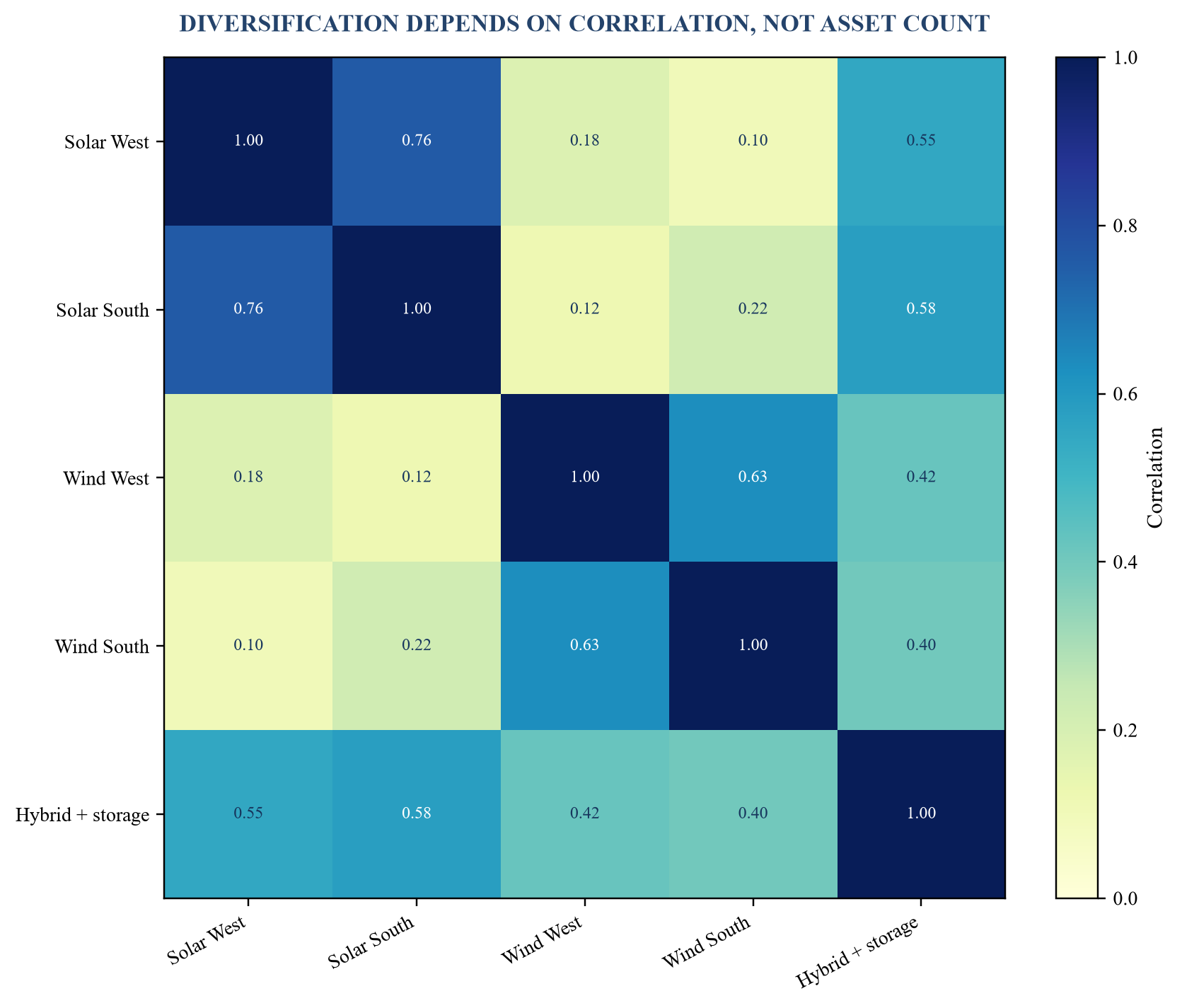
Values are illustrative management assumptions; actual analysis requires verified asset-level time series and common-event overlays.
6. Translate covariance into a downside generation case
The lender's case should begin with project-specific resource assessments and operating history, then aggregate them with observed correlation. Applying the same percentage haircut to every asset at the same time is simple and conservative in some respects, but it can misstate the benefit of different seasonal profiles. Assuming full diversification can be equally misleading.
A practical method has three layers. First, calculate asset-level expected and downside generation after availability, degradation, losses and curtailment. Second, aggregate the time series so that monthly seasonality and covariance are preserved. Third, overlay common shocks: severe grid restriction, market-rule change, equipment defect, cyber incident, common contractor failure or counterparty delay.
Short histories require judgement. A recently commissioned project may not have experienced a full range of weather or operational conditions. Resource studies can extend the data, but assumptions should be reconciled to actual performance. Repowering, module degradation, turbine availability and storage dispatch can change the relationship between historical resource and future cash.
The downside case should be expressed in cash, not only megawatt-hours. Lower output may reduce revenue and increase liquidated damages or deviation charges. Higher market prices can help an uncontracted asset while increasing replacement-power cost under a firm-delivery obligation. The model should trace each stress through invoice, collection and the waterfall.
Portfolio benefit can support a lower aggregate reserve or higher advance rate only after these dependencies are tested. The benefit should be revisited when a platform acquires assets. A new project that looks attractive on standalone yield may increase exposure to a state, grid zone, equipment supplier, contract type or payer that already dominates the pool.
7. Establish objective acquisition eligibility
An acquisition facility creates value through speed. It also transfers underwriting discretion from the initial credit committee to future management decisions. Eligibility criteria must therefore be precise enough to protect lenders and usable enough to permit disciplined growth.
The acquisition test should begin with legal and operating gates: commissioned status or a defined migration route; ownership and land rights; grid connection; valid licences; executed sale contract; required consents; insurance; environmental and social compliance; and no material unresolved dispute. Financial gates should cover historical generation, revenue, receivables, operating cost, maintenance capex, project debt and cash availability.
The target should then be scored for incremental diversification and concentration. A project can pass standalone coverage while failing the portfolio test because it adds excessive exposure to one counterparty, state, technology, contractor or contract expiry year. Eligibility should be tested both before and after the acquisition and after drawing the associated debt.
Price discipline is part of credit discipline. A facility should state the maximum eligible value, independent valuation approach, debt-funded percentage, required equity contribution and treatment of earn-outs or contingent payments. Acquisition debt should not be advanced against hoped-for synergies that are outside lender control.
Migration rules should address projects acquired before full operating history is available. Such assets can enter a provisional pool with a lower advance rate, enhanced reserve and evidence milestones. Full eligibility follows stable commissioning, accepted metering, first collections and an agreed operating record. Failure to migrate by a long-stop date should trigger repayment, additional equity or exclusion.
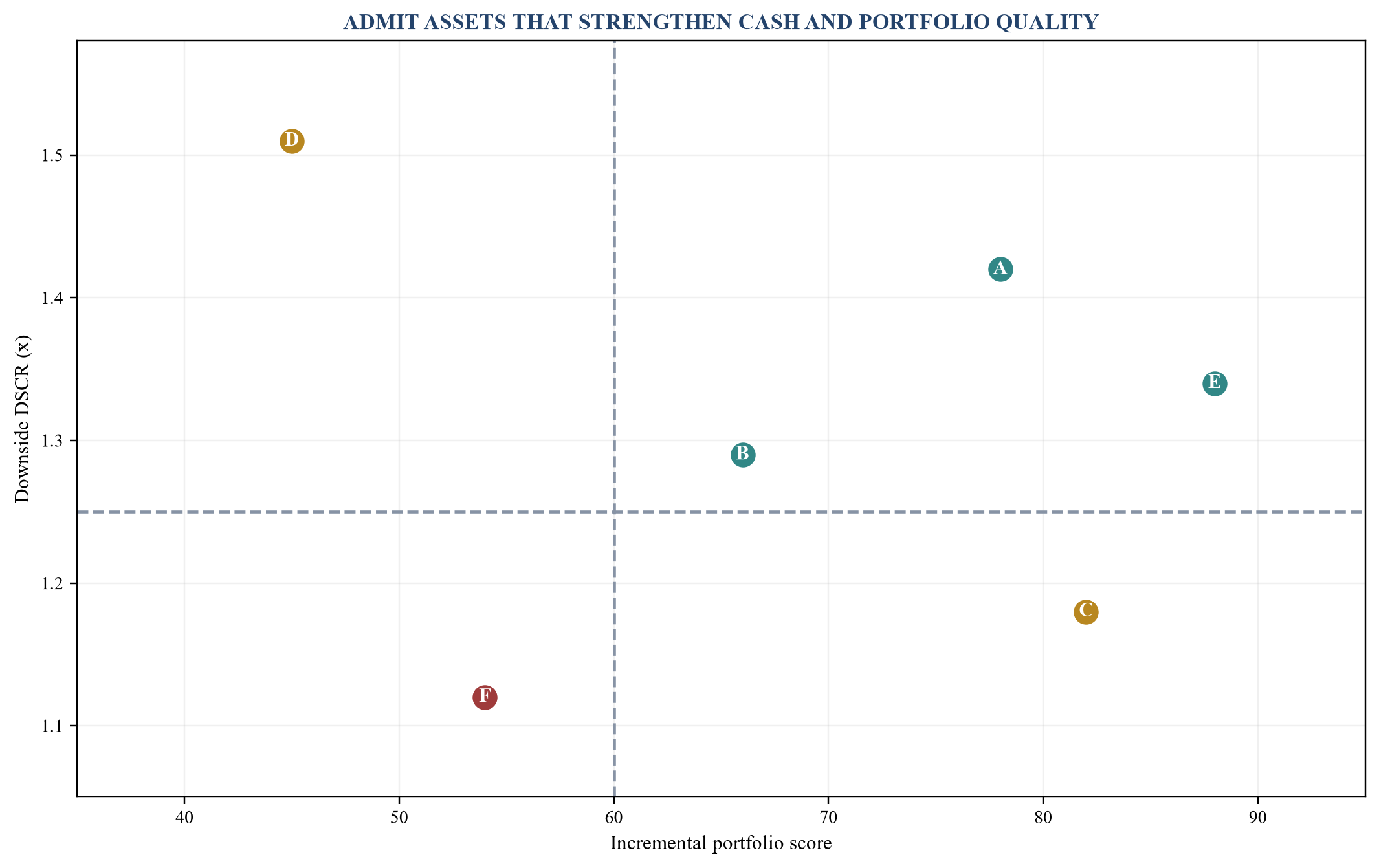
The matrix combines standalone cash strength with incremental portfolio benefit; thresholds are illustrative management assumptions.
Table 2. Acquisition and migration eligibility matrix
| Gate | Operating asset | Migrating asset | Exclusion trigger | Cure route |
|---|---|---|---|---|
| rights and title | perfected ownership and usable land rights | closing documents plus pending ministerial act | disputed title or expiring right | legal completion before admission |
| grid and operation | accepted connection and commercial operation | completed tests with defined long stop | material connectivity uncertainty | provisional pool with no base advance |
| revenue contract | executed, assignable and effective | execution condition satisfied before draw | cancellable or non-assignable core revenue | consent, replacement or lower advance |
| performance | verified meter and operating record | engineer-certified commissioning | unresolved material defect | retention and performance reserve |
| collections | reconciled invoices and bank receipts | first invoice and collection milestones | aged or disputed receivables | cash exclusion and collection plan |
| concentration | within all portfolio caps | pro forma compliance | breach after acquisition | equity, sell-down or substitute asset |
| value | independent method and capped eligible cost | staged eligible cost | unsupported synergy or contingent value | sponsor-funded portion |
Evidence should be delivered before funding and refreshed through the migration period.
8. Build an eligibility-based borrowing base
A borrowing base converts eligible project cash into a maximum facility amount. It should be transparent enough to reproduce from the asset register and conservative enough to respond when risk changes. A single loan-to-value ratio on enterprise value gives the lender less operational control.
One method capitalises eligible cash available for debt service under a downside case, subject to a maximum advance rate and debt-service coverage test. Another advances against eligible project debt value after risk haircuts. Whichever method is used, the calculation should prevent double counting between cash, reserves and collateral.
Haircuts should reflect specific risks. Short contract tenor can reduce recognised cash beyond the PPA expiry. Delayed receivables can reduce current eligibility and increase reserves. Merchant exposure can be valued at a conservative price floor. Construction or migration assets can receive low or zero advance until milestones are met. Weak data can reduce eligible value even if reported performance is strong.
Concentration limits should be applied after asset-level haircuts. Typical dimensions include counterparty, state, grid region, technology, original equipment manufacturer, operator, contract form, merchant exposure, construction exposure and maturity year. The lender should also test combined concentrations, such as solar projects in one state selling to related distribution companies.
Borrowing-base deficiency mechanics should be predetermined. If eligible value falls below debt, the borrower can add equity, prepay, add an eligible asset or cure the underlying defect within a limited period. Cash distributions should stop while a deficiency exists. A permanent decline should lead to amortisation rather than repeated waiver.
Table 3. Illustrative borrowing-base recognition rules
| Asset or cash class | Illustrative recognition | Principal reason | Required evidence | Review frequency |
|---|---|---|---|---|
| mature contracted operating cash | 80% | operating and counterparty residual risk | meter, invoice, collection and contract | monthly |
| diversified C&I operating cash | 70% | corporate concentration and replacement risk | customer credit and termination protection | monthly |
| short-tenor contracted cash | 55% | refinancing and recontracting risk | maturity ladder and replacement plan | quarterly |
| conservative merchant floor cash | 40% | price, volume and liquidity risk | market history and hedging evidence | monthly |
| project in migration pool | 20% | commissioning and first-collection risk | engineer certificate and long-stop plan | monthly |
| development pipeline | 0% | no operating cash | tracked outside borrowing base | quarterly |
| overdue or disputed receivable | 0% | uncertain timing and recovery | cure before reinstatement | monthly |
Percentages are illustrative management assumptions and require transaction-specific calibration.
9. Design the debt waterfall around collections
Portfolio finance is only as strong as its cash control. The waterfall should identify where each project is paid, which local costs rank first, how surplus moves to the central account and how debt service, reserves and distributions are prioritised. It should be consistent with project contracts, tax, minority rights and existing financing.
Revenue should enter controlled project accounts wherever feasible. Statutory payments and essential operating expenses can be paid according to an approved budget. Local senior debt, if permitted, should be serviced under an agreed intercreditor arrangement. Remaining cash can transfer to the portfolio account subject to project-level restrictions.
The portfolio account should pay taxes and essential platform costs, interest, scheduled principal, debt-service reserve top-up, maintenance or inverter reserve, hedging payments and mandatory prepayments. Growth expenditure and distributions should rank after all tests. Cash sweeps can accelerate amortisation when merchant prices, collections or generation exceed the underwritten case.
Traps should respond to specific problems. A project-level trap can retain cash when that asset has a dispute or reserve deficiency. A portfolio trap can stop all distributions after a borrowing-base or coverage breach. The documents should prevent cash from becoming permanently stranded after cure; release conditions should be objective and auditable.
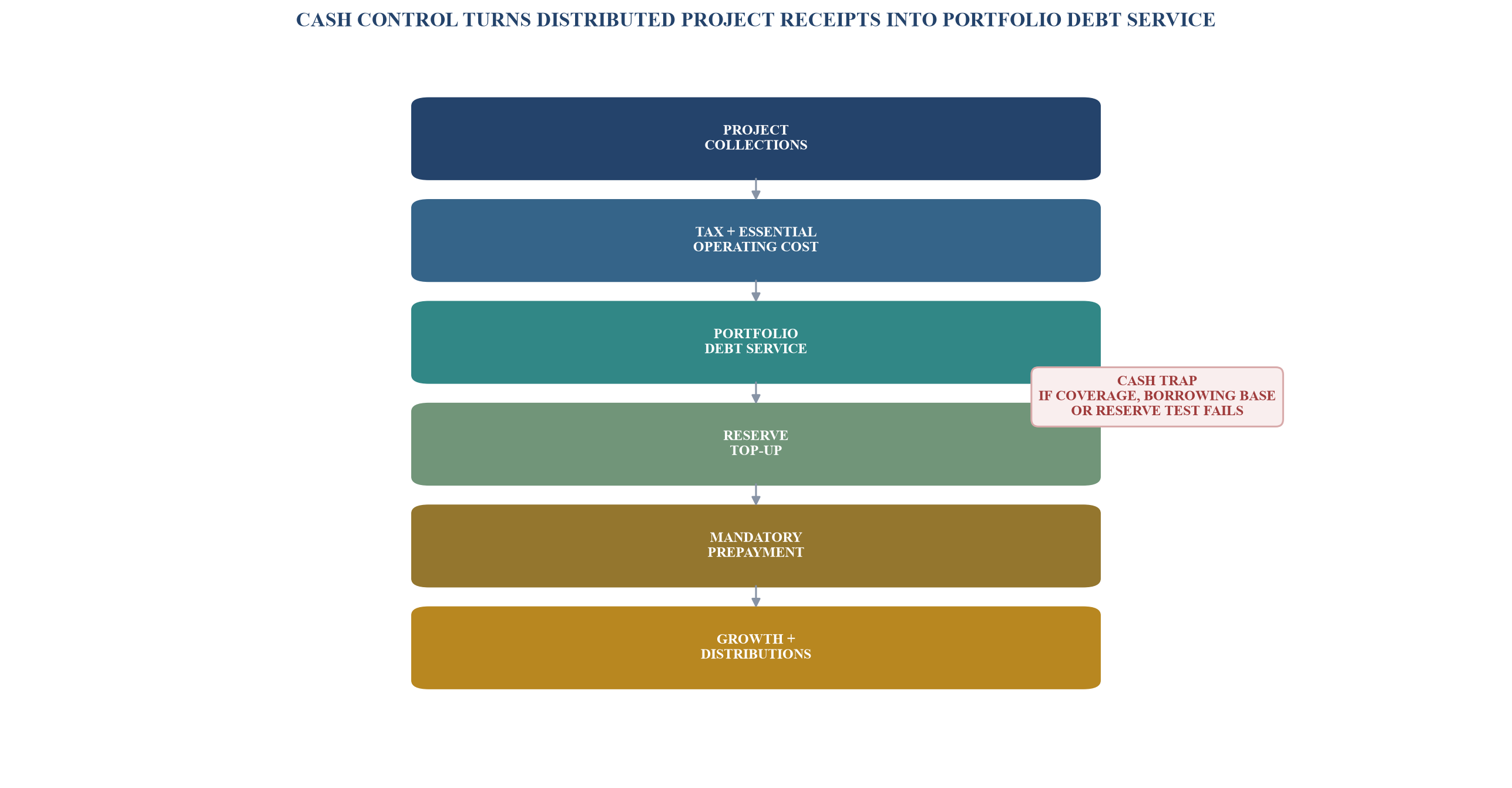
Essential operating continuity is protected before portfolio debt service, reserves, growth and distributions.
10. Size debt using DSCR, LLCR and cash timing
Debt-service coverage ratio measures cash available for debt service divided by scheduled debt service in a period. Loan-life coverage ratio discounts cash available through loan maturity relative to outstanding debt. Both are useful; neither repairs weak cash definitions or uncontrolled accounts.
The model should calculate coverage monthly or quarterly before presenting annual ratios. Seasonal solar and wind profiles can create intra-year pressure even when annual DSCR appears adequate. Receivable delay can shift cash beyond an interest or principal date. Reserve drawing and replenishment should therefore be included in the period model.
Debt should be sized to the lowest of several constraints: borrowing base, minimum downside DSCR, minimum LLCR, contract tenor, legal maturity, concentration caps and asset-life limits. An acquisition facility may have a revolving period followed by amortisation. A refinancing facility may sculpt principal to portfolio cash. A bridge may rely on a defined takeout; the takeout should be supported by evidence rather than assumed market access.
Interest-rate, refinancing and currency risks should be visible. Most domestic project revenue is rupee-denominated; foreign-currency debt creates mismatch unless hedged or naturally offset. Floating-rate debt requires interest stress. A long-dated portfolio can face refinancing concentration even if current coverage is strong.
The base case should not use value accretion to fund scheduled repayment. Platform overhead savings, improved procurement and operational analytics can enhance resilience, but they should enter debt capacity only after evidenced. The lender can capture upside through cash sweep and lower future pricing rather than relying on forecast synergies.
11. Calibrate reserves to identifiable timing risks
A debt-service reserve protects temporary cash shortfall. It should not mask a structurally underperforming portfolio. Reserve sizing should link to the actual debt-service schedule, payment delays, seasonality and concentration. A six-month convention may be appropriate in one pool and inadequate or excessive in another.
Separate reserves improve transparency. A maintenance reserve can fund major component replacement. An inverter or battery augmentation reserve can address predictable lifecycle expenditure. A receivable reserve can absorb counterparty delay. A deviation or balancing reserve can protect against scheduling volatility. A construction contingency should remain with migration assets until completion.
Funding can be upfront, built from cash or supported by a permitted instrument. A funded reserve offers immediate liquidity but increases initial financing need. A letter of credit transfers risk to the issuing bank and requires renewal discipline. A cash-build mechanism may be unsuitable when early coverage is already tight.
Release rules should match risk reduction. A receivable reserve can fall after sustained payment performance. A construction reserve can release after final completion and claims settlement. A maintenance reserve should reflect remaining equipment life rather than original commission date. Any release should pass the borrowing-base and distribution tests.
Table 4. Reserve architecture for a renewable-energy platform
| Reserve | Risk addressed | Sizing driver | Funding route | Release or replenishment trigger |
|---|---|---|---|---|
| debt service | timing and temporary cash shortfall | scheduled payments, seasonality and delay | funded at close or cash build | restored before distributions |
| receivable delay | late or disputed offtaker payment | payer history and invoice concentration | project or portfolio cash | reduce after sustained normal payment |
| major maintenance | inverter, turbine and balance-of-plant work | condition and lifecycle plan | periodic cash contribution | engineer-certified completion |
| battery augmentation | degradation and capacity commitment | warranted trajectory and dispatch duty | scheduled reserve or service contract | verified augmentation and performance |
| deviation and balancing | scheduling and settlement variability | historical charges and rule stress | rolling liquidity buffer | recalibrate from actual settlements |
| migration contingency | commissioning, punch list and first collections | cost to complete and unresolved items | acquisition equity and retained debt | final completion and claim closure |
Reserve amounts and funding methods should be calibrated to verified cash timing and asset condition.
12. Manage curtailment, grid and deviation-settlement exposure
Generation is valuable only when it can be delivered, scheduled, measured and paid. Grid congestion, outages, connectivity delay and dispatch instructions can reduce cash. The CEA has highlighted that renewable projects can be developed faster than associated transmission, creating a need for advance network planning.[3] This timing mismatch belongs in asset admission and acquisition pricing.
Curtailment analysis should classify cause, compensation and controllability. Grid-security curtailment may receive different treatment from commercial backing down or project non-compliance. Contract language, regulatory orders, meter evidence and dispatch instructions should be reconciled. A generic curtailment percentage can conceal concentrated exposure at one pooling station.
Deviation settlement and forecasting rules create operating cash volatility. CERC's current regulatory framework includes the 2024 deviation-settlement regulations and subsequent amendments.[4] A platform should track forecast accuracy, schedule revisions, deviation volumes, rates, disputes and settlement timing at asset level. Storage or hybridisation can reduce some exposure but introduces dispatch and degradation obligations.
Connectivity is both a technical and legal asset. The lender should verify application, grant, bank guarantees, milestones, commissioning extensions, transmission charges and long-stop dates. Recent CERC proceedings show continuing disputes involving connectivity, project delay, change in law and payment obligations.[4] Proceedings evidence the importance of these risks; they do not establish that every project has the same outcome.
A grid-event register should feed the borrowing base. Repeated outage, unresolved compensation or threatened connectivity can reduce eligibility. A cure can include technical remediation, contract enforcement, reserve increase, conservative generation recognition or asset substitution.
13. Underwrite receivables as a portfolio of credit exposures
Renewable receivables are often presented as one line in the model. They should be analysed by invoice, obligor, ageing, dispute, security and collection route. Cash timing can matter more to near-term debt service than accounting revenue.
The lender should reconcile meter data to invoice, invoice to acceptance, acceptance to due date and due date to bank receipt. Differences should be explained. Change-in-law claims, curtailment compensation, late-payment surcharge and tax adjustments should be separated from ordinary energy receivables because timing and recovery can differ.
Ageing thresholds should drive eligibility. Current undisputed invoices may receive full recognition. Moderately delayed receivables can receive a haircut and reserve. Long-overdue or disputed claims should be excluded until collected or otherwise protected. The same discipline should apply even when management expects eventual recovery.
Concentration should include economic linkage. Several project companies selling through one procurer or payment chain can create correlated delay. A government-related counterparty may have strong ultimate capacity and slow process. Coverage should be based on collected cash, with a transparent reserve for delay.
Payment-security instruments should be monitored as assets. Expiry, replenishment, draw tests and issuing-bank credit belong in the monthly report. CERC materials concerning payment undertakings and security alternatives show that market participants continue to refine payment protection structures.[6] Each facility should rely on its executed instruments and legal analysis.
14. Control construction-to-operation migration
Portfolio facilities often seek to refinance projects soon after commercial operation or fund late-stage completion. The construction risk does not disappear on the commercial-operation certificate. Punch-list work, performance testing, final accounts, warranty claims, retention and first collections can remain unresolved.
The migration protocol should specify objective milestones: permits and land complete; grid connection effective; equipment tests passed; commercial operation accepted; PPA effective; metering accepted; insurance in place; operations contract active; final cost report delivered; minimum reserve funded; first invoice issued; and first cash collected. A project can receive staged recognition as evidence accumulates.
Cost-to-complete remains relevant until final completion. Undrawn commitments, cash, retention and sponsor support should cover remaining cost, claims, tax and contingency. Portfolio debt should not absorb an open-ended construction overrun without a defined sponsor obligation.
Performance guarantees and warranties should be assignable or protected through direct agreement. The platform should retain claims against contractors and suppliers. A debt structure that releases contractor security at commercial operation without reviewing remaining defects can transfer value away from lenders.
Long-stop consequences should be clear. If a project fails to migrate, the borrower can inject equity, repay the associated advance, substitute another eligible asset or sell the project outside the security group. Repeated extensions can convert temporary construction risk into permanent portfolio leverage.
Table 5. Construction-to-operation migration gates
| Stage | Required evidence | Debt treatment | Cash treatment | Failure response |
|---|---|---|---|---|
| late construction | engineer progress, funded cost to complete and valid contracts | limited staged advance | cash retained locally | sponsor cure and draw stop |
| energisation | grid acceptance, tests and insurance | provisional recognition | controlled operating account | technical cure and contingency use |
| commercial operation | COD certificate and effective revenue contract | migration pool advance | collections trapped | no distribution until collection evidence |
| first collections | reconciled meter, invoice and bank receipt | higher advance subject to caps | portfolio transfer permitted | receivable reserve and haircut |
| stable operation | agreed operating history and no material defect | full eligible advance | ordinary waterfall | ongoing monthly monitoring |
Admission occurs through evidence milestones rather than elapsed time alone.
15. Align security and intercreditor arrangements
Project companies may already have local senior lenders. A portfolio lender may sit at the holding company, share security, or refinance existing debt. The intercreditor structure should identify payment priority, enforcement control, cure rights, standstill, turnover, hedging, reserve use and release mechanics.
Structural subordination should be modelled as a cash restriction. A holding-company lender receives distributions only after project liabilities and local covenants are satisfied. The portfolio model should not treat project EBITDA as immediately available. Distribution capacity should be tested under each local finance document.
Common security can simplify enforcement but may require consents and regulatory analysis. Share pledges can provide control of project companies; receivables and account security can protect cash; contract assignments and direct agreements can preserve operations. Asset security alone may have limited value if licences, land and PPAs cannot transfer.
Intercreditor remedies should preserve electricity operations. A prolonged standstill can allow a project lender to stabilise an asset while portfolio lenders protect remaining collateral. Release provisions should permit ordinary asset sales only when debt is prepaid or the borrowing base remains compliant.
Hedging counterparties and working-capital providers can also claim priority. Their permitted amounts, termination payments and security should be capped and visible. A platform facility should avoid unmonitored debt at subsidiaries that dilutes expected recovery.
16. Use covenants as an operating control system
Covenants should identify deterioration early and create proportionate remedies. A long list of generic undertakings is less useful than a small set tied to the borrowing base, cash conversion and portfolio dependencies.
Core financial tests include minimum DSCR, minimum LLCR, maximum leverage, borrowing-base compliance, reserve funding and minimum liquidity. Operating tests include availability, generation variance, receivable ageing, contract tenor, uninsured exposure and maintenance. Concentration limits apply to payer, state, technology, grid region, operator, merchant exposure and migration assets.
Reporting should be monthly for asset performance and cash, with quarterly compliance and annual independent review. Material events should be reported promptly: PPA termination notice, payment-security lapse, grid disconnection, major equipment failure, regulatory order, environmental or social incident, fraud, cyber event, litigation and change of control.
Remedies should follow severity. A reporting delay can trigger enhanced information. A reserve deficiency can trap cash. A borrowing-base deficiency can require equity or prepayment. A material contract loss can exclude an asset. Persistent payment or coverage failure can accelerate debt or enable enforcement.
Table 6. Covenant and remedy ladder
| Indicator | Early warning | Distribution lock | Mandatory cure | Enforcement trigger |
|---|---|---|---|---|
| DSCR | forecast approaches buffer | test below distribution threshold | reserve, equity or prepayment | sustained payment default |
| borrowing base | headroom narrows | deficiency arises | add asset, equity or repay | uncured deficiency after grace |
| receivables | ageing worsens | overdue concentration exceeds cap | reserve, collection plan or exclusion | material non-payment and insolvency |
| reserves | projected draw or shortfall | top-up incomplete | fund or replace permitted instrument | failure to restore after cure period |
| concentration | acquisition approaches cap | cap exceeded | equity, sell-down or substitution | deliberate uncured breach |
| project status | delay threatens migration | no further migration advance | sponsor completes or repays | long-stop failure without cure |
Thresholds should be calibrated to the financed portfolio and tested against realistic volatility.
17. Stress the portfolio as a system
Stress testing should connect physical, contractual and financial variables. A generation shock reduces billed energy. A grid shock can affect several projects. A counterparty delay shifts cash. An interest-rate shock raises debt service. A contract-expiry cluster reduces tenor. An acquisition delay leaves bridge debt outstanding. Combined stresses reveal dependencies that isolated sensitivities miss.
At minimum, the model should test lower solar and wind output; common grid curtailment; major equipment outage; payment delay by the largest counterparty; tariff or charge change; higher operating cost; interest-rate increase; delayed project migration; and loss of merchant price support. Reverse stress should identify the combination that consumes the reserve and breaches debt service.
Management actions should be linked to time. The platform can defer acquisitions, reduce distributions, draw a reserve, increase collection activity, hedge exposure, inject equity, sell an asset or prepay debt. The model should distinguish actions within management control from those requiring lender, regulator or counterparty consent.
Figure 5 shows an illustrative DSCR surface. It combines a generation factor and collection delay with fixed assumptions for other variables. The purpose is to identify where the capital structure loses resilience. Actual analysis should use project-level contracts, timing and correlation.
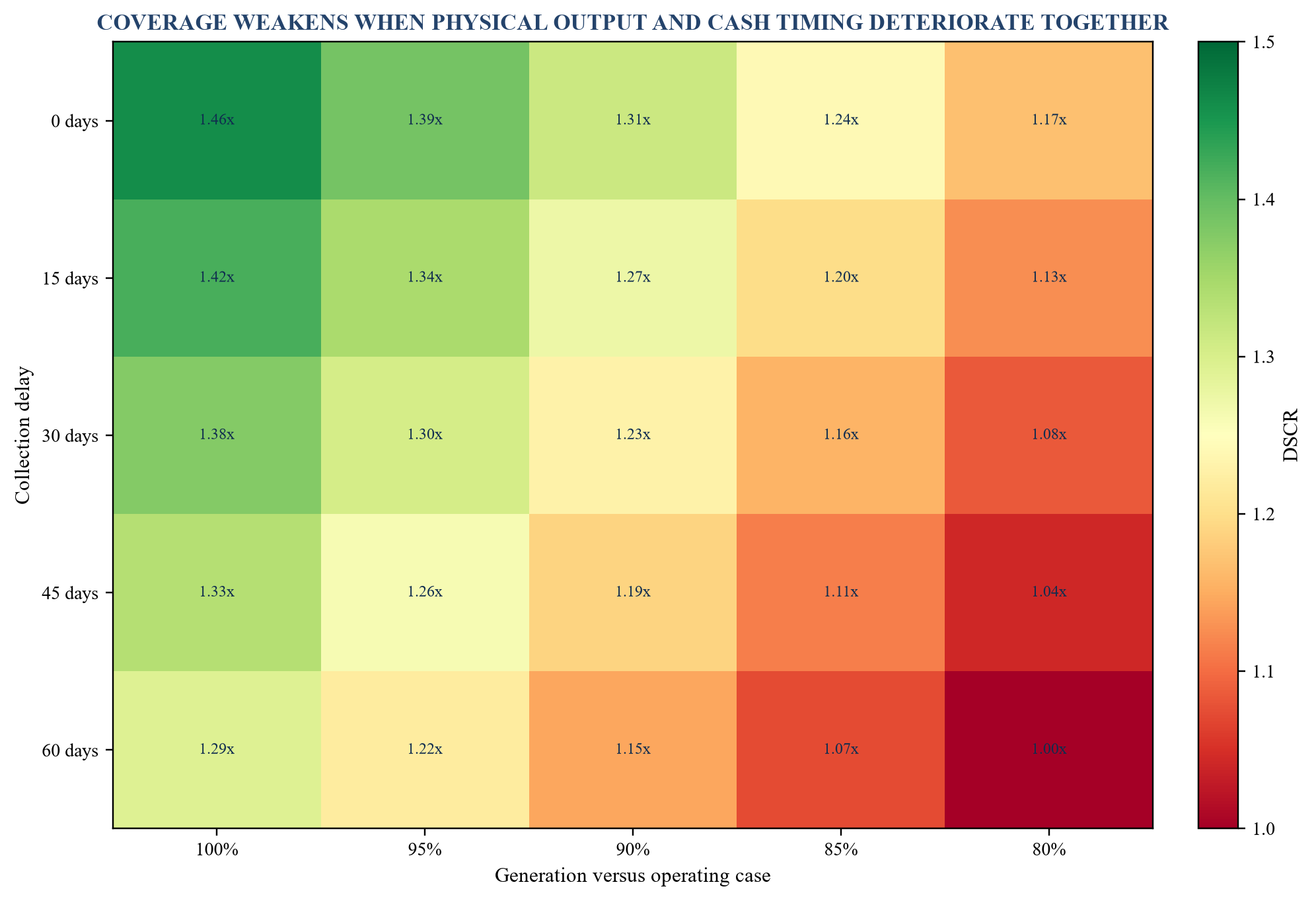
Values are illustrative management assumptions; the decision boundary should be calibrated to verified portfolio cash and debt service.
18. Match the facility to the platform's job
Different jobs require different instruments. A stable operating portfolio can support a long-dated amortising refinancing. A platform aggregating assets may need a revolving acquisition facility. A project approaching operation may use a migration tranche. A receivable delay may justify working capital. A merchant asset may need conservative leverage and cash sweep.
The instrument should follow the repayment source. Acquisition debt can be drawn quickly against pre-agreed eligibility. It should convert to amortising debt after admission and valuation. A delayed-draw term loan can fund specified acquisitions or refinancing. A hold-company facility can provide flexibility but depends on distribution capacity. A preferred or subordinated tranche can absorb risk that senior debt should not carry.
Private lenders can add value through bespoke draw mechanics, currency or tenor, but contractual flexibility should remain measurable. Pricing cannot compensate for an unidentified cash source. A higher coupon can worsen the very coverage risk being underwritten.
The RBI's priority-sector framework includes eligible bank loans for renewable-energy purposes up to stated borrower limits.[2] The RBI's 2025 project-finance directions also create a prudential framework for regulated lenders.[2] Private-debt structures should be designed with the applicable regulated-lender, external-commercial-borrowing, security, tax and insolvency rules. Legal advice is required for each capital source and borrower.
Development finance can support scale and risk allocation. A World Bank paper describes an IFC local-currency senior secured loan to subsidiaries of an Indian distributed-generation platform financing a diversified portfolio of offsite and rooftop solar assets.[9] The example demonstrates portfolio finance in practice; it does not establish terms for other borrowers.
19. Execute a 12-day bankability diagnostic
A focused diagnostic can determine whether a platform is ready for portfolio debt before a full financing process begins. Day one establishes the legal-entity and asset perimeter. Day two reconciles capacity, generation and commercial operation. Day three maps PPAs and sale arrangements. Day four reconciles invoices, receivables and collections. Day five examines operating cost, maintenance and capex.
Day six analyses generation seasonality and covariance. Day seven tests grid, curtailment, scheduling and deviation exposure. Day eight builds the eligibility and concentration matrix. Day nine constructs the borrowing base and cash waterfall. Day ten sizes debt and reserves. Day eleven reviews security, intercreditor and migration mechanics. Day twelve produces the lender evidence pack and decision log.
The output should classify issues as evidence gaps, curable weaknesses, structural constraints and value opportunities. An evidence gap can be resolved by locating an executed consent. A curable weakness may require account control or a payment-security renewal. A structural constraint, such as a non-assignable core contract, may require exclusion or different capital. A value opportunity can include refinancing expensive project debt or combining complementary assets.
The diagnostic should quantify the consequence of each issue. Missing data may reduce advance rate. Contract expiry may shorten maturity. counterparty concentration may require a lower cap. A migration asset may require extra equity. This converts diligence into financing choices rather than a static red-flag list.
20. Deliver the financing through a 100-day plan
The first twenty days establish governance, data and scope. Management appoints workstream owners, freezes the asset register, reconciles entity and contract records, identifies advisers, prepares confidentiality and data-room protocols, and agrees the lender-facing base case. The board approves the financing objectives, permitted security and acquisition policy.
Days twenty-one to forty-five complete technical, legal, financial, tax, insurance, environmental and commercial diligence. The platform resolves high-priority document gaps, validates generation data, confirms payment security, calculates receivable ageing, reviews maintenance plans and maps consents. The lender and borrower agree provisional eligibility, concentrations and migration criteria.
Days forty-six to seventy negotiate term sheet and documents. The model is locked to agreed definitions. The waterfall, reserves, borrowing base, reporting, security and intercreditor terms are drafted. Acquisition and asset-release mechanics are tested on examples. Conditions precedent are assigned with evidence owners.
Days seventy-one to ninety complete consents, account control, security perfection, insurance endorsement, direct agreements and final diligence. A dry run reproduces the borrowing base and waterfall from current data. Management certifies that no internal planning labels or unsupported figures enter external materials.
Days ninety-one to one hundred close and stabilise. Funds flow is rehearsed, existing debt is repaid or coordinated, reserves are funded and reporting begins. The first post-close borrowing-base certificate should use the same data lineage as the close model. A lessons review captures process improvements for the next acquisition.
21. Conclusion
India's renewable-energy expansion creates a growing pool of operating assets and financing needs. Portfolio debt can help platforms refinance project liabilities, acquire assets, recycle equity and fund disciplined growth. Its bankability depends on preserving project-level truth while building portfolio-level controls.
The practical sequence is clear. Define the legal and cash perimeter. Standardise project data. Score contracts and counterparties. Measure generation covariance. Admit assets through objective criteria. Convert eligible cash into a borrowing base. Control receipts through a waterfall. Size debt with period coverage and tenor. Fund reserves for identifiable timing risks. Monitor grid, receivable, construction and concentration exposure.
Diversification should be demonstrated in data and contracts. Growth should be governed through eligibility and pricing. Remedies should be automatic, proportionate and tied to the source of weakness. When these disciplines are combined, portfolio finance can support renewable platforms without losing sight of the individual projects that generate every debt-service rupee.
References
- Ministry of New and Renewable Energy, Government of India, “Year-wise Achievements,” capacity as at 30 June 2026, https://mnre.gov.in/en/year-wise-achievement/.
- Reserve Bank of India, “Priority Sector Lending: Targets and Classification,” 24 March 2025; and “Reserve Bank of India (Project Finance) Directions, 2025,” 19 June 2025, https://rbi.org.in/Scripts/NotificationUser.aspx?Id=12799 and https://www.rbi.org.in/.
- Central Electricity Authority, “National Electricity Plan, Volume I: Generation,” 2023; and “Draft National Electricity Plan, Volume II: Transmission,” 2024, https://cea.nic.in/wp-content/uploads/notification/2023/06/NEP_2022_32_FINAL_GAZETTE_English.pdf and https://cea.nic.in/wp-content/uploads/psp___a_i/2024/01/Draft_NEP_Vol_II.pdf.
- Central Electricity Regulatory Commission, “Current Regulations,” including Deviation Settlement Mechanism Regulations, 2024 and amendments; and recent proceedings, accessed August 2026, https://cercind.gov.in/current_reg.html and https://cercind.gov.in/recent_rops.html.
- Solar Energy Corporation of India, “Standard Power Purchase Agreement for Short Term Power,” payment-security and force-majeure provisions, https://www.seci.co.in/uploads/tenders/Standard_PPA_short_term_Power.pdf.
- Central Electricity Regulatory Commission, Order in Petition No. 92/MP/2024, 2025, discussion of payment undertakings and security arrangements, https://www.cercind.gov.in/2025/orders/92-MP-2024.pdf.
- International Energy Agency, “Renewables Integration in India,” 12 July 2021, https://www.iea.org/reports/renewables-integration-in-india.
- International Energy Agency, “World Energy Investment 2025: India,” 2025, https://www.iea.org/reports/world-energy-investment-2025/india.
- World Bank, “Blended Finance for Climate Investments in India,” 2025, including the Fourth Partner Energy portfolio-finance case, https://ppp.worldbank.org/sites/default/files/2025-06/Blended%20Finance%20for%20Climate%20Investments%20in%20India.pdf.
- International Renewable Energy Agency, “Renewable Power Generation Costs in 2024,” 2025, https://www.irena.org/Digital-Report/Renewable-Power-Generation-Costs-in-2024.
- International Energy Agency, “Renewables 2025: Executive Summary,” 2025, https://www.iea.org/reports/renewables-2025/executive-summary.
- International Energy Agency, “Electricity 2026: Supply,” 2026, https://www.iea.org/reports/electricity-2026/supply.
- Ministry of New and Renewable Energy, Government of India, homepage and programme materials, accessed August 2026, https://mnre.gov.in/en/.
- Indian Renewable Energy Development Agency, operating and portfolio information as at 31 March 2026, https://www.ireda.in/IredaWebPortal/.
- Solar Energy Corporation of India, Virtual Power Purchase Agreement demand-aggregation expression of interest, 17 April 2026, https://www.seci.co.in/tender-details/YmZx.
- Securities and Exchange Board of India, “SEBI (Alternative Investment Funds) Regulations, 2012,” last amended 18 April 2026, https://www.sebi.gov.in/legal/regulations/apr-2026/securities-and-exchange-board-of-india-alternative-investment-funds-regulations-2012-last-amended-on-april-18-2026-_101019.html.
- Ministry of New and Renewable Energy, Government of India, “Renewable Energy Capacity in 2025,” press release dated 29 December 2025, https://nghm.mnre.gov.in/admin/uploads/176794038987418Press%20Release_Renewable%20Energy%20Capacity%20in%202025.pdf.
- International Energy Agency, “Transition from Rapid Expansion to System Integration,” updated 22 April 2026, https://www.iea.org/policies/31617-transition-from-rapid-expansion-to-system-integration.
