

1. Begin with the signed investment case
A value-creation office should begin with the investment case approved at completion. That case normally contains an entry valuation, capital structure, operating forecast, market assumptions, diligence findings, downside risks, management plan and expected exit routes. The office should preserve those elements as dated evidence. A later budget should not silently replace the acquisition thesis, and a revised forecast should not erase the assumptions against which the investment was approved.
The first task is to convert the investment case into an operating charter. The charter states the ownership objective, expected holding period, required return logic, capital limits, strategic boundaries and mandatory risk gates. It assigns the board, sponsor, chief executive, chief financial officer and functional leaders distinct decisions. It also identifies the few outcomes that must change for the investment to create value: customer growth, price, mix, productivity, working capital, capital intensity, capability, acquisitions, financing or exit readiness.
Governance remains company-specific. The G20/OECD Principles assign boards responsibility for strategy, budgets, performance objectives, major capital expenditure, acquisitions, divestitures, risk management and reporting integrity.[1] The IFC Corporate Governance Methodology uses progression matrices adapted to company and ownership type, including funds and family or founder-owned businesses.[2] These sources support a structured governance assessment. They do not prescribe one sponsor operating model for every GCC company.
The office should reconcile four versions of value. Investment value is the sponsor's underwriting at entry. Operating value is the performance management can influence. Accounting value follows applicable reporting standards. Market value reflects the assumptions a buyer or capital provider would use at a measurement date. The four can diverge. A portfolio company can improve EBITDA while consuming cash, increasing customer concentration or relying on a temporary multiple. It can also invest ahead of earnings and build capabilities that a simple annual budget does not capture.
Table 1. Value-creation office charter
| Charter element | Required decision | Accountable owner | Evidence | Escalation trigger |
|---|---|---|---|---|
| ownership thesis | capability, market position and exit pathways | sponsor and board | signed investment paper and completion model | thesis no longer supported |
| operating baseline | revenue, margin, cash, capital and risk starting point | CFO and CEO | reconciled completion accounts and operating data | baseline cannot be reproduced |
| initiative portfolio | actions, investment, owners and dependencies | CEO and value-creation lead | approved initiative ledger | material initiative lacks owner or funding |
| capital allocation | operating investment, acquisitions, debt and distributions | board | sources-and-uses model and downside liquidity | covenant or minimum-cash threshold approached |
| risk gates | legal, licence, tax, data, people and integrity limits | board and control owners | risk register and adviser conclusions | mandatory gate fails |
| exit evidence | sustainable earnings, forecast, controls and diligence file | sponsor, CEO and CFO | monthly evidence archive and valuation bridge | proposed value lacks support |
The allocation is illustrative. Constitutional documents, financing terms and applicable law determine actual authority.
2. Preserve a single investment-case bridge
The office should maintain one bridge from entry assumptions to current evidence. The bridge begins with the completion baseline and records separately the effect of market volume, price, mix, acquired or disposed perimeter, management initiatives, financing, tax, currency and exceptional events. It should reconcile the sponsor model, statutory accounts, management reporting, bank reporting and board pack. Reconciliation prevents a favourable label from concealing a weaker economic result.
Every movement requires a source and a counterfactual. If revenue grows, the office asks whether the increase came from market growth, price, volume, a new product, acquisition or currency. If margin improves, it distinguishes price, mix, procurement, productivity, accounting classification and deferred spending. If cash rises, it separates sustainable conversion from delayed suppliers, asset sales, new borrowing and tax timing. A claimed initiative benefit needs a dated baseline and a calculation that another reviewer can reproduce.
The bridge should also show capital consumed to create the outcome. A sales initiative may require headcount, working capital, discounts and product investment. A procurement saving may require supplier transition and inventory buffers. A technology programme may reduce future cost while increasing near-term capital expenditure and execution risk. Value is measured after the resources and risks needed to produce it.
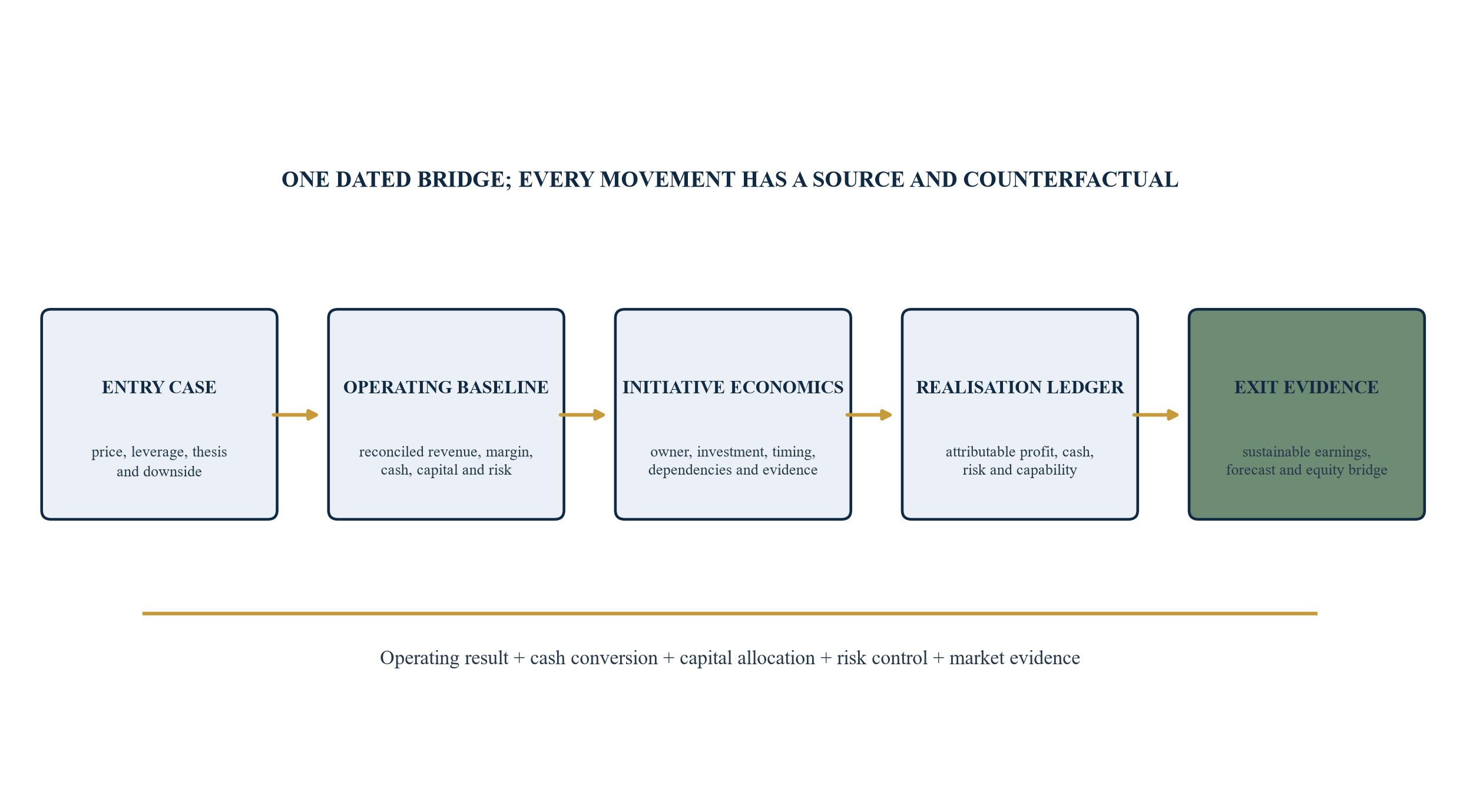
The sequence is an original management framework. Actual value depends on verified company performance, capital structure, market conditions and transaction terms.
3. Build a value-driver tree that management can operate
A value-driver tree translates equity value into operating decisions. At the top sits equity value after debt, cash, priority claims, transaction costs and other agreed adjustments. Enterprise value then connects to sustainable earnings, growth, risk, capital intensity and market assumptions. Sustainable earnings connect to revenue, gross margin and operating cost. Cash conversion connects earnings to working capital, capital expenditure, tax, restructuring and exceptional cash items.
The tree should remain specific enough to assign accountability. Revenue can be decomposed into customers, retention, volume, price, mix, geography, channel and product. Gross margin can be decomposed into input cost, labour, logistics, utilisation, yield, warranty and discounting. Working capital can be decomposed into receivable days, inventory, contract assets, payable terms, advances and disputed balances. Each node requires a definition, source system, owner and review frequency.
The office should distinguish outcome measures from operating drivers. EBITDA and cash are outcomes. Customer retention, sales conversion, price realisation, utilisation, procurement coverage, inventory turns, billing timeliness and collection effectiveness can be drivers. A leading indicator earns its place only when management can explain the relationship to a financial or risk outcome and can produce reliable data.
IFRS 8 requires qualifying public entities to disclose operating-segment information using the management view, including information about products, services, geographic areas and major customers.[3] A private portfolio company may fall outside that scope, yet the management principle remains useful: the decision system should reflect how the chief operating decision maker allocates resources and reviews performance. IAS 7 provides the reporting framework for operating, investing and financing cash flows.[4] The office should reconcile its operational cash bridge to applicable accounting records rather than maintain an independent value narrative.
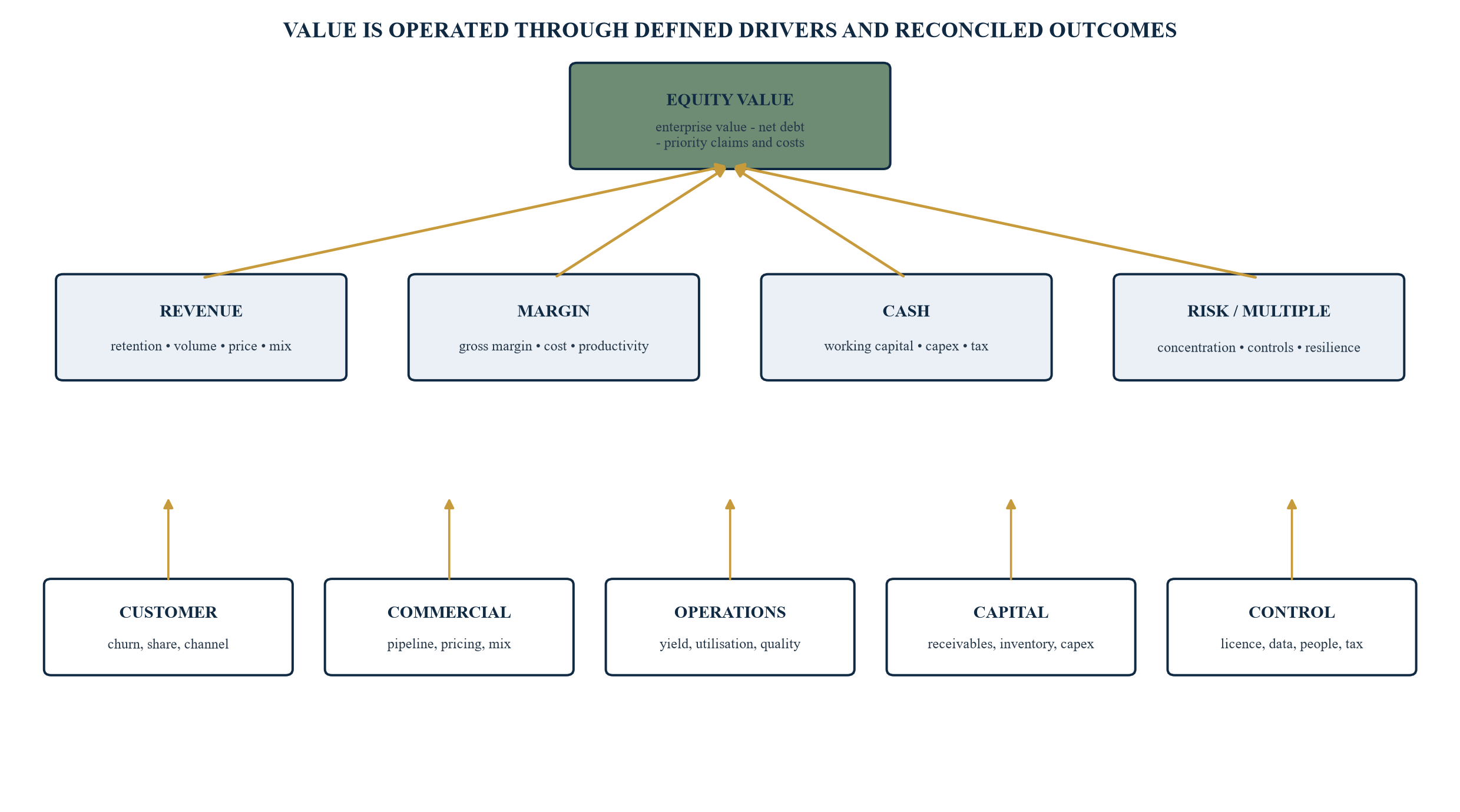
The branches are illustrative. Sector economics and the approved investment thesis determine the relevant drivers.
4. Convert the tree into an initiative portfolio
The value-driver tree explains what matters. The initiative portfolio explains what management will do. Every initiative should have a problem statement, baseline, target, owner, actions, investment, timing, dependencies, risk conditions and evidence. The office should reject initiatives whose benefits are merely the difference between an unapproved aspiration and a later budget.
Initiatives should be sized in a common economic language. A revenue initiative records incremental sales, gross margin, commercial cost, working capital and implementation risk. A cost initiative records the addressable base, negotiated or technical saving, implementation cost, leakage and the date at which the expense leaves the run rate. A working-capital initiative records the balance, operational cause, release mechanism, recurrence and customer or supplier consequence. A capability initiative records the future decision it enables and the evidence by which progress is assessed.
The office should maintain gross, net and realised views. Gross benefit is the change before implementation costs and offsets. Net benefit deducts recurring and one-off costs, adverse interactions and investment. Realised benefit appears only when the financial result is present in the agreed source records or when a defined risk or capability outcome has been evidenced. Forecast benefit remains separate from realised benefit.
Table 2. Initiative economics ledger
| Initiative | Baseline | Gross outcome | Investment and offsets | Timing | Realisation evidence |
|---|---|---|---|---|---|
| price architecture | AED 220m eligible revenue | AED 6.6m annualised gross margin | AED 0.8m systems and commercial support | six months | invoice-level price and volume bridge |
| procurement wave | AED 95m addressable spend | AED 5.2m contracted saving | AED 1.1m transition cost and AED 0.7m quality reserve | nine months | purchase orders, receipts and general ledger |
| collections control | 78 debtor days | AED 14m cash release | AED 0.5m temporary collection team | four months | customer-level cash receipts |
| service productivity | 68% utilisation | AED 4.1m contribution improvement | AED 1.4m scheduling and training | eight months | time, billing, payroll and margin records |
| data and cyber uplift | fragmented access controls | defined critical-control maturity | AED 3.0m programme cost | twelve months | tested controls and independent assurance |
Values are hypothetical management assumptions. The ledger illustrates definitions and does not forecast a company.
5. Prioritise through impact, confidence, control and reversibility
A long list of initiatives can exceed management capacity. The office should prioritise using four separate dimensions. Impact estimates the net economic or risk outcome. Confidence tests the evidence and causal logic. Control asks whether management can execute the required action. Reversibility asks how much value is lost if the intervention fails. The dimensions should not be collapsed into a single score that hides a mandatory compliance or liquidity gate.
The office should also test dependency. A pricing initiative may depend on customer segmentation and contract data. A procurement initiative may depend on specifications, inventory and supplier qualification. A digital initiative may depend on data ownership and process redesign. An acquisition synergy may depend on legal completion, integration authority and customer consent. Dependencies should appear in the initiative plan and weekly decision log.
Resource constraints belong in the portfolio view. The same finance, technology, commercial and operational leaders often support several initiatives. The office should show critical people, system releases, adviser decisions, capital expenditure and change windows across the portfolio. An initiative can be economically attractive and still need to be sequenced later because its prerequisites are absent.
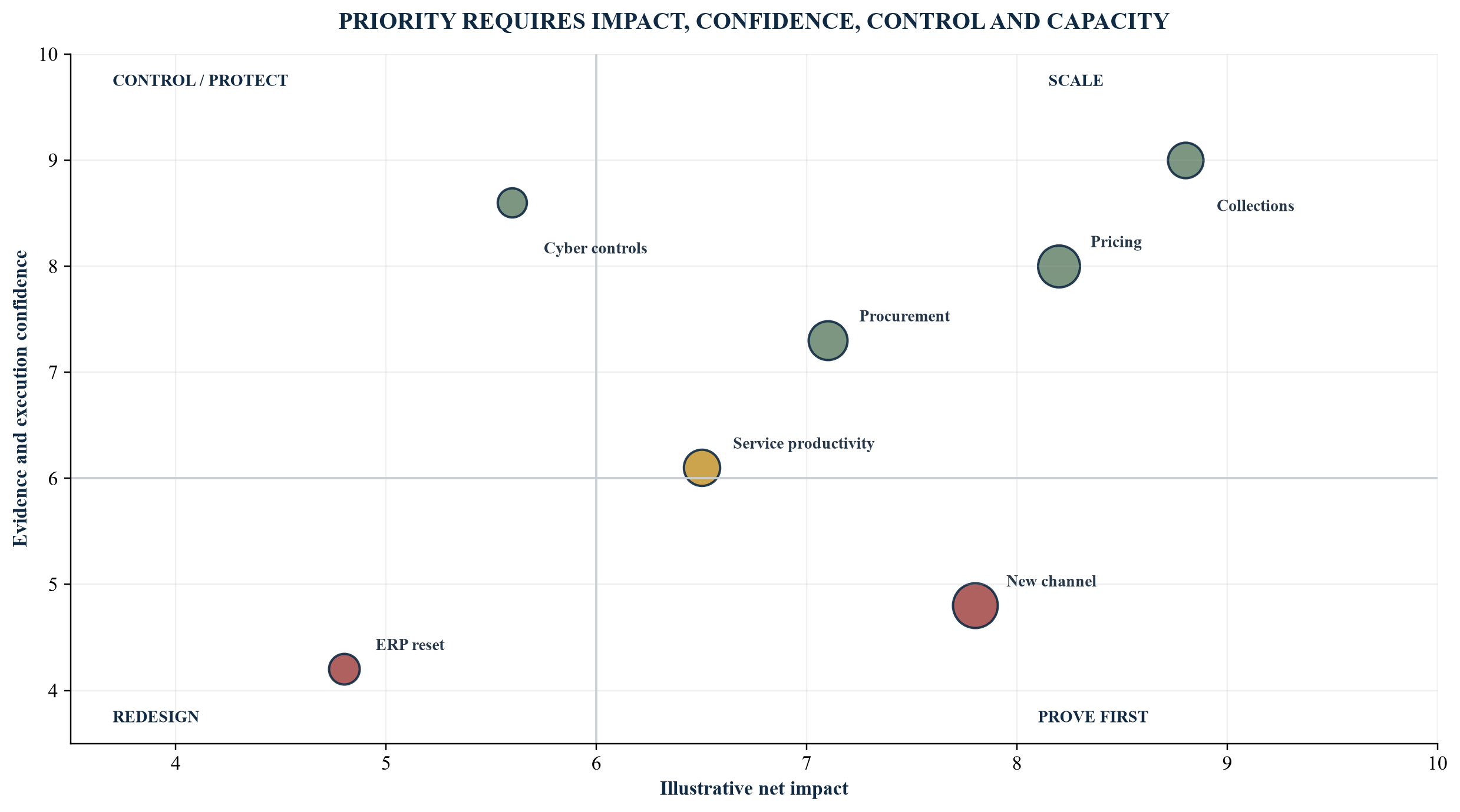
Positions and AED values are hypothetical. Mandatory legal, liquidity, safety, integrity and compliance actions should not be ranked solely by economic score.
6. Establish a baseline that survives diligence
The baseline is the starting point against which initiative outcomes are measured. It should reconcile to completion accounts, statutory records, management reporting and direct operational data. The office should document every material adjustment: acquisitions, disposals, discontinued products, foreign exchange, accounting policy, exceptional items, owner costs, related parties, subsidies and underinvestment.
Run-rate adjustments require particular care. A signed contract may support a revenue assumption, yet delivery capacity, customer acceptance and gross margin remain relevant. A vacancy may support a temporary cost reduction, yet the role may need replacement. A procurement contract may state a lower unit price, yet volume, specification, freight, inventory and supplier performance determine the realised result. The baseline should identify which evidence is direct, which is management-estimated and which remains open.
The board should approve a baseline-change policy. Changes may be permitted for verified perimeter movements, accounting changes or errors. Market underperformance should generally remain visible. Rebaselining an initiative after it misses its target can erase accountability. Where facts genuinely change, the office should preserve the original baseline, document the revised case and show both in the decision record.
7. Define metrics before collecting data
The office should maintain a metric dictionary. Each metric needs a purpose, formula, source system, owner, frequency, cut-off, dimensional detail, control and limitation. The dictionary should distinguish a reported financial metric from an operational approximation. It should also state how acquisitions, disposals, currency, discontinued activities and accounting changes affect comparability.
ILPA's template hub includes reporting, performance and portfolio-company resources intended to improve consistency across private markets.[5] Its portfolio-company metrics work has focused on periodic investment-level information and standardisation.[6] These resources can inform LP and fund reporting. The portfolio-company operating system still needs sector-specific definitions tied to management decisions.
The office should avoid metric abundance. A weekly pack may contain ten to twenty decision metrics, while the underlying data model contains more detail. Every headline should permit drill-down to customer, product, site, contract, supplier or employee where relevant. Data quality exceptions should be visible. A dashboard that suppresses missing or late data can create false confidence.
Table 3. Metric dictionary excerpt
| Metric | Definition | Source | Frequency | Owner | Limitation |
|---|---|---|---|---|---|
| net revenue retention | opening cohort revenue retained plus expansion less contraction and churn | contract, billing and customer master | monthly | chief commercial officer | affected by currency, acquisitions and cohort rules |
| price realisation | invoiced price change after volume, mix and contract adjustments | invoice and product data | monthly | commercial finance | requires consistent product and customer mapping |
| contribution margin | revenue less directly attributable delivery cost under approved policy | general ledger and operating data | monthly | CFO and operations | allocation policy can change the result |
| cash conversion | operating cash flow before defined exceptional items divided by approved earnings measure | bank and ledger records | monthly | CFO | timing and working-capital seasonality require explanation |
| initiative realised value | verified financial or risk outcome less implementation costs and offsets | initiative ledger and source records | monthly | value-creation lead | attribution may remain shared or uncertain |
Definitions are illustrative and require reconciliation to the company's accounting policies, systems and contracts.
8. Run a weekly cadence that produces decisions
The weekly cadence should begin with facts and end with decisions. A short operating review covers customer, revenue, margin, cash, working capital, delivery, people, systems and control incidents. An initiative review covers only milestones, economics, dependencies and changes requiring authority. A sponsor review addresses capital allocation, leadership, acquisitions, financing, risk gates and exit choices.
The cadence should avoid parallel command structures. The chief executive remains accountable for the business. Functional owners remain accountable for delivery. The office maintains the common definitions, evidence, integrated plan and decision log. The sponsor and board exercise the rights granted by constitutional and transaction documents. Operating partners can challenge, support and escalate within the agreed mandate.
Each decision should record the issue, evidence, alternatives, authority, conclusion, owner, date and follow-up. Decisions that change price, customer commitments, headcount, capital expenditure, debt, related-party arrangements, data use, licences or material risk should follow the applicable approval route. The office should maintain a closed-loop register rather than rely on meeting minutes alone.
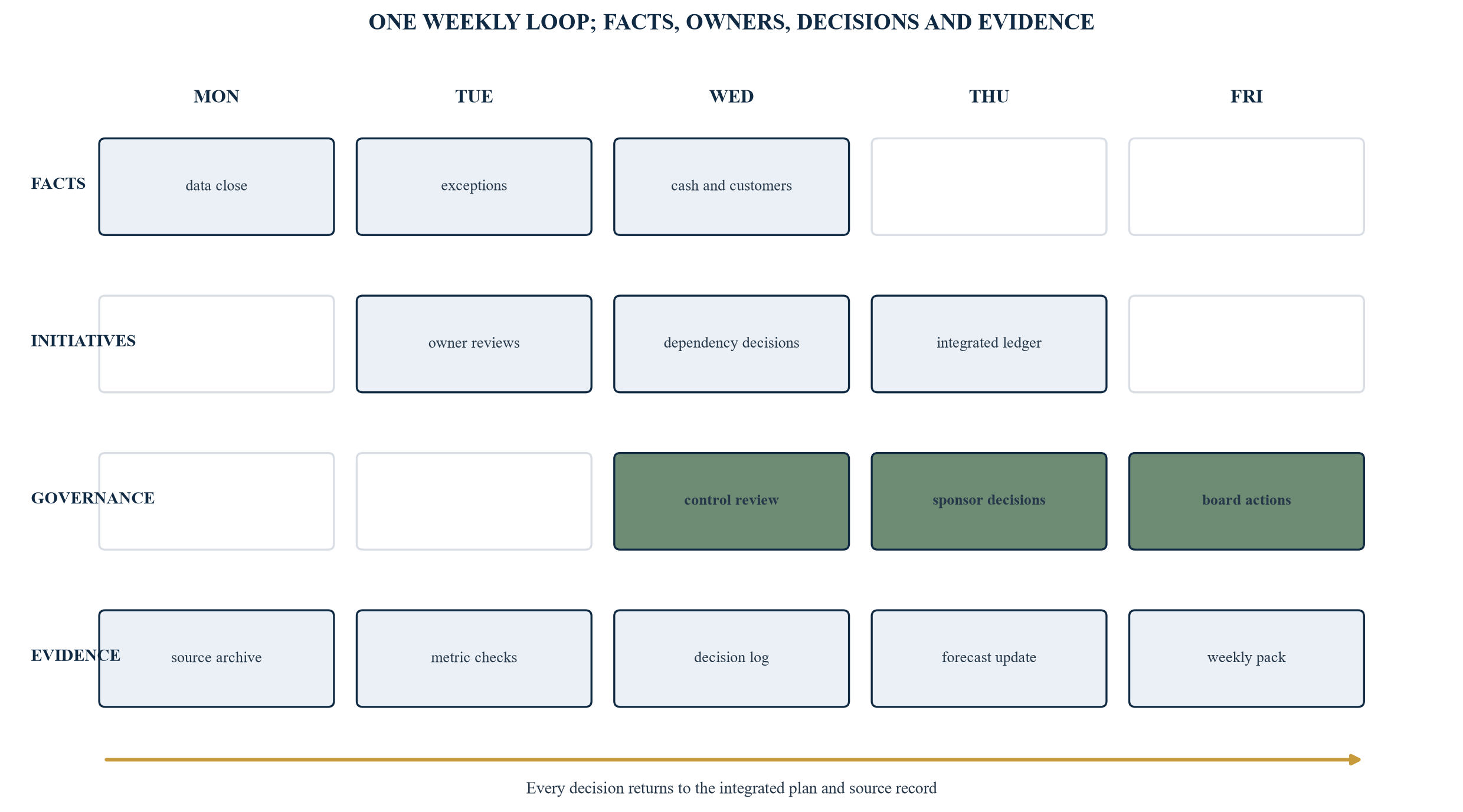
Timing and forums are illustrative. The board and management should adapt the cadence to the company's governance, operating rhythm and risk profile.
9. Govern cash, leverage and capital allocation together
Value creation can fail through liquidity even when the income statement improves. The office should maintain a short-term cash forecast, covenant model, debt schedule and capital-allocation register. The cash forecast should reconcile opening bank balances, receipts, payroll, suppliers, tax, capital expenditure, debt service, acquisitions, distributions and exceptional costs. Forecast and actual variances should be reviewed by cause.
Leverage should be connected to the operating downside. Covenant headroom, interest, refinancing, foreign exchange, guarantees and security should appear in the same scenario model as revenue, margin and working capital. The office should identify the decisions required when headroom narrows: collections, expenditure, asset sales, equity funding, waiver, refinancing or a change to the investment plan. Legal and finance advisers should confirm the applicable documents and duties.
Capital allocation should compare initiatives, maintenance, compliance, growth, acquisitions, debt reduction and shareholder distributions on a consistent basis. Mandatory safety, legal, licence and integrity expenditure should remain visible even when it does not produce a financial return. Discretionary programmes should show expected value, downside, cash timing, capacity and stop conditions.
10. Treat governance and talent as operating infrastructure
The office should translate shareholder rights into an operating authority system. Reserved matters, board committees, delegations, bank mandates, procurement limits, hiring authority, contract approval, system access and reporting obligations should agree. A right stated in a shareholder agreement has limited practical value if the company cannot produce the required information or control the relevant system.
Management incentives should connect to controllable and evidenced outcomes. Measures can include cash conversion, customer retention, margin, strategic milestones, safety, compliance and equity value. The board should test whether metrics overlap, reward market movement, encourage underinvestment or create conduct risk. Leaver, change-of-control, acquisition and restructuring treatment require clear documents and jurisdiction-specific legal, tax and accounting advice.
Leadership capacity should be treated as a portfolio constraint. The office should identify critical roles, succession, retention, decision bottlenecks and change load. Sponsor support can include recruitment, specialist advisers, commercial introductions, financing expertise and acquisition execution. The support plan should preserve management accountability and record the economic cost.
11. Integrate GCC legal, tax and cross-border requirements
The GCC is not one corporate or tax jurisdiction. A portfolio may include UAE mainland and free-zone entities, Saudi companies, holding vehicles and operating subsidiaries in other countries. The office should maintain a legal-entity map, licence register, beneficial-ownership record, tax profile, transfer-pricing file, intercompany-agreement register and cash-repatriation map.
The UAE Federal Tax Authority's Corporate Tax General Guide explains that taxable income begins with accounting income and is subject to statutory adjustments; it also addresses related-party transactions under the arm's-length principle.[7] The FTA Transfer Pricing Guide provides further guidance on controlled transactions and documentation.[8] Saudi Arabia's transfer-pricing framework also applies the arm's-length principle to transactions between related persons or persons under common control.[9] The office should therefore include intercompany services, management charges, financing, intellectual property, guarantees and shared functions in its value plan and evidence file.
Acquisitions and disposals require competition and sector review. Saudi Arabia's Economic Concentration Review Guidelines explain notification and review under the Kingdom's competition framework.[10] Comparable analysis may be required in the UAE and other jurisdictions. The office should begin competition, licence, data, employment and tax analysis before execution assumptions enter the initiative economics.
Cross-border cash can be constrained by banking, tax, distributable-reserve, covenant, minority, regulatory and currency conditions. The office should distinguish accounting profit from cash legally and operationally available to the sponsor. Dividend, fee, interest, loan, capital reduction and asset-sale routes require fact-specific advice and documentation.
12. Create a portfolio layer without flattening company economics
A sponsor needs a common portfolio view. The view should standardise definitions for invested capital, current value, leverage, liquidity, trading, initiative value, risk, governance and exit readiness. It should retain company-specific operating drivers. A software business, healthcare operator, manufacturer and infrastructure company cannot be governed through one generic set of operational metrics.
Portfolio aggregation should disclose perimeter and currency. It should distinguish organic change, acquisitions, disposals and foreign exchange. It should also show concentration by geography, customer, financing source, sector and critical technology. A positive portfolio total can conceal a material company-level failure, so mandatory gates and liquidity alerts should remain visible.
The sponsor should use the portfolio layer to allocate operating-partner time, specialist support, capital and board attention. The system can show which companies need a cash intervention, management decision, digital-control uplift, acquisition office, exit preparation or simple monitoring. Support should follow evidenced need and value, not presentation quality.
13. Prepare exit evidence throughout ownership
Exit readiness begins with reproducibility. A buyer, lender or public-market investor will test historical performance, forecast credibility, customer concentration, quality of earnings, working capital, capital expenditure, tax, legal rights, systems, people and controls. The office should preserve the evidence as it is created rather than reconstruct it under transaction pressure.
IFRS 13 defines fair value as an exit price in an orderly transaction between market participants at the measurement date and requires market-participant assumptions where the standard applies.[11] IAS 36 addresses impairment and recoverable amount for relevant assets and cash-generating units.[12] These accounting standards do not determine a private transaction price. They reinforce the need to separate current evidence, valuation technique, assumptions and risk.
The exit bridge should begin with sustainable operating performance. It should remove non-recurring items, reconcile acquisitions and disposals, explain run-rate adjustments and show the investment required to sustain the forecast. It should then bridge enterprise value to equity proceeds through debt, cash, leases, debt-like items, working capital, priority claims, transaction costs, management participation and tax.
Table 4. Exit-evidence file
| Evidence stream | Ownership-period record | Exit question answered | Control |
|---|---|---|---|
| commercial | contracts, cohorts, pricing, churn, pipeline and concentration | how durable is revenue and growth? | customer and invoice reconciliation |
| financial | monthly accounts, policies, adjustments and cash bridge | how sustainable are earnings and cash? | ledger and bank reconciliation |
| initiatives | baseline, investment, milestones and realised value | which changes are attributable and repeatable? | approved value ledger |
| operations | capacity, utilisation, quality, suppliers and capex | can the forecast be delivered? | source-system and site evidence |
| governance and risk | board decisions, licences, tax, data, people and incidents | which exposures affect value or completion? | legal and control-owner verification |
| valuation | scenarios, market evidence and equity bridge | how does operating evidence translate to proceeds? | dated model and independent challenge |
The file is an illustrative management index. Transaction advisers should define the actual diligence scope.
14. Test value through scenarios rather than a single exit multiple
Exit value should be tested across operating and market scenarios. The office should vary sustainable earnings, growth, margin, cash conversion, leverage, multiple, timing and transaction costs. It should preserve the relationship among variables. A downside case with lower earnings may also carry weaker working capital, higher debt and a lower multiple.
Multiple expansion should be shown separately from operating improvement. The sponsor can influence strategy, governance, capability and exit preparation, yet market pricing remains outside management control. A value bridge should identify the portions attributable to earnings change, cash and debt movement, acquisitions, dilution and the exit multiple.
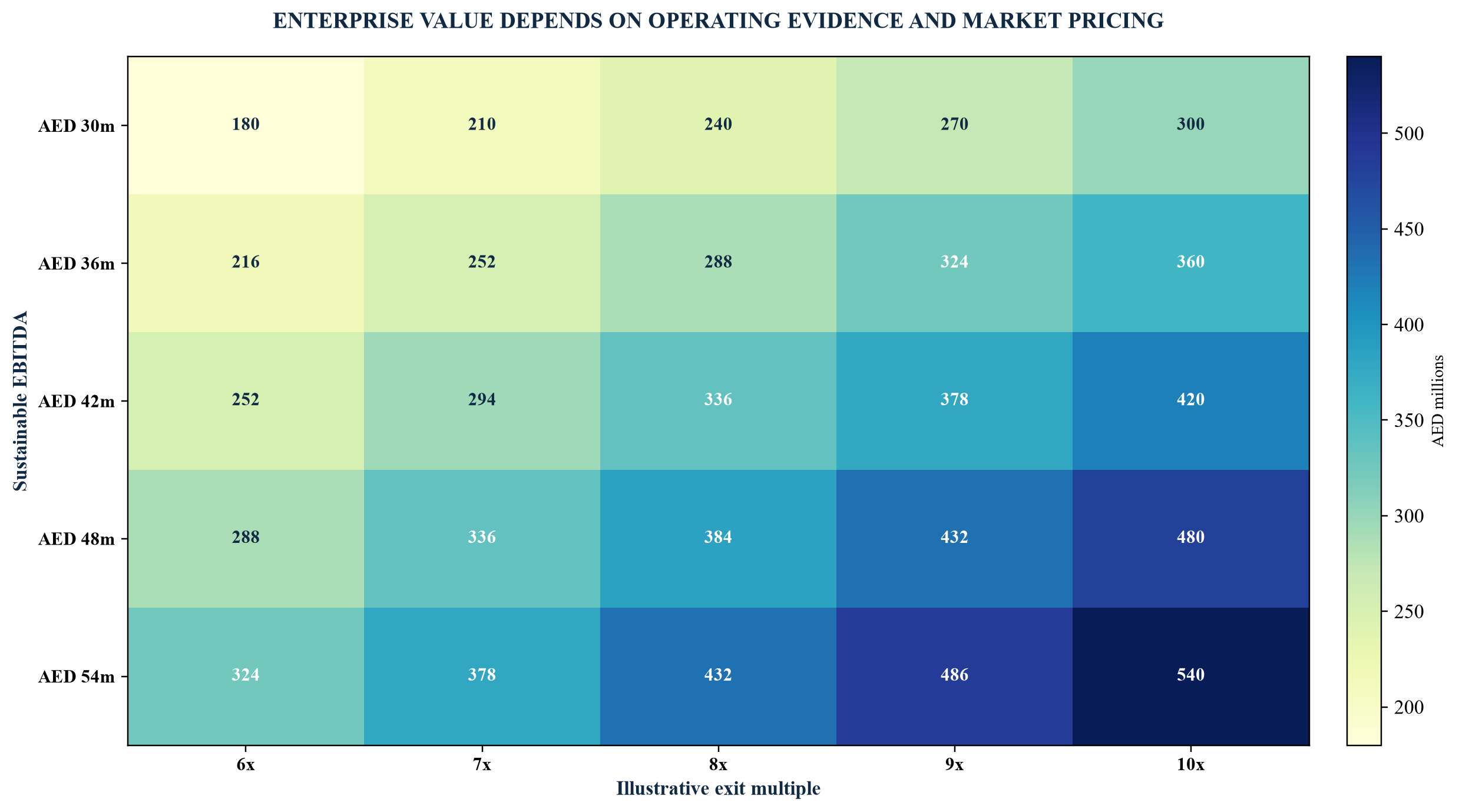
Values are hypothetical AED millions calculated as sustainable EBITDA multiplied by an illustrative exit multiple. They exclude debt, cash, priority claims, tax and transaction costs.
15. Apply the office to a hypothetical GCC portfolio company
Consider a hypothetical regional business-services company acquired for an enterprise value of AED 420 million. Reported entry EBITDA is AED 42 million, net debt is AED 180 million and opening unrestricted cash is AED 22 million. Two customers represent 31 percent of revenue. Receivable days are 78. The company operates through UAE and Saudi entities and uses intercompany services for finance, technology and commercial support.
These figures are invented for method testing. They do not represent a transaction, market benchmark, valuation recommendation or expected return.
During the first thirty days, the office reconciles completion accounts, customer revenue, payroll, bank balances, debt, tax, licences, data access and the initiative pipeline. It restates the entry baseline after identifying AED 3 million of non-recurring project margin and AED 2 million of overdue maintenance expenditure. The board preserves both the original investment case and the corrected operating baseline.
The office approves five initiatives. Pricing targets invoice-level realisation without assuming volume retention. Procurement targets addressable categories after specification and supplier review. Collections targets customer-level cash. Service productivity targets utilisation and first-time quality. Data and cyber controls operate as a risk and capability programme with defined testing evidence.
The base case assumes that sustainable EBITDA reaches AED 54 million after three years, net debt falls to AED 120 million and exit enterprise value is calculated at eight times sustainable EBITDA. The downside assumes EBITDA of AED 42 million, net debt of AED 160 million and a six-times multiple. The upside assumes EBITDA of AED 60 million, net debt of AED 95 million and a nine-times multiple. Transaction costs, management participation and tax would still need to be deducted to calculate shareholder proceeds.
Table 5. Hypothetical three-year value bridge
| Value component | Entry | Downside year three | Base year three | Upside year three | Evidence required |
|---|---|---|---|---|---|
| sustainable EBITDA | 37 | 42 | 54 | 60 | reconciled trading and quality-of-earnings bridge |
| illustrative multiple | 10.0x | 6.0x | 8.0x | 9.0x | current market and transaction evidence |
| enterprise value | 420 | 252 | 432 | 540 | approved valuation model |
| net debt | 180 | 160 | 120 | 95 | direct lender and bank evidence |
| illustrative equity value before other adjustments | 240 | 92 | 312 | 445 | enterprise-to-equity bridge |
| principal management response | establish baseline | protect cash and redesign | execute funded plan | test capacity and preserve controls | board decision record |
All values are invented management assumptions in AED millions. They do not forecast an achievable result.
The weekly cadence reveals that price realisation is ahead of plan while volume in one customer cohort is weaker. The office separates the two effects and reduces the forecast benefit. Procurement contracts are signed, but realised savings remain pending until purchase orders and receipts show the lower cost. Collections release cash in the first quarter, while the office retains a separate measure for overdue balances to prevent timing from being treated as permanent improvement.
During year two, management proposes an acquisition. The office creates a separate acquisition case with purchase price, integration investment, customer retention, synergy evidence, liquidity and competition analysis. It does not add the target's full EBITDA to the organic initiative ledger. The board approves the transaction subject to financing, regulatory, customer and integration gates.
At the end of year three, exit preparation begins from the maintained evidence file. The sponsor can reproduce the baseline, explain every initiative, reconcile earnings to cash and identify assumptions that remain dependent on market pricing. The scenario demonstrates the office's function: it makes value claims traceable and capital decisions governed. It does not make the outcome certain.
16. Execute the first one hundred days
Days zero to ten establish authority and preserve evidence. The sponsor and board approve the office charter. Management secures bank, ledger, contract, customer, supplier, payroll, system and licence records. The CFO produces opening cash, debt and completion-account reconciliations. The office creates the source register and records unresolved diligence matters.
Days eleven to thirty establish the operating baseline and value-driver tree. Management agrees metric definitions, customer and product dimensions, cash forecasting and initiative ownership. The board approves mandatory risk gates and capital limits. The office separates existing management actions from new sponsor-backed interventions.
Days thirty-one to sixty build the initiative portfolio. Owners produce business cases, investment requirements, milestones, dependencies and evidence. Finance tests gross, net and realised economics. Technology and operations confirm data availability. Legal, tax, people and compliance owners review the actions within their scope.
Days sixty-one to one hundred establish the weekly cadence and portfolio reporting. The office issues the first integrated pack, runs decision forums and closes data exceptions. The sponsor tests downside liquidity, leadership capacity and acquisition or exit dependencies. Internal audit or another independent control function can test selected metrics and calculations.
Table 6. One-hundred-day implementation gates
| Gate | Timing | Required evidence | Decision |
|---|---|---|---|
| authority and access | day 10 | charter, delegations, source access and issue register | proceed, restrict or escalate |
| operating baseline | day 30 | reconciled revenue, margin, cash, capital and risk | approve or correct baseline |
| initiative portfolio | day 60 | owners, economics, investment, dependencies and gates | fund, sequence, redesign or stop |
| weekly system | day 80 | metric dictionary, cadence, decision log and forecast | adopt or remediate controls |
| board value plan | day 100 | integrated bridge, downside, talent, capital and exit evidence plan | approve ownership-period plan |
Timing is an illustrative management sequence. Completion depends on company readiness, governance and transaction conditions.
17. Maintain professional and evidential boundaries
This paper is general research and a management framework. It is not investment, legal, tax, accounting, valuation, competition, employment, data-protection, sector-regulatory or insolvency advice. The applicable position depends on the company, fund, shareholders, instruments, jurisdictions, licences, contracts, financing, workforce, data and transaction facts.
The office should label hypothetical values and management estimates in its internal records. Public and investor reporting should follow applicable agreements, standards, law and approval. The office should not represent forecast benefits as realised, temporary cash timing as permanent value, or a modelled exit multiple as an available transaction price.
The empirical research has boundaries. Kaplan and Strömberg review the economics and evidence surrounding leveraged buyouts and private equity.[13] Acharya and colleagues examine operating performance and governance in a defined sample of Western European buyouts.[14] Their findings inform questions about governance and operating improvement. They do not predict a GCC portfolio company's outcome or establish that a particular initiative causes value.
18. Implementation conclusion
A Private Equity Value-Creation Office gives the sponsor, board and management one operating system for the investment case. It preserves the entry thesis, establishes a reconciled baseline, translates value into controllable drivers, governs an initiative portfolio and connects realised outcomes to cash, leverage, risk and exit evidence.
The office works when authority, definitions and evidence agree. Management owns the business. The board governs strategy, capital and risk. The sponsor exercises its rights and provides support. Functional owners deliver initiatives. Finance reconciles operating change to financial results. The office maintains the integrated plan and decision record.
The system should remain proportionate. A smaller company may use a compact weekly pack and one accountable programme lead. A complex multi-country group may require dedicated data, finance, tax, technology and integration workstreams. In each case, the central discipline is the same: every value claim has a baseline, economics, owner, investment, dependency, timing and reproducible evidence.
References
- Organisation for Economic Co-operation and Development, G20/OECD Principles of Corporate Governance 2023. https://doi.org/10.1787/ed750b30-en
- International Finance Corporation, Corporate Governance Methodology, 2023. https://www.ifc.org/content/dam/ifc/doc/2023/ifc-corporate-governance-methodology.pdf
- IFRS Foundation, IFRS 8 Operating Segments. https://www.ifrs.org/issued-standards/list-of-standards/ifrs-8-operating-segments/
- IFRS Foundation, IAS 7 Statement of Cash Flows. https://www.ifrs.org/issued-standards/list-of-standards/ias-7-statement-of-cash-flows.html/
- Institutional Limited Partners Association, Templates, Standards and Model Documents. https://ilpa.org/industry-guidance/templates-standards-model-documents/
- Institutional Limited Partners Association, Portfolio Company Metrics Template: Beyond Cost and Market Value. https://ilpa.org/wp-content/uploads/2018/09/ILPA-Webcast-PortCo-Template-FINAL.pdf
- United Arab Emirates Federal Tax Authority, Corporate Tax General Guide CTGGCT1. https://tax.gov.ae/en/content/corporate.tax.general.guide.home.aspx
- United Arab Emirates Federal Tax Authority, Transfer Pricing Guide CTGTP1. https://tax.gov.ae/Datafolder/Files/Pdf/2023/Transfer%20Pricing%20Guide%20-%20EN%20-%2023%2010%202023.pdf
- Saudi Zakat, Tax and Customs Authority, Transfer Pricing Regulations and Bylaws. https://zatca.gov.sa/en/RulesRegulations/Taxes/Pages/transfer-pricing.aspx
- Saudi General Authority for Competition, Economic Concentration Review Guidelines. https://gacbep.gac.gov.sa/cms/b9376edc-79a1-4573-a36d-4f3effaba838.pdf
- IFRS Foundation, IFRS 13 Fair Value Measurement. https://www.ifrs.org/issued-standards/list-of-standards/ifrs-13-fair-value-measurement/
- IFRS Foundation, IAS 36 Impairment of Assets. https://www.ifrs.org/issued-standards/list-of-standards/ias-36-impairment-of-assets/
- Steven N. Kaplan and Per Strömberg, Leveraged Buyouts and Private Equity, Journal of Economic Perspectives 23(1), 2009, 121-146. https://doi.org/10.1257/jep.23.1.121
- Viral V. Acharya, Oliver F. Gottschalg, Moritz Hahn and Conor Kehoe, Corporate Governance and Value Creation: Evidence from Private Equity, Review of Financial Studies 26(2), 2013, 368-402. https://doi.org/10.1093/rfs/hhs117
- International Finance Corporation, Governance and Performance in Emerging Markets. https://www.ifc.org/content/dam/ifc/doc/mgrt/governance-and-performance-in-emerging-markets.pdf
About the Author
Chennakeshav Adya is an independent researcher whose work focuses on corporate finance, value creation, private capital and transaction execution. His research translates financial, commercial and operating evidence into decision frameworks for boards, investors and management teams.
