

1. Define the decision before selecting the price
The same issuer can carry several valid price observations at the same time. A seller may state a minimum acceptable price. A buyer may submit a conditional bid. A broker may circulate an indication. A tender offer may set a price for eligible holders under specific terms. A transfer may close at another price after fees, rights and timing are considered. An accounting team may estimate fair value for financial reporting. Each observation answers a different question.
The decision record should begin with purpose. A portfolio valuation asks for an exit-price estimate under the applicable accounting framework. A live acquisition asks what price and terms can produce an approved, executable transfer. A seller reserve asks what outcome meets the seller's objectives. A financing exercise asks what collateral value and advance rate a lender will support. A fairness review asks whether the process and consideration are reasonable for the relevant parties and facts.
Purpose determines evidence selection, adjustments, governance and output. The team should record the decision date, security, share class, quantity, holder form, buyer type, settlement route, time horizon, currency and intended use. The output may be an executable bid, an asking range, a valuation interval, a reference point or a decision to obtain more evidence.
The order book should preserve several views. A raw view shows every observation. A normalised view makes comparable observations visible. An executable view shows interest capable of progressing under current terms. A decision view identifies the evidence used, exclusions, adjustments, uncertainty and approval. This architecture lets commercial teams move quickly while keeping the conclusion traceable.
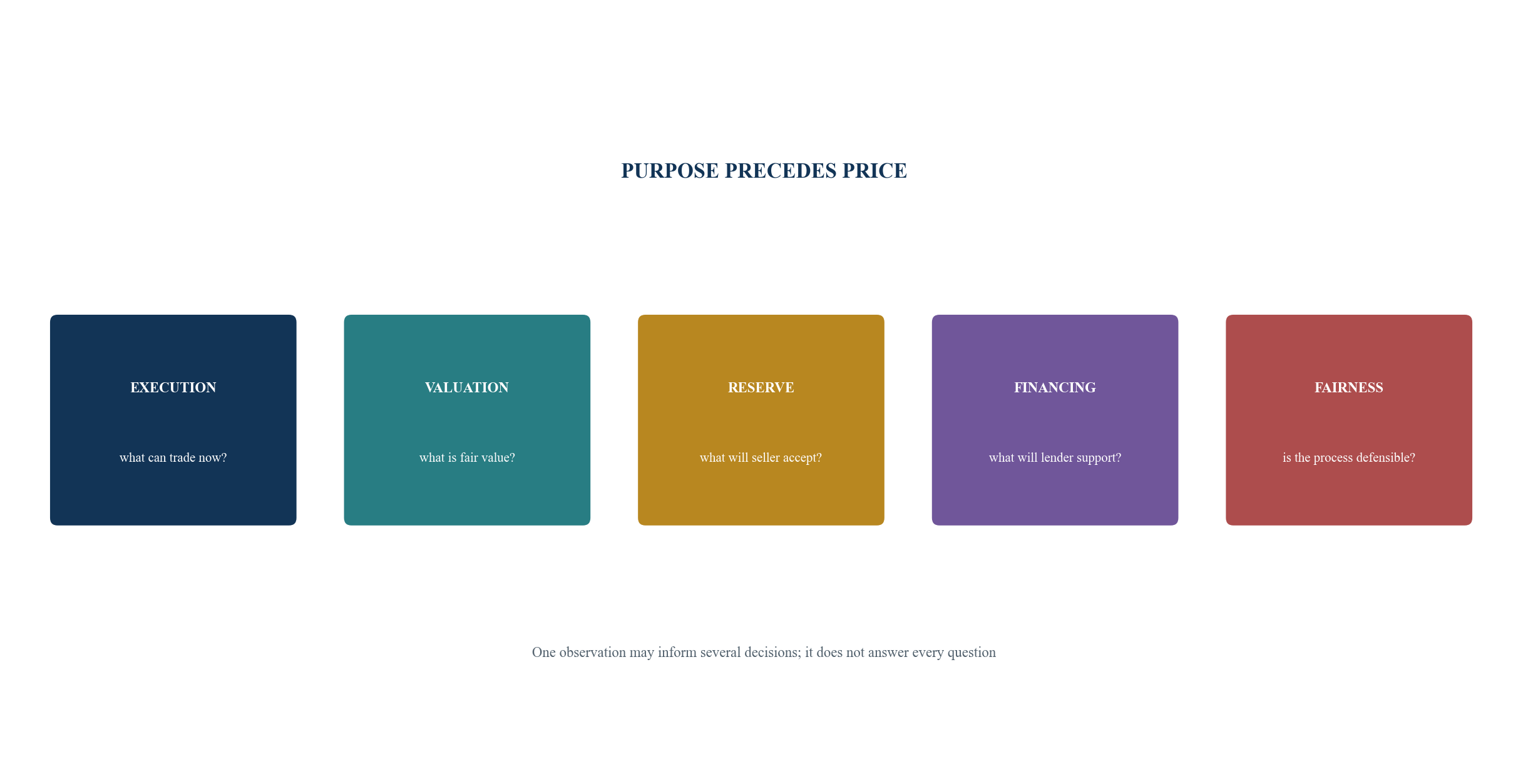
Each question requires its own evidence, assumptions and decision owner.
Table 1. Price-purpose register
| Purpose | Primary question | Relevant evidence | Required output |
|---|---|---|---|
| live execution | what can transfer under approved terms? | executable bids, offers and conditions | approved price and route |
| financial reporting | what exit price is supported at the measurement date? | market-participant evidence and valuation techniques | fair-value conclusion and disclosures |
| seller reserve | what outcome meets the seller mandate? | holder objectives, alternatives and market evidence | reserve and concession rules |
| financing | what value and liquidity support credit exposure? | price evidence, volatility, transferability and stress | collateral value and advance rate |
| fairness review | what process and consideration are supportable? | alternatives, market checks and conflicts | documented opinion or decision record |
Current advisers should confirm the governing legal, accounting and regulatory standard.
2. Build an observation ledger before building an order book
Every price fragment should enter a controlled observation ledger. The minimum fields are issuer, security class, side, quantity, price, currency, timestamp, source entity, source individual, source capacity, represented principal, economic state, conditions, fees, settlement route, expiry, evidence location and permitted use. A message without enough information remains an incomplete observation.
The ledger should distinguish source from origin. Three brokers may repeat one seller's price. Treating the three messages as independent offers overstates depth. The record should identify the earliest known origin, every transmission path and whether the quantity is shared, split or duplicated. Where origin remains unknown, the observation carries a circularity risk.
Economic state should use controlled terms. An enquiry shows interest in information. An indication expresses a non-binding level or range. A firm order states a quantity, price, expiry and conditions from an authorised principal. A matched trade records commercial agreement. A closed trade records completed settlement. A tender or issuer programme follows its own eligibility and process. A model mark is an estimate rather than market interest.
Evidence should be preserved in its original form. The team stores the message, call note, platform record, term sheet, tender document, trade confirmation or register evidence. Normalised fields improve comparison while the original evidence remains available. Any correction or cancellation should create a new event rather than silently rewriting history.
The ledger also needs accountable status ownership. Each active observation has a named owner and next verification action. The operating team can then distinguish market depth from an archive of untested messages. Ageing rules should move expired or unverified observations out of the executable view while preserving them for analysis.
3. Classify evidence by economic state
Completed transactions generally provide stronger evidence of achieved exchange than untested indications, subject to comparability and time. Executable bids and offers provide current directional evidence when the principal, authority, quantity, terms and expiry are verified. Conditional orders may remain highly informative if their conditions are explicit and realistically satisfiable.
Indications help map interest and negotiation boundaries. Their weight should reflect source, specificity, freshness, quantity, authority and history. A repeated round number with no named principal or expiry should carry limited weight. A written range from an authorised buyer with a defined security and diligence path provides more decision value.
Tender prices require their complete context. An issuer or sponsor may set eligibility, quantity caps, priority rules, transfer restrictions, representations, fees and deadlines. The headline price cannot be treated as an unrestricted market-clearing price without those terms. Participation and proration can reveal additional information when documented.
Primary financing rounds also need interpretation. A preferred share issued with liquidation preferences, anti-dilution, information rights or other terms differs from common shares or employee interests. The round price can anchor enterprise expectations while direct comparison may require a rights adjustment. A round that includes strategic benefits or bundled commercial terms requires additional analysis.
Valuation marks, broker opinions and financing marks provide useful analytical inputs. Their method, date, purpose, assumptions and independence should be recorded. They should remain clearly identified as estimates. IFRS 13 defines fair value as an exit price in an orderly transaction between market participants at the measurement date and requires market-participant assumptions. The standard provides the relevant accounting objective when it applies.
The classification should remain visible in every dashboard. Blending states into an undifferentiated average weakens the result. A strong order book shows the distribution of evidence and explains why particular states drive the decision.
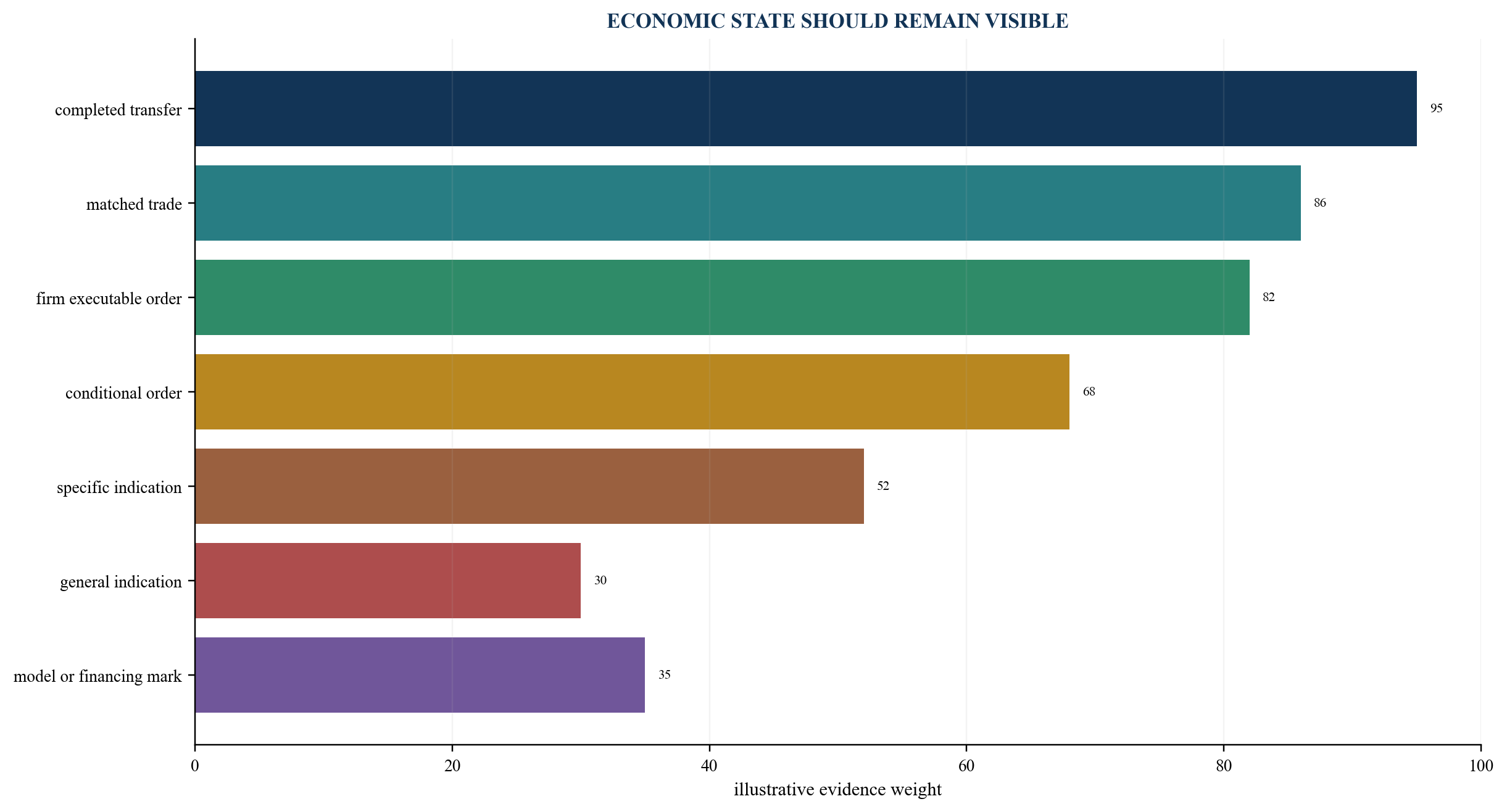
Relative weights are illustrative management assumptions and require decision-specific governance.
Table 2. Evidence-state controls
| State | Minimum verification | Principal limitation | Treatment |
|---|---|---|---|
| completed transfer | contract, price, quantity, class, date and settlement | may be stale or non-comparable | high weight after adjustment |
| matched trade | agreed terms and authorised parties | settlement can still fail | show execution and completion probability |
| firm order | principal, authority, price, quantity, expiry and conditions | may be withdrawn or inaccessible | include in executable book |
| conditional order | complete condition set and approval path | conditions may alter probability | probability-adjust or separate |
| indication | source, side, range and date | limited commitment | include in indicative layer |
| tender or primary round | complete terms, rights and eligibility | process-specific economics | normalise before comparison |
| model mark | method, assumptions, date and owner | estimate rather than order | use as analytical cross-check |
Weight depends on the actual observation, market and decision purpose.
4. Verify the principal, authority and capacity behind each quote
A price gains meaning when the team can identify who stands behind it. The record should distinguish the message sender, intermediary, represented principal, ultimate decision maker and economic beneficiary. Authority to discuss a level differs from authority to commit the principal.
Capacity shapes interpretation. An intermediary acting as agent transmits another party's interest. A principal may quote inventory it owns or expects to acquire. A syndicator may aggregate several investors. A lender may provide a collateral mark for a credit decision. A fund administrator or valuation adviser may supply an estimate. These roles carry different incentives and evidence.
Verification should use proportionate steps: confirm entity and individual identity; document the mandate or representation; establish whether the position is owned, controlled or contingent; identify competing intermediaries; confirm permitted recipients; and record compensation. A source refusing to identify the principal can remain in the indicative layer with reduced weight and restricted distribution.
Conflicts should be recorded alongside the observation. A holder seeking liquidity, an intermediary earning a percentage fee, a lender protecting collateral, a fund manager reporting performance and an investor accumulating a position can each have economic incentives. A conflict does not invalidate evidence. It informs weighting, review and disclosure.
The order book should expose internal inventory and related-party interest. A quote sourced from an affiliate, employee, portfolio company, warehouse vehicle or connected fund requires clear identification. Allocation decisions and transfers among related vehicles need their own governance and fairness analysis.
5. Normalise the security and rights package
Price per share is comparable only when the underlying rights are comparable. The record should identify the exact legal security, authorised and issued class, conversion ratio, liquidation preference, participation, dividend rights, anti-dilution protection, voting rights, information rights, transfer restrictions and priority in a sale or liquidation.
The team should build a rights bridge from each observed instrument to the target instrument. A preferred round price may require adjustment before informing a common-share transfer. A forward contract or beneficial SPV interest may contain counterparty, fee, governance and liquidity differences. An employee option or restricted share can carry exercise cost, vesting and tax considerations.
Capital structure matters. Fully diluted share counts, option pools, warrants, convertibles and senior preferences affect value distribution. The decision record should state which capitalisation table and date are used. A stale share count can make a correct enterprise-value view produce an incorrect per-share result.
Issuer consent and rights processes affect economic value through timing, failure probability and buyer eligibility. A quote conditioned on issuer approval is not equivalent to freely transferable inventory. The price bridge should show the condition and any adjustment rather than embedding it invisibly.
Adjustments should use defined methods and governance. Some rights can be modelled. Others require a qualitative range. The team records the method, assumptions, sensitivity and reviewer. Where adjustment cannot be supported, the observation remains in a separate comparison bucket.
Table 3. Security comparability bridge
| Dimension | Source observation | Target decision | Control response |
|---|---|---|---|
| class | preferred shares | common shares | value rights difference |
| ownership form | SPV interest | direct registered share | assess layer, fees and governance |
| quantity | small employee lot | institutional block | consider size and execution effect |
| restrictions | issuer-approved tender | bilateral transfer | preserve eligibility and consent terms |
| economics | gross price | net seller proceeds | separate fees, tax and FX |
| timing | historical close | current decision date | assess events and market movement |
| currency | foreign-currency quote | base-currency decision | record rate, timestamp and spread |
Legal and valuation advisers should confirm rights and adjustment methods.
6. Normalise quantity, timing, fees, currency and settlement probability
Private-share liquidity can change with block size. A small lot may attract individual buyers while a large block requires institutional capital, syndication or a discount. A strategic block can command different economics when it carries influence or access. The ledger should display quantity and avoid scaling one price across all sizes without evidence.
Gross and net prices should remain separate. Buyer cost can include intermediary fees, vehicle expenses, escrow cost, transfer charges, tax and foreign exchange. Seller proceeds can reflect different deductions. A headline price may therefore differ from both parties' complete economics. The decision record should show the chosen price basis.
Settlement probability influences executable value. A high bid from an unverified buyer facing uncertain consent may carry less decision weight than a lower, funded and approved bid. The team can show the price and probability separately or compute a decision metric for internal comparison. A probability-adjusted figure remains a management model rather than a tradable price.
Expected timing also matters. Cash today and cash after a long rights process differ economically. Any time-value adjustment should state the discount rate, expected delay and failure outcome. The original nominal price remains visible.
7. Score observation quality without manufacturing certainty
A quality score creates consistent review across a large ledger. It should measure evidence attributes rather than predict the correct price. Useful dimensions include source identity, principal verification, authority, economic state, documentation, freshness, security comparability, quantity match, term completeness, settlement accessibility, independence and historical reliability.
Scores need hard stop rules. An observation can have a high numeric score and still fail because the principal is sanctioned, the security does not exist as described, the quote is unauthorised, the source is circular, the communication route is prohibited or the order has expired. Critical defects should prevent inclusion in the executable view.
The scorecard should show missing evidence. A composite number alone can hide that an observation is strong on freshness and weak on ownership. Reviewers need the dimension profile and supporting record. Any manual override should identify the original score, revised treatment, reason, approver and expiry.
Score thresholds are management choices. The board or delegated committee should approve them for each purpose. External reporting should describe the evidence and limitations rather than presenting an internal score as a universal measure.
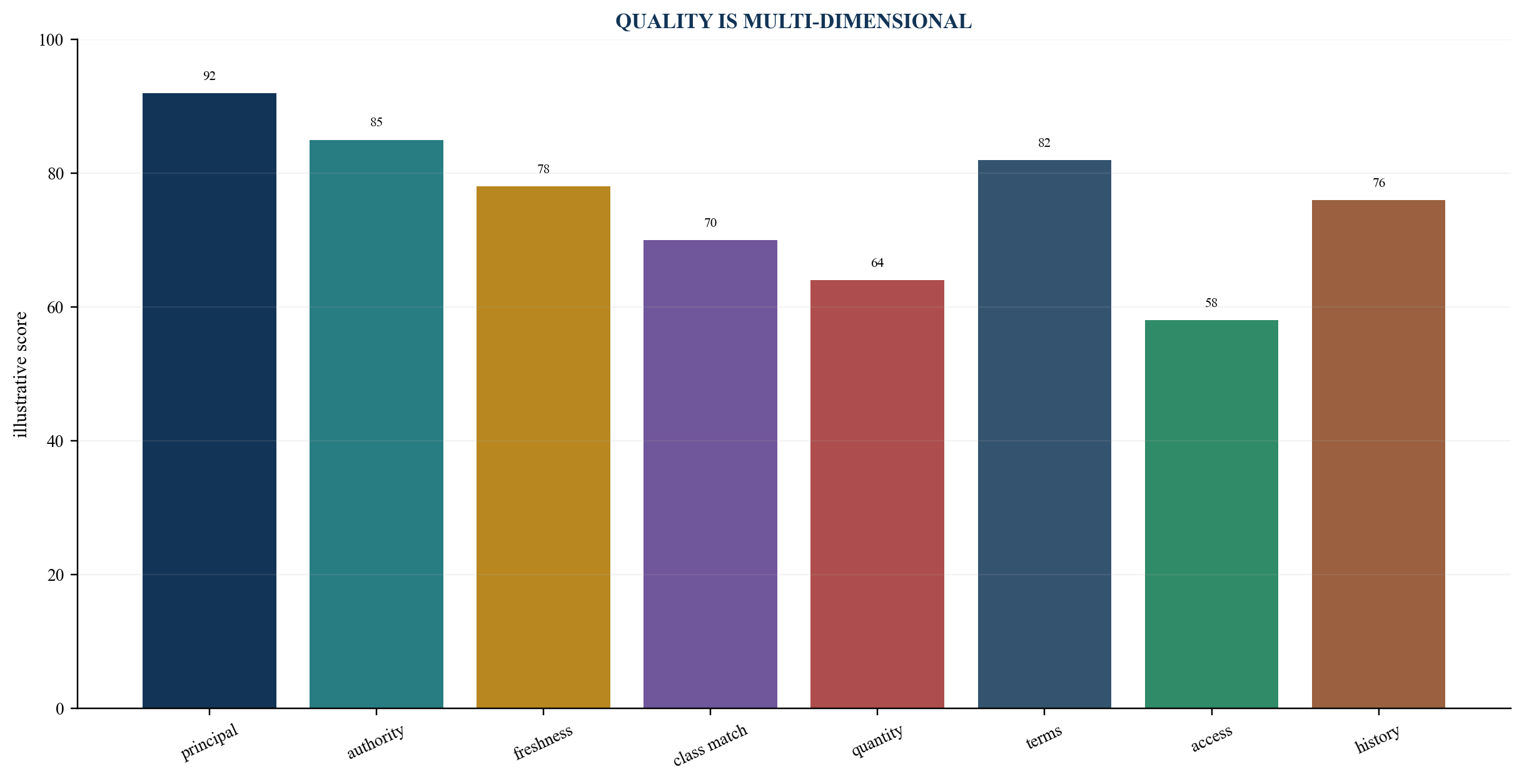
Scores are illustrative management assumptions; critical defects override the composite result.
8. Detect duplicate, circular and impossible inventory
Duplicate inventory arises when several intermediaries circulate the same holder, certificate, SPV interest or expected allocation. Summing quoted quantities can create fictitious depth. The surveillance process should compare issuer, class, quantity, lot characteristics, holder clues, price, timing, document fingerprints and transmission chain.
Exact matching is rarely available because messages can redact identities or round quantities. The team can use a potential-duplicate flag and seek source confirmation. An observation remains separated until ownership or independent origin is established. Restricted identity evidence can be reviewed by an authorised control function without broad disclosure.
Circular quotes occur when participants repeat each other's messages. A buyer indication may return through another broker as apparent seller demand. The lineage record should track who supplied each price and which side originated it. A quote with no identifiable principal should never create executable depth by repetition.
Impossible access includes quantities exceeding known transferable holdings, a class that has not been issued, an SPV claiming ownership without asset evidence, a seller lacking authority, a buyer outside eligibility conditions or a closing timetable inconsistent with transfer restrictions. These cases require a stop and verification path.
Surveillance findings should feed counterparty quality. Repeated duplication, unverifiable access, price manipulation or refusal to correct stale quotes reduces future weight and can restrict the counterparty. Decisions require documented evidence and appropriate legal or compliance review.
9. Construct price intervals before selecting a point
A defensible order book begins with a distribution. The team plots normalised bids, offers, completed trades, tenders and analytical marks by date, quantity and evidence quality. It shows the best verified bid, best verified offer, midpoint, last comparable trade, volume-weighted references where appropriate and the range of current indications.
Sparse data calls for intervals. The lower bound can reflect executable demand, downside comparables and stressed settlement. The upper bound can reflect verified offers, recent financing evidence and upside comparables. The central estimate should follow the decision methodology and evidence. Each bound needs a clear rationale.
Weighting can combine quality, freshness, comparability and quantity relevance. The calculation should avoid giving a large number of repeated low-quality quotes more influence than one verified transaction. Cluster or source caps can limit concentration. Observations sharing one origin should be treated together.
Dispersion is information. A wide bid-offer range can reflect uncertainty, fragmented access, heterogeneous rights, illiquidity or different expectations. The output should report dispersion and evidence density rather than hide them inside a midpoint.
The final price range should state its validity period and update triggers. A material issuer event, new financing, verified block, tender, consent change, market movement or quote expiry can reopen the conclusion.
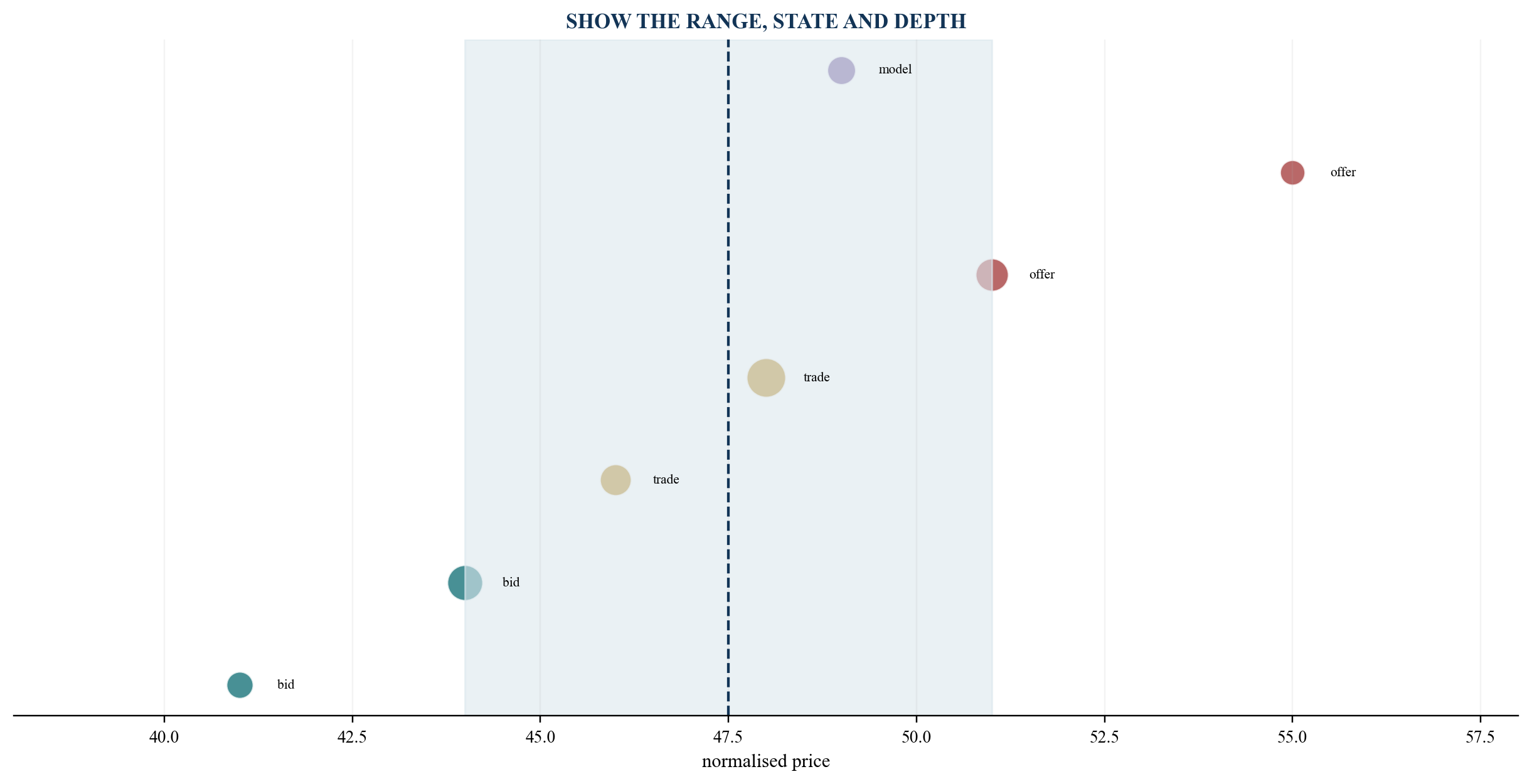
Values and observations are illustrative management assumptions.
Table 4. Price-range construction record
| Element | Evidence | Adjustment | Output |
|---|---|---|---|
| lower bound | verified bids and downside cases | class, size, time and settlement | defensible demand floor |
| upper bound | verified offers and relevant financing evidence | rights, quantity and conditions | supportable supply ceiling |
| central view | weighted comparable observations | quality and origin controls | decision estimate |
| dispersion | bid-offer and source distribution | none; reported directly | uncertainty measure |
| liquidity | executable quantity by price | probability and timing shown separately | depth curve |
| validity | observation expiry and event calendar | defined update triggers | review date |
The selected methodology should align with the stated decision purpose.
10. Separate price discovery from accounting fair value
The private-share order book provides market evidence. Accounting fair value follows the applicable reporting framework and governance. IFRS 13 defines the objective and requires market-participant assumptions at the measurement date. The standard's fair-value hierarchy prioritises inputs to valuation techniques. Fragmented private-share observations usually require careful assessment of observability, activity and comparability.
A quote can inform fair value without determining it. The valuation team assesses whether the quote is orderly, current, accessible, bona fide and relevant to the unit of account. It evaluates rights, restrictions, quantity, market participants and transaction costs under the applicable standard. The conclusion should retain the source and adjustment bridge.
The FCA's March 2025 review of private-market valuation practices identified robust processes through independence, expertise, transparency and consistency. It also described improvement areas in conflicts, independence, ad hoc valuations and decision records. These findings support a governance model with accountable committees, detailed minutes, defined event triggers and transparent methodology.
IOSCO's principles call for comprehensive documented valuation policies, defined methodologies and sound reliable data sources. The order-book ledger can support these requirements by preserving the origin, quality and treatment of market evidence. It does not replace the responsible valuation process.
Valuation and execution can diverge. A portfolio can carry a fair-value estimate while the price available for an urgent block differs because of quantity, timing, restrictions or buyer concentration. The two outputs should be reconciled and explained. Silent substitution creates governance risk.
11. Apply quotation and execution controls to the relevant regulated activity
FINRA Rule 5210 states that a member should have a basis to believe a published transaction is bona fide and a published bid or offer represents a bona fide quotation. This principle illustrates why quote state and source verification matter. Its legal application depends on the entity, activity and jurisdiction.
FINRA Rule 5310 requires reasonable diligence to ascertain the best market for a customer transaction and identifies factors including market character, transaction size and type, markets checked, quote accessibility and order terms. FINRA Rule 2121 addresses fair prices and commissions, considering the relevant circumstances. These rules should be assessed by qualified compliance and legal advisers for covered firms and transactions.
The internal framework can support evidence regardless of jurisdiction. It records markets and sources checked, access limitations, order terms, capacity, fees, quotations available at the decision time and reasons for the selected route. This creates a reproducible transaction file.
The communication record should distinguish market colour from a firm order. External language should accurately describe economic state and capacity. A source-attributed indication should not become a house quote unless the firm has authority and intends that meaning.
Cross-border activity can engage several regulatory perimeters. Sender, recipient, security, content, service, compensation, location and next act should follow the approved route. The order book should contain permission metadata so a commercially attractive observation does not bypass communication or transaction controls.
12. Govern conflicts, fees and price influence
Price discovery can be influenced by compensation. Percentage commissions, principal spreads, warehousing gains, referral fees, financing economics and performance-linked remuneration can affect which observations are promoted and which routes are selected. The decision file should identify each economic interest.
The team should separate the market-evidence function from sales incentives through review, permissions and recorded challenge. A commercial owner can gather evidence. A control owner verifies status, origin and comparability. The authorised decision maker approves use. Proportionate arrangements depend on business size and regulation.
Related-party quotes deserve specific treatment. An affiliate buying from a managed vehicle, an employee selling to a connected fund or a warehouse transferring to customers can create allocation and fairness questions. The order book should identify the relationship and alternative evidence sought.
Fees should appear separately from the security price. A net buyer cost and net seller proceeds view can then show complete economics. Mark-ups, commissions and indirect benefits should use accurate capacity labels and current legal review. Disclosure does not turn weak price evidence into strong evidence.
Committee minutes should capture dissent and alternatives. A final range that differs from the strongest raw observation may be reasonable because of rights, quantity, staleness or execution probability. The record should make that reasoning visible.
13. Design governance for overrides and exceptions
Every methodology encounters exceptional facts. A material issuer event may make prior trades stale. A single verified block may dominate a thin book. A distressed seller may transact outside the current range. A tender may reveal demand while applying eligibility constraints. The governance model should allow overrides with evidence.
An override record contains the affected observation or output, original treatment, revised treatment, reason, supporting evidence, approver, effective date, expiry and required follow-up. The system should prevent an override from becoming a permanent hidden rule.
Escalation should also reflect evidence defects. Unknown principal, conflicting share class, expired authority, unverifiable ownership, circular origin, missing permission or unresolved inside-information concerns require specialist review or exclusion.
The committee should include the expertise needed for the decision. Commercial, transaction, valuation, legal, compliance, finance and risk functions may participate. Decision rights and quorum should be defined. Independent challenge should be genuine and recorded.
Table 5. Override and escalation matrix
| Trigger | Immediate action | Evidence required | Approval |
|---|---|---|---|
| quote outside current interval | pause automated inclusion | source, terms, event and principal | market-evidence owner |
| related-party observation | flag and seek alternatives | relationship and complete economics | conflict reviewer |
| material issuer event | expire affected observations | event log and impact analysis | valuation or transaction committee |
| circular or duplicate source | remove duplicated depth | lineage and holder evidence | control owner |
| large manual adjustment | preserve original and bridge | method, sensitivity and rationale | designated approver |
| legal or permission concern | stop circulation or transaction use | current counsel or compliance decision | authorised function |
Thresholds and decision rights are illustrative management assumptions.
14. Build a decision record for every executed block
The transaction decision record captures what the team knew and why it acted. It includes decision purpose, timestamp, security, class, quantity, buyer and seller capacity, approved communication route, available price evidence, excluded observations, comparability adjustments, fees, settlement probability, chosen price and range, alternatives and approvals.
The record should preserve the order-book snapshot. A live dashboard changes as quotes expire and new evidence arrives. The executed decision needs an immutable view of the inputs available at that time. Source documents remain linked under access control.
Price and route should be approved together. A higher nominal price through an uncertain or unauthorised route can produce a weaker expected outcome. The record shows consent, rights process, funding, settlement method, timetable and failure path.
Post-trade evidence closes the loop. The team records agreed price, final quantity, fees, FX, conditions, completion date, registration and net proceeds. Differences from the decision view are analysed. Failed or renegotiated trades remain part of the evidence set with accurate status.
The completed record supports later review by management, clients, auditors, regulators or counterparties where authorised. It also improves the next decision because model assumptions can be compared with actual outcomes.
15. Measure liquidity, dispersion and outcome quality
Market activity should be measured through states rather than gross quote count. Useful measures include verified principals, unique origins, executable bid quantity, executable offer quantity, matched quantity, closed quantity, median age, expiry profile, price dispersion, bid-offer interval, completion probability and days to settlement.
Outcome measures should test decision quality. The team compares decision range with executed price, executed price with later evidence, predicted probability with completion, expected timing with actual timing and quoted quantity with delivered quantity. These comparisons identify systematic optimism or conservatism.
Commercial measures include paid diagnostics, signed order-book or transaction-control retainers, active mandates, completed blocks, invoiced fees, cleared receipts, repeat mandates and contribution after delivery cost. Expressions of interest, projected fees and potential mandates remain management estimates until supported by executed agreements and bank evidence.
Control measures include unauthorised circulation, missing source evidence, stale quotes in executable views, unresolved conflicts, unexplained overrides, duplicate inventory and decisions without a preserved snapshot. Exceptions should have owners and ageing.
Dashboards should preserve confidentiality and avoid implying a public market. Aggregate views can support management without disclosing restricted issuers, holders or counterparties. Access and permitted use remain visible.
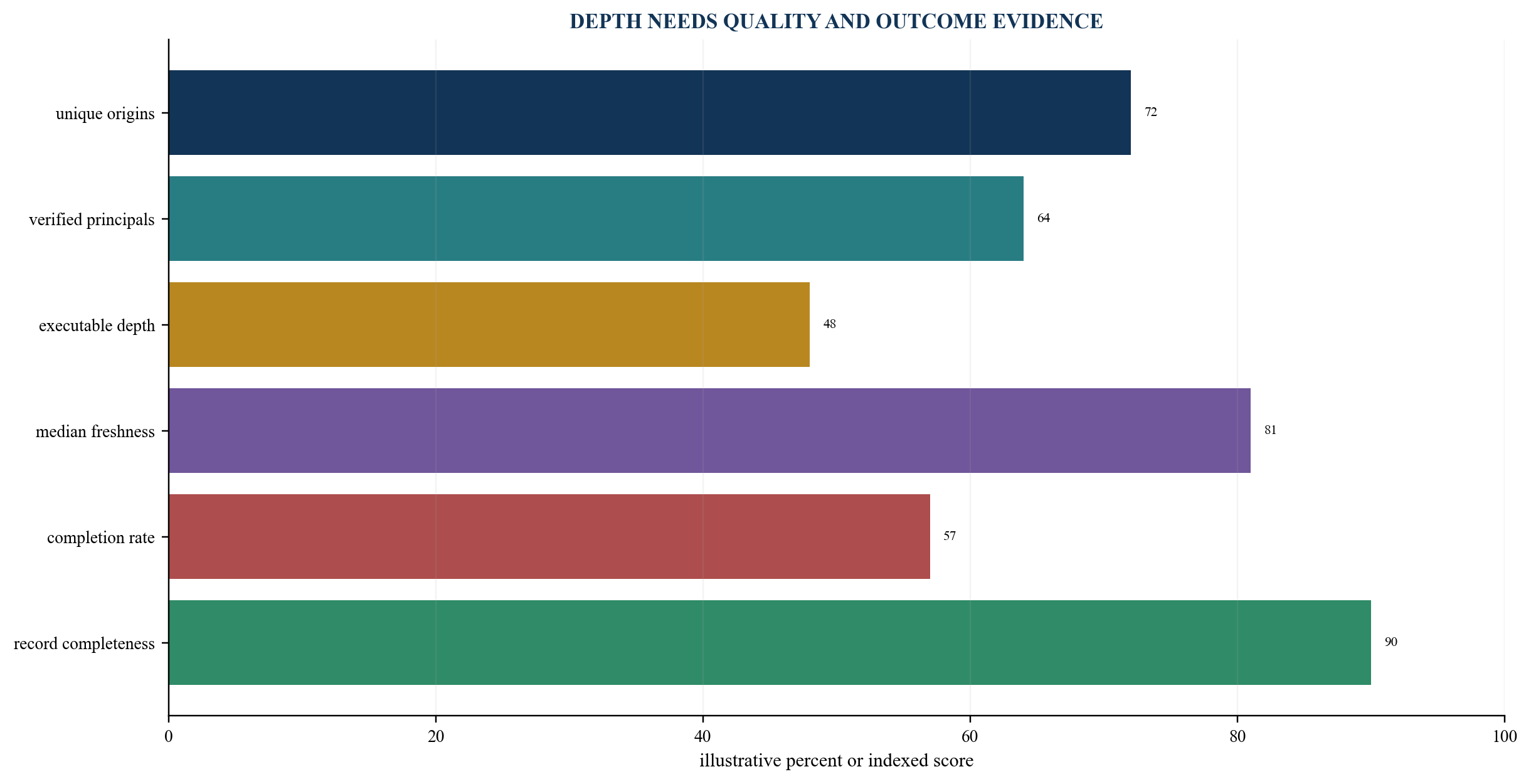
Values are illustrative management assumptions.
16. Run a ten-day price-evidence diagnostic
Days one and two define the decisions, securities, users, jurisdictions, capacities and existing data sources. The team inventories spreadsheets, messages, CRM records, platform exports, trade files, valuation packs and tender documents under a controlled access plan.
Days three and four sample observations across issuers and sources. The review tests principal identity, origin, economic state, timestamp, quantity, share class, conditions, fees, expiry and original evidence. It identifies duplicates, circular messages and permission gaps.
Days five and six build the security and comparability map. The team reconciles share classes, rights, capitalisation, ownership forms, currencies, quantity buckets, transfer restrictions and settlement routes. Material gaps receive owners.
Days seven and eight reconstruct selected historical decisions. The team compares the evidence available at the time with the price used, approval, actual execution, completion and later observations. Overrides and conflicts are reviewed.
Day nine scores control maturity across data, lineage, comparability, permissions, methodology, governance, decisions and outcome testing. Findings are ranked by commercial and control consequence. Immediate stop items are separated from improvement work.
Day ten presents a board-ready action pack: target operating model, data dictionary, source-quality framework, priority remediation, system requirements, ownership, timeline, budget assumptions and measures. Any proposed revenue or collection outcome remains a management estimate until achieved and evidenced.
17. Implement a thirty-day order-book control office
Days one to five establish governance, decision rights, the data dictionary, access groups, critical stop rules and the initial issuer population. Active mandates and near-term decisions receive priority.
Days six to ten ingest and clean current observations. The team links original evidence, identifies origins, verifies principals, labels economic states, applies expiry rules and isolates potential duplicates. It preserves the raw data before normalisation.
Days eleven to fifteen build security masters and comparability bridges. Share classes, rights, capitalisation, currencies, quantity buckets, fees, transfer restrictions and ownership forms are mapped. Specialists review material adjustments.
Days sixteen to twenty implement scoring, price ladders, dispersion views, executable depth and decision snapshots. User permissions and change logs are tested. Committee templates and override records become operational.
Days twenty-one to twenty-five reconstruct prior decisions and compare them with outcomes. The team calibrates weights, thresholds and source treatment. Counterparty-quality results are reviewed for evidence and fairness.
Days twenty-six to thirty train users, test incidents, finalise reporting, assign remediation owners and complete management acceptance. The operating model enters a scheduled review cycle. System automation remains subject to human approval and specialist review for material decisions.
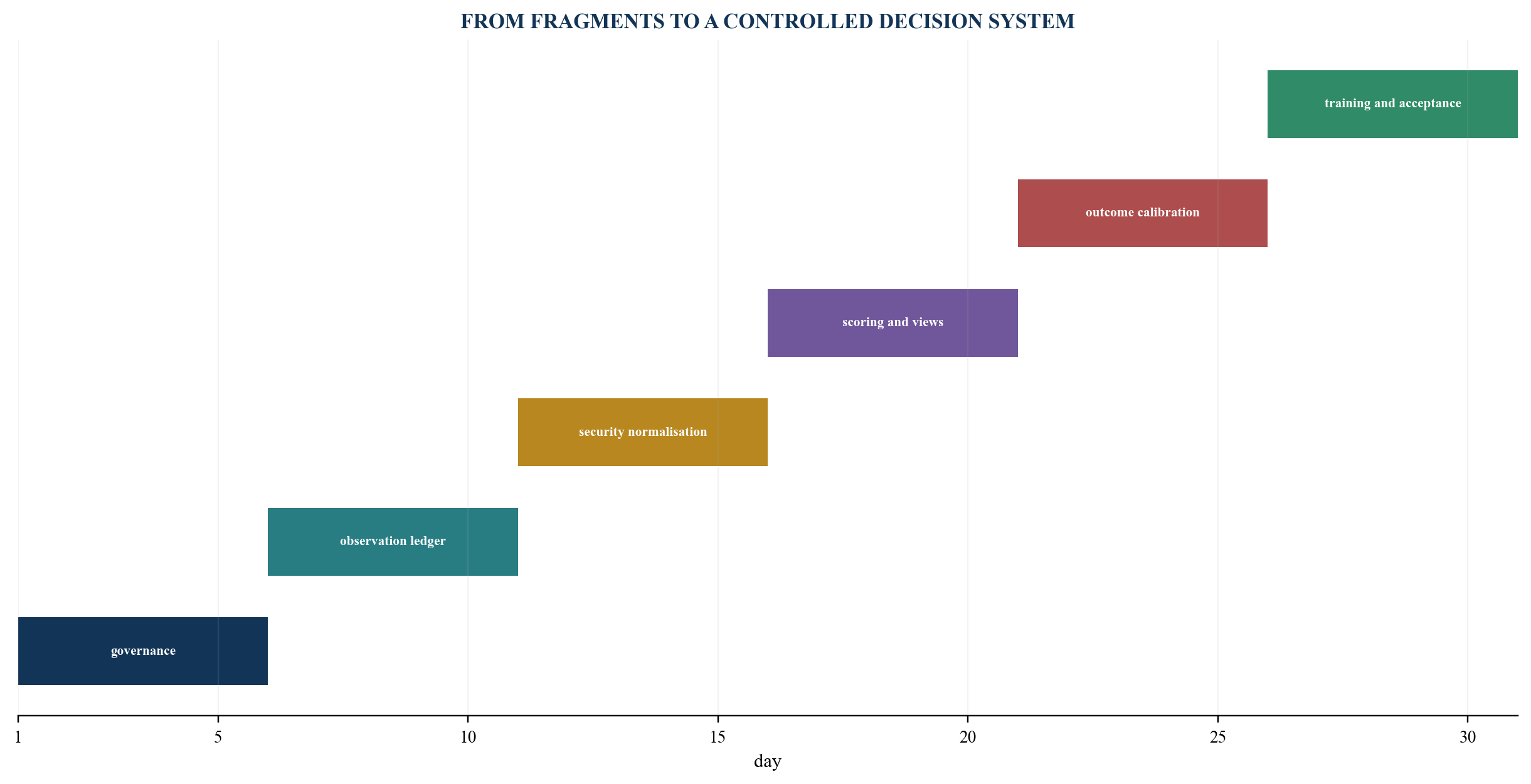
Timing is an illustrative management assumption and should reflect data quality, mandate volume and system complexity.
Table 6. Implementation deliverables
| Workstream | Deliverable | Acceptance evidence | Operating owner |
|---|---|---|---|
| governance | policy, roles and stop rules | approved decision matrix | governing committee |
| data | observation ledger and source lineage | complete sampled records | market-evidence owner |
| comparability | security masters and adjustment bridges | specialist-reviewed mappings | valuation or transaction lead |
| controls | scoring, expiry, duplicate and permission rules | tested exceptions | control owner |
| decisions | snapshot and override records | reproducible historical cases | authorised decision maker |
| reporting | depth, dispersion, outcomes and collections | reconciled dashboard | management owner |
Scope should be matched to the firm's activities, permissions and transaction volume.
18. Package the work around paid decision outcomes
The framework can support a price-evidence diagnostic, order-book design, security-master build, counterparty-quality review, transaction decision office, valuation evidence pack, portfolio surveillance or data-and-control implementation. The mandate should define the decision, users, securities, jurisdictions, permissions and specialist boundaries.
Commercial qualification should start with consequence and authority. Stronger demand can arise where the client has an active block, unreliable inventory, a disputed mark, repeated failed matches, a valuation event, a financing need, a board deadline or an audit finding. The economic buyer should own the consequence and budget.
Deliverables should connect to measurable decisions: verified inventory, unique principals, reduced duplicate depth, current price ranges, documented adjustments, faster approvals, higher settlement conversion and reconciled fees. Performance claims require actual client evidence and an agreed measurement basis.
Pricing can reflect issuer count, security complexity, observation volume, source fragmentation, jurisdiction count, historical reconstruction, system integration, committee support and transaction intensity. A recurring retainer can cover ongoing ingestion, verification, range updates, committee packs and outcome testing. Any transaction-linked fee requires current legal and regulatory review and an executed agreement.
Collection reporting should identify executed mandate, invoice, cleared bank receipt, engagement, delivery cost and contribution. Contracted, invoiced and collected fees remain separate states. Pipeline and expected revenue remain management estimates.
Reserved legal, regulatory, brokerage, valuation-opinion, accounting, audit, tax and investment-decision functions should remain with qualified and authorised providers. Matchpoint's role, data access, decision rights, reliance limitations and handoffs should be explicit in the engagement.
19. Conclusion
Private-share price discovery becomes defensible when every observation retains its identity. The decision starts with purpose. The ledger preserves source, origin, state, terms and evidence. The security bridge makes rights and quantities comparable. The scoring method reveals quality. The surveillance layer removes duplicated and impossible depth. The price ladder shows range, dispersion and executable liquidity. The decision record preserves the evidence and reasoning used.
A completed trade, firm order, indication, tender, financing mark and accounting fair value each contribute different information. Their differences should remain visible. Strong governance allows justified adjustment while preserving the original evidence and approval trail.
The final operating standard is practical: no quote without a state, no depth without a unique origin, no comparison without a rights bridge, no selected price without a stated purpose and no completed decision without an immutable evidence record.
References
- US Securities and Exchange Commission. Private Secondary Markets. https://www.sec.gov/resources-small-businesses/capital-raising-building-blocks/private-secondary-markets
- US Securities and Exchange Commission. What Is a Private Secondary Market? Updated 2026. https://www.sec.gov/file/private-secondary-markets-building-block
- Financial Industry Regulatory Authority. Rule 5210: Publication of Transactions and Quotations. https://www.finra.org/rules-guidance/rulebooks/finra-rules/5210
- Financial Industry Regulatory Authority. Rule 5310: Best Execution and Interpositioning. https://www.finra.org/finramanual/rules/r5310/
- Financial Industry Regulatory Authority. Rule 2121: Fair Prices and Commissions. https://www.finra.org/rules-guidance/rulebooks/finra-rules/2121
- Financial Conduct Authority. Private Market Valuation Practices. 5 March 2025. https://www.fca.org.uk/publications/multi-firm-reviews/private-market-valuation-practices
- Financial Conduct Authority. Growth of Private Markets Requires Continued Focus on Valuations. 5 March 2025; updated 5 December 2025. https://www.fca.org.uk/news/press-releases/growth-private-markets-requires-continued-focus-valuations
- IFRS Foundation. IFRS 13 Fair Value Measurement. https://www.ifrs.org/issued-standards/list-of-standards/ifrs-13-fair-value-measurement/
- IFRS Interpretations Committee. IFRIC Update January 2015: Fair Value Hierarchy when Third-Party Consensus Prices Are Used. https://media.ifrs.org/2015/IFRIC/January/IFRIC-Update-January-2015.html
- International Organization of Securities Commissions. Principles for the Valuation of Collective Investment Schemes. https://www.iosco.org/library/pubdocs/pdf/IOSCOPD413.pdf
- US Securities and Exchange Commission. Good Faith Determinations of Fair Value: A Small Entity Compliance Guide. https://www.sec.gov/resources-small-businesses/small-business-compliance-guides/good-faith-determinations-fair-value-small-entity-compliance-guide
- US Securities and Exchange Commission. SEC Modernizes Framework for Fund Valuation Practices. https://www.sec.gov/newsroom/press-releases/2020-302
- European Securities and Markets Authority. Final Report on the 2022 Common Supervisory Action on Valuation. 24 May 2023. https://www.esma.europa.eu/press-news/esma-news/esma-report-points-out-improvements-needed-supervision-asset-valuation
- Dubai Financial Services Authority. Collective Investment Funds. https://www.dfsa.ae/what-we-do/collective-investment-funds
- Abu Dhabi Global Market Financial Services Regulatory Authority. Public Fund Registration: Valuation and Pricing. https://assets.adgm.com/download/assets/FSRA%2B%2BFPR%2BPublic%2BFund%2BRegistration%2Bv301220.pdf/081ccd2a660011efaa5e06e482506d96
- Abu Dhabi Global Market Financial Services Regulatory Authority. Venture Capital Fund Manager Application: Fund Valuation. https://assets.adgm.com/download/assets/FSRA%2BVenture%2BCapital%2BFund%2BManager%2BVCFM.pdf/cfda52d45b9611efa6a0deeeaf1f200d
About the Author
Chennakeshav Adya, Independent Researcher
