

1. A public quotation is one milestone in a longer liquidity transition
An IPO changes the information, trading and valuation environment around a security. It can establish an observable market price, a public disclosure regime and an exchange-traded instrument. A pre-IPO shareholder can still be unable to sell. The original shares may remain subject to a contractual lock-up, a statutory or exchange moratorium, a restrictive legend, affiliate limitations, an insider-trading policy, a closed window, a pledge, a tax hold or an incomplete custody conversion.
The transition should therefore be governed as a sequence of states. The listing date is one state within that sequence. Listing does not by itself prove legal eligibility, operational deliverability or economic executability. Each state requires evidence, an accountable owner and a completion condition.
The shareholder's objective also matters. A founder seeking limited diversification, an employee funding tax, a fund returning capital, a lender enforcing collateral and a family office rebalancing a portfolio can face the same lock-up date with different constraints. A defensible plan begins with the holder's authority, obligations, cash need, tax basis, concentration and risk tolerance.
The transition office should be active before the prospectus becomes effective or the admission document is published. It should reconcile the position, identify every restriction, prepare account and transfer documentation, model sale capacity and obtain conditional approvals. Work performed before listing can shorten the period between eligibility and executable liquidity.
The plan remains conditional. The IPO can be postponed, repriced or withdrawn. Underwriters or issuers can amend arrangements within their contractual and legal authority. Trading can be volatile or suspended. The investor should preserve a private-company contingency and avoid committing expected proceeds before the cash is settled and available.
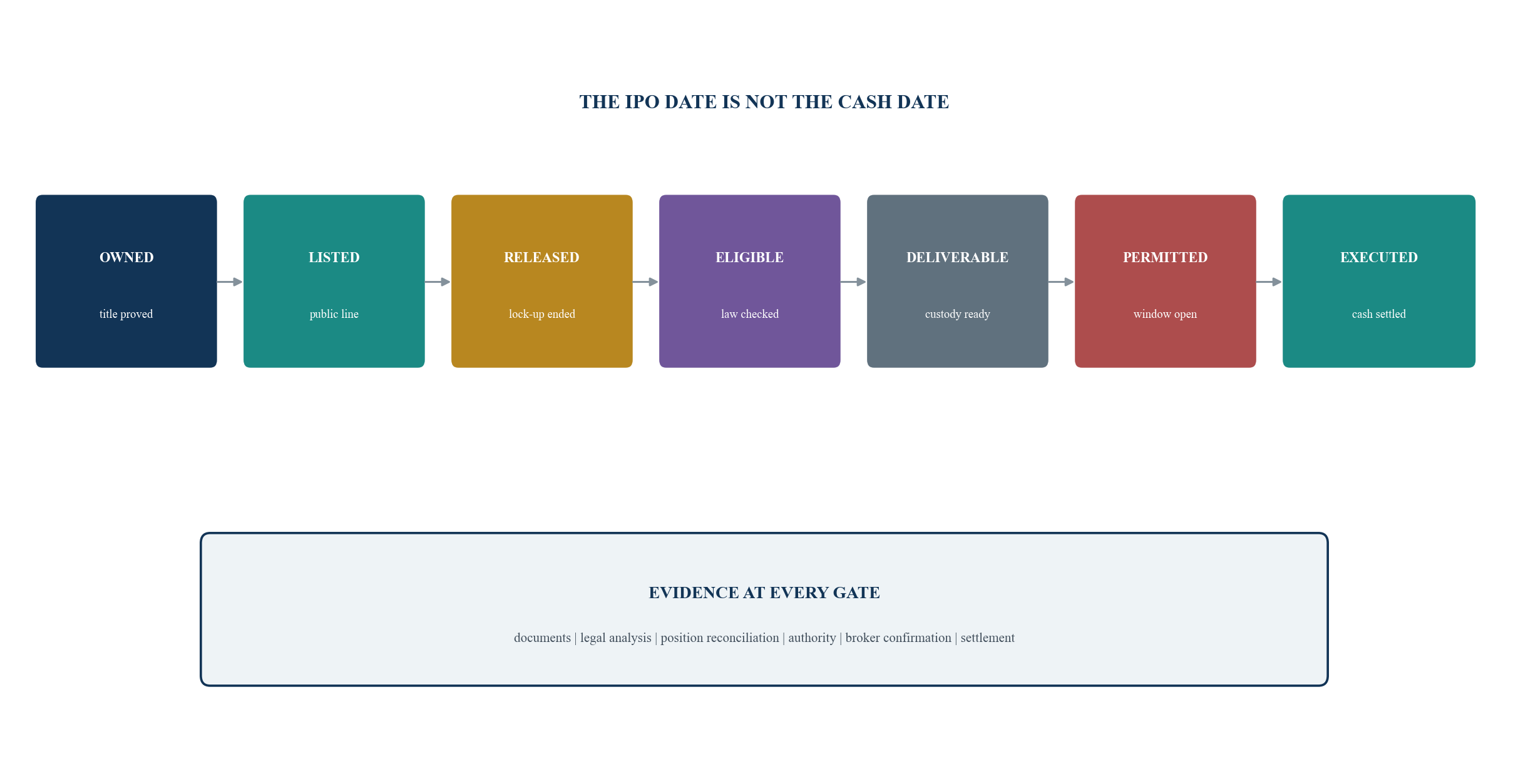
Each gate requires separate evidence; passing one gate does not establish that later gates have been passed.
2. Build one restriction register before modelling a sale date
Restrictions arise from several documents and legal regimes. The register should begin with the shareholder agreement, subscription or purchase agreement, side letters, share certificate or electronic legend, company constitution, financing documents, option or award agreement, custody terms, underwriting agreement, lock-up agreement, prospectus and public-company dealing policy.
Each restriction requires its own start event, end event, extension mechanics, release authority, exceptions, notice period and evidence of satisfaction. A fixed number of days after pricing can differ from the same number of days after admission. A provision can extend automatically after an earnings release, blackout or follow-on offering. A waiver can apply to one holder, transaction type or quantity while leaving the remaining position restricted.
The register should distinguish contractual, regulatory, exchange, issuer-policy and operational restrictions. It should also identify the entity and beneficial owner to which each restriction attaches. A permitted transfer to an affiliate, trust or estate-planning vehicle can carry the remaining lock-up and require the transferee to sign an undertaking.
FINRA's Rule 5131 framework requires advance public notice for certain releases or waivers of lock-ups applicable to officers and directors, subject to the rule's scope and exceptions. The notice obligation does not create a general waiver right for a holder. The executed agreement and current advisers determine the applicable route.
The UK Financial Conduct Authority's Prospectus Regulation Manual disclosure annexes require specified details concerning lock-up parties, content, exceptions and period in relevant securities notes. The FCA's UK Listing Rules also use lock-up status in particular public-hands calculations. These provisions illustrate why disclosure, admission and sale eligibility should remain separate workstreams.
Table 1. Lock-up and restriction register
| Restriction layer | Evidence | Control question | Release evidence |
|---|---|---|---|
| shareholder contract | shareholder agreement and side letters | does an IPO terminate or preserve transfer restrictions? | counsel-confirmed clause outcome |
| underwriter lock-up | executed undertaking and underwriting materials | which securities, holders, transfers and hedges are covered? | expiry or written release evidence |
| statutory or exchange moratorium | venue rules and holder classification | does a promoter, controller or recent investor rule apply? | applicable period completed and recorded |
| securities-law resale | acquisition history, holder status and current law | which registration or exemption supports the sale? | legal and broker acceptance |
| issuer dealing policy | policy, insider list and calendar | is the holder inside, restricted or within a closed window? | compliance clearance or valid plan route |
| lien or pledge | facility and security documents | can the shares be released or sold under the financing terms? | lender release and custody instruction |
| custody or legend | register, certificate, agent and broker records | can the public line be credited and delivered? | reconciled unrestricted position in account |
The executed documents and current rules determine the actual restriction and release mechanics.
3. Preserve the complete acquisition and ownership history
Public-market settlement begins with private-market evidence. The transition file should preserve original subscription or purchase documents, issue and transfer dates, consideration, share class, certificate or electronic record, conversions, splits, consolidations, recapitalisations, distributions, option exercises, tax elections, nominee movements and security interests.
The position is reconciled across the issuer register, cap table, nominee or custodian statement, fund administrator, general ledger and legal documents. A quantity match is insufficient when the records use different classes, identifiers or beneficial owners. The reconciliation should show the bridge from each private security to the expected public security and account.
Convertible preferred shares can convert automatically or conditionally at an IPO. Notes, warrants, options and restricted stock units can follow different mechanics. The model should record conversion ratios, accrued amounts, exercise requirements, cashless provisions, fractional treatment, tax withholding and the date on which the public instrument arises.
Corporate actions between the last private statement and listing can create breaks. A pre-listing reorganisation can insert a new holding company, exchange securities, change nominal value or move the governing jurisdiction. The transition team should obtain the formal exchange terms and confirm that the holder has completed every required election, representation and KYC step.
Title and beneficial ownership should remain explicit when shares are held through an SPV or nominee. The public account can receive the SPV's shares while the ultimate investor continues to own an interest in the vehicle. The investor receives the listed security only through a valid vehicle-level distribution, which requires its own authority, allocation, tax and transfer process.
4. Map the private-to-public instrument conversion
The conversion map connects each private line item to the public security identifier and holder account. It states the formula, timing, responsible agent and exceptions. The expected result is compared with the actual credited position after admission.
The map should cover share class conversion, capital reorganisation, bonus or split factors, accrued preferred return, option exercise, warrant treatment, employee withholding, fractional shares and any shares sold in the offering. It should reconcile both gross and net quantities.
A selling shareholder can dispose of part of the position in the IPO while the balance remains locked. The selling allocation, underwriting deductions and settlement cash should be separated from the retained public position. The retained position can include sub-lots with different legal, tax or contractual characteristics.
The public security's currency, listing venue, settlement cycle and custody eligibility affect the operating design. A holder domiciled elsewhere may need a cross-border brokerage account, local tax forms, currency instructions and an approved cash destination. Account-opening and beneficial-owner verification should start early enough to avoid becoming the critical path.
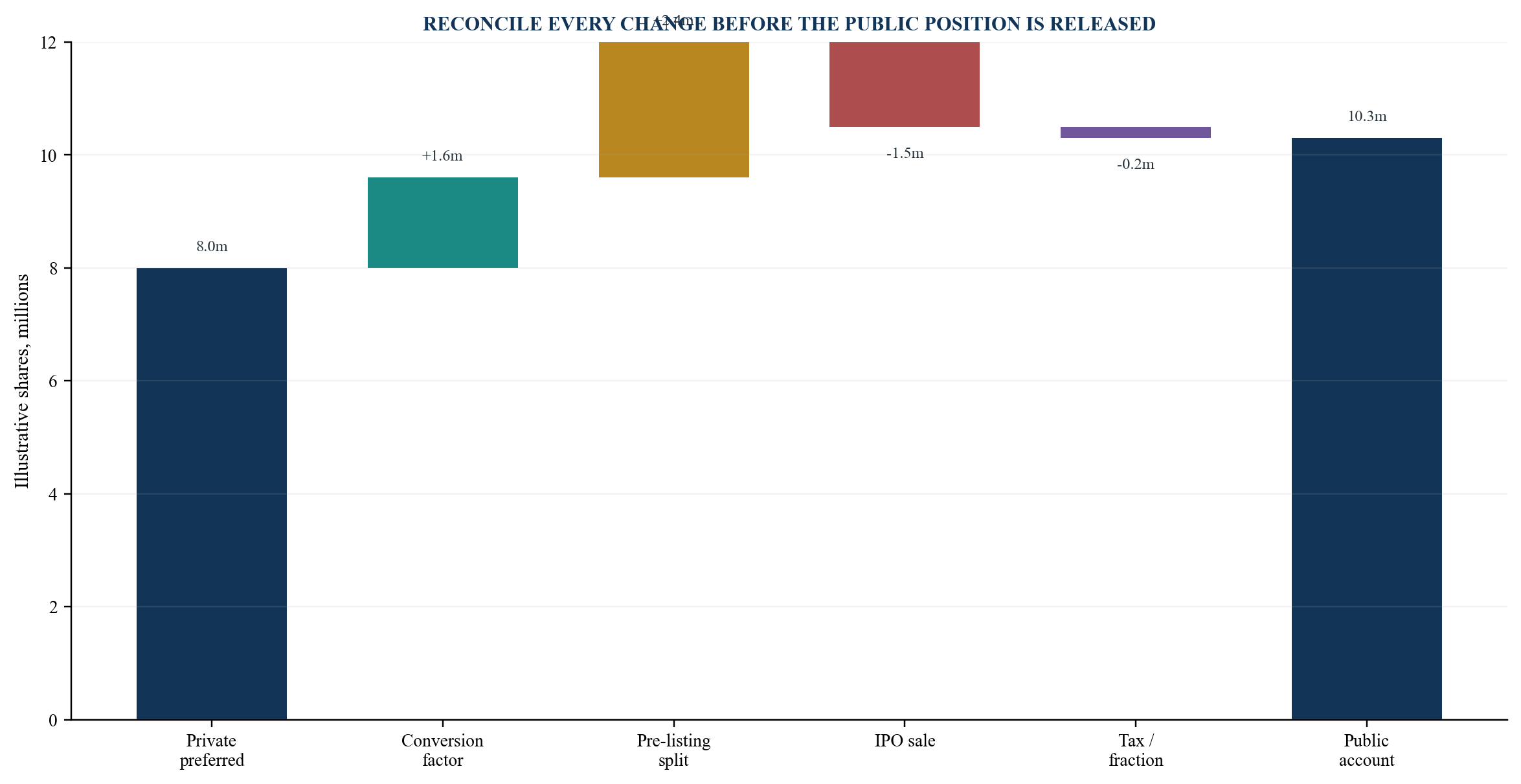
Values are management assumptions used solely to demonstrate reconciliation.
5. Determine the governing resale route in each jurisdiction
The legal workstream should identify the holder, issuer, security, transaction, venue and destination before selecting a resale route. One answer cannot be applied across jurisdictions or holders.
In the United States, securities acquired in unregistered transactions can be restricted securities. SEC Rule 144 provides a non-exclusive safe harbour with conditions that can depend on the issuer's reporting status, the holding period, current public information, affiliate status, sale volume, manner of sale and Form 144 notice. The holding period alone does not settle the analysis. Registration rights, another exemption, contractual restrictions and state requirements can also matter.
Affiliate status requires a fact-specific current analysis. Officers, directors and persons controlling or controlled by the issuer can face additional conditions. A shareholder's percentage alone may not determine control. The decision file should record counsel's conclusion, its facts and the period for which it remains valid.
In the United Kingdom, the prospectus, admission route, UK Listing Rules, issuer arrangements, market-abuse controls and dealing policy require coordinated review. The FCA's current public-offer and admission regime came into force on 19 January 2026. The exact security and market determine which provisions apply.
Singapore Exchange rules impose moratorium requirements on defined promoters and certain other holders within their scope. The rules address direct and indirect interests and contractual undertakings. India's current SEBI Issue of Capital and Disclosure Requirements framework includes lock-in provisions for specified categories and depository recording mechanics; current transaction counsel should confirm the operative regulation and any 2026 changes for the particular offer and holder.
The jurisdiction matrix is a routing tool. It cannot replace advice. The team should update the matrix when the issuer changes venue, uses depositary receipts, adds a secondary listing or conducts a concurrent offering.
Table 2. Jurisdiction-routing matrix for a pre-IPO holder
| Market context | Primary official evidence | Holder classification question | Transition control |
|---|---|---|---|
| United States | SEC registration, resale, insider and offering materials; FINRA underwriting rules | restricted holder, affiliate, officer, director or 10% holder? | route memo, legend process, notice, volume and trading-policy checks |
| United Kingdom | FCA prospectus, listing, market-abuse and disclosure materials | holder covered by lock-up, issuer policy or disclosure threshold? | prospectus extraction, dealing clearance and disclosure calendar |
| Singapore | SGX listing and moratorium rules | promoter, controller, executive director, multiple-vote holder or covered investor? | undertaking register and direct/indirect interest reconciliation |
| India | current SEBI ICDR, depository and market-abuse requirements | promoter, promoter group, pre-issue holder or other specified holder? | lock-in confirmation, depository status and approved execution route |
| cross-border holding | home and venue law, tax, sanctions, broker and custody requirements | beneficial owner, nominee, vehicle and destination account? | coordinated opinions, KYC, tax forms, currency and settlement test |
This matrix identifies questions for current advisers; it does not state a sale entitlement.
6. Treat contractual expiry and legal eligibility as different tests
A contractual lock-up can expire while a restrictive legend, affiliate condition or issuer trading restriction remains. A statutory moratorium can continue beyond an underwriter lock-up. A permitted transfer during the lock-up can move the security to a transferee who remains bound for the balance of the period.
The release certificate should therefore list every restriction and its status. It should include the controlling document, date calculation, extension events, waiver evidence, holder classification, securities-law route, issuer clearance, lien release, legend status and broker acceptance.
Date calculation deserves independent review. Pricing, closing, admission and first trading can occur on different dates. Calendar days, business days and trading days are not interchangeable. Time zones can affect a release that occurs at a specified market open or close.
The plan should also address early release or waiver. The approving party, notice obligation, equality considerations, public disclosure and insider information should be evaluated before the holder relies on a waiver. The investor should not commit a sale based on an informal indication.
When the release applies in tranches, the custody record should preserve separate restricted and unrestricted lots. The sale engine should draw only from the confirmed available balance.
7. Establish public-company insider and market-conduct controls
Pre-IPO holders can become public-company insiders or remain exposed to material non-public information through board rights, observer roles, employment, information rights or close relationships. The transition office should map every information channel and role.
The holder's ability to trade should be assessed under applicable law and the issuer's policy. A contractual lock-up expiry does not authorise trading while the holder possesses material non-public information. An open company window does not remove an individual's own legal responsibility.
For US reporting companies, SEC materials explain that Section 16 applies to directors, officers and holders of more than 10% of a registered class, with transaction reporting and short-swing-profit implications within its scope. Beneficial-ownership reporting under Schedules 13D or 13G can also apply at specified ownership levels. Current counsel should establish the holder's status and filing obligations.
A Rule 10b5-1 plan can provide an affirmative-defence framework when its requirements are met. It is not a universal permission to sell and must be designed around current rules, cooling-off periods, good-faith requirements, certifications where applicable, issuer policy, Section 16, Rule 144 and the holder's facts.
The control record should include insider status, information sources, wall-crossings, restricted lists, window calendar, pre-clearance, plan adoption and amendment, required filings and public announcements. It should also identify who can halt an order if new information arises.
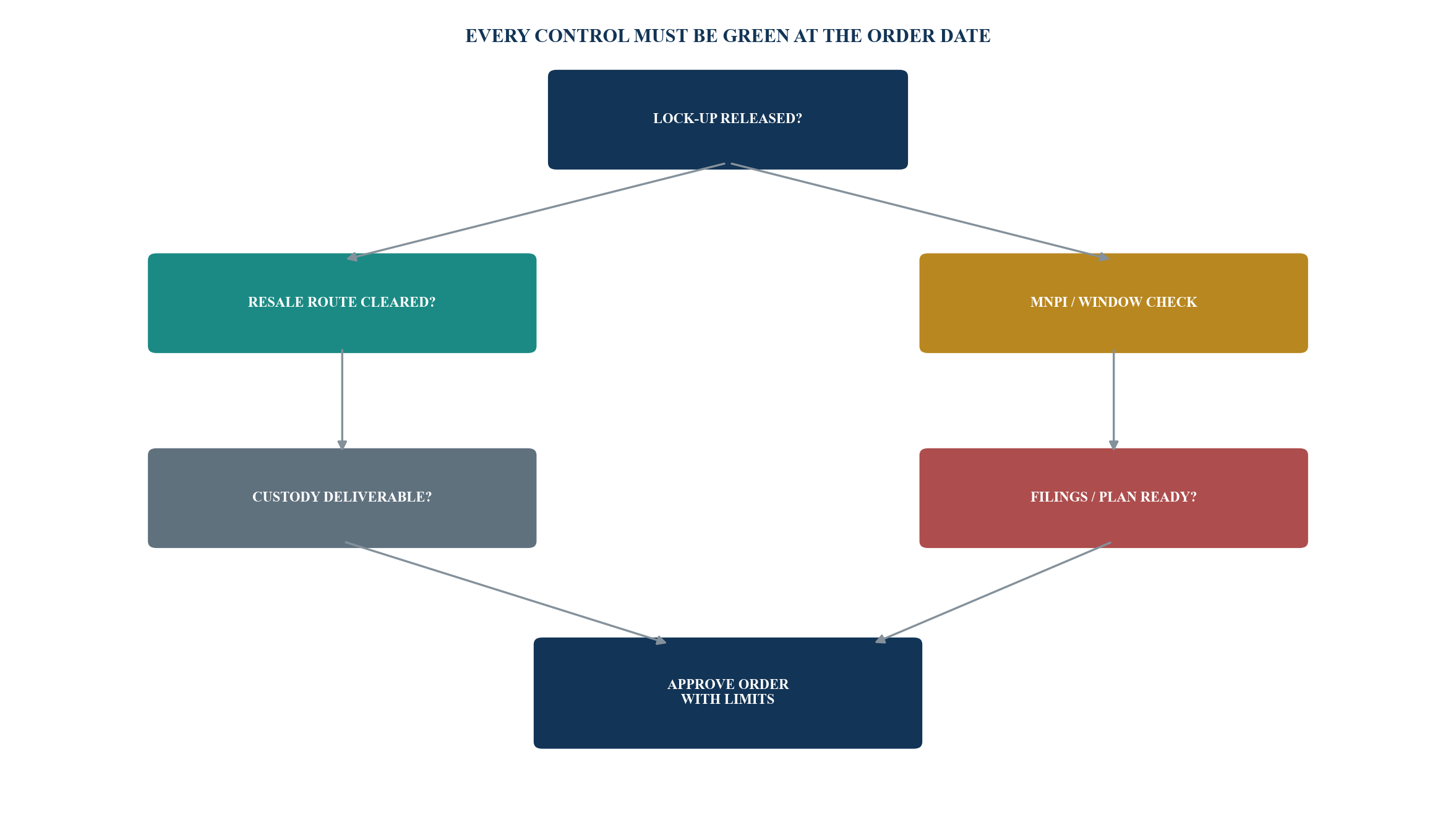
Current legal and compliance advisers should approve the actual decision path.
8. Make custody conversion a named critical path
The operational workstream should identify the registrar or transfer agent, central securities depository, local custodian, global custodian, broker, nominee and beneficial-owner account. Each party can require different documents and processing times.
The team should confirm the public identifier, eligible market, account name, tax status, settlement instructions and cash account. It should test whether the broker will accept the holder, issuer, position size and intended resale route. A broker's onboarding approval does not establish that a particular lot is legally saleable.
Restrictive-legend removal can require an issuer instruction, transfer-agent process, counsel opinion and supporting acquisition records. The exact requirements depend on the security and route. The team should obtain a written checklist. Automatic conversion of a private certificate into an unrestricted book-entry position should not be assumed.
Position delivery should be tested in a controlled way where feasible. The reconciliation compares the issuer or agent record, custodian position, broker position and internal ledger. Any failed or partial movement becomes a dated exception with an owner.
Cross-border holders should confirm market access, foreign ownership restrictions, sanctions screening, local account requirements, tax documentation, withholding and currency conversion. The plan should state whether sale proceeds remain at the broker, move to a custodian, repay financing or fund another obligation.
Table 3. Custody and settlement readiness checklist
| Workstream | Required evidence | Failure mode | Gate owner |
|---|---|---|---|
| identity and authority | KYC, beneficial owner, signatories and resolutions | account or instruction rejected | legal and operations |
| instrument mapping | public identifier and conversion statement | wrong class or quantity credited | issuer and agent |
| restriction status | agent and counsel release package | restricted balance cannot settle | legal and transfer agent |
| account eligibility | broker and custodian acceptance | holder, market or security unsupported | operations and broker |
| position movement | matched delivery instruction and test | delay, partial delivery or failed transfer | custodian control |
| cash destination | verified bank, currency and payment authority | proceeds delayed or misdirected | treasury |
| reconciliation | issuer, agent, custodian, broker and ledger match | sale exceeds deliverable quantity | independent control owner |
Evidence should be obtained from the actual agent, custodian and broker supporting the position.
9. Build a tax-lot and proceeds ledger before placing an order
The tax workstream should preserve acquisition date, cost, currency, fees, corporate-action adjustments, elections, residence, beneficial owner and holding entity for every lot. The IPO conversion can change the number and form of securities without necessarily answering the tax treatment. Current tax advisers should determine basis, character, sourcing, withholding, reporting and remittance.
Employee and founder positions can involve option exercise, restricted awards, payroll withholding or other employment-related treatment. Fund and SPV positions can allocate proceeds, expenses and tax attributes across investors under governing documents. A single brokerage statement may not contain the information required by the beneficial owner.
The proceeds waterfall starts with gross sale value and deducts brokerage, taxes or withholding, transfer and agent charges, financing repayment, hedging close-out, SPV costs, distributions and retained reserves. The investor should distinguish trade-date proceeds, settlement cash and freely deployable cash.
Foreign exchange can create another timing and value bridge. A sale in the listing currency can settle before conversion to the holder's functional or obligation currency. The plan should define who can hedge or convert, under which limits and using which verified account.
The ledger should retain confirmations and filed forms. A tax estimate is a planning input and should remain identified as an estimate until the applicable return, assessment or adviser conclusion is complete.
10. Convert an unrestricted balance into realistic sale capacity
An eligible quantity is not necessarily executable at the observed price. The sale-capacity model should combine legal volume limits, contractual limits, board or mandate limits, broker capacity, average trading volume, order-book depth, expected participation rate, price sensitivity, disclosure thresholds and the investor's deadline.
The SEC's investor bulletin on IPOs explains that the release of a large locked position can create market overhang and that price can decline when many shares become available. This is a risk disclosure, not a prediction for a particular issuer. The execution model should therefore use ranges and live market evidence.
Average daily volume can overstate capacity when a few volatile sessions dominate. The model should review median volume, block liquidity, free float, shareholder concentration, borrow, volatility, announcements and known expiry clusters. It should separate ordinary market sales, blocks, registered secondary offerings, accelerated processes and other lawful routes.
Price is one dimension of outcome. Information leakage, certainty, speed, market impact, execution cost, disclosure and relationship considerations also matter. The committee should approve the route and limits before the holder becomes time-pressured.
The model should use current broker and legal input. Worked participation rates or discounts are management assumptions and should not be described as market facts.
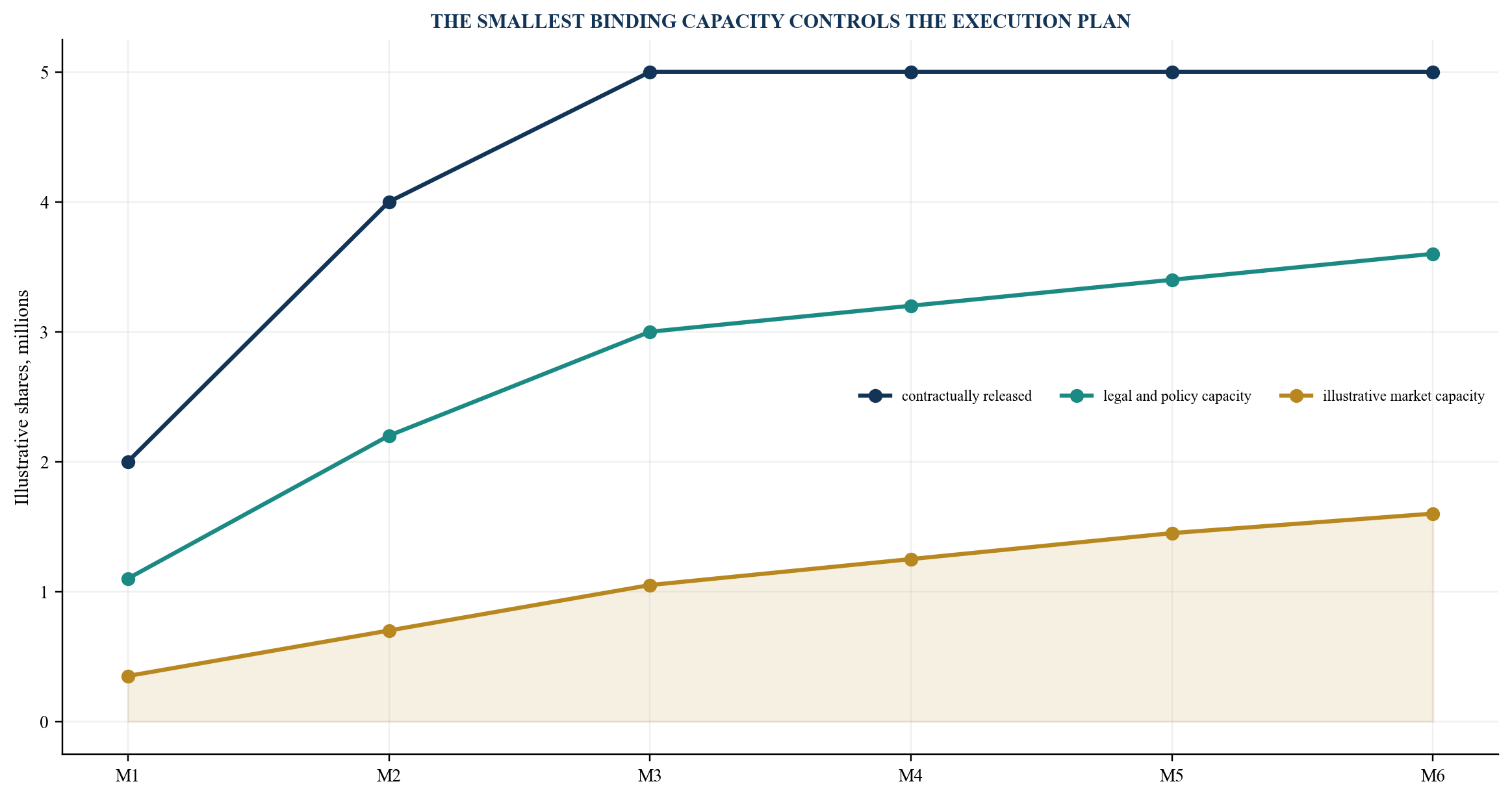
Quantities and participation rates are management assumptions; they do not represent an observed security or recommended order.
11. Choose an execution route that matches the holder and market
Ordinary market sales can provide flexibility for smaller quantities while creating price and information-leakage considerations. A broker-administered trading plan can sequence orders under an approved framework. A block can accelerate liquidity with a negotiated discount and execution risk. A registered secondary offering can address a larger position while requiring issuer, underwriter, disclosure and legal work. Private or structured routes can have separate securities-law, transfer and economic implications.
The route screen should compare available quantity, deadline, expected cost, market impact, disclosure, legal prerequisites, issuer cooperation, counterparty risk and certainty. It should identify combinations that allocate the holding across suitable channels.
The plan can use tranches. A first tranche can meet tax, debt or distribution needs. A second can reduce concentration. A retained balance can preserve upside or governance alignment. Each tranche should be governed by purpose and limits.
Pricing discretion should be explicit. The approved instruction can include limit prices, maximum participation, daily quantity, blackout events, order expiry and escalation thresholds. The broker should confirm how the instructions interact with its execution obligations and the chosen route.
The holder should avoid public statements that imply certainty of sale or price. Communications should align with required disclosures and the issuer's process.
Table 4. Execution-route decision matrix
| Route | Typical purpose | Evidence required | Principal control |
|---|---|---|---|
| staged open-market sale | gradual diversification or cash generation | tradable balance, permissions and broker limits | participation, price and information control |
| compliant trading plan | pre-specified execution under applicable framework | valid adoption, certifications, cooling-off and oversight | amendment, suspension and filing governance |
| negotiated block | faster sale of a larger quantity | buyer or underwriter capacity and lawful distribution route | discount, certainty and leakage |
| registered secondary | coordinated monetisation with public disclosure | registration rights, issuer cooperation and underwriting | timetable, diligence and market risk |
| permitted private transfer | transfer outside ordinary public trading | valid exemption, contract permission and eligible buyer | continued restrictions and settlement |
| financing or hedge | liquidity or risk management without immediate full sale | lender or counterparty terms and legal permissibility | collateral calls, maturity and basis risk |
Route availability and terms require current legal, issuer, underwriter and broker confirmation.
12. Link the sale plan to obligations and concentration reduction
The investor should state why cash is required and when. Obligations can include tax, debt maturity, capital calls, distributions, employee exercise costs, estate planning or strategic reinvestment. A dated obligation should be matched with conservative usable-cash timing that reflects every required gate and settlement.
Concentration reduction can be expressed as a target range across price scenarios. A falling share price can require more shares to meet the same cash need. A rising price can reduce required quantity while increasing portfolio concentration. The approval should state which variable takes priority.
The model should preserve a minimum operating or contingency reserve. Sale proceeds should not be committed twice. A fund can earmark the same expected cash for a distribution and a new investment if the portfolio forecast lacks a single controlled ledger.
The transition should also consider the retained position. Voting, information, board, registration, pre-emption or contractual rights can change after listing or after ownership crosses a threshold. Financing and insurance arrangements can also depend on ownership or role.
The committee should approve a base plan, downside plan and delay plan. Each should show shares sold, net cash, remaining concentration, obligations covered and actions if a gate remains closed.
13. Stress delay, price, volume and operational failure together
Single-variable sensitivities understate transition risk. An IPO delay can coincide with a private funding need. Lock-up expiry can coincide with weak market volume. A price decline can increase the number of shares required while a legal or policy limit constrains sale quantity. A custody failure can prevent settlement during the intended window.
The integrated stress should vary listing date, lock-up release, window availability, price, volume, participation, discount, tax, currency, settlement delay and financing calls. It should calculate usable cash by date, remaining concentration, reserve, uncovered obligations and required action.
Reverse stress identifies the combination that causes a missed obligation or breach. The response can include a larger pre-listing reserve, refinancing, a smaller new commitment, earlier documentation, a different route or a formal extension of the obligation.
The model should preserve the distinction between management assumptions and observed market data. Live price, volume and order-book evidence should be dated. Future dates, participation and discounts remain scenario inputs until executed.
Table 5. Illustrative integrated liquidity-transition stress
| Scenario | Availability effect | Price and volume effect | Usable cash effect | Required response |
|---|---|---|---|---|
| base transition | staged release and open window | planned participation range | obligations covered with reserve | execute approved tranches |
| IPO delayed six months | no public route by target date | private price remains uncertain | cash arrives after obligation | preserve reserve or arrange bridge |
| lock-up extended | public quote exists; position restricted | no authorised sale quantity | concentration remains | confirm extension and reset plan |
| price falls 35% | quantity eligible | more shares needed; capacity lower | net proceeds below target | resize obligation, extend timing or review block |
| expiry-volume surge | many holders released together | participation and impact worsen | slower cash conversion | stagger orders and refresh route screen |
| closed trading window | legal route otherwise ready | orders paused | cash delayed to next permitted route | use pre-approved contingency only if lawful |
| custody conversion fails | shares cannot be delivered | market opportunity missed | no settlement cash | escalate agent reconciliation and protect obligations |
Values and outcomes are management assumptions for method demonstration and do not represent an observed holder or security.
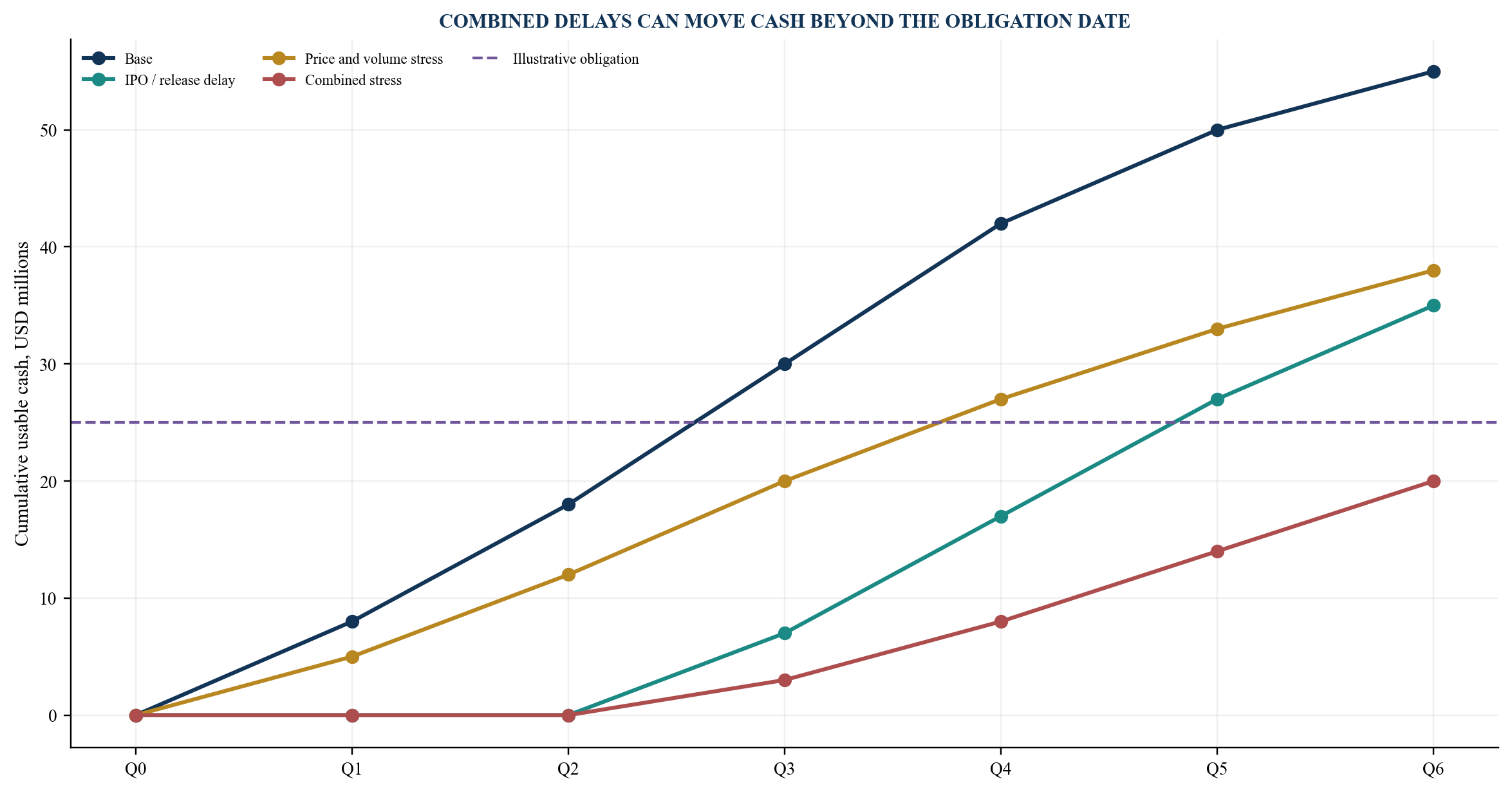
Values are management assumptions; they do not represent observed proceeds or a forecast for any security.
14. Govern releases, orders, changes and exceptions
The investment committee or authorised body should approve the objective, route, quantity, timing, price and risk limits. Legal, compliance, tax, operations, treasury and investment owners should attest to their gates. An independent control owner should confirm the complete evidence pack before the first order.
The approval should define who can change an order and within what bounds. A price movement, new filing, waiver, earnings announcement, trading halt, custody break or material information event should trigger a pause and review where required.
Exceptions need the same discipline as the base plan. The request should state the failed control, value at risk, proposed action, legal and compliance conclusion, owner, duration, mitigants and return-to-policy path. Urgency alone is not evidence.
The order log should reconcile instructions, acknowledgements, executions, fees, settlement, cash and remaining quantity. The post-trade review should compare achieved price and cost with the approved benchmark while respecting the route and market conditions.
The public disclosure and filing calendar should be owned. Required forms, ownership reports, issuer announcements and notifications should be prepared, reviewed and filed within their applicable periods.
15. Run a ten-day transition diagnostic
The diagnostic is designed to locate the critical path before the expected release date. It should be performed early enough to correct evidence and account gaps.
Days one and two establish the holder, objective, obligations, governance and full position inventory. Days three and four build the restriction register and obtain current legal routing. Days five and six reconcile conversion, custody, tax lots and account eligibility. Days seven and eight model sale capacity, routes and integrated stress. Days nine and ten complete approvals, exceptions, owners and the implementation calendar.
The output should include a red-amber-green gate map. Red means the evidence is absent or the control has failed. Amber means the outcome is conditional or time-sensitive. Green means the named evidence has been obtained and remains current.
Table 6. Ten-day private-to-public transition diagnostic
| Day | Workstream | Required output | Decision enabled |
|---|---|---|---|
| 1 | authority and cash objective | approved holder, purpose and obligations | define transition perimeter |
| 2 | position inventory | lot-level ownership and instrument ledger | establish gross exposure |
| 3 | contract review | complete restriction register | identify contractual critical path |
| 4 | regulatory routing | current jurisdiction and holder memo | identify lawful routes and filings |
| 5 | conversion map | private-to-public quantity bridge | validate expected public balance |
| 6 | custody and tax | account, agent, settlement and tax-lot readiness | establish deliverability |
| 7 | market capacity | price, volume, participation and route ranges | size executable tranches |
| 8 | integrated stress | delay, price, volume and failure cases | protect obligations and reserve |
| 9 | governance | approvals, limits, owners and exception record | authorise conditional execution |
| 10 | action calendar | dated ninety-day control plan | mobilise transition office |
Duration is a management planning assumption; actual timing depends on issuer, holder, venue and evidence readiness.
16. Operate a ninety-day transition office
The office can be divided into prepare, validate, release and execute phases. The sequence should follow the actual transaction calendar and remain adjustable when the IPO date changes.
Prepare establishes the data room, restriction register, conversion map, tax-lot ledger, accounts and adviser responsibilities. Validate obtains current legal and compliance conclusions, reconciles expected quantities, completes broker and custodian onboarding and tests instructions. Release records each expired, waived or satisfied restriction and confirms the unrestricted balance. Execute places approved orders, monitors events, reconciles settlement and updates the retained-position plan.
The office should hold a short daily control meeting during the release and execution period. The agenda should cover new information, gate changes, position balance, orders, market capacity, filings, cash, exceptions and next actions. The record should be concise and auditable.
The office remains useful when the IPO is delayed. It can maintain current documents, quantify private-company liquidity alternatives, protect cash obligations and reset the timetable without losing the evidence base.
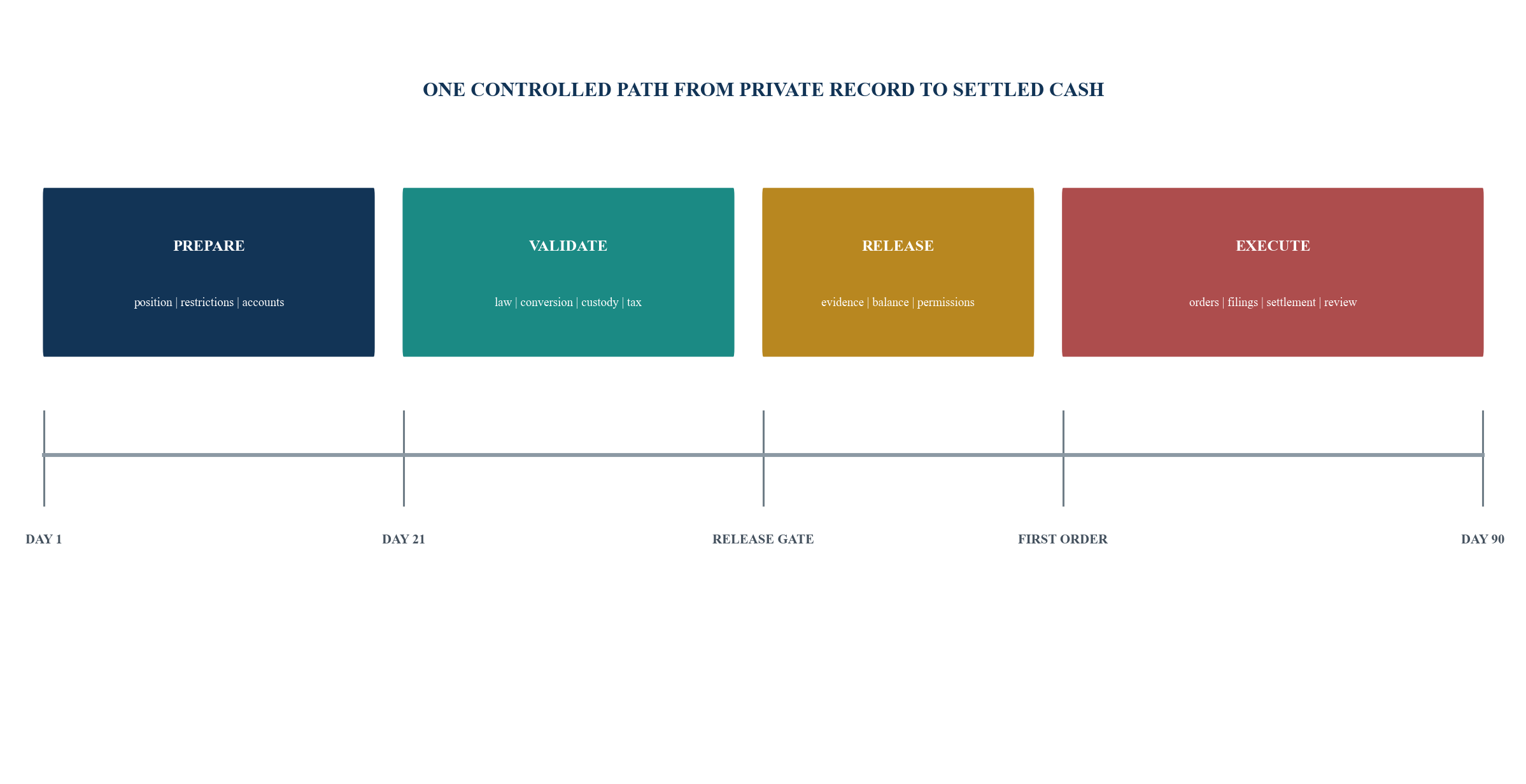
Timing is a management implementation assumption and should be adapted to the actual offer calendar.
17. Measure execution readiness and realised outcomes
Readiness measures should include percentage of lots with complete acquisition evidence, restrictions with confirmed start and end mechanics, conversion lines reconciled, accounts approved, positions deliverable, tax lots supported, legal conclusions current and required approvals complete.
Execution measures should include eligible quantity, deliverable quantity, authorised quantity, executed quantity, settlement failures, time from release to first lawful order, net proceeds, fees, taxes or withholding, price impact, remaining concentration and obligations covered.
Quality measures should record late changes, exceptions, missing filings, control overrides and post-trade breaks. A fast sale with incomplete evidence is not a sound transition outcome.
The report should separate observed results from management estimates. Executed trades, confirmed fees and settled cash are observed. Future prices, participation rates, taxes and timing remain estimates until evidenced.
Commercial demand and fees for a transition mandate remain unverified until supported by a signed engagement and collected payment. A service team can still define a clear work package: restriction diagnostic, legal and adviser coordination, conversion and custody control, sale-capacity modelling, governance, execution support and post-trade reconciliation.
18. Conclusion
The move from a private share to public stock is a controlled transition across ownership, contract, law, public-company conduct, custody, tax, market capacity and settlement. Listing creates an observable market. Usable liquidity arises only after the relevant gates have been passed and the trade has settled.
A robust playbook begins before the IPO, preserves lot-level history, records every restriction, separates release from eligibility and deliverability, and links sales to obligations and concentration. It uses current jurisdiction-specific advice, staged execution and integrated stress across a range of release dates.
The decision rule is simple to state: count cash only after the position is legally eligible, operationally deliverable, permitted to trade, executed and settled. The work required to support that rule is detailed. That detail protects the holder when the transaction calendar, market or restriction changes.
References
- US Securities and Exchange Commission. Investor Bulletin: Investing in an IPO. https://www.sec.gov/file/ipo-investorbulletinpdf
- US Securities and Exchange Commission. Rule 144: Selling Restricted and Control Securities. https://www.sec.gov/resources-small-businesses/capital-raising-building-blocks/rule-144-selling-restricted-control-securities
- US Securities and Exchange Commission. Officers, Directors and 10% Shareholders. 6 June 2024. https://www.sec.gov/resources-small-businesses/going-public/officers-directors-10-shareholders
- US Securities and Exchange Commission. Exchange Act Section 16 and Related Rules and Forms. https://www.sec.gov/rules-regulations/staff-guidance/corporation-finance-interpretations/exchange-act-section-16-related-rules-forms
- US Securities and Exchange Commission. Frequently Asked Questions About Regulation M. https://www.sec.gov/rules-regulations/staff-guidance/staff-legal-bulletins/staff-legal-bulletin-9-faq-regulation-m
- Financial Industry Regulatory Authority. Regulatory Notice 10-60: Rule 5131 Lock-Up Agreements. https://www.finra.org/rules-guidance/notices/10-60
- Financial Industry Regulatory Authority. Rule 5110: Corporate Financing Rule; Underwriting Terms and Arrangements. https://www.finra.org/rules-guidance/rulebooks/finra-rules/5110
- Financial Conduct Authority. PS25/9: New Rules for the Public Offers and Admissions to Trading Regime. 15 July 2025; updated 19 January 2026. https://www.fca.org.uk/publications/policy-statements/ps25-9-new-rules-public-offers-admissions-trading-regime
- Financial Conduct Authority Handbook. PRM Appendix 2 Disclosure Annexes; lock-up-agreement disclosure. https://handbook.fca.org.uk/handbook/prmapp2
- Financial Conduct Authority Handbook. UKLR 16.2 Requirements for Listing; shares in public hands. Updated 24 April 2026. https://handbook.fca.org.uk/handbook/uklr16/uklr16s2
- Singapore Exchange Regulation. Mainboard Rules, Part VIII: Moratorium. https://rulebook.sgx.com/rulebook/part-viii-moratorium-0
- Securities and Exchange Board of India. Ease of Doing Business; mechanism for lock-in of pledged shares under the SEBI Issue of Capital and Disclosure Requirements Regulations, 2018. April 2026. https://www.sebi.gov.in/legal/circulars/apr-2026/ease-of-doing-business-mechanism-for-lock-in-of-pledged-shares-under-sebi-issue-of-capital-and-disclosure-requirements-regulations-2018_100826.html
About the Author
Chennakeshav Adya, Independent Researcher
