
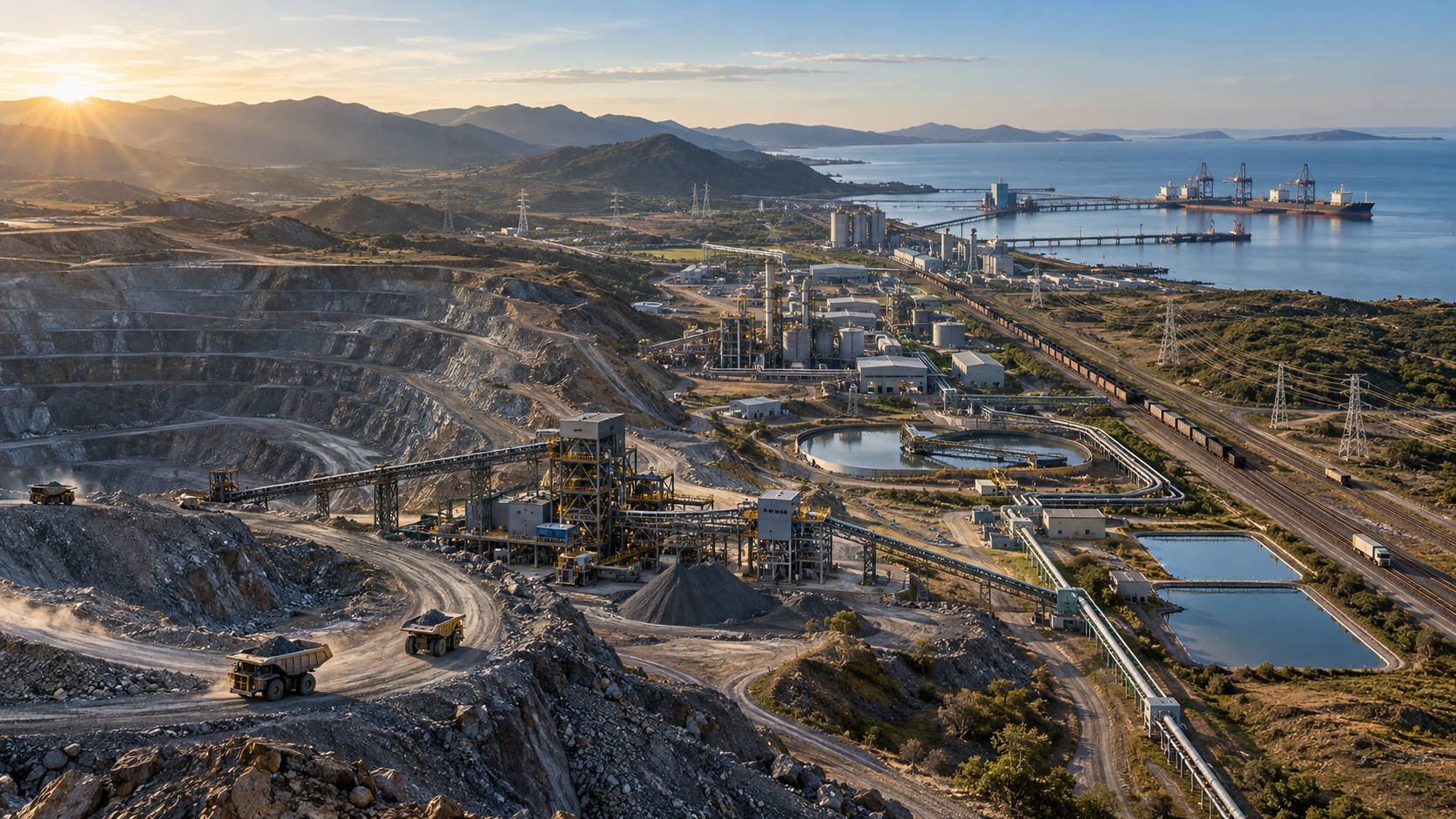
1. Define the investment decision as a corridor decision
The central decision is whether a connected mineral-to-market system can reach completion, produce a qualified product and generate resilient cash flow. The deposit remains fundamental, yet it is only one node. Processing recovery, reagent availability, power quality, water rights, transport capacity, port handling, customer qualification and trade access determine whether saleable output reaches a paying buyer.
The investment perimeter should therefore include every asset and contract whose failure can stop production or prevent sale. A corridor may sit within one company, across several special-purpose vehicles or across public and private ownership. Legal ownership is less important to the operating test than control, enforceability, timing and capacity. A third-party railway can be as economically critical as a wholly owned concentrator.
The board paper should state the product, destination markets, planned annual throughput, ramp-up profile, required infrastructure, funding sources and the date when the whole system becomes operational. It should identify the weakest dependency, the capital required to remedy it and the party bearing delay or underperformance. Approval should be conditional on the complete system meeting a common evidence standard.
The 2026 critical-minerals outlook makes this system view commercially relevant. Refining concentration remains high, investment declined in 2025 and announced downstream capacity continues to lag mining in several value chains [1][2]. The World Bank Group and other multilateral development banks have consequently highlighted power, transport, logistics, digital connectivity, water and corridor-based development as integral to mineral value chains [3].
2. Use an eight-gate Processing Corridor Investment System
The framework has eight gates: mineral and metallurgical evidence; product and market acceptance; complete physical corridor; capacity and interface integrity; environmental and social permissions; commercial contracts; financeability and downside liquidity; and controlled execution. Each gate has a named evidence owner, independent challenger, approval authority and stop condition.
The first gate confirms resource, reserve, mine plan, metallurgy, recovery and variability. The second proves that the intended product can meet buyer specifications and that qualification time is reflected in the schedule. The third maps the physical route from mine to customer. The fourth reconciles capacity and timing across every node. The fifth tests permits, water, land, community, biodiversity, emissions, tailings and closure. The sixth evaluates offtake, tolling, power, water and logistics contracts. The seventh sizes capital and liquidity under common scenarios. The final gate controls integration, commissioning and handover.
The gates should operate through one assumptions register and one integrated model. If a refinery recovery assumption changes, mine throughput, energy demand, water use, residue handling, logistics volumes and revenue must update together. A corridor cannot be approved through separate models that use inconsistent dates or capacities.
The decision system is designed to expose dependency risk early. A project should not pass because each workstream is individually plausible. It passes when interfaces are proved, the critical path is credible and a funded remedy exists for foreseeable shortfalls.
3. Map the complete mineral-to-market system
The transaction map should show the licence holder, mine, concentrator, refinery, utilities, transport links, storage, port, marketing entity, buyers, government counterparties and financing vehicles. It should also show title transfer, customs points, product custody, data flows, payment routes, security and step-in rights.
Six physical nodes are common: mine and concentration; refining or conversion; power; water; inland logistics; and export or downstream delivery. Supporting layers include digital control, laboratories, reagents, spares, workforce accommodation, waste and residue management, security and emergency response. Their materiality depends on the commodity, process, jurisdiction and destination market.
The map must distinguish dedicated, shared and regulated infrastructure. Dedicated assets offer greater control but increase capital intensity. Shared assets can lower unit cost and create regional benefits, while introducing allocation, congestion and counterparty risk. Regulated utilities may provide reliable service where network capacity and tariff rules are credible. Each category requires different remedies.
The map should identify single points of failure and alternatives. A single transmission line, bridge, reagent supplier or berth can interrupt the whole corridor. Redundancy has a cost, so the investment case should compare the probability-weighted loss from interruption with the cost of duplicated capacity, inventory, alternative routing or contractual priority.
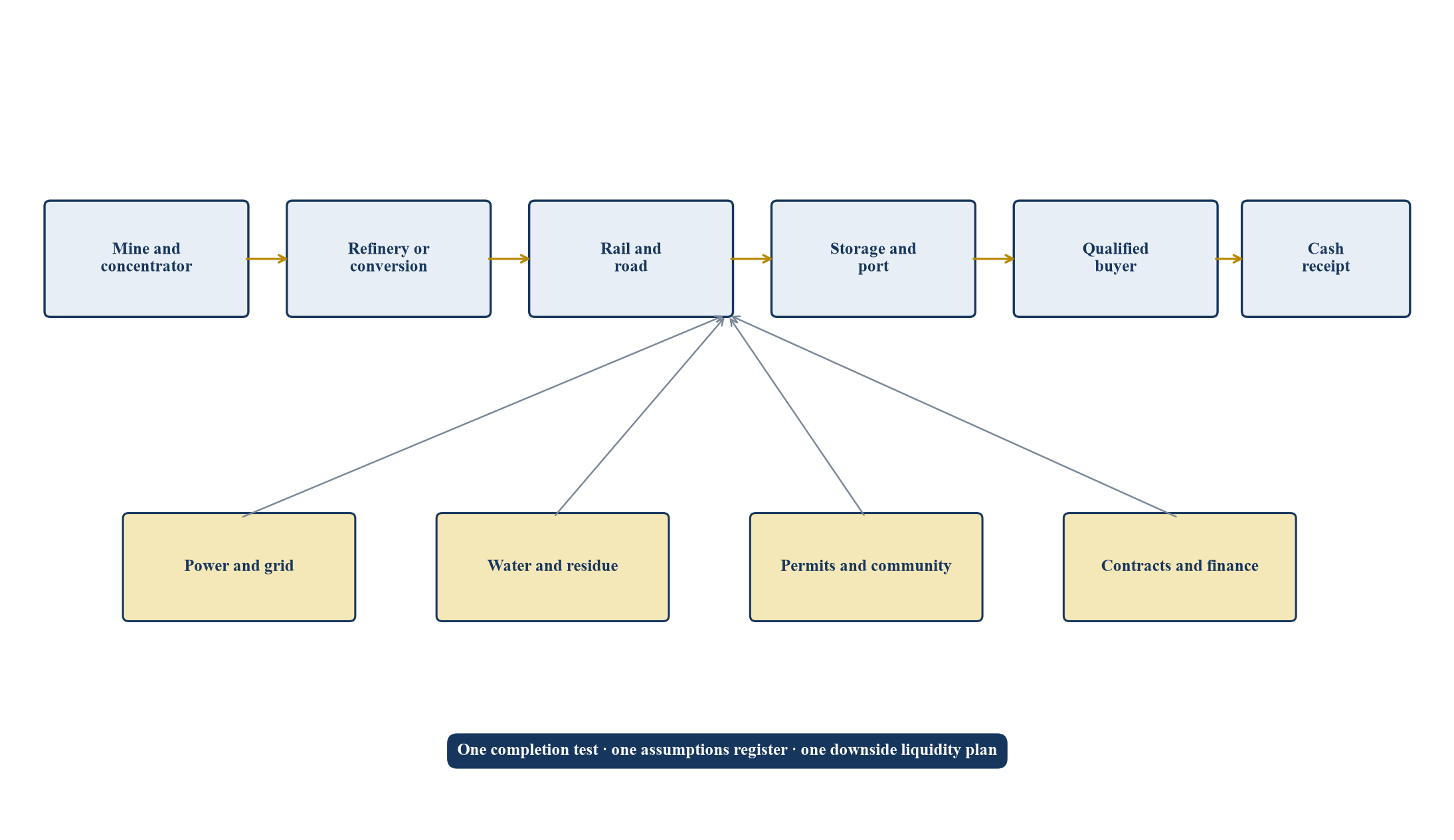
Investibility depends on the connected performance of physical nodes, contracts, permissions and finance.
4. Prove mineral and metallurgical evidence before sizing the corridor
The resource model, reserve conversion, mine plan and metallurgical programme establish the feed available to the processing system. The evidence should show grade distribution, mineralogy, impurities, hardness, recovery variability, deleterious elements, blending needs, tailings characteristics and the sampling basis. Relevant disclosure standards include CRIRSCO-aligned reporting, National Instrument 43-101 and Regulation S-K Subpart 1300 [14][15][16].
Average-grade assumptions can conceal operating risk. Early years may contain different mineralogy or impurity levels from the life-of-mine average. A refinery designed for an assumed concentrate can underperform when feed composition changes. The integrated model should therefore use scheduled feed characteristics, not a single static recovery.
Pilot testing and product samples should reflect representative material and the intended process route. Scale-up factors, reagent regimes, residence time and impurity removal must be reconciled with equipment design. The investment committee should see the remaining technical uncertainty and the cost, schedule and decision value of further test work.
The mineral evidence must also support infrastructure sizing. Throughput drives power demand, water balance, residue volume, road or rail movements and port capacity. A mine-plan revision should automatically trigger a corridor-capacity review. Building infrastructure around an aspirational production number can strand capital; sizing it around an understated case can create an expensive bottleneck.
5. Qualify the product and revenue route
A mineral product becomes commercially valuable when a buyer accepts its specification, provenance, delivery point and payment terms. The corridor model should define grade, moisture, particle size, impurities, packaging, assay, penalties, payability, treatment charges, refining charges, quotation period and dispute mechanisms.
Qualification can be a critical-path activity for battery, magnet, semiconductor, aerospace and other high-specification materials. Laboratory acceptance may not equal plant-scale approval. The schedule should include sample preparation, buyer testing, repeat lots, process adjustment, audit and final qualification. Revenue should begin when the product can be sold on contracted terms, not when the plant first produces material.
The offtake strategy should separate volume security from price transfer. Fixed floors, collars, index formulas, prepayments and take-or-pay commitments allocate different risks. Buyers may seek exclusivity, matching rights, security, product-control rights or change-of-control consent. These provisions can support financing while restricting future competition or M&A.
Sales concentration should be treated as a corridor dependency. A technically successful refinery can remain exposed if one buyer controls qualification. The investment case should identify alternative markets, requalification time and the cost of producing a different specification.
6. Reconcile capacity at every interface
Corridor capacity is the lowest dependable capacity across connected nodes after allowing for availability, maintenance, losses, seasonality and operating constraints. Nameplate capacity should not be summed or compared without a common basis. Wet tonnes, dry tonnes, contained metal, refined product and shipping lots are different units.
The capacity register should state nameplate, practical and contracted capacity for each node. It should include planned downtime, ramp-up, bottlenecks, expansion rights and third-party allocation. A rail contract for annual tonnage may still fail operationally if train slots, axle load, wagon availability or port windows do not match daily production.
Interfaces require specifications. Concentrate moisture affects transport and handling. Grid voltage and stability affect refinery performance. Water chemistry affects recovery and equipment. Port storage must match shipment size and weather exposure. The responsible parties should agree acceptance criteria and testing procedures before financial close.
Capacity should be stress-tested dynamically. A ten-day port closure can fill storage, stop transport and force mine curtailment. The liquidity model should capture inventory, demurrage, restart cost and delayed receipts. This operational chain is often absent from a conventional annual project-finance model.
| Corridor node | Evidence required | Primary failure mode | Contractual or funded remedy |
|---|---|---|---|
| Mine and concentrator | Reserve, schedule, recovery and ramp-up evidence | Feed shortfall or variable concentrate | Stockpiles, blending plan, staged expansion |
| Refinery | Pilot results, process guarantee and qualification plan | Recovery loss or off-spec product | Performance security, bypass or tolling option |
| Power | Connection study, PPA, reliability and tariff | Outage, curtailment or price shock | Backup supply, reserve margin, tariff protection |
| Water | Rights, source yield, balance and quality | Shortage, competing demand or permit breach | Recycling, storage, alternative source, priority rules |
| Inland logistics | Capacity, route condition and operating plan | Congestion, damage or border delay | Priority slots, alternate route, inventory buffer |
| Port and storage | Berth, stockpile, assay and customs plan | Closure, contamination or shipment mismatch | Dedicated capacity, weather buffer, alternative port |
The evidence and remedy must be adapted to the commodity, process, jurisdiction and contract structure.
7. Treat refining as an independent investment case
Refining should not be assumed to create value merely because it increases local processing. Its economics depend on recovery, scale, technology, energy, reagents, by-products, waste, product premiums, treatment charges, working capital and customer qualification. The refinery can be the strongest value-creation node or the largest source of execution risk.
The IEA reports that refining concentration increased for most minerals through 2025 and that planned downstream capacity remains behind mining in important value chains [1]. This supports strategic interest in diversified processing. Strategic value does not remove the need for commercial discipline. A diversified refinery must still compete on delivered cost, product quality, reliability and capital efficiency.
The model should separate tolling, merchant and integrated economics. A tolling refinery earns a processing fee while customers retain commodity exposure. A merchant refinery buys feed and sells product, creating price and working-capital risk. An integrated owner internalises transfer prices and should reveal each node's standalone economics to avoid cross-subsidy.
Technology licences, proprietary reagents, control software and specialist spares can introduce hidden concentration. The diligence should identify intellectual-property rights, export restrictions, supplier support, substitution time and access after a change of control.
8. Underwrite power as a production input and financing condition
Processing can be power intensive and sensitive to outages, voltage fluctuations and harmonic distortion. The power case should show hourly and seasonal load, critical loads, start-up demand, grid stability, planned maintenance, curtailment rules and backup capability. Annual energy availability alone is insufficient.
Supply options may include grid power, dedicated generation, renewable energy, storage, wheeling or a hybrid. Their comparison should use delivered cost, reliability, emissions, construction interface and contractual bankability. A low tariff with uncertain connection timing can be less valuable than a higher-cost supply available before commissioning.
The PPA or utility agreement should address capacity reservation, connection assets, take-or-pay, indexation, curtailment, outage compensation, change in law, force majeure, credit support and step-in rights. Where power infrastructure serves other users, allocation during scarcity should be explicit.
Decarbonisation claims require a traceable basis. Renewable certificates or contractual attributes may support reporting, while physical reliability still depends on the system. The investment model should keep energy cost, reliability and emissions attributes separate so that one benefit does not conceal another weakness.
9. Secure water through a catchment-level test
Water risk includes physical availability, legal rights, quality, competing use, infrastructure condition, climate variability and community legitimacy. The project water balance should cover withdrawal, recycling, evaporation, seepage, process losses, residue storage, potable use and emergency reserves across wet, normal and dry conditions.
The assessment should extend beyond the project fence. Other users and ecosystems can affect availability and permitting. IFC Performance Standards and the World Bank Group mining environmental, health and safety guidance provide relevant frameworks for environmental and social risk management [10][11]. Local law, permits and site-specific studies remain decisive.
Water infrastructure can be shared with municipalities, agriculture or industry. Shared investment may improve regional value and social outcomes, but allocation, tariffs, maintenance and drought priority must be enforceable. Community supply should not depend on optimistic mine cash flow without a funded operating plan.
Water quality can constrain refining and residue management. Treatment cost, brine or sludge disposal and discharge standards belong in the financial model. A water-right document alone does not prove usable process water at the required location, quality, time and cost.
10. Design logistics around operating rhythm
The logistics plan should convert production into daily movements, storage turns and shipment lots. It should identify route length, border crossings, mode changes, handling losses, security, dangerous-goods rules, customs, assay and insurance. Annual tonnage divided by 365 rarely captures peak movements or disruptions.
Rail can offer scale and lower unit cost, while requiring compatible loading, wagons, track capacity and train paths. Roads may provide flexibility but expose the project to congestion, maintenance, axle limits, safety and community impacts. Ports require storage, blending, sampling, customs clearance, berth windows and vessel compatibility.
Cross-border corridors introduce sovereign interfaces. Transit permits, tariffs, foreign exchange, customs systems and political relations can change. The contracts should specify responsibility for delay, loss, contamination and new charges. Political-risk insurance or guarantees may cover defined events, subject to conditions and exclusions.
The investment case should value route optionality. An alternative port or toll refinery may have higher operating cost yet cap the loss from a primary-route outage. The option value should be compared with reservation fees, duplicate permits and inventory required to keep it usable.
11. Build the environmental and social licence into completion
Environmental and social obligations are operating dependencies. Land access, resettlement, biodiversity, tailings, emissions, labour, security, cultural heritage, indigenous peoples, community health, closure and cumulative impacts can alter scope, timing and cost. They require evidence, engagement and funding.
The completion test should include material permits and plans, not only construction. A plant that is mechanically complete but cannot lawfully draw water, store residue or transport product is not complete. Lenders and investors should define which approvals are conditions precedent, which can be conditions subsequent and which require reserves or covenants.
Shared corridors create cumulative effects across multiple projects. Assessment should consider combined water demand, traffic, migration, housing, public services and ecosystem pressure. Governance is required when no single project controls the aggregate impact.
The social-investment programme should distinguish mandatory mitigation, contractual commitments and voluntary development activity. Each category needs an accountable budget and delivery mechanism. Disclosure and grievance systems should allow issues to be identified before they become interruptions or disputes.
12. Allocate permits and sovereign interfaces
The permit matrix should list every licence, approval, land right, water right, construction consent, grid connection, environmental authorisation, customs status, export permit and operating certificate. It should state the issuing authority, legal holder, conditions, expiry, dependencies and appeal or renewal risk.
Strategic-mineral policies may provide accelerated procedures, public finance or infrastructure support. The EU Critical Raw Materials Act, for example, supports strategic projects intended to increase extraction, processing and recycling capacity and diversify supply [8]. Strategic designation should be modelled through its actual legal and financial effects, not treated as a substitute for permits or capital.
Government undertakings should be specific and authorised. A policy statement is different from a contractual commitment to deliver a substation, road or tariff. The investment committee should see executed agreements, budget authority, implementation responsibility and remedies for delay.
Stabilisation, change-in-law, tax and foreign-exchange provisions require specialist advice. Their value depends on enforceability and the sovereign counterparty. Political support can improve coordination, while concentration of decision rights in one administration can also create transition risk.
13. Create a corridor contract matrix
The contract matrix should connect each operating dependency to a counterparty, term, capacity, price, performance standard, security and remedy. It should identify cross-default, termination, change-of-control and assignment provisions. A portfolio of individually reasonable contracts can still be incompatible when dates, specifications or remedies do not align.
Construction contracts should allocate interface responsibility. If the refinery contractor assumes grid power by a date and the utility contract excludes delay liability, the project retains the gap. An integration agreement or strong owner team is needed where no contractor accepts system performance.
Long-term supply and offtake contracts should be tested under commodity and operating stresses. Take-or-pay can support debt service when the project performs, yet it can create liabilities when feed is unavailable. Minimum volume commitments should align with realistic ramp-up and force-majeure provisions.
Security packages must reflect the corridor structure. Lenders may need shares, assets, accounts, contracts and step-in rights across several entities. Public or shared assets may be unavailable as collateral. The model should state which cash flows and remedies are legally accessible.
| Contract | Economic purpose | Key diligence questions | Minimum protection |
|---|---|---|---|
| Offtake | Revenue and product acceptance | Qualification, pricing, volume, destination, buyer credit | Clear specification, payment security, balanced remedies |
| Tolling or feed supply | Refinery utilisation | Feed quality, minimum volume, title and working capital | Assay protocol, volume flexibility, credit support |
| Power | Reliable energy | Connection, capacity, tariff, curtailment and outages | Completion date, performance standard, backup rights |
| Water | Lawful usable supply | Rights, source yield, quality, drought allocation | Priority, storage, recycling and alternative-source plan |
| Transport and port | Product movement | Capacity, slots, losses, border and customs | Reserved capacity, service levels, alternate route |
| EPC and integration | Completed operating system | Interfaces, guarantees, tests and delay | System completion tests, security and liquidated damages |
Contract requirements remain subject to project-specific legal, technical, tax and regulatory advice.
14. Separate dedicated, shared and public infrastructure
Dedicated infrastructure can be designed for the project and pledged to financiers. It also concentrates capital in a single user and may become underutilised if mine output disappoints. The project should test whether the dedicated asset remains economic at downside throughput.
Shared infrastructure can reduce duplication and unlock a mineral cluster. Its economics depend on anchor demand, expansion capacity, access rules, tariffs and governance. A neutral infrastructure company may separate asset ownership from mining risk, provided it has bankable contracts and competent operation.
Public infrastructure can support wider economic development. The funding model should identify which benefits are project-specific and which are public. Public support should be transparent, authorised and compatible with applicable procurement, subsidy and fiscal rules. EITI guidance recognises that associated transport, processing and infrastructure agreements can materially affect extractive rights and should be considered in disclosure frameworks [7].
The capital structure should match demand risk. A shared railway dependent on one pre-production mine carries project risk despite being labelled infrastructure. Availability-based payments, minimum-volume commitments or public support can reallocate risk, but they must be affordable under stress.
15. Measure geopolitical concentration across the whole chain
Geopolitical risk should be mapped by function, not only mine location. Concentration can arise in refining, technology, equipment, reagents, shipping routes, finance, insurance, buyers or intellectual property. The IEA reported that the leading refining country accounted for an average 72 per cent of refined supply across key minerals excluding rare earths in 2025 [1].
The corridor map should identify export controls, sanctions exposure, licensing, foreign-investment review, local-content rules, tariffs, maritime chokepoints and currency restrictions. These risks can affect product movement, equipment service, dividend flow or refinancing.
Diversification should be measured through executable alternatives. A second supplier that uses the same controlled technology or shipping route may not reduce risk. The model should include switching time, qualification cost, inventory and contractual constraints.
Strategic buyers or public financiers may value resilient supply beyond spot economics. Any premium, floor, guarantee or grant should be supported by executed terms before it enters the committed case. Policy intent can be shown separately as potential upside.
16. Integrate traceability without confusing it with performance
Traceability can support provenance, responsible-sourcing requirements, carbon data, custody and compliance. The OECD and IEA describe traceability as one component of broader risk-based due diligence and emphasise data quality, governance, interoperability and proportional implementation [5].
The corridor should define data at each custody transfer: origin, batch, grade, mass, ownership, processing history, environmental attributes and responsible-sourcing evidence. Controls should address calibration, segregation, reconciliation, access, cyber security and third-party assurance.
A digital record does not prove that the underlying event occurred correctly. Physical controls, inspections, assays and audits remain necessary. The system should record confidence, exceptions and corrections rather than create an appearance of certainty.
Data rights matter in M&A and financing. Contracts should permit lenders, buyers and future owners to access records needed for diligence and compliance, while protecting legitimate confidential information. A proprietary platform that cannot be transferred can become a change-of-control obstacle.
17. Build the complete sources-and-uses schedule
The hypothetical corridor has six development uses totalling USD 1.45 billion: USD 410 million for the mine and concentrator; USD 500 million for the refinery; USD 190 million for power; USD 90 million for water; USD 145 million for rail and road; and USD 115 million for port and storage. The amounts are illustrative management assumptions.
Funding is assumed at USD 500 million of sponsor and strategic equity, USD 650 million of senior corridor debt, USD 200 million of development-finance or export-credit funding and a USD 100 million contingent facility. The contingent facility is committed liquidity, not a reduction in base capital cost.
The uses schedule should include contingency, owner costs, fees, working capital and reserves within each package or as explicit lines. Double counting is a common risk when node budgets include local contingency and the consolidated model adds another percentage. A reconciliation should trace every amount to a controlled estimate.
Timing should be monthly through construction and ramp-up. Equity should fund according to agreed priority; debt availability should match conditions and long-stop dates; and the contingent facility should remain available until system completion. Uncommitted future refinancing should not fund the base case.
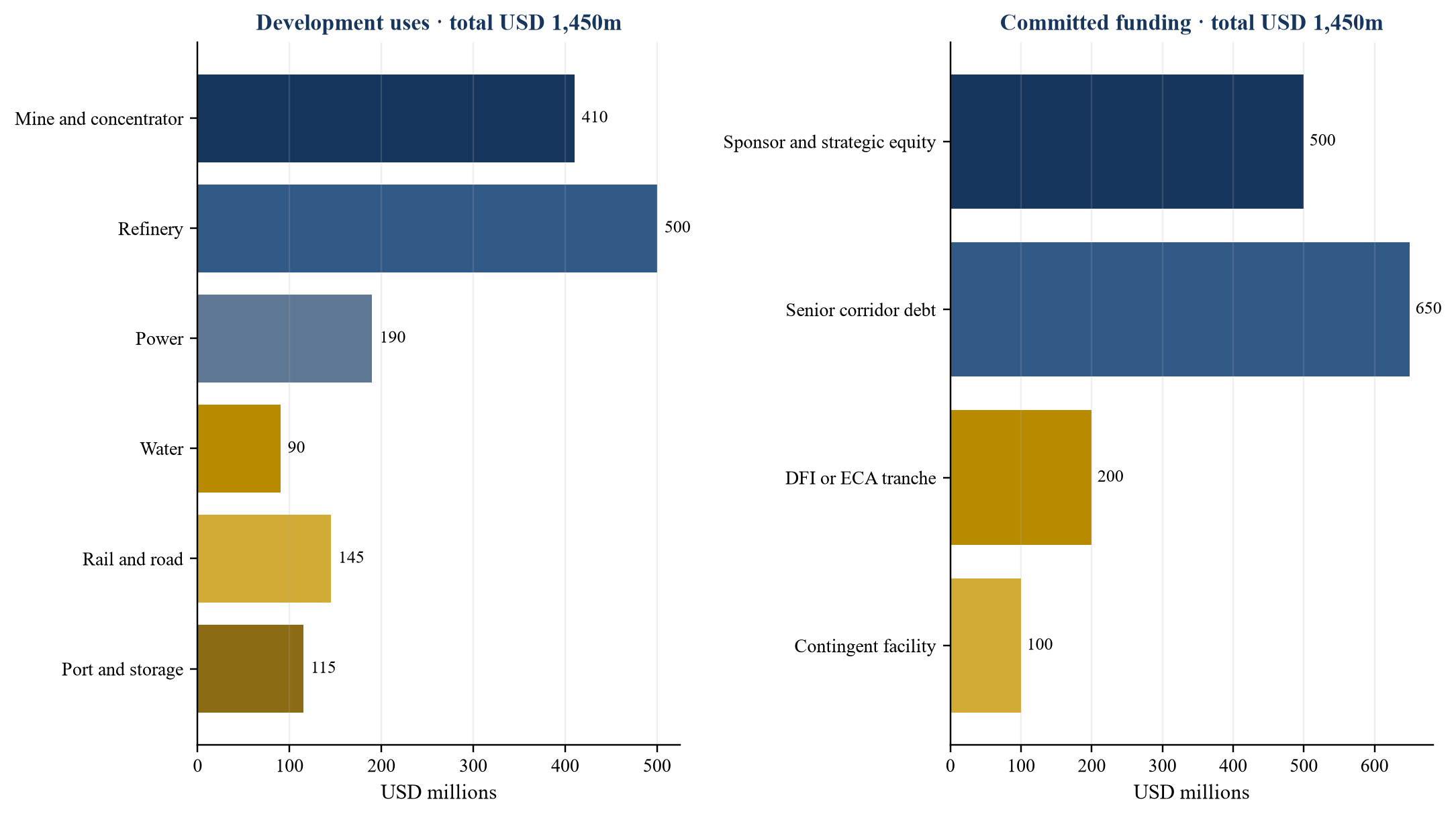
USD millions. All amounts are illustrative management assumptions and do not describe an actual transaction.
18. Model corridor cash flow rather than mine cash flow
The central hypothetical case assumes annual processed-product revenue of USD 720 million, operating cash cost of USD 430 million and fixed infrastructure and logistics cost of USD 65 million. Cash flow available for debt service is therefore USD 225 million before the modelled debt-service line. Annual debt service is assumed at USD 115 million, producing a 1.96 times debt-service coverage ratio.
This calculation is intentionally simple. A live model would include taxes, sustaining capital, working-capital movements, reserve funding, royalties, hedging and other items. The purpose is to demonstrate the corridor linkage: revenue depends on saleable qualified product delivered to the contractual point, and cost includes every node required to achieve that delivery.
The model should allocate costs to drivers. Power can be linked to throughput and tariff; logistics to tonnes and route; water to withdrawal and treatment; reagents to feed mineralogy; and fixed costs to capacity and service commitments. This enables stresses to be combined rather than applied as one arbitrary percentage.
Cash receipts should reflect shipment, assay and payment timing. A profitable annual case can still experience a liquidity shortfall when inventory builds or a buyer disputes quality. The financing plan should therefore include working-capital headroom and minimum cash.
19. Stress correlated failures
Critical-minerals corridors face correlated risks. Lower prices can reduce sponsor liquidity at the same time as construction costs rise. A commissioning problem can delay qualification and trigger minimum-volume liabilities. Drought can constrain water and power simultaneously. Trade restrictions can alter routes, buyers and working capital.
The hypothetical downside assumes output 20 per cent below plan and realised price 15 per cent lower. Revenue falls from USD 720 million to USD 489.6 million. Operating cash cost falls to USD 365.5 million because some variable cost declines, while power and logistics disruption add USD 31 million. Cash flow available for debt service becomes USD 93.1 million, producing 0.81 times coverage against USD 115 million of debt service.
A mitigated downside assumes contractual and funded measures lift cash flow available for debt service to USD 132 million through minimum-throughput support, working-capital release, power-price protection, logistics alternatives and controlled cost deferral. Coverage becomes 1.15 times. These values are illustrative management assumptions; they show the scale of remedy required and do not claim that each measure is available or additive in a real case.
The analysis should also test completion delay, capex overrun, product-rejection, counterparty default, route closure and sovereign action. The most important scenario is often a sequence, such as delayed power causing late commissioning, missed qualification and a liquidity shortfall.
| Hypothetical annual case | Central | Unmitigated downside | Mitigated downside |
|---|---|---|---|
| Revenue | USD 720.0m | USD 489.6m | USD 489.6m |
| Operating cash cost | (USD 430.0m) | (USD 365.5m) | (USD 357.6m) |
| Infrastructure, logistics and disruption cost | (USD 65.0m) | (USD 31.0m incremental plus base embedded in cost case) | Included in mitigated cost case |
| Cash flow available for debt service | USD 225.0m | USD 93.1m | USD 132.0m |
| Annual debt service | USD 115.0m | USD 115.0m | USD 115.0m |
| Debt-service coverage | 1.96x | 0.81x | 1.15x |
USD millions unless stated. All amounts and outcomes are illustrative management assumptions.
20. Interpret the hypothetical results carefully
The central case has apparent debt capacity, while the unmitigated downside does not cover scheduled debt service. The difference is driven by linked price, volume and infrastructure assumptions. A lender or investor should therefore examine the evidence behind each driver and the timing of cash, rather than accept a single coverage ratio.
The mitigated case indicates that remedies worth USD 38.9 million of annual cash effect would be required to move from USD 93.1 million to USD 132 million. A live transaction must show which remedies are contractual, funded and executable. Double counting must be prevented; for example, reduced production cannot simultaneously support full take-or-pay revenue and full variable-cost savings unless the contracts genuinely provide both.
Coverage above 1.0 times does not establish resilience. Reserve accounts, covenant levels, maintenance, sustaining capital and recovery time matter. A corridor operating close to minimum coverage can lose strategic flexibility and become vulnerable to a second disruption.
Equity return analysis should use the same scenarios and include additional capital. Public or strategic benefits can be described, but they should not be inserted as cash value without an agreed payment mechanism.
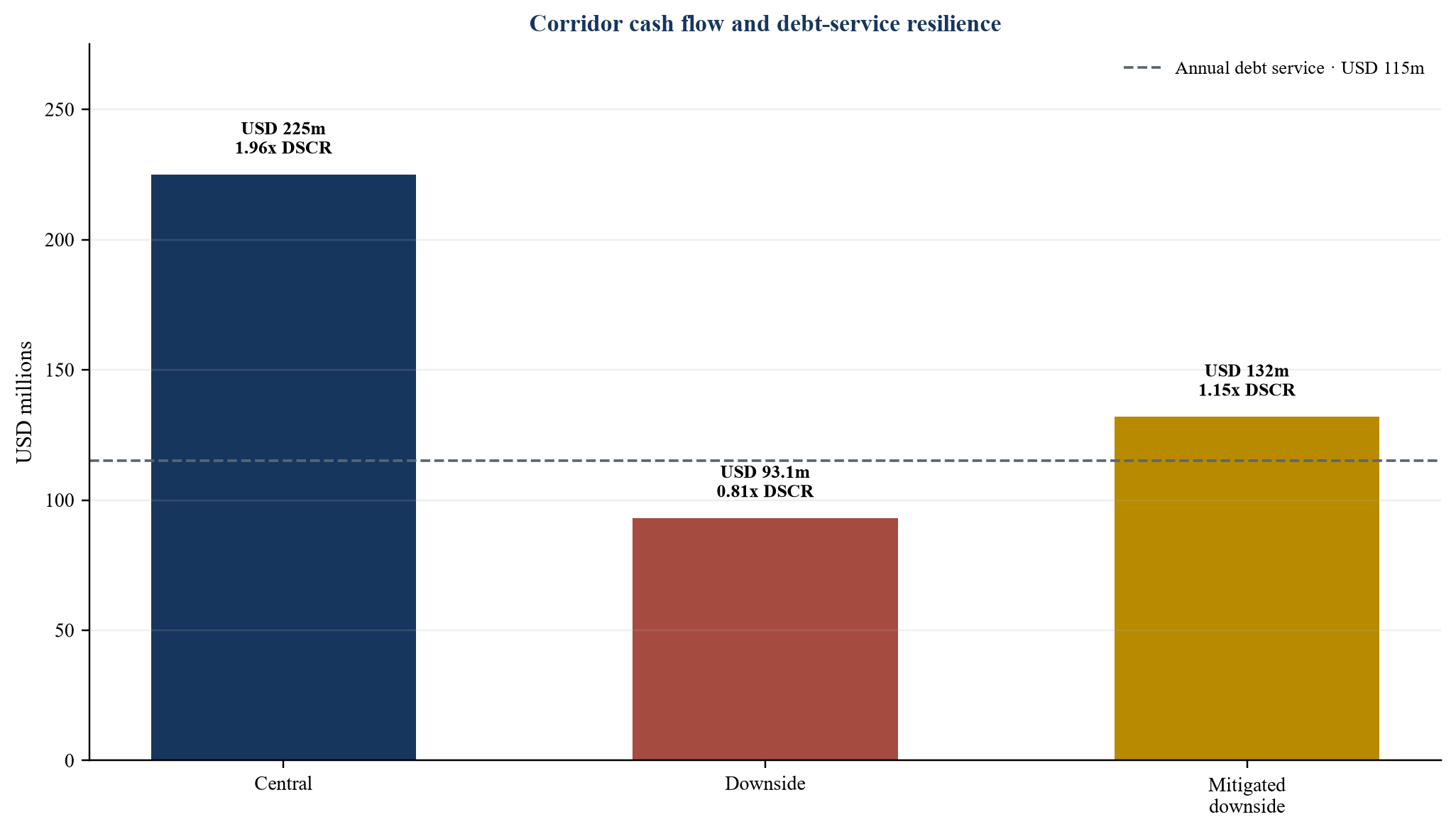
Cash flow available for debt service and coverage use illustrative management assumptions. The dashed line is annual debt service of USD 115 million.
21. Stage capital against corridor evidence
Capital should be released against value-inflecting evidence and system dependencies. Early equity can fund resource definition, metallurgy, product samples, permitting and engineering. Construction funding should follow a bankable scope, material permits, contracted infrastructure and an integrated schedule.
Staging reduces exposure to unresolved risk, yet underfunding early work can weaken the evidence needed for a sound decision. The budget should cover the work required to retire the most material uncertainties. Each tranche should have clear outputs, acceptance criteria and authority.
Milestones should be within the project's influence where possible. A draw condition tied to an uncertain government action can leave committed contractors unpaid. Where external conditions are necessary, the schedule and liquidity plan should allow delay or provide a waiver framework.
The final funding tranche should not disappear at mechanical completion. Commissioning, qualification, ramp-up and working capital can consume substantial liquidity. The facility should remain available until the corridor passes an integrated completion test and demonstrates stable cash conversion.
22. Design completion around system performance
Completion should test the connected system. Relevant measures can include mine and concentrator throughput, refinery recovery and product specification, power availability, water balance, transport cycle, port handling, permits, buyer acceptance and operating-cost performance over a defined period.
Individual contractor tests may occur at different times. The owner or integrator should reconcile them into one system test and manage interface defects. Liquidated damages from one contractor may not cover lost revenue caused by the combined failure, so adequate contingency and sponsor support remain important.
Completion should require reliable data and repeatability. A short run using selected feed or exceptional staffing may not demonstrate sustainable operation. The test should reflect expected feed variability, normal maintenance and commercial delivery.
The documents should define cure rights, retesting, independent certification and the consequence of partial failure. Debt conversion, distribution permission, guarantee release and facility expiry should align with the same completion definition.
23. Finance the corridor through compatible layers
The corridor may combine sponsor equity, strategic equity, commercial bank debt, project bonds, development-finance institution funding, export-credit support, government facilities, grants, guarantees and offtake prepayments. Each source has a different risk appetite, tenor, security, policy requirement and timetable.
The structure should allocate each risk to capital able to bear it. Equity and contingent capital can absorb construction and market variability. Long-tenor infrastructure funding may suit power, water or transport assets with contracted revenues. Export-credit support can align with eligible equipment and origin rules. Public support can address demonstrated externalities or strategic value.
Intercreditor arrangements are central when assets and cash flows sit in different entities. The structure should define priority, distributions, reserve accounts, enforcement, standstill, cure and step-in rights. A lender to shared infrastructure may have objectives different from the mine lender.
Foreign-exchange risk should be matched where possible. Construction cost, debt, operating cost and revenue currencies should be mapped. Hedging capacity and convertibility under stress should be tested.
24. Protect downside liquidity explicitly
The liquidity plan should cover base cash needs, contingency, working capital, debt service, reserve replenishment and recovery from operational shocks. Sources should be ranked by legal commitment and availability conditions. Cash held in an inaccessible entity or currency is not equivalent to project liquidity.
Contingent facilities should have long-stop dates beyond realistic delay cases and should not depend on the project remaining within covenants already threatened by the event. Sponsor support should be sized, documented and tested against sponsor capacity.
Reserve accounts can address debt service, major maintenance, environmental obligations and closure. They protect resilience but increase funding need. The model should avoid treating trapped cash as both a reserve and distributable equity value.
Liquidity triggers should prompt action before cash is exhausted. Examples include delayed permits, contractor claims, qualification failure, inventory growth and coverage deterioration. The board should know who can reduce scope, draw contingency, seek waivers or raise additional capital.
25. Preserve refinancing and M&A optionality
Corridor contracts can restrict a future sale or refinancing through consent, assignment, exclusivity, matching rights, security and change-of-control provisions. These rights should be valued when negotiated, not discovered during a transaction.
Shared assets can complicate valuation because cash flows depend on capacity allocation and related-party terms. Long-term access rights, tariff formulas, expansion options and operating standards should be transferable and auditable. A buyer needs confidence that the corridor survives ownership change.
The legal structure should balance ring-fencing with integration. Separate special-purpose vehicles can attract specialised capital and isolate risk, while increasing intercompany contracts and enforcement complexity. The transaction map should show dependencies and transfer restrictions.
Data rooms should be maintained continuously. Technical, environmental, contractual, land, permit, tax, insurance and operating evidence should remain current. This reduces transaction friction and allows management to respond to market opportunities.
26. Run a controlled partner and capital process
The project may require strategic buyers, operators, infrastructure investors, lenders and public partners. A controlled process should provide a common fact base, clear perimeter and comparable request. Parties should disclose their required rights, funding conditions, approvals and timetable.
Strategic value can appear through offtake, technology, market access, credit support or public-policy alignment. The model should quantify only benefits supported by terms. A high headline valuation accompanied by restrictive offtake or control rights may transfer substantial value elsewhere.
Confidentiality and competition rules should be managed, particularly when potential buyers are also customers or suppliers. Clean teams and staged disclosure can protect sensitive technical and commercial information.
Bid evaluation should use total corridor value: committed capital, cost, risk absorption, contractual restrictions, execution capability, timetable and future optionality. The process should preserve a credible fallback if the preferred partner does not close.
27. Establish governance across multiple owners
Corridor governance should distinguish asset ownership, system coordination and public oversight. A steering committee can manage interfaces, while each entity retains lawful decision rights. Reserved matters should cover capacity changes, maintenance, tariffs, expansion, related-party contracts, budgets and emergency action.
Information rights should support timely operating decisions. Shared dashboards can report throughput, availability, water, power, inventory, quality, safety, environmental and cash metrics. Data definitions and assurance responsibilities should be agreed.
Dispute mechanisms should be fast enough for operating issues. Expert determination may suit technical or assay disputes; arbitration may suit contractual claims. Emergency protocols should permit safe action without waiting for a final dispute outcome.
Public stakeholders and communities require structured engagement. Governance should disclose material commitments and monitor delivery. Contract transparency can improve accountability where associated infrastructure changes the allocation of public benefits or extractive rights [6][7].
28. Execute through a 32-week decision roadmap
Weeks 1 to 4 establish the controlled data room, perimeter, decision statement and assumptions register. Weeks 5 to 10 validate mineral, metallurgical and product evidence, map permits and build the corridor capacity register. Weeks 11 to 16 develop contracts, technical interfaces and environmental and social plans.
Weeks 17 to 22 integrate the financial model, downside cases, funding sources and risk allocation. Weeks 23 to 27 run partner and capital engagement, update diligence and negotiate term sheets. Weeks 28 to 32 complete definitive approval materials, financing documents, execution controls and the closing plan.
The roadmap is illustrative. Real timing depends on project maturity, jurisdiction, permitting, engineering and counterparties. The key control is sequencing: uncertainty should be retired before irreversible capital is committed, and external dependencies should be escalated early.
The programme office should maintain the critical path, evidence register, decision log and interface matrix. Changes to scope, cost, capacity or schedule should be assessed across the whole corridor before approval.
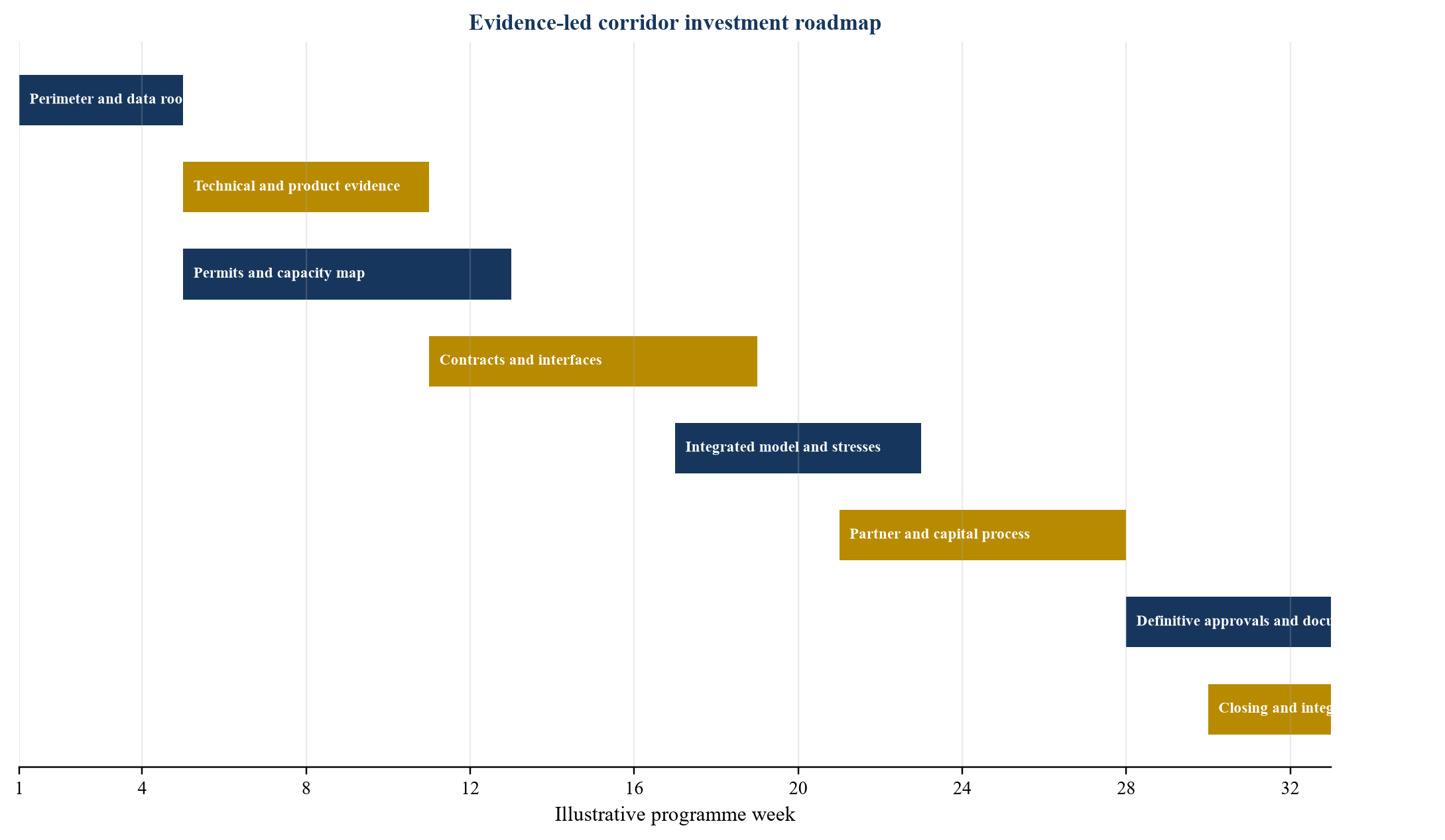
Timing is a management-planning assumption. Regulatory, technical and counterparty processes may require longer.
29. Monitor the operating corridor after close
Post-close surveillance should track physical, commercial and financial leading indicators. Throughput, recovery, product quality, availability, power interruptions, water use, logistics cycle, inventory, customer claims, cash conversion and covenant headroom should be reconciled.
The monitoring system should identify dependency drift. A gradual fall in grid quality, water yield or rail punctuality can precede a material interruption. Thresholds should trigger investigation and remediation before the covenant or liquidity consequence appears.
Contract compliance should be tested against invoices, operating data and service levels. Tariff indexation, take-or-pay, penalties, assay settlement and allocation rules can materially affect value. Independent audit rights should be practical.
Scenario models should be refreshed with actual performance and market evidence. The board should see whether risk mitigants are working and whether reserves, alternative routes or refinancing need adjustment.
30. Use a board approval matrix
The final approval pack should state the investment perimeter, system completion definition, capital request, sources and uses, base and downside economics, key contracts, permits, environmental and social conditions, governance, security, timetable and fallback. It should identify unresolved matters and delegated authority.
The board should approve limits and conditions rather than a narrative aspiration. Examples include maximum capital, minimum liquidity, minimum contracted infrastructure capacity, required permits, acceptable product qualification, counterparty credit, coverage, reserve accounts and change-of-control flexibility.
The recommendation should explain why the corridor is investible as a system and identify the dependency most likely to impair value. It should show the remedy, cost and owner. A high-quality deposit does not compensate for an unfunded or unenforceable corridor gap.
| Approval question | Evidence | Approval threshold | Escalation trigger |
|---|---|---|---|
| Is the feed technically sufficient? | Resource, reserve, mine plan and metallurgy | Independent evidence supports scheduled feed and recovery | Material grade, recovery or schedule change |
| Can qualified product reach buyers? | Qualification, offtake and logistics | Executable route and acceptance process | Buyer, route or specification failure |
| Are utilities and permits complete? | Power, water, land and permit matrix | Capacity, timing and rights match commissioning | Delay beyond funded headroom |
| Is capital complete and resilient? | Sources, uses, model and liquidity | Committed funding through completion and downside | Cost, delay or coverage outside limits |
| Are governance and remedies enforceable? | Contracts, security and legal opinions | Rights align across corridor entities | Consent, priority or change-of-control conflict |
Thresholds should be converted into transaction-specific limits and conditions before approval.
31. Make the final investment decision
The investment decision should be framed around system evidence, resilient economics and controlled execution. The corridor should proceed when the mineral base, processing route, infrastructure, permits, contracts, capital and governance are mutually consistent and funded through integrated completion.
The hypothetical case illustrates the risk of relying on a central ratio. A 1.96 times coverage ratio falls to 0.81 times under linked volume, price and infrastructure stress. The mitigated case reaches 1.15 times only after assumed remedies worth USD 38.9 million of annual cash effect. A real transaction must prove those remedies through contracts, reserves and accountable execution.
Staging can preserve capital while evidence improves. Shared infrastructure can lower cost and expand regional value when capacity, tariffs and governance are bankable. Strategic or public finance can address demonstrable resilience and development benefits when commitments are authorised and transparent.
The final evidence appendix should include technical reports, product tests, capacity and interface registers, permits, environmental and social studies, contracts, legal advice, model, scenario outputs, funding evidence, governance documents and the closing checklist. The investment should remain auditable from the original decision through operation.
Processing corridors convert mineral potential into dependable market access. The investible proposition is the complete route from resource to qualified product, supported by infrastructure, lawful permissions, resilient contracts, sufficient capital and governance capable of managing shared dependencies.
Sources
- International Energy Agency, Global Critical Minerals Outlook 2026, Executive Summary, 16 July 2026. Read the primary source
- International Energy Agency, Global Critical Minerals Outlook 2026, Outlook, 2026. Read the primary source
- World Bank Group and participating multilateral development banks, Joint MDB Statement on Critical Minerals to Manufacturing Value Chains, 17 April 2026. Read the primary source
- U.S. Geological Survey, Mineral Commodity Summaries 2026, version 1.3, May 2026. Read the primary source
- OECD and International Energy Agency, The Role of Traceability in Critical Mineral Supply Chains, 28 February 2025. Read the primary source
- Extractive Industries Transparency Initiative, Contract Transparency. Read the primary source
- Extractive Industries Transparency Initiative, Contracts and Licenses, Requirement 2.4 guidance note, November 2024. Read the primary source
- European Commission, Strategic Projects under the Critical Raw Materials Act. Read the primary source
- World Bank Group, Metals and Minerals. Read the primary source
- International Finance Corporation, Performance Standards on Environmental and Social Sustainability, 2012. Read the primary source
- World Bank Group, Environmental, Health, and Safety Guidelines for Mining, 2007. Read the primary source
- OECD, Due Diligence Guidance for Responsible Supply Chains of Minerals from Conflict-Affected and High-Risk Areas, third edition. Read the primary source
- Extractive Industries Transparency Initiative, Infrastructure Provisions and Barter Arrangements. Read the primary source
- Committee for Mineral Reserves International Reporting Standards, International Reporting Template, November 2019. Read the primary source
- Ontario Securities Commission, National Instrument 43-101 Standards of Disclosure for Mineral Projects. Read the primary source
- U.S. Securities and Exchange Commission, Regulation S-K Subpart 1300, Disclosure by Registrants Engaged in Mining Operations. Read the primary source
- European Commission, Commission selects 13 Strategic Projects in third countries under the Critical Raw Materials Act, 4 June 2025. Read the primary source
- International Energy Agency, Energy Technology Perspectives 2026, Executive Summary, 2026. Read the primary source
