

1. Treat the project twin as a credit-control system
A lender needs a reliable answer to five connected questions at every draw. What has physically been completed? What value has been earned under the approved contracts? What amount is eligible for payment from loan and escrow accounts? What cost and time remain to completion? What new risk could impair repayment or delivery?
A project digital twin can connect those questions to a controlled digital representation of the asset, its programme, commercial records and financing conditions. The term should be used precisely. A static three-dimensional model is useful design information. A lender-grade twin adds time-appropriate observations from the physical project, reconciles them to controlled records and returns decisions or exceptions to the project workflow.
The twin does not issue an engineering certificate, approve an escrow release or exercise credit authority. It organises the evidence used by the authorised parties. The independent certifier, cost consultant, account-trustee engineer, regulator and lender retain their documented responsibilities.
Credit design begins with the decision, not the technology. Each loan and escrow condition is translated into required evidence, data owner, independent reviewer, acceptance rule, exception route and retained audit record. The model then connects drawings, quantities, schedule activities, contracts, invoices, inspections and payments at the level required for that decision.
The resulting control spine has four states: intended, observed, certified and funded. Keeping them separate prevents an updated model, a site image or a contractor claim from being treated as approved progress.
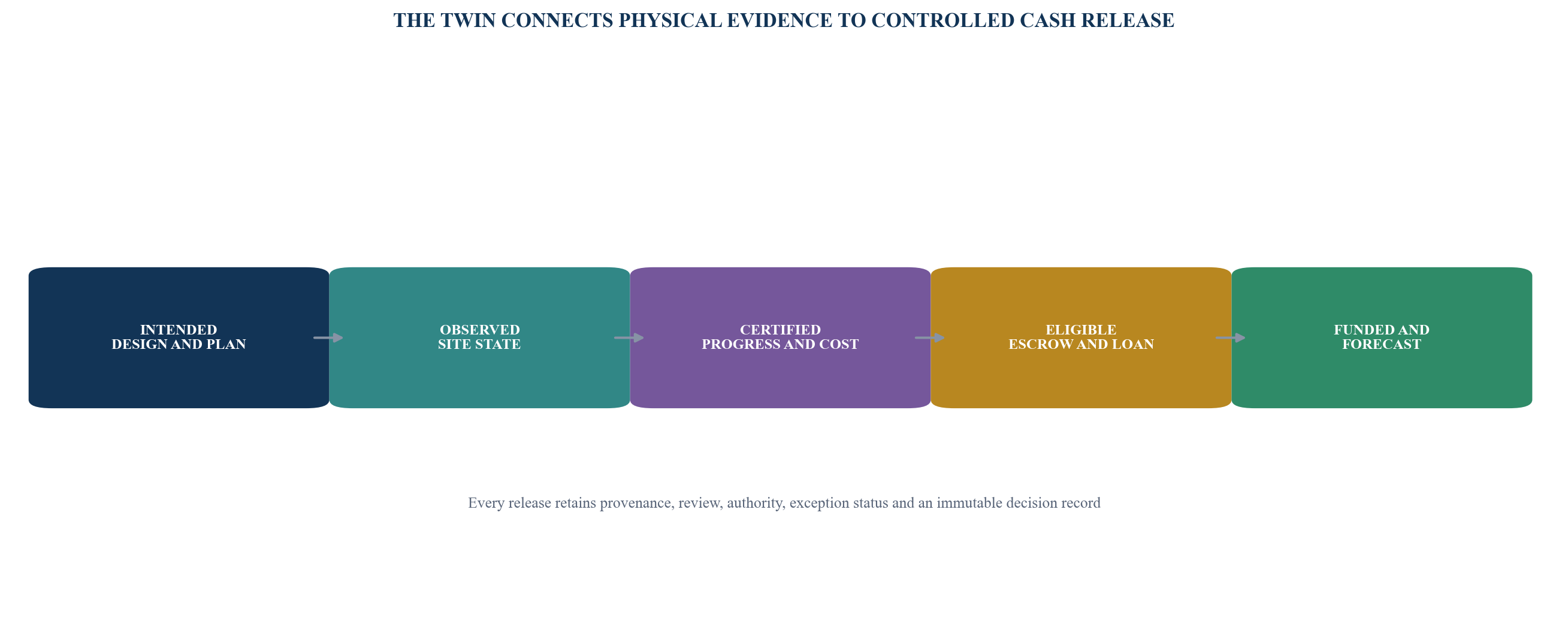
Authority and certification remain with the parties named in the project, escrow and finance documents.
2. Start with the draw conditions and escrow rules
The information architecture should be derived from the finance and escrow documents. Relevant clauses can include conditions precedent, equity-first requirements, eligible costs, approved budgets, milestone tests, sales-receipt treatment, minimum contingency, cost-overrun support, retention, permitted accounts, draw frequency, certification, insurance, permits, covenants and events of default.
Dubai Land Department explains that payments from a real-estate development escrow account are generally restricted to project contractors, consultants and permitted marketing. Its published frequently asked questions state that the developer reports a completed major stage, the account-trustee engineer visits the site, and disbursement follows verification. The current escrow-activation service also refers to recent technical reports and different bases for bank guarantees, developer contributions, bank finance and financial solvency.
These published requirements inform the control design. Actual release follows the applicable law, regulations, trustee agreement, project registration, finance documents and authority instructions. The project twin should store the governing source and effective version for every rule.
A condition-to-evidence matrix gives the delivery team a usable specification. If the facility requires verified completion of a structural milestone, the matrix identifies the controlled design, measured quantities, inspection record, certification, contract value, prior payment and exceptions. If a draw is restricted to approved project costs, the matrix links the invoice, contract, purchase order, approval, work package, tax treatment and payee account.
Rules should produce one of three outcomes: satisfied, exception requiring authorised resolution, or insufficient evidence. A digital green status without the underlying evidence chain has limited credit value.
Table 1. Finance-condition-to-evidence matrix
| Control condition | Required evidence | Independent or authorised review | Release response |
|---|---|---|---|
| physical milestone | controlled design, measured installed work, inspection and dated site evidence | engineer or certifier named in the documents | accept, qualify or reject measured progress |
| eligible project cost | contract, approved variation, invoice, work package and payment history | cost consultant, trustee or lender review | include only approved eligible amount |
| equity contribution | bank evidence, project-account ledger and sources-and-uses reconciliation | lender and account control | release after required contribution is verified |
| cost to complete | remaining quantities, commitments, forecast, contingency and claims | lender technical and commercial review | test remaining funding sufficiency |
| permit or insurance | current document, scope, validity and conditions | counsel, adviser or lender as assigned | block affected release when required |
| sales and escrow receipt | registered sale, receipt, refund and account record | trustee and project finance control | reconcile permitted cash and buyer obligations |
Actual conditions and approving parties depend on the applicable project and finance documents.
3. Define a minimum viable lender twin
The minimum viable twin contains enough structured information to support draw and risk decisions. It does not require every component, sensor or design attribute to be modelled. Excess detail raises cost, creates maintenance obligations and can obscure material exceptions.
The core objects are project, plot, building, zone, level, work package, contract, schedule activity, cost code, drawing or model element, inspection, quantity, invoice, payment, variation, risk, permit, sale, escrow receipt and loan draw. Each object has an identifier, owner, status, effective date, source, revision and links to related objects.
ISO 19650 describes a framework for managing information across the asset lifecycle, including exchange, recording, versioning and organisation. It also distinguishes information requirements and a common data environment. These concepts help a lender specify what information is needed, when it is needed, who produces it and which state is approved for use.
The lender information requirement should be proportionate to project complexity and risk. A standardised residential tower may use level, zone and work-package controls. A mixed-use megaproject may require asset, system and interface layers. The specification should identify the decisions supported by each attribute.
The model also needs external records that may remain outside BIM. Cost plans, bank statements, escrow ledgers, permits and certificates can be linked through controlled identifiers. One federated evidence view is more valuable than forcing every record into one application.
The minimum viable twin is complete when authorised users can trace a requested amount from draw summary to cost, contract, work, observation, certification and payment history without changing systems of record invisibly.
4. Separate design intent from physical truth
Design and construction models show what is intended, coordinated or recorded. They do not automatically prove what exists on site. The status of every model and information container must be visible.
An approved-for-construction model can support quantity and location checks. Contractor updates can show claimed progress. Drone imagery, laser scans, geotagged photographs, inspection results, delivery records and sensors can add observations. Each observation needs time, location, method, operator, device or source, coverage and quality metadata.
Observed evidence should be compared with the correct approved design revision. A scan showing concrete at a location has little meaning if the element identity, approved geometry, inspection status and measurement boundary are unclear. Progress recognition also depends on the contract. Materials on site, off-site fabrication, installation, testing and commissioning may earn different values.
The United Kingdom Government's official 2025 definition describes a digital twin as a digital representation with two-way communication into and out of the real world in a timeframe appropriate to the decision. For lending, the communication loop can include verified observations entering the evidence model and authorised exceptions or inspection requests returning to the site process.
Confidence should be explicit. High-confidence progress may combine complete coverage, controlled design, independent inspection and reconciled quantity. Lower-confidence evidence may trigger sampling, a site visit or temporary exclusion from certified value.
The audit record preserves the original observation, transformation method, comparison result, human review and final disposition. Automated classification remains an input to authorised judgement.
5. Build an evidence ledger with provenance
The evidence ledger records the lineage of every material claim. It answers who created the record, when, under which method, using which source, against which design and contract revision, who reviewed it, and how it affected a decision.
The ledger should retain rather than overwrite superseded records. Corrections are new entries linked to the prior version. This supports audit, disputes, fraud review and reconstruction of a draw decision months later.
Evidence quality can be scored across identity, timing, location, coverage, independence, approval and consistency. A photograph without reliable location has different weight from a signed inspection tied to a controlled element. A contractor quantity has different authority from an independent certificate. The score guides review; it does not create authority.
Access control is role based. Contractors can submit evidence. Consultants can review within appointment scope. The developer can respond to exceptions. The certifier can issue a certificate. The trustee and lender can record their decisions. No participant should be able to alter another participant's signed record.
The ledger also records negative evidence: missed inspections, expired permits, rejected material, design holds, unclosed non-conformance, unpaid subcontractors and disputed variations. A reporting system that captures only completed work can conceal emerging delivery risk.
Data retention, privacy, intellectual property, reliance and admissibility require documented treatment. The finance documents and information protocol should state permitted use, responsibility, access, retention, cybersecurity and consequences of system unavailability.
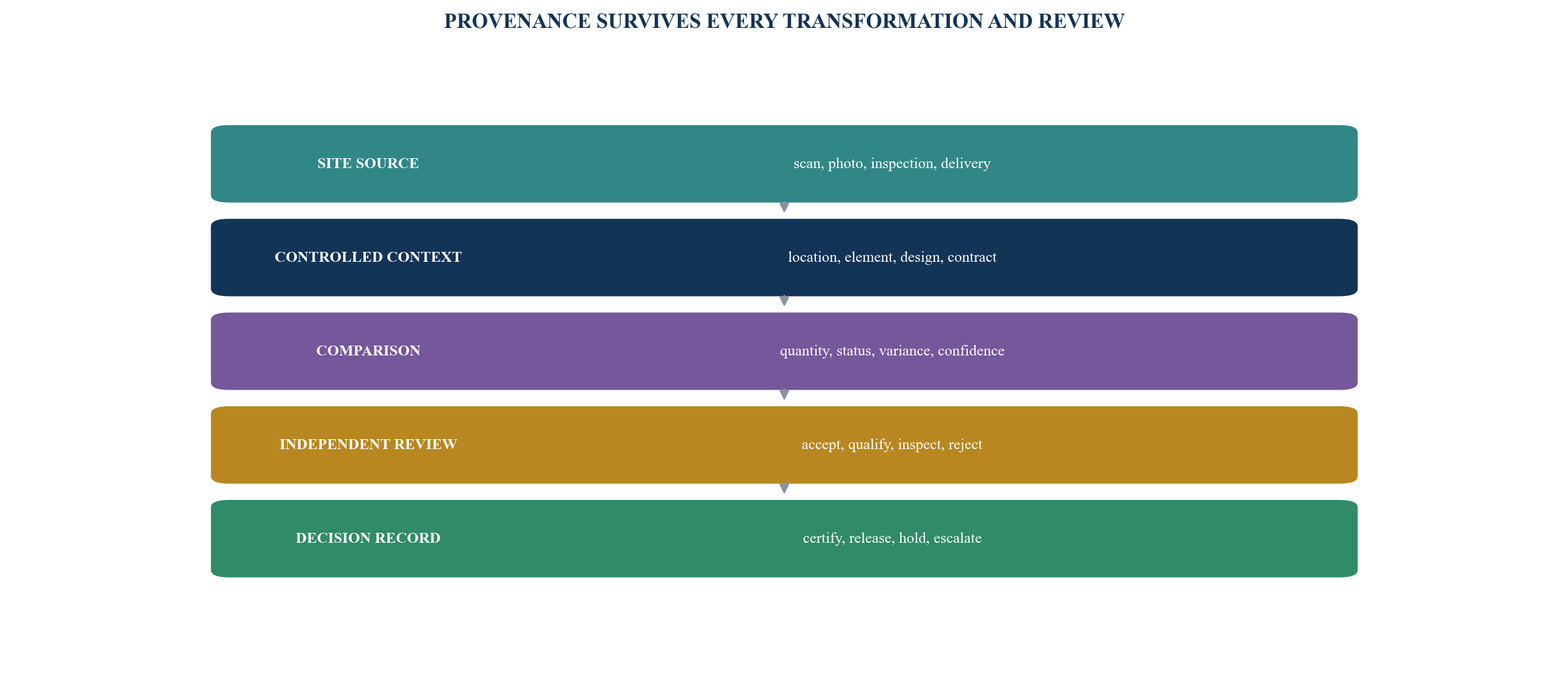
The sequence illustrates information governance and does not assign authority for a specific project.
6. Measure progress through earned scope
Progress should be measured against defined scope and contract value. A headline percentage can hide which buildings, packages and milestones have advanced, whether work is accepted, and whether the remaining sequence is achievable.
The work breakdown structure should align design objects, schedule activities, cost codes and payment items. Each progress rule defines the measurement unit, evidence, weighting, completion states and responsible certifier. Concrete can be measured by accepted volume. Facade can be measured through fabrication, delivery, installation and testing gates. Mechanical systems may require installation, pressure testing, energisation and commissioning.
Weighting must avoid front-loading. High early value for design, mobilisation or materials can produce paid progress ahead of physical risk reduction. Off-site materials require title, identification, insurance, storage, inspection and vesting controls where the finance documents permit recognition.
The lender should see claimed, observed, certified and paid percentages separately. Differences reveal disputes, evidence delays, rejected work, cash timing and potential contractor stress.
Programme progress also needs logic. A project can report substantial installed value while critical-path design, approvals or long-lead equipment remain late. The twin connects certified physical progress to baseline, current programme and forecast completion.
Sampling is recorded explicitly. The method states population, sample, selection, tolerances and extrapolation. Material exceptions expand the sample or trigger direct inspection. One verified floor should not automatically establish the status of every floor.
Table 2. Progress measurement rulebook
| Work package | Earned-progress basis | Evidence gate | Common exception |
|---|---|---|---|
| substructure and frame | accepted installed quantities by zone | survey, inspection and approved records | quantity exists but inspection remains open |
| facade | weighted fabrication, delivery, installation and test states | tagged units, vesting, inspection and test | installed units fail water or fire requirement |
| building services | system installation, testing and commissioning states | controlled system boundary and signed results | visible installation lacks energisation or test |
| finishes | completed and accepted rooms or areas | location-based inspection and snag status | activity is claimed complete with material snags |
| external works | measured quantity and accepted section | survey, permit and inspection evidence | area inaccessible or dependent utility unresolved |
| professional services | accepted deliverable or time under approved scope | document status, instruction and invoice | revised design follows contractor error |
Measurement rules require agreement with contracts, appointments and finance documents.
7. Reconcile schedule, quantity and cost
The twin should maintain three distinct measures: physical quantity, schedule progress and financial value. They rarely move in perfect alignment. A procurement deposit can create financial expenditure before physical installation. A completed structure can earn value while a late utility connection controls opening.
Each work package is mapped to a schedule activity, contract line and location. The mapping enables variance analysis: installed quantity versus planned quantity, certified value versus planned value, and forecast completion versus baseline.
The schedule should retain baseline, approved revisions and current forecast. Logic changes are material. Removing a predecessor, changing a calendar or compressing testing can improve the reported completion date without improving delivery. The review should identify changes to critical and near-critical paths, float consumption and unmitigated constraints.
Cost reconciliation begins with original contract, approved variations, pending variations, claims, provisional sums, allowances, committed cost, certified amount, paid amount and forecast final cost. Each item is linked to scope and responsibility. A quantity change can then be traced to design development, employer instruction, site condition, correction or commercial settlement.
Progress quality matters. Work completed out of sequence may create rework or access problems. The twin can flag closed ceilings before above-ceiling inspections, finishes before water-tightness or equipment installation before permanent power.
The lender dashboard should present a small set of explainable variances. Drill-down provides evidence. A composite score without visible drivers can conceal a serious exception.
8. Forecast cost to complete as an evidence range
Cost to complete is the central financing calculation. It should include remaining base scope, approved changes, likely changes, claims, escalation, professional fees, authority costs, finance costs, testing, commissioning, handover, retention, defects, contingency and any sponsor-funded exclusions.
The estimate starts with the current controlled design and contract position. Remaining quantities are priced using committed rates where applicable and current market evidence for uncommitted scope. Procurement status, bid validity, foreign exchange, logistics and long-lead exposure are visible.
One deterministic forecast can imply more certainty than the evidence supports. The lender should see a base forecast, identified-risk allowance and downside range. Each material risk has probability or scenario treatment, consequence, owner, mitigation and expected resolution date.
Contingency is not treated as spare funding. The model separates approved use, transferred risk, retained risk and remaining unallocated reserve. Draw approval should test whether remaining liquidity covers the current forecast under the facility's rules.
The worked illustration can use management assumptions. Suppose the approved project budget is AED 720 million, certified cost is AED 270 million, committed remaining cost is AED 330 million, uncommitted scope is AED 55 million, identified risks are AED 28 million and remaining contingency is AED 24 million. The model would expose a possible AED 13 million gap before the next release. These figures demonstrate the calculation only.
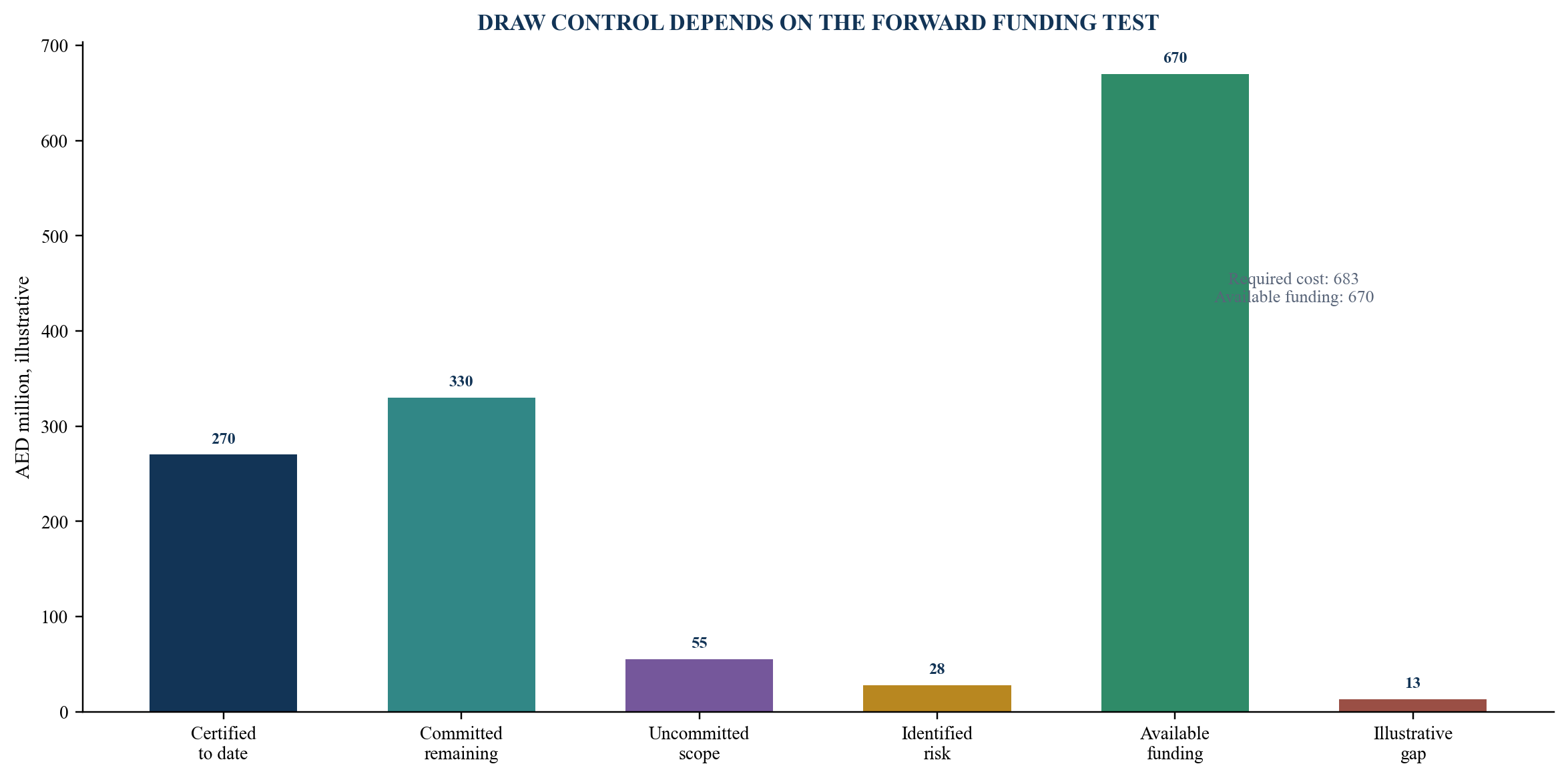
All values are management assumptions in AED millions and do not describe a named project.
9. Connect escrow and loan cash without merging authorities
Development cash can include sponsor equity, buyer receipts, escrow balances, loan proceeds, refunds, interest, taxes and restricted retention. The twin should reconcile these sources while preserving the legal identity and control of each account.
Dubai Land Department states that buyer receipts and project financing are deposited into the project escrow account and that a separate account is maintained for each project. Published information also describes a five-percent retained amount for one year after completion under the referenced escrow law. Actual treatment requires current project-specific confirmation.
The cash model begins with opening balances, receipts, transfers, eligible obligations, certified amounts, prior payments and closing balances by controlled account. Every proposed payment links to payee, contract, invoice, eligible category, certified work, tax and bank instructions.
The waterfall applies the governing sequence. It can test required sponsor equity, eligible escrow cash, loan availability, retention and reserve. It should also show payments that are valid project costs but ineligible for a particular controlled account.
The trustee and lender may apply different tests. A trustee's permitted escrow disbursement does not automatically satisfy a loan condition. A lender approval does not replace escrow requirements. The twin records both decisions and releases cash only through the actual authorised workflow.
Daily bank data can improve reconciliation. It should not make cash release automatic. Sanctions screening, beneficiary verification, fraud controls and dual authorisation remain part of payment governance.
Table 3. Controlled-account reconciliation
| Cash source or account | Core control | Twin evidence | Decision boundary |
|---|---|---|---|
| sponsor equity | source, deposit and permitted use | bank record, ledger and sources-and-uses mapping | lender verifies contractual contribution |
| buyer receipts | registered obligation, receipt and refund treatment | sale record, receipt, unit and escrow reconciliation | trustee applies escrow requirements |
| development loan | availability, condition and eligible use | facility ledger, draw conditions and approved payment | lender retains draw authority |
| project escrow | project-specific receipts and permitted disbursement | trustee ledger, certificate and payment package | trustee and regulator retain authority |
| retention and reserves | restricted purpose and release date | contract, completion and defects evidence | release only under governing conditions |
| operating or other cash | documented source and transfer permission | bank and accounting reconciliation | legal and finance review where required |
Account rules and sequence depend on applicable law, trustee arrangements and finance documents.
10. Make independent certification visible
Independent certification is a professional process. The twin should make its scope, evidence and qualifications visible while avoiding the appearance that software has issued the conclusion.
World Bank guidance on managing public-private partnership contracts describes independent certifiers monitoring compliance, progress and quality, and lender technical advisers monitoring construction and approving drawdowns. The roles depend on the project documents, but the principle is broadly relevant: financing decisions use review that is separate from the contractor's claim.
The certifier's workflow can receive the contractor application, controlled contract data, prior certificate, evidence coverage, site observations, testing, non-conformance, variation status and cost forecast. The certifier records accepted amount, exclusions, qualifications and required follow-up.
Digital comparison can prioritise inspection. A scan-to-model variance may identify missing or out-of-tolerance work. Schedule analysis can identify critical packages. Cost analytics can flag unusual rates, duplicate invoices or front-loading. Each flag remains subject to review.
Reliance should be clear. Drone, scan and model vendors can provide data or analysis. They do not assume design, measurement or certification responsibility unless their appointment expressly says so. The lender should understand exclusions, professional indemnity, duty of care and access to source records.
The certificate itself remains a controlled document with issue date, period, scope, amount, assumptions, exceptions and signature. Its links to underlying evidence allow efficient review without replacing the legal instrument.
11. Build a formal exception taxonomy
The twin creates value when it exposes exceptions early and routes them to an accountable decision. An unstructured list can mix minor data gaps with material funding threats.
Exceptions can be classified as evidence, design, quality, programme, cost, contract, permit, escrow, sales, insurance, safety, cyber or fraud. Severity reflects potential impact on safety, legality, completion, cost, time, cash and repayment. Urgency reflects how quickly the issue can affect a release or critical activity.
Every exception has source, location, owner, response deadline, required evidence, interim control, financial exposure and closure authority. Closure requires evidence. Changing status without a new source record leaves the issue unresolved.
Some exceptions should trigger automatic holds under approved policy. Examples can include expired insurance where current cover is a draw condition, an unapproved payee, duplicate invoice, missing certificate or a material unclosed safety prohibition. Other exceptions require judgement and can be released with a documented qualification or reserve.
Recurring exceptions reveal control weakness. Repeated late inspections, model revisions after installation, unexplained quantity variance or delayed subcontractor payment can signal future distress. Trend analysis should reach the lender before the headline progress percentage deteriorates.
The committee view shows open critical exceptions, ageing, cash at risk, critical-path impact and closure forecast. It also shows which party has authority to resolve each item.
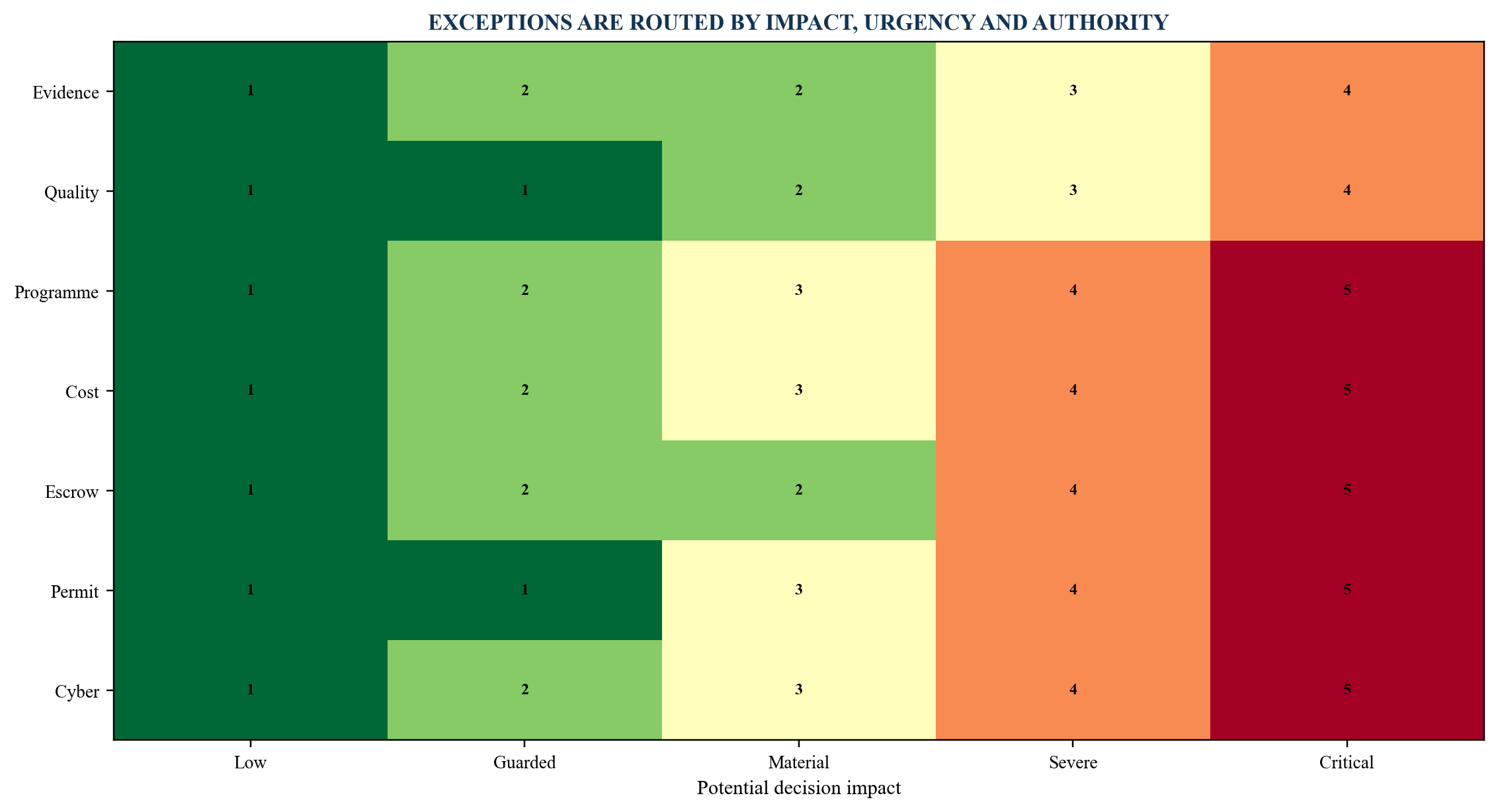
Scores and thresholds are management assumptions for method demonstration.
12. Use site capture proportionately
Site capture can include mobile photographs, fixed cameras, drones, laser scanning, photogrammetry, positioning, environmental sensors and equipment telemetry. The method should match the decision and physical conditions.
Dubai Municipality describes geospatial capture using aerial photography, laser scanning, 360-degree cameras and change-detection methods as inputs to its wider digital-twin programme. This demonstrates the range of available tools. A project lender still needs a project-specific sampling, accuracy, safety and review protocol.
Mobile photographs can be effective for repeatable inspections when location, orientation, time and work package are controlled. Drone capture can cover facades, roofs and large sites subject to permits, safety and privacy. Laser scanning can support geometry and quantity comparison where line of sight and tolerances are suitable. Sensors can monitor concrete curing, movement, temperature, energy or water when calibrated and maintained.
Coverage limitations must be recorded. Finished surfaces can conceal services. A scan cannot confirm material composition, fire stopping behind closed construction or system performance without appropriate tests. Image quality can be affected by lighting, access and obstruction.
The capture plan defines frequency, areas, method, accuracy, operator, permissions, storage, retention and escalation. The lender can increase capture in high-risk packages or after a material exception.
Raw data should be retained with hashes or equivalent integrity controls where appropriate. Processed outputs link to software version, method and reviewer. The ability to reproduce a material result is part of evidence quality.
13. Govern model and data changes
Construction information changes frequently. The lender needs to know whether a variance reflects physical work, approved design change, correction, changed classification or an unauthorised model edit.
The common data environment should maintain work-in-progress, shared, published and archived states or an equivalent controlled workflow. Only information approved for the stated purpose should feed a formal measurement or draw decision.
Every model release should have revision, status, suitability, author, checker, approver, date and change summary. The twin links physical evidence to the exact revision used. When a new design is issued, prior observations remain tied to the old revision and are reassessed only through a controlled process.
Data dictionaries define identifiers, units, classifications and permitted values. Consistent identifiers connect elements to work packages, contracts, schedule and cost. Manual mapping is reviewed and recorded, especially where legacy systems use different codes.
Change control identifies design impact, authority approval, contract instruction, quantity, cost, programme, procurement, financing and operating effect. A visually minor change can create a material cost or permit consequence. The twin should show pending changes before they become certified cost.
Information quality metrics can include late delivery, rejected submissions, missing identifiers, unresolved clashes, unapproved status and mapping exceptions. These metrics measure the reliability of the evidence process; they do not measure physical progress directly.
Table 4. Information-change control
| Information event | Required control | Financing relevance | Evidence retained |
|---|---|---|---|
| new design revision | author, checker, approval, purpose and change summary | quantity, scope, permit and cost may change | old and new version plus approved comparison |
| site observation | time, place, method, coverage and operator | supports inspection and progress review | raw and processed record plus lineage |
| model-to-cost mapping | identifier, rule and independent check | connects physical state to certified value | mapping table, exception and approval |
| schedule update | data date, logic, progress basis and change log | affects completion and finance cost | baseline, update and variance analysis |
| commercial change | instruction, entitlement, estimate and approval | changes cost to complete and availability | request, assessment, decision and ledger |
| correction | reason, originator, reviewer and link to prior record | may affect earlier decision or certificate | immutable prior record and corrected entry |
Workflow names can vary; the control principle is approval for a defined use.
14. Protect cybersecurity, access and continuity
A project twin contains commercially sensitive designs, security information, personal data, bank records, contracts and payment instructions. Compromise can disrupt construction, facilitate fraud or expose the asset.
The security model begins with data classification and least-privilege access. Users receive role-based permissions, strong authentication and periodic access review. Privileged actions, exports and payment-related changes are logged. External vendors receive limited access for defined periods.
System integrations require authenticated interfaces, encryption, validation, monitoring and failure handling. A connection from the twin to bank, escrow, enterprise resource planning or common data environment should not create an uncontrolled path to release cash.
Segregation of duties is essential. The person submitting an invoice should not approve the payee, certify the work and release the payment. Changes to bank details require independent out-of-band verification under an approved procedure.
Availability also matters. The draw process needs documented backups, recovery objectives, offline evidence packages and manual continuity. A platform outage should delay or route the decision under policy, not erase the supporting record.
Incident response identifies notification, containment, evidence preservation, authority, lender and insurer requirements. Cyber exceptions enter the same governance system as physical and commercial exceptions.
The United Kingdom Government's digital-twin publication notes data-security challenges. Project-specific security design should follow applicable law, contractual requirements and recognised professional practice rather than rely on the platform label.
15. Stress the progress and cash case together
Physical delay, cost growth and cash pressure reinforce each other. A late facade can delay internal finishes, extend preliminaries, defer sales collections or handover, increase interest and consume contingency. The twin should carry these connections into downside analysis.
The base case uses the current certified position, controlled schedule, cost forecast, committed funding, sales receipts and escrow rules. Stress cases vary progress rate, procurement delay, cost escalation, sales collections, refunds, interest, contingency draw, claims and completion date.
A model can test false progress. If claimed progress is five percentage points above independently supported progress, the eligible draw reduces and contractor liquidity may tighten. If the project then slows, the cost-to-complete gap can widen before the next monthly certificate.
Correlated scenarios are more informative than isolated sensitivities. A material quality failure may cause demolition, replacement, programme delay, additional supervision, retained sales receipts and a dispute. Each effect should enter the cash forecast in the month it occurs.
Management actions need mechanism, authority and timing. Additional equity requires evidence of availability and commitment. Scope reduction requires design, permit, contract and sales assessment. Accelerated work requires resources and may increase cost or quality risk.
The lender view includes minimum liquidity, remaining contingency, facility availability, equity requirement, projected completion, sales or handover timing and covenant headroom. Each scenario identifies the next decision date.
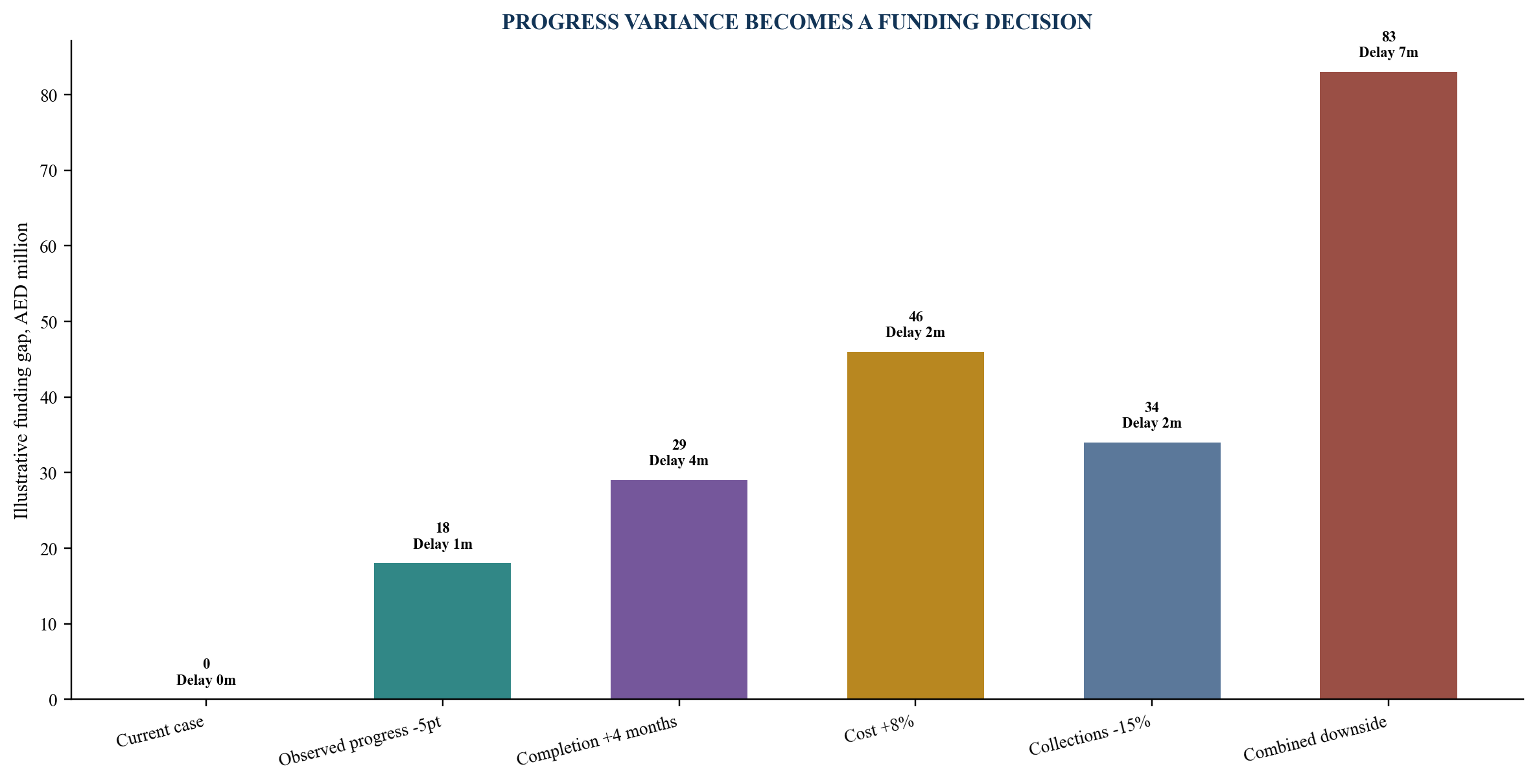
Percentages and AED values are management assumptions for method demonstration.
16. Design the lender committee dashboard
The committee dashboard should lead with decisions and exceptions. It is not a three-dimensional model viewer. A compact first page can show requested draw, independently certified amount, eligible amount, recommended release, remaining funding, cost to complete, contingency, forecast completion and critical exceptions.
Progress is shown by asset, package and critical path. The dashboard separates claimed, observed, certified and paid status. It identifies where evidence coverage is weak or inspections remain open.
Commercial controls show original budget, approved changes, pending exposure, committed cost, forecast final cost, claims and payments. Cash controls show equity, buyer receipts, escrow, loan, restricted balances and next sixty or ninety days of obligations.
Risk controls show open critical exceptions, ageing, owner, cash exposure, programme effect and closure date. The committee can drill from each number to the controlled source, certificate and ledger.
Historical views are frozen at each decision date. Later corrections do not change what the committee saw. A restatement process identifies any prior decision affected by material new evidence.
Narrative remains necessary. The technical adviser explains judgement, sampling, qualifications, material changes and forecast confidence. The digital twin provides traceability and efficient access.
Table 5. Lender draw-committee pack
| Committee question | Primary measure | Supporting evidence | Decision output |
|---|---|---|---|
| what amount can be released? | requested, certified, eligible and recommended draw | certificate, cost ledger and conditions matrix | approve, qualify, reduce or hold |
| is the project on plan? | physical progress, critical path and completion forecast | programme, observations and inspections | accept forecast or require recovery plan |
| is funding sufficient? | cost to complete, available funding and downside gap | contracts, changes, risks and cash model | require equity, reserve or restructuring |
| are controlled accounts reconciled? | opening, receipts, payments and closing balances | bank, escrow, sales and loan ledgers | clear or investigate reconciliation |
| what can impair completion? | critical exceptions and trend | evidence, owner and closure record | escalate, inspect, reserve or impose condition |
| is evidence reliable? | coverage, age, provenance and rejected records | ledger and information-quality report | accept scope or expand verification |
Approval content and authority follow the facility and escrow arrangements.
17. Run a ten-day lender-twin diagnostic
A rapid diagnostic can determine whether existing project data can support stronger draw control. It should focus on one live decision cycle rather than attempt a full technology transformation.
Days one and two map the facility, escrow, certification and payment conditions. The team identifies accounts, parties, authorities, current draw calendar, systems and recent exceptions.
Days three and four reconcile one representative work package across design, location, schedule, cost, contract, observation, certificate and payment. Missing identifiers, status conflicts and manual transformations are recorded.
Days five and six test site-capture coverage, progress rules, cost to complete, programme logic, variation and claims. The team rebuilds the evidence chain for a prior or current draw.
Days seven and eight design the minimum data model, condition-to-evidence matrix, exception taxonomy, access model and committee dashboard. The work specifies interfaces while retaining current systems of record where appropriate.
Days nine and ten produce a control-gap heat map, pilot scope, governance protocol, implementation budget, ninety-day plan and measurable acceptance criteria. The paid diagnostic states data limitations, reliance and professional responsibilities.
The diagnostic is commercially qualified when there is a live construction facility or controlled account, a senior sponsor, lender or trustee decision owner, access to current records, a material draw or completion risk, and budget for implementation. General interest in digital twins does not establish a mandate.
18. Operate a ninety-day implementation office
The first thirty days establish governance, information requirements, identifiers, source systems, access, evidence ledger, priority work packages and a shadow draw. The shadow process runs alongside existing controls without affecting cash.
Days thirty-one to sixty integrate controlled design, schedule, cost, site capture and certification for the pilot scope. The team tests mappings, sampling, exception workflow, cybersecurity, continuity and committee reporting. Differences from the existing certificate are investigated.
Days sixty-one to ninety complete independent acceptance, user training, procedures, audit record, production readiness and the first controlled reporting cycle. Any authority to use the output in a draw is documented by the parties with the relevant power.
Implementation gates should be measurable. Examples include complete identifier mapping for the pilot population, reproducible quantity calculations, closed critical access issues, agreed progress rules, evidence lineage for every included amount, tested backup and signed role matrix.
The office should preserve a manual fallback. The platform should improve the quality and speed of review while the signed certificates, approvals and payment controls remain available outside a single technology dependency.
A recurring lender-twin office can manage monthly evidence ingestion, reconciliation, site-capture planning, exceptions, cost-to-complete updates, committee packs and continuous control improvement.
19. Measure value through decisions and avoided leakage
Implementation value should be measured through financing and delivery outcomes. Useful measures include time to assemble a draw, percentage of requested amount with complete evidence, reconciliation breaks, duplicate or ineligible invoices detected, unapproved change exposure, exception closure time, forecast accuracy and days of earlier warning.
Technology activity is a weak success measure. Model size, image count and dashboard views do not establish credit value. Each capability should connect to a faster, better supported or earlier decision.
The baseline should be measured before implementation. If a monthly draw requires fifteen business days and repeated manual reconciliation, the pilot can test whether controlled mappings reduce preparation and review time without weakening professional checks.
Avoided leakage requires evidence. A flagged invoice becomes value only when review establishes duplication, ineligibility, unsupported quantity or another valid reason. A possible saving should not be presented as realised cash.
Forecast performance can be measured by comparing prior cost-to-complete and completion-date estimates with subsequent outcomes. Persistent bias can reveal optimistic reporting, missing scope or weak risk quantification.
Commercial impact can include improved lender confidence, more predictable draw timing and earlier sponsor intervention. Attribution should remain careful because project performance depends on many parties and market conditions.
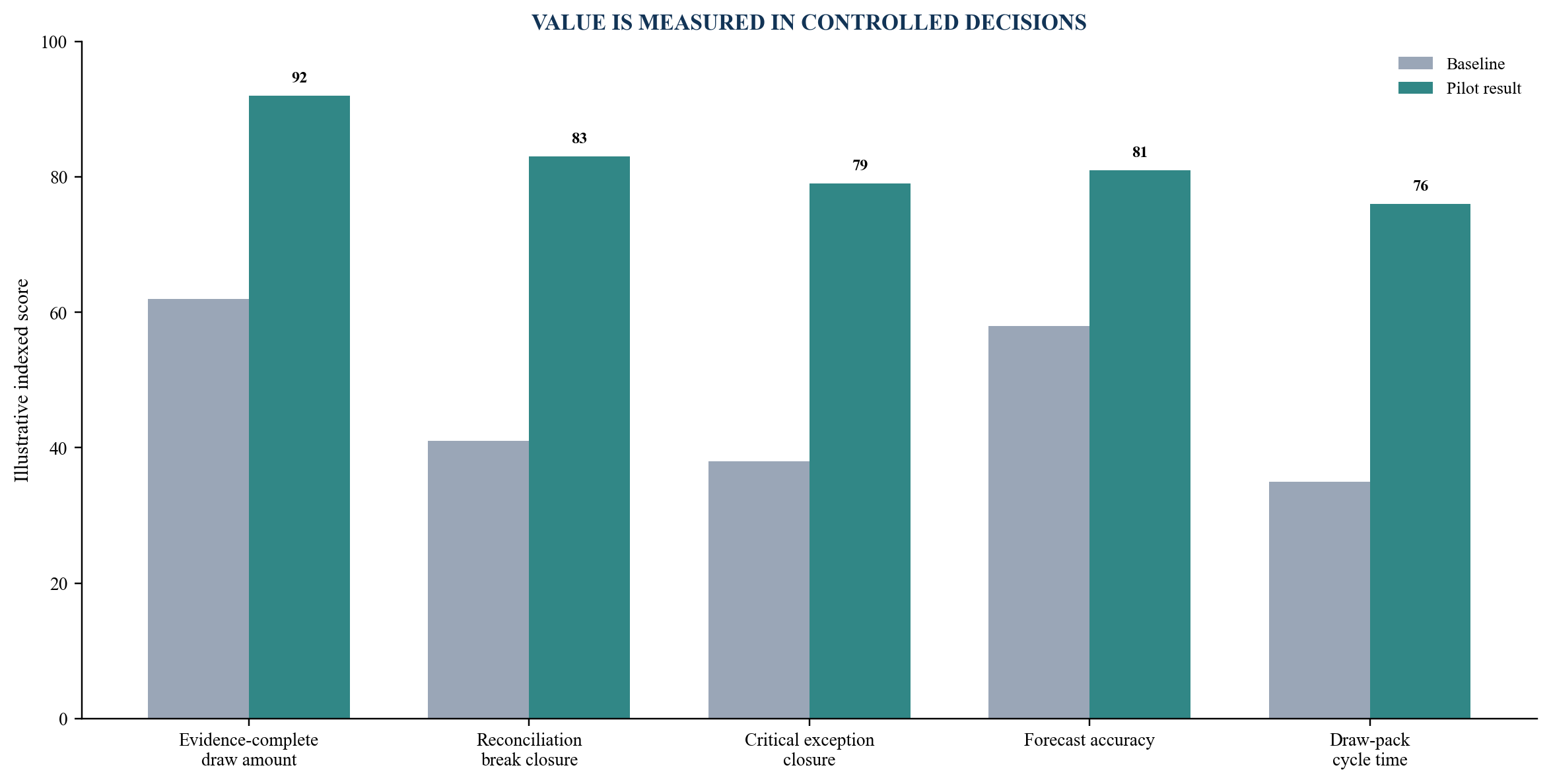
Targets are project-specific management decisions; the illustration shows measure design.
20. Package advisory work around funded control decisions
A lender-twin diagnostic can support a bank, private-credit fund, developer, escrow trustee or institutional investor reviewing a live construction exposure. The paid outcome is a decision-grade view of information reliability, progress, cost to complete, controlled cash and implementation priorities.
A recurring project-finance control office can coordinate the borrower, project manager, designers, contractor, cost consultant, independent certifier, trustee, lender technical adviser and lender operations team. Deliverables can include the condition-to-evidence matrix, evidence ledger, progress rulebook, draw reconciliation, exception register, cost-to-complete model, dashboard and committee paper.
An implementation mandate can support requirements, system selection, data mapping, pilot design, acceptance, training and operating procedures. Technology procurement, professional appointments, reliance, cybersecurity, intellectual property, regulatory obligations and liability should be documented separately.
Commercial qualification establishes a live project, funded facility or controlled account; senior authority; access to design, cost, programme and cash records; a defined draw, completion or control problem; cooperation from the appointed professionals; and budget. The scope should identify decisions Matchpoint supports and those retained by authorised third parties.
The investable project twin is a governed chain from physical evidence to cash decision. It makes uncertainty, provenance and exceptions visible. It gives capital providers a stronger basis to release, reserve, inspect, restructure or hold funds while keeping professional and statutory authority intact.
Table 6. Ninety-day lender-twin delivery office
| Phase | Core output | Decision supported | Acceptance test |
|---|---|---|---|
| days 1 to 30 | conditions map, data model, governance and shadow draw | approve pilot and controlled scope | every pilot amount has source, owner and rule |
| days 31 to 60 | integrations, evidence ledger, capture and exception workflow | test reliability against current process | variances are explained and independently reviewed |
| days 61 to 90 | accepted procedure, dashboard, continuity and first cycle | authorise defined production use | roles, security, audit and fallback tests pass |
| recurring mandate | monthly reconciliation, forecast and committee support | protect capital through completion | exceptions and funding gaps reach authority on cadence |
Timing should be adapted to project stage, data condition, appointments and draw cycle.
References
- Dubai Land Department. Escrow Account Activation. https://dubailand.gov.ae/en/eservices/request-to-activate-an-escrow-account/
- Dubai Land Department. Frequently Asked Questions. https://dubailand.gov.ae/en/frequently-asked-questions
- Dubai Land Department. Dubai REST Real Estate Services and Project Information. https://dubailand.gov.ae/en/news-media/dubai-land-department-enhances-dubai-rest-real-estate-services-via-improved-interactive-interface/
- Dubai Land Department. International Development Bank Joins Authorised Banks as an Escrow Account Trustee. https://dubailand.gov.ae/en/news-media/international-development-bank-officially-joins-the-authorised-banks-by-dubai-land-department-as-an-escrow-account-trustee
- Dubai Land Department. Real Estate Legislation. https://rdc.dubailand.gov.ae/Assets/img/Real_Estate_Legislation_en.pdf
- Dubai Municipality. GIS Projects and Dubai Digital Twin Initiative. https://www.dm.gov.ae/municipality-business/planning-and-construction/geographic-information-systems/gis-projects/
- Dubai Municipality. BuildingSmart UAE Division and BIM Development. https://www.dm.gov.ae/dubai-municipality-highlights-developments-and-achievements-of-buildingsmart-organizations-uae-division/
- Dubai Municipality. Dubai Municipality and Dubai Land Department Digital Partnership. https://www.dm.gov.ae/dubai-municipality-and-dubai-land-department-partner-to-boost-smart-city-management/
- Building and Construction Authority Singapore. Integrated Digital Delivery. https://www1.bca.gov.sg/growth-and-transformation/productivity/idd-integrated-digital-delivery/
- International Organization for Standardization. ISO 19650-1:2018 Information Management Using Building Information Modelling. https://www.iso.org/standard/68078.html
- United Kingdom Government. Digital Twin: Official Definition. https://www.gov.uk/government/publications/digital-twin-definition/digital-twin-official
- United Kingdom Government. Building Information Modelling. https://www.gov.uk/government/publications/building-information-modelling
- United States General Services Administration. 3D-4D BIM Overview. https://www.gsa.gov/cdnstatic/BIM_Guide_Series_04_v1.pdf
- World Bank Group. Managing PPP Contracts. https://ppp.worldbank.org/sites/default/files/2024-10/updated_full-document_art3_web.pdf
- World Bank Group. Construction Contracts Checklist. https://ppp.worldbank.org/ppp-overview/practical-tools/checklists-risk-matrices/construction-contracts-checklist
- World Bank Group. Leveraging Digital Technologies to Enable Program Monitoring. https://www.worldbank.org/en/results/2023/03/07/leveraging-digital-technologies-to-enable-program-monitoring-in-remote-fragile-and-conflict-affected-areas
About the Author
Chennakeshav Adya, Independent Researcher
