
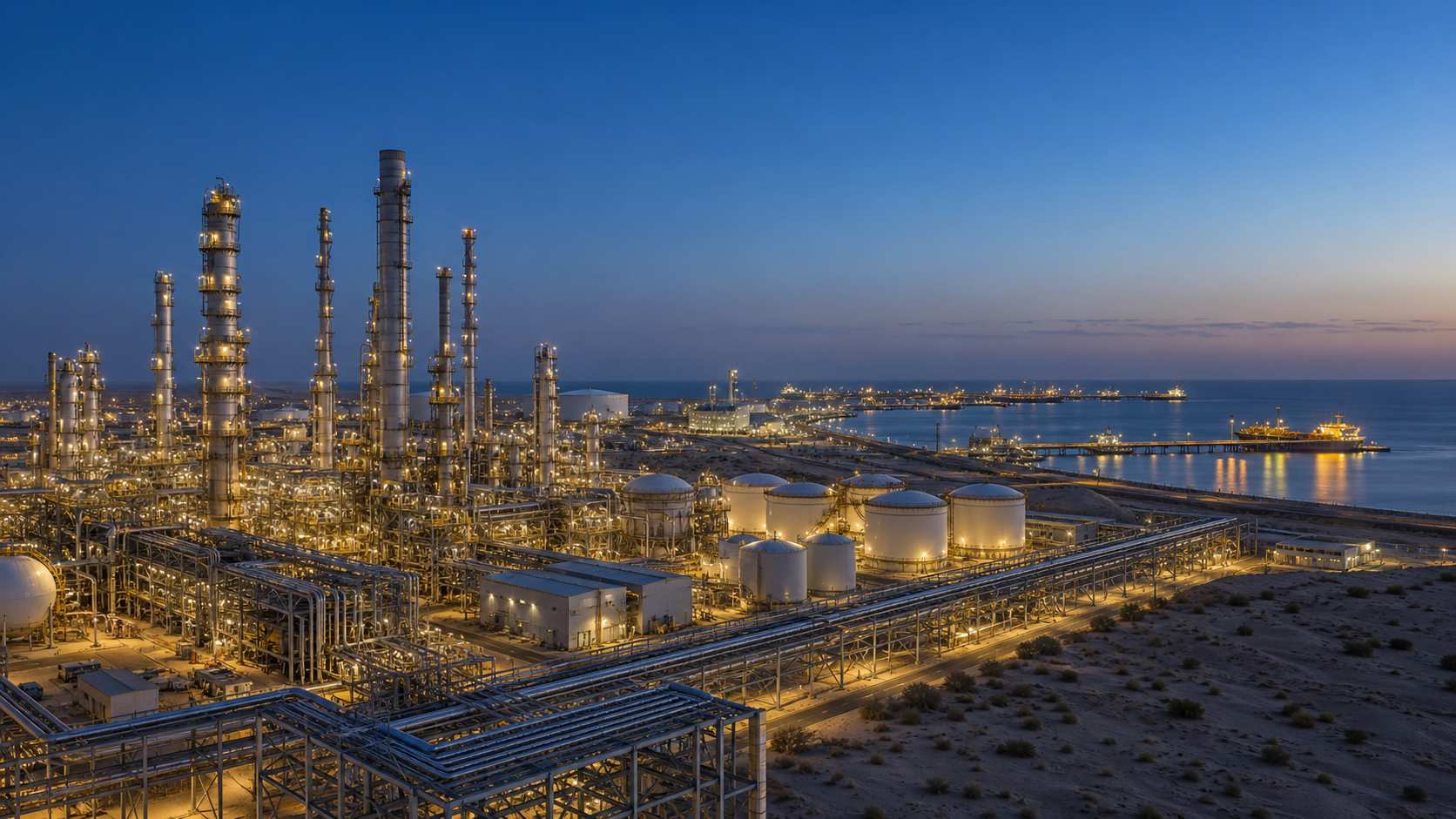
1. Treat the chemicals project as one conversion chain
A chemicals project is a chain of interdependent rights and physical systems. Feedstock must arrive in the correct quantity and specification. Power, steam, water, industrial gases and waste services must be available. Licensed technology and equipment must convert inputs at agreed yield and energy intensity. The plant must run safely and reliably. Product must meet customer specification, move through storage and logistics, and be accepted and paid for. Debt service depends on the entire chain.
This feature distinguishes chemicals project finance from simple asset-backed lending. The installed equipment has limited independent value if feedstock rights, utilities, licences, operating knowledge or product routes cannot transfer. Security should therefore protect contracts and continuity as well as physical assets.
The bankability file should begin with a molecule-to-cash map. For every principal product and coproduct it should identify the input, supplier, delivery point, price formula, storage, process route, design yield, utility intensity, quality specification, customer, sales basis, transport, payment route and cash account. Waste streams, by-products and emissions should be included because they can create cost, permit or shutdown exposure.
The project perimeter should distinguish common infrastructure from dedicated facilities. Industrial gases, seawater cooling, power, port, pipeline and waste treatment may be provided by third parties or industrial-city systems. A failure at a shared facility can affect several plants. The lender should identify capacity reservation, priority, maintenance, force majeure and remedy for every critical interface.
Saudi industrial clusters can offer proximity to energy, raw materials, ports and infrastructure. The Royal Commission describes Jubail's location and access to energy and essential raw materials as central to its investment environment.[10] Credit analysis should convert these locational strengths into project-specific contracts, permitted capacity and tested interfaces.
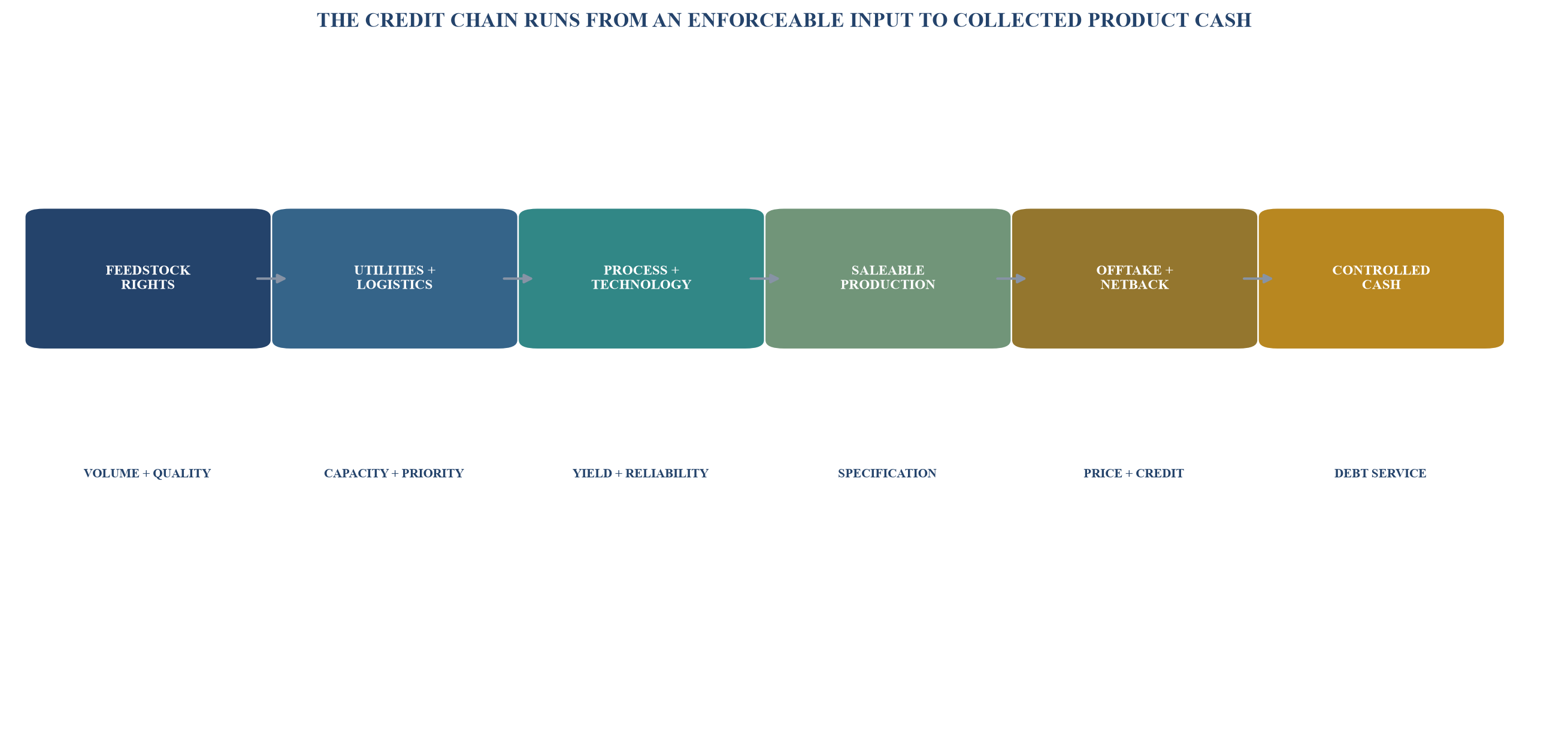
Debt capacity depends on every link remaining available, specified, controlled and evidenced.
2. Define the product, process and financing perimeter
The term chemicals covers very different assets. Basic chemicals can rely on scale, integration and commodity markets. Intermediate chemicals add process and customer dependencies. Specialty formulations can have smaller trains, more products, higher margins, qualification requirements and customer concentration. Conversion businesses may use resins or intermediates to produce packaging, automotive, construction or consumer inputs.
The financing perimeter should match the operating system. A standalone project company can own one train and contract with affiliates for feedstock, utilities, marketing and services. An integrated platform can own several units and share infrastructure. A brownfield expansion can depend on the host plant for land, control room, maintenance, storage and emergency response. Each structure changes completion, allocation of cost and lender control.
Shared assets should have measurable service. A broad corporate support letter does not replace a utility agreement that states capacity, specification, availability, price, maintenance notice, expansion, priority and liability. An affiliate marketing arrangement should state sales duty, transfer price, credit risk, inventory ownership and termination. Common-cost allocation should be transparent and auditable.
The security group should reflect these dependencies. Lenders may require project-company shares, land or lease rights, movable assets, receivables, accounts, insurance proceeds and material contracts, subject to Saudi law and existing rights. Direct agreements can provide notice, cure, continuity and substitution around feedstock, technology, engineering, operations, utilities and offtake.
The financing model should exclude value that cannot support the borrower. Corporate brand, affiliate customers and group infrastructure can improve operating strength, yet their benefit enters debt capacity only through enforceable rights or sustained evidence. The same principle applies to planned downstream demand and policy support.
3. Convert feedstock advantage into a financeable contract
Feedstock economics are central to Saudi chemicals. SABIC's 2025 reporting describes a raw-material base that includes methane, ethane, propane, butane, naphtha and condensates, with long-term agreements supporting Saudi operations.[5][6] Aramco's integrated chemicals strategy similarly seeks to capture value across the hydrocarbon chain.[7][8] A new project should document its own supply rights rather than rely on sector precedent.
The feedstock agreement should define committed and interruptible volume, quality range, pressure, temperature, delivery point, metering, nomination, take-or-pay, make-up, storage, price formula, taxes, maintenance, force majeure, curtailment, allocation during shortage, termination and transfer. The lender should test whether minimum supply covers the production case used for debt service.
Quality matters because yield and equipment performance depend on composition. An acceptable range can still alter throughput, catalyst use, energy consumption, by-product generation and product quality. The financial model should translate feedstock variation into saleable output and operating cost.
Pricing should be analysed through the product spread. A low headline feedstock price can still create margin volatility if it resets faster than product prices, uses a different index or includes floors and escalation. A lender should test historical and forward relationships without assuming they remain constant. Transfer pricing between affiliates requires governance and auditability.
Interruption analysis should identify physical and contractual alternatives. Storage provides hours or days, not permanent supply. A second pipeline can share one upstream source. Imported replacement may be technically possible and economically uneconomic. The credit case should state the time, cost, specification and permits required for substitution.
Table 1. Feedstock bankability scorecard
| Dimension | Strong evidence | Watch condition | Weak condition | Credit response |
|---|---|---|---|---|
| volume | firm minimum supports downside production | partial interruptibility | allocation without minimum | lower throughput and reserve |
| specification | narrow range tied to process warranty | variable yield within range | material quality uncertainty | performance case and supplier remedy |
| tenor | extends beyond debt with transfer rights | renewal before maturity | short or cancellable supply | shorten debt or require replacement |
| price | transparent formula with matching reset | basis or timing mismatch | discretionary affiliate transfer price | spread stress and audit covenant |
| interruption | defined allocation, notice and compensation | shared source and limited storage | broad force majeure and no remedy | liquidity reserve and reduced leverage |
| delivery | tested pipeline, meter and capacity | single critical interface | unbuilt or unpermitted connection | construction condition and contingency |
The lender should score the executed project agreement and physical system, not the sector's general feedstock position.
4. Underwrite utilities and industrial interfaces as critical supply
Chemicals plants require continuous power, steam, cooling water, process water, industrial gases, waste treatment, flare and port services. Interruption can stop production, damage catalysts or create a hazardous restart. Utility diligence should receive the same attention as feedstock.
For each utility, the model should state normal and peak demand, redundancy, backup, quality, pressure, voltage, interruption tolerance, restart time and price. The contract should address capacity reservation, maintenance coordination, emergency curtailment, metering, expansion and liability. The technical adviser should confirm that shared systems can meet coincident peak demand across the industrial cluster.
Power reliability and energy intensity affect both cost and production. Steam and industrial gases may be produced internally or purchased. Internal generation increases capex and operating complexity. External supply creates counterparty and interface risk. The decision should be reflected in availability assumptions and completion tests.
Waste and environmental services are operating constraints. The Royal Commission Environmental Regulations 2025 apply across its industrial cities and include permitting, standards and penalties.[9] A project should identify every material air, water, hazardous-material and waste obligation, the monitoring system, treatment capacity and consequences of non-compliance.
Port and logistics interfaces determine netback. Export products can require dedicated tanks, packaging lines, hazardous-goods handling, berth windows and shipping documentation. A lender should test both normal throughput and disruption scenarios. Storage can separate production from shipment, while insufficient storage can force a plant slowdown when logistics are delayed.
5. Prove technology at the intended feedstock and product slate
Process technology can be commercially proven and project-specific performance can remain uncertain. The relevant test is whether the selected licensor, design and equipment can convert the specified Saudi feedstock into the intended product slate at guaranteed capacity, yield, quality, energy use, emissions and reliability.
The technology package should include licence, basic engineering, proprietary equipment, catalyst, control logic, operating procedures, training, technical assistance, warranty and performance guarantees. Rights should survive contractor or licensor distress. Lenders need cure and continued-use rights sufficient to complete and operate the plant.
Reference-plant analysis should compare scale, feedstock, process configuration, product grade, climate, utilities and operating history. A larger train can introduce scale-up risk. A new catalyst or energy-saving configuration can change reliability. Specialty grades may require more qualification and operating precision than commodity output.
Guarantees should be measurable and aligned. Capacity, yield, product purity, energy intensity, emissions and reliability may be tested under different conditions. The protocol should state feedstock, duration, measurement, permitted exclusions, retest, liquidated damages and rejection rights. Damages should reflect economic loss and remain available from a creditworthy provider.
The project model should distinguish nameplate capacity from saleable capacity. Start-up losses, grade transitions, off-specification production, catalyst conditioning, maintenance and customer qualification reduce early cash. Debt service should follow conservative saleable output and collections.
Table 2. Technology and performance evidence
| Evidence | Credit question | Required comparison | Failure consequence | Protection |
|---|---|---|---|---|
| reference plant | has the process operated reliably? | scale, feedstock, climate and product grade | higher ramp and outage risk | independent review and reserve |
| process guarantee | what output is contractually promised? | capacity, yield, quality and energy | lower margin or volume | performance test and damages |
| emissions guarantee | can the plant remain permitted? | normal, start-up and upset conditions | curtailment, retrofit or penalty | warranty, contingency and monitoring |
| catalyst package | is the initial run cycle supported? | life, activation, regeneration and supply | early replacement or lower yield | inventory, warranty and supplier support |
| operating system | can people and controls run safely? | training, procedures, cyber and staffing | unstable start-up and incidents | readiness audit and technical assistance |
| product qualification | will customers accept production? | samples, approvals and change control | inventory and discount risk | staged ramp and qualification milestones |
Completion testing should reproduce the operating conditions that support the lender's cash case.
6. Make engineering and procurement packages interface cleanly
Large chemicals projects can use one lump-sum turnkey contractor, multiple engineering and procurement packages, or a hybrid. A single contractor concentrates accountability but may exclude feedstock, utilities, licensor, infrastructure and owner-supplied equipment. Multiple packages can reduce price and access specialist capability while leaving the project company with interface risk.
The contract map should allocate design, procurement, construction, commissioning, performance, schedule, safety and environmental responsibility. Every physical and data interface should have an owner, required input, acceptance criterion and long-stop date. The integrated schedule should identify which package controls first production and performance testing.
Price certainty should be decomposed. A fixed contract can retain escalation, change order, taxes, currency, provisional sums, ground conditions, owner delay and force majeure. Long-lead equipment may require early deposits and supplier credit support. The cost model should reconcile contract price with owner's cost, utilities, infrastructure, spares, catalyst, start-up inventory, interest, fees, contingency and working capital.
Contractor security can include performance bonds, advance-payment guarantees, retention, parent guarantee and liquidated damages. The amount and expiry should track remaining exposure. A bond that reduces before performance testing may leave the project underprotected during commissioning.
The independent engineer should test physical progress, schedule, change orders, claims, contingency, interface closure and cost to complete. Progress payment should depend on verified evidence and title to paid equipment. The lender retains credit discretion beyond technical certification.
7. Establish a funded cost-to-complete discipline
Cost to complete is a forward-looking test. It compares remaining committed sources with all forecast expenditure needed to reach completion and fund required reserves. Historical spend does not prove that the remaining project is funded.
Remaining uses should include committed contract payments, forecast changes, claims, owner's cost, infrastructure, licences, taxes, insurance, interest during construction, financing fees, start-up loss, feedstock and product inventory, working capital, performance-test cost, reserve funding and contingency. The same cut-off date should be used for actual cost, commitments, cash and undrawn facilities.
Remaining sources should distinguish cash already funded, undrawn senior debt, subordinated debt, committed sponsor equity, grants or development finance and enforceable contractor recovery. Expected insurance, claims or asset sales should receive cautious recognition until their timing and availability are clear.
The test should include schedule risk. A six-month delay increases site overhead, owner team, insurance, commitment fees and interest. It can extend guarantees or push equipment beyond storage warranties. Cost contingency should not be released merely because physical construction is advanced.
SIDF describes project-finance disbursement as linked to project progress after conditions and required documents are verified.[3] A multi-lender structure should align SIDF, commercial banks and private lenders around one sources-and-uses statement and one completion definition.
Table 3. Cost-to-complete certificate
| Component | Evidence | Conservative adjustment | Control owner | Draw consequence |
|---|---|---|---|---|
| committed contracts | executed order and payment schedule | include approved and probable changes | project controls | fund only eligible verified cost |
| unresolved claims | claim register and adviser assessment | include probable settlement and defence cost | commercial lead | retain contingency |
| schedule delay | integrated critical path | add time-related cost and interest | independent engineer | reduce availability or add support |
| start-up and testing | commissioning plan and consumables | include failed test and retest | commissioning director | preserve start-up reserve |
| working capital | inventory, receivables and payables | use downside ramp and payment delay | finance lead | fund before completion release |
| committed sources | bank statements and binding commitments | exclude discretionary or expired support | facility agent | equity cure before debt draw |
Every draw should use a current cut-off date and include delay, commissioning and working-capital exposure.
8. Build a predetermined cost-overrun waterfall
Cost overruns should have an agreed order of funding before they occur. Negotiating support during distress weakens completion and creates intercreditor conflict. The waterfall should state which resources are available, when they are called and whether they increase leverage.
The first layer is unused project contingency within the approved budget. The second can be contractor recovery, warranty or insurance proceeds when collectible in time. The third is committed sponsor equity or a standby facility. The fourth may be deeply subordinated debt whose payment and security do not weaken senior completion. Senior debt increase should be a credit decision, not an automatic cure.
Support should cover both money and time. A sponsor commitment can be capped in amount and fail if delay continues beyond the cap. A completion guarantee can cover all cost and debt service until a defined test, subject to sponsor capacity. A letter of credit can provide liquidity and expiry risk. The lender should verify legal enforceability, governing law, demand mechanics and credit.
Cost savings should not be distributed during construction. They can absorb overruns elsewhere or remain until final completion and claims settlement. Contingency release should follow a forecast of remaining risk, not a simple percentage of physical progress.
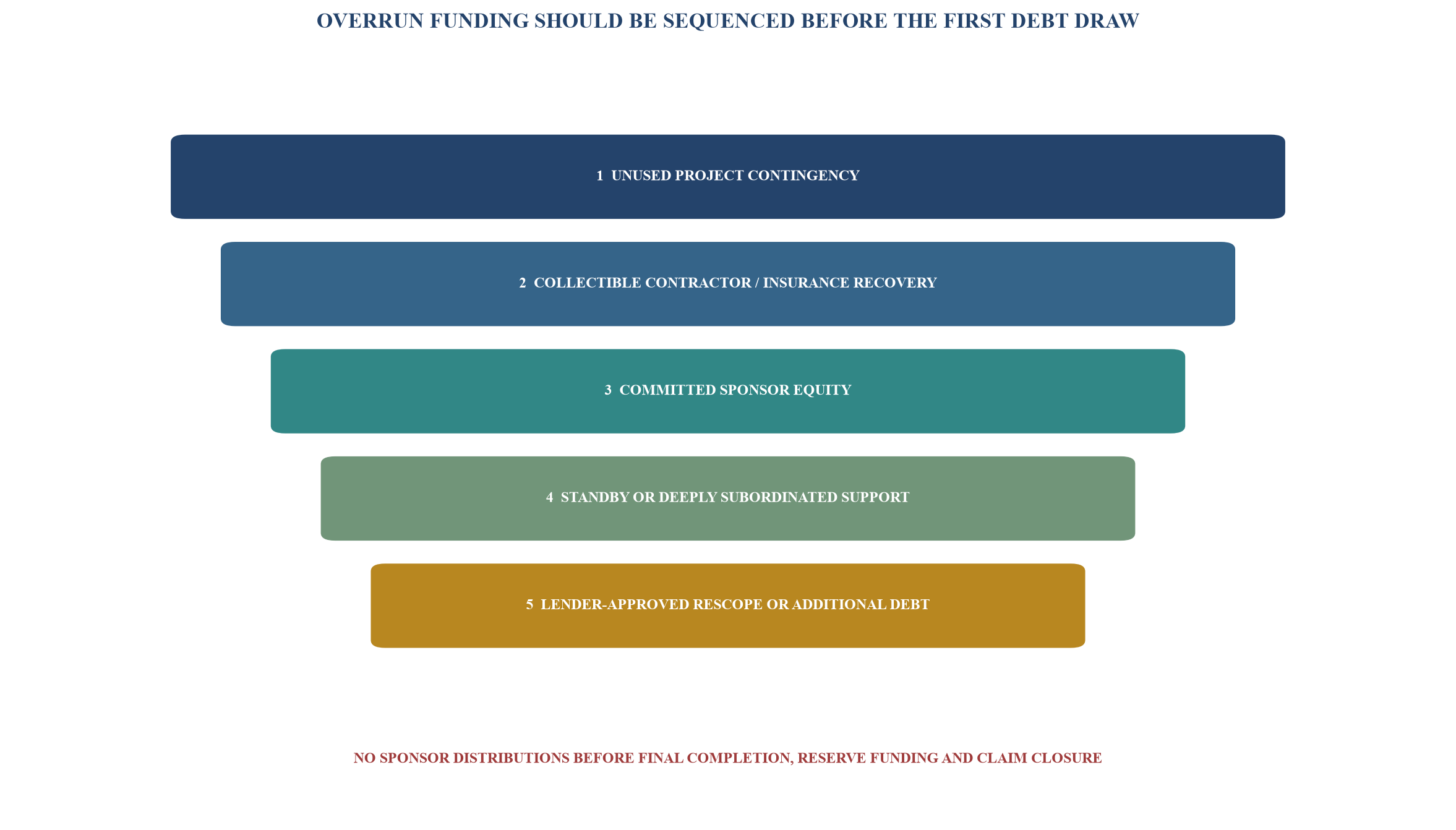
Funding layers are illustrative management assumptions; transaction documents should state amount, timing and replenishment.
9. Define completion as stable saleable production
Mechanical completion confirms that construction systems are installed and checked. Ready for start-up confirms that the plant can introduce feedstock safely. Commercial operation can be defined by contract. Financial completion should require a stronger evidence set that supports debt service.
The completion test should include permits, land and utilities; mechanical completion; safety and pre-start-up review; feedstock availability; operating staff and procedures; initial spares and catalyst; successful start-up; stable production; product specification; capacity and yield tests; energy and emissions tests; customer acceptance; first shipment and collection; final cost; reserve funding; insurance; and absence of material default.
Stable production should be tested over a meaningful period and product slate. A short peak-rate test can prove instantaneous capacity while ignoring reliability, yield or energy. A long test may be delayed by customer qualification or market demand. The protocol should balance technical evidence with cash evidence and specify permitted interruptions.
Punch-list items should be classified. Minor items that do not affect safety, output, quality, emissions or cost can remain against retention. Material defects should block completion or require quantified support. Final acceptance should preserve warranty and latent-defect claims.
Debt conversion should be tied to the financial test. Construction pricing, capitalised interest and sponsor support can remain until completion. Term amortisation begins after stable operation and a funded debt-service reserve. Failure by the long-stop date should trigger sponsor funding, cash trap, mandatory prepayment or enforcement rights.
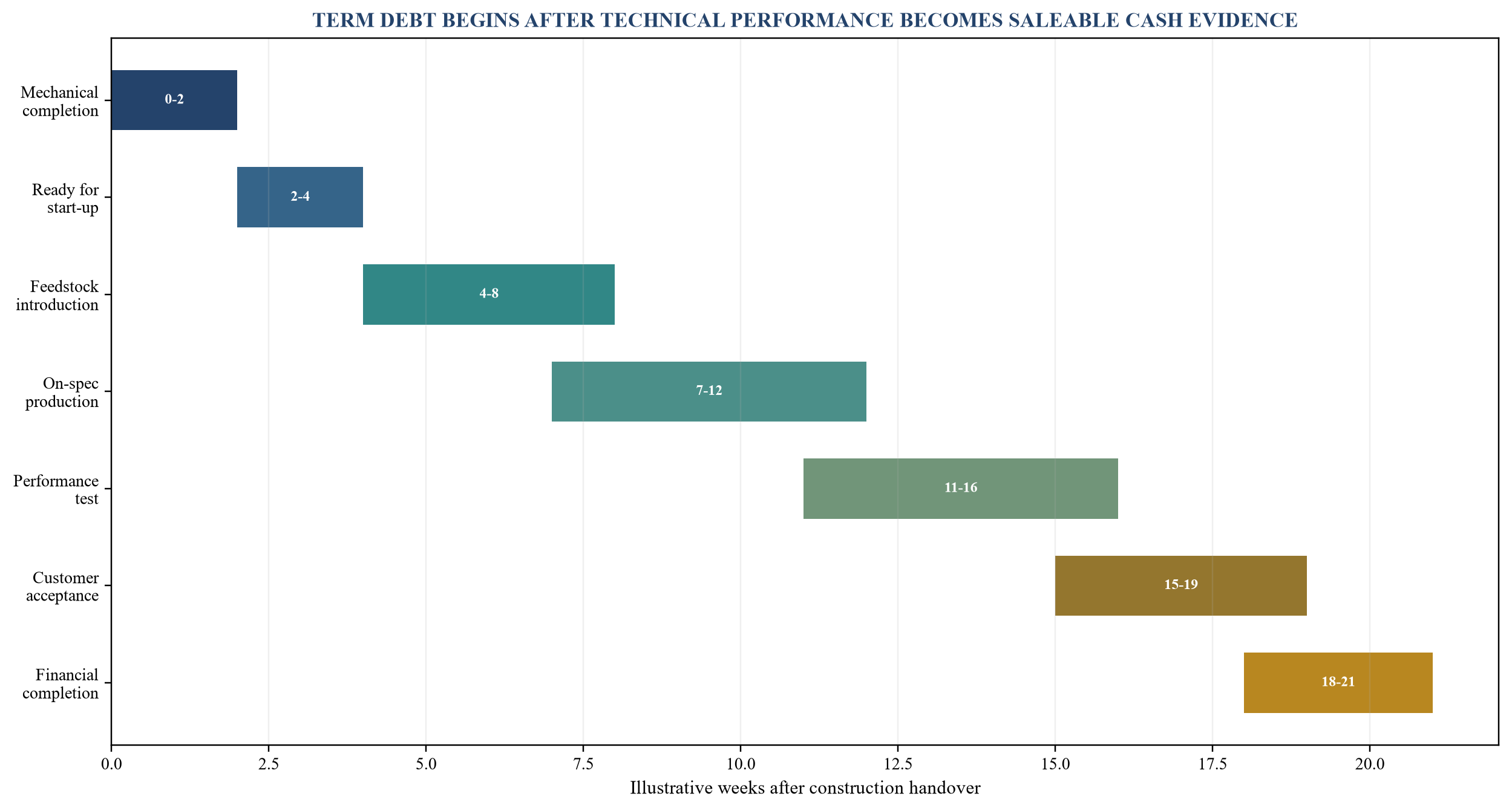
Timing is illustrative; progress advances through evidence gates rather than calendar alone.
10. Allocate completion support to the party controlling each risk
Completion support should follow control. The engineering contractor controls construction and some performance. The licensor controls process design and proprietary know-how. The feedstock supplier controls delivery. The utility provider controls shared services. The sponsor controls equity, owner decisions and uncovered interfaces. The project company coordinates the system.
A broad sponsor guarantee can simplify lender protection while weakening incentives for contractors and suppliers. A collection of narrow guarantees can leave gaps. The completion-support matrix should allocate each failure, evidence, remedy, liquidity source and long-stop consequence.
Contractor liquidated damages can address delay and performance, subject to caps and enforceability. They rarely cover the full economic loss. Sponsor support should fill residual cost and debt service until completion, with recourse to contractor recovery remaining in the project.
Technology support should include retest and remediation. Feedstock and utility contracts should compensate or provide make-up where appropriate. Offtaker qualification obligations should be distinguished from plant performance. Lenders need a central decision route when failures overlap.
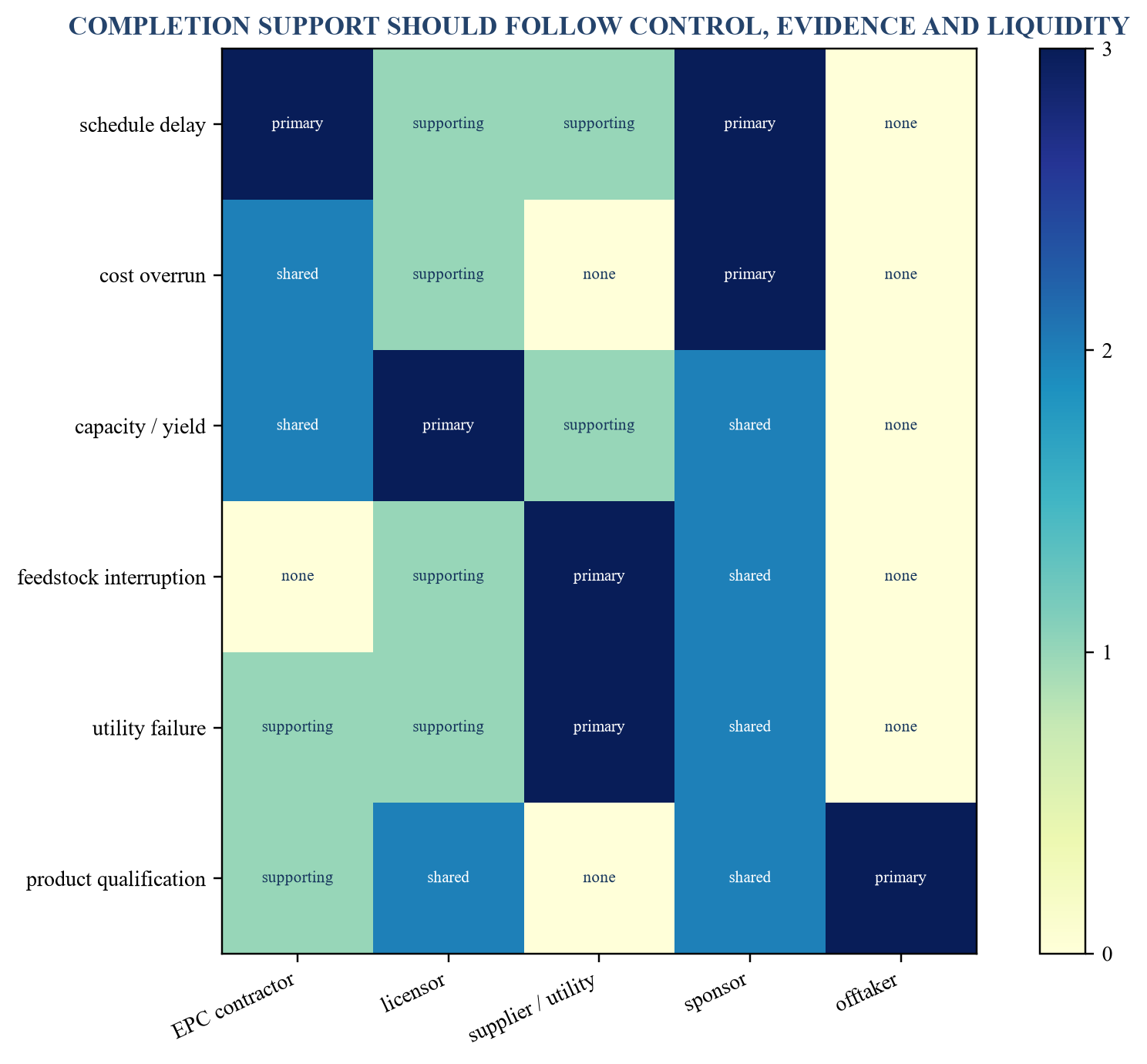
Strength indicates the expected primary support role; final allocation depends on executed contracts.
Table 4. Completion support by risk owner
| Risk | Primary control | Contract protection | Liquidity protection | Release evidence |
|---|---|---|---|---|
| construction delay | EPC contractor and sponsor | schedule LDs, bond and sponsor completion | interest and delay reserve | accepted schedule and completion test |
| cost overrun | sponsor and project controls | fixed-price scope, change control and equity commitment | funded contingency and standby support | final forecast and claims closure |
| process performance | licensor and EPC contractor | capacity, yield, quality and energy guarantees | performance security and sponsor residual | successful sustained test |
| feedstock | supplier and sponsor | firm volume, specification and allocation | storage, replacement and liquidity reserve | supply proven through test and operation |
| utilities | provider and project | capacity, quality, notice and compensation | backup and restart liquidity | integrated reliability test |
| product acceptance | project, marketer and customer | specification, qualification and purchase terms | ramp reserve and alternative market plan | accepted sale and collection |
Support should remain effective until the relevant risk is tested and released.
11. Underwrite offtake by product, customer and netback
Chemicals offtake can range from long-term take-or-pay agreements to framework contracts, distributor sales and spot exports. A contract label does not determine credit. The lender should analyse committed volume, product specification, price, index, floor, logistics, credit, termination, market depth and replacement value.
The product slate matters. Commodity products may have deep markets and cyclical margins. Specialty products can have higher margin and smaller addressable markets, with lengthy customer qualification. Coproducts can materially affect economics. The model should use separate volume, price and cost assumptions for each product.
Pricing should be converted to plant-gate netback. Export sales price less freight, port, storage, packaging, commissions, insurance, duties and working-capital cost may differ materially from headline market price. Domestic sales can reduce logistics and currency exposure while adding customer concentration.
Take-or-pay protection should be read carefully. Buyer obligations may depend on product specification, nomination, delivery availability and force majeure. Damages or deficiency payments can be capped. A related-party buyer requires transfer-pricing governance and credit analysis of the actual payer.
The replacement-market test should identify alternative customers, qualification time, logistics, price discount and marketing capability. A product with broad industrial use can still face regional oversupply. A specialty grade may have few buyers and strong switching costs after approval.
Table 5. Offtake and netback credit test
| Dimension | Evidence | Downside test | Concentration measure | Financing treatment |
|---|---|---|---|---|
| committed volume | executed purchase obligation | buyer nomination and force majeure | share of plant by buyer | recognise protected minimum |
| specification | agreed grade and acceptance protocol | off-spec discount or rejection | products requiring one approval | ramp haircut and qualification reserve |
| price formula | transparent index, floor and reset | spread compression and basis | common index exposure | conservative netback floor |
| logistics | tank, packaging, port and freight contracts | delay, demurrage and route loss | single terminal or carrier | storage and logistics reserve |
| buyer credit | accounts, rating, security and history | payment delay or default | related and economic groups | cash reserve, LC or guarantee |
| replacement market | customer map and qualification route | time and discount to substitute | market share and regional capacity | shorter debt or cash sweep |
Revenue recognition follows cash available after product, logistics and counterparty stresses.
12. Model margins through the cycle
Chemicals cash flow is driven by the spread between product netback and feedstock, utilities, logistics and fixed operating cost. Volume and price are linked to global capacity, demand, outages and trade. A model based on one spot year can overstate debt capacity.
The operating case should use product-by-product production, yield, price and variable cost. Fixed cost should include labour, maintenance, catalyst, insurance, environmental monitoring, shared services and turnaround. Maintenance capex and major turnaround should be scheduled explicitly.
The downside case should combine lower utilisation, narrower spread, higher utilities, slower qualification and receivable delay. It should model startup and grade-transition losses. A plant with low cash cost can continue operating during a weak cycle while generating insufficient cash for aggressive amortisation.
SABIC reported 2025 revenue of SAR 116.53 billion, production of 55.5 million tonnes and net income of SAR 2.07 billion, together with transformation and portfolio actions.[4][5] These figures show scale and cyclicality at an established company; they should not be used as a proxy for a new project's margin or credit.
Debt sizing should use a sustainable spread and realistic utilisation. Upside from debottlenecking, new grades or integration can support later refinancing after evidence. It should not be necessary for scheduled repayment at close.
13. Size working capital before declaring completion
Chemicals projects need feedstock, catalyst, consumables, spare parts, work in process, finished product and receivables. Payment terms to suppliers and customers can create a substantial cash need during ramp. Working capital should be funded before sponsor completion support releases.
The model should calculate inventory by material and days, receivables by customer and terms, payables by supplier, taxes and logistics deposits. Export documentation and shipping schedules can delay billing. Customer qualification can create finished inventory that is technically on specification and not yet accepted.
A revolving working-capital facility can support normal cycles. It should not finance permanent start-up loss or disputed product. Eligibility can exclude aged receivables, related-party balances, off-spec inventory and slow-moving grades. The project-finance waterfall should coordinate working-capital lender priority and collateral.
Stress should combine slow ramp and working-capital build. Lower production does not always reduce cash need proportionately because minimum feedstock, catalyst and fixed cost remain. Higher product prices can increase receivable value and margin while consuming liquidity.
Completion should require funded initial working capital and established collections. First invoice alone is insufficient. The lender should see accepted product, valid documents and cash through the controlled account.
14. Establish reserves for the identifiable risk periods
Reserves should correspond to specific timing and operating risks. During construction, contingency and interest reserves protect completion. During commissioning, start-up and working-capital reserves protect failed tests, ramp and initial sales. During operation, debt-service and maintenance reserves protect cash timing and lifecycle cost.
A catalyst reserve can fund replacement if performance or contamination shortens life. A turnaround reserve can accumulate for major planned shutdowns. An environmental reserve can fund monitoring or defined corrective work. A feedstock interruption reserve can support fixed cost and restart where compensation is delayed.
The amount should follow evidence. A six-month debt-service convention may be a starting point. The appropriate period depends on buyer payment, inventory, seasonality, shutdown and restart. Reserve use, replenishment and release should be documented.
Cash reserves provide immediate liquidity. Letters of credit transfer risk to a bank and require renewal. Sponsor facilities depend on sponsor credit and call mechanics. The lender should prevent expiry before the supported risk ends.
15. Control accounts and cash through the operating waterfall
Sales receipts should enter controlled accounts. The waterfall should preserve safe operation before debt service while preventing leakage. Statutory payments, essential feedstock, utilities, labour, insurance and approved operating cost can rank ahead of scheduled debt service. Their budgets and variance should be monitored.
After operating needs, cash pays interest, principal, hedging, reserve top-up and mandatory prepayment. Major maintenance and approved working capital should have clear priority. Growth capex and distributions rank after all tests.
Cash traps should respond to the source of weakness. A delayed performance test stops distributions. An offtaker default increases liquidity reserve. A feedstock interruption can retain cash for restart. A cost-to-complete shortfall blocks further debt draw until sponsor cure.
Affiliate payments require control. Marketing fees, shared services, feedstock transfer price and technical fees should follow agreed formulas and remain subject to audit. Changes should require lender consent where they affect debt service.
The waterfall should allow ordinary commercial operation. Excessively restrictive approvals can slow procurement and maintenance. Annual budgets, permitted variances and emergency authority provide a workable balance.
16. Build security and continuity around an operating plant
The value of a chemicals plant lies in safe continuous operation. Enforcement that terminates feedstock, technology, utilities or permits can destroy recovery. Lender security should therefore be paired with continuity rights and an enforcement plan.
Direct agreements can provide notice, cure, step-in and substitution under the EPC, technology, feedstock, utility, operations, marketing and key offtake contracts. Consent should be obtained before first draw. The lender should know which rights require government, industrial-city or counterparty approval.
Share security can transfer control of the project company, subject to law and approvals. Account and receivable security protects cash. Insurance proceeds should restore or repay according to economic repair. Movable-asset security should cover critical equipment where available.
An enforcement adviser should test operational transfer: licences, environmental permits, industrial land, customs, workforce, data, cybersecurity, product registrations and customer qualifications. Replacement of an operator or sponsor may require a technically qualified party.
Intercreditor terms should coordinate SIDF, commercial banks, private lenders, working-capital providers and hedging counterparties. Payment priority, voting, standstill, cure, turnover, enforcement and release should be defined before distress.
17. Use a covenant dashboard linked to physical causes
Chemicals covenants should connect operating evidence with finance. Financial ratios alone can identify deterioration after production, margin or collections have already weakened. A dashboard should include leading and lagging indicators.
Leading indicators include construction schedule, contingency headroom, feedstock availability, utility interruptions, safety and environmental events, equipment defects, commissioning milestone, product qualification, order book, shipment delay and receivable ageing. Lagging indicators include utilisation, yield, energy intensity, netback, EBITDA, DSCR, LLCR, leverage and liquidity.
Thresholds should create proportionate remedies. A watch level increases reporting. A distribution-lock level traps cash. A cure level requires sponsor funding, reserve, operating plan or prepayment. A persistent default can stop draw, accelerate or enable enforcement.
The dashboard should preserve context. Low utilisation caused by planned qualification differs from unplanned equipment failure. Higher product price can conceal falling yield. Management commentary should identify cause, action, owner and expected resolution date.
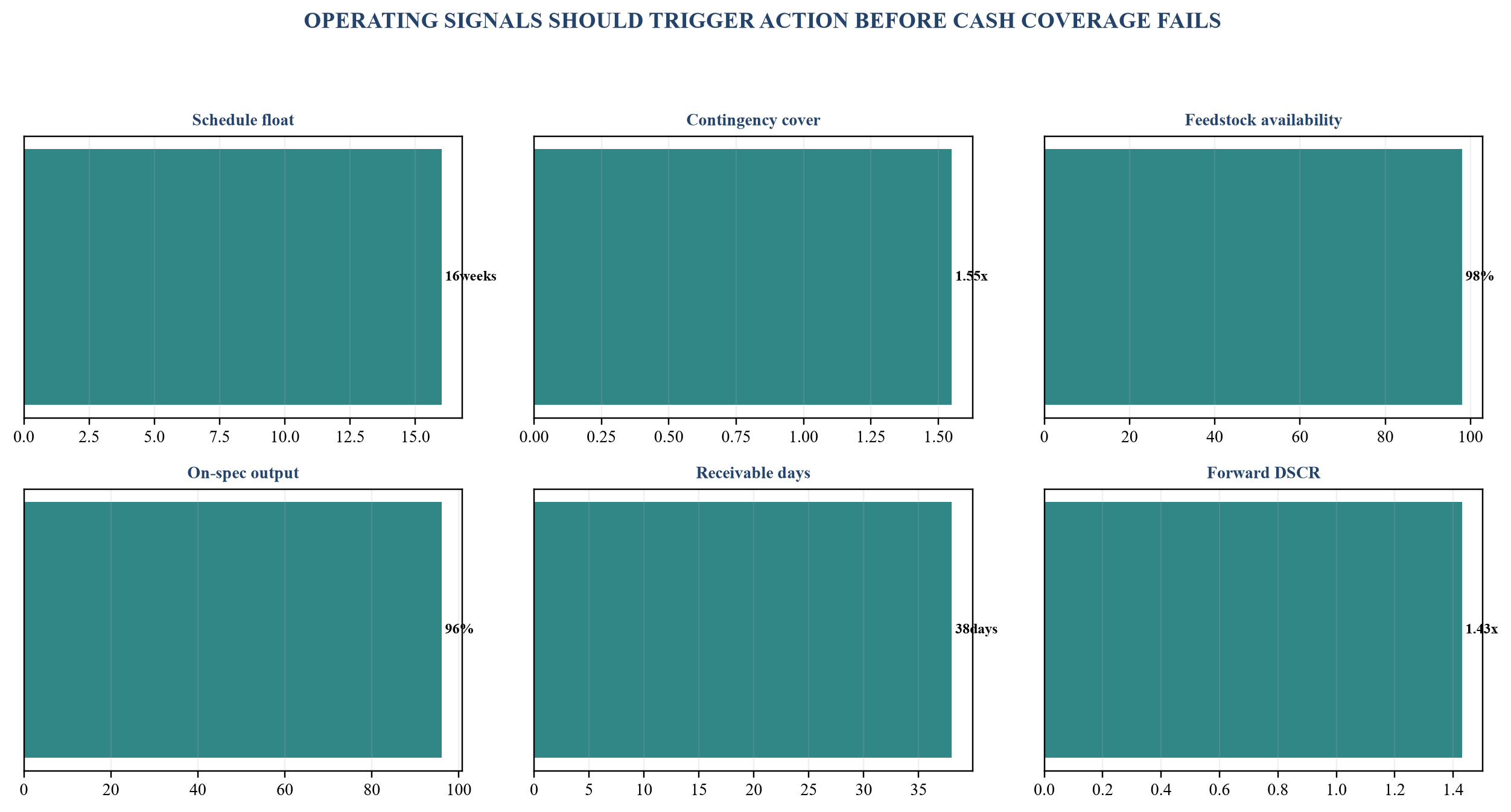
Thresholds and values are illustrative management assumptions and require project-specific calibration.
Table 6. Covenant and remedy ladder
| Indicator | Watch | Distribution lock | Mandatory cure | Default |
|---|---|---|---|---|
| cost to complete | contingency narrows | minimum headroom breached | sponsor funds shortfall | uncured funding gap |
| completion schedule | float consumed | long-stop buffer breached | recovery plan and support | long-stop failure |
| feedstock and utilities | repeated interruption | downside volume unavailable | reserve and supply cure | prolonged inability to operate |
| production | yield or quality variance | sustained on-spec shortfall | remediation and sponsor support | failed completion or payment default |
| offtake and collections | order or payment delay | concentration or ageing cap breached | security, reserve or replacement | material uncured non-payment |
| coverage and liquidity | forecast approaches buffer | DSCR or liquidity threshold breached | equity, cash sweep or prepayment | debt-service default |
The dashboard should be updated at the frequency of the underlying risk.
18. Stress the project through combined events
Stress testing should reflect causal sequences. Feedstock interruption reduces production and can create restart cost. Technology underperformance reduces yield and increases energy. A delayed performance test extends construction interest and sponsor support. Product qualification delay increases inventory and working capital. Market weakness compresses netback. Customer delay shifts cash beyond debt service.
At minimum, the lender should test lower feedstock volume, off-specification input, utility outage, construction delay, cost overrun, failed performance test, lower utilisation, lower yield, higher energy cost, narrower product spread, logistics interruption, customer rejection, receivable delay, interest-rate increase and combined events.
Reverse stress should identify the combination that exhausts reserves and breaches debt service. It should state the time available for action. A plant can have strong annual economics and fail a quarterly payment during commissioning or turnaround.
Management actions should be separated by control. The project can slow capex, defer distributions, draw reserves, change product slate, increase storage, renegotiate shipping or sell to alternative customers. Feedstock allocation, permit relief, customer qualification and lender waiver require third-party action.
The model should show residual value after a severe event. Can the plant restart? Can another operator use the technology? Can products reach alternative markets? Are contracts transferable? Recovery should be based on a functioning system, not equipment replacement cost alone.
19. Run a 15-day bankability diagnostic
Day one defines the entity, asset and contract perimeter. Day two maps feedstock and utilities. Day three reviews technology and reference plants. Day four reconciles EPC scope, schedule and interfaces. Day five tests cost, commitments and sources.
Day six reviews permits, environmental obligations and industrial-city services. Day seven builds the commissioning and completion protocol. Day eight maps product specification, qualification and customers. Day nine calculates product netback and market replacement. Day ten sizes working capital and reserves.
Day eleven builds the cost-overrun waterfall and completion support. Day twelve tests security, direct agreements and intercreditor. Day thirteen constructs the operating model and downside cases. Day fourteen calibrates covenants and reporting. Day fifteen produces the lender evidence pack, issue ledger and decision memo.
Issues should be classified as evidence gaps, curable weaknesses, structural constraints and value opportunities. A missing utility annex can be an evidence gap. An expiring performance bond can be curable. A short feedstock tenor can constrain maturity. Better integration or product mix can create value after evidence.
Every issue should change financing. It can alter advance, tenor, reserve, condition, support, covenant, price, security or the decision to stop. This turns diligence into a bankability design rather than a list of observations.
20. Deliver the financing through a 120-day plan
Days one to twenty establish governance, advisers, confidentiality, data room, asset register and integrated project model. The board confirms scope, sponsor support, security, target leverage and decision rights. The project team freezes contract and cost baselines.
Days twenty-one to fifty complete technical, market, legal, financial, environmental, insurance and tax diligence. Feedstock, utilities, technology, EPC, permits, product, customers and logistics are tested. The independent engineer establishes progress, critical path and cost to complete.
Days fifty-one to eighty negotiate the term sheet, common terms, completion support, accounts, reserves, covenants and intercreditor principles. Drafting uses the same definitions as project contracts. The performance test and financial-completion certificate are rehearsed.
Days eighty-one to one hundred and ten close conditions: consents, direct agreements, account control, security perfection, insurance, hedging, equity funding, reserve accounts, contractor security and lender reports. A draw simulation reproduces uses and evidence.
Days one hundred and eleven to one hundred and twenty execute funds flow and stabilise reporting. The first post-close certificate uses current data. Decision logs record residual risks, owners and dates. The covenant dashboard begins before the next draw.
21. Conclusion
Saudi Arabia's chemicals strategy combines feedstock, industrial infrastructure, global-scale producers, downstream localisation and new manufacturing opportunities. Project finance can help convert this platform into additional capacity when contracts and controls connect industrial advantage to debt-service cash.
The credit sequence is practical. Define the molecule-to-cash chain. Secure feedstock and utilities. Prove technology at the intended input and product slate. Allocate engineering interfaces. Maintain funded cost to complete. Establish predetermined overrun support. Define completion as stable saleable production. Underwrite customers and plant-gate netback. Fund working capital and reserves. Control cash, security and continuity.
Completion is the pivotal gate. The plant must move from installed equipment to safe, reliable, on-specification production, accepted shipment and collected cash. Lenders should retain construction protections until that evidence exists.
When feedstock, offtake, technology and completion are governed as one system, project debt can support Saudi chemicals growth through the cycle. The framework also gives sponsors a disciplined route to preserve capital efficiency, accelerate lender decisions and protect operating value.
References
- National Industrial Development and Logistics Program, “Annual Report 2024,” Vision 2030, including the 70 percent chemicals supply-chain localisation aspiration, https://www.vision2030.gov.sa/media/uvknp4di/nidlp_annual_report-2024_-en.pdf.
- Ministry of Industry and Mineral Resources, “National Industrial Strategy,” chemicals and specialty-formulations subsector materials, https://www.vision2030.gov.sa/media/t0uiiudv/nsd_en.pdf.
- Saudi Industrial Development Fund, “Project Financing,” requirements, evaluation and progress-based disbursement, updated July 2026, https://www.sidf.gov.sa/FinancialSolutions/financialSolutionsServices/ProjectFinancing.
- SABIC, “Integrated Annual Report 2025,” financial, operating, strategic and localisation information, https://www.sabic.com/en/reports/integrated-report-2025.
- SABIC, “Petrochemicals: Chemicals,” 2025 operating, product and feedstock information, https://www.sabic.com/en/reports/integrated-report-2025/business-performance/chemicals.
- SABIC, “Integrated Annual Report 2025,” original PDF, https://www.sabic.com/en/Images/SABIC-Integrated-Annual-Report-2025-EN_tcm1010-49452.pdf.
- Saudi Aramco, “Annual Report 2025,” downstream and chemicals performance and strategy, https://www.aramco.com/-/media/publications/corporate-reports/reports-and-presentations/2025/fy/saudi-aramco-ara-2025-english.pdf.
- Saudi Aramco, “Crude Oil to Chemicals,” liquids-to-chemicals strategy, accessed August 2026, https://www.aramco.com/en/what-we-do/energy-innovation/advancing-energy-solutions/crude-oil-to-chemicals.
- Royal Commission for Jubail and Yanbu, “Royal Commission Environmental Regulations 2025,” Volumes I to III, https://www.rcjy.gov.sa/documents/5272171/5763572/RCER%202025%20Volume%203%2025-5-2025/0de1e34c-98e5-e653-3daa-13bdd059d1cd?download=true.
- Royal Commission for Jubail and Yanbu, “Jubail Industrial City,” infrastructure, raw-material and investment context, https://www.rcjy.gov.sa/en/jubail.
- Saudi Vision 2030, “Annual Report 2025,” industrial infrastructure, clusters and specialised chemicals, https://www.vision2030.gov.sa/media/ecdjfopq/vision2030_annual_report_2025_en.pdf.
- Saudi Industrial Development Fund, “Financial Solutions,” project, working-capital, acquisition and supply-chain financing, https://www.sidf.gov.sa/Financial_Solutions.
- Saudi Industrial Development Fund, “Loan Request User Manual,” project-finance and manufacturing definitions, https://www.sidf.gov.sa/Documents/LoanManualEn.pdf.
- International Finance Corporation, “Environmental, Health and Safety Guidelines for Large Volume Organic Chemical Manufacturing,” World Bank Group, https://www.ifc.org/content/dam/ifc/doc/2000/2007-large-volume-organic-chemical-manufacturing-ehs-guidelines-en.pdf.
- International Finance Corporation, “Performance Standards on Environmental and Social Sustainability,” 2012, https://www.ifc.org/en/insights-reports/2012/ifc-performance-standards.
- Equator Principles Association, “The Equator Principles EP4,” project-finance environmental and social risk framework, https://equator-principles.com/app/uploads/The-Equator-Principles_EP4_July2020.pdf.
- World Bank, “Private Participation in Infrastructure Database,” Saudi Arabia and industrial-infrastructure context, https://ppi.worldbank.org/en/ppi.
- World Bank, “Commodity Markets Outlook,” price and commodity-cycle analysis, https://www.worldbank.org/en/research/commodity-markets.
