
1 Define the acquisition decision
A buyer considering cryogenic infrastructure needs a transaction thesis that can be tested against a particular operating business. The author proposes beginning with a sentence identifying the capability to be controlled, the customers it serves, the rights being acquired and the financial improvement expected from ownership. A thesis such as acquiring the ability to deliver and maintain accepted low-temperature measurement systems is sufficiently specific to examine. A broad reference to quantum growth leaves the economic perimeter unresolved.
Control requires documentary detail. Equipment designs, manufacturing drawings, test software, calibration procedures, customer approvals and field-service knowledge may sit in different legal entities or depend on arrangements outside the acquisition. The proposed initial decision record names those dependencies and assigns evidence owners. It also describes which capability can remain useful if an anticipated computing architecture develops more slowly than management expects. That resilience question belongs in product-level analysis, without assuming every scientific application supports a separate addressable market.
The investment committee can then choose between acquisition, partnership, minority investment, distribution rights or a supply contract. The relevant comparison is the cost and risk of obtaining the specified capability under each arrangement. Ownership may provide decision rights, people access and manufacturing coordination; its associated obligations include service exposure, development spending and integration. The recommended decision sequence is to identify the capability, establish the transfer mechanism and model the resulting cash flows. A proposed price becomes meaningful after these steps have a common perimeter.
2 Method and evidence boundaries
This paper combines documentary research with an author-proposed advisory framework. References cover disclosed cryogenic acquisitions, announced engineering developments, measurement methodology, investment screening, export-control history and fair-value principles. Each source supports a bounded claim. Company announcements establish what the issuer reported at the stated date; they do not independently establish successful integration, customer retention, delivered margins or future quantum demand. Original calibration research supports its documented experimental method and conditions, rather than a target company's qualification.
The analysis uses a fictional operating company to demonstrate valuation mechanics. All cash flows, debt, offer terms, costs, discount rates and terminal growth inputs in that example are assumptions. The base and downside cases have no assigned probabilities. Neither is a statistical estimate of cryogenic-company outcomes. The diligence heatmap and roadmap are proposed decision tools, without scores derived from an actual target. These distinctions apply throughout the tables, figures and transaction recommendations.
For an actual mandate, the proposed evidence register records a claim, its source, the applicable product or entity, the relevant date and the decision it changes. Engineering, legal and accounting specialists would validate their respective inputs. Contractual acceptance and regulatory analysis require the actual system, transaction structure and jurisdictions. Public information can establish useful questions and reported examples; buyer diligence must supply the target-specific evidence. The resulting paper is a structural analysis for transaction preparation, with no investment recommendation concerning a security or counterparty.
3 What disclosed acquisitions establish
Oxford Instruments announced an agreement in June 2025 to sell NanoScience to Quantum Design International for total cash consideration of GBP 60 million, including up to GBP 3 million deferred consideration linked to future quantum-scaling-system revenues. The seller reported approximately GBP 59 million revenue and GBP 1 million adjusted operating profit for the business in its financial year 2025, with approximately GBP 4 million allocated costs remaining in the group after disposal [1]. Quantum Design announced completion on 2 January 2026 [2].
Bluefors announced completion of its Cryomech acquisition in March 2023. Its statement described continuing operations in Syracuse and disclosed approvals by Cryomech's employee-shareholder structure and CFIUS [3]. These accounts provide transaction evidence, with distinct disclosed boundaries. This paper uses no acquisition multiple inferred from the announcements and no assumed price for Cryomech. Adjusted operating profit in the Oxford disclosure is not treated as EBITDA.
The author-proposed lesson for a new mandate is to request a seller-to-buyer cost reconciliation before relying on an announced earnings figure. Allocated overhead, a transferred operational function and a retained group cost are different model inputs. A buyer may incur replacement spending even when an allocation disappears from the seller's divisional accounts. The committee should ask which employees, facilities, contracts and systems explain each adjustment. A transaction announcement can guide that request; the supporting schedules, separation agreement and operational evidence determine the actual acquisition economics.
4 Map product pathways without combining unsupported markets
The proposed product map separates cryogenic cooling, magnetic-field infrastructure, microwave measurement, control electronics, detector support and field service. Each product should have an application, performance specification, customer approval path and revenue record. Computing, sensing and energy-related research can create different requirements. The existence of a technical use does not establish a purchase order, profitable product family or forecastable installed base. The analysis therefore recommends tracing commercial forecasts to named products and evidenced customer decisions.
Architecture matters. A cooling system designed around one installation may require different wiring, access, vibration, serviceability or detector conditions in another. A product described as enabling quantum activity can be dependent on the engineering choices of a specific customer. The buyer should document whether the target sells a configurable platform, a customer-specific assembly, a licensed design or a service relationship. The cost of adapting between those categories belongs in the forecast before revenue from adjacent applications is credited.
An author-proposed adjacency test has four elements: identify the changed operating requirement; demonstrate the available design rights; budget qualification and delivery resources; and obtain commercially meaningful customer evidence. If any element remains unresolved, the associated revenue should remain a separately labelled scenario. This method supports strategic option analysis while preserving the base business's observable perimeter. It also avoids counting the same customer spending under multiple scientific or industry labels. A credible acquisition case can be built around a narrower, documented product programme when broader commercial expansion has yet to be demonstrated.
5 Establish the transaction perimeter
The perimeter schedule is the proposed common reference for legal, engineering and financial diligence. For every acquired capability, it records an asset or right, its owner, the planned transfer and any necessary third-party approval. A legal share transfer may leave licensed technology, leased equipment or customer approvals dependent on separate agreements. An asset purchase may require explicit transfers of the people, data and documents used to operate the acquired assets. The appropriate structure needs advice based on the actual entities and jurisdictions.
The buyer should connect this schedule to the financial model. A cash-flow line attributed to service revenue needs the relevant contracts, installed-base records, spares and field-support capacity inside the operating perimeter. A software improvement needs usable code, rights to modify it and access to the associated test environment. Any missing element becomes a contractual dependency, cost adjustment or excluded benefit. The same schedule helps distinguish a seller's retained business from assets temporarily shared under transition arrangements.
Table 1. Proposed capability-to-perimeter diligence schedule
| Capability | Evidence to request | Proposed transaction treatment |
|---|---|---|
| Cooling equipment | Ownership, drawings, production records and supplier agreements | Define transferred assets and continuing supply rights |
| Control software | Code ownership, licences, versions and build dependencies | Specify usable rights and retained third-party restrictions |
| Calibration | Procedures, reference standards, uncertainty records and test files | Link acceptance to repeatable methods and agreed conditions |
| Customer service | Installed-base records, warranties, spares and response commitments | Allocate obligations, reserves and transitional responsibilities |
| Manufacturing knowledge | Employee roles, process records and qualification histories | Agree retention, documented transfer and replacement plans |
Author-proposed schedule; no target diligence results or legal conclusion are represented.
6 Specify loaded-system acceptance
Engineering acceptance should describe the operating condition in which a delivered system becomes commercially useful. The author proposes requiring a documented test configuration, stated loads, measurement locations, instrumentation and acceptance duration. A temperature reading without the relevant operating context may answer a narrower question than the customer's specification. The acquisition team should distinguish factory tests, installation tests and customer acceptance, then relate each to billing, warranty and service obligations. Actual engineering requirements need independent specialist review.
For cooling equipment, the proposed schedule asks how configuration changes affect the accepted performance envelope. Wiring, installed components, maintenance access and other system features may alter the integration requirements. The buyer's engineers should identify which observations are repeatable, which depend on a particular prototype and which remain roadmap objectives. The transaction model should reserve the costs and time needed to qualify a changed configuration instead of assuming a prior demonstration transfers automatically to a new application.
Acceptance also needs a controlled record. A retained raw data file, instrument configuration, software version and signed customer disposition allow reviewers to identify what was actually tested. The proposed commercial bridge links that evidence to delivery recognition, deferred payments and the cost of unresolved exceptions. An investment committee can then distinguish a deliverable product family from a sequence of engineering demonstrations. This approach does not establish any universal technical threshold; it proposes a disciplined method for identifying the target-specific thresholds already promised to customers or required by the buyer's intended application.
7 Treat calibration as an operating capability
Measurement evidence deserves its own diligence workstream. Published NIST-associated research demonstrated a data-based single-port calibration method for superconducting microwave resonator measurements at millikelvin temperatures, with comparison to a two-port technique [6]. The NIST quantum-characterization programme describes work on reproducible resonator measurements, calibration and related loss and packaging questions [7]. These sources show the importance of specified methods in their research settings. They do not certify a commercial target or establish its measurement uncertainty.
The author proposes requesting the target's calibration procedures, reference histories, software settings and exception records. Reviewers should identify the equipment needed to repeat an accepted test and the people qualified to interpret it. If an acquisition depends on reproducible customer acceptance, the model should include the cost of maintaining those capabilities. A procedure that remains tied to an undocumented employee practice creates a transfer risk even if the equipment itself appears on the asset register.
Calibration can also affect commercial control. A buyer might own manufacturing rights while relying on an external measurement service or a customer's proprietary test environment. The perimeter record should identify that dependency and the associated access rights. Proposed acceptance conditions can require reproducible test files and a witnessed handover, subject to engineering and legal agreement. The purpose is to connect measurement practice with operational continuity. Pricing a calibration capability requires evidence of its usable process, costs and customer relevance; a reference to scientific research alone cannot supply those inputs.
8 Separate modular progress from commercial delivery
IBM reported in August 2026 that it had connected two modular cryogenic systems and cooled them together to 4 kelvin in under five days, with temperatures below 15 millikelvin shortly afterward [4]. The disclosure is a company-reported engineering milestone. This paper does not treat future roadmap dates or anticipated computing capacity as delivered commercial results. An acquisition forecast should maintain the same distinction between a demonstrated configuration and an expected product programme.
The proposed diligence response is to ask whether a target can reproduce a configuration, manufacture its parts consistently, service it safely and price it with a defensible margin. Modular construction may create opportunities for standard interfaces and separate testing; those opportunities need configuration-specific evidence. The buyer should examine which interfaces remain stable across revisions and which require development, supplier coordination or additional qualification. Forecast revenue tied to a future configuration should include the associated engineering and customer-approval path.
The framework recommends a product-version register linked to the order book. It records the version promised, delivered and accepted for each significant programme, with unresolved changes assigned to an owner and budget. This is especially relevant when the proposed strategic benefit involves adding modules, changing detector support or expanding control wiring. The public engineering milestone supplies context for the diligence questions. Target documents and witnessed testing must establish whether the acquired business can meet the specific commitments on which its cash-flow forecast depends.
9 Reconcile orders, revenue and cash
The proposed commercial diligence bridge follows each material order from contractual commitment to delivery, acceptance, recognised revenue and collected cash. It identifies cancellation rights, technical conditions, customer deposits and outstanding warranty obligations. A reported backlog should be decomposed into enforceable orders, conditional programmes and management expectations. Each category can support a different forecasting treatment. The actual accounting and contractual classifications require the target's documentation and qualified advisers.
Cash forecasting should include the inventory, supplier advances, engineering effort and commissioning expenditure incurred before acceptance. A business with attractive recorded gross margins can still require significant financing during production or customer installation. The proposed model records the timing of those outflows alongside deposits and milestone receipts. Refundable deposits and amounts restricted to a particular programme should be identified separately from cash freely available to the business. Their treatment depends on the actual contract and accounting analysis.
The same order-level review helps test customer concentration. A large programme can represent repeatable product demand, a one-time installation or development work funded by one customer. The acquisition team should ask which future receipts depend on that programme continuing and what capacity remains useful if it stops. An evidenced pipeline could support upside analysis, while a base forecast should state which orders and retention assumptions it includes. The framework supplies the reconciliation method; it does not provide an observed conversion rate, customer concentration benchmark or sector-wide cash-cycle estimate.
10 Value manufacturing and service together
The author proposes assessing manufacturing and service as a connected operating system. The ability to produce an accepted unit depends on design control, supplier qualification, assembly processes and test capacity. The ability to maintain it depends on spares, diagnostic access, trained personnel and installed-base records. Acquisition benefits attributed to a broader sales channel should include the costs of extending those functions into the intended customer locations. An expanded addressable market is not an operating plan until those delivery obligations have owners and resources.
For manufacturing, the evidence request includes rejected builds, rework costs, supplier substitutions and changes to approved configurations. Reviewers should distinguish normal production variation from redesign or product-development spending. A replacement supplier may have a qualification path that affects delivery commitments and cash needs. The investment committee should see these dependencies in the forecast rather than only in an engineering appendix. Specialist testing determines the significance of particular materials, processes or components.
For service, the proposed review connects response commitments to personnel coverage, travel, inventory and diagnostic permissions. Warranty exposure should be reconciled to actual contracts and historical records. Recurring service revenue needs an accompanying cost model and evidence that the buyer can lawfully use the relevant data and software. These tests help the committee assess whether equipment and service cash flows can continue under new ownership. They also establish which integration steps are necessary before the buyer can responsibly assume the target's customer obligations.
11 Price the separation before the synergy
A carve-out forecast should identify which seller functions disappear, transfer or require replacement. The proposed separation schedule covers finance, procurement, systems, property, compliance and engineering support, with contractual boundaries specified for the actual business. Divisional overhead allocations may bear little relationship to the buyer's recurring replacement cost. Removing an allocation from reported earnings and adding a full synergy credit for the same function would produce an internally inconsistent model.
The author recommends a cost ledger with three classifications: standalone recurring cost, temporary separation or integration spending, and genuinely incremental buyer benefit. Each adjustment gets a baseline, implementation date, responsible owner and supporting document. The base cash-flow forecast includes recurring replacement functions. Temporary costs are placed in their expected periods. Buyer-specific benefits are modelled separately and linked to an executable action. This treatment makes timing assumptions visible and provides a route for reviewing changes after diligence.
Transition-service arrangements need the same discipline. Their duration, service scope, cost and exit requirements determine the resource plan. A proposed committee condition is a funded exit route for each material shared system or facility before the related synergy is credited. Legal terms and operational tests would be negotiated for the actual transaction. The approach can expose an acquisition case that depends on continued access to seller resources after an assumed separation date. It also provides a basis for comparing full ownership with a staged purchase or a more limited commercial partnership.
12 Use a diligence heatmap tied to decisions
The proposed heatmap uses qualitative evidence states rather than numerical probabilities. A workstream can be documented, awaiting a specific test or dependent on an external agreement. Those states should reflect current evidence and name the decision affected. Colour alone is insufficient; the underlying register needs a document identifier, an owner and a closure requirement. A summary shown to the committee should retain enough context to distinguish missing evidence from an identified negative result.
The transaction perimeter and evidence review can be combined. For cooling equipment, the relevant question may be transfer of manufacturing rights and an accepted loaded test. For control software, it may be usable code rights and repeatability of the build. For service, it may be inherited obligations and the capacity to meet them. Each row then connects a dependency to a contract condition, budget adjustment, reserve or excluded benefit. The framework does not rank a real target or assign universal severity scores.
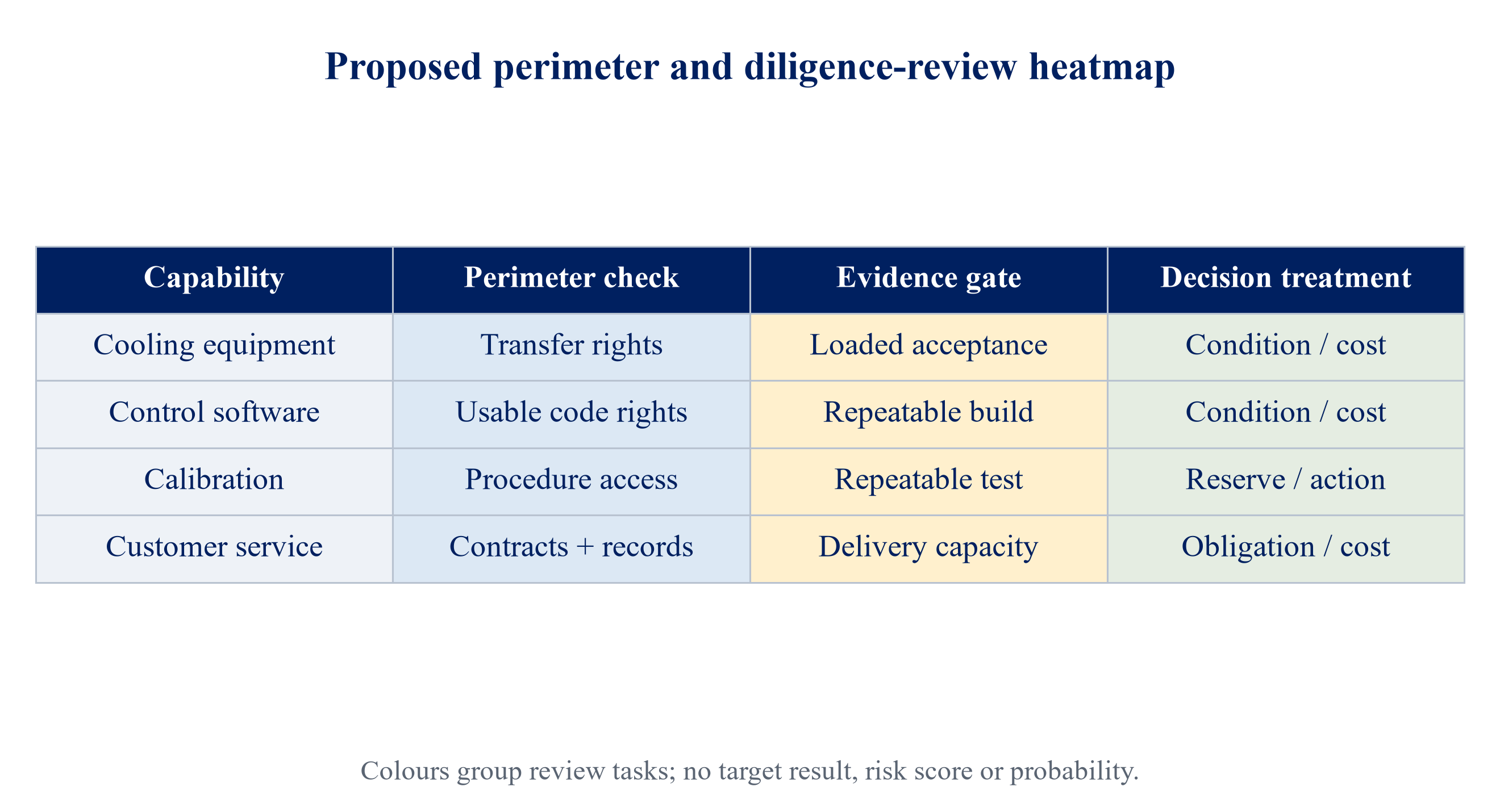
Author-proposed framework. Evidence categories are qualitative review states, without target observations, numerical risk scores or probabilities. Each capability must connect a transfer right to an acceptance record and a decision treatment.
This presentation is useful for coordinating specialists because it keeps the closing decision visible. An unresolved test with little effect on the acquisition thesis may require a post-close action. An unresolved right essential to forecast service revenue may change the perimeter or purchase terms. The significance depends on the actual target and intended use. The recommended committee discussion asks what evidence changes the price, financing need or willingness to complete.
13 Specify the fictional valuation inputs
The numerical illustration begins with a fictional business whose forecast free cash flows to the firm are USD 6, 7, 8, 9 and 10 million in years one through five. These cash flows are assumed to include operating taxes, maintenance and growth capital expenditure, working-capital changes and recurring standalone costs. They exclude financing cash flows and the separately modelled buyer benefits. The example uses a 12% discount rate and 3% perpetual growth beginning after year five. Neither input is an estimate of actual sector pricing.
The model assumes unrestricted excess cash is zero and net debt is USD 8 million. It uses a cash-free, debt-free enterprise-value convention, followed by an equity bridge. Actual purchase-price adjustments could involve debt-like liabilities, restricted cash, working-capital targets, leases, pensions or other items; those issues are outside the fictional inputs. Their omission is explicit so that the illustration remains arithmetically coherent rather than suggesting a complete contractual definition.
Table 2. Fictional discounted-cash-flow assumptions
| Input | Assumption | Modelling treatment |
|---|---|---|
| Standalone annual free cash flows | 6, 7, 8, 9, 10 | USD millions, years one through five |
| Discount rate and perpetual growth | 12%; 3% | Same rates for standalone and recurring buyer benefits |
| Incremental buyer annual cash flows | 0, 0.8, 1.5, 2, 2 | USD millions; exclude standalone cash flows |
| Transaction and integration spending | 2 plus 3 | USD millions at completion; stated net cash amounts |
| Net debt and illustrative offer | 8; 95 | USD millions; offer is enterprise value |
Entire numerical company and all inputs are fictional. Annual cash flows occur at year-end; transaction and integration spending occur at time zero. No scenario probabilities are assigned.
14 Calculate standalone enterprise value
The base standalone enterprise value equals the present value of the five annual cash flows plus the present value of terminal value. The year-six terminal cash flow is USD 10.300 million, calculated as year-five cash flow of 10.000 multiplied by 1.03. The year-five terminal value is therefore 10.300 divided by the difference between 0.12 and 0.03, or USD 114.444 million. Discounting the annual and terminal amounts at 12% produces standalone enterprise value of USD 92.965 million, rounded to three decimals.
These mechanics require a continuing-business assumption. The perpetual-growth component assumes the operating capability, customer economics and recurring reinvestment represented by the final-year cash flow remain supportable. An actual acquisition would need analysis of product life, competition, maintenance needs and customer commitments before adopting that assumption. A terminal formula supplies arithmetic; the engineering and commercial record must establish whether its inputs describe a defensible continuing state.
The committee should also request an alternative exit or finite-life treatment when the evidence supports a more limited horizon. Such an analysis would require separately justified disposal value and remaining obligations. This paper does not fabricate those inputs. Its base value is conditional on the stated perpetual model, and its downside later changes both operating cash flows and growth. The proposed advisory discipline is to display how much of the acquisition thesis depends on the final operating state and to identify the evidence that would support or change that state before making a binding offer.
15 Isolate buyer-specific integration benefits
The example assumes incremental buyer free cash flows of USD 0, 0.800, 1.500, 2.000 and 2.000 million during years one through five. Their assumed year-six amount is 2.060, using the same 3% perpetual growth. Discounting the annual amounts and terminal value at 12% produces gross buyer-benefit present value of USD 17.099 million. Separate time-zero transaction spending of 2.000 and integration spending of 3.000 reduce that amount to net buyer benefit of USD 12.099 million.
The illustration deliberately treats buyer benefits as an incremental cash-flow stream. They are excluded from the standalone forecast and defined after their recurring costs, reinvestment and tax effects. The two completion-date spending amounts are separately stated net cash outflows. This avoids subtracting the same recurring implementation expense twice. In an actual model, each benefit would require its own operational driver, baseline and timing evidence. Revenue benefits should include associated delivery and working-capital requirements; procurement savings need supplier-level support.
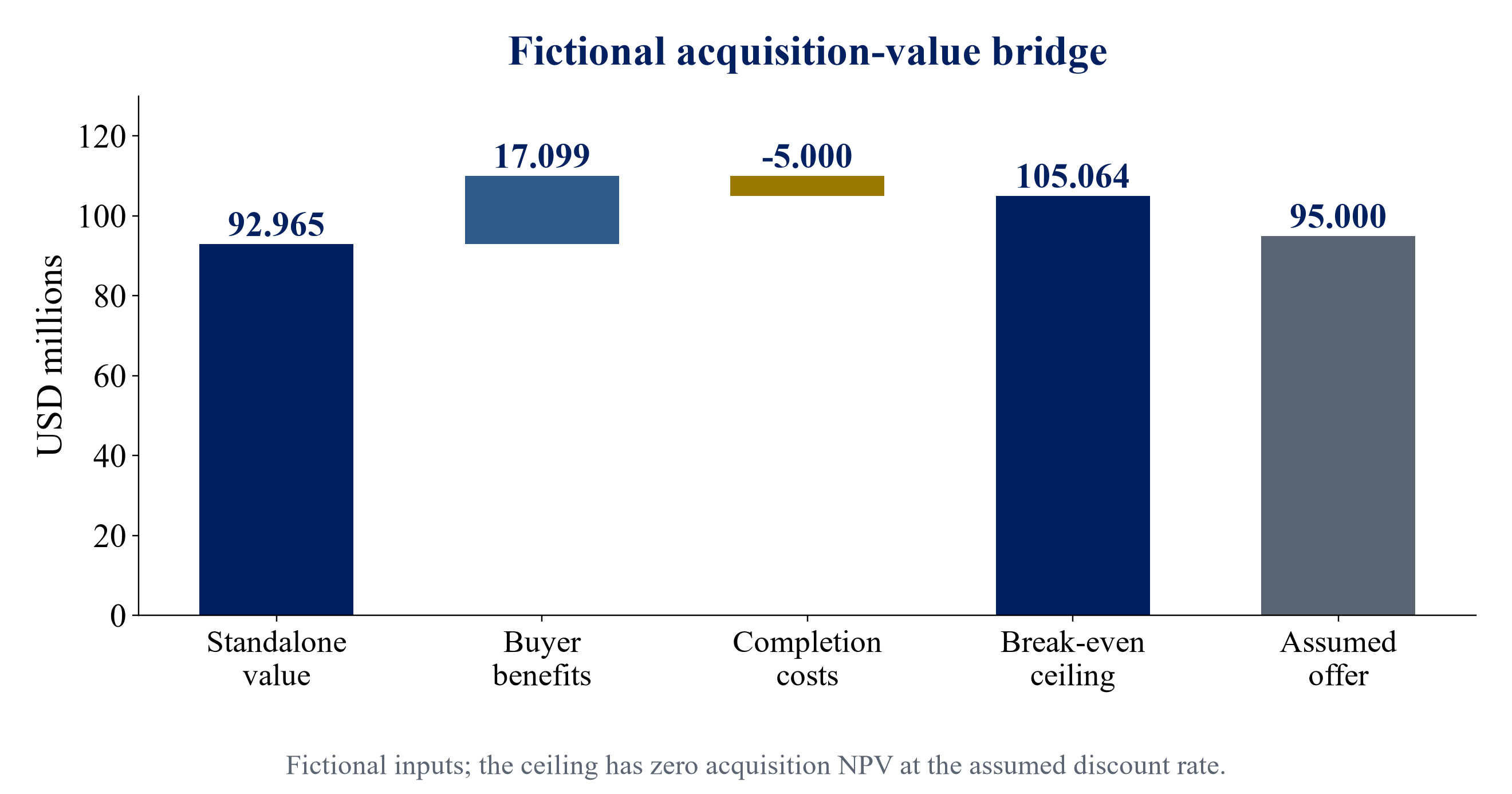
USD millions. Standalone enterprise value 92.965 plus gross buyer-benefit present value 17.099 less completion-date costs 5.000 gives an illustrative enterprise-value break-even ceiling of 105.064. The figures are calculations from fictional inputs, without market valuation evidence.
The proposed committee review asks which benefits require ownership and which could arise under a partnership. It also asks who receives the benefit if the seller raises the price. The net incremental value is the modelled amount available for purchase premium and buyer return; an offer at the modelled ceiling would exhaust that acquisition net present value under the stated assumptions. IFRS 13's market-participant fair-value framework has a different measurement purpose [11]; this buyer-specific decision model is not presented as an IFRS fair-value conclusion.
16 Translate enterprise value into a purchase decision
The fictional offer is USD 95.000 million enterprise value. Deducting assumed net debt of 8.000 gives an equity purchase amount of USD 87.000 million. Adding gross buyer-benefit present value to standalone enterprise value and subtracting completion-date costs and the enterprise-value offer produces acquisition net present value of USD 10.064 million. This is a modelled value surplus at the assumed discount rate, without an observed investor return or an assurance of deal performance.
The model's break-even enterprise-value ceiling is USD 105.064 million; subtracting net debt gives an equity ceiling of USD 97.064 million. A buyer would normally require a commercial return buffer and consider financing, execution risk and evidence quality before using a ceiling in negotiations. The fictional calculation does not prescribe the acceptable buffer. It identifies the arithmetic boundary implied by the assumed cash flows and allows a committee to see how an offer consumes it.
Table 3. Fictional offer, equity bridge and acquisition value
| Item | USD million | Interpretation |
|---|---|---|
| Standalone enterprise value | 92.965 | Discounted standalone cash flows and terminal value |
| Gross buyer benefits; completion costs | 17.099; 5.000 | Incremental present value and separate time-zero outflows |
| Break-even enterprise-value ceiling | 105.064 | Zero acquisition NPV at the stated assumptions |
| Offer enterprise value; equity payment | 95.000; 87.000 | Equity deducts assumed net debt of 8.000 |
| Acquisition NPV at the offer | 10.064 | Modelled surplus; no actual transaction outcome |
Rounded values; calculations use unrounded inputs. USD 87.000 equity, 8.000 debt settlement and 5.000 costs sum to 100.000 initial acquisition uses, before any additional reserves or financing costs.
17 Test downside and financing resilience
The separately defined downside uses standalone annual cash flows of USD 4, 4, 6, 7 and 8 million, a 14% discount rate and zero perpetual growth. Its terminal value is 8.000 divided by 0.14, or USD 57.143 million at year five. The resulting standalone enterprise value is USD 48.614 million. The example assigns no probability to this scenario and does not imply a statistically expected loss. It illustrates the valuation effect of a different operating path and continuing-state assumption.
A simpler acquisition sensitivity retains the base standalone value but assumes all buyer benefits fail while the USD 5.000 million costs are still paid. At the USD 95.000 million offer, acquisition net present value becomes negative USD 7.035 million. That sensitivity isolates dependence on incremental integration benefits. It should be read separately from the operating downside, which changes the standalone business. Combining them would require an explicit joint scenario and avoid counting the same operational disruption twice.
Financing analysis needs actual debt terms and cash timing. The paper's fictional enterprise-value model contains no assumed lender commitment, debt capacity or interest coverage. The author proposes assessing liquidity under customer-acceptance delays, programme cancellations, service spending and transition-service expiry. Reserves should be connected to specific evidence and payment obligations. A lender may need collateral, covenant and recovery analysis beyond the equity committee's valuation. Specialist modelling would test the proposed financing structure against the actual contracts, debt terms and operating forecast before any conclusion about financing resilience.
18 Connect contingent consideration to accepted evidence
Contingent consideration can link part of a purchase price to a defined later outcome. The proposed design process identifies the commercial objective, measurement record, buyer control rights and dispute mechanism before selecting a revenue, margin or acceptance trigger. A condition tied to system revenue needs rules for returns, discounts, customer acceptance and transfers between group entities. A technical condition needs a reproducible configuration and appropriately qualified assessors. Neither kind of trigger should depend on an informal description of future capability.
The framework recommends mapping each contingent payment to the risk it allocates. A revenue condition could address uncertainty about an order programme while leaving production costs with the buyer. An acceptance milestone could address deliverable performance while leaving later customer demand unresolved. A combined arrangement may be appropriate for a particular deal, but it requires negotiated definitions and advice. The paper supplies no standard earn-out percentage or claim that contingent terms resolve all integration disputes.
The financial model should show expected payment scenarios separately from the standalone operating forecast. Deferred purchase amounts, their timing and contractual treatment affect financing uses and the economic purchase price. The illustrative USD 95.000 million offer here contains no earn-out; adding one would change the model. A proposed committee condition is a reconciled purchase-consideration schedule that connects legal definitions, model assumptions and payment administration. This makes it possible to identify whether a lower headline cash payment is accompanied by substantial later obligations or operational restrictions.
19 Review UK screening using the actual activities
UK National Security and Investment guidance describes quantum-technology activities that can fall within mandatory notification requirements. It also states that an entity solely supplying a component, with a dilution refrigerator given as an example, is unlikely to be covered by the quantum category; other categories may still need consideration [8]. This distinction is relevant to cryogenic acquisitions. The paper does not interpret it as a blanket exemption for cooling businesses or a conclusion about any specific transaction.
The author proposes an activity-level legal review documenting what the acquired entity develops or produces, how the acquisition changes rights and which other classifications may apply. The proposed transaction perimeter can inform that review, while counsel must apply the current legislation and guidance to the actual facts. A company label such as quantum infrastructure does not supply the entity's legal classification. Any adjacent advanced-materials, defence or other activity requires its own analysis where relevant.
The operational consequence is a closing plan based on the verified transaction structure. The buyer should define responsibility for filings, information access, cooperation and any conditions, with dates informed by qualified advice. A conditional offer can address uncertainty without presenting a public guidance example as legal clearance. If the deal structure changes during negotiations, the review should be updated. The framework connects legal diligence to the investment decision while leaving jurisdiction-specific conclusions to advisers with the complete ownership, activity and rights information needed for the transaction.
20 Coordinate US screening and export questions
CFIUS publishes guidance on declarations, notices and mandatory filing circumstances, including certain transactions involving critical technologies and foreign-government interests [9]. The Bluefors announcement reports CFIUS approval for its Cryomech acquisition [3]; that reported outcome does not establish the treatment of another buyer, business or structure. An actual US transaction needs review of the activities, ownership, rights and other applicable facts. The investment committee should see the resulting conditions in the closing and financing plan.
Separately, the US Bureau of Industry and Security announced controls concerning specified quantum-computing items and related technologies in September 2024 [10]. This paper cites that announcement as regulatory history. It does not represent the release as a complete, current classification of every cryogenic component in October 2026. Export counsel should examine current rules, item classifications, destinations, end uses, technology access and licensing questions for the actual products and people involved.
The proposed execution register separates investment screening from exports and technology-access obligations. Clearance of an ownership transaction does not answer every supply or information-sharing question. Engineering diligence may itself involve access to controlled information; authorised review procedures need to be established before disclosure. Integration benefits dependent on cross-border manufacturing or technical collaboration should retain their legal access assumptions. Where restrictions remain unresolved, the financial case should show the affected benefit separately, with a compliant alternative or an explicit condition. This paper provides a coordination method rather than a legal opinion or assurance about an acquisition's approval.
21 Compare acquisition with targeted partnership
Full ownership is one method of coordinating capability, development and delivery. A strategic partnership can define interfaces, prototype responsibilities, commercial rights and subsequent options without transferring an entire business. Bluefors and Xanadu announced a collaboration in September 2026 to develop a prototype modular cryogenic platform supporting single-photon detectors [5]. The source describes intended development; this paper does not report a completed utility-scale installation or realised partnership cash flows.
The author proposes evaluating alternatives against the same capability specification used for an acquisition. The comparison should record access duration, exclusivity, intellectual-property rights, acceptance tests, capacity commitments and termination consequences. A supply agreement might provide delivery certainty for a particular programme while leaving product-roadmap control elsewhere. A partnership could share development risk while preserving separate commercial priorities. The actual arrangement needs evidence-based negotiation and legal advice, with no generic assumption that one structure has lower total cost.
The valuation comparison should include payments, development spending, operating obligations and the rights retained at expiry. Ownership benefits should be credited only where the proposed transaction actually creates them. A buyer considering detector support, control software or a limited product family might require a narrower agreement than a broad platform acquisition. A committee can therefore use the proposed perimeter record to identify both the acquisition case and a fallback structure. The decision is based on obtaining the defined capability under acceptable economics and constraints, with the evidence and remaining limitations visible in either route.
22 Build an integration and separation roadmap
The proposed roadmap begins before completion with a baseline of customer commitments, accepted configurations, licences and operating cash needs. The buyer and seller should assign ownership of every material transition dependency and establish continuity responsibilities that are lawful and practical. A proposed completion gate is agreement on service ownership, usable rights, required consents and funded transition obligations. These are recommendations for deal preparation, without assertions that a specific target has met them.
The first post-completion stage preserves the documented operating baseline while transferring decision rights and reporting. The next stage tests proposed changes to interfaces, systems and supply arrangements against accepted customer specifications. Benefits are then released into the model as the relevant actions become evidenced, rather than being credited merely because the calendar reaches an assumed integration date. A later review assesses recurring costs, collections, acceptance exceptions and the exit from seller support. Exact milestones should be adapted to the actual agreements and business.
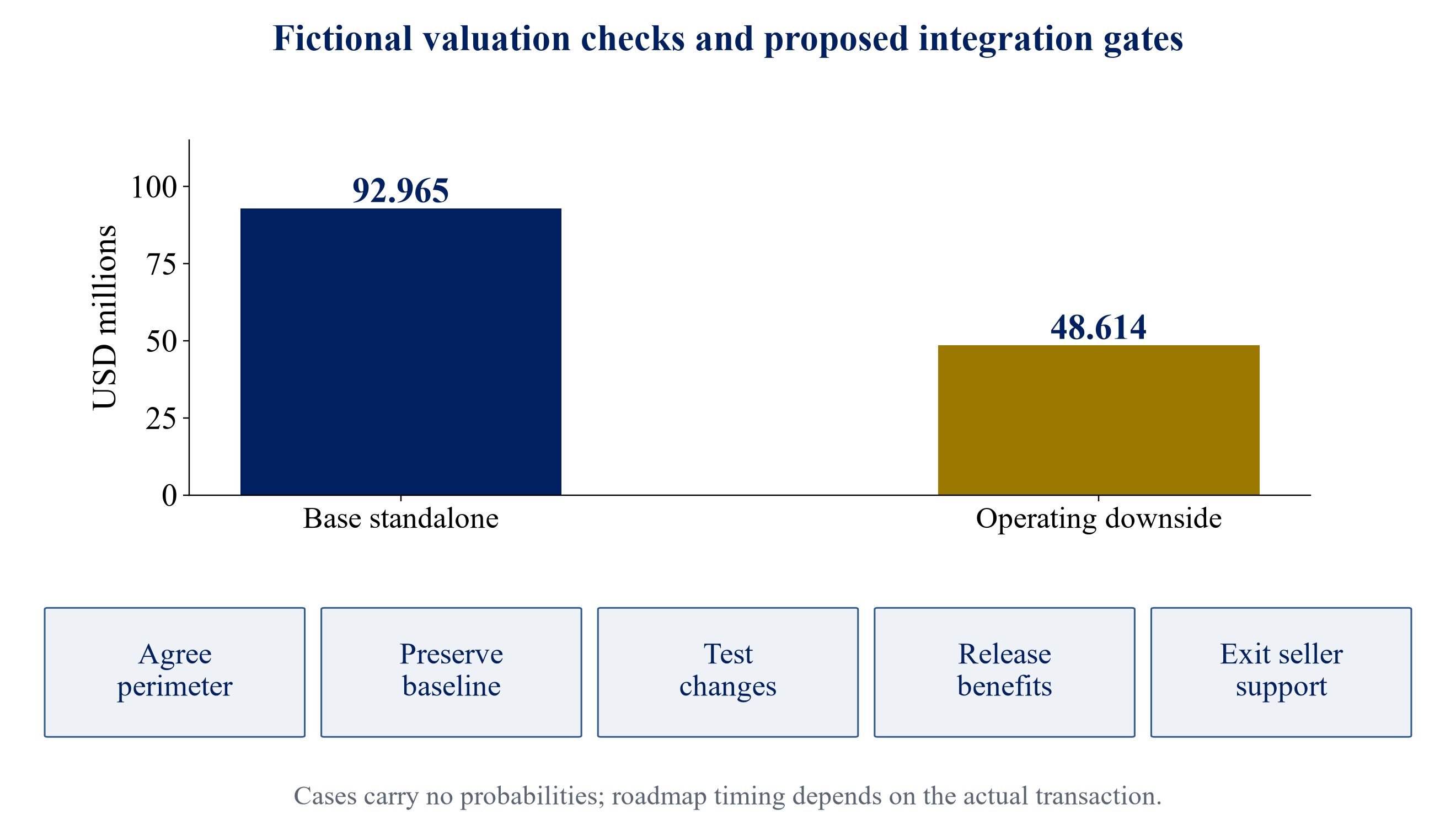
Roadmap stages are author proposals, without a universal timetable. The accompanying fictional checks distinguish base standalone value of USD 92.965 million from a separately assumed operating downside of USD 48.614 million; they carry no probabilities.
The roadmap should contain evidence gates as well as dates. A software transfer is complete when the agreed rights and reproducible environment are available; a service transition requires the agreed records, personnel and operating capacity. The framework recommends linking each integration benefit to that specific completion evidence. Governance then has a practical basis for retaining, reducing or postponing forecast benefits.
23 Use AI for evidence navigation with human validation
The author proposes limited AI and data tools for organising the acquisition evidence register. Candidate uses include identifying contract clauses for review, linking product versions to test records, grouping warranty incidents and locating inconsistent definitions across schedules. These are proposed workflows. The paper contains no measured productivity gain, deployed system or validated accuracy result. Confidentiality, access permissions and restrictions on technical information need review before any target material is processed.
A controlled workflow should retain the original document, its version and the relevant passage alongside an extracted field. Human reviewers validate any field used in a legal conclusion, engineering acceptance or financial adjustment. The model should distinguish a retrieved statement from a calculated result and from an adviser judgement. If automated extraction cannot locate the supporting record, the field remains unresolved. Numerical reconciliations should use explicit formulas and independent arithmetic checks; a generated summary cannot establish their accuracy.
The proposed commercial value is traceability across specialist workstreams. A product label in an order schedule can be connected to its promised configuration, licence dependency, acceptance file and cash-flow treatment. That connection helps the committee understand why a diligence item changes a proposed term or benefit. It also supports post-completion review of the original assumptions. The framework gives AI a bounded role in evidence navigation, while responsibility for target conclusions remains with qualified reviewers. Actual cost, security and accuracy would need testing in the buyer's authorised environment before operational adoption.
24 Committee conclusion and research limitations
The proposed committee pack contains a capability thesis, legal perimeter, accepted engineering evidence, customer cash bridge, recurring-cost reconciliation, separate buyer-benefit schedule and execution conditions. Each material claim should lead to a supporting record and a decision treatment. This creates a practical connection between what the buyer expects to control and the cash flows it proposes to purchase. The pack should state unresolved issues and their price, financing or closing consequences, with ownership assigned for any further work.
The fictional valuation demonstrates the arithmetic rather than proving an acquisition opportunity. A USD 95.000 million offer creates modelled acquisition NPV of USD 10.064 million only under the specified standalone and incremental assumptions. Removing buyer benefits produces a different result; changing operating cash flows and continuing growth produces a substantially lower standalone value. The committee therefore needs evidence for both the existing business and the integration plan. Company disclosures and research methods can inform the questions; they do not substitute for target diligence.
The paper's limitations include its small documentary evidence set, absence of private target data, lack of observed integration outcomes and deliberately hypothetical economics. Further research could compare accepted configurations, service obligations and transaction structures using consented, auditable deal records. Such work would require consistent accounting and engineering definitions. Until that evidence exists, the proposed framework is best used to organise a mandate, identify decision-critical dependencies and prepare a disciplined negotiation. Its central requirement is a demonstrable chain from transferable capability through accepted operation to contractual rights and cash generation.
References
- Oxford Instruments. Sale of Oxford Instruments' Quantum Business, NanoScience. 10 June 2025. https://www.oxinst.com/news/sale-of-oxford-instruments%E2%80%99-quantum-business,-nanoscience/
- Quantum Design International. Quantum Design Acquires Oxford NanoScience Joining Two Historic Cryogenic Companies. 2 January 2026. https://qdusa.com/siteDocs/news/2026_01_02_QD_Completes_Acquisition_of_Oxford_NanoScience.pdf
- Bluefors. Bluefors Closes the Acquisition of Cryomech. 28 March 2023. https://bluefors.com/press-releases/bluefors-closes-the-acquisition-of-cryomech/
- IBM. IBM Connects Its First Modular Cryogenic Systems in Milestone toward Fault-Tolerant Quantum Computing. 19 August 2026. https://newsroom.ibm.com/2026-08-19-ibm-connects-its-first-modular-cryogenic-systems-in-milestone-toward-fault-tolerant-quantum-computing
- Bluefors. Xanadu and Bluefors Partner to Redefine Cryogenic Infrastructure for Utility-Scale Quantum Computing. 29 September 2026. https://bluefors.com/news/xanadu-and-bluefors-partner-to-redefine-cryogenic-infrastructure-for-utility-scale-quantum-computing/
- Wang, H. and colleagues. Cryogenic Single-Port Calibration for Superconducting Microwave Resonator Measurements. Quantum Science and Technology, 6(3), 2021. DOI: 10.1088/2058-9565/ac070e. https://www.nist.gov/publications/cryogenic-single-port-calibration-superconducting-microwave-resonator-measurements
- National Institute of Standards and Technology. Quantum Characterization programme description. https://www.nist.gov/programs-projects/quantum-characterization
- UK Government. National Security and Investment Act: Guidance on Notifiable Acquisitions, quantum technologies section. https://www.gov.uk/government/publications/national-security-and-investment-act-guidance-on-notifiable-acquisitions/national-security-and-investment-act-guidance-on-notifiable-acquisitions
- US Department of the Treasury, CFIUS. CFIUS Overview, declarations and notices. https://cfius.gov/about/overview/
- US Bureau of Industry and Security. Commerce Strengthens Export Controls on Advanced Technologies in Coordination with International Partners. 5 September 2024. Historical announcement, not a complete current item-classification opinion. https://www.bis.gov/sites/default/files/press-release-uploads/2024-09/Quantum%20Press%20Release%20FINAL%20_0.pdf
- IFRS Foundation. IFRS 13 Fair Value Measurement. Official standard overview. https://www.ifrs.org/issued-standards/list-of-standards/ifrs-13-fair-value-measurement/
About the Author
Chennakeshav (CK) is a corporate finance and investment banking executive with 25+ years of global experience in deal origination, structuring and execution across M&A, growth capital and corporate strategy. He has led value-creation mandates for founders, corporates and funds — bridging the boardroom view to hands-on execution and close.
His career spans Morgan Stanley, HSBC, Lloyds Banking Group, EWEC, ADQ portfolio companies and Emirates Growth Fund, across TMT, real estate, fintech, deeptech, cleantech, infrastructure and energy. He has partnered with C-suite leaders, private equity and venture funds, sovereign wealth funds and family offices to finance complex fund raises and scale-up ventures, and has led M&A due diligence, post-merger integration and business-transformation initiatives to create value.
At Matchpoint Partners he is Managing Partner, leading the firm's corporate finance, M&A and capital-raising practice. He holds an MBA from London Business School, an engineering degree from VTU and a Master of Laws (LLM, in progress) from UCL London.
An active start-up mentor, CK mentors at Techstars, DIFC FinTech Hive, Startup Grind, Founder Institute and IN5, serves as Entrepreneur Mentor in Residence (EMiR) at London Business School, and judges the Entrepreneurship World Cup.
