

1 The valuation decision
The immediate decision is how much capital an investor should commit to the next defined development stage and what economic rights that commitment should purchase. A quantum energy venture may also require a value for financial reporting, a negotiated financing price or an acquisition discussion. Each purpose needs an explicit measurement date and perimeter. This paper proposes a framework for preparing those decisions, with technical evidence and financing assumptions recorded together. The framework is an analytical proposal and has not been tested on a client portfolio.
The proposed perimeter starts with a product and a customer problem. A sensor intended to identify a specified equipment condition, a computing service intended to improve a defined materials calculation and a component supplied to another technology developer have different deliverables. The committee should establish what the venture actually sells, who accepts the result and which party pays. A general description of quantum capability gives insufficient information to prepare the forecast proposed here.
The model should next identify the resources already owned and the expenditure needed to reach the next decision. These could include an operating prototype, licensed intellectual property, trained personnel, access to equipment and an agreed test protocol. A record should state which resources are controlled, what restrictions apply and what evidence remains outstanding. The proposed valuation process gives unresolved dependencies their own assumptions and review dates. It does not turn the number of unresolved questions into a universal valuation discount.
2 Method and evidence boundaries
The research method combines a bounded review of eight primary and official sources with original analytical scenarios. IFRS and IPEV materials supply valuation principles. Government guidance supplies a basis for examining technology evidence and funding processes. Original research supplies examples of benchmark design and resource estimation. The paper uses those materials within their stated scope. Its decision tree, milestone register and financing illustrations are author proposals; their inputs are fictional and carry no empirical calibration.
The evidence register should distinguish an observed result from a forecast and from an agreed contractual requirement. A research publication can support a claim about the experiment described in that publication. A management forecast can support an account of management's expectations. An executed customer agreement can support an account of the agreed obligations, subject to review of its conditions. This proposed register retains those boundaries when information moves into a valuation model.
No confidential company data, observed financing round, customer quotation or sector-wide failure rate was available for this analysis. Consequently, the paper makes no estimate of the current value of a particular venture. It makes no claim that a particular approach commands a higher multiple or produces superior investment returns. The scenarios show arithmetic and the effects of specified assumptions. Independent review would be required to determine whether the proposed process is useful in an actual transaction.
3 Define the value and the security
The IFRS Foundation describes fair value as an exit-price measurement in an orderly transaction between market participants at the measurement date, using their assumptions about current conditions and risk. IFRS 13 supplies the measurement framework when another standard requires or permits its use [1]. A negotiated subscription price has its own transaction context. A strategic buyer's internal investment appraisal has its own cash-flow boundary. The proposed committee memorandum identifies its purpose before selecting a calculation.
For a financing, identify the legal security, the subscribed amount, the rights attaching to that security and the shares included in the ownership calculation. An announced enterprise amount may omit the differences between preferred and ordinary securities. The proposed work therefore prepares a capitalisation record, a financing bridge and an allocation analysis. These are separate documents that should reconcile at the same measurement date and use the same treatment of options and other outstanding rights.
The programme model developed in this paper values a fictional development opportunity before an instrument-specific allocation. Its result is not a formal fair-value conclusion. It assumes specified cash requirements, outcomes and timing without market-participant evidence for those inputs. A real valuation should state its treatment of cash, debt, working capital and remaining development costs. The proposed review should flag any disagreement between the programme perimeter and the perimeter used to describe a financing price.
4 Separate the product pathways
For a computing venture, the proposed diligence unit is an application workflow. The record should identify the input problem, the required accuracy, the classical comparison, the quantum resources and the work needed to convert a result into a customer decision. A materials calculation may be only one part of a larger development programme. An investor should state which part the venture supplies and which expenses remain with the customer before assigning revenue or margin assumptions.
For a sensing venture, the proposed unit is an accepted measurement service or installed product. Relevant questions concern the measurement boundary, field conditions, installation responsibilities and continuing support. The commercial model should identify who owns the equipment and what the customer accepts as completion. A prototype measurement and a repeatable delivery process create different records. The model should specify the observation needed to change its assumptions about repeat deployment.
For an enabling component, the proposed unit is an accepted specification within another party's system. The diligence record should identify the purchasing programme, qualification criteria, permitted substitutions and dependence on the customer's own schedule. A component business may have a broader range of potential customers, but that range requires customer-specific evidence. The paper assumes no automatic diversification benefit. Its proposed process examines each material revenue dependency and identifies any common underlying programme.
5 Map technical evidence to a milestone
The US Government Accountability Office's technology-readiness guide describes a framework for assessing technology maturity and evidence supporting its integration into larger acquisition programmes. It identifies credibility and objectivity as characteristics of a useful assessment [3]. This paper proposes using an assessment record to inform a financing decision. It supplies no conversion from a technology-readiness level into an equity value or a numerical probability of success.
A milestone should define the task, the conditions, the acceptance criterion and the reviewer. For example, a hypothetical sensor milestone might require a repeatable result under an agreed operating range using identified equipment and an independently reviewed protocol. A hypothetical computing milestone might require a defined output tolerance and a complete resource account. The wording should identify what has to be demonstrated. A delivery date alone does not describe the technical result being purchased.
The proposed committee decision records whether the submitted evidence meets the criterion and what remains outside the test. Partial acceptance should describe its limits. An observation on one configuration should retain that configuration when it appears in a valuation memorandum. The committee may propose further work before changing an assumption about another configuration. This creates a record of the decision and its basis without implying that a reviewer has certified every future application.
Table 1. Proposed evidence register for development milestones
| Milestone | Record required | Model assumption under review |
|---|---|---|
| Defined application | Customer problem and accepted output | Scope of the revenue forecast |
| Technical result | Protocol, configuration and reviewed results | Technical acceptance assumption |
| Relevant environment | Operating conditions and repeat observations | Deployment scope and cost |
| Commercial acceptance | Executed terms and delivery acceptance | Timing and collectability of cash |
| Repeat delivery | Cost record and subsequent customer evidence | Scale assumptions and margins |
This is an author-proposed register. Its categories have no prescribed success probabilities or automatic valuation uplift.
6 Distinguish a mission from a contract
The UK's quantum missions include objectives for useful quantum computing and for networked sensors across critical infrastructure, including energy. These are policy objectives with future dates [4]. They provide context for a potential application. This paper treats a policy objective as information about the stated programme direction. It assigns no contracted revenue, grant award or customer purchase to a venture because its product relates to that objective.
A proposed revenue forecast should identify the decision process of the actual customer. The diligence record can ask who controls a budget, which requirement is being procured and which conditions apply before an order becomes binding. A discussion with a technical team may reveal an application question. Commercial evidence requires its own documentation. The model should identify the point at which an exploratory relationship could become an enforceable paid engagement and what remains unknown.
For a venture relying on a public programme, the record should separate eligibility, an application, an award, permitted use of funds and the receipt of cash. The expected timing of each step should appear in the liquidity analysis only with its stated evidence and assumptions. A strategy memorandum may discuss possible programme fit. The proposed valuation process does not convert that fit into a certainty of financing or into an unrestricted cash balance.
7 Assess published computing results precisely
McCaskey and colleagues' 2019 quantum chemistry benchmark used alkali-metal hydrides and specified quantum processors, with ground-state energy accuracy as a benchmark metric [7]. Its results are associated with those instances and methods. This paper uses that example to propose a diligence question: what exact calculation has the venture completed, and what result would a customer need? It asserts no performance result for another molecule, device or commercial workflow.
Nguyen and colleagues' corrosion study presents a hybrid workflow and a quantum resource analysis. Its reported logical resource table excludes initial-state preparation, which the authors discuss separately [5]. A proposed diligence memorandum should retain that exclusion when discussing a resource estimate. The investor should identify which omitted activities must be estimated before preparing a complete cost or schedule. The study supplies no observed price for a commercial quantum corrosion service.
The proposed review should retain the distinction between an experiment, a computational model and a prospective resource estimate. Each can contribute useful information when its boundary is understood. The committee can ask a technical specialist to identify the additional demonstration required for its investment case. The paper proposes that the valuation assumption remain linked to that specialist's defined question and response. It does not assign a fixed premium to the presence of a peer-reviewed publication.
8 Build a complete cost benchmark
Otten and colleagues' QREChem work develops logical resource estimates for quantum chemistry and examines algorithmic overheads. It highlights the importance of estimating resources required for specific problems [6]. This paper proposes extending a transaction's cost review to the full workflow that the customer would purchase. Any physical implementation, access charge or operational cost in that review needs separate evidence. Logical estimates alone do not establish the cost of an installed commercial system.
Consider a fictional comparison in which a classical workflow uses one compute hour and a quantum-led workflow uses 0.65 hours. Both incur an assumed compute charge of USD 4,000 per hour. Validation costs are assumed to be USD 8,000 and USD 12,000 respectively, with an assumed accepted-result fraction of 0.80 for each. The resulting cost per accepted result is USD 15,000 for the classical workflow and USD 18,250 for the quantum-led workflow. Every input is fictional.
The proposed common boundary includes problem preparation, compute access, checking the output and delivery of the required result. A customer may also need equipment, integration and specialist labour. Those costs are excluded from the fictional calculation and should be identified before using an actual comparison. The example demonstrates how the stated calculation works. It establishes no observed runtime reduction, acceptance rate, commercial advantage or supplier charge.
9 Use separate readiness records
The proposed framework maintains a technical readiness record, a customer acceptance record and a financing availability record. These records answer distinct questions. Technical evidence concerns what the product can demonstrate under stated conditions. Commercial evidence concerns what a customer has agreed to accept and pay for. Financing evidence concerns what cash is available, when it can be used and which conditions govern access. Each record should name its responsible reviewer and the supporting documents.
Figure 1 shows a proposed sequence from a defined application through a reviewed result, relevant-environment acceptance, a paid deployment and repeat delivery. Its vertical positions indicate order only. They are not measured readiness scores, standard technology-readiness levels or success probabilities. The sequence may need revision for a component provider or a service venture. The figure is intended to help a committee specify the observation it wants before approving the next commitment.
The financing record should identify the stage for which money is committed. A technical result may leave customer acceptance unresolved. A signed customer agreement may leave an unfunded delivery requirement. The proposed committee review examines the records together before changing the model. Where a record is incomplete, the investment memorandum should state the remaining assumption and proposed follow-up. A single combined score would conceal those distinctions in the method proposed here.
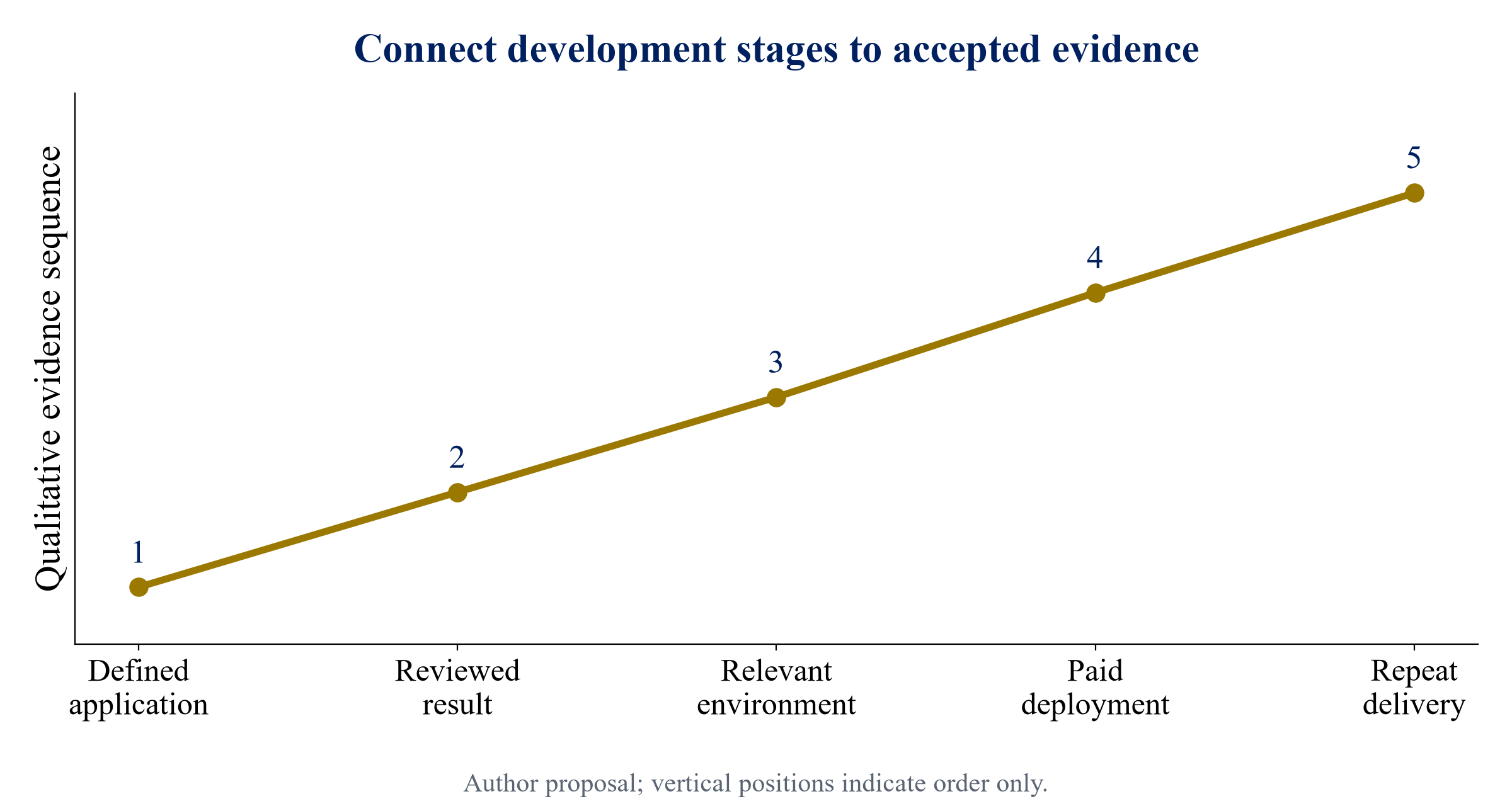
The curve shows the order of proposed review stages. It reports no measured readiness score, required duration or probability of commercial success.
10 Specify the outcome tree
The fictional model begins at a development decision date, called year zero. Technical acceptance at the end of year one is assigned an assumed probability of 0.60. Conditional on that acceptance, commercial acceptance at the end of year two is assigned an assumed probability of 0.50. A successful commercial branch has a terminal programme amount of USD 120 million at the end of year five. A technically accepted branch without commercial acceptance has an assumed licensing amount of USD 40 million at that same date.
The technical-failure branch has an assumed terminal amount of zero. The unconditional weights are therefore 0.30 for commercial acceptance, 0.30 for the licensing outcome and 0.40 for technical failure. These weights sum to one. They are fictional assumptions introduced to explain a calculation; the paper has no observed population or venture evidence with which to estimate them. The licensing branch is an assumed alternative outcome and has no identified buyer or executed agreement.
Each terminal amount is defined here as a net amount available within the programme boundary after all other assumed operating, sale and completion effects. Expenditure explicitly scheduled in Sections 11 and 12 is excluded from those terminal amounts and deducted separately. This simplifying boundary avoids counting the specified development costs twice. It also prevents a reader from treating USD 120 million as a gross financing headline or a measured enterprise value for an actual start-up.
11 Attach expenditure to the branches
The fictional proof stage requires USD 2 million at year zero. A qualification payment of USD 3 million is made at the end of year one only if the technical stage is accepted. A commercialisation payment of USD 4 million is made at the end of year two only if both technical and commercial acceptance occur. No qualification or commercialisation payment is made following technical failure. The licensing branch incurs the qualification payment and does not incur the commercialisation payment.
In the fully successful branch, the specified development payments total USD 9 million. In the licensing branch they total USD 5 million. In the technical-failure branch they total USD 2 million. Their unconditional expected total is USD 5 million: the initial USD 2 million, expected qualification expenditure of USD 1.8 million and expected commercialisation expenditure of USD 1.2 million. These are probability-weighted costs under the fictional tree, not a cash reserve sufficient for every branch.
A sponsor using such a model should also prepare a branch-specific funding plan. The successful branch requires access to its full stated commitments at the specified dates. Availability of only the expected USD 5 million could leave that branch unable to proceed. This paper assumes the required conditional financing is available when needed. It claims no observed financing offer. Section 17 explains how the proposed method would examine an actual funding dependency.
Table 2. Fictional programme assumptions and payment boundary
| Input | Assumption | Treatment in the model |
|---|---|---|
| Technical acceptance | 0.60 | Applied once at year one |
| Commercial acceptance | 0.50 conditional on technical acceptance | Applied once at year two |
| Proof payment | USD 2m at year zero | Paid in every branch |
| Qualification payment | USD 3m at end of year one | Paid after technical acceptance |
| Commercialisation payment | USD 4m at end of year two | Paid after both acceptances |
| Terminal net amounts | USD 120m, USD 40m or zero at end of year five | Matched to the three outcomes |
| Discount rate | 12 percent | Fictional residual discount assumption |
All inputs are author assumptions. Terminal net amounts exclude the explicitly scheduled payments; no further intermediate cash flow is assumed.
12 Calculate the programme value
Under the stated assumptions, the expected terminal net amount is USD 48 million. It consists of 0.30 times USD 120 million and 0.30 times USD 40 million; the remaining 0.40 branch contributes zero. Discounting that amount for five years at the assumed rate of 12 percent produces a present amount of USD 27.236 million. The discount rate is a fictional input. It is not a measured cost of capital, an expected investor return or a rate recommended for quantum ventures.
The present cost of the specified development payments is USD 4.564 million. It consists of USD 2 million today, 0.60 times USD 3 million divided by 1.12 and 0.30 times USD 4 million divided by 1.12 squared. Deducting this cost from the terminal present amount produces USD 22.673 million of net programme value. Calculations use unrounded inputs. Displayed components are rounded to three decimal places and may show a small reconciliation difference when added manually.
The model applies technical and commercial failure assumptions through the branches. An additional haircut for the same failures would need a distinct justification. The proposed review should identify which remaining considerations the discount rate addresses and avoid reintroducing the same probability adjustment under another name. Its simplified terminal amounts and fixed timing are material assumptions. The calculation is an analytical illustration whose apparent precision comes from arithmetic, with uncertainty remaining in every fictional input.
13 Examine sensitivity and timing
Keeping the technical assumption at 0.60, a conditional commercial assumption of 0.30 produces unconditional commercial and licensing weights of 0.18 and 0.42. The net programme value becomes USD 17.608 million. Raising the conditional commercial assumption to 0.70 produces weights of 0.42 and 0.18 and a value of USD 27.737 million. Figure 2 displays those values alongside the base case. None of the three commercial assumptions is an estimated success rate.
The development payments also change with the commercial branch. A higher commercial acceptance assumption increases expected commercialisation spending as well as the terminal amount. The calculation therefore updates both sides of the model. A sensitivity that changes the outcome while freezing its conditional expenditure would describe a different programme. The proposed review should state which inputs are held constant and which follow a branch automatically before interpreting a movement in value.
Separately, delaying both terminal outcomes by one year while leaving the stated development payments unchanged reduces net programme value to USD 19.755 million. This sensitivity assumes no extra expenditure during the delay and no change in terminal amounts or outcome weights. Those simplifications require examination in an actual venture. The proposed use of the sensitivity is to identify a funding and customer-timing question. It supplies no forecast of an actual delay or its total cost.
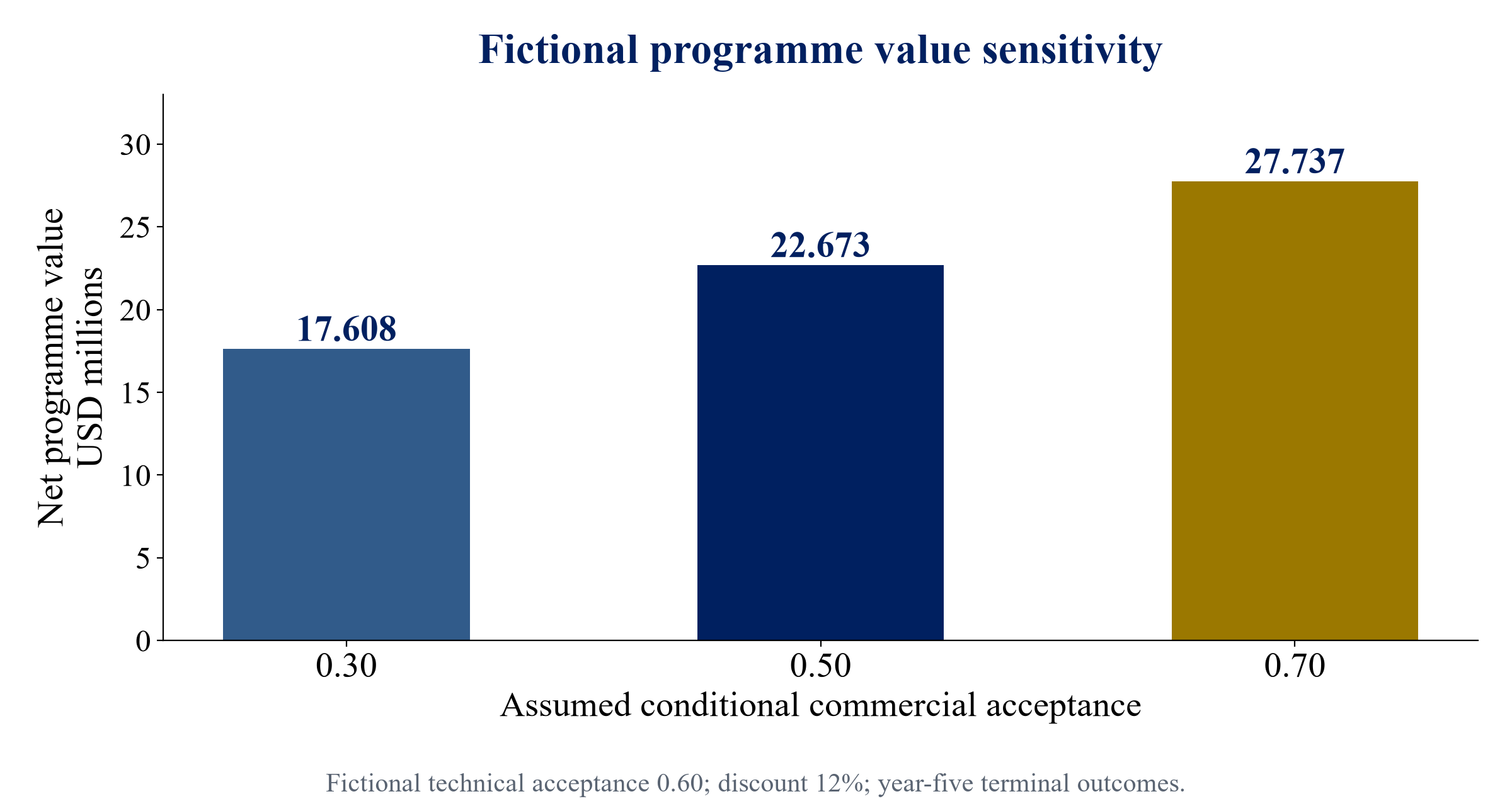
USD millions. Technical acceptance remains 0.60; commercial acceptance assumptions are 0.30, 0.50 and 0.70. Development costs change with their respective branch weights.
14 Record the reason for an assumption change
The proposed evidence-to-assumption register identifies each model input, its current basis and the observation that would trigger a review. For the technical branch, the record might identify a specified accepted test. For the commercial branch, it might identify a customer contract and an acceptance decision. For terminal amounts, it should identify the valuation method, its cash-flow boundary and any market evidence used. A review trigger is a proposal for further analysis; it is not an automatic numerical change.
When new evidence arrives, the committee should record what it shows and which assumptions remain unchanged. An accepted technical test may support a narrower product claim than the forecast previously used. A prospective customer's requested price may require a margin review without changing technical capability. The proposed process records those consequences separately. This permits a reviewer to trace a value movement back to its stated basis and to challenge any unsupported interpretation.
The register also records disagreements and missing information. Where the venture and an independent specialist describe a test differently, the committee can request a defined reconciliation. Where a management estimate has no supporting data, the model should retain that status. The paper supplies no procedure that guarantees agreement among reviewers. Its proposed record makes the open issue visible and identifies the decision that would be affected if the assumption changed.
15 Calibrate a model to transaction evidence
The December 2025 IPEV Guidelines discuss calibration to transaction evidence, subsequent assessment of changing assumptions and early-stage milestone or scenario approaches. They also address the different rights in complex capital structures and possible future financing dilution [2]. This paper proposes a transaction-specific review using those principles. It claims no general relationship between a successful milestone and the price a market participant would pay for a quantum energy security.
If an actual orderly financing is available, the proposed review identifies the security issued, the capital provided, the conditions and the assumptions prevailing on its date. The model can then examine whether its inputs are consistent with that transaction within the chosen perimeter. An unexplained gap requires analysis. The committee should not resolve the gap by choosing a single probability solely to reproduce the headline price and presenting that probability as a measured success rate.
At a later date, the record should identify new product evidence, customer changes, cash requirements and financing conditions. Calibration requires revisiting the input basis. The proposed framework leaves the relative importance of those observations to the transaction-specific valuation work. A price change cannot be attributed to a milestone alone without examining the other material changes. The result should describe the security valued, the method used and the remaining limitations of the evidence.
16 Allocate value across financing rounds
Consider a separate fictional financing illustration, independent of the programme value in Section 12. A company has only founder ordinary shares initially. An investor subscribes USD 5 million at an assumed pre-money equity price of USD 20 million. The post-money amount is USD 25 million and the investor receives 20 percent of the fully diluted shares. There are no options, convertibles or other outstanding rights in this simplified example.
Later, a new investor subscribes USD 8 million at an assumed pre-money equity price of USD 32 million. The new investor receives 20 percent of the post-money shares. Founders then hold 64 percent, the earlier investor holds 16 percent and the new investor holds 20 percent. The example shows ownership arithmetic. It makes no connection between the assumed financing prices and the fictional programme model, and it establishes no market valuation for a particular business.
An actual financing may require analysis of option-pool changes, accrued rights, convertible securities, anti-dilution provisions and class-specific terms. The proposed capitalisation review records those terms before preparing an allocation. A fully diluted ownership percentage alone may not describe the security's economic payout. The model should reconcile the subscribed cash, instrument terms and value allocation. Section 18 uses a deliberately narrow preference example to illustrate that separate step.
17 Model financing availability explicitly
The programme tree assumes conditional capital is available after each accepted milestone. An actual venture needs evidence for that availability. The proposed liquidity analysis distinguishes unrestricted cash, committed facilities, conditional subscriptions, awarded grants and prospective funding discussions. Each item should identify its permitted use, expected availability date and conditions. A discussion with a potential investor should retain its status as a discussion until the relevant commitment is documented.
One possible extension is a separate financing branch following technical acceptance. Its probability and terms would require their own support. Failure to secure funding could change the subsequent expenditure, timing or exit outcome. A model that adds such a branch should specify those changes rather than applying an unexplained discount to the final number. This paper does not assign a financing probability because no evidence was available to estimate one.
The proposed committee review also compares the fundraising process with the branch's required payment dates. A delayed capital receipt may require a changed programme or a contractual revision. The resulting cash effects should be included within a clearly defined sensitivity. The committee should identify who can approve a revised scope and which expenses continue while financing is sought. This is a proposed planning analysis, with no claim of assured access to equity, debt or public funding.
18 Examine preferences and exit proceeds
Extend the separate financing illustration by assuming that both investors hold one-times non-participating preferences, the later investor is senior, there are no dividends or conversion costs, and the stated exit amount is available to distribute after all other claims. At a fictional USD 10 million exit, the later investor receives its USD 8 million preference and the earlier investor receives the remaining USD 2 million. Founders receive zero. The assumptions define that result.
At a fictional USD 25 million exit under the same terms, the later investor receives USD 8 million, the earlier investor USD 5 million and founders USD 12 million. At USD 100 million, both investors convert to ordinary shares under the assumed voluntary conversion rights, giving USD 20 million to the later investor, USD 16 million to the earlier investor and USD 64 million to founders. These illustrations identify the conversion choices as part of the calculation.
The proposed allocation review should implement the actual documents and examine any competing elections together. Participating preferences, accrued dividends, multiple preferences or different seniority could produce different payouts. Debt and transaction expenses would change the amount available for distribution. The simplified outcomes in Table 3 are not a substitute for a legal review or a security-specific valuation. They show why an ownership percentage and an investment's payout need separate records.
Table 3. Fictional exit allocation under specified non participating preferences
| Distributable exit amount | Later investor | Earlier investor | Founders |
|---|---|---|---|
| USD 10m | USD 8m | USD 2m | Zero |
| USD 25m | USD 8m | USD 5m | USD 12m |
| USD 100m | USD 20m | USD 16m | USD 64m |
The later USD 8m investment is senior to the earlier USD 5m investment. Preferences are one-times and non-participating; voluntary conversion and no other claims are assumed.
19 Consider public funding and eligibility
The EIC Accelerator describes grant, investment-only and blended-finance routes, including equity or quasi-equity support and investment diligence. Its process can revisit investment readiness at defined milestones [8]. This provides an official example of staged financing processes. The paper makes no claim that a particular quantum energy venture qualifies, will receive support or can use funds without restrictions. Eligibility and award conditions require review against the applicable current documents.
The proposed model distinguishes the company paying development costs from the party supplying the cash. A grant receipt may reduce the private cash requirement under specified terms. The associated activity still has a cost that belongs in the programme account. An investor should identify whether the grant pays for costs already included, whether it is restricted to a particular stage and what obligations attach. Recording the same receipt as both free funding and additional operating revenue would need examination.
For a cross-border company, the proposed review identifies the relevant entity, operating location and ownership conditions. A UK, European, US or other programme may have a specific perimeter. The model should use verified eligibility and documented award terms for the actual entity. This paper proposes the questions to investigate. It supplies no legal conclusion about a structure and no amount of expected public support for an unnamed venture.
20 Evaluate the customer economics
The proposed customer analysis starts with a defined decision that the product is intended to inform. For a hypothetical materials application, that could be selecting a candidate for a subsequent experiment. For a sensing product, it could be deciding whether a specified inspection is required. The record should identify the accepted output and the existing process. A claimed benefit needs evidence within that process before it enters a revenue or retention assumption.
The customer comparison should identify which costs the customer bears and which costs the venture bears. Integration, training, validation and ongoing support may sit on different sides of the contract. The proposed model reconciles its margin assumption to that allocation. A price for a pilot should retain the pilot's scope and conditions. The paper assumes no repeat order because a customer has agreed to a single trial or expressed interest in the technology.
Concentration also requires a defined perimeter. Two contracts could depend on the same purchasing programme, equipment provider or public budget. The proposed diligence register records those shared dependencies. A larger list of prospects supplies no measured diversification without commercial evidence. An actual model should identify the cash consequence of losing or delaying a material customer. The paper proposes that sensitivity without estimating a customer-loss probability from unavailable data.
21 Review intellectual property and acquisitions
The proposed intellectual-property review identifies what the company owns, what it licenses and what permissions are needed to deliver the forecast. The record should distinguish a patent application, a granted right and a contractual licence. It should also identify background intellectual property, collaboration terms and restrictions on transfer. These are questions for qualified advisers and the relevant documents. The paper provides no ownership conclusion about any technology or company.
For an acquisition, the proposed valuation perimeter should identify which resources and obligations move to the buyer. A purchaser may be acquiring a product, a team, a manufacturing capability or a restricted licence. Each proposed perimeter needs a corresponding forecast and integration account. An existing customer or supplier relationship should be reviewed for relevant consent and change conditions. The model should identify any assumed continuation and the evidence supporting it.
Any proposed synergy belongs to a defined buyer action with its own cost and timing. A valuation memorandum should distinguish the standalone programme from a buyer's additional cash effects. This paper estimates no strategic premium or synergy value. It proposes a reconciliation so that shared costs, completion expenditure and customer benefits are counted within the chosen boundary once. Specialist diligence is necessary before a transaction-specific value can be concluded.
22 Use AI within the evidence review
The author-proposed role for AI is organising authorised documents, extracting candidate model inputs and identifying questions for human review. Each extracted item should retain a reference to its document, date and context. A reviewer should compare it with the original before relying on it. The paper reports no measured improvement in diligence speed, forecast accuracy or investment performance from using an AI system.
A candidate comparison could group technical claims by problem instance, configuration and acceptance criterion. The proposed workflow should preserve exclusions, alternative interpretations and uncertainty. A generated summary should not become a new technical observation merely because it appears in a model worksheet. An investment team should define how its reviewers verify an entry and how a correction flows through affected assumptions. Access and confidentiality require their own approved controls.
For financial modelling, the proposed use is supporting arithmetic review and checking whether scenario changes propagate to their conditional costs. The model's economic meaning still requires a responsible reviewer. An automated calculation can reproduce a fictional assumption accurately while leaving its relevance untested. The paper therefore proposes retaining both the numerical verification and the separate evidence review. It makes no claim that AI can certify a quantum result, legal right or fair-value conclusion.
23 Prepare the investment committee record
The proposed committee record begins with the specific capital decision and the security under consideration. It states the measurement date, perimeter, current cash and proposed commitments. The next sections identify accepted evidence, unresolved dependencies and the exact terms of each milestone. The scenario model should be supplied with its calculation notes and branch-specific funding needs. A reviewer should be able to identify which inputs are observations and which remain management estimates or assumptions.
The proposed review then considers the sensitivity most relevant to the next decision. A change in the terminal date may have a different consequence from a change in customer acceptance. A funding gap may require a redesigned programme. The memorandum should explain those relationships in prose and identify who would review the underlying evidence. Figure 3 combines the fictional cost benchmark with a proposed commercialisation roadmap to support that discussion.
The decision record should state what is approved, which conditions remain and what observation triggers the next review. It should preserve the model used at the decision date alongside later revisions. An outcome review can then compare the original assumptions with the actual records when they exist. This paper reports no such outcome review. Its proposed process is intended to support an auditable investment discussion and requires testing in practice.
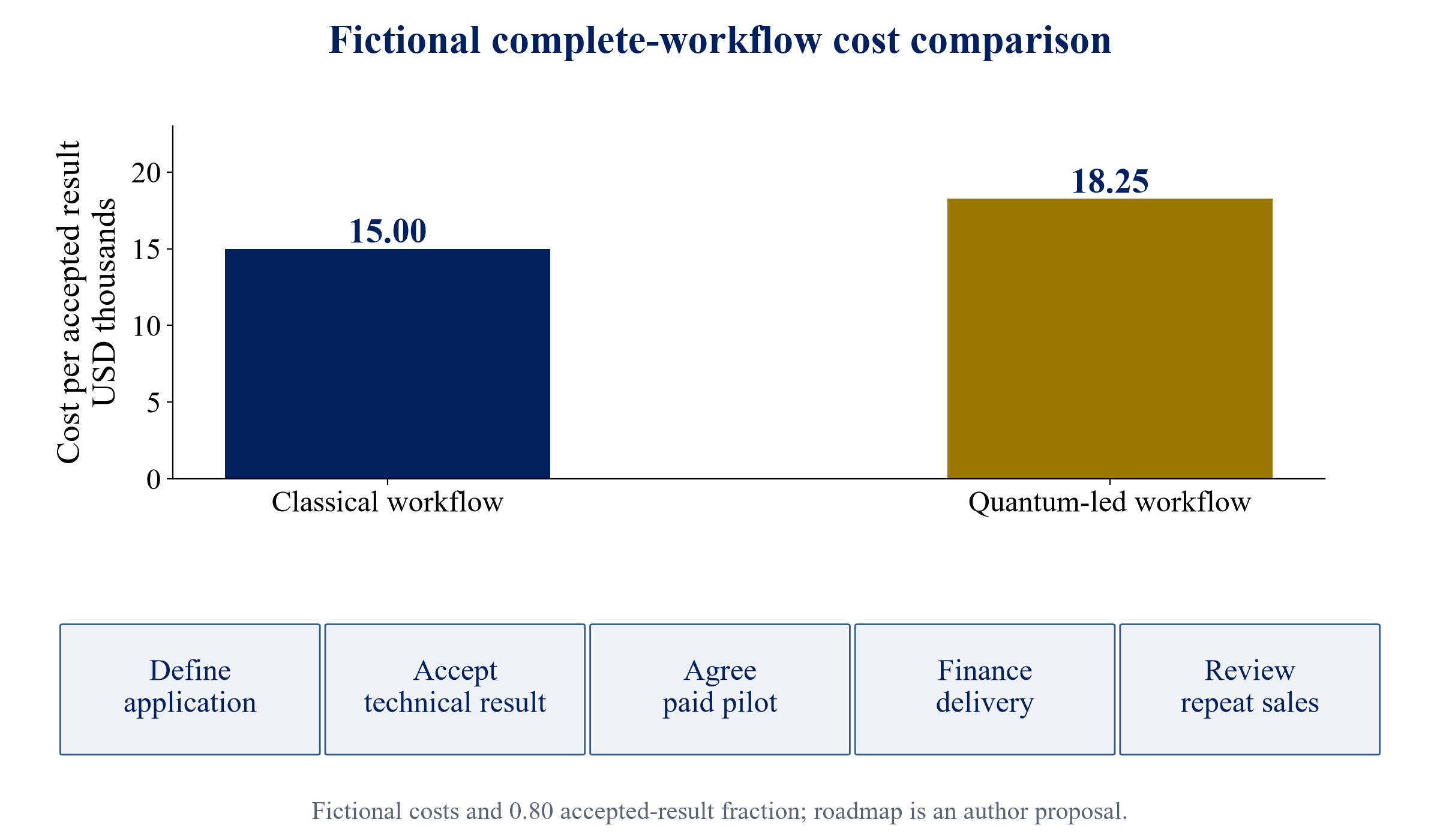
Costs are USD thousands per accepted result using assumed compute charges, validation costs and an accepted-result fraction of 0.80. The roadmap stages carry no promised duration or financing outcome.
24 Conclusions and limitations
This paper proposes a method for linking quantum energy venture valuation to accepted milestones and explicit financing assumptions. The model separates technical acceptance, commercial acceptance, development payments and security allocation. Its fictional net programme value of USD 22.673 million follows from the stated branch weights, terminal net amounts and discount rate. No observation in the reviewed sources establishes those numerical inputs or validates that programme amount as a transaction price.
The proposed evidence register makes each assumption review traceable to a defined source and decision. Application to an actual company requires a product perimeter, appropriately qualified technical review, customer documentation, funding conditions and an instrument-specific model. The research reviewed here supports specific technical and methodological statements within their original boundaries. Its experiments, estimates, policy missions and funding descriptions cannot establish another venture's commercial result without additional evidence.
Future research could test the proposed process against documented investment cases and compare forecast assumptions with subsequent delivery records. Such work would need permission to use the underlying documents and a consistent measurement boundary. The present paper reports no validation dataset or observed improvement in returns. Its contribution is an explicit analytical framework whose limitations remain visible alongside its calculations. Actual investment, accounting and transaction decisions require qualified, case-specific professional review.
References
- IFRS Foundation. IFRS 13 Fair Value Measurement. Official standard overview; accessed 5 October 2026. https://www.ifrs.org/issued-standards/list-of-standards/ifrs-13-fair-value-measurement/
- International Private Equity and Venture Capital Valuation Board. International Private Equity and Venture Capital Valuation Guidelines. December 2025; sections on calibration, early-stage investments and complex capital structures. https://www.privateequityvaluation.com/Portals/0/Documents/Guidelines/2025%20IPEV%20Valuation%20Guidelines.pdf
- US Government Accountability Office. Technology Readiness Assessment Guide. GAO-20-48G, January 2020; revised February 2020. https://www.gao.gov/products/gao-20-48g
- UK Department for Science, Innovation and Technology. National Quantum Strategy Missions. Official policy objectives; accessed 5 October 2026. https://www.gov.uk/government/publications/national-quantum-strategy/national-quantum-strategy-missions
- Nguyen, N., Watts, T. W., Link, B., and colleagues. Quantum computing for corrosion simulation: workflow and resource analysis. npj Quantum Information 12, 27, 2026. https://doi.org/10.1038/s41534-025-01171-1
- Otten, M., and colleagues. QREChem: Quantum Resource Estimation Software for Chemistry Applications. arXiv:2404.16351, 2024. Research preprint. https://arxiv.org/abs/2404.16351
- McCaskey, A. J., and colleagues. Quantum chemistry as a benchmark for near-term quantum computers. npj Quantum Information 5, 99, 2019. https://doi.org/10.1038/s41534-019-0209-0
- European Innovation Council. EIC Accelerator. Official funding and selection-process description; accessed 5 October 2026. https://eic.ec.europa.eu/eic-funding-opportunities/eic-accelerator_en
About the Author
Chennakeshav (CK) is a corporate finance and investment banking executive with 25+ years of global experience in deal origination, structuring and execution across M&A, growth capital and corporate strategy. He has led value-creation mandates for founders, corporates and funds — bridging the boardroom view to hands-on execution and close.
His career spans Morgan Stanley, HSBC, Lloyds Banking Group, EWEC, ADQ portfolio companies and Emirates Growth Fund, across TMT, real estate, fintech, deeptech, cleantech, infrastructure and energy. He has partnered with C-suite leaders, private equity and venture funds, sovereign wealth funds and family offices to finance complex fund raises and scale-up ventures, and has led M&A due diligence, post-merger integration and business-transformation initiatives to create value.
At Matchpoint Partners he is Managing Partner, leading the firm's corporate finance, M&A and capital-raising practice. He holds an MBA from London Business School, an engineering degree from VTU and a Master of Laws (LLM, in progress) from UCL London.
An active start-up mentor, CK mentors at Techstars, DIFC FinTech Hive, Startup Grind, Founder Institute and IN5, serves as Entrepreneur Mentor in Residence (EMiR) at London Business School, and judges the Entrepreneurship World Cup.
