

Introduction
Modern economies use satellite-derived position and time far beyond visible route guidance. Aircraft, ships, telecommunications networks, electricity systems, financial markets, emergency services and autonomous machines depend on positioning, navigation and timing. The United States PNT policy states that widespread dependence creates vulnerability when signals are disrupted or manipulated [1]. Aviation authorities continue to address jamming and spoofing because interference can affect navigation, surveillance, automation and timing-dependent functions [2,3,4].
Resilience requires layers. Protected satellite services, terrestrial navigation aids, conventional inertial systems, radio-frequency monitoring, map matching and operating procedures can all contribute. Quantum sensors may add a self-contained reference that accumulates error more slowly or provides more stable timing. NIST describes atom interferometers as an emerging alternative or backup to satellite navigation and classical inertial sensors [5]. The United Kingdom has set missions to deploy quantum navigation systems on aircraft and to field mobile networked quantum sensors [6,7].
These policy signals can attract strategic buyers. Aerospace primes may seek differentiated navigation components. Defence groups may seek sovereign capability. Industrial sensor companies may seek new accuracy or timing layers. Financial investors may see platform optionality across aviation, maritime, rail, underground and autonomous systems. The acquisition case remains difficult because technical progress and commercial readiness are often measured with different evidence.
This paper provides a board-level method for bridging that gap. It defines the system outcome, constructs an evidence ladder, tests ruggedisation and integration, evaluates procurement and regulatory access, and converts findings into scenario value and transaction terms. The framework treats quantum performance as one element of a mission system whose value appears only when it operates repeatedly in the buyer's intended environment.
1 Define the navigation outcome before valuing the sensor
The acquisition thesis should identify the navigation problem in operational terms. A buyer may require an aircraft to maintain bounded position error during a thirty-minute GNSS outage, a submarine to navigate during a longer submerged mission, a train to locate itself in tunnels, or an autonomous vehicle to remain safe in an urban canyon. Each case has different dynamics, error tolerances, available maps, installation constraints and certification paths.
The target's scientific claim should be translated into that outcome. Acceleration sensitivity, rotation sensitivity, clock stability and interrogation rate are component measures. The system outcome includes position, velocity, attitude and time error over the mission profile. It also includes availability, integrity, continuity, latency and the ability to detect when information is unreliable.
The buyer should specify the baseline architecture against which value is measured. Existing solutions may combine multiple GNSS constellations, protected signals, high-grade classical inertial measurement units, visual or radar odometry, terrain or gravity maps, celestial observations and terrestrial radio aids. Quantum technology must improve the whole system enough to justify its cost, installation burden and qualification risk.
The economic outcome should also be explicit. Resilience can avoid mission cancellation, operational restriction, safety exposure, asset loss or dependence on an unavailable signal. The model should identify who receives that benefit and who controls the procurement budget. A technically important capability can remain commercially weak when its beneficiary, buyer and integration owner are different organisations. The acquisition case should therefore trace value from operational loss avoided to the contractual path through which the target can be paid.
An acquisition memorandum should therefore state the user, platform, outage scenario, required performance, operating environment, integration boundary, certification route and economic benefit. It should also identify evidence that would disconfirm the thesis. A component that performs well while stationary may provide little value on a vibrating platform. A navigation improvement may be real but uneconomic if cooling, laser or calibration requirements exceed the platform budget.
2 Build an evidence ladder from physics to accepted operation
Quantum-sensor valuation requires a hierarchy of evidence. The first level is a defensible physical principle supported by peer-reviewed research and a controlled laboratory implementation. The second is reproducible component performance measured against a calibrated reference. The third is operation on a moving platform. The fourth is representative environmental testing. The fifth is an integrated navigation result against a defined mission profile.
Qualification and production sit above demonstration. A product needs stable requirements, controlled configuration, verified interfaces, traceable calibration, environmental resilience, repeatable manufacture and service procedures. Safety-critical use can require additional development assurance, installation approval and operational validation. Defence use can require security, export, supply-chain and platform-integration approvals.
Evidence should be graded by independence and repeatability. Internal test data has value when raw records, methods and calibration are controlled. A customer-observed trial is stronger. A repeat test on another unit under a pre-agreed protocol is stronger again. Qualification by an accepted laboratory and customer acceptance under an operational contract carry different weight from a demonstration funded primarily for research.
The evidence register should preserve failed and inconclusive tests. Excluding them can hide sensitivity to configuration or environment and can create an unrealistic readiness narrative. A disciplined target should explain why a test failed, what changed, whether the correction affects other requirements and how regression was performed. Buyers can use this history to estimate remaining engineering work and the organisation's ability to solve unexpected problems after closing.
The buyer should avoid treating levels as a simple technology-readiness number. A target can have mature component physics and immature packaging. It can pass a flight test with a prototype assembled by its inventors while lacking production yield. It can produce repeatable units but still face a long certification or procurement path. The evidence ladder should record each dimension separately and connect it to the intended revenue model.
3 Reconcile laboratory sensitivity with navigation error
Laboratory reports may present noise floors, bias stability, scale-factor stability, dynamic range, bandwidth and long-term drift. These measures need precise definitions, test durations and uncertainty. The buyer should obtain raw data and reproduce calculations. Cherry-picked intervals, unreported filtering or calibration against the same reference used in development can overstate practical performance.
Navigation error is cumulative. Small biases in accelerometers and gyroscopes can create position and attitude errors that grow with time. A quantum device may reduce one source of drift while adding dead time, limited bandwidth or sensitivity to vibration and alignment. Hybrid systems often use a classical sensor for high-rate motion and a quantum reference for correction. The transaction value then depends on the fusion architecture as much as the quantum component.
The diligence team should construct an error budget. It should separate sensor noise, bias, scale factor, misalignment, gravity-model error, temperature effects, timing error, latency, quantisation, map uncertainty and integration error. Each item should show the measurement method, confidence interval, operating range and effect on mission performance.
The model should include adverse motion. Aircraft manoeuvres, rail vibration, sea state and vehicle shock can differ greatly from laboratory conditions. A result remains provisional until the device has been tested across the intended envelope. The buyer should value a truthful performance map more highly than a single best-case number because it supports engineering, customer commitments and certification.
Reference quality requires review as well. An apparent quantum error can reflect limitations in the reference trajectory, synchronisation or coordinate transformation. The diligence team should confirm reference accuracy over the relevant dynamics and should reconcile sensor time to platform time. Where two reference systems disagree, the test report should show the resolution process. Uncertainty belongs in the valuation evidence rather than disappearing through a final plotted line.
4 Treat size, weight, power and cost as core performance
Quantum navigation systems can require vacuum chambers, lasers, optical benches, magnetic shielding, control electronics, cooling and precise mechanical structures. The system's size, weight, power and cost determine where it can be installed. UK quantum missions explicitly identify reduction of these constraints as necessary for deployment [7,8].
Diligence should measure the complete installed system. Prototype photographs and sensor-head dimensions can exclude racks, pumps, cooling, power conversion, computers, vibration isolation and maintenance equipment. The buyer should request the bill of materials, mass properties, peak and steady power, heat rejection, start-up time, calibration time and required operator intervention.
The reduction roadmap should identify which improvements are engineering tasks and which require scientific breakthroughs. A smaller vacuum package may be achievable through known design changes. A higher data rate may require a different atom source or interrogation method. The schedule, capital and probability should differ accordingly.
The roadmap should also address maintainability. Fielded equipment needs diagnostic access, replaceable modules, software updates and calibration procedures that operators can execute. A prototype supported by its inventors may tolerate long fault isolation and specialist adjustment. A product installed on an aircraft, vessel or remote infrastructure asset requires predictable recovery and spares. Maintainability evidence can therefore change both revenue potential and warranty exposure.
Cost should be separated into prototype, low-rate initial production and scaled production. Government-funded development can absorb non-recurring engineering without proving a commercial gross margin. The buyer should model purchased components, internal labour, yield loss, calibration, environmental test, warranty, field support and obsolescence. Supplier concentration and export restrictions may dominate the economics of lasers, photonics or specialised electronics.
5 Test ruggedisation as a controlled engineering programme
Ruggedisation is the process of making scientific performance survive the operating environment. It includes mechanical design, thermal control, contamination management, electromagnetic compatibility, software recovery, component selection and calibration stability. A target that has flown a prototype has evidence of platform operation. The acquisition case still needs the test configuration, environment and repeatability.
The buyer should build an environmental matrix covering temperature, pressure, humidity, vibration, shock, acceleration, electromagnetic disturbance, power quality and storage. Limits should reflect the intended platform rather than a generic standard. Every test should identify the unit, configuration, firmware, calibration state, pass criteria, anomalies and corrective action.
Failures are informative. A company that records and closes failures can be more valuable than one that reports only successful demonstrations. The diligence team should examine non-conformance records, root-cause analyses, design changes and regression tests. It should trace whether the claimed performance was re-established after each modification.
Test coverage should reflect combined stresses where the mission requires them. Passing temperature, vibration and electromagnetic tests separately may not prove performance when heat changes optical alignment during vibration or when a power transient interrupts sensor lock. Combined testing can be expensive, so the qualification plan should justify sequence and coverage. The buyer should price any untested interaction as future engineering exposure.
Ruggedisation can change sensor physics. Stiffer mounts, smaller optical paths, thermal isolation or magnetic shielding can affect sensitivity and bandwidth. Engineering and scientific teams must therefore operate one configuration-controlled loop. The buyer should avoid assuming that laboratory performance automatically transfers to a rugged product or that packaging changes are low-risk merely because they use established manufacturing methods.
6 Value the hybrid navigation stack
Operational navigation is usually a system of systems. A quantum sensor may correct a conventional inertial measurement unit, provide a stable clock, measure gravity for map matching, or improve heading through atomic gyroscopy. Its value depends on estimation algorithms, integrity monitoring, maps, data interfaces and platform dynamics.
The target should demonstrate the complete estimation chain. The buyer should inspect time synchronisation, coordinate frames, filtering, sensor health logic, calibration updates, map selection, uncertainty propagation and fall-back states. Software should produce a position solution and a defensible measure of confidence. A precise answer without trustworthy integrity information can create safety risk.
Data rights matter. Gravity, magnetic or terrain maps may come from governments, commercial providers or customer programmes. The target may own algorithms while lacking rights to deploy the required map. Training data, test routes and reference trajectories may also be restricted. Diligence should map ownership, licence, export, security and change-of-control terms.
The integration boundary affects revenue and margin. A component supplier can sell sensors but may depend on a prime contractor for system integration and customer access. A full-stack provider can capture more value but assumes certification, support and liability. The acquisition model should match the buyer's capabilities and avoid paying a platform multiple for a component business without funded integration.
Interface ownership is central. Mechanical, electrical, data and timing interfaces determine whether the sensor can be installed without redesigning the platform. The target should maintain interface-control documents, versioned message definitions and timing budgets. Proprietary interfaces may support differentiation while slowing adoption. Open or standard interfaces may accelerate integration while exposing the sensor to substitution. The buyer should decide which layer it intends to control.
7 Require representative field performance
Field tests should reproduce the intended operational challenge. A GPS-denied trial needs a clearly defined denial period, reference trajectory, platform motion, environmental conditions and performance limit. The test should report maximum and time-dependent position, velocity, attitude and timing errors. It should distinguish quantum contribution from classical sensors, map matching and post-processing.
The publicly reported UK airborne trial demonstrated an optical atomic clock and core elements of an ultra-cold-atom system on a modified aircraft [9,10]. It is meaningful evidence of airborne operation and collaboration with aerospace partners. The official account describes potential and a step toward the national mission; it does not publish a complete certification data package or prove production economics.
The buyer should request repeated trials across units, crews, routes and environmental states. It should compare real-time results with post-processed results and examine periods when the quantum sensor was unavailable. A system that recovers gracefully from interruption can be more useful than one with a superior best-case result and fragile availability.
Independent witnessing improves evidence quality. Test protocols should be agreed before execution. Raw outputs and reference data should be retained. Changes between runs should be configuration-controlled. A customer acceptance event under a funded programme is stronger evidence than an internal demonstration because it links performance to an external requirement.
The transaction team should conduct an evidence-removal test. It should ask what conclusion remains if the best demonstration is excluded, if one reference instrument is challenged or if the most experienced operator is unavailable. A business supported by several independent evidence paths is more durable than one dependent on a single celebrated event. This test also identifies which pre-closing experiment can reduce uncertainty most efficiently.
8 Convert platform trials into qualification evidence
A demonstration answers whether a concept can work in a selected setting. Qualification asks whether a defined product configuration meets specified requirements across its operating envelope. Certification asks whether an authorised process accepts the product or installation for a regulated use. The buyer should distinguish all three.
For aviation, the route can involve equipment standards, environmental qualification, development assurance, aircraft integration, safety assessment and operational approval. The exact route depends on intended function and whether the system is primary, supplemental or advisory. Regulators currently emphasise preparation for GNSS interference and resilient navigation [2,3,4]. An emerging quantum system must integrate into that broader safety architecture.
Qualification plans should identify requirements, methods, facilities, evidence owners, open issues and schedule margin. The target should show traceability from mission need to system requirement, component requirement, test case and result. Unresolved requirements should be priced as future work.
A buyer can create value by adding certification capability, quality systems and platform relationships. That synergy requires resources and time. It should not be capitalised as existing target value. The valuation should distinguish the target's standalone evidence from buyer-enabled outcomes and fund the latter through an integration plan.
9 Examine production repeatability and calibration economics
Deeptech prototypes can depend on scarce experts, selected components and repeated manual adjustment. Production value requires a controlled design, qualified suppliers, assembly instructions, test equipment, calibration standards, yield data and field service. The buyer should observe the build and acceptance of more than one unit.
The bill of materials should be reconciled to physical units and purchase records. Long-lead optics, lasers, vacuum components and electronics require alternate-source and obsolescence plans. Supplier rights, export controls and minimum orders can affect working capital and delivery risk.
Calibration is an economic process. The model should include initial calibration, periodic recalibration, reference equipment, transport, downtime and skilled labour. A sensor with excellent performance may remain commercially unattractive if calibration consumes scarce facilities or if field replacement requires factory return.
Yield should be defined at each stage. Passing after unlimited rework is different from first-pass yield. The buyer should quantify scrap, rework hours, component selection and performance spread. A credible learning curve connects design changes, tooling and process control to future cost rather than applying an unsupported scale discount.
Configuration proliferation can destroy that learning curve. Customer programmes may request different lasers, electronics, enclosures, interfaces or software. Each variant adds qualification, inventory and support exposure. The target should identify a controlled product core and a limited adaptation layer. The buyer should model margin and schedule by configuration rather than averaging engineering effort across unrelated prototypes.
10 Analyse government programmes and procurement conversion
Early quantum-navigation revenue may come from grants, research contracts, prototypes and government-funded demonstrations. These sources validate interest and support development. They do not automatically create repeatable product revenue. The buyer should classify each award by customer, contract type, funded amount, allowable cost, deliverable, intellectual-property right, termination provision and route to follow-on production.
United States acquisition rules recognise that R&D work can lack specifications and reliable cost estimates, making cost-reimbursement arrangements appropriate in some circumstances. They also contemplate movement toward fixed-price contracts as designs and production processes become proven [11,12]. This progression provides a useful commercial-readiness test. A target that remains dependent on reimbursed research may have valuable capability but limited evidence of production demand or gross margin.
Pipeline should be separated into funded backlog, awarded but unfunded options, qualified opportunities and management aspiration. Framework eligibility or inclusion on an indefinite-delivery vehicle can improve access without guaranteeing orders. Programme budgets can change, and government contracts may allow termination for convenience. Public filings from defence and quantum-adjacent companies describe these risks [13,14].
Procurement relationships are organisational assets only when they are transferable. Security clearances, facility approvals, approved accounting systems, past performance, prime-contractor agreements and customer confidence can depend on the entity, site and people. The acquisition plan should identify which registrations survive change of control and which require novation, consent or new approval.
11 Map export, security and investment-screening constraints
Quantum sensing and navigation can have civil and military applications. Technology, components, software, data and technical assistance may be subject to export controls. Customer work can impose nationality, location, information-security and access restrictions. The buyer should map every product and programme to the applicable jurisdiction and obtain specialist advice.
The United Kingdom's National Security and Investment framework identifies quantum technologies as a sensitive area. Its guidance includes quantum imaging, sensing, timing and navigation and can require mandatory notification for qualifying acquisitions [15]. Defence, advanced materials, computing hardware, critical suppliers and military or dual-use activities may create additional screening questions.
Regulatory review can affect timing, control rights, information access, governance and operating location. A buyer should submit complete, consistent information and avoid integrating before clearance. The valuation model should distinguish a condition that preserves capability, such as maintaining a domestic research site, from a remedy that limits expected synergy.
The target's technical data room should use access controls proportionate to sensitivity. Diligence can proceed through clean teams, redacted material, secure facilities or expert summaries where required. The board still needs enough evidence to understand value. A vague assertion of security sensitivity should not become a substitute for verified performance or ownership.
12 Assess intellectual property and freedom to operate
Patent review should connect claims to product architecture, inventors, assignments, licences and workarounds. A broad patent around atom interferometry or timing may not cover the target's practical implementation. Conversely, much value may sit in optical alignment, control sequences, calibration, packaging, data processing and manufacturing know-how that patents disclose only partly.
The buyer should confirm employment and university rights. Quantum businesses often emerge from academic laboratories and use licensed intellectual property, sponsored research, shared facilities and continuing collaborations. Agreements should be reviewed for field limitations, royalties, diligence obligations, sublicensing, improvements, publication, change of control and termination.
Freedom to operate is a product-level assessment. The diligence team should identify material patent families, geographical coverage, expiry, ownership and likely design alternatives. It should also review software licences, map rights, firmware, third-party models and reference data. A sensor can be technically differentiated while its deployable product depends on a restricted third-party layer.
Know-how transfer should be tested. Another qualified team should be able to build, calibrate, operate and diagnose a representative unit from controlled records with appropriate support. Missing negative results, undocumented tuning and inventor-only judgement increase transaction risk and should affect price, retention and integration.
13 Evaluate customer concentration and system-integrator dependence
Quantum-navigation targets may have few customers because programmes are large, classified or experimental. Revenue concentration is therefore common but needs granular analysis. The buyer should examine contract funding, milestone acceptance, option history, customer budgets, termination rights, payment timing and the target's position in the supply chain.
A prime contractor can provide platform access, certification capability and procurement credibility. It can also control customer relationships, requirements, data and margin. The target should show whether it is a replaceable component supplier, a named programme partner or the owner of a differentiated subsystem. Subcontract terms, exclusivity, background intellectual property and rights in deliverables require review.
Customer evidence should move beyond letters of support. Strong evidence includes funded integration, supplied requirements, access to representative platforms, accepted test results, repeat orders and production planning. A memoranda of understanding can be useful but should remain outside committed backlog unless it creates enforceable obligations.
The valuation should include loss and delay scenarios for the largest programme. A target with one strong government customer may warrant high technical confidence and low revenue diversification. The transaction response can combine a lower closing value, customer-continuity condition, funded integration reserve and contingent payment tied to follow-on orders.
14 Model unit economics across maturity states
Prototype economics, low-rate production and scaled production are different businesses. The model should show engineering revenue, hardware revenue, software or data revenue, integration services, maintenance and support separately. Gross margin should be calculated after realistic direct labour, testing, calibration, warranty and customer-specific engineering.
The hypothetical target reports USD 14 million of annual revenue. The model assumes USD 8 million of reimbursed development, USD 4 million of prototype hardware and USD 2 million of integration and support. These amounts are illustrative. They should not be interpreted as observed market data.
At prototype stage, the hypothetical gross contribution is low because units require selected components and extensive calibration. The central case assumes that configuration control and modular packaging improve first-pass yield and reduce test hours. The downside case assumes that environmental redesign resets qualification and preserves high service content.
Working capital can be material. Long-lead components may require deposits before customer funding, while milestone payments can be delayed by test availability or acceptance. The acquisition model should include inventory, customer advances, grant receivables, warranty reserves and non-recurring engineering. Cash needs belong in the transaction funding plan even when headline enterprise value is based on future revenue.
15 Perform evidence-led technical and commercial diligence
The data room should contain requirements, system architecture, error budgets, raw test records, reference-system calibration, configuration baselines, software repositories, bills of material, supplier agreements, qualification plans, programme contracts, intellectual-property records, export classifications, security approvals and customer acceptance evidence. Each item should have an owner, date and scope.
Diligence interviews should follow a recent failure. Ask what happened, how the team detected it, what evidence separated possible causes, who approved the correction and whether the result was reproduced. This reveals scientific judgement, engineering control and organisational learning more effectively than a prepared product demonstration.
The buyer should observe a controlled operating cycle. A representative unit should be configured, calibrated, run against a reference, exposed to an agreed disturbance, recovered and analysed. The exercise must remain within safe and authorised limits. Its purpose is to understand repeatability, data provenance and diagnosis.
Every material finding should connect to a transaction response. A missing assignment may require a closing condition. An unqualified supplier may require a funded alternate-source plan. A promising but unverified field claim may move value into contingent consideration. A security restriction may change the acquisition perimeter or information plan.
16 Construct the hypothetical valuation
The hypothetical target has 74 employees, including 49 technical staff. It develops an atom-interferometer inertial sensor, compact optical clock and hybrid navigation software. It reports USD 14 million of annual revenue, USD 31 million of unrestricted cash and USD 18 million of annual cash use. All figures are hypothetical.
Four scenarios frame enterprise value. A transferable laboratory-evidence business is valued at USD 65 million with 25 per cent probability. A repeatable field demonstrator with funded programmes is valued at USD 180 million with 40 per cent probability. A certifiable integrated product with credible low-rate production is valued at USD 420 million with 25 per cent probability. A qualified production platform with durable procurement access is valued at USD 760 million with 10 per cent probability.
The probability-weighted enterprise value is USD 269.25 million. This arithmetic is a decision model rather than a market quotation or forecast. It separates achieved evidence from outcomes that require qualification, production and customer conversion.
The illustrative allocation assigns USD 52 million to intellectual property and controlled know-how, USD 48 million to field-performance evidence, USD 58 million to product and integration capability, USD 41 million to customer and procurement access, USD 34 million to manufacturing and qualification systems, and USD 36.25 million to future platform options. Each category requires its own evidence and downside treatment.
17 Structure consideration around verification gates
Closing consideration should reflect controlled assets, independently verified performance and funded relationships that transfer at closing. Employee compensation should pay for future service. Contingent consideration can address qualification, production and customer outcomes when milestones are observable and accounting, tax, employment and legal treatment is understood.
Technical milestones should specify product configuration, protocol, environment, reference system, pass criteria, witness, data rights and treatment of anomalies. A statement such as successful navigation trial is too broad. A stronger milestone may require a defined unit to remain within a position-error bound during a stated outage and motion profile, across repeated tests and without post-processing.
Commercial milestones should require funded and accepted outcomes. Examples include programme novation, customer acceptance, low-rate production order, qualified alternate supplier or collected cash. Pipeline, framework eligibility and non-binding interest should not release value without a defined conversion event.
The buyer should maintain reserves for qualification, platform integration, supplier remediation, export compliance and working capital. Integration funding should not be hidden inside the acquisition premium. Board approvals should identify which future expenditure creates buyer synergy and which closes a target capability gap.
18 Integrate through a mission-assurance plan
The first integration objective is continuity of controlled evidence. The buyer should preserve laboratories, calibration references, configuration systems, programme reporting, security controls and supplier orders. Immediate relocation or platform standardisation can invalidate test baselines and delay customer milestones.
Joint governance should connect scientific performance, product requirements, qualification and customer commitments. Decision rights must be explicit. A technical change that improves sensitivity may harm environmental resilience or certification. The governance process should evaluate the complete mission effect before release.
Integration should include a ninety-day evidence plan and a longer qualification roadmap. The first period should reconcile assets, code, data, suppliers, contracts and requirements; reproduce a representative result; secure programme continuity; and confirm funding. Later stages should execute environmental tests, integration trials, production builds and customer acceptance.
The board should maintain a value ledger. It should track baseline evidence, planned action, cost, owner, timing and realised result for performance, ruggedisation, production, customer access and cash. Value is realised when the combined organisation produces accepted capability and economic return. Completion of an integration activity alone is an input.
Integration reporting should preserve the distinction between technical progress and economic conversion. Improved sensor stability, a completed environmental test or an approved interface can reduce risk without generating revenue immediately. A funded production order can improve commercial evidence while introducing working-capital and delivery exposure. The board should therefore review the evidence ladder, cash forecast and customer commitments together. Any release of contingent consideration should use the definitions agreed in the transaction documents and should rely on controlled records. Where a milestone is missed, management should identify whether the cause is scientific performance, engineering execution, regulatory timing, customer delay or buyer integration. This attribution supports fair governance and prevents a general programme delay from concealing a specific loss of capability clearly.
Conclusion
Quantum sensors can strengthen navigation architectures that must continue operating when satellite signals are unavailable, degraded or untrusted. The strategic need is supported by government policy, active programmes and regulator attention to GNSS interference. Product and transaction value remain specific to evidence, mission and route to deployment.
The buyer should define the operational outcome, reconcile laboratory metrics to navigation error, test size, weight, power and cost, examine ruggedisation, validate hybrid integration, and require repeated representative field results. Qualification, certification, production repeatability, procurement conversion, investment screening, export controls and customer concentration belong inside valuation rather than after it.
The proposed evidence ladder supports disciplined pricing. Closing value attaches to controlled and verified capability. Contingent value attaches to independently observable qualification, production and customer outcomes. Integration proceeds through mission assurance and controlled evidence.
Boards that use this method can distinguish a promising scientific asset from a deployable navigation business and can fund the steps needed to move from one to the other.
Appendix A Field-test protocol
Define the mission profile, outage duration, platform motion, environment, reference trajectory, required accuracy, integrity and availability before the test. Freeze the unit, software, calibration and configuration. Record raw sensor, fusion and reference data with synchronised time. Identify allowed post-processing before the run.
Repeat the test across units and representative conditions. Record anomalies, unavailable periods, resets and operator interventions. Preserve data provenance and independent witness records. Report complete error distributions and time histories rather than one best result.
Appendix B Minimum acquisition evidence schedule
The data room should include system requirements, architecture, error budgets, raw trial records, calibration certificates, configuration history, source code, bills of material, supplier agreements, manufacturing instructions, yield and rework, qualification plans, customer contracts, programme funding, security approvals, export classifications, patents, licences and insurance.
Each item should state the relevant product, configuration, date, owner and completeness. Missing evidence should become a priced risk, condition or funded remediation action.
Appendix C Valuation controls
The model should preserve scenario definitions, evidence gates, probabilities, revenue classifications, gross-margin assumptions, qualification cost, working capital and review dates. Changes require an accountable owner and an explanation.
Sensitivity should vary field performance, qualification delay, production yield, customer conversion, component cost and programme loss. The board should review the full outcome distribution and liquidity requirement.
Appendix D Integration value ledger
For each value category, record baseline, target, evidence, action, owner, cost, timing and realised outcome. Performance evidence, qualified configuration, first-pass yield, supplier coverage, programme continuity, customer acceptance and collected cash should remain distinct.
The ledger should reconcile to the acquisition model and board reporting. It should identify value lost through delay or evidence failure as well as value created.
Appendix E Decision figures and tables
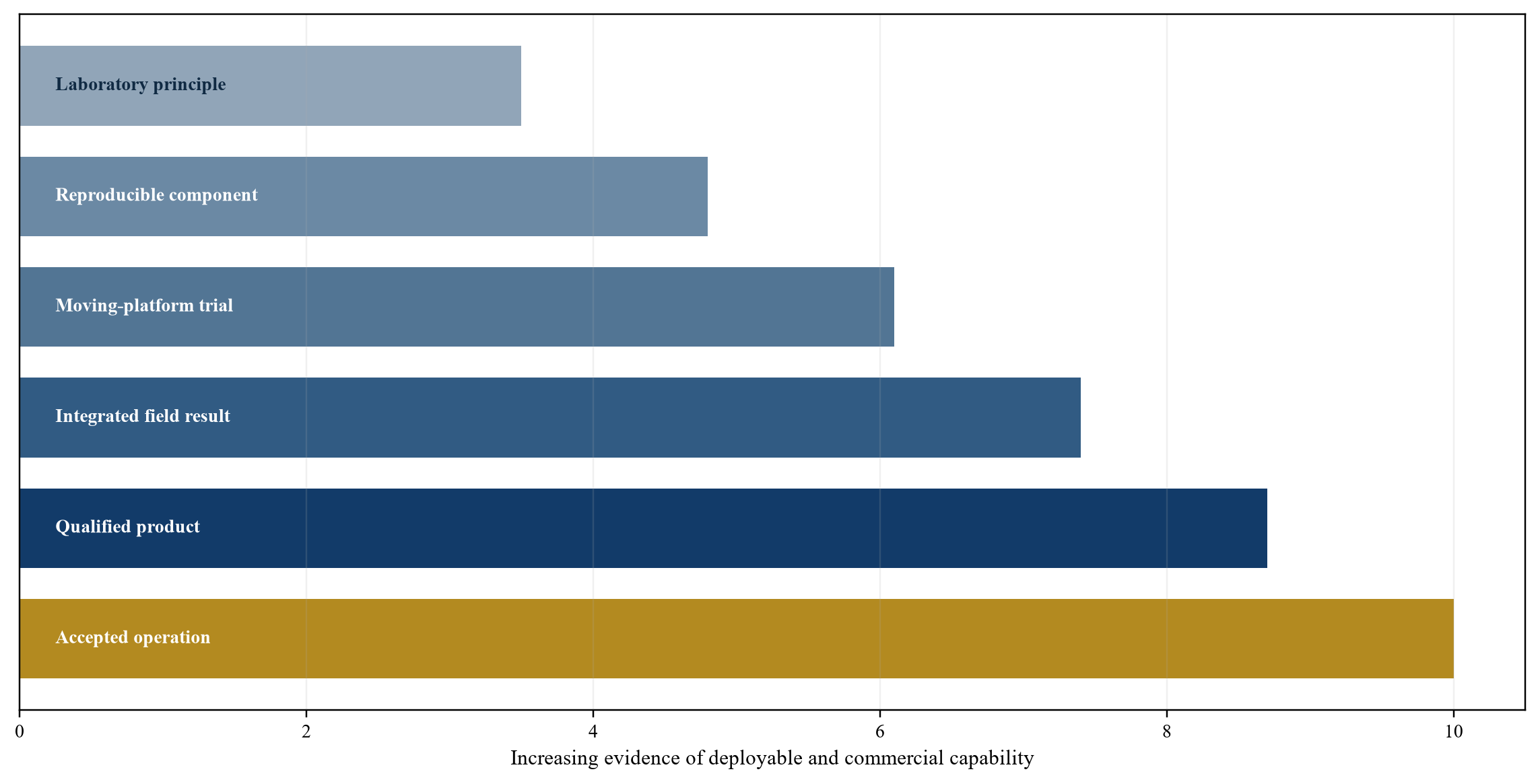
Proposed diligence structure; each level requires configuration-controlled evidence.
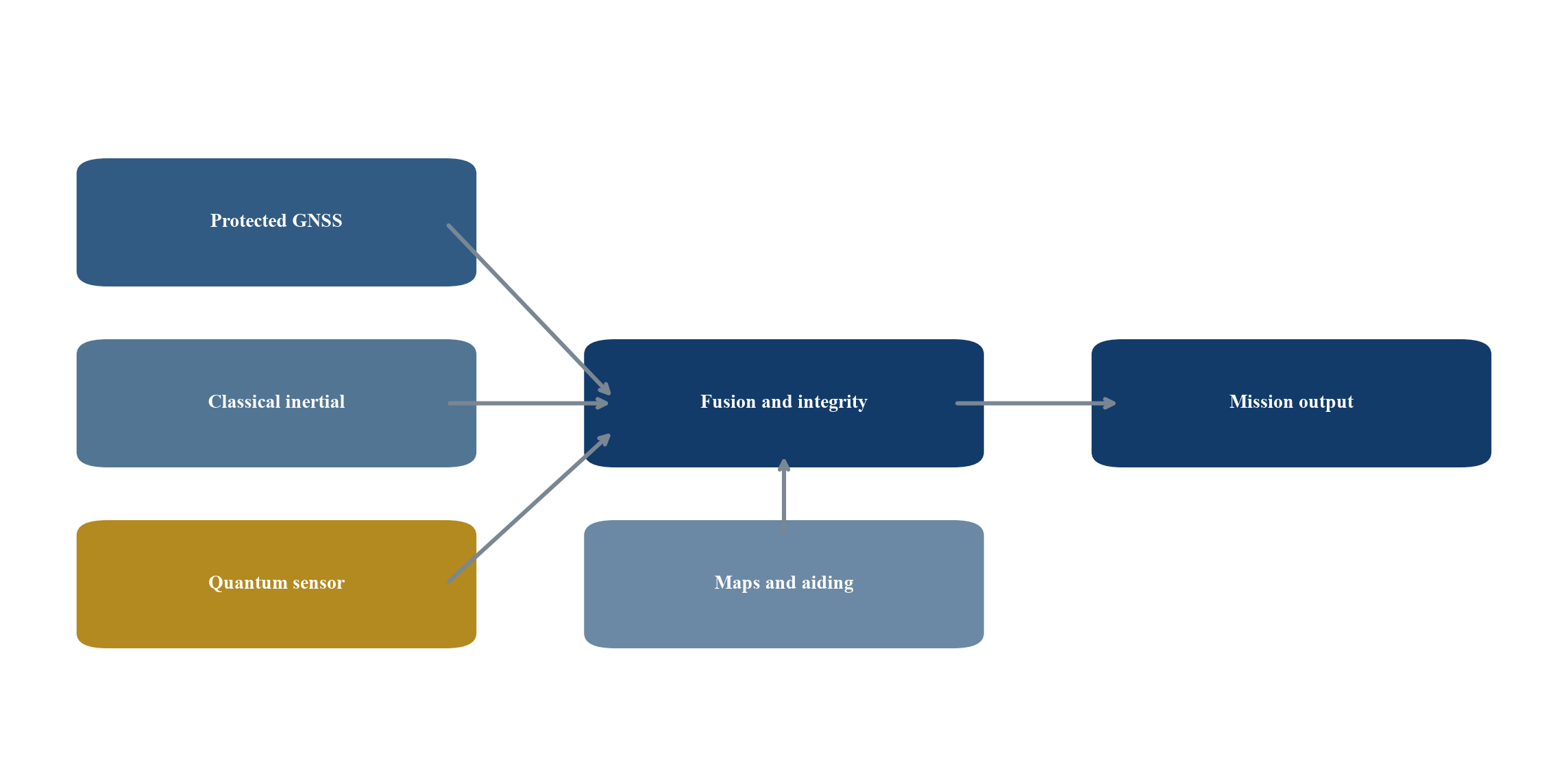
Illustrative architecture; quantum sensors are one layer in a resilient system.
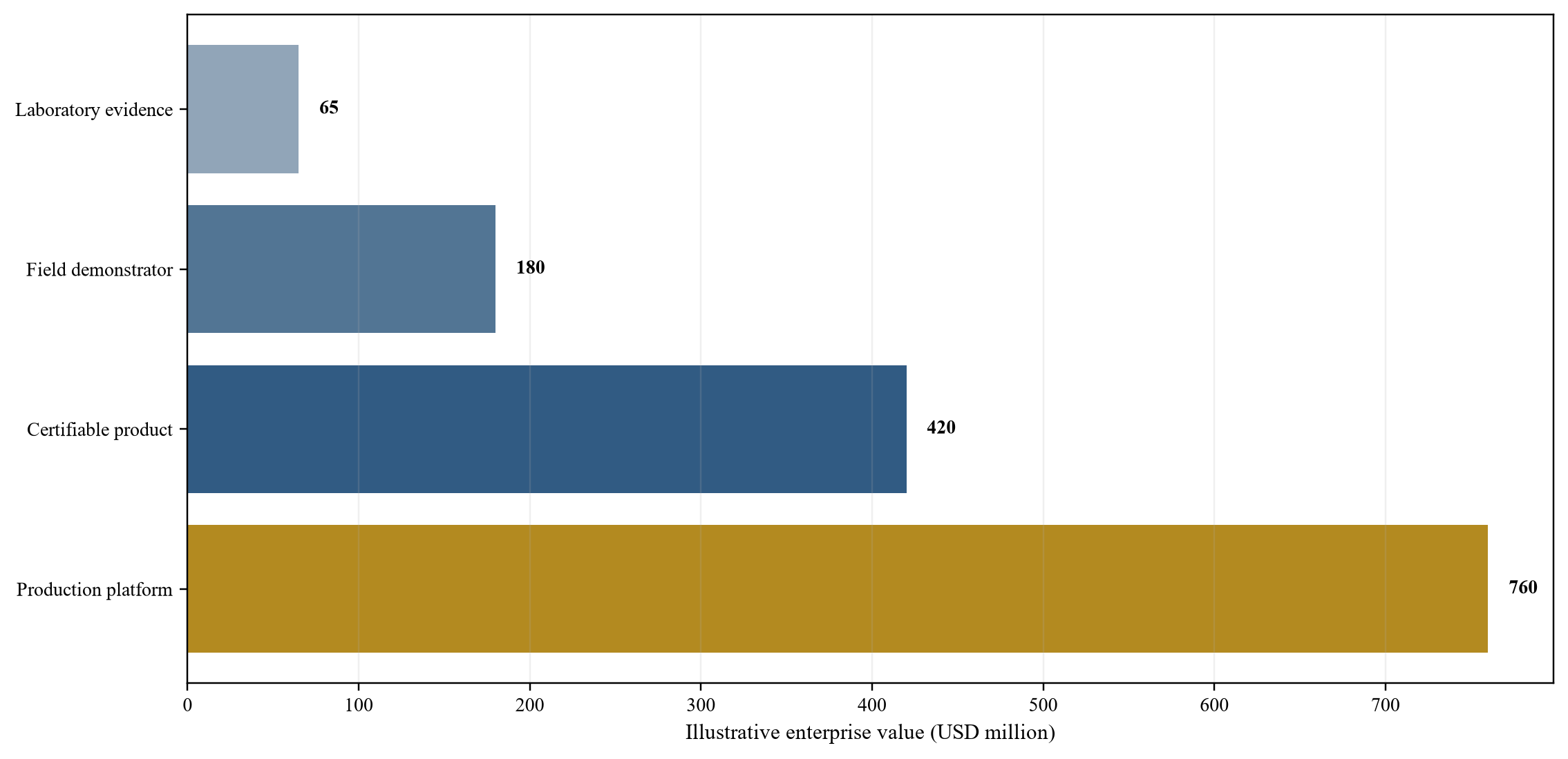
Wholly hypothetical assumptions; USD million.
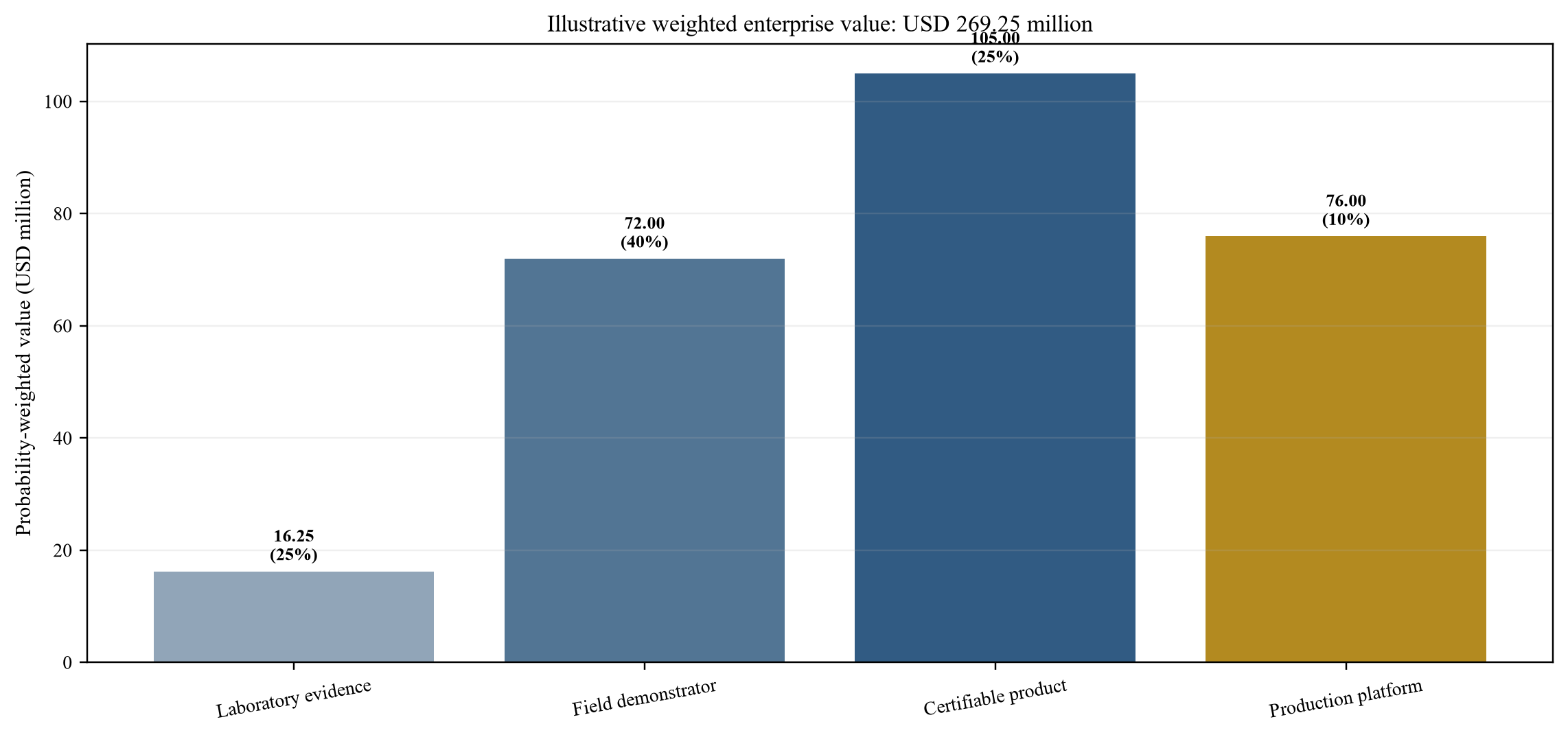
Wholly hypothetical assumptions; USD million.
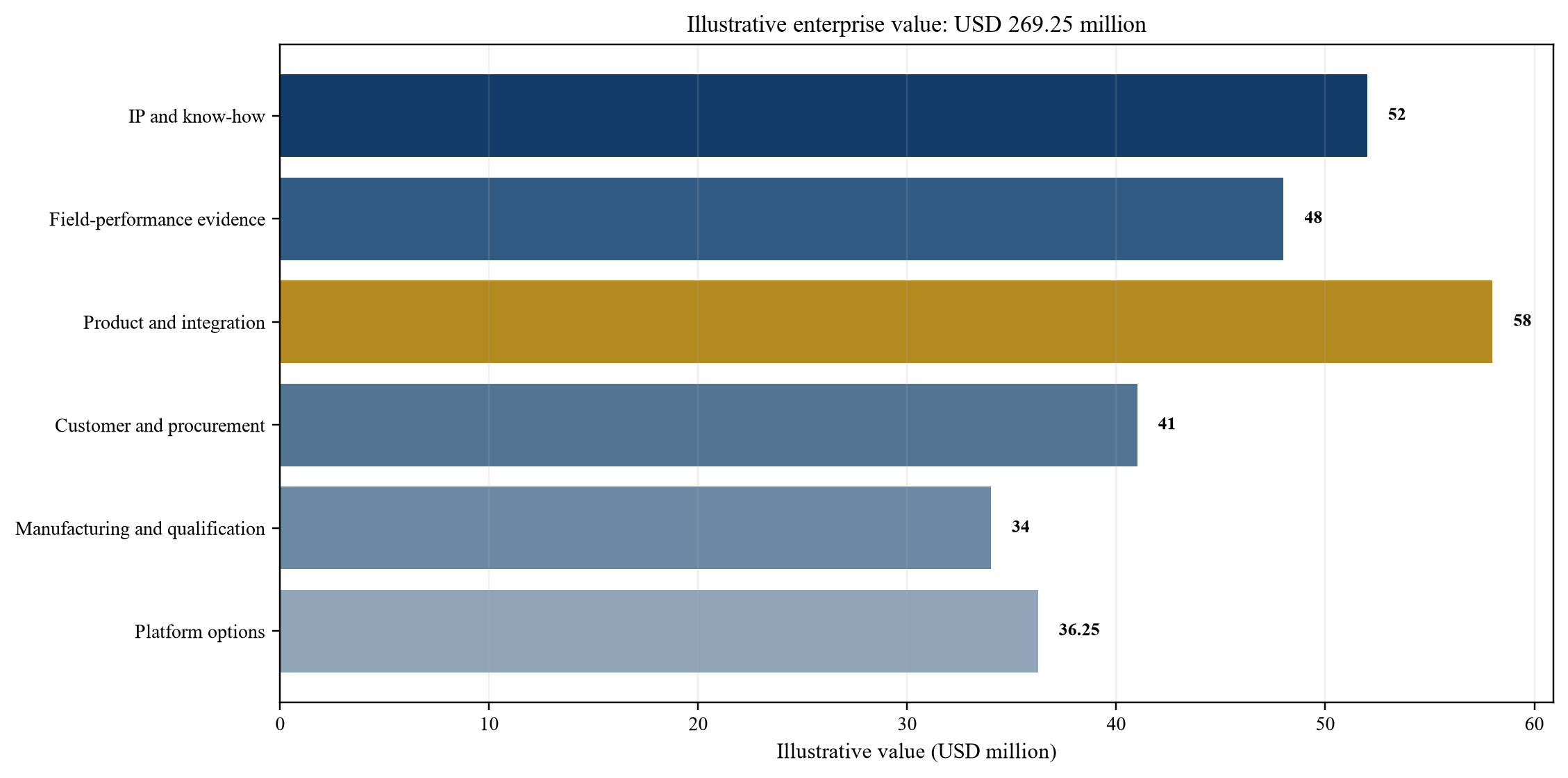
Wholly hypothetical assumptions; USD million.
| Level | Required evidence | Principal residual risk | Valuation treatment |
|---|---|---|---|
| Laboratory principle | Controlled experiment and defensible physics | Practical deployment unproved | Research-option value |
| Reproducible component | Multiple units and calibrated reference | Packaging and motion sensitivity | Component value with discount |
| Moving-platform trial | Real-time operation on representative platform | Limited environment and configuration | Demonstrator value |
| Integrated field result | Mission-level error and integrity evidence | Qualification and production | Scenario value |
| Qualified product | Requirement traceability and passed test programme | Customer adoption and rate production | Product value |
| Accepted operation | Customer acceptance, support and repeat orders | Concentration and programme renewal | Commercial-platform value |
Proposed diligence classification.
| Dimension | Minimum evidence | Common weakness | Board question |
|---|---|---|---|
| Accuracy | Error over defined outage and route | Best interval reported | Does the complete mission pass? |
| Integrity | Confidence bounds and fault detection | Precise output without warning logic | Can the system detect misleading data? |
| Availability | Uptime and recovery across runs | Unreported dropouts | How often is the capability usable? |
| Latency | Real-time timestamped output | Post-processed result | Does the output arrive in time? |
| Repeatability | Units, routes and conditions repeated | Single prototype or run | Does performance survive variation? |
| Contribution | Ablation against baseline stack | Quantum benefit not isolated | What improvement comes from the acquired layer? |
Proposed acquisition scorecard; thresholds should be defined for the intended mission.
| Stress | Evidence | Failure mode | Required response |
|---|---|---|---|
| Temperature | Hot, cold and transition tests | Drift or loss of lock | Thermal design and recalibration |
| Vibration | Representative spectra | Optical misalignment or noise | Isolation, mounting and regression test |
| Shock | Platform and handling loads | Mechanical or vacuum damage | Qualification and packaging change |
| Electromagnetic environment | Emissions and susceptibility | Sensor corruption or control reset | Shielding, filtering and interface control |
| Power quality | Start, interruption and transient tests | Data loss or unsafe state | Hold-up, recovery and state management |
| Storage and transport | Defined packaged conditions | Calibration shift | Shipping controls and acceptance check |
Proposed matrix; exact limits depend on the platform and intended function.
| Metric | Prototype stage | Low-rate production | Scaled production case |
|---|---|---|---|
| Annual units | 4 | 18 | 60 |
| Average hardware revenue per unit | 1.60 | 1.25 | 0.95 |
| Direct cost per unit | 1.42 | 0.88 | 0.57 |
| First-pass yield | 40% | 68% | 85% |
| Average calibration hours | 180 | 95 | 48 |
| Hardware gross margin | 11% | 30% | 40% |
Wholly hypothetical management assumptions; USD million except units and percentages.
| Scenario | Evidence state | Enterprise value | Probability | Weighted value |
|---|---|---|---|---|
| Laboratory evidence | Transferable science and controlled know-how | 65 | 25% | 16.25 |
| Field demonstrator | Repeatable mobile trial and funded programmes | 180 | 40% | 72.00 |
| Certifiable product | Integrated evidence and credible low-rate production | 420 | 25% | 105.00 |
| Production platform | Qualified product and durable procurement access | 760 | 10% | 76.00 |
| Total | Probability-weighted enterprise value | 100% | 269.25 |
Wholly hypothetical management assumptions; USD million.
| Value category | Closing evidence | Possible protection | Release evidence |
|---|---|---|---|
| Intellectual property | Ownership, scope and transferable know-how | Title condition and escrow | Confirmed transfer and reproducibility |
| Field performance | Repeated protocol and raw data | Technical holdback | Independent repeat test |
| Qualification | Approved plan and controlled configuration | Contingent consideration | Defined qualification pass |
| Production | Build records, yield and suppliers | Working-capital reserve | Accepted low-rate production units |
| Customer access | Funded contracts and transferable approvals | Customer-continuity condition | Novation, order and collected cash |
| Team continuity | Roles, rights and successor coverage | Lawful retention programme | Knowledge transfer and milestone delivery |
Proposed structure; legal, accounting, tax and employment advice remains transaction-specific.
| Decision question | Minimum evidence | Owner | Gate |
|---|---|---|---|
| Is the mission outcome defined? | Platform, outage, accuracy, integrity and economics | Investment committee | Thesis approval |
| Does the sensor improve the system? | Error budget, ablation and representative field data | Technical committee | Valuation |
| Can performance survive deployment? | Ruggedisation, qualification and recovery evidence | Engineering leadership | Signing or closing |
| Can units be produced economically? | Controlled build, yield, calibration and suppliers | Operations leadership | Funding release |
| Can the buyer reach customers lawfully? | Procurement, security, export and screening analysis | Legal and commercial teams | Closing |
| Is value realised after integration? | Accepted units, repeat orders and collected cash | Board and management | Contingent payment |
Proposed acquisition and integration control.
Sources
- National Coordination Office for Space-Based Positioning, Navigation, and Timing. Resilience Through Responsible Use of PNT. 2026. Read the primary source
- European Union Aviation Safety Agency. EASA updates Safety Information Bulletin on GNSS interference. 3 July 2026. Read the primary source
- International Civil Aviation Organization. Global Navigation Satellite Systems Radio Frequency Interference. 2026. Read the primary source
- Federal Aviation Administration. Global Navigation Satellite System Interference Resource Guide. Updated 8 December 2025. Read the primary source
- National Institute of Standards and Technology. Turning Atoms Into Waves to Measure Gravity and Acceleration. 2026. Read the primary source
- Department for Science, Innovation and Technology. National Quantum Strategy. Updated 14 December 2023. Read the primary source
- Department for Science, Innovation and Technology. National Quantum Strategy Missions. Updated 14 December 2023. Read the primary source
- UK Research and Innovation. Quantum technologies for positioning, navigation and timing. 2022. Read the primary source
- Department for Science, Innovation and Technology and UK Research and Innovation. Un-jammable quantum tech takes flight to boost UK resilience against hostile actors. 13 May 2024. Read the primary source
- UK Research and Innovation. Un-jammable quantum tech takes flight to boost UK resilience. 13 May 2024. Read the primary source
- United States Federal Acquisition Regulation. Part 35 Research and Development Contracting. 2026. Read the primary source
- United States Federal Acquisition Regulation. Subpart 15.4 Contract Pricing. 2026. Read the primary source
- United States Securities and Exchange Commission. Public filing discussing quantum sensing, government programmes and procurement risks. 2026. Read the primary source
- United States Securities and Exchange Commission. Public filing discussing government-customer concentration and contract termination risk. 2026. Read the primary source
- Cabinet Office. National Security and Investment Act guidance on notifiable acquisitions. Updated 6 February 2024. Read the primary source
- National Institute of Standards and Technology. Atomic Gyroscopes. 2026. Read the primary source
- Defense Advanced Research Projects Agency. Quantum sensing and computing. 2020. Read the primary source
- UK Research and Innovation. Contracts for Innovation quantum sensors and PNT missions primer. 19 May 2025. Read the primary source
- UK Research and Innovation. Winners of Contracts for Innovation quantum funding announced. 11 November 2025. Read the primary source
- United Kingdom National Quantum Technologies Programme. Our programme and quantum missions. 2026. Read the primary source
- Federal Aviation Administration. GPS and GNSS Interference Resource Guide. 2025. Read the primary source
- Federal Aviation Administration. Performance-Based Navigation and Area Navigation; recognising and adapting to GNSS jamming and spoofing. 2026. Read the primary source
- International Civil Aviation Organization. Medium-Term Actions for GNSS radio-frequency interference resilience. 2026. Read the primary source
- European Union Agency for the Space Programme. Galileo Open Service Navigation Message Authentication. 2026. Read the primary source
- European Union. Galileo Public Regulated Service. 2025. Read the primary source
- National Coordination Office for Space-Based Positioning, Navigation, and Timing. Space Policy Directive 7. 15 January 2021. Read the primary source
- National Coordination Office for Space-Based Positioning, Navigation, and Timing. Program Funding and Complementary PNT priorities. 2026. Read the primary source
- UK Research and Innovation. UK Quantum Technologies Challenge Project Directory. 2025. Read the primary source
- International Financial Reporting Standards Foundation. IFRS 3 Business Combinations. 2026. Read the primary source
- Financial Accounting Standards Board. Business Combinations Topic 805. 2026. Read the primary source
- World Intellectual Property Organization. Patent analytics and technology trends resources. 2026. Read the primary source
- United States Department of Commerce Bureau of Industry and Security. Export Administration Regulations. 2026. Read the primary source
