

Introduction
Rail is already one of the most energy-efficient forms of passenger and freight transport. The International Energy Agency reports that rail carries about 8% of global passengers and 7% of freight while accounting for roughly 2% of total transport energy demand.[1] Electrification can strengthen that advantage, but a logistics hub contains much more than traction power.
An intermodal terminal may include locomotives, overhead or third-rail supply, cranes, reach stackers, yard tractors, refrigerated containers, warehouses, lighting, buildings, truck charging, workshops and data systems. Solar generation and battery storage can add new flows. A project that evaluates each asset separately can overlook shared connection costs, coordinated demand, operational constraints and commercial value.
The World Bank describes rail logistics as an integrated investment and policy challenge involving infrastructure, terminals, multimodal connections, operating reform and institutional capacity.[2] Its current programmes show how capacity, service reliability and modal shift can create logistics and environmental benefits. Those benefits remain project-specific and do not prove the return of an individual hub.
This paper provides a strategy and execution framework for valuing the whole system. It separates financial cash flow, operational value, public benefit and conditional option value. It also establishes investment gates for grid, equipment, contracts and delivery.
1. Define the hub boundary
The project should begin with a physical and commercial boundary. Identify the rail corridor, sidings, terminal, warehouses, gates, parking, maintenance areas, adjacent land and last-mile interfaces. Record which assets and operations sit inside the sponsor's control.
The energy boundary should include utility connection, traction supply, private network, generation, storage, chargers, buildings and metering. The operating boundary should include train arrival, shunting, unloading, storage, truck dispatch and equipment charging.
A narrow boundary can transfer cost without improving the end-to-end service. A broad boundary can assign benefits the sponsor cannot capture. The investment committee needs a clear statement of owned cash flow, contracted cash flow, external benefit and unsupported potential.
2. State the decision
The decision should name the first-stage assets, capacity, commissioning date, capital envelope and operating objective. It should answer whether to build a common electrical backbone now, electrify selected equipment, add storage, reserve future capacity or defer specified components.
The decision should also identify the target return and service outcomes. These may include lower energy cost, reduced maintenance, increased throughput, shorter dwell, improved reliability, additional train paths, tenant revenue or compliance.
Investment approval should cover a stage with evidence and stop rules. A general commitment to electrification is not an executable capital decision.
3. Map the whole system
The hub connects energy, transport and land. Electricity enters through the grid or local generation. It serves traction, terminal equipment, vehicles and buildings. Storage shifts demand and may provide resilience or grid services. Operating schedules determine when loads coincide.
Cash enters through handling, access, rent, logistics services, energy charges or availability payments. Capital and operating costs flow to the utility, contractors, equipment suppliers, operators and maintenance providers.
The system map should show physical energy, cargo, data, title and payment. It should identify the party controlling every interface and the evidence supporting each benefit.
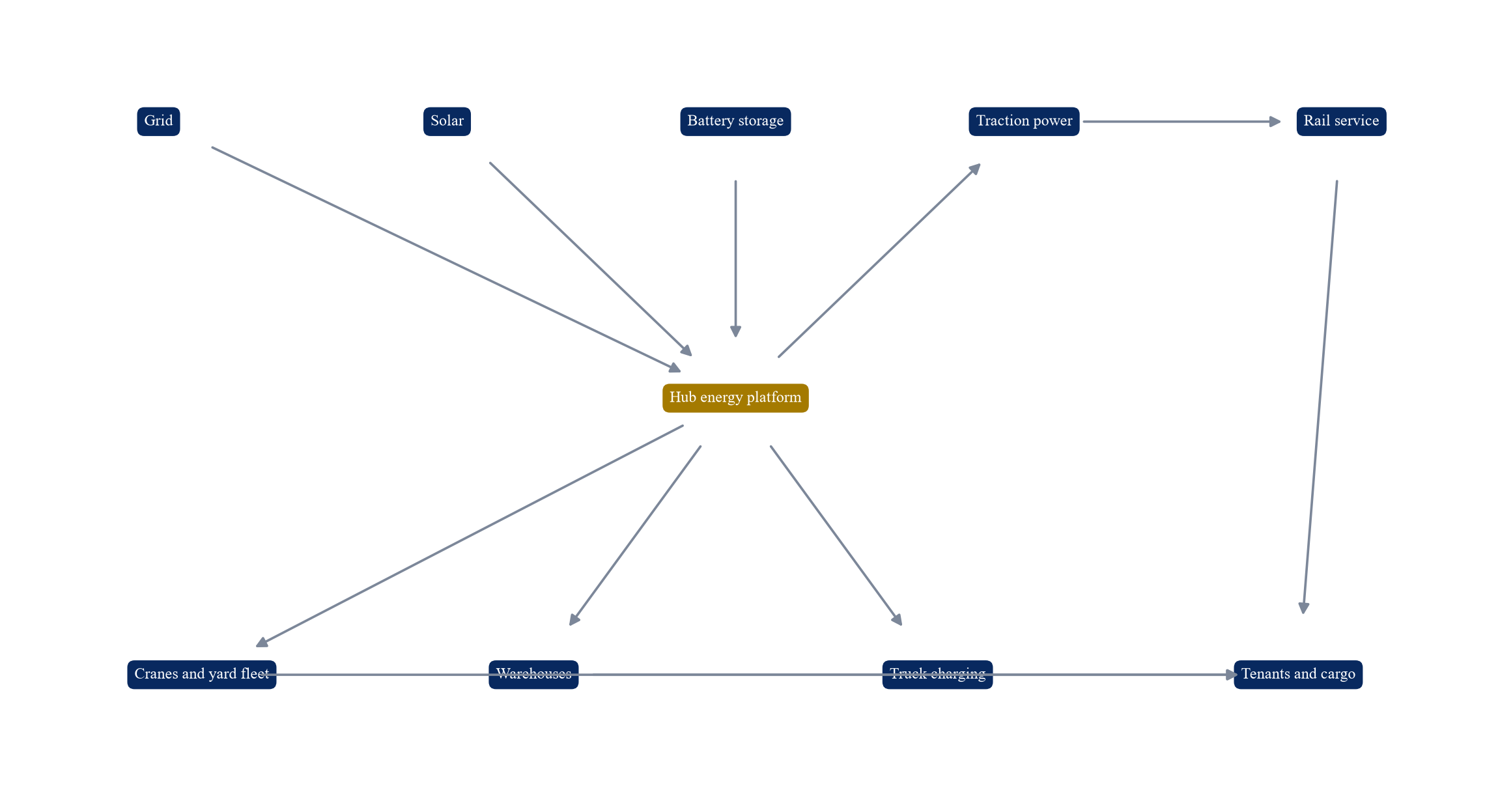
Proposed system map; actual ownership, technology and contracts depend on the hub and jurisdiction.
4. Establish the operating baseline
Whole-system valuation needs a measured baseline. Record train movements, tonnes, containers, dwell, crane moves, gate transactions, truck queues, equipment hours, fuel, electricity, maintenance, failures and labour.
Energy data should use interval meters where possible. Monthly bills can hide peaks and coincident loads. Fuel records should distinguish traction, shunting, yard equipment, backup generation and vehicles.
The baseline should capture seasonality and disruption. A short survey during a quiet period can understate connection and storage needs. Data gaps should be stated and reflected in contingency.
5. Forecast throughput
Throughput drives revenue and energy demand. Build the forecast from contracts, service schedules, corridor capacity, customer plans, port flows and addressable demand. Separate committed, advanced, probable and strategic volumes.
Rail demand depends on commodity, distance, service reliability, terminal location, train path and last-mile cost. The World Bank notes that rail competitiveness reflects volume, commodity, distance and access to rail-served points.[3]
The forecast should translate annual volume into daily peaks, train length, lift count, storage and truck flows. A hub can have acceptable annual utilisation and severe weekly congestion.
6. Identify capacity bottlenecks
Capacity may be constrained by mainline paths, siding length, yard layout, crane moves, storage space, gates, road access, labour, power or information. Electrification should target measured constraints.
A faster electric crane provides limited value if trains wait for a path. Additional rail capacity can overwhelm gates. Truck charging can occupy dwell space. The model should represent the operating chain rather than add independent utilisation assumptions.
Simulation may be appropriate for a complex hub. A simpler process map and peak-hour model can support an early decision if assumptions and limits are clear.
7. Select traction technology
Rail traction options include continuous electrification, discontinuous electrification, battery, hydrogen and diesel transition arrangements. Technical suitability depends on speed, distance, gradients, freight mass, duty cycle and network.
Network Rail's Traction Decarbonisation Network Strategy identifies electric traction as suitable across passenger and freight applications, while battery and hydrogen have limitations for high-speed and heavy freight duties.[4] The strategy also recognises that fixed electrification has higher infrastructure cost and may not suit low-traffic routes.
The hub decision should align with corridor and fleet strategy. Electrifying a terminal without compatible locomotives can strand capacity. Battery shunters or short discontinuities may solve local emissions while mainline traction follows a separate plan.
8. Size traction power
Traction load is shaped by train acceleration, gradient, locomotive configuration, timetable and regenerative braking. Peak demand can exceed average energy use substantially.
The power study should model simultaneous movements and contingency. It should identify voltage, feeder, substation, protection, harmonics, earthing and interface standards. Regenerative energy can reduce net consumption when another train or storage can absorb it.
Connection and traction assets may have long lead times. The programme should coordinate utility, rail infrastructure manager, operator, signalling and safety approvals.
9. Electrify terminal equipment
Electric cranes and yard vehicles can reduce local fuel and maintenance while changing operating routines. The choice should consider duty cycle, lift demand, charging opportunity, battery size, utilisation and redundancy.
Equipment replacement cycles create a natural sequence. Early retirement of functioning diesel assets requires a value case. New equipment can be specified electric when utilisation and infrastructure are ready.
The financial model should include charger, cable, civil works, spare vehicles, battery replacement and training. It should also capture avoided fuel, maintenance and downtime only when supported by operating evidence.
10. Design truck charging
Logistics hubs can host truck charging because vehicles already dwell there. The design should identify fleet, route, daily energy, arrival pattern, parking time and charger access.
Charging can coincide with rail and terminal peaks. Managed scheduling, reservation and tariff design can reduce connection cost. The operator should define priority and penalties when vehicles overstay.
Public or multi-user charging introduces access, payment, interoperability and service obligations. A private fleet depot has a different revenue and risk profile.
11. Integrate warehouses and tenants
Warehouses consume electricity for lighting, heating, cooling, automation and refrigeration. Tenant leases determine who pays capital, energy and efficiency investment.
The hub should map each meter, lease and service charge. A common network can support procurement and resilience while requiring transparent allocation and regulation.
Efficiency measures often have shorter payback than new supply. Building controls, insulation, refrigeration and lighting should enter the same capital ranking.
12. Assess local generation
Large roofs and land can host solar generation where structural, planning and grid conditions permit. The value depends on hourly coincidence with hub demand, tariff, export rights and curtailment.
The model should use a generation profile and measured load. Annual netting can overstate self-consumption. Roof ownership, lease term, maintenance access and reinstatement should be defined.
Power-purchase structures can reduce upfront capital while creating long-term obligations. Credit, change in law and termination require review.
13. Define the storage use case
Battery storage can reduce peak demand, shift solar energy, support resilience, absorb regenerative braking or provide grid services. Each use case needs a technical requirement and revenue rule.
The IEA identifies storage and demand-side participation as tools for easing grid constraints and improving flexibility.[5] This does not establish a positive return for every hub. Connection rules, cycling, degradation and service-market access matter.
The design should avoid stacking incompatible uses. A battery reserved for backup cannot always discharge for arbitrage. Control priority and state-of-charge limits should be explicit.
14. Model the grid connection
Grid capacity can be the critical constraint. The connection study should identify firm and flexible capacity, reinforcement, delivery date, charges, curtailment and security standard.
A flexible connection can accelerate service or lower cost while limiting peak availability. The operating model should show how the hub responds to curtailment without compromising safety or rail performance.
The wider programme should reserve capacity for staged electrification. Overbuilding early can produce idle capital. Under-sizing can require expensive rework.
15. Build the load profile
Create an hourly or finer profile for traction, cranes, yard fleet, trucks, warehouses and buildings. Model normal, peak and disrupted days. Include weather and refrigerated loads where relevant.
The profile should account for diversity. Independent nameplate totals can overstate connection need. Uncoordinated schedules can also create higher coincidence than annual averages suggest.
The energy-management system should forecast arrivals and allocate charging. Operational authority must remain clear when an automated schedule conflicts with train or cargo priorities.
16. Value avoided energy cost
Avoided diesel or other fuel should be calculated from measured consumption, efficiency and delivered price. Electricity cost should include energy, network, capacity, losses, taxes and renewable procurement.
Price scenarios should separate wholesale energy, network charges and fuel. A fixed power contract can reduce volatility while creating volume and credit commitments.
The model should avoid assuming today's spread for the full asset life. It should show break-even combinations of utilisation and price.
17. Value maintenance
Electric equipment can have fewer moving parts and different maintenance requirements. Savings depend on asset design, duty, technician capability, warranty and spare parts.
The baseline should use actual work orders, parts and downtime. Forecasts should include power electronics, batteries, cooling, pantographs, chargers and control systems.
Maintenance value includes reliability and capacity, not only expense. Reduced unplanned downtime can increase throughput when the hub is constrained.
18. Value throughput and dwell
Operational value can exceed energy savings when electrification enables faster, more reliable handling. The model should connect equipment performance to lifts, train turnaround, gate capacity and customer service.
Faster equipment does not automatically create revenue. The sponsor needs demand, path and contract capacity to sell the additional throughput. Otherwise, the benefit may appear as resilience or avoided expansion.
Dwell reduction can free storage and working capital for customers. The hub captures that value only through tariff, volume or retention.
19. Value modal shift
Rail investment can shift freight from road, reducing congestion, emissions and road wear. The World Bank reports substantial logistics and emissions benefits in current rail programmes, including the Indian Dedicated Freight Corridor.[2]
These are public or system benefits unless a contract or policy mechanism transfers value to the hub. Carbon payments, grants, access support or land uplift may create capture.
The appraisal should present financial return and economic benefit separately. This supports transparent public funding without overstating project cash flow.
20. Value resilience
Resilience can arise from backup power, multiple feeders, storage, spare equipment and operational flexibility. Its value is the avoided consequence of disruption multiplied by credible probability.
The assessment should use incident history, recovery time and customer obligations. Double-counting can occur when reliability value also appears within throughput or penalties.
Critical loads should be prioritised. Storage sized for peak shaving may provide limited outage duration unless reserved.
21. Build the capital programme
The budget should include utility connection, traction supply, private network, chargers, equipment, storage, generation, controls, civil works, design, approvals, testing, owner costs, financing and contingency.
Existing asset retirement, lease termination and remediation should be included. Replacement capital should reflect battery and power-electronics life.
The estimate should state price date, procurement status, tax, escalation and accuracy range. Interfaces and live-site work often drive contingency.
Table 1. Hypothetical sources and uses for hub electrification
| Uses | Amount | Sources | Amount |
|---|---|---|---|
| Grid and private electrical network | 42 | Sponsor equity | 38 |
| Traction and terminal interfaces | 31 | Senior infrastructure debt | 55 |
| Electric cranes and yard vehicles | 29 | Equipment finance | 24 |
| Truck charging and tenant systems | 17 | Tenant and fleet contributions | 12 |
| Solar and battery storage | 22 | Public or climate support | 20 |
| Development, contingency and finance | 14 | Contingency facility | 6 |
| Total hypothetical uses | 155 | Total hypothetical sources | 155 |
Illustrative values only; no identified hub, operator, borrower or transaction is represented.
22. Construct the financial model
The model should consolidate capital timing, grants, debt, leases, energy, network charges, operations, maintenance, throughput revenue, tenant payments and service charges.
Each benefit should have a responsible owner and evidence source. Avoided fuel should not also appear as customer willingness to pay unless captured separately. Public benefit should remain outside project cash flow until contracted.
The model should show the port, rail, terminal, energy and tenant economics separately and as a consolidated system. This reveals value transfers.
23. Model operating sensitivities
The principal variables are throughput, connected load, utilisation, fuel and electricity price, peak demand, storage cycling, equipment availability and dwell.
Sensitivities should show annual cash and coverage, not only project return. Combined downside can delay volume while capital and fixed charges are already incurred.
Recovery actions should be operationally credible. Raising tariffs can weaken demand. Deferring maintenance can reduce reliability.
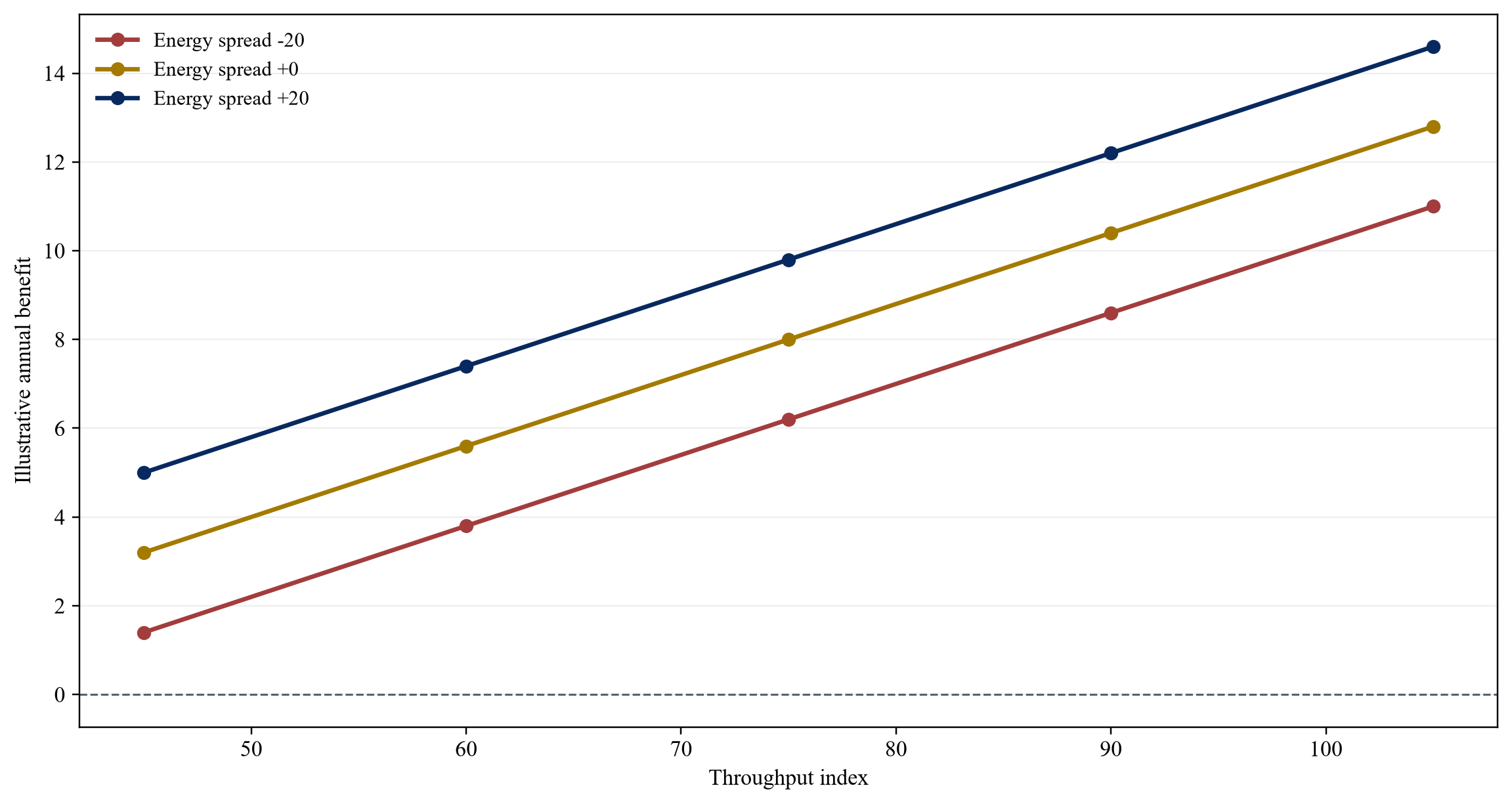
Illustrative scenario analysis only; values are not forecasts or transaction evidence.
24. Test correlated downside
Grid delay, equipment overrun and volume ramp can occur together. A rail-service delay can reduce throughput while connection charges and debt service begin.
The combined stress should include commissioning delay, capital overrun, lower throughput, adverse energy spread, weaker storage performance and longer equipment downtime.
The model should identify minimum cash, covenant pressure and sponsor support. It should also show which stage can be deferred without damaging the operating system.
25. Design revenue mechanisms
Hub revenue may include handling, access, rent, energy services, charging, availability and logistics services. Each line needs volume, tariff, credit and duration.
An energy tariff alone may not recover shared network capital. A capacity or availability component can support fixed costs. Users need transparent allocation and performance.
Anchor contracts can support financing when they contain enforceable minimum volume or availability payments. Flexibility and relief events should be explicit.
26. Allocate energy risk
The hub can pass through energy cost, fix tariffs, hedge or use collars. Each choice allocates volatility and basis risk.
Network and capacity charges can change independently of wholesale power. Peak-management value depends on the applicable tariff and measured peak.
Renewable certificates and carbon claims should follow current rules and data. They should not substitute for physical cost control.
27. Allocate volume risk
Volume risk should sit with parties that influence traffic and can support it. The hub controls service and marketing. Rail operators control schedules. Cargo owners control flows. Infrastructure managers control paths.
Minimum-volume arrangements can support debt while requiring performance and relief. Diversified customers reduce concentration but can increase operating complexity.
Public sponsors may support strategic capacity where economic benefits exceed private cash flow. The support should have a clear purpose and expiry.
28. Allocate completion risk
Completion spans grid connection, traction works, terminal equipment, storage, control and operating readiness. One completed package may be unusable without the others.
An interface matrix should allocate design data, access, testing and delay. Contractors should accept risks they control and support them with warranties or security.
Financing can use staged drawdown and integrated completion tests. Temporary operation should have explicit limits.
29. Allocate performance risk
Performance should cover electrical capacity, availability, charging time, equipment moves, storage output, safety and data.
Guarantees need test conditions and remedies. An equipment guarantee may not cover terminal throughput because scheduling and cargo affect the result.
The sponsor should retain a realistic residual risk and fund ramp-up. Service credits should align with contract revenue.
30. Protect land and access
Hub electrification uses land for substations, storage, chargers, circulation and safety. Tenure and operating access should last beyond debt and equipment life.
Concessions should address tariff, third-party access, change in control, lender step-in and termination compensation. Tenant rights can constrain works.
Future expansion needs protected corridors and space. Reservation has an opportunity cost that should be valued.
31. Plan procurement
Long-lead transformers, switchgear, traction equipment, batteries and cranes require coordinated procurement. Early orders can protect schedule while creating design and storage risk.
Frameworks can standardise equipment across phases. Separate packages increase competition and interface burden. A systems integrator needs clear authority.
Procurement should include cybersecurity, software support, spares, obsolescence and local maintenance.
32. Establish data governance
Data supports energy settlement, charging, equipment dispatch, customer billing, performance, emissions and finance. Define an authoritative source for each field.
Controls should cover meter calibration, access, time synchronisation, change logs, cybersecurity and retention. Operational and commercial data require appropriate separation.
The dashboard should reconcile energy, activity and cash. Unexplained losses or mismatched timestamps can distort value.
33. Build operating governance
A programme office should coordinate utility, rail infrastructure, terminal, tenants, fleet, contractors and finance. It should own the integrated schedule and risks.
Daily operating authority should remain clear. Energy optimisation cannot override railway safety or cargo commitments without an approved rule.
The steering committee should review service, energy, cost, safety and benefit realisation rather than construction only.
34. Use staged delivery
Stage one creates the baseline, demand forecast, grid study and concept. Stage two secures anchor contracts, design, permits and procurement. Stage three builds the electrical backbone and a first equipment cohort. Stage four commissions integrated operations. Stage five scales after evidence.
Each stage should identify capital, evidence, decision authority and stop rule. Flexible early assets can reduce stranded capital.
The sequence should follow asset replacement, grid timing and customer demand. It should preserve future options without funding speculative capacity.
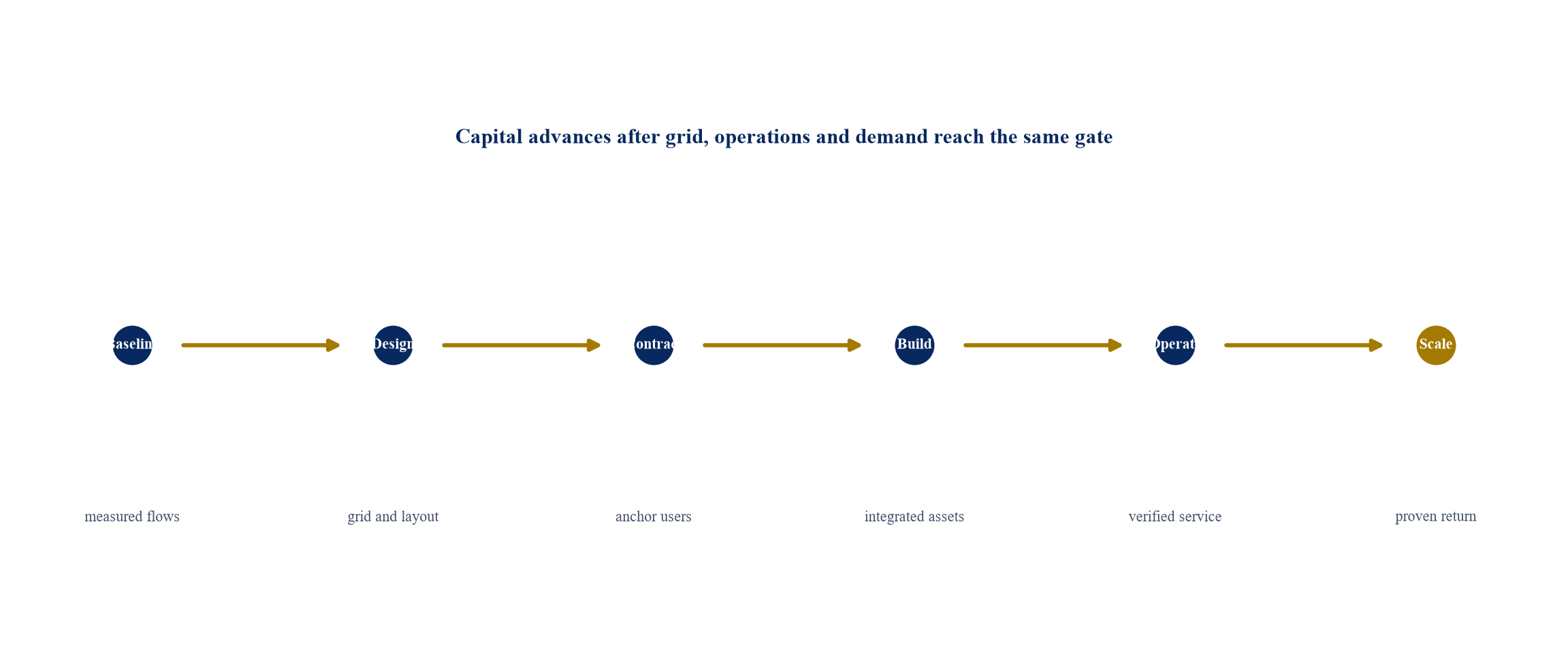
Proposed governance framework; timing requires hub-specific adaptation.
35. Set completion tests
Grid completion should confirm capacity, protection, quality and control. Traction completion should confirm safe supply and train integration. Terminal completion should confirm chargers, equipment, meters and procedures.
Integrated tests should use representative operating conditions and failure scenarios. They should cover curtailment, emergency stop, communication loss and restart.
Financial completion can require permits, contracts, reserves, insurance, operator readiness and anchor-user effectiveness.
36. Monitor benefits
The dashboard should report throughput, dwell, energy, peak demand, fuel avoided, equipment availability, maintenance, delay, revenue and cash coverage.
Benefits should be compared with the approved baseline. Changes in volume or service should be separated from technology performance.
Public claims should use verified boundaries. Commercial and security-sensitive data should remain controlled.
37. Define expansion rules
Expansion should follow contracted volume, capacity utilisation, service performance and grid headroom. Triggers should identify when another charger, crane, feeder or storage module is required.
Lead times matter. Waiting until full capacity can create congestion. Building far ahead can create idle assets.
The programme should preserve modularity and standard interfaces. Future technology should not require full replacement where adaptation is practical.
38. Evaluate storage performance
Storage performance should be measured against its approved use. Peak shaving requires verified demand reduction. Resilience requires available energy during an outage. Grid service requires dispatch and settlement.
The model should update degradation, efficiency, cycling and warranty. Revenue stacking should reflect priority and actual market access.
Replacement reserve should match expected life. Residual value should be conservative without a demonstrated secondary market.
39. Integrate modal and land strategy
The hub's value can increase when rail, road, port and industrial land are planned together. Better access can attract warehousing and manufacturing.
Land uplift should remain separate from operating return unless the sponsor owns or contractually captures it. Planning and infrastructure obligations can absorb value.
The commercial plan should identify target cargo, tenant and service propositions. Energy capability supports the proposition but does not create demand alone.
40. Apply the investment-committee test
The committee should test whether demand, grid, technology, operations, contracts, capital and downside advance together. It should see an auditable baseline and whole-system model.
Approval should state stage, assets, capacity, capital, service outcomes, evidence, conditions and stop rules. Each benefit should be financial, contractual, public or conditional.
The committee should identify who funds delay and underperformance. Liquidity should match the residual exposure.
Table 2. Hub electrification investment scorecard
| Test | Approval evidence | Downside concern | Gate response |
|---|---|---|---|
| Demand | contracted flows and operating forecast | delayed ramp or concentrated customer | phase capacity and size debt conservatively |
| Grid | dated connection and load profile | delay, curtailment or high peak charge | flexible connection and staged assets |
| Technology | duty-cycle fit and supported equipment | underperformance or obsolescence | pilot, warranty and modular design |
| Operations | integrated process and simulation | bottleneck moves elsewhere | redesign interfaces before commitment |
| Commercial | enforceable tariff and service contracts | value remains external | secure capture or classify public benefit |
| Finance | funded contingency, reserves and stress | correlated delay and lower volume | reduce leverage and add liquidity |
| Execution | accountable programme and completion tests | fragmented ownership | central interface governance |
Proposed framework; conclusions require project-specific technical, legal, operational and financial review.
41. Implementation roadmap
The first 90 days should establish data, authority and options. Create the asset register, meter plan, throughput baseline, load study, grid request and stakeholder map. Select the initial operating problem.
The next phase should complete concept design, equipment duty analysis, storage use case, commercial terms, permits and model. It should compare staged alternatives.
Major procurement should follow an integrated design freeze and evidence of demand, capacity and funding. Commissioning should precede scale.
42. Structure the financing
The financing structure should follow the assets and contracted cash flow. Utility and common electrical infrastructure may sit on the hub owner's balance sheet or within an infrastructure project company. Mobile equipment can use asset finance. Solar and storage can use a service or power-purchase structure. Tenant-specific works can be funded through contributions or lease adjustments.
Project debt requires durable rights, defined tariffs, completion coordination and sufficient contracted revenue. Corporate finance may be simpler when the sponsor has strong credit and the hub's cash flows are integrated. Public or climate support can fund enabling infrastructure and economic benefits that the project cannot capture privately.
Tenor should reflect concession, customer contracts, equipment life and replacement cycles. Debt for civil and grid assets can be longer than finance for batteries or mobile equipment. A consolidated model should avoid using short-lived equipment cash flow to support long-dated debt without replacement funding.
Security and direct agreements should cover material land, connection, construction, operating and anchor-user contracts where permitted. Lenders need notice and cure rights. Enforcement should preserve safe railway and electrical operation.
43. Size liquidity and reserves
The programme needs liquidity for construction overrun, grid delay, commissioning, throughput ramp and equipment failure. A single contingency percentage can conceal different risks. Allocate reserves to defined exposures and release them against evidence.
Interest during construction should cover the realistic integrated completion date. A grid or traction delay can postpone revenue after other packages are complete. Sponsor support, delayed draw and contractor security should match the residual exposure.
Operating reserves can cover debt service, major maintenance, battery replacement and market settlement. The required level depends on contracted payments, asset reliability and repair lead time. A hub with one critical transformer or crane may need spares or greater liquidity.
Treasury should also model collateral and margin requirements under electricity hedges. A hedge can reduce long-term price risk while creating short-term cash calls. Liquidity stress should combine operating and financial obligations.
44. Protect railway and electrical safety
Electrification changes hazards across the terminal. The safety case should address high voltage, overhead lines, vehicle movement, lifting equipment, battery fire, emergency isolation, maintenance and contractor access. Railway rules, electrical codes, fire requirements and occupational safety can overlap.
The design should define exclusion zones, earthing, interlocks, isolation authority, permits to work and emergency response. Charging areas need traffic segregation and equipment protection. Storage needs detection, ventilation or suppression appropriate to the technology and jurisdiction.
Operational procedures should cover degraded modes. A failed charger, feeder or communications link should lead to a safe and practical response. Diesel backup or mobile equipment may remain during transition, introducing mixed-fleet procedures.
Completion tests should involve the infrastructure manager, operator, utility, emergency services and tenants as required. A technically energised system is not commercially complete until personnel can operate and recover it safely.
45. Plan the workforce transition
Electric traction, battery systems, power electronics and energy management require different skills. The workforce plan should identify roles, competence, certification, recruitment and training. It should cover operators, maintainers, control-room staff, emergency teams and contractors.
Training has operating and scheduling cost. Staff need practical drills and supervised experience, not only classroom instruction. Shift coverage and absence should be considered before launch.
The transition may change work content and staffing patterns. Early engagement can identify safety, productivity and industrial-relations issues. The business case should not assume labour savings until roles, agreements and service levels are established.
Local capability improves repair time and resilience. Supplier support should include knowledge transfer, documentation, diagnostic access and spares. Long-term dependence on a remote specialist can increase downtime and lifecycle cost.
46. Integrate digital operations
An electrified hub benefits from a shared operating picture covering train arrivals, lift plans, truck bookings, equipment state, charger availability, battery state, building load and grid constraints. The platform should support dispatch while preserving clear human authority.
Data interfaces should use documented standards and ownership. Vendors may control equipment telemetry. Contracts should provide the access required for operations, warranty, performance and future replacement.
Cybersecurity is a safety and continuity issue. Segmentation, identity, patching, backups, incident response and supplier access should be designed with the control system. A compromised energy platform must not expose signalling or critical railway systems.
Analytics should begin with reliable data and defined decisions. Forecasting train and truck arrivals can improve charging schedules. Predictive maintenance can reduce downtime where failure data and intervention processes exist. Benefits should be measured against a baseline.
47. Allocate the principal risks
Risk should sit with the party that controls it, can price it and can withstand it. The utility controls defined connection obligations. Contractors control their design and workmanship. The operator controls dispatch within network and customer constraints. Customers control committed volumes subject to service performance.
Some risks remain shared. Grid delay may affect contractors and users. Throughput depends on corridor performance, terminal service and customer demand. Energy price depends on market and tariff design. Contracts should define relief, compensation and termination rather than leave gaps.
Transfer has limits. A contractor liability cap may be small relative to lost throughput. A long-term customer commitment has value only if the counterparty performs. Insurance has exclusions and waiting periods. The model should retain untransferred risk.
Table 3. Proposed hub-electrification risk-allocation matrix
| Risk | Natural owner | Contract mechanism | Evidence for capital release |
|---|---|---|---|
| Grid connection and reinforcement | utility and sponsoring hub within control | dated connection agreement, milestones and relief | accepted offer and credible delivery plan |
| Traction and equipment design | asset owner, integrator and suppliers | performance specification, warranty and security | approved design and factory tests |
| Construction interface | programme sponsor and package contractors | interface matrix, access plan and integrated schedule | coordinated design freeze and funded contingency |
| Throughput ramp | hub, rail operators and anchor users | minimum volume, availability and service standards | executable commitments and corridor capacity |
| Energy price and network charges | allocated through tariff and procurement | pass-through, hedge, cap or indexed price | approved strategy and combined stress test |
| Storage performance | owner, integrator and operator | capacity, efficiency, degradation and availability guarantee | witnessed test and operating protocol |
| Operational availability | hub operator and maintainers | service levels, spares, response and service credits | staffed O&M plan and recovery exercise |
| Regulation and permits | sponsor and public authorities within control | conditions precedent and change-in-law provisions | complete permit register and approvals |
Proposed framework; allocation requires project-specific legal, technical, commercial and credit review.
48. Test the business case against alternatives
The committee should compare the integrated programme with credible alternatives. These may include continued diesel operation, partial electrification, equipment replacement without storage, managed connection, temporary mobile charging or a different terminal layout.
Each alternative should deliver the same service boundary. Comparing an integrated hub with an option that omits growth or compliance can bias the decision. The analysis should state what happens to throughput, reliability and future capital under each path.
Option value can justify preparatory works such as ducts, land reservation, switchgear space or adaptable equipment. The option should have a cost, exercise condition and expiry. A vague future benefit is not sufficient.
The preferred case should remain robust under lower volume and adverse energy prices. If return depends on every benefit arriving at once, staging may improve risk-adjusted value. The investment committee should see which components are essential, optional and contingent.
49. Sequence the first 24 months
Months one to three should complete the operating baseline, load metering, asset register, grid request, customer interviews and initial safety review. The sponsor should appoint one programme owner and establish the integrated data room.
Months four to nine should complete concept engineering, load and storage studies, fleet duty analysis, terminal simulation, commercial options, permits and delivery packaging. Anchor users should receive term sheets linked to service and capacity.
Months ten to fifteen should finalise design, contracts, finance, procurement and construction staging. Long-lead orders should follow approved interfaces and funded contingency. Enabling works can proceed where they preserve options and do not force an unapproved final design.
Months sixteen to twenty-four should deliver the first integrated stage, train personnel, conduct factory and site tests, commission representative operations and establish benefit monitoring. Expansion approval should use actual service, energy and financial evidence from that stage.
50. Limitations
This paper provides a general decision framework. It does not provide legal, regulatory, railway-safety, engineering, grid, environmental, tax, accounting, insurance, investment, valuation or credit advice.
Rail systems, grids, tariffs, technology, regulation, freight markets and public funding differ by jurisdiction. Published examples do not prove the performance or financeability of another hub.
The availability and quality of operating data also vary. Energy meters may not align with train, cargo or equipment records. Fuel savings, maintenance improvements and dwell reductions can be affected by unrelated changes in traffic, staffing, route performance or customer mix. A project-level benefit study should define its baseline, counterfactual, measurement period and attribution method before investment approval. Economic benefits such as congestion, air quality, road maintenance and regional development may be material while remaining outside the sponsor's enforceable revenue. Those benefits require a separate appraisal and an explicit public-funding or value-capture decision.
All numerical exhibits are hypothetical. They are not forecasts, offers, valuations, credit opinions or evidence concerning an identified hub, operator, borrower or transaction.
51. Conclusion
Hub electrification is an operating-system investment. Traction power, terminal equipment, trucks, buildings, generation and storage share the same grid and schedule. Separate business cases can overbuild capacity, miss constraints and double-count benefits.
A credible strategy begins with measured throughput, energy and bottlenecks. It selects technology by duty, builds an hourly load profile, values financial and public benefits separately, and allocates completion and operating risk through contracts.
Capital should advance in stages. The hub scales after grid, assets, operations and demand demonstrate whole-system performance. This discipline converts electrification from an equipment list into a controlled logistics and energy platform.
Appendix A. Investment-committee questions
1. Which physical and commercial assets define the hub boundary?
2. Which throughput is contracted, probable and strategic?
3. Where is the current operating bottleneck?
4. Which traction technology fits the corridor and duty?
5. What are the normal and peak electrical loads?
6. When can the grid connection be delivered?
7. Which equipment replacement cycles support staging?
8. Which storage use case has measured value?
9. How are train, crane, truck and building loads coordinated?
10. Which energy and fuel prices drive the economics?
11. Which maintenance and reliability benefits are evidenced?
12. Can additional throughput be sold and delivered?
13. Which modal-shift and land benefits enter project cash?
14. Which contracts support debt and capital recovery?
15. Who bears grid, volume, price and completion risk?
16. How does combined downside affect cash and coverage?
17. Which permits and access rights survive financing?
18. Which integrated tests define completion?
19. Which metrics prove benefit realisation?
20. Which evidence releases the next stage?
References
- International Energy Agency, The Future of Rail, January 2019. https://www.iea.org/reports/the-future-of-rail
- World Bank, Transforming Logistics: The Power of Rail Investment, 28 August 2025. https://www.worldbank.org/en/results/2025/08/28/transforming-logistics-the-power-of-rail-investment
- World Bank, Railways as a Low-Carbon and Efficient Transport Solution, 2023. https://documents1.worldbank.org/curated/en/099063023170016545/pdf/P1748630c1d3630a80876405ecad08e27f8.pdf
- Network Rail, Traction Decarbonisation Network Strategy: Executive Summary, September 2020. https://www.networkrail.co.uk/wp-content/uploads/2020/09/Traction-Decarbonisation-Network-Strategy-Executive-Summary.pdf
- International Energy Agency, Electricity 2026: Grids, 2026. https://www.iea.org/reports/electricity-2026/grids
- Network Rail, Traction Decarbonisation Network Strategy: Interim Programme Business Case, September 2020. https://www.networkrail.co.uk/wp-content/uploads/2020/09/Traction-Decarbonisation-Network-Strategy-Interim-Programme-Business-Case.pdf
- Network Rail, Supporting the delivery of net zero, accessed 3 October 2026. https://www.networkrail.co.uk/sustainability/a-low-emission-railway/
- Network Rail, Long-term planning, accessed 3 October 2026. https://www.networkrail.co.uk/our-work/long-term-planning/
- World Bank, Global Facility to Decarbonize Transport: Grantees, accessed 3 October 2026. https://www.worldbank.org/en/programs/global-facility-to-decarbonize-transport/grantees
- International Energy Agency, Electrification, 22 September 2026. https://www.iea.org/reports/electrification
- International Energy Agency, Batteries and Secure Energy Transitions, April 2024. https://www.iea.org/reports/batteries-and-secure-energy-transitions
- European Union Agency for Railways, TSI package 2022 recommendation, accessed 3 October 2026. https://www.era.europa.eu/content/recommendation-era1175-1218-european-union-agency-railways-tsi-package-2022-relating_en
- European Commission, Sustainable and Smart Mobility Strategy, December 2020. https://transport.ec.europa.eu/transport-themes/mobility-strategy_en
- International Transport Forum, ITF Transport Outlook 2023, OECD, 2023. https://www.itf-oecd.org/itf-transport-outlook-2023
- World Bank, Unlocking Green Logistics for Development, 2024. https://www.worldbank.org/en/topic/transport/publication/unlocking-green-logistics-for-development
- International Union of Railways, Rail Sustainability Index, accessed 3 October 2026. https://uic.org/sustainability/
- European Commission, Rail Freight Corridors, accessed 3 October 2026. https://transport.ec.europa.eu/transport-modes/rail/infrastructure/rail-freight-corridors_en
- European Investment Bank, Rail transport overview, accessed 3 October 2026. https://www.eib.org/en/projects/sectors/transport/railways
- International Renewable Energy Agency, Electricity Storage Valuation Framework, 2020. https://www.irena.org/publications/2020/Mar/Electricity-Storage-Valuation-Framework-2020
- World Bank, Railway Reform: Toolkit for Improving Rail Sector Performance, accessed 3 October 2026. https://www.worldbank.org/en/topic/transport/publication/railway-reform-toolkit-for-improving-rail-sector-performance
About the Author
Authored by Chennakeshav Adya Independent Researcher
Chennakeshav (CK) is a corporate finance and investment banking executive with 25+ years of global experience in deal origination, structuring and execution across M&A, growth capital and corporate strategy. He has led value-creation mandates for founders, corporates and funds — bridging the boardroom view to hands-on execution and close.
His career spans Morgan Stanley, HSBC, Lloyds Banking Group, EWEC, ADQ portfolio companies and Emirates Growth Fund, across TMT, real estate, fintech, deeptech, cleantech, infrastructure and energy. He has partnered with C-suite leaders, private equity and venture funds, sovereign wealth funds and family offices to finance complex fund raises and scale-up ventures, and has led M&A due diligence, post-merger integration and business-transformation initiatives to create value.
At Matchpoint Partners he is Managing Partner, leading the firm's corporate finance, M&A and capital-raising practice. He holds an MBA from London Business School, an engineering degree from VTU and a Master of Laws (LLM, in progress) from UCL London.
An active start-up mentor, CK mentors at Techstars, DIFC FinTech Hive, Startup Grind, Founder Institute and IN5, serves as Entrepreneur Mentor in Residence (EMiR) at London Business School, and judges the Entrepreneurship World Cup.
Matchpoint profile: https://www.matchpoint-partners.com/team/ck-adya.html LinkedIn: https://www.linkedin.com/in/ckadya/
