

1. Treat reasoning as a production decision
Traditional SaaS analysis often begins with recurring revenue, gross retention, net revenue retention, gross margin, sales efficiency and cash generation. The model assumes that software can serve an additional user at a small marginal cost. Cloud hosting, support and third-party services remain relevant, yet the economic story usually rests on substantial operating leverage.
Reasoning software adds another production decision. The product can allocate more inference effort to a task before returning an answer. A harder legal review, engineering diagnosis, financial analysis or research request may receive a larger reasoning budget, more tool calls, more candidate paths or additional verification. A routine extraction or classification can receive a smaller budget. Management therefore controls part of the direct cost at the moment of service.
The decision should begin with customer value. A product should not spend ten times more because a model can think longer. It should spend more when the expected improvement in accepted outcome, avoided loss, time saved, revenue created or risk reduced exceeds the complete incremental cost and remains inside the product's safety and service envelope.
OpenAI's o1 research described performance improvements with additional test-time compute.[1] Google documents thinking controls and states that thinking tokens can be included in output pricing.[2] Anthropic documents extended thinking and explains the treatment of thinking tokens within its service.[3] These provider mechanisms differ, and the applicable documentation and contract at the transaction date remain authoritative. Their common commercial implication is that reasoning intensity can be an explicit product variable.
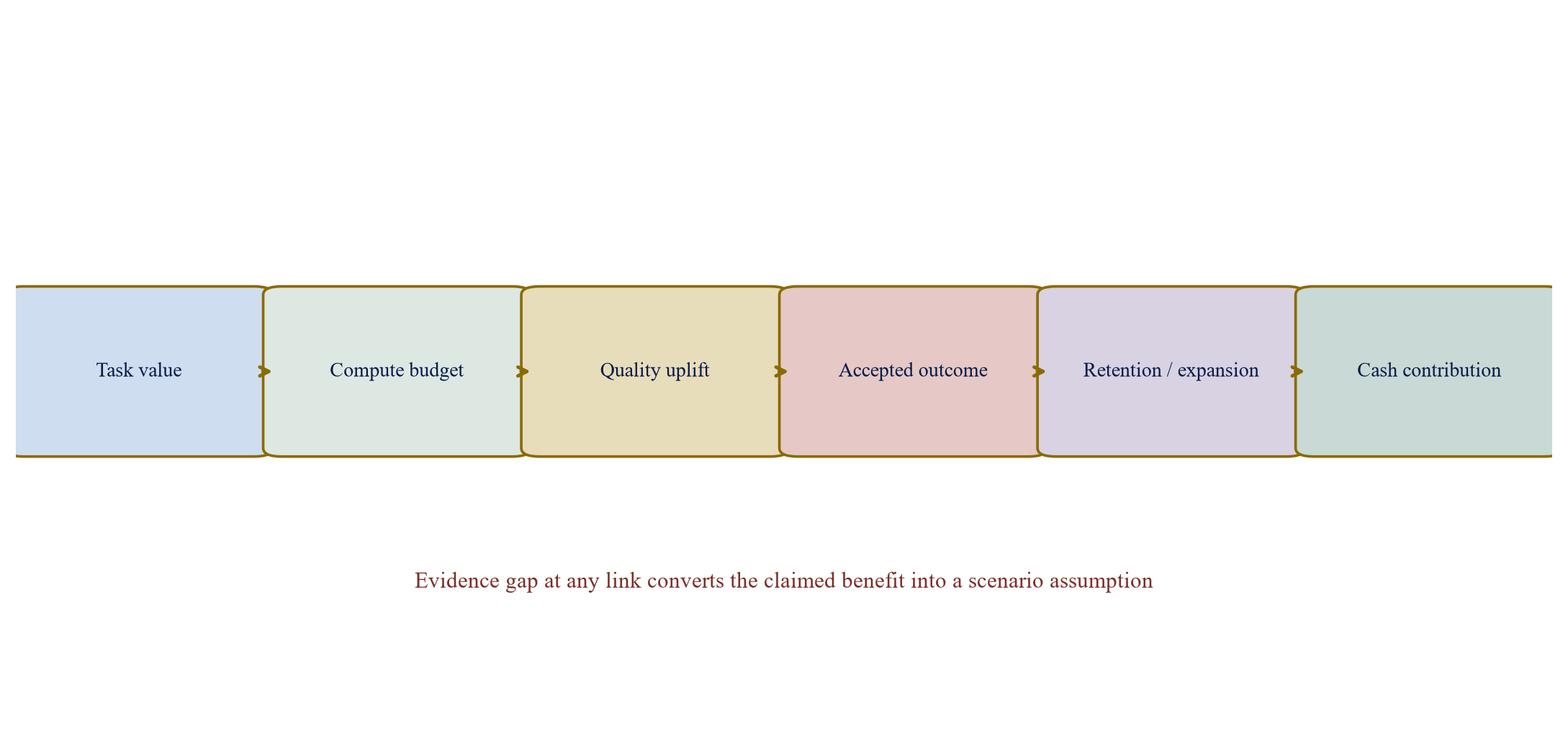
Author framework. Each link requires observable evidence before higher compute is credited with higher enterprise value.
2. Define the task before measuring the token
A defensible unit model begins with a task taxonomy. “AI request” is too broad. The same user can ask for a two-line rewrite, a contract comparison, a multi-source market study or an agentic sequence that changes a business system. Each task has a different value, risk, latency tolerance, evidence requirement and cost envelope.
The taxonomy should be stable enough for finance and commercial teams to use. Product events should record the task class, customer, package, model route, reasoning setting, tool calls, attempts, evaluation result, latency, direct review and final acceptance. The taxonomy can evolve through controlled versioning. Silent changes weaken cohort comparisons and transaction diligence.
| Task class | Customer promise | Typical consequence | Reasoning policy | Commercial treatment |
|---|---|---|---|---|
| Routine assist | draft, classify, summarise or extract | low and reversible | bounded model and low effort | included within seat allowance |
| Professional analysis | compare evidence and explain a recommendation | material decision support | higher effort, retrieval and cited sources | reasoning credits or premium tier |
| Controlled decision support | analyse a consequential regulated or financial question | high consequence with human accountability | approved route, verification and mandatory review | premium workflow or outcome fee |
| Agentic execution | plan and perform permitted multi-step actions | operational side effects | tool limits, confirmation, rollback and audit trail | metered run plus service commitment |
| Exceptional investigation | ambiguous, cross-domain or high-volume problem | high value and uncertain effort | explicit budget, checkpoint and stop rule | scoped project or separately approved overage |
The taxonomy should be versioned and reconciled to product, finance and commercial systems.
Task classification should happen before routing. A customer label alone is insufficient. One enterprise account can contain routine and consequential work. Contracting should define which tasks are included, which require premium credits and which remain outside the automated service.
3. Measure incremental quality, not theatrical effort
More reasoning can improve some tasks. It can also add latency, verbosity and cost without changing customer acceptance. The product therefore needs a quality-response curve by task class.
The curve compares approved routes and effort settings on a versioned evaluation set. It should measure task success, factual support, instruction compliance, tool correctness, safety, latency and review effort. Customer acceptance and subsequent workflow completion provide essential production evidence. A laboratory score without customer behaviour is an incomplete commercial measure.
The relevant metric is incremental accepted value per incremental complete cost. Suppose a medium reasoning setting improves an approved professional-analysis task from 76 per cent to 86 per cent acceptance, while a high setting improves it from 86 per cent to 88 per cent. The medium increment may be economic. The high increment may serve only high-value or high-consequence work. These percentages are illustrative and require company-specific evidence.
Evaluation design should protect against contamination and selection bias. Historic accepted answers can inform a benchmark, subject to rights and privacy controls. New cases should be held out. Reviewers need defined rubrics and agreement testing. Production samples should be stratified by task, customer and difficulty. Version changes require regression testing before economic assumptions are rolled forward.
4. Build a task-value router
A task-value router combines technical policy with commercial policy. It asks how much the task is worth, what can go wrong, which quality threshold applies and how much complete cost the package can support. The router then selects an approved model, reasoning level, retrieval method, tool set and verification path.
The router can use deterministic rules for high-consequence categories and learned predictions for bounded low-risk tasks. It should retain clear override, monitoring and rollback. Routing purely to the cheapest model can damage quality. Routing every task to the most capable model can destroy contribution margin. The objective is the lowest complete cost that meets the approved outcome standard for that task and customer promise.
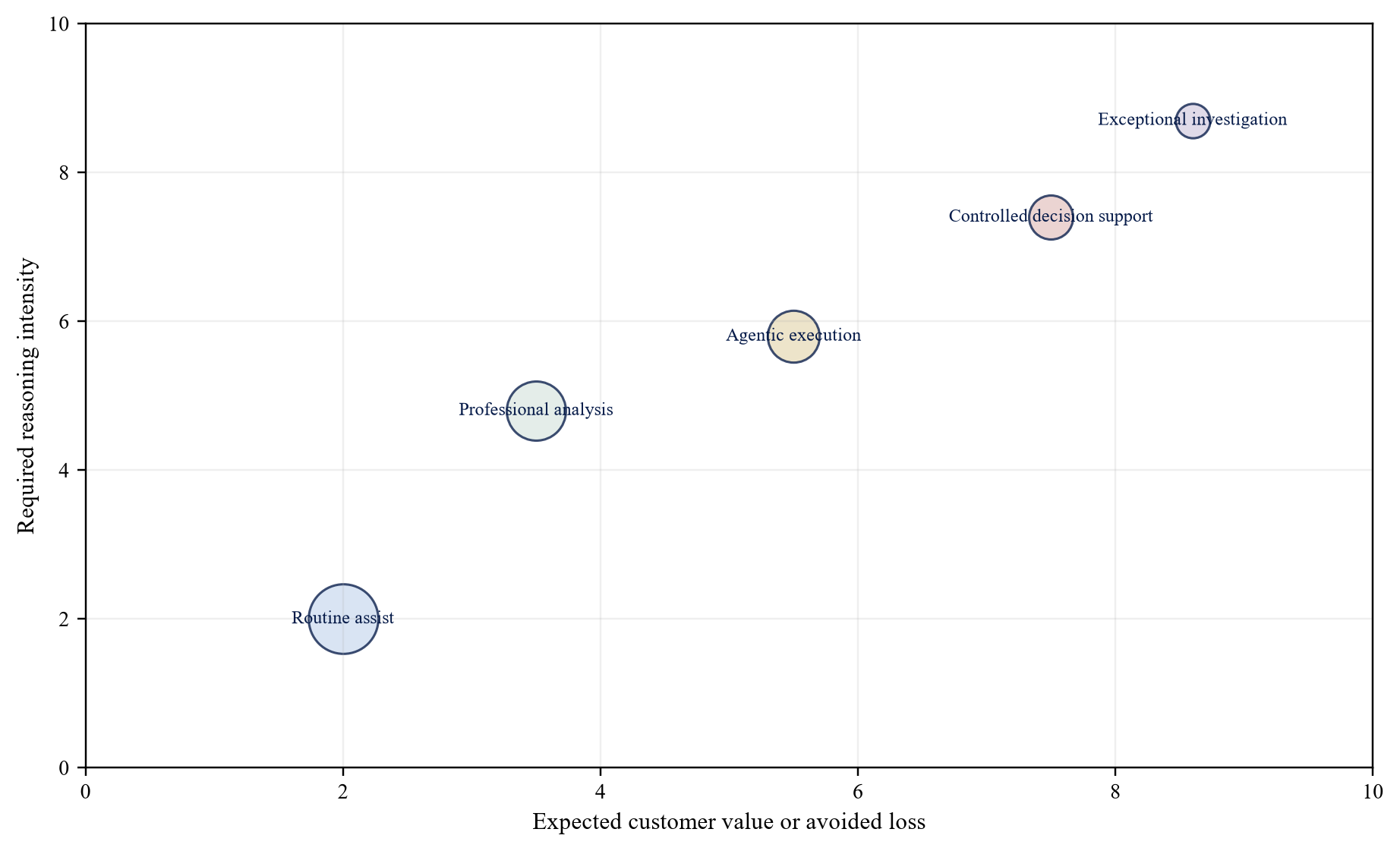
Author framework. Bubble size represents hypothetical task volume; positions are illustrative.
The router should record rejected routes and fallbacks. A preferred route may fail because of availability, rate limits, regional constraints or an evaluation regression. Fallback economics belong in the base model when they occur regularly. Rare disaster recovery can remain a separately weighted scenario.
5. Construct the complete reasoning ledger
Provider output or thinking tokens are only one cost layer. The reasoning ledger should include foundation-model input and output, cached input, retrieval, reranking, search, code execution, external APIs, storage, data transfer, orchestration, evaluation, safety, observability, failed attempts and direct human review. Capacity commitments and minimum spends should be allocated according to a documented policy.
| Ledger field | Measurement source | Economic purpose |
|---|---|---|
| Customer and contract | CRM, order form and billing system | connects task cost to realised price and package |
| Task class and risk tier | product event and policy register | determines route and control requirement |
| Model and reasoning setting | orchestration trace | measures chosen production intensity |
| Input, output and thinking units | provider usage export | reconciles technical consumption to invoice |
| Retrieval and tool calls | trace and vendor invoice | captures non-model variable cost |
| Attempts, retries and fallbacks | workflow trace | identifies failure and reliability cost |
| Evaluation and control cost | evaluation log and service bill | prices the approved quality and safety envelope |
| Direct review minutes | workflow and time record | captures required human delivery work |
| Accepted outcome | product event and customer action | supplies the economic denominator |
| Collected or recognised revenue | finance ledger | supplies the contribution numerator |
Inclusion and allocation depend on the service and documented accounting policy.
Finance should reconcile a sample from customer contract through task event, provider meter, invoice, evaluation and collection. Allocation choices should be documented and consistent. If evaluation or human review is required to deliver the contracted service, it should be visible in product contribution even when statutory presentation uses another line.
6. Separate reasoning contribution from reported gross margin
Reported gross margin is governed by the company's accounting policy and applicable standards. Transaction analysis can add a management measure called reasoning contribution margin. The measure deducts the complete direct cost of delivering accepted outcomes from the relevant revenue. It should be reconciled to reported financial statements and presented consistently.
The measure needs cohort views. Aggregate improvement can hide deterioration in recently acquired customers, discounted enterprise contracts or heavy users. Cohorts can be grouped by start quarter, package, task mix, geography, model route or sales channel. A durable business should show that mature cohorts produce stable or improving accepted value and cash contribution after required controls.
Reasoning contribution should also separate fixed and variable commitments. A reserved capacity contract can lower effective cost at high utilisation and increase cost at low utilisation. The model should show consumed capacity, unused capacity, overflow, renewal rights and termination exposure. Credits and temporary incentives should be excluded from the mature run-rate case unless contractually durable.
7. Design a pricing architecture that makes value legible
Pure seat pricing remains useful when customers value predictable procurement and usage variance is modest. Reasoning-intensive products need an internal usage ledger even if the customer sees a simple subscription. Without that ledger, growth in deep tasks can turn a successful product into a margin surprise.
A hybrid architecture can preserve simplicity. The subscription grants access, workflow features and an included reasoning allowance. Premium tasks consume published or contract-specific credits. Overage can be purchased or paused. High-consequence workflows can carry separate pricing because they include verification, audit evidence and human accountability. Outcome pricing can apply where the result is objectively measurable and legal, regulatory and incentive questions are addressed.
| Package component | Customer value | Cost protection | Evidence required |
|---|---|---|---|
| Base seat | access, collaboration and routine assistance | included task and credit allowance | active use and routine cost distribution |
| Reasoning credits | transparent access to deeper analysis | maps premium effort to economic unit | credit consumption and accepted outcome |
| Overage | flexibility beyond included allowance | prevents unlimited variable cost | notice, limit, price and approval trail |
| Premium workflow | controlled consequential analysis | funds verification, audit and review | service definition and control record |
| Outcome fee | payment linked to defined result | aligns price with measurable value | objective measure, attribution and contract |
| Enterprise commitment | predictable capacity and service | supports planning and minimum revenue | committed volume, true-up and renewal terms |
Commercial design should align customer value, contract clarity and delivery economics.
Credits should correspond to a stable commercial entitlement rather than expose raw provider tokens. A provider can change tokenisation, model architecture or price. The product should preserve the right to update the conversion schedule with notice and customer protection. Contract language requires qualified legal review.
8. Model usage elasticity before promising margin expansion
A lower price per generated unit does not translate mechanically into higher margin. Customers can ask more questions. Product teams can add longer context, more agents, more retries and richer output. A cheaper model can make previously uneconomic workflows viable. These effects can increase total consumption even as the unit rate falls.
The forecast should separate four elasticities. Task-frequency elasticity measures how many more tasks users initiate when the service improves or becomes less constrained. Reasoning-intensity elasticity measures the change in compute per task. Quality elasticity measures the change in accepted outcomes from additional effort. Price elasticity measures the customer's response to package price and included allowance.
Management can test elasticity with controlled package experiments. The test should avoid consequential workflows where experimentation could create unacceptable risk. It should measure activation, accepted outcomes, retention signals, expansion, cost and support. A favourable result has more customer value and more retained contribution, rather than merely more tokens.
The experiment design should distinguish an allowance effect from a capability effect. A larger included allowance can increase use even when the underlying product has not improved. A stronger reasoning route can improve acceptance without increasing task frequency. A price reduction can stimulate use while reducing realised revenue. Randomised or phased tests can help management separate these effects where customer contracts, sample size and risk permit.
Finance should translate experiment results into a monthly contribution bridge. The bridge begins with observed customer price and task mix, applies the measured change in frequency and intensity, includes all route and control costs, and then applies the observed customer response. Management should report confidence intervals or sample limitations where relevant. A short test with self-selected power users should not be extrapolated automatically to the entire customer base.
9. Connect quality to retention and expansion
Valuation requires a commercial bridge from model performance to customer behaviour. An evaluation uplift creates enterprise value only when it influences adoption, renewal, expansion, pricing or risk. The bridge can be measured through task-level acceptance, repeated use, workflow completion, saved time, avoided error and economic outcome.
Retention analysis should distinguish product dependency from promotional usage. A customer may experiment heavily during onboarding and then disengage. Another may use fewer tasks because the product resolves them efficiently. Simple request count can misclassify both customers. Cohort reporting should combine active qualified users, completed workflows, accepted outcomes, customer value indicators, realised price and complete cost.
Net revenue retention can be decomposed into seat expansion, package upgrade, reasoning-credit consumption, contractual price, contraction and churn. This decomposition reveals whether AI value is broadening the account or merely increasing variable consumption within a fixed contract. Sales compensation should reward durable contribution and collection, subject to appropriate governance, rather than uneconomic usage growth.
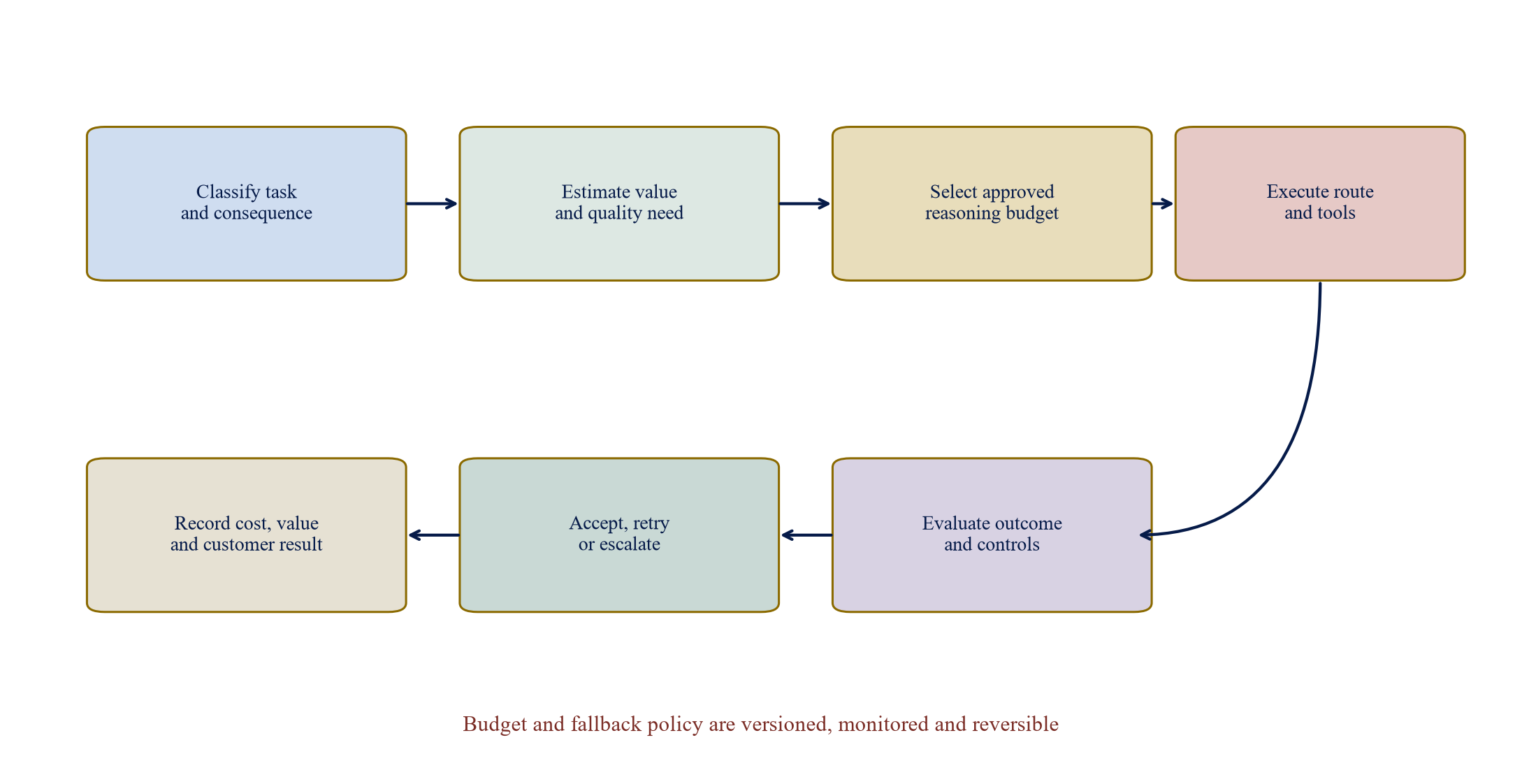
Author framework. High-consequence tasks retain mandatory controls and human accountability.
10. Price latency, reliability and evidence
Deep reasoning can increase latency. Some workflows tolerate minutes or hours; others require interactive response. Premium service therefore includes more than answer quality. It can include queue priority, completion time, audit evidence, data location, failover and support.
The product should measure end-to-end latency by percentile, including retrieval, tools, retries, evaluation and review. Average latency can hide a damaging tail. Contracts should align service commitments with the actual route, capacity and fallback architecture. Service credits, penalties and customer remedies belong in the unit model.
Reliability can alter both cost and retention. A failed long-running task wastes model and tool spend and can require human recovery. Checkpointing, idempotent tools, bounded retries, fallbacks and clear stop conditions can improve completion economics. These mechanisms create engineering and infrastructure cost, so their benefit should be measured through avoided failures and protected customer value.
Evidence is a product feature in professional work. Citations, traceability, version history, approval records and reproducible calculations can justify a premium when they reduce customer review burden or support governance. The claims should be validated with observed willingness to pay and customer behaviour.
11. Govern provider and model concentration
A reasoning product can depend on one provider's capability, price, region, throughput or safety controls. A multi-provider claim is meaningful only when an alternate route meets the required quality, latency, data and tool standards. A dormant integration that fails current evaluations does not create operating resilience.
The board should receive a provider concentration register. It should show spend, tasks, customers, regions, data categories, minimum commitments, service performance, termination rights, deprecation exposure and tested alternatives. Switching cost includes prompt and workflow redesign, evaluation, regression, customer validation, migration and commercial disruption.
Open models or self-hosting can improve control for selected workloads. They also introduce infrastructure, optimisation, security, model-management and talent requirements. The make-or-buy decision should compare complete cost at representative load and the value of control. It should include the cost of maintaining quality through model and data change.
12. Protect the product contract
Commercial terms should define the service rather than promise an abstract level of intelligence. Relevant terms can cover task scope, usage allowance, credits, overage, service level, permitted data, retention, output responsibility, human review, audit evidence, model change, third-party providers and termination.
Price-adjustment language matters when provider rates, product architecture or regulatory requirements change. A customer needs predictability. The supplier needs protection against unlimited reasoning or new control cost. Minimum commitments, fair-use rules, budget alerts, admin controls and renewal adjustments can allocate the risk transparently.
Material consequential use requires explicit responsibility. The product can support analysis while the authorised person retains the decision. Contract language, user experience, workflow controls and operating practice should agree. A disclaimer that conflicts with product design or sales claims may provide weak protection.
Renewal mechanics deserve specific attention. If the supplier can change credit conversion, model route or fair-use thresholds, the customer may seek notice, termination or price protection. If the customer can roll unused credits indefinitely, the supplier may accumulate a delivery obligation whose future cost is uncertain. Contract design should align commercial flexibility with accounting, customer trust and operational capacity.
Enterprise procurement can also require committed throughput, dedicated environments or regional processing. These features can turn a nominally variable service into a capacity business. The order form should identify which capacity is reserved, how it is measured, what happens during provider interruption and who bears unused or overflow cost. The economic model should use the same definitions.
13. Align revenue and cost recognition
Pricing innovation does not remove accounting requirements. IFRS 15 requires an entity to identify the contract, performance obligations, transaction price, allocation and revenue recognition pattern under the standard.[44] A subscription, reasoning credits, implementation, premium support and outcome payment may create different accounting questions depending on the contract.
Unused credits, expiry, refunds, rollover and material rights require careful analysis. Outcome fees can contain variable consideration. Enterprise commitments may include service levels or other obligations. Management should obtain current professional advice and maintain an accounting memorandum that agrees with product configuration and invoicing.
Cost classification also needs consistency. Provider compute that directly delivers the service normally belongs in the economic contribution calculation. Product development, research and general platform work require a documented policy. Direct human review should be visible even when the statutory line differs. Investors need a reconciliation from the management measure to audited or reviewable accounts.
14. Treat governance cost as part of the product
The NIST AI Risk Management Framework and its Generative AI Profile organise governance around govern, map, measure and manage.[11][12] ISO/IEC 42001 specifies requirements for an AI management system.[50] Applicable legal and sector obligations vary by product and jurisdiction. The economic model should fund the required controls rather than assume compliance appears without cost.
Control intensity should follow the task. Routine drafting can use proportionate evaluation and monitoring. Consequential financial, legal, employment, health, safety or infrastructure analysis may require stronger data controls, validation, human review, logging and incident response. The product should identify restricted and prohibited uses and enforce them through system design.
Governance can create commercial value when it helps customers adopt the service. An enterprise buyer may pay for evidence, control, security and accountability. The company should track whether these features shorten sales cycles, support renewals or justify premium pricing. Unsupported claims remain scenarios.
15. Hypothetical enterprise-software case
Consider a hypothetical enterprise analysis platform serving finance, legal and operations teams. The platform sells annual seats with an included reasoning allowance and premium credits. All numbers in this section are management assumptions for illustration. They do not describe a named company or market forecast.
The base month has 1,000 seats at an average realised subscription price of AED 1,400 per seat per month, producing AED 1.4 million of recognised subscription revenue. Customers also buy AED 180,000 of premium reasoning credits. Total monthly revenue is AED 1.58 million. The product processes 90,000 routine tasks, 18,000 professional analyses and 2,000 controlled decision-support tasks.
Complete direct cost includes models, retrieval, tools, infrastructure, evaluation, safety, observability, customer-specific environments and required review. The base month incurs AED 632,000 of direct cost and produces AED 948,000 of reasoning contribution, or 60.0 per cent.
| Metric | Base month assumption | Month twelve case | Evidence gate |
|---|---|---|---|
| Seats | 1,000 | 1,340 | active contracted seats and collection |
| Subscription revenue | AED 1,400,000 | AED 1,943,000 | invoice, recognised revenue and realised discount |
| Premium-credit revenue | AED 180,000 | AED 356,000 | paid credits and accepted premium tasks |
| Total accepted tasks | 91,400 | 139,500 | product event and approved evaluation |
| Model and reasoning cost | AED 244,000 | AED 391,000 | provider usage and invoice reconciliation |
| Retrieval, tools and infrastructure | AED 138,000 | AED 205,000 | trace, cloud and vendor invoice |
| Evaluation, controls and direct review | AED 250,000 | AED 295,000 | test, control and workflow records |
| Complete direct cost | AED 632,000 | AED 891,000 | reconciled cost ledger |
| Reasoning contribution | AED 948,000 | AED 1,408,000 | total revenue less complete direct cost |
| Reasoning contribution margin | 60.0% | 61.2% | consistent accounting and allocation policy |
Every value is an illustrative management assumption for method demonstration.
The month-twelve case assumes more seats, a higher share of premium tasks, improved routing and less review per accepted task. It also assumes a small increase in average subscription price and higher credit purchases. Each assumption requires operating evidence. The margin gain is modest because more difficult work consumes more reasoning and control.
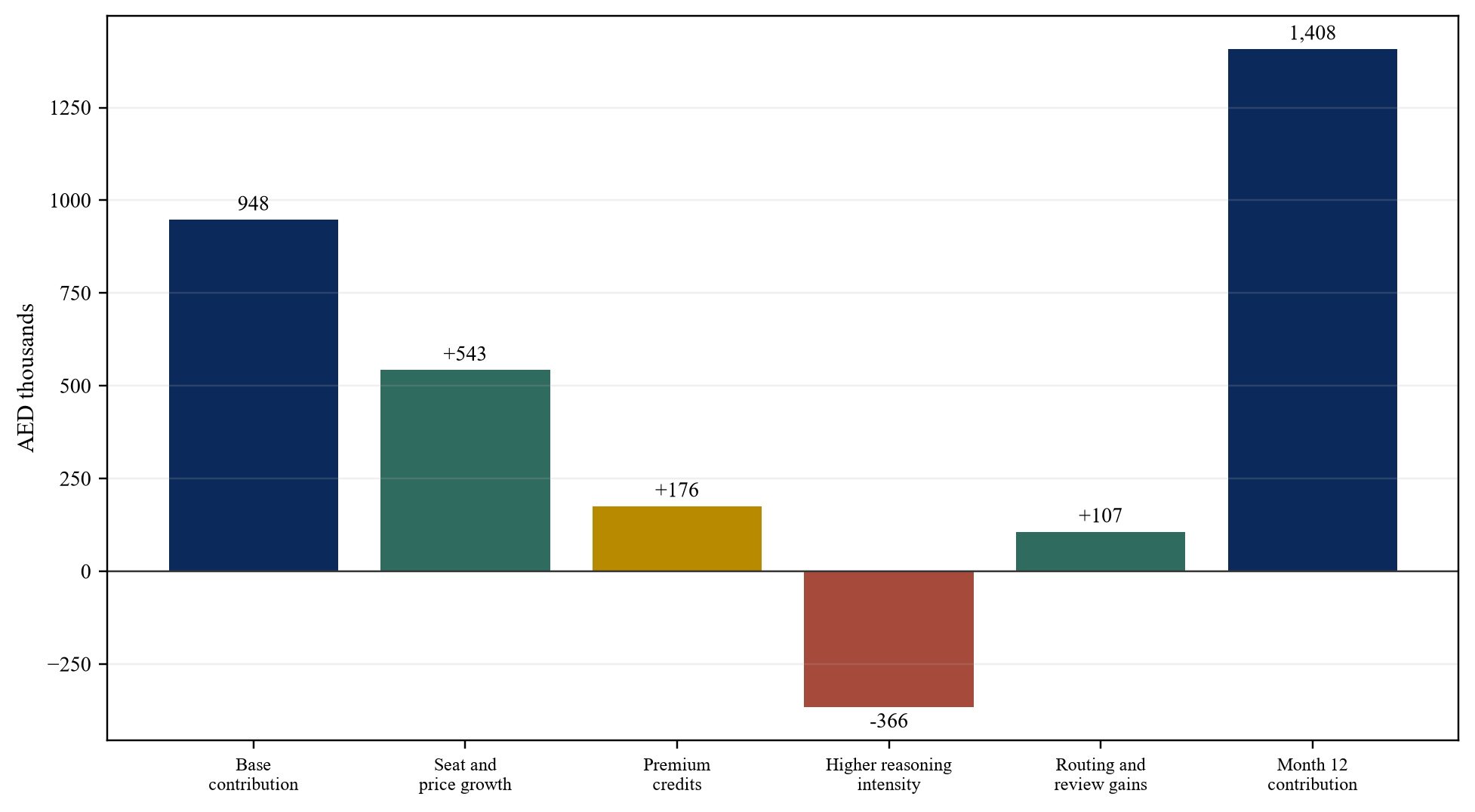
All values are illustrative management assumptions in AED thousands.
The bridge should be rebuilt with actual cohort and task data. The transaction case should not credit routing savings that have not passed production tests. It should not treat temporary provider credits as mature cost. It should include the cash required to build evaluation, telemetry and commercial packaging.
16. Stress the task mix, not only the provider price
The central downside is an adverse shift in task mix. Customers may discover that the product is most valuable for difficult work. Premium usage can grow faster than routine usage, while the contract remains seat-based and unlimited. Average provider cost per generated unit can fall at the same time that complete cost per seat rises.
The sensitivity model should vary reasoning intensity, acceptance, task frequency, realised price, direct review, provider rate and capacity utilisation independently. Correlations also matter. A quality problem can increase retries and human review while reducing retention. A capacity shortage can increase latency, trigger premium service charges and cause customer credits.
| Scenario | Realised price | Reasoning intensity | Accepted outcome rate | Complete direct cost | Contribution margin | Interpretation |
|---|---|---|---|---|---|---|
| Base assumption | index 100 | index 100 | 83% | AED 632k | 60.0% | illustrative current case |
| Premium mix with credit uptake | index 108 | index 132 | 87% | AED 755k | 62.1% | higher cost supported by price and acceptance |
| Unlimited-seat leakage | index 100 | index 145 | 84% | AED 814k | 48.5% | premium reasoning consumed inside fixed price |
| Quality regression | index 98 | index 118 | 70% | AED 792k | 48.9% | retries, review and concession pressure |
| Provider saving absorbed by use | index 96 | index 138 | 85% | AED 704k | 54.1% | lower unit rate does not reach margin fully |
| Controlled router | index 101 | index 92 | 84% | AED 558k | 65.0% | requires verified quality and customer response |
| Combined downside | index 90 | index 150 | 68% | AED 910k | 39.0% | liquidity and package redesign required |
Every value is an illustrative management assumption and requires company-specific evidence.
These figures are illustrative assumptions. A buyer or lender should replace them with actual contract, telemetry, invoice, evaluation and collection data. The downside should flow into cash runway, debt service, covenant headroom and funding need.
17. Rebuild valuation around durable contribution
Revenue multiples can provide market context, subject to comparability. They do not solve the reasoning-economics question. A buyer can normalise revenue and gross margin, construct a cash-flow case and use transaction structures to allocate uncertainty.
The normalisation should remove temporary credits, capitalised or excluded costs that belong in the economic delivery model, unusual service work and unsupported routing savings. It should identify the mature package mix, provider commitments, review burden and control cost. Cohort contribution should be reconciled to financial statements.
A discounted cash-flow model can forecast seats, realised price, task frequency, reasoning intensity, accepted outcome rate, complete direct cost, retention, expansion, operating expense, working capital, capital expenditure and tax. The terminal case should reflect a mature task mix and sustainable control environment. A contribution multiple can be applied to verified cash contribution with an explicit reinvestment requirement.
| Valuation item | Base observation | Transaction adjustment | Required evidence |
|---|---|---|---|
| Recurring revenue | contracted and recognised subscriptions | remove non-recurring or weakly collectible amounts | contracts, billing, recognition and collections |
| Premium revenue | credits, overage and controlled workflows | retain only demonstrated repeat use and willingness to pay | usage, renewal and customer evidence |
| Direct cost | reported cost of revenue | add complete reasoning, tool, control and direct-review cost | invoice-to-task ledger and policy |
| Cohort retention | gross and net revenue retention | separate price, seats, credits, contraction and churn | cohort bridge and contract history |
| Routing benefit | current production performance | credit verified savings net of quality and implementation | controlled test and production result |
| Provider concentration | spend and capability dependency | price switching, disruption and commitment exposure | contracts, alternatives and tested fallback |
| Control maturity | current governance and evidence | fund required remediation and continuing operation | control register, incidents and roadmap |
| Terminal margin | forecast mature economics | use stable task mix, price and complete cost | supported operating case and sensitivities |
Adjustments should be supported by reproducible evidence and reconciled to financial statements.
Valuation can rise when reasoning creates demonstrable customer value, supports premium price, improves retention and produces durable contribution. It can fall when unlimited commitments, weak telemetry, provider dependence or required review make margin unpredictable. The analysis should locate the evidence behind each adjustment.
Comparable-company analysis should screen for revenue model and delivery intensity. A conventional workflow SaaS business, a generative assistant, an agentic platform and a technology-enabled service can report similar subscription labels while carrying different direct cost and labour exposure. Public disclosure may not provide the required task-level detail. The analyst should state the limitation and use wider sensitivity ranges where comparability is weak.
Purchase price allocation and impairment analysis can also be affected by the durability of technology, customer relationships and forecast cash flows. IFRS 3, IFRS 13, IAS 36 and IAS 38 provide relevant accounting frameworks.[40][41][42][43] Their application depends on facts and professional judgement. Technical obsolescence, model substitution, customer portability and provider concentration can influence useful life and risk assumptions.
The capital structure should reflect downside cash behaviour. A business with annual prepaid contracts can receive cash before consuming reasoning capacity, but heavy later use can create a delivery burden. A business with consumption billing may match revenue and cost more closely while carrying demand volatility. Debt sizing should use collections, committed cost, renewal concentration and downside contribution rather than headline annual recurring revenue alone.
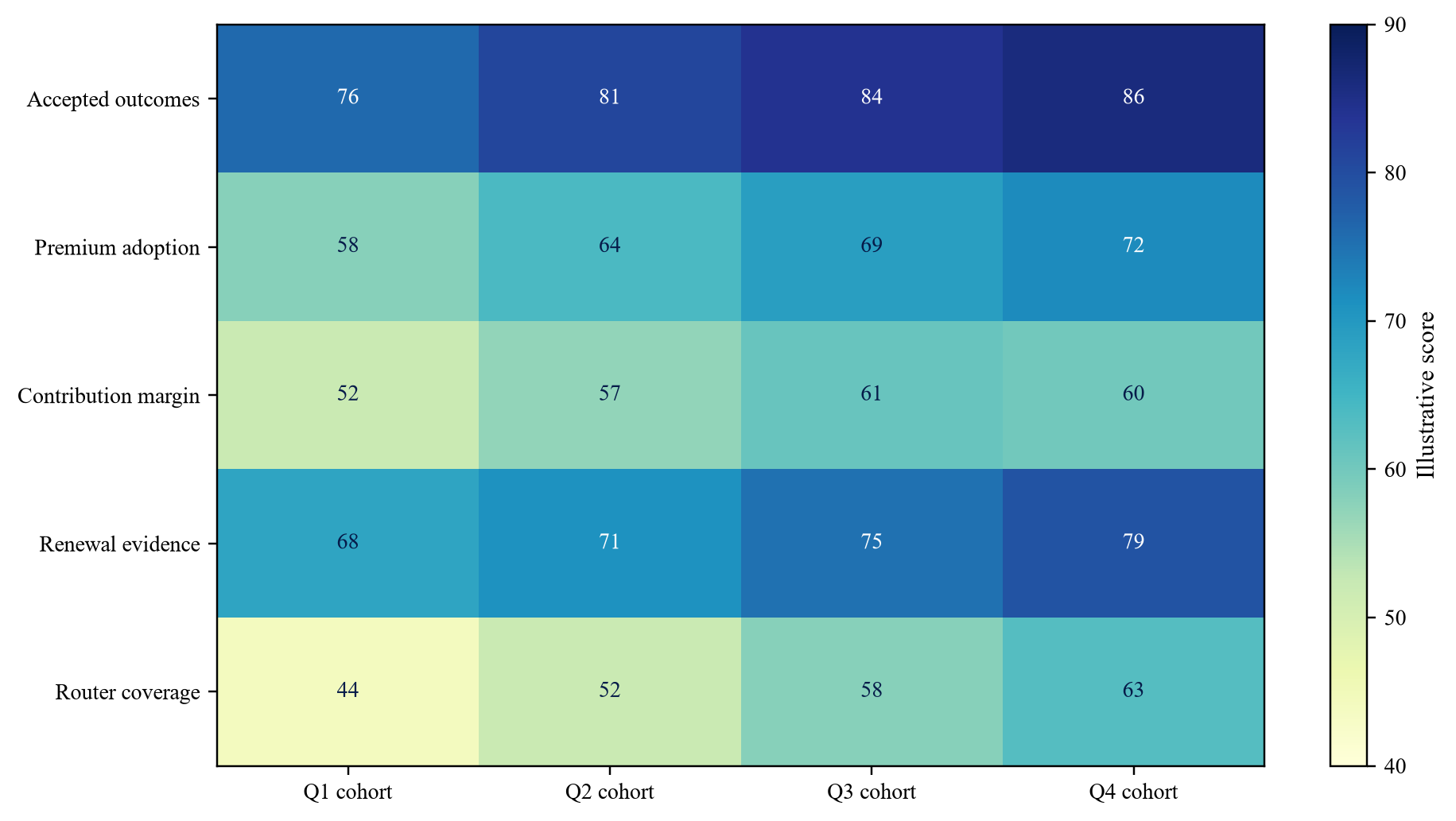
Illustrative heatmap. Higher scores are favourable except intensity variance, which is evaluated against package design.
18. Use deal terms to allocate reasoning uncertainty
Transaction structure can bridge evidence gaps. An acquirer can tie contingent consideration to customer renewal, premium adoption or verified contribution, subject to precise definitions. Growth capital can be staged against telemetry coverage, package migration, margin and retention milestones. Debt can use covenants and liquidity cases that reflect the downside task mix.
Metric definitions must be durable. “Gross margin” can become disputed when the parties disagree about model, evaluation, support or review cost. Transaction documents can define eligible revenue, direct reasoning cost, accepted outcome, task class, allocation policy, measurement period, permitted changes, data source, audit right and dispute process. Qualified legal and accounting advice is essential.
Representations and diligence should cover provider contracts, data rights, evaluation integrity, material incidents, customer commitments, pricing controls and accounting. The buyer should understand whether historical economics depend on founder review, promotional credits, an undisclosed human service or a provider feature that can change.
An escrow or retention mechanism can fund known remediation. A price adjustment can recognise an uneconomic unlimited contract portfolio. A seller can benefit from an earn-out when a reasoning product proves premium adoption and contribution after closing. The structure should avoid incentives to suppress required control or customer support.
19. Build an evidence-led diligence room
The diligence room should allow a reviewer to reproduce economic claims. Static presentations are insufficient. A selected sample should connect contract, task, route, provider meter, tool calls, evaluation, review, invoice, customer charge and collection.
| Workstream | Core evidence | Reperformance test |
|---|---|---|
| Customer and pricing | contracts, packages, allowances, credits, invoices and collections | rebuild realised price by cohort and task mix |
| Product telemetry | task, route, reasoning setting, tools, retries, latency and acceptance | trace selected tasks from initiation to accepted outcome |
| Provider economics | contracts, rate cards, commitments, usage, credits and invoices | reconcile provider bill to task and customer allocation |
| Quality and controls | evaluation sets, rubrics, results, incidents and approvals | rerun material task classes on current and fallback routes |
| Human delivery | review, exceptions, implementation and support records | allocate direct minutes and cost to workflows and customers |
| Finance | revenue policy, cost policy, ledger, budgets and cash forecast | reconcile reasoning contribution to financial statements |
| Resilience and governance | data flow, regions, failover, security, privacy and AI governance | test fallback, change approval and incident evidence |
The reviewer should select representative samples and preserve data protection and confidentiality.
Data protection and confidentiality apply to the room. Access should be scoped, logged and time-limited. Customer and personal data can be minimised or anonymised where appropriate. Evidence requests should align with contractual and legal permissions.
The reviewer should select samples rather than accept only management-curated examples. A balanced sample can include high and low margin customers, new and mature cohorts, routine and premium tasks, successful and failed workflows, normal and fallback routes, and periods before and after a model change. The objective is to test whether the ledger behaves consistently across the portfolio.
Customer calls can validate the economic story. The discussion should distinguish satisfaction with the interface from dependence on the completed workflow. Relevant questions include the alternative process, time saved, error reduction, approval burden, budget owner, renewal decision, willingness to pay and response to usage limits. Statements should be documented as customer evidence and should not replace operating data.
Cyber-security and privacy diligence should follow the actual data path. The team should understand input collection, retrieval stores, provider processing, tool permissions, logs, retention, model improvement terms, regional transfer and deletion. A high-margin route that violates a customer commitment is not an acceptable route. Remediation cost and commercial impact belong in the transaction model.
20. Execute a 180-day margin programme
The first 30 days establish definitions and facts. Management approves the task taxonomy, accepted-outcome standard, cost policy and provider register. Finance reconciles selected customers. Product and engineering instrument the missing events. Commercial teams identify unlimited or unclear packages.
Days 31 to 60 establish the router and evaluation baseline. The company compares approved models and reasoning settings by task. It defines fallback, stop and escalation rules. Finance publishes cohort contribution. Legal and commercial teams prepare revised package terms.
Days 61 to 100 pilot packaging and routing. Selected customers receive clear allowances, premium credits or workflow tiers. Experiments measure acceptance, adoption, retention signals, support and contribution. High-consequence tasks retain approved controls.
Days 101 to 140 expand verified improvements. The company migrates eligible customers, negotiates provider commitments only against evidenced demand and removes uneconomic routes. The board reviews provider concentration, control investment and forecast variance.
Days 141 to 180 lock the transaction evidence. Management produces the cohort scorecard, valuation bridge, downside liquidity case and data-room sample. Remaining unsupported benefits stay outside the base case.
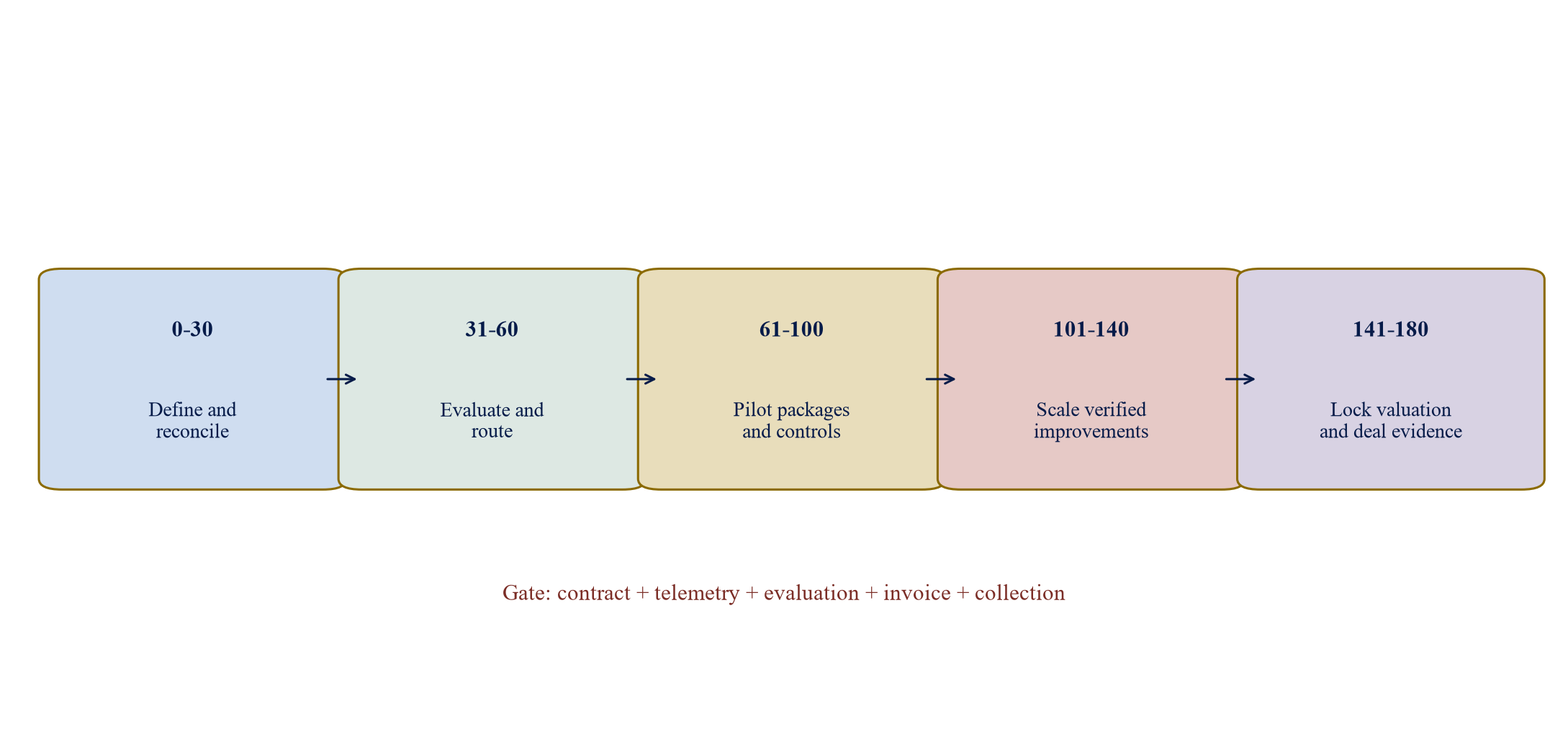
Author framework. Each phase closes with an evidence gate.
21. Convert the thesis into board decisions
The board should approve three numbers for each material task class: the quality threshold, the compute budget and the commercial allowance. These numbers connect product, finance and customer promise. Management can change them through an approved process supported by evaluation and operating evidence.
The monthly board pack should show accepted outcomes, realised price, reasoning intensity, complete cost, contribution, retention signals and incidents by cohort. Variance should be separated into customer price, task frequency, route mix, reasoning setting, provider rate, retries, tools, review and customer mix. Each material variance needs an owner and action.
Capital allocation should follow marginal evidence. Engineering effort can target task classes where better routing or workflow design improves contribution without lowering acceptance. Commercial effort can migrate packages where premium use is trapped inside a fixed seat price. Procurement can negotiate commitments after eligible demand and fallback exposure are understood.
The company should maintain a model-version register and package register. The first records approved tasks, reasoning settings, evaluation results, expected cost, provider, fallback and retirement. The second records included allowance, credits, overage, renewal, price-review terms and economic assumptions. Linking them identifies contracts that become uneconomic after a model or usage change.
22. Apply a transaction decision matrix
An investor can classify the opportunity across four evidence states. Proven value with proven contribution supports the base case. Proven value with weak contribution requires pricing, routing or contract remediation. Weak value with low cost still presents product-market risk. Weak value with high cost requires a fundamental product and capital-allocation review.
Each state leads to a different action. A strong operating case can support ordinary valuation methods and growth investment. A remediable margin case can support a phased plan, deferred consideration or milestone funding. A value-evidence gap requires customer research and controlled adoption tests. A combined value and cost problem should remain outside the investment base case until evidence changes.
The final investment committee paper should state which benefits are observed, which are contracted, which are tested and which remain management assumptions. It should show the source, period, owner and sensitivity of every material claim. This discipline allows a transaction team to move quickly while preserving the boundary between current evidence and prospective value creation.
Conclusion
Reasoning models make inference effort a controllable input to a customer service. This capability can improve difficult professional work. It also weakens the assumption that every additional SaaS interaction has a negligible and predictable marginal cost.
The appropriate economic unit is the accepted customer outcome. Management should link task value, compute budget, quality uplift, acceptance, retention, expansion, complete direct cost and cash contribution. The product should allocate reasoning through an approved task-value router and price premium work through allowances, credits, overages, workflow tiers or measurable outcomes.
Investors should evaluate cohort contribution after the complete cost of models, retrieval, tools, infrastructure, evaluation, controls and required human review. Revenue multiples require normalisation for task mix, provider dependence, unlimited commitments and unsupported margin improvements. Cash-flow valuation should use explicit operating drivers and downside cases.
The valuation reset rewards evidence. A company that proves premium customer value, disciplined compute allocation, strong retention and durable contribution can earn a stronger case. A company that cannot connect reasoning spend to accepted value leaves the benefit as an unverified management scenario. The transaction model should preserve that distinction.
That evidence should be refreshed as models, provider terms, customer behaviour and product controls change. A current ledger and repeatable decision process create more reliable management information than a one-time diligence calculation.
Sources
- OpenAI, Learning to Reason with LLMs, 12 September 2024, Read the primary source
- Google AI for Developers, Gemini Thinking, Read the primary source
- Anthropic, Extended Thinking, Read the primary source
- OpenAI, API Pricing, Read the primary source
- OpenAI, Reasoning Models Guide, Read the primary source
- Google AI for Developers, Gemini Developer API Pricing, Read the primary source
- Anthropic, Claude Pricing, Read the primary source
- Amazon Web Services, Amazon Bedrock Pricing, Read the primary source
- Microsoft, Provisioned Throughput Billing and Cost Management, Read the primary source
- MLCommons, MLPerf Inference: Datacenter, Read the primary source
- National Institute of Standards and Technology, AI Risk Management Framework, Read the primary source
- National Institute of Standards and Technology, Generative Artificial Intelligence Profile, Read the primary source
- Stanford Institute for Human-Centered Artificial Intelligence, AI Index Report 2026, Read the primary source
- Stanford Institute for Human-Centered Artificial Intelligence, AI Index Report 2025, Read the primary source
- OpenAI, Prompt Caching Guide, Read the primary source
- OpenAI, Batch API Guide, Read the primary source
- Anthropic, Message Batches, Read the primary source
- Anthropic, Prompt Caching, Read the primary source
- Google Cloud, Vertex AI Generative AI Pricing, Read the primary source
- Google Cloud, Vertex AI Context Caching, Read the primary source
- Amazon Web Services, Understanding Amazon Bedrock Cost and Usage Report Data, Read the primary source
- Microsoft, Plan and Manage Costs for Microsoft Foundry, Read the primary source
- GitHub, Copilot Plans, Read the primary source
- GitHub Docs, Copilot Billing, Read the primary source
- Adobe, Creative Cloud Pricing, Read the primary source
- Salesforce, Agentforce Pricing, Read the primary source
- Salesforce, Annual Reports, Read the primary source
- ServiceNow, Annual Reports, Read the primary source
- Palantir Technologies, Annual Reports, Read the primary source
- European Commission, Guidelines on Obligations for General-Purpose AI Providers, Read the primary source
- European Commission, Transparency Obligations under Article 50 of the AI Act, Read the primary source
- Organisation for Economic Co-operation and Development, Measuring the Environmental Impacts of AI Compute and Applications, Read the primary source
- International Energy Agency, Energy and AI Executive Summary, Read the primary source
- International Energy Agency, Energy Demand from AI, Read the primary source
- Cloud Security Alliance, Security Guidance for Critical Areas of Focus in Cloud Computing, Read the primary source
- OWASP Foundation, Top 10 for Large Language Model Applications, Read the primary source
- MITRE, ATLAS, Read the primary source
- United States Securities and Exchange Commission, Commission Guidance on Management's Discussion and Analysis, Read the primary source
- IFRS Foundation, Conceptual Framework for Financial Reporting, Read the primary source
- IFRS Foundation, IFRS 13 Fair Value Measurement, Read the primary source
- IFRS Foundation, IFRS 3 Business Combinations, Read the primary source
- IFRS Foundation, IAS 36 Impairment of Assets, Read the primary source
- IFRS Foundation, IAS 38 Intangible Assets, Read the primary source
- IFRS Foundation, IFRS 15 Revenue from Contracts with Customers, Read the primary source
- Financial Accounting Standards Board, Accounting Standards Codification Topic 606, Read the primary source
- International Valuation Standards Council, International Valuation Standards, Read the primary source
- Association of International Certified Professional Accountants, SaaS Metrics and Financial Reporting Resources, Read the primary source
- National Institute of Standards and Technology, Secure Software Development Framework, Read the primary source
- International Organization for Standardization, ISO/IEC 27001 Information Security Management Systems, Read the primary source
- International Organization for Standardization, ISO/IEC 42001 AI Management Systems, Read the primary source
