

1. Recovery is a dated cash-flow question
The amount written in a facility agreement is a legal and accounting starting point. A recovery decision needs a dated cash-flow view. It should identify the cash that can reach the creditor after disputes, ranking, enforcement, sale costs, taxes where relevant, professional fees, operating expenditure and time.
A secured position can produce a low recovery when the security is unperfected, the asset cannot be controlled, the obligor has competing claims, the value is obsolete or the process is delayed. An unsecured position can produce a higher recovery when the business remains viable, free cash flow supports a restructuring and stakeholders agree a controlled plan.
The workout team should therefore distinguish legal entitlement, accounting exposure, security coverage, market value and expected recovery. Each measure has its own date, evidence and decision use.
The governing body should define the objective. It can seek maximum net present recovery, preserve a viable business, reduce concentration, achieve a rapid cash exit, protect a strategic relationship or comply with a regulatory or fiduciary requirement. The objective should be recorded before route selection.
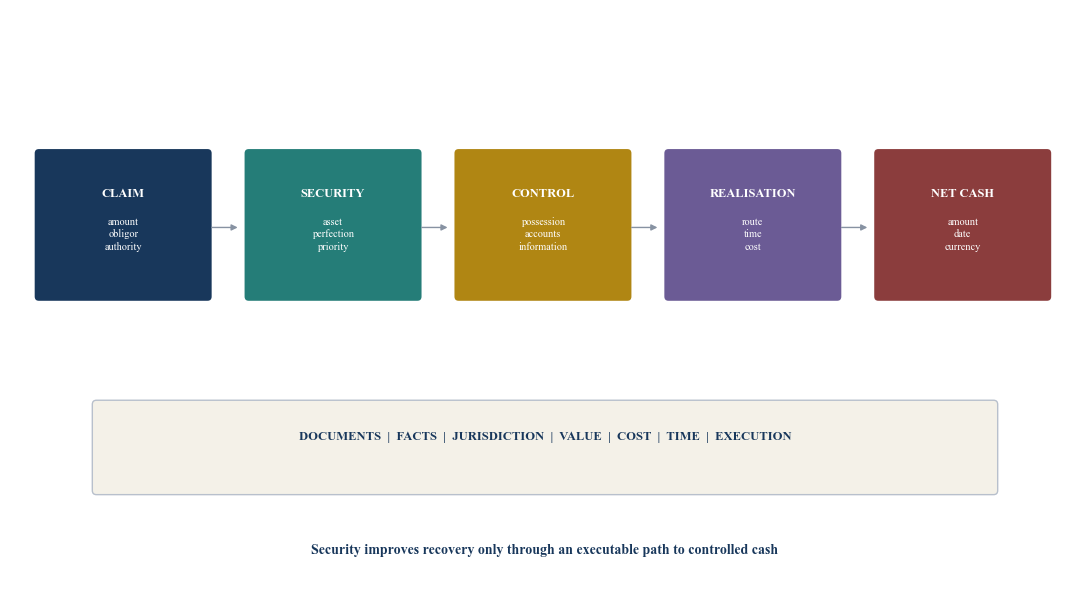
Author framework. Each transition requires current evidence and an accountable decision owner.
2. Establish the verified claim before valuing recovery
The recovery file should begin with the exact creditor, debtor, guarantor and security provider. It should reconcile principal, accrued return or interest, fees, costs, payments, capitalised amounts, default amounts, currency and disputed items to the executed documents and ledger.
Authority matters. The team should identify who can issue a reservation of rights, accelerate, enforce, appoint an adviser, vote in a restructuring, agree a standstill, release security, compromise debt or sell the exposure. Valid delegation and conflicts should be recorded.
The document hierarchy should include facilities, security, guarantees, intercreditor arrangements, account documents, hedges, amendments, waivers, notices and perfection evidence. A model should not assume a right that counsel has not confirmed under the relevant documents and facts.
Claims can change after default through payments, set-off, amendments, judgments, costs and insolvency admission. The claim schedule should retain an opening position, movements and current verified position.
Table 1. Recovery decision file
| Component | Evidence | Decision use | Control question |
|---|---|---|---|
| Creditor and obligor | constitutional and facility records | standing and claim | which entity owes which entity? |
| Claim amount | ledger, statements and contract calculation | exposure and voting | which amounts are admitted, disputed or contingent? |
| Default and rights | events, notices and legal analysis | remedy availability | has the right arisen and been preserved? |
| Guarantees | executed guarantees and authority | additional obligor cash | are scope, cap, expiry and defences understood? |
| Security | executed documents and asset schedule | collateral route | which asset secures which obligation? |
| Perfection | registry, notice, possession or control evidence | priority and third-party effect | is every required step current? |
| Intercreditor position | priority, turnover and enforcement terms | cash waterfall | who controls enforcement and receives proceeds? |
| Asset evidence | title, location, condition and insurance | control and sale | does the asset exist and remain available? |
| Valuation | current independent report and assumptions | gross and net value | which value concept and date apply? |
| Procedure | counsel memorandum and court or trustee record | time and constraints | which forum, stay and approval affect action? |
| Costs and tax | adviser budgets, operating costs and tax analysis | net cash | which costs rank ahead or reduce proceeds? |
| Collections | controlled account and reconciliation | realised recovery | did cash reach the entitled creditor? |
Required evidence depends on the facility, parties, security, jurisdiction and procedural route.
3. Map security as a network of rights and dependencies
Security should be mapped by asset and jurisdiction. Real estate, receivables, bank accounts, shares, inventory, equipment, vehicles, vessels, intellectual property and contractual rights can have different creation, registration, notice, possession, control, valuation and sale requirements.
UAE Federal Law No. 4 of 2020 addresses security rights in movable property, including accounts receivable and other movable assets.[5] Federal Decree-Law No. 16 of 2021 addresses factoring and transfers of current or future receivables.[6] Those laws provide statutory context and do not establish perfection or priority for a specific transaction.
The team should verify the secured obligation, grantor, asset description, registry record, renewal, notice, negative pledge, prior lien, permitted disposal, proceeds and insurance. It should test whether the asset has moved, changed form, been commingled, depreciated or become subject to another claim.
Guarantees require their own analysis. A guarantee can depend on capacity, authority, form, cap, expiry, demand, defences, governing law and guarantor resources. The model should avoid counting a guarantor and pledged guarantor asset twice.

Author framework. A recovery estimate is credible when right, asset and execution evidence intersect.
4. Keep value definitions separate
Market value estimates exchange value under the valuer's stated assumptions. Forced-sale value applies a constrained sale premise. Net realisable value deducts costs and reflects time and uncertainty. Borrowing-base value applies contractual eligibility, advance rates and reserves. Accounting carrying amount follows the applicable reporting framework. Recovery value is the present value of net cash expected through the selected route.
The CBUAE Credit Risk Management Regulation requires collateral valuation within its scope to reflect net realisable value, prevailing market conditions and the time and cost required for realisation.[2] The accompanying standards require realistic documented assumptions for collateral, recovery cash flows, time, costs and discounting. They also require eligible collateral to be measured with uncertainty-sensitive haircuts and specified legal and valuation controls.[1]
The valuation date should be explicit. A valuation prepared at origination can become stale after operating distress, construction delay, physical deterioration, tenant loss, commodity movements or a change in permitted use.
The recovery model should bridge from current gross value to cash available to the creditor. Each deduction should have evidence, an owner and a range where uncertainty is material.
Table 2. Value definitions in recovery analytics
| Measure | Core question | Typical inputs | Recovery limitation |
|---|---|---|---|
| Market value | what is the asset worth under stated market assumptions? | comparable evidence, income and cost | assumes a defined market and process |
| Forced-sale value | what may be achieved under constrained time or conditions? | market value, sale constraint and liquidity | may still exclude all creditor-specific costs |
| Net realisable value | what net amount remains after time, costs and uncertainty? | sale price, costs, delay, taxes and haircuts | depends on route and priority |
| Borrowing-base value | how much funded availability does the contract permit? | eligibility, advance rate and reserves | a funding control, not a sale prediction |
| Accounting carrying amount | what amount is recognised under reporting policy? | gross amount, impairment and write-off | can differ from transaction proceeds |
| Recovery value | what is the present value of creditor cash across paths? | probabilities, net cash, timing and discount rate | scenario-dependent management estimate |
| Executed proceeds | what cash actually arrived? | bank receipt and allocation | realised evidence after execution |
Definitions should be aligned with the applicable professional, regulatory, accounting and contractual context.
5. Build the net recovery bridge
The bridge starts with verified asset proceeds or business cash. It deducts preservation, completion, enforcement, adviser, trustee, court, broker, sale, tax and other route-specific costs. It applies senior claims and priority. It then allocates the creditor's share and discounts the dated cash flows.
Cash can arrive in stages. A restructuring can produce interim debt service, an asset sale, refinancing and a contingent payment. Enforcement can produce deposits, completion proceeds and later distributions. The model should retain timing for each component.
Probability should attach to defined paths rather than to a single unexamined recovery number. The team can model consensual restructuring, refinancing, collateral sale, guarantor payment, insolvency distribution and failure. Mutually exclusive paths should not be added together.
The discount rate should correspond to the approved valuation purpose and risk treatment. The model should state whether probability is embedded in the cash flow, the rate or both to avoid double counting.
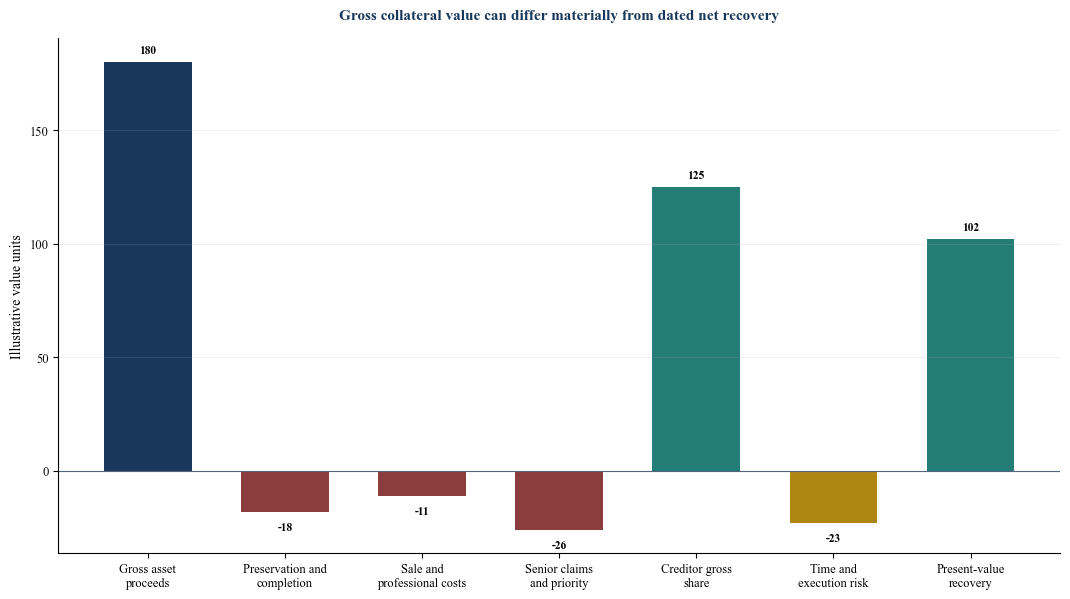
Author framework. Deductions, ranking and timing require case-specific evidence.
6. Re-underwrite business viability
Recovery strategy begins with the operating business. A viable borrower can generate more value through a controlled restructuring than through immediate liquidation. A non-viable borrower can consume cash and erode collateral while negotiations continue.
The viability assessment should reconstruct revenue, gross margin, working capital, maintenance capital, tax, essential suppliers, leases, employee obligations and liquidity. It should distinguish current trading from management forecasts and identify the funding required to preserve value.
SAMA's official problem-loan guidance uses borrower viability and stressed collateral value to segment cases and recommends comparison of expected recovery net present values across workout options.[14] That guidance applies within its stated Saudi banking scope and illustrates a general analytical discipline.
The credit team should test whether restructuring solves the cause of distress. Maturity extension alone can defer recognition when leverage, margins, governance or asset quality remain unsustainable.
7. Compare recovery routes through one model
A consensual cure can preserve relationship and reduce cost when the borrower can remedy a short disruption. A restructuring can reallocate cash, tenor, pricing, ownership and control when the business remains viable. Refinancing or loan sale can produce earlier liquidity. Enforcement can realise security. Formal insolvency can coordinate stakeholders and preserve or liquidate the estate under the applicable law.
Each route should be compared on gross cash, time, costs, probability, operational funding, control, legal constraints, stakeholder consent and residual exposure. The route with the highest nominal recovery can have a lower present value or greater execution risk.
The UAE Financial Restructuring and Bankruptcy Law states objectives that include preserving creditor rights, assisting viable debtors, fair procedure and maximising estate value.[7] It includes provisions for secured-creditor enforcement subject to Bankruptcy Court permission and specified procedures.[7] Saudi Arabia's official Bankruptcy Commission identifies seven procedures under its Bankruptcy Law.[12] Bahrain publishes its Reorganisation and Bankruptcy Law through the official legislation authority.[15]
The legal perimeter should be confirmed for each debtor and asset. Mainland UAE, ADGM, DIFC, Saudi Arabia, Bahrain and other Gulf regimes have distinct statutes, courts, procedures and recognition questions.
Table 3. Recovery-route comparison
| Route | Value source | Principal conditions | Primary execution risk |
|---|---|---|---|
| Cure and reinstatement | resumed contractual cash | short disruption, credible liquidity and verified cure | recurrence and weak monitoring |
| Amend and restructure | sustainable operating cash and agreed terms | viable business, stakeholder alignment and new controls | plan failure and value leakage |
| Refinancing | new lender or capital provider | financeable business, data, security and market access | timing, conditions and pricing |
| Exposure sale | buyer cash for creditor position | transferable asset, diligence, price and settlement | discount, consent and execution |
| Voluntary asset sale | controlled disposal proceeds | authority, title, process and stakeholder agreement | delay and sale leakage |
| Guarantee demand | guarantor liquidity or assets | valid right, demand and solvent guarantor | defences, cross-default and collectability |
| Security enforcement | net proceeds of secured asset | enforceable perfected right and available procedure | stay, priority, control, time and cost |
| Formal restructuring | enterprise value under approved process | procedural eligibility and creditor plan | plan feasibility and litigation |
| Liquidation or bankruptcy | distributed estate proceeds | formal process and verified claims | erosion, ranking and long duration |
Availability and effect require current transaction-specific legal and specialist advice.
8. Model time as a recovery variable
Time affects value through discounting, operating losses, asset depreciation, maintenance, insurance, storage, professional fees and lost opportunity. It also affects evidence: employees leave, records degrade, registrations expire and assets move.
The model should use dated milestones rather than one duration assumption. Examples include notice, standstill, valuation, filing, judgment, appeal, possession, sale preparation, marketing, closing and distribution.
Delay scenarios should identify the cash needed to preserve the asset or business. A partially completed property can require construction and permitting expenditure before sale. Inventory can require storage and insurance. A vessel can require crewing, port and maintenance costs.
Elapsed time should be monitored against the original estimate. Variance is a portfolio input for future recovery modelling and a case-level prompt to change route.
9. Analyse priority and competing claims
Security coverage cannot be measured before priority is known. The team should identify prior liens, pari passu claims, account-bank rights, retention of title, employee claims, taxes, trustee costs, landlord rights, possessory liens and other claims that may affect proceeds.
Intercreditor agreements can allocate enforcement control, standstill, turnover, voting, release and proceeds. The creditor with economic exposure may lack unilateral control. A junior creditor can receive value through a restructuring and no cash through a collateral sale.
The current UAE Bankruptcy Law addresses secured-creditor payments and the order of distributions within its scope.[7] The current Central Bank law contains a separate priority framework for licensed financial institutions placed into resolution.[16] These regimes should not be conflated.
The waterfall should show gross proceeds, preservation and process costs, super-priority or senior claims where applicable, secured claims, preferential claims, unsecured claims and equity under the relevant legal advice. Contingent or disputed items should be separately identified.
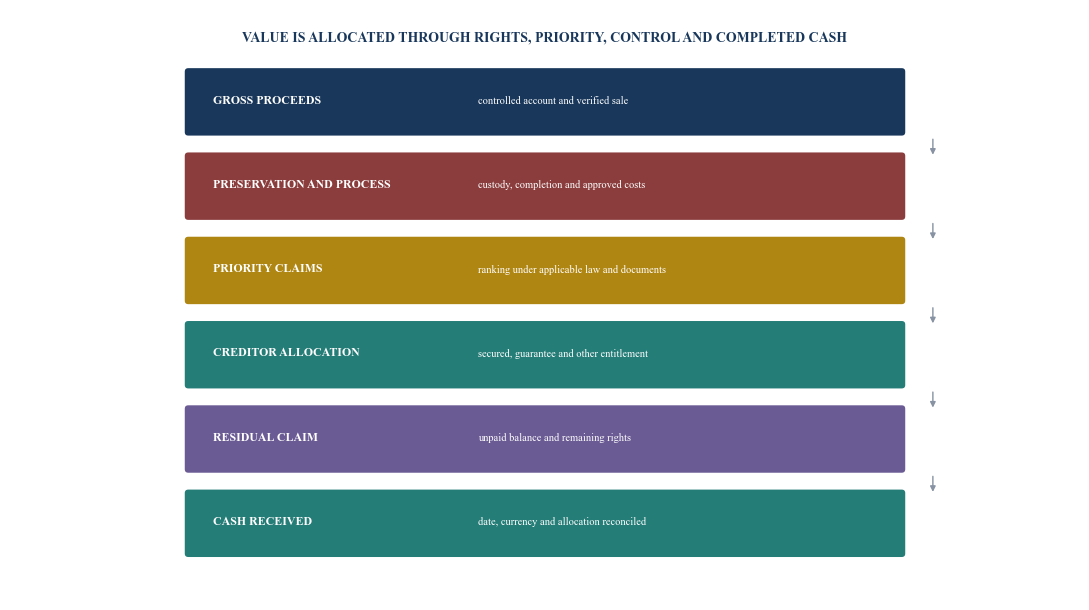
Author framework. Legal ranking depends on the applicable regime, documents and facts.
10. Treat collateral as an operating workstream
Collateral management continues after default. The team should confirm location, possession, condition, title, registration, insurance, maintenance, occupancy, income, environmental exposure and access. It should prevent unauthorised disposal where permitted and protect records.
The CBUAE standards require institutions within scope to maintain specialist collateral processes covering legal charge, enforceability, valuation, insurance, assigned income and inspection.[1] They also specify valuation and legal-opinion conditions for certain collateral categories and foreign-jurisdiction assets.[1]
The asset plan should identify preservation expenditure and the party authorised to incur it. Paying to preserve an asset can improve recovery. It can also create an unrecoverable cash outflow when ranking or control is misunderstood.
Every valuation refresh should state physical inspection, scope, restrictions, occupancy, completion, encumbrances and the assumed sale route. Exceptions should feed the recovery range immediately.
11. Control information and evidence under stress
Information quality frequently weakens as credit deteriorates. Reporting arrives late, reconciliations break, management forecasts change and advisers work from different data cuts. Recovery analytics require a controlled evidence room.
The room should contain executed documents, claims, entity records, security evidence, asset data, valuations, financials, bank statements, cash forecasts, stakeholder correspondence, court or trustee filings, adviser reports and the decision log. Each item should have source, date, owner and status.
Verified facts, borrower representations and management assumptions should remain distinguishable. A borrower's sale expectation is not a binding offer. A broker indication is not cash. A court filing is not a judgment. A judgment is not a collection.
Material changes should trigger model refresh. The committee should see the last verified date and the effect of missing evidence on value and route.
12. Build a probability-weighted cash-flow model
The model should contain a small number of coherent paths. Each path has starting facts, required actions, milestone dates, cash inflows, cash outflows, priority, probability, discounting and residual claims. Dependencies between paths should be explicit.
Probabilities are management estimates unless supported by a validated model and relevant data. They should be approved, sensitivity tested and kept separate from observed outcomes. A range can be more honest than one precise figure.
The expected present recovery is the sum of each path's probability multiplied by its discounted net cash. The expected loss compares that value with the approved exposure measure, subject to the purpose of the analysis.
Actual collections should be loaded by date and route. The model then becomes a living forecast and a source of realised recovery evidence.
Table 4. Hypothetical probability-weighted recovery model
| Path | Assumed probability | Gross creditor cash | Costs and deductions | Timing | Assumed present value |
|---|---|---|---|---|---|
| Consensual restructuring | 35% | 154.0 | (12.0) | staged over 36 months | 119.0 |
| Refinancing or exposure sale | 20% | 132.0 | (5.0) | month 9 | 117.0 |
| Controlled collateral sale | 25% | 125.0 | (18.0) | month 20 | 88.0 |
| Formal insolvency distribution | 15% | 91.0 | (21.0) | month 42 | 48.0 |
| Minimal recovery | 5% | 8.0 | (3.0) | month 48 | 3.0 |
| Probability-weighted value | 100% | not additive | path-specific | mixed | 92.1 |
| Verified exposure | n/a | 200.0 | n/a | valuation date | 200.0 |
| Illustrative expected shortfall | n/a | n/a | n/a | valuation date | 107.9 |
Every amount, probability, cost, timing and present value is an illustrative management assumption in AED millions.
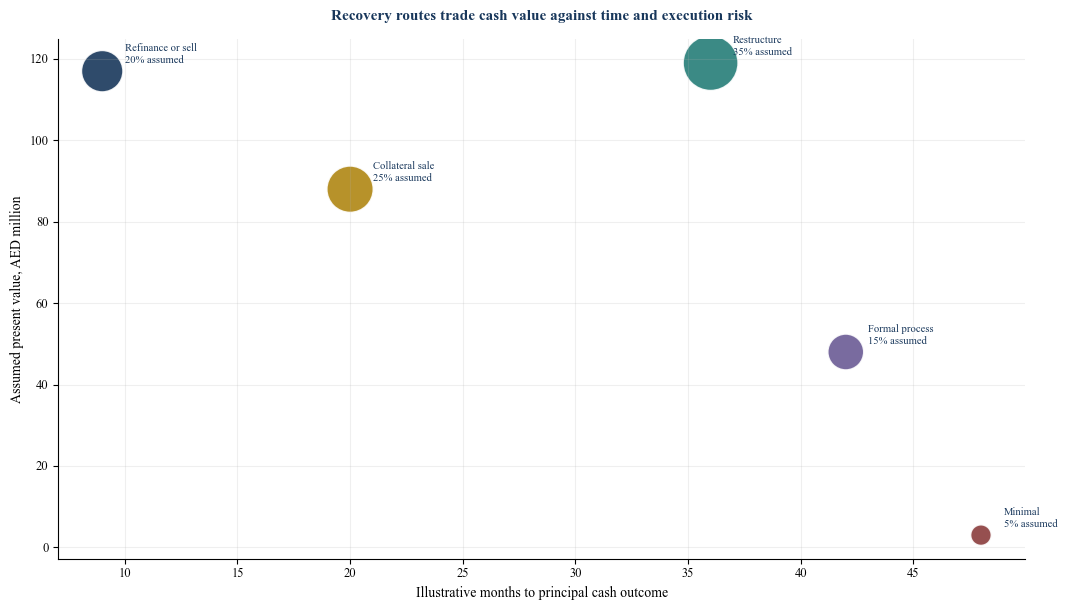
Every displayed value and timing is an illustrative management assumption.
13. Select the route through a governed decision
The committee pack should state the decision, authority, verified facts, unresolved evidence, options, financial comparison, legal constraints, stakeholder positions, risks, recommendation, conditions and next review.
The recommended route should identify actions that preserve alternatives. A limited standstill can create time for diligence while preserving rights under counsel's advice. Controlled interim funding can protect enterprise value under agreed priority and monitoring. A dual-track process can test restructuring and sale until a defined decision date.
Decision triggers should be objective. Examples include missed milestones, liquidity exhaustion, valuation deterioration, loss of control, failed consent, adverse judgment, sale bid expiry or covenant breach under revised terms.
Every concession should have consideration, authority, expiry and evidence. Repeated extensions without delivered actions should cause a route reassessment.
14. Manage multi-jurisdiction recovery explicitly
Gulf credit frequently connects borrowers, guarantors, assets, accounts and contracts across several jurisdictions. Governing law and court clauses can differ across documents. Recognition and enforcement can require additional steps.
The jurisdiction map should identify debtor incorporation, centre of main interests where relevant, asset location, security law, registration, dispute forum, insolvency regime, judgment or award recognition and enforcement route. It should also identify sanctions, exchange control and information restrictions that may affect cash.
ADGM publishes an insolvency framework and rules for insolvency practitioners.[17] Dubai Law No. 2 of 2025 addresses the jurisdiction and enforcement framework of the DIFC Courts, including insolvency claims within the applicable DIFC legal framework.[18] These materials apply within their respective legal perimeters.
The recovery committee should receive transaction-specific advice for each route. A general Gulf recovery assumption can conceal decisive differences in court permission, stay, ranking, security recognition, practitioner powers and sale procedure.
15. Learn from realised recovery rather than closed-file labels
Portfolio analytics should retain the full recovery history after a case closes. The record should include exposure at default, credit grade, collateral, guarantee, route, gross collections, costs, dates, time to first cash, time to resolution, write-off, residual rights and reasons for variance.
Realised loss given default depends on the approved definition and discounting method. The CBUAE standards require PD and LGD quantification within scope to reflect the institution's default, collateral-management and recovery-collection experience.[1] CBUAE model guidance also addresses realised LGD analysis, including recovery patterns, economic cycles, collateral, time and liquidation value.[3]
The portfolio should segment realised outcomes by product, obligor, sector, jurisdiction, collateral type, seniority, vintage, process and workout route. Small samples and changing practices should be disclosed.
Model governance should compare original estimate with actual collections, costs and timing. Repeated optimism in valuations, duration or guarantor recovery should change policy and new underwriting.
16. Monitor signals and actions together
The dashboard should combine case economics, legal process, asset condition, cash, stakeholders and execution. Status labels alone do not show whether value is improving.
Useful measures include verified claim, current net recovery range, probability-weighted present value, cash collected, professional and preservation costs, days since default, days to first cash, next legal milestone, asset condition, open evidence, stakeholder consent and route trigger.
Each signal should have an owner and response. A missed sale milestone can prompt reserve, valuation and route review. A new lien can prompt legal escalation. A forecast liquidity gap can prompt a controlled funding decision.
Table 5. Recovery signal-to-action controls
| Signal | Verification | Recovery question | Controlled action |
|---|---|---|---|
| Claim changes | reconcile ledger and documents | has entitlement or voting changed? | update claim and approvals |
| Security exception | registry, notice or control evidence | is perfection or priority impaired? | legal cure, reserve or route change |
| Asset value falls | independent valuation and condition | what net cash remains after time and cost? | update haircut and strategy |
| Business cash weakens | bank and operating cash forecast | is the restructuring still viable? | liquidity gate or enforcement review |
| Milestone missed | decision log and evidence | does the standstill remain value-accretive? | enforce expiry or reset route |
| Competing claim appears | legal and registry diligence | how does the waterfall change? | revise priority and cash allocation |
| Sale bid received | binding status, conditions and funds | what is executable net value? | compare, negotiate or accept within authority |
| Court event occurs | official order or filing | what rights, stay or timetable follow? | counsel-led procedural action |
| Cost exceeds plan | invoice and forecast | does additional spend improve net recovery? | approve, cap or discontinue |
| Cash is collected | controlled bank receipt | how is cash allocated and reported? | reconcile, distribute and reduce exposure |
Actions require valid authority and current legal and specialist advice.
17. Demonstrate a hypothetical Gulf recovery decision
Consider a hypothetical AED 200 million secured private-credit exposure to an operating group with assets and guarantors in more than one Gulf jurisdiction. The assumed borrower has missed payment and requires liquidity. The example does not represent a client or observed market case.
The recovery file identifies a first-ranking security claim over specified UAE assets, share security, assigned receivables and a capped guarantee. Current legal opinions, registry evidence and asset control remain conditions in the hypothetical decision.
The base restructuring path assumes staged net cash with a present value of AED 119 million. A refinancing or exposure-sale path assumes AED 117 million. A controlled collateral-sale path assumes AED 88 million. Formal-process and minimal-recovery paths have lower assumed present values. Probability weighting produces an illustrative AED 92.1 million expected present recovery.
The committee approves a short dual-track period. The borrower must deliver controlled cash reporting, asset access, valuation, sale preparation, investor outreach and restructuring documentation by dated milestones. Rights remain subject to legal advice. Failure at a milestone triggers enforcement-route review.
No recovery, probability, legal right, sale price, guarantor payment or timetable is claimed as fact.
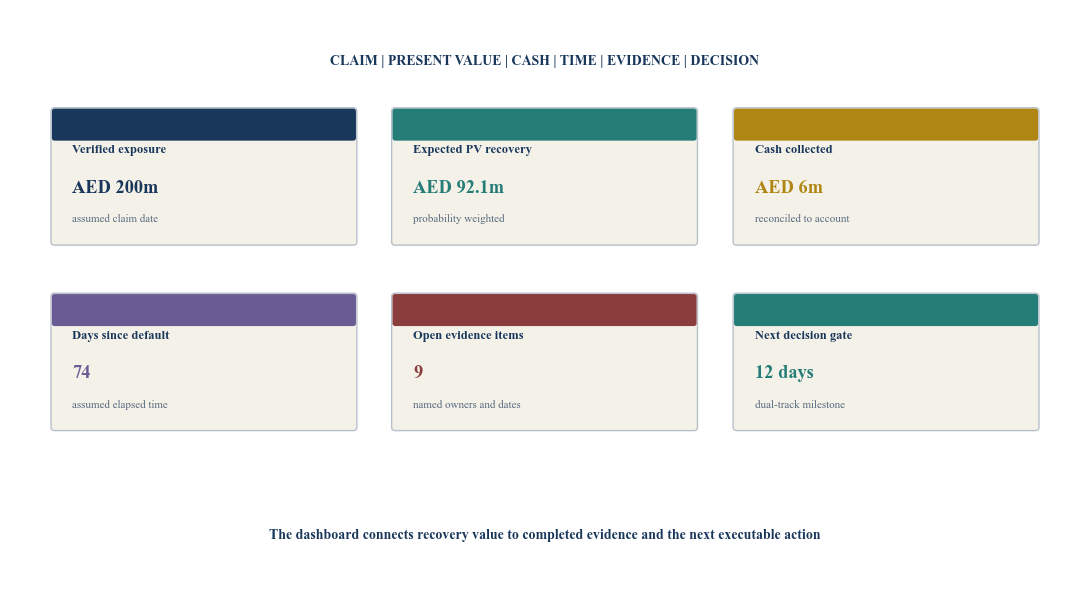
Every displayed value is an illustrative management assumption.
18. Implement recovery analytics in 120 days
Days one to twenty establish governance, authority, definitions, legal perimeter, case segmentation and data ownership. The team selects representative live and closed cases and preserves all source records.
Days twenty-one to forty build the recovery file, claim reconciliation, security map, valuation hierarchy, jurisdiction map, cost taxonomy and actual-collection ledger. Counsel and credit owners validate the required evidence.
Days forty-one to sixty develop route templates, probability-weighted cash flows, discounting rules, waterfall logic and decision packs. Independent reviewers reproduce selected calculations.
Days sixty-one to eighty pilot the framework on live cases. The team records assumptions, milestone gates, cash, elapsed time, costs and route changes. Material data gaps remain visible.
Days eighty-one to one hundred build portfolio reporting and realised-recovery histories. Model governance compares estimates with outcomes and identifies bias by asset, jurisdiction and route.
Days one hundred and one to one hundred and twenty approve policies, limits, escalation, audit trail and a review calendar. The governing body accepts use only after legal, risk, finance and operations controls are complete.
Table 6. One-hundred-and-twenty-day recovery-analytics programme
| Days | Workstream | Controlled deliverable | Gate |
|---|---|---|---|
| 1 to 10 | governance | objectives, authority, definitions and owners | governing body confirms scope |
| 11 to 20 | segmentation | case population, jurisdictions and evidence plan | representative sample accepted |
| 21 to 30 | claim and security | reconciled exposure and right map | legal and credit owners validate |
| 31 to 40 | value and cost | value hierarchy, haircuts and cost taxonomy | independent valuation inputs accepted |
| 41 to 50 | route model | cure, restructuring, sale and formal paths | dependencies and legal limits recorded |
| 51 to 60 | cash-flow engine | probabilities, dates, costs and discounting | calculation independently reproduced |
| 61 to 70 | live pilot | decision packs and milestone gates | material conditions closed or visible |
| 71 to 80 | cash control | collection, allocation and cost reconciliation | bank-to-case ledger reconciles |
| 81 to 90 | portfolio view | recovery range, time, route and exception dashboard | senior management accepts definitions |
| 91 to 100 | realised evidence | closed-case cash, cost and duration history | data quality and sample limits disclosed |
| 101 to 110 | policy | route authority, overrides and escalation | legal, risk and finance approval |
| 111 to 120 | controlled adoption | calendar, audit trail and model review | governing body approves use |
Timing depends on portfolio, data, jurisdictions, proceedings, systems and approvals.
19. Limitations and conclusion
The CBUAE regulations and standards cited in this paper apply within their stated scope.[1][2][3] Bank requirements should not be assumed to apply identically to every private fund, family office, corporate lender or other investor.
UAE, Saudi, Bahrain, ADGM and DIFC materials describe distinct legal frameworks.[5][6][7][12][15][17][18] The applicable law, forum, insolvency regime, security requirements, stay, ranking, recognition and enforcement route require transaction-specific advice.
Valuations are conditional opinions under stated assumptions. Market value, forced-sale value and net realisable value do not guarantee proceeds. Probability-weighted recovery values are management estimates unless supported by validated methods and relevant evidence.
Every exposure, value, probability, cost, time, haircut, exchange rate and outcome in the worked example is a hypothetical management assumption. No client position, legal conclusion, market price, court outcome, guarantor capacity or recovery result is claimed.
Recovery analytics convert security from a static document list into a governed cash-realisation process. The framework verifies the claim, maps the security network, controls value definitions, models dated net cash, compares routes, monitors priority and evidence, and learns from realised outcomes.
The resulting decision is explicit about what the creditor owns, which route is available, what cash may arrive, when it may arrive, which costs and claims intervene, and what event changes the plan.
References
- [1] Central Bank of the UAE, Credit Risk Management Standards, including collateral, recovery cash flow, net realisable value and provisioning requirements, C 3/2024, effective 30 November 2024. https://rulebook.centralbank.ae/en/rulebook/credit-risk-management-standards
- [2] Central Bank of the UAE, Credit Risk Management Regulation, including Articles 10 to 12, C 3/2024. https://rulebook.centralbank.ae/en/rulebook/credit-risk-management-regulation
- [3] Central Bank of the UAE, Model Management guidance, Analysis of Realised LGD, status in force when accessed 13 August 2026. https://rulebook.centralbank.ae/en/rulebook/44-analysis-realised-lgd
- [4] Central Bank of the UAE, Residual Risk guidance, status in force when accessed 13 August 2026. https://rulebook.centralbank.ae/en/rulebook/c-residual-risk
- [5] United Arab Emirates, Federal Law No. 4 of 2020 on Securing the Rights in Movables. https://uaelegislation.gov.ae/en/legislations/1446/download
- [6] United Arab Emirates, Federal Decree-Law No. 16 of 2021 on Factoring and Transfer of Receivables. https://uaelegislation.gov.ae/en/legislations/1515/download
- [7] United Arab Emirates, Federal Decree-Law No. 51 of 2023 Promulgating the Financial Restructuring and Bankruptcy Law, current text accessed 13 August 2026. https://uaelegislation.gov.ae/en/legislations/2190
- [8] United Arab Emirates, Cabinet Resolution No. 94 of 2024 Concerning the Executive Regulation of the Financial Restructuring and Bankruptcy Law. https://www.uaelegislation.gov.ae/en/legislations/2582/download
- [9] United Arab Emirates, Federal Decree-Law No. 6 of 2025 Regarding the Central Bank, Regulation of Financial Institutions and Activities, and Insurance Business. https://uaelegislation.gov.ae/en/legislations/3284
- [10] Saudi Central Bank, Collateral valuation guidance, status in force when accessed 13 August 2026. https://rulebook.sama.gov.sa/en/33-collateral
- [11] Saudi Central Bank, Guidelines on Management of Problem Loans, issued 2020, status in force when accessed 13 August 2026. https://www.rulebook.sama.gov.sa/en/guidelines-management-problem-loans
- [12] Saudi Arabia Bankruptcy Commission, Bankruptcy Law and Implementing Regulations, current official materials accessed 13 August 2026. https://bankruptcy.gov.sa/en/bankruptcylaw/systemandregulations/pages/default.aspx
- [13] Saudi Arabia Bankruptcy Commission, Bankruptcy Law, official English PDF. https://bankruptcy.gov.sa/en/KnowledgeCenter/Publications/Documents/Bankruptcy%20Law.pdf
- [14] Saudi Central Bank, Guidelines on Management of Problem Loans, viability, stressed collateral and NPV route comparison sections. https://www.rulebook.sama.gov.sa/en/guidelines-management-problem-loans
- [15] Kingdom of Bahrain Legislation and Legal Opinion Commission, Legislative Decree No. 22 of 2018 Promulgating the Reorganisation and Bankruptcy Law, updated 9 April 2026. https://www.lloc.gov.bh/en/legislation/id/k2218
- [16] United Arab Emirates, Federal Decree-Law No. 6 of 2025, priority provisions for licensed financial institutions under resolution. https://uaelegislation.gov.ae/en/legislations/3284
- [17] Abu Dhabi Global Market, Insolvency Regulations and Insolvency Practitioner Rules 2022, current official materials. https://www.adgm.com/documents/operating-in-adgm/insolvency-practitioners/insolvency-regulations-insolvency-practitioner-rules-2022.pdf
- [18] Government of Dubai, Law No. 2 of 2025 Concerning Dubai International Financial Centre Courts. https://dlp.dubai.gov.ae/Legislation%20Reference/2025/Law%20No.%20%282%29%20of%202025%20Concerning%20Dubai%20International%20Financial%20Centre%20Courts.html
About the Author
Chennakeshav Adya is an independent researcher and Managing Partner of Matchpoint Partners. His research focuses on investment strategy, capital formation, transaction execution, governance and operating-model design across the Gulf and international markets.
