

Introduction
Energy-price support takes many forms. A government may cap retail prices, reduce taxes, compensate suppliers, provide fuel below an import-parity benchmark, direct a state-owned utility to charge below cost, forgive arrears or guarantee borrowing used to fund losses. Some costs appear in the budget. Others accumulate as supplier arrears, utility debt, deferred maintenance, unpaid power-purchase obligations or underinvestment.
The policy objective is often legitimate. Energy is essential for lighting, cooling, heating, mobility, cooking and productive activity. A sudden increase can harm households with limited cash buffers and firms that cannot reprice output quickly. The IMF's review of energy and food price responses finds that targeted cash transfers are generally a more cost-effective way to protect vulnerable households than broad measures that prevent price pass-through [1]. The OECD similarly identifies targeted, temporary support that preserves incentives to reduce energy use as a central lesson from recent price shocks [2].
Implementation quality determines the outcome. A reform can fail when the subsidy baseline is disputed, social registries are incomplete, compensation is delayed, utility accounts are opaque or public communication promises benefits that are not visible. The IMF's 2025 Fiscal Monitor emphasises that public sentiment, perceived fairness and confidence in government affect reform durability [3].
This paper provides a decision framework for sequencing energy subsidy reform. It uses public evidence and illustrative author-modelled scenarios. Jurisdiction-specific legal, tax, regulatory and social-protection advice remains necessary.
1 Define the decision and the reform perimeter
The first decision is the perimeter. Electricity, gasoline, diesel, liquefied petroleum gas, natural gas and district heating have different consumers, supply chains and social consequences. A reform can cover one product, one customer class or the full energy system. The perimeter should identify each price-control instrument, fiscal transfer, tax preference, state-owned-enterprise obligation and contingent liability.
The decision should also state the intended outcome. A fiscal ministry may seek to reduce volatile budget exposure. An energy ministry may seek cost-reflective tariffs and reliable supply. A utility may need cash for maintenance, connections and generation procurement. An investor may need a credible revenue path. A social-protection agency may need to protect a defined vulnerable group. These objectives can be reconciled only when they share one timetable and one financial model.
The analysis should define the policy-information date and distinguish enacted measures, official proposals and author-modelled scenarios. Each scenario should identify the legal authority, implementing agency, funding source, data owner and approval gate.
2 Build the full subsidy baseline
The baseline should reconcile the economic gap and the cash gap. The economic gap is the difference between an efficient supply-cost benchmark and the net price paid by the consumer. The cash gap is the amount that must be funded during the period after accounting for taxes, explicit budget transfers, cross-subsidies, supplier credit and timing.
For electricity, the cost stack can include generation or purchase cost, capacity payments, network losses, transmission, distribution, system services, metering, billing, bad debt, policy levies, tax and an allowed return. Fuel benchmarks may include import or refinery cost, freight, storage, distribution margin, tax and exchange-rate effects. The chosen benchmark must be documented and updated consistently.
The IMF distinguishes explicit subsidies from broader implicit subsidy estimates that include undercharging for environmental and other external costs [4]. A government budget and a utility financing plan require the explicit cash and quasi-fiscal components to remain visible. Broader economic-cost analysis can inform environmental policy without obscuring the immediate funding requirement.
The baseline should reconcile budget records, regulator determinations, utility accounts, supplier invoices, tax expenditures and public guarantees. Unfunded obligations should be aged. Delayed compensation can force a utility to borrow or defer maintenance even when a formal reimbursement mechanism exists.
3 Separate affordability from price suppression
Affordability is a household-level relationship among income, essential energy need, dwelling efficiency, climate, transport access and tariff design. A low national tariff does not prove that vulnerable households can afford adequate service. Households without a grid connection may receive little benefit from an electricity subsidy and pay more for alternative fuels.
Broad price suppression distributes support according to consumption. Higher-consuming households can receive a large share of the fiscal benefit. The OECD's review of Indonesia notes that historical fuel support was highly regressive and that targeted assistance can improve distribution [5]. The allocation differs by product and country, so distributional analysis should use current household expenditure and consumption data.
A reform should define the protected outcome. Possible measures include a maximum energy-burden ratio, an essential-consumption allowance, protection against disconnection, access to clean cooking, mobility support or a minimum household income after essential energy spending. The metric should determine eligibility and benefit design.
4 Measure direct and indirect incidence
Direct incidence captures the household's own fuel and electricity spending. Indirect incidence captures higher prices for transport, food, housing, water and other goods produced with energy. Firm-level effects can transmit through wages, employment, output prices and supply chains.
An incidence model should combine household survey data, tariff schedules, consumption patterns and an input-output or social-accounting model where available. It should calculate effects by income group, geography, dwelling type, household size and energy source. It should also identify excluded households and informal workers who may not appear in tax or payroll databases.
Price elasticity matters. Essential consumption can respond slowly in the near term. A household with an inefficient appliance or no public transport alternative has limited ability to reduce usage. The model should therefore separate the first-year cash impact from medium-term adaptation.
The World Bank's work on energy subsidy reform stresses the importance of distributional analysis, social protection and communication as part of implementation [6]. The analytical result should specify the number of households affected, the expected loss before support, the transfer required and the remaining welfare effect.
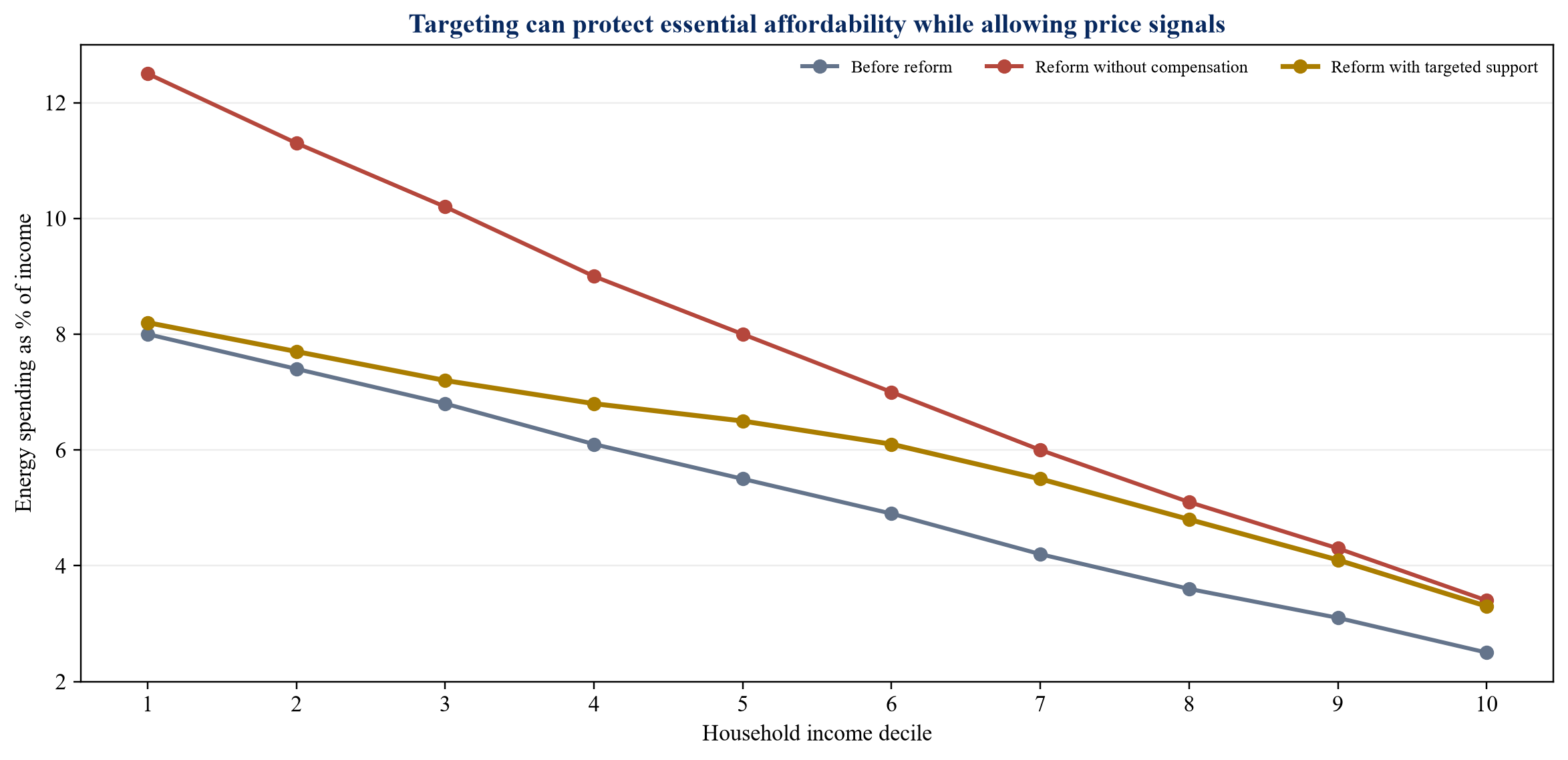
All values are hypothetical author-modelled assumptions. The chart demonstrates a distributional method and does not represent a country, tariff proposal or observed household survey.
5 Classify reform instruments by the signal they preserve
Policy instruments differ in the price signal that reaches consumers. A universal price cap suppresses the marginal price for all covered consumption. A lump-sum cash transfer preserves the marginal price and gives recipients discretion. A targeted bill credit can protect liquidity while retaining part of the signal. A lifeline block lowers the price for an essential quantity and applies a higher price above it.
Tax reductions can be implemented quickly but may be broad and difficult to reverse. Supplier compensation protects service continuity if it is funded and settled promptly. Energy vouchers can target use but require merchant and payment infrastructure. Efficiency grants reduce future bills and demand but take longer to deploy.
The choice should consider coverage, targeting error, administrative speed, fraud risk, fiscal volatility, energy-saving incentives and the utility's cash cycle. A portfolio of instruments may be appropriate. The design should avoid overlapping benefits that overcompensate some households while missing others.
Table 1. Reform instruments and their decision characteristics
| Instrument | Affordability channel | Price signal | Main implementation risk | Appropriate use |
|---|---|---|---|---|
| Universal price cap | Lowers bill for all covered users | Weak | High fiscal exposure and regressive distribution | Short emergency period with explicit expiry |
| Targeted cash transfer | Raises household resources | Strong | Registry exclusion and payment delay | Broad reform where payment rails are reliable |
| Targeted bill credit | Reduces bill for eligible account | Partial to strong | Tenant and account-holder mismatch | Grid-connected households with reliable customer data |
| Lifeline block | Discounts essential consumption | Partial | Multiple meters, shared connections and block gaming | Essential electricity or water-energy service |
| Energy voucher | Funds specified purchase | Partial | Merchant coverage and leakage | Clean cooking or transport transition |
| Efficiency support | Reduces future consumption need | Strong | Slow installation and landlord-tenant split | Medium-term affordability and resilience |
The table is a policy-design checklist. Performance depends on local institutions, data and delivery systems.
6 Establish eligibility before changing prices
Compensation readiness should be a formal gate. The programme should define eligibility, data sources, appeals, payment frequency, indexation and treatment of households without formal accounts. A social registry can provide a base, yet it may omit newly vulnerable households, migrants, informal workers or people whose circumstances changed after the last survey.
The eligibility model can combine income, proxy means testing, categorical criteria, geography and verified hardship. Each method creates inclusion and exclusion error. The programme should publish a clear route for correction and maintain audit trails for changes.
Payment testing should occur before the price change. A dry run can validate identity matching, bank or wallet details, returned payments, customer-service capacity and reconciliation. The government should fund at least the first compensation cycle in advance where liquidity permits.
The OECD's Western Balkans review recommends replacing universal support with targeted financial assistance and complementing transfers with disconnection protection and efficiency measures [7]. This layered approach recognises that cash alone may not resolve access, housing efficiency or billing constraints.
7 Choose a sequencing path
The reform path should reflect the size of the price gap, inflation, social-protection capacity, utility liquidity, political calendar, energy security and availability of alternatives. A small gap with strong payment infrastructure can close quickly. A large gap with weak registries may require staged increases and early institution building.
Product sequencing matters. A government may begin with a fuel that is consumed disproportionately by higher-income groups, preserve temporary support for essential cooking fuel and improve compensation before broader changes. The IMF's assessment of Angola describes a multiphase approach that initially adjusted gasoline while retaining support for LPG and cooking gas during preparation of mitigation measures [8].
Customer sequencing can protect essential use. Higher residential blocks, luxury consumption or large commercial users can move first. The model should consider cross-subsidy changes and competitive effects on firms.
The timetable should include explicit review points. A pause trigger can respond to a documented delivery failure, exceptional market shock or service-security event. The trigger should not create an open-ended discretion that destroys the price path.
8 Use automatic pricing with governance
An automatic pricing mechanism can translate changes in benchmark cost, exchange rate, taxes and regulated margins into retail prices. The formula can reduce discretionary delay and make the fiscal implication of an override visible. Its credibility depends on governance.
The formula should specify data sources, averaging periods, pass-through lags, smoothing bands, floors, ceilings, tax treatment and publication dates. A stabilisation account can spread exceptional movements across periods. Its balance and funding limit should be disclosed.
Smoothing reduces abrupt changes but creates a temporary asset or liability. The utility or government must finance that balance. A mechanism without funding can convert price volatility into arrears.
The IMF identifies automatic pricing mechanisms as a feature that can support durable reform when combined with communication and mitigation [9]. The formula should be reviewed periodically and audited independently.
9 Protect utility cash flow during the transition
Price reform can improve a utility's economics and still create a short-term cash deficit. Compensation may be paid to households while the utility bills higher tariffs. Collection rates can weaken. Government arrears can remain unpaid. Fuel and power-purchase costs may rise faster than allowed tariffs.
The utility model should project billings, collections, bad debt, compensation settlement, supplier payments, tax, capex and financing by month. It should calculate minimum cash, borrowing need and covenant headroom. The model should identify which entity carries each timing difference.
Legacy arrears need a separate resolution. Options include verified settlement, debt consolidation, a funded regulatory asset, equity recapitalisation or a time-bound surcharge. The OECD's Western Balkans work notes that utility debt may require consolidation and targeted capital injections as pricing converges toward market values [7].
The transition should include service-performance commitments. Additional revenue should fund maintenance, procurement security, loss reduction and connections according to an approved plan. This makes the customer value proposition observable.
10 Link reform to investment signals
Below-cost prices weaken the revenue signal for generation, networks, efficiency and distributed energy. They can make demand appear stronger than it would be under transparent pricing. Investors then face uncertainty about tariff recovery, government compensation and curtailment.
A credible reform path can improve project bankability when it defines cost recovery, indexation, loss treatment and payment security. The benefit depends on implementation history and legal enforceability. Investors should stress delays and reversals rather than assuming the announced path is fully achieved.
The price design should also support efficient consumption. Time-of-use or scarcity pricing may become relevant after the basic cost-recovery and metering foundations are ready. Vulnerable users can receive targeted protection without suppressing every marginal signal.
The IEA tracks fossil-fuel consumption subsidies and highlights their interaction with energy transitions and market signals [10]. Investment analysis should include subsidy reform in demand forecasts, renewable competitiveness, storage value and network planning.
11 Publish the use of reform savings
Public acceptance can depend on whether households see how savings are used. The government should publish gross subsidy savings, compensation cost, utility support, administrative cost and net fiscal effect. It should distinguish realised cash savings from modelled estimates.
Possible uses include targeted transfers, health, education, public transport, energy efficiency, clean cooking, network investment and debt reduction. Earmarking can strengthen credibility, though excessive legal rigidity can constrain fiscal management. A transparent budget classification and regular report can provide accountability.
The OECD's 2024 analysis describes cases where subsidy savings were redirected toward social support and renewable investment [11]. Country outcomes depend on the quality of targeting, public finance and delivery.
An independent fiscal institution, auditor or parliamentary committee can review the reconciliation. Publication should occur on a fixed timetable and explain material variances.
12 Model inflation and second-round effects
Energy-price reform can affect consumer prices directly and through transport and production costs. The magnitude depends on the energy weight in the price index, firm pricing power, exchange rates, wage setting and monetary conditions. A one-time level adjustment differs from persistent inflation.
The model should identify direct price-index effects, input-output effects and behavioural responses. It should also calculate how transfers alter disposable income and demand. Central-bank assumptions should remain separate from the government's fiscal case.
Indexation clauses can amplify effects. Public wages, pensions, contracts and regulated tariffs may respond automatically to inflation. These channels should be included in fiscal and utility scenarios.
The reform timetable can reduce concentration of increases. Staging also prolongs the subsidy and can invite reversal. The choice should be quantified through annual fiscal cost, cumulative household impact and credibility.
13 Address firms and competitiveness
Industrial support should begin with a diagnosis of exposure. Energy intensity, trade exposure, pricing power, technology options, employment and regional concentration matter. A broad discount for all firms can preserve inefficient consumption and create a large fiscal commitment.
Temporary, conditional support can fund audits, efficiency upgrades, fuel switching, electrification or working capital for viable firms. Conditions should include eligibility, performance milestones, reporting and expiry. Support should avoid protecting owners from ordinary commercial risk.
Export-exposed firms may face carbon-border measures or customer decarbonisation requirements. Transparent energy pricing and efficiency investment can support long-term competitiveness. The OECD's reviews of Egypt and Colombia connect subsidy reform with fiscal sustainability, efficient consumption and targeted protection [12][13].
Lenders should assess how reform affects borrower margins, covenant headroom and capex. A borrower with a credible adaptation plan may require transition financing rather than a permanent energy-price discount.
14 Integrate energy efficiency into affordability policy
Income support addresses the current bill. Efficiency reduces the energy needed to obtain the same service. The reform programme should identify high-impact measures such as cooling, insulation, motors, lighting, pumps, appliances and building controls.
Upfront cost, split incentives and access to finance can prevent adoption. Grants, concessional loans, on-bill finance, performance contracts and minimum standards can address different barriers. Programmes should verify installation and savings.
Efficiency support should be targeted using building, appliance and household data. A universal equipment subsidy can repeat the distributional problem of a universal energy subsidy. Low-income tenants may require landlord obligations or direct installation.
The IEA identifies energy efficiency as a central resilience measure that can reduce exposure to price shocks [14]. The reform model should include implementation lead time and rebound effects.
15 Treat access and clean cooking separately
Price reform should not reduce access to basic energy. Connection charges, network availability, deposit requirements and informal tenure can be more important than the unit tariff. The programme should track new connections, disconnections, outages and use of unsafe alternatives.
Clean cooking requires product-specific analysis. LPG, electricity, biogas and other options differ in infrastructure, appliance cost and supply reliability. A rapid withdrawal of support without alternatives can increase use of polluting fuels.
Targeted vouchers, starter equipment, distribution investment and phased pricing can support transition. The benefit should be linked to verified access and use where feasible.
World Bank and Sustainable Energy for All data can support access baselines, while national household surveys remain necessary for programme design [15][16].
16 Build a communication architecture
Communication should disclose the problem, the price path, compensation, use of savings, service commitments and review process. It should state which values are estimates and publish updates when assumptions change.
Messages should be supported by delivery. Announcing a transfer that arrives after the price increase damages trust. Call centres, local offices, digital channels and civil-society partners need consistent information and escalation routes.
The reform should publish examples for common household and business profiles. These examples should be clearly labelled as illustrations. A calculator can show the tariff, benefit and expected net change without collecting unnecessary personal data.
The IMF's 2025 analysis links reform success to fairness perceptions, trust and communication [3]. Engagement should begin before implementation and continue through published results.
17 Design a control room for implementation
The implementation unit should integrate finance, energy, utility, regulator, social protection, statistics, communications and local delivery. It needs a single dashboard and clear decision rights.
Daily indicators during the initial phase can include prices, transfer success, utility collections, fuel availability, outages, complaints and transport costs. Weekly review can cover targeting, fiscal cost and supplier cash. Monthly review can assess inflation, poverty indicators, investment and service performance.
Data definitions should be agreed before launch. The dashboard should separate observed values, administrative estimates and model projections. Personally identifiable information should be protected through access controls and minimisation.
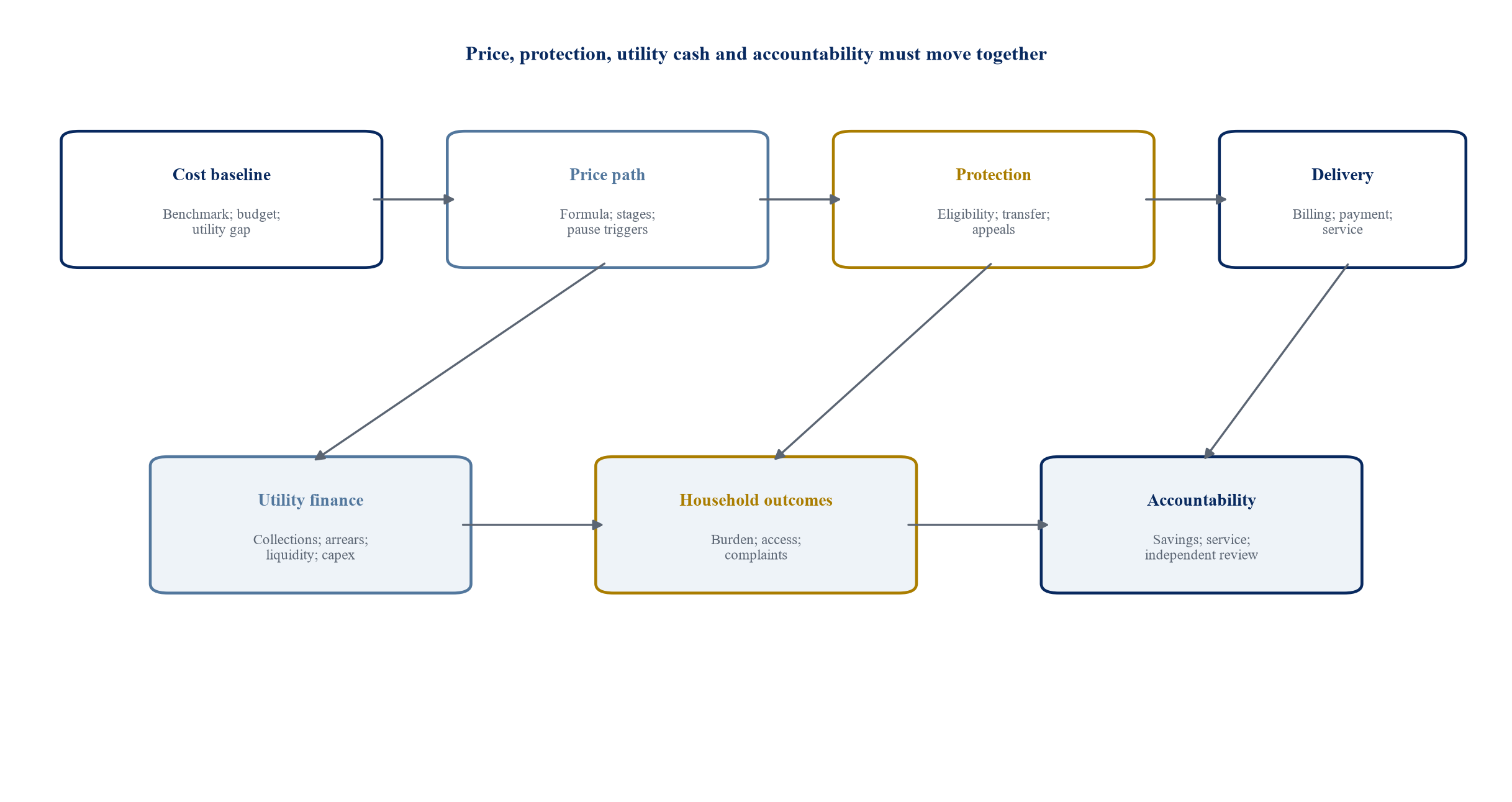
The system map shows the linked policy, delivery, utility and accountability modules required for implementation.
18 Establish readiness gates
The first gate confirms the baseline: verified cost benchmarks, budget exposure, utility arrears and customer data. The second confirms protection: eligibility, funded benefits, payment testing, appeals and local support. The third confirms utility readiness: billing configuration, collection plan, liquidity and supplier continuity.
The fourth gate confirms legal and operational authority. Required regulations, tariff orders, budget appropriations and data-sharing arrangements should be effective. The fifth confirms communication and monitoring. Public materials, complaint routes, dashboards and escalation decisions should be ready.
A failed gate should produce a corrective plan and revised decision date. A political announcement should not substitute for operational readiness.
19 Use pause and adjustment triggers carefully
Triggers can protect the programme from a severe external shock or delivery failure. Examples include a high transfer-failure rate, fuel shortage, exceptional benchmark movement, material service deterioration or natural disaster. Each trigger should have a metric, threshold, owner and expiry.
A pause should preserve transparency. The government should publish the reason, fiscal cost, funding source and conditions for resumption. Any temporary cap should specify who receives it and how suppliers are compensated.
Frequent discretionary pauses can weaken investment signals and encourage households and firms to delay adaptation. A smoothing rule within the formula can absorb ordinary volatility. Exceptional powers can remain narrow.
20 Finance the transition explicitly
Reform can require upfront financing for compensation, arrears clearance, utility liquidity, metering, efficiency and administrative systems. Savings may accrue later. The programme should model sources and uses by month and year.
Potential sources include budget appropriation, development-policy financing, utility working-capital facilities, concessional social-protection finance and targeted investment loans. Borrowing should not conceal a permanent operating deficit.
Development finance can support systems and transition investments where conditions are credible. The financing plan should specify disbursement conditions, procurement, safeguards, reporting and debt-service implications.
21 Translate the programme into lender analysis
A lender should assess tariff authority, formula design, compensation mechanism, collections, loss trajectory, government arrears, supplier obligations and capital programme. Announced reform improves credit only when the cash reaches the borrower or reduces its obligations.
The base case should use enacted measures and funded transfers. Upside can include later stages when approval and delivery remain uncertain. Downside should test delay, partial pass-through, collection weakness, exchange-rate depreciation and fuel-cost shocks.
Debt sizing should use cash available for debt service after required maintenance and transition expenditure. Liquidity facilities should cover timing mismatches within a credible recovery mechanism.
Security and covenants should reflect the legal structure. A state-owned utility may have policy obligations that cannot be enforced through ordinary commercial remedies. Government support should be documented and assessed under applicable law.
22 Value a utility under reform
Valuation should bridge revenue from current tariffs to the reform path, collections, losses, compensation, costs and capex. The model should identify the terminal tariff regime and service obligation.
Discount rates should not absorb every policy uncertainty. Material cash-flow paths should be modelled explicitly. Residual regulatory and execution risk can inform probability weights, discount rate and transaction structure.
The value of improved cash recovery can be offset by required investment and arrears settlement. A buyer should review whether historic underinvestment creates latent obligations. A seller should support claimed reform benefits with evidence of tariff orders, collections and funding.
23 Integrate renewable and network investment
Subsidy reform can improve the relative economics of renewable energy, storage and efficiency by allowing consumers and utilities to see more of the supply cost. The investment response also depends on procurement, grid access, contracts, curtailment and credit support.
Recovered utility cash can support network maintenance and expansion. The programme should ring-fence or track approved uses where governance allows. Investment should follow least-cost planning and reliability requirements.
The International Renewable Energy Agency and IEA provide cost and investment evidence, while project decisions require jurisdiction-specific resource, grid and contract analysis [17][18].
24 Compare four illustrative reform paths
The illustrative paths demonstrate the method. They do not describe a named country. The emergency-cap path holds retail prices low and accumulates fiscal and utility exposure. The front-loaded path closes the gap quickly and introduces targeted cash before implementation. The staged path uses three increases with funded protection and efficiency measures. The delayed-adjustment path postpones reform and then implements a larger increase after the funding gap widens.
The front-loaded path produces the fastest improvement in the illustrative utility cash ratio but the largest first-year household shock before compensation. The staged path produces a slower fiscal improvement and the lowest modelled compensated energy burden for vulnerable households. The delayed path generates the largest cumulative financing requirement.
Table 2. Illustrative fiscal, household and utility outcomes under four reform paths
| Metric | Emergency cap | Front-loaded | Staged | Delayed adjustment |
|---|---|---|---|---|
| Retail cost recovery in year 3 | 72% | 100% | 96% | 88% |
| Cumulative fiscal and quasi-fiscal support | USD 5.8bn | USD 2.6bn | USD 3.1bn | USD 6.4bn |
| Targeted protection coverage | 20% | 35% | 40% | 25% |
| Vulnerable-household energy burden after support | 9.8% | 8.7% | 8.2% | 10.6% |
| Utility operating cash ratio in year 3 | 0.82x | 1.15x | 1.08x | 0.91x |
| New network and efficiency investment | USD 0.5bn | USD 1.4bn | USD 1.7bn | USD 0.7bn |
All values are hypothetical author-modelled assumptions. They demonstrate scenario comparison and are not forecasts, policy proposals or observed data.
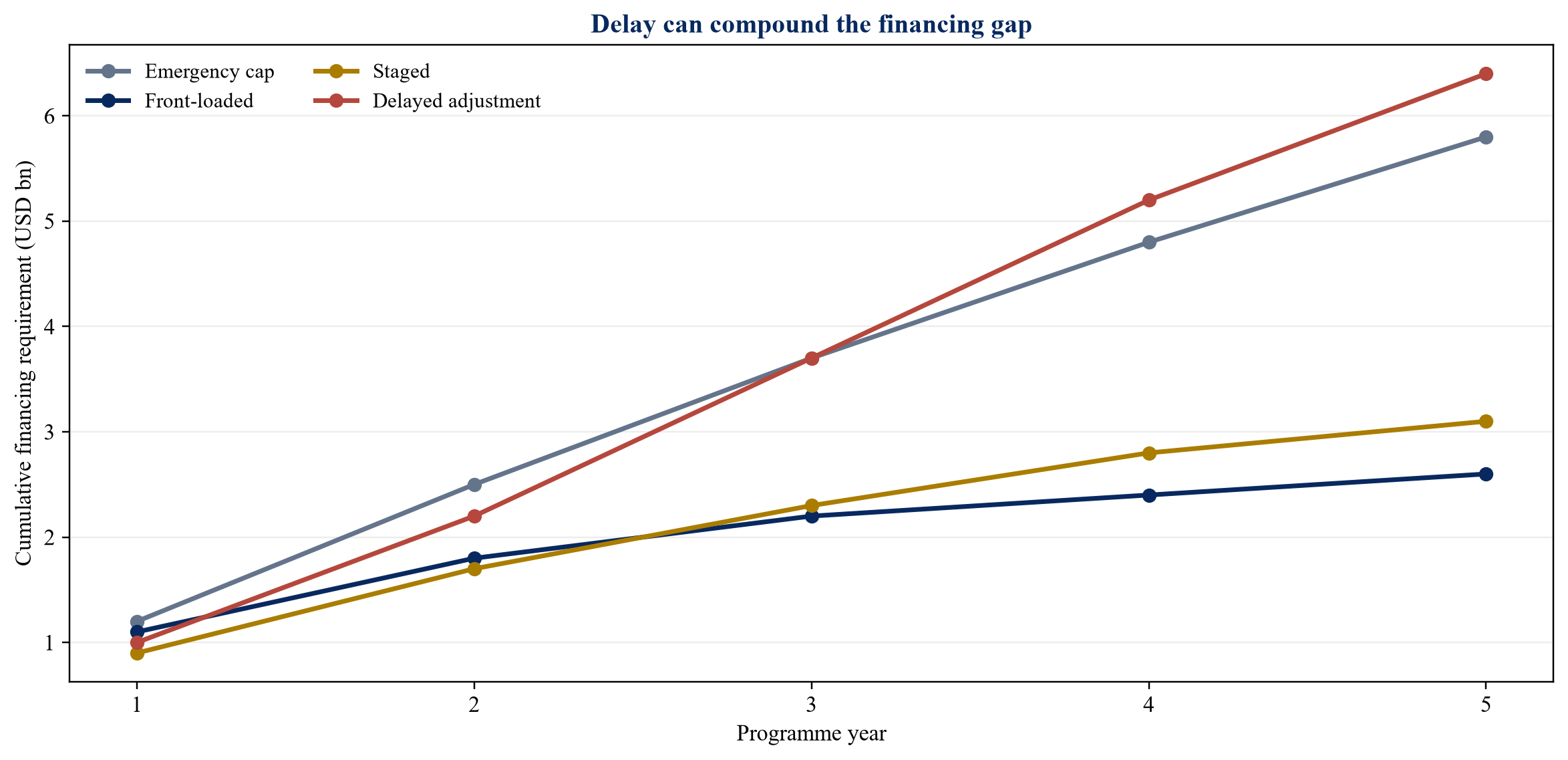
Values are hypothetical author-modelled assumptions in USD billions. Financing requirement includes explicit support, utility liquidity and programme cost, net of modelled reform savings.
25 Create a 180-day implementation programme
Days one to thirty should establish governance, policy perimeter, subsidy baseline and data room. The team should reconcile budget, utility, regulator, supplier and tax data. It should identify legal actions and appoint decision owners.
Days thirty-one to seventy-five should complete incidence analysis, eligibility design, utility cash modelling and reform scenarios. The programme should test household impacts, compensation, inflation, firm exposure, collections and financing.
Days seventy-six to one hundred and twenty should build and test delivery. Activities include payment dry runs, billing changes, complaints, local training, communication, liquidity facilities and published monitoring definitions.
Days one hundred and twenty-one to one hundred and eighty should approve the price path, fund protection, issue legal instruments and conduct a controlled launch. The first post-launch cycle should reconcile prices, payments, utility cash, service and complaints.
26 Assign decision rights
The finance ministry should own the fiscal envelope and published reconciliation. The energy ministry and regulator should own pricing rules, service obligations and utility performance. The social-protection agency should own eligibility, payment and appeals. The utility should own billing, collections and service data.
The central bank or statistical authority can advise on inflation measurement within its mandate. Competition and consumer bodies can monitor market conduct and customer protection. An independent auditor can validate selected results.
The cabinet or authorised committee should approve material changes. Operational teams should have delegated authority within defined thresholds.
Table 3. Energy-price reform decision and control matrix
| Decision | Primary owner | Required evidence | Approval trigger |
|---|---|---|---|
| Subsidy baseline | Finance ministry and regulator | Cost benchmark, budget, utility accounts and arrears | Material methodology or data change |
| Price-path adjustment | Energy ministry or regulator | Formula, market data, incidence and utility cash | Scheduled stage or exceptional trigger |
| Compensation release | Social-protection agency and treasury | Eligible register, payment test and funded appropriation | Each payment cycle |
| Utility liquidity support | Finance ministry and lender group | Monthly cash model, collections and supplier exposure | Minimum cash or service threshold |
| Programme pause | Authorised reform committee | Verified trigger, fiscal cost and recovery plan | Published threshold breached |
| Savings allocation | Cabinet and legislature as applicable | Realised reconciliation and programme performance | Budget approval cycle |
Responsibilities should be adapted to the jurisdiction's legal and institutional framework.
27 Monitor outcomes rather than announcements
The dashboard should track cost recovery, subsidy cash, arrears, utility collections, transfers, household burden, disconnections, outages, fuel availability, complaints, efficiency installations and investment. Each indicator requires a source, frequency and owner.
The programme should publish a compact public version and retain a detailed operational version. Revisions should preserve history. Missing data should be visible.
An evaluation should compare outcomes with the pre-reform baseline and approved scenario. It should identify distributional effects and implementation lessons. The result can inform the next stage.
28 Apply the framework across market structures
An oil exporter with administered fuel prices faces different fiscal and political dynamics from an importer exposed to exchange rates. A vertically integrated state utility differs from a competitive retail market. An island system faces fuel and reserve constraints that limit immediate substitution.
The same framework still applies: establish the economic and cash gaps, model incidence, fund protection, stabilise utility cash, define the price path and monitor outcomes. Instrument design should reflect local institutions.
International evidence provides design lessons rather than a copyable formula. The Asian Development Bank's regional work emphasises social protection, communication and sequencing in reform [19]. National data and legal authority determine the executable programme.
29 Test fiscal resilience and contingent liabilities
The fiscal model should distinguish the annual subsidy appropriation from the government's full exposure. A utility may borrow against an expected compensation payment, a fuel supplier may extend credit, or a state guarantee may support procurement. These arrangements can shift the timing and presentation of the cost without reducing the underlying obligation.
The model should consolidate explicit transfers, tax expenditure, supplier arrears, guaranteed debt, unpaid regulatory assets and commitments under power or fuel contracts. It should show which items are recognised in the budget, utility accounts and public-sector balance sheet. Accounting treatment requires jurisdiction-specific review, while the commercial model should retain every material cash and credit exposure.
Stress testing should combine benchmark energy prices, exchange rates, demand, collection rates and reform delay. A high-price scenario can increase the unit support gap. Currency depreciation can raise imported fuel and debt service. Weak collections can prevent the utility from retaining the revenue expected from a tariff increase. A demand response can reduce sales and partly offset the intended cash improvement.
The fiscal authority should calculate a maximum annual support envelope and a cumulative liability limit. Breaching either limit should trigger an approved response such as an accelerated price stage, additional targeted protection, a tax adjustment, a funded liquidity facility or a revision to procurement. The response should be modelled before launch.
Contingent liabilities require named owners and reporting dates. A government guarantee should specify the covered obligation, limit, expiry and claim process. A stabilisation account should disclose its balance and financing. A utility compensation receivable should identify the legal basis, verification process and settlement history.
The programme should also test how reform savings behave during a new shock. Savings based on a central benchmark may disappear when global prices or the exchange rate move. Commitments funded from expected savings should therefore have a downside financing plan. Long-term social and investment programmes should not depend on an unverified short-term saving.
An investment committee or fiscal-risk committee should receive the annual and cumulative exposure, stress outcomes, liquidity path and legal commitments. This view identifies whether the reform improves public-sector resilience or merely transfers risk among the budget, utility, supplier and lender.
30 Convert the programme into transaction diligence
An investor evaluating a utility, generator, distributor, retailer or energy-intensive borrower should map subsidy exposure to contracts and cash. The diligence scope should identify regulated tariffs, compensation receivables, fuel support, tax preferences, arrears and guarantees.
Quality of earnings should separate ordinary revenue from temporary compensation and unpaid claims. Working capital should include the timing of government and customer receipts. Debt-like items may include overdue supplier balances, regulatory liabilities and unfunded service obligations.
Transaction documents can address defined risks through price adjustments, conditions precedent, specific indemnities, escrow, earn-outs or government support. Drafting should follow the modelled mechanism and applicable law. A general change-in-law clause may not allocate a delayed subsidy payment or disputed cost benchmark.
The investment committee should receive the reform paths, household and political constraints, utility cash, required capex, debt headroom and evidence gaps. This creates a traceable decision under uncertainty.
31 Recognise limitations
The scenarios in this paper are illustrative. They do not use a country's household survey, utility accounts, tariff order, fiscal data, social registry, input-output table or legal framework. Results change with energy mix, prices, exchange rates, climate, income, market structure and management action.
Targeting models can contain data errors and may exclude eligible people. Transfers can affect labour, consumption and household decisions. Inflation and firm effects are uncertain. Administrative and political responses can alter the intended path.
Legal, accounting, tax and regulatory treatment depends on facts and jurisdiction. The framework supports policy, financing and transaction analysis. Executed decisions require authorised approvals, professional advice, model assurance and tested delivery systems.
Conclusion
Energy subsidy reform is a connected fiscal, social and utility-finance programme. The price decision cannot be separated from compensation, utility liquidity, service and investment. A durable programme begins with a verified baseline and a clear affordability objective.
The practical method is to model the cost and cash gaps, measure direct and indirect incidence, select targeted protection, establish readiness gates, sequence price changes and connect them to utility cash and investment. Automatic pricing, published savings and independent review can strengthen credibility when governance is clear.
Boards, governments, utilities and lenders can use this framework to identify the price stage, transfer failure, market shock or service event that changes the plan. The result is a reform path grounded in evidence, funded delivery and explicit controls.
References
- International Monetary Fund. Policy Responses to High Energy and Food Prices. 2023. https://www.imf.org/en/publications/wp/issues/2023/03/24/policy-responses-to-high-energy-and-food-prices-531343
- OECD. Energy Support Measures Tracker. 2026. https://www.oecd.org/en/data/tools/oecd-energy-support-measures-tracker.html
- International Monetary Fund. Fiscal Monitor April 2025, Chapter 2: Public Sentiment Matters. 2025. https://www.imf.org/-/media/files/publications/fiscal-monitor/2025/english/ch2.pdf
- International Monetary Fund. Fossil Fuel Subsidies. 2026. https://www.imf.org/en/topics/climate-change/energy-subsidies
- OECD. OECD Economic Surveys: Indonesia 2024. 2024. https://www.oecd.org/en/publications/oecd-economic-surveys-indonesia-2024_de87555a-en/full-report/pressing-ahead-with-the-green-transition_7524bbfd.html
- World Bank. Energy Subsidy Reform Assessment Framework. 2014. https://documents.worldbank.org/en/publication/documents-reports/documentdetail/109711468151798065/energy-subsidy-reform-assessment-framework-esraf-good-practice-notes
- OECD. Energy Prices and Subsidies in the Western Balkans. 2025. https://www.oecd.org/en/publications/energy-prices-and-subsidies-in-the-western-balkans_082ea26a-en.html
- International Monetary Fund. Angola: 2023 Article IV Consultation. 2024. https://www.elibrary.imf.org/view/journals/002/2024/080/article-A001-en.xml
- International Monetary Fund. Malaysia: 2023 Article IV Consultation. 2023. https://www.imf.org/-/media/files/publications/cr/2023/english/1mysea2023001.pdf
- International Energy Agency. Fossil Fuels Consumption Subsidies 2023. 2024. https://www.iea.org/reports/fossil-fuels-consumption-subsidies-2023
- OECD. Pro-poor Fossil Fuel Subsidy Reform. 2024. https://www.oecd.org/en/publications/development-co-operation-report-2024_357b63f7-en/full-report/pro-poor-fossil-fuel-subsidy-reform_ffb194f7.html
- OECD. Green Growth Policy Review of Egypt 2024. 2024. https://www.oecd.org/en/publications/oecd-green-growth-policy-review-of-egypt-2024_b9096cec-en.html
- OECD. Environmental Performance Reviews: Colombia 2026. 2026. https://www.oecd.org/en/publications/oecd-environmental-performance-reviews-colombia-2026_968398f7-en.html
- International Energy Agency. Energy Efficiency 2024. 2024. https://www.iea.org/reports/energy-efficiency-2024
- World Bank. Tracking SDG7: The Energy Progress Report 2025. 2025. https://www.worldbank.org/en/topic/energy/publication/tracking-sdg-7-the-energy-progress-report
- Sustainable Energy for All. Energy Access. 2026. https://www.seforall.org/energy-access
- International Renewable Energy Agency. Renewable Power Generation Costs in 2024. 2025. https://www.irena.org/Publications/2025/Jun/Renewable-Power-Generation-Costs-in-2024
- International Energy Agency. World Energy Investment 2025. 2025. https://www.iea.org/reports/world-energy-investment-2025
- Asian Development Bank. Fossil Fuel Subsidies in Asia: Trends, Impacts, and Reforms. 2016. https://www.adb.org/publications/fossil-fuel-subsidies-asia-trends-impacts-and-reforms
- International Monetary Fund. IMF Fossil Fuel Subsidies Data: 2023 Update. 2023. https://www.imf.org/en/Publications/WP/Issues/2023/08/22/IMF-Fossil-Fuel-Subsidies-Data-2023-Update-537281
- World Bank. The Political Economy of Energy Subsidy Reform. 2014. https://documents.worldbank.org/en/publication/documents-reports/documentdetail/745311467990998350/the-political-economy-of-energy-subsidy-reform
- International Monetary Fund. Energy Subsidy Reform: Lessons and Implications. 2013. https://www.imf.org/external/np/pp/eng/2013/012813.pdf
- International Monetary Fund. Equity and Efficiency in the Reform of Price Subsidies. 2000. https://www.imf.org/external/pubs/ft/equity/index.htm
- OECD. Energy Subsidy Reform in the Republic of Moldova. 2018. https://www.oecd.org/en/publications/energy-subsidy-reform-in-the-republic-of-moldova_9789264292833-en.html
- European Commission. Energy Prices and Costs in Europe. 2024. https://energy.ec.europa.eu/data-and-analysis/energy-prices-and-costs-europe_en
- World Bank. State of Social Protection Report 2025. 2025. https://www.worldbank.org/en/publication/state-of-social-protection-report
- International Labour Organization. World Social Protection Report 2024-26. 2024. https://www.ilo.org/publications/flagship-reports/world-social-protection-report-2024-26-universal-social-protection
- International Monetary Fund. Arab Republic of Egypt: Third Review under the Extended Arrangement. 2024. https://www.elibrary.imf.org/view/journals/002/2024/274/article-A001-en.xml
- World Bank. Rethinking Power Sector Reform in the Developing World. 2020. https://openknowledge.worldbank.org/handle/10986/32335
- International Energy Agency. Electricity 2026. 2026. https://www.iea.org/reports/electricity-2026
About the Author
Authored by Chennakeshav Adya Independent Researcher
Chennakeshav (CK) is a corporate finance and investment banking executive with 25+ years of global experience in deal origination, structuring and execution across M&A, growth capital and corporate strategy. He has led value-creation mandates for founders, corporates and funds — bridging the boardroom view to hands-on execution and close.
His career spans Morgan Stanley, HSBC, Lloyds Banking Group, EWEC, ADQ portfolio companies and Emirates Growth Fund, across TMT, real estate, fintech, deeptech, cleantech, infrastructure and energy. He has partnered with C-suite leaders, private equity and venture funds, sovereign wealth funds and family offices to finance complex fund raises and scale-up ventures, and has led M&A due diligence, post-merger integration and business-transformation initiatives to create value.
At Matchpoint Partners he is Managing Partner, leading the firm's corporate finance, M&A and capital-raising practice. He holds an MBA from London Business School, an engineering degree from VTU and a Master of Laws (LLM, in progress) from UCL London.
An active start-up mentor, CK mentors at Techstars, DIFC FinTech Hive, Startup Grind, Founder Institute and IN5, serves as Entrepreneur Mentor in Residence (EMiR) at London Business School, and judges the Entrepreneurship World Cup.
LinkedIn: https://www.linkedin.com/in/ckadya/ Matchpoint Partners: https://www.matchpoint-partners.com/team/ck-adya.html
This paper is part of a continuing series on the structure of private and alternative markets. The views expressed are the author's own. The paper is for information only, describes market structure in general terms, and does not constitute investment, legal, tax or regulatory advice or a recommendation in respect of any security, vehicle or counterparty.
