

1. Treat the platform choice as an operating-model decision
A regulated fund platform can combine a licensed or authorised manager, fund governance, administration, compliance, risk, financial-crime controls, reporting, service providers, technology and distribution support. The exact bundle varies by provider, jurisdiction, fund and contract. The word platform has no universal regulatory meaning.
The sponsor's decision is therefore wider than rent a licence or build one. It asks which legal entity performs each regulated and operational activity, who makes investment and risk decisions, which duties remain with the appointed manager, which work is delegated, who controls data and cash, how investors are served and how the arrangement can change or end.
Three routes commonly require comparison. The build route creates or expands the sponsor's own authorised manager and operating system. The hosted route appoints an established regulated manager or operator and contracts for defined infrastructure and oversight. The hybrid route retains selected sponsor capabilities and uses external regulated or operational components. An external-manager route can also be available under specific fund regimes.
The board should define the decision horizon. A vehicle expected to raise one fund, a sponsor planning a sequence of strategies and a diversified manager building an institutional platform face different economics. A faster first launch can have value. Recurring cost, decision friction, product constraints and later migration can change the answer over the fund's full life.
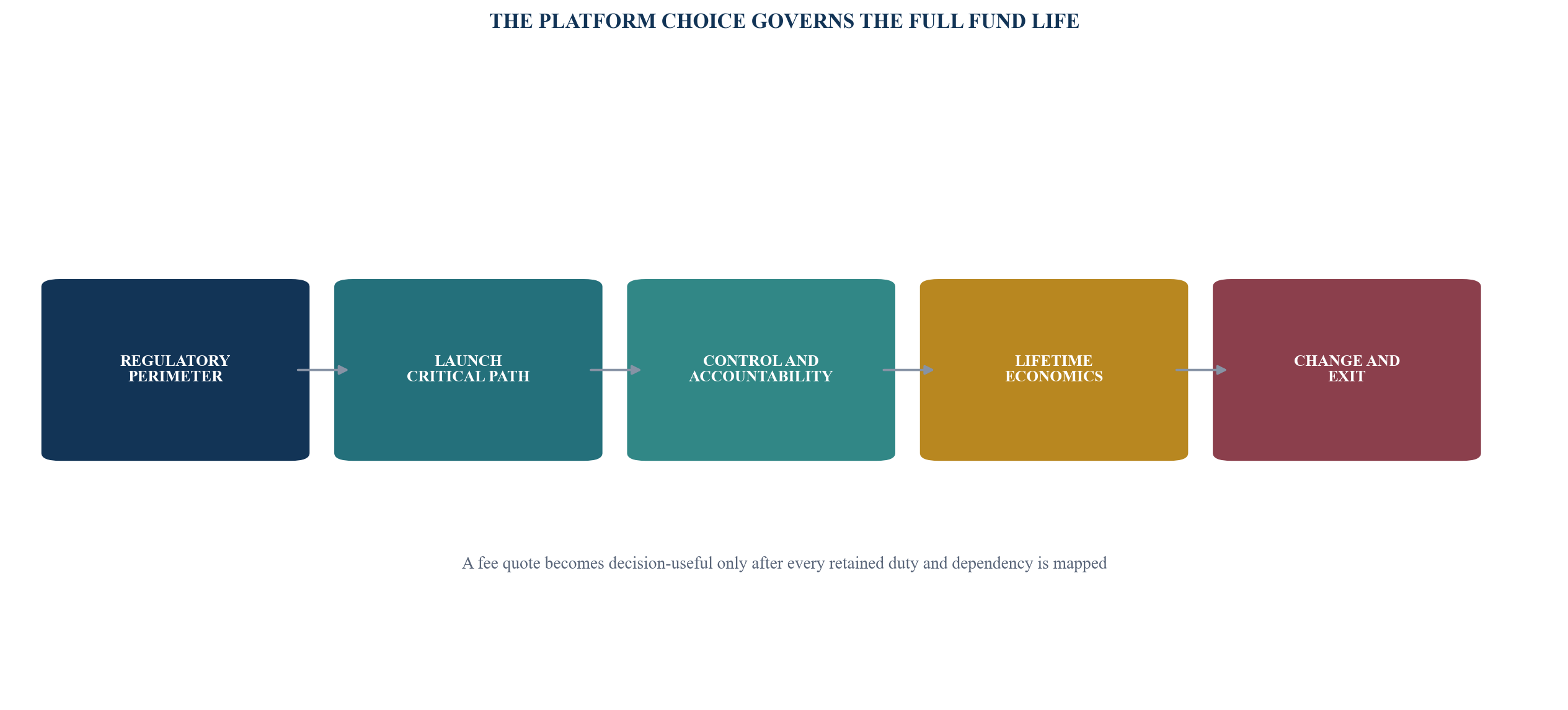
The selected model should connect the regulatory perimeter, launch, control, economics, operation and exit.
2. Establish the regulatory perimeter first
The perimeter identifies the manager, fund, activities, investors, jurisdictions and people. It maps portfolio management, risk management, operating a fund, arranging, advising, marketing, dealing, custody, administration, valuation, financial promotions and investor communications. The governing law and current rules determine which activity requires which permission or appointment.
A provider's licence does not automatically cover the sponsor's people, every strategy or every jurisdiction. The board should examine the provider's permissions, restrictions, regulatory status, approved persons, financial resources and experience with the proposed asset class. It should identify who signs fund documents, contracts with investors, supervises delegates and communicates with regulators.
The United Kingdom host-AIFM model can involve an authorised alternative investment fund manager and seconded or appointed-representative personnel. The FCA's March 2024 material, updated in May 2025, reports potential harm from inadequate oversight of seconded staff, insufficient investor due diligence and weaknesses in capital-adequacy calculations. It states that the AIFM is responsible for all employees, including secondees, and needs robust monitoring of fund activity.
The FCA's 2021 host-authorised-fund-manager review also identified weaknesses in due diligence, oversight, governance, resources and conflicts at sampled firms. It emphasised that regulatory responsibility is unaffected by delegation. These findings describe reviewed firms and supervisory expectations. They do not establish that every host model has the same weakness.
Table 1. Regulatory-perimeter map
| Activity | Proposed performer | Authority or appointment to verify | Evidence |
|---|---|---|---|
| portfolio decisions | sponsor team or regulated manager | permission, delegation and named authority | mandate, role descriptions and minutes |
| risk management | regulated manager or independent function | current rules and functional separation | policy, limits, reports and challenge |
| fund operation | appointed manager or operator | fund and firm permissions | appointment and governing documents |
| administration | in-house team or administrator | contract and any regulatory status | SLA, control reports and reconciliations |
| custody or depositary | eligible appointed provider | asset and fund-regime requirements | appointment, asset map and oversight |
| marketing and placement | authorised firm and approved persons | jurisdiction and investor route | marketing-perimeter register |
| investor due diligence | appointed accountable firm | financial-crime framework | risk assessment, files and approvals |
Current specialist advice should confirm each activity, entity, permission and jurisdiction.
3. Compare build, host and hybrid routes on the same scope
A fair comparison uses one target operating model. The sponsor lists every capability required to launch and operate the fund, then assigns it under each route. Leaving internal work out of the hosted model or treating existing staff as free distorts the economics.
The build route can include authorisation strategy, legal entity, governance, board, senior managers, compliance, money-laundering reporting, risk, finance, regulatory reporting, capital, insurance, policies, technology, records, data, administrator oversight, valuation, investor operations and continuity. The regulator controls the authorisation outcome and timing.
The hosted route can include product approval, appointed manager, risk and compliance, regulated governance, service-provider coordination, investor onboarding, reporting and oversight. The sponsor can still retain strategy, sourcing, underwriting, portfolio support, fundraising, data preparation and substantial provider-management work. The contract should state the actual boundary.
The hybrid route may build sponsor-side investment, data and investor capabilities while appointing an external regulated manager. It can later migrate selected functions after authorisation or scale. The transition assumptions need to be modelled at inception.
Comparison should separate current capability, required new capability and proposed future capability. A platform presentation can show a complete system. The sponsor should identify which components are included, optional, third-party, subject to minimum fees or priced after diligence.
4. Define speed through a critical path
Launch time is governed by the longest dependent workstream, not the provider's shortest task. The critical path can include strategy and investor definition, entity formation, manager approval, fund registration or notification, governing documents, tax structure, banking, administrator and depositary appointments, valuation, financial-crime controls, offering materials, data, subscriptions, distribution permissions and first-close evidence.
The DFSA describes Public, Exempt and Qualified Investor Fund regimes with different investors, offer methods and application processes. Its public material states five-business-day processing for Exempt Funds and a two-business-day fast-track notification process for Qualified Investor Funds. Those periods concern stated regulatory processes after the required conditions and materials are satisfied. They do not establish an end-to-end fund-launch time.
The DFSA's online service for new fund registration publishes a regulatory service fee range of USD 1,000 to USD 4,000 and lists governing documents and an information memorandum or prospectus among required documents. The current Fees module and actual application govern the payable amount.
A hosted model can shorten manager-authorisation work when an appropriate provider is already authorised and approves the product. Product diligence, provider contracting, fund documentation, banking, operations and distribution still take time. The board should measure launch readiness through accepted evidence rather than calendar promises.
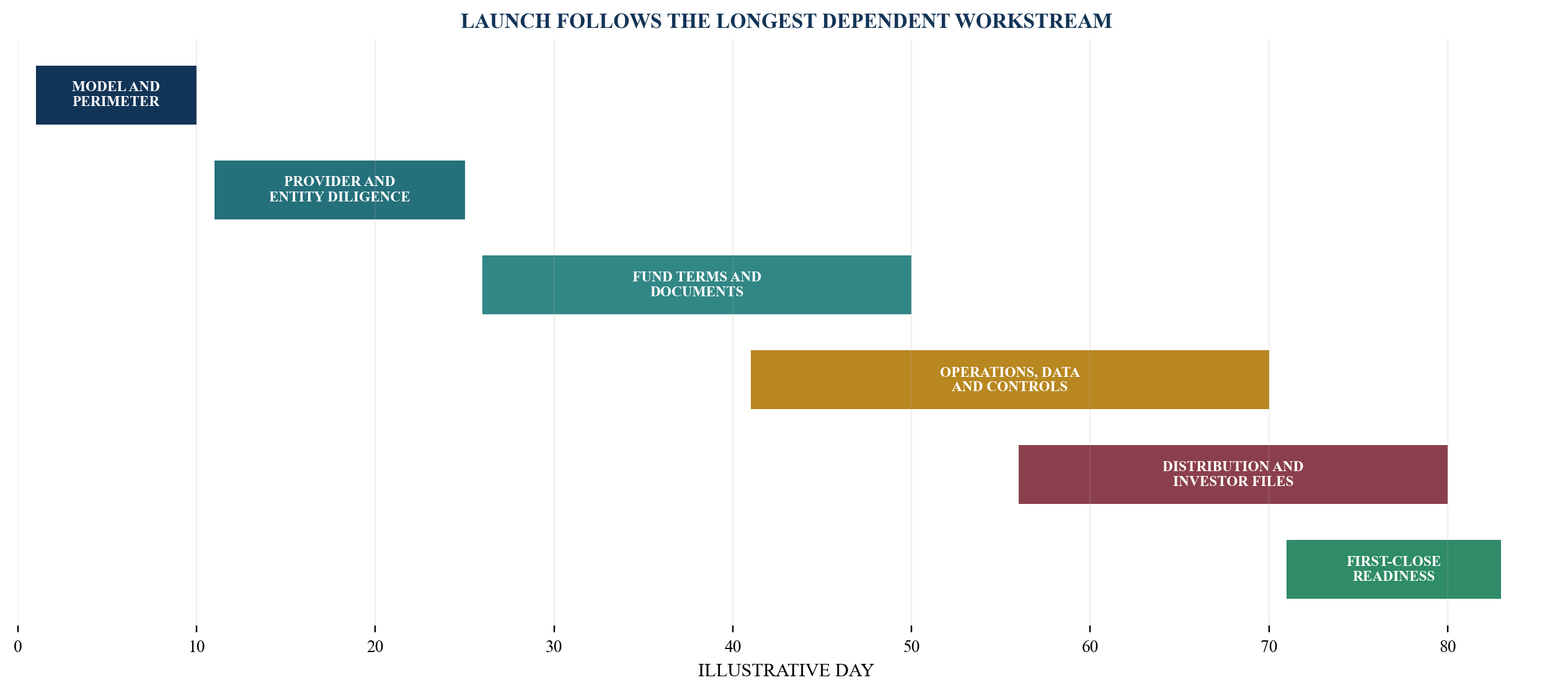
Regulatory processing is one workstream inside the full evidence and implementation path.
5. Build the lifetime-cost architecture
Lifetime cost begins before formation and continues through wind-down. One-off costs can include regulatory and entity applications, legal and tax advice, fund documents, provider onboarding, policy design, systems, data migration, banking, insurance, recruitment and first-close support.
Recurring external costs can include platform or manager fees, administration, custody or depositary, audit, directors, legal, compliance, regulatory reporting, valuation, insurance, technology, data rooms, tax reporting, banking and investor portals. Pricing can use fixed fees, basis points, minimums, transaction charges, investor counts, entity counts, asset counts or service tiers.
Internal cost remains material under every route. Investment professionals, finance, operations, investor relations, compliance coordination, data, governance and executive oversight consume time. The model should assign loaded cost according to actual work rather than job title.
Contingent and change costs include new share classes, side letters, additional jurisdictions, valuation events, complex investments, investor remediation, regulatory change, incidents, fund extensions, restructurings and termination. Exit costs can include notice, transfer, document amendment, data extraction, parallel operation and regulatory work.
The cost model uses a common currency, date, inflation rule, fund and entity scope, assets-under-management path, investor path and service boundary. It separates cash cost, regulatory capital and management capacity.
Table 2. Lifetime-cost ledger
| Cost layer | Build route | Hosted route | Hybrid route |
|---|---|---|---|
| formation and approval | entity, authorisation and full design | product approval, contracting and fund formation | sponsor build plus platform onboarding |
| fixed annual | people, systems, governance and premises | minimum platform, provider and internal retained team | mixed internal and external fixed costs |
| variable annual | AUM-linked provider and operating costs | platform basis points, transactions and providers | selected AUM-linked external services |
| prudential resources | regulatory capital, insurance and liquidity | reflected in provider economics plus sponsor liquidity | capital for retained regulated scope |
| change | permission, product and operating changes | change requests, approvals and contract pricing | two-system coordination and migration |
| termination | wind-down or licence change | notice, replacement, transfer and data extraction | phased migration and duplicate operation |
Provider proposals should be normalised to this ledger before comparison.
6. Use a transparent five-year model
The model should show assumptions separately from formulas. A base case can include one fund, target commitments, closing schedule, investment period, investor count, entities, assets, staff, providers, fixed and variable fees, inflation, regulatory capital, internal time and exit cost.
For method demonstration, assume a fund grows from USD 40 million at first close to USD 200 million in final commitments. Assume the hosted route has a USD 180,000 annual minimum plus 8 basis points on committed capital, and the build route requires USD 850,000 of annual loaded operating cost after USD 1.4 million of setup. These values are management assumptions. They are not quotes, market averages or recommendations.
The model should avoid comparing only platform fee with only employee salaries. The hosted route includes retained sponsor work and third-party costs outside the platform scope. The build route includes shared corporate capability, regulatory capital and all provider costs. The hybrid route includes duplication during transition.
Discounted cost can support decisions when timing differs. The board should also see nominal cash, peak funding, fixed-cost exposure and cost per active fund. A lower present value can still require unaffordable early cash or create operational concentration.
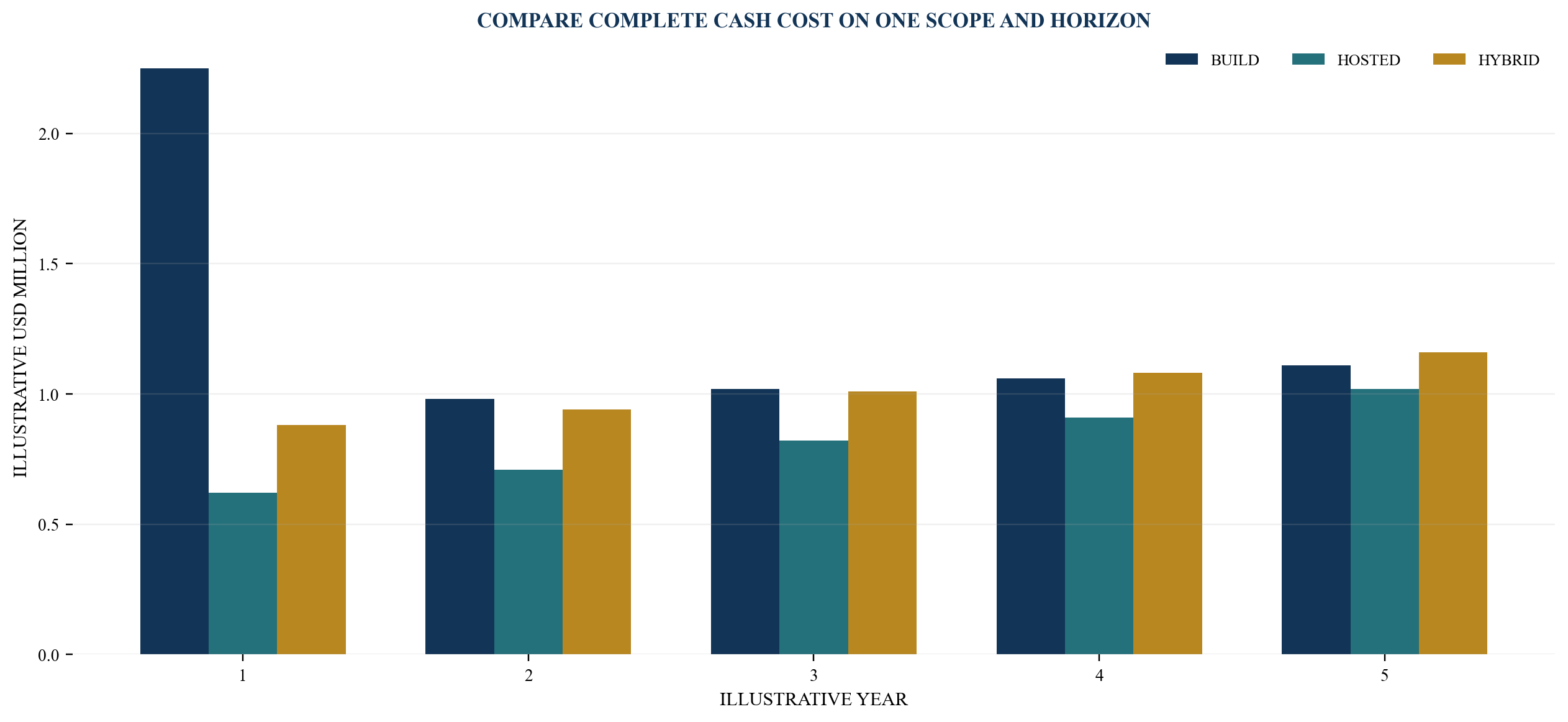
Every value is a management assumption for method demonstration; verified quotes and a current operating design are required.
7. Test break-even scale without hiding step costs
Build economics can improve across several funds when fixed capabilities are genuinely reusable. Hosted economics can remain attractive when activity is intermittent, product count is low or the sponsor values flexibility. Variable platform fees can rise with commitments or net assets. Minimums can dominate a small first fund.
A break-even model should use number of funds, strategies, entities, investors, assets, jurisdictions and operational events. Two funds with different liquidity, valuation and reporting complexity do not consume the same capability. The relevant denominator may be active vehicles rather than assets under management.
Step costs matter. A new strategy can require an additional risk specialist. A retail product can require different governance, disclosures and operations. A new jurisdiction can add reporting and distribution work. Thresholds should trigger new people, systems, capital or providers in the model.
The board can calculate the scale at which cumulative build cost falls below hosted cost under stated assumptions. It should then vary asset growth, launch delay, platform pricing, staffing, inflation and migration. A single break-even point creates false precision.
Table 3. Break-even sensitivity register
| Driver | Lower case | Base case | Higher case | Decision effect |
|---|---|---|---|---|
| final commitments | USD 100m | USD 200m | USD 350m | variable fee and operating scale |
| active funds in year five | 1 | 2 | 4 | fixed-cost reuse and governance load |
| build authorisation delay | 0 months | 6 months | 12 months | duplicate cost and lost sequencing |
| hosted variable fee | 5 bps | 8 bps | 12 bps | cumulative platform economics |
| internal loaded team | USD 0.6m | USD 0.85m | USD 1.2m | build capacity and control |
| transition cost | USD 0.2m | USD 0.5m | USD 1.0m | value of future optionality |
Each scenario should show cumulative cash, peak funding, operational capacity and decision consequences.
8. Price control as a separate economic dimension
Control is the practical ability to make, approve, execute and evidence a decision. It covers strategy, portfolio decisions, risk limits, valuation, liquidity, leverage, conflicts, product changes, service providers, investor acceptance, marketing, side letters, communications and incident response.
A hosted manager retains responsibilities that cannot be reduced to a service promise. The sponsor should expect independent challenge, information requests, approval conditions and stop decisions within the manager's remit. That governance can protect investors and the regulated entity. It can also change timing and product flexibility.
The authority matrix should state reserved matters, delegated decisions, consultation rights, vetoes, escalation, quorum and evidence. Marketing titles and commercial descriptions should match the legal roles. The FCA's host-AIFM material highlights misleading claims where third parties described themselves as investment managers despite narrower permissions or arrangements.
Control has economic value when it supports differentiated products, rapid portfolio action, proprietary data, institution-specific reporting or repeated launches. It also has cost because the sponsor must finance people, governance, systems and accountability. The board should value specific decision rights rather than the abstract idea of independence.
9. Keep delegation and accountability connected
Delegation assigns a task while accountability can remain with the appointed manager. The European AIFMD framework requires objective reasons, capable and supervised delegates for specified functions, effective monitoring, instructions and withdrawal rights. It states that delegation must not turn the manager into a letter-box entity. The exact application depends on the manager, fund, domicile and current law.
The FCA's host-AFM review similarly states that regulatory responsibility is unaffected by delegation. A sponsor should therefore assess whether the host has sufficient people, expertise, systems, data and authority to oversee the proposed strategy.
IOSCO's 2021 Principles on Outsourcing address governance, due diligence, contracts, information security, concentration, access, continuity, monitoring and exit for regulated entities within scope. The principles are proportionate and should be read with their explanatory text. They provide a useful control architecture where applicable.
The delegation register identifies each task, provider, legal basis, criticality, data, sub-delegation, performance measures, oversight, regulatory access, continuity and exit. It distinguishes advice from discretion and administrative support from regulated decision-making.
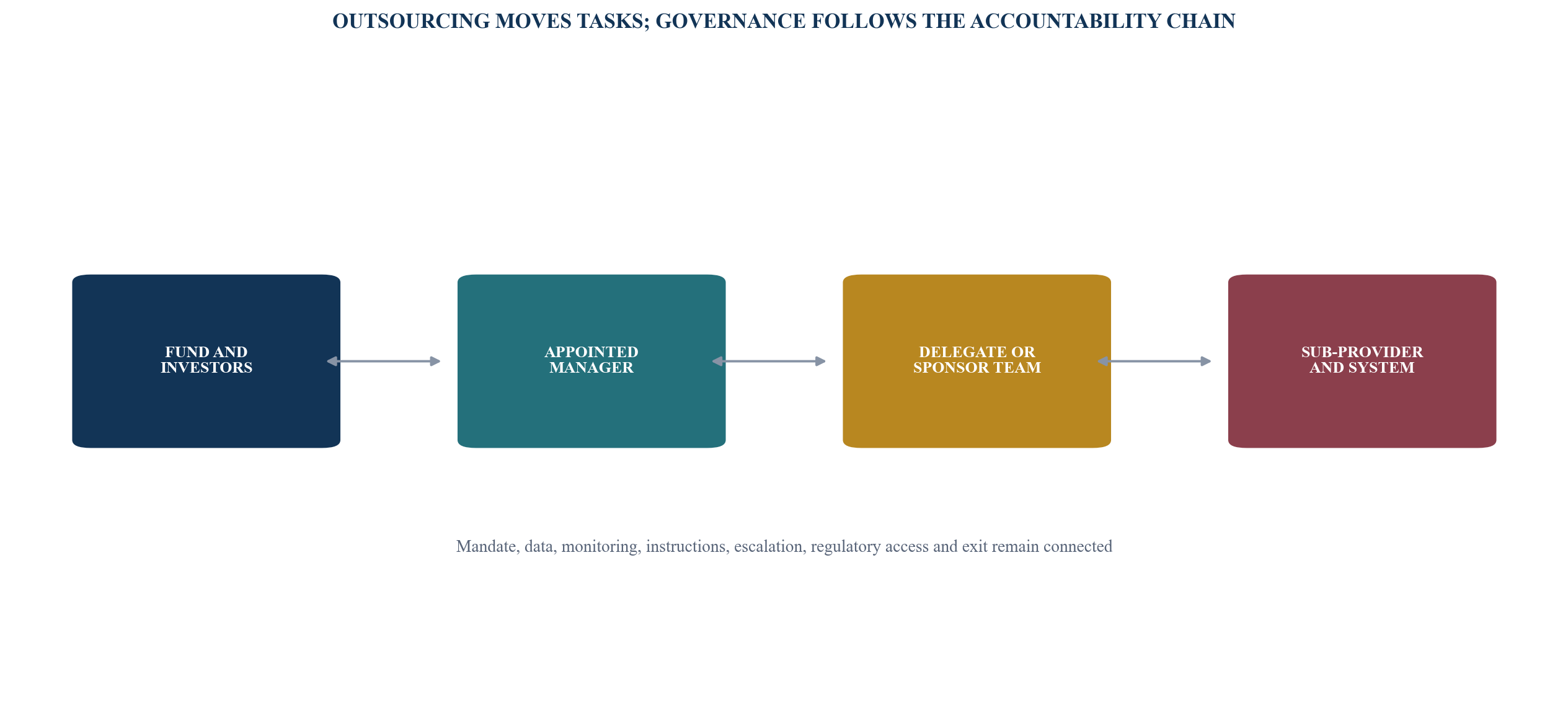
The appointed manager retains the oversight, information and intervention capability required by the applicable framework.
10. Conduct provider diligence on the live service
Provider diligence should test the legal entity and team that will perform the service. Group scale, brand and aggregate assets can differ from the resources allocated to the proposed fund. The sponsor should obtain the service map, key roles, capacity, client concentration, strategy expertise, financial resources, regulatory history, insurance and continuity arrangements.
Governance diligence examines product approval, investment and risk committees, valuation, conflicts, financial crime, complaints, incidents, breaches and regulatory reporting. Operational diligence examines administration, cash, reconciliations, data, cybersecurity, records, outsourcing, service levels and tested recovery.
Commercial diligence reconstructs the full fee schedule, included work, assumptions, minimums, pass-through costs, changes, tax, invoice controls and termination. References should match fund type, asset class, investor geography and service model.
Capacity needs evidence. The provider can show named people, client and fund load, service calendar, peak processes, vacancies, turnover, automation, controls and escalation. The sponsor should identify which dependencies rely on one person or downstream provider.
11. Contract for outcomes, information and intervention
The appointment should define services, responsibilities, reserved matters, delegation, standard of performance, data, reporting, approvals, fees, conflicts, confidentiality, intellectual property, audit, regulatory cooperation, insurance, liability, business continuity, change, sub-contracting, termination and transition.
Service levels should measure decision-relevant outcomes. Examples include complete onboarding files, approved valuations, reconciled capital accounts, reporting timeliness, issue resolution, breach escalation, data quality and recovery tests. A response-time metric can be met while the underlying decision remains unresolved.
The contract should give the accountable manager access to source records and the sponsor access to its permitted data. Regulators, auditors, depositaries and appointed advisers need appropriate access under current requirements. Data location, transfer, retention, deletion and portability should be explicit.
Termination planning begins at appointment. The contract identifies notice, assistance, data format, records, investor communications, provider consents, fee treatment, unresolved incidents and parallel operation. A low initial fee can be offset by an expensive or constrained exit.
Table 4. Platform contract control schedule
| Contract domain | Required precision | Evidence at acceptance | Exit implication |
|---|---|---|---|
| service perimeter | included, excluded and optional work | signed responsibility matrix | replacement scope |
| decision rights | approvals, vetoes and escalation | authority schedule | interim governance |
| data and records | ownership, access, format and retention | tested exports and lineage | portable complete archive |
| service levels | outcome, threshold, evidence and remedy | dashboard and issue logs | open-item handover |
| sub-providers | identity, consent and oversight | provider register | transfer or replacement |
| fees | fixed, variable, pass-through and changes | normalised cost schedule | termination and tail fees |
| continuity | recovery, incidents and financial resilience | test results and plans | emergency transition |
Counsel should align the commercial schedule with governing documents and regulatory duties.
12. Treat data and investor operations as core infrastructure
A fund operating model connects subscription documents, investor identity, commitments, calls, distributions, capital accounts, portfolio values, fees, expenses, performance, side letters, tax and regulatory reporting. The platform should use controlled definitions and reproducible calculations.
The sponsor should know which system is the book of record for each field, who can change it, how changes are approved and how data reconcile across administrator, manager, bank, depositary, portfolio and investor portal. Manual spreadsheets may support analysis but should not create uncontrolled competing records.
Investor onboarding includes eligibility, know-your-customer work, beneficial ownership, sanctions, tax forms, source information, subscriptions and approvals. The FCA's 2024 host-AIFM material highlights the importance of AIFM involvement in investor due diligence. The actual duty allocation depends on the arrangement and current framework.
Reporting should be designed before first close. The obligation register maps governing documents, side letters, regulation and investor commitments to fields, calculations, owners, review, delivery and corrections. Bespoke promises can materially change lifetime cost.
13. Select the fund structure and platform together
The fund vehicle, manager, investor base, strategy and service model are interdependent. Legal form affects governance, tax, subscriptions, transfer, accounting and operations. Open-ended and closed-ended structures have different liquidity and valuation needs. Credit, property, venture, hedge and private-equity funds can require different systems and providers.
The DFSA describes investment companies, investment trusts and investment partnerships for domestic funds, along with umbrella, protected-cell and incorporated-cell structures within stated conditions. It also describes domestic and external fund managers. The current rules and forms govern the proposed structure.
The DFSA published Consultation Paper 173 in July 2026 proposing material changes, including removal of the external-fund-manager regime. The paper is a consultation proposal at the date of this research. A selection model should maintain a regulatory-change register and should not treat a proposal as adopted.
ADGM's current FSRA guide identifies the Fund Rules, fund categories and manager routes. Its FSRA implemented periodic regulatory reporting requirements for funds in 2025. Current rulebooks, forms, permissions and fees should be checked for the live proposal.
14. Include prudential resources and organisational resilience
An own-manager route requires financial resources that can absorb operating risk and sustain the business. The FCA's authorised-AIFM material sets out current prudential requirements for firms within scope, including base, expenditure and professional-negligence components. Exact calculations require current advice and firm-specific facts.
Regulatory capital is not an operating expense in the same way as salary. It is still a funding requirement with opportunity cost, liquidity restrictions and governance. The model should show initial and ongoing resources, buffers, insurance, stress and wind-down.
A platform provider's financial resilience matters because failure can disrupt several funds. Diligence should examine capital, liquidity, profitability, insurance, concentrations, claims, regulatory issues, recovery and wind-down. Public accounts and regulatory information should be reconciled with provider explanations.
The sponsor also needs resilience. It should fund its retained team, adviser costs, unforeseen changes and a transition. Dependence on the platform does not remove the sponsor's responsibility to protect its franchise and investor relationships.
15. Model distribution as its own regulated system
Fund formation and fund distribution are different workstreams. A manager or platform appointment in one jurisdiction does not establish permission to market to every investor elsewhere. The sponsor should map fund, manager, sender, recipient, country, investor category, permission or exemption, document, approval and record.
Placement agents, distributors, private banks and internal teams can add relationships and regulated activities. Each needs scope, authority, compensation, conflicts, communications approval and oversight. Marketing materials should describe the manager, adviser, sponsor and delegates accurately.
Distribution economics can include retainer, placement fee, trail, platform access, due diligence, share-class economics, rebates and internal investor-relations cost. Side letters and reporting requirements can create lifetime operating cost after the commitment.
The model should track qualified processes, diligence stages, conditions and closed commitments through approved evidence. Investor conversations and pipeline estimates are not commitments. Fee-revenue attribution requires signed and paid mandate evidence.
16. Price product change before launch
Funds change after formation. A new investor can request a side letter, share class, feeder, parallel vehicle, currency, reporting package or most-favoured-nation process. The investment strategy can require a new asset type, jurisdiction or financing route. Regulation and tax can change.
The operating model should define how a change is requested, assessed, priced, approved, documented, implemented and tested. The impact assessment covers legal, tax, regulation, investors, valuation, operations, data, providers, systems and timeline.
Hosted arrangements can require platform approval and provider change fees. Build arrangements consume internal specialists and can require regulatory engagement. A hybrid model can need both. The lifetime model should include an expected change budget and stress cases.
Change velocity can be strategically important. A sponsor planning several innovative products may value internal capability. A focused manager with one stable strategy may prefer external scale. The decision should follow an evidenced product roadmap.
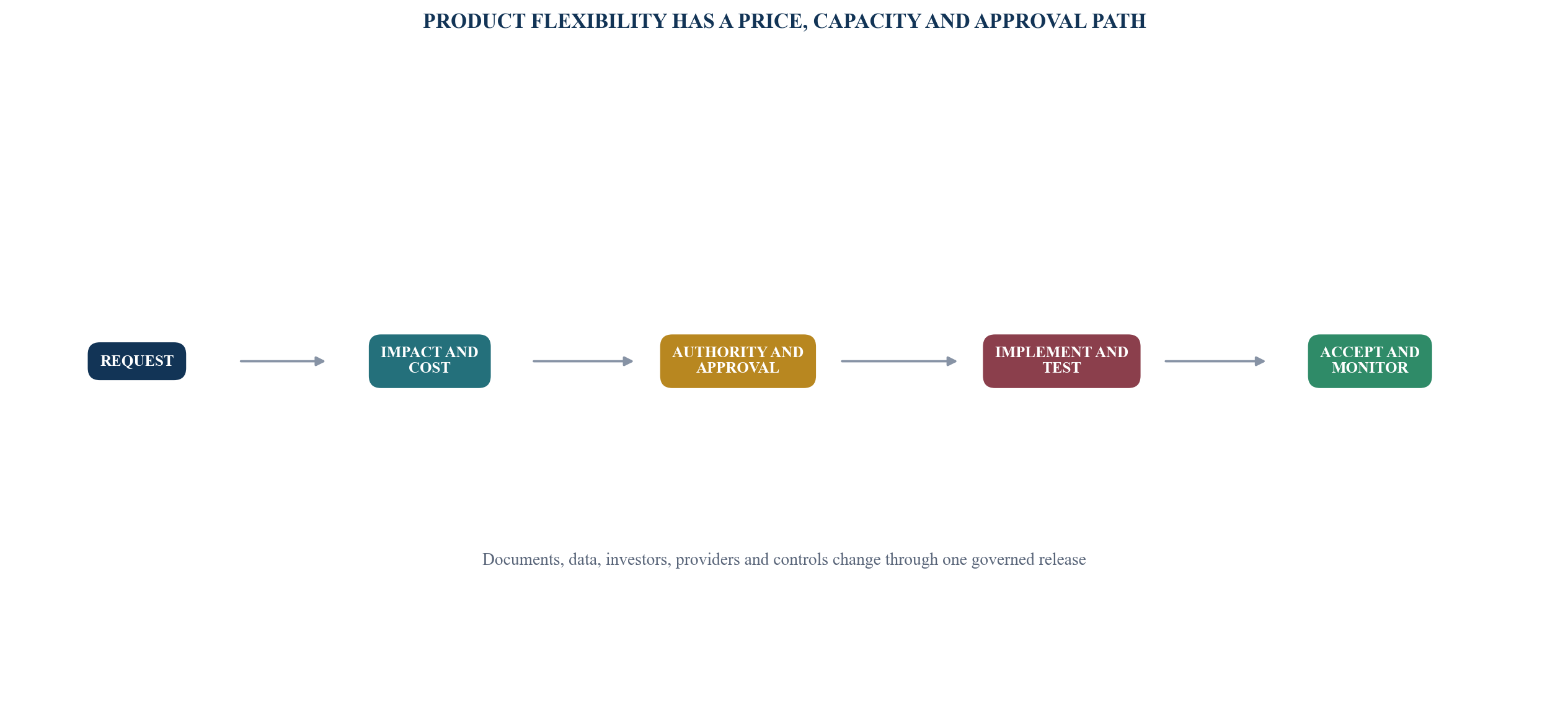
Every material change moves through scope, impact, authority, implementation and acceptance.
17. Design portability and transition at inception
A sponsor may move because it obtains its own authorisation, changes domicile, adds scale, loses provider confidence, faces a fee change or needs a capability the platform cannot support. The transition can involve manager replacement, fund-document amendments, investor consents, service providers, bank accounts, data, records, distribution arrangements and regulatory approvals.
Portability begins with structured data, documented processes, current records and assignable or replaceable contracts. The sponsor should retain lawful access to investor, portfolio, valuation, transaction, reporting and governance evidence. It should know which provider systems cannot be exported without transformation.
The transition plan identifies the trigger, authority, critical path, interim governance, parallel operation, communications, acceptance tests, rollback and cost. The receiving provider should prove it can reconcile commitments, capital accounts, cash, assets, valuations, obligations and open issues.
A termination clause does not create operational portability. Periodic dry runs can test data extraction, document completeness, contact records and reporting reconstruction. Unresolved portability risk should be included in the platform score and economic model.
18. Run a ninety-day platform-selection office
Days one to fifteen define the business plan, product roadmap, target investors, jurisdictions, strategy, funds, internal capability and decision horizon. The team maps the regulatory perimeter and target operating model.
Days sixteen to thirty build the route comparison and long list. It identifies build, hosted, hybrid and external-manager options allowed by current frameworks. Requests for information use one scope and evidence standard.
Days thirty-one to fifty conduct legal, regulatory, operational, technology, data, financial and commercial diligence. Provider demonstrations use scripted fund events rather than generic presentations. References match the proposed service.
Days fifty-one to sixty-five normalise costs, test launch paths, map authority and score control. The five-year model includes internal work, capital, changes and exit. Sensitivities identify the conditions that change the decision.
Days sixty-six to eighty negotiate scope, approvals, service levels, fees, data, regulatory access, continuity and transition. Days eighty-one to ninety present the board decision and implementation plan.
Table 5. Ninety-day platform-selection office
| Period | Workstream | Controlled output | Decision gate |
|---|---|---|---|
| days 1-15 | strategy, perimeter and roadmap | target operating model | scope approved |
| days 16-30 | route map and market scan | comparable long list | diligence candidates |
| days 31-50 | provider and build diligence | evidence files and issue register | qualified routes |
| days 51-65 | cost, control and critical path | five-year model and authority map | preferred route |
| days 66-80 | terms and transition | negotiated commercial schedule | executable proposal |
| days 81-90 | board and implementation | decision paper and owned plan | build, appoint, redesign or defer |
The sequence is a management model; actual duration depends on strategy, evidence, providers and approvals.
19. Operate a recurring platform-control office
Selection is the beginning of oversight. The recurring office monitors service, risk, conflicts, decisions, reporting, data, incidents, finances, regulation, investor issues, product changes and transition readiness.
Weekly work can review cash, subscriptions, open decisions, breaches and deadlines. Monthly work can examine service levels, reconciliations, data quality, complaints, financial-crime cases and changes. Quarterly work can review provider performance, risk, valuation, regulatory reporting, cost and capacity. Annual work can reassess strategy, fees, financial resilience, market alternatives and exit readiness.
The dashboard separates provider performance from fund performance. It tracks complete outputs, exceptions, decision time, correction, open risk, recurring defects and required management action. Low incident counts can reflect under-reporting; assurance should test operating evidence.
The economic model should be refreshed after actual commitments, fund events, invoices, staffing and changes. The board can compare observed cost with the approved case and understand whether variation reflects scale, scope, price or control weakness.
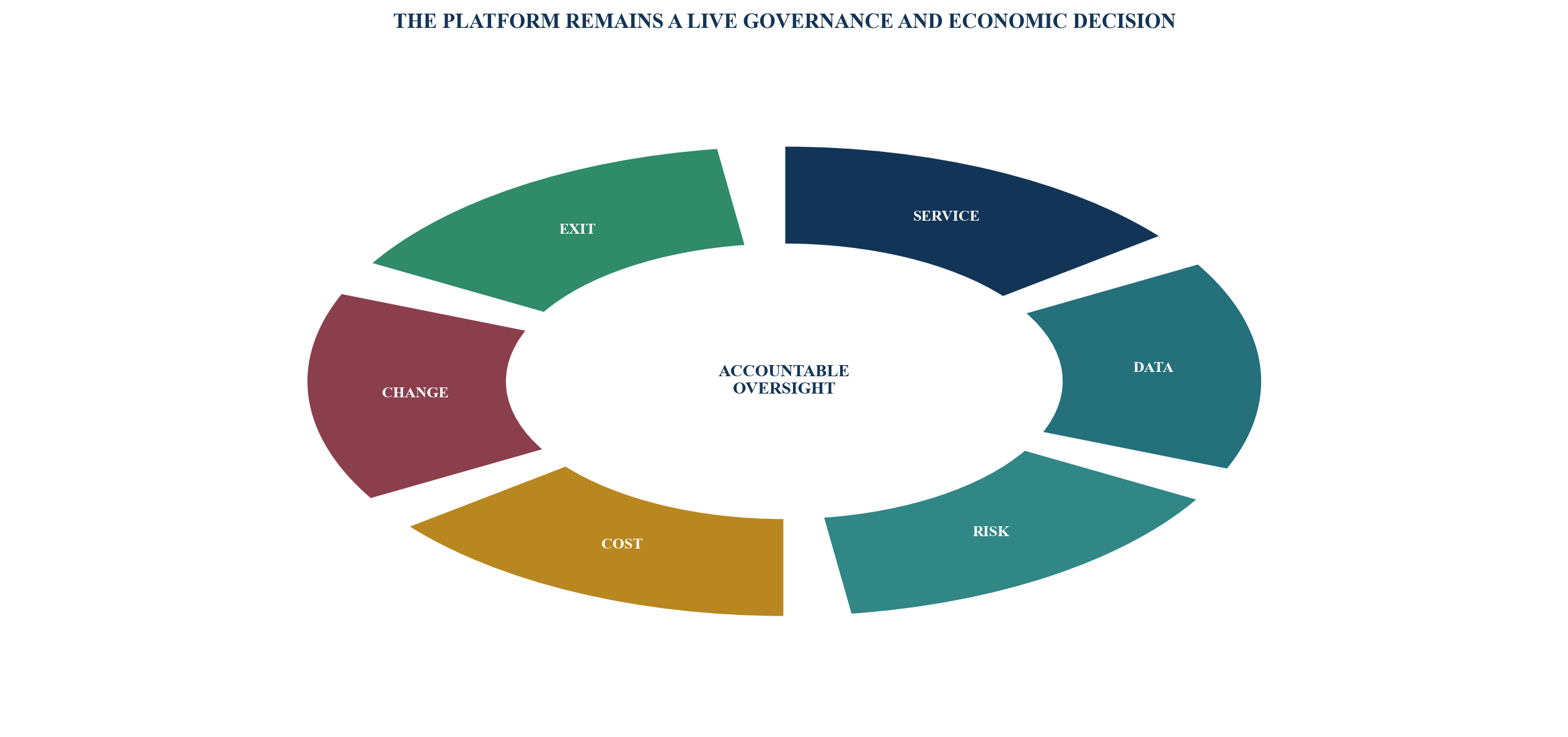
Oversight connects evidence, service, economics, risk and the continuing route decision.
20. Make the board decision on evidence
The board should approve the target product roadmap, jurisdiction and investor scope, regulatory perimeter, operating model, cost horizon, control requirements, provider shortlist, diligence findings, critical path, capital plan, contracts, data architecture, transition and recurring oversight.
It should ask which regulatory and operational duties remain with each entity, which launch dependencies are outside the platform's control, which fees are missing, which changes are likely, which data cannot be exported, which service failures affect investors and which conditions would change the route.
Table 6. Board route-decision scorecard
| Dimension | Evidence | Example decision question | Route consequence |
|---|---|---|---|
| regulatory fit | perimeter and current permissions | can the exact fund and activity be supported? | exclude unsupported route |
| launch readiness | accepted critical-path evidence | which dependency controls first close? | sequence and contingency |
| control | authority and intervention map | which decisions can the sponsor make and when? | value specific rights |
| lifetime cost | normalised five-year model | what is complete cash, capital and internal cost? | compare route economics |
| capacity and resilience | people, systems, finances and recovery | can the model operate under stress and growth? | require remediation or buffer |
| data and portability | lineage, access and tested export | can records and operation move safely? | price lock-in and transition |
| strategic scalability | evidenced product roadmap | which capability is reusable across future funds? | build, host or phase |
Weights and thresholds are management choices and should be approved before provider scoring.
Potential benefits of a platform include reduced duplication, access to specialist capability and a shorter selected launch workstream. Potential benefits of building include reusable capability, decision control and product flexibility. Each benefit requires evidence under the sponsor's actual plan.
No approved observed Matchpoint or client evidence was supplied for platform launch times, fund commitments, cost savings, conversion, mandate fees or collected revenue attributable to this framework. Attributed monetary value remains USD 0 until supported by signed and paid mandate evidence or approved client records.
The central conclusion is that speed, control and lifetime cost cannot be read from a platform rate card. The board needs one regulatory perimeter, one operating scope, one launch critical path and one full-life model across build, hosted and hybrid routes. The selected route should remain supportable when the fund grows, changes, encounters stress and eventually exits the arrangement.
References
- Financial Conduct Authority. Alternative Investment Fund Manager Hosting, first published March 2024 and updated May 2025. https://www.fca.org.uk/firms/principals-appointed-representatives/alternative-investment-fund-manager-hosting
- Financial Conduct Authority. Review of Host Authorised Fund Management Firms, June 2021. https://www.fca.org.uk/publications/multi-firm-reviews/host-authorised-fund-management-firms
- Financial Conduct Authority. Review of Principal Firms in the Investment Management Sector. https://www.fca.org.uk/publications/multi-firm-reviews/review-principal-firms-investment-management-sector
- Financial Conduct Authority. Apply to Be an Authorised AIFM. https://www.fca.org.uk/firms/aifmd/apply-authorised-aifm
- Financial Conduct Authority. UK AIFM and NPPR Fees, updated December 2025. https://www.fca.org.uk/firms/aifmd/fees
- Financial Conduct Authority. Authorisation and Registration Application Fees, updated July 2026. https://www.fca.org.uk/firms/authorisation/apply/fees
- Financial Conduct Authority. Consultation Paper 26/28: The UK AIFM Regime, July 2026. https://www.fca.org.uk/publications/consultation-papers/cp26-28-uk-aifm-regime
- European Union. Directive 2011/61/EU, Article 20 on Delegation. https://eur-lex.europa.eu/legal-content/EN/TXT/?print=true&uri=CELEX:02011L0061-20190113
- European Securities and Markets Authority. Q&A 2229 on Third-Country Delegation, answer published January 2025. https://www.esma.europa.eu/publications-data/questions-answers/2229
- International Organization of Securities Commissions. Principles on Outsourcing, October 2021. https://www.iosco.org/library/pubdocs/pdf/IOSCOPD687.pdf
- Dubai Financial Services Authority. Collective Investment Funds. https://www.dfsa.ae/what-we-do/collective-investment-funds
- Dubai Financial Services Authority. Request for New Registration of Collective Investment Funds. https://services.dfsa.ae/collective-investment-funds-qualified-investment-funds/qualified-investment-funds-request-for-new-registration/
- Dubai Financial Services Authority. Consultation Paper 173: Proposed Updates to the Collective Investment Fund Framework, July 2026. https://www.dfsa.ae/news/dfsa-proposes-significant-updates-its-collective-investment-fund-framework
- Abu Dhabi Global Market Financial Services Regulatory Authority. Getting Started Guide, 2025. https://assets.adgm.com/download/assets/Getting%2BStarted%2BGuide%2Bwith%2BFSRA.pdf/a8c5b07a589a11efa1111ed8b674bcd6
- Abu Dhabi Global Market Financial Services Regulatory Authority. Regulatory Reporting Requirements for Funds, October 2025. https://www.adgm.com/media/announcements/adgm-fsra-implements-regulatory-reporting-requirements-for-funds
About the Author
Chennakeshav Adya, Independent Researcher
