

1. Choose a structure by the risk that must move
Risk transfer starts with a defined exposure, not a preferred product. The insurer should identify the peril, portfolio, legal entities, policy periods, loss-development pattern, volatility, concentration, growth plan and management constraint. It should then state what success means: underwriting capacity, catastrophe protection, earnings stability, solvency relief, liquidity, diversification, access to multi-year capital or a combination of these objectives.
The International Association of Insurance Supervisors describes reinsurance as insurance purchased by an insurer to transfer underwriting risk, while recognising that the cedant exchanges part of that risk for credit, operational and sometimes basis risk [1]. That exchange is central to the decision. The correct question is not how much premium is ceded. It is which losses, cash flows and capital demands move, which remain, and which new risks appear.
Four structures cover a broad range of board decisions. Quota share transfers an agreed proportion of premiums and losses. Excess-of-loss protection responds above a retention and up to a limit. A sidecar uses third-party capital to assume a defined share of a portfolio, commonly through a special-purpose structure. Insurance-linked securities transfer specified risks to capital-market investors through a funded vehicle and instrument.
Each structure has different economics. Quota share exchanges a share of the whole underwriting result for capacity and commissions. Excess-of-loss preserves attritional economics while protecting a severity layer. A sidecar can add aligned capacity without issuing ordinary equity at the insurer. A catastrophe bond or other insurance-linked security can provide collateralised and often multi-year protection, while exposing the insurer to trigger design and basis risk.
The proposed Risk-Transfer Structure Test has eight gates: objective, risk definition, economic transfer, regulatory recognition, security, liquidity, duration and governance. A structure passes only when the evidence chain remains coherent across all eight.
2. Begin with the commercial objective
A board should approve a short objective statement before requesting terms. A useful statement identifies the constrained resource, the business opportunity and the loss outcome the insurer is prepared to retain. For example: support 20 per cent growth in a property portfolio while preserving a 160 per cent management solvency target and limiting annual catastrophe loss volatility to a stated amount.
Capacity and protection are different objectives. Capacity allows more premium or exposure to be written. Protection limits loss from an existing book. A proportional structure often supports both, but its price includes the ceded margin on good business. A non-proportional structure protects a layer while leaving most premium and attritional loss with the insurer.
Capital release is also distinct from cash protection. A regulator may recognise a risk-mitigation effect in a capital calculation only when the contractual transfer is effective and the counterparty or vehicle meets applicable requirements. Cash may arrive after claims are paid, creating a timing gap even when the accounting recoverable is valid. The board should therefore state capital, liquidity and earnings objectives separately.
The objective should include a time horizon. Annual treaties provide flexibility but create renewal-price and availability risk. Multi-year capital can improve certainty, while locking in terms and transaction costs. A sidecar can align with a defined underwriting vintage. A catastrophe bond can protect several renewal periods if the trigger and legal structure remain suitable.
The final objective should specify decision boundaries: maximum expected economic cost, minimum capital recognition, acceptable basis risk, minimum counterparty quality, collateral requirements, liquidity tolerance and the period for which committed capacity is required.
3. Map the four structures
Quota share is proportional. If 30 per cent is ceded, the reinsurer generally receives 30 per cent of the defined premium and pays 30 per cent of covered losses, subject to the contract. The ceding commission compensates the insurer for acquisition and operating expenses. A profit commission can return part of favourable experience and changes the sharing of upside and downside.
Excess-of-loss is layered. The cedant retains losses up to the attachment point; the reinsurer pays covered losses above attachment up to the limit. Per-risk, per-occurrence and aggregate covers address different loss patterns. Reinstatement terms determine whether and at what price an exhausted limit can be restored.
A sidecar is a capital partnership around a defined risk portfolio. Investors provide capital to a vehicle, which assumes risk sourced by a sponsor or cedant. The sponsor may earn ceding, underwriting or management economics and can retain an interest. The structure should make risk selection, allocation, collateral, conflicts, fees, loss development and exit explicit.
Insurance-linked securities use a special-purpose vehicle to transform insurance risk into an investment exposure. Investors fund the vehicle; the vehicle holds collateral and provides protection to the sponsor under a risk-transfer agreement. Investor principal can be reduced when a qualifying event meets the trigger. The NAIC identifies catastrophe bonds as the dominant outstanding ILS form and also describes quota-share and excess-of-loss notes [2].
The structures can coexist. A programme may use quota share for growth, excess-of-loss for peak severity and an ILS layer for remote catastrophe risk. The selection process should optimise the programme as a whole because one layer changes the marginal value of another.
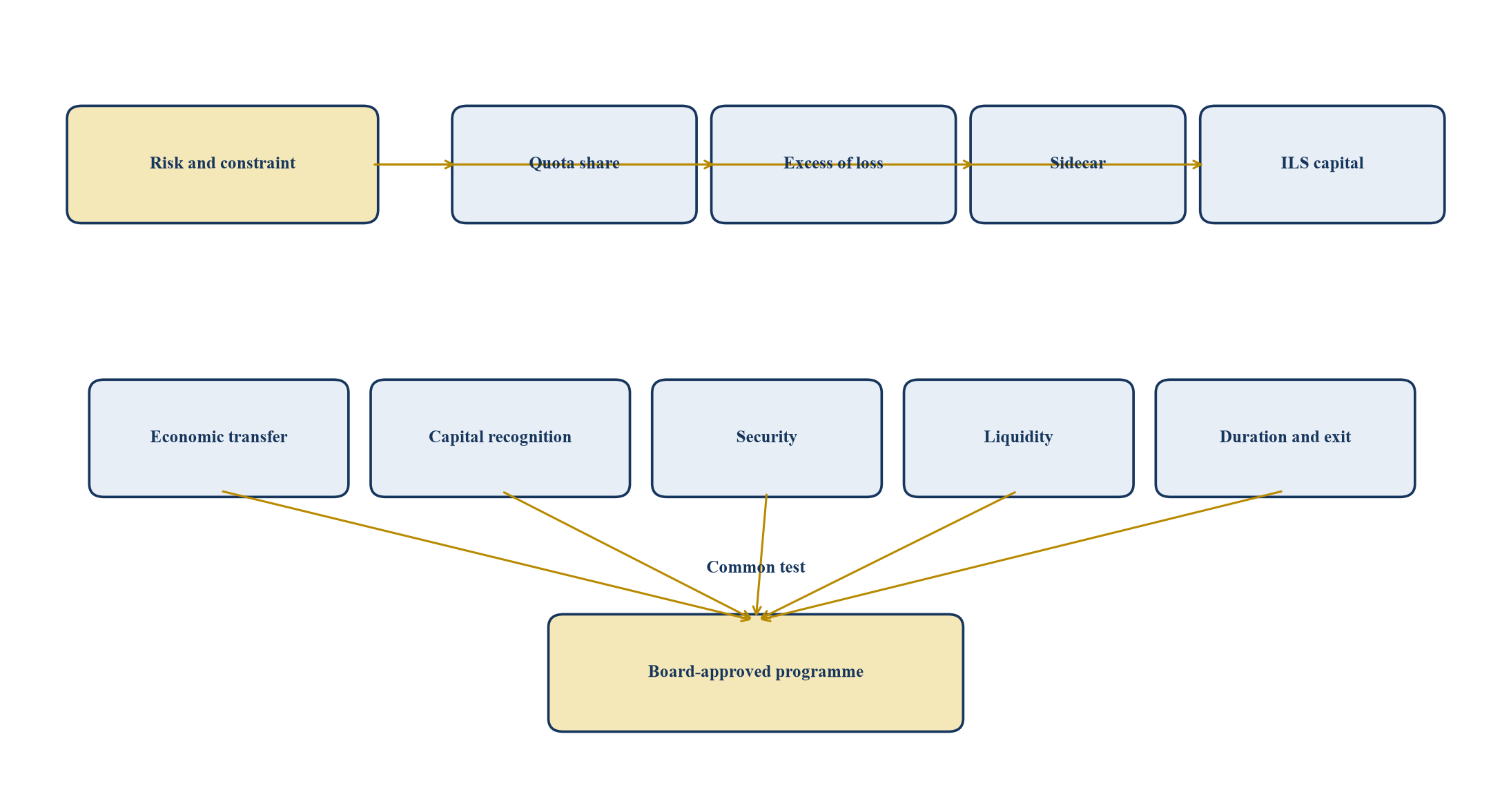
The architecture begins with the risk and constraint, then tests four structure families through a common evidence chain.
4. Define the hypothetical insurer
The worked case assumes a composite insurer writes USD 1.20 billion of annual gross written premium. A catastrophe-exposed property segment contributes USD 600 million. The insurer plans 20 per cent growth in that segment during the next underwriting year.
The portfolio has an illustrative expected loss ratio of 65 per cent and an expense ratio of 27 per cent before reinsurance. Its expected underwriting margin is therefore 8 per cent. Catastrophe loss is concentrated: the model uses a USD 450 million gross 1-in-100 loss for decision testing. That event estimate is hypothetical and should not be treated as a catastrophe model output.
The insurer begins with eligible own funds of USD 1.40 billion and a capital requirement of USD 900 million, giving a 156 per cent ratio. Management wants a minimum operating target of 160 per cent after growth. These amounts and targets are illustrative.
Four programme alternatives are tested. The quota-share alternative cedes 30 per cent of the property portfolio with a 29 per cent ceding commission and a contingent profit commission. The excess-of-loss alternative buys USD 300 million of annual aggregate limit above a USD 50 million retention. The sidecar alternative provides USD 250 million of collateralised capacity and assumes 40 per cent of a defined catastrophe layer. The ILS alternative provides USD 300 million of three-year protection above a defined attachment.
The scenario model deliberately simplifies tax, accounting, discounting, broker remuneration, reinstatements and legal-entity effects. A live decision would require contract-level cash flows, validated exposure data, catastrophe-model output, actuarial pricing, applicable capital rules and legal opinions.
| Item | Illustrative assumption | Decision relevance | Evidence required in practice |
|---|---|---|---|
| Gross written premium | USD 1.20bn | Establishes overall scale | Audited accounts and underwriting plan |
| Property premium | USD 600m | Defines exposed portfolio | Policy and exposure records |
| Planned property growth | 20% | Creates capacity requirement | Board-approved business plan |
| Expected loss ratio | 65% | Central underwriting economics | Actuarial pricing and experience |
| Expense ratio | 27% | Determines ceded-margin cost | Expense study and commission terms |
| Gross 1-in-100 event loss | USD 450m | Sizes peak protection | Validated catastrophe model |
| Eligible own funds | USD 1.40bn | Starting capital resources | Regulatory return |
| Capital requirement | USD 900m | Starting capital demand | Regulatory return and model |
| Management target | 160% | Defines operating buffer | Board risk appetite |
| Quota share | 30%; 29% commission | Proportional capacity alternative | Binding treaty terms |
| Excess-of-loss | USD 300m xs USD 50m | Severity-layer alternative | Treaty wording and pricing |
| Sidecar | USD 250m collateralised capacity | Portfolio-sharing alternative | Vehicle documents and collateral |
| ILS | USD 300m three-year layer | Multi-year funded alternative | Offering, trigger and risk-transfer documents |
All values are illustrative. They are used to demonstrate the decision method and are not forecasts or market quotations.
5. Verify data before pricing
Risk transfer is only as reliable as the exposure and loss data used to define it. The insurer should reconcile policy, premium, limit, deductible, location, construction, occupancy, peril, geocode, claims and reinsurance data. Missing or inconsistent fields should be quantified rather than absorbed into broad judgement.
Data quality affects all four structures. A quota-share partner prices portfolio quality and selection. An excess-of-loss reinsurer needs credible severity and aggregation data. A sidecar investor needs confidence that business is allocated according to agreed rules. An ILS investor needs a transparent risk analysis and trigger whose behaviour can be modelled.
The data room should preserve lineage from policy administration to catastrophe model and board paper. Every transformation should have an owner, version, reconciliation and exception log. The insurer should distinguish exposure captured at inception from endorsements, cancellations and changes after binding.
Historical loss data should be adjusted carefully. Inflation, coverage change, claims handling, legal environment, exposure growth and model change can distort comparisons. The adjustment method should be documented and tested against unadjusted experience.
The result is a data-confidence score by segment. Low-confidence segments can be excluded, separately priced, subject to tighter terms or retained until evidence improves. A board should not accept apparent capital efficiency that depends on unverifiable exposure assumptions.
6. Test quota share economics
Quota share can support rapid growth because the reinsurer participates from the first unit of premium and loss. It can reduce net premium, reserves and underwriting capital under the applicable framework. The ceding commission provides cash and expense recovery, subject to timing and treaty terms.
The central economic cost is the share of profitable underwriting surrendered. If the gross portfolio earns an 8 per cent underwriting margin and 30 per cent is ceded, the insurer gives up part of that expected margin. Commission and profit commission alter the outcome. The model should calculate ceded premium, ceded losses, commission, profit commission, brokerage, tax, collateral cost and capital benefit across scenarios.
Selection provisions matter. A reinsurer may require the same portfolio mix, pricing standards or underwriting rules. Growth outside the agreed plan can be excluded or repriced. A treaty can also include loss-ratio corridors, sliding-scale commissions or caps that reduce apparent symmetry.
Quota share is strongest when the insurer wants broad proportional capacity, values reinsurer expertise or cannot support planned premium growth within its capital target. It is weaker when the existing book is highly profitable and the capital constraint sits mainly in remote severity.
The board should compare quota share with ordinary equity. Both can support growth, but they have different cost, control, duration and risk-sharing effects. Equity absorbs enterprise-wide loss and remains available, while quota share transfers contractually defined underwriting risk and can renew annually.
7. Test excess-of-loss architecture
Excess-of-loss protection should be designed from the loss distribution. Attachment determines the insurer's retention. Limit determines the amount transferred. Coverage definition determines which events or claims aggregate. Reinstatement terms determine the protection available after a loss.
A low attachment transfers more frequent losses and usually costs more. A high attachment preserves premium but leaves earnings volatility below the layer. The insurer should evaluate the marginal benefit of each layer rather than use a single average rate-on-line.
The transaction model should show annual aggregate exhaustion. Several medium events can consume a programme even if no single event reaches the remote tail. Aggregate deductibles, hours clauses, occurrence definitions and franchise provisions can change recovery materially.
Counterparty diversification is relevant. A tower placed with several reinsurers can reduce concentration, while introducing wording consistency and collection complexity. The insurer should map signed lines, ratings, collateral, disputes, sanctions, governing law and recoverable timing.
Excess-of-loss is strongest when the risk is concentrated above a defendable retention and the insurer wants to retain attritional economics. It is weaker when growth creates capital demand across the full portfolio or when loss aggregation cannot be defined reliably.
8. Test the sidecar proposition
A sidecar can bring third-party capital into a defined underwriting portfolio. The sponsor may source business, perform underwriting and claims functions, and retain a participation. Investors receive a share of premiums and losses after agreed fees and expenses.
Alignment depends on risk sharing and governance. Sponsor retention can demonstrate conviction, but its size should reflect the portfolio and conflicts. Business allocation should be rule-based and auditable so the sponsor cannot place weaker risks into the vehicle after investors commit.
The sidecar documents should specify underwriting guidelines, portfolio eligibility, risk period, capital, collateral, permitted investments, loss reserves, commutation, claims authority, fees, reporting, valuation and exit. A multi-year loss tail may delay capital return even when the underwriting period has ended.
The structure can convert a temporary market opportunity into capacity without permanent ordinary equity. It can also create a recurring capital platform if investors renew. Dependence on investor appetite, renewal terms and portfolio performance remains.
The sponsor should model fee income separately from underwriting participation. A structure can look attractive because management fees are stable while the sponsor retains adverse tail exposure. The board should view all sponsor cash flows and contingent obligations together.
9. Test insurance-linked capital
Insurance-linked securities can provide collateralised protection funded at inception. The special-purpose vehicle receives investor capital, invests it in permitted collateral and enters a risk-transfer contract with the sponsor. Investors receive a risk spread and investment return, subject to the trigger.
The trigger can be indemnity, industry loss, modelled loss, parametric or a hybrid. Indemnity triggers can align closely with the sponsor's actual covered loss but require claims development and disclosure. Industry or parametric triggers can settle more quickly and reduce moral hazard, while creating basis risk when the trigger outcome differs from the sponsor's loss.
The PRA expects a UK insurance special-purpose vehicle to remain fully funded and requires effective, enforceable and clearly defined risk transfer [3]. EIOPA's Solvency II rulebook also conditions recognition on qualitative criteria and, for special-purpose vehicles, fully funded protection and applicable regulatory requirements [4]. Jurisdiction-specific rules determine the final treatment.
Transaction cost and lead time matter. Modelling, legal structuring, investor marketing, ratings where used, reporting, listing and administration can make small transactions uneconomic. A multi-year term can spread fixed cost and provide renewal certainty.
ILS is strongest for well-defined, modelled and diversifying risks with sufficient scale. It is weaker when data are poor, wording must remain flexible, loss settlement is highly subjective or basis risk is unacceptable.
10. Measure genuine economic transfer
Premium paid does not prove risk transfer. The insurer should model the distribution of ceded cash flows and the probability, timing and amount of recoveries. Contract terms that return most downside to the cedant through experience accounts, profit commissions, termination rights or other features require careful analysis.
IAIS Insurance Core Principle 13 requires effective management of reinsurance and other forms of risk transfer [1]. EIOPA's 2025 supervisory priorities specifically called for assessment of whether capital relief is commensurate with actual risk transfer and whether basis or other risks are captured [5]. In 2026, EIOPA consulted on proportional-treaty features that can jeopardise commensurateness between capital relief and risk transfer [6].
The model should calculate cedant net loss across the full distribution, not only expected loss and a single catastrophe point. It should identify contract boundaries, exclusions, caps, corridors, aggregate limits, reinstatement premiums, profit commissions, funds withheld, recapture and termination.
For each structure, management should state the risk transferred in plain language. The statement should reconcile to contract wording, actuarial output and capital treatment. Any difference should be escalated before binding.
Economic transfer should be assessed before capital benefit. A structure should not be selected mainly because a model produces relief. The board needs evidence that the losses driving that relief have actually moved.
11. Translate transfer into capital recognition
Regulatory capital recognition depends on applicable law, the insurer's model, contract enforceability, counterparty, collateral, duration and basis risk. A board paper should distinguish estimated economic protection from verified regulatory treatment.
The capital model should show gross requirement, recognised mitigation, counterparty default charge, basis-risk adjustment and operational effects. It should also show management buffer because a nominal reduction in the prescribed requirement may not create deployable capital if management retains the full amount for uncertainty.
Recognition can change over time. Counterparty deterioration, collateral shortfall, contract termination, model approval or rule changes can reduce benefit. The insurer should define monitoring and remediation in advance.
For an SPV, full funding and segregation are central. The PRA's 2025 UK ISPV policy describes expectations for funding, effective transfer and segregation between risk-transformation transactions [3]. EIOPA's rulebook links SPV recognition to full funding and permits only partial recognition in specified temporary shortfalls [4].
The decision should therefore use verified capital benefit at the relevant legal entity and group. A theoretical benefit at group level does not necessarily support a constrained subsidiary or release distributable cash.
12. Price counterparty and collateral risk
Traditional reinsurance creates a recoverable from the reinsurer. The cedant should evaluate financial strength, legal enforceability, collateral, concentration, dispute history, claims practice and exposure across all treaties. Ratings are one input and should not replace a counterparty limit framework.
Collateralised structures change the risk rather than removing it. The insurer should test collateral eligibility, valuation, haircut, custodian, control agreement, permitted investments, currency, liquidity, replenishment and release. Collateral can be fully funded at inception and still become insufficient through asset movement, trapped interest, timing or operational failure.
The NAIC's Credit for Reinsurance Model Law and Regulation address the conditions under which a ceding insurer can receive credit, including security arrangements in specified cases [7]. Exact state adoption and application require legal verification.
Counterparty exposure should be tested after a major industry event, when several reinsurers face claims and collateral markets are stressed. Correlation matters: the same event can create underwriting loss, reinsurance recoverables, asset volatility and operational demand.
The board should receive gross, secured and unsecured exposure by counterparty and vehicle, together with collection timing. This view prevents nominally diverse placements from hiding common ownership, collateral or service-provider concentration.
13. Model liquidity and settlement timing
Reinsurance can reduce ultimate loss while leaving a temporary cash deficit. The insurer may pay claims before receiving recoveries. Claims cooperation, proof requirements, adjustment, commutation and dispute resolution affect timing.
Quota-share settlements can occur quarterly or through accounts. Excess-of-loss recoveries can require event and loss evidence. Sidecar collateral may be held until reserves mature. An indemnity catastrophe bond can retain principal until losses are determined, while a parametric trigger may settle sooner if the measurement is objective.
The cash model should run monthly under central and catastrophe scenarios. It should include premium receipts, claims, ceded premium, commissions, collateral, recoveries, reinstatement premium, taxes, expenses and financing. The maximum funding gap should be compared with liquid resources and committed facilities.
Liquidity terms belong in the commercial negotiation. Interim payments, cash calls, collateral draw rights, clean-cut provisions and settlement frequency can be as important as headline price.
The insurer should avoid counting the same collateral twice. Funds supporting an SPV obligation may be unavailable for another purpose. Liquidity should be tested by legal entity and currency because transfer and conversion can be constrained during stress.
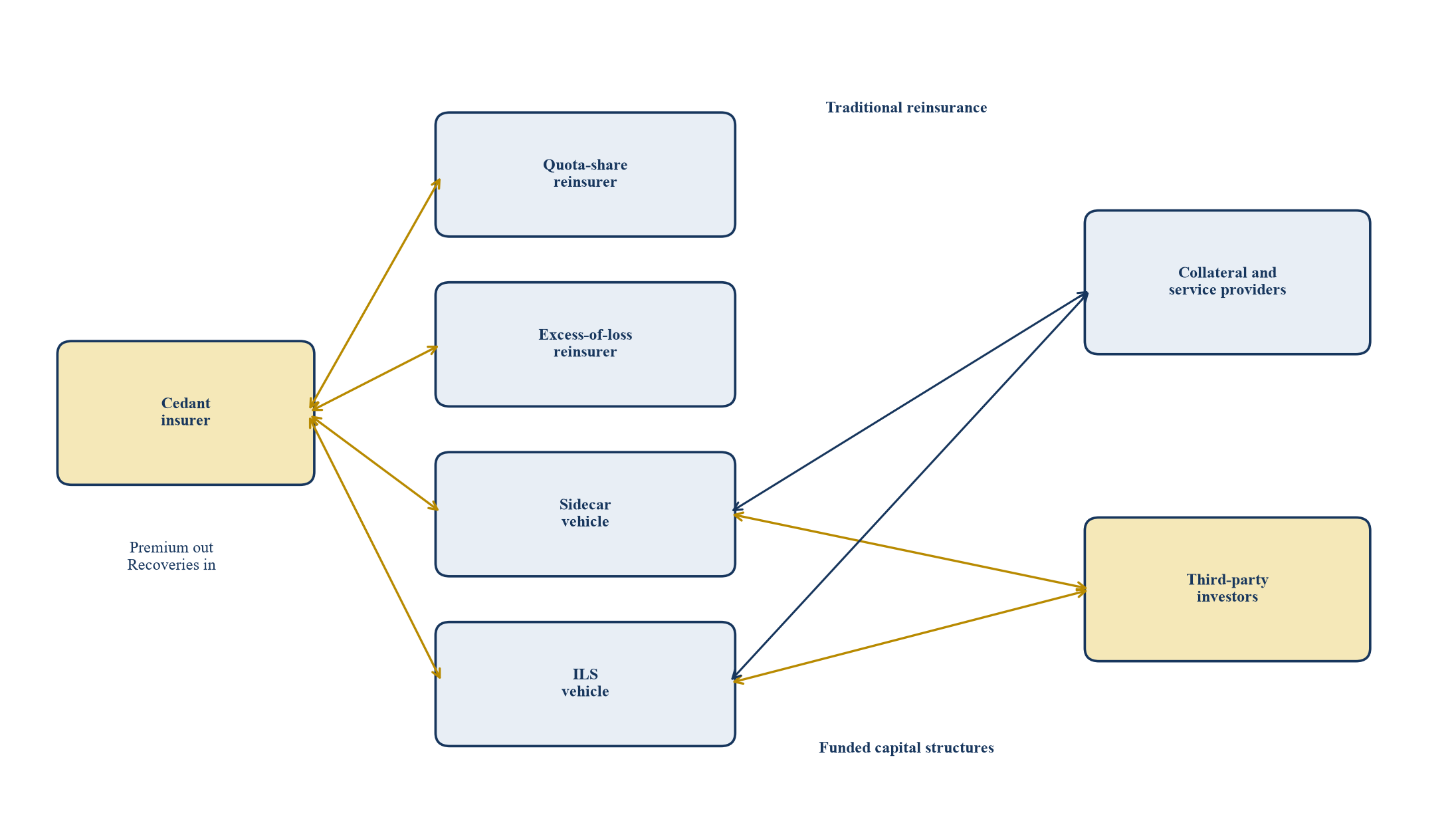
The map highlights premium, loss, collateral and investor flows. Contract terms determine exact timing and enforceability.
14. Evaluate basis risk
Basis risk is the difference between the insurer's economic loss and the recovery produced by the structure. It exists in contract wording, portfolio definition, model assumptions and external triggers.
An indemnity contract can still create basis through exclusions, sublimits, hours clauses, claims definitions and allocation. Industry-loss and parametric triggers introduce a more visible difference between sponsor loss and trigger outcome. Modelled-loss triggers depend on the agreed model and exposure data.
The board should review a basis-risk matrix across historical events, synthetic events and near misses. The test should include cases where the insurer suffers a large loss and receives little recovery, as well as cases where the trigger pays more than the insurer's loss.
Basis risk can be reduced through hybrid structures, lower layers of indemnity protection, tailored parameters or multiple measurement points. Each adjustment affects cost, transparency, moral hazard and settlement speed.
OECD analysis notes that event-based instruments can settle faster than indemnity cover, while creating the possibility of uncovered losses when trigger outcomes differ from actual damage [8]. The trade-off should be quantified rather than described as a general preference.
15. Assess duration and renewal resilience
Annual reinsurance allows regular repricing and programme change. It also exposes the insurer to market capacity and price after a loss. A hard market can raise cost, tighten terms or reduce available limit precisely when the insurer wants to rebuild protection.
Multi-year ILS can reduce renewal concentration and provide committed protection across several periods. The insurer accepts fixed wording and spread for the term and may need a new transaction for material portfolio changes.
A sidecar often aligns capital with one or more underwriting years. Capital release depends on loss development and commutation. Investors may choose not to renew after poor performance, changing the sponsor's capacity.
The model should include renewal stress. It should test price increases, lower limits, higher retentions, delayed issuance and investor withdrawal. The business plan should state which premium growth can continue if capacity is unavailable.
Renewal resilience is a strategic value. A slightly more expensive multi-year layer can be preferable when it protects a critical franchise or supports contractual commitments. The value should be stated as avoided disruption rather than assumed to equal the premium difference.
16. Compare total economic cost
Headline premium does not capture total cost. The board should compare ceded underwriting margin, commissions, brokerage, legal and modelling fees, collateral cost, investor spread, placement expense, operating burden, tax, accounting, renewal option value and capital benefit.
Quota share cost varies with portfolio profitability. Excess-of-loss cost varies with expected layer loss and market risk appetite. A sidecar combines risk-sharing economics with fees, expenses and sponsor participation. ILS combines expected loss, risk spread, collateral return and transaction cost.
Capital benefit should be valued conservatively. The model should calculate after-tax recurring earnings divided by net capital released and should include the cost of replacing protection at expiry. A one-year ratio can overstate a structure whose setup cost or renewal risk is high.
The analysis should also show retained upside. A cheap structure can be expensive if it cedes profitable growth. An expensive remote layer can protect enterprise value by preventing a severe loss from breaching the management buffer.
The appropriate metric depends on the objective. Growth capacity can be compared through return on retained capital. Catastrophe protection can be compared through expected cost, tail reduction and liquidity. Multi-year certainty can be compared through scenario-weighted renewal cost and availability.
| Dimension | Quota share | Excess of loss | Sidecar | Insurance-linked capital |
|---|---|---|---|---|
| Primary use | Proportional growth capacity | Severity and volatility protection | Ring-fenced third-party underwriting capacity | Funded, often multi-year tail protection |
| Premium and loss transfer | Agreed share from first dollar | Losses within defined layer | Agreed share of eligible portfolio or layer | Loss determined by contractual trigger |
| Retained upside | Lower because profitable margin is shared | Higher below attachment | Depends on sponsor participation and fees | Generally retained outside protected layer |
| Basis risk | Mainly wording and eligibility | Attachment, aggregation, exclusions and exhaustion | Allocation, portfolio and vehicle terms | Trigger and model basis can be material |
| Counterparty/security | Reinsurer credit and collateral | Reinsurer credit and collateral | Funded vehicle and collateral controls | Funded SPV and collateral controls |
| Duration | Commonly annual | Commonly annual | Underwriting-vintage or multi-year | Commonly multi-year |
| Execution burden | Moderate | Moderate | High | High |
| Best fit in the case | Broad growth constraint | Peak catastrophe severity | Defined book plus aligned investors | Remote, modelled multi-year layer |
The relative assessments are decision aids. Actual outcomes depend on contract terms, portfolio, jurisdiction and market conditions.
17. Run central, adverse and severe cases
The central case assumes expected attritional performance and no major catastrophe. The adverse case assumes a USD 150 million gross catastrophe loss and weaker attritional loss experience. The severe case assumes a USD 450 million gross event, delayed recoveries and a stressed renewal market.
For quota share, the model transfers the contractual proportion of covered premium and losses. It includes ceding commission and removes profit commission when the loss ratio exceeds the threshold. For excess-of-loss, it applies the retention and aggregate limit. For the sidecar, it transfers the agreed share of the eligible layer and holds capital until loss estimates stabilise. For ILS, it applies the defined trigger and tests a basis-risk shortfall.
The illustrative severe case shows why structure choice cannot rely on central expected cost. Quota share provides broad participation but leaves a substantial proportional net loss. Excess-of-loss strongly reduces a loss within the layer but can exhaust. The sidecar's response depends on portfolio eligibility and its share. ILS can provide large funded protection, while a trigger mismatch can leave part of the sponsor loss uncovered.
The model should calculate post-event solvency, liquid resources, recoverables, collateral, renewal need and capital restoration. It should show gross and net results before management actions.
No structure is universally superior. The outcome depends on the board's objective and the actual contract. A combined programme can place frequent severity with traditional reinsurance and remote, multi-year catastrophe risk with funded capital.
| Scenario and measure | Quota share | Excess of loss | Sidecar | ILS |
|---|---|---|---|---|
| Central: expected annual economic cost | 22 | 31 | 28 | 36 |
| Adverse: gross loss | 150 | 150 | 150 | 150 |
| Adverse: illustrative recovery | 45 | 100 | 40 | 85 |
| Adverse: net loss | 105 | 50 | 110 | 65 |
| Severe: gross loss | 450 | 450 | 450 | 450 |
| Severe: illustrative recovery | 135 | 300 | 160 | 270 |
| Severe: net loss | 315 | 150 | 290 | 180 |
| Severe: timing concern | Quarterly settlement | Collection after adjustment | Capital held through development | Trigger verification and collateral release |
| Renewal exposure | Annual price and terms | Annual tower capacity | Investor renewal and commutation | Lower during three-year term |
Amounts are simplified hypothetical decision outputs in USD millions. They exclude tax and several contract-specific cash flows.
18. Build a risk heat map
The heat map should distinguish probability from impact and should show the residual risk after controls. Principal risks include inadequate transfer, wording, basis, counterparty, collateral, liquidity, model, data, renewal, operational, legal, tax, accounting and conduct.
Quota share has relatively low trigger basis but can have high ceded-margin and selection risk. Excess-of-loss has attachment, aggregation and exhaustion risk. Sidecars have allocation, conflict, governance and exit risks. ILS has trigger, disclosure, modelling and transaction-execution risks.
Risk scores should have evidence behind them. A green status requires completed tests, not optimism. An amber status should identify the missing evidence and deadline. A red status should prevent binding unless the board approves a defined exception.
The heat map should be refreshed after terms change. A higher ceding commission may introduce a loss corridor. A cheaper excess layer may narrow the event definition. A faster ILS settlement may use a parameter that increases basis risk.
The final heat map belongs with the contract summary and scenario output so that economic price and residual risk remain connected.
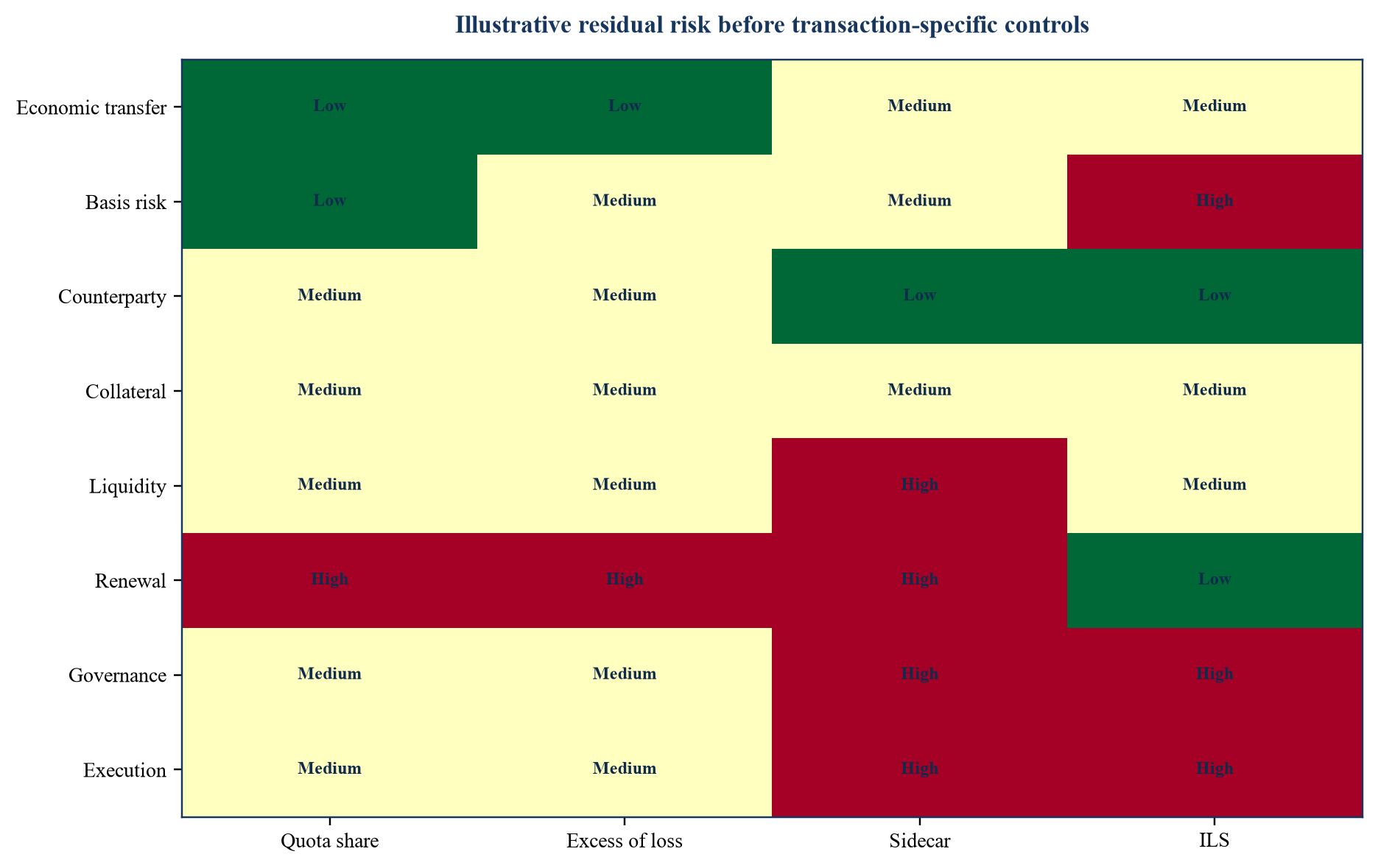
Scores are hypothetical. A live assessment should use contract, legal, actuarial, regulatory and operational evidence.
19. Design a combined programme
A combined programme assigns each risk layer to the structure best suited to it. The insurer may retain predictable attritional loss, use quota share for new growth, buy excess-of-loss for working layers and use ILS for remote catastrophe severity.
The programme should avoid gaps and unintended overlap. Definitions of event, loss, territory, policy period and recoverable should be reconciled across contracts. Hours clauses and aggregate provisions should be tested together.
Capital benefit should be calculated on the combined net distribution. Adding two covers does not mean their individual benefits can simply be added. Correlation, exhaustion and model treatment can change the combined result.
The insurer should also test order of recovery. A sidecar participation can change the exposure entering an excess layer. A quota share can reduce premium and loss subject to another treaty. Contract wording determines inuring order.
The board should approve a target net risk profile rather than a list of products. The placement team can then optimise terms while preserving the target.
20. Govern conflicts and allocation
Sidecars and affiliated vehicles create conflicts because the sponsor can influence which business is allocated, how it is priced and how claims are managed. The governance framework should define eligibility, allocation sequence, exceptions, audit and independent oversight.
Investor reporting should be consistent with sponsor reporting. Material model, exposure, pricing or claims changes should be disclosed under the agreed standard. Valuation methods should be fixed before performance is known.
Fees should be transparent. Ceding commission, underwriting fees, management fees, performance fees, expenses and sponsor participation should be modelled together. A fee can reward growth even when investor returns deteriorate.
Claims authority should balance speed with investor protection. The sponsor may manage claims operationally, while reserved matters and audits protect the vehicle. Dispute routes should be workable during catastrophe response.
The board should retain accountability for policyholder obligations. Risk transfer does not transfer the insurer's obligations to insureds unless a legally effective portfolio transfer occurs.
21. Address accounting, tax and legal form
Accounting presentation does not determine economic transfer, and economic transfer does not automatically produce reinsurance-accounting treatment. The finance team should assess applicable accounting standards, contract boundaries, deposit components, experience accounts and presentation.
Tax treatment can change cost through premium taxes, withholding, vehicle residence, transfer pricing and deductibility. The model should use advice for each entity and cash flow.
Legal enforceability should be tested in the cedant, reinsurer, vehicle, collateral and investor jurisdictions. Governing law, arbitration, insolvency, set-off, sanctions and currency controls can affect recovery.
The insurer should obtain opinions tied to final documents. A generic precedent does not establish treatment for amended terms. Conditions and qualifications should be logged and translated into model assumptions.
The transaction should also preserve confidentiality and market disclosure duties. An ILS issuance can require investor disclosure beyond traditional bilateral reinsurance. Data-sharing permissions and cyber controls should be built into the plan.
22. Apply the Risk-Transfer Structure Test
The first gate verifies the objective and constrained resource. The second defines the risk and data. The third confirms genuine economic transfer. The fourth verifies regulatory recognition. The fifth tests counterparty and collateral. The sixth models cash timing. The seventh tests duration, renewal and exit. The eighth confirms governance and implementation.
Each gate should have a named owner and evidence. The decision record should distinguish completed evidence, conditional evidence and assumptions. An assumption should have a deadline and consequence if it fails.
The board should receive a recommendation with alternatives. It should see the selected programme, rejected structures, sensitivities and conditions. The recommendation should state the maximum acceptable price and minimum required terms.
The test should be repeated at indication, firm order, binding and contract execution. Terms can change late in placement, and the final wording controls.
The executed contracts should be compared with the approved term sheet. Every deviation should be classified by economic, capital, liquidity or legal effect.
| Gate | Required evidence | Decision output | Accountable owner |
|---|---|---|---|
| Objective | Business plan, risk appetite and capital target | Defined constraint and success measure | Board and CFO |
| Risk definition | Exposure, loss, model and data reconciliation | Covered portfolio and loss distribution | Chief underwriting officer and chief actuary |
| Economic transfer | Cash-flow distribution and final terms | Gross-to-net risk movement | Chief actuary |
| Capital recognition | Applicable rules, model and supervisory analysis | Verified solo and group benefit | Chief risk officer |
| Security | Counterparty, collateral and legal controls | Secured and unsecured exposure | Treasurer and general counsel |
| Liquidity | Monthly central and stress cash flows | Peak funding need and facilities | Treasurer |
| Duration | Renewal, commutation and exit scenarios | Capacity-resilience plan | Reinsurance director |
| Governance | Approvals, conflicts, reporting and controls | Executable programme | Board risk committee |
The gate owners should certify the evidence before binding.
23. Execute a controlled implementation roadmap
The implementation begins with a board mandate and data freeze. During weeks one to four, the insurer defines objectives, reconciles exposure, validates loss history and produces a gross risk profile. It also identifies legal entities and regulatory requirements.
During weeks five to eight, the team develops structure alternatives, seeks actuarial and legal input, engages regulators where appropriate and prepares market materials. The model should remain independent of indicative quotes so the insurer knows its own reservation terms.
During weeks nine to twelve, the insurer receives terms, evaluates counterparties and investors, negotiates wording and tests capital and liquidity. Sidecar or ILS execution may require a longer timetable for vehicle, disclosure and investor work.
Before binding, the gate owners certify final evidence. The board or delegated committee approves the programme within stated limits. Contracts are executed only after deviations from the approved structure are resolved.
After binding, the insurer loads contracts into administration, claims, finance, capital and treasury systems. It confirms collateral, settlement, reporting, contacts and escalation. A dry run should test a hypothetical claim and cash call.
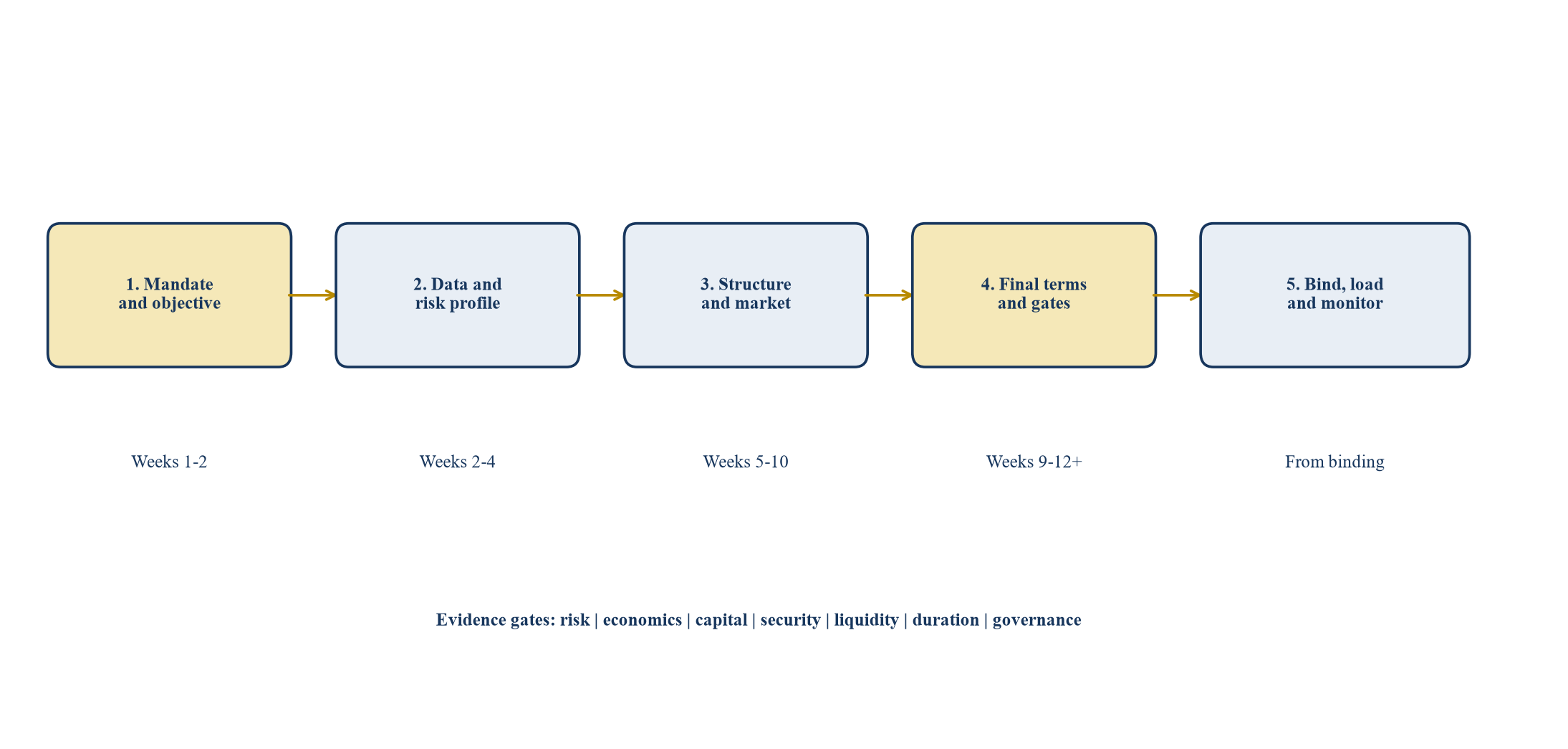
Timing is illustrative and should be adjusted for transaction complexity, regulatory engagement and market windows.
24. Monitor after binding
Risk transfer requires continuing control. The insurer should monitor exposure growth, loss experience, recoverables, counterparty strength, collateral, trigger status, model change, capital recognition and remaining limit.
A monthly dashboard should show gross and net exposure, limit used, reinstatement, expected and actual recoveries, collateral sufficiency, unsecured exposure, cash timing and capital benefit. After a major event, reporting should become more frequent.
Contract changes should enter change control. Endorsements, commutations, novations and collateral substitutions can alter economics and recognition. The same gate owners should review material changes.
Renewal planning should begin before capacity becomes urgent. The insurer should update its risk profile, evaluate performance and maintain alternative structures. Investor and reinsurer relationships should be supported by consistent data and claims practice.
The board should compare actual outcomes with the original decision model. Differences should improve future attachment, limit, commission, trigger and duration decisions.
25. Define escalation and contingency actions
Escalation triggers should include counterparty downgrade, collateral shortfall, disputed recovery, data error, unexpected basis, limit exhaustion, delayed settlement, regulatory non-recognition, vehicle breach and failed renewal.
Each trigger needs an owner, deadline and action. Actions can include collateral calls, replacement cover, facultative placement, portfolio reduction, pricing changes, capital injection, liquidity draw, claim acceleration or legal enforcement.
Contingency capacity should be pre-authorised within limits. Waiting for a stressed market can make protection expensive or unavailable. The insurer should identify counterparties, documentation and funding routes in advance.
A severe event can trigger several actions at once. The crisis plan should coordinate claims, reinsurance, treasury, capital, communications, regulator engagement and policyholder service.
The board should receive a clear statement of residual exposure after actions. Contingency plans reduce response time, while they do not create capacity until executed.
26. Use the framework in transaction and capital planning
The framework also supports M&A, portfolio transfers and capital raising. A buyer can test whether a target's reinsurance truly reduces acquired volatility and whether protection survives change of control. A seller can improve transaction readiness by documenting transfer, recoverables and renewal.
A capital investor can separate underwriting return from leverage created by reinsurance. A sidecar investor can test allocation and governance. An ILS investor can test trigger, modelling and collateral. The same evidence chain serves different stakeholders.
The framework can inform strategic alternatives. An insurer can compare reinsurance with equity, subordinated debt, portfolio reduction, pricing, underwriting change or a legal-entity restructure. Risk transfer should be selected where it directly addresses the binding risk and offers acceptable total economics.
The decision should also consider franchise value. Stable capacity can support broker and customer relationships. Poorly designed transfer can create abrupt underwriting withdrawal after a loss.
The board should revisit structure as the portfolio changes. Growth, geography, climate, claims inflation, technology, regulation and capital markets can move the optimal programme.
27. Limitations and conclusion
This paper provides a decision framework. It does not constitute investment, actuarial, insurance, accounting, legal, tax or regulatory advice. Contract effect and capital recognition depend on the jurisdiction, entity, portfolio, wording, counterparty, model and facts.
The worked case is hypothetical. Premiums, losses, commissions, attachment, limits, collateral, spreads, capital and scenarios are illustrative. They are not forecasts, market quotations or descriptions of an actual insurer.
The central conclusion is that risk-transfer structures should be selected through a common test. The insurer should begin with the risk and constraint, verify data, model genuine transfer, confirm capital recognition, assess security and liquidity, and test duration and governance.
Quota share is a strong tool for proportional growth capacity. Excess-of-loss is a strong tool for defined severity. A sidecar can align third-party capital with a portfolio and preserve sponsor economics when governance is robust. Insurance-linked capital can add funded, multi-year capacity when risk and triggers are sufficiently precise.
A combined programme often produces the best result because different structures serve different layers. The board should approve the target net risk profile and evidence gates, then require final terms to reconcile to that decision.
The Risk-Transfer Structure Test makes the trade-offs visible. It connects underwriting, capital, cash, security and execution so that balance-sheet release is supported by risk that has genuinely moved.
Sources
- International Association of Insurance Supervisors, Insurance Core Principle 13: Reinsurance and Other Forms of Risk Transfer, adopted 2 November 2017, accessed 17 September 2026, Read the primary source
- National Association of Insurance Commissioners, Insurance-Linked Securities, accessed 17 September 2026, Read the primary source
- Bank of England, Prudential Regulation Authority, SoP4/25: The PRA's approach to authorising and supervising UK Insurance Special Purpose Vehicles, 24 July 2025, accessed 17 September 2026, Read the primary source
- European Insurance and Occupational Pensions Authority, Solvency II Single Rulebook, Article 214: Risk-mitigation techniques using reinsurance contracts or special purpose vehicles, accessed 17 September 2026, Read the primary source
- European Insurance and Occupational Pensions Authority, Union-wide strategic supervisory priorities 2025, risk transfers and operational resilience, accessed 17 September 2026, Read the primary source
- European Insurance and Occupational Pensions Authority, Consultation on proportional reinsurance treaties with features that may jeopardise effective risk transfer, 15 April 2026, accessed 17 September 2026, Read the primary source
- National Association of Insurance Commissioners, Credit for Reinsurance Model Law and Model Regulation, accessed 17 September 2026, Read the primary source
- Organisation for Economic Co-operation and Development, Building Financial Resilience to Climate Impacts, risk transfer and basis risk, 2022, accessed 17 September 2026, Read the primary source
- International Association of Insurance Supervisors, Global Insurance Market Report 2024, December 2024, accessed 17 September 2026, Read the primary source
- European Insurance and Occupational Pensions Authority, Supervisory Statement on third-country reinsurance, 4 April 2024, accessed 17 September 2026, Read the primary source
- European Insurance and Occupational Pensions Authority, Guidance on mass-lapse reinsurance and reinsurance termination clauses, 15 July 2025, accessed 17 September 2026, Read the primary source
- Bank of England, Prudential Regulation Authority, SS2/25: Prudential considerations for insurance and reinsurance undertakings when transferring risk to Special Purpose Vehicles, December 2025, accessed 17 September 2026, Read the primary source
- Bank of England, Prudential Regulation Authority, DP2/25: Alternative Life Capital, 14 November 2025, accessed 17 September 2026, Read the primary source
- Bermuda Monetary Authority, Bermuda insurance markets and Insurance Linked Securities innovation, 29 October 2025, accessed 17 September 2026, Read the primary source
- Organisation for Economic Co-operation and Development, Protection Gaps in Insurance for Natural Hazards and Retirement Savings in Asia, 2025, accessed 17 September 2026, Read the primary source
- Organisation for Economic Co-operation and Development, Fostering Catastrophe Bond Markets in Asia and the Pacific, 2023, accessed 17 September 2026, Read the primary source
- National Association of Insurance Commissioners, Special Purpose Reinsurance Vehicle Model Act, Model 789, accessed 17 September 2026, Read the primary source
- Bank of England, Prudential Regulation Authority, Annual Report 2025/26, Insurance special purpose vehicles, June 2026, accessed 17 September 2026, Read the primary source
