

1. Treat the remedy as a second transaction
A regulator-required disposal is a transaction in its own right. It has its own investment thesis, perimeter, buyer universe, diligence process, financing requirements, contracts, closing conditions and operational transition. The strategic acquisition that created the remedy may remain the board's principal focus, yet the remedy business must be prepared for sale with equal discipline. Its failure can delay or undermine the primary transaction.
The board should establish a Remedy Divestiture Office as soon as a credible structural remedy enters the decision set. The office should combine M&A execution, separation, finance, legal, tax, technology, people, operations, commercial, regulatory and communications work. It should report through one accountable executive and maintain a single evidence base for the authority, monitor, prospective buyers, financing parties and board.
The office has five outcomes. It preserves the competitiveness of the remedy business. It produces a perimeter that a buyer can own and operate. It creates evidence that supports authority and buyer decisions. It manages the sale within the required timetable. It transfers the business without prolonged dependence that weakens competition or destroys value.
The office should not become another reporting layer. Its purpose is to resolve cross-functional dependencies and convert commitments into executable deliverables. Every obligation should have an owner, due date, evidence requirement, escalation threshold and consequence for the sale or primary transaction. The operating rhythm should make delay and ambiguity visible early.
2. Translate the remedy into operating requirements
Public authorities consistently focus on effectiveness, viability, purchaser suitability, timely implementation and enforceability. The UK Competition and Markets Authority's December 2025 guidance explains how remedies are selected, designed and implemented and describes roles for monitoring trustees, divestiture trustees, adjudicators and independent experts. [1] The US Department of Justice states that remedies must preserve competition, be enforceable and place the risk of failure on the merging parties. [2]
The Federal Trade Commission's remedy materials emphasise a complete divestiture package, a competitively and financially viable buyer, review of transaction agreements, maintenance of assets and monitoring where continuing relationships are required. [3] Its remedy study found that back-office systems, customer relationships, third-party consents, transitional services, supply and buyer funding can determine whether a divestiture works in practice. [4]
The European Commission Remedies Notice requires a viable business that can compete effectively on a lasting basis and recognises the importance of purchaser requirements, monitoring and implementation arrangements. [5] Competition Bureau Canada guidance similarly favours timely structural relief, complete assets, an independent capable buyer, hold-separate controls and trustee powers when the seller does not complete the sale within the initial period. [6]
These principles should be translated into operational tests. The remedy business must have products, customers, contracts, people, intellectual property, systems, licences, facilities, working capital and governance sufficient for the buyer's plan. Dependencies excluded from the perimeter must be replaceable through a credible route. The buyer must have the capability, resources, incentives and independence to operate the business. The transfer must satisfy the order and avoid creating a new competition concern.
| Remedy principle | Office control | Evidence required | Board consequence |
|---|---|---|---|
| Preserve a viable competitor | Integrated perimeter and viability test | Product, customer, asset, people, system, licence and cash-flow schedules | Add assets, services or funding before launch |
| Approve a suitable purchaser | Buyer qualification gate independent of headline price | Strategy, capability, funding, independence, approvals and operating plan | Reject or condition a bidder despite a higher price |
| Complete within the remedy period | Critical path with authority and trustee milestones | Deliverables, dependencies, owner attestations and schedule variance | Escalate resources, scope or route before trustee risk rises |
| Maintain the business | Hold-separate and preservation controls | Trading results, retention, capex, customer health and asset condition | Fund intervention and protect management authority |
| Limit continuing dependence | TSA and supply exit architecture | Service inventory, cost, service levels, migration plan and exit tests | Reprice, redesign or extend only through controlled approval |
| Ensure enforceability | Obligation and evidence register | Commitment text, accountable owner, proof, exceptions and certification | Withhold release until evidence satisfies the obligation |
The table is a management translation of selected public guidance and does not state the complete legal test in any jurisdiction.
3. Establish mandate authority and decision rights
The office needs a written charter approved by the board or transaction committee. The charter should define the remedy objective, scope, decision rights, protected information, reporting route and relationship with the legal team, hold-separate manager, monitoring trustee and authority. It should identify decisions reserved to the board and decisions delegated to the remedy executive.
Decision rights become important when the seller's commercial interest conflicts with remedy effectiveness. The seller may prefer a narrow perimeter, a higher price, a familiar buyer or longer transitional dependence. The authority may require a broader package, stronger buyer, faster timetable or greater operational independence. The office should surface these conflicts rather than allowing them to appear as routine workstream debates.
The hold-separate manager, where appointed, needs practical authority over the remedy business. Budget, pricing, hiring, retention, customer commitments, capital expenditure and supplier decisions should be governed consistently with the applicable order. The parent should not direct competitive conduct or use confidential information outside permitted channels. The information-control plan should separate the sale process from prohibited influence over day-to-day competition.
The monitoring trustee requires direct access to relevant records, people and facilities within the mandate. A trustee request protocol should define intake, privilege review, factual ownership, response timing and the evidence of completion. The protocol should not be used to obstruct access. It should make delivery accurate, controlled and auditable.
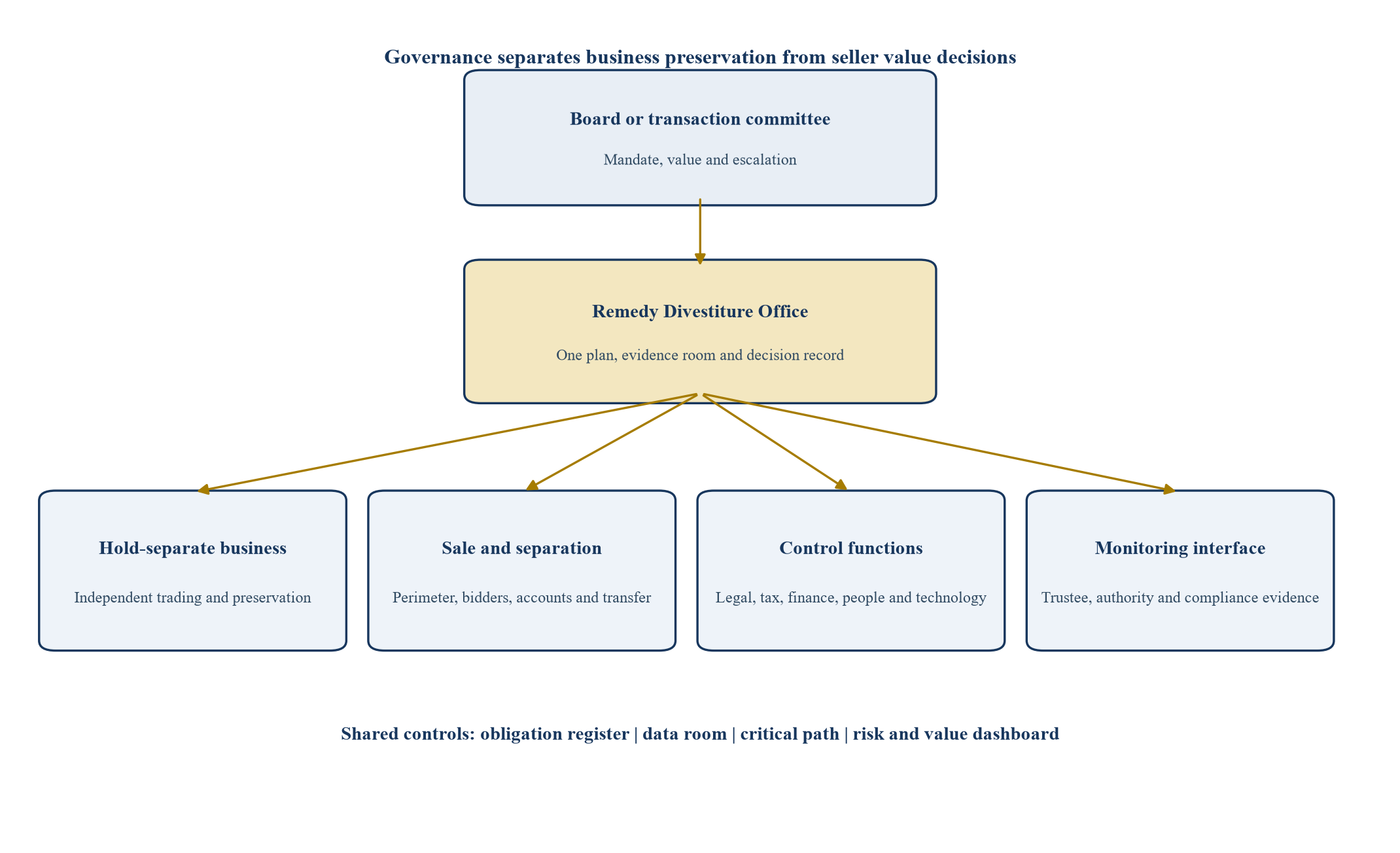
The architecture is a proposed management model. Actual authority and reporting lines follow the applicable commitments or order.
4. Define the divestiture perimeter by capability
A remedy perimeter should be defined by the capability required to compete, not by an accounting code or the minimum assets directly associated with an overlap. The office should start with the products and services that the business must supply. It should then trace the customers, contracts, people, intellectual property, data, systems, facilities, licences, inventory, supplier relationships and working capital required to deliver them.
The perimeter should distinguish dedicated assets, shared assets, duplicated capability and missing capability. Dedicated assets normally transfer. Shared assets need an allocation, duplication, licence, service or replacement plan. Missing capability needs to be built or obtained. The business should be assessed as it will operate under the buyer, rather than as a division supported by the seller's group functions.
The analysis should identify assets outside the apparent product scope that are needed for viability. These may include complementary products, brands, quality systems, manufacturing lines, route-to-market rights, technical records, regulatory dossiers, enterprise licences or specialist personnel. Public guidance recognises that a complete remedy can require assets beyond the narrow overlap where those assets are needed for an effective competitor. [2] [5]
Each exclusion requires a reason and replacement route. A statement that the buyer can provide a function is insufficient without evidence about cost, timing, integration and service continuity. The office should test the perimeter with prospective buyers and the monitor without disclosing information outside authorised channels.
5. Build a separation inventory that reconciles
The separation inventory is the factual spine of the transaction. It should identify every legal entity, asset, contract, employee, application, dataset, licence, permit, bank account, insurance policy, site, supplier, customer and intercompany relationship within or supporting the perimeter. Each record should have an owner, transfer method, consent requirement, current status and evidence link.
Several reconciliations are required. The employee list should reconcile to payroll, organisation charts, cost centres and access records. The application list should reconcile to the configuration-management database, software spend and identity systems. Customer and supplier contracts should reconcile to revenue, procurement, receivables and payables. Property should reconcile to leases, fixed assets and operational occupancy. Intellectual property should reconcile to legal registers, product documentation, source repositories and licences.
The inventory should record shared dependencies that are easy to miss. Examples include master-data objects, group licences, interfaces, signing authority, bank guarantees, transfer-pricing arrangements, cybersecurity monitoring, product certifications, insurance coverage and regulatory reporting. A dependency that is absent from the inventory cannot be priced, transferred or replaced deliberately.
| Inventory domain | Hypothetical population | Transfer or replacement issue | Readiness evidence |
|---|---|---|---|
| Legal entities and branches | 12 | Share transfer, asset transfer, registrations and intercompany balances | Entity perimeter and legal-step plan |
| Employees | 2,400 | Assignment, consultation, retention, pensions and mobility | Reconciled employee schedule and offer plan |
| Operating sites | 14 | Ownership, leases, shared utilities, permits and access | Property schedule and separation design |
| Priority customer contracts | 96 | Assignment, consent, service continuity and change of control | Revenue reconciliation and consent tracker |
| Material supplier arrangements | 37 | Novation, volume terms, qualification and supply continuity | Spend reconciliation and supplier plan |
| Material applications | 62 | Licence, clone, migration, interface and cyber control | Application disposition and cutover plan |
| Registered intellectual property families | 48 | Ownership, licence, territory and technical know-how | Rights schedule and chain-of-title evidence |
| Material permits and certifications | 31 | Transferability, new application and operating condition | Jurisdictional permit roadmap |
Counts are scenario assumptions for the worked case.
6. Protect the remedy business from deterioration
The business can lose value and competitive capability while the sale is being prepared. Employees may leave, customers may defer awards, suppliers may tighten terms and investment may be postponed. The office should operate a preservation plan that measures the business against an agreed baseline and supports prompt intervention.
The baseline should cover revenue, order intake, customer retention, service levels, backlog, pricing, margin, working capital, capex, research and development, headcount, vacancies, employee turnover, quality, safety and regulatory performance. Variances should be explained through operating evidence. The purpose is to distinguish market change from deterioration caused by the transaction or inadequate support.
Management authority matters. The hold-separate manager should be able to respond to competition, retain critical staff, maintain customer relationships and approve ordinary investment within the mandate. Delayed parent approvals can harm the business even when no one intends to obstruct it. Approval thresholds and response times should therefore be explicit.
The retention programme should focus on roles required for independent operation and transfer. Awards should be linked to continuity, documentation and transfer milestones, with appropriate safeguards against incentives that discourage cooperation with the purchaser. Succession coverage should be built for roles with concentrated knowledge.
7. Produce carve out accounts that a buyer can finance
Carve-out financial information should explain the economics of the business under the seller, on a pro forma standalone basis and during transition. Historical divisional reporting often includes allocations that do not reflect the resources required after separation. The office should reconcile reported revenue, gross margin, operating cost, assets, liabilities, cash flow and working capital to source systems and legal entities.
The standalone bridge should replace parent allocations with the cost of actual capability. It should identify functions transferring with the business, services supplied through a TSA, services the buyer can provide and capabilities that must be built. The bridge should separate recurring standalone cost, temporary separation expenditure, one-time buyer integration cost and seller stranded cost.
Revenue quality requires contract-level support. The office should reconcile customers, products, billing entities, backlog, deferred revenue, rebates, warranties and cash collection. Working capital should reflect the transfer mechanics, seasonal needs and any receivable, payable or inventory exclusions. Buyers and lenders will test whether the opening balance sheet can support uninterrupted trading.
The financial model should maintain traceability from assumptions to evidence. Scenario changes should show the effect on value, liquidity, funding and timetable. A buyer may be strategically suitable yet unable to finance the required working capital, capex and separation programme. Financial diligence and purchaser suitability should therefore interact.
8. Separate seller value from remedy effectiveness
The board may seek a high sale price, limited seller liabilities and rapid TSA exit. These aims are legitimate, while the remedy objective remains the preservation of competition through a viable purchaser and complete package. The office should keep these decision criteria separate so a commercial preference does not become an untested assumption about remedy effectiveness.
Bid evaluation should show cash price, certainty, conditionality, financing, authority approval, operating capability, separation complexity, required support, timing and residual liability. A higher headline bid can produce lower expected value if it depends on uncertain funding, broad conditions, delayed approvals or extensive seller support.
The board should also model the cost of delay. This can include financing carry on the primary transaction, prolonged hold-separate cost, employee retention, additional capex, customer leakage, adviser cost, trustee escalation and the loss of control associated with a no-minimum-price sale. The model should avoid presenting these consequences as certain. They are scenario inputs tied to the applicable timetable and facts.
9. Design the buyer universe around suitability
The buyer universe should begin with the remedy's competitive objective. A suitable purchaser generally needs independence from the parties, resources, capability, incentives and a credible plan to operate the business as an effective competitor. The acquisition by the buyer should not create a separate competition problem. Criteria should be agreed early and applied consistently.
Strategic buyers may provide infrastructure, customers and operating capability, while raising overlap or independence questions. Financial sponsors may provide speed and capital, while needing a proven management team, operating plan and financing for standalone investment. Industry entrants may strengthen competition, while requiring more support and presenting execution risk. No buyer type is automatically acceptable.
The office should pre-screen ownership, governance, related interests, financing sources, sector approvals, sanctions, foreign-investment review and reputation. It should assess the buyer's proposed leadership, systems, supply arrangements, customer strategy, investment plan and ability to exit transitional dependence. Authority engagement should occur before commercial momentum makes rejection costly.
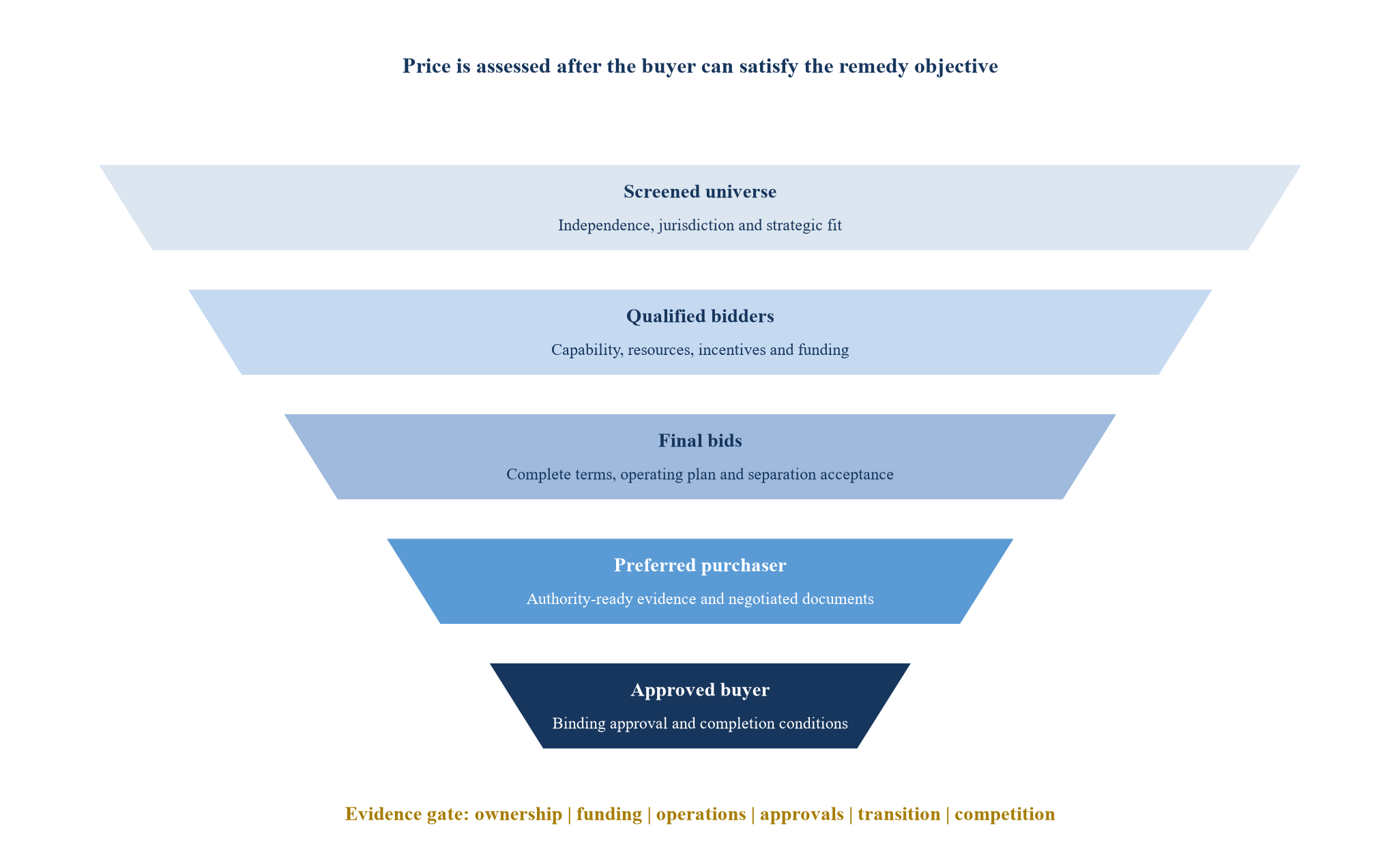
The funnel is a proposed control sequence and does not determine authority approval.
10. Give bidders evidence without weakening the business
The data room should allow a bidder to test viability, price, financing and execution. It should be organised around the perimeter and operating model rather than the seller's internal organisation. The index should connect financial information to products, customers, contracts, sites, people, systems, intellectual property and separation plans.
Confidentiality and competition controls remain necessary. The remedy business may compete with bidders or the seller. Clean-team arrangements, redaction, aggregation and staged disclosure can protect sensitive information while supporting diligence. Access decisions should be documented by purpose, recipient and permitted use.
Buyer diligence should include direct access to appropriate business management and, where permitted, customers, suppliers and relevant third parties. The FTC remedy study emphasises direct access and adequate diligence because buyers can otherwise misunderstand back-office, customer and operational dependencies. [4] The office should maintain a question register that identifies source, owner, response, evidence and effect on the perimeter or documents.
The seller should avoid controlling the buyer's diligence narrative through unsupported summaries. Buyers, authorities and monitors need records that can be independently tested. If source data are incomplete, the limitation should be stated and resolved through a plan rather than concealed by presentation.
11. Build transitional services around exit
Transitional services can support immediate viability while the purchaser establishes independent capability. They also create operational dependence between future competitors. The office should use them where necessary, scope them precisely and design an evidence-based exit from the beginning.
Each service should identify the service description, users, systems, data, geography, capacity, service level, cost, price, security, regulatory requirements, change control, dispute route, duration, extension right, early termination and exit deliverables. The agreement should distinguish a service from a project. Migration, cloning and remediation work need their own plan, resources and acceptance criteria.
The TSA should avoid incentives to delay exit. Charges should be transparent and consistent with the applicable remedy. Service levels should reflect what the business received historically or the standard required for viability. The purchaser should control its exit plan and be able to terminate services when independent capability is ready, subject to agreed safeguards.
The office should maintain a service-by-service exit dashboard. Evidence can include migrated data, independent licences, tested interfaces, trained users, control certification, cutover rehearsal and purchaser acceptance. A service remains open until the agreed exit test is passed, even if the contractual end date is close.
12. Treat technology separation as a business transfer
Technology is frequently the most interconnected part of a remedy business. A legal entity can transfer while identity, data, applications, interfaces, cyber monitoring and support remain embedded in the seller. The office should build an application and data disposition for every capability in the target operating model.
Disposition options include transfer, clone, licence, replace, retire and TSA. The selection should consider legal rights, architecture, data, security, cost, timing, vendor consent and the purchaser's environment. Shared applications may require logical separation before physical separation. Interfaces should be traced through the full transaction flow rather than treated as isolated connections.
Data separation requires defined populations, ownership, lawful transfer, retention, deletion and reconciliation. The buyer should receive the records required to operate the business, while the seller retains only what it is authorised or required to keep. Historical archives, analytics, model training data, customer configurations and support records can be essential even when they sit outside core transaction systems.
Cutover should be rehearsed through business scenarios. Order entry, production, fulfilment, invoicing, cash collection, payroll, supplier payment, regulatory reporting, customer support and incident response should work end to end. Technical completion without business evidence is insufficient.
13. Transfer people authority and knowledge
The people perimeter should cover employees dedicated to the remedy business and shared specialists required for independent operation. The office should assess legal transfer mechanisms, consultation, employee choice, mobility, immigration, pensions, benefits, incentives, retention and works-council or union requirements.
Roles should be mapped by capability and decision authority. The buyer needs leadership and functional accountability, not only a list of employees. The organisation design should show who owns revenue, product, operations, finance, risk, technology, people and compliance from completion. Vacancies and interim arrangements should be visible.
Knowledge transfer should be treated as a controlled deliverable. Process documentation, technical records, customer histories, supplier knowledge, regulatory files and exception handling should be transferred with named owners and acceptance evidence. Shadowing and paired decisions can reveal gaps that static manuals miss.
Retention should prioritise critical capabilities and a stable transfer. The plan should monitor resignation risk, competing offers, morale and workload. Communications should explain what is known, what remains subject to approval and how employee information will be handled. Unsupported certainty can damage trust and create legal risk.
14. Secure contracts consents and operating permissions
The office should identify every consent, novation, permit, licence, approval and registration required for transfer or continued operation. It should distinguish legal completion conditions, authority approval conditions and post-completion actions. Each item needs a strategy, owner, counterpart, submission date and fallback.
Customer consents can affect both value and remedy effectiveness. The plan should prioritise contracts by revenue, strategic importance, transfer restriction, termination right and service complexity. Buyer participation in outreach should be designed within competition and confidentiality controls. Communications should support continuity without giving the seller influence over future customer choice.
Supplier arrangements require equal attention. Volume rebates, credit terms, qualification, group guarantees, intellectual-property licences and shared procurement can change on separation. The buyer may need replacement contracts or temporary supply. The duration of any supply agreement should align with qualification and replacement timing.
Permits and certifications can be tied to sites, entities, responsible persons or technical systems. The office should validate transferability with the relevant authority rather than relying on a generic legal assumption. Completion plans should protect lawful operation on day one.
15. Use a single critical path across sale and separation
The remedy timetable should integrate authority engagement, buyer outreach, diligence, bids, purchaser approval, definitive agreements, employee processes, consents, separation build, TSA readiness and completion. Separate workstream schedules conceal dependencies and produce late surprises.
The critical path should identify decision gates rather than only tasks. Examples include perimeter freeze, financial baseline approval, buyer qualification, final-bid readiness, preferred-purchaser selection, authority submission, separation design freeze, cutover rehearsal and completion certification. Each gate needs entry criteria and signed evidence.
Schedule logic should include rework. Authority feedback can change the package or buyer criteria. Diligence can expose a missing asset. Employee consultation can affect transfer timing. A system clone can fail testing. The plan should show recovery options and the last date on which each option remains executable.
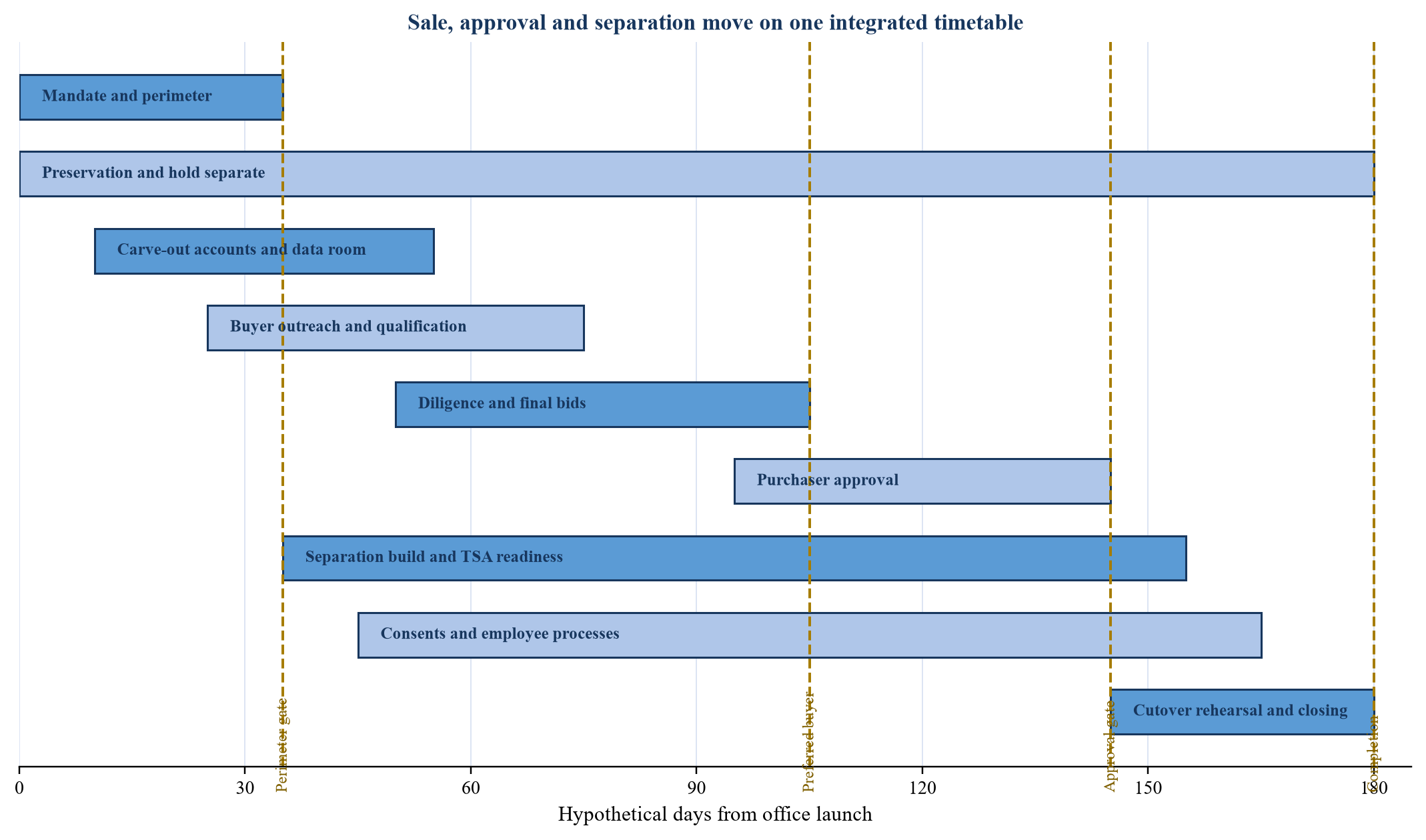
Timing is a scenario assumption and must be adapted to the applicable order and transaction facts.
16. Define the hypothetical forced sale case
The case concerns a global industrial-technology group required to divest a regional digital-control business following merger review. The business provides control software, field devices and lifecycle services to industrial customers. It operates through 12 legal entities and 14 sites, employs 2,400 people and generates USD 285 million of annual revenue and USD 34 million of standalone EBITDA.
The assumed transaction value is USD 620 million. The perimeter includes 96 priority customer contracts, 37 material supplier arrangements, 62 material applications, 48 registered intellectual-property families and 31 material permits or certifications. The business currently relies on the parent for enterprise resource planning, identity, cybersecurity, treasury, tax, insurance, procurement, human resources and selected engineering tools.
Management estimates USD 48 million of separation expenditure. The initial TSA design has annualised cost of USD 19 million and a planned duration of 12 months, with service-specific exit dates. The seller also identifies USD 14 million of potential annual stranded cost if retained functions are not removed or redeployed. These amounts are planning assumptions rather than observed transaction outcomes.
The programme assumes 180 days from office launch to completion. A preferred purchaser is targeted by day 105 and authority approval by day 145. If the seller cannot complete within the applicable period, a divestiture trustee may obtain greater control over the sale under the relevant instrument. The model tests central, delayed and trustee-sale scenarios without predicting authority action.
| Item | Scenario assumption | Decision use | Execution implication |
|---|---|---|---|
| Annual revenue | 285.0 | Scale and buyer funding | Reconcile to contracts, billing and cash |
| Standalone EBITDA | 34.0 | Valuation and financing | Test replacement cost and normalisation |
| Assumed transaction value | 620.0 | Seller value case | Compare certainty and remedy effectiveness |
| Separation expenditure | 48.0 | Funding and purchase agreement | Gate expenditure by transfer requirement |
| Annualised TSA cost | 19.0 | Transition economics | Price transparently and design exit |
| Potential annual stranded cost | 14.0 | Seller retained-business plan | Assign elimination or redeployment owner |
| Employees | 2,400 | Capability and consultation | Reconcile transfer and retention population |
| Completion window | 180 days | Critical path | Escalate variance before options expire |
Every value and outcome is a scenario assumption. USD millions unless stated otherwise.
17. Model value across execution scenarios
The central scenario assumes completion on day 180 at USD 620 million, USD 48 million of separation expenditure and a controlled TSA exit. A delayed scenario assumes a lower price of USD 585 million, USD 9 million of additional preservation and retention cost, and three additional months of financing and adviser cost. A trustee-sale scenario assumes a USD 510 million price, USD 15 million of additional cost and reduced seller control over terms. These scenarios are management models, not forecasts.
Expected value should reflect more than price. The model should include probability-weighted completion, timing, separation cost, retained liabilities, working-capital adjustment, tax, financing carry, stranded cost and effects on the primary transaction. A scenario with lower price can produce greater strategic value if it secures timely approval and closes the principal acquisition.
The office should identify value levers within its control. A complete data room can widen competition among bidders. Reliable carve-out accounts can support financing. Early consents can reduce conditionality. A tested TSA exit can improve buyer confidence. Preservation action can protect revenue and staff. These levers improve both remedy effectiveness and commercial outcomes.
The board should maintain a separate downside reserve for facts that remain unresolved. It should not reduce the reserve merely because a bid is received. Release should follow verified evidence such as signed consents, authority approval, completed system tests and agreed completion accounts.
The model should distinguish the economics of the remedy business from the economics of the retained group. The buyer's standalone plan may require additional management, systems, premises and working capital. The seller may incur duplicate cost while services continue and stranded cost after they end. Combining these effects in one adjustment can hide the party that bears each exposure and the action required to remove it.
Bid conditions should be converted into scenario mechanics. A financing condition should show the committed amount, remaining approvals, equity support and long-stop date. A consent condition should identify the contracts and revenue affected. A separation condition should identify the systems, tests and acceptance route. This discipline allows the board to compare bids on executable value rather than legal wording alone.
The office should maintain a value change log from launch to completion. Every material movement should identify the new fact, affected assumption, responsible owner and board decision. This record supports negotiation, authority engagement and post-completion review. It also reduces the risk that price movements are attributed to the remedy when they arise from performance, market conditions or bidder strategy.
18. Manage the risk of a trustee sale
Trustee provisions create a powerful completion mechanism. Public guidance in Canada describes a trustee period during which the trustee controls the divestiture process and may sell to a qualified buyer without a minimum price. [6] CMA guidance also contemplates appointment of a divestiture trustee where timely disposal is unlikely. [1] The exact powers and triggers depend on the applicable instrument.
The office should model trustee risk from the start. The board needs to know the trigger date, notice requirements, information rights, access obligations, decision transfer, price limitations, crown-jewel provisions and remaining seller protections. This analysis should inform the timetable and escalation thresholds.
Preparation for a trustee should not undermine the seller-led process. A complete perimeter, clean data room, reliable accounts and qualified buyer evidence are useful under either route. The office should maintain records that allow a trustee to assume control without losing time or information.
The seller should avoid decisions that appear to delay, narrow or frustrate the remedy. Disputes about access, assets, expenditure or buyer cooperation should be escalated and documented promptly. The governing objective is an effective and timely divestiture.
Trustee readiness should include a controlled handover pack. The pack should contain the obligation register, authority correspondence, perimeter schedules, preservation reports, bidder log, diligence index, transaction documents, buyer assessments, separation plans, financial model and unresolved issues. Access rights and confidentiality restrictions should be mapped before a trigger occurs.
The board should understand that a trustee route can change negotiating leverage. Prospective buyers may know that time and price flexibility have shifted. The office should therefore protect competition in the buyer process, maintain factual consistency and continue preserving the business. Unsupported urgency can weaken price and terms without accelerating approval.
Escalation decisions should be taken before the trustee trigger becomes imminent. Options may include adding resources, changing the perimeter, advancing a stronger bidder, accepting a lower but executable offer or seeking a fact-specific timetable variation where the instrument permits it. Each option should be assessed against remedy effectiveness and the board's obligations.
19. Build a remedy risk heat map
The risk register should connect likelihood, consequence, evidence quality, owner and mitigation. Generic labels such as technology risk or consent risk are too broad. Each risk should describe a mechanism, affected deliverable, decision date and value or remedy consequence.
High-priority risks commonly include an incomplete perimeter, weak purchaser funding, employee loss, customer non-consent, application migration failure, intellectual-property gaps, permit delay, TSA dependence and schedule compression. Risks should be assessed for both the remedy business and retained group.
Evidence quality should affect priority. A material risk supported by reconciled data may be manageable through a defined action. A moderate risk with weak evidence can require urgent investigation. The office should record facts that would change the score and the date on which they will be obtained.
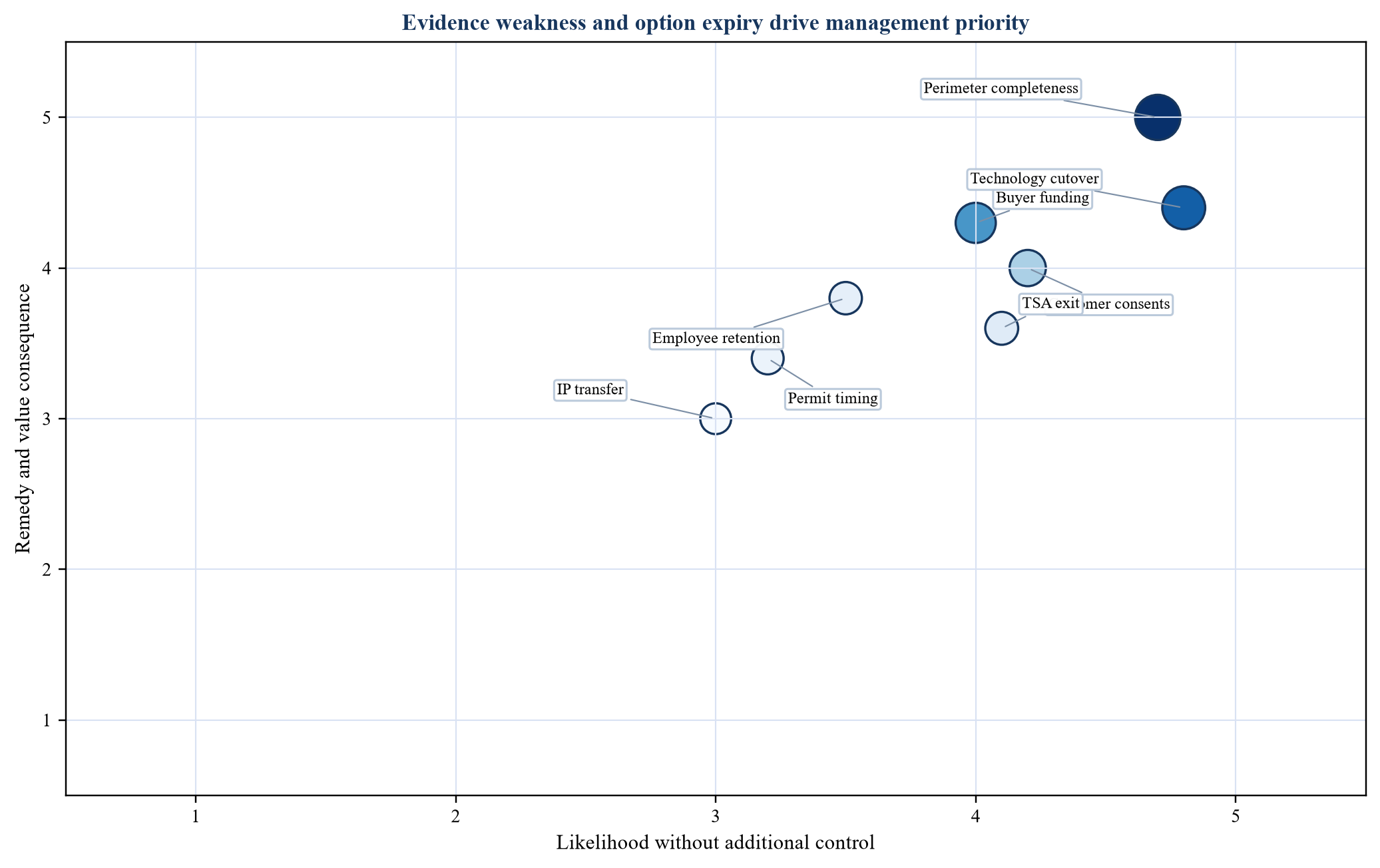
Scores and exposures are scenario assumptions and do not predict an authority or transaction outcome.
20. Operate a disciplined meeting and evidence rhythm
The office should run a short daily dependency review during critical periods and a weekly decision meeting throughout the programme. Workstream meetings can resolve detail, while the central meeting should focus on decisions, overdue evidence, critical-path variance, authority obligations, buyer questions and value at risk.
The obligation register should contain the exact requirement, interpretation, owner, due date, evidence, status and certification route. The issue register should record the decision required, alternatives, recommendation, affected documents and deadline. The data room, separation inventory and financial model should use consistent identifiers so evidence can be traced across outputs.
Reporting to the board should be compact. It should show perimeter completeness, preservation indicators, buyer progress, authority gates, separation readiness, TSA exit, consents, people, liquidity, value and trustee risk. Each red item should contain a decision or funded action rather than a descriptive update.
The final completion certificate should confirm that contractual and regulatory conditions, assets, people, systems, funds, approvals, consents and operating controls are ready. Exceptions should be recorded with owners and remedies. Completion should not rely on informal assurance dispersed across email and meetings.
| Period | Required output | Accountable owner | Verification |
|---|---|---|---|
| Days 1 to 15 | Charter, obligation register, hold-separate controls and preservation baseline | Remedy executive and legal lead | Board mandate and trustee-ready evidence plan |
| Days 16 to 35 | Perimeter, inventory, standalone design and initial financial bridge | Separation and finance leads | Reconciled scope and viability challenge |
| Days 36 to 60 | Data room, buyer criteria, TSA architecture and separation funding | M&A and functional leads | Launch readiness certificate |
| Days 61 to 105 | Diligence, consents, final bids, buyer operating plans and preferred purchaser | M&A lead and transaction committee | Bid comparison and purchaser recommendation |
| Days 106 to 145 | Purchaser approval, definitive documents, separation build and cutover tests | Legal, separation and buyer teams | Authority submission and readiness evidence |
| Days 146 to 180 | Final consents, employee transfer, service activation and completion | Remedy executive and completion lead | Signed completion certificate and evidence archive |
| Monthly after completion | TSA exit, residual obligations, monitor reporting and stranded-cost action | Transition and retained-business leads | Service acceptance and compliance reports |
The timing should be adapted to the applicable order, purchaser process and separation facts.
21. Give the board a remedy decision dashboard
The dashboard should show whether the business remains viable, the perimeter is complete, a suitable buyer can be approved, separation can complete on time and seller value remains within the board's risk appetite. It should avoid blending these questions into one score.
Perimeter reporting can show the percentage of inventory records reconciled, material dependencies resolved and exclusions supported by an approved replacement route. Buyer reporting can show qualified bidders, financing evidence, operating-plan readiness and approval issues. Separation reporting can show critical-path variance, system-test results, consent status, employee retention and TSA exit readiness.
Value reporting should bridge headline bids to expected cash and retained exposure. The bridge should include conditionality, completion accounts, separation cost, tax, financing carry, indemnities and downside reserves. The board should see the cost of schedule variance alongside the price comparison.
The dashboard should identify decisions that expire. A delayed perimeter decision can reduce buyer diligence time. A late technology decision can make the planned cutover unavailable. An unresolved buyer issue can miss the authority submission window. The office should express these points as dates and choices.
Preservation metrics should show both absolute performance and variance from an agreed counterfactual. Revenue can decline because of a wider market contraction, while customer loss concentrated in the remedy business can indicate transaction-related deterioration. The dashboard should therefore combine financial trends with contract-level, operational and people evidence.
Buyer readiness should be displayed as a set of verified gates. Ownership and independence, committed funding, management, operating plan, regulatory approvals, separation acceptance and transition exit should each have a conclusion and evidence date. A bidder should not move to preferred-purchaser status merely because most questions have been answered.
The final dashboard should survive external review. Figures should reconcile to source systems, conclusions should cite evidence and management assumptions should be labelled in the underlying record. The board minutes should capture the decision, alternatives, uncertainty and follow-up actions. This creates an auditable bridge from remedy obligation to transaction execution.
22. Make the forced sale executable before launching it
An effective remedy depends on a business that can compete, a purchaser capable of operating it and an implementation plan that survives the transition from seller to buyer. The Remedy Divestiture Office connects these requirements to the transaction process.
The office begins with governance and a capability-based perimeter. It reconciles the separation inventory and carve-out accounts, preserves commercial strength, defines buyer criteria, supports controlled diligence and integrates authority approval with separation execution. It designs transitional services around exit and keeps trustee risk visible.
The hypothetical case shows why price cannot be the sole decision measure. A USD 620 million bid can only create the assumed value if the buyer is approvable, the business transfers with its required capability and the 180-day plan remains executable. The USD 48 million separation programme and USD 19 million annualised TSA cost must be linked to evidence, service acceptance and exit.
Public guidance across major jurisdictions places weight on viability, purchaser capability, timeliness, monitoring and enforceability. The office provides a management system for those principles. It does not determine the legal sufficiency of a remedy or predict approval. Parties should obtain current competition, corporate, tax, employment, data, regulatory and transaction advice for the relevant jurisdictions and commitments.
Sources
- UK Competition and Markets Authority, Merger Remedies Guidance CMA87, December 2025. Read the primary source
- US Department of Justice Antitrust Division, Merger Remedies Manual, September 2020, official archive updated 5 February 2025. Read the primary source
- US Federal Trade Commission, Negotiating Merger Remedies. Read the primary source
- US Federal Trade Commission, The FTC's Merger Remedies 2006 to 2012, January 2017. Read the primary source
- European Commission, Commission Notice on Remedies Acceptable under Council Regulation EC No 139/2004 and Commission Regulation EC No 802/2004, 22 October 2008. Read the primary source
- Competition Bureau Canada, Information Bulletin on Merger Remedies in Canada, 22 September 2006. Read the primary source
- International Competition Network, Merger Remedies Guide, 2016. Read the primary source
- US Federal Trade Commission, Remedy Study. Read the primary source
- US Federal Trade Commission, Unpacking Divestiture Packages, 14 June 2019. Read the primary source
- US Federal Trade Commission, Looking Back Again at FTC Merger Remedies, 3 February 2017. Read the primary source
- Competition Bureau Canada, Mergers Consent Agreement Template, 26 November 2015. Read the primary source
- Competition Bureau Canada, Merger Remedies Study Summary, 4 August 2011. Read the primary source
- European Commission Directorate-General for Competition, Ex Post Evaluation of the Implementation and Effectiveness of EU Antitrust Remedies, 2025, sections discussing monitoring trustees and structural remedies. Read the primary source
- European Commission, Merger Legislation Notices and Guidelines, Remedies Notice and model texts. Read the primary source
- UK Competition and Markets Authority, Enterprise Act 2002 Merger Remedies in Force. Read the primary source
- Competition Bureau Canada, Overview of the Merger Review Process, 4 July 2025. Read the primary source
- International Competition Network, Merger Remedies Training Materials. Read the primary source
- European Commission, Merger Control Procedures. Read the primary source
