

1. Define the conversion boundary
A stranded industrial site should be evaluated as a bundle of rights, obligations and physical systems. The address alone carries little value. The decision file should identify what the buyer can lawfully control, reuse, alter, connect, demolish and finance.
The conversion boundary includes land title and tenure, easements, grid connection, substations, generation, water, wastewater, buildings, roads, rail, fibre, hazardous materials, environmental permits, decommissioning duties, workforce arrangements and community commitments.
The target digital service should be equally precise. A wholesale data-centre campus, powered shell, colocation platform, sovereign compute facility or edge aggregation site has different power quality, latency, security, water, planning and customer requirements.
The initial comparison should include greenfield development and other brownfield sites. Conversion wins when verified schedule, connection, land or infrastructure advantages exceed remediation, adaptation, legacy and execution costs on a risk-adjusted basis.
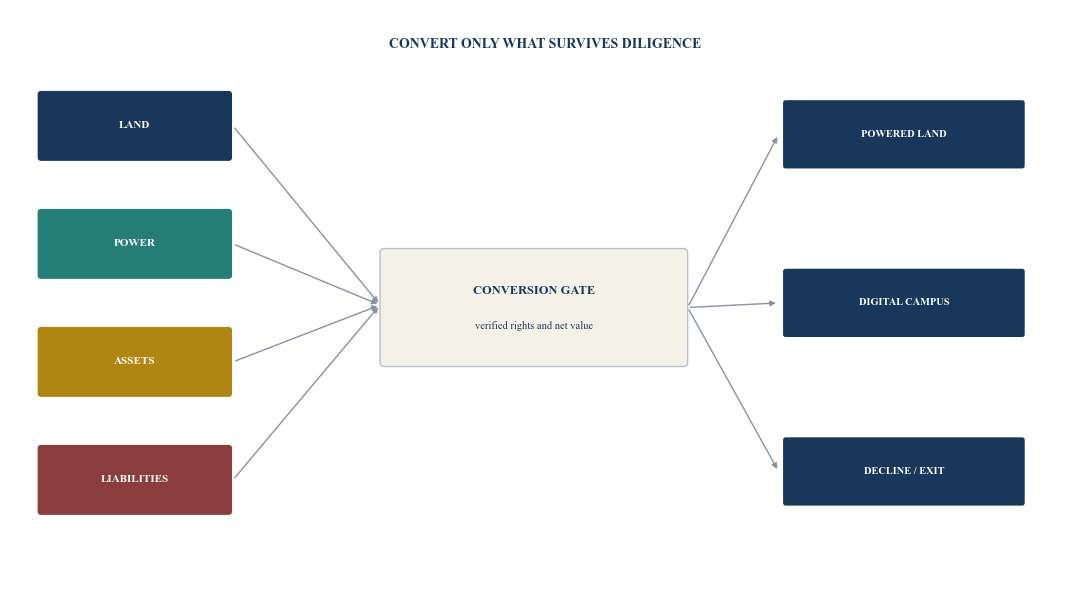
Author framework. Legacy value must pass legal, technical and environmental verification.
2. Triage the site before exclusivity
The first screen should identify fatal flaws before the buyer funds detailed design. Title defects, unavailable power, severe contamination, incompatible planning, flood exposure, insufficient fibre or unresolved decommissioning can defeat the concept.
The screen should use documentary evidence and site inspection. Seller statements about megawatts, permits or clean condition should remain unverified until the relevant authority, utility, registry or independent adviser confirms them.
Site history matters. Process diagrams, chemical inventories, fuel storage, waste disposal, underground tanks, asbestos, fire records and historic environmental reporting can direct intrusive investigations.
The screen should also identify alternatives. A partial land sale, powered-shell conversion, energy project, logistics use or staged mixed-use redevelopment may produce more value than a full data-centre campus.
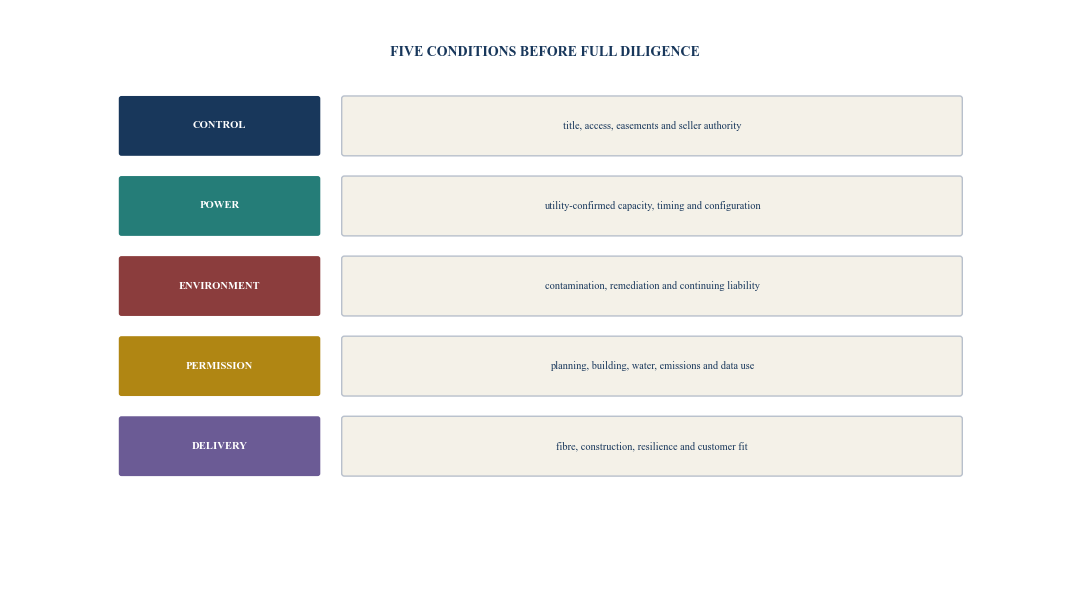
Author framework. A red condition can stop or restructure the acquisition.
3. Separate electricity history from a new connection right
Historic consumption or generation does not establish the power available to a new data centre. The interconnection agreement may have terminated, changed, been surrendered or applied to a different legal entity and operating profile.
The utility or system operator should confirm connection point, voltage, import and export capacity, firm or non-firm status, network reinforcement, fault level, protection, metering, power quality, ramp, outage, security deposits, tariff and delivery date.
Data-centre load differs from many industrial loads. It can be high, continuous and sensitive to interruption. Artificial-intelligence workloads can also change rapidly. The power study should model the proposed load rather than rely on the old site's peak demand.
The IEA reported in Electricity 2026 that more than 2,500 GW of renewable, large-load and storage projects were stalled in grid queues worldwide, and that new grid infrastructure can take materially longer than new data centres.[1] An existing connection can therefore have schedule value, subject to fresh technical and commercial confirmation.
4. Verify co-location and behind-the-meter arrangements
A legacy generator can create an apparent path to faster power. The proposed arrangement may still rely on the grid for balancing, backup, fault response and market settlement.
FERC's work on co-located large loads in PJM illustrates the need for transparent rules that protect reliability and consumers.[2] Its prior proceedings also show that existing interconnection arrangements can require amendment when a new large load changes the configuration.[3]
The project should distinguish direct generation, grid imports, exports, backup, island operation and transition states. Contract and modelling boundaries should align with the physical system.
Fuel, emissions, water, noise, planning and community impacts remain relevant when a retired or operating generator serves a digital load. Restarting an asset can require extensive licensing and capital, as illustrated by current US nuclear restart programmes.[4]
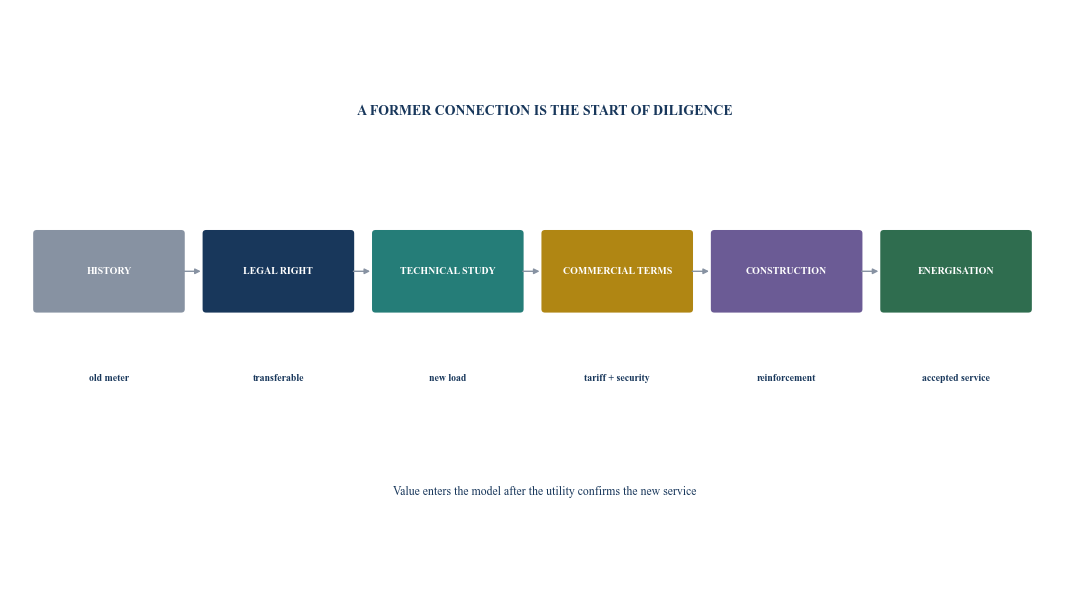
Author framework. Historic power creates value only after each condition is evidenced.
5. Establish the complete diligence file
The transaction file should combine property, environmental, power, technical, planning, commercial and financing evidence. Separate advisers should use consistent site boundaries and development assumptions.
The property file should include title, cadastral plans, access, easements, mortgages, leases, rights of way, utility corridors and restrictions. The seller's ownership of equipment and connection assets should be traced.
The environmental file should cover historic operations, permits, notices, spills, waste, soil, groundwater, asbestos, tanks, remediation, monitoring and closure. The power file should contain utility correspondence, studies, agreements, metering and system diagrams.
Table 1. Stranded-site conversion diligence file
| File | Minimum content | Control | Decision use |
|---|---|---|---|
| Property | title, survey, access, easements, leases, security and restrictions | counsel and registry verification | legal control and financeability |
| Environment | site history, soil, groundwater, hazardous materials, permits and closure | qualified assessment and authority records | liability, remediation and schedule |
| Power | historic use, connection, study, capacity, tariff, deposits and reinforcement | direct utility or system-operator confirmation | power value and energisation date |
| Physical assets | buildings, substations, switchgear, generation, cooling, water and roads | condition survey, testing and ownership trace | reuse, repair, demolition or disposal |
| Planning | current use, zoning, change, EIA, building, noise, water and emissions | authority advice and planning counsel | permission path and conditions |
| Network | fibre routes, carriers, latency, diversity, meet points and repair | route survey and executable service offer | customer service and resilience |
| Commercial | market, customer, service, capacity, start, price and contract | customer evidence and technical acceptance | revenue and phasing |
| Finance | price, remediation, capex, tax, debt, reserves, contingency and exit | integrated model and independent review | risk-adjusted value and capital plan |
Evidence should be current, attributable and reconciled to one site and development boundary.
6. Price contamination and continuing liability
Industrial land can contain soil and groundwater contamination, hazardous building materials, buried structures and regulated waste. Liability can attach to the current owner, operator, polluter or other parties depending on law and facts.
The United States EPA's 2026 guidance on redeveloping Superfund and brownfield sites as AI data centres describes site-screening and redevelopment considerations.[5] EPA programmes can support assessment, cleanup and reuse while the legal and technical requirements remain site-specific.
The acquisition case should distinguish known remediation, reasonably foreseeable remediation, monitoring, third-party claims and unknown conditions. Cost estimates need scope, quantities, disposal routes, inflation, schedule and contingency.
Indemnities have value only when enforceable against a creditworthy counterparty for a suitable term. Escrow, retention, insurance, price adjustment and seller completion can complement contractual protection.
7. Determine what can be reused
Existing assets should be classified as retain, adapt, replace or demolish. Book value and historic replacement cost are poor proxies for digital-infrastructure usefulness.
Buildings should be tested for floor loading, clear height, column grid, vibration, fire separation, water ingress, roof, security and future expansion. Substations and switchgear require ownership, rating, condition, protection, spares and compliance evidence.
Cooling and water systems designed for an industrial process can have different temperature, quality, redundancy and efficiency requirements. Roads, rail and heavy-lift access can support construction even when they have limited operating value.
Reuse value equals avoided new-build cost and schedule benefit, less adaptation, repair, testing, operating penalty, shorter life and risk. Demolition value should include waste classification, salvage and site restoration.
Table 2. Legacy-asset reuse matrix
| Asset | Reuse evidence | Typical adaptation | Principal failure mode | Decision |
|---|---|---|---|---|
| Land and roads | title, survey, bearing capacity and access | grading, drainage, security and traffic | restriction, flood or insufficient expansion | retain, reconfigure or decline |
| Building shell | structure, dimensions, fire and water condition | envelope, floors, fire zones and security | adaptation exceeds new-build value | retain, partial reuse or demolish |
| Substation | ownership, rating, condition and utility acceptance | protection, transformers, redundancy and metering | obsolete equipment or unavailable import | reuse, augment or replace |
| Generation | licence, fuel, emissions, condition and grid role | overhaul, controls, emissions and new contracts | restart cost, permit or reliability | restart, reserve, replace or retire |
| Cooling and water | source, quality, capacity and condition | treatment, heat rejection and redundancy | scarcity, contamination or inefficient duty | reuse, hybridise or replace |
| Fibre and telecoms | route, ownership, capacity and diversity | new meet points and carrier entry | common route or weak market | retain and diversify |
| Workforce and workshops | skills, agreements, facilities and location | retraining, new procedures and security | mismatch or unresolved obligations | transition, supplement or exit |
Each decision requires verified ownership, condition, compliance and fit with the target digital service.
8. Assess water, cooling and residual utilities
Water rights and historic supply should not be assumed to continue. The new use may face different tariffs, allocations, discharge standards and community scrutiny.
Cooling selection depends on climate, IT density, water availability, energy, noise, resilience and customer requirements. Existing cooling towers or process-water systems can require significant overhaul and treatment.
Wastewater, stormwater and contaminated drainage should remain separated. Construction can disturb historic contamination and change runoff.
The model should value utility corridors, treatment systems and storage only when their condition and regulatory use are confirmed. A stranded pipeline can create a liability rather than an asset.
9. Prove network and market location
Industrial sites can sit near transmission infrastructure and far from dense fibre and customer interconnection. A data-centre campus requires at least two physically diverse routes appropriate to its service.
Carrier maps should be verified by route survey and commercial offer. Multiple carriers can share one long-haul corridor or bridge. The design should identify the complete path to cloud on-ramps, internet exchanges and customer locations.
Latency should be measured to relevant demand centres. A power-rich remote site may fit batch compute, training or sovereign capacity and perform poorly for latency-sensitive colocation.
The revenue case should match the site. Customer letters, reservations and technical workshops are stronger than broad forecasts. Contracted requirements should inform phasing.
10. Build the planning and environmental path
Industrial use does not automatically permit data-centre use, generation, storage or new transmission. Change of use, building permits, environmental assessment, water, noise, air emissions, hazardous materials and traffic can require separate approvals.
The European Commission states that environmental impact assessment applies to specified major projects and can apply to other industrial or urban development based on national criteria and case-by-case screening.[6] The EU Industrial Emissions Portal also provides public information on industrial emissions and resource use that can support site-history diligence.[7]
UK planning materials for data-centre campuses illustrate how projects can combine on-site energy, future grid connection and substantial planning evidence.[8] Each planning decision is fact-specific and should not be treated as a precedent without qualified review.
The approval schedule should include surveys, consultation, design freeze, submission, information requests, appeals and conditions discharge. A theoretical fast-track has little value unless the project satisfies its eligibility and evidence requirements.
11. Incorporate community and workforce transition
A failed industrial asset can be an important employer and part of local identity. Digital infrastructure usually creates fewer operating jobs than a large factory or mine, even when construction employment is significant.
The redevelopment plan should describe jobs, skills, procurement, tax base, traffic, noise, energy, water, emissions and public access. Claims should be supported by a defined construction and operating model.
The US Department of Energy identifies workforce, transport and grid interconnection among the attributes of retired energy sites and provides public resources for reinvestment.[9] Its Energy Infrastructure Reinvestment programme also links qualifying investment to benefits such as grid capacity, reliability and workforce opportunity.[10]
Training, redeployment and community funding should enter project cost when committed. Early engagement can surface site history, environmental concerns and infrastructure needs that are absent from the seller's data room.
12. Benchmark retired energy-site conversion
The US Department of Energy lists data centres among potential reuse pathways for retired coal-plant sites, alongside generation, storage and manufacturing.[9] It also selected federal sites including a former gaseous-diffusion plant for proposed AI data-centre and energy development in 2025.[11]
These examples show why energy sites attract digital infrastructure: land, grid access, transport and industrial history. They do not establish automatic suitability or a universal financing model.
DOE's work on nuclear-powered data centres describes potential advantages of existing or restarted nuclear assets and identifies licensing, capital and schedule challenges.[12] A data-centre offtake can support generation, while the reactor and campus retain separate regulatory and operating systems.
The comparison should therefore distinguish powered land, co-location, behind-the-meter supply, grid-connected supply and generator restart. Each structure has different rights and risks.
13. Apply Gulf-specific diligence
The UAE Ministry of Energy and Infrastructure created a national team in 2025 to study data-centre energy demand, market conditions, geographic distribution and policy.[13] In July 2026, it inaugurated a national monitoring centre linking the four electricity utilities and reported approximately 48 GW of installed generation capacity.[14]
These national developments provide system context. They do not confirm power at any industrial site. The relevant utility must verify the specific connection and new load.
Gulf sites also require project-specific treatment of land tenure, industrial-zone authority, cooling climate, water, dust, fibre, emergency generation, emissions, data regulation and foreign ownership.
The conversion case should include the alternative use of the site and power. Industrial redevelopment, energy storage, renewable generation, logistics or a mixed campus can compete with data-centre use.
14. Design the conversion concept
The concept design should place new digital infrastructure around verified reusable assets and environmental constraints. It should preserve safe access to monitoring wells, remediation systems and retained industrial equipment.
Phasing can begin with a powered shell or first data hall while other areas are remediated, subject to safe separation and authority approval. Shared substations, cooling or water can create construction interfaces that require detailed sequencing.
The design should reserve future capacity only when land and power support it. A masterplan can display a large campus while the financial case funds a smaller first phase.
Resilience should cover utility outage, retained generation, backup, fuel, network, cooling, flood, dust, security and emergency access. Legacy systems should not become common-mode failures.
15. Build the complete capital stack
The capital model should separate site acquisition, seller liabilities, remediation, demolition, retained-asset repair, grid, generation, building, cooling, network, compute-ready infrastructure, financing and reserves.
Site price can be structured through an option, deposit, deferred payment, contingent value, seller note or earn-out linked to power and planning. The structure should match the risks the seller can influence and the evidence available.
Remediation capital may be funded by the seller, buyer, public programme or a ring-fenced vehicle. Lenders will examine liability, completion standards, authority acceptance and cost overrun.
Digital-infrastructure debt should rely on suitable site control, approvals, power, construction and customer evidence. Legacy assets with uncertain condition should receive limited collateral value.
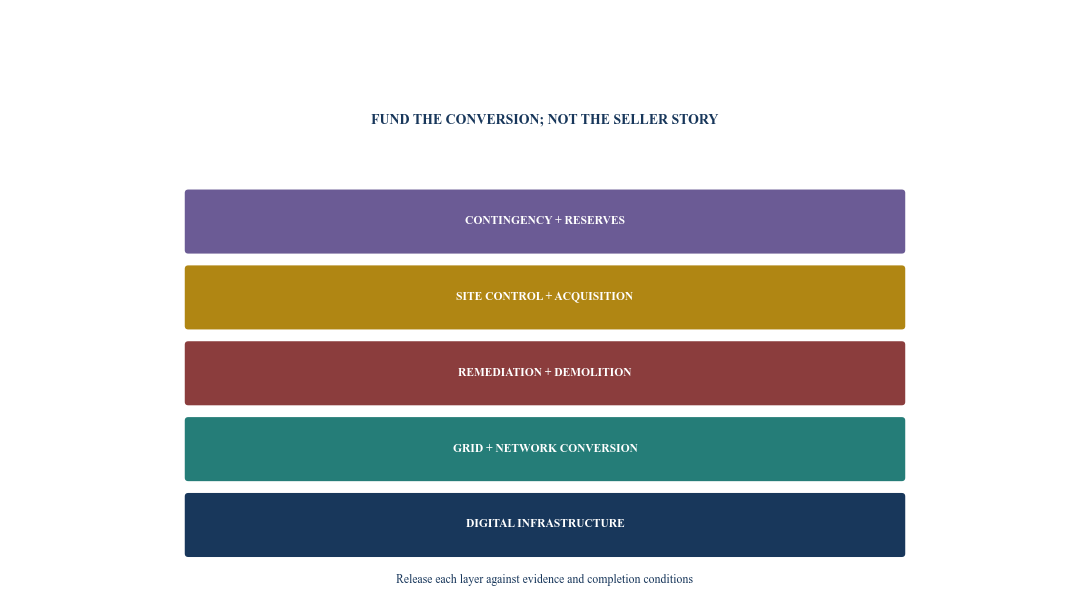
Author framework. Acquisition, legacy and new-build capital should remain separately visible.
16. Allocate legacy and development risks
Risk should sit with the party able to understand, control or price it. The seller can provide history, access and representations. The buyer controls concept and development after completion. Utilities and contractors control defined delivery obligations under their agreements.
Unknown environmental conditions are difficult to transfer through a general indemnity. Targeted investigation, escrow, insurance and staged completion can improve protection.
Grid timing should follow the utility agreement. A seller warranty about capacity cannot replace a system-operator study. The acquisition can remain conditional on an acceptable offer.
Table 3. Conversion risk-allocation matrix
| Risk | Evidence | Preferred control | Residual exposure |
|---|---|---|---|
| Historic contamination | records, assessments, sampling and authority file | seller remediation, indemnity, escrow and insurance | unknown condition, enforcement and counterparty credit |
| Title and access | registry, survey, leases and easements | completion condition, warranty and cure | third-party claim and boundary dispute |
| Grid capacity | utility study, offer and agreement | acceptable connection as condition precedent | reinforcement, delay, tariff and curtailment |
| Asset condition | inspection, test, maintenance and spares | price adjustment, warranty and contractor guarantee | latent defect and obsolescence |
| Planning | policy, pre-application, surveys and submission | long-stop, conditional acquisition and appeal strategy | authority discretion and third-party challenge |
| Construction interface | design, scope and condition survey | single-point coordination, contingency and testing | hidden condition and operational disruption |
| Customer demand | technical acceptance, reservation and contract | staged build, minimum payment and termination protection | ramp, concentration and technology change |
| Community commitments | consultation record and signed obligations | costed plan, governance and reporting | reputation, delay and additional mitigation |
Allocation requires project-specific legal, technical, environmental and credit review.
17. Test a hypothetical 120 MW conversion
The following case demonstrates the method. Every value is a hypothetical management assumption. It does not describe an actual industrial site, connection, customer or investment result.
Assume a closed industrial complex has 75 hectares, an existing high-voltage substation, process-water infrastructure, heavy roads and two fibre corridors. The proposed digital campus targets 120 MW of critical IT capacity across three 40 MW phases.
Assume the utility confirms 60 MW of firm import after two years and a further 90 MW after network reinforcement in year five. The first phase therefore combines grid supply, on-site firm generation and storage under project-specific approvals.
Table 4. Hypothetical 120 MW industrial-site conversion
| Item | Hypothetical management assumption |
|---|---|
| Site control and acquisition | USD 42 million |
| Environmental remediation and monitoring | USD 28 million |
| Demolition and retained-asset repair | USD 21 million |
| Grid, substation and utility reinforcement | USD 94 million |
| On-site energy and storage | USD 135 million |
| Data-centre shell and MEP for first 40 MW | USD 380 million |
| Network, security and campus infrastructure | USD 36 million |
| Development, finance, contingency and reserves | USD 104 million |
| Total phase-one conversion capital | USD 840 million |
| Reuse and schedule benefit versus hypothetical greenfield | USD 86 million |
| Residual legacy and conversion premium | USD 63 million |
| Stabilised contracted annual operating cash before debt service and tax | USD 91 million |
| Hypothetical unlevered cash yield on phase-one capital | 10.8% |
Every number is a hypothetical management assumption created solely to demonstrate the method.
The hypothetical reuse benefit comes from land, substation, roads, water corridors and earlier site access. Remediation, asset repair and interface risk offset much of that value.
The correct comparison includes time. An earlier first phase can create material present value when customer revenue is contracted. A schedule benefit should remain outside the base case until power, planning and construction evidence supports it.
18. Reconcile conversion value
The buyer should begin with the value of an equivalent approved greenfield project and reconcile all site-specific differences. Positive items can include connection timing, reusable infrastructure, land and tax support. Negative items include remediation, demolition, adaptation, inefficiency, legacy obligations and reduced flexibility.
The value bridge should avoid double counting. A lower purchase price and a public remediation grant can reflect the same site problem. A schedule benefit and customer premium can also overlap.
Contingent consideration can share verified upside. The seller can receive an additional payment after connection or planning while the buyer avoids paying upfront for an uncertain claim.
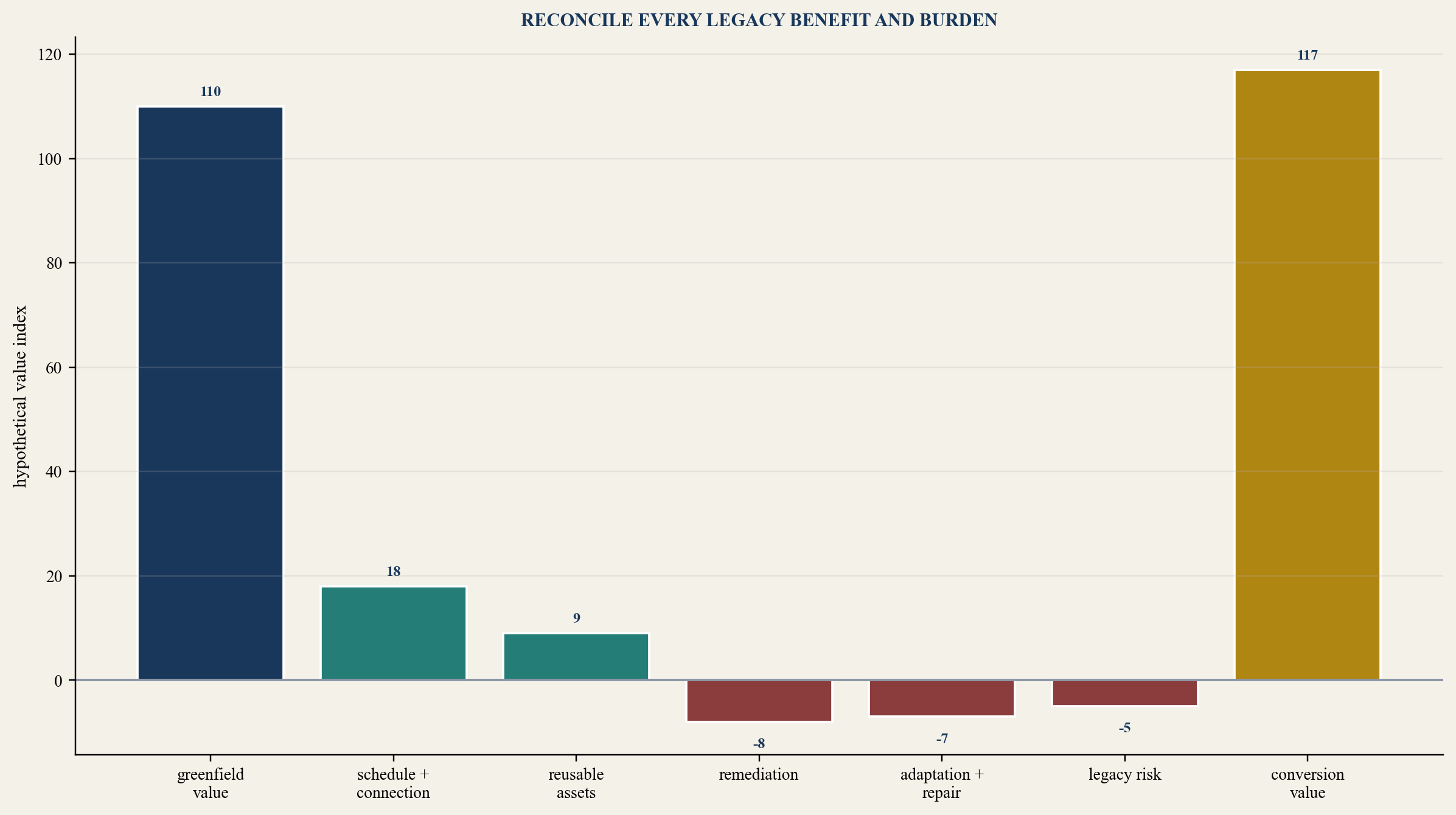
Hypothetical management values illustrate the method; they are not an actual valuation.
19. Stress power, remediation and demand together
Conversion risks can be correlated. Intrusive investigation can discover contamination where a new substation or data hall is planned. Redesign can delay utility works and customer acceptance.
Power delay should affect revenue, interest, contractor standby and customer remedies. Remediation overrun should affect construction access and contingency. A customer delay can weaken debt capacity while site carrying costs continue.
The model should change connected assumptions in one scenario rather than present isolated sensitivities only.
Table 5. Stranded-site conversion sensitivity matrix
| Stress | Hypothetical management case | Financial transmission | Required response |
|---|---|---|---|
| Grid delay | first 60 MW slips 18 months | deferred revenue, capital carry and customer risk | long-stop, alternative phasing and utility milestones |
| Capacity reduction | firm import falls from 60 MW to 40 MW | smaller first phase and higher unit cost | modular design, storage and revised customer plan |
| Contamination expansion | remediation cost rises by USD 35 million | equity overrun and construction delay | investigation, escrow, insurance and contingency |
| Retained-asset failure | substation reuse is rejected | replacement capital and later energisation | early testing, parallel design and price adjustment |
| Planning condition | operating hours and noise controls tighten | added enclosure, generation limit and delay | acoustic study, design reserve and stakeholder plan |
| Customer deferral | anchor acceptance moves 12 months | lower debt capacity and idle assets | deposit, termination payment and staged procurement |
| Fibre constraint | diverse route arrives nine months late | service ineligibility and revenue delay | route works, alternate carrier and acceptance condition |
| Water restriction | planned evaporative cooling unavailable | higher power and redesign | air-cooled or hybrid option and revised energy model |
Every scenario is a hypothetical management assumption and should be replaced with project-specific evidence.
20. Structure site control and acquisition
An option or conditional sale can provide investigation access while limiting purchase capital. The agreement should address entry, sampling, disturbance, confidentiality, restoration, insurance and ownership of studies.
Conditions precedent can include satisfactory title, environmental assessment, utility offer, planning path, customer approval, financing and investment committee decision. Long-stop dates should match the evidence schedule.
The buyer should control the ability to assign the site to the financing or project vehicle, subject to negotiated seller protections. Lender security and step-in rights need to be compatible with leases and industrial-zone rules.
Completion mechanics should separate assumed and retained liabilities. Post-completion access may be required for seller remediation or monitoring, with clear safety and operational interfaces.
21. Execute through 180 days
The conversion programme should move from fatal-flaw review through intrusive diligence, utility and authority engagement, concept design, market testing, financing and a gated acquisition decision.
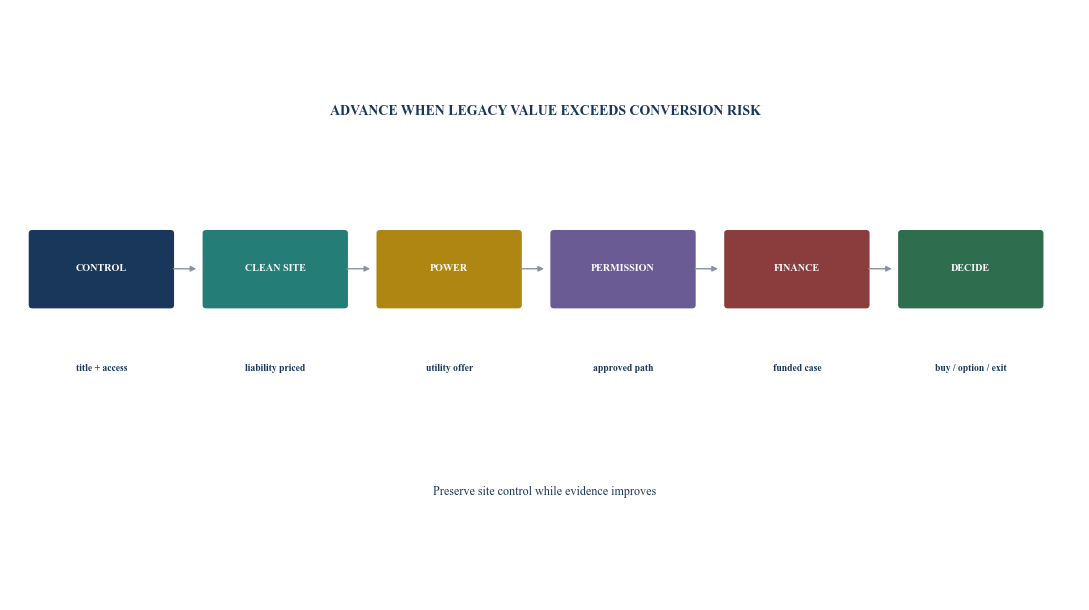
Author framework. Every gate requires approved evidence, ownership and a recorded decision.
Table 6. 180-day stranded-site execution plan
| Days | Workstream | Principal output | Gate |
|---|---|---|---|
| 1 to 15 | fatal-flaw screen | control, power history, environment, planning, fibre and market | option or stop decision |
| 16 to 40 | site control and desktop diligence | access agreement, title, records, utility request and authority plan | diligence scope approved |
| 41 to 75 | intrusive and technical work | soil, groundwater, buildings, substation, water, cooling and network | liabilities and reusable assets defined |
| 76 to 105 | concept and market engagement | phased campus, power, resilience, contractor and customer evidence | preferred conversion concept selected |
| 106 to 130 | integrated model and contracts | price, remediation, capex, schedule, revenue, debt and risk allocation | conditional economics accepted |
| 131 to 150 | planning and utility path | submissions, studies, connection offer and long-lead requirements | permission and power path accepted |
| 151 to 170 | financing and transaction | facilities, equity, escrow, insurance, conditions and completion | fundable package established |
| 171 to 180 | investment decision | approved price, conditions, contingency, governance and exit | acquire, extend option or decline |
Sequencing is indicative and should reflect site access, authority and utility timetables.
22. Set the investment decision
The committee should approve site boundary, target service, title, environmental allocation, retained assets, demolition, grid path, generation, water, fibre, planning, customer evidence, acquisition price, capital, financing, contingency and execution governance.
Conditions should cover utility confirmation, environmental scope, authority approvals, contractor pricing, customer acceptance, insurance, lender consent and seller protections.
The transaction should pause or reprice when historic power lacks a transferable path, remediation is open-ended, title or access is defective, reuse benefits are unsupported, planning depends on untested assumptions, fibre is weak or customer revenue cannot support the complete conversion cost.
An option can remain valuable when evidence is incomplete and a decision date is clear. The buyer should exit when additional diligence cannot resolve the principal uncertainty within the approved capital and timetable.
23. Limitations and conclusion
Site condition, environmental law, utility policy, grid capacity, planning, construction markets, technology, customer demand and capital markets can change. Decisions require current evidence from authorities, utilities, environmental specialists, engineers, planners, lawyers, customers, contractors, insurers and lenders.
The cited public programmes and regulatory materials describe their own jurisdictions and purposes. They do not establish that a specific industrial site is clean, powered, permitted, transferable or financeable.
Every numerical value and result in the worked case is a hypothetical management assumption. No actual site, connection, remediation programme, customer contract or investment result is represented.
Stranded industrial assets can shorten the path to digital infrastructure when land, grid, transport and existing systems survive verification. Their history can also carry contamination, obsolete equipment and non-transferable rights.
The investable conversion is the one that prices both sides. Controlled site access, direct utility evidence, intrusive environmental work, a phased digital design and risk-matched capital can transform genuine legacy advantages into a financeable new service.
References
- [1] International Energy Agency, Electricity 2026: Grids, official analysis accessed 13 August 2026. https://www.iea.org/reports/electricity-2026/grids
- [2] United States Federal Energy Regulatory Commission, FERC Directs PJM to Create New Rules for Co-Located Large Loads, 18 December 2025. https://ferc.gov/news-events/news/fact-sheet-ferc-directs-nations-largest-grid-operator-create-new-rules-embrace
- [3] United States Federal Energy Regulatory Commission, Order ER24-2172-000, 1 November 2024. https://www.ferc.gov/sites/default/files/2024-11/20241101-3061_ER24-2172-000.pdf
- [4] United States Department of Energy, Crane Restart, official project page, accessed 13 August 2026. https://www.energy.gov/edf/crane-restart
- [5] United States Environmental Protection Agency, Guidance on the Redevelopment of Superfund and Brownfield Sites as AI Data Centers, January 2026. https://www.epa.gov/system/files/documents/2026-01/guidance-on-the-redevelopment-of-superfund-and-brownfield-sites-as-ai-data-centers.pdf
- [6] European Commission, Environmental Impact Assessment, official policy page accessed 13 August 2026. https://environment.ec.europa.eu/law-and-governance/environmental-assessments/environmental-impact-assessment-eia_en
- [7] European Commission, Industrial Emissions Portal Regulation, official policy page accessed 13 August 2026. https://environment.ec.europa.eu/topics/industrial-emissions-and-safety/industrial-emissions-portal-regulation-iepr_en
- [8] United Kingdom Department for Energy Security and Net Zero, Section 35 Direction Request for the SDC M40 Campus, 2026. https://assets.publishing.service.gov.uk/media/69b7ece3ba47c264e6c8cfba/Request_Document_-_SDC_M40_Campus_-_Section_35_Direction.pdf
- [9] United States Department of Energy, Repurposing Retired Coal Plants for the Energy Future, 14 January 2025. https://www.energy.gov/policy/articles/repurposing-retired-coal-plants-energy-future
- [10] United States Department of Energy, Title 17 Energy Infrastructure Reinvestment Financing, official programme page. https://www.energy.gov/edf/title-17-energy-infrastructure-reinvestment-eir-financing
- [11] United States Department of Energy, Site Selection for AI Data Center and Energy Infrastructure Development on Federal Lands, 24 July 2025. https://www.energy.gov/articles/doe-announces-site-selection-ai-data-center-and-energy-infrastructure-development-federal
- [12] United States Department of Energy, Advantages and Challenges of Nuclear-Powered Data Centers, 8 April 2025. https://www.energy.gov/ne/articles/advantages-and-challenges-nuclear-powered-data-centers
- [13] UAE Ministry of Energy and Infrastructure, National Team for Reviewing the Impact of Data Centers on the Energy Sector, 3 February 2025. https://www.moei.gov.ae/en/media-center/news/3/2/2025/national-team-for-reviewing-the-impact-of-data-centers-on-energy-sector-holds-first-meeting
- [14] UAE Ministry of Energy and Infrastructure, Emirates Monitoring Center for National Power Grid Resilience, 9 July 2026. https://www.moei.gov.ae/en/media-center/news/9/7/2026/ministry-of-energy-and-infrastructure-inaugurates-emirates-monitoring-center-to-strengthen-national
- [15] Australian Energy Market Operator, Maintaining Reliable Supply to the Bathurst, Orange and Parkes Areas, 31 January 2023. https://aemo.com.au/consultations/current-and-closed-consultations/transgrid-amended-pacr-maintaining-reliable-supply-to-the-bathurst-orange-and-parkes-areas
- [16] Australian Government, New Platform Could Fast-Track Large-Scale Grid Connections, 19 July 2022. https://www.energy.gov.au/news/new-platform-could-fast-track-large-scale-grid-connections
About the Author
Chennakeshav Adya is an independent researcher and Managing Partner of Matchpoint Partners. His research focuses on investment strategy, capital formation, transaction execution, governance and operating-model design across international markets.
