

1. INTRODUCTION
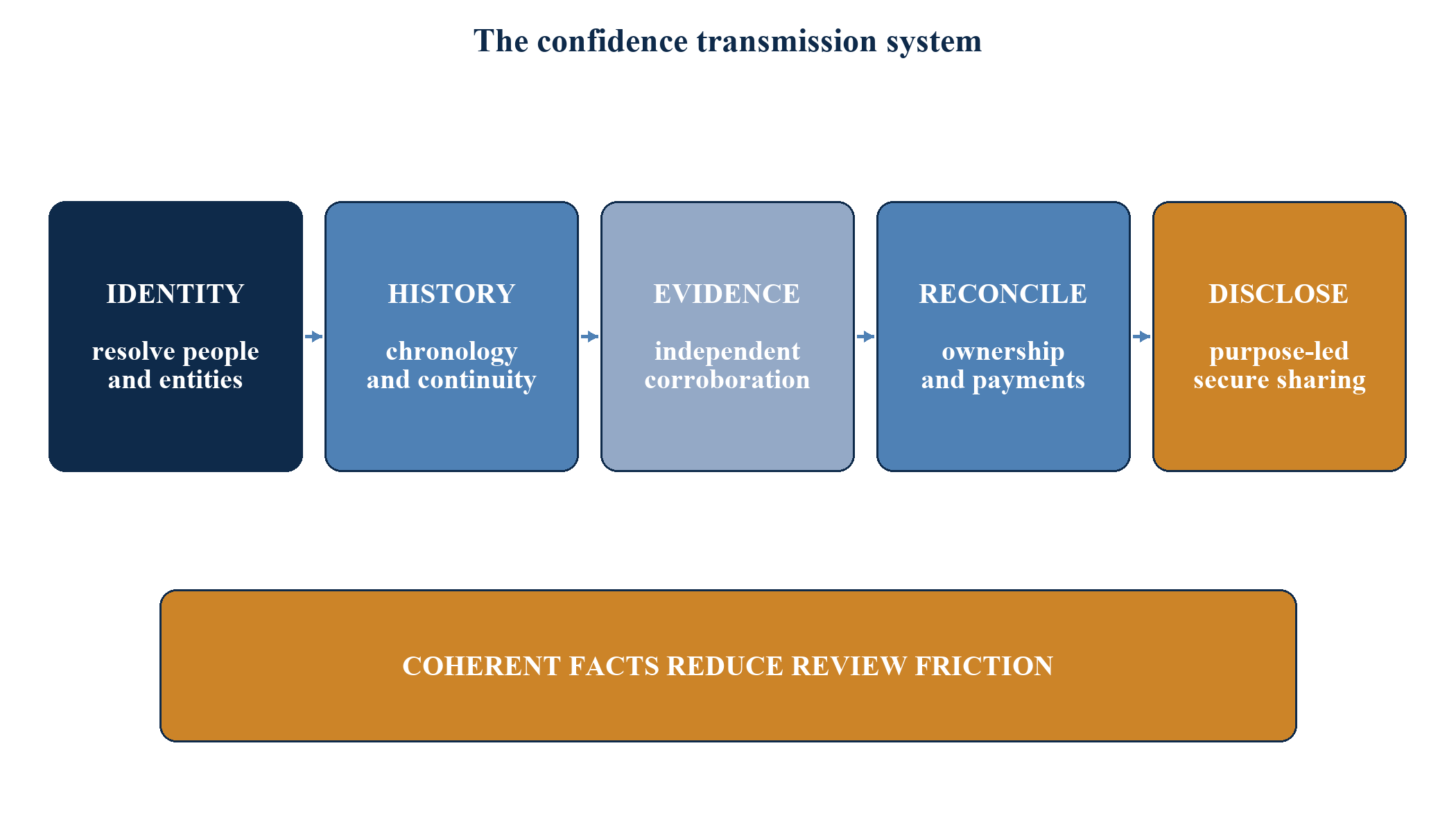
Cross-border relocation creates an information problem before it creates a reputation problem. A principal may have decades of legitimate business history in the United Kingdom, a new residence and operating base in the United Arab Emirates, assets held through several legal persons, and current transactions routed through institutions that have only recently begun to know the family. Each fact may be valid. Confidence can still weaken when the facts arrive in fragments, use inconsistent names or dates, omit the economic path by which wealth was created, or leave the recipient to reconcile ownership and control without a reliable index.
This paper calls that loss of confidence the reputation discount. The term does not mean a finding of misconduct, a financial valuation adjustment or a presumption that relocation is suspicious. It describes the additional friction that can arise when a bank, investor, buyer, lender, fund administrator, lawyer or other counterparty cannot quickly establish a coherent and evidenced account of identity, residence, wealth, ownership, control and intended activity. The practical effects may include more questions, longer review, narrower product access, additional approvals, delayed transactions or a decision not to proceed.
Financial institutions operate under risk-based customer due diligence. Current CBUAE guidance requires institutions to understand customers, beneficial owners, source of wealth, source of funds and expected activity, and to verify information using reliable and independent sources on a risk-sensitive basis [1-6]. FATF standards likewise connect identity, beneficial ownership, purpose, ongoing monitoring, politically exposed person controls and sanctions to a proportionate assessment of risk [13-19]. A relocating family therefore benefits from presenting its history as an evidence system rather than a collection of disconnected documents.
The framework developed here has six components. First, state the propositions that a recipient needs to understand. Second, map each proposition to current and historical evidence. Third, reconcile the ownership and control chain to natural persons. Fourth, separate overall source of wealth from the source and route of a particular transaction. Fifth, resolve inconsistencies in public, private and regulatory records. Sixth, govern the information so that it is accurate, proportionate, secure and capable of being refreshed.
This is general research. It does not determine whether any person or relationship presents financial-crime, sanctions, tax, legal, privacy, credit or commercial risk. Every score, threshold, timetable and worked case is hypothetical and simplified. Institutions retain their own risk appetites, legal duties and decision rights. Current official guidance and fact-specific professional advice remain decisive.
2. WHAT THE REPUTATION DISCOUNT MEANS
2.1 Confidence is an operating asset
Confidence allows a recipient to move from identity to decision. A bank needs confidence that it knows the customer and can predict activity sufficiently to apply its controls. A buyer needs confidence that ownership, authority and proceeds will survive diligence and closing. An investor needs confidence that representations correspond to records and that the operating substance described to it exists. A professional adviser needs confidence that instructions come from an authorised person and that the engagement can be performed lawfully.
The confidence requirement is asymmetric. The principal may know the history intimately, while the recipient sees only the documents, databases, explanations and transactions available within its process. Familiarity cannot be transferred by assertion. It is transferred through evidence that a separate reviewer can understand, verify and reconcile.
The discount therefore appears as friction across four dimensions: time, breadth of access, internal escalation and residual uncertainty. Time increases when questions circulate between relationship, compliance, legal, tax and operations teams. Access narrows when products, limits or transaction types remain unavailable pending evidence. Escalation increases when the file requires senior or specialist approval. Residual uncertainty remains when the recipient accepts the relationship while applying tighter monitoring or conditions.
2.2 A gap is not an allegation
An evidence gap is a missing bridge between a proposition and a reliable source. An inconsistency is a difference between two sources that requires explanation. A red flag is an observed fact or pattern that a recipient assesses under its controls. These concepts should remain separate. Treating every gap as misconduct would defeat the risk-based and proportionate approach emphasised by FATF and supervisory guidance [13,17,18]. Treating every gap as harmless would leave the recipient unable to meet its responsibilities.
The family office should classify an issue before responding. A spelling difference may be an identity-resolution task. An old registered address may require a filing update. A dormant company shown in a historic structure chart may require an explanatory timeline. A source-of-wealth statement that does not reconcile to audited accounts or sale documents requires substantive investigation. Classification keeps the response proportionate and prevents routine discrepancies from becoming an uncontrolled narrative.
| Issue type | Core question | Appropriate response | Decision owner |
|---|---|---|---|
| missing evidence | which proposition lacks support? | obtain a reliable source or narrow the proposition | file owner |
| record inconsistency | why do current sources differ? | reconcile chronology and correct the relevant record | legal or compliance lead |
| identity ambiguity | do names refer to the same person or entity? | resolve identifiers, transliteration and dates | onboarding lead |
| unexplained transaction | how was the money generated and routed? | build source-of-funds chain and corroborate | finance and compliance |
| adverse information | is the result accurate, relevant and material? | verify subject, source, stage, response and outcome | specialist reviewer |
| legal restriction | does a sanctions or other prohibition apply? | stop and obtain specialist advice | legal and sanctions lead |
3. THE REPUTATION-RISK MAP
3.1 Seven linked risk domains
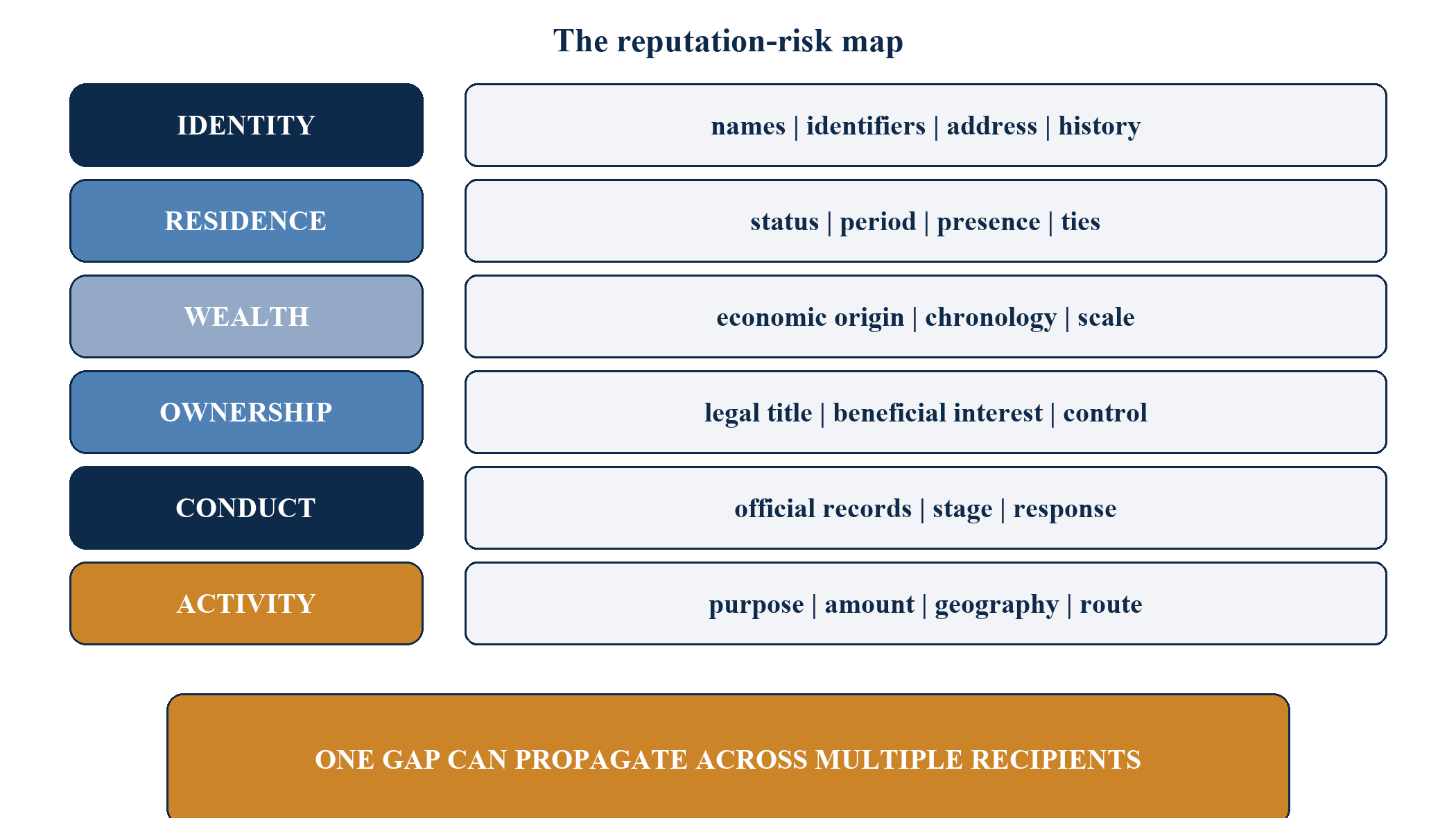
The reputation-risk map covers identity, residence, wealth, ownership, control, conduct and transaction behaviour. Identity asks whether the person or entity has been resolved across official identifiers, former names, transliterations and dates. Residence asks what status is claimed, for which period and under which legal test. Wealth asks which economic activities created the principal's overall net worth. Ownership asks which natural persons ultimately own or benefit from relevant vehicles. Control asks who actually directs decisions, accounts and transactions. Conduct asks whether reliable information identifies relevant legal, regulatory or commercial issues. Transaction behaviour asks whether the proposed and observed activity fits the stated profile.
These domains interact. A relocation changes addresses, phone numbers, tax self-certifications, authorised signatories and the expected geography of payments. A business sale can change wealth composition and create a large incoming payment. A holding-company reorganisation changes legal ownership while beneficial ownership may remain stable. A family governance transition changes control without changing economic ownership. The file needs to show both the change and the continuity.
3.2 Risk is transmitted through dependencies
A single inconsistency can travel across systems. An old address at a company registry can conflict with a tax self-certification. A name variation in a trust deed can create a screening alert. A sale price reported in the press can differ from cash received because debt, escrow, rollover equity and tax are omitted from the public number. A new UAE entity can appear to have no operating history even though it is part of a longer group history.
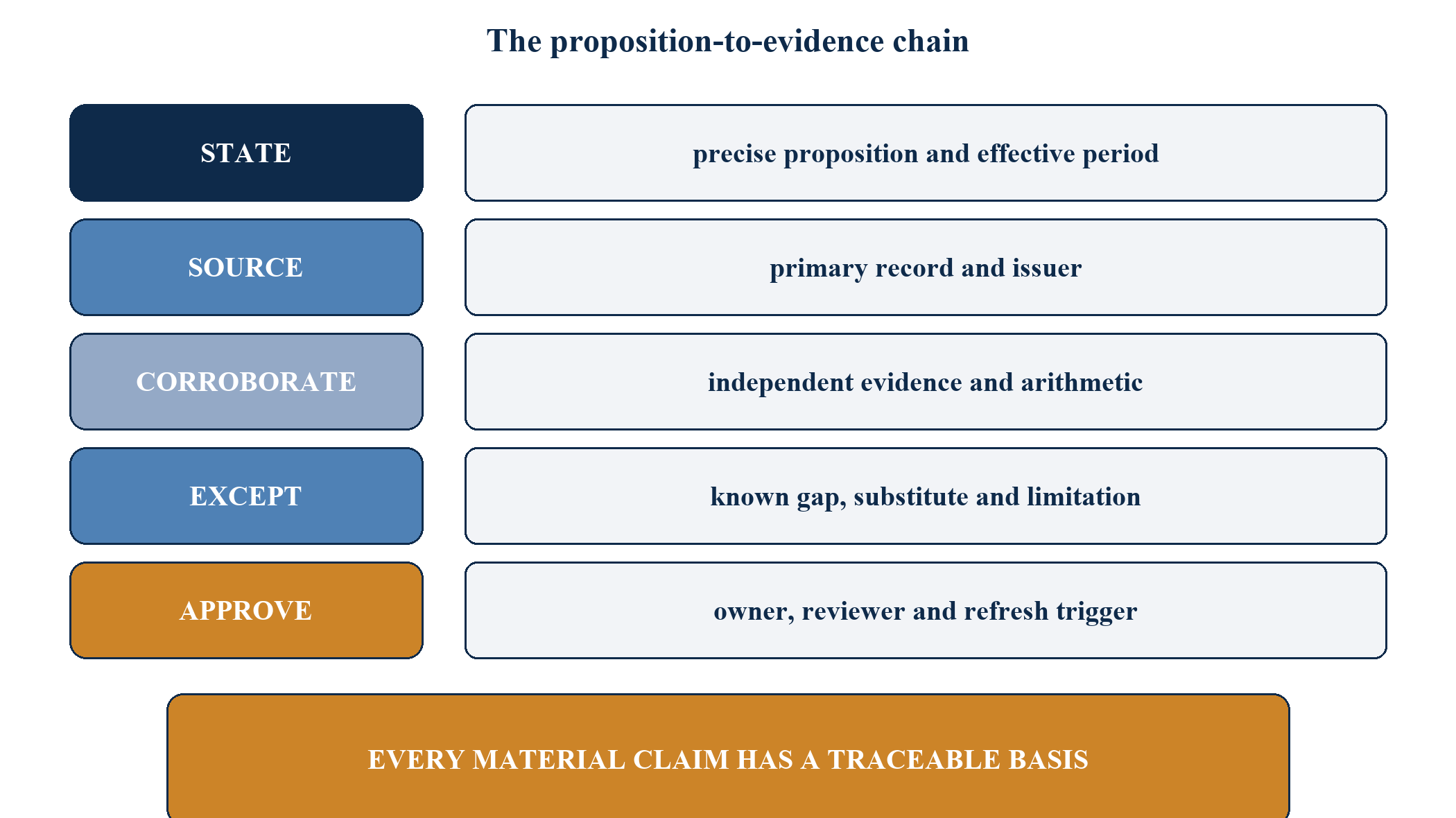
The control objective is traceability. Every material claim should lead to a source, effective period, owner, status and known limitation. Every material discrepancy should have a reason, evidence, corrective action and closure record. This converts reputation management from messaging into governed information.
| Domain | Typical proposition | Strong evidence | Frequent source of friction |
|---|---|---|---|
| identity | this is the same person across records | passport, Emirates ID, former-name evidence, date of birth | transliteration, shortened names, expired documents |
| residence | the principal is resident in a stated jurisdiction for a stated period | official residence records, travel history, tax certificate where applicable | visa treated as tax residence, incomplete day counts |
| wealth | overall wealth arose from identified legitimate activities | audited accounts, sale agreements, dividends, probate, investment records | narrative without scale or chronology |
| ownership | natural persons and interests are known | registers, constitutional documents, shareholder and trust records | stacked vehicles, nominees, stale charts |
| control | decision-makers and authority are known | board records, mandates, powers, investment and delegation policies | legal ownership confused with practical control |
| conduct | relevant issues are accurately understood | court, regulator and credible-source records with response | mistaken identity, allegation treated as finding |
| activity | proposed flows fit the profile | transaction documents, expected-activity schedule, bank trail | unexplained third parties, sudden changes, circular flows |
4. CUSTOMER DUE DILIGENCE AS A NARRATIVE SYSTEM
4.1 Institutions need a profile they can monitor
CDD is more than identification at account opening. Current CBUAE guidance describes a programme that collects and verifies information, assigns a risk profile, applies enhanced measures where appropriate, refreshes the record and uses the profile in ongoing monitoring [1-6]. The Basel consolidated framework similarly connects customer acceptance, identification, beneficial ownership, risk profiling and monitoring to the management of legal, reputational, operational and concentration risks [26].
A usable profile answers who the customer is, what the customer does, why the relationship is sought, where activity will occur, how much activity is expected, who owns and controls the relevant structures, how wealth was accumulated, and where the funds for a specific transaction originate. The profile also states which changes should trigger a refresh. Relocation is such a change because it can alter address, tax residence, employment, business activity, account use, counterparties and transaction geography at the same time.
4.2 The proposition register
The proposition register is the first operating document. It records what the family wants a recipient to understand and the evidence that supports each statement. It prevents the same facts from being described differently in bank forms, legal instructions, tax files, investor materials and transaction documents.
| Proposition | Effective period | Primary evidence | Corroborating evidence | Owner | Refresh trigger |
|---|---|---|---|---|---|
| identity and current address | current | government identity and residence record | utility, tenancy or regulated-institution record | family office COO | renewal or address change |
| tax residence | stated tax year or 12-month period | official analysis and certificate where available | travel, home, work and family evidence | tax adviser | travel or family change |
| wealth origin | historic and cumulative | audited business, sale, inheritance or investment records | tax, bank and public records | CFO | material liquidity event |
| beneficial ownership | current and historic | corporate, trust and register records | legal opinion and filings | legal counsel | reorganisation or succession |
| intended account activity | next 12 months | cash-flow and transaction schedule | contracts and investment commitments | treasury lead | new product or transaction |
| public-record issue | event-specific | official disposition and current status | reliable media and legal analysis | compliance lead | new report or proceeding |
The register should distinguish fact, professional conclusion and forward-looking expectation. A passport is a fact source. A tax-residence memorandum is a professional conclusion based on stated facts and law. An expected-activity schedule is a forecast. Recipients may test each category differently.
5. SOURCE OF WEALTH AND SOURCE OF FUNDS
5.1 Two questions with different evidence
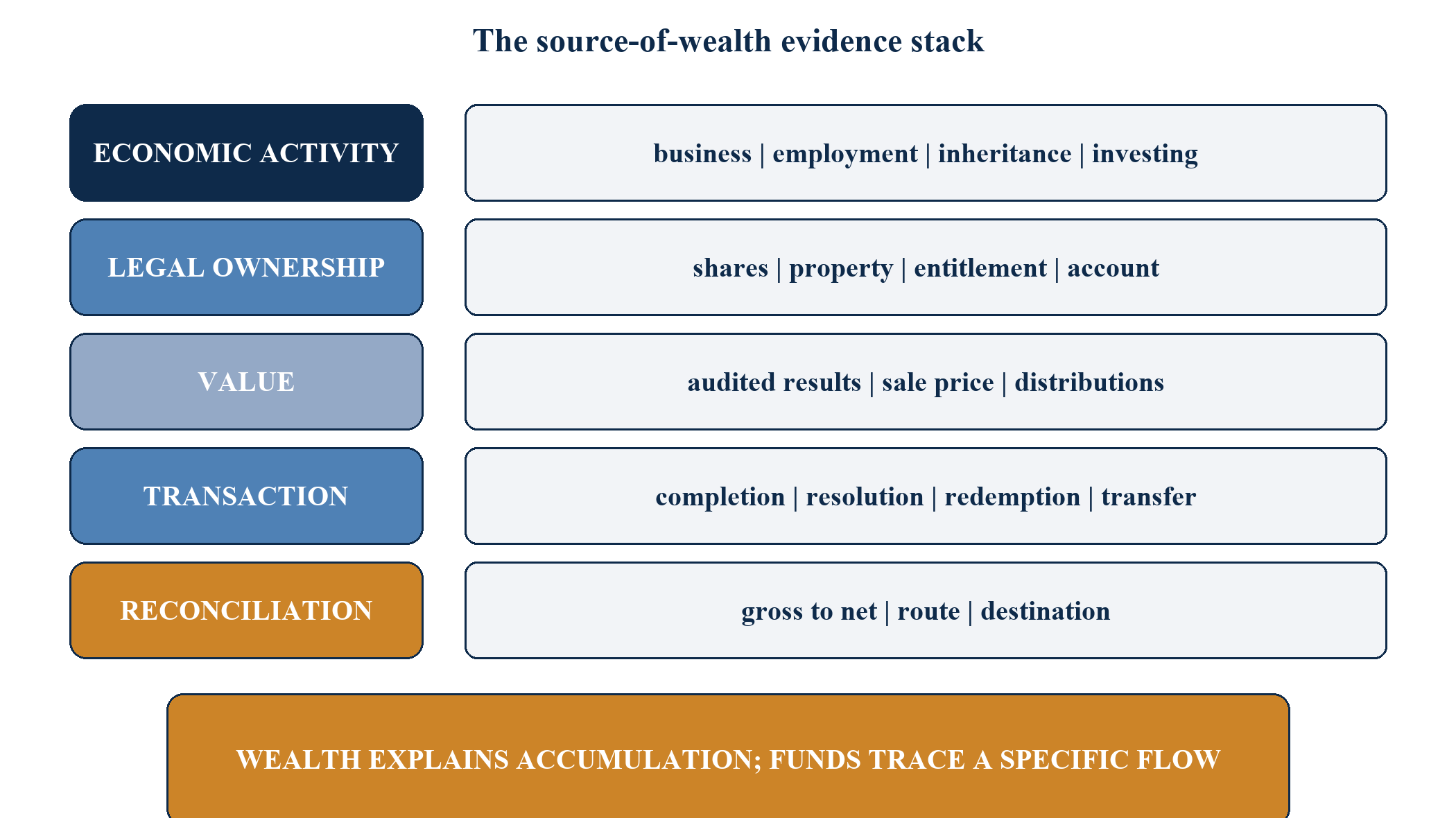
Source of wealth explains how the customer or beneficial owner accumulated overall net worth. Source of funds explains the economic origin and transfer route of money used in a particular relationship or transaction. CBUAE, FCA, HMRC and Wolfsberg materials distinguish these concepts and emphasise corroboration according to risk [2,5,20,22,28-30]. A bank statement can show where money arrived from without explaining the activity that generated it. A business-sale agreement can explain generation without proving the exact route to the receiving account.
The source-of-wealth narrative should identify the principal wealth events, time period, ownership at the relevant time, economic value and supporting records. It does not need to inventory every asset when the applicable standard seeks a reasonable understanding of the principal sources. It should still reconcile scale. A long career, ownership percentage, business profitability, dividends, sale proceeds, investment returns and inheritance should form a plausible chronology.
| Wealth source | Core evidence | Reconciliation question | Common limitation |
|---|---|---|---|
| founded business | incorporation, ownership, audited accounts, dividends | did ownership and earnings support the claimed wealth? | early records incomplete |
| business sale | sale agreement, completion statement, escrow and bank records | how did enterprise value become net cash and retained interests? | public headline differs from proceeds |
| employment or partnership | contracts, compensation, tax and account records | does cumulative compensation fit the stated accumulation? | bonuses and carried interests reported separately |
| inheritance or gift | probate, will, deed, donor evidence and receipt | was the transfer valid and how was the donor's wealth generated? | cross-border succession records differ |
| investment returns | custody statements, realised gains, distribution records | can opening capital, flows and returns be reconciled? | multiple managers and currencies |
| property | title, purchase, financing and sale records | what equity was invested and what net proceeds were received? | gross price confused with equity value |
5.2 Build the transaction chain
A source-of-funds chain has five links: generator, legal owner, transaction event, transfer route and destination. For sale proceeds, the generator is the sale of an identified asset or business. The legal owner is the seller under the agreement. The event is completion and settlement. The route includes payer, escrow, debt repayment, tax withholding, adviser fees and intermediate accounts. The destination is the account or investment receiving the net amount.
| Link | Question | Evidence | Control |
|---|---|---|---|
| generation | what activity created the funds? | contract, distribution, sale, redemption or income record | economic rationale review |
| ownership | who legally owned the asset or entitlement? | register, deed, account or governing instrument | beneficial-owner reconciliation |
| event | what caused money to become payable? | completion statement, dividend resolution, maturity or invoice | authority and condition check |
| route | which accounts and intermediaries carried the funds? | statements, payment messages, escrow and settlement records | name and amount reconciliation |
| destination | where will funds be held or used? | account details, subscription or purchase documents | verified beneficiary and purpose |
The strongest file shows gross-to-net arithmetic. It explains debt repayment, escrow retention, rollover equity, taxes, fees, currency conversion and timing differences. A recipient can then connect the economic event to the exact amount presented for use.
6. EVIDENCE QUALITY AND THE CONFIDENCE LADDER
6.1 Reliability, independence and relevance
Current CBUAE guidance permits documentary and non-documentary verification and expects reliable, independent sources selected on a risk-sensitive basis [1-4]. Evidence quality depends on who created the record, why it was created, whether it can be authenticated, whether it covers the relevant period and whether it directly proves the proposition. An official record may be strong for identity while saying little about the economic origin of wealth. A management schedule may be detailed while requiring independent corroboration.
The evidence ladder has five levels. Level one is unsupported statement. Level two is internally generated explanation. Level three is third-party professional or commercial evidence. Level four is regulated, audited or official evidence. Level five is a reconciled chain in which independent sources agree across identity, ownership, value, time and payment route. The objective is not to force every fact to level five. It is to match evidence strength to materiality and risk.
| Level | Evidence form | Appropriate use | Required caution |
|---|---|---|---|
| 1 | oral or written assertion | initial fact collection | no independent corroboration |
| 2 | family-office schedule or explanation | organising complex history | creator is interested party |
| 3 | lawyer, accountant, broker or counterparty record | professional or transaction context | scope and reliance may be limited |
| 4 | audited, regulated, court, registry or government record | high-reliability factual proposition | may be historic or narrow in scope |
| 5 | reconciled multi-source chain | material wealth and transaction conclusion | requires clear assumptions and exceptions |
6.2 The exception register
Old businesses, private companies, trusts and cross-border families often have incomplete records. The answer is an exception register. It states the missing item, affected proposition, reason it is unavailable, substitute evidence, residual limitation, approving reviewer and any expiry. This approach is more credible than silence or overstatement.
Substitute evidence can include archived accounts, tax filings, bank statements, transaction correspondence, registry extracts, contemporaneous professional records and affidavits. Each substitute has a defined purpose. Several weak records do not automatically equal one strong record; their independence and consistency matter.
7. BENEFICIAL OWNERSHIP AND CONTROL
7.1 Trace to natural persons
FATF's updated standards and guidance require adequate, accurate and current beneficial-ownership information and promote a multi-pronged approach using company records, registries and other sources [13-15]. UAE Cabinet Decision No. 109 of 2023 requires relevant legal persons to maintain beneficial-owner information, and UK reforms have introduced identity verification for directors and people with significant control [9,32-34]. These systems serve distinct legal purposes. A family file should reconcile them without assuming that one registry proves the entire control picture.
The ownership map begins with the customer or asset-holding vehicle and traces every intermediate entity or arrangement to natural persons. For each link it records legal title, economic interest, voting rights, appointment rights, reserved matters, nominee or fiduciary capacity and effective dates. Trusts, foundations and partnerships require the roles defined by their governing law and documents. The map should preserve historical versions so a transaction can be assessed against the structure that existed when wealth was generated.
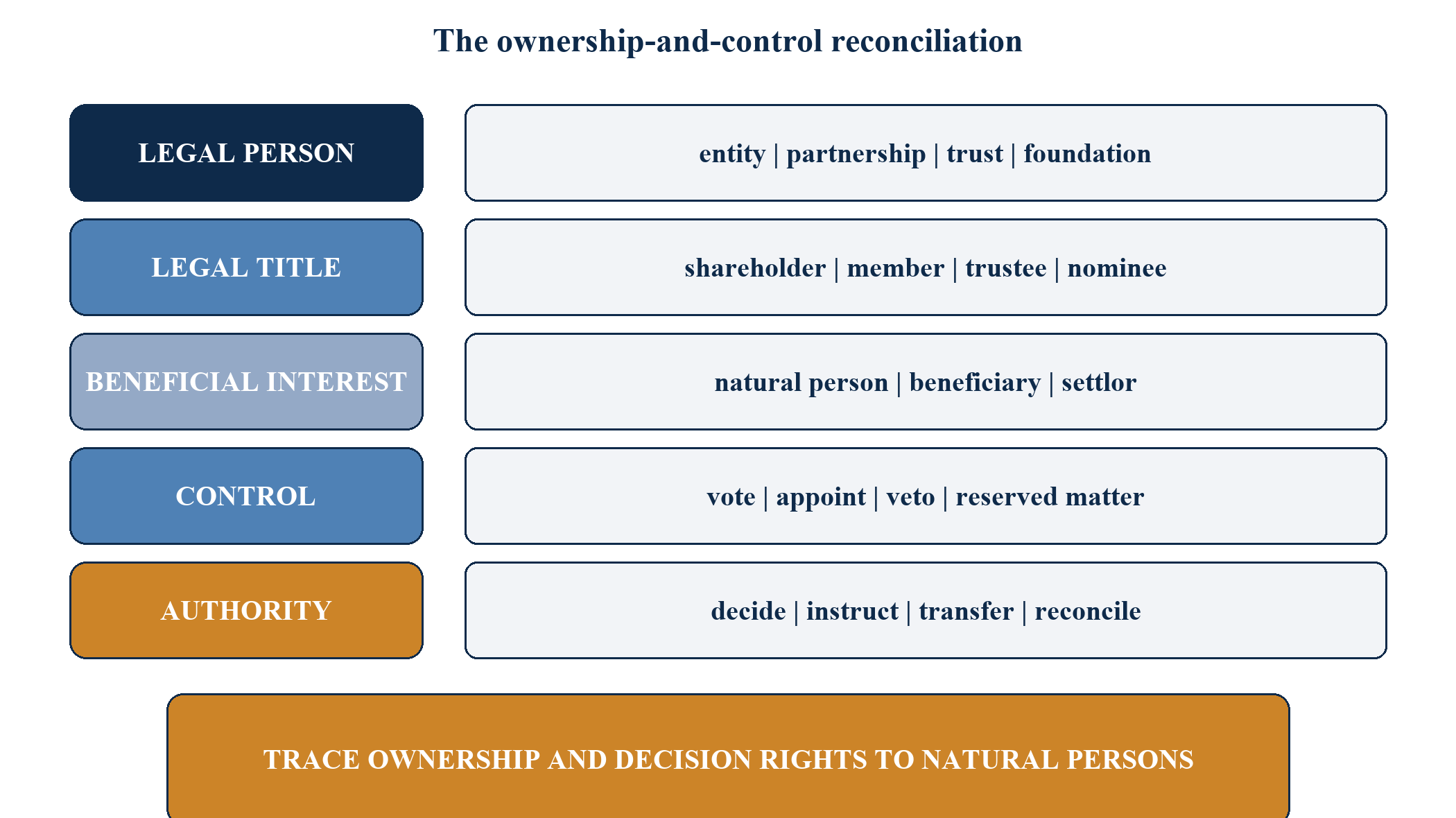
| Layer | Evidence | Question | Reconciliation output |
|---|---|---|---|
| legal entity | incorporation, register, constitutional documents | what exists and in which jurisdiction? | current legal identity |
| legal ownership | shareholder, partnership or member records | who holds formal interests? | percentage and effective date |
| beneficial ownership | declarations, trust or foundation records | which natural persons ultimately own or benefit? | beneficial-owner schedule |
| control rights | voting, appointment, veto and reserved matters | who can direct material decisions? | control matrix |
| authority | board, power, mandate and delegation records | who may instruct each account or transaction? | authorised-person register |
| economic outcome | distribution and entitlement records | who receives value and under what conditions? | beneficiary and proceeds map |
7.2 Separate ownership from authority
A principal can own an entity while a board, trustee, council or investment committee holds legal decision authority. A nominee can hold legal title without economic benefit. An authorised signatory can move money without owning it. A protector can influence a trust without holding assets. The file should describe these roles accurately and avoid collapsing them into the phrase "owns and controls everything."
Authority must also match provider records. A board resolution that appoints a signatory does not by itself prove that a bank or custodian has accepted the mandate. A provider confirmation, current authorised-person list and tested instruction route complete the operational evidence.
8. RESIDENCE, TAX SELF-CERTIFICATION AND THE RELOCATION STORY
8.1 Immigration and tax residence answer different questions
A UAE residence visa and Emirates ID establish important identity and immigration facts. UAE domestic tax residence and treaty residence are assessed under their applicable rules. The FTA describes evidence for natural persons by reference to presence, home, employment, business, financial and personal interests, and the relevant certificate route [11]. UK residence is tested under UK law and facts. OECD CRS materials require account holders and controlling persons to disclose all tax residences in self-certifications [23-25].
A credible relocation story uses dates and sources. It states when physical presence changed, when homes became available or ceased to be available, when employment or business duties moved, when family circumstances changed, which entities were managed from where, and which tax conclusions apply to which periods. It avoids using a future intention as evidence of a completed fact.
| Residence proposition | Period | Supporting record | Limitation to state |
|---|---|---|---|
| UAE immigration status | validity dates | Emirates ID, visa and passport | does not alone determine tax residence |
| UAE physical presence | relevant 12-month period | official entry and exit report | report should be reconciled to travel records |
| UAE home | period available | tenancy, title, utility and occupancy evidence | ownership does not necessarily prove use |
| UK residence analysis | relevant UK tax year | day count, ties, work and home analysis | conclusion is year-specific |
| treaty position | relevant period and treaty | professional analysis and certificate where available | domestic residence may exist in both states |
| CRS self-certification | current account record | signed certification and tax identifiers | must be refreshed after relevant change |
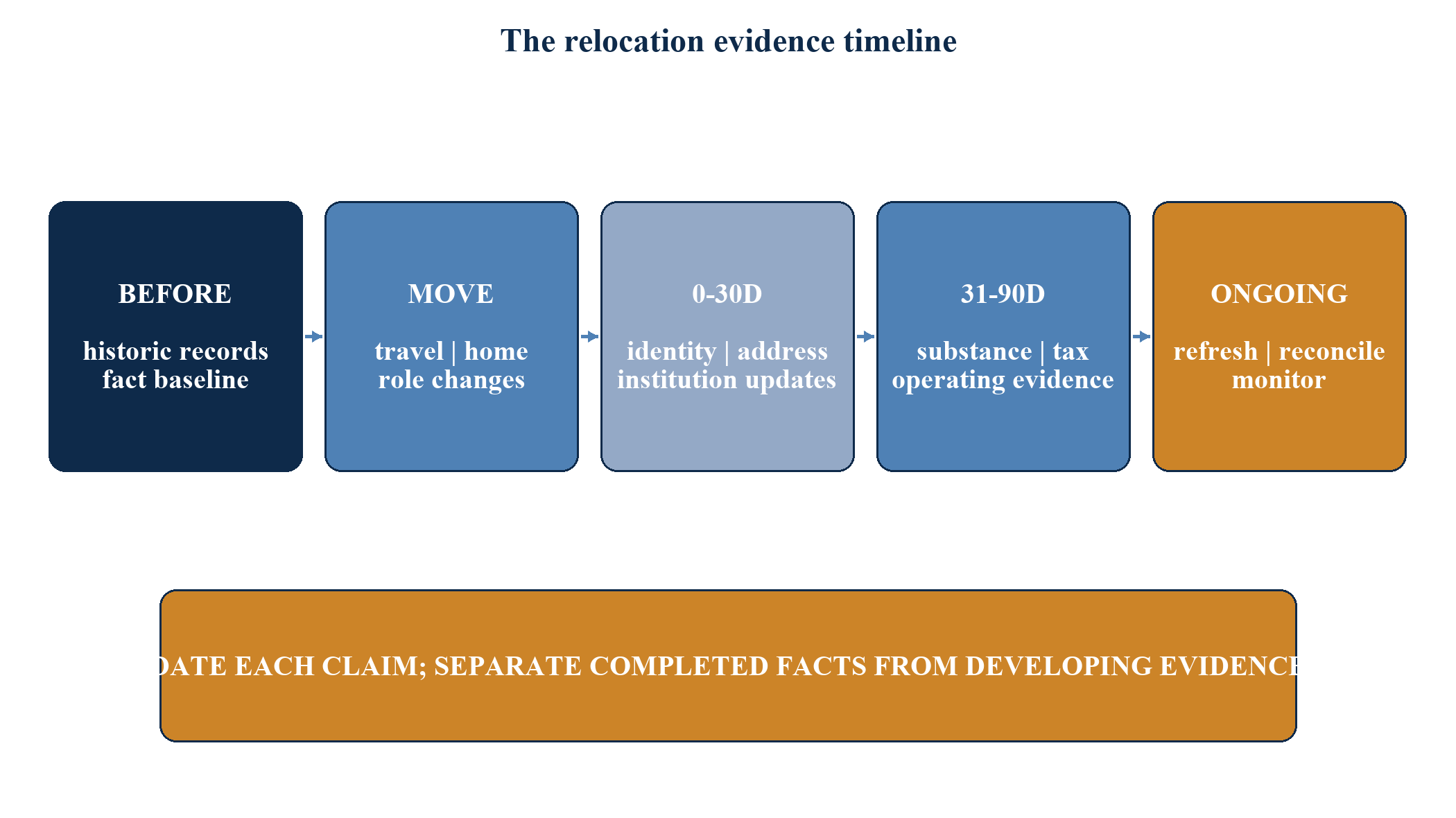
8.2 Sequence the updates
The family should maintain an institution-by-institution update register. It covers banks, custodians, brokers, insurers, trustees, company registries, fund administrators and material counterparties. For each, it records current address, tax residence, identification, controlling-person status, expected activity and outstanding requests.
Updates should be accurate and timely. Prematurely stating that a condition has been achieved creates inconsistency. Delaying a material change can leave old data in monitoring systems. The register links each update to the effective date and underlying evidence.
9. BUSINESS SUBSTANCE AND LOCATION OF CONTROL
9.1 Formation is the beginning of evidence
A UAE licence and incorporation certificate prove that an entity exists. They do not describe where substantive decisions occur, who performs functions, where records and systems are held, how contracts are negotiated or which office bears costs and risks. A newly formed entity will naturally have a short record. The file should distinguish inherited group history from the new entity's own operating history.
The substance record covers governance, people, premises, systems, contracts, expenditure, service providers, tax registration, banking and decision logs. Each element is dated. A board calendar and minutes should reflect real decisions. Employment and service arrangements should identify who performs which work. Intercompany arrangements should align responsibility, control and remuneration.
9.2 Explain continuity and change
A cross-border reorganisation often preserves beneficial ownership while moving legal ownership, management functions or investment activity. The narrative should show the before structure, transaction steps, after structure, commercial purpose and tax or legal advice obtained. Counterparties then see a controlled transition rather than an unexplained appearance of new entities.
This is especially important when a new UAE vehicle receives large proceeds or investment assets shortly after formation. The supporting file should connect the vehicle to the historical wealth owner, governing authority, transaction purpose and payment route. It should state whether the vehicle acts as owner, holding company, investment company, service company, trustee or another defined role.
10. PUBLIC RECORDS, IDENTITY AND COHERENCE
10.1 Build a record map
Public records can include company registers, regulatory notices, court records, sanctions lists, professional registers and official tax or property sources where accessible. Private records include bank files, custodian records, tax submissions, contracts and family-governance documents. Differences may arise because of reporting periods, filing lags, name formats, historic addresses or genuine errors.
| Record | Field to reconcile | Current source | Historic source | Corrective route |
|---|---|---|---|---|
| identity | full and former names, date of birth, nationality | government identity | prior passports and legal-name records | issuing authority or explanation |
| company | registered name, number, address, directors | current registry | archived filings | company filing |
| beneficial ownership | natural persons, percentages, control basis | required register and declarations | prior ownership records | legal-person update |
| bank or custodian | address, tax residence, authority | provider confirmation | prior KYC file | formal refresh request |
| tax | residence, identifiers, filing status | official record or advice | prior returns and certificates | tax-authority or adviser process |
| professional profile | biography, roles and transactions | approved current biography | archived website or publication | publisher correction or contextual note |
Companies House identity verification now applies through a phased regime to directors and people with significant control, with current government guidance explaining the legal requirement and transition [32,33]. The family should treat verification as one part of the record map and avoid representing it as independent proof of wealth or conduct.
10.2 Resolve name ambiguity
Arabic and other scripts may produce several Latin transliterations. Names may include patronymics, initials, honorifics or married names. Entity names may have English and Arabic versions. The identity schedule should list official current names, former names, transliterations, dates of birth or incorporation, nationality or jurisdiction, identifiers and the source of each variation.
Screening alerts should be adjudicated using multiple identifiers. A name match alone can be a false positive. Date of birth, nationality, location, associates, role and event details help distinguish the subject. The file should never alter an official name to avoid a match. It should make identity resolution easier and auditable.
11. ADVERSE INFORMATION, ERROR AND CONTEXT
11.1 Reliability and stage matter
Negative-news screening can help institutions identify financial-crime risk, and the Wolfsberg FAQs emphasise a risk-based approach, source reliability, materiality, event stage, language, false positives and disinformation [21]. An allegation, investigation, charge, civil finding, regulatory action, settlement, acquittal and conviction have different meanings. A credible review records the stage precisely and does not convert an allegation into a finding.
| Review field | Question | Evidence | Output |
|---|---|---|---|
| subject match | does the report concern the same person or entity? | identifiers and relationship map | true, false or unresolved match |
| source quality | who published it and what is the original source? | official record, credible journalism or derivative report | reliability assessment |
| event stage | allegation, inquiry, charge, finding, settlement or closure? | court, regulator or authority record | precise status |
| relevance | does the matter relate to the relationship or transaction risk? | conduct, geography, role and timing | scoped relevance |
| response | what did the subject say or do? | filed response, judgment, correction or remediation | balanced record |
| currency | has the status changed? | latest official source and monitoring date | refresh requirement |
11.2 Correct the record lawfully
Where information is factually wrong, the family should preserve the source, gather decisive evidence, use the publisher's or controller's correction process and record the result. UK data-protection principles require personal data to be accurate and kept up to date where necessary, and the ICO advises controllers to record sources, consider challenges and rectify inaccurate data [37,38]. UAE data-protection law also establishes governance, confidentiality, correction rights and cross-border transfer requirements [12].
The response pack should remain factual. It may include an identity clarification, official disposition, correction, counsel-confirmed procedural status and a short chronology. Aggressive attempts to erase accurate reporting can reduce confidence and create new records. Lawful correction and contextualisation are more durable.
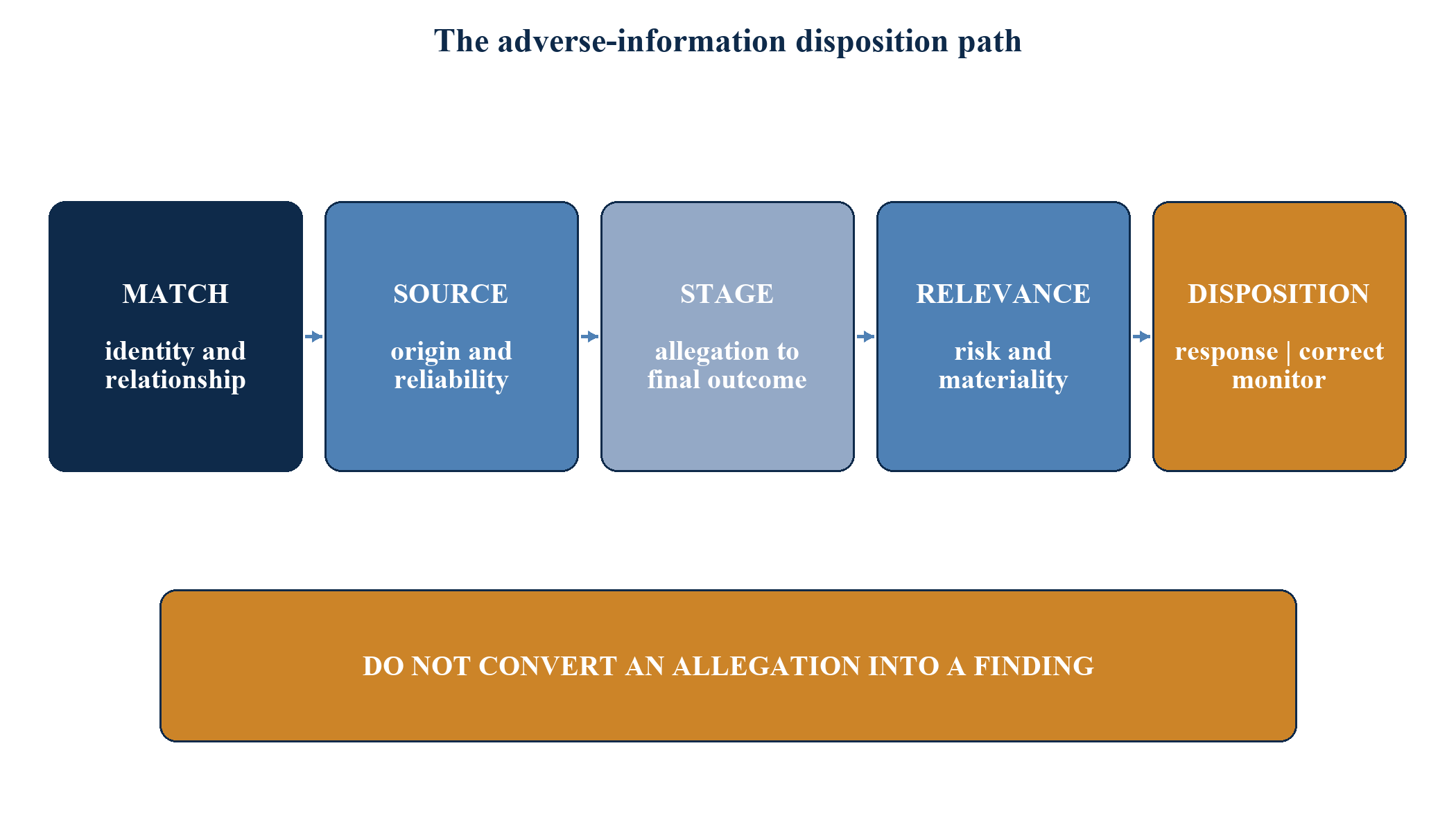
12. SANCTIONS, POLITICALLY EXPOSED PERSONS AND ASSOCIATIONS
12.1 Classification drives controls
Sanctions and PEP status are legal and risk-control categories. FATF makes clear that PEP measures are preventive and should not be interpreted as a conclusion that every PEP is involved in criminal activity [16]. The file should identify relevant current or former public functions, family members and close associates as required by the applicable regime and provider policy. It should then support source of wealth, source of funds, authority and expected activity at the required level.
UAE targeted-financial-sanctions guidance imposes screening and action requirements for designated persons and entities [10]. UK users should rely on the current UK Sanctions List, which replaced the former OFSI consolidated-list system in January 2026, together with current general guidance [35,36]. The UN consolidated list remains a core official source [40]. Screening requires current data and cannot be reduced to a saved screenshot.
12.2 Associations need a relationship map
A family office may interact with relatives, partners, directors, trustees, advisers, co-investors and operating companies. The relationship map describes the role, period, ownership or control connection, transaction exposure and evidence. It avoids implying that every association carries the same risk. It also prevents an important connection from being omitted when a recipient asks about related parties.
The map should be updated after appointments, acquisitions, disposals, succession events and material new transactions. It should be held securely because it contains sensitive personal and commercial information.
13. BANK ONBOARDING AND CONTINUING CONFIDENCE
13.1 Onboarding is a staged decision
Bank onboarding generally moves through relationship fit, identity and eligibility, risk assessment, source-of-wealth review, ownership and control, expected activity, screening, approvals, account implementation and monitoring. The sequence varies by institution. A complete pack does not guarantee acceptance because institutions apply their own risk appetites, product strategies and legal duties.
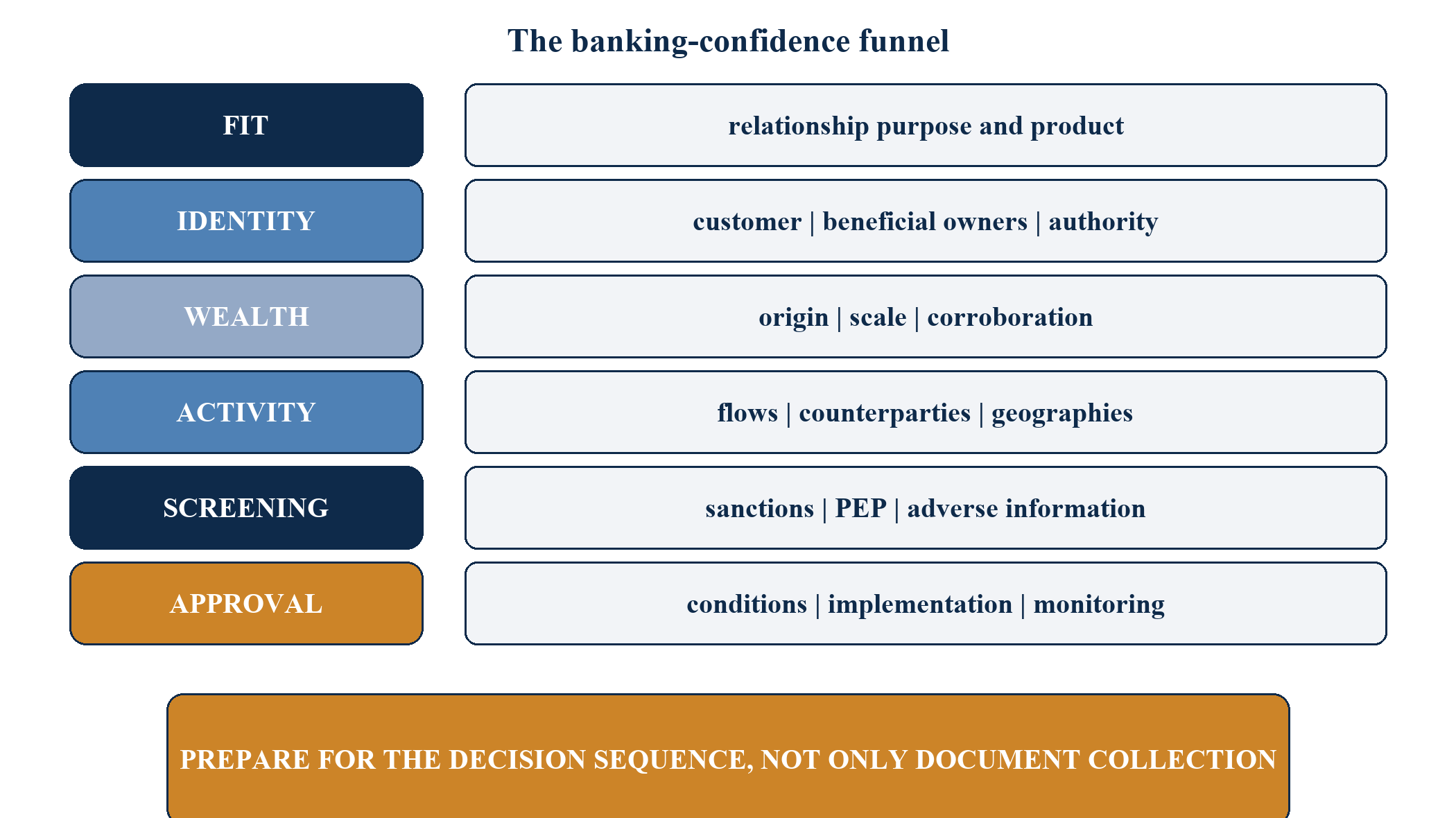
| Stage | Recipient question | Customer output | Failure mode |
|---|---|---|---|
| relationship fit | why this institution and service? | concise purpose and expected use | generic or unexplained request |
| identity | who are the persons and entities? | verified identifiers and record map | inconsistent names or addresses |
| wealth | how was overall wealth accumulated? | chronology, scale and corroboration | documents without economic explanation |
| ownership | who owns, benefits and controls? | current and historic structure | chart does not match legal records |
| activity | what flows, products and geographies are expected? | 12-month schedule and transaction rationale | first transaction surprises the bank |
| screening | do sanctions, PEP or adverse-information issues arise? | identifiers, classification and disposition | unaddressed matches |
| approval | can residual risks be accepted and managed? | answers, conditions and accountable contacts | open questions circulate without owner |
| monitoring | does observed activity remain consistent? | timely updates and transaction evidence | profile becomes stale |
13.2 Manage requests as a controlled workflow
The request log records institution, question, date, exact wording, owner, response, evidence, disclosure basis, recipient, status and next action. It prevents contradictory answers and uncontrolled sharing. A question about source of wealth should be answered consistently across institutions while respecting each recipient's form and legal basis.
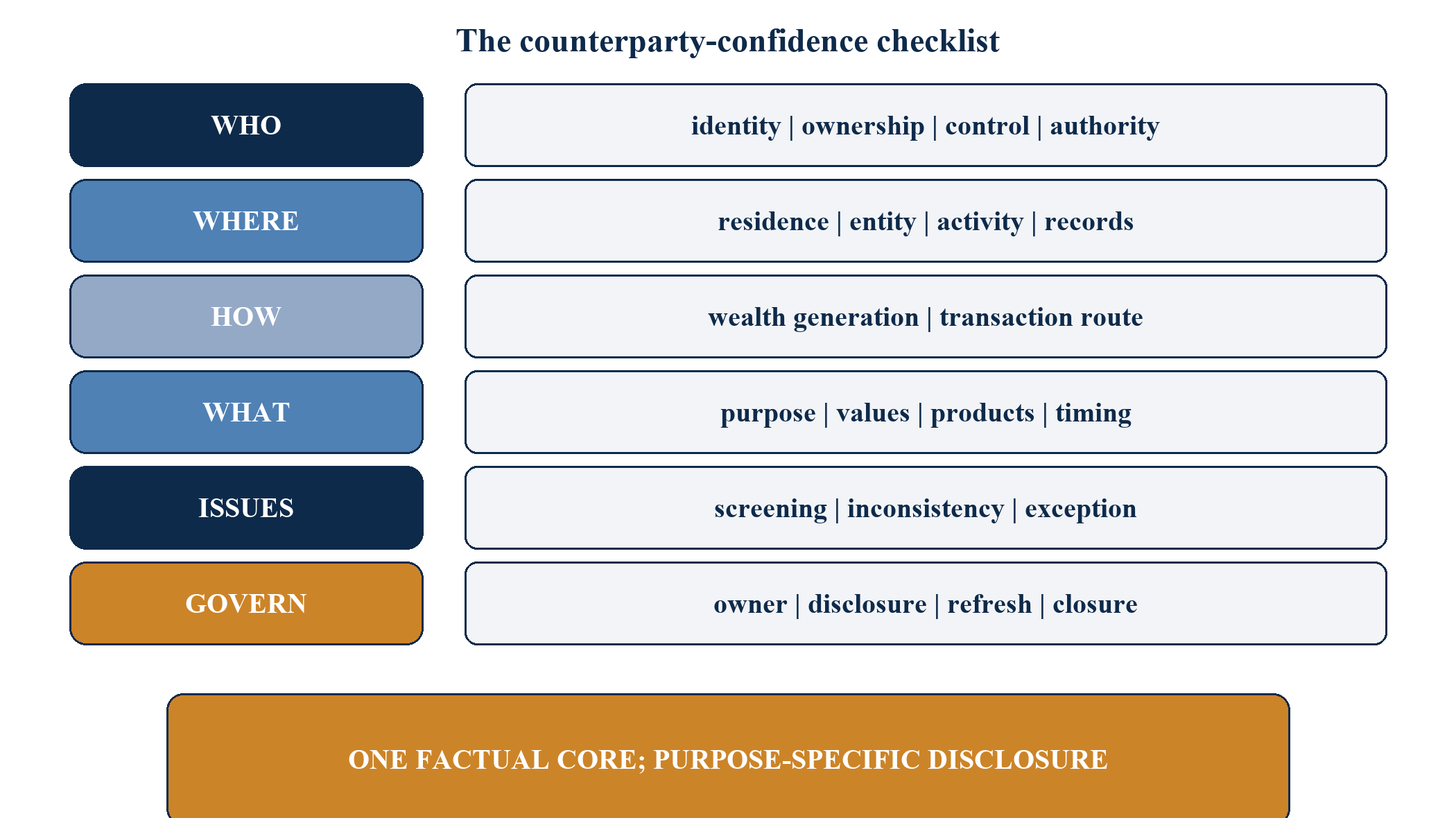
The office should agree a factual core and a recipient-specific disclosure layer. The factual core contains the verified history. The disclosure layer selects information relevant and proportionate to the stated purpose. This supports data minimisation and avoids sending the entire family archive to every recipient.
14. COUNTERPARTY CONFIDENCE BEYOND BANKING
14.1 Different decisions require different proof
A buyer, lender, investor, fund, insurer and adviser do not require identical files. A buyer focuses on title, authority, liabilities, warranties and closing proceeds. A lender focuses on borrower identity, ownership, repayment, collateral, covenants and source of equity. An investor focuses on governance, strategy, track record, conflicts and subscriptions. A fund administrator focuses on investor identity, beneficial ownership, tax classification and subscriptions. An insurer focuses on disclosure relevant to the risk underwritten.
| Counterparty | Principal confidence question | Priority evidence | Timing |
|---|---|---|---|
| bank or custodian | can the relationship and activity be understood and monitored? | CDD, wealth, ownership, tax and expected activity | before onboarding and on change |
| business buyer | can title, authority and proceeds survive diligence and closing? | ownership history, authority, sale and settlement file | before diligence launch |
| lender | who bears risk and how is repayment funded? | borrower group, cash flows, collateral, equity source | before credit committee |
| investor or co-investor | are governance, conflicts and economics reliable? | entity, control, track record and decision records | before commitment |
| fund or administrator | are investor identity, tax and subscription facts complete? | KYC, beneficial ownership, CRS and funds chain | before admission and funding |
| adviser | who instructs, who benefits and can the work be performed lawfully? | client identity, authority, ownership and purpose | before engagement |
14.2 Prepare once and index many uses
The evidence vault should hold authoritative records once and expose controlled indices for each use. A document can support several propositions, while each disclosure should state its purpose and date. Version control is essential; recipients should not receive different structure charts or biographies marked as current.
15. DATA PROTECTION, CONFIDENTIALITY AND SECURITY
15.1 Due diligence creates a sensitive data estate
A reputation file can include passports, addresses, family relationships, health or security details, tax records, bank statements, ownership structures, litigation records and wealth evidence. The office should identify the controller, purpose, lawful basis, recipients, retention, access controls, cross-border transfers and deletion or correction process under applicable law [12,37,38].
The minimum-access principle is practical as well as legal. The master vault remains restricted. A disclosure room contains only approved records. A recipient index states which files were shared, with whom, for what purpose and when. Watermarks or access logs may be appropriate where legally and operationally suitable. Authentication and secure transmission should not rely on personal email or uncontrolled messaging.
15.2 Preserve an audit trail without preserving everything forever
The office needs evidence of what it disclosed and the basis for material decisions. It should also apply retention limits. A superseded record can be archived with its effective period rather than left in the current pack. A correction log should preserve the fact that a discrepancy was resolved while preventing the old error from continuing to appear as current.
Access should be role-based. Tax files, source-of-wealth materials, security information and adverse-media reviews may require separate confidentiality rings. External advisers should receive only the data necessary for their mandate and be subject to appropriate terms.
16. THE REPUTATION EVIDENCE PACK
16.1 A twelve-part architecture
The recommended pack contains: a one-page verified profile; identity index; residence and tax chronology; source-of-wealth narrative; source-of-funds transaction files; ownership and control record; entity substance record; public-record reconciliation; screening disposition file; expected-activity schedule; counterparty disclosure log; and exception and refresh register. Each part has an owner and as-of date.
The one-page profile is an index, not a marketing biography. It states the current identity, principal roles, residence positions as advised for stated periods, core wealth sources, relevant structures, purpose of the relationship and file contacts. It links every material statement to a numbered evidence section.
16.2 Document naming and provenance
Each file name should include a subject, document type, effective date and version. The index records issuer, date, coverage period, language, translation status, authentication status, propositions supported and restrictions. Translations should identify translator and scope. Certified copies should record certification details.
| Pack component | Owner | Minimum refresh | Trigger refresh |
|---|---|---|---|
| identity and address | operations | document expiry | name, nationality or address change |
| residence and tax | tax lead | each relevant period | travel, home, work or family change |
| wealth narrative | CFO | annual | sale, inheritance or material distribution |
| ownership and control | legal | quarterly confirmation | restructuring, succession or appointment |
| expected activity | treasury | quarterly | new product, geography or transaction |
| adverse-information review | compliance | risk-based | new alert, proceeding or correction |
| disclosure log | data owner | continuous | every external disclosure |
| exception register | file owner | monthly while open | new evidence or recipient decision |
17. WRITING THE RELOCATION NARRATIVE
17.1 Use chronology, causality and continuity
A strong narrative answers three questions. What changed? Why did it change? What remained continuous? Chronology establishes dates. Causality explains commercial, family, operating or investment reasons without making unsupported legal conclusions. Continuity connects identity, beneficial ownership, historical wealth and existing obligations through the transition.
The narrative should use neutral language. It should say that a principal established UAE residence, moved specified functions, retained identified UK ties, created or repurposed certain vehicles and updated institutions on stated dates. It should avoid claims such as "fully left the UK" unless the legal and factual proposition is defined for the relevant purpose and period.
17.2 Separate the master narrative from recipient answers
The master narrative can be detailed. Recipient forms often require shorter answers. The office should maintain approved response modules for identity, residence, employment, business, wealth, funds, ownership, expected activity and public-record matters. Each module cites the same source register.
Response modules should not become boilerplate detached from current facts. Every use should be checked against the effective date and recipient question. A bank asking about the source of a USD 20 million subscription needs the specific transaction chain, while an insurer asking about occupation may need only the current role and business activity.
18. A 90-DAY EVIDENCE TRANSITION
18.1 Before the move
Before relocation, the office should capture historic records that may become difficult to retrieve. These include ownership records, audited accounts, tax filings, dividend records, sale documents, bank statements, investment statements, trust and foundation records, former addresses and approved biographies. It should record all institutions that hold KYC or tax data and identify upcoming transactions.
The office should also freeze narrative drift. A single approved fact book records names, dates, roles, entities, interests, residence evidence and wealth milestones. Advisers review their areas and identify unresolved points. The objective is a coherent baseline, not a predetermined tax or regulatory answer.
18.2 Days one to thirty
The first month focuses on identity, residence logistics, contact data, bank notifications, local entity records, governance and secure information channels. The office records actual presence and activity. It does not backfill a story later from memory.
The update register prioritises institutions that will receive or transmit material funds. Expected activity is revised. Any new UAE vehicle receives documented purpose, ownership, authority, budget, contracts and operating responsibilities.
18.3 Days thirty-one to ninety
The next two months build operating evidence. Board and investment decisions are recorded where they occur. Employment and service arrangements operate in practice. Bank and custodian files are refreshed. Tax-residence evidence accumulates. The office tests whether a reviewer can connect historic wealth to current ownership and planned transactions.
At day ninety, an independent file review should select several material propositions and trace them end to end. Open exceptions receive owners and dates. The process continues after day ninety because residence, substance and monitoring depend on facts over time.
19. A HYPOTHETICAL CONFIDENCE MODEL
19.1 Model design
Consider a hypothetical and simplified family office with a principal who founded and sold a UK business, moved to the UAE, retained a UK investment holding company and created a new UAE investment company. The family expects to fund a USD 25 million portfolio through two banks and commit USD 10 million to private funds. Public reports cite a headline sale value of USD 180 million. Completion records show debt repayment, rollover equity, escrow and fees, leaving USD 62 million of cash proceeds to the principal.
The model scores six evidence domains from zero to five: identity, residence, wealth, ownership and control, public-record coherence, and transaction traceability. Zero means the proposition is absent or contradicted. Five means current, independently corroborated and reconciled. The score is an internal preparation tool. It does not predict a bank or counterparty decision.
| Domain | Initial score | Gap | Remediation | Revised score |
|---|---|---|---|---|
| identity | 4 | one entity uses shortened name | official identifiers and name schedule | 5 |
| residence | 2 | visa available; tax-year analysis incomplete | travel, home and professional residence analysis | 4 |
| wealth | 2 | headline sale value used as cash proceeds | gross-to-net sale reconciliation | 5 |
| ownership and control | 3 | new UAE company chart lacks historic link | before-and-after legal map and authority record | 5 |
| public-record coherence | 2 | old UK biography states principal remains chief executive | dated role chronology and publisher correction | 4 |
| transaction traceability | 2 | funds pooled through two accounts | payment-chain schedule and bank evidence | 5 |
19.2 Interpretation
The initial file is plausible but expensive to review. The largest gap is the difference between public enterprise value and net cash. The remediation makes the arithmetic transparent and connects the principal's historical ownership to the receiving accounts. Residence remains below five because the relevant period is still developing and the conclusion depends on future facts.
The model avoids an artificial total score. A critical sanctions match or inability to establish beneficial ownership cannot be offset by strong evidence elsewhere. The dashboard therefore shows domain status, critical blockers and open exceptions separately.
20. FOUR HYPOTHETICAL PATHS
20.1 Path A: founder sale and new UAE bank
The founder presents a sale agreement, audited accounts, shareholder records, completion statement and bank trail. The file explains that the headline price included debt assumed, rollover equity and contingent consideration. The bank can reconcile the net proceeds and expected investment activity. Remaining residence questions are handled separately by period.
20.2 Path B: inherited wealth through a family structure
The principal received interests through succession and a trust distribution. The file includes probate and trust records, donor or settlor wealth evidence, distribution authority and receipt. Privacy restrictions are documented, and counsel identifies what can be disclosed. The story distinguishes inherited entitlement from current investment returns.
20.3 Path C: adverse-media name collision
A screening result concerns a person with a similar English name. The file compares date of birth, nationality, Arabic spelling, employment and location, establishing that the result concerns another individual. The disposition record preserves the search, identifiers and conclusion so the alert can be handled consistently on refresh.
20.4 Path D: historic regulatory settlement
A family-controlled company entered a regulatory settlement years before relocation. The file provides the official notice, scope, responsible entity, period, remediation and current status. It does not deny or minimise the record. It explains the principal's role accurately and separates the settled company matter from unrelated entities while allowing the recipient to make its own assessment.
21. REMEDIATION WHEN CONFIDENCE HAS ALREADY FALLEN
21.1 Stabilise the facts
The first step is a controlled fact base. The office should stop sending new explanations until it has collected prior submissions, recipient questions, transaction records and source documents. It identifies contradictions and decides which current statement is correct. Legal or regulatory restrictions take priority over communication concerns.
The second step is a correction plan. Each issue receives a proposition, evidence, corrective channel, owner, recipient, deadline and closure test. The office corrects official and provider records through their processes. It sends contextual explanations only where relevant and lawful.
| Priority | Condition | Action | Closure evidence |
|---|---|---|---|
| critical | legal prohibition, true sanctions match or ownership unknown | stop affected activity and obtain specialist advice | documented legal disposition |
| high | material wealth or transaction chain cannot be reconciled | reconstruct records and suspend unsupported assertion | independent reconciliation |
| medium | public or provider record materially inconsistent | correct source and notify affected recipients | updated record and acknowledgement |
| routine | formatting, transliteration or historic address issue | add identity note or update on normal cycle | resolved index entry |
21.2 Answer the recipient's decision problem
A remediation response should identify the question, provide the decisive evidence, explain the discrepancy and state the current position. Long bundles without an index increase review cost. Assertions that the recipient is overreacting rarely resolve a compliance or credit decision.
The family should keep a response ledger because a correction at one institution may affect others. Material changes to residence, ownership, tax classification or expected activity should be assessed across the entire relationship map.
22. GOVERNANCE AND ACCOUNTABILITY
22.1 One factual core, distributed ownership
The governing body approves the policy and risk appetite. The COO owns the master index and workflow. Legal counsel owns entity, beneficial-ownership and authority records. The CFO owns wealth and transaction reconciliations. The tax adviser owns advice for relevant periods. Compliance owns screening and recipient-request governance. Data protection owns access, transfer and retention controls. Each owner signs an as-of confirmation.
The family principal remains responsible for providing complete and accurate facts within the process. Advisers should record assumptions and limitations. No one function should be able to alter the factual core without review and version history.
22.2 Metrics should measure decision readiness
Useful metrics include percentage of material propositions linked to current evidence, unresolved critical exceptions, average response time, number of contradictory active documents, percentage of material institutions refreshed, age of ownership and expected-activity records, and percentage of adverse-information alerts with documented disposition.
Volume is a poor measure. A file with thousands of pages can remain weak if it does not connect evidence to questions. The target is traceability, accuracy and proportionate disclosure.
23. IMPLEMENTATION AND TESTING
23.1 Build the minimum viable file
The first implementation should cover identity, current residence facts, principal wealth sources, current ownership and control, planned material flows, screening identifiers and a disclosure log. The office then adds deeper transaction and historic evidence according to risk and expected use.
The file should be tested through three reviewer exercises. The first reviewer traces a source-of-wealth statement to underlying records. The second reconciles a planned payment from economic generator to destination. The third takes a public-record or screening issue and reaches a documented disposition. Every failure becomes an exception with an owner.
23.2 Exercise before a live transaction
A dry run can simulate a new bank onboarding, a fund subscription and a business sale. The team receives recipient questions under time pressure and must answer through approved sources and secure channels. The exercise measures retrieval time, consistency, authority and disclosure control.
The office should repeat exercises after a relocation milestone, major liquidity event, restructuring, succession, adverse-information event or change in principal service providers. A static file loses value as the facts change.
24. LIMITATIONS AND CONCLUSION
The reputation discount is a practical framework for information friction. It is not an empirical estimate of account acceptance, pricing or counterparty behaviour. Institutions apply different laws, policies, systems, risk appetites and commercial strategies. A complete file cannot guarantee acceptance or prevent further questions.
The framework also cannot replace legal analysis of sanctions, suspicious activity, privilege, confidentiality, tax residence, beneficial ownership or data protection. Some information may be unavailable, restricted or unsafe to share. The exception and disclosure controls allow those limits to be managed explicitly.
The central conclusion is that cross-border confidence is built through coherent evidence. Identity, residence, wealth, ownership, control, public records and transaction behaviour should form one dated system. Source of wealth explains accumulation; source of funds traces a specific flow. Public information is tested for identity, reliability, stage and relevance. Corrections follow lawful channels. Sensitive evidence is disclosed proportionately and securely.
For a UK-to-UAE move, the most valuable preparation occurs before a material transaction. Historic records are collected, the relocation chronology is maintained as facts develop, institutional records are refreshed and the ownership and payment chains are tested. The result is a file that allows recipients to understand the family without relying on unsupported narrative. Confidence then becomes a governed operating capability.
APPENDIX A. ONE-PAGE VERIFIED PROFILE
| Field | Required entry |
|---|---|
| profile date | exact as-of date and next review |
| principal identity | full official name, former names, transliterations, date of birth and nationality |
| current roles | role, entity, start date and authority |
| residence positions | jurisdiction, period, basis and adviser reference |
| principal wealth sources | category, period, scale and evidence section |
| current structures | entities and arrangements with ownership and control reference |
| relationship purpose | products, services, expected values and geographies |
| material upcoming flows | event, amount range, payer, route, destination and timing |
| public-record matters | concise status and disposition reference |
| responsible contacts | COO, legal, finance, tax, compliance and data owner |
APPENDIX B. SOURCE-OF-WEALTH INDEX
For each wealth event record the event identifier, period, economic activity, legal owner, beneficial owner, value or range, currency, tax or accounting treatment where professionally advised, primary evidence, corroborating evidence, public references, assumptions, exceptions and reviewer approval. Link the event to current assets or proceeds where practicable.
The index should distinguish enterprise value, equity value, gross proceeds, net cash, retained or rollover interest, deferred consideration and contingent value. It should reconcile foreign-currency translations to a stated date and source.
APPENDIX C. COUNTERPARTY CONFIDENCE CHECKLIST
| Check | Ready condition | Owner | Evidence |
|---|---|---|---|
| identity resolved | all names and identifiers reconciled | operations | identity schedule |
| residence current | claims are period-specific and supported | tax | residence file |
| wealth explained | principal sources and scale reconcile | finance | wealth index |
| funds traced | planned material flow has complete chain | treasury | transaction file |
| ownership current | natural persons, rights and dates recorded | legal | structure and registers |
| authority tested | decision and provider mandates agree | legal and operations | authority register |
| public records reviewed | material inconsistencies have disposition | compliance | record map |
| sanctions and PEP current | current lists and classifications checked | compliance | screening record |
| expected activity approved | values, geographies and purposes stated | treasury | activity schedule |
| disclosure lawful | purpose, recipient and secure route approved | data owner | disclosure log |
| exceptions governed | blocker, substitute evidence and approval recorded | file owner | exception register |
| refresh scheduled | owner, trigger and next date assigned | COO | dashboard |
APPENDIX D. QUESTIONS FOR BANKS AND OTHER RECIPIENTS
Questions before submission should include: Which legal person is the customer? Which natural persons must be identified as beneficial owners or controlling persons? Which source-of-wealth and source-of-funds evidence is expected for the risk profile and proposed activity? Which tax self-certifications and identifiers are required? How should certified copies and translations be provided? Which secure channel should be used? Who can answer scoping questions? Which events require an update after onboarding? What is the process for correcting inaccurate information or resolving a screening match?
The family should request clarity without asking the recipient to waive its controls. A precise evidence request reduces irrelevant disclosure and improves response quality.
REFERENCES
[1] Central Bank of the UAE, Guidance for Licensed Financial Institutions on Customer Due Diligence, Know Your Customer and Record-Keeping, effective 7 November 2025. https://rulebook.centralbank.ae/en/rulebook/guidance-licensed-financial-institutions-customer-due-diligenceknow-your-customer-and
[2] Central Bank of the UAE, Source of Funds and Source of Wealth, section 3.3.2, effective 7 November 2025. https://rulebook.centralbank.ae/en/rulebook/332-source-funds-and-source-wealth
[3] Central Bank of the UAE, Customer Due Diligence, effective 7 November 2025. https://rulebook.centralbank.ae/en/rulebook/3-customer-due-diligence
[4] Central Bank of the UAE, Documentary and Non-Documentary Means of Customer Identification and Verification, effective 7 November 2025. https://rulebook.centralbank.ae/en/rulebook/324-documentary-and-non-documentary-means-customer-identification-and-verification
[5] Central Bank of the UAE, Enhanced Due Diligence Requirements and politically exposed persons. https://rulebook.centralbank.ae/en/rulebook/326-enhanced-due-diligence-requirements
[6] Central Bank of the UAE, AML/CFT Guidelines for Financial Institutions. https://rulebook.centralbank.ae/en/rulebook/anti-money-laundering-and-combating-financing-terrorism-and-illegal-organisations
[7] Dubai Financial Services Authority, Anti-Money Laundering, Counter-Terrorist Financing and Sanctions Module, version 30/04-26. https://dfsaen.thomsonreuters.com/rulebook/anti-money-laundering-counter-terrorist-financing-and-sanctions-module-aml-ver3004-26
[8] Abu Dhabi Global Market Financial Services Regulatory Authority, Enhancements to the AML Framework, 21 May 2026. https://www.adgm.com/media/announcements/adgm-fsra-finalises-enhancements-to-its-anti-money-laundering-framework
[9] UAE Cabinet Decision No. 109 of 2023 on Regulating the Beneficial Owner Procedures. https://www.moet.gov.ae/documents/20121/294745/Cabinet%2BDecision%2B109-2023%2BEnglish%2BVersion%2BPDF.pdf/1590f581-52c1-ac5c-19de-be97a879a240?t=1706692042660
[10] UAE Executive Office for Control and Non-Proliferation, Overview of the UN Consolidated Sanctions List and National List of Terrorists. https://beta.uaeiec.gov.ae/en-us/United-Nations-Security-Council-Sanctions?p=0
[11] UAE Federal Tax Authority, Issuance of Tax Certificates for Tax Residency, updated 6 April 2026. https://tax.gov.ae/en/services/issuance.of.tax.certificates.aspx
[12] Official Portal of the UAE Government, Data Protection Laws and Federal Decree Law No. 45 of 2021. https://u.ae/en/about-the-uae/digital-uae/data/data-protection-laws.
[13] Financial Action Task Force, The FATF Recommendations, as amended October 2025. https://www.fatf-gafi.org/en/publications/Fatfrecommendations/Fatf-recommendations.html
[14] Financial Action Task Force, Guidance on Beneficial Ownership of Legal Persons, 2023. https://www.fatf-gafi.org/en/publications/Fatfrecommendations/Guidance-Beneficial-Ownership-Legal-Persons.html
[15] Financial Action Task Force, Guidance on Beneficial Ownership and Transparency of Legal Arrangements. https://www.fatf-gafi.org/content/dam/fatf-gafi/recommendations/Guidance-Beneficial-Ownership-Transparency-Legal-Arrangements.pdf.coredownload.inline.pdf
[16] Financial Action Task Force, Guidance on Politically Exposed Persons, Recommendations 12 and 22. https://www.fatf-gafi.org/en/publications/Fatfrecommendations/Peps-r12-r22.html
[17] Financial Action Task Force, Updates to the Standards to Promote Proportionate Risk-Based Measures, 25 February 2025. https://www.fatf-gafi.org/en/publications/Fatfrecommendations/update-standards-promote-financial-conclusion-feb-2025.html
[18] Financial Action Task Force, High-Level Synopsis of the Stocktake of Unintended Consequences of the FATF Standards. https://www.fatf-gafi.org/content/dam/fatf/documents/Unintended-Consequences.pdf
[19] Financial Action Task Force, Private Sector Information Sharing, 2017. https://www.fatf-gafi.org/en/publications/Fatfrecommendations/private-sector-information-sharing.html
[20] Wolfsberg Group, Source of Wealth and Source of Funds FAQs for Private Banking and Wealth Management, 2020. https://dev.wolfsberg-group.org/resources/general/32
[21] Wolfsberg Group, Negative News Screening FAQs, 2022. https://wolfsberg-group.org/resources/guidances-principles-standards-and-faqs/118
[22] Wolfsberg Group, Private Banking Principles. https://dev.wolfsberg-group.org/resources/general/45
[23] OECD, Standard for Automatic Exchange of Financial Account Information in Tax Matters. https://www.oecd.org/en/publications/standard-for-automatic-exchange-of-financial-account-information-in-tax-matters_9789264216525-en.html
[24] OECD Global Forum, Tax Residency and CRS self-certification. https://www.oecd.org/en/networks/global-forum-tax-transparency/resources/aeoi-implementation-portal/tax-residency.html
[25] OECD, CRS-related Frequently Asked Questions. https://www.oecd.org/tax/automatic-exchange/common-reporting-standard/CRS-related-FAQs.pdf
[26] Basel Committee on Banking Supervision, Consolidated Guidelines, Anti-money laundering and counter-terrorist financing, AFS10. https://www.bis.org/basel_consolidated_guidelines/chapter/AFS/10.htm
[27] World Bank, De-risking in the Financial Sector. https://www.worldbank.org/en/topic/financialsector/brief/de-risking-in-the-financial-sector
[28] Financial Conduct Authority, Financial Crime Guide, source of wealth and source of funds. https://www.handbook.fca.org.uk/handbook/FCG.pdf
[29] HM Revenue and Customs, Source of Funds and Source of Wealth, AMLG11630, updated 16 July 2026. https://www.gov.uk/hmrc-internal-manuals/anti-money-laundering-guidance-for-supervised-businesses/amlg11630
[30] HM Revenue and Customs, Responsibilities under Money Laundering Supervision. https://www.gov.uk/guidance/money-laundering-regulations-your-responsibilities
[31] Joint Money Laundering Steering Group, Current Guidance. https://www.jmlsg.org.uk/guidance/current-guidance/
[32] Companies House, Verifying Your Identity for Companies House, updated 1 June 2026. https://www.gov.uk/guidance/verifying-your-identity-for-companies-house
[33] Companies House, Economic Crime and Corporate Transparency Act Transition Plan. https://www.gov.uk/government/publications/economic-crime-and-corporate-transparency-act-outline-transition-plan-for-companies-house/economic-crime-and-corporate-transparency-act-outline-transition-plan-for-companies-house
[34] Companies House, People with Significant Control guidance. https://www.gov.uk/government/publications/guidance-to-the-people-with-significant-control-requirements-for-companies-and-limited-liability-partnerships
[35] UK Government, The UK Sanctions List. https://www.gov.uk/government/publications/the-uk-sanctions-list
[36] Office of Financial Sanctions Implementation, Financial Sanctions General Guidance. https://www.gov.uk/government/publications/financial-sanctions-general-guidance
[37] UK Government, Data Protection and the UK GDPR and Data Protection Act 2018. https://www.gov.uk/data-protection
[38] Information Commissioner's Office, Principle (d): Accuracy. https://ico.org.uk/for-organisations/uk-gdpr-guidance-and-resources/data-protection-principles/a-guide-to-the-data-protection-principles/accuracy/
[39] HM Revenue and Customs, Statutory Residence Test, RDR3. https://www.gov.uk/government/publications/rdr3-statutory-residence-test-srt
[40] United Nations Security Council, Consolidated Sanctions List. https://main.un.org/securitycouncil/en/content/un-sc-consolidated-list
ABOUT THE AUTHOR
Chennakeshav Adya is an independent researcher and corporate finance practitioner with more than twenty years of international experience across business strategy, transformation, investment banking, family-office operations, risk, technology and cross-border transactions. His research focuses on practical decision systems for private capital, banking relationships, corporate finance and emerging technology. The views expressed in this paper are his own and do not constitute investment, legal, tax, regulatory or compliance advice.
