

1. Define the acquisition decision precisely
The board decision is whether to acquire a legally controlled mining business at a price and on terms that remain supportable after the deposit, process route, mine plan, permits, infrastructure and market assumptions are tested together. The decision is broader than confirming that mineralisation exists. It concerns how much material can be mined economically, when cash can be generated, which obligations transfer at closing and how unresolved uncertainty should alter consideration.
The acquisition perimeter should identify the licences, land, plant, infrastructure, contracts, data, workforce, environmental obligations and financing liabilities that move with the target. Geological evidence has value only through this operating and legal perimeter. A resource outside a valid licence, a reserve dependent on inaccessible land or a processing route without secure water cannot support the same price as an executable mine plan.
The investment paper should state the proposed purchase price, funding structure, principal valuation case, remaining evidence gaps and the protection attached to each gap. It should also state the date at which each technical estimate was effective and the reporting code used. CRIRSCO, JORC, National Instrument 43-101 and Regulation S-K Subpart 1300 all distinguish mineral resources from mineral reserves and link reserve status to technical and economic modifying factors [1][2][3][4].
Approval should be expressed as a controlled range. The board may approve a maximum cash-at-close amount, a contingent pool, permitted adjustments and a long-stop date. That format prevents a headline valuation from becoming detached from the evidence supporting it.
2. Use a Reserve-to-Protection Transaction System
The proposed system has eight gates: title and data integrity; geological confidence; estimation and classification; mining and recovery; capital and operating readiness; permits and social performance; commodity and market economics; and transaction protection. Each gate has an evidence owner, an independent challenger, a decision threshold and a contractual response.
The first three gates establish whether the data and model support the reported categories. The next three test whether the material can be converted into permitted, saleable production. The seventh gate tests price, payability, foreign exchange, cost and financing. The final gate converts any residual uncertainty into executable deal terms.
The gates should use one controlled assumptions register. Tonnage, grade, recovery, dilution, production rate, capital cost, schedule and commodity price must reconcile across the technical report, valuation model, financing case and transaction documents. A buyer should stop the process when different workstreams use materially different numbers without an approved bridge.
The system is designed for decisions rather than disclosure compliance alone. Public reporting codes provide vital discipline, but a transaction requires additional work on legal ownership, warranties, information rights, post-closing control and remedies. The buyer must decide which uncertainty can be priced, which can be transferred and which prevents closing.
3. Distinguish resources, reserves and exploration potential
Exploration results indicate observations from exploration work. An exploration target expresses potential quantity and grade as a range where evidence is insufficient to estimate a mineral resource. A mineral resource requires reasonable prospects for eventual economic extraction. A mineral reserve is the economically mineable part of a measured or indicated resource after relevant modifying factors are applied [1][2].
These categories cannot be added as if they have equal confidence or economic meaning. Inferred resources generally carry greater geological uncertainty and cannot support the same mine-planning or financing reliance as measured or indicated resources. Exploration targets should sit outside the acquisition base case unless the valuation explicitly treats them as speculative option value.
The deal model should contain separate schedules for proved and probable reserves, measured and indicated resources outside reserves, inferred resources and exploration potential. Each schedule should state the valuation method, probability treatment, development cost and expected decision date. This prevents the same tonnes from appearing in both the reserve case and an upside case.
The buyer should also identify material already included in the seller's production plan that does not meet the reserve definition. SEC staff correspondence has highlighted the importance of keeping inferred material outside economic analyses intended to demonstrate reserve viability [4]. A transaction model can evaluate additional material as a scenario, provided its status and limitations remain explicit.
4. Build an evidence chain from sample to purchase price
The evidence chain begins with location, ownership and integrity of samples. It continues through laboratory preparation, assay, quality assurance, density, geological interpretation, domaining, estimation, classification, pit or stope design, dilution, recovery, scheduling, product terms and cash flow. Every major valuation input should point back to a controlled source.
The buyer should obtain the database, model files, estimation parameters, validation outputs, survey controls, laboratory certificates, chain-of-custody records and version history. A static technical report is insufficient where material judgements cannot be reconstructed. The CIM estimation guidelines emphasise sound evaluation practice, estimation principles, disclosure of assumptions and work that can be supported and defended [6].
Version control matters because a transaction may span several estimate updates. The data room should identify the effective date of each model, changes from the prior model and the person who approved them. Any late drilling or assay results should be assessed for materiality before signing and again before closing.
The financial model should preserve lineage. A change to grade or recovery should update payable production, revenue, royalties, processing costs, working capital, tax and debt capacity. A manual overlay that changes valuation without changing the technical schedule creates an untraceable result.
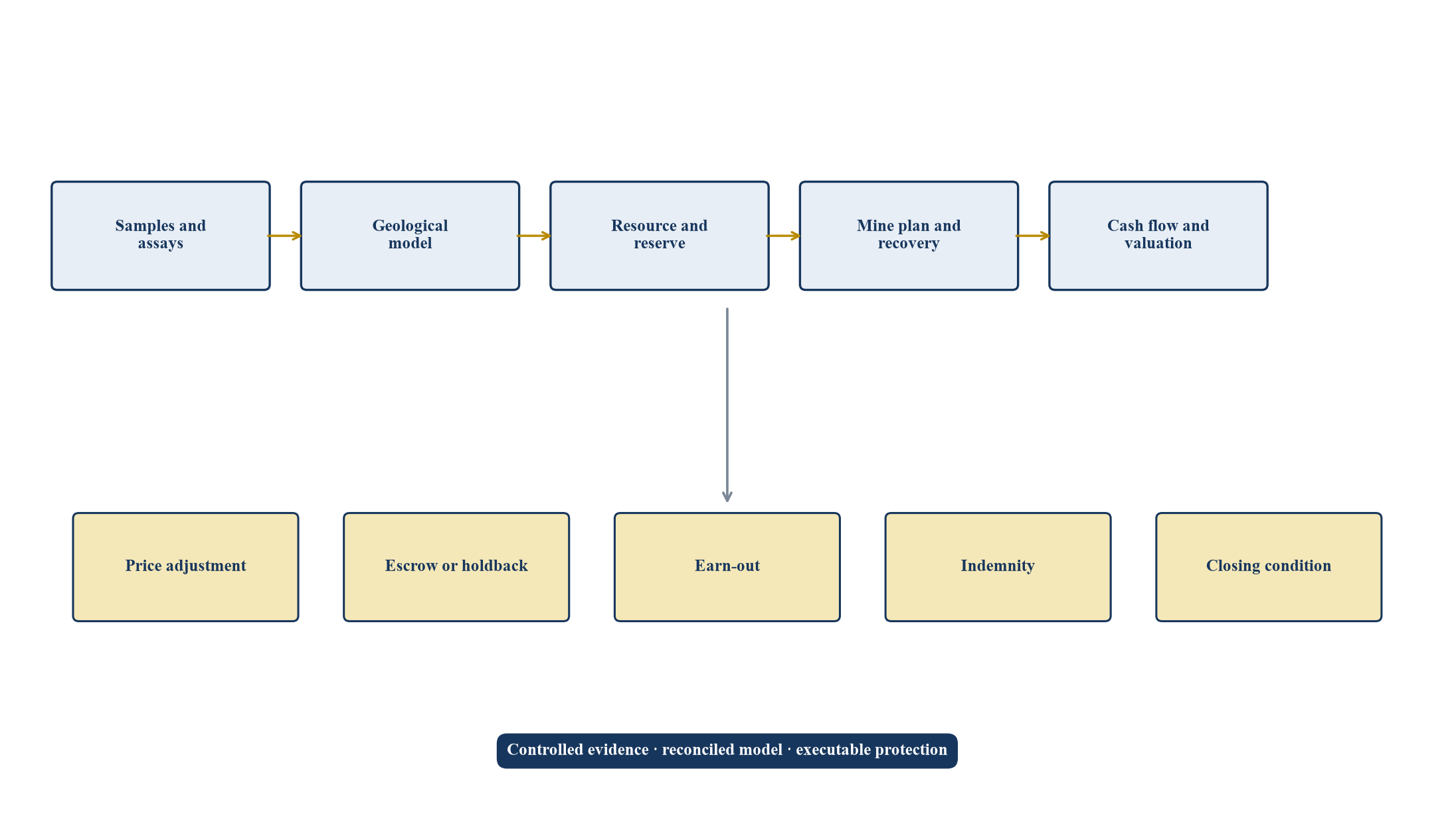
Each material evidence gap should have a defined valuation effect, decision owner and contractual response.
5. Test data integrity before debating valuation
Database integrity is a threshold issue. The buyer should reconcile collar, survey, assay, lithology, density and geotechnical tables; identify duplicates, missing intervals and unsupported edits; and compare digital records with original certificates and core or sample storage. Quality assurance should address standards, blanks, duplicates, laboratory accreditation and failure investigation.
Spatial controls deserve particular attention. Incorrect collar coordinates, down-hole surveys or topography can move mineralised intervals and distort volumes. Density errors can change tonnage without changing grade. Historic data may remain useful, but its limitations should influence classification and transaction reliance.
Independent re-assay or twin drilling can create decision value when a small amount of work tests a material uncertainty. The buyer should select tests according to the valuation sensitivity and the time available. A programme should state what result changes price, structure or the decision to proceed.
Data-access restrictions can themselves indicate transaction risk. If the seller cannot provide model files, certificates or competent-person technical files, the buyer should avoid treating the reported estimate as fully verified. The remedy may be a pre-signing condition, a lower cash price or a contingent payment after verification.
6. Challenge geological interpretation and continuity
Geological interpretation converts observations into volumes and grade relationships. The buyer should challenge domain boundaries, structural controls, weathering, mineralogy, fault displacement and continuity. A smooth block model can conceal sparse drilling or alternate interpretations that produce materially different mineable shapes.
Drill spacing should be considered against the deposit style and the intended mining selectivity. Confidence may vary within the same reported category. Local uncertainty can affect near-term scheduling even when global tonnes and grade appear stable. The buyer should compare classification with the areas scheduled in the first years after closing.
The model should identify extrapolation beyond drilling, high-grade capping, compositing, search parameters, anisotropy and estimation method. Sensitivity models using reasonable alternative parameters can show whether the reported estimate is stable or dependent on narrow choices.
Geological risk becomes transaction risk when the buyer pays for production that relies on uncertain zones. The response can include excluding those zones from base value, delaying payment until infill drilling confirms them or using a metal-delivered earn-out with clear measurement rules.
7. Review estimation and classification as governance decisions
Classification is a reasoned judgement based on geological confidence, data quality, continuity, estimation performance and the intended use of the estimate. It should not be treated as a mechanical output from drill spacing alone. Recent S-K 1300 technical reports disclose multiple classification criteria, including data quality, model complexity, search strategy and estimation diagnostics [18].
The buyer should review the Competent Person or Qualified Person's relevant experience, independence, scope and site involvement. Reporting codes allocate professional responsibility, yet the acquisition committee remains responsible for deciding how much reliance to place on the work.
The classification review should compare stated categories with kriging variance, slope of regression, average distance to samples, number of informing samples and visual continuity where applicable. No single metric determines classification. The objective is to understand the judgement and its sensitivity.
Any difference between the seller's classification and the buyer's view should be quantified. A reclassification does not necessarily remove tonnes; it changes the confidence and the permissible reliance. The transaction model should show the value attributed to each category and the cost and time required to increase confidence.
8. Reconcile cut-off grade and commodity-price assumptions
Cut-off grade links geology to economics. It depends on commodity price, recovery, payability, mining and processing cost, royalties, dilution and other constraints. A resource or reserve estimate can change materially when these inputs change, even where the underlying geology is unchanged.
The buyer should reconstruct the cut-off calculation and compare it with the mine schedule and valuation price. CIM guidance identifies commodity price as a significant parameter in resource and reserve estimation and economic analysis [8]. The reporting price, planning price, financing price and transaction valuation price may differ; each should be named and bridged.
Long-term price assumptions should be tested against observable market information, cost curves, incentive economics and the product's actual specifications. Current spot prices may be unsuitable for a long-lived project. Strategic demand can support an upside case, while contractual floors or offtake terms deserve greater weight than policy ambition alone.
The buyer should run a grade-tonnage curve across relevant cut-offs. A deposit whose mineable inventory collapses after a modest change may require stronger price protection. A deposit with stable geometry and margin across a wide range can support greater confidence.
9. Test dilution, loss and mineability
Resource blocks do not become saleable production without mine design. The reserve process should account for minimum mining width, dilution, ore loss, geotechnical constraints, access, sequence, equipment productivity and practical operating conditions. These factors can reduce grade, increase tonnes moved or delay higher-value material.
The buyer should compare resource-to-reserve conversion by domain, category and mining area. Low conversion may reflect geometry, geotechnical conditions, metallurgy, infrastructure or economics. The explanation should reconcile with the mine plan and future study programme.
Selective mining assumptions require equipment and operational evidence. Narrow-vein or variable deposits may experience greater dilution than a model based on idealised shapes. Open-pit shells depend on slope angles and geotechnical confidence. Underground schedules depend on development metres, ventilation, ground support and sequencing.
A practical protection is to tie contingent value to independently verified reserves or delivered payable metal rather than gross resource tonnes. The metric should remain within the buyer's operational control and avoid incentives to maximise tonnes at the expense of margin or safety.
10. Validate metallurgical recovery and product quality
Recovery converts contained metal into payable product. The buyer should review sample representativeness, mineralogical variability, test scale, process route, reagent regime, impurities, concentrate grade, moisture, penalties and tailings behaviour. CIM's mineral-processing guidance links process evidence to resource and reserve work under National Instrument 43-101 [7].
Average recovery can misstate cash flow when ore types vary over time. The schedule should use recovery by domain or ore type, with blending constraints and ramp-up assumptions. Locked-cycle, pilot or demonstration work may be required depending on process novelty and scale.
Product quality affects payability and customer acceptance. Deleterious elements can trigger penalties, rejection or additional processing. The buyer should obtain indicative or executed offtake terms and test whether the planned product meets the relevant specification.
Metallurgical uncertainty can be addressed through a recovery-linked price adjustment, an earn-out based on payable metal, a seller-funded test programme or a closing condition. The chosen response should reflect whether the uncertainty can be resolved before closing and whether post-closing measurement can be audited.
| Evidence area | Core diligence test | Value failure | Possible transaction response |
|---|---|---|---|
| Database | Reconcile source records, QA results and model inputs | Tonnage or grade overstatement | Re-assay condition, price reduction, warranty |
| Geological model | Test domains, continuity and alternative interpretations | Mineable shapes shrink or move | Exclude uncertain zones, drilling earn-out |
| Classification | Review confidence criteria and competent-person judgement | Base case relies on lower-confidence material | Category haircut, staged consideration |
| Mine design | Reconcile dilution, loss, slopes, access and schedule | Payable grade or production falls | Completion test, reserve-linked holdback |
| Metallurgy | Test representativeness, recovery and product quality | Lower payable metal or penalties | Recovery earn-out, process guarantee |
| Permitting | Verify approvals, conditions, land and water | Schedule delay or constrained operation | Closing condition, escrow, long-stop right |
The response depends on materiality, resolution time, seller control and the buyer's ability to measure the outcome after closing.
11. Review capital cost and schedule maturity
Reserve economics depend on the capital required to build, expand or sustain the operation. The buyer should identify estimate class, engineering maturity, quantities, rates, contingency, owner costs, escalation, foreign exchange, indirect costs, pre-stripping, commissioning and working capital.
The schedule should connect engineering, procurement, permits, access, construction, commissioning and ramp-up. A reserve may remain technically valid while the transaction return deteriorates because completion capital increases or cash flow moves later. The model should measure both effects.
Existing operations require sustaining capital, deferred maintenance and closure funding. A short seller model may omit fleet replacement, tailings lifts, underground development or plant refurbishment needed to maintain production. Site inspections and maintenance records should be reconciled with the capital plan.
Transaction protection can include a completion-capital adjustment, seller-funded remediation, escrow, specific indemnity or deferred consideration. A general warranty is usually a weak substitute for a quantified and measurable known exposure.
12. Test operating cost and throughput evidence
Operating costs should reconcile with the physical plan. Mining cost should reflect material movement, haul profiles, development and equipment. Processing cost should reflect throughput, hardness, reagents, power, water and maintenance. Site administration, royalties, transport and refining charges should be complete.
Unit costs can look attractive when divided by optimistic throughput. The buyer should model fixed and variable components and test ramp-up, downtime and lower-grade periods. Inflation, local currency, labour availability and imported consumables can create correlated cost pressure.
Historical performance should be normalised carefully. A period of deferred stripping or maintenance may improve short-term cash flow while increasing future obligations. A recent throughput record may have been achieved on favourable ore that does not represent the forward schedule.
The purchase price should rely on a cost case that the buyer can execute. Synergies may be shown separately with owners, cost and timing. Seller forecasts should not receive full value when they depend on unapproved expansion or uncontracted savings.
13. Verify title, tenure and surface access
The buyer should map mining licences, exploration licences, surface rights, easements, water rights, access agreements, royalties, encumbrances and renewal obligations. The technical model must sit within the verified legal boundaries. VALMIN identifies tenure status as material and calls for sufficiently recent inquiry [9].
Licence conditions may require expenditure, work programmes, local ownership, reporting, fees or commencement milestones. A change of control may require consent. The buyer should determine whether breaches can be cured and whether the seller has disclosed notices or disputes.
Surface access can be distinct from mineral title. The mine, waste facilities, water infrastructure, roads and power lines may depend on separate agreements. Traditional rights, indigenous rights or community use may require consultation and consent processes under applicable law.
Closing conditions should cover material title and change-of-control approvals. Specific warranties and indemnities can address historic breaches, but they cannot create a missing right. Where renewal risk remains, contingent consideration may align payment with the secured tenure period.
14. Integrate permitting and environmental obligations
Permits influence reserve conversion, schedule, capacity and closure. The buyer should maintain a register showing authority, holder, scope, conditions, expiry, transferability, compliance and dependencies. Environmental assessment, water, tailings, emissions, biodiversity, heritage and rehabilitation requirements should reconcile with the mine plan.
IFC Performance Standard 1 provides a structured approach to identifying and managing environmental and social risks across a project's life [14]. The OECD environmental due-diligence handbook applies a risk-based process to mineral supply chains [15]. Local law and project-specific approvals remain controlling.
Tailings deserve separate technical and governance review. The Global Industry Standard on Tailings Management emphasises affected communities, an integrated knowledge base, lifecycle design, monitoring and governance [16]. The buyer should examine consequence classification, design basis, independent review, emergency planning, closure and financial assurance.
Known compliance gaps should be costed and assigned. A permit essential to production may be a condition precedent. A remediable historic issue may support an escrow or indemnity. A fundamental inability to secure approval should remain a walk-away condition.
15. Assess social performance and operating legitimacy
Mining operations depend on relationships with workers, communities, governments and rights holders. The buyer should review commitments, benefit-sharing, grievances, security practices, resettlement, local employment, procurement and cumulative impacts. Formal permits do not capture every source of disruption.
The diligence should identify commitments made in impact assessments, agreements, public statements and operating practice. Unrecorded expectations can become future cost or delay. The buyer should test whether budgets, teams and monitoring systems are adequate.
Community conflict can affect access, construction and production. The model should use evidence-based delay scenarios rather than a generic percentage contingency. The transaction documents should preserve access to records, allocate historic liabilities and require ordinary-course engagement before closing.
The buyer's integration plan should begin during diligence. Changes to workforce, contractors or community programmes can affect trust and operating continuity. The first hundred days should include accountable owners for inherited commitments and unresolved grievances.
16. Reconcile infrastructure and corridor dependencies
A reserve can depend on power, water, roads, rail, ports, laboratories, reagents and skilled labour outside the licence boundary. The buyer should identify capacity, contract term, reliability, expansion rights, tariffs, change-of-control provisions and alternatives for every material dependency.
The prior processing-corridor analysis showed that mineral value depends on the connected system from extraction to cash receipt. For acquisition diligence, the question is whether the seller's reserve and valuation already reflect dependable infrastructure or assume future access that remains uncommitted.
The model should capture interface delays and working capital. A port closure can fill stockpiles and stop production before annual capacity is exhausted. A grid connection delay can postpone commissioning. An alternative route may cap downside if permits and capacity are maintained.
Any infrastructure agreement that terminates on change of control should be addressed before signing or made a closing condition. The buyer should also examine security and step-in rights if debt financing relies on third-party infrastructure.
17. Build a controlled central acquisition case
The hypothetical target reports 52 million tonnes of mineral reserves at an average payable copper-equivalent grade of 0.88 per cent. Planned throughput is 5.0 million tonnes a year, average recovery is 86 per cent and annual payable metal is approximately 37,840 tonnes before production variability. The model uses a long-term realised price of USD 8,600 per tonne.
Completion capital is assumed at USD 190 million. At steady state, annual revenue is approximately USD 325.4 million. Illustrative operating costs are USD 168 million, sustaining capital USD 34 million, royalties and selling costs USD 16 million, and cash taxes and other cash items USD 28 million. Illustrative steady-state cash flow after these items is therefore USD 79.4 million.
The central model produces a post-tax project net present value of USD 910 million. After USD 180 million of assumed net debt and debt-like items, modelled equity value is USD 730 million. Proposed equity consideration is USD 600 million, comprising USD 450 million at closing, a USD 60 million escrow and up to USD 90 million of contingent consideration.
These figures are hypothetical management assumptions. They are used to show mechanics and do not represent a market valuation or forecast. The acquisition committee should replace them with controlled project data and specialist work before making a real decision.
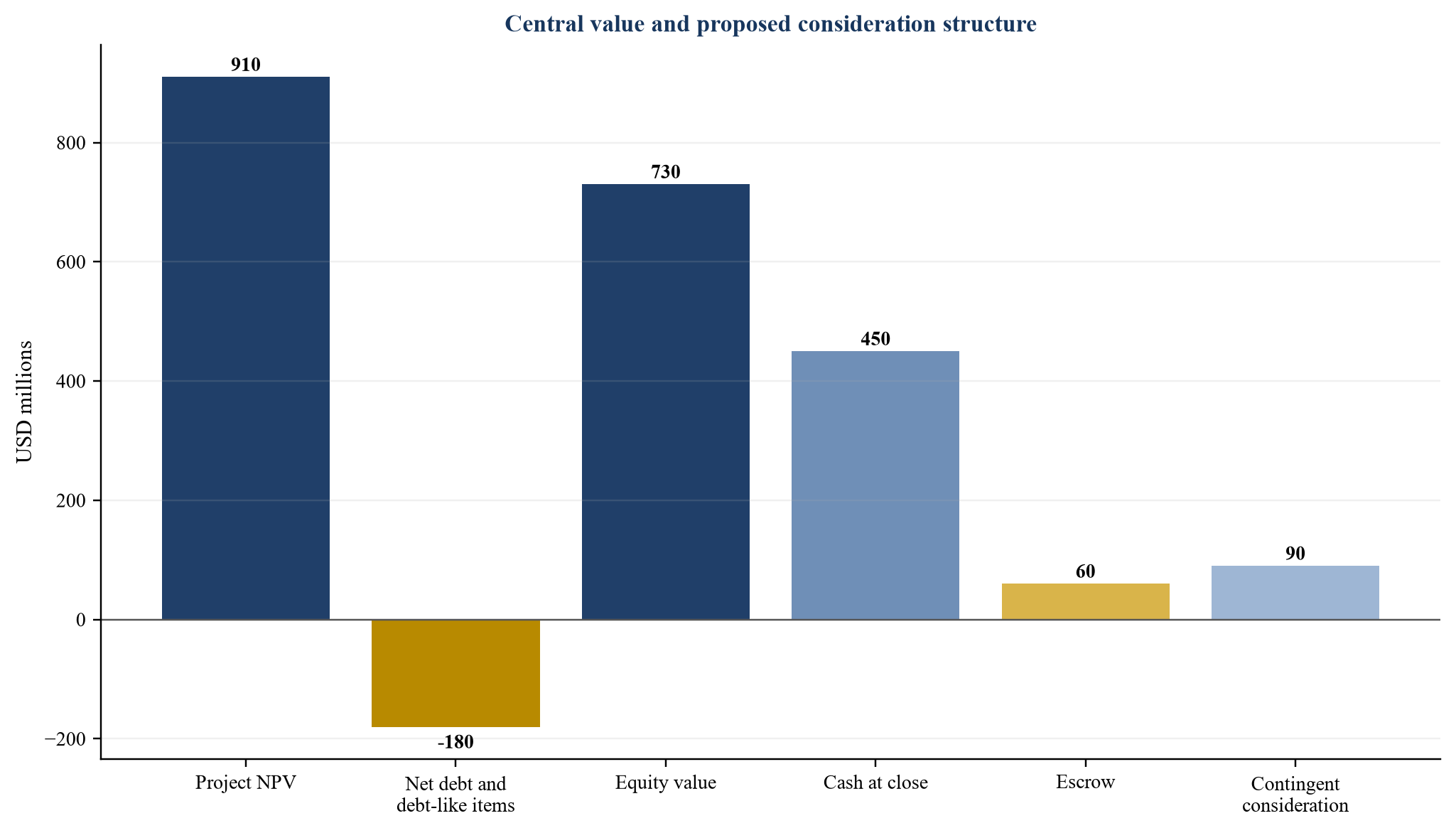
USD millions. All values are illustrative management assumptions and do not describe an actual acquisition.
18. Build downside cases from technical drivers
The unmitigated downside assumes 45 million tonnes of reserves, 0.80 per cent payable grade, 80 per cent recovery, USD 245 million of completion capital and a twelve-month permit delay. The long-term price remains unchanged so the case isolates technical, capital and timing effects.
Under those assumptions, modelled project net present value falls to USD 610 million. After the same USD 180 million of net debt and debt-like items, modelled equity value is USD 430 million. Paying the full USD 600 million would create a USD 170 million shortfall relative to that modelled value.
A protected structure limits cash at close to USD 450 million. The USD 60 million escrow remains available for defined breaches, and the USD 90 million contingent payment is not earned unless reserve, recovery, permit and capital thresholds are met. A specific indemnity is assumed to recover up to USD 25 million for a defined historic obligation. If fully available in the scenario, the effective protected exposure is USD 425 million and modelled headroom is USD 5 million.
The scenario does not prove that the structure is optimal. It shows how a known sensitivity can be linked to measurable terms. Legal enforceability, tax, accounting, security and seller credit require specialist advice.
19. Use a sensitivity cube rather than one downside line
Reserve quality has interacting dimensions. Tonnage, grade, recovery, capital, schedule and price can deteriorate together. A sensitivity cube should combine technically plausible cases rather than changing one variable while holding all others constant.
The buyer should identify correlations. Lower grade may require higher throughput and more power. Difficult mineralogy can reduce recovery and increase reagent cost. Permit delay can increase capital and postpone revenue. Commodity-price weakness can reduce reserve conversion and refinancing capacity.
The cube should distinguish reversible and irreversible effects. A delayed permit may shift value if the project remains viable. A geological reinterpretation can permanently remove mineable tonnes. A commodity-price decline may later reverse, while overbuilt infrastructure remains sunk.
Decision thresholds should be visible. The committee should know the combination at which the price must change, contingent consideration becomes essential, financing fails or the transaction should stop.
| Measure | Central case | Unmitigated downside | Protected downside |
|---|---|---|---|
| Mineral reserves | 52 Mt | 45 Mt | 45 Mt |
| Payable grade | 0.88% | 0.80% | 0.80% |
| Recovery | 86% | 80% | 80% |
| Completion capital | 190 | 245 | 245 |
| Permit delay | 0 months | 12 months | 12 months |
| Project NPV | 910 | 610 | 610 |
| Equity value after net debt | 730 | 430 | 430 |
| Effective consideration exposure | 600 | 600 | 425 |
| Modelled headroom | 130 | -170 | 5 |
USD millions except operational assumptions. Figures are illustrative management assumptions.
20. Interpret the hypothetical model carefully
The central case has USD 130 million of modelled headroom between equity value and total consideration. That headroom is exposed to the quality of the reserve case and does not represent a guaranteed return. A modest number of correlated changes removes more value than a simple single-variable sensitivity may suggest.
The protected downside achieves its result because USD 150 million of consideration is withheld or contingent and a defined indemnity is assumed to be recoverable. The structure therefore depends on precise definitions, auditable measurement, security and seller credit. An unsecured claim against an insolvent seller offers little practical protection.
The protected case also shows that contractual terms cannot repair every asset problem. The buyer still owns a lower-value project after closing. Price protection can preserve economics, while operational and reputational obligations remain with the owner.
The model should be updated at signing, satisfaction of conditions and closing. Material new drilling, permitting, capital or market information should trigger a documented review under the change-control protocol.
21. Convert each uncertainty into the right deal tool
A price adjustment is suitable when the value effect can be estimated before signing. A holdback or escrow is suitable for a defined exposure that may crystallise after closing. An earn-out is suitable when future evidence or performance can be measured objectively. An indemnity is suitable for a specified historic liability. A condition precedent is suitable where the buyer should not close without the result.
The tool should match the exposure. Geological uncertainty may suit a reserve-confirmation or payable-metal earn-out. Permit uncertainty may suit a condition precedent or long-stop right. Known remediation cost may suit escrow. Undisclosed data defects may support warranties and indemnities.
Measurement design is central. A reserve-based earn-out should identify the reporting code, effective date, competent person, price and cost assumptions, categories included, dispute process and treatment of buyer decisions. A production earn-out should define product, payability, period, operating standard and permitted changes.
Deal protection should avoid incentives that damage long-term value. A gross-tonnage target can reward low-margin extraction. A revenue target can encourage uneconomic sales. Payable metal or cash margin may align better, subject to buyer control and accounting complexity.
22. Design representations around evidence ownership
Representations should cover title, licences, data completeness, technical reports, sampling, environmental compliance, material contracts, litigation and liabilities. They should be specific enough to connect to the diligence record and disclosure schedule.
The seller should identify the models and reports on which the representation relies. A statement that information is accurate in all material respects may be difficult to enforce without a defined dataset and date. The data-room index can be incorporated into disclosure controls.
Knowledge qualifiers, materiality, survival, caps and baskets determine practical value. The buyer should identify which matters require fundamental treatment, specific indemnity or ordinary warranty treatment. Specialist legal advice is required for jurisdiction and structure.
Warranty insurance may provide additional recourse, subject to exclusions, diligence standards and underwriting. Known geological, permitting or environmental issues are often unsuitable for general warranty cover and may need tailored protection.
23. Use contingent consideration with disciplined definitions
Contingent consideration can bridge a valuation gap when seller and buyer differ on reserve conversion or project performance. IFRS 3 requires acquisition-date fair-value measurement of consideration and addresses contingent consideration in business combinations [12]. Accounting consequences should be assessed before terms are agreed.
The trigger should be observable and resistant to manipulation. Examples include independently verified reserves above a threshold, achievement of a permit, plant acceptance tests, recovery over a defined campaign or cumulative payable metal. Each trigger should have a deadline and evidence procedure.
The agreement should allocate control. After closing, the buyer may change mine sequence, capital or operating strategy. The seller may seek operating covenants, while the buyer needs freedom to protect the asset. A neutral standard, information rights and expert determination can reduce disputes.
The contingent amount should reflect the value actually at risk. A small earn-out attached to a large uncertain upside may create false comfort. The buyer should compare the maximum payment with the value contribution of the disputed assumption.
24. Size escrow and indemnity from exposure
Escrow should be sized from the plausible cash exposure, enforcement period and overlap with other remedies. It can cover permit remediation, tax, environmental obligations, title defects or data-related claims. The release schedule should follow the risk rather than a standard anniversary.
Specific indemnities should define the event, covered loss, mitigation, control of claims and security. Environmental and closure obligations can persist for long periods, so the buyer should consider funded trusts, guarantees or retained liabilities where legally feasible.
Double recovery should be prevented, while separate risks should not share an inadequate cap. The model should show the maximum effective recovery and expected timing. A nominal claim may not help if cash is needed immediately to protect operations.
The buyer should include recovery costs and tax effects. Insurance, government security and seller recourse may interact. Legal and tax advisers should confirm the treatment in each relevant jurisdiction.
| Exposure | Evidence milestone | Preferred tool | Drafting focus |
|---|---|---|---|
| Resource classification | Independent model review or infill drilling | Deferred price or earn-out | Code, categories, assumptions, expert |
| Metallurgical recovery | Representative campaign or acceptance test | Recovery earn-out or holdback | Ore type, period, payability, control |
| Completion capital | Fixed scope and updated estimate | Price adjustment or escrow | Baseline scope, changes, release |
| Material permit | Final non-appealable approval where required | Condition precedent | Authority, conditions, long-stop right |
| Historic environmental issue | Verified remediation and closure evidence | Specific indemnity and security | Covered sites, costs, survival, access |
| Commodity exposure | Contracted floor or realised-price formula | Collar or contingent value | Index, quotation period, caps, audit |
The table is a decision aid and does not replace transaction-specific legal, tax, accounting or technical advice.
25. Align financing with the reserve case
Acquisition debt should rely on the same reserve, price, recovery and capital assumptions as the board case. Lenders may apply their own price deck, reserve tail, completion tests and debt-service constraints. A financing model based on a stronger case than the acquisition model creates closing risk.
The buyer should distinguish acquisition debt, project debt, working-capital facilities, equipment finance and hedging. Security may include shares, licences where permitted, accounts, contracts and assets. Government consent or licence restrictions can limit enforcement.
Liquidity should cover completion capital, operating ramp-up, debt service and downside remediation. Contingent consideration may preserve cash, but future payment can compete with project funding. The model should show the payment priority and covenant effect.
Refinancing should not be assumed until the reserve case, permits and operations meet lender thresholds. A delayed refinancing can materially reduce equity returns even when project NPV remains positive.
26. Preserve fair-value and accounting discipline
IFRS 13 defines fair value through an orderly transaction between market participants and requires the assumptions that market participants would use under current conditions [13]. Mining valuations often rely heavily on unobservable inputs, making governance and disclosure important.
The purchase-price allocation may identify mineral properties, plant, contracts, liabilities, deferred tax and goodwill. The transaction model and accounting valuation may serve different purposes, yet major assumptions should reconcile or be explained.
Contingent consideration requires fair-value measurement and subsequent accounting according to its classification. A structure designed only for negotiation can create earnings volatility or complex disclosures. Accounting analysis should occur before signing.
Post-closing impairment indicators may arise from reserve revisions, permit delays, cost escalation or commodity prices. The buyer should retain model lineage and decision records so later reviews can distinguish new information from conditions existing at acquisition.
27. Run the diligence process through decision rights
The transaction leader should own the integrated decision, while specialists own defined evidence areas. The Competent Person or Qualified Person owns professional technical conclusions within scope. Management owns the acquisition recommendation. The board owns approval.
A weekly evidence register should list each material question, requested item, source, owner, status, value sensitivity, contractual response and escalation date. Red items should not be closed through narrative reassurance; they require evidence, a priced assumption or an explicit risk decision.
Clean-team or restricted arrangements may be required for sensitive customer, employee or pricing information. The technical team should still receive enough information to test assumptions. Any limitation should be recorded in the reliance statement.
The diligence report should separate findings, assumptions, recommendations and unresolved matters. That structure allows the purchase agreement, financing documents and integration plan to draw from the same record.
28. Execute a twenty-four-week transaction roadmap
Weeks one to three define scope, materiality, data protocols and the preliminary value bridge. Weeks four to eight validate title, databases, geology, estimation and classification. Weeks nine to twelve test mine design, recovery, capital, operating cost, infrastructure and permits.
Weeks thirteen to sixteen update valuation, financing and the downside cube. Weeks seventeen to nineteen convert findings into price and protection. Weeks twenty to twenty-two complete confirmatory diligence, approvals and financing. Weeks twenty-three and twenty-four close subject to conditions and establish the post-closing control baseline.
The sequence should adapt to auction timing and evidence maturity. High-value tests should begin early. Infill drilling or metallurgical work may take longer than the transaction; the buyer then decides whether to delay, reduce cash consideration or use contingent terms.
Each phase should end with a documented gate. The transaction should not progress merely because advisers remain active. Gate approval should identify accepted residual risk and the term that addresses it.
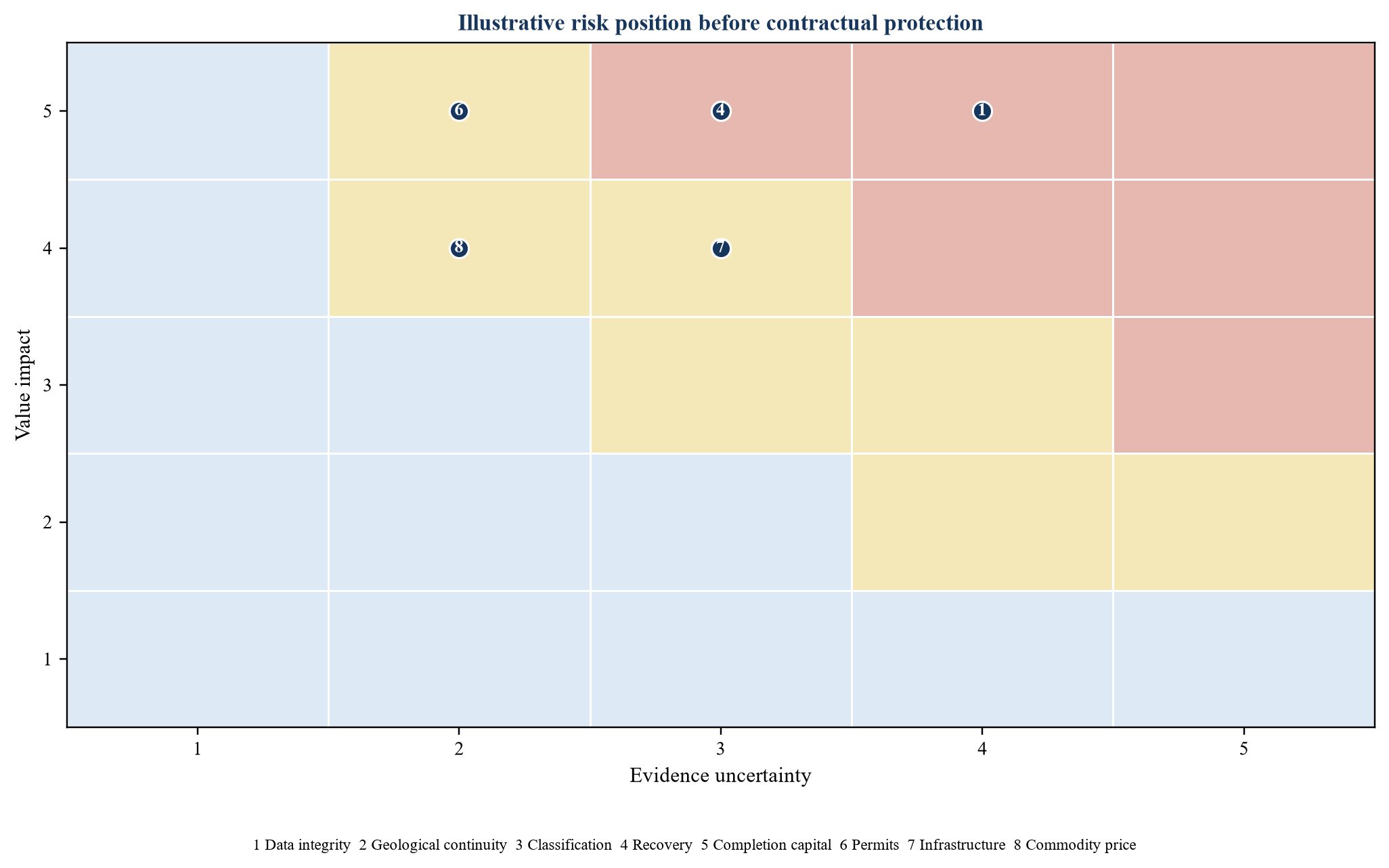
Scores are illustrative management assessments on a five-point scale and should be replaced with project evidence.
29. Establish post-closing reserve controls
The buyer should lock the closing database, model, assumptions and technical report. Subsequent changes should use approved version control, competent-person review and reconciliation to the acquisition case. This creates a baseline for earn-outs, warranties, impairment and operational decisions.
Near-term drilling should target decision value. It may improve confidence in the first years of production, test high-sensitivity zones or support expansion. The programme should state the decision each hole informs rather than pursue tonnes alone.
Monthly reporting should bridge ore mined, grade, dilution, recovery, payable product, cost, capital and permits against the acquisition model. Variances should identify geological, operating and estimation causes. The reserve reconciliation process should feed both operations and board oversight.
Annual resource and reserve reporting remains important under applicable codes. Transaction controls should also monitor the specific milestones that release escrow or contingent consideration. The same evidence should not be interpreted differently by finance, operations and legal teams.
30. Use a board approval matrix
The board should receive a concise matrix showing the evidence conclusion, valuation effect, protection, owner and residual risk for each gate. The detailed reports remain available, while the decision paper should make dependencies visible.
Approval conditions should specify the maximum cash at close, required escrow, contingent-payment cap, material permits, financing certainty and acceptable changes before closing. Delegated authority should identify who can accept waivers and within what limits.
The board should see the unmitigated and protected downside. That comparison shows which value relies on contractual recovery and which risk remains operational. It also exposes a structure that appears protected only because recoveries are assumed without security.
The final minutes should record the evidence considered, key assumptions and residual risks accepted. This supports governance without turning the board into the technical author.
| Gate | Evidence threshold | Transaction condition | Approval owner |
|---|---|---|---|
| Title and data | Verified material rights and controlled database | No uncured material defect | Board on legal and technical advice |
| Reserve quality | Independent review supports base reserve case | Cash price excludes unsupported upside | Investment committee |
| Recovery and product | Representative evidence supports scheduled recovery | Contingent payment for unresolved performance | Investment committee |
| Capital and schedule | Controlled estimate and funded downside liquidity | Maximum completion exposure approved | Board |
| Permits and social | Critical approvals and commitments mapped | Material approvals as closing conditions | Board |
| Price and financing | Common price deck and committed funds | Financing and hedge conditions satisfied | Board |
| Deal protection | Escrow, earn-out and indemnity are measurable and secured | No material drafting gap | Board on legal advice |
Thresholds are illustrative and should be tailored to the transaction, jurisdiction and board mandate.
31. Make the acquisition decision
A mining acquisition should proceed when the evidence chain supports the model, the price reflects the confidence level, the capital and permit path is executable, and residual uncertainty has an enforceable response. The strongest transaction case is internally consistent from sample to cash flow and from diligence finding to purchase agreement.
The buyer should decline or defer when title is insecure, core data cannot be reconstructed, the reserve case depends materially on unsupported lower-confidence material, recovery evidence is unrepresentative, essential permits are implausible or downside liquidity is unavailable. A lower price cannot cure every operational or legal failure.
The proposed Reserve-to-Protection Transaction System creates a practical control loop. It separates categories, reconstructs evidence, tests technical and commercial dependencies, quantifies correlated downside and assigns each unresolved matter to a deal tool. It also preserves a controlled baseline after closing.
The final decision remains transaction specific. Reporting codes, models and contractual protections support judgement. They do not replace competent technical work, legal advice, environmental and social diligence, accounting analysis or accountable board approval.
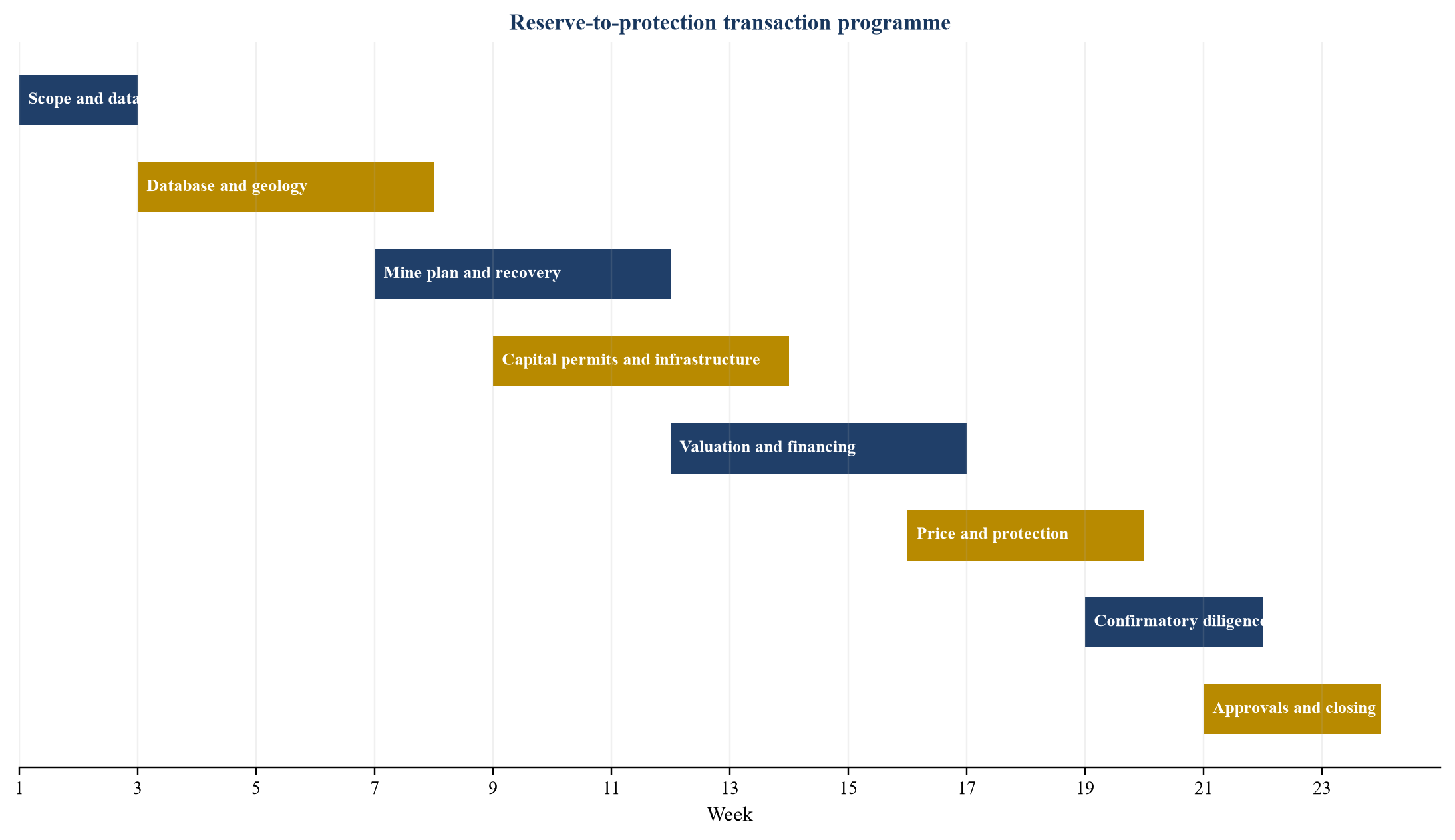
Timing is illustrative and depends on transaction process, evidence availability, regulatory requirements and seller access.
Sources
- Committee for Mineral Reserves International Reporting Standards, International Reporting Template, 2019. Read the primary source
- Australasian Joint Ore Reserves Committee, Australasian Code for Reporting of Exploration Results, Mineral Resources and Ore Reserves, 2012. Read the primary source
- US Securities and Exchange Commission, Modernization of Property Disclosures for Mining Registrants: Small Entity Compliance Guide, 2018. Read the primary source
- Electronic Code of Federal Regulations, Regulation S-K Subpart 1300, Disclosure by Registrants Engaged in Mining Operations. Read the primary source
- Ontario Securities Commission, Companion Policy 43-101CP to National Instrument 43-101, 2023 amendments. Read the primary source
- Canadian Institute of Mining, Metallurgy and Petroleum, Estimation of Mineral Resources and Mineral Reserves Best Practice Guidelines, 2019. Read the primary source
- Canadian Institute of Mining, Metallurgy and Petroleum, Leading Practice Guidelines for Mineral Processing, 2022. Read the primary source
- Canadian Institute of Mining, Metallurgy and Petroleum, Guidance on Commodity Pricing and Other Issues Related to Mineral Resource and Mineral Reserve Estimation and Reporting, 2020. Read the primary source
- VALMIN Committee, Australasian Code for Public Reporting of Technical Assessments and Valuations of Mineral Assets, 2015. Read the primary source
- South African Mineral Resource Committee, South African Code for the Reporting of Exploration Results, Mineral Resources and Mineral Reserves, 2016. Read the primary source
- Australian Securities Exchange, Guidance Note 31: Reporting on Mining Activities. Read the primary source
- IFRS Foundation, IFRS 3 Business Combinations. Read the primary source
- IFRS Foundation, IFRS 13 Fair Value Measurement. Read the primary source
- International Finance Corporation, Performance Standards on Environmental and Social Sustainability, 2012. Read the primary source
- Organisation for Economic Co-operation and Development, Handbook on Environmental Due Diligence in Mineral Supply Chains, 2023. Read the primary source
- United Nations Environment Programme, Principles for Responsible Investment and International Council on Mining and Metals, Global Industry Standard on Tailings Management, 2020. Read the primary source
- International Energy Agency, Global Critical Minerals Outlook 2026, 2026. Read the primary source
- Albemarle Corporation, Greenbushes Mine S-K 1300 Technical Report Summary, 2026 filing. Read the primary source
