

1. Design a decision system rather than a veto list
A reserved matter is a decision that cannot be taken without a specified approval. In a minority investment, that approval may come from a class of shares, a named investor, a shareholder majority, the board or an investor-appointed director. The commercial purpose is to protect the investor from actions that could alter the capital structure, transfer value, increase risk or defeat the investment thesis. The operating risk is that a long undifferentiated list captures routine decisions and makes the investor an informal manager.
The distinction matters because corporate governance allocates authority before the shareholder agreement adds contractual controls. Directors generally remain responsible for managing the company and exercising their duties. Shareholders retain statutory and constitutional rights over specified fundamental matters. Contractual reserved matters create an additional consent layer, but they do not automatically transfer the board's legal responsibility or validate an action that would otherwise breach law or duty.
The G20/OECD Principles identify fundamental corporate changes for shareholder approval, including amendments to governing documents, authorisation of additional shares and extraordinary transactions that effectively sell the company. They also support timely information and equitable treatment of shareholders. [1] Those principles point toward a focused protection perimeter. They do not support investor approval over every commercial choice.
The Reserved Matters Operating Test begins with the harm being controlled. It then asks which decision-maker is legally competent, what threshold makes the matter material, what evidence is required, how quickly a decision must be made and what happens if circumstances change. The result is a controlled process with defined autonomy inside the approved plan.
2. Start with the legal baseline and document hierarchy
The parties should map the authority already created by statute, constitutional documents and board delegations before drafting contractual consent rights. The inventory normally includes the applicable companies law, articles or certificate of incorporation, class rights, shareholder agreement, investment agreement, board terms of reference, delegation of authority, approved budget, financing documents and regulated permissions.
UK law illustrates why the hierarchy matters. The Companies Act 2006 addresses removal of directors, substantial property transactions involving directors, authority to allot shares, statutory pre-emption and relief for unfairly prejudicial conduct. [2] [3] A contractual investor consent can sit alongside those provisions. It cannot be analysed as though the contract were the only source of authority.
Delaware law similarly places core matters in the certificate, board and stockholder approval system. Title 8 governs the creation of classes and series, certificate amendments, mergers and sales of all or substantially all assets. [4] Contractual consent rights may provide additional protection, while the legal validity and corporate approval of the underlying act continue to depend on the statute and governing documents.
The deal team should produce a one-page authority map. Each proposed reserved matter should identify the statutory approval, constitutional approval, board approval, investor consent and any lender, regulatory or third-party consent. Duplicated approvals should be intentional. Conflicting thresholds or definitions should be resolved before signing.
3. Map every consent right to a protected harm
A consent right should answer a specific risk question. Issuing a new senior security can dilute economics and subordinate existing claims. Selling a material asset can remove the earnings base. Borrowing above an agreed level can increase insolvency risk. A related-party transaction can transfer value away from minority shareholders. Changing the business model can invalidate the original risk and return case.
The mapping prevents decorative drafting. If a proposed item cannot be connected to dilution, subordination, value leakage, control change, solvency, regulatory perimeter, thesis departure or loss of a critical asset, it may belong in board governance, information rights or notification rather than investor veto. The list can still include qualitative protections where a low-value act has severe consequences, such as surrendering a licence or transferring core intellectual property.
IFC's Corporate Governance Methodology includes treatment of minority shareholders as a distinct assessment area. [5] The OECD also emphasises equitable treatment, disclosure of control arrangements and safeguards around related-party transactions. [1] These sources support a risk-based architecture in which the intensity of approval follows the potential harm.
The harm map should include the control owner and evidence of operation. Capital structure risk may be controlled by the company secretary and finance team. Related-party risk may require an independent-director process. Regulatory risk may require compliance confirmation. A consent schedule works only when the business can identify a proposed action before the commitment becomes irreversible.
| Protection category | Illustrative harm | Typical decision route | Calibration anchor |
|---|---|---|---|
| Capital and ownership | Dilution, subordination or control change | Class or investor consent plus corporate approvals | Security type, percentage dilution and ranking |
| Strategic perimeter | Departure from the approved investment thesis | Board approval; investor consent for defined departures | Business line, geography, regulated activity and value at risk |
| Assets and transactions | Disposal of earnings capacity or core capability | Board and investor consent above threshold | Enterprise value, assets, revenue or EBITDA contribution |
| Debt and security | Solvency pressure or priority leakage | Board approval; investor consent above leverage or amount | Net leverage, debt-service capacity and secured assets |
| Related parties | Transfer of value or conflicted decision | Independent review and disinterested approval | Counterparty relationship, value and arm's-length evidence |
| People and incentives | Loss of key capability or excessive dilution | Board or remuneration committee; selected investor rights | Role, compensation change and equity-pool impact |
| Compliance and licences | Loss of legal capacity to operate | Board and compliance oversight; urgent notification | Licence criticality, sanction exposure and remediation time |
The categories are a design framework. Applicable law and transaction facts determine the final allocation.
4. Separate board shareholder class and investor approvals
The same action can require several approvals for different reasons. A board approves because directors manage the company and owe duties. Shareholders approve where law or the constitution requires a member decision. A class approves when its rights are varied or a contractual threshold is triggered. A named investor may have a personal consent right negotiated as part of the financing.
The drafting should identify these layers precisely. Expressions such as "the consent of the investor" can become ambiguous when securities are transferred, a fund distributes shares, several investors share a class or the original investor falls below a negotiated holding threshold. The agreement should define the protected investor group, voting denominator, aggregation rules and the effect of affiliates, nominees and permitted transferees.
Current NVCA model legal documents separate the certificate, stock purchase agreement, investors' rights agreement, voting agreement and transfer arrangements. The suite is designed as an internally consistent starting point and includes current options for evolving financing practice. [6] The separation is useful because economic rights, governance rights and voting commitments may sit in different instruments.
The authority map should also state whether approval is affirmative consent, a class vote, a board vote including the investor director, or a right to object within a defined period. Each mechanism produces different quorum, conflict and enforceability consequences. The company should be able to determine the required path without reconstructing the transaction history each time.
5. Define ordinary course around the approved plan
"Ordinary course" is often used as an exclusion without defining the operating boundary. Historical practice alone can be too narrow for a scaling company. Management may need to enter larger contracts, hire in new markets and invest in systems that were not routine twelve months earlier. A useful definition connects ordinary course to the approved business, budget, policies and risk appetite.
The exclusion can require that the action is consistent with the annual plan, on arm's-length terms, within delegated authority, compliant with law and not part of a series designed to avoid a threshold. An action outside historical practice can still be ordinary implementation when it is explicitly contemplated by the approved plan. An action within budget can still require consent if it changes the capital structure, transfers core intellectual property or involves a related party.
The board should approve the plan with enough specificity for the exclusion to work. Revenue targets alone are insufficient. The operating envelope may include capital expenditure, hiring, market entry, product investment, pricing authority, working capital, debt capacity and regulated activities. Management autonomy increases when the plan and delegations are clear.
The agreement should address acquisitions, disposals and new subsidiaries separately. These can be strategically material even when individually within budget. Aggregation rules should prevent a series of related actions from remaining below the threshold while avoiding the capture of unrelated transactions across the entire year.
6. Build materiality from more than one metric
A fixed monetary threshold is easy to administer and quick to become obsolete. Inflation, growth, acquisitions and currency movements can cause the same number to capture too much or too little. A percentage-only threshold can also fail where a small transaction changes a licence, transfers intellectual property or creates an unlimited liability.
The materiality system should combine absolute, relative and qualitative tests. Absolute values provide certainty. Relative tests link the threshold to revenue, EBITDA, total assets, cash or the approved budget. Qualitative triggers capture matters whose nature is important regardless of amount. The drafting should state whether a matter is reserved when any test is met or only when specified tests operate together.
European rules on related-party transactions provide a useful design analogy. Directive (EU) 2017/828 requires materiality to consider quantitative ratios based on financial position, revenue, assets, capitalisation, equity or turnover, together with the nature of the transaction and the related party's position. [7] The directive applies to listed companies, while its combination of amount and nature is relevant to private-company design.
Thresholds should use defined financial data. The parties should specify the measurement period, accounting standard, currency conversion date, treatment of subsidiaries and whether values are gross, net or committed. A threshold without a measurement rule invites delay at the moment a decision is needed.
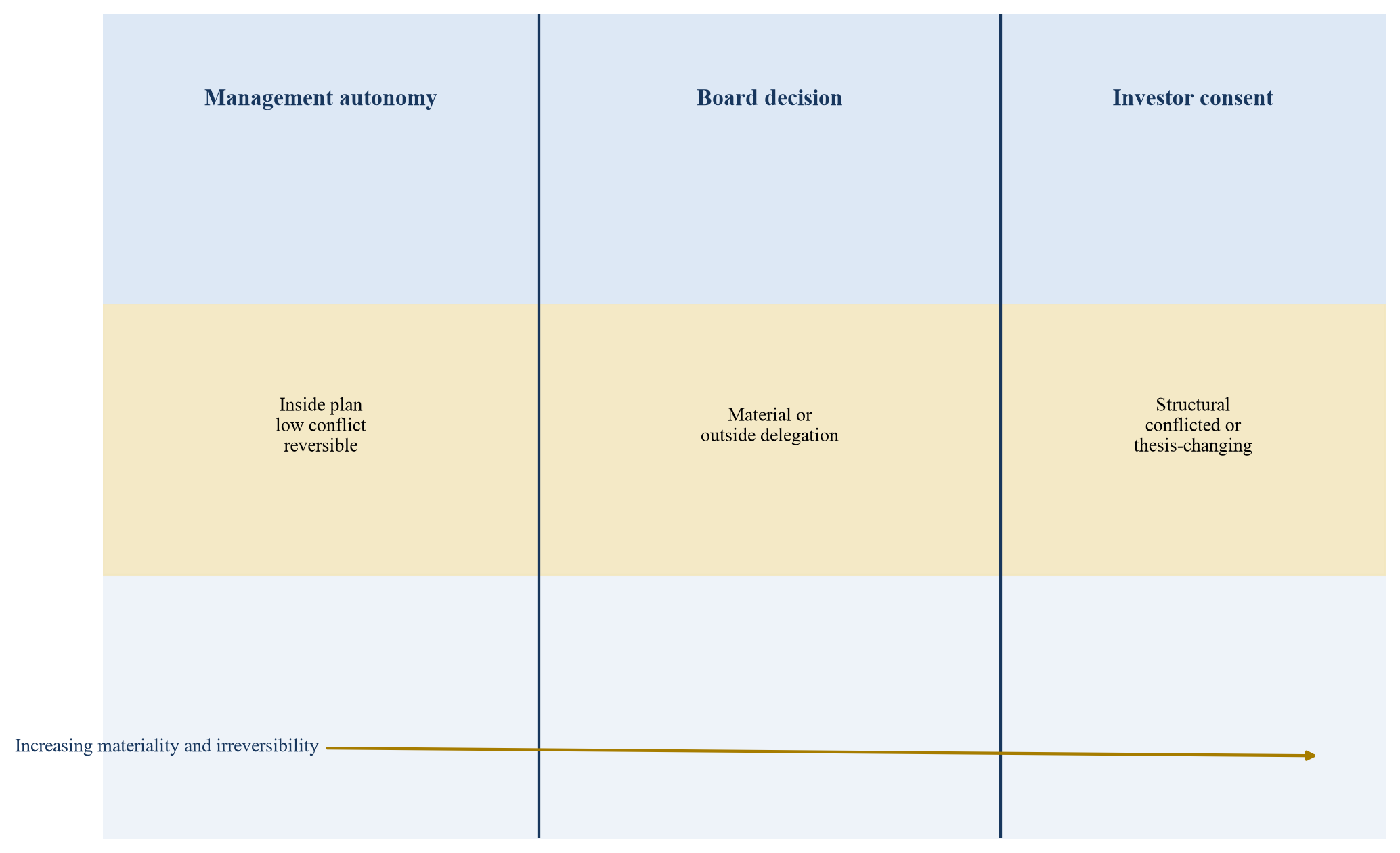
The architecture is illustrative. Legal competence and the definitive agreements control each decision.
7. Link budget approval and variance control
The annual budget is one of the strongest tools for preventing consent creep. The investor participates in approving the strategic and financial envelope. Management then executes within that envelope under the delegation of authority. Consent is reserved for defined deviations rather than every spend item.
The agreement should distinguish approval of the initial budget, amendments to the budget and variances during execution. A variance can be measured by line item, business unit, project or total company result. A single percentage may create false precision. A revenue shortfall, cash reduction or increase in committed expenditure can be more important than a small accounting variance in a discretionary cost line.
A useful design combines total and category thresholds. For the hypothetical company, aggregate capital expenditure of USD 12 million is approved. Management can reallocate up to the lower of USD 2 million or 15 per cent between non-critical categories. A new project above USD 5 million or an aggregate budget increase above 10 per cent requires board approval. Investor consent is limited to an aggregate increase above 20 per cent or a project that changes the strategic perimeter.
The budget must remain current. If management is operating against an obsolete plan, every decision can appear exceptional. The governance calendar should include forecast refreshes and a defined process for amending the plan without reopening the entire shareholder agreement.
8. Reserve capital structure matters with precision
Capital structure protections usually cover new shares, options, warrants, convertibles, changes to class rights, buybacks, dividends and alterations of share capital. These matters can dilute ownership, change ranking or transfer value. They are appropriately central to a minority investor's protection package.
The schedule should distinguish issuances already contemplated by the financing. An approved employee option pool, conversion of existing instruments and shares issued under agreed acquisition consideration may be excluded or subject to notice. New senior or pari passu securities, increases to the pool above an agreed level and non-pro-rata distributions may require consent.
UK statutory pre-emption gives existing shareholders an opportunity to protect their proportion on qualifying issues, subject to exclusions and disapplication. [3] Contractual pro-rata rights and investor consent can extend or modify the practical protection. The documents should state how statutory, constitutional and contractual rights interact.
The threshold should also consider economic effect. A small issuance with superior liquidation rights may be more consequential than a larger ordinary-share issuance. The consent trigger should capture ranking, participation, anti-dilution and conversion features rather than relying solely on the number of shares.
9. Calibrate acquisitions disposals and joint ventures
Acquisitions and disposals can alter the business faster than organic spending. A low-price acquisition may introduce regulatory, integration or liability risk. A disposal below a monetary threshold may remove a critical licence, data set, customer contract or technology platform. Joint ventures can move control and cash outside the consolidated entity.
The schedule should use several tests: transaction value, assumed liabilities, revenue or EBITDA contribution, percentage of assets, strategic perimeter and integration burden. Series of related transactions should be aggregated over a stated period. Unrelated ordinary-course asset sales should remain delegated.
The board package should include strategic rationale, valuation, funding, diligence findings, integration plan, conflicts and downside cases. Investor consent should focus on departures from the investment thesis, transactions above material thresholds and actions that transfer core capability. It should not become a substitute for the board's evaluation of every bolt-on acquisition.
The OECD Principles identify extraordinary transactions that effectively sell the company as fundamental corporate changes. [1] Delaware law separately addresses mergers and sales of all or substantially all assets. [4] The private agreement should align with those legal triggers while covering transaction-specific risks that may arise below a statutory whole-company test.
10. Control debt security guarantees and cash leakage
Debt can increase enterprise value when it funds productive growth. It can also subordinate equity economically, restrict strategic flexibility and accelerate distress. Reserved matters should therefore focus on aggregate capacity, security over critical assets, guarantees for third parties and departures from the approved financing plan.
The company should define debt broadly enough to capture loans, notes, finance leases, receivables financing, guarantees, indemnities with financing character and contingent obligations. Ordinary-course trade credit and approved working-capital facilities can be excluded. The definition should avoid double counting and should correspond to the leverage and liquidity metrics used by the board.
For the hypothetical company, the board approves facilities within the annual plan and net leverage up to 1.5 times budgeted EBITDA. Investor consent applies to debt that would raise net leverage above 2.0 times, create security over core intellectual property or guarantee obligations outside the group. A temporary draw within an approved revolving facility does not require repeat consent.
The evidence package should include pro forma leverage, interest cover, liquidity headroom, covenants, security, maturity and downside sensitivity. Consent based only on principal amount can miss the risk created by tenor, amortisation, currency or collateral.
11. Build an independent route for related-party matters
Related-party transactions require more than a monetary threshold because the decision-maker may be conflicted. The process should identify the relationship, exclude interested participants where required, obtain arm's-length evidence and document why the transaction is fair to the company.
IAS 24 defines related-party transactions as transfers of resources, services or obligations between related parties, whether or not a price is charged, and requires disclosures that allow users to understand the potential effect. [8] The European Shareholder Rights Directive similarly requires procedures that protect the company and non-related shareholders, with the related party excluded from specified approvals. [7]
The private-company process can use disinterested board approval, an independent committee or external fairness evidence depending on materiality. Investor consent may be appropriate where the founder, controlling shareholder or investor itself is the related party. The agreement should state how a conflict affecting the investor's consent right is handled.
Small recurring transactions should be governed through an approved policy and periodic reporting. A blanket veto over every affiliate payment can impede payroll, shared services and ordinary group operations. The board should approve the methodology, benchmark and annual cap, with exceptions returning to the independent route.
| Matter | Management or board envelope | Investor-consent trigger | Evidence package |
|---|---|---|---|
| Capital expenditure | Within approved USD 12 million budget; project below USD 5 million | Aggregate budget increase above 20 per cent or strategic-perimeter change | Business case, cash impact and sensitivity |
| Debt | Approved facilities and net leverage up to 1.5x EBITDA | Net leverage above 2.0x, core-IP security or external guarantee | Sources and uses, covenants and downside headroom |
| Acquisition or disposal | Board-approved transaction below USD 10 million and within strategy | Above USD 10 million, above 10 per cent of assets, or core capability | Valuation, diligence, funding and integration plan |
| Related party | Policy-compliant recurring transaction below USD 0.5 million | Above cap, non-standard terms or material conflict | Relationship, benchmark and disinterested recommendation |
| Senior hire | Inside approved organisation and remuneration bands | CEO change or compensation outside agreed boundary | Role, search process, package and succession impact |
| Litigation settlement | Within provision and below USD 2 million | Above USD 2 million or admission affecting licence or reputation | Legal assessment, range and regulatory consequences |
Values are hypothetical inputs for the worked case and are not market benchmarks.
12. Allocate people compensation and incentive decisions
Investors have a legitimate interest in the chief executive, key-person continuity and equity dilution. Management needs authority to hire, reward and reorganise teams. A schedule that reserves every senior hire or compensation change can slow recruitment and weaken accountability.
The agreement should identify the genuinely critical roles. Chief executive appointment or removal may require investor involvement. Other executive roles can remain board or remuneration-committee matters within an approved organisation plan and compensation framework. The investor may receive notice and consultation rights rather than a veto.
Equity incentives should be connected to the approved pool and grant policy. Consent can apply when the pool is increased, when grants exceed individual limits or when awards carry unusual vesting, acceleration or liquidity rights. Routine grants within the approved plan should be delegated.
The process should include succession and emergency cover. An investor consent right that prevents an interim appointment during a sudden departure creates the risk it was intended to reduce. The agreement can allow an interim appointment for a defined period, with prompt notice and a timetable for permanent selection.
13. Define controls for contracts litigation and compliance
High-value contracts are not automatically high-risk, and low-value commitments can create unlimited liability or regulatory exposure. The schedule should focus on commitments outside standard terms, unusually long duration, exclusivity, change-of-control restrictions, material indemnities and obligations that constrain financing or exit.
Management should operate under approved contracting and litigation policies. Standard customer and supplier contracts within delegated limits remain ordinary course. Exceptions move to legal or board review. Investor consent is reserved for commitments with enterprise-level consequences, such as transfer of core intellectual property, uncapped liability outside policy or settlement that threatens a licence.
The UK Corporate Governance Code 2024 requires boards within its scope to monitor and review material financial, operational, reporting and compliance controls; Provision 29 applies for financial years beginning on or after 1 January 2026. [9] A private company is not automatically subject to that code. Its material-control approach provides a useful discipline for defining which commitments justify escalation.
The evidence pack should contain legal analysis, financial exposure, insurance position, regulatory notifications and remediation obligations. A consent request stating only the settlement amount or contract value is incomplete where non-financial consequences drive materiality.
14. Standardise the consent information package
Decision speed depends on information quality. The agreement should specify the minimum content of a consent request: the decision sought, relevant reserved-matter clause, recommendation, alternatives, financial impact, risks, conflicts, legal or regulatory implications and deadline. Supporting documents should be proportionate to the matter.
The request should identify whether the information is final, preliminary or commercially sensitive. Material assumptions and unresolved diligence should be visible. The investor should be able to ask focused questions without restarting the response clock for immaterial additions.
The board pack and consent pack should share a common record. Management should not prepare competing narratives for directors and investors. The company secretary or governance owner should maintain the decision log, evidence received, questions, approval, conditions and expiry.
Information rights require confidentiality and conflict safeguards. A strategic investor may compete with the company or face restrictions on receiving customer, pricing or transaction information. Current UK private-capital model-document commentary includes optional treatment for strategic investors where the board restricts access in specified circumstances. [10] The reserved-matter process should use a clean team, adviser or independent representative when direct access is inappropriate.
15. Put service levels around consent
A consent right without a response period can become an indefinite option over the company's decision. The process should state when the clock starts, the response period, permitted questions, escalation and the consequence of silence. Different matters need different speeds.
Structural matters such as a new class of securities may justify a longer review. A customer contract, acquisition bid or regulatory remediation may require a rapid decision. The parties can create standard, expedited and emergency tracks rather than force every issue through one timetable.
Deemed consent can support speed for operational matters, though it may be unsuitable for structural rights or where law requires affirmative approval. An alternative is deemed referral to senior representatives or an independent director. The agreement should avoid accidental consent where the request was incomplete or delivered to the wrong recipient.
The response should be approval, approval with stated conditions or a reasoned objection connected to the protected harm. A bare refusal makes escalation difficult and can invite strategic blocking. Conditions should remain proportionate and within the consent right.
| Track | Typical matter | Complete-pack response | Escalation | Silence treatment |
|---|---|---|---|---|
| Standard | Material acquisition, debt or budget deviation | Five business days | CFO and investor principal within two further days | Escalation; no deemed consent for structural matters |
| Expedited | Live bid, key contract or time-limited waiver | Two business days | Same-day senior call | Deemed escalation or consent only if expressly agreed |
| Emergency | Safety, cyber, sanctions, licence or asset preservation | Four hours where practicable | Immediate chair and investor principal contact | Management may act within emergency cap and seek ratification |
| Notification | Action within approved envelope | Notice within two business days | Questions at next board cycle | Action remains effective |
| Periodic report | Aggregated ordinary-course items | Monthly or quarterly | Board review of exceptions | No transaction-level consent |
Timings are hypothetical design inputs. The definitive agreement should reflect the business and applicable law.
16. Create bounded emergency authority
Emergencies expose the weakness of a rigid veto list. A cyber incident, safety event, sanctions issue, court order, liquidity shock or threat to a critical asset may require immediate action. Waiting for formal consent can increase the loss.
The agreement should define emergency conditions and a bounded authority to protect life, assets, data, legal compliance and business continuity. The authority can include an amount cap, shortest practical notice, documented rationale and prompt ratification. It should not become a general exception for poor planning.
In the hypothetical case, management can commit up to USD 3 million when delay would reasonably increase material harm. It must attempt immediate contact, notify the chair and investor principal within 24 hours, and submit a full ratification pack within 72 hours. Actions affecting capital structure or ownership remain subject to applicable law and cannot be validated merely by contractual emergency language.
The board should review every use of the emergency route. Repeated use may indicate that thresholds, policies or contingency plans are inadequate. The review should improve the operating system rather than punish good-faith protection of the company.
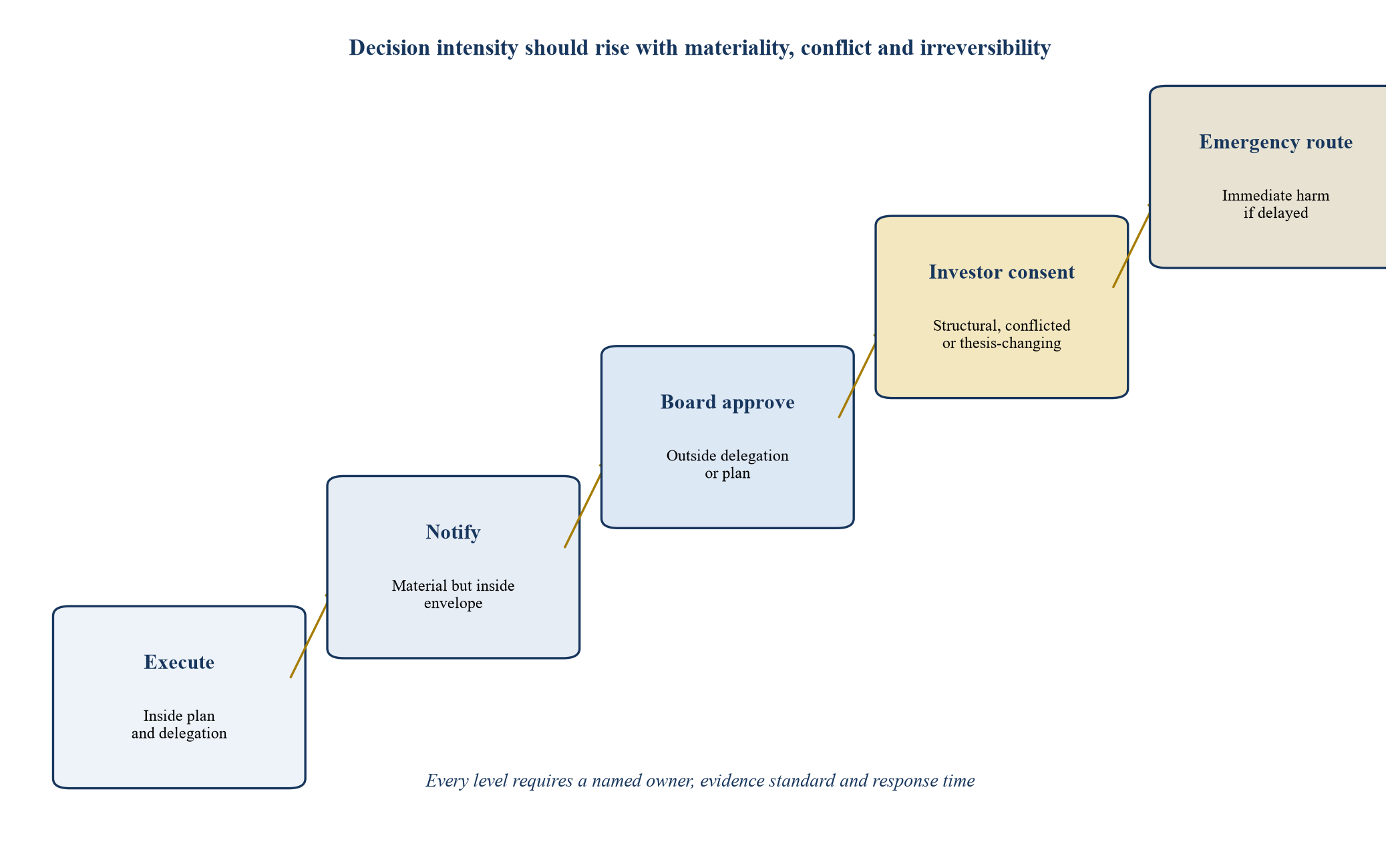
Thresholds and timings are hypothetical and must be calibrated to the company.
17. Manage investor conflicts and competitive sensitivity
An investor may be conflicted because it owns a competitor, is considering a related transaction or has fund-level interests that differ from the company. The governance documents should address these circumstances before a consent request arises.
The process can use an independent investor representative, clean team, external adviser or disinterested shareholder threshold. Sensitive information may be summarised or withheld to the extent permitted by the agreement and law. The company should still provide enough evidence for the decision route to be credible.
Conflict rules should operate both ways. A founder or controlling shareholder should not approve a related-party transaction merely because the investor is conflicted. The matter may require independent directors, an external valuation or approval by disinterested shareholders.
The agreement should define whether a conflicted investor is excluded from the denominator, whether its consent right is suspended or transferred, and how a dispute over conflict status is resolved. Ambiguity can give either side an unintended blocking right.
18. Escalate disagreement without creating permanent deadlock
Investor and management can disagree in good faith about risk, value or timing. A reserved-matter regime should create a structured escalation path rather than treat the first refusal as final. The path can move from operating executives to the chief executive and investor principal, then to the chair, independent director or expert.
The escalation should preserve the distinction between judgment and measurement. An accounting, valuation or threshold dispute may be suitable for an independent expert. A strategic decision remains a matter for the authorised decision-makers. Mediation can help resolve process and information disputes without transferring the commercial decision.
The agreement should specify the interim position. Existing operations may continue while a new action is paused. Safety, compliance and asset-preservation measures should remain available. A standstill should not prevent the company from meeting legal duties or avoiding immediate loss.
Persistent deadlock may trigger a board review, buy-sell right or other negotiated remedy, depending on the investment. Such remedies require careful legal and economic advice. They should not activate merely because an ordinary consent request takes an additional day.
19. Prevent leakage through subsidiaries and aggregation
Value can move outside the protected entity through subsidiaries, joint ventures, guarantees, service arrangements and asset transfers. The reserved-matter perimeter should cover the group where appropriate, while recognising that minority-owned subsidiaries and regulated entities may have their own governance.
The agreement should define the group and the treatment of future subsidiaries. Materiality may be measured on a consolidated basis, at the affected entity or both. A transaction that is small for the group can be existential for a regulated subsidiary or project company.
Aggregation rules should capture a series of related steps. They should define the look-back period, relationship test and common purpose. Broad annual aggregation of unrelated ordinary-course transactions can overwhelm the process. A reasoned connection test is preferable to mechanical addition of every item in a category.
Cross-guarantees and cash pooling require special attention. They can move risk between entities without changing consolidated debt. The consent right should focus on guarantees outside the approved treasury policy, security over critical assets and transfers that prejudice creditors or minority holders.
20. Apply the framework to a hypothetical company
The worked case assumes USD 120 million of revenue, USD 18 million of EBITDA, USD 25 million of cash and a USD 12 million capital-expenditure budget. A new investor contributes USD 40 million for 20 per cent of fully diluted equity. The company expects rapid expansion and approximately 240 decisions each year that could touch a broad precedent-based reserved-matter list.
Design A applies a flat veto list with low fixed thresholds. Ninety-six decisions require investor consent. The hypothetical median response is eight calendar days because requests vary in quality and frequently require clarification. The system produces 768 decision-days of waiting before parallel processing and commercial overlap are considered.
Design B uses the tiered architecture in this paper. Thirty-one decisions require consent, twenty-one require notification and the remaining matters stay within management or board authority. The hypothetical median consent time is five days, producing 155 consent decision-days. Structural and conflict-sensitive matters remain protected.
Design C uses high monetary thresholds and few qualitative triggers. Sixteen decisions require consent with a four-day median response. The system is fast, but the scenario assumes two value-changing actions fall below the monetary thresholds: a licence change and a transfer of core intellectual property. The example shows why speed alone is not the objective.
21. Compare protection and execution outcomes
The hypothetical results show a frontier rather than a single optimal number of consents. As the list expands from high-risk matters, protection initially increases. After ordinary-course matters enter the list, additional vetoes add limited protective value while delay and administrative cost continue to rise.
Design A scores highest on formal coverage because almost every relevant action reaches the investor. Its protection is weakened by volume. The investor spends attention on low-risk requests, management packages matters late, and genuinely material decisions compete for review time. A right that is frequently waived or approved without analysis provides weak control evidence.
Design C minimises delay. Its fixed high thresholds miss qualitative risks. The company could change a critical licence or transfer intellectual property without consent because neither action exceeds the monetary test. The apparent simplicity creates gaps around the investment thesis.
Design B balances the hypothetical case by combining structural rights, relative thresholds, qualitative triggers and service levels. This conclusion applies only to the stated assumptions. A regulated infrastructure company, distressed borrower or early-stage biotechnology company would require a different perimeter.
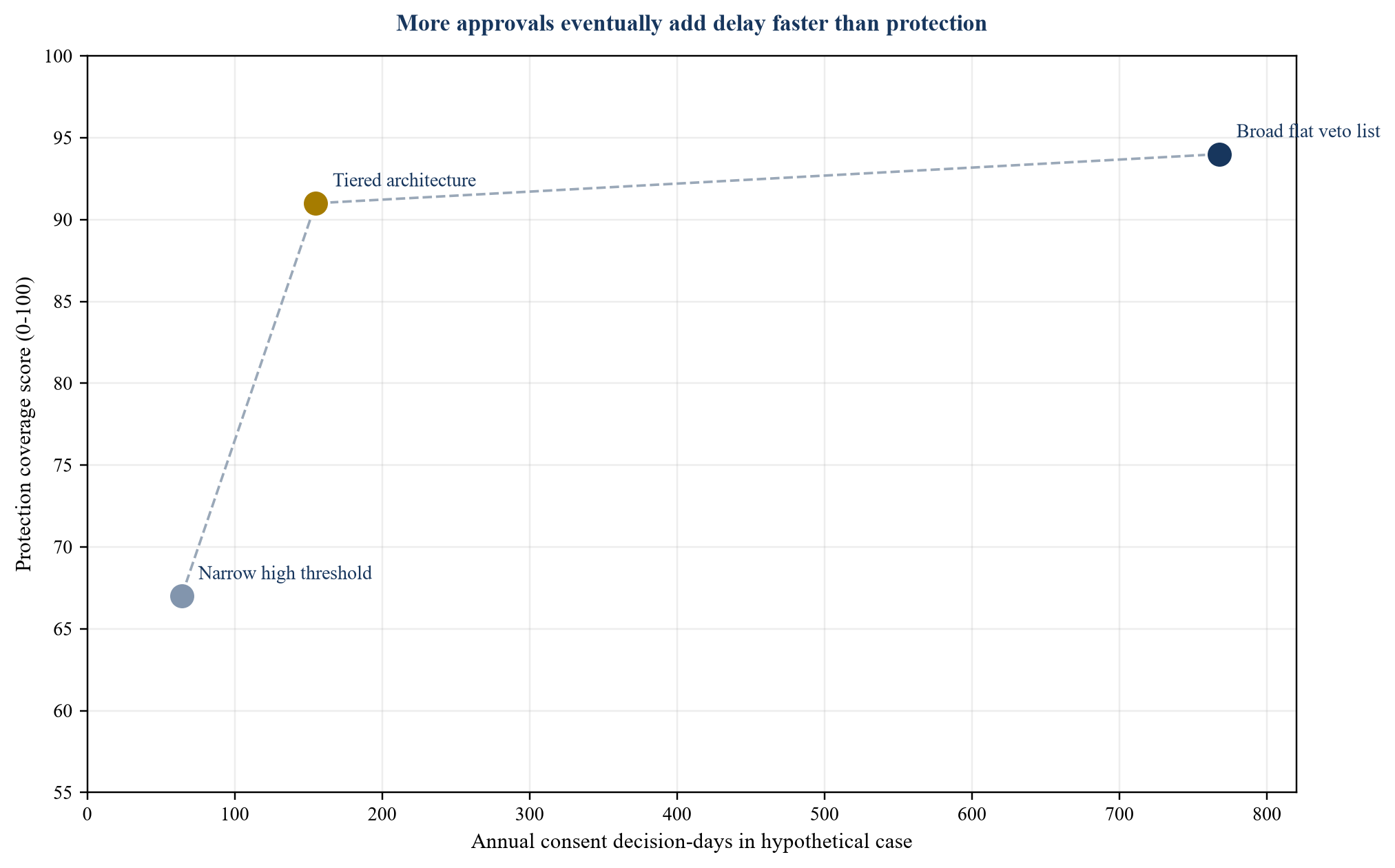
Scores and delays are illustrative scenario outputs, not observed market data.
| Metric | Broad flat veto list | Tiered architecture | Narrow high threshold |
|---|---|---|---|
| Annual decisions screened | 240 | 240 | 240 |
| Consent requests | 96 | 31 | 16 |
| Notification-only matters | 0 | 21 | 8 |
| Hypothetical median consent time | 8 days | 5 days | 4 days |
| Annual consent decision-days | 768 | 155 | 64 |
| Protection coverage score | 94 | 91 | 67 |
| Qualitative risks missed | 0 | 0 | 2 |
| Principal weakness | Volume obscures priority | Requires disciplined classification | Monetary thresholds leave gaps |
All values are scenario assumptions or calculated from those assumptions.
22. Draft implement and recalibrate the operating model
The legal schedule should be accompanied by an operating protocol. The protocol names request owners, authorised recipients, delivery method, information requirements, response times, escalation contacts, decision log and periodic reporting. It can be updated more easily than the core consent rights if the agreement permits.
Implementation should begin before completion. The parties classify sample decisions, test the request form, confirm authority matrices and train finance, legal, commercial and operating teams. The company should integrate the trigger check into procurement, treasury, hiring, contracting, M&A and board workflows.
For the first ninety days, the governance owner should review each request for false positives, missed triggers, incomplete evidence and delay. The investor should record reasons for conditions or refusal. A joint review at thirty, sixty and ninety days can resolve drafting ambiguities before they become established practice.
Thresholds should be reviewed at least annually and after material financing, acquisition, disposal or change in scale. The agreement can use automatic indexation, formula-based thresholds or a board-approved reset within defined limits. Structural rights and conflict protections may continue while operational thresholds evolve.
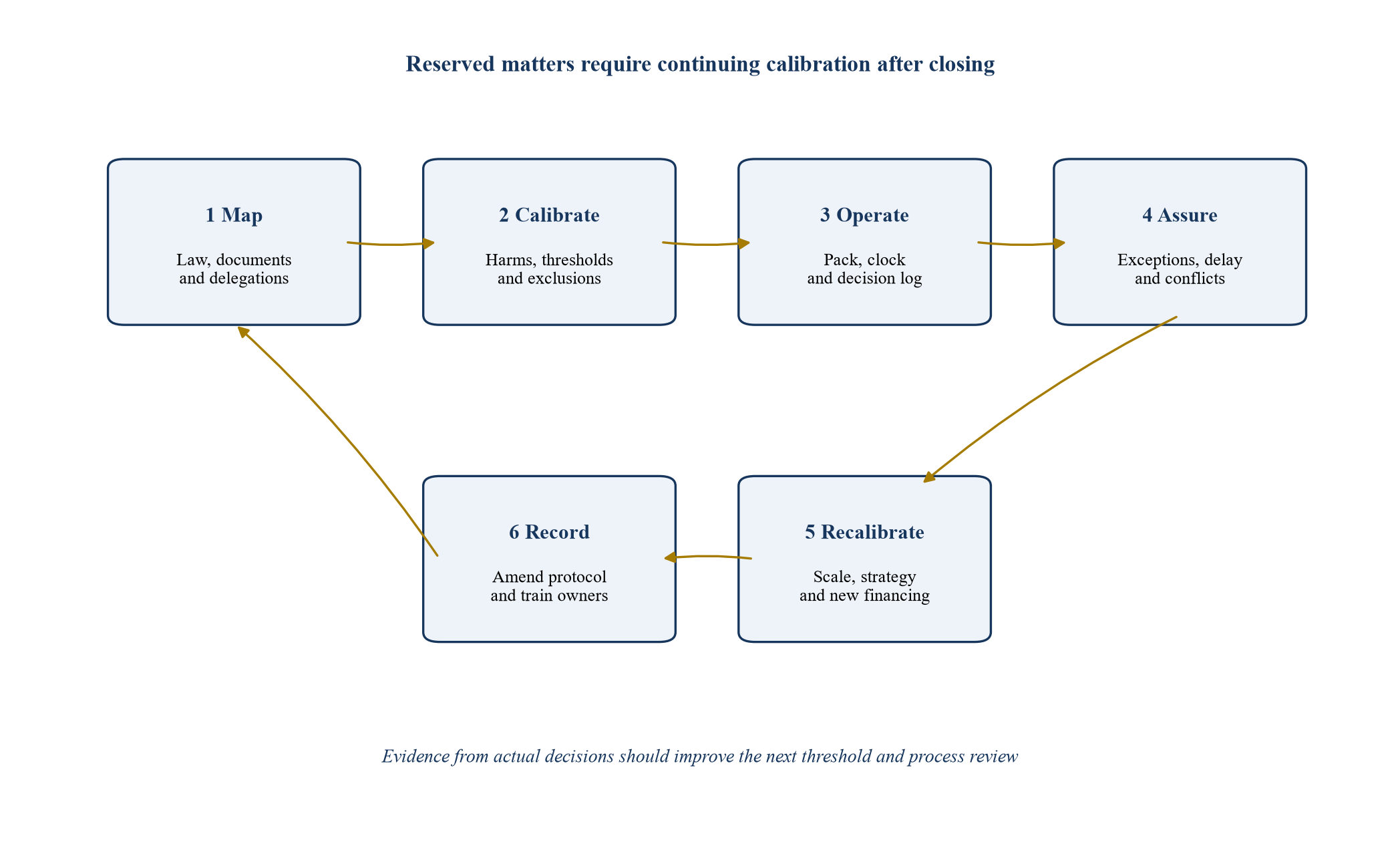
The cycle is a governance operating model and does not replace legal advice or formal approvals.
23. Recognise limitations
The framework cannot determine enforceability, legal competence or appropriate thresholds without company-specific facts and current professional advice. Company, securities, insolvency, employment, competition, foreign-investment, data, sanctions and regulatory rules vary by jurisdiction and can change.
The hypothetical case simplifies decision volume and delay. The protection scores are constructed scenario measures. They are not observations, forecasts or market benchmarks. Real outcomes depend on the nature of the business, quality of governance, behaviour of the parties and timing of events.
Contractual consent does not replace directors' duties or regulatory responsibility. An investor may face liability, confidentiality restrictions or conflicts if it becomes involved in management beyond the agreed governance role. Legal advice should address the boundary in the relevant jurisdiction.
The framework also assumes that the investor and management act in good faith and maintain capable decision processes. No drafting can compensate fully for missing information, weak controls or strategic abuse. The operating evidence should therefore be reviewed alongside the legal terms.
24. Conclusion
Reserved matters can protect minority capital while preserving execution speed when they are designed around harms, legal authority, materiality and process. Structural changes, value leakage, conflicts and thesis departures justify focused protection. Ordinary-course activity inside an approved plan should remain delegated.
The Reserved Matters Operating Test maps the authority hierarchy, combines absolute and relative thresholds, distinguishes consent from notification, standardises evidence, sets response times and creates emergency, conflict and escalation routes. It turns a schedule in a shareholder agreement into an operating control.
Boards, founders and investors should test the proposed schedule against real decisions before signing and recalibrate it as the company changes. A smaller number of well-defined, well-operated rights can provide stronger protection than a broad list that obscures priority and delays the business.
Sources
- OECD, G20/OECD Principles of Corporate Governance 2023, 11 September 2023, Read the primary source
- UK Parliament, Companies Act 2006, sections including 168, 190, 551 and 994, Read the primary source
- UK Parliament, Companies Act 2006 Explanatory Notes, including section 561 pre-emption, Read the primary source
- Delaware General Assembly, Delaware Code Title 8, General Corporation Law, Read the primary source
- International Finance Corporation, Corporate Governance Methodology Tools, Read the primary source
- National Venture Capital Association, Model Legal Documents, current page accessed 17 September 2026, Read the primary source
- European Union, Directive (EU) 2017/828 on long-term shareholder engagement, Article 9c, Read the primary source
- IFRS Foundation, IAS 24 Related Party Disclosures, Read the primary source
- Financial Reporting Council, UK Corporate Governance Code 2024, effective from 1 January 2025 with Provision 29 from 1 January 2026, Read the primary source
- UK Private Capital, Venture Capital in the UK Report 2025, discussion of 2025 model-document revisions, Read the primary source
- OECD, OECD Corporate Governance Factbook 2023, chapter on shareholder rights and ownership functions, Read the primary source
- International Finance Corporation, Implementing Corporate Governance Practices, Read the primary source
- Abu Dhabi Global Market, Companies Regulations 2020, Read the primary source
- Dubai Multi Commodities Centre, Legal Corner: The Importance of Shareholders' Agreements, Read the primary source
- Financial Reporting Council, Corporate Governance Code Guidance, updated 3 June 2026, Read the primary source
- IFRS Foundation, IAS 24 supporting material, Read the primary source
