

1. The financing decision is how much resilience remains valuable after control costs
Trade and shipping disruption can turn a small component into the constraint on an entire production system. The commercial response is often to hold more inventory. The financing response requires a harder question: which additional units protect contribution margin and customer delivery, and which merely convert liquidity into stock that may age, fall in price or become obsolete? A resilience inventory facility should finance the first category under verifiable controls while requiring the borrower to fund or reserve against the second.
The decision begins with a critical-input map. Each item should be linked to the product, project or service it enables; the time required to replenish it; the availability of substitutes; the concentration of supply; and the cash loss caused by its absence. This avoids treating all inventory as equally strategic. It also reveals where a low-value part has a high operational consequence, where a high-value item has a deep resale market, and where management's preferred buffer does not change the probability or duration of a shutdown.
Recent public evidence supports this item-level approach. UNCTAD reports that maritime routes and freight rates have remained exposed to geopolitical tension, rerouting and port disruption, with longer journeys increasing delays and costs [1]. The OECD finds that significant import concentration rose materially in the early 2020s and cautions that wholesale relocalisation can impose high economic costs without consistently improving resilience [2]. The IEA identifies high concentration, export controls and exceptional price volatility in strategic minerals that feed energy, technology and advanced manufacturing [3]. These findings do not determine a borrower-specific stock target. They establish why disruption exposure, substitutability and price behaviour belong in a financing model.
A lender therefore needs two linked cases. The operating case estimates the production, revenue or service continuity protected by the buffer. The collateral case estimates what can be realised from controlled stock if the borrower fails. A facility may be justified by the operating case while remaining conservatively sized by the collateral case. The difference is an equity-funded resilience layer, a junior tranche, a guarantee, a purchase commitment or another risk-bearing instrument.
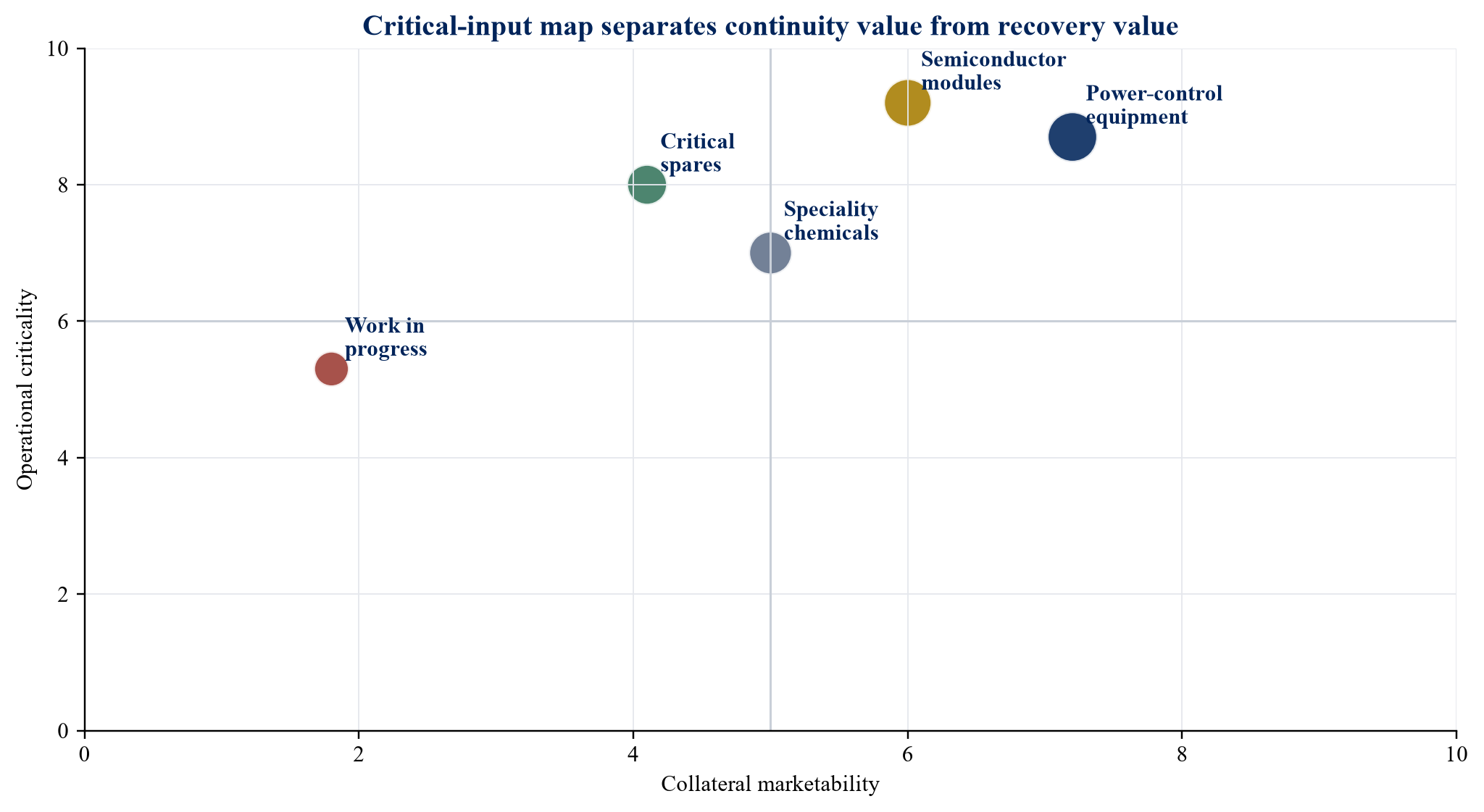
The framework separates business criticality from collateral quality. The categories and decision thresholds are author-designed.
The practical financing decision can be stated as four tests. First, does the incremental inventory reduce an evidenced disruption exposure? Second, can the lender establish and maintain enforceable rights over the goods and related documents? Third, can quantity, condition, location, ownership and encumbrances be verified frequently enough? Fourth, does the stressed realisable value, after costs and reserves, support the proposed advance? A negative answer need not end the transaction. It changes structure, pricing, recourse, tenor or the source of risk capital.
2. A critical-input map turns supply-chain anxiety into a measurable borrowing need
The critical-input map should begin at the output, not the warehouse. For each revenue-producing line, management identifies the minimum set of inputs whose absence stops or materially degrades delivery. Each input is then scored across economic consequence, replenishment exposure and recovery options. The purpose is prioritisation. A business with thousands of stock-keeping units may discover that a few dozen determine most continuity risk.
Economic consequence measures the cash contribution exposed per day, the contractual penalties or service credits that may arise, and the cost and time required to restart. Replenishment exposure covers quoted lead time, observed lead-time variability, supplier and country concentration, transport route, customs requirements, minimum order quantities and capacity reservations. Recovery options include qualified substitutes, alternate specifications, redesign, repair, cannibalisation, secondary-market purchases and customer-approved changes.
The map should also distinguish four inventory purposes. Cycle stock supports ordinary production between routine replenishments. Pipeline stock is in transit or awaiting customs clearance. Safety stock absorbs ordinary variability. Strategic reserve covers a defined severe disruption beyond routine planning. Only the last category should carry a resilience label, and even then the borrower should document the event class, protected period and release rule. This classification prevents routine working capital from being presented as an exceptional strategic need.
Criticality should be revisited when the bill of materials, product mix, supplier base or technology changes. A component can migrate from critical to ordinary after a substitute is qualified. Another can become critical when demand shifts toward a product that relies on a single-source part. Facility reporting should therefore include changes in dependency, not only changes in quantity and value.
Table 1. Critical-input classification and evidence requirements
| Classification | Operational test | Minimum evidence | Financing implication |
|---|---|---|---|
| Cycle stock | Supports normal production cadence | Usage history, purchase orders and sales plan | Standard working-capital eligibility may apply |
| Pipeline stock | Purchased and moving through a controlled route | Title document, carrier data, insurance and destination | Advance depends on document control and transit exclusions |
| Safety stock | Covers measured demand or lead-time variability | Variability analysis and approved policy | Eligible within a capped days-of-cover band |
| Strategic reserve | Protects against a named severe disruption | Dependency map, disruption scenario and release protocol | Separate sublimit, higher reserves and tighter monitoring |
| Speculative stock | Held principally for anticipated price gain or unsupported demand | Trading thesis or forecast without firm operational linkage | Normally excluded or funded by equity |
Classification follows the evidenced purpose of stock rather than a management label.
Days of cover offers a useful common language, but a single formula can mislead. Historic consumption may understate future demand during growth or overstate it during a downturn. Unit usage can change after engineering redesign. Some parts are consumed in batches, and others serve as insurance against rare events. The denominator should therefore match the approved production or service plan, with a sensitivity to lower demand. The facility should also show units, replacement time and protected output alongside days of cover.
The resilience benefit should be bounded. Extra inventory cannot cure every disruption. It may buy time for qualification, rerouting or redesign, yet it cannot resolve a prolonged export ban or the loss of a sole technology licence. Management should specify the actions enabled during the protected period. Without such a bridge, stock merely delays the same failure point.
3. Eligibility starts with rights, identity and control
Inventory becomes financeable when the lender can establish what exists, who owns it, where it is, whether another party has a superior claim, and how it can be sold. The physical goods, accounting records and legal rights must tell the same story. A borrowing-base certificate alone is not sufficient evidence.
The legal analysis is jurisdiction-specific. UNCITRAL's secured-transactions framework covers security rights in inventory and related documents and emphasises effectiveness against third parties through an appropriate notice or control system [4]. The 2024 UNCITRAL-UNIDROIT Model Law on Warehouse Receipts supports paper and electronic receipts and addresses issuance, transfer, warehouse-operator duties and security rights [5]. The United States Uniform Commercial Code treats warehouse receipts and bills of lading as documents of title and provides a framework for electronic documents [6]. The United Kingdom's Electronic Trade Documents Act 2023 recognises qualifying electronic trade documents where a reliable system provides exclusive control and transfer [7]. These sources offer design principles; local counsel must determine attachment, perfection, priority, recognition and enforcement in every relevant jurisdiction.
Title risk often arises before the lender sees the stock. Supplier retention-of-title terms may preserve a supplier claim until payment. Consignment can leave ownership with the consignor. Tolling arrangements can place customer-owned or third-party material in the borrower's facility. Goods may be subject to customs liens, warehouse charges, landlord rights, repairer's liens or existing security. Purchase-order and invoice data should therefore be reconciled to payment status, contract terms and legal searches.
Identity and segregation matter most for specialised goods. Serial numbers, batch numbers, heat numbers, certificates of analysis, expiry dates and country-of-origin records can determine whether a buyer accepts the item. Commingled fungible goods can be financed if the legal and operational regime reliably identifies the lender's interest in an undivided mass. High-value non-fungible items usually require unit-level identification.
Location changes the control problem. Inventory at the borrower's premises may require landlord waivers, access rights and periodic counts. Inventory at a third-party warehouse may support stronger control if the warehouse is independent, insured, reputable and contractually bound to acknowledge the lender's interest. Inventory in transit depends on bills of lading, carrier terms, route, insurance, customs status and release mechanics. Stock held by suppliers or subcontractors requires additional confirmation that the borrower owns it and can recover it.
Double financing is a systems risk as well as a fraud risk. The same goods can appear in multiple ledgers, receipts or facilities when identifiers are weak, financing silos do not communicate, or control over electronic records is ambiguous. The lender should combine registry searches, warehouse acknowledgements, document-control rules, duplicate-identifier tests, purchase and payment matching, and negative confirmation with other known financiers where lawful. A digital token or electronic receipt improves speed only when it maps uniquely to the legal asset and the control regime prevents duplicate issuance or transfer.
4. The borrowing base must value exit proceeds rather than operational importance
Operational criticality measures the cost of being without an item. Collateral value measures the cash recoverable from selling it. These measures can move in opposite directions. A custom component may prevent a multimillion-dollar shutdown and have almost no resale value outside the borrower's product. A widely traded metal may have modest operational significance and strong collateral liquidity. Advance rates should follow the latter.
The base value should be the lower of a relevant accounting amount and a current collateral value, subject to eligibility and reserves. IAS 2 requires inventory to be measured at the lower of cost and net realisable value, with cost and net realisable value defined for financial reporting [8]. A lender may need a more conservative value, such as net orderly liquidation value or net forced liquidation value, depending on default assumptions, sale period, buyer universe and costs. An independent appraisal can inform recovery, but the lender should understand the appraiser's premise and data limitations.
Eligibility filters should remove inventory whose ownership, location, condition or saleability cannot be demonstrated. Typical exclusions include unpaid goods subject to supplier title rights; consigned inventory; work in progress without a reliable recovery market; demonstration units; customer-specific stock without a purchase obligation; expired, damaged, recalled or quarantined stock; slow-moving or obsolete items; goods at unapproved locations; inventory subject to sanctions or export restrictions; and amounts already financed elsewhere. The exact list depends on industry and jurisdiction.
Table 2. Illustrative advance-rate and reserve architecture
| Inventory class | Initial value basis | Illustrative gross advance | Key reserves and caps |
|---|---|---|---|
| Exchange-traded or widely quoted inputs | Lower of cost and observable market value | 65% to 75% | Price volatility, basis, location and liquidation costs |
| Standard components with multiple buyers | Lower of cost and net orderly liquidation value | 45% to 60% | Ageing, concentration, condition and buyer depth |
| Specialised components with qualified secondary demand | Appraised net orderly liquidation value | 20% to 40% | Obsolescence, certification, customer specificity and sale period |
| Custom or single-programme components | Documented recovery value | 0% to 20% | Purchase commitment, completion cost and enforceability |
| Work in progress or unverified strategic stock | No reliable immediate exit value | 0% | Excluded unless supported by a separate risk-bearing structure |
Percentages are author assumptions for framework illustration and require transaction-specific calibration.
Every percentage in Table 2 is an author assumption for framework illustration. It is not a market quotation, credit recommendation or claim about a particular borrower. A real facility requires field examination, appraisal, legal review and lender approval.
The effective advance should be calculated after item-level and portfolio-level reserves. A price-volatility reserve addresses the possibility that value falls before liquidation. An obsolescence reserve addresses technology change, redesign or expiry. A concentration reserve reduces reliance on one item, supplier, programme, location or buyer. A liquidation-cost reserve covers storage, handling, duties, broker fees, testing and disposal. A foreign-exchange reserve applies when collateral value and debt differ by currency. A tax reserve covers amounts that may rank ahead or reduce proceeds.
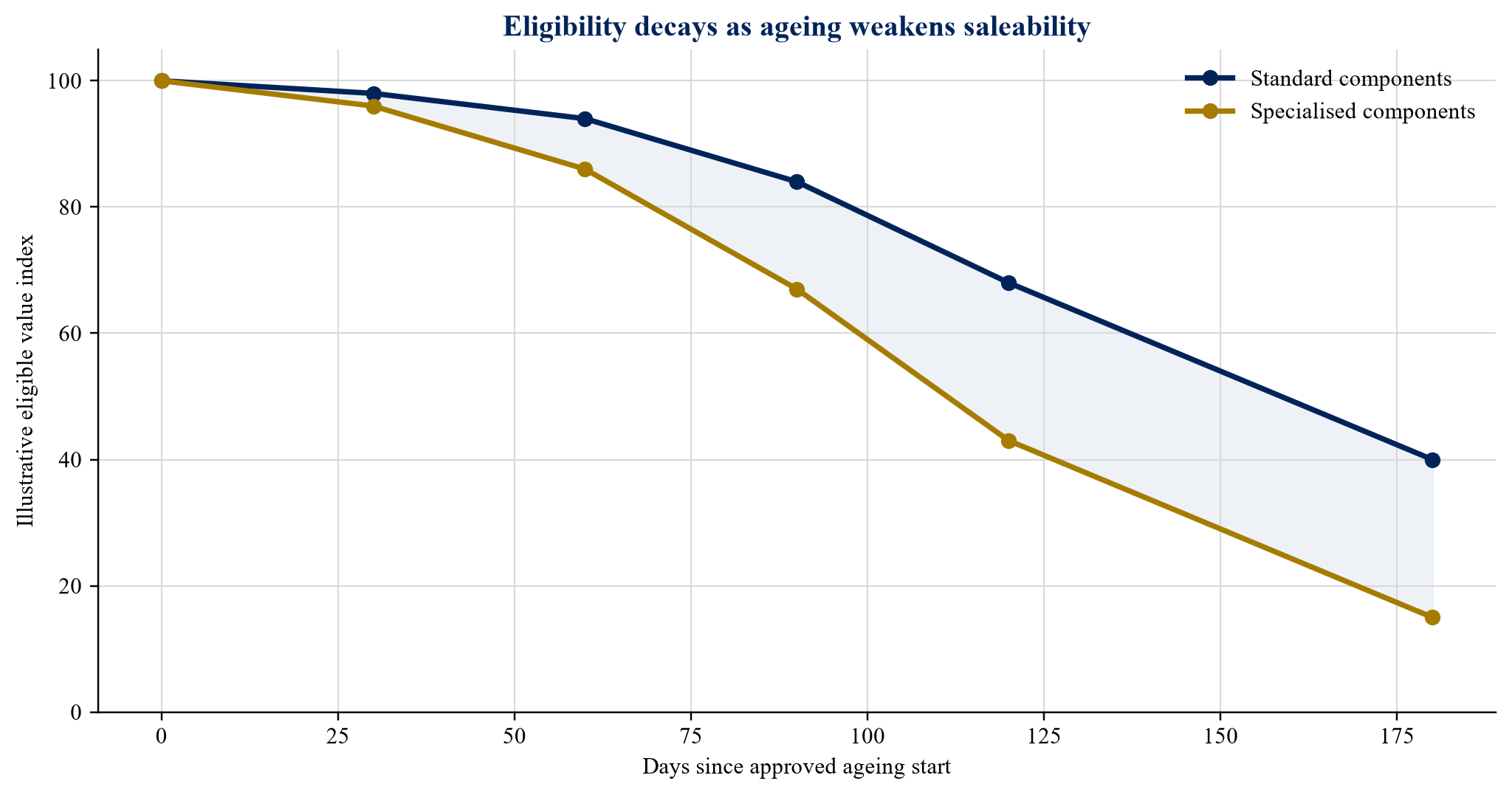
The model applies progressively lower eligibility to older stock. All ages, values and percentages are author assumptions.
Ageing should measure more than time since purchase. For shelf-life items, remaining useful life matters. For technology components, generations since current specification may be more informative. For repairable spares, serviceability and certification date can dominate age. The lender should define a clock that corresponds to loss of saleability and test it against actual disposition history.
5. An original model shows how a USD 40 million stock pool becomes a smaller facility
The following model demonstrates the framework. It describes a hypothetical manufacturer and infrastructure-services group that depends on power-control equipment, semiconductor modules, speciality chemicals and critical spares. The company proposes to hold USD 40.0 million of additional and existing inventory to protect customer delivery during shipping or trade disruption. All quantities, values, advance rates, reserves, stress movements and results are author assumptions. They have not been calibrated to an observed transaction.
The stock pool contains USD 12.0 million of power-control equipment, USD 11.0 million of semiconductor modules, USD 7.0 million of speciality chemicals, USD 6.0 million of critical spares and USD 4.0 million of work in progress. The initial classification assigns USD 17.0 million to strategic reserve, USD 10.0 million to safety stock, USD 8.0 million to cycle stock and USD 5.0 million to pipeline stock. Classification does not itself create eligibility.
Title, location and condition tests exclude USD 4.0 million of work in progress, USD 1.5 million of unpaid components subject to unresolved supplier terms, USD 1.0 million held at an unapproved subcontractor and USD 0.5 million of quarantined chemicals. Ageing and demand tests exclude a further USD 3.0 million. The resulting eligible gross value is USD 30.0 million.
The model then applies class-specific value haircuts and advance rates. Widely saleable power equipment and standard components receive higher rates than customer-specific spares. Gross availability before portfolio reserves is USD 16.2 million. Concentration, price, obsolescence, location and liquidation-cost reserves total USD 3.7 million, producing net borrowing availability of USD 12.5 million. The implied facility covers 31.3 percent of the original USD 40.0 million stock pool.
Table 3. Hypothetical borrowing-base calculation
| Step | USD millions | Percentage of gross pool | Rationale |
|---|---|---|---|
| Gross inventory pool | 40.0 | 100.0% | Book and procurement value before lender tests |
| Legal, location and condition exclusions | (7.0) | (17.5%) | Work in progress, title, location and quarantine |
| Ageing and unsupported-demand exclusions | (3.0) | (7.5%) | Weak saleability or excess cover |
| Eligible gross inventory | 30.0 | 75.0% | Inventory passing initial eligibility |
| Advance-rate haircut | (13.8) | (34.5%) | Difference between eligible value and gross availability |
| Gross availability | 16.2 | 40.5% | Availability before portfolio reserves |
| Portfolio reserves | (3.7) | (9.2%) | Concentration, price, obsolescence, location and liquidation costs |
| Net borrowing availability | 12.5 | 31.3% | Model facility availability |
All amounts and percentages are author assumptions and do not represent market terms or a financing quote.
The model deliberately creates a gap between management's desired resilience inventory and lender availability. That gap is economically informative. If the borrower believes the full USD 40.0 million protects substantial margin, it can fund the remaining amount with equity, retained cash, a subordinated tranche, supplier support, customer prepayment, a government programme or a guarantee. The allocation of this gap should follow who benefits from continuity and who can absorb loss.
Advance rates should also respond to the protected output. If an eligible item supports a contract with termination rights, weak customer credit or low contribution margin, the operating benefit is fragile even if collateral remains saleable. Conversely, a bespoke item with poor resale value may justify customer-backed financing if the customer has a firm purchase obligation. The borrowing base and contract structure can therefore work together.
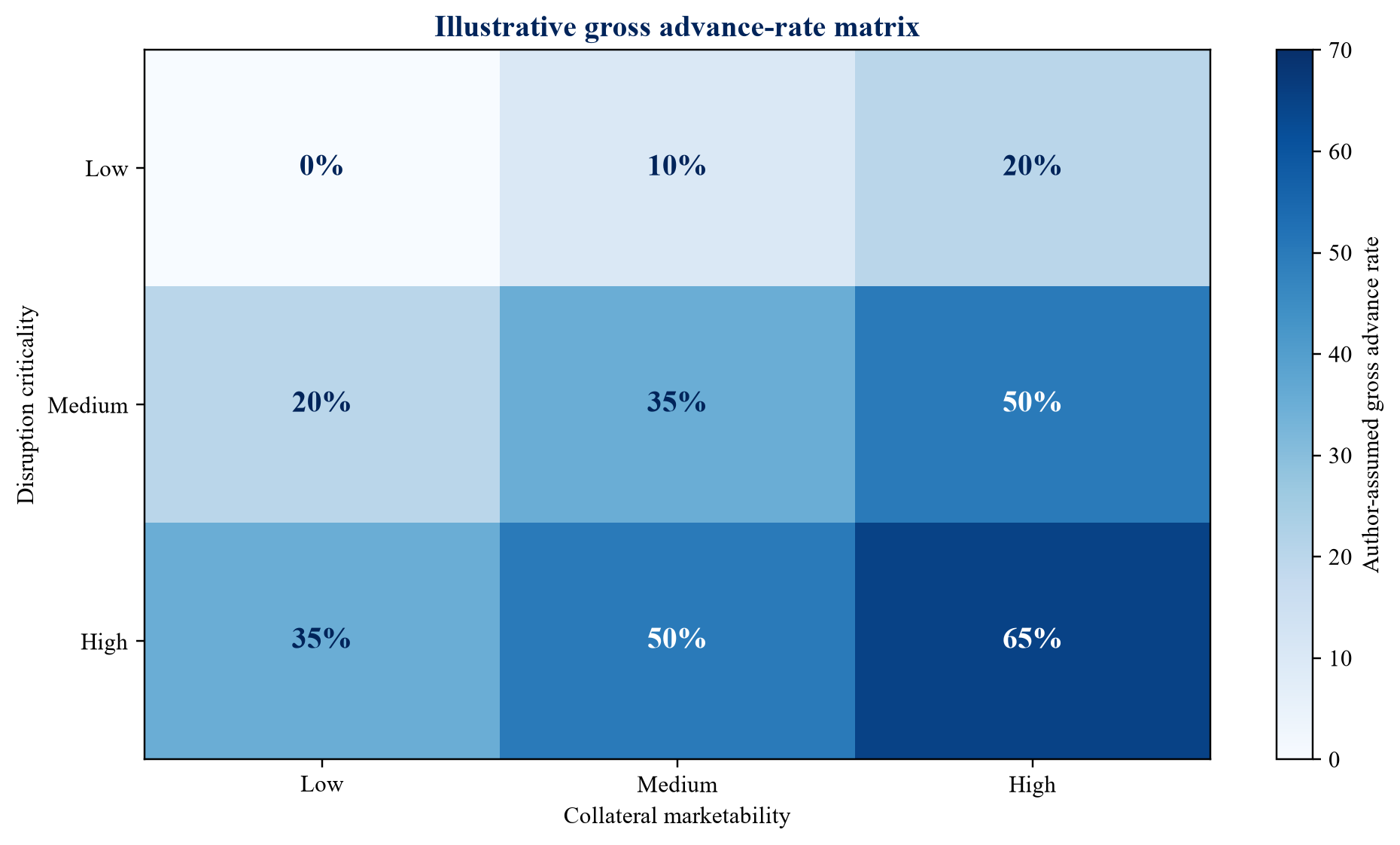
The matrix illustrates financing treatment under the author framework. It does not state market practice.
6. Disruption stress testing links facility size to time and cash
A static borrowing base cannot show whether a resilience buffer buys enough time. The lender and borrower should model the disruption as a sequence: supply interruption, available stock consumption, alternate sourcing, transport delay, customer delivery, cash collection and debt repayment. This reveals whether inventory value declines while debt remains outstanding.
The base case assumes that critical inputs arrive on planned lead times and demand follows budget. The moderate disruption case assumes a six-week delay, 15 percent freight and procurement cost inflation, and slower replenishment. The severe case assumes a twelve-week delay, a 30 percent spot-price increase for constrained inputs, a 20 percent reduction in customer demand after initial fulfilment, and two months of slower collections. These figures are author assumptions.
In the model, opening net borrowing availability is USD 12.5 million. Under the moderate case, higher replacement prices raise the cost of some stock, yet ageing and concentration reserves increase; net availability falls to USD 10.9 million. Under the severe case, consumption removes the most liquid stock first, remaining items age, customer-specific inventory rises as demand softens, and sale costs increase. Net availability falls to USD 7.1 million while the drawn loan would remain USD 11.5 million without amortisation. The resulting USD 4.4 million shortfall demonstrates why cash sweep and draw-stop triggers should activate before a borrowing-base deficit becomes large.
Table 4. Hypothetical disruption stress cases
| Metric | Base case | Moderate disruption | Severe disruption |
|---|---|---|---|
| Shipping and replenishment delay | Planned lead time | 6 additional weeks | 12 additional weeks |
| Constrained-input price movement | 0% | +15% | +30% |
| Customer demand movement | 0% | -5% | -20% after initial fulfilment |
| Collection delay | 0 days | 20 days | 60 days |
| Net borrowing availability | USD 12.5m | USD 10.9m | USD 7.1m |
| Assumed drawn amount before response | USD 11.5m | USD 11.5m | USD 11.5m |
| Availability cushion or shortfall | USD 1.0m cushion | USD 0.6m shortfall | USD 4.4m shortfall |
| Illustrative response | Normal monitoring | Draw stop and partial cash sweep | Full cash dominion, accelerated amortisation and restructuring review |
All changes and outputs are illustrative author assumptions.
Price increases require careful treatment. A higher replacement cost does not automatically increase collateral value. If the lender could sell at the higher price and market liquidity remains strong, value may rise. If the increase reflects scarcity, export restriction or an illiquid spot market, quoted prices may be unavailable at scale. The facility should cap upward revaluation, require independent price sources and increase volatility reserves when dispersion or illiquidity rises.
Demand reduction creates a second-order risk. Inventory purchased for continuity can become surplus if customers defer orders, redesign products or shift suppliers during the same disruption. Stress testing should therefore combine supply and demand shocks. A resilience facility should not assume that every protected sale remains available when inputs finally arrive.
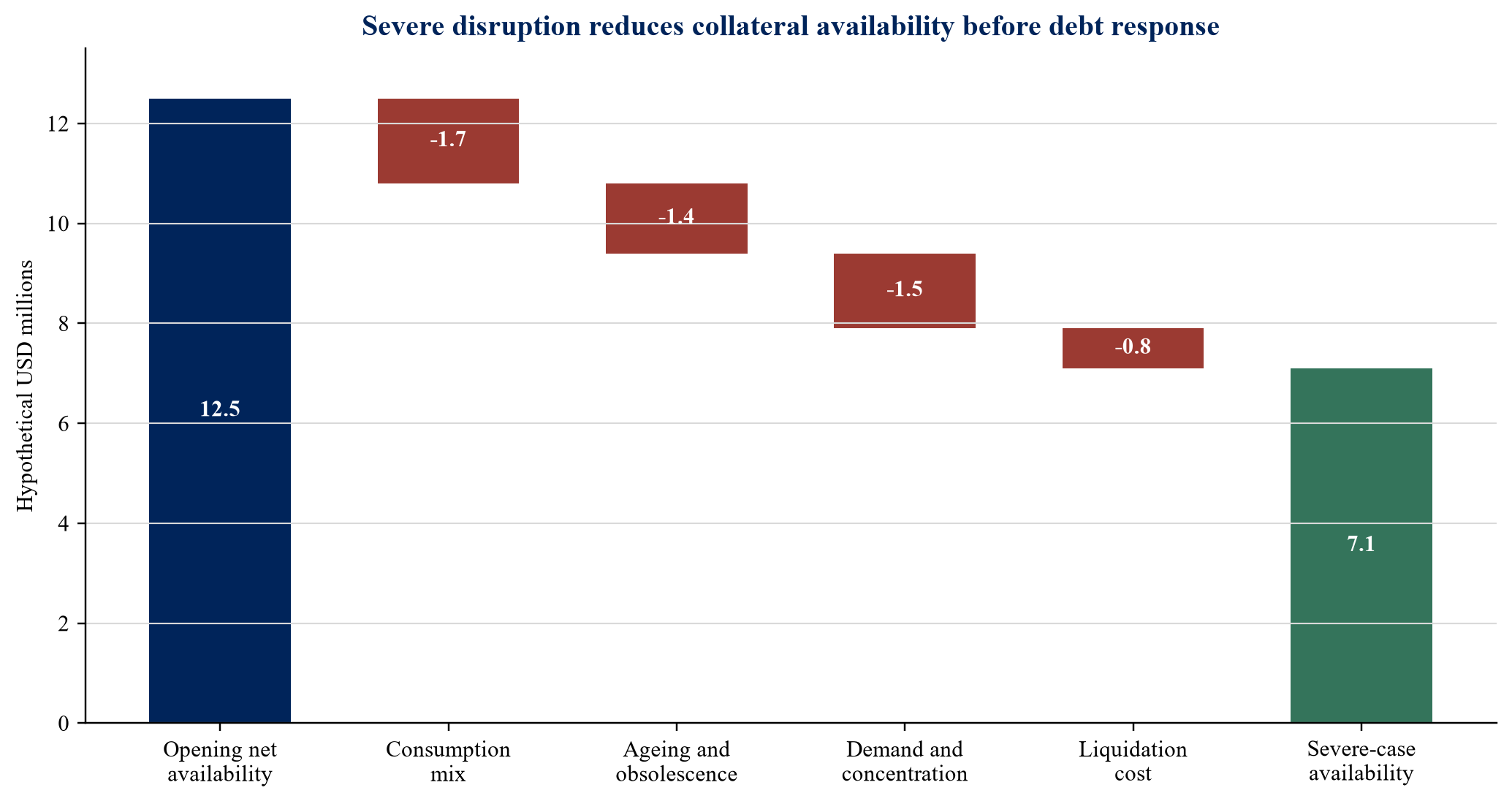
Values are author assumptions and show the interaction of consumption, ageing, concentration and demand effects.
7. Cash control and trigger design protect the lender before liquidation
Inventory is a secondary source of repayment. The facility should still be repaid through operating cash generated when inputs become output and customers pay. Cash control links this conversion cycle to debt reduction. It also prevents the borrower from using proceeds to replenish ineligible stock or distribute cash while availability deteriorates.
A controlled-account structure can route customer collections, insurance proceeds and disposal proceeds through an agreed waterfall. Taxes and unavoidable operating costs may be paid first within a budget. Interest, fees and scheduled principal follow. A borrowing-base shortfall is then cured through retained cash before residual funds are released. The exact waterfall should match local account-control law, the borrower's operating needs and other creditors' rights.
Reporting should join warehouse data, enterprise-resource-planning records, procurement systems, production consumption and cash. Daily feeds may be appropriate for high-value or fast-moving stock; weekly or monthly reporting may suffice for stable categories. The frequency should be shorter than the time in which a material collateral decline can occur.
Triggers should operate as a ladder. Early-warning indicators include lead-time extension, supplier downgrade, route closure, a failed warehouse reconciliation, increasing aged stock and rising price dispersion. A defined breach can increase reserves or reduce availability. More serious events activate cash dominion, stop new draws, require field examination, accelerate amortisation or force a restructuring review. Fraud, loss of control or uninsured loss should permit immediate protective action.
Field examinations should test the data trail rather than simply count boxes. A sample should move from purchase order to invoice, payment, receipt, location, serial or batch record, production issue, sale and cash collection. Reverse testing should start from the warehouse floor and trace back to ownership and the borrowing base. Surprise counts, third-party confirmations and duplicate-identifier analytics strengthen the control environment.
Warehouse arrangements require independent diligence. The World Bank's warehouse-receipt guidance highlights licensing, insurance, physical inspection and a reliable legal framework as foundations of finance [9]. The warehouse agreement should address care, segregation, access, release instructions, liens, insurance, records, audit rights and consequences of insolvency. A lender should understand whether the operator accepts liability and whether its financial capacity supports that promise.
Insurance should cover the actual peril and location. Property insurance alone may not cover transit, contamination, temperature excursions, cyber-enabled release fraud, political violence or delay. Business-interruption insurance may protect margin but include waiting periods and exclusions. The lender should be named appropriately, verify premium payment and test claim proceeds through the waterfall.
8. Structure can allocate risks that the borrowing base cannot absorb
A single revolving loan is not the only structure. A committed working-capital line can finance ordinary eligible inventory, while a separate resilience tranche funds approved strategic stock. The resilience tranche can have slower amortisation, a lower advance rate and a scheduled reduction as alternate supply is qualified. This separation improves transparency and prevents strategic reserve from crowding out routine liquidity.
A special-purpose vehicle may purchase inventory and lease or sell it to the operating company. This can strengthen asset control when carefully implemented, yet it introduces true-sale, tax, accounting, operational and insolvency questions. The vehicle requires independent governance, controlled cash, clear release mechanics and sufficient capital. Legal form cannot replace economic substance or physical control.
Supplier finance can shift funding earlier in the chain. A supplier may extend terms, a financier may pay the supplier, or a buyer may provide a purchase commitment that supports stock. Customer prepayment or capacity reservation can be appropriate when continuity principally benefits the customer. Government guarantees or strategic-stock programmes may address national-security externalities that a commercial lender cannot price efficiently.
Hedging can protect price exposure for standard commodities with liquid instruments. Basis risk remains when the financed item differs from the hedge, and margin calls can create liquidity pressure. Many specialised components and strategic minerals lack deep hedging markets. The facility should then rely more heavily on lower advances, revaluation limits, offtake support and equity.
Digital control can improve auditability. Electronic warehouse receipts, bills of lading and inventory records can reduce reconciliation time and support controlled transfer where the legal framework recognises them. The system should establish singularity, integrity, exclusive control, transfer history and linkage to the goods. Cybersecurity, operator failure, access rights and interoperability are part of collateral risk. Technology should be tested under outage and dispute scenarios.
Sustainability and human-rights diligence may affect both eligibility and realisation. Inputs associated with prohibited labour, unlawful extraction, sanctions, environmental breach or missing chain-of-custody evidence can become unsaleable or expose the lender to legal and reputational risk. Eligibility should incorporate applicable due-diligence duties and customer requirements. The standard should be defined in documents and supported by evidence rather than a generic policy statement.
9. Governance separates commercial judgment from borrowing-base administration
The board or investment committee should approve the resilience purpose, maximum funded amount and risk appetite. Operations should own the critical-input map and continuity actions. Procurement should own supplier evidence and alternate sourcing. Finance should own the borrowing base, cash forecast and covenant certificate. Legal should confirm rights and priority. Risk or internal audit should test data and controls independently.
Exceptions require discipline. A business may need to buy an unapproved item quickly during disruption. The facility can allow a temporary exception if a named authority approves it, a reserve applies, evidence arrives within a short period and the exception expires automatically. Repeated exceptions should trigger redesign of eligibility or a reduction in commitment.
Management incentives should avoid rewarding stock accumulation. Useful measures include protected contribution margin, verified continuity days, aged-stock reduction, recovery on disposals, supplier diversification progress and forecast accuracy. Inventory value by itself can encourage overbuying. The facility should also monitor the opportunity cost of cash tied up in stock.
Independent review is especially important when borrower and lender rely on the same service provider or data platform. Appraisers, warehouse operators, collateral managers, auditors and technology vendors should have clear scopes and conflicts policies. Reliance limits should be understood. A report addressed to one party may not create a duty to another.
The credit committee should receive a movement bridge for both units and value. Opening stock should reconcile to receipts, production issues, transfers, write-offs, sales and closing stock. The value bridge should separately identify quantity, price, foreign exchange, impairment and reclassification. This distinction matters during disruption because a rising book value can reflect higher replacement prices while physical cover is falling. It also makes manual overlays easier to identify and challenge.
Collateral data should preserve evidence at the transaction level. A lender should be able to reproduce the eligibility result for a selected item from source documents and system records. Changes to master data, ageing dates, standard cost, location, ownership flag or eligibility category should create an audit trail. Access rights should prevent the person who prepares the certificate from silently altering the evidence on which it relies. Exception reports should identify late feeds, duplicate identifiers, negative quantities and unexplained valuation movements.
Where the facility supports inputs relevant to national infrastructure, governance may include public-sector stakeholders without weakening commercial controls. A ministry, strategic procurement body or guarantee provider may define the continuity objective and eligible input universe. The lender should retain independent authority over collateral value, controls and draw conditions. Any guarantee should specify covered losses, claim conditions, timing and exclusions. Public purpose does not eliminate title, verification, recovery or moral-hazard risk.
The committee should compare financing with alternatives at each review. Additional inventory may be less effective than paying for supplier capacity, qualifying a second source, redesigning a product, acquiring reusable spares, improving demand visibility or agreeing customer allocation rules. The approved solution can combine these measures. This keeps the facility connected to the cheapest credible continuity plan rather than treating debt-funded stock as the default response.
10. Implementation can proceed through a twelve-week design and diligence programme
Weeks one and two establish the decision perimeter. The borrower identifies protected outputs, critical inputs, current funding, requested commitment, jurisdictions and locations. The lender defines initial exclusions, information requirements and legal questions. Both sides agree which scenario decisions the model must support.
Weeks three and four build the data tape. Required fields include item identifier, description, owner, supplier, purchase terms, payment status, location, custodian, quantity, unit cost, currency, acquisition date, expiry or certification date, demand linkage, consumption history, substitute status, insurance and existing liens. Data-quality exceptions are logged and reconciled.
Weeks five and six complete legal, warehouse and operational diligence. Counsel reviews security, title, priority, documents of title, enforcement and insolvency. The field examiner tests inventory records and performs floor-to-sheet and sheet-to-floor samples. The appraiser assesses marketability, buyer universe, sale period and costs. Operations validates disruption assumptions and alternate actions.
Weeks seven and eight design eligibility, valuation and reserves. Item categories receive objective rules. Concentration and ageing thresholds are back-tested against historic movements where data exist. The lender calculates availability under base and stress cases. Management identifies the equity-funded or supported layer.
Weeks nine and ten design documentation and controls. The parties agree the borrowing-base certificate, representations, covenants, warehouse acknowledgements, account control, cash waterfall, reporting frequency, appraisal cadence, field-examination rights and trigger ladder. Technology feeds are tested against source records.
Weeks eleven and twelve run a closing simulation. The borrower prepares a mock certificate and draw request. The lender verifies a sample from source evidence. Both sides simulate a disruption, reserve increase, draw stop, shortfall cure and release. Closing conditions remain open until legal rights, insurance, accounts, data and operational access are effective.
The implementation team should maintain a single decision log. Each unresolved point should name the item, evidence requested, interim treatment, owner and deadline. An unresolved ownership question should lead to exclusion. An unresolved valuation question should lead to a conservative cap or reserve. An unresolved operational dependency may require the stock to remain outside the resilience tranche until the protected output and mitigation action are demonstrated. This keeps uncertainty visible in availability rather than burying it in narrative diligence.
The first three reporting cycles should be treated as a controlled proving period. The lender compares certificates with source data, tests warehouse confirmations, reviews item movements and measures how quickly exceptions are resolved. Commitment availability can step up only after the control environment performs as designed. A clean closing snapshot does not prove that the borrower can maintain control while stock moves, prices change and disruption decisions are taken.
Borrowers should also define an exit from the resilience position. A strategic reserve can decline when another supplier is qualified, a product is redesigned, shipping normalises, a customer programme ends or the financed technology changes. Scheduled review dates and item-specific release rules prevent temporary buffers from becoming permanent leverage. Proceeds from planned reductions should repay the tranche unless the lender approves a replacement critical-input programme.
11. Limitations and further research
The framework is general and does not establish a market-standard advance rate, legal conclusion or optimal stock level. Inventory behaviour varies materially across commodities, pharmaceuticals, semiconductors, aerospace parts, energy equipment, food, construction inputs and service spares. Jurisdictional differences in secured transactions, documents of title, insolvency, customs, sanctions and warehouse regulation can change the outcome.
The hypothetical model excludes taxes, lender capital treatment, detailed interest calculations and borrower-specific probability of default. It assumes that data can be reconciled and that appraisals are available. It does not estimate the probability or duration of a particular disruption. Scenario results are sensitivities, not forecasts.
Observed borrower data should replace every assumption before a credit, treasury or board decision is taken.
Further research should test realised recovery by inventory class, the predictive value of ageing measures, the interaction between supply and demand shocks, and the performance of electronic warehouse-receipt systems. Industry-specific studies could compare the value of stock buffers with alternate-source qualification, redesign, insurance, capacity reservations and public guarantees.
The central conclusion is practical. Resilience inventory can protect valuable output, but financing should be earned item by item through evidence, rights, control, marketability and cash conversion. A disciplined facility funds the portion that can survive both disruption and default; the remaining strategic benefit must be supported by the parties best placed to bear it.
References
- UN Trade and Development. Review of Maritime Transport 2025: Staying the Course in Turbulent Waters. 24 September 2025. https://unctad.org/publication/review-maritime-transport-2025
- Organisation for Economic Co-operation and Development. OECD Supply Chain Resilience Review: Navigating Risks. 2 June 2025. https://www.oecd.org/en/publications/2025/06/oecd-supply-chain-resilience-review_9930d256.html
- International Energy Agency. Global Critical Minerals Outlook 2026, Executive Summary. 2026. https://www.iea.org/reports/global-critical-minerals-outlook-2026/executive-summary
- United Nations Commission on International Trade Law. UNCITRAL Model Law on Secured Transactions and Guide to Enactment. 2016-2017. https://uncitral.un.org/en/texts/securityinterests/modellaw/secured_transactions
- United Nations Commission on International Trade Law and UNIDROIT. Model Law on Warehouse Receipts. 2024. https://uncitral.un.org/en/mlwr
- Uniform Law Commission. Uniform Commercial Code, Article 7, Documents of Title. Accessed 6 September 2026. https://www.uniformlaws.org/acts/ucc
- United Kingdom. Electronic Trade Documents Act 2023 and Explanatory Notes. 2023. https://www.legislation.gov.uk/ukpga/2023/38/notes/division/4/index.htm
- IFRS Foundation. IAS 2 Inventories. Accessed 6 September 2026. https://www.ifrs.org/issued-standards/list-of-standards/ias-2-inventories/
- World Bank Group. A Guide to Warehouse Receipt Financing Reform. 2016. https://documents1.worldbank.org/curated/en/885791474533448759/pdf/108450-WP-PUBLIC.pdf
- Office of the Comptroller of the Currency. Asset-Based Lending, Comptroller's Handbook. Version 1.1, January 2017. https://www.occ.treas.gov/publications-and-resources/publications/comptrollers-handbook/files/asset-based-lending/pub-ch-asset-based-lending.pdf
- Board of Governors of the Federal Reserve System. Commercial Bank Examination Manual, Section 2160.1, Asset-Based Lending. October 2023. https://www.federalreserve.gov/publications/files/cbem-2000-202310.pdf
- International Energy Agency. Global Critical Minerals Outlook 2025. 21 May 2025. https://www.iea.org/reports/global-critical-minerals-outlook-2025
- World Trade Organization. Global Trade Outlook and Statistics. March 2026. https://www.wto.org/english/res_e/booksp_e/gtos0326_e.pdf
- UN Trade and Development. Review of Maritime Transport 2024: Navigating Maritime Chokepoints. 2024. https://unctad.org/system/files/official-document/rmt2024_en.pdf
- United Nations Commission on International Trade Law. Legislative Guide on Secured Transactions. 2007. https://uncitral.un.org/en/texts/securityinterests/legislativeguides/secured_transactions
- Law Commission of England and Wales. Electronic Trade Documents. 2022-2023. https://lawcom.gov.uk/project/electronic-trade-documents/
