

1. INTRODUCTION
A move from the United Kingdom to the United Arab Emirates is often described as a departure decision. For a family principal, founder or investment professional, it is more useful to treat it as a sequence of decisions with a possible return. The return may arise from family needs, education, health, a transaction, public service, a new operating role, a change in risk appetite or simple preference. A credible relocation therefore needs two capabilities at the same time: enough substance and evidence to support the UAE phase, and enough governance to make any later return to Britain deliberate rather than accidental.
The return option is the ability to re-establish UK residence when circumstances justify it while understanding the tax, ownership, liquidity, reporting and operational consequences in advance. It is not an assurance that a return will be tax neutral. It is not a short absence dressed as a permanent move. It is a design discipline that preserves facts, choices and decision rights. UK residence follows the Statutory Residence Test, which applies by tax year and uses automatic tests, day counts, work patterns, homes and ties [1-5]. Treaty residence can allocate residence for treaty purposes when domestic tests in both states are met, but it does not erase the domestic analysis [6-9].
Time matters in different ways. The temporary non-residence rules can bring specified income and gains arising during a period of absence into charge in the period of return when the statutory conditions are met [15-19]. The four-year foreign income and gains regime generally requires ten consecutive years of non-UK residence before the return [20-22]. Inheritance Tax now uses a long-term UK residence test for relevant events from 6 April 2025; the period during which overseas assets remain within scope after departure can range from three to ten tax years, and ten consecutive years of non-residence can reset the test [23-29]. These clocks are related but distinct.
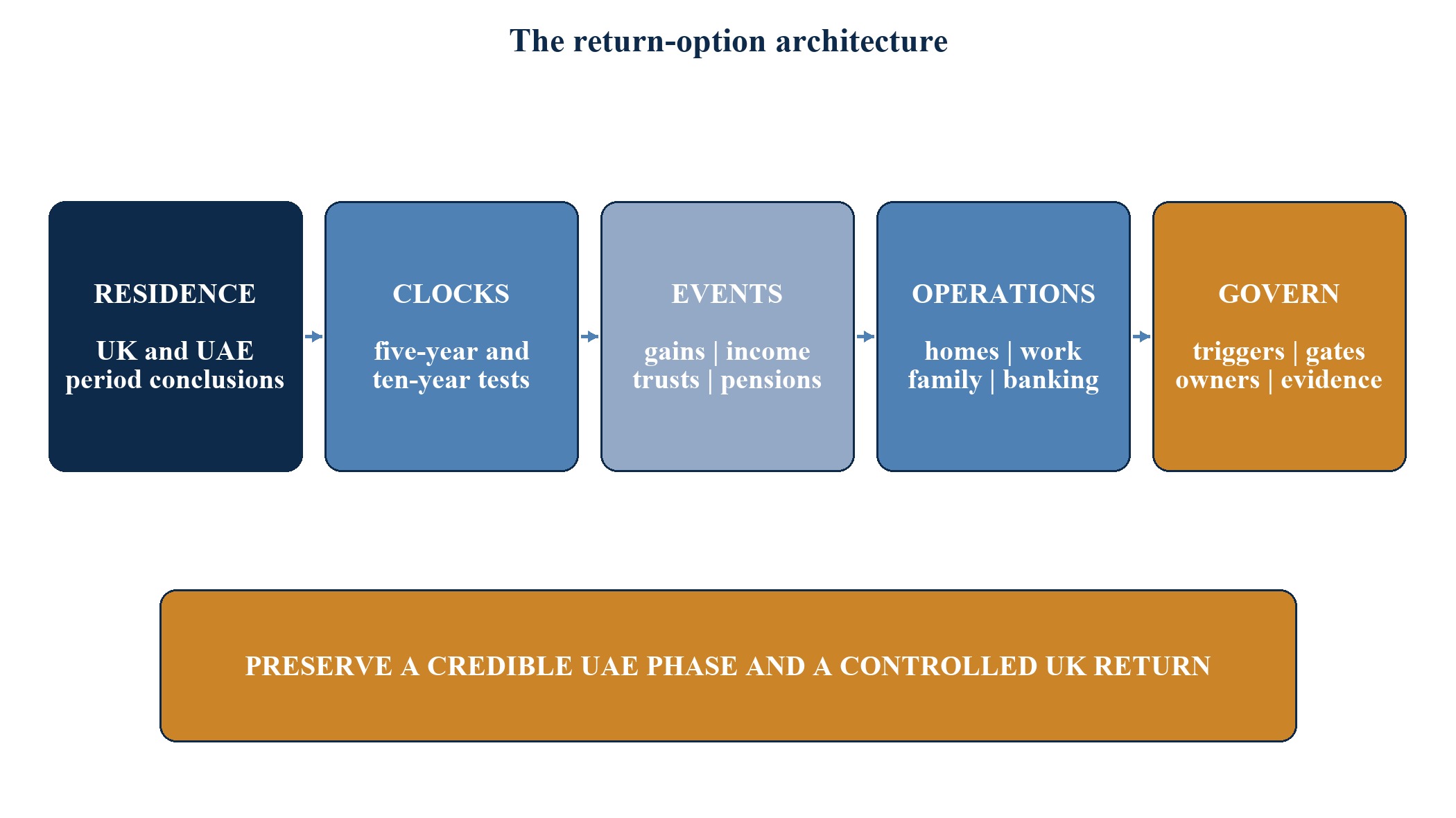
This paper develops a return-option framework around six controls. First, determine residence under domestic and treaty rules for every relevant period. Second, track temporary non-residence separately from broader long-term planning. Third, map assets, income, gains, distributions, pensions and trust interests to the rules that may apply on return. Fourth, preserve evidence of UAE residence, activity and management. Fifth, define return triggers and approval rights before they are needed. Sixth, run a pre-return review before homes, work, family presence or travel create a new UK residence period.
This is general research. It does not determine the residence, tax, immigration, succession, trust, corporate, pension or reporting position of any person. Every worked case, score, threshold and timetable is hypothetical and simplified. Actual outcomes depend on current law, exact facts, treaty eligibility, elections, claims and professional advice. Official guidance and fact-specific analysis remain essential.
2. THE RETURN OPTION AS A GOVERNED ASSET
2.1 Preserve choice through evidence
An option has value when it can be exercised with known consequences. A principal who may return needs a reliable chronology of residence days, homes, work, family ties, asset events, distributions and control decisions. Without that chronology, the family may discover after the event that a visit created residence, a dividend fell within temporary non-residence rules, a retained UK home changed the sufficient-ties calculation or a return reactivated worldwide taxation sooner than expected.
Evidence also protects the original move. A UAE residence visa, home, business, board role and bank relationship should correspond to actual conduct. The FTA's current Tax Residency Certificate process uses different evidence according to the basis claimed, including physical presence, a permanent place of residence, employment or business, and the centre of financial and personal interests [10-12]. The return file should therefore retain both UK and UAE evidence rather than treating one jurisdiction's paperwork as proof of the other jurisdiction's conclusion.
2.2 Four dimensions of option quality
Return-option quality can be assessed through timing, tax exposure, operating continuity and family feasibility. Timing asks whether the contemplated return date creates a UK residence period and whether split-year treatment may apply. Tax exposure asks which income, gains, distributions, pensions, trust benefits and estate assets enter or re-enter UK scope. Operating continuity asks whether companies, funds, family-office functions and banking relationships have authority, substance and records through the transition. Family feasibility asks whether homes, schools, care responsibilities and employment can be changed without an uncontrolled residence outcome.
| Dimension | Core question | Evidence | Decision owner |
|---|---|---|---|
| timing | when does UK residence begin under domestic and treaty rules? | day log, home record, work calendar, family timeline | tax lead |
| tax exposure | which historic and current items may be taxed on return? | asset-event ledger, distributions, gains, pension and trust records | tax and legal leads |
| operating continuity | can entities, accounts and mandates function through the move? | authority matrix, board record, banking and provider map | family-office COO |
| family feasibility | can the return be implemented without accidental facts? | housing, education, employment and care plan | principal and family governance body |
3. THREE CLOCKS AND ONE DECISION
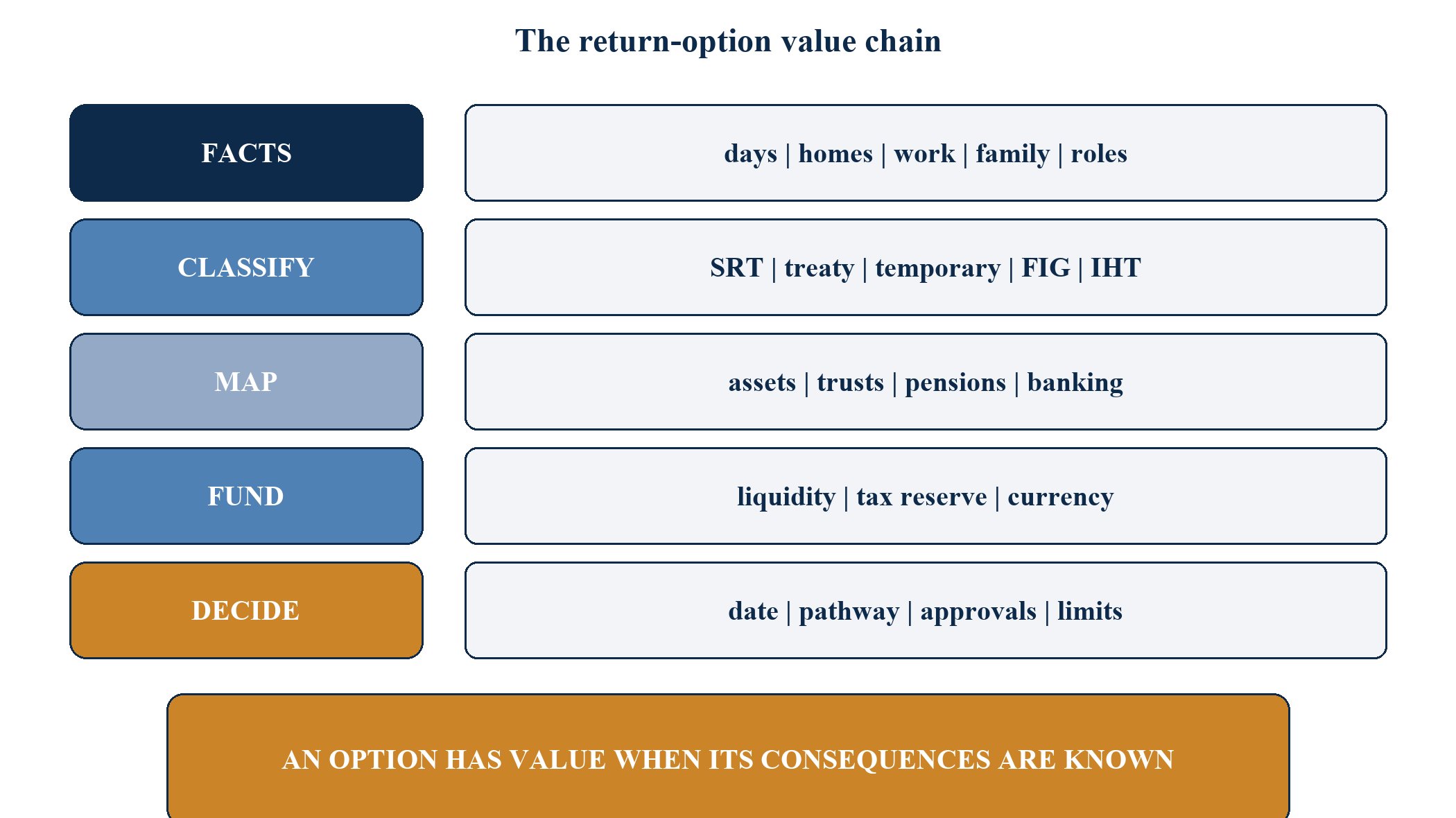
3.1 The UK tax-year clock
The UK tax year runs from 6 April to 5 April. Residence is normally determined for the whole tax year, although statutory split-year treatment can divide a qualifying year into an overseas part and a UK part [1,2,4,5]. A calendar-year plan that ignores 6 April can misstate both the duration of non-residence and the timing of a return. The year of departure, residence periods inside a split year and the first period of sole UK residence on return can all matter for temporary non-residence [15].
3.2 The UAE twelve-month clock
UAE domestic tax residence for a natural person may be evidenced through physical presence over a consecutive twelve-month period, a 90-to-182-day case combined with specified UAE connections, or a primary residence and centre of financial and personal interests in the UAE [10-12]. The relevant period is not automatically aligned with the UK tax year. A family can therefore need two day-count schedules: one supporting the UK SRT analysis and one supporting the UAE residence claim and certificate application.
3.3 The family and transaction clock
Family commitments and transaction timetables rarely follow either statutory calendar. School terms, property completion, investment exits, carried-interest crystallisation, pension withdrawals, dividend declarations and employment start dates create a third clock. The governance task is to reconcile all three before an irreversible event. A transaction should not be moved merely to meet a tax narrative; its commercial, legal and operational substance must stand independently.
| Clock | Measurement | Key event | Frequent error |
|---|---|---|---|
| UK residence | UK tax year and residence periods | arrival, home, work, family and day thresholds | using calendar years only |
| UAE residence | consecutive twelve-month evidence period and treaty requirements | day threshold, home, work, business and centre of interests | treating a visa as conclusive |
| family or transaction | actual commercial and personal timetable | school, sale, distribution, employment, care or housing event | allowing the event to create residence before review |
4. THE STATUTORY RESIDENCE TEST ON RETURN
4.1 Apply the tests in sequence
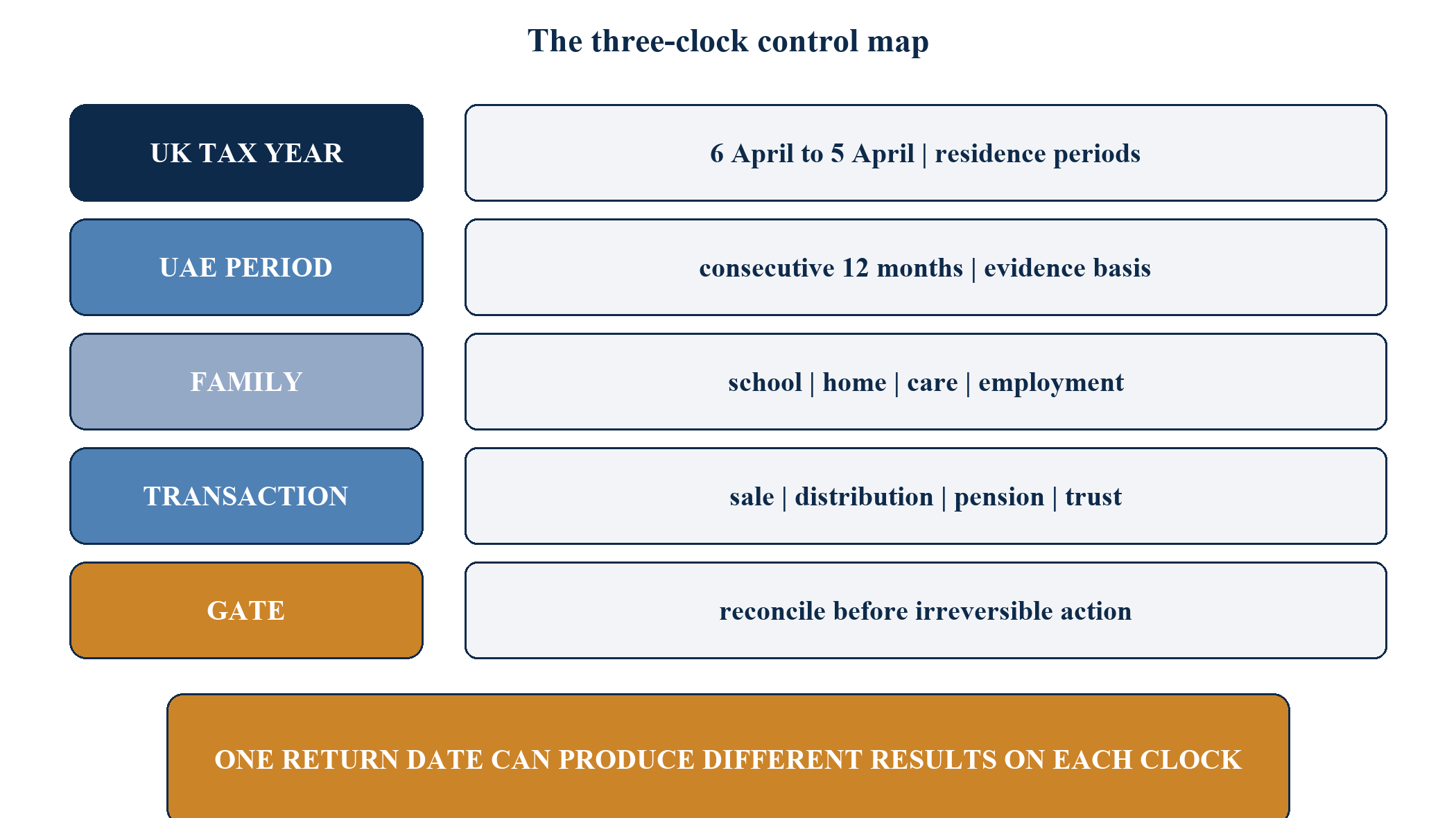
The SRT uses a defined sequence. The automatic overseas tests are considered before the automatic UK tests; if neither resolves the position, the sufficient-ties test applies [1-3]. A return plan should document the result rather than rely on a target day count in isolation. A UK home, full-time work, a family tie, accommodation, substantive UK workdays or prior residence can change the day threshold that produces residence.
An operational dashboard should calculate the position under multiple scenarios. It should record expected UK midnights, qualifying workdays, exceptional circumstances relied upon, homes available, family presence and previous residence history. The owner should update the dashboard after each material change. A forecast is an early-warning tool; the final conclusion depends on actual facts and the statutory rules for the completed tax year.
4.2 A residence conclusion is period-specific
Residence can change from one tax year to the next even when the family's broad lifestyle appears similar. The SRT looks at each year's facts and, for sufficient ties, at prior residence status. The return option should therefore store one signed factual schedule per tax year. It should separate a legal conclusion from the underlying evidence and list any assumptions that remain open.
| Test stage | Question | Return-planning control | Evidence owner |
|---|---|---|---|
| automatic overseas | does an automatic overseas test determine non-residence? | monitor days, overseas work and UK workdays | principal and tax team |
| automatic UK | does a day count, UK home or UK work test determine residence? | review housing and employment before commitment | tax and family leads |
| sufficient ties | do UK days and relevant ties produce residence? | maintain tie register and day-limit alerts | tax lead |
| split year | does a statutory arrival case divide the year? | identify qualifying case and deemed arrival date | tax adviser |
| treaty | if dual resident, how does the treaty allocate residence? | prepare homes, vital interests, habitual abode and nationality evidence | treaty specialist |
5. DAY COUNTS, WORKDAYS AND TIES
5.1 Count the right facts
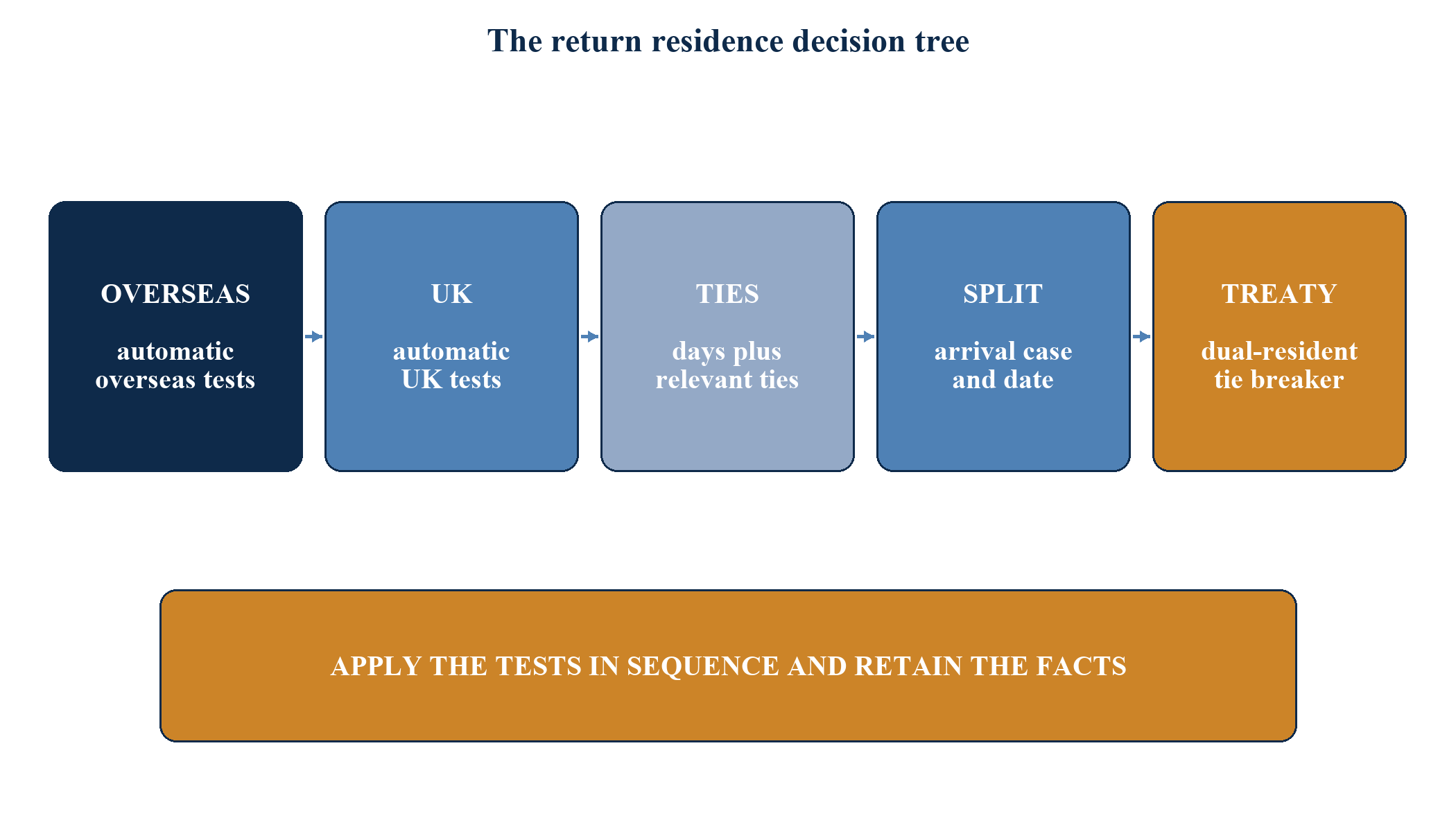
Most SRT day counting focuses on presence in the UK at midnight, subject to specific rules and exceptions. Workday concepts can use different measures, and treaty analysis may require evidence beyond midnight counts [1,2,40]. A robust travel log should contain entry and exit times, location at midnight, purpose, work hours, accommodation used and the evidence source. Airline records alone may omit land movements, changes and work activity.
5.2 Treat ties as controlled variables
The family tie, accommodation tie, work tie, 90-day tie and country tie can affect the sufficient-ties analysis. The exact relevance depends on prior residence and the number of UK days [1,2]. A house retained for optional use can be more significant than an investment property let on commercial terms. A few days of substantive UK work can change the work-tie evidence. A spouse or minor child returning first can alter the family analysis.
| Variable | Control evidence | Trigger for review | Owner |
|---|---|---|---|
| UK midnights | travel log reconciled to passport and bookings | forecast approaches internal limit | principal's office |
| UK workdays | calendar with hours and duty description | new board, advisory or executive activity | employment and tax leads |
| accommodation | title, tenancy, availability and actual use | lease ends, home acquired or family moves in | property lead |
| family location | residence and school or care timetable | spouse, partner or minor child changes base | family governance lead |
| prior presence | rolling 90-day record | travel pattern repeats across years | tax lead |
6. SPLIT-YEAR TREATMENT FOR THE ARRIVAL YEAR
6.1 Arrival cases are conditional
HMRC identifies five split-year cases for an individual who comes to the UK during a tax year, with priority rules where more than one case may apply [2,4]. The cases address circumstances such as beginning full-time work in the UK, ceasing full-time work overseas, accompanying a partner and starting to have a home in the UK [4,5]. Split-year treatment is statutory and conditional; it is not a general election available whenever a person moves mid-year.
6.2 The deemed arrival date matters
If a qualifying case applies, the overseas part ends and the UK part begins on the statutory date for that case. The date can differ from the first physical visit, property completion or public announcement. The return plan should model each plausible case before signing employment, occupying a UK home or moving family members. It should then retain evidence proving the conditions for the applied case.
| Arrival pattern | Possible analytical focus | Evidence needed | Planning caution |
|---|---|---|---|
| starts full-time UK work | statutory work conditions and start date | contract, duty calendar, work hours and location | preparatory work can matter |
| ceases full-time overseas work | prior overseas work and UK presence limits | historic work record, travel and cessation evidence | part-time transition may change the case |
| partner returns | partner's qualifying treatment and cohabitation | relationship, travel and residence records | different arrival dates need separate analyses |
| begins to have UK home | home availability, use and future residence | tenancy or title, occupation and overseas home evidence | an available home can precede the intended move |
7. TREATY RESIDENCE AND DUAL-RESIDENT PERIODS
7.1 Domestic residence comes first
The UK-UAE Double Taxation Convention defines residence for each contracting state and provides successive tie-breaker tests for an individual resident in both states under domestic law [6]. The sequence considers a permanent home, centre of vital interests, habitual abode, nationality and, if required, agreement between competent authorities. Treaty residence is relevant to treaty allocation and relief; it should not be used as a substitute for applying each domestic test.
7.2 Build a treaty evidence file
A treaty file should identify every permanent home, who uses it, where the family lives, where principal economic activities and investments are directed, the pattern of habitual abode and nationality. It should include UAE residence support and any Tax Residency Certificate, while recognising that a certificate does not decide every treaty fact [6-10]. The file should state the period to which each item relates and reconcile inconsistent addresses or household records.
| Treaty step | Factual question | Evidence | Escalation condition |
|---|---|---|---|
| permanent home | where is a home continuously available? | title or lease, utilities, availability and use | homes in both states |
| centre of vital interests | where are personal and economic relations closer? | family, role, business, investment and social record | mixed indicators |
| habitual abode | where does the person habitually stay? | multi-year day and overnight pattern | similar presence in both states |
| nationality | which state is the person a national of? | passports and nationality evidence | dual or neither nationality |
| mutual agreement | can competent authorities settle unresolved status? | complete domestic and treaty file | prior tests remain inconclusive |
8. TEMPORARY NON-RESIDENCE
8.1 The five-year boundary is a tax rule, not a lifestyle label
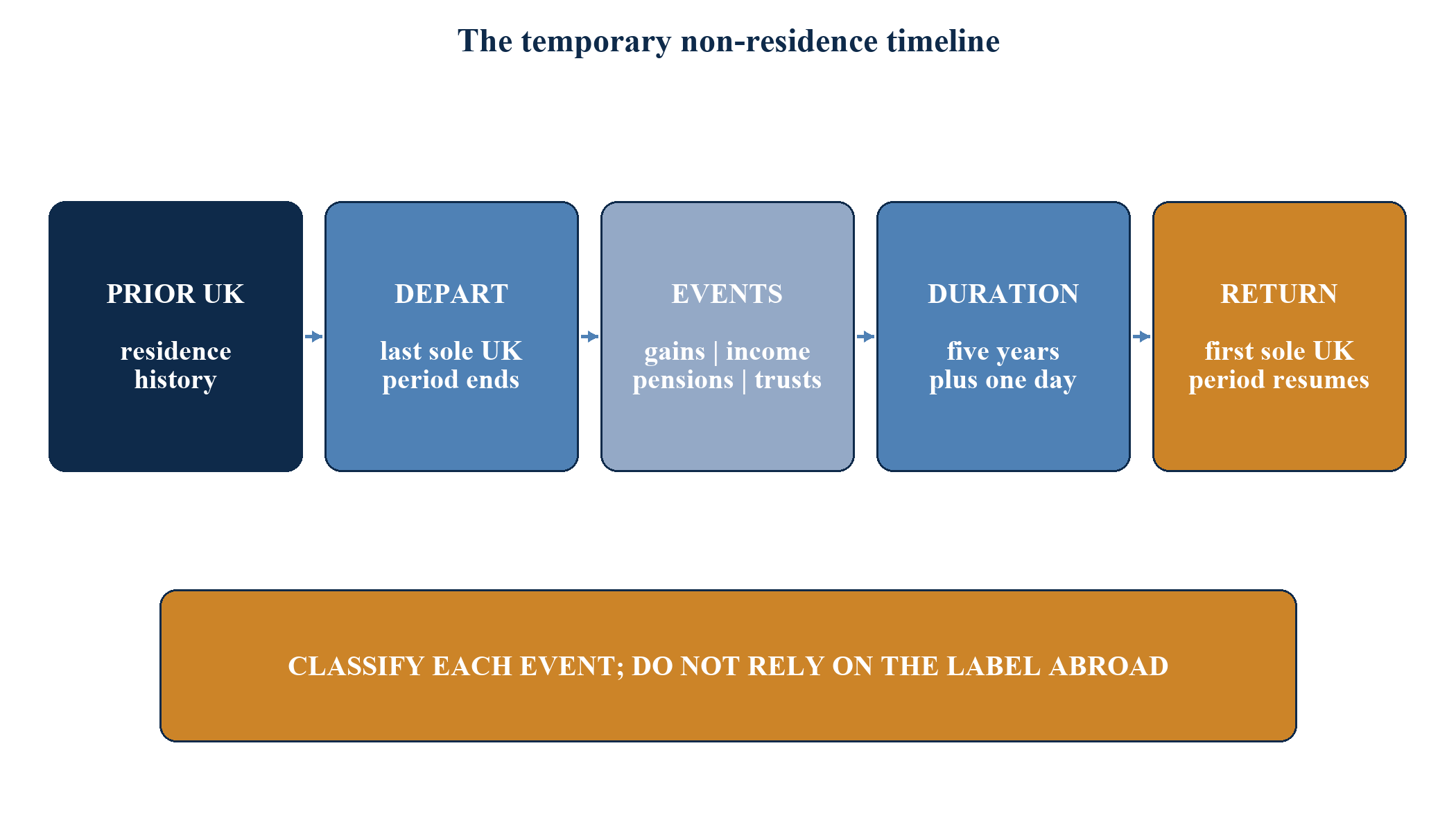
The temporary non-residence rules can apply where the individual had sufficient prior UK residence, has a period without sole UK residence and returns within the statutory duration [2,15-19]. Current HMRC guidance describes a period of non-residence lasting five years or less as potentially temporary; a period longer than five years, meaning five years plus one day, falls outside that duration condition [2]. The exact start and end depend on residence periods and split-year treatment, not simply departure and arrival flights [15].
8.2 Scope is item-specific
Temporary non-residence does not bring every item arising abroad into charge. It applies to specified categories and detailed conditions. HMRC's current guidance lists capital gains, offshore income gains, certain close-company distributions, specified pension amounts, chargeable-event gains, remitted historic foreign income and other items [2,16-19]. Each event needs its own statutory classification, acquisition history, ownership and timing.
| Step | Control question | Required record | Failure risk |
|---|---|---|---|
| prior residence | was the individual within the required prior-residence condition? | seven-year residence history and treaty status | incorrect assumption of exclusion |
| period start | when did the last sole UK residence period end? | departure-year and split-year analysis | wrong clock start |
| period end | when did sole UK residence resume? | return-year SRT, split-year and treaty analysis | wrong clock end |
| duration | was the period more than five years? | dated residence-period calculation | relying on tax-year labels only |
| item scope | is the income or gain a specified category? | asset-event ledger and source documents | over- or under-inclusion |
9. CAPITAL GAINS AND ASSET DISPOSALS DURING ABSENCE
9.1 Map the acquisition and disposal history
Current HMRC guidance provides that certain gains arising in a temporary period of non-residence can be treated as arising in the period of return [16,17]. The analysis can depend on the asset, acquisition timing, attribution rules and other charging provisions. A disposal should be recorded with acquisition date, ownership, cost, improvement expenditure, consideration, connected-party status, completion date, currency, foreign tax and use of proceeds.
9.2 UK land remains a separate exposure
Non-residents can be within UK tax and reporting rules for direct and certain indirect disposals of UK land [30-32]. A return-option plan therefore needs two analyses: the immediate non-resident property charge and reporting obligation, and the possible effect of temporary non-residence on other gains. UK property reporting can apply even when no tax is due or a loss arises [30,31].
| Asset event | Immediate question | Return question | Core evidence |
|---|---|---|---|
| sale of foreign operating company | was a gain outside current UK charge while non-resident? | can temporary non-residence attribute it to return? | acquisition, ownership, sale and residence records |
| sale of listed portfolio | which disposals and lots created gains or losses? | are gains within specified temporary rules? | custody statements and tax-lot ledger |
| sale of UK land | what non-resident CGT and reporting apply now? | does any further rule or relief affect return? | valuation, completion and filing evidence |
| trust or attributed gain | which attribution and matching rules apply? | does benefit or return create a UK charge? | trust accounts, distributions and advice |
10. CLOSE-COMPANY DISTRIBUTIONS AND FOUNDER LIQUIDITY
10.1 The post-departure dividend is not automatically outside UK tax
For individuals returning on or after 6 April 2026 after a temporary period of non-residence, current HMRC guidance states that the relevant close-company distribution charge can apply to the full amount, including amounts relating to trade profits arising during the temporary period, subject to the statutory conditions and foreign-tax credit rules [18]. The rule can also address payments routed through intermediaries where the purpose condition is met. Founder liquidity should therefore be modelled against the actual temporary non-residence position before declaration.
10.2 Separate commercial distribution policy from residence planning
A company should document why a dividend, redemption, capital reduction, buyback, loan release or sale consideration is commercially appropriate. The principal's personal residence planning should not replace corporate purpose, solvency, distributable-reserve and governance analysis. A return-option ledger should record the legal form, board decision, profit source, payment date, recipient, foreign tax and use of proceeds.
| Event | Corporate evidence | Individual evidence | Return review |
|---|---|---|---|
| dividend | accounts, reserves, board approval and voucher | receipt, ownership and foreign tax | close-company temporary rule |
| buyback or redemption | legal conditions, valuation and capital treatment | acquisition cost and proceeds | income or gains classification |
| loan release | loan account, approval and accounting | benefit and treaty position | specified temporary rule |
| business sale | sale agreement, completion and proceeds allocation | ownership, gain and receipt trail | capital gains and return timing |
11. PENSIONS, POLICIES AND HISTORIC FOREIGN INCOME
11.1 Pension events require product-level analysis
HMRC's current temporary non-residence guidance identifies specified pension withdrawals, lump sums and related benefits that can fall within the rules [19]. Treaty treatment, scheme type, member history, residence, payment form and foreign tax can affect the result. A decision to draw a pension during the UAE phase should therefore be documented at scheme and payment level rather than described as a generic offshore receipt.
11.2 Historic remittance-basis pools still need records
The remittance basis was replaced for current periods from 6 April 2025, but historic foreign income and gains, mixed funds and remittances can remain relevant [21,22]. Temporary non-residence can also interact with remittances of historic amounts [17]. The family should preserve bank account composition, nominations, transfers and designations even when the present return plan focuses on the new foreign income and gains regime.
| Item | Pre-event question | Evidence | Return-period question |
|---|---|---|---|
| pension withdrawal | what scheme and benefit type applies? | scheme terms, valuation, advice and payment statement | does a temporary rule or treaty provision apply? |
| insurance policy gain | what chargeable event and time apportionment applies? | policy history, premiums and insurer calculation | is the gain specified on return? |
| historic foreign income | when did it arise and was remittance basis claimed? | tax returns, bank composition and transfer record | was it remitted during temporary absence? |
| trust benefit | what is the legal and tax character of the benefit? | trust accounts, resolutions and matching analysis | does return or remittance alter the charge? |
12. THE FOUR-YEAR FOREIGN INCOME AND GAINS REGIME
12.1 Ten consecutive years create a different return profile
The four-year foreign income and gains regime is available to a qualifying new resident who meets the statutory non-residence history and makes the relevant claims [20-22]. Current guidance uses ten consecutive tax years of non-UK residence as the central history condition. A former UK resident can qualify after that period; nationality and domicile do not determine eligibility [20]. The relief period is limited and does not pause indefinitely when the individual becomes non-resident during it [21].
12.2 Relief is elective and has consequences
The regime is claim-based. A return plan should identify qualifying foreign income and gains, excluded categories, claims, loss of allowances or other consequences, and the interaction with employment reliefs and trusts. The family should not assume that all non-UK receipts are relieved. It should compare claiming relief with ordinary arising-basis treatment for each return year.
| Return history | Potential profile | Planning implication | Evidence |
|---|---|---|---|
| absence shorter than temporary threshold | possible temporary non-residence exposure | event-by-event return-year review | residence periods and asset events |
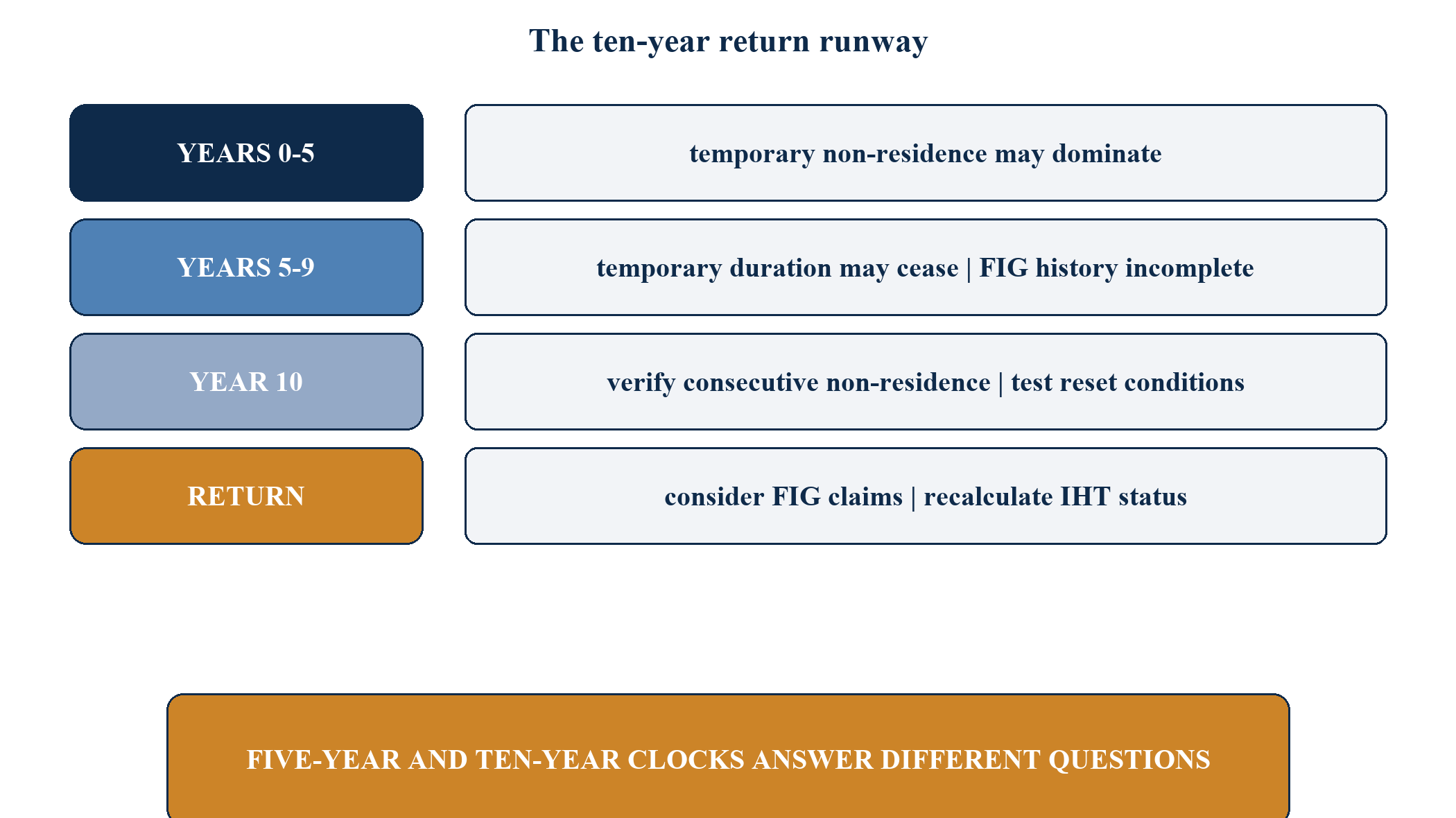
| more than five years but less than ten tax years | temporary rule may cease while FIG history is incomplete | worldwide arising basis normally relevant on return | continuous residence history |
| ten consecutive non-resident tax years | possible qualifying new-resident status | assess four-year FIG claims and IHT reset separately | ten-year SRT and treaty record |
| interrupted non-residence | history may not satisfy consecutive-year condition | recalculate from actual residence results | year-by-year residence conclusions |
13. INHERITANCE TAX AND THE LONG-TERM RESIDENCE TAIL
13.1 Departure does not necessarily end worldwide exposure
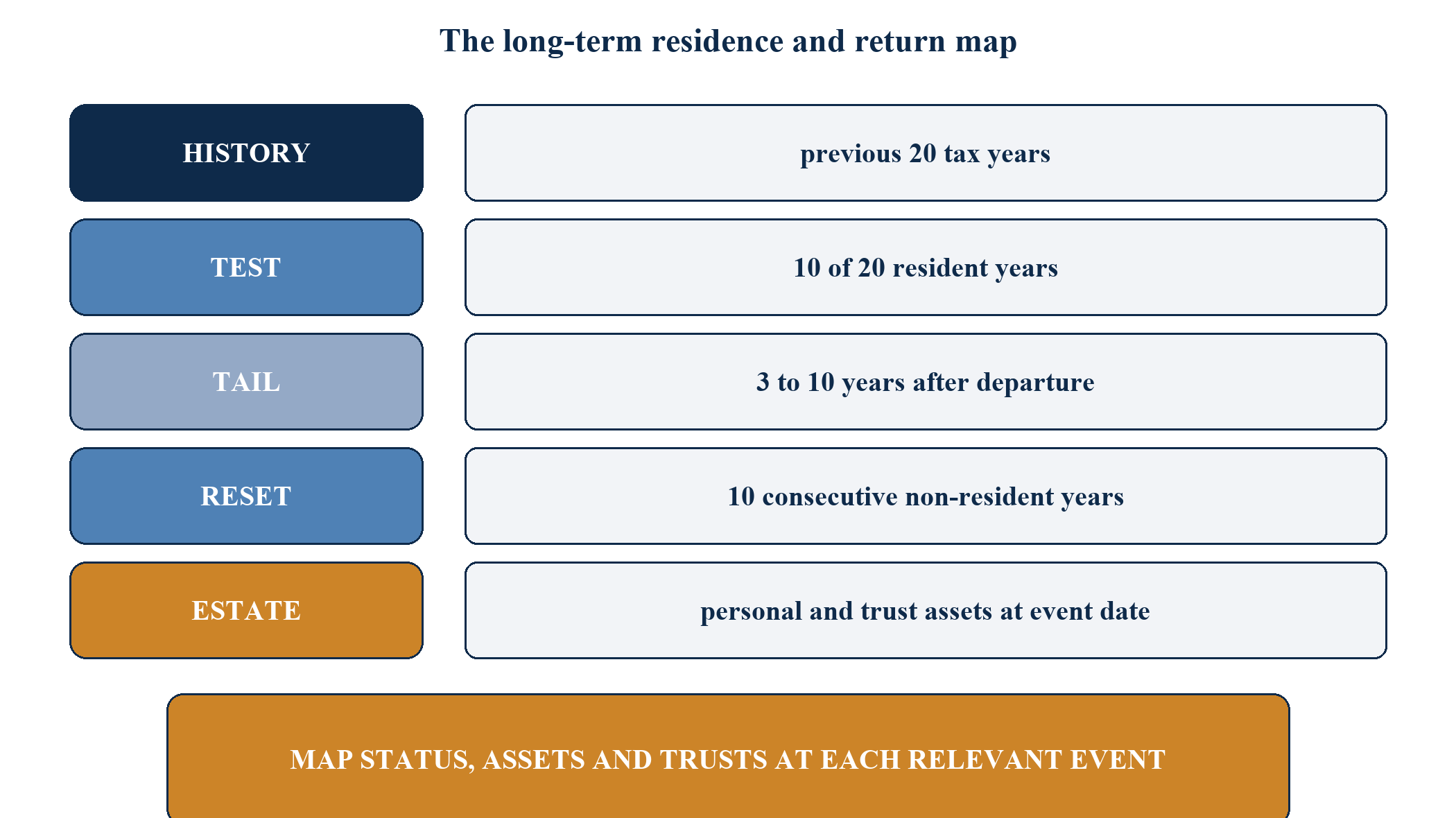
For relevant events from 6 April 2025, Inheritance Tax uses long-term UK residence instead of domicile as the principal test for overseas property [23-29]. Broadly, an individual can be long-term UK resident when resident for at least ten of the previous twenty tax years. A person leaving after a long UK history can remain within scope for overseas assets for a tail period that depends on that history, with a minimum of three and a maximum of ten tax years in the circumstances described by HMRC [23-25].
13.2 Return can extend or restart the residence count
A return before the tail expires may keep the individual within the long-term residence framework. Ten consecutive tax years of non-residence can reset the test so that the return year and later residence years count afresh [23,25]. This ten-year reset is distinct from the temporary non-residence duration and from eligibility for the four-year FIG regime, even though the ten-year history can be relevant to both FIG and IHT planning.
| Prior UK residence in relevant history | Illustrative HMRC tail description | Return-option control | Caution |
|---|---|---|---|
| 10 to 13 tax years | minimum three-year tail after leaving | test intended return against tail end | exact statutory years and transition rules matter |
| 14 to 19 tax years | tail increases with prior years | maintain annual residence and estate review | split years count for IHT residence history |
| 20 tax years | up to ten-year tail | treat worldwide estate exposure as continuing until verified | asset and trust mapping remains essential |
| ten consecutive non-resident years | long-term test can reset on return | document every year before claiming reset | any UK residence can break the sequence |
14. TRUSTS, SETTLEMENTS AND SUCCESSION STRUCTURES
14.1 Settlor status can affect foreign trust property
Current HMRC guidance links the IHT treatment of certain foreign settled property to the long-term residence status of the settlor, with transitional and trust-specific rules [23-29]. A return can therefore affect more than assets held personally. Trustees need the settlor's residence history, dates on which property entered the settlement, the situs and nature of assets, interests in possession, additions, distributions and relevant charge dates.
14.2 Preserve the trust chronology
The family office should maintain a trust chronology that distinguishes settlement, addition, investment, distribution, loan, benefit, death and return events. It should avoid describing a trust as permanently outside UK scope based only on the settlor's status at establishment. Current rules can examine status at later charge points, and other income and gains rules may apply independently.
| Trust fact | Why it matters | Primary evidence | Refresh trigger |
|---|---|---|---|
| settlor identity and residence history | long-term residence and attribution analysis | deed, additions and annual residence schedules | return or new residence conclusion |
| asset situs and character | excluded-property and UK-asset analysis | custody, title and valuation records | acquisition, disposal or migration |
| beneficiary and benefit record | income, gains and matching analysis | resolutions, accounts, loans and distributions | proposed benefit or return |
| charge history | periodic and exit-charge continuity | prior returns, calculations and advice | ten-year anniversary or asset leaving scope |
15. RETAINED UK HOMES AND PROPERTY
15.1 A home is both a residence fact and an investment asset
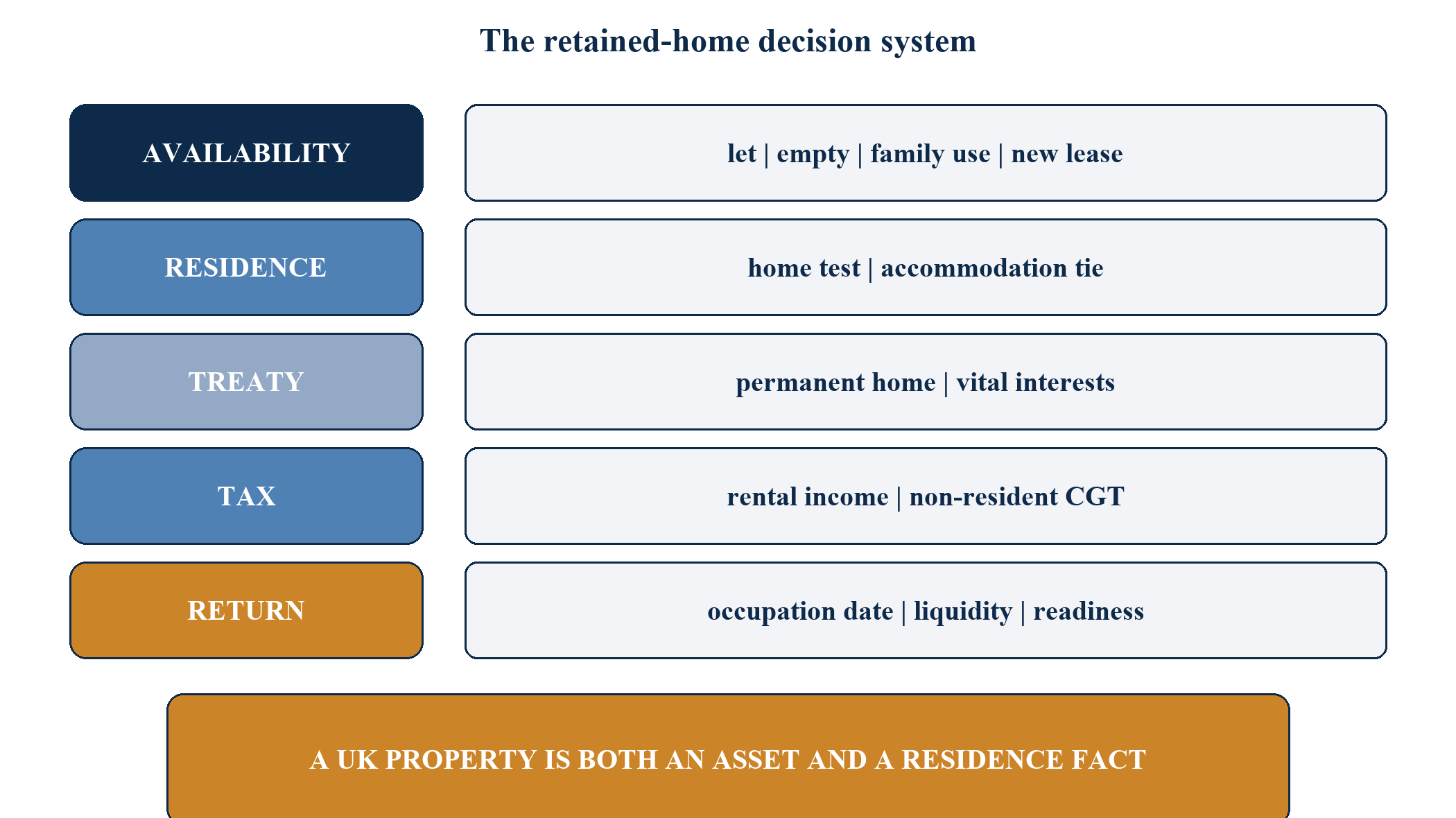
Retaining a UK property can preserve flexibility, rental income and family access. It can also affect the automatic UK home test, accommodation tie, treaty permanent-home analysis and practical arrival date [1,2,5-9]. A commercially let property may have a different availability profile from a home kept for personal use. The evidence should record tenancy terms, actual availability, occupation, family use and changes.
15.2 UK property tax continues during absence
UK rental income remains within UK tax even when the owner is non-resident, and the Non-Resident Landlord Scheme can govern collection [35,36]. Disposals of UK land can create non-resident CGT and reporting obligations [30,31]. The return plan should coordinate lease expiry, sale, refurbishment and occupation with the SRT and split-year analysis.
| Property strategy | Residence effect to test | Tax and operating control | Return flexibility |
|---|---|---|---|
| long commercial letting | availability and actual use | NRL scheme, agent, returns and maintenance | occupation depends on lease expiry |
| short or flexible letting | possible availability and frequent access | rental reporting and booking evidence | higher accidental-use risk |
| kept empty for family | home and accommodation tests | costs, security and documented use | immediate access with stronger residence implications |
| sold during absence | UK land reporting and gain | valuation, completion and filing | return requires new housing decision |
16. RETAINED UK BUSINESSES, ROLES AND CONTROL
16.1 Ownership can remain while duties move
A founder can retain shares in a UK company while changing employment, office, board responsibilities or day-to-day management. Each role should be analysed separately. UK workdays and employment duties can affect individual residence, while company residence, permanent establishment, payroll, director duties and corporate governance follow their own rules. The UK-UAE treaty also addresses enterprise residence and permanent establishments [6].
16.2 Governance should match actual conduct
The return option should document which decisions are taken in the UAE, which remain with UK management, how reserved matters operate and where records are kept. A director should not create artificial minutes that contradict actual decision-making. If a later return is contemplated, the company can maintain a succession and authority plan that allows management roles to change lawfully at the selected time.
| Role | Individual residence control | Corporate control | Evidence |
|---|---|---|---|
| passive shareholder | days, meetings and any work performed | shareholder reserved matters | cap table, votes and meeting record |
| non-executive director | UK duty hours and location | board composition and decisions | calendar, minutes and role description |
| executive founder | employment location and substantive work | operational authority and management | contract, delegation and decision log |
| investment committee member | meeting location and preparation work | mandate and voting rights | committee papers and attendance |
17. FAMILY, EDUCATION, CARE AND EMPLOYMENT TRIGGERS
17.1 Family facts can precede the principal's intended return
A spouse, partner or minor child may move to Britain before the principal. A school place, care requirement or UK home can change the sufficient-ties and split-year analysis [1,2,4,5]. The return option should therefore be a household plan rather than an individual travel budget. Each adult still needs an individual residence analysis, because family members can have different arrival dates, work and treaty positions.
17.2 Employment commitments create early facts
Signing a UK employment contract, beginning substantive duties, accepting a board mandate or developing a regular work pattern can affect the arrival analysis before a formal household move. The plan should identify the first duty, location, hours, employer, expected schedule and any overseas role being ceased. Preparatory work needs careful factual treatment.
| Trigger | Early evidence | Decision required | Owner |
|---|---|---|---|
| child begins UK school | enrolment, term and living arrangements | household residence and home review | family lead |
| spouse moves first | travel, work, home and cohabitation plan | separate SRT and split-year review | tax and family leads |
| care need arises | duration, location and accommodation | exceptional-circumstance and residence analysis | family and medical advisers |
| UK role accepted | contract, first duties and location | workday and split-year analysis | employment and tax leads |
| UK home becomes available | lease, completion or end of letting | home test and occupation control | property and tax leads |
18. UAE RESIDENCE, HOME AND CENTRE OF INTERESTS
18.1 Build evidence during the UAE phase
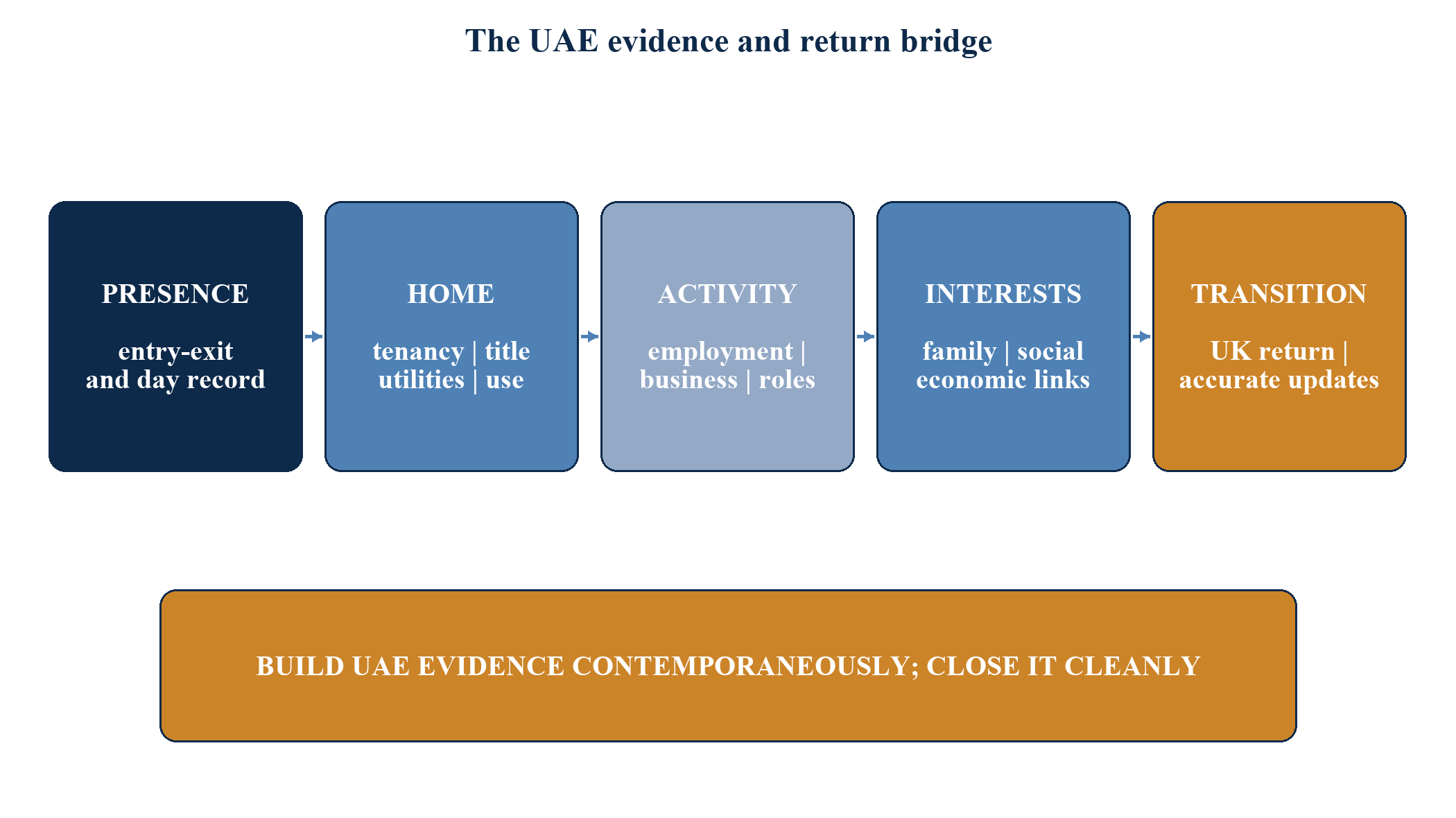
The UAE return option depends on the credibility of the UAE period. Current FTA guidance recognises multiple routes for natural-person tax residence and specifies supporting documents for presence, residence, employment, business and the centre of financial and personal interests [10-12]. A family should build the file contemporaneously: entry and exit reports, Emirates ID, visa, tenancy or title, utilities, employment or business evidence, family presence, memberships, accounts and professional activity.
18.2 Treaty evidence needs a coherent narrative
When both states' domestic rules are engaged, treaty analysis may ask where permanent homes, personal relations and economic relations are closer [6-9]. A UAE file that consists only of a visa and occasional hotel stays may not answer those questions. The narrative should reflect actual routine and avoid overstating exclusivity where the family deliberately maintains connections in both states.
| UAE proposition | Primary support | Corroboration | Return file use |
|---|---|---|---|
| physical presence | official entry and exit report | travel calendar and bookings | reconcile UK and UAE day counts |
| permanent home | tenancy, title and utilities | household records and actual use | domestic and treaty analysis |
| employment or business | contract, licence, invoices and work record | bank, payroll and client evidence | residence and corporate-tax analysis |
| centre of interests | family, social, business and investment record | memberships, accounts and governance | treaty tie-breaker evidence |
19. UAE BUSINESS ACTIVITY AND NATURAL-PERSON CORPORATE TAX
19.1 Personal investment income and business activity are different categories
Current FTA guidance states that a natural person is within UAE Corporate Tax for business or business activity conducted in the UAE when the applicable turnover threshold is exceeded; wages, personal investment income and real-estate investment income are excluded from that business-turnover calculation [33,34]. A principal who operates a consultancy, sole establishment or unincorporated business should distinguish those activities from private portfolio returns.
19.2 Close the UAE compliance period properly
A return to Britain does not remove UAE registration, filing, record, payment or deregistration obligations that arose during the UAE phase. The family office should identify the final calendar-year turnover, business assets, contracts, receivables, employees, licences and permanent establishment questions. The UK return analysis should then address whether the business continues, migrates, is sold or becomes managed from Britain.
| UAE activity | Classification question | Exit or return action | Evidence |
|---|---|---|---|
| private investment portfolio | does it remain personal investment income? | retain custody and mandate evidence | statements and investment policy |
| UAE consultancy | is it a taxable business activity above threshold? | final accounts, filings and contract transition | invoices, expenses and registration |
| real-estate investment | does it meet excluded investment criteria? | rental, sale and management review | title, leases and receipts |
| interest in UAE company | is income salary, dividend or business receipt? | board, payroll and distribution review | contracts, minutes and vouchers |
20. BANKING, CRS AND ADDRESS TRANSITIONS
20.1 Tax-residence self-certifications must change with facts
Financial institutions collect tax-residence self-certifications under the Common Reporting Standard and must consider whether information is reasonable in light of documentary evidence [13,14]. A return can change address, tax residence, controlling-person status and expected transaction geography. The family should notify institutions accurately and retain the effective date and evidence for each update.
20.2 Preserve banking continuity without inconsistent profiles
Maintaining UK and UAE accounts can support bills, investments and a future move. The profiles should still agree on residence, occupation, source of wealth and expected activity. A large transfer immediately before or after return should have a documented purpose, source, route and beneficiary. The banking plan should avoid simultaneous forms that describe the same period differently.
| Banking event | Required update | Evidence | Control |
|---|---|---|---|
| UAE arrival | address, residence, occupation and expected activity | visa, Emirates ID, home and work record | dated institution register |
| UK return decision | future address and intended status | SRT advice, housing and employment plan | pre-notification review |
| actual UK residence | current tax residence and controlling-person data | final residence facts and self-certification | coordinated account updates |
| material transfer | purpose, source and destination | transaction file and bank trail | pre-clearance where appropriate |
21. THE ASSET-EVENT LEDGER
21.1 One ledger connects departure, absence and return
The asset-event ledger records every material acquisition, disposal, distribution, loan, pension payment, trust benefit, remittance and ownership change during the absence. Its purpose is to support classification and chronology. It is not a tax return or a substitute for advice. Each entry should identify the asset or source, legal owner, event date, amount and currency, acquisition history, foreign tax, supporting documents and whether temporary non-residence, UK-source, trust or return-year rules require review.
21.2 Reconcile values to cash
Headline values often differ from net proceeds. A business sale can include debt repayment, escrow, rollover equity, earnout, fees and tax. A dividend can be declared in one period and paid in another. A trust distribution can include capital and income components. The ledger should reconcile gross value to the amount received and then to the account or asset in which the proceeds are held.
| Ledger field | Purpose | Minimum evidence | Reviewer |
|---|---|---|---|
| legal and beneficial owner | identify taxpayer and attribution path | register, deed, account or trust record | legal lead |
| acquisition and base cost | support gain and history | contract, statement and improvement record | tax lead |
| event and completion date | place event in residence period | agreement, resolution and settlement | transaction lead |
| gross-to-net bridge | reconcile economic value to receipt | completion statement and bank trail | CFO |
| return-rule flag | identify further analysis | documented issue classification | tax adviser |
22. LIQUIDITY AND CURRENCY FOR THE RETURN YEAR
22.1 Fund the move without forcing a taxable event
A return can require housing deposits, school fees, payroll transition, insurance, professional fees and working capital before UK banking and tax administration are fully updated. The family office should build a twelve-month liquidity plan using already available cash, contractual inflows and tested payment routes. It should avoid creating a rushed disposal or distribution solely because the operational plan was underfunded.
22.2 Currency management needs authority and evidence
Sterling requirements can be hedged or staged, but every instrument has counterparty, liquidity and documentation implications. The plan should record who may convert, hedge or transfer funds, the approved range, collateral requirements and the destination of proceeds. A modelled exchange rate is hypothetical and simplified; it should not be presented as a forecast.
| Liquidity bucket | Horizon | Eligible sources | Control |
|---|---|---|---|
| immediate return costs | 0 to 30 days | cash in verified accounts | dual approval and payment calendar |
| first-year living and tax reserve | 1 to 12 months | cash, deposits and scheduled income | separate reserve and monthly reconciliation |
| transaction commitments | contractual dates | committed facility or ring-fenced capital | covenant and draw-condition review |
| strategic portfolio | longer term | diversified investment assets | no forced sale without investment approval |
23. RETURN TRIGGERS AND DECISION RIGHTS
23.1 Define triggers before urgency arrives
Return triggers can be elective, conditional or emergency. Elective triggers include a planned operating role, family preference or investment opportunity. Conditional triggers include a child reaching a school stage, a business sale completing or an elderly relative requiring regular care. Emergency triggers include safety, serious illness or sudden loss of access. Each trigger should have an owner, evidence threshold, response time and pre-approved interim actions.
23.2 Separate activation from final residence outcome
An emergency journey does not automatically settle the final residence conclusion. It may still change day counts, accommodation and family facts, and exceptional-circumstance rules are limited and fact-specific [1,2]. The governance plan should activate travel and welfare controls immediately while reserving the tax conclusion for a factual review.
| Trigger class | Example | Activation authority | Required review |
|---|---|---|---|
| elective | UK role or voluntary family move | principal and governance body | full pre-return gate |
| conditional | school, sale, care or property milestone | named family-office committee | timing and scenario refresh |
| emergency | health, safety or access disruption | principal, deputy or crisis lead | immediate facts and day-count review |
| regulatory | licence, sanctions, tax or immigration change | legal and compliance leads | mandatory impact assessment |
24. FOUR RETURN PATHWAYS
24.1 Planned permanent return
The family selects a target date, secures housing, resolves employment and school arrangements, updates institutions and accepts the projected UK tax profile. The plan uses a pre-return gate at least twelve months in advance and a final gate before the first fact that could begin a UK residence period.
24.2 Trial year with controlled limits
The principal increases UK presence while attempting to remain non-resident. This pathway requires the strongest day, work, home and tie controls. It should have a hard stop well inside the legal limit because forecasts can change and ties may be misclassified.
24.3 Return after ten consecutive non-resident years
The family may seek the different profile created by a ten-year history, including potential FIG eligibility and an IHT residence reset [20-25]. The plan must prove each year's non-residence and avoid assuming that treaty non-residence or split-year treatment counts identically for every rule.
24.4 Emergency or involuntary return
The family prioritises safety and continuity, then performs a rapid residence and tax review. Existing governance, clean records and liquidity reserves reduce the need for improvised transactions. The plan should state which actions remain prohibited without specialist approval even during a crisis.
| Path | Primary objective | Main risk | Minimum gate |
|---|---|---|---|
| planned permanent return | orderly UK re-entry | timing and worldwide tax exposure | full asset, residence and liquidity review |
| controlled trial | preserve optionality | accidental residence through ties or work | live dashboard and conservative internal limits |
| ten-year return | enter with reset residence history where available | broken consecutive-year evidence | year-by-year signed residence record |
| emergency return | protect people and operations | decisions made before facts are known | crisis authority and rapid specialist review |
25. A HYPOTHETICAL RETURN MODEL
25.1 Model design
Consider a hypothetical and simplified family principal who left the UK after a long period of residence, established a genuine home and investment office in the UAE and retained a commercially let UK property. During the UAE phase, the principal sold part of a foreign business, received dividends from a closely controlled company and made no UK home available for personal use. The family is considering three return dates: after three years, after six years and after ten consecutive non-resident tax years.
The model assigns no tax rate and produces no tax bill. It scores four workstreams from zero to five: residence certainty, temporary non-residence exposure, IHT history and operating readiness. A score of five means the factual file is complete and the relevant issue has been analysed; it does not mean tax is nil. The purpose is to identify where a decision needs evidence or professional analysis.
| Workstream | Return after 3 years | Return after 6 years | Return after 10 years | Required action |
|---|---|---|---|---|
| SRT and split year | target date and ties unresolved | target date modelled | target date modelled | complete arrival-case analysis |
| temporary non-residence | likely central review | duration condition may no longer apply | duration condition may no longer apply | classify every material event |
| FIG eligibility | ten-year history absent | ten-year history absent | possible if all years qualify | verify consecutive history and claims |
| IHT long-term residence | tail or renewed residence may apply | history must be recalculated | reset may be available | map estate and trusts at return date |
| operations | UK home and role transition needed | transition plan funded | transition plan funded | approve authority, liquidity and institution updates |
25.2 Interpretation
The three-year return may maximise personal flexibility while creating the most extensive temporary non-residence review. The six-year return can fall outside that duration condition while still lacking the ten-year history for FIG and IHT reset purposes. The ten-year return can create a different entry profile if every intervening year is genuinely non-resident, but it also requires the longest operational and evidential discipline. None of the paths is universally superior. The correct choice depends on family objectives, asset events and facts.
26. BEFORE DEPARTURE: BUILD THE RETURN FILE
26.1 Freeze the opening position
Before leaving, the principal should create an opening residence, asset and governance file. It should contain the prior seven-year residence history needed for temporary non-residence analysis, the twenty-year history relevant to long-term residence, current homes and ties, asset acquisition records, company reserves, trust chronology, pension details and historic remittance-basis pools. Missing records should be identified while UK institutions and advisers can still retrieve them efficiently.
26.2 Approve a provisional return policy
The family governance body should define likely return triggers, internal day limits, prohibited events without review, annual reporting and who may approve an emergency variation. The policy should state that tax outcomes are not guaranteed and that legal limits override internal dashboards.
| Before-departure deliverable | Contents | Owner | Approval evidence |
|---|---|---|---|
| residence baseline | seven- and twenty-year history, homes, work and ties | tax lead | signed factual schedule |
| asset baseline | ownership, base cost, reserves, trusts, pensions and historic pools | CFO and legal lead | reconciled asset register |
| UAE implementation plan | visa, home, activity, governance and banking | family-office COO | board or family resolution |
| return policy | triggers, limits, roles and review gates | governance body | approved policy and deputies |
27. DURING THE UAE PHASE: MAINTAIN THE OPTION
27.1 Run an annual residence close
At each 5 April, the family should close the UK tax-year record: actual days, workdays, homes, ties, exceptional circumstances, treaty facts and any split-year relevance. At the end of the selected UAE twelve-month period, it should close the UAE evidence file and determine whether a Tax Residency Certificate is needed [10-12]. The two schedules should reconcile.
27.2 Review every material event before execution
The asset-event ledger should be reviewed before a business sale, dividend, buyback, pension withdrawal, trust benefit, large remittance, UK property sale or ownership change. The review identifies immediate tax, reporting and banking requirements and flags consequences if the principal returns within a specified period. Advice should be refreshed when the return date changes.
| Ongoing control | Frequency | Evidence | Escalation |
|---|---|---|---|
| day and work dashboard | weekly during UK travel | reconciled travel and calendar | projected internal limit reached |
| residence close | annually after 5 April | signed SRT and treaty schedule | facts or advice unresolved |
| UAE evidence close | selected twelve-month period | FTA-aligned supporting pack | residence basis incomplete |
| asset-event review | before each material event | issue memo and source documents | temporary or trust rule may apply |
| return-policy review | annually and on trigger | updated scenario and approvals | target date or family facts change |
28. TWELVE MONTHS BEFORE RETURN
28.1 Open the pre-return gate
The pre-return gate should begin before a home, role or school commitment becomes irreversible. It confirms the intended arrival pathway, UK and UAE residence results, temporary non-residence duration, asset events, IHT history, FIG eligibility, treaty position, trust exposure, property plan, liquidity and institution updates. Open items receive owners and deadlines.
28.2 Run a transaction standstill where needed
If the family is considering a material distribution, disposal, pension withdrawal or trust benefit near return, the governance body may require a short standstill until classification and timing are approved. This is a control, not an assumption that deferral is beneficial. Commercial need, market risk, fiduciary duties and legal constraints remain relevant.
| Gate question | Pass evidence | Conditional pass | Fail condition |
|---|---|---|---|
| residence date | written SRT, split-year and treaty analysis | limited open travel variables | target date inconsistent with facts |
| temporary rules | complete event classification | documented advice pending on immaterial item | material event unanalysed |
| estate and trusts | current long-term residence and trust map | valuation update pending | ownership or settlor history missing |
| liquidity | twelve-month sterling plan and tax reserve | committed facility subject to routine condition | forced transaction required |
| operations | homes, roles, schools, mandates and institution plan | staged updates with owners | authority or banking continuity unresolved |
29. THE FIRST NINETY DAYS AFTER RETURN
29.1 Confirm facts rather than forecasts
The first ninety days should convert the return forecast into a factual record. The file should confirm actual arrival, home availability and occupation, employment duties, family presence, UK and overseas travel, UAE business changes, account updates and material payments. If split-year treatment is expected, the evidence for the applied case should be secured while records are current [4,5].
29.2 Complete tax and institution onboarding
A returning individual may need to register for Self Assessment and report UK and foreign income or gains according to the applicable rules [37-39]. Banks and other institutions should receive accurate residence and address updates. UAE licences, payroll, company roles, leases and tax registrations should be closed or maintained according to actual continuing activity.
| Period | Priority actions | Output | Owner |
|---|---|---|---|
| days 0 to 10 | confirm arrival facts, housing, work and family status | signed return fact sheet | principal's office and tax lead |
| days 11 to 30 | update banks, employers, companies and providers | institution update register | COO and compliance lead |
| days 31 to 60 | close UAE operational changes and reconcile transfers | UAE continuity or closure pack | UAE operations lead |
| days 61 to 90 | refresh tax calculations, liquidity and estate map | post-return review memorandum | tax, legal and investment leads |
30. GOVERNANCE CHECKLIST, LIMITATIONS AND CONCLUSION
30.1 Relocation governance checklist
The return option should be governed through a small set of permanent records: year-by-year residence conclusions, a dual day-count calendar, an asset-event ledger, a trust and ownership chronology, a long-term residence schedule, a return-trigger register, a liquidity plan, an institution update register and a decision log. Each record needs a named owner, reviewer, effective period and refresh trigger.
The governing body should review the return option at least annually and whenever a trigger occurs. It should distinguish what has happened from what is intended, what is legally concluded from what is modelled, and which items require external advice. Sensitive records should be shared only for a defined purpose through secure channels.
30.2 Limitations
This framework cannot determine a person's residence, tax liability, treaty entitlement or succession outcome. The law can change; HMRC and FTA guidance can be updated; treaties can be modified; and facts can produce results that a simplified model does not capture. Trusts, pensions, carried interest, companies, partnerships, immigration status, employment and financial products can introduce additional rules. Scores and timelines in this paper are hypothetical and simplified.
30.3 Conclusion
A successful UAE relocation preserves the integrity of the UAE phase and creates an orderly path for any later return. The return option is built through contemporaneous evidence, separate statutory clocks, event-level analysis, conservative operational limits and clear decision rights. A short return, a six-year return and a ten-year return can have materially different consequences. The family should choose with a complete chronology and a clear view of what the selected date changes.
The practical objective is controlled choice. The principal can respond to family, commercial and personal priorities without allowing an unplanned home, work pattern, distribution or journey to decide the outcome first. The result is a relocation that remains credible in both directions.
APPENDIX A. RETURN-OPTION DECISION TREE
Start with the intended return date and apply the UK SRT for the relevant tax year. Test each possible split-year arrival case and determine whether domestic UAE residence also continues for any part of the period. If both states' domestic tests apply, prepare the treaty tie-breaker file. Establish the temporary non-residence start, end and duration. Classify every material asset event during the absence. Calculate the IHT long-term residence history and any tail or reset. Test FIG eligibility after ten consecutive non-resident years. Approve homes, work, family, liquidity and institution updates only after the legal and operational gates agree.
APPENDIX B. RELOCATION GOVERNANCE CHECKLIST
| Control | Minimum evidence | Owner | Status question |
|---|---|---|---|
| UK residence history | annual SRT and treaty conclusions | tax lead | are all relevant years signed and supported? |
| UAE residence history | entry-exit, home, activity and TRC pack | UAE lead | does the evidence match actual routine? |
| temporary non-residence | start, end, duration and event analysis | tax adviser | is every specified event classified? |
| IHT long-term residence | twenty-year schedule, tail and reset | estate-planning lead | are personal and trust assets mapped? |
| asset-event ledger | acquisitions, disposals, distributions and receipts | CFO | does gross value reconcile to cash? |
| return triggers | elective, conditional, emergency and regulatory triggers | governance body | is activation authority current? |
| liquidity | twelve-month sterling and tax reserve | treasury lead | can return proceed without a forced event? |
| institutions | banks, employers, companies, trustees and providers | COO | are updates sequenced and consistent? |
APPENDIX C. QUESTIONS FOR THE PRE-RETURN REVIEW
Which UK tax year and arrival date are being considered? Which automatic and sufficient-ties tests apply? Is split-year treatment available, and under which case? Does domestic UAE residence continue for any overlapping period? Is treaty residence relevant? When did the last period of sole UK residence end? Will the absence exceed five years plus one day? Which gains, close-company distributions, pensions, policy gains, trust benefits or remittances arose during the absence? How many consecutive non-resident tax years have elapsed? Does the individual qualify for the four-year FIG regime? What is the current IHT long-term residence and tail position? Which UK homes, property income, roles, family arrangements and workdays will exist? What changes are required to UAE companies, licences, accounts and tax registrations? Has every bank and CRS self-certification been scheduled for update? Is sufficient sterling liquidity available without an unreviewed transaction?
REFERENCES
[1] HM Revenue and Customs, RDR3: Statutory Residence Test, updated 11 June 2026. https://www.gov.uk/government/publications/rdr3-statutory-residence-test-srt
[2] HM Revenue and Customs, RDR3 Statutory Residence Test notes, updated 2026. https://www.gov.uk/government/publications/rdr3-statutory-residence-test-srt/guidance-note-for-statutory-residence-test-srt-rdr3
[3] HM Revenue and Customs, Residence and FIG Regime Manual: Statutory Residence Test overview. https://www.gov.uk/hmrc-internal-manuals/residence-and-fig-regime-manual/rfig20000
[4] HM Revenue and Customs, RFIG21030, Split-year treatment and priority rules, updated 3 July 2026. https://www.gov.uk/hmrc-internal-manuals/residence-and-fig-regime-manual/rfig21030
[5] HM Revenue and Customs, RFIG21280, Split-year Case 8, updated 3 July 2026. https://www.gov.uk/hmrc-internal-manuals/residence-and-fig-regime-manual/rfig21280
[6] HM Revenue and Customs, 2016 UK-UAE Double Taxation Convention. https://www.gov.uk/government/publications/united-arab-emirates-tax-treaties/2016-uk-uae-double-taxation-convention
[7] HM Revenue and Customs, United Arab Emirates tax treaties and synthesised MLI text. https://www.gov.uk/government/publications/united-arab-emirates-tax-treaties
[8] HM Revenue and Customs, HS302 Dual residents, updated 6 April 2026. https://www.gov.uk/government/publications/dual-residents-hs302-self-assessment-helpsheet/dual-residents-2024-hs302
[9] HM Revenue and Customs, INTM154020, Double taxation agreements and dual residents, updated 24 July 2026. https://www.gov.uk/hmrc-internal-manuals/international-manual/intm154020
[10] UAE Federal Tax Authority, Issuance of Tax Certificates for Tax Residency, updated 2026. https://tax.gov.ae/en/services/issuance.of.tax.certificates.aspx
[11] UAE Federal Tax Authority, Tax Resident and Tax Residency Certificate, TPGTR1. https://tax.gov.ae/Datafolder/Files/Guides/VAT/VAT%20Guides/Tax-Resident-and-TRC--18-10-2024.pdf
[12] UAE Cabinet Decision No. 85 of 2022 on Determination of Tax Residency. https://www.tax.gov.ae/Datafolder/Files/Legislation/Corporate%20Tax/Cabinet%20Decision%2085%20of%202022%20-%20For%20publishing.pdf
[13] OECD, Guidance Notes for the Common Reporting Standard: United Arab Emirates. https://www.oecd.org/content/dam/oecd/en/topics/policy-issue-focus/aeoi/uae-guidance.pdf
[14] OECD, Common Reporting Standard individual self-certification form. https://www.oecd.org/content/dam/oecd/en/topics/policy-issue-focus/aeoi/crs_individual_self-cert_form.pdf
[15] HM Revenue and Customs, RFIG21550, Meaning of year of departure and period of return, updated 3 July 2026. https://www.gov.uk/hmrc-internal-manuals/residence-and-fig-regime-manual/rfig21550
[16] HM Revenue and Customs, RFIG21630, Temporary non-residence: capital gains and offshore income gains, updated 3 July 2026. https://www.gov.uk/hmrc-internal-manuals/residence-and-fig-regime-manual/rfig21630
[17] HM Revenue and Customs, HS278 Temporary non-residents and Capital Gains Tax 2026. https://www.gov.uk/government/publications/temporary-non-residents-and-capital-gains-tax-hs278-self-assessment-helpsheet/hs278-temporary-non-residents-and-capital-gains-tax-2026
[18] HM Revenue and Customs, RFIG21600, Distributions from closely controlled companies, updated 3 July 2026. https://www.gov.uk/hmrc-internal-manuals/residence-and-fig-regime-manual/rfig21600
[19] HM Revenue and Customs, RFIG21580, Temporary non-residence: pension income, updated 3 July 2026. https://www.gov.uk/hmrc-internal-manuals/residence-and-fig-regime-manual/rfig21580
[20] HM Revenue and Customs, RFIG44000, FIG regime: qualifying new resident, updated 3 July 2026. https://www.gov.uk/hmrc-internal-manuals/residence-and-fig-regime-manual/rfig44000
[21] HM Revenue and Customs, Check if you can claim the four-year foreign income and gains regime. https://www.gov.uk/guidance/check-if-you-can-claim-the-4-year-foreign-income-and-gains-regime
[22] HM Revenue and Customs, RDRM76100, Interaction between the FIG regime and temporary repatriation facility, updated 7 April 2026. https://www.gov.uk/hmrc-internal-manuals/residence-domicile-and-remittance-basis/rdrm76100
[23] HM Revenue and Customs, Inheritance Tax if you are a long-term UK resident. https://www.gov.uk/guidance/inheritance-tax-if-youre-a-long-term-uk-resident
[24] HM Revenue and Customs, IHTM47001, Introduction to long-term UK residence, updated 7 April 2026. https://www.gov.uk/hmrc-internal-manuals/inheritance-tax-manual/ihtm47001
[25] HM Revenue and Customs, IHTM47020, Long-term UK residence test, updated 7 April 2026. https://www.gov.uk/hmrc-internal-manuals/inheritance-tax-manual/ihtm47020
[26] HM Revenue and Customs, IHTM47023, Charges on 6 April 2025. https://www.gov.uk/hmrc-internal-manuals/inheritance-tax-manual/ihtm47023
[27] HM Revenue and Customs, Trusts and Inheritance Tax. https://www.gov.uk/guidance/trusts-and-inheritance-tax
[28] UK Parliament, Finance Act 2025. https://www.legislation.gov.uk/ukpga/2025/8/contents
[29] UK Parliament, Finance Act 2026. https://www.legislation.gov.uk/ukpga/2026/11/contents
[30] HM Revenue and Customs, Capital Gains Tax for non-residents disposing of UK property or land, updated 13 January 2026. https://www.gov.uk/guidance/capital-gains-tax-for-non-residents-uk-residential-property
[31] HM Revenue and Customs, HS307 Non-resident Capital Gains for land and property in the UK, 2026. https://www.gov.uk/government/publications/non-resident-capital-gains-for-land-and-property-in-the-uk-self-assessment-helpsheet-hs307
[32] HM Revenue and Customs, CG25799, Arrival, departure and split years, updated 24 July 2026. https://www.gov.uk/hmrc-internal-manuals/capital-gains-manual/cg25799
[33] UAE Federal Tax Authority, Basis of Taxation: Natural Person. https://tax.gov.ae/en/taxes/corporate.tax/corporate.tax.topics/basis.of.taxation.natural.person.aspx
[34] UAE Federal Tax Authority, Corporate Tax Registration, updated 25 June 2026. https://tax.gov.ae/en/services/corporate.tax.registration.aspx
[35] HM Revenue and Customs, PIM4810, Non-resident landlord scheme, updated 21 May 2026. https://www.gov.uk/hmrc-internal-manuals/property-income-manual/pim4810
[36] HM Revenue and Customs, Apply as an individual to receive UK rental income without tax deducted. https://www.gov.uk/guidance/apply-as-an-individual-to-receive-uk-rental-income-without-uk-tax-deducted
[37] HM Revenue and Customs, Tax if you return to the UK. https://www.gov.uk/tax-return-uk
[38] HM Revenue and Customs, Self Assessment tax return guidance for 2026. https://www.gov.uk/guidance/how-to-complete-your-self-assessment-tax-return-for-last-tax-year
[39] HM Revenue and Customs, Residence and foreign income and gains Self Assessment forms and helpsheets. https://www.gov.uk/government/collections/self-assessment-helpsheets-residence-and-remittance-basis
[40] HM Revenue and Customs, RDR1 Guidance note: residence, domicile and record keeping. https://www.gov.uk/government/publications/residence-domicile-and-remittance-basis-rules-uk-tax-liability/guidance-note-for-residence-domicile-and-the-remittance-basis-rdr1
ABOUT THE AUTHOR
Chennakeshav Adya is an independent researcher and corporate finance practitioner with more than twenty years of international experience across business strategy, transformation, investment banking, family-office operations, risk, technology and cross-border transactions. His research focuses on practical decision systems for private capital, banking relationships, corporate finance and emerging technology. The views expressed in this paper are his own and do not constitute investment, legal, tax, regulatory or compliance advice.
