

1. Establish the revenue acceleration office as a decision system
A revenue acceleration office should begin with a written mandate. Its purpose is to turn the investment case into a limited set of commercial decisions, actions and evidence that can be governed every week. It is neither a reporting layer nor a substitute for sales leadership. It is the operating mechanism through which management aligns strategy, sales, marketing, pricing, product, delivery, finance, legal and data owners around the same revenue outcomes.
The mandate should identify the value hypothesis, decision horizon, markets in scope, products and services in scope, customer cohorts, baseline period, financial definitions and reserved decisions. It should specify who can change target markets, approve commercial experiments, allocate coverage, change prices, accept contractual risk, revise forecasts and recognise benefits. The office needs authority to stop unsupported activity as well as coordinate new activity.
The investment thesis should be translated into a causal evidence chain. Capital may fund capability, capacity, market access, acquisition integration, product development or working capital. Each funded input needs an intended commercial capability, observable customer behaviour, operating output and financial result. A chain that jumps from hiring salespeople to enterprise value conceals the assumptions that management must test.
The office should retain an immutable view of the original investment case and a controlled current view. Revisions are expected as evidence changes. Each revision should state what changed, why it changed, the evidence, the decision owner and the consequence for resources and benefits. This makes adaptation accountable.
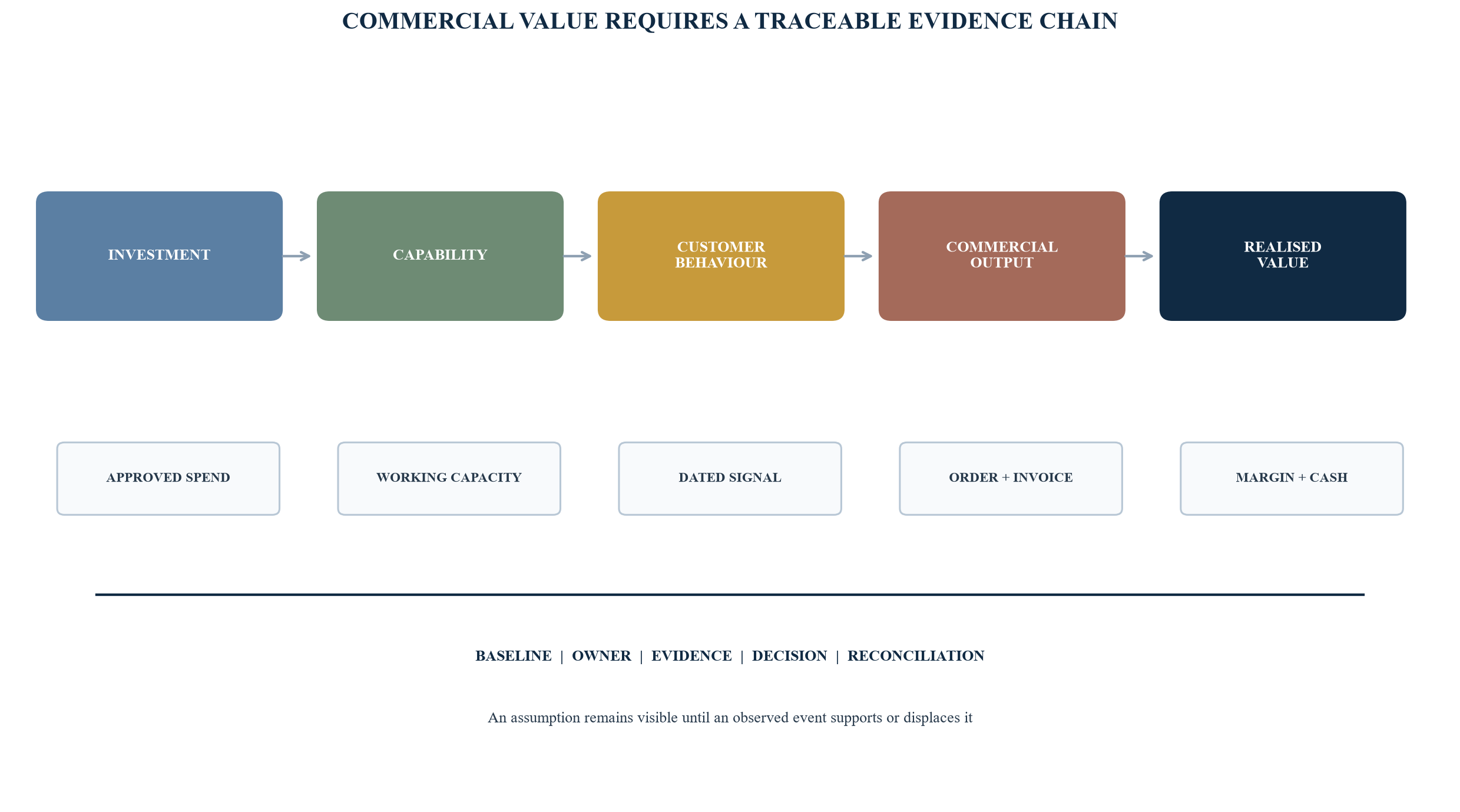
The chain is a management model. Each transition requires defined evidence, ownership and reconciliation.
Table 1. Revenue baseline evidence register
| Domain | Minimum evidence | Baseline decision | Control question |
|---|---|---|---|
| market | named geography, sector, customer problem and reachable demand | which markets are included | Can the market claim be traced to dated external or customer evidence? |
| account | legal entity, group relationship, owner and current relationship | which accounts are addressable | Are duplicates, conflicts and restricted accounts resolved? |
| pipeline | opportunity, need, decision process, value, timing and next action | which opportunities qualify | Does each stage contain the required customer evidence? |
| pricing | offer, unit, list or reference price, concessions and approval | which price basis applies | Can the quoted economics be reconstructed? |
| revenue | contract, obligation, transaction price, invoice and recognised amount | which revenue measure is reported | Does the management view reconcile to finance? |
| contribution | variable cost, service burden, channel economics and expected loss | which contribution definition applies | Are allocations and estimates separately identified? |
| cash | payment terms, invoice date, collection and dispute | which cash outcome is attributed | Is collection linked to the underlying commercial action? |
Definitions should reconcile to controlled systems and applicable accounting policies.
2. Reconcile the investment thesis to a controlled baseline
Management needs a baseline before it claims acceleration. The baseline should capture historical revenue, gross contribution, bookings, qualified pipeline, conversion, sales-cycle duration, retention, expansion, pricing realisation, collection and commercial cost. It should identify source systems, cut-off dates, currencies, acquisitions, discontinued activities, exceptional contracts and data gaps.
IFRS 15 establishes principles for revenue arising from contracts with customers, including identification of performance obligations, determination of transaction price and recognition when obligations are satisfied.[1] A commercial dashboard may use bookings, annualised contract value or pipeline measures that are not IFRS revenue. Those measures require distinct names, written definitions and a reconciliation path. IFRS 18 also introduces requirements relevant to qualifying management-defined performance measures, including descriptions, calculation methods and reconciliations.[2]
The baseline should preserve cohort structure. New customers, existing customers, acquired customers, renewals, expansions, products, channels and geographies can respond differently to the same intervention. A blended total can show growth while a strategically important cohort deteriorates. Cohorts need stable entry dates and definitions so management can compare like with like.
Baseline adjustments should be governed. Foreign exchange, acquisitions, disposals, price changes, capacity constraints, supply interruption and one-off contracts may justify analytical views, but each adjustment should be shown beside the reported result. A bridge that removes every adverse event ceases to measure performance.
3. Select markets through reachable economics
Market focus should connect a customer problem to an economically reachable set of accounts. A broad industry label does not define a market. The office should state the specific problem, triggering event, buyer, users, decision criteria, budget source, alternatives, route to access, service requirements and time to value.
The accessible market should be built from named accounts or defensible account populations. Each population needs an inclusion rule and evidence source. Management should distinguish total theoretical demand from demand the business can reach with current permissions, relationships, capability, capacity and time. Competitive intensity, procurement structure, local presence, language, certification, data residency and channel dependence affect reachability.
Account prioritisation should combine expected value, probability of access, urgency, strategic fit, cost to serve, delivery feasibility and concentration risk. Scores are decision aids. Their inputs should remain visible, with categorical evidence where numerical precision is unsupported. A lower-scoring account may receive coverage because it provides learning, a reference, diversification or entry into a valuable network. The reason and investment limit should be explicit.
Market decisions should have review dates. A market can remain attractive while the business lacks a credible route to win. The office should define evidence that supports continued investment, evidence that triggers redesign and evidence that stops activity. This prevents commercial resources from becoming permanently attached to an appealing narrative.

Placement and thresholds are illustrative. Account decisions require current customer, delivery, risk and economic evidence.
Table 2. Account coverage and action matrix
| Coverage tier | Required evidence | Minimum action | Exit or redesign trigger |
|---|---|---|---|
| priority | named problem, credible access, value potential, owner and delivery fit | account plan, stakeholder map and dated next action | no validated problem or access after defined learning period |
| develop | attractive problem and economics with incomplete access | access hypothesis, sponsor route and bounded test | repeated failed access or unavailable capability |
| selective | clear demand with limited economics or strategic value | standard offer and controlled service level | exception burden exceeds approved economics |
| monitor | weak timing or incomplete evidence | trigger watch and periodic evidence refresh | no credible trigger by review date |
| restricted | legal, conflict, credit, sanctions, capacity or reputation concern | no action outside reserved approval | restriction remains until competent owner clears it |
The office should set capacity limits and review dates for every coverage tier.
4. Convert pipeline stages into evidence gates
A pipeline stage should describe an evidenced change in the customer's decision process. Activities such as sending a proposal, holding an internal meeting or updating a record do not prove customer progression. Each stage needs an entry criterion, exit criterion, mandatory evidence, maximum ageing expectation and disqualification rule.
The earliest stage may require a named account, identifiable problem and lawful basis for contact. A qualified stage can require direct confirmation of the problem, consequence, stakeholders and decision route. A solution stage can require agreement on scope and evaluation criteria. A commercial stage can require an issued proposal, confirmed procurement path and identified objections. A commit category requires stronger evidence than optimism: customer-confirmed timing, final decision authority, legal and procurement status, delivery readiness and a dated action that can change the outcome.
Sabnis and colleagues studied the disposition of marketing leads using data involving 461 sales representatives across four firms. Their findings connect lead follow-up to lead prequalification, managerial tracking, sales-process factors and salesperson motivation.[3] The practical lesson is that lead volume alone is an incomplete operating measure. The office should govern the transition from signal to sales action and preserve the reason a lead is accepted, nurtured, returned or rejected.
Pipeline hygiene should be mechanical where possible. Records without required evidence should leave the reported stage. Duplicate opportunities, expired close dates, unsupported values, inactive contacts and missing next actions should be isolated. Management can retain them in a learning or nurture population without allowing them to inflate a decision forecast.
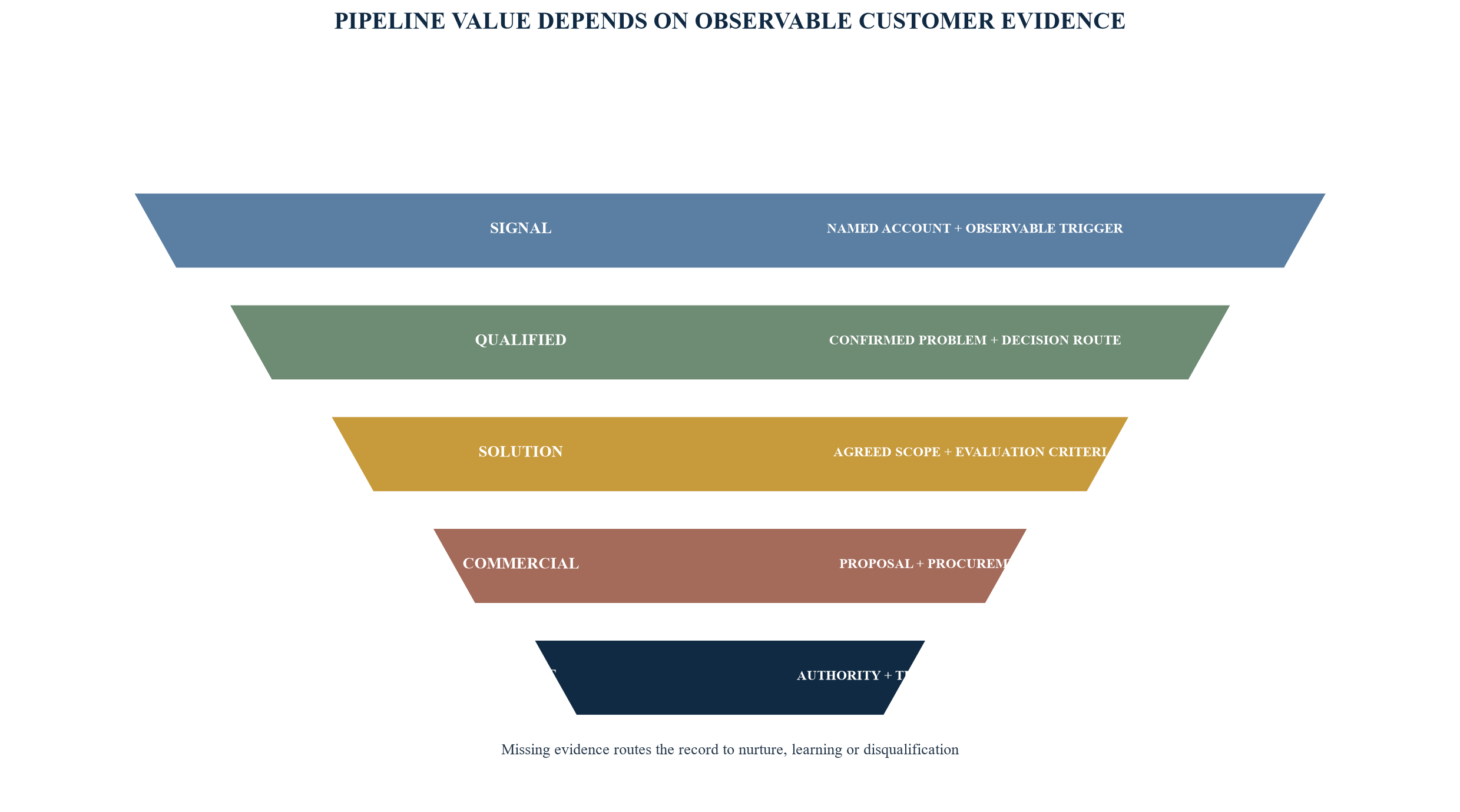
Stage labels and gates are illustrative. The business should define evidence appropriate to its buying process and legal obligations.
Table 3. Stage definitions and exit criteria
| Stage | Required evidence | Exit criterion | Primary health test |
|---|---|---|---|
| signal | named account, trigger, plausible problem and source | lawful contact or other validated route begins | source, age and acceptance decision are recorded |
| qualified | direct problem confirmation, consequence, stakeholders and route | customer agrees to explore a defined outcome | problem and timing are customer-evidenced |
| solution | scope, users, constraints, alternatives and evaluation criteria | customer accepts solution and evaluation path | delivery and commercial owners validate feasibility |
| commercial | proposal, economics, authority, procurement and objections | final decision path and remaining conditions are known | value, date and conditions have current evidence |
| commit | customer-confirmed decision, executable next action and delivery readiness | contract or order becomes effective | no unresolved condition contradicts the forecast |
| closed or lost | executed evidence or documented loss outcome | finance and delivery records reconcile | outcome and learning code are complete |
Evidence requirements should be proportionate to deal value, complexity and buying process.
5. Qualify opportunities around consequence and decision
Qualification should establish whether a real problem can produce an authorised decision within a useful time. The office should require evidence of the current state, consequence of inaction, desired outcome, affected stakeholders, available alternatives, decision criteria, authority, budget path, procurement process, legal constraints and timing. The depth should reflect opportunity size and complexity.
Discovery quality can be assessed through evidence quality. A direct customer statement, observed operational record, executed document or confirmed stakeholder action has a different status from sales interpretation. The record should preserve both the observation and the interpretation. Unsupported precision, such as an exact probability derived from a vague conversation, should be avoided.
Disqualification is a productive outcome when it releases capacity. Reasons should be specific enough to guide future action: no material problem, inaccessible buyer, no authority, no funding path, unacceptable risk, unavailable capability, poor economics, incompatible timing or chosen alternative. A generic lost or no response label destroys learning.
The office should review stalled opportunities as hypotheses. The next action must be a dated event with a named participant and intended evidence. Repeated internal follow-up does not constitute progression. When no credible action can change the outcome, the opportunity should move out of the active forecast.
6. Design coverage as a portfolio of constrained choices
Sales capacity is finite. Coverage should therefore be allocated as a portfolio across acquisition, expansion, renewal, channel development and strategic learning. The office should calculate available selling time after administration, travel, internal meetings and service demands. It should then compare required account actions with actual capacity.
Coverage ratios require context. A complex transaction may need a narrow portfolio and specialist support. A standard recurring offer may permit broader digital and inside-sales coverage. The design should identify account owner, specialist roles, executive sponsor, channel partner, service hand-off and conflict rules. Shared ownership without decision rights creates duplicated contact and missing accountability.
Account plans should contain a small number of current facts and decisions: customer priorities, relationship map, current economics, active opportunities, delivery issues, whitespace hypotheses, next actions and risks. Historical narrative can remain available, but the weekly view should surface what management can decide.
Coverage changes should be logged. Reassigning an account can disrupt relationships and distort performance attribution. The office should retain the date, reason, handover evidence, open commitments and benefit-treatment rule. Incentive consequences should be resolved before they shape behaviour.
7. Govern offers and prices before the customer receives them
Pricing is part of revenue execution. The office should define the offer, price metric, reference price, permitted configurations, service obligations, payment terms, concessions, approval authority and expiry. A quotation should display expected pocket revenue and contribution beside headline revenue.
IFRS 15 addresses variable consideration such as discounts, rebates, refunds, credits, concessions, incentives and penalties when determining transaction price.[1] Commercial teams should capture these terms in structured fields and reconcile them to contract and accounting treatment. An internal estimate does not determine the accounting conclusion.
Authority should follow economic and contractual exposure. A small headline discount can carry a large consequence when it creates precedent, adds service, changes liability, extends payment or consumes scarce capacity. Approval packs should show the customer's value case, alternatives, expected economics, risk, proposed exchange and walk-away position.
Competition law constrains coordination and pricing conduct. The UAE competition framework includes Federal Decree-Law No. 36 of 2023 and implementing measures published by the Ministry of Economy and Tourism.[4] Saudi competition law and economic-concentration guidance are administered by the General Authority for Competition.[5] Pricing systems, information exchange, exclusivity, bundling and algorithmic recommendations require current jurisdiction-specific legal review.
Table 4. Offer and pricing governance
| Decision | Evidence pack | Default owner | Escalation trigger |
|---|---|---|---|
| offer configuration | customer outcome, scope, capacity and delivery validation | product and commercial owner | non-standard obligation or unavailable capability |
| reference price | price book, segment, value evidence and effective date | pricing owner | new market, metric or material price architecture change |
| concession | pocket economics, exchange, precedent, expiry and alternatives | authorised commercial approver | threshold, aggregation, strategic or legal exposure |
| payment term | credit evidence, cash effect, security and collection route | finance and credit owner | exception to policy or material concentration |
| contract risk | liability, warranty, termination, data, IP and compliance | legal or competent contract owner | reserved clause or unresolved obligation |
| bundled proposal | component scope, allocation, dependencies and service burden | product, finance and sales | hidden concession or uncertain delivery economics |
Reserved matters and thresholds should be approved for the business, jurisdiction and transaction type.
8. Make weekly sales execution decision-led
The weekly meeting should produce decisions and commitments. A useful sequence is: prior actions, realised outcomes, pipeline changes, forecast movement, priority opportunities, account coverage, price exceptions, delivery constraints, experiments, customer risks and decisions required. Each item should have an owner, due date and evidence of closure.
The meeting pack should be generated from controlled data before the meeting. Participants should receive definitions and exception lists, with drill-through to evidence. Time should focus on changes and choices rather than reading totals aloud. Material disagreements should be documented, including the evidence needed to resolve them.
Decision rights should distinguish commercial judgement from reserved expertise. Sales may own engagement strategy while finance owns credit policy, legal owns reserved clauses, product owns standard configuration and delivery owns capacity confirmation. The office coordinates the decision path and service time.
The cadence should include a monthly reconciled review and a quarterly strategy reset. Weekly information is timely but may contain estimates. The monthly view should reconcile orders, invoices, credits, delivery and cash. The quarterly view should decide whether markets, offers, coverage and investment assumptions remain valid.
9. Build a forecast that can be tested
A forecast should state the outcome, horizon, unit, inclusion rules, cut-off and evidence. Management may need separate views of orders, bookings, recognised revenue, invoicing, contribution and cash. Combining them in a single number obscures timing and accounting differences.
Opportunity forecasts can combine categorical evidence with statistical reference rates. Historical conversion by stage, age, cohort, market, offer and deal size can inform a base rate. Current customer evidence can justify deviation. The record should preserve the base rate, judgemental adjustment and rationale.
Forecast accuracy should be evaluated over repeated vintages. Hyndman and Koehler explain limitations of commonly used measures and propose scaled errors that can support comparisons across series.[6] Percentage errors can become unstable where actual values are zero or small. The office should select measures appropriate to the data and show signed error so persistent optimism or conservatism remains visible.
Forecast movement is as important as point accuracy. The office should show opening forecast, new opportunities, progression, slippage, value change, wins, losses, scope change and closing forecast. Late-stage additions and repeated date movement are operating signals. They should lead to changes in qualification, coverage or decision authority.
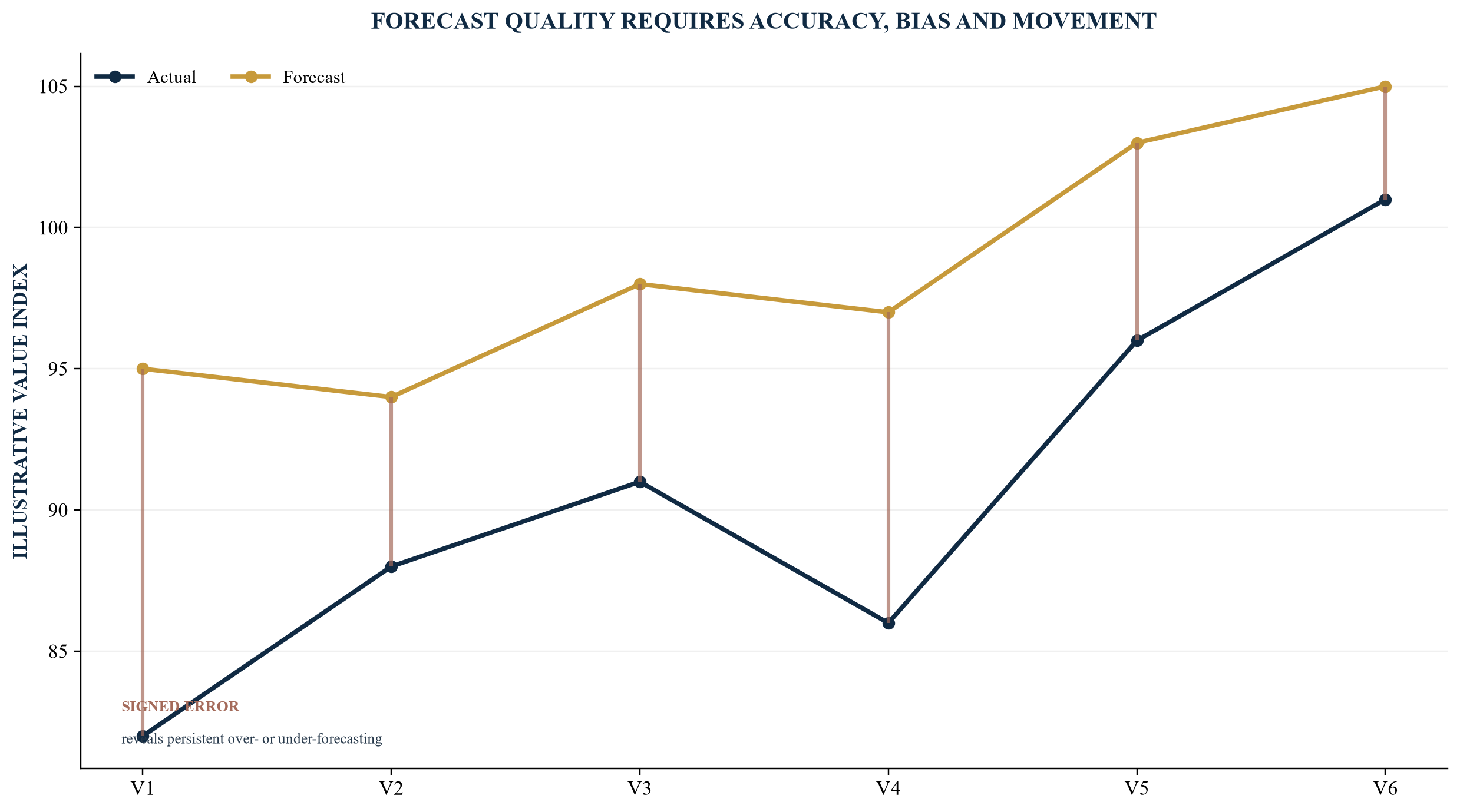
Values are illustrative. Metric selection should reflect the forecast series, horizon and decision use.
Table 5. Forecast quality scorecard
| Measure | Decision use | Required definition | Failure signal |
|---|---|---|---|
| signed error | detects systematic optimism or conservatism | forecast minus actual for a fixed vintage and horizon | persistent error in one direction |
| absolute or scaled error | compares magnitude across periods or series | selected formula and scaling basis | large error hidden by offsetting direction |
| coverage | tests whether qualified pipeline supports target or forecast | eligible value divided by relevant outcome | inflated coverage from weak or duplicate records |
| conversion | tests stage effectiveness | cohort entry and realised exit within a defined window | mixed cohorts or changing denominator |
| ageing and velocity | identifies stalled decisions | time in stage and evidenced transition | close date movement without customer action |
| movement bridge | explains forecast revision | opening, additions, progression, slippage and outcome | unexplained manual overrides |
The office should preserve exact definitions, vintage dates and denominators.
10. Use experiments to learn before scaling spend
Commercial experiments should test a decision. Examples include a message, channel, offer, price metric, service configuration, account sequence or onboarding intervention. The experiment needs a hypothesis, eligible population, treatment, comparison, outcome, observation window, sample limitations, stop rule and decision owner.
Randomisation can strengthen causal interpretation where practical and lawful. Where it is unavailable, management can use staged roll-outs, matched cohorts, interrupted time series or other quasi-experimental approaches with explicit limitations. Selection effects, seasonality, concurrent campaigns, sales discretion and capacity changes should be considered.
Online behaviour should be interpreted carefully. Moe and Fader developed a model of dynamic conversion behaviour using evolving visit patterns at an e-commerce site.[7] A visit or response does not carry the same purchase probability across every customer or time. The office should connect digital signals to account identity and downstream commercial outcomes where lawful, while avoiding unsupported intent claims.
Experiments should reconcile to economics. Cost per response or meeting is insufficient when the subsequent opportunity is weak, heavily discounted, expensive to deliver or slow to collect. The office should track progression, conversion, pocket contribution, retention and cash where the observation window permits.
11. Connect customer retention and expansion to value
Revenue acceleration includes retaining and expanding sound customer relationships. The office should maintain renewal cohorts, contracted obligations, usage or delivery evidence, service incidents, invoice disputes, relationship coverage, price position and expansion hypotheses. Renewal risk should be based on observed signals with a named owner and action.
Customer value models depend on acquisition cost, margin, retention, expansion, service cost, risk and discounting assumptions. Gupta, Lehmann and Stuart connect customer value measures to firm value within their studied settings.[8] Management should treat a customer-lifetime estimate as a model with uncertainty, not an observed asset value.
Expansion should follow demonstrated customer outcomes and unused value potential. Cross-selling unrelated products can damage trust and distract coverage. The account plan should state the customer problem, evidence of achieved outcome, new problem, buying stakeholders, delivery capability and expected economics.
Retention interventions should distinguish preventable failure from commercial pressure. A service defect, billing error, adoption gap, competitive alternative, budget reduction and strategic exit require different responses. The office should prevent a discretionary discount from masking an unresolved operating problem.
12. Govern CRM data, privacy and commercial evidence
The customer record is part of the control environment. Required fields should exist because they support a decision, obligation or reconciliation. Each field needs a definition, permissible values, owner, source, retention period and quality test. Free text should preserve context without becoming the only location of material evidence.
The UAE Personal Data Protection Law provides a federal framework governing personal-data processing and related rights and obligations.[9] Saudi Arabia's Personal Data Protection Law and implementing regulations address collection, processing, disclosure, rights and transfers.[10] Other jurisdictions and sector rules may apply. The office should document purpose and legal basis, minimise data, restrict access, govern recording and enrichment, define retention and deletion, and assess cross-border transfer requirements.
Direct marketing deserves specific controls. Contact source, consent or other lawful basis, channel preferences, objections and suppression should be retained and enforced across systems. Purchasing or enriching contact data does not remove the controller's obligations.
Data quality should be reported as coverage and exception, not concealed by default values. The share of pipeline value with verified contact, decision process, next action, value evidence and current close date can be shown separately. Management should avoid interpreting missing evidence as zero risk.
13. Use AI and analytics under accountable control
AI can support research, lead prioritisation, call summarisation, next-action prompts, pricing analysis, forecast baselines and anomaly detection. Each use case needs a defined decision, data boundary, human owner, evaluation method, override, monitoring and incident route. Generated output should not silently become customer evidence.
The NIST AI Risk Management Framework organises risk-management activity around Govern, Map, Measure and Manage.[11] The NIST Generative AI Profile provides additional guidance for generative-AI risks.[12] A revenue office can apply these functions by documenting use cases, affected people, data, performance, failure modes, oversight and change control.
Lead and opportunity scores should retain their intended use and validation population. A score trained on historical wins may reproduce past coverage choices, exclude new markets or learn from inconsistent stage labels. Management should compare performance by relevant cohorts and monitor drift. A salesperson should be able to challenge the score and provide evidence.
Algorithmic pricing creates competition, discrimination, transparency and consumer risks. The OECD has examined algorithmic pricing and competition responses across G7 jurisdictions.[13] Businesses should obtain legal review and prevent systems from using impermissible coordination signals or sensitive attributes. Human approval does not cure an unlawful or unsupported recommendation.
14. Reconcile benefits to finance and cash
Benefit claims should begin with a preserved baseline and a written formula. Revenue effects should be separated into volume, price, mix, retention, expansion, new customers, acquisitions, currency and timing. Contribution effects should incorporate concessions, variable costs, service burden and expected losses. Cash effects should follow invoicing, terms, disputes and collection.
Hanssens and Pauwels review approaches for demonstrating marketing value and connecting marketing actions to business outcomes.[14] The office should select methods proportionate to the decision and available evidence. A controlled experiment may support causal attribution. A simple bridge may only support contribution or association. The claim should match the design.
Benefits should be classified as observed, accrued, modelled or at risk. Observed invoicing can still reverse through credits or returns. A contract can create committed value while revenue recognition and cash occur later. Forecasted opportunities remain contingent. The board pack should preserve these distinctions.
Costs should include employees, incentives, technology, data, agencies, discounts, implementation and incremental delivery. The office itself has a cost. Net benefit and payback should be shown under central and downside assumptions, with sensitivity to conversion, price, timing, churn and collection.
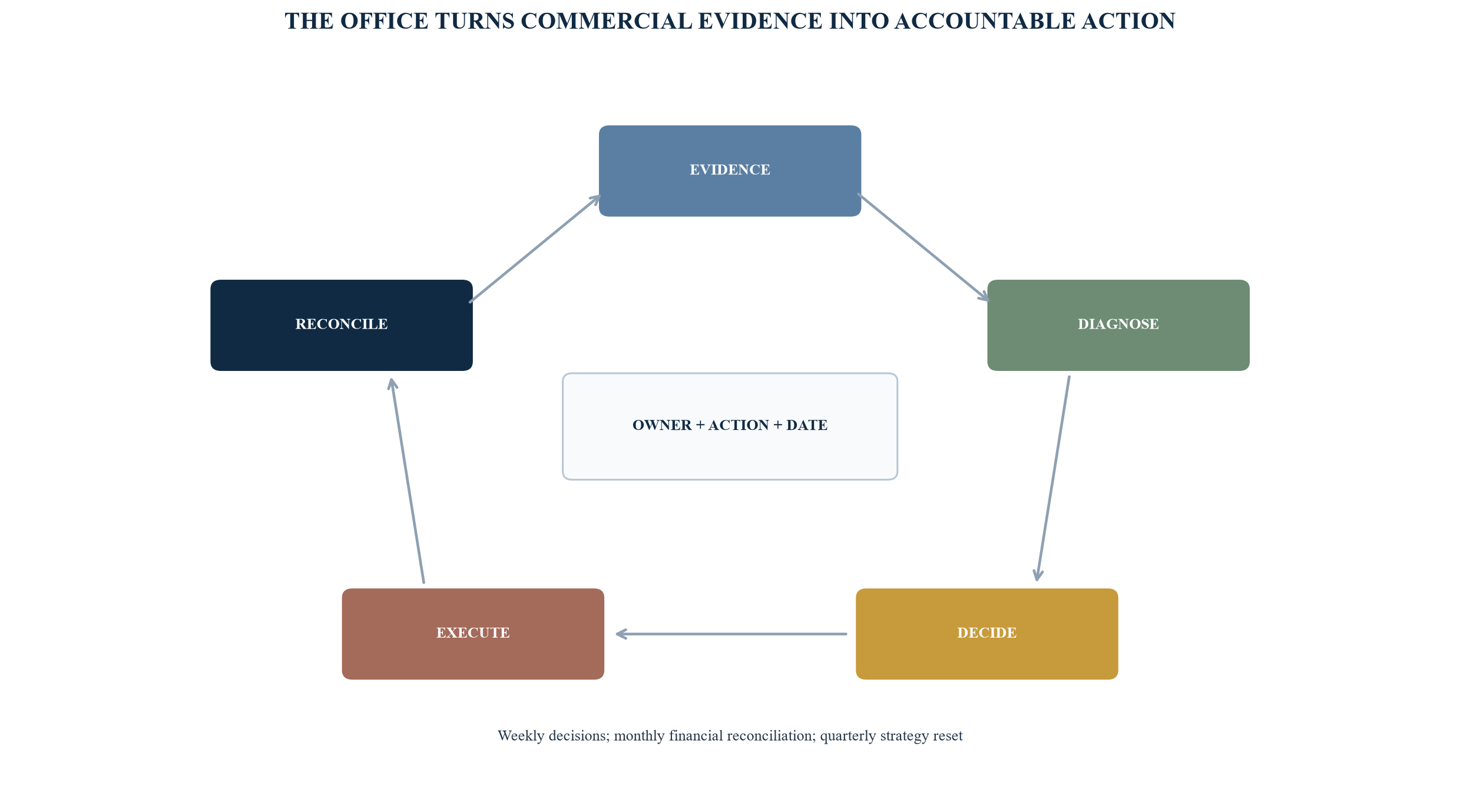
The loop separates timely management estimates from monthly financial reconciliation.
Table 6. Weekly decision and benefit register
| Register field | Required content | Closure evidence | Review owner |
|---|---|---|---|
| decision | precise choice, alternatives and reason | approved decision and effective date | accountable executive |
| action | owner, deliverable, due date and dependency | completed output or documented exception | workstream owner |
| customer evidence | source, date, stakeholder and observed statement or action | linked record and quality status | commercial owner |
| forecast effect | series, horizon, prior value, new value and reason | later actual and error calculation | revenue operations and finance |
| benefit claim | baseline, formula, category, period and confidence | invoice, ledger, delivery or cash reconciliation | finance owner |
| risk or constraint | impact, likelihood basis, trigger and mitigation | resolved condition or accepted exposure | competent risk owner |
| learning | hypothesis, result, limitation and next decision | approved scale, redesign or stop action | office lead |
Every entry should retain its evidence, approval and later outcome.
15. Execute a twelve-week mobilisation
Weeks one and two should establish the mandate, definitions, baseline, source systems, decision rights and current risks. The office should freeze a snapshot of pipeline and forecasts, identify data gaps, map markets and accounts, and reconcile reported commercial measures to finance. Immediate control failures, such as unsupported commits or unapproved price exceptions, should be isolated.
Weeks three and four should define evidence-gated stages, disqualification codes, account tiers, offer architecture, price authority and weekly cadence. Management should select a bounded set of priority markets and opportunities. Training should use live records and decisions rather than generic system demonstrations.
Weeks five to eight should operate the cadence. The office should clean active pipeline, reallocate coverage, resolve stalled decisions, implement quote controls, start selected experiments and publish the first forecast-vintage analysis. Delivery capacity, contract risk and customer experience should be reviewed beside sales activity.
Weeks nine to twelve should reconcile early outcomes, refine stage reference rates, assess experiments, review incentives and establish the continuing governance model. The office should recommend which capabilities transfer into line management, which controls remain central and which unresolved issues require a longer programme.
The twelve-week horizon is an illustrative mobilisation period. Complex products, long sales cycles, regulated markets, integration constraints or poor data may require more time. Management should avoid claiming realised benefit before the relevant contract, delivery, accounting and cash events occur.
16. Board and executive diagnostic
The board should ask whether the reported pipeline can be reconstructed from current customer evidence. It should examine concentration, stage ageing, late-stage additions, forecast bias, price exceptions, delivery readiness, retention risks and the bridge from commercial action to finance. A growing pipeline with declining evidence quality is a warning.
Executives should be able to identify the markets and accounts that receive scarce capacity and the evidence supporting those choices. They should know which opportunities can change the current period, what action is required, who owns it and what constraint could prevent execution. They should also know which activity has been stopped.
The office should report disagreements and uncertainty. A forecast range with explicit drivers is more useful than a precise number that conceals unresolved conditions. Management assumptions should remain visible until observed outcomes replace them.
The revenue acceleration office creates value when it improves the speed and quality of commercial decisions and connects them to realised economics. Its enduring output is a repeatable operating system: focused markets, accountable coverage, evidence-gated pipeline, governed offers and prices, tested forecasts, disciplined experimentation and reconciled benefits.
References
- IFRS Foundation. IFRS 15 Revenue from Contracts with Customers. https://www.ifrs.org/issued-standards/list-of-standards/ifrs-15-revenue-from-contracts-with-customers/
- IFRS Foundation. IFRS 18 Presentation and Disclosure in Financial Statements: Key terms. https://www.ifrs.org/supporting-implementation/supporting-materials-by-ifrs-standards/ifrs-18/key-terms/
- Sabnis, G., Chatterjee, S. C., Grewal, R. and Lilien, G. L. (2013). The Sales Lead Black Hole: On Sales Reps' Follow-Up of Marketing Leads. Journal of Marketing, 77(1), 52-67. https://doi.org/10.1509/jm.10.0047
- UAE Ministry of Economy and Tourism. Regulation of Competition Legislation. https://www.moet.gov.ae/en/regulation-of-competition-legislations
- General Authority for Competition, Saudi Arabia. Guidelines for Economic Concentration Review. https://gacbep.gac.gov.sa/cms/b9376edc-79a1-4573-a36d-4f3effaba838.pdf
- Hyndman, R. J. and Koehler, A. B. (2006). Another Look at Measures of Forecast Accuracy. International Journal of Forecasting, 22(4), 679-688. https://doi.org/10.1016/j.ijforecast.2006.03.001
- Moe, W. W. and Fader, P. S. (2004). Dynamic Conversion Behavior at E-Commerce Sites. Management Science, 50(3), 326-335. https://doi.org/10.1287/mnsc.1040.0153
- Gupta, S., Lehmann, D. R. and Stuart, J. A. (2004). Valuing Customers. Journal of Marketing Research, 41(1), 7-18. https://doi.org/10.1509/jmkr.41.1.7.25084
- United Arab Emirates. Federal Decree-Law No. 45 of 2021 Concerning the Protection of Personal Data. https://www.uaelegislation.gov.ae/en/legislations/1972/download
- Saudi Data and Artificial Intelligence Authority. Personal Data Protection Law and Implementing Regulations guidance. https://dgp.sdaia.gov.sa/wps/portal/pdp/knowledgecenter/details/PDPLCP/
- National Institute of Standards and Technology. Artificial Intelligence Risk Management Framework (AI RMF 1.0). NIST AI 100-1. https://doi.org/10.6028/NIST.AI.100-1
- National Institute of Standards and Technology. Artificial Intelligence Risk Management Framework: Generative Artificial Intelligence Profile. NIST AI 600-1. https://doi.org/10.6028/NIST.AI.600-1
- OECD (2025). Algorithmic Pricing and Competition in G7 Jurisdictions: Emerging Trends and Responses. https://doi.org/10.1787/f36dacf8-en
- Hanssens, D. M. and Pauwels, K. H. (2016). Demonstrating the Value of Marketing. Journal of Marketing, 80(6), 173-190. https://doi.org/10.1509/jm.15.0417
- U.S. Securities and Exchange Commission (2020). Commission Guidance on Management's Discussion and Analysis of Financial Condition and Results of Operations. Release No. 33-10751. https://www.sec.gov/rules-regulations/2020/01/commission-guidance-managements-discussion-analysis-financial-condition-results-operations
- Committee of Sponsoring Organizations of the Treadway Commission. Internal Control: Integrated Framework. https://www.coso.org/internal-control
- UAE Government. Data protection laws. https://u.ae/en/about-the-uae/digital-uae/data/data-protection-laws
- OECD. Competition and algorithmic pricing. https://www.oecd.org/en/topics/sub-issues/competition-and-digital-economy/algorithmic-pricing.html
About the Author
Chennakeshav Adya is an independent researcher focused on corporate finance, strategy, transactions and operating transformation. His work develops evidence-led frameworks that connect executive decisions to implementation, governance and measurable commercial outcomes.
