

1. INTRODUCTION
Working capital finance converts the timing gap between operating expenditure and customer cash into controlled liquidity. A distributor may pay for inventory before it is delivered. A manufacturer may fund raw materials, production and shipping before issuing an invoice. A services business may pay payroll several weeks before a customer settles. These gaps can be commercially healthy and financially demanding at the same time.
The Central Bank of the UAE's Credit Sentiment Survey for the first quarter of 2026 identified working capital requirements as the most important driver of business loan demand [1]. The survey also reported less favourable credit conditions and a moderated positive balance for business-loan demand. Respondents expected weaker appetite for lending to small and medium-sized enterprises in the following quarter [1]. This combination makes facility design important: companies need reliable capacity, while lenders need evidence that the line finances a self-liquidating operating cycle and can be repaid from identifiable cash receipts.
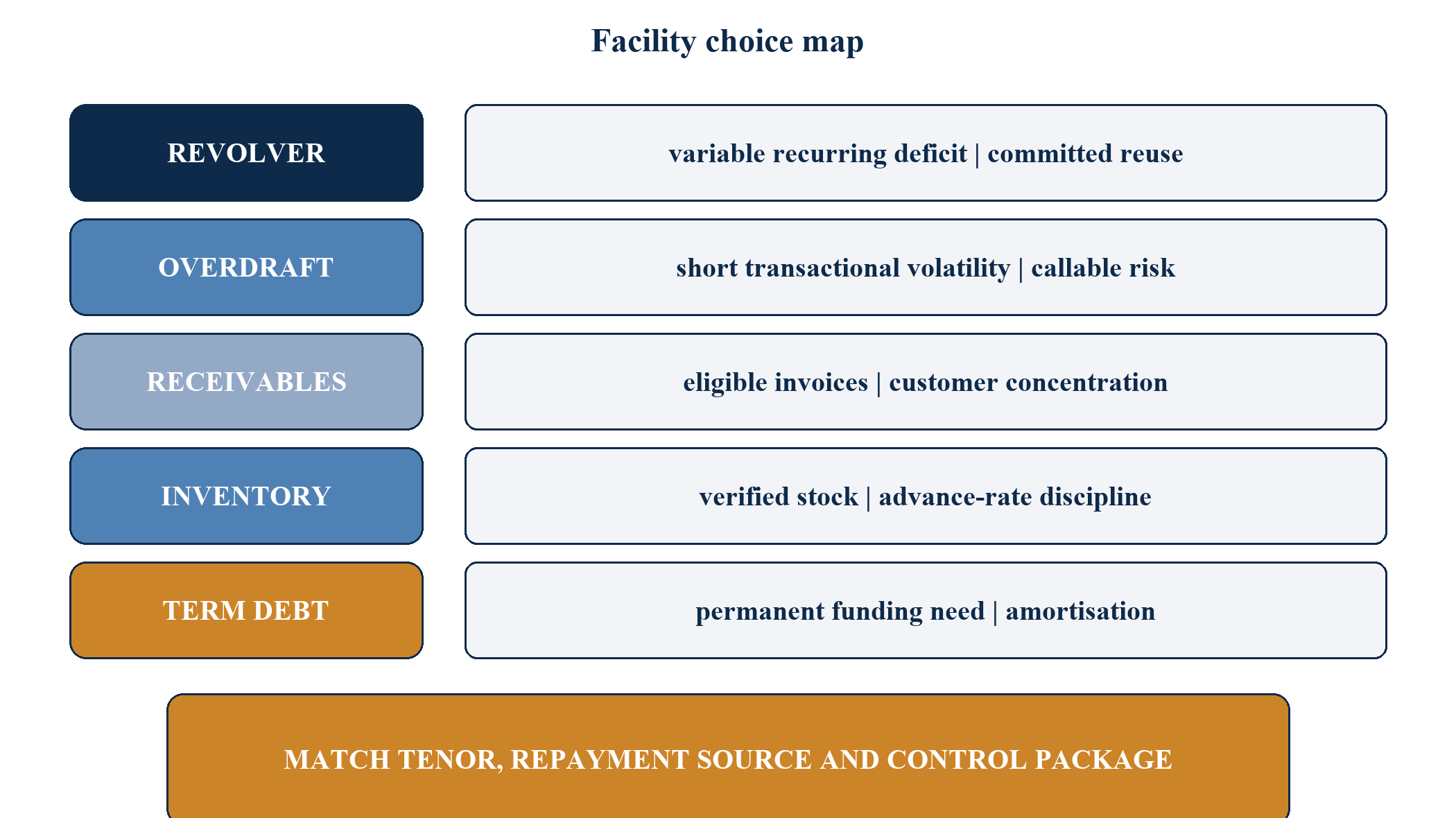
A revolving credit facility allows a borrower to draw, repay and redraw within an agreed commitment during its availability period. A working capital facility can also take the form of an overdraft, receivables purchase, invoice discounting, inventory finance, import finance, trade instruments or a combination of sublimits. Each instrument allocates liquidity, repayment, collateral, discretion and operating control differently. A large headline limit can provide little usable liquidity when eligibility rules, reserves, sublimits or draw conditions constrain availability.
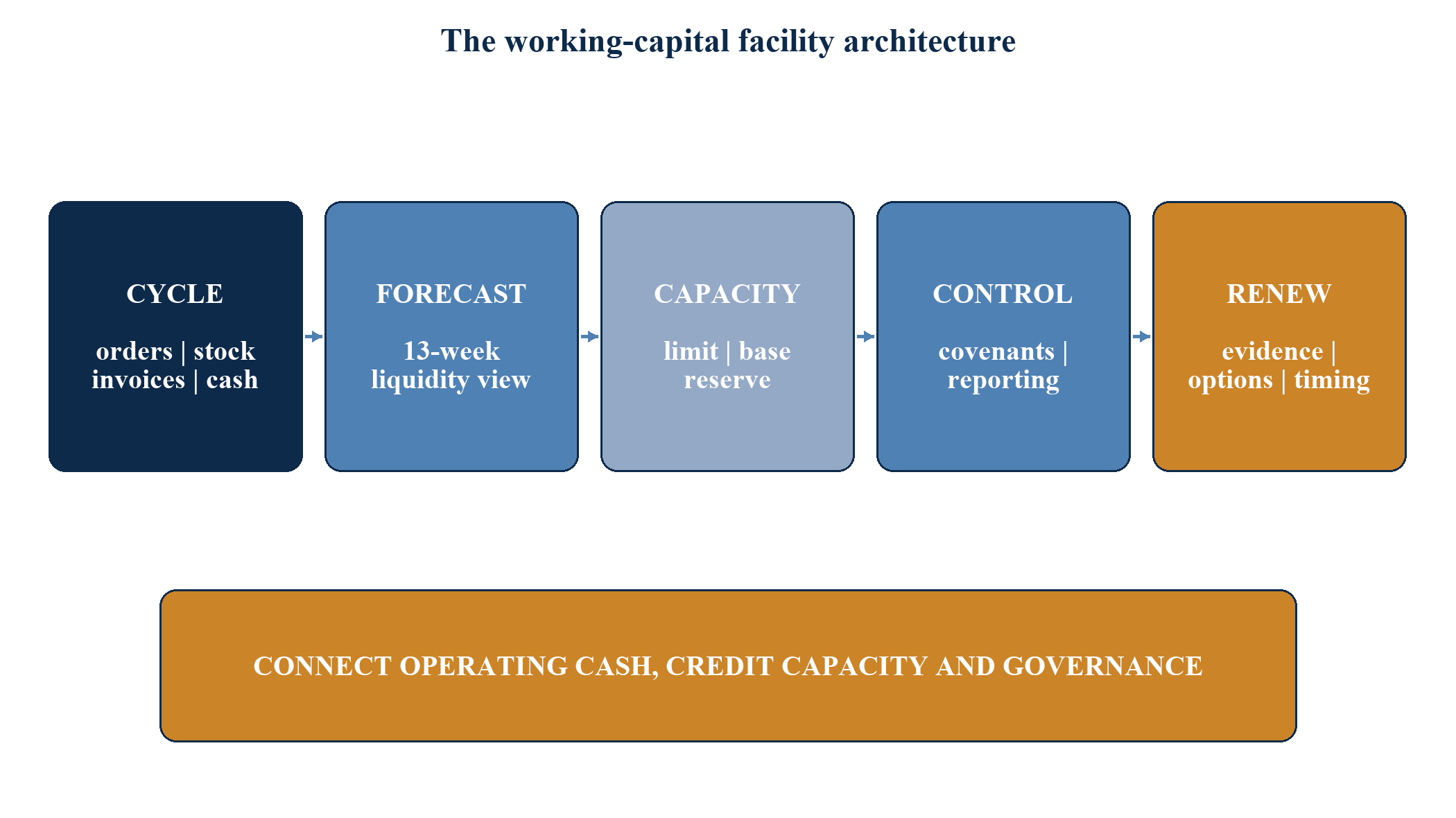
This paper develops an integrated framework for purpose, sizing, borrowing-base design, pricing, covenants, security, reporting and renewal. The framework begins with the operating cash cycle and a 13-week forecast. It then reconciles the forecast funding need with the capacity supported by collateral, cash generation and lender risk appetite. The result is an operating system for liquidity rather than a one-time financing transaction.
Every worked case, amount, ratio and timetable in this paper is hypothetical and simplified. The cases illustrate the mechanics of facility design and do not represent Matchpoint Partners, its clients or any identified business. Actual terms depend on current law, accounting, tax, documentation, collateral, credit approval and fact-specific professional advice.
2. DEFINE THE JOB BEFORE CHOOSING THE INSTRUMENT
2.1 The funding purpose
The first decision concerns the job assigned to the facility. Seasonal inventory purchases, long customer-payment terms, a temporary order backlog and a payroll timing gap can suit revolving finance. A recurring deficit caused by structurally weak margins, permanent inventory, unpaid shareholder distributions or long-lived capital expenditure needs a different solution. Funding a permanent requirement with a short-dated line creates renewal and repayment risk.
A useful purpose statement names the funded assets, the operating event that creates the draw, the expected source and timing of repayment, the maximum duration of use and the information that proves completion of the cycle. The statement should be observable in the borrower's ledger, bank accounts and management information. Broad wording such as general corporate purposes provides flexibility in documents; internal treasury policy still needs a more precise operating rule.
| Purpose | Natural instrument | Primary repayment source | Core control |
|---|---|---|---|
| seasonal stock build | revolving line or inventory-backed sublimit | sale and collection of funded stock | stock ageing, margin and draw duration |
| customer receivables | receivables-backed line, invoice discounting or factoring | payment of eligible invoices | ageing, dispute, concentration and dilution |
| import cycle | import loan, trust receipt or trade sublimit | sale proceeds from imported goods | shipping documents, stock and collections |
| short payroll or expense timing | committed revolver | contracted operating receipts | 13-week cash forecast and minimum liquidity |
| equipment or permanent expansion | term loan, lease or equity | multi-period cash flow | amortisation and long-term leverage |
2.2 A facility should turn
A revolving line demonstrates its working capital function when exposure rises with the operating cycle and falls as customers pay. The pattern need not reach zero in every business. A persistent core balance, however, is evidence that part of the requirement may be permanent. Treasury should split the observed balance into seasonal, cyclical, stressed and structural components. The structural component can then be funded with longer-tenor capital or addressed through operational improvement.
3. THE 2026 GCC CREDIT CONTEXT
3.1 UAE demand and lender appetite
The UAE survey evidence for the first quarter of 2026 provides a useful current signal. Business-loan demand remained positive, with a net balance of 4.7 percentage points, while working capital requirements were the leading demand driver [1]. Survey respondents expected demand from small and medium-sized enterprises to weaken and expected lender appetite for that segment to decline in the next quarter [1]. The survey is a sentiment measure based on lender responses; it is not a commitment, price quotation or forecast for an individual borrower.
The Central Bank reported continued strength and resilience in the UAE banking sector in its 2024 Financial Stability Report and 2025 Annual Report materials [2,3]. System strength does not remove borrower-specific underwriting. A mid-market company still needs to demonstrate repayment capacity, information quality, governance and collateral effectiveness.
3.2 Public guarantee and risk-sharing channels
Emirates Development Bank offers working capital and other business-finance solutions and operates credit-guarantee arrangements through partner financial institutions [13,14]. Its published 2024 annual report described cumulative financing and guarantee activity supporting micro, small and medium-sized enterprises [15]. Qatar Development Bank's credit-guarantee programme covers eligible working capital and other facilities through partner lenders [16]. Saudi Arabia's Kafalah programme describes support for working capital, bills, guarantees and related purposes [17,18].
These programmes can extend access or support lender risk sharing. Eligibility, coverage, pricing, lender participation and approval remain programme-specific. A borrower should treat a guarantee channel as one route in a financing plan and verify the current rules directly with the relevant institution.
| Market signal | Implication for borrowers | Implication for lenders |
|---|---|---|
| working capital is a leading demand driver | prepare evidence before the funding peak | distinguish self-liquidating demand from structural deficit |
| SME lending appetite can soften | preserve time and competitive options | calibrate capacity and covenants to current risk appetite |
| public guarantee channels exist | test eligibility early | assess residual risk, process and guarantee conditions |
| collateral laws support movable assets | improve asset and registration records | verify creation, perfection, priority and enforceability |
4. CASH-CONVERSION CYCLE AS THE ECONOMIC ENGINE
4.1 From supplier payment to customer receipt
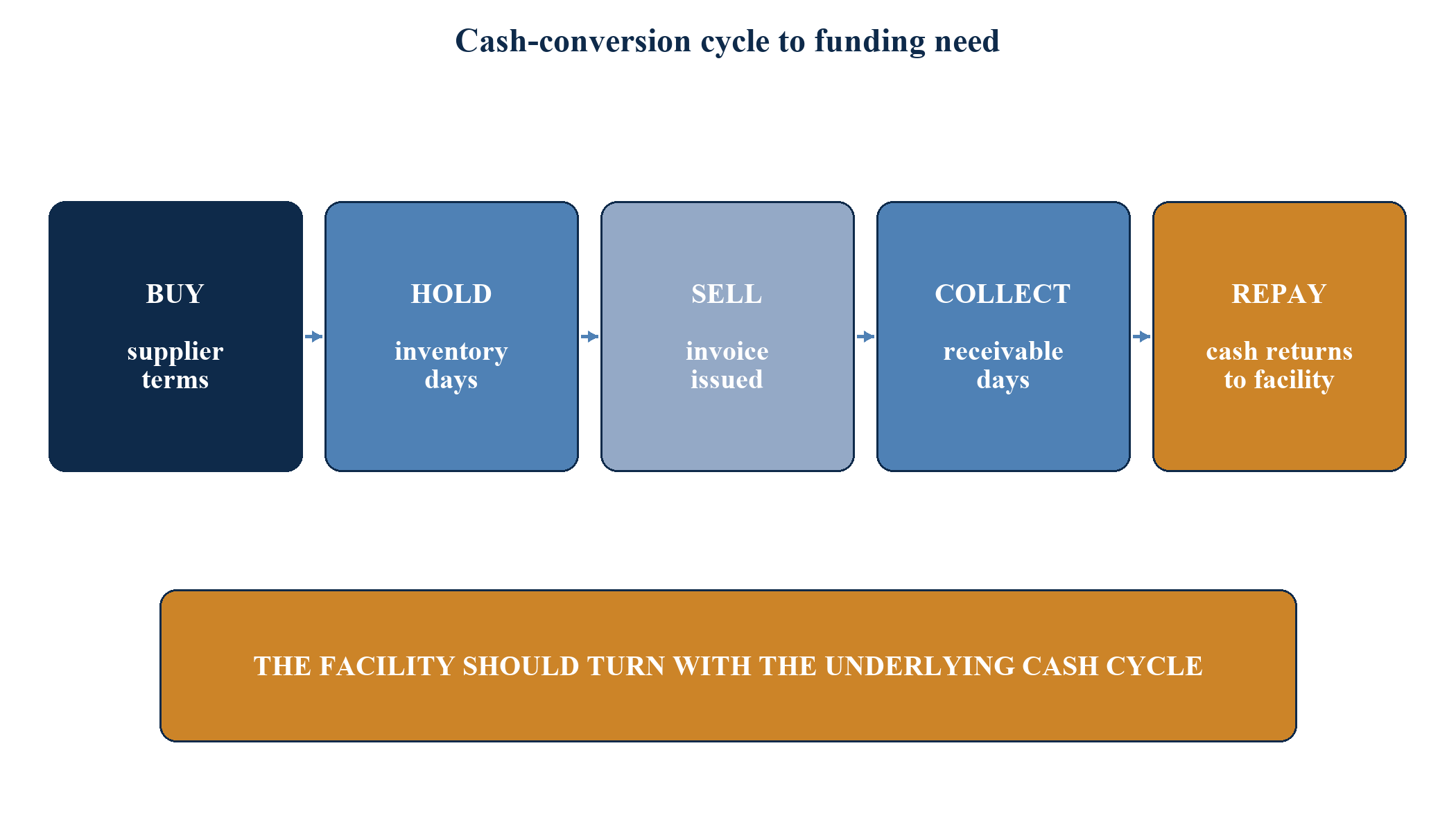
The cash-conversion cycle links inventory days and receivable days to payable days. A simplified formulation is inventory days plus receivable days less payable days. The measure translates operating timing into an approximate number of days for which cash is committed. It should be supplemented by absolute amounts, margin, tax timing, deposits, advances and intra-month payment patterns.
Two businesses with the same cycle length can require different facilities. One may have stable margins and diversified customers; the other may have customer concentration, price volatility and disputed invoices. Average days can also hide weekly peaks. Treasury should calculate the cycle by product, channel, geography and material customer where data permits.
4.2 Operating levers create financing capacity
Working capital improvement can reduce the required commitment. Examples include better billing accuracy, earlier milestone invoicing, electronic invoice delivery, active dispute resolution, credit limits, inventory segmentation, supplier-term negotiations and procurement discipline. These improvements need owners and measurement. A financing process should therefore run beside an operating working-capital programme.
| Driver | Measurement | Liquidity effect | Operating owner |
|---|---|---|---|
| receivable days | weighted days sales outstanding and ageing | slower collection increases draws | sales, finance and collections |
| inventory days | days on hand by category | slow stock consumes capacity and may become ineligible | supply chain and operations |
| payable days | weighted supplier terms and actual payment | longer agreed terms defer cash outflow | procurement and treasury |
| gross margin | contribution by funded cycle | lower margin weakens repayment coverage | commercial and finance |
| disputes and credits | dilution as a percentage of gross invoices | dilution reduces eligible collateral | operations and finance |
5. THE 13-WEEK CASH FORECAST
5.1 Direct cash visibility
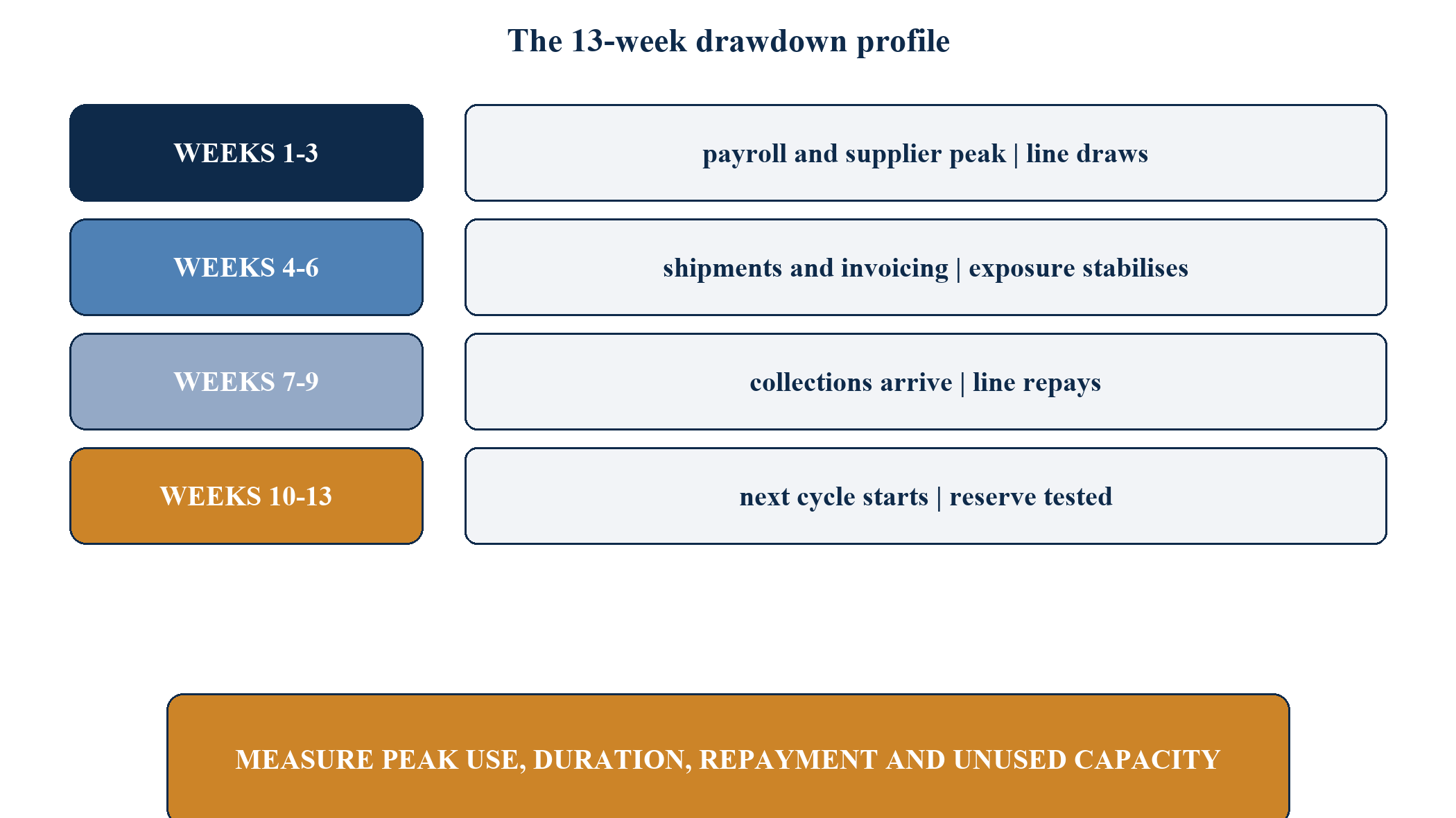
A 13-week forecast records expected receipts and payments by week. It begins with bank cash, adds receipts and subtracts disbursements to produce closing cash before financing. Facility draws, repayments, interest and fees then reconcile the closing liquidity position. The horizon is long enough to show several operating events and short enough for transaction-level evidence.
The model should use direct cash categories rather than an earnings bridge. Receipts should link to invoice or order schedules, and payments should link to payroll, supplier, tax, rent, debt and capital-expenditure calendars. Opening cash should reconcile to bank statements. The forecast should identify restricted cash, trapped balances and currencies that cannot be used for the relevant obligation.
5.2 A forecast is governed through variance
Forecast quality improves through weekly comparison of actual cash with prior forecasts. Variance should be separated into timing, amount, omission and classification. A receipt that arrives one week late creates a timing variance and may still indicate a customer-risk issue. A permanently lower receipt is an amount variance with a different response. Repeated omissions indicate a process problem.
| Weekly forecast line | Evidence | Typical sensitivity | Control |
|---|---|---|---|
| customer receipts | invoice, ageing, collection promise, historical payment | 7, 14 and 30-day delay | probability weighting and owner confirmation |
| supplier payments | approved invoices, purchase orders and terms | accelerated payment or supply hold | criticality and approved date |
| payroll and employment cost | payroll file and calendar | headcount or variable pay | fixed date and approval |
| taxes and duties | filing calendar and customs data | assessment or timing change | tax-owner sign-off |
| interest and fees | facility calculation | benchmark and draw level | independent recalculation |
5.3 Worked 13-week pattern
Consider a hypothetical and simplified distributor with AED 12 million of opening cash and a board minimum of AED 8 million. Cash outflows peak during the first three weeks as inventory and payroll are paid. Customer collections begin in week five. The model shows a pre-financing low point of negative AED 21 million in week four. A base-case committed need is therefore AED 29 million, comprising the AED 21 million deficit and the AED 8 million minimum cash requirement, before stress and availability constraints.
Under a simplified stress in which 25 per cent of customer receipts are delayed by two weeks, the peak need rises to AED 38 million. This amount remains an input to facility design rather than an automatic limit. The lender and borrower must reconcile it with collateral, repayment evidence, leverage, concentration and credit approval.
6. SELECTING THE FACILITY FORM
6.1 Committed revolver
A committed revolver provides an agreed commitment during its availability period, subject to conditions, representations, undertakings and events of default. Commitment has value because the lender reserves capital and liquidity for potential drawdown. Pricing commonly includes interest on drawings and a commitment fee on unused capacity. The borrower gains draw flexibility and accepts ongoing information and covenant obligations.
6.2 Overdraft
An overdraft can be operationally simple and useful for short transactional volatility. Its legal and commercial terms may allow review, cancellation or demand with less protection than a committed revolving facility. Treasury should read the actual offer and account terms, document the notice and demand mechanics, and avoid treating an uncommitted balance as assured liquidity.
6.3 Receivables and inventory facilities
Receivables-backed facilities link availability to eligible invoices. Inventory-backed facilities link capacity to verified, controlled and realisable stock. These structures can support more capacity when asset data is reliable. They also create operational requirements: frequent certificates, eligibility rules, reserves, audits, concentration caps, notices, account controls and valuation.
6.4 Trade and supply-chain instruments
Letters of credit, trust receipts, import loans, guarantees, performance bonds and supply-chain finance can finance or support specific trade events. They often sit as sublimits inside an overall working-capital envelope. Sublimit use can reduce remaining cash availability, so treasury should model contingent and funded utilisation together.
7. LIMIT SIZING
7.1 Three ceilings
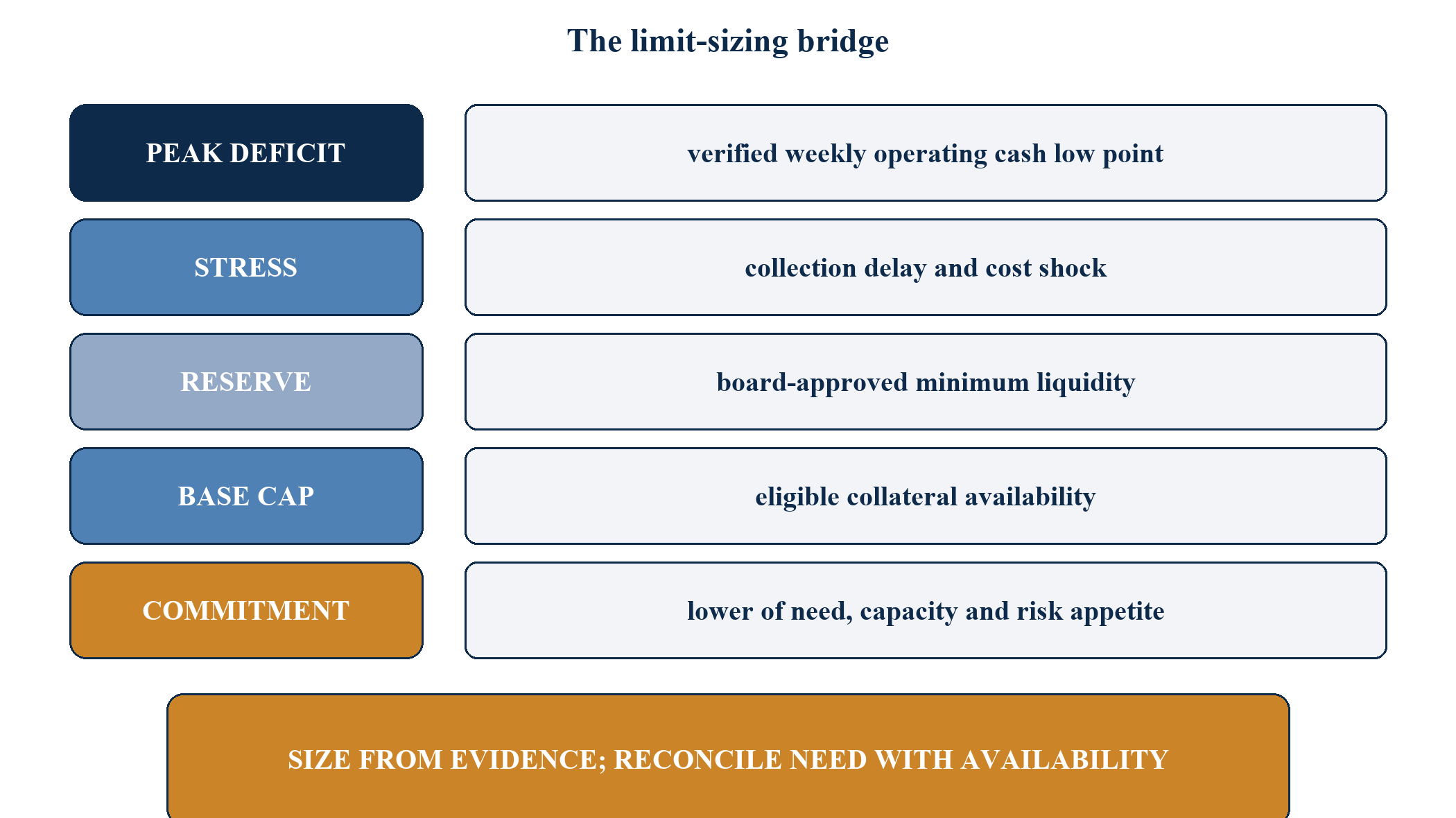
The final commitment is governed by three ceilings. The first is need: the forecast peak deficit plus a defined liquidity reserve. The second is capacity: the amount supported by cash flow, collateral and legal availability. The third is risk appetite: the amount approved by the lender and accepted by the borrower under the covenant, pricing and security package. The commitment should fit all three.
A single average working capital figure is weak sizing evidence. Weekly and monthly peaks, operating volatility, customer delays, currency moves, margin compression and tax dates need explicit treatment. Historical drawings, where available, reveal peak, average, duration, repayment and clean-down behaviour.
7.2 Hypothetical sizing bridge
Assume a hypothetical and simplified business has a verified peak forecast deficit of AED 34 million. The board requires AED 6 million of minimum operational cash. A tested collection-delay scenario adds AED 9 million, producing a gross liquidity requirement of AED 49 million. Eligible collateral supports AED 46 million after advance rates and reserves. Credit approval supports AED 44 million. The proposed commitment is AED 44 million, accompanied by AED 5 million of separately identified contingency actions.
This bridge makes the uncovered amount visible. The response may include operating improvement, a term facility, shareholder support, asset disposal, lower minimum cash or a smaller stress appetite. Concealing the gap inside optimistic collections weakens the financing plan.
| Sizing component | Hypothetical amount | Evidence | Decision |
|---|---|---|---|
| peak forecast deficit | AED 34m | 13-week direct cash forecast | validated by treasury and operations |
| minimum cash reserve | AED 6m | board liquidity policy | retained unless formally changed |
| collection-delay stress | AED 9m | aged receivables and scenario | included in gross need |
| gross liquidity requirement | AED 49m | sum of verified components | tested against capacity |
| collateral-supported capacity | AED 46m | borrowing-base model | caps available line |
| approved commitment | AED 44m | lender credit approval | leaves AED 5m contingency gap |
8. BORROWING-BASE DESIGN
8.1 From gross assets to availability
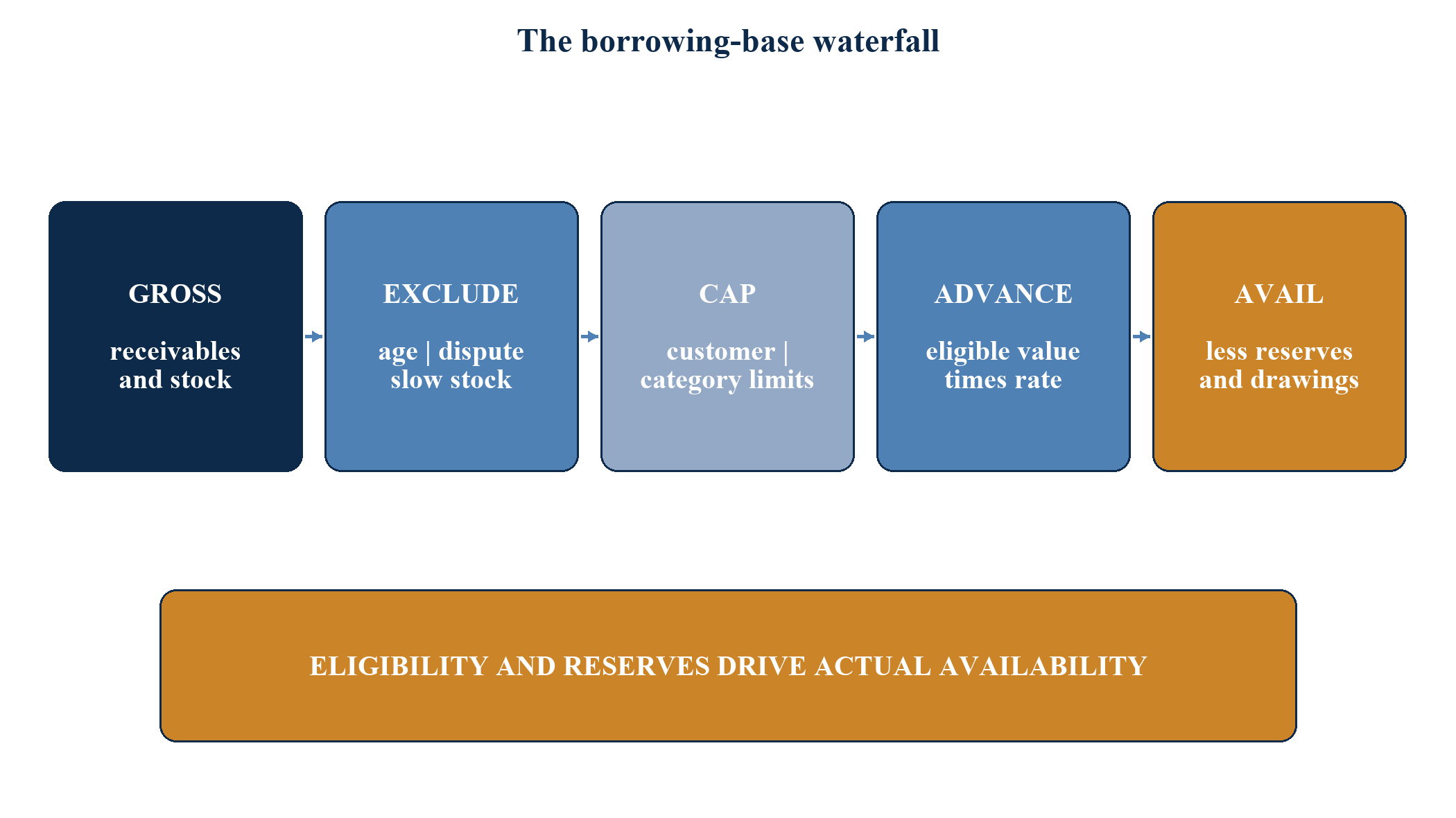
A borrowing base starts with reported receivables or inventory and applies eligibility rules, concentration caps, advance rates and reserves. Availability equals the supported amount less drawings and other reductions. The formula converts collateral information into current capacity. It also transfers significant operational responsibility to the borrower because data quality affects the right to draw.
Receivables may be excluded when they are overdue, disputed, intercompany, subject to set-off, concentrated above a cap, denominated in an unsupported currency or owed by an ineligible jurisdiction or customer. Inventory may be excluded when obsolete, slow-moving, work in progress, consigned, perishable, in an uncontrolled location or subject to title uncertainty.
8.2 Advance rates and reserves
Advance rates reflect expected realisation, volatility, dilution, legal rights and operating control. A reserve protects against risks that are insufficiently captured by eligibility. Examples include customer credits, returns, taxes, supplier retention-of-title claims, freight, liquidation cost and foreign-exchange exposure. The lender should define the calculation method and discretion, while the borrower should model how a reserve change affects available liquidity.
8.3 Hypothetical borrowing-base waterfall
Assume a hypothetical and simplified gross receivables ledger of AED 80 million. AED 12 million is more than 90 days overdue, AED 5 million is disputed, and AED 8 million exceeds a customer concentration cap. Eligible receivables are AED 55 million. At an 80 per cent advance rate, gross support is AED 44 million. A AED 4 million dilution and tax reserve produces AED 40 million of borrowing-base availability before drawings.
The borrower should reproduce the result from source records. A certificate signed without a ledger-level reconciliation can create a representation breach and an immediate liquidity problem.
9. COMMITMENTS, SUBLIMITS AND REAL AVAILABILITY
9.1 Headline commitment and usable cash
The headline commitment can be reduced by trade sublimits, outstanding guarantees, letters of credit, ancillary facilities, swingline exposure, reserves and borrowing-base constraints. Treasury should maintain a daily or weekly availability bridge that shows gross commitment, each reduction, current drawings and undrawn usable cash.
Sublimits should reflect actual use. A large guarantee sublimit can unnecessarily constrain cash if all exposure reduces the same commitment. A multi-currency option can add flexibility and create foreign-exchange revaluation risk. Ancillary bank products can consume capacity through documented equivalent amounts.
| Availability item | Effect | Monitoring frequency | Owner |
|---|---|---|---|
| cash drawings | reduce available commitment | daily | treasury |
| letters of credit and guarantees | consume relevant sublimit and often overall commitment | daily | trade finance and treasury |
| borrowing-base cap | limits drawings to eligible support | weekly or monthly | finance and lender monitoring |
| reserves | reduce supported availability | on certificate and lender notice | finance and relationship lead |
| foreign-exchange revaluation | can change equivalent utilisation | daily in volatile periods | treasury |
9.2 Conditions to drawing
Availability also depends on conditions precedent and repeated draw conditions. These can include no default, repeated representations, delivery of a borrowing-base certificate, minimum utilisation, notice timing and permitted purpose. The operating team should translate these conditions into a draw checklist. A legal right that cannot be exercised before payroll because a certificate is late has limited liquidity value.
10. ALL-IN PRICING
10.1 Price components
All-in cost includes the benchmark, margin, commitment fee, arrangement fee, agency fee, security and valuation costs, audit fees, legal fees, utilisation fees, letter-of-credit commissions, guarantee fees and hedging cost. The calculation should separate recurring cost from one-time cost and compare committed, drawn and effective tenors.
A lower margin can be outweighed by a high unused fee, tight borrowing-base rules, expensive ancillary conditions or frequent audits. A wider margin may carry more flexible availability and lower execution risk. Treasury should compare expected, high-use and low-use scenarios.
10.2 Hypothetical price comparison
Assume two hypothetical and simplified AED 50 million facilities. Facility A charges a 250-basis-point margin and a 40 per cent commitment fee rate on unused capacity. Facility B charges a 275-basis-point margin and a lower unused fee. At 80 per cent average utilisation, Facility A may have the lower interest cost. At 25 per cent utilisation, Facility B may become competitive depending on the unused fee and one-time costs. A present-value model should use expected drawings, repayment dates and fees rather than the headline margin alone.
| Cost item | Calculation base | Decision question |
|---|---|---|
| benchmark | daily or periodic drawn principal | which reference rate, observation and floor apply? |
| margin | drawn principal | does pricing ratchet with leverage or rating? |
| commitment fee | unused commitment or agreed proportion | how is unused capacity defined? |
| arrangement and agency fees | commitment or fixed amount | are fees upfront, annual or amortised? |
| collateral and monitoring cost | fixed or activity-based | who bears valuations, audits and registrations? |
| hedging | notional and market price | is a hedge required and for what amount and tenor? |
11. BENCHMARKS, FLOORS AND RATE RISK
11.1 Contract mechanics
UAE dirham facilities may reference EIBOR or another agreed benchmark. Contracts define the relevant tenor, fixing source, business-day convention, fallback, floor, interest period and default rate. Multi-currency facilities may use different benchmarks for different drawings. Treasury should reproduce each interest calculation independently and retain the supporting market observation.
The Central Bank publishes key interest-rate information and EIBOR data [19,20]. Published rates change over time. A paper prepared in August 2026 should therefore avoid embedding a rate as a permanent assumption. Borrower models should draw the current contract-relevant rate from an approved source and separately apply margin, floor and fees.
11.2 Stress the cash interest burden
Rate stress should use the expected draw profile rather than the full limit alone. A company with seasonal peak use may carry a different annual burden from one with a permanent balance. The model should test benchmark increases, margin ratchets, default interest, currency basis and the loss of interest income on trapped cash.
| Rate-risk input | Base evidence | Stress question | Control |
|---|---|---|---|
| benchmark | contract and approved market source | what if the rate rises 100 or 200 basis points? | weekly forecast and annual budget |
| drawn amount | 13-week and monthly utilisation profile | what if collections are delayed? | draw-duration limit |
| margin | term sheet and ratchet table | what if leverage crosses a pricing level? | covenant forecast |
| floor | facility agreement | does a floor prevent benefit from lower rates? | all-in pricing model |
| hedge | hedge confirmation and policy | does notional match expected exposure? | treasury risk review |
12. FINANCIAL COVENANTS
12.1 Measure the risk the facility creates
Financial covenants can include leverage, interest cover, fixed-charge cover, minimum liquidity, tangible net worth, borrowing-base availability and clean-down requirements. A working capital facility should focus on liquidity, repayment capacity and asset quality without duplicating ratios that provide little early-warning value.
Definitions drive the result. EBITDA adjustments, exceptional items, shareholder loans, lease liabilities, cash netting, permitted acquisitions and currency conversion can materially change covenant calculations. The borrower should maintain a definition book and calculate the lender version beside management measures.
12.2 Headroom and forecast breach
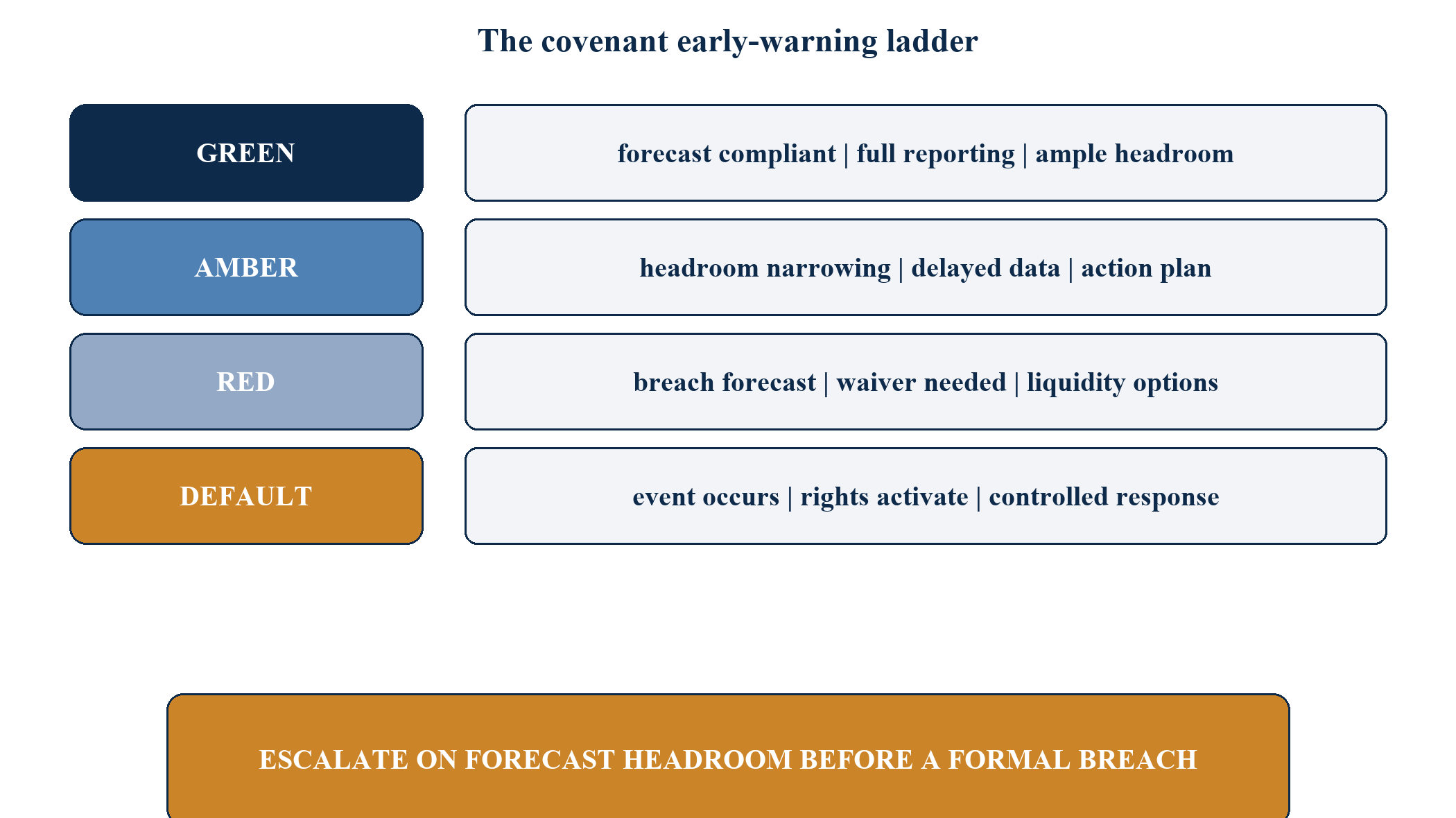
Compliance on a test date is one point in time. Governance should track forecast headroom across the 13-week model and the annual plan. An amber threshold can require management action before a formal breach. A red threshold can require board review, lender engagement and contingency funding.
Assume a hypothetical and simplified minimum interest-cover covenant of 2.0 times. Management forecasts 2.6 times in the base case and 2.1 times under a collection-delay stress. A margin increase and cost overrun reduce the stress case to 1.85 times. The correct response begins when the forecast crosses the internal amber level, allowing time to adjust cost, capital, drawings or lender consent.
13. INFORMATION UNDERTAKINGS AND THE MONTHLY CONTROL PACK
13.1 Information is part of credit capacity
Basel's 2025 Principles for the Management of Credit Risk organise sound practice around the credit environment, granting, administration and monitoring, and controls [7]. Information undertakings translate those disciplines into borrower deliverables. Common requirements include financial statements, management accounts, compliance certificates, ageing, inventory, borrowing-base certificates, budgets, forecasts, bank statements and notices of material events.
Late or inconsistent reporting can narrow lender confidence and delay consent. The borrower should appoint an owner for each deliverable, maintain a calendar and complete an internal review before submission. The pack should reconcile to the general ledger and bank accounts.
13.2 Monthly minimum pack
| Deliverable | Core reconciliation | Early-warning use |
|---|---|---|
| management accounts | trial balance and prior month | margin, overhead and earnings trend |
| 13-week cash forecast | bank cash and actual variance | peak draw and minimum liquidity |
| receivables ageing | control account and invoice ledger | delinquency, dispute and concentration |
| inventory report | general ledger and warehouse system | ageing, obsolescence and location |
| borrowing-base certificate | eligible ledgers and facility definition | current availability and reserve sensitivity |
| covenant certificate | agreement definitions and accounts | headroom and forecast breach |
| facility utilisation | bank statements and lender portal | limit, sublimit and interest control |
14. UAE MOVABLE SECURITY
14.1 Security over operating assets
UAE Federal Law No. 4 of 2020 concerning securing rights in movable assets provides a framework for security rights over tangible and intangible movables, including present and future assets and accounts receivable, with registration in an electronic register [4]. Facility design should identify the asset, owner, secured obligation, creation method, registration, priority, proceeds and enforcement path.
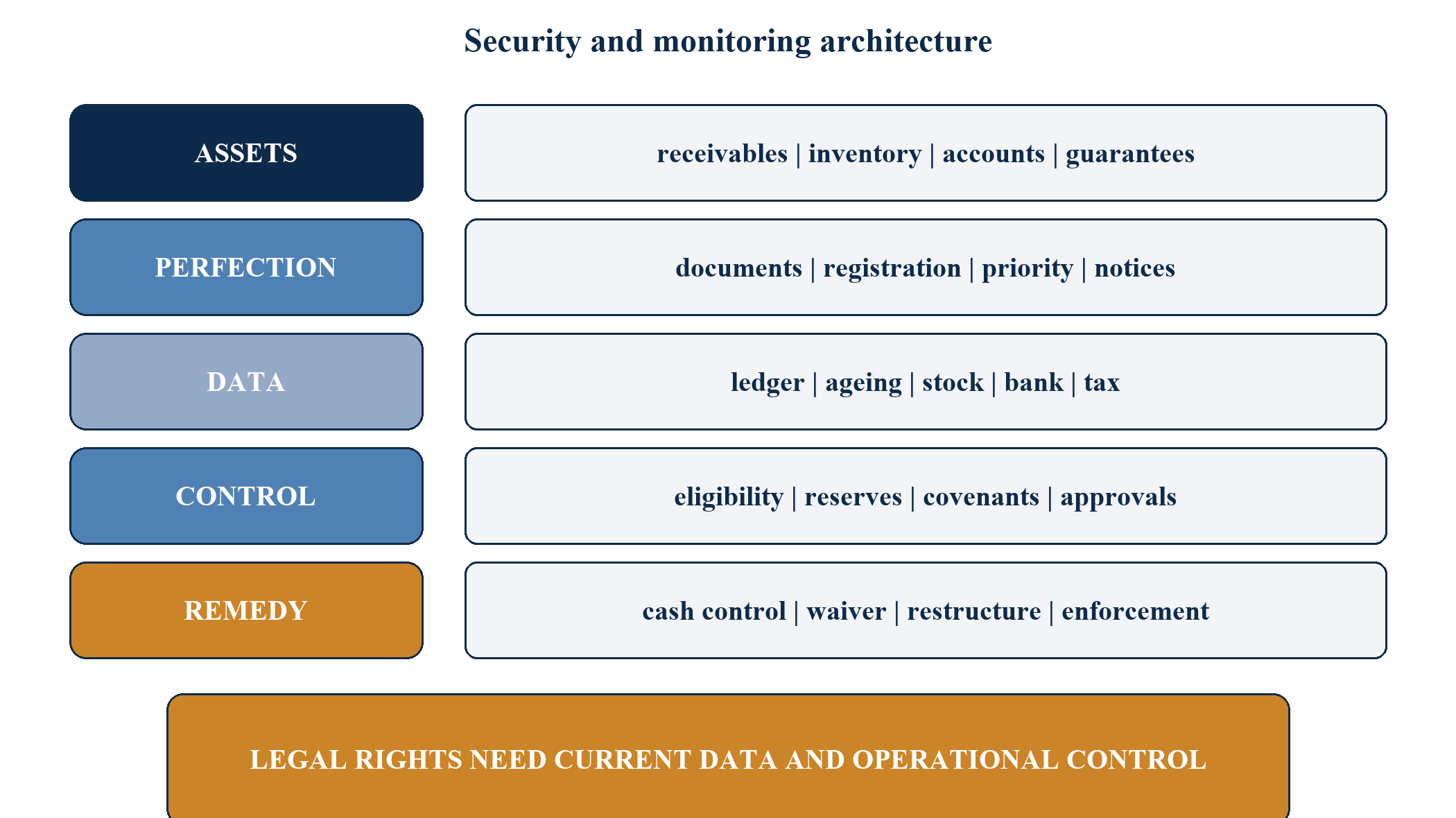
Legal rights and operational data need to correspond. A receivables security package is stronger when the invoice ledger, customer contracts, collection accounts, notices and borrowing-base records identify the same assets. Inventory security depends on title, location, description, access, insurance and realisable value.
14.2 Perfection and priority are continuing controls
The initial registration is one step. Amendments, new entities, additional assets, changes in debtor details, competing claims and expiry dates can affect the position. A security register should record each document, filing, asset class, grantor, secured party, date, renewal and evidence location. Local legal counsel should confirm current creation, perfection, priority and enforcement requirements for the exact structure.
15. GUARANTEES AND GROUP STRUCTURE
15.1 Identify the value chain and credit support
Mid-market groups often separate trading, manufacturing, distribution, intellectual property and property ownership. The lender may request upstream, downstream or cross-stream guarantees. The group should map where revenue is earned, cash is collected, assets are held and liabilities arise. It should evaluate corporate benefit, capacity, approvals, financial assistance, tax, insolvency and minority interests under applicable law.
A guarantee can support access to cash without transferring operational control. Its value depends on the guarantor's resources, legal effectiveness and competing liabilities. Public credit-guarantee schemes also provide partial risk sharing under their own eligibility and process [13-18]. Their presence does not replace borrower credit analysis.
| Support type | Economic purpose | Evidence | Key review |
|---|---|---|---|
| parent guarantee | consolidate group credit support | group accounts and authority | value, capacity and corporate benefit |
| operating-company guarantee | link cash generation to debt | operating cash flow and obligations | structural subordination and creditor claims |
| personal guarantee | additional recourse to owner | net-worth and enforceability evidence | scope, cap, release and succession |
| public guarantee | share eligible lender loss | programme approval and guarantee terms | coverage, conditions and residual risk |
| cash collateral | create readily available support | controlled deposit and set-off terms | trapped liquidity and release conditions |
16. DRAW CONDITIONS, REPRESENTATIONS AND PURPOSE CONTROL
16.1 Convert legal conditions into an operating process
A committed amount becomes cash only when the draw conditions are met. A utilisation request may need to specify amount, currency, date, interest period, purpose and receiving account. Repeated representations can address legal status, authority, no default, financial information, security, sanctions, tax and litigation. Each drawing can therefore carry a fresh factual statement.
Treasury should maintain a draw checklist with legal, finance, compliance and authorised-signatory approvals. The checklist should confirm available commitment, borrowing-base support, sublimit capacity, permitted purpose, no forecast breach and completion of notice requirements. The record protects both liquidity continuity and representation accuracy.
16.2 Control funded purpose after the draw
Purpose control continues after cash is received. A draw register can connect proceeds to supplier batches, payroll, eligible inventory or other approved uses. Tracing may be a documentation requirement or an internal governance choice. It helps management distinguish true working capital use from leakage into capital expenditure, owner payments or unrelated investments.
| Draw control | Evidence | Owner | Escalation |
|---|---|---|---|
| current availability | facility and borrowing-base bridge | treasury | insufficient headroom |
| no default | covenant and event checklist | CFO and legal | actual or forecast issue |
| permitted purpose | cash-use schedule | treasury and operations | unsupported use |
| repeated representations | current factual certificate | legal, tax and compliance | statement cannot be confirmed |
| notice mechanics | approved request and timestamp | treasury | cut-off or formal defect |
17. CLEAN-DOWN, SEASONALITY AND PERMANENT DEBT
17.1 Clean-down as diagnostic evidence
A clean-down requires drawings to fall below a defined level, sometimes to zero, for an agreed period. It provides evidence that the line turns with the operating cycle. A rigid clean-down can create operational strain where the business has overlapping cycles, multi-country seasonality or continuous trade. The test should correspond to the real cycle and preserve the intended credit signal.
Historical utilisation can be decomposed into a base balance and seasonal peaks. If the base balance rises each year, management should examine margin, inventory, customer terms, capital expenditure, dividends and acquisitions. A structural requirement can be refinanced into amortising term debt or equity, leaving the revolver free for variable working capital.
17.2 Hypothetical utilisation diagnostic
Assume a hypothetical and simplified AED 60 million line. Drawings range between AED 20 million and AED 55 million during the first year, with a two-week low of AED 12 million. In the second year, the minimum rises to AED 28 million. The company still meets a clean-down threshold of AED 30 million, yet the rising minimum indicates a larger permanent component. Management should explain the movement before renewal rather than relying on technical compliance alone.
| Utilisation signal | Possible cause | Management response |
|---|---|---|
| higher seasonal peak | growth, slower collections or stock build | validate profitable growth and resize capacity |
| longer draw duration | delayed sales or collection | address operating cause and stress liquidity |
| rising minimum balance | permanent funding need or leakage | term out structural component |
| sudden repayment before test date | window dressing or asset event | validate source and sustainability |
| unused commitment throughout year | oversized facility or contingency value | compare assurance value with all-in cost |
18. ACCOUNT CONTROL AND CASH DOMINION
18.1 Collection architecture
Receivables-backed facilities can direct customer payments into identified collection accounts. Account control, cash sweeps or cash dominion may apply continuously or after a trigger. The design should identify who can instruct the account bank, when funds are released to the borrower, how currencies are converted and how receipts are allocated to invoices.
Operational friction can arise when customer remittances lack invoice references, payments arrive in multiple currencies or a customer pays a group entity that did not issue the invoice. The cash-application process should resolve unidentified receipts quickly. A lender and borrower need the same ledger-to-bank reconciliation.
18.2 Triggered control
Springing cash dominion can activate when availability, covenant headroom, delinquency or an event of default crosses a threshold. The trigger should be objective, measurable and operationally tested. The borrower should model the cash-flow effect because a sweep can reduce discretion over payroll, suppliers and tax payments even while it repays the line.
| Account-control question | Required answer |
|---|---|
| where do customers pay? | complete account list by entity, currency and customer channel |
| who controls each account? | mandate, security and instruction rights |
| how are receipts identified? | customer reference, lockbox or cash-application process |
| when does a sweep occur? | timing, threshold, permitted payments and waterfall |
| how is control released? | cure, evidence, notice and lender approval |
19. RECEIVABLE ELIGIBILITY, DILUTION AND CONCENTRATION
19.1 Eligibility should follow realisation risk
Receivables provide strong working capital support when invoices evidence completed delivery, customers accept performance, payment terms are clear and collections are predictable. Age, dispute, set-off, credit notes, returns, rebates, contra arrangements, customer jurisdiction and contractual restrictions can reduce realisable value. Eligibility rules should reflect those risks and be reproducible from the ledger.
Dilution measures the reduction between gross invoices and cash ultimately collected due to credits, returns, rebates, disputes and similar adjustments. A lender may apply a reserve or reduce an advance rate when dilution rises. The borrower should calculate gross and net dilution consistently and identify the operating causes.
19.2 Customer concentration
A high-quality receivable from one major customer can still create concentration risk. A cap can limit the eligible amount from that customer to a percentage of the borrowing base. The cap should consider credit quality, contractual set-off, payment history, sector and common ownership. Excess concentration may be included with a lower advance rate or excluded entirely.
| Receivable test | Evidence | Exclusion or reserve driver |
|---|---|---|
| invoice exists and is accurate | invoice and ledger | missing or duplicate record |
| performance is complete | delivery, acceptance or milestone | unperformed obligation |
| amount is undisputed | dispute and credit-note log | open dispute or expected credit |
| age is within threshold | due date and ageing | overdue beyond eligibility window |
| customer is eligible | KYC, jurisdiction and contract | sanctions, legal or transfer issue |
| concentration is within cap | customer-level ledger | excess over agreed percentage |
20. INVENTORY AVAILABILITY AND REALISABLE VALUE
20.1 Value depends on state and control
Inventory finance requires accurate quantity, ownership, location, condition, ageing and value. Finished goods with repeat demand and reliable resale may support a higher advance rate than work in progress, bespoke items, raw material subject to price volatility or stock held by a third party. The accounting carrying value may differ from net orderly liquidation value.
The borrower should reconcile warehouse systems to the general ledger and physical counts. It should identify consigned stock, supplier retention-of-title claims, goods in transit, damaged stock, obsolete items and insurance coverage. Independent field examinations or valuations can test the data and control environment.
20.2 Inventory reserves
A reserve can address obsolescence, liquidation cost, duty, freight, storage and price volatility. Advance rates may differ by category and ageing band. Slow-moving stock can remain commercially valuable while falling outside a working capital borrowing base because the expected realisation horizon exceeds the facility's liquidity purpose.
| Inventory category | Typical evidence | Key risk | Control response |
|---|---|---|---|
| finished repeat product | SKU ledger, sales velocity and count | demand or margin decline | ageing and advance-rate bands |
| raw material | purchase, title and production schedule | price and conversion dependency | commodity and production controls |
| work in progress | bill of materials and completion status | incomplete value | low advance rate or exclusion |
| goods in transit | shipping and title documents | location and title uncertainty | verified document set and insurance |
| obsolete or bespoke stock | ageing and customer linkage | limited realisation | exclusion or specific valuation |
21. FOREIGN EXCHANGE AND MULTI-CURRENCY LIQUIDITY
21.1 Currency mismatch
A GCC business may purchase in US dollars, sell in UAE dirhams or Saudi riyals, and incur operating costs in several currencies. Pegged exchange-rate arrangements reduce some volatility and do not remove timing, basis, non-pegged currency or convertibility risks. A multi-currency facility can align drawings with obligations, while equivalent utilisation changes as exchange rates move.
Treasury should map currency by receivable, payable, inventory, facility drawing and cash account. Natural hedges should be identified before derivatives. The forecast should calculate liquidity and covenant headroom under relevant currency stresses.
21.2 Facility and hedge interaction
A lender may require hedging for material non-functional-currency exposure or floating interest. Hedging consumes credit lines, collateral and cash when mark-to-market moves. The treasury policy should define permitted products, counterparties, tenors, hedge ratios and delegated authorities. A derivative should correspond to an identified exposure and be tested for liquidity under stress.
| Currency control | Decision |
|---|---|
| exposure register | record committed and forecast receipts, payments, debt and cash by currency |
| facility currency | draw in the currency that best matches the obligation and repayment source |
| revaluation buffer | reserve headroom for equivalent-amount movement |
| hedge policy | define purpose, instrument, ratio, tenor and counterparty limits |
| cash location | distinguish accessible operating cash from restricted or trapped balances |
22. CORPORATE TAX, INTEREST AND ACCOUNTING
22.1 UAE corporate-tax interest rules
The UAE Federal Tax Authority's current Interest Deduction Limitation Rules guide explains the general restriction for net interest expenditure above the applicable de minimis amount [10]. The guide describes a deduction equal to the greater of 30 per cent of accounting earnings before interest, tax, depreciation and amortisation and AED 12 million, subject to the detailed rules and exclusions, with carry-forward of disallowed amounts for up to ten tax periods [10,11].
A borrower should calculate tax interest using current law, its exact tax group, accounting treatment, related-party position and excluded activities. Facility pricing models should distinguish cash interest from tax-deductible interest. Fees, guarantee charges, hedging and capitalised borrowing costs need their own classification.
22.2 IFRS 9 and undrawn commitments
IFRS 9 addresses classification, measurement and impairment of financial instruments [21]. The IFRS Transition Resource Group paper on revolving credit facilities discusses expected credit losses for drawn and undrawn components and the period over which exposure can remain even where contractual cancellation rights exist [22]. For a lender, the commitment creates exposure before drawing. For a borrower, strong reporting and early-warning processes support continued access to that committed capacity.
Accounting for fees, modification, refinancing and covenant breaches depends on the exact terms and applicable standards. The finance team should involve the auditor before execution when classification or modification consequences could be material.
| Issue | Borrower question | Lender question |
|---|---|---|
| interest deduction | how much cash interest is deductible and when? | does tax affect debt service and forecast cash? |
| upfront fees | how are fees recognised over the instrument? | how is effective yield calculated? |
| modification | does an amendment change carrying value or derecognition? | how is credit deterioration reflected? |
| undrawn commitment | how is liquidity disclosed and managed? | what expected draw and credit loss apply? |
| covenant breach | what classification and disclosure result? | what risk grade, reserve and action follow? |
23. LENDER ECONOMICS AND UNDRAWN EXPOSURE
23.1 A commitment consumes resources before use
Basel credit-risk rules account for potential exposure from undrawn commitments through credit-conversion factors or approved models, depending on the applicable approach and conditions [8]. Basel credit-risk mitigation rules also recognise that collateral and guarantees can transfer or reduce credit risk while introducing legal, operational, liquidity, market and residual risks [9].
The lender therefore prices commitment, monitors expected drawing and evaluates the borrower's ability to draw when conditions deteriorate. A line that is undrawn in normal conditions can become highly utilised during stress. Portfolio concentration across a sector or supply chain can magnify simultaneous draws.
23.2 Borrower actions that support capacity
Transparent forecasts, timely reporting, stable controls, clean collateral data and early disclosure reduce uncertainty. A borrower should explain both draw and repayment events. It should distinguish available cash from restricted balances and explain how contingency actions work. These actions support a more informed credit decision; the final limit and terms remain subject to lender approval.
| Lender concern | Borrower evidence | Facility response |
|---|---|---|
| simultaneous draw in stress | tested 13-week scenarios | commitment level and liquidity reserve |
| collateral value decline | ageing, concentration and valuation | advance rates and reserves |
| late risk detection | monthly pack and variance analysis | reporting frequency and triggers |
| structural debt inside revolver | historical utilisation and clean-down | term-out or amortisation |
| renewal concentration | early timeline and diversified options | maturity and extension design |
24. WAIVERS, DEFAULTS AND RESTRUCTURING
24.1 Forecast, communicate and document
A forecast covenant breach, reporting delay or borrowing-base shortfall should trigger a controlled process. The borrower should establish facts, quantify current and forecast impact, preserve liquidity, prepare a remediation plan and approach the lender with time for credit review. Informal discussion does not replace a written waiver, amendment or consent where the facility requires one.
UAE Federal Decree-Law No. 51 of 2023 and its executive regulations provide the current federal framework for financial reorganisation and bankruptcy proceedings within their scope [5,6]. A distressed business needs legal advice on duties, transactions, creditor rights, enforcement and available procedures. Early cash governance preserves more choices than action after liquidity is exhausted.
24.2 Response ladder
| Stage | Evidence | Borrower action | Lender engagement |
|---|---|---|---|
| forecast pressure | base and stress forecasts | operating actions and contingency review | early factual update |
| likely breach | revised certificate and cause analysis | request waiver or amendment | credit proposal and conditions |
| actual breach | confirmed calculation and legal review | comply with notice and protect cash | reservation, waiver or remedies |
| borrowing-base shortfall | ledger-level reconciliation | repay, add collateral or seek reserve change | verify cure and ongoing availability |
| severe liquidity distress | daily cash and creditor map | specialist legal and restructuring advice | standstill, restructure or enforcement review |
25. PUBLIC GUARANTEES AND ALTERNATIVE LIQUIDITY CHANNELS
25.1 Development-bank programmes
Emirates Development Bank publishes solutions covering working capital, receivables, purchase finance and related needs [13]. Its credit-guarantee scheme works through partner financial institutions and publishes programme features and eligibility information [14]. Qatar Development Bank and Saudi Arabia's Kafalah programme describe comparable guarantee support in their respective markets [16-18]. Current eligibility, maximum amounts, coverage, sectors and process should be confirmed directly.
An EDB announcement in May 2026 described a supply-chain liquidity programme with Zelo for eligible approved government and government-related invoices [23]. The announced terms illustrate how verified invoice data and approved counterparties can support targeted liquidity. A company should confirm current programme availability and exact contractual terms before relying on it.
25.2 Complementary instruments
Supply-chain finance, dynamic discounting, receivables purchase, inventory monetisation, purchase-order finance, asset-based lending and private credit can complement bank revolvers. Their economic cost includes discount, fees, recourse, data integration, customer notice, collateral sharing and intercreditor terms. The comparison should use the same draw profile and repayment assumption.
| Channel | Best-aligned use | Main diligence |
|---|---|---|
| development-bank guarantee | eligible growth or working-capital need through partner lender | programme, sector, residual risk and process |
| receivables purchase | predictable invoices and strong customers | recourse, eligibility, dilution and customer notice |
| supply-chain finance | approved payables and anchor-buyer programme | accounting, supplier economics and programme continuity |
| asset-based line | reliable receivables and inventory data | collateral control, audits and reserves |
| private credit | complexity, speed or tailored risk | all-in cost, covenants, security and exit |
26. THE LENDER-READY DATA ROOM
26.1 Evidence should answer the credit questions
A financing data room should be organised around legal capacity, business performance, cash conversion, repayment, collateral, downside and governance. Current documents should be distinguished from historic records. A request tracker should name the owner, source, review status, delivery date and open question.
Financial statements alone cannot show weekly liquidity or collateral eligibility. The pack should include monthly management accounts, 13-week forecasts, customer and supplier concentrations, receivables ageing, inventory reports, existing facilities, tax status, group structure, contracts, security and insurance.
26.2 Reconcile before delivery
Every key schedule should reconcile. Receivables and inventory should reconcile to the general ledger. Cash should reconcile to bank statements. forecast opening balances should reconcile to actual cash. Debt should reconcile to lender statements. Covenant calculations should use agreement definitions. Inconsistent information creates additional diligence and can delay approval.
| Data-room section | Minimum content | Review owner |
|---|---|---|
| corporate and authority | licences, constitutional documents, ownership, board authority and group chart | legal and company secretary |
| performance | audited accounts, management accounts, budget and variance | CFO and controller |
| liquidity | 13-week forecast, bank accounts and facility utilisation | treasury |
| working capital | ageing, inventory, payables, concentrations and disputes | finance and operations |
| credit and security | existing debt, guarantees, liens, filings and insurance | legal and treasury |
| compliance | tax, litigation, sanctions, licences and material contracts | tax, legal and compliance |
27. TERM-SHEET NEGOTIATION
27.1 Negotiate the operating system
The term sheet should cover commitment, purpose, maturity, availability, repayment, pricing, security, guarantees, borrowing base, covenants, information, conditions, events of default, transfer, confidentiality, governing law and costs. The company should model each term against the forecast and operating process.
Definitions and discretion deserve particular attention. A lender's power to change reserves, determine eligibility, cancel ancillary lines or require additional information can affect real availability. The company should understand notice, reasonableness, materiality and cure mechanics. Legal counsel should record agreed points and ensure definitive documents match the commercial approval.
27.2 Compare proposals on a common basis
| Dimension | Comparison metric | Evidence |
|---|---|---|
| assured liquidity | committed amount after base, sublimits and conditions | expected and stressed availability bridge |
| cost | present value of interest, fees and required ancillary cost | draw-profile model |
| operating burden | frequency and complexity of certificates, audits and notices | responsibility map |
| covenant resilience | base and stress headroom under agreement definitions | covenant forecast |
| collateral flexibility | eligible assets, advance rates, reserves and release | borrowing-base model |
| execution | approvals, documentation, conditions and closing date | transaction plan |
28. A 90-DAY IMPLEMENTATION PLAN
28.1 Days 1 to 30: establish facts
The first month should confirm the funding purpose, cash-conversion cycle, existing debt, bank accounts, collateral, guarantee structure and forecast. Management should approve the liquidity reserve and downside scenarios. The data room and lender universe can then be built from reconciled evidence.
28.2 Days 31 to 60: create competition and validate structure
The company can issue a consistent lender pack, answer diligence, receive proposals and test availability under each structure. Legal, tax and accounting review should begin before selection. Collateral data and registration searches should identify execution dependencies.
28.3 Days 61 to 90: document and operationalise
Definitive documents, security, conditions, account control, reporting templates and authorised-signatory processes should be completed. Treasury should perform a dry run of the borrowing-base certificate, utilisation request, interest calculation and monthly pack. Closing should include a calendar for every post-closing obligation.
| Period | Deliverable | Gate |
|---|---|---|
| days 1-10 | purpose statement, 13-week forecast and debt map | CFO confirms reconciled facts |
| days 11-30 | sizing bridge, collateral model and data room | board approves target structure |
| days 31-45 | lender outreach and diligence | comparable proposals received |
| days 46-60 | term-sheet selection and professional review | mandate approved |
| days 61-80 | documents, security and conditions | closing items verified |
| days 81-90 | operational dry run and first-draw readiness | owners sign the control calendar |
29. THREE HYPOTHETICAL CASES
29.1 Case A: seasonal distributor
This case is hypothetical and simplified. A regional distributor records annual revenue of AED 420 million and a pronounced pre-season inventory build. Receivables are diversified, inventory is standard and the line repays materially after the sales season. The 13-week stress model produces a peak need of AED 52 million. An AED 55 million committed revolver with a receivables and inventory borrowing base provides the principal liquidity, while a separate guarantee sublimit supports suppliers.
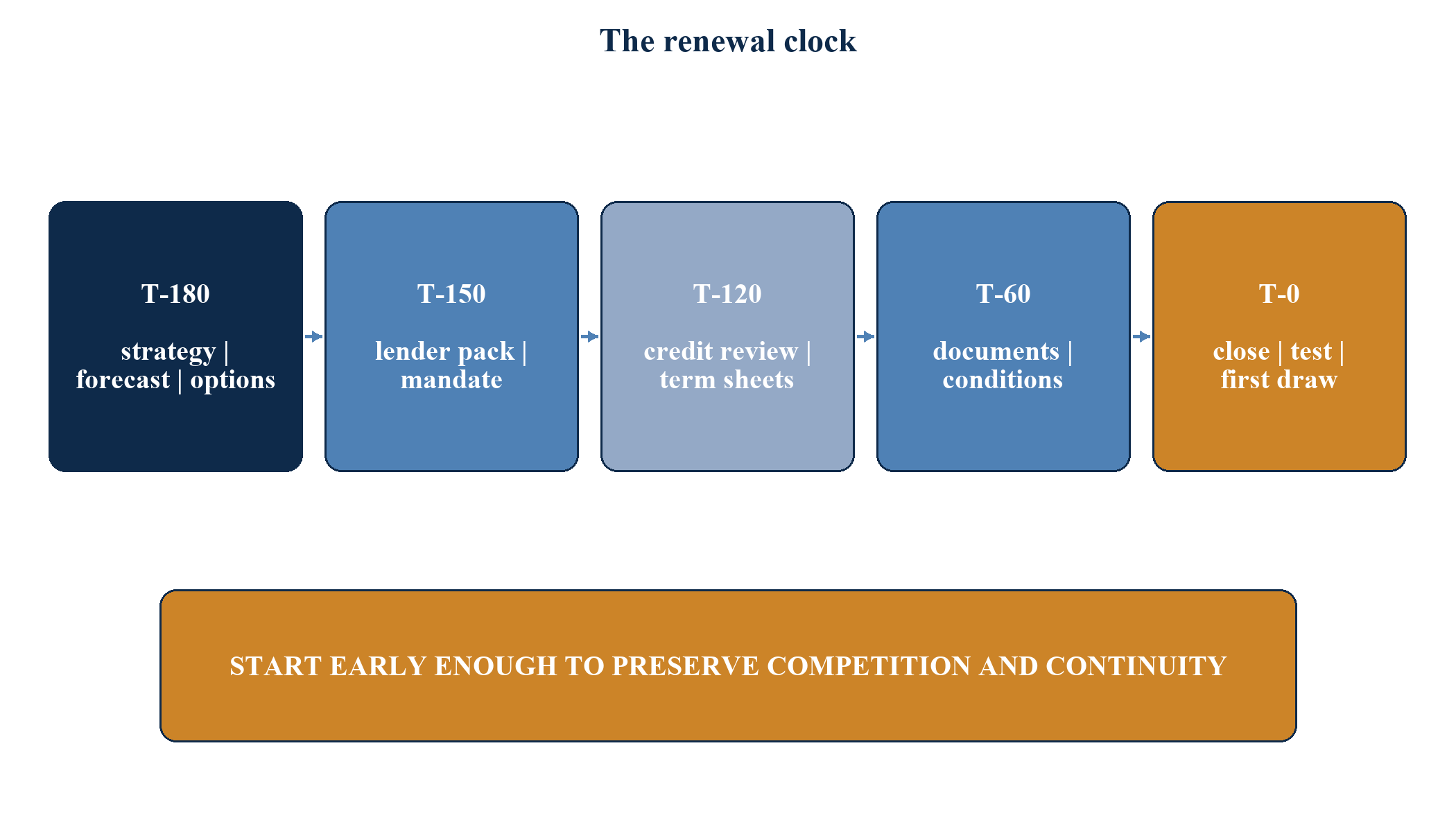
The operating controls include weekly forecast updates during the peak, monthly borrowing-base certificates, concentration caps, inventory ageing, a minimum-liquidity covenant and a six-month renewal clock. The key risk is slower sell-through. A stock-age reserve and an agreed term-out review address a persistent balance.
29.2 Case B: family-owned manufacturer
This case is hypothetical and simplified. A manufacturer has stable orders, 120-day customer payment terms and lumpy raw-material purchases. Its minimum revolver balance has risen for three years because capacity investment and shareholder distributions were funded through operating cash. The solution separates AED 30 million of permanent need into amortising term debt and retains a AED 45 million revolving line for variable working capital.
The facility uses receivables, selected inventory and account control. Financial covenants focus on leverage, interest cover and minimum liquidity. The board adopts a distribution gate linked to forecast headroom. The key result is clarity: long-lived funding serves the permanent component, and the revolver turns with the operating cycle.
29.3 Case C: project-services business
This case is hypothetical and simplified. A services company pays monthly payroll and receives milestone payments from five large customers. Gross receivables are concentrated and some invoices depend on customer certification. A pure receivables borrowing base produces volatile availability because uncertified work and disputed milestones are excluded.
The company uses a smaller committed cash revolver sized from contracted receipts, supported by a minimum-liquidity covenant and a customer-level forecast. Performance guarantees consume a separate sublimit. The financing package is combined with contract changes that accelerate certification and require advance payments for selected projects.
| Case | Core instrument | Primary control | Structural action |
|---|---|---|---|
| seasonal distributor | committed asset-backed revolver | inventory and receivables availability | stock-age reserve and renewal review |
| family manufacturer | term debt plus revolver | draw turning and distribution gate | term out permanent balance |
| project services | smaller cash revolver plus guarantee sublimit | milestone and customer cash forecast | improve certification and advance terms |
30. GOVERNANCE, LIMITATIONS AND CONCLUSION
30.1 Governance checklist
A working capital facility should have named accountability across the board, CFO, treasury, controller, legal, tax, operations, sales, collections and supply chain. The board approves risk appetite, commitment, security, guarantees, minimum liquidity and material amendments. Management owns the forecast, certificates, covenants, collateral, draw decisions and renewal plan.
| Frequency | Review | Required decision |
|---|---|---|
| daily during stress | bank cash, available commitment and critical payments | draw, pay, defer or escalate |
| weekly | 13-week forecast, variance and draw profile | update liquidity actions |
| monthly | management accounts, collateral, covenants and compliance | confirm headroom and certificates |
| quarterly | downside scenarios, customer and supplier concentrations | adjust reserve and contingency plan |
| semi-annually | lender options, maturity and security register | launch renewal or amendment |
| annually | facility purpose, permanent balance and all-in cost | retain, resize, reprice or restructure |
30.2 Limitations
This paper provides a general decision framework. It does not determine the creditworthiness, borrowing capacity, legal rights, tax treatment, accounting or optimal facility for any person. GCC jurisdictions have distinct laws, regulators, registries, insolvency frameworks and market practices. Bank terms, programme eligibility, benchmarks and public guidance can change after publication. The central-bank survey evidence describes reported sentiment and does not predict an individual credit decision.
The numerical examples are hypothetical and simplified. They omit many items that can be material, including value-added tax, customs, withholding, transfer pricing, minority interests, intercreditor arrangements, hedging documentation, sector regulation and entity-specific restrictions. Professional legal, tax, accounting, treasury and credit advice should be obtained for the actual transaction.
30.3 Conclusion
The strongest working capital facility starts with operating evidence. A 13-week forecast identifies the funding peak. The cash-conversion cycle explains why the peak occurs. A borrowing base tests collateral capacity. Pricing, covenants, security, reporting and draw conditions determine how much of the commitment can be used. The renewal clock preserves continuity and negotiating choice.
Facility design therefore connects liquidity with operating control. A company that can reconcile cash, receivables, inventory, covenants and repayment gives its board and lenders a common view of risk. That common view supports faster decisions, earlier intervention and a commitment that works when the operating cycle needs it.
APPENDIX A. LIMIT-SIZING MODEL
A.1 Inputs
The model should use weekly receipts and payments, unrestricted cash, minimum operating cash, current drawings, unused commitment, borrowing-base availability, sublimits and stress assumptions. Each input should have a source, owner, last update and validation status.
A.2 Calculation sequence
- Calculate closing cash before financing for each of 13 weeks.
- Add the board-approved minimum cash requirement.
- Identify the largest resulting deficit.
- Apply defined receipt, cost, currency and timing stresses.
- Compare gross need with eligible collateral and credit capacity.
- Identify any uncovered amount and approved contingency action.
- Calculate drawings, repayments, interest, fees and covenant headroom.
| Model control | Test |
|---|---|
| opening cash | reconcile to bank statements and restricted-cash schedule |
| receipts | reconcile to invoices, orders and historic payment behaviour |
| payments | reconcile to approved ledger, payroll and statutory calendars |
| facility | reproduce commitment, sublimits, conditions and cost from documents |
| collateral | reproduce eligibility, caps, advance rates and reserves |
| scenarios | name the event, magnitude, duration and management response |
APPENDIX B. TERM-SHEET CHECKLIST
| Term | Questions for approval |
|---|---|
| parties | are borrower, guarantors, lenders, agent, account bank and security agent correct? |
| commitment | what is committed, uncommitted, ancillary and available by currency? |
| purpose | which operating uses are permitted and how are proceeds evidenced? |
| maturity | what are availability, extension, review and final repayment dates? |
| pricing | which benchmark, floor, margin, ratchet, fee and default cost apply? |
| borrowing base | which assets, exclusions, caps, advance rates, reserves and audit rights apply? |
| covenants | what are exact definitions, levels, test dates, cure rights and headroom? |
| information | which reports, certificates, notices and delivery periods apply? |
| security | which assets, entities, accounts, registrations, notices and releases apply? |
| guarantees | who guarantees, for how much, under which law and with what release? |
| draw conditions | which notices, repeated representations and no-default tests apply? |
| default | which events, grace periods, materiality thresholds and remedies apply? |
| transfer | can lenders transfer, disclose or sub-participate and to whom? |
| costs | who bears legal, audit, valuation, registration and monitoring costs? |
APPENDIX C. MONTHLY REPORTING PACK
C.1 Cover sheet
The cover sheet should state the reporting date, facility, borrower, certification status, current drawings, commitment, borrowing-base availability, unused cash capacity, covenant headroom and material exception. It should be signed under the authority required by the facility.
C.2 Supporting schedules
| Schedule | Reconciliation | Exception test |
|---|---|---|
| 13-week cash forecast | opening bank cash and prior actuals | minimum cash or capacity breach |
| receivables ageing | control account | age, dispute, concentration and dilution |
| inventory | ledger and physical system | age, location, title and obsolescence |
| borrowing base | eligible ledgers | reserve, excess concentration and shortfall |
| covenant calculation | management accounts and facility definitions | threshold and amber headroom |
| draw and interest | lender statements and contract | calculation difference or late payment |
| security register | legal documents and filings | expiry, amendment or missing asset |
| compliance calendar | facility obligations | overdue deliverable or notice |
REFERENCES
- Central Bank of the UAE. *Credit Sentiment Survey, Q1 2026*. 2026. https://www.centralbank.ae/media/xpvl2iea/credit-sentiment-survey-q1-2026.pdf
- Central Bank of the UAE. *Financial Stability Report 2024*. 2025. https://www.centralbank.ae/en/our-operations/financial-stability/
- Central Bank of the UAE. *The CBUAE issues its 2025 Annual Report*. 2026. https://www.centralbank.ae/en/news-and-publications/news-and-insights/press-release/the-cbuae-issues-its-2025-annual-report-exceptional-growth-and-major-achievements-strengthening-the-stability-of-the-uae-s-financial-system/
- United Arab Emirates. *Federal Law No. 4 of 2020 on Securing Rights in Movable Assets*. Current official text. https://uaelegislation.gov.ae/en/legislations/1446
- United Arab Emirates. *Federal Decree-Law No. 51 of 2023 Promulgating the Financial Reorganisation and Bankruptcy Law*. https://uaelegislation.gov.ae/en/legislations/2190
- United Arab Emirates. *Cabinet Resolution No. 94 of 2024 Concerning the Executive Regulation of the Financial Reorganisation and Bankruptcy Law*. https://uaelegislation.gov.ae/en/legislations/2582
- Basel Committee on Banking Supervision. *Principles for the Management of Credit Risk*. 30 April 2025. https://www.bis.org/bcbs/publ/d595.htm
- Basel Committee on Banking Supervision. *Calculation of RWA for credit risk: off-balance sheet items*. Basel Framework CRE32. https://www.bis.org/basel_framework/chapter/CRE/32.htm
- Basel Committee on Banking Supervision. *Credit risk mitigation techniques*. Basel Framework CRE22. https://www.bis.org/basel_framework/chapter/CRE/22.htm
- UAE Federal Tax Authority. *Interest Deduction Limitation Rules Guide*. https://tax.gov.ae/Datafolder/Files/Guides/CT/Interest-Deduction-guide.pdf
- UAE Federal Tax Authority. *Corporate Tax General Guide*. https://tax.gov.ae/Datafolder/Files/Guides/CT/CT%20General%20Guide%20-%20EN%20-%2010%2009%202023.pdf
- United Arab Emirates. *Federal Decree-Law No. 50 of 2022 Issuing the Commercial Transactions Law*. https://uaelegislation.gov.ae/en/legislations/1610
- Emirates Development Bank. *Small and Medium Enterprises Solutions*. https://edb.gov.ae/customers/small-and-medium-enterprises
- Emirates Development Bank. *Credit Guarantee Scheme*. https://edb.gov.ae/en/solutions/credit-guarantee-scheme
- Emirates Development Bank. *Annual Report 2024*. https://edb.gov.ae/financial-reports/annual_report_2024/reports/ENGLISH/EDB%20AR24%20ENG%2031AUG%20%28FULL%20ARTWORK%20INCL.%20FINS%29%20LO-RES.pdf
- Qatar Development Bank. *Credit Guarantees*. https://www.qdb.qa/en/financing-and-funding/credit-guarantees
- Kafalah. *About the Program*. https://www.kafalah.gov.sa/en/About/Pages/default.aspx
- Kafalah. *What is the purpose for which financing is granted under the Program?* https://www.kafalah.gov.sa/en/Help/FAQ/Pages/What-is-the-purpose-for-which-financing-is-granted-under-the-Program.aspx
- Central Bank of the UAE. *EIBOR Rates*. https://www.centralbank.ae/en/forex-eibor/eibor-rates/
- Central Bank of the UAE. *Key Interest Rates*. https://www.centralbank.ae/umbraco/Surface/InterestRate/GetKeyInterestRate
- IFRS Foundation. *IFRS 9 Financial Instruments*. https://www.ifrs.org/issued-standards/list-of-standards/ifrs-9-financial-instruments/
- IFRS Foundation. *Measurement of expected credit losses for revolving credit facilities*. April 2015. https://www.ifrs.org/content/dam/ifrs/meetings/2015/april/itg/impairment-of-financial-instruments/ap4-revolving-credit-facilities.pdf
- Emirates Development Bank. *EDB and Zelo launch a supply-chain liquidity programme*. 13 May 2026. https://edb.gov.ae/posts/msrf-alamarat-lltnmy-omns-zylo-ytlkan-brnamga-bkym-350-mlyon-drhm-ltaazyz-alsyol-ld-alshrkat-alsghyr-oalmtost-odaam-slasl-altoryd-alsnaaay
- World Bank Group. *Secured Transactions, Collateral Registries and Movable Asset-Based Financing Knowledge Guide*. 2019. https://documents.worldbank.org/en/publication/documents-reports/documentdetail/193261570112901451
- World Bank Group. *Collateral Registries*. https://www.worldbank.org/en/topic/financialsector/brief/collateral-registries
- World Bank Group. *Business Ready: Financial Services*. https://www.worldbank.org/en/businessready/topic/financial-services
- OECD. *Financing SMEs and Entrepreneurs 2026: An OECD Scoreboard*. 2026. https://www.oecd.org/en/publications/financing-smes-and-entrepreneurs-2026_075d8058-en/full-report.html
- OECD. *OECD Financing SMEs and Entrepreneurs Scoreboard: 2025 Highlights*. 2025. https://www.oecd.org/en/publications/oecd-financing-smes-and-entrepreneurs-scoreboard-2025-highlights_64c9063c-en.html
ABOUT THE AUTHOR
Chennakeshav Adya is an independent researcher. His work examines corporate finance, capital structure, transaction strategy, investment governance and cross-border decision systems.
