

1. Reopen the policy when the family's economic centre moves
An investment policy statement records the purpose of capital, the obligations it must fund, the risks its owners accept and the authority by which decisions are made. Relocation can change every element. The family may acquire a new residence, shift operating businesses, employ staff in a new jurisdiction, change the currency of household spending, add school or university commitments, alter philanthropic plans and establish new investment entities. The portfolio may remain operationally anchored to the former country even as its economic purpose changes.
The first task is a formal policy-reopening decision. The board or principal should identify the relocation date, the jurisdictions involved, the expected duration, the people and entities affected, the liabilities that moved and the decisions that remain pending. The review should cover beneficial ownership, tax residence, legal residence, banking, custody, investment management, reporting, insurance, borrowing and cash operations. A migration project that addresses residence documentation while leaving the investment policy unchanged can create avoidable mismatches between capital and obligations.
The policy should be rewritten from evidence. Residence records, spending ledgers, property commitments, debt schedules, capital calls, operating-company plans and tax advice should support the new assumptions. Official UAE monetary materials explain that the dirham remains conventionally pegged to the US dollar and that domestic monetary operations operate within that framework [1, 2]. The peg reduces one category of short-term AED/USD variability; it does not make every UAE liability economically identical to a dollar asset. Local inflation, property pricing, school fees, taxes, service costs and timing still matter.
The reopening decision should also define stop conditions. Large currency trades, asset sales, remittances, vehicle transfers and mandate changes should wait until legal ownership, tax basis, liquidity and authority are understood. The board can authorise temporary cash protection while the full policy is developed. This preserves optionality and creates a defensible sequence for specialist advice, policy design and execution.
2. Replace one base currency with a hierarchy of functional currencies
A single reporting currency is useful for consolidation. It can be inadequate as the only basis for risk decisions. A globally mobile family can have several functional currencies at once. Household expenditure may be predominantly AED; global investment performance may be evaluated in USD; future UK education or property obligations may remain in GBP; Swiss living or healthcare costs may create CHF needs; an Asian business or family branch may introduce SGD. Each currency serves a different decision.
The policy should classify currencies into five functions. The reporting currency consolidates statements. The spending currency funds recurring consumption. The liability currency matches known contractual obligations. The opportunity currency supports planned investments and capital calls. The resilience currency protects access to purchasing power under stress. One currency may perform several functions, while the labels should remain separate so that committees understand why an exposure exists.
Functional-currency weights should be derived from cash flows and decision horizons. A recurring AED household budget deserves a different treatment from a possible GBP property acquisition. A committed USD private-equity capital call has a stronger claim on liquidity than a future discretionary allocation. A CHF reserve for a planned move is linked to a dated scenario. The board should document probability, amount, timing, flexibility and the consequence of a funding shortfall.
The policy can use a liability-weighted currency basket for risk measurement. The basket should be reviewed as residence, family plans and commitments change. It may remain dominated by USD because of global assets and the AED peg, yet that conclusion should follow the obligations. A committee that reports solely in the former home currency can mistake exchange-rate translation for investment skill and can overlook the purchasing power that the portfolio now needs to protect.
Table 1. Functional-currency register by obligation and decision
| Currency function | Illustrative obligation | Decision horizon | Flexibility | Policy treatment | Evidence owner |
|---|---|---|---|---|---|
| reporting | consolidated family wealth in USD | continuous | medium | report total return and risk in USD plus liability basket | chief investment officer |
| spending | UAE household and office costs in AED | 0-24 months | low | prefund rolling runway; monitor AED and local inflation | family-office finance lead |
| contractual liability | UK property instalment in GBP | 3-18 months | low | match dated obligation through cash or hedge | treasury lead |
| opportunity | USD private-market capital calls | 0-36 months | medium | reserve committed and stressed calls separately | private-markets lead |
| resilience | diversified emergency access in USD, AED, GBP and CHF | immediate | high | maintain multiple banking and custody channels | chief operating officer |
| strategic scenario | possible Singapore family branch in SGD | 2-5 years | high | stage exposure after decision gates are met | board sponsor |
Amounts, horizons and hedge ranges are hypothetical management assumptions. The table is a policy design example, not a recommendation.
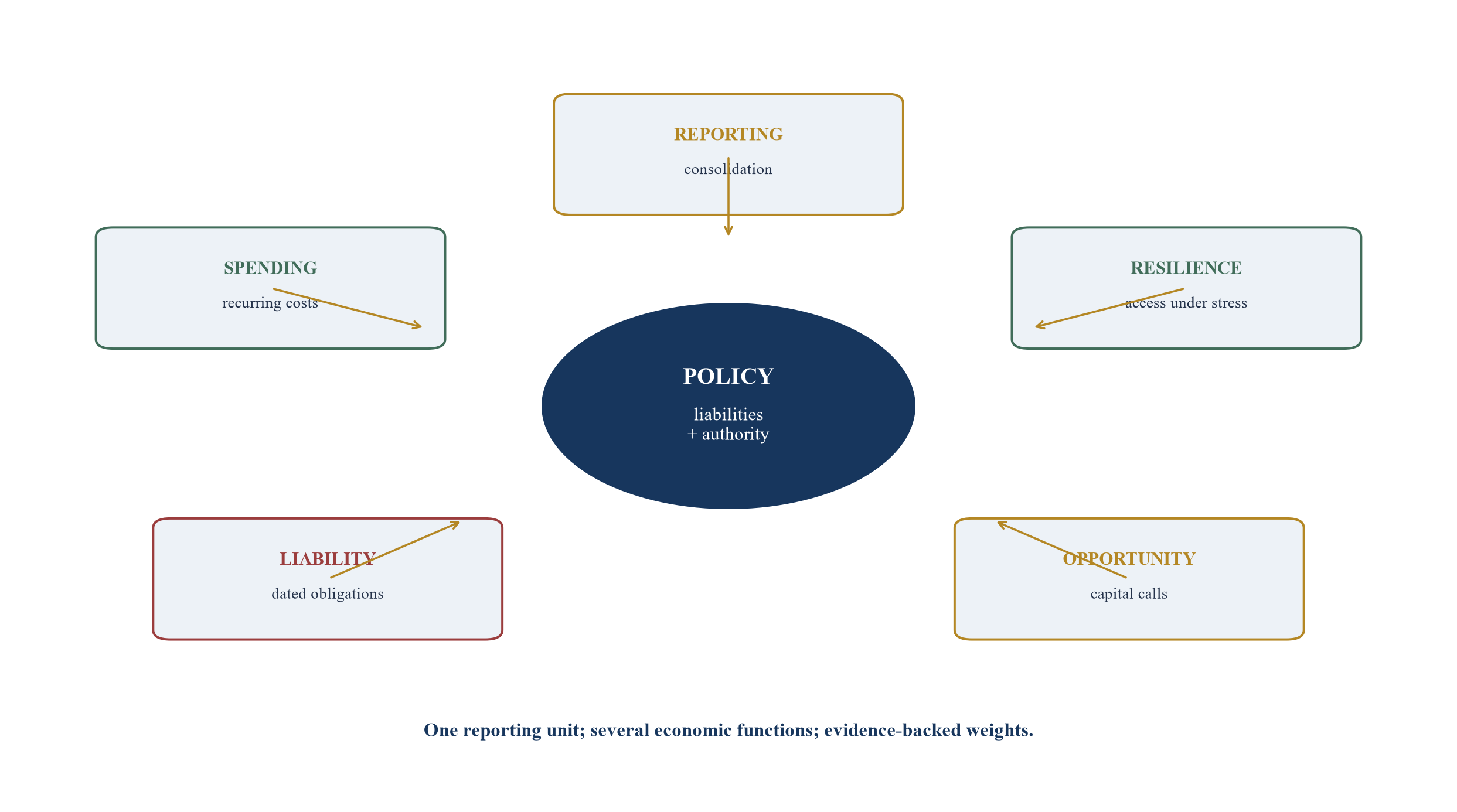
The diagram separates reporting, spending, liability, opportunity and resilience functions. Percentages are omitted because weights must follow each family's evidence.
3. Build the liability map before setting asset weights
Asset allocation should begin with what capital must accomplish. The liability map should capture recurring spending, debt service, property purchases, taxes, business funding, education, healthcare, philanthropy, family distributions, insurance premiums, staff costs and investment commitments. Each item needs an amount, currency, due date, legal obligor, probability, flexibility, inflation sensitivity and funding source.
The map should separate contractual liabilities from policy intentions. A signed property completion schedule and a committed fund capital call create defined obligations. A possible acquisition, planned gift or anticipated support for a family member remains conditional until approved. Treating every aspiration as a liability can create excessive cash drag. Treating every non-contractual intention as optional can leave the family unprepared for decisions that are practically unavoidable.
Tax should be handled through scenario ranges supported by advisers. The UAE Federal Tax Authority provides processes for tax-residency certificates and specific rules for natural persons conducting business activities [5, 6]. UK residence and foreign-income treatment depend on domestic law and individual facts [9, 10, 11]. Relocation can therefore change the timing and location of payments, filing requirements and the liquidity available for remittance or investment. The investment team should use approved estimates and should avoid interpreting tax rules independently.
The liability map should include contingent demands. Guarantees, margin calls, litigation, business rescue capital, unfunded commitments and family support can become urgent during stressed markets. A prudent policy identifies a base case, an adverse case and a severe-but-plausible case. The board should know which assets fund each case, how quickly they can be realised, which approvals are required and whether sale proceeds can reach the relevant account in time.
4. Distinguish economic currency risk from statement translation
Currency exposure appears at several layers. An asset can be denominated in one currency, generate revenue in several currencies, hold debt in another and be reported through a vehicle using a fourth. A UK-listed global company quoted in GBP can earn most revenue outside the UK. A USD-denominated fund can own European and Asian assets. A UAE property can be priced in AED while its value responds to international demand, local financing conditions and construction inputs.
The policy should therefore use economic look-through. For listed securities, revenue, cost and balance-sheet exposures can supplement quotation currency. For funds, the manager's reporting should identify underlying geographic and currency risks where available. For private assets, the investment team should map operating cash flows, debt service, exit currency and contractual hedges. For cash and bonds, denomination usually gives a clearer starting point, though credit and issuer risk remain separate.
Statement translation should be reported without being confused with realised purchasing-power risk. A portfolio translated from USD to GBP can rise when sterling falls even when no underlying asset gained value. If future spending has shifted to AED and USD-linked obligations, the GBP translation gain may have little economic significance. Performance reports should show returns in the reporting currency, returns against the liability-weighted currency basket, and the separate contribution from currency.
The IMF describes the UAE's exchange-rate arrangement as a conventional peg at AED 3.6725 per US dollar, within an open capital-account setting [4]. This is a valuable policy fact. It supports coordinated treatment of short-horizon AED and USD liquidity where banking, settlement and legal-access conditions are satisfactory. It does not remove issuer risk, bank risk, local price changes, cross-border transfer controls in other jurisdictions or the possibility that spending needs evolve.
5. Set the hedge objective before choosing instruments
A currency hedge should have a stated objective. Common objectives include protecting a dated liability, reducing portfolio volatility relative to the policy basket, preserving a minimum spending runway, controlling borrowing exposure or limiting a concentrated risk. The board should approve the purpose, eligible instruments, counterparties, collateral terms, tenor, hedge range, rebalancing rule, cost measurement and authority.
Liability hedging can be relatively direct. A known GBP payment due in nine months can be matched with GBP cash or an appropriately structured forward after legal, credit and tax review. Portfolio hedging is more complex because asset values move, underlying exposures change and hedges can require collateral. A hedge can create liquidity pressure when the underlying portfolio appreciates in the hedged currency or when markets gap. The policy must treat collateral and settlement as part of the exposure.
The Global Foreign Exchange Committee's December 2024 FX Global Code sets principles for integrity and effective functioning in wholesale foreign exchange markets [25]. It emphasises governance, execution, information sharing, risk management, compliance, confirmation and settlement. A family office or external manager should translate relevant principles into counterparty selection, pre-trade documentation, best-execution review, settlement-risk controls and incident escalation.
The policy should also define permissible non-hedging. Some currency exposure may diversify local economic risk or support future global opportunities. The board can approve unhedged strategic bands where the rationale, risk budget and review trigger are explicit. It should avoid frequent tactical currency decisions unless the mandate, skill, data and governance support them. The objective is alignment with obligations and risk capacity rather than a forecast of exchange-rate direction.
Table 2. Currency exposure and hedge decision matrix
| Exposure | Primary policy question | Possible treatment | Principal implementation risk | Required evidence |
|---|---|---|---|---|
| dated foreign-currency payment | what amount and date are contractually fixed? | cash matching or forward hedge | payment changes after hedge is placed | contract, payment schedule and authority |
| recurring spending | how stable is the monthly requirement? | rolling cash ladder and hedge band | overfunding or stale assumptions | reconciled spending history and budget |
| global listed assets | what is the economic look-through exposure? | strategic partial hedge or policy band | quotation currency used as a false proxy | manager and issuer exposure data |
| private fund commitment | which currencies apply to calls and distributions? | reserve call currency; hedge dated notices selectively | uncertain timing and collateral needs | commitment schedule and manager notices |
| foreign-currency debt | which cash flow services interest and principal? | natural match, swap or forward after review | hedge and debt terms become misaligned | facility agreement and cash-flow model |
| resilience reserve | which jurisdictions and channels must remain accessible? | diversified bank and custody access | concentration in one institution or payment rail | account, counterparty and access test |
Hedge ranges are omitted. Each instrument requires suitability, legal, credit, collateral, tax and operational review.
6. Build a multi-horizon liquidity runway
Liquidity is the ability to meet obligations in the required currency, jurisdiction and account by the required time. A marketable asset may be economically liquid and operationally unavailable because it is pledged, held in a slow vehicle, subject to a settlement delay, awaiting tax clearance or controlled by an unavailable signatory. The policy should measure usable liquidity after these constraints.
The runway should have four horizons. Immediate liquidity covers the next thirty days and operational incidents. Near-term liquidity covers one to twelve months of spending, taxes, debt service and committed transactions. Planning liquidity covers one to three years of property, education, philanthropy, business and investment commitments. Strategic capital funds long-horizon growth and can tolerate illiquidity. Each horizon should specify currency, instrument quality, account location, ownership, signatory access and replenishment rules.
Liquidity testing should examine both assets and liabilities. IOSCO's 2025 revised recommendations for collective investment schemes emphasise design, day-to-day management, stress testing and contingency planning [26]. ESMA's liquidity-stress guidance similarly requires asset and liability scenarios for relevant funds [27]. A family-office policy can adapt these principles without assuming that a private family portfolio is a regulated collective scheme. Capital calls, margin requirements, concentrated business exposure and family decisions form the liability side of the stress.
The board should approve a liquidity floor and a replenishment sequence. The floor can be defined by months of essential spending plus dated commitments and stress reserves. Replenishment should identify which assets may be sold, which credit lines can be drawn, who can authorise action and how currency is delivered. A credit line can support timing; its availability, covenants, security and lender discretion must be tested. Liquidity should be counted after haircuts and within the time in which cash can actually arrive.
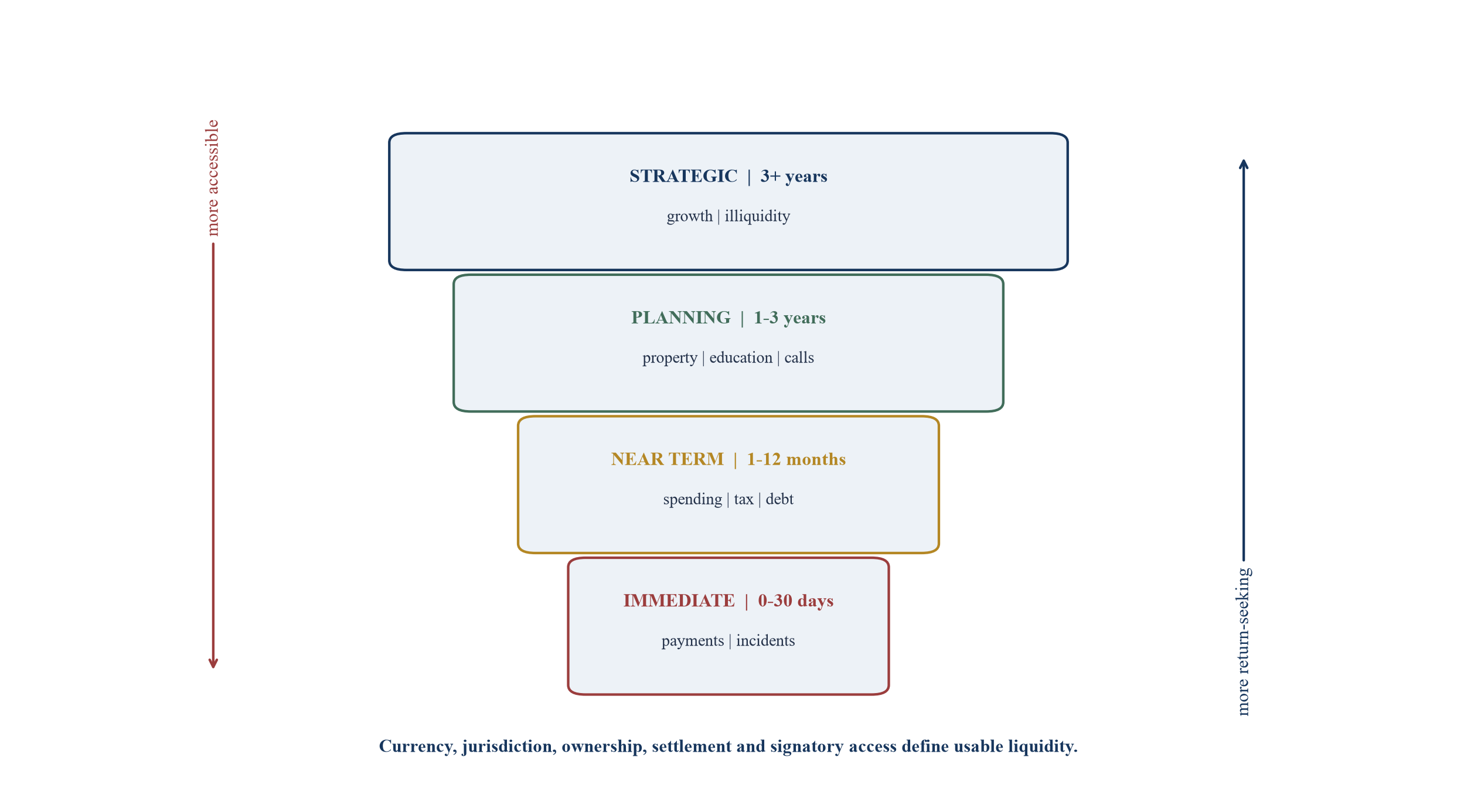
The horizons provide a governance structure. Amounts and eligible assets must be approved from family-specific evidence.
7. Stress liquidity through the whole balance sheet
A relocation-period stress can combine several events. Markets may fall while the family completes a property purchase, a business requires rescue capital, private funds call commitments and a currency moves against the new spending base. The stress test should combine shocks that share an economic cause. Independent single-factor tests can understate the cash demand created by correlated events.
The test should begin with a complete balance sheet. Assets include cash, public securities, private funds, direct businesses, property, insurance and receivables. Liabilities include debt, guarantees, capital calls, taxes, property instalments, family commitments and operating costs. Each item needs a liquidity horizon, currency, haircut, encumbrance and legal owner. The test should then model cash availability over days, weeks, months and quarters.
The United States Securities and Exchange Commission's liquidity-risk framework for registered investment companies illustrates the value of classifying assets by the time reasonably expected for conversion to cash without materially changing market value [28]. A family office can adapt the concept using assumptions suited to its portfolio. Private assets, concentrated listed positions and property should receive conservative treatment. The policy should document that market depth can deteriorate under stress.
Management should run reverse stress as well. Instead of asking what happens under a chosen market fall, it asks which combination of events exhausts the liquidity floor or forces the sale of a strategic asset. The result identifies fragile dependencies, including one bank, one borrower, one signatory or one exit. Remediation can include larger currency reserves, staggered commitments, alternative banking channels, reduced leverage, contractual notice, insurance, backup authority or a narrower illiquidity budget.
Table 3. Illustrative whole-balance-sheet liquidity stresses
| Stress | Combined assumptions | Liquidity question | Policy response to test | Decision owner |
|---|---|---|---|---|
| relocation completion | property payment, furnishing, tax estimate and six months of new operating costs | can every payment settle in the correct account and currency? | prefund dated payments and retain contingency | family-office CFO |
| market and currency shock | public assets decline while spending currency strengthens | does the runway survive without selling depressed strategic assets? | replenish early; use approved hedge and sale sequence | investment committee |
| private-market acceleration | capital calls arrive faster and distributions slow | how much committed capital is genuinely reserved? | commitment pacing and stressed-call reserve | private-markets lead |
| operating-company event | business needs emergency liquidity during portfolio drawdown | is support capped and approved? | ring-fenced limit and independent board gate | principal and company board |
| banking disruption | primary bank or payment rail is temporarily inaccessible | can essential payments move through another institution? | tested secondary accounts and signatories | chief operating officer |
| family event | health, education or succession event creates urgent cross-border funding | are authority and records available under pressure? | emergency file, powers and liquidity protocol | family governance lead |
Shocks and responses are hypothetical management assumptions. They are not forecasts of market, currency or funding conditions.
8. Decompose home bias before changing it
Home bias is an allocation to familiar domestic assets above their weight in a suitable global opportunity set. Some components can be rational. Local liabilities may support domestic bonds or cash. A family may possess genuine information, governance influence or operating expertise in a home market. Tax, legal or regulatory constraints may affect implementation. A family business can also be an intentional source of concentrated entrepreneurial risk.
Other components arise from familiarity, reporting habits, inherited portfolios, adviser networks, currency comfort, political narratives or reluctance to realise gains. These exposures should be visible. A decision to retain them can then be judged against diversification, liquidity, governance and opportunity cost. The SNB's research on capital flows and home bias explores how domestic preferences interact with international positions and market conditions [23]. The policy implication is analytical: home bias should be decomposed rather than treated as one behavioural label.
The diagnostic should classify each domestic exposure by purpose. Liability-matching assets have a defined cash-flow role. Control assets reflect ownership or influence. Advantage assets rely on documented information or operating capability. Constraint assets cannot be moved efficiently because of tax, legal, lock-up or market-depth considerations. Legacy assets remain because no explicit decision has been made. Each category requires a separate retention test.
Relocation can create a second home bias without reducing the first. A family moving to the UAE may retain concentrated UK assets while rapidly acquiring UAE property, local private deals and relationship-led investments. The combined portfolio can become more concentrated even though it spans two countries. The policy should measure exposure by country, currency, sector, legal system, funding source and economic driver. Diversification requires independent risk drivers, not a larger count of local holdings.
9. Set a concentration budget for family enterprise and property
Family wealth often includes a controlling business, operating-company shares, carried interests, property and loans to related entities. These assets can dominate net worth while generating the income that funds spending and future investment. The policy should recognise their strategic role and measure the risks they create for the liquid portfolio.
The board should calculate exposure under several lenses: market value, stressed value, income contribution, debt linkage, guarantee exposure, sector dependence, country dependence and liquidity. A family business can represent half of net worth and a larger share of cash-flow risk if the same industry influences employment, dividends, property and borrowing. Relocation can add financing and jurisdictional links without reducing the underlying dependence.
A concentration budget defines how much additional exposure may be accepted. It can set limits for related-party investments, domestic property, one sector, one borrower, one manager and one currency. Existing strategic assets may sit outside a conventional limit, while any new allocation should pass an incremental-risk test. The policy should explain who can approve exceptions and how the liquid portfolio compensates for the concentration.
Property deserves special treatment because it is both a consumption asset and an investment. A principal residence provides utility, may match local spending and can carry emotional value. It also consumes liquidity, creates maintenance and transaction costs, and concentrates exposure to one location. Investment property adds tenant, financing and regulatory risks. The board should separate residence, income property, development exposure and operating premises when measuring home bias and liquidity.
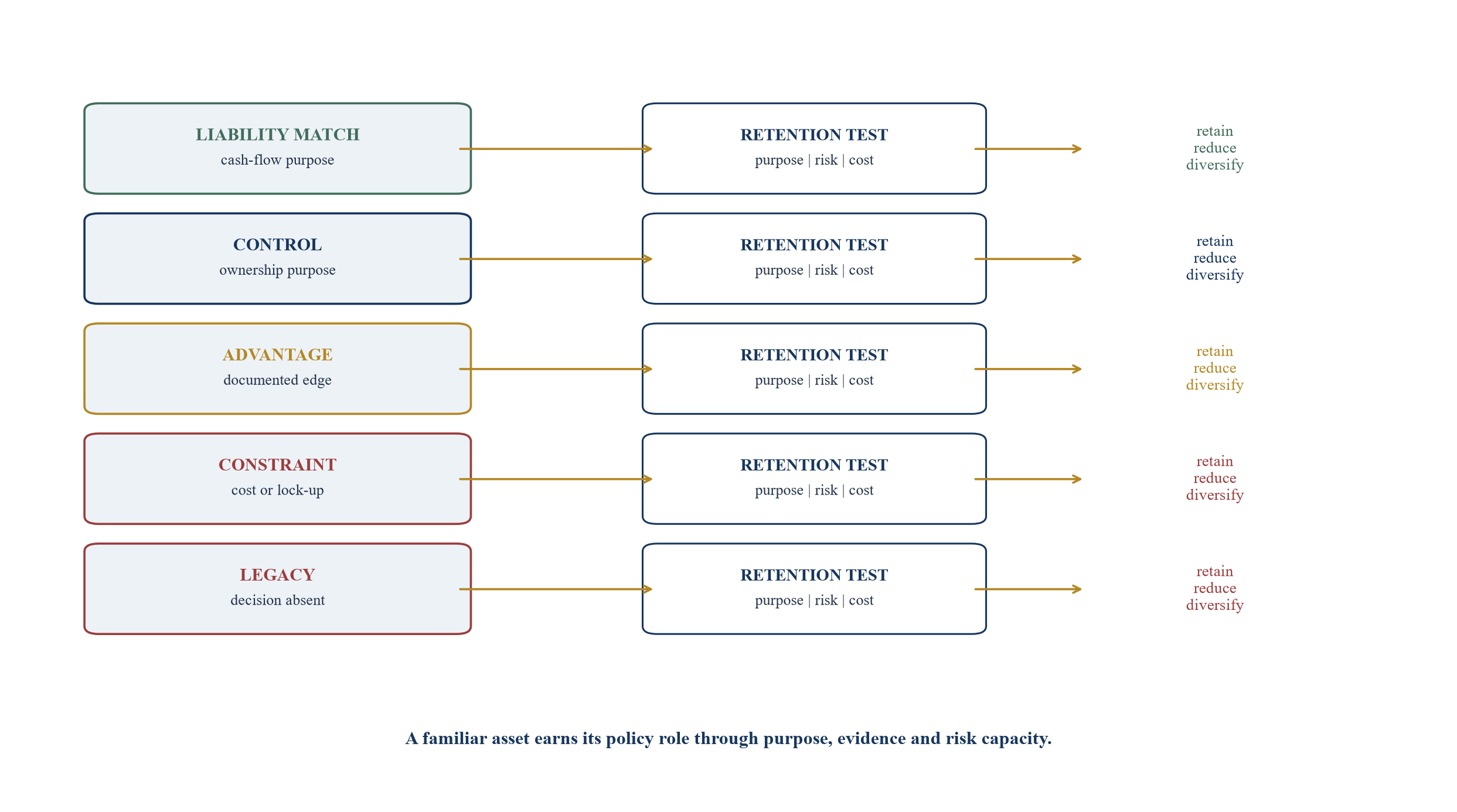
Each domestic exposure is assigned a purpose before retention, reduction or diversification is approved.
10. Map ownership, vehicle, custodian and underlying exposure
Relocation can produce a fragmented architecture. The same family may own assets personally, through companies, trusts, foundations, partnerships, funds, insurance wrappers and pension arrangements. Assets may be managed by several banks and advisers. The investment policy needs a look-through map that connects beneficial owner, legal owner, vehicle, custodian, manager, underlying exposure, currency, liquidity, tax basis, reporting and decision authority.
The legal location of an asset and its economic exposure can differ. A fund domiciled in one jurisdiction may own assets across many countries. A custody account in Switzerland may hold US securities and euro bonds. A UAE company may own a UK business. The policy should show domicile, custody and exposure in separate fields. This improves concentration analysis and helps legal, tax and sanctions advisers reach decisions from the same data.
The map should also identify restrictions. Lock-ups, gates, notice periods, side letters, pledges, margin arrangements, borrowing covenants, consent rights and transfer limits determine whether an asset can support liquidity or rebalancing. The 2025 IOSCO liquidity recommendations and ESMA guidance reinforce the value of connecting investment strategy, dealing terms, investor behaviour and available tools [26, 27]. Private family structures require their own terms-based analysis.
Data quality should be graded. Audited statements and current custodian feeds have a different evidence level from manager estimates or family recollection. Missing acquisition cost, beneficial ownership or transfer documentation should create a remediation task. The board should avoid approving a major policy shift until material holdings have been mapped and reconciled. Decisions based on partial exposure data can create duplicated risk, accidental sales and incorrect tax or cash assumptions.
Table 4. Asset-location and exposure look-through register
| Layer | Core field | Policy use | Evidence | Common gap |
|---|---|---|---|---|
| beneficial owner | person or governed family purpose | authority, succession and suitability | ownership register and governance documents | informal family attribution |
| legal owner | name on title, account or contract | transfer, tax and control | title, register, account and contract | stale or nominee record |
| vehicle | company, trust, foundation, partnership, fund or policy | legal and tax constraints | constitutional and subscription documents | structure known without current terms |
| custodian or administrator | institution holding or recording the asset | access, counterparty and reporting | statements, mandates and service terms | dormant or duplicated account |
| underlying exposure | country, sector, issuer, revenue and debt drivers | allocation and concentration | look-through data and manager reports | fund label used as full exposure |
| liquidity | settlement, notice, lock-up, gate, pledge and haircut | runway and stress testing | terms, side letters and facility documents | marketability mistaken for cash access |
| currency | quotation, cash flow, debt, liability and reporting | hedge and purchasing-power analysis | issuer, manager and treasury data | denomination used as economic proxy |
| tax and basis | cost, elections, withholding and advice | net-return and transfer analysis | tax records and adviser conclusions | missing acquisition history |
The rows show required fields. Asset values and legal conclusions must come from verified records and advisers.
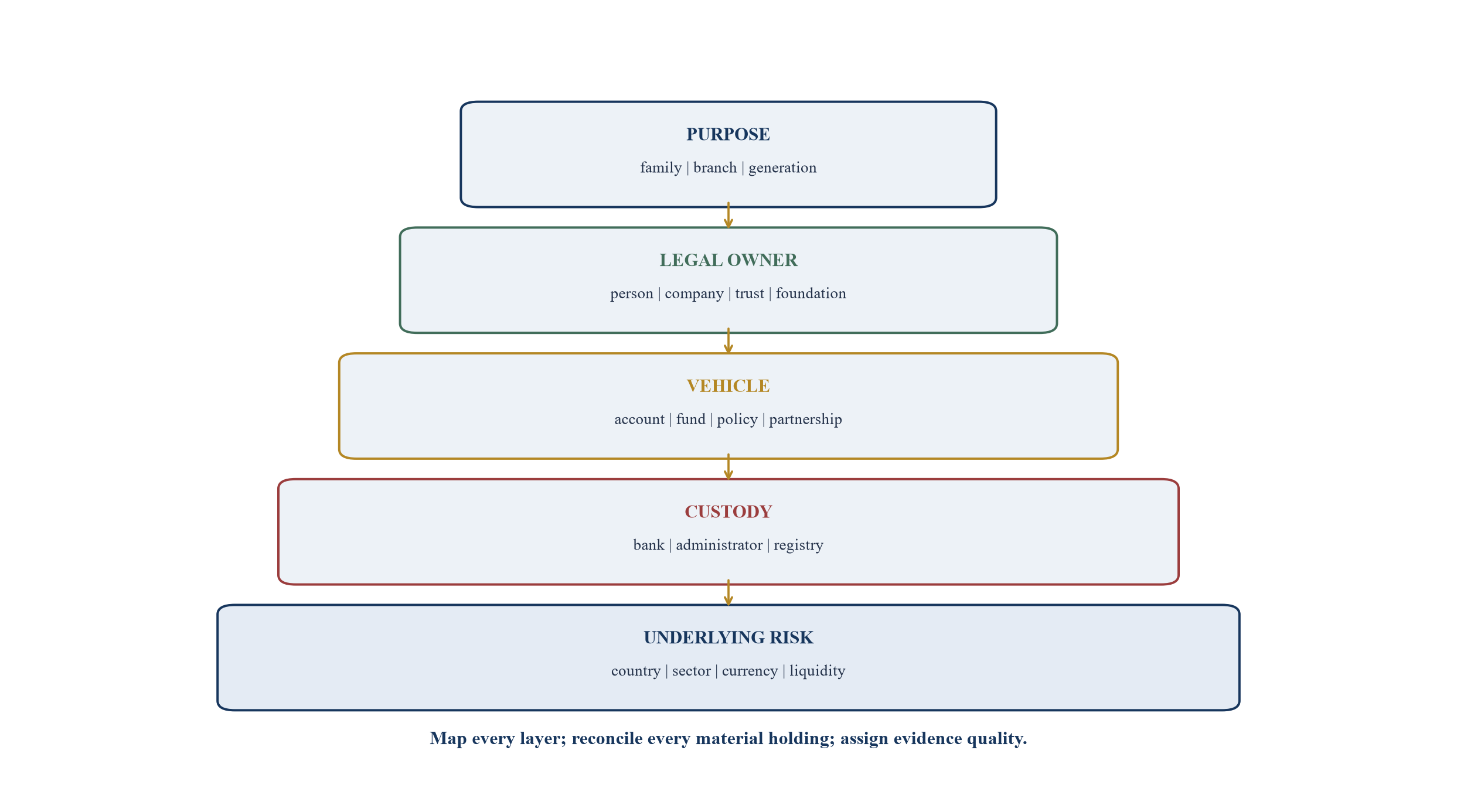
Each layer remains distinct so that legal ownership, custody and economic risk are not collapsed into one location label.
11. Compare jurisdictional features without reducing policy to tax
The UAE, United Kingdom, Singapore and Switzerland provide different monetary, tax, regulatory and market contexts. The policy should record features that affect investment operations while leaving personal legal conclusions to qualified advisers. Residence status, source rules, remittance, entity treatment, reporting, succession, custody and fund regulation can interact with portfolio design.
The UAE's dirham peg and domestic monetary framework make USD conditions relevant to AED liquidity and financing [1, 2, 4]. The Federal Tax Authority's residency-certificate process requires evidence that can include immigration, residence, employment, business and personal-interest records [5]. The DFSA provides a defined treatment for a single family office within its rulebook, subject to facts and scope [7]. ADGM also publishes a family-office framework and operating materials [8]. These institutional features should be mapped to the actual structure.
The United Kingdom applies a statutory residence framework and, from 6 April 2025, a residence-based foreign income and gains regime with specific transitional provisions [9, 11, 12, 13]. The UK-UAE double taxation convention addresses residence, income and gains within its terms [14]. A portfolio transfer, remittance or disposal can therefore require sequencing with tax advice. The investment policy should use approved net-return and liquidity assumptions.
Singapore determines individual tax residence through published rules and provides a certificate-of-residence process for treaty claims [16, 17]. Its monetary policy centres on the exchange rate rather than a conventional policy-rate target [19]. Switzerland's monetary policy focuses on price stability and uses the SNB policy rate and foreign-exchange operations as instruments [21, 22]. These differences affect reporting, cash management and scenario design. They do not create a universal ranking of jurisdictions or a substitute for personal suitability.
Table 5. Jurisdiction comparison for investment-policy redesign
| Jurisdiction | Monetary and currency feature | Residence or tax evidence | Investment-office question | Policy implication |
|---|---|---|---|---|
| UAE | AED conventionally pegged to USD; domestic operations reflect the framework | FTA residency-certificate evidence depends on the claimed basis | mainland, DIFC or ADGM entity; licence, activity and governance | coordinate AED and USD liquidity; preserve separate local-cost scenarios |
| United Kingdom | floating GBP and deep domestic markets | statutory residence and post-2025 foreign-income rules require fact analysis | legacy portfolios, remittances, disposals and continuing UK structures | model GBP liabilities, tax timing and legacy concentration before transfers |
| Singapore | exchange-rate-centred monetary framework | published day and residence tests; treaty certificate process | Asian family branch, custody, funds and operating links | introduce SGD exposure from actual obligations and governance |
| Switzerland | price-stability mandate with policy-rate and FX instruments | federal and cantonal facts require specialist analysis | custody, residence, operating substance and CHF liabilities | separate custody location from CHF economic exposure |
This table identifies policy questions from official sources. It does not state personal tax, legal or regulatory outcomes.
12. Rewrite the strategic asset allocation from risk capacity
Strategic asset allocation should reflect the family's ability and willingness to bear loss, illiquidity and complexity after the move. Risk capacity can change materially. A property purchase reduces liquid capital. A business sale can increase cash and tax liabilities. A new operating venture can create capital demands. A move may increase recurring costs or reduce dependence on one operating company. The policy should quantify these changes before approving target weights.
The allocation process should start with the liquidity floor, liability reserve, concentration budget and governance capacity. Remaining capital can then be assigned to growth, income, inflation protection, diversifiers and strategic opportunities. Asset classes should be defined by economic function and implementation reality. Private credit can provide contractual income while carrying default, valuation and liquidity risk. Infrastructure can offer long-duration cash flows while exposing the portfolio to regulation, leverage and construction. Hedge funds can diversify some risks while introducing manager, strategy and redemption complexity.
The board should use ranges rather than false precision. Each range needs a rationale, rebalancing rule and exception process. Illiquid allocations should include unfunded commitments and future pacing. Related-party and direct investments should consume the concentration budget. Currency overlays should sit alongside asset allocation so the committee can see whether risk is driven by asset choice or hedge choice.
Expected returns, volatility and correlations should be documented as uncertain modelling inputs. They are management assumptions, not forecasts. Scenario analysis should include historical and hypothetical stresses, regime changes and the effect of the family's own cash flows. The approved allocation should remain implementable after transaction costs, taxes, lock-ups, manager capacity and vehicle restrictions.
13. Use relocation as a governance reset
Relocation is a useful point to clarify authority. Informal arrangements can persist for years because the principal, banker and advisers know each other. New jurisdictions, entities and providers increase the cost of ambiguity. The revised investment policy should state who owns strategy, who approves allocation, who appoints managers, who executes transactions, who moves cash, who values private assets and who monitors risk.
Reserved matters should be explicit. They can include changes to the strategic allocation, new borrowing, guarantees, related-party investments, new jurisdictions, private-market commitments, currency derivatives, transfers between structures, custody changes and policy exceptions. Each matter needs a threshold, quorum, conflict process, evidence pack and emergency route. Delegations should have expiry dates and system permissions that match the written authority.
The policy should integrate family governance. Different generations can have different residence, spending, risk and liquidity needs. One consolidated portfolio may conceal branch-specific obligations. The board should decide whether capital remains pooled, divided into sleeves or governed through purpose-based pools. Distribution policy and decision rights should align with the legal structure and succession plan.
External advisers should have defined roles. Investment managers manage only within mandate. Lawyers, tax advisers, accountants, custodians and treasury providers provide separate expertise. The chief investment officer or equivalent integrates the evidence without substituting for specialist conclusions. Conflicts, fees, inducements, related products and placement arrangements should be disclosed and reviewed. Minutes should record the decision, evidence, dissent, conditions and next review date.
14. Design a policy benchmark that reflects the new purpose
A benchmark should measure whether the portfolio is delivering the return and risk needed for its purpose. A broad market index may be useful for one asset class, while the total portfolio needs a policy benchmark that reflects strategic weights, currency treatment and investable implementation. The benchmark should be set before performance is judged and changed only through governance.
The policy can maintain three views. An asset-policy benchmark measures manager and allocation performance. A liability benchmark tracks the currency and inflation characteristics of expected obligations. A preservation benchmark tests whether purchasing power and liquidity floors are maintained after spending, costs and taxes. These views answer different questions and should not be blended into one unexplained number.
Currency treatment is critical. If the portfolio is reported in USD while material future liabilities are in AED, GBP, CHF and SGD, the board should see performance in USD and against the liability-weighted basket. Hedged and unhedged returns should be separated. Any tactical currency result should be reported against the approved hedge policy and risk budget.
Private assets require transparent valuation treatment. Manager marks can be lagged and may smooth reported volatility. The policy should define valuation sources, frequency, challenge procedures and stale-price adjustments for risk reporting. It should also distinguish cash distributions from investment performance. A board should understand how much reported return comes from market movement, currency translation, leverage, valuation changes, income, fees and cash flows.
15. Establish rebalancing corridors and transition rules
Rebalancing restores the portfolio to approved risk ranges. After relocation, immediate rebalancing can generate tax, transaction, liquidity and market costs. Delay can leave material mismatches. The policy should use a staged transition with priority given to critical liquidity, contractual liabilities, excessive leverage, uncovered currency commitments and unauthorised concentrations.
Corridors should reflect asset liquidity and risk contribution. Public equities can have narrower operating bands than private assets that cannot be sold quickly. Currency hedge bands should account for collateral and cash flows. Illiquid allocations should be governed by commitment pacing and projected net asset value rather than current marks alone. The committee can use cash inflows, distributions and maturities to move toward target before selling assets.
Tax and legal advice should precede transfers and disposals. UK rules on residence, foreign income and gains, transitional treatment and temporary repatriation can affect the timing and net proceeds of actions for relevant individuals [9, 11, 12, 13]. The UK-UAE treaty can inform specific cross-border analysis within its terms [14]. The investment team should implement only conclusions approved for the actual person, asset, structure and date.
The transition plan should record pre-trade estimates, responsible person, approvals, counterparty, settlement path and post-trade reconciliation. Large or complex changes can be divided into tranches with decision gates. The board should define what would pause execution, including material market dislocation, changed tax advice, liquidity deterioration, counterparty concerns or a family decision. An implementation shortfall report should compare expected and realised costs without implying that all slippage was avoidable.
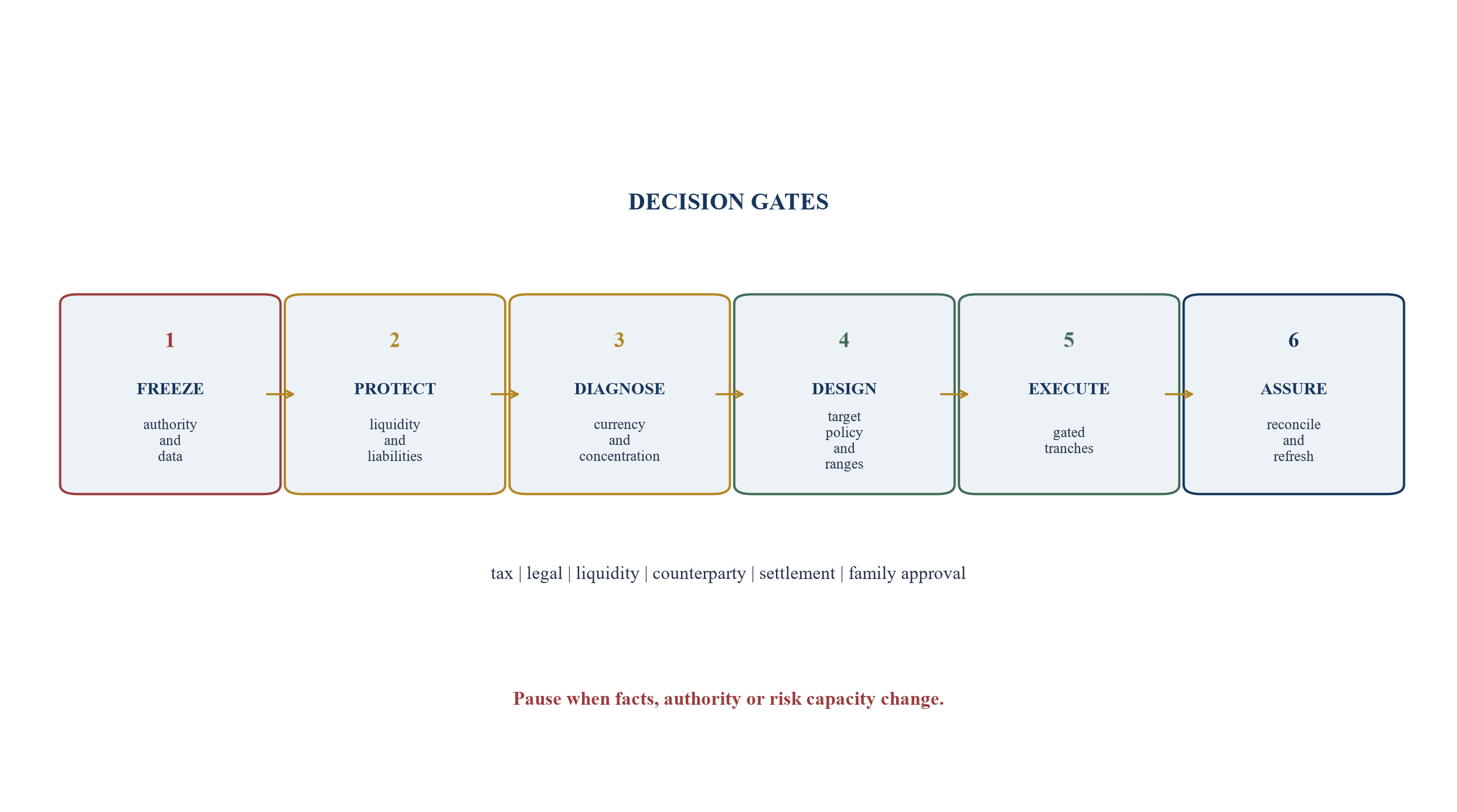
The sequence prioritises critical obligations and evidence before strategic portfolio changes.
16. Control cash, custody and counterparty concentration
Relocation often produces temporary cash balances. Property sales, business proceeds, portfolio liquidations and tax reserves can accumulate at one bank while new accounts are opened. The policy should set limits by legal entity, banking group, jurisdiction, currency, instrument, maturity and payment rail. Deposit protection, set-off, security interests and client-asset arrangements should be reviewed by advisers.
Cash should be assigned a purpose. Operating cash funds current payments. Reserve cash supports the liquidity floor. Transaction cash is awaiting a defined use. Strategic cash reflects a deliberate allocation view. Unassigned cash should trigger review because it can remain idle, exceed counterparty limits or become available for impulsive investments. Yield should be considered after access, credit, maturity, currency and tax.
Custody diversification requires operational readiness. A second custodian that has not completed onboarding, signatory tests, asset eligibility and payment rehearsals may provide little resilience. The family office should test account access, dual approval, call-back procedures, emergency contacts, settlement instructions, cyber controls and continuity. The Global FX Code's focus on confirmation and settlement risk supports disciplined processes for currency transactions [25].
The Federal Reserve's interagency policy statement on funding and liquidity risk management highlights diversified funding, cash-flow projections, stress testing, collateral management and contingency plans for supervised institutions [29]. A family office is a different kind of organisation, while these principles can inform treasury governance. The policy should state which external facilities are committed, which assets are eligible collateral, what covenants apply and how lender discretion could affect availability.
17. Integrate tax, legal and regulatory sequencing
Investment policy is an economic document operating inside legal structures. Relocation can make a sound allocation costly or impossible if assets are sold, transferred or hedged in the wrong sequence. The implementation team should create a decision register that links every material action to required tax, legal, regulatory, accounting, banking and family approvals.
The register should state the proposed action, legal owner, beneficial purpose, jurisdictions, date, expected proceeds or cost, currency, adviser conclusion, conditions and evidence of completion. Examples include opening an account, transferring securities, changing a mandate, funding a vehicle, remitting cash, executing a hedge, disposing of a legacy asset and pledging collateral. The chief investment officer should not assume that an approved target allocation authorises every legal step needed to reach it.
Tax-residency documentation should be kept current. The UAE Federal Tax Authority and Singapore's Inland Revenue Authority publish certificate processes with evidential requirements [5, 17]. HMRC publishes residence and foreign-income rules for UK analysis [9, 10, 11]. A certificate can support a position; it does not settle all source, treaty, entity, beneficial-ownership or anti-avoidance questions. The policy file should preserve person-specific advice and dates.
Regulated activities require a perimeter review. Managing family capital, advising related entities, arranging transactions, marketing funds, handling client assets or serving multiple families can have different consequences. The DFSA's single-family-office provision and ADGM's published family-office framework illustrate the need to define scope and structure [7, 8]. The board should approve only activities that the relevant entity and people may lawfully perform.
18. Organise data, reporting and cyber controls around decisions
A revised policy needs a trusted data model. Holdings should use consistent identifiers, ownership fields, currencies, valuation dates, liquidity classifications, cost basis and source quality. Liabilities should use the same currency and horizon taxonomy. Bank, custodian, fund, property and company data should reconcile to the general ledger and governance records. Manual adjustments should identify preparer, reason, evidence and reviewer.
The reporting pack should separate facts, assumptions and adviser conclusions. Verified balances and contractual payments belong in the factual layer. Expected spending, stress haircuts and scenario dates are management assumptions. Residence, tax, regulatory and legal positions belong to the professional-conclusion layer. This separation lets the board understand where uncertainty resides and prevents an internal estimate from becoming a repeated apparent fact.
Access should follow authority. Portfolio systems, bank portals, data rooms and treasury platforms should use named accounts, multi-factor authentication, least privilege, dual approval and prompt removal of access. Relocation increases phishing and payment-change risk because staff, advisers and institutions expect new addresses, accounts and instructions. Any payment-detail change should use verified call-back procedures and an independent approval route.
Continuity should be tested. The family office should be able to produce a current asset map, liabilities, signatories, emergency contacts, critical contracts and pending settlements without relying on one person. Backups should be encrypted and stored under approved retention and access rules. The board should receive data-quality measures, including unreconciled accounts, stale valuations, missing ownership evidence, unclassified currency exposure and overdue access reviews.
19. Implement through a 120-day gated programme
The first fifteen days establish control. The board appoints a sponsor, confirms scope, freezes unauthorised transfers, inventories entities, accounts and holdings, identifies payments due within ninety days, and secures critical system access. Immediate liquidity and legal risks are escalated. The team creates one evidence repository and one decision log.
Days sixteen to thirty-five produce the current-state map. Holdings, ownership, custody, liabilities, currencies, commitments, debt, cash flows, tax basis and authorities are reconciled. The team classifies evidence quality and records missing documents. Advisers confirm residence, tax, legal and regulatory workstreams. The output is an agreed fact base, not a target portfolio.
Days thirty-six to sixty design the future policy. The board approves functional currencies, liquidity floors, stress cases, concentration budgets, strategic ranges, hedge purposes, benchmarks, governance and transition principles. Options should show costs, constraints and decision dependencies. Management assumptions are recorded with owners and review dates.
Days sixty-one to ninety build implementation readiness. Accounts, custody, mandates, signatories, data feeds, counterparty documentation and execution plans are completed. Tax and legal conditions are attached to each material action. The committee approves initial tranches only after the evidence gates pass. Days ninety-one to one hundred and five cover controlled execution and reconciliation. Days one hundred and six to one hundred and twenty complete assurance, exception closure and business-as-usual handover.
Table 6. 120-day investment-policy rewrite and transition plan
| Phase | Days | Core work | Gated output | Release condition |
|---|---|---|---|---|
| control | 1-15 | sponsor, freeze, near-term payments, accounts, access and evidence room | critical-risk and action register | every material owner, obligation and deadline identified |
| reconcile | 16-35 | holdings, vehicles, custody, liabilities, currencies, basis and authority | current-state balance sheet and exposure map | material balances and ownership evidence reconcile |
| design | 36-60 | functional currencies, liquidity, concentration, allocation and governance | board-approved target policy | assumptions, advisers and reserved matters documented |
| build | 61-90 | accounts, mandates, counterparty files, data and execution tranches | implementation-readiness pack | legal, tax, liquidity and settlement gates pass |
| execute | 91-105 | controlled trades, transfers, hedges and cash movements | trade and transfer reconciliation | exceptions remain within approved limits |
| assure | 106-120 | stress test, access review, reporting, training and handover | operating policy and dashboard | owners complete a decision and continuity drill |
Timing is an illustrative management assumption. Legal, tax, banking and market dependencies can require a different sequence.
20. Operate an event-driven policy refresh
An annual calendar review is insufficient for a mobile family. The policy should trigger review when residence, spending, liabilities, family composition, business ownership, borrowing, commitments, property, entity structure, tax advice, regulation, manager terms or custody changes. A material currency move or liquidity event can also trigger action if approved thresholds are crossed.
Triggers should be classified by urgency. Pre-approval events include a new property commitment, borrowing, guarantee, private-fund subscription, related-party investment, custody move, currency derivative and transfer between structures. Prompt-review events include a material change in spending, travel plans, tax estimate, capital-call schedule, valuation or counterparty quality. Routine events feed monthly and quarterly monitoring.
The policy dashboard should show usable liquidity by horizon and currency, exposures against strategic ranges, home-bias categories, concentration-budget use, unfunded commitments, counterparty limits, hedge collateral, pending tax or legal conditions, stale valuations and open exceptions. Metrics need supporting evidence and named owners. A green average should not hide one unpaid obligation or one unauthorised transfer.
The committee should rehearse adverse events. Examples include temporary loss of bank access, incapacity of a signatory, delayed private distributions, a large margin call, a change of residence plan and an urgent operating-company request. The rehearsal tests data, authority, communication and settlement. Findings should amend the policy and continuity file. The policy remains effective when operating behaviour, systems and evidence stay aligned with the approved design.
21. Govern through a board-ready investment-policy decision file
The board-ready file should answer nine questions. What purposes does capital serve? Which currencies fund those purposes? How much liquidity is usable across time and jurisdictions? Where is home bias intentional? Which concentrations consume risk capacity? Who owns every asset and liability? Which actions require specialist approval? Who has authority to decide and execute? Which events reopen the policy?
The file should include the family purpose statement, current balance sheet, liability map, functional-currency register, liquidity ladder, stress tests, asset-location map, home-bias diagnostic, concentration budget, strategic allocation, hedge policy, benchmarks, governance schedule, implementation register, adviser conclusions, data-quality report and exception log. Each material conclusion should identify evidence, owner, approval date and refresh trigger.
Management may use a readiness score while preserving critical gates. A portfolio can be ninety-five percent mapped and still contain an unknown beneficial owner for a material asset. It can hold ample marketable securities and still lack the signatory or settlement route needed for an imminent payment. It can meet strategic ranges and still breach a currency or related-party limit. Critical exceptions should remain visible until closed or formally accepted within applicable law and mandate.
The operating principle is alignment. Residence, spending, liabilities, ownership, currency, liquidity, concentration, authority and reporting should describe the same economic reality. A structured policy cannot guarantee returns, preserve wealth under every condition or determine a tax or legal result. It gives principals and boards a disciplined system for obtaining advice, protecting liquidity, allocating risk and implementing decisions after relocation.
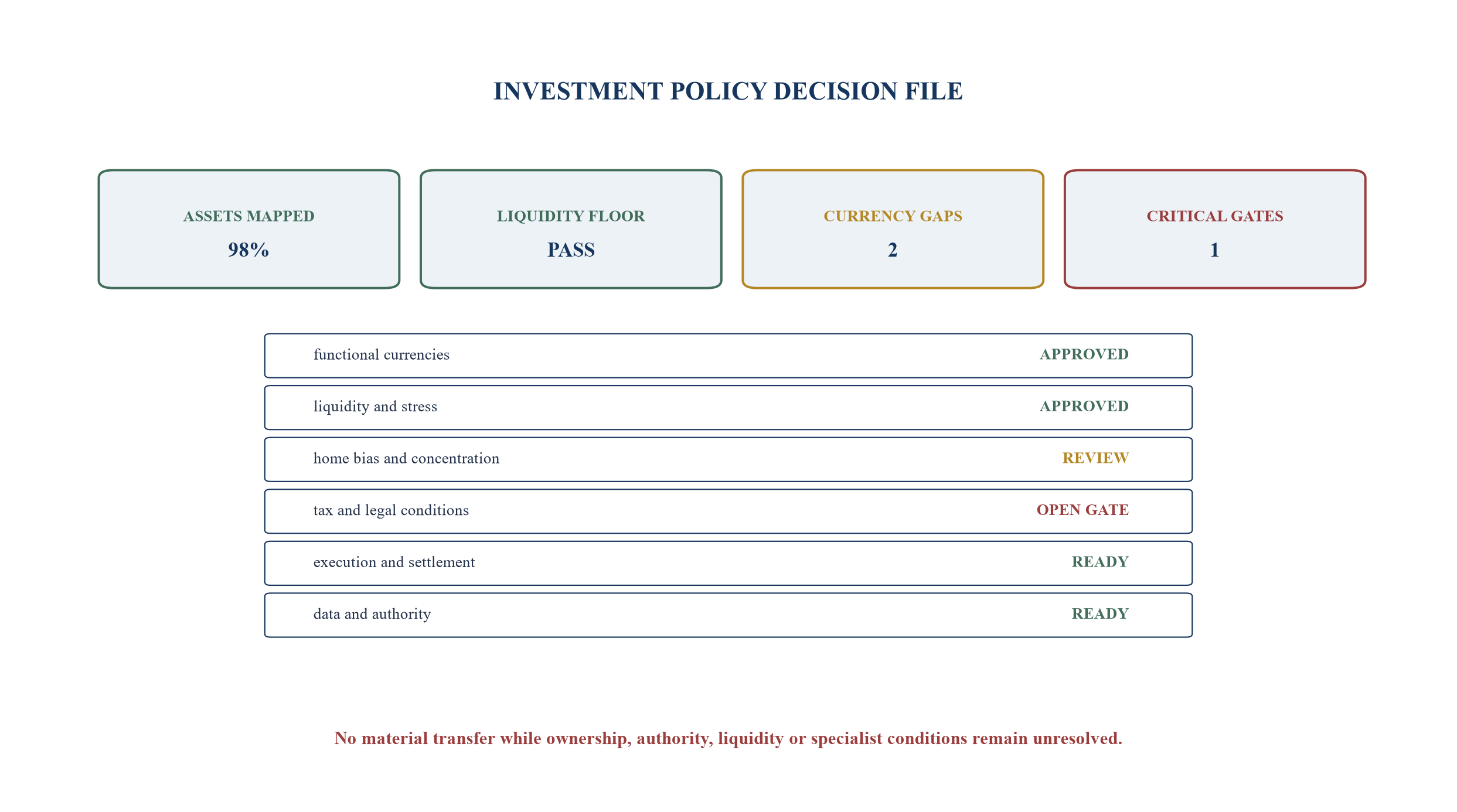
Values are illustrative. Critical gates remain visible regardless of the overall readiness percentage.
Sources and further reading
- Central Bank of the UAE, Domestic Market Operations Official source
- Central Bank of the UAE, Monetary Policy and Domestic Markets Official source
- Central Bank of the UAE, Exchange Rates against UAE Dirham Official source
- International Monetary Fund, United Arab Emirates 2025 Article IV Consultation Official source
- UAE Federal Tax Authority, Issuance of Tax Certificates for Tax Residency Official source
- UAE Federal Tax Authority, Basis of Taxation for Natural Persons Official source
- Dubai Financial Services Authority, GEN Rule 2.3.5 Single Family Office Treatment Official source
- Abu Dhabi Global Market, Family Offices Official source
- HM Revenue and Customs, Tax on Foreign Income and UK Residence Official source
- HM Revenue and Customs, Tax on Foreign Income Official source
- HM Revenue and Customs, Residence and Foreign Income and Gains Regime Manual Official source
- United Kingdom, Finance Act 2025 Official source
- HM Revenue and Customs, Temporary Repatriation Facility Official source
- HM Revenue and Customs, 2016 United Kingdom-United Arab Emirates Double Taxation Convention Official source
- Financial Conduct Authority, Liquidity Management for Investment Firms: Good Practice Official source
- Inland Revenue Authority of Singapore, Working Out Individual Tax Residency Official source
- Inland Revenue Authority of Singapore, Apply for Certificate of Residence Official source
- Inland Revenue Authority of Singapore, What Is Taxable and What Is Not Official source
- Monetary Authority of Singapore, Singapore's Exchange Rate-Based Monetary Policy Official source
- Monetary Authority of Singapore, Statement of Commitment to the FX Global Code Official source
- Swiss National Bank, Monetary Policy Official source
- Swiss National Bank, Implementation of Monetary Policy Official source
- Swiss National Bank, Capital Flows and the Swiss Franc: Home Bias and International Positions Official source
- Swiss National Bank, Portfolio Rebalancing under Stress Official source
- Global Foreign Exchange Committee, FX Global Code, December 2024 Official source
- International Organization of Securities Commissions, Revised Recommendations for Liquidity Risk Management for Collective Investment Schemes Official source
- European Securities and Markets Authority, Guidelines on Liquidity Stress Testing in UCITS and AIFs Official source
- United States Securities and Exchange Commission, Investment Company Liquidity Risk Management Programs Official source
- Board of Governors of the Federal Reserve System, Interagency Policy Statement on Funding and Liquidity Risk Management Official source
- Bank for International Settlements, Triennial Central Bank Survey of Foreign Exchange and Over-the-Counter Derivatives Markets in 2022 Official source
