

1. Define the financing decision
The board decision is whether a specified future pharmaceutical cash-flow interest should be exchanged for capital now, and whether that exchange serves the company's funding plan better than available equity, debt, licensing or partnership alternatives. The decision should identify the asset, payment right, territory, duration, funding amount, use of proceeds, retained economics and conditions under which the company can raise additional capital.
Royalty finance can involve an existing royalty owed by a third-party marketer or a synthetic royalty created by the product owner. It can also involve a note repaid solely from royalty receipts, a sale of milestone payments, or development funding repaid through future product economics. These structures allocate product risk, counterparty risk and financing risk differently. The transaction label does not determine the economic outcome.
The approval memorandum should state the minimum capital required, the funded period, the next value-inflection point and the cost of every financing route under the same product scenarios. It should state which upside is transferred, which obligations survive product underperformance and which rights are granted over contracts, accounts, intellectual property or cash proceeds.
2. Use a Royalty Finance Decision System
The proposed system has nine gates: financing purpose; legal entitlement; clinical and regulatory evidence; commercial cash flow; contract waterfall; structure selection; financing economics; control and reporting; and closing readiness. Each gate should have a named evidence owner, a defined acceptance threshold and a response when evidence fails.
The system begins with the corporate funding need rather than an available term sheet. A company seeking enough capital to reach a pivotal readout may need a different instrument from a licensor monetising a mature third-party royalty. A portfolio company with several marketed products can support diversification that a single pre-approval asset cannot.
One controlled model should connect the product forecast to the financing waterfall. Units, net price, deductions, launch timing, probability, patent term, royalty rate, milestones, caps, step-ups, payment frequency, taxes and transaction costs should reconcile across the valuation, board paper, accounting analysis and definitive documents. Manual adjustments outside that model require recorded approval.
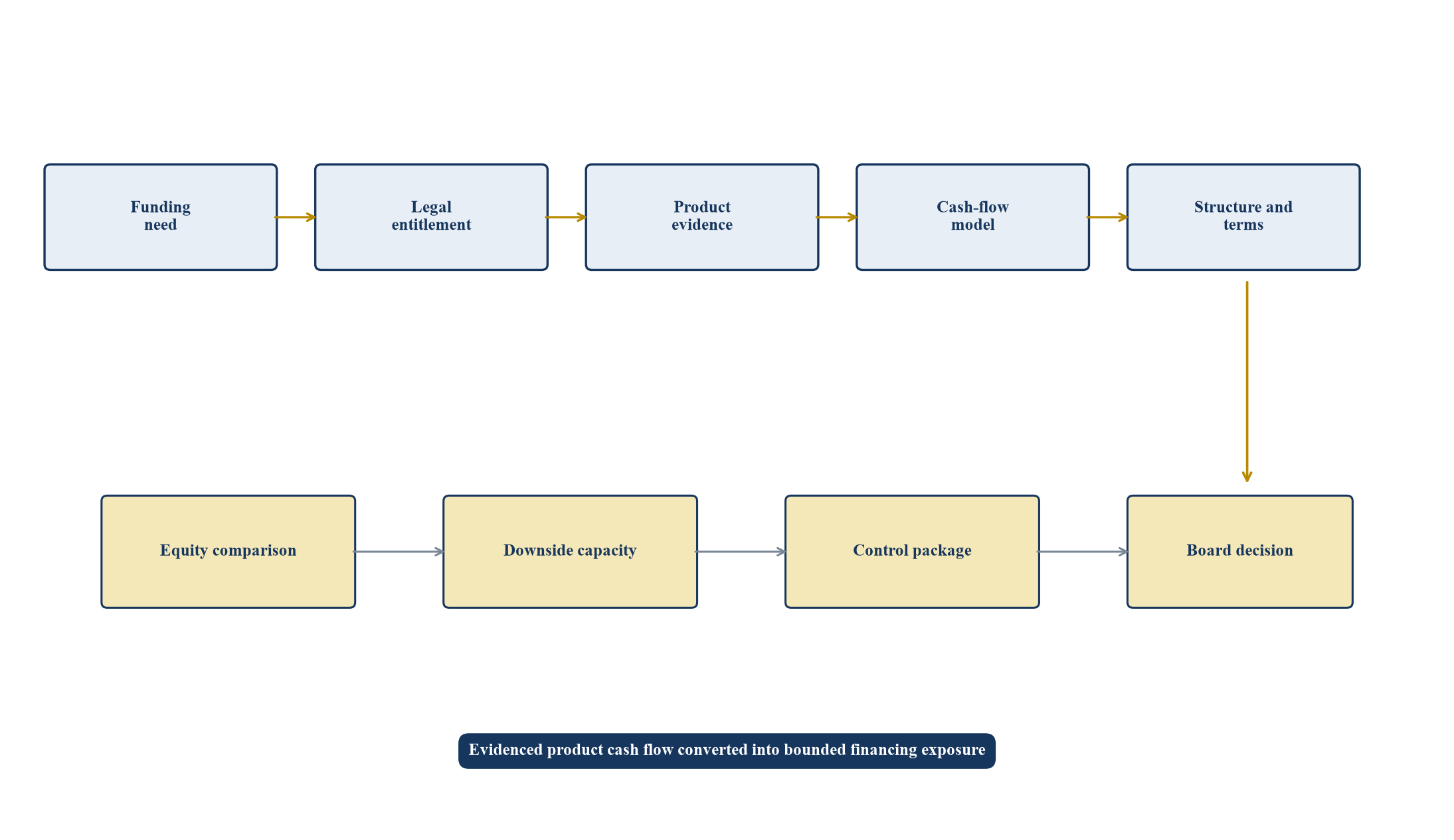
The architecture connects product evidence and contractual entitlement to financing economics, control and the final board decision.
3. Distinguish the principal structures
An acquired royalty is an existing contractual payment right sold by its owner. The underlying product may be marketed by another company, so the seller transfers an asset while retaining limited operating responsibility. The buyer underwrites the licence agreement, marketer, product and enforceability of the assignment.
A synthetic royalty is created by the product owner in exchange for funding. It gives the financier a percentage of defined future net sales even when no pre-existing third-party royalty exists. The agreement must define the products, indications, territories, sales base, term, reductions, reporting and remedies. The company usually retains operational control and product-development obligations.
A royalty-backed note is debt-like capital repaid from a stated share of royalty receipts. In March 2026 Royalty Pharma announced a USD 250 million non-recourse royalty-backed note for Zymeworks, with repayment from 30 per cent of specified worldwide tiered royalties and reversion of the full royalty after repayment [1]. The form can preserve part of the royalty while creating a finite repayment claim.
Development funding can transfer clinical risk through staged commitments and product-linked repayment. Milestone monetisation sells a defined contingent payment. Each route needs separate analysis of recourse, control, accounting, tax, insolvency treatment and future financing capacity.
| Structure | Cash-flow source | Typical seller objective | Principal underwriting focus | Retained exposure |
|---|---|---|---|---|
| Existing royalty sale | Third-party licence royalty | Monetise a non-core or concentrated asset | Licence enforceability, marketer, sales and term | Unsold share and contractual tail |
| Synthetic royalty | Product owner's net sales | Fund development or launch without ordinary equity | Clinical, regulatory, commercial and execution risk | Product value after royalty burden |
| Royalty-backed note | Contractual royalty receipts | Raise finite capital while retaining residual royalty | Coverage, payment direction and repayment mechanics | Royalty after note repayment |
| Milestone monetisation | Defined development, approval or sales payment | Convert a contingent event into current cash | Event definition, probability, timing and obligor | Other licence economics |
| Development funding | Funded programme with product-linked return | Share development risk and extend runway | Trial plan, spend controls, option and repayment | Unfunded obligations and residual product rights |
Actual allocation depends on the definitive documents, governing law and accounting analysis.
4. Start with the financing purpose
The use of proceeds determines the appropriate risk allocation. Capital intended to complete a trial should remain available through the next decision point and should not require repayment before the programme can generate cash. Launch funding must account for inventory, market access, gross-to-net deductions, receivables and post-approval commitments. Shareholder liquidity requires a separate corporate-governance and solvency analysis.
The board should reconcile the requested amount to a dated sources-and-uses schedule. Development costs, manufacturing commitments, milestone payments, regulatory fees, launch expenditure, working capital, transaction costs and minimum liquidity should be visible. Contingency should be connected to specific timing and cost risks.
A large upfront payment can exceed the amount needed to reach the next evidence point. Excess funding transfers more future product value than necessary and can reduce flexibility. A small first tranche with a committed second tranche may preserve economics, although its conditions and timing can create funding risk. The company should model both overfunding and underfunding.
5. Establish the legal cash-flow asset
The transaction perimeter should identify every agreement, amendment, side letter, payment instruction, security document and consent that creates or affects the royalty. The diligence team should trace the right from the originating licence through any assignment, corporate reorganisation, encumbrance or prior financing.
For an existing royalty, the buyer should confirm that the seller owns the payment right, that assignment is permitted, and that the marketer can direct payment to the buyer or a controlled account. Restrictions on assignment, change of control, confidentiality, audit rights and enforcement can affect value. A right to receive cash can be weaker if the buyer cannot obtain information or enforce the underlying agreement.
For a synthetic royalty, the agreement creates a new payment obligation. Product definitions should capture relevant formulations, combinations, delivery methods, line extensions and successor products without unintentionally covering unrelated programmes. The territory, field, indications, affiliates and permitted transfers should be precise. The economic model should match those definitions exactly.
6. Build a complete payment chain
The payment chain should connect patient or customer demand to product shipment, gross sales, contract deductions, net sales, royalty calculation, invoice or statement, currency conversion, tax withholding and cash receipt. Each stage has a responsible party and an evidence source.
The model should distinguish sales recorded by the product marketer from royalty-bearing sales under the financing contract. Wholesaler inventory changes, returns, rebates, chargebacks, government discounts, patient assistance, distribution fees, taxes and bad debt may reduce the base. The deduction order and treatment of estimates should be consistent with the definitive agreement.
Where the seller receives royalties from a licensee, the financier depends on two contracts: the original licence and the financing agreement. Payment-direction arrangements, information covenants and enforcement cooperation should connect them. The buyer should understand whether it can act directly after underpayment or default.
7. Confirm the product evidence boundary
The product state should be recorded as of a defined diligence date. Discovery, preclinical, clinical, regulatory-review and marketed assets carry distinct evidence and cash-flow profiles. The FDA describes the development process as a sequence from discovery and preclinical research through clinical research, regulatory review and post-market safety monitoring [2].
The diligence record should identify completed and ongoing studies, patient population, endpoints, statistical plan, safety observations, manufacturing readiness and regulator correspondence. Public records can support verification, yet the underwriting decision requires controlled reports and direct access to material correspondence.
The model probability remains a management assumption. Published industry averages do not establish the probability for a specific asset. The assumption should therefore identify its supporting evidence, accountable clinical owner, decision date and sensitivity. A product with uncertain evidence should transfer less current value or use staged funding.
8. Map regulatory timing and obligations
Regulatory approval determines whether many royalty streams begin and which label supports sales. Submission, filing acceptance, priority review, accelerated approval, conditional approval, traditional approval and label expansion are separate events. The financing agreement should define which event triggers funding or changes the royalty.
FDA accelerated approval permits earlier approval for serious conditions based on a surrogate or intermediate endpoint that is reasonably likely to predict clinical benefit. Confirmatory studies remain required, and failure to verify benefit can lead to withdrawal [3]. The FDA's January 2025 draft guidance also discusses its authority to require confirmatory studies to be underway before approval or within a specified period [4]. A royalty model should include post-approval trial cost, timing and withdrawal exposure.
EMA conditional marketing authorisations impose specific obligations within defined timelines and require annual renewal until conversion to a standard authorisation [5]. Territory-specific approval paths should be modelled separately. An approval in one jurisdiction does not establish timing, label or obligations in another.
9. Analyse patent life and exclusivity
Royalty duration may depend on patent claims, regulatory exclusivity, a fixed period after first commercial sale, or the latest of several tests. The model should calculate the term by product and country when differences are material. Patent expiry, invalidity, non-infringement, compulsory licensing, generic entry and biosimilar competition can change the payment rate or end the royalty.
The FDA explains that patents and regulatory exclusivity are separate protections and may run concurrently or independently [6]. The Orange Book and Purple Book provide public information relevant to approved drugs and biologics [7]. Public listings should be reconciled with prosecution records, licence terms and specialist legal analysis.
The company should avoid treating one patent date as the entire commercial life. Manufacturing know-how, device protection, formulation patents, orphan exclusivity and market-entry barriers can affect cash flows, while an adverse claim construction or successful challenge can shorten value. The agreement should define any rate step-down when valid claims cease.
10. Underwrite the commercial revenue base
The forecast should begin with eligible patients or units, diagnosis, treatment line, access, duration, adherence and competing therapies. Gross price should be converted to net price through explicit deductions. Market share should reflect launch timing, label, physician adoption, payer controls, supply capacity and the standard of care.
The Medicare Drug Price Negotiation Program introduced negotiated maximum fair prices for selected medicines from 1 January 2026 [8]. CMS publishes selected-drug information and negotiated prices and updates relevant product codes [9]. Royalty underwriting should identify whether a product can become subject to negotiation during the model period and should test net-sales effects rather than assume list-price continuity.
Commercial forecasts should distinguish observed sales from analyst or management estimates. A marketed product with several years of demand evidence can support narrower distributions than a pre-launch asset. Forecast dispersion should be visible and should feed both value and financing-capacity tests.
11. Reconstruct the contract waterfall
The contract waterfall applies the royalty rate to the defined sales base and then applies tiers, reductions, floors, caps and timing rules. Tiered royalties can be marginal or apply to all annual sales after a threshold. A percentage quoted without its calculation method is incomplete.
Royalty stacking, third-party licence costs, generic or biosimilar entry, loss of exclusivity, compulsory licences and combination products can reduce the rate. The order matters. Applying two reductions sequentially can produce a different result from adding them. A floor may limit total reductions.
Recent public filings show diverse mechanics. Milestone Pharmaceuticals disclosed tiered royalties of 7 per cent, 4 per cent and 1 per cent across annual net-sales bands, with a possible step-up to 9.5 per cent when a stated sales threshold is missed [10]. Such terms create path-dependent cash flows and require annual calculations rather than a constant rate.
12. Separate nominal proceeds from economic cost
The seller receives capital now and transfers uncertain cash flows later. Economic cost should be evaluated through present value, internal rate of return, multiple of invested capital, expected transfer of upside and retained product value. No single measure is sufficient.
A capped return can limit the financier's receipts. A time-dependent cap can increase if repayment is slower. uniQure disclosed a financing in which the purchaser could receive 1.85 times the upfront payment by an initial date and up to 2.25 times by a later date [11]. The seller should model how product timing affects the applicable cap.
The seller's cost is scenario dependent. Strong sales can make the transferred royalty expensive in absolute terms even if the transaction met its original hurdle. Weak sales can shift risk to the financier if there is no recourse. The board should therefore compare expected economics and the allocation of tail outcomes.
13. Model probability and timing explicitly
Pre-approval royalty cash flows require a probability tree. Each clinical, regulatory, manufacturing and launch step should have a conditional probability, timing and cost. Correlated risks should not be treated as independent when the same biological mechanism, endpoint or manufacturing platform affects several events.
Funding tranches should be linked to events that reduce uncertainty. A first tranche can fund a trial; a second can follow a defined result or approval. Royalty Pharma's 2026 transaction disclosures include development-funding commitments with staged or option-based capital, demonstrating how capital availability can follow evidence [12].
Milestone probabilities should match the commercial forecast. If projected sales are already weighted by approval probability, another full approval adjustment to the resulting royalty can double count risk. The model should show where probability enters every line.
14. Choose the discount and return framework
The discount rate should reflect product uncertainty, contract enforceability, counterparty strength, cash-flow duration, concentration, liquidity and structure. A marketed diversified royalty portfolio should not use the same rate as one pre-approval synthetic royalty.
The financier may use an internal return target rather than a conventional discount rate. The seller should reconstruct that return across central, downside and upside cases, including fees, unused commitments, timing and caps. An apparently low stated rate can become expensive when the transaction captures a disproportionate share of upside.
Accounting effective interest rates can differ from transaction underwriting returns. Public filings show royalty financing obligations measured using expected future payments and an effective interest method [13]. The board should keep valuation, cash economics and accounting measurement separate while reconciling the cash-flow assumptions.
15. Test product and counterparty concentration
A single-product transaction concentrates scientific, regulatory, commercial and operational risk. The company may depend on one marketer, one manufacturing network, one territory or one payer segment. The financier may respond with a higher return target, lower advance, step-up, cap or additional controls.
An existing royalty can reduce operational exposure when a large pharmaceutical company markets the product, although the royalty owner still faces contract and counterparty risk. Diligence should assess the marketer's incentives, competing products, development priorities, sales capability, financial strength and compliance with the licence.
Portfolio structures can diversify product-specific risk and support larger funding. Diversification should be measured across mechanisms, indications, marketers, territories, patent expiries and payer exposure. Several royalties tied to the same platform or commercial partner may remain correlated.
16. Compare financing alternatives on one basis
Equity transfers ownership and governance rights while preserving product cash flows. Its economic cost rises with future enterprise value and dilution, and it can provide permanent capital without product-linked payment obligations. Market price, investor appetite and control considerations affect availability.
Secured debt preserves equity but requires contractual repayment, covenants and often security. A pre-revenue company may lack predictable cash to service it. Convertible capital combines debt and potential dilution. Licensing transfers product rights and can provide upfront, milestone and royalty economics, while also transferring some development or commercial control.
Royalty finance links payment to product performance and may avoid ordinary equity dilution. It can still transfer a material share of asset value and may rank ahead of future capital in practice through payment direction, security or negative covenants. Every route should be modelled using the same product scenarios, funding date, fees, tax, control effects and terminal ownership.
| Route | Cash obligation | Ownership effect | Product rights and control | Principal failure mode |
|---|---|---|---|---|
| Royalty finance | Product-linked receipts, possibly capped or stepped | No ordinary share issuance | Usually retained, subject to covenants and reporting | Upside transfer and future financing constraint |
| Ordinary equity | No contractual repayment | Immediate dilution | Company retains product rights, investors obtain governance rights | High dilution at low valuation |
| Secured debt | Scheduled interest and principal | No immediate dilution | Security and covenants can constrain decisions | Liquidity failure before product cash flow |
| Convertible capital | Interest, maturity and possible equity conversion | Deferred or contingent dilution | Company retains product rights, with investor protections | Combined refinancing and dilution risk |
| Licence or co-development | Upfront and partner funding; economics shared | No ordinary share issuance | Territory, field or development control transferred | Strategic dependence and loss of future optionality |
The comparison is a decision framework. Actual availability and terms depend on the company, asset and market.
17. Build the worked transaction
The hypothetical company owns worldwide rights to a therapy in late-stage development. It requires USD 120 million to complete development, prepare launch supply and maintain minimum liquidity through an expected regulatory decision. Management estimates a 68 per cent probability of approval in the initial indication and a two-year delay in the downside case.
The proposed synthetic royalty pays the financier 7.5 per cent of annual net sales until cumulative receipts reach USD 255 million. The rate falls to 3.0 per cent after the cap date if the cap has not been reached. Funding is paid at closing, with no additional mandatory company payment when product sales are zero. The agreement includes reporting, audit, development-plan and permitted-transfer covenants.
The central unweighted sales forecast reaches USD 620 million in year six and then declines with competition and loss of exclusivity. The probability-adjusted and discounted royalty receipts equal USD 176 million. The modelled financier return is 12.8 per cent. Transaction fees equal USD 5 million. The company's probability-adjusted product value before financing is USD 515 million, and remaining development and launch expenditure is USD 176 million.
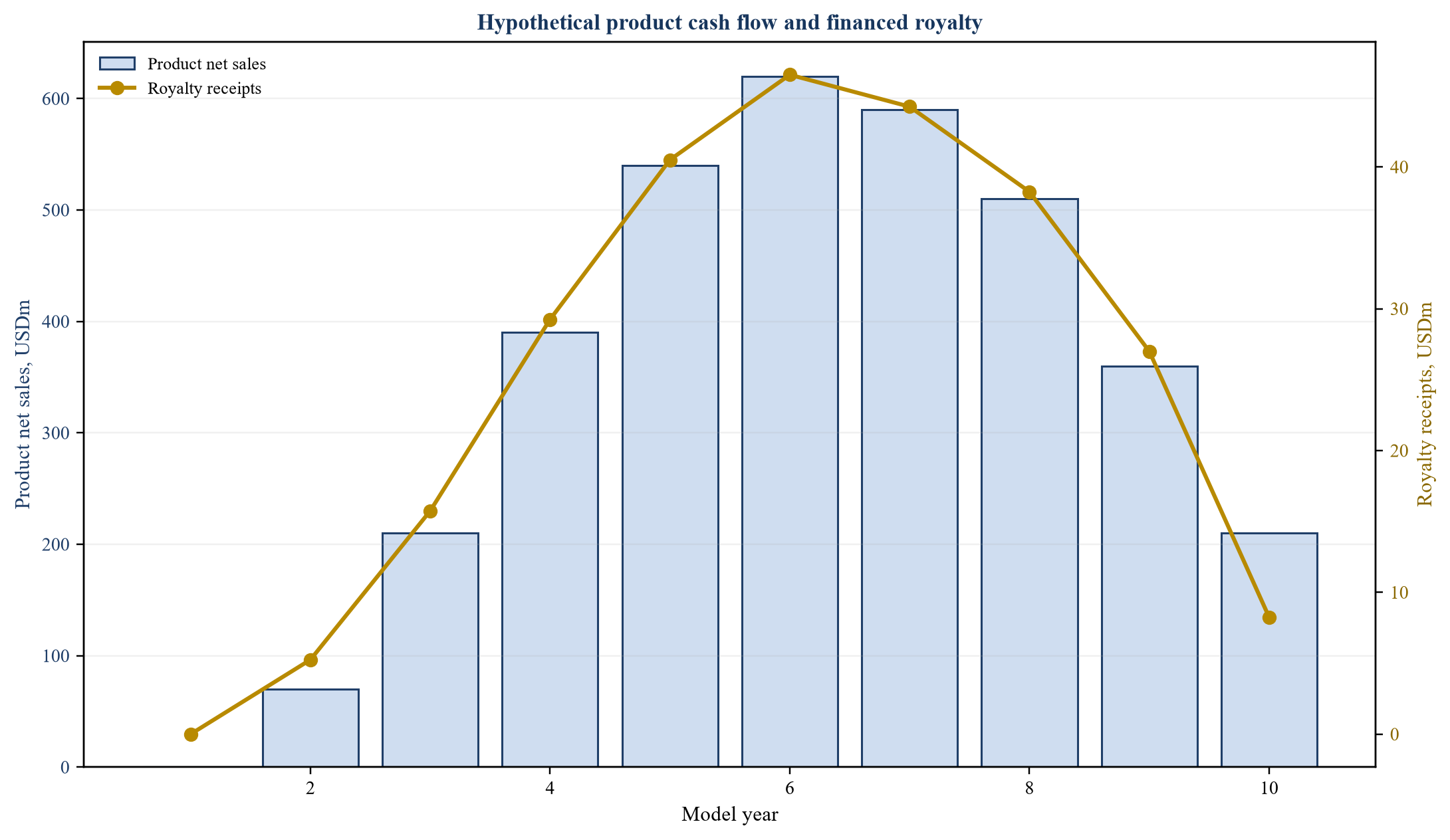
Values are illustrative management scenarios in USD millions. Product net sales are unweighted; royalty receipts reflect the stated 7.5 per cent rate before the contractual cap.
18. Reconcile value retained by the seller
Seller-retained value begins with probability-adjusted product value and subtracts remaining development and launch expenditure, the expected present value of the financed royalty and transaction costs. Under the central assumptions, USD 515 million less USD 176 million of expenditure, USD 120 million of funding received, USD 176 million of expected royalty value and USD 5 million of fees should not be combined mechanically because funding offsets expenditure timing.
The controlled bridge treats the upfront funding as a source of liquidity and the royalty as transferred product value. Probability-adjusted value after remaining expenditure is USD 339 million. Deducting USD 120 million of financing value transferred beyond the immediate cash received is inappropriate unless both are measured at the same date and risk basis. The correct central residual is derived from the unlevered product cash flows after the royalty, remaining spend and fees, resulting in USD 214 million.
The board should avoid value bridges that add financing proceeds to enterprise value. Proceeds finance costs or replace other capital. They do not create product value. The decision is whether the risk-adjusted value preserved, liquidity secured and control retained justify the transferred cash-flow interest.
| Measure | Central case | Downside case | Board relevance |
|---|---|---|---|
| Upfront funding | 120 | 120 | Liquidity available at closing |
| Approval timing | Year 2 | Year 4 | Delays sales and royalty receipts |
| Peak unweighted net sales | 620 | 310 | Principal commercial sensitivity |
| Expected discounted royalty receipts | 176 | 92 | Value transferred to financier |
| Financier modelled return | 12.8% | 4.1% | Risk allocation across outcomes |
| Seller retained probability-adjusted product value | 214 | 58 | Residual value after royalty and spend |
| Minimum liquidity before additional capital | 31 | 8 | Funding resilience |
All figures are illustrative management scenarios. Values are USD millions except return percentages and timing.
19. Stress the full distribution of outcomes
Central and downside cases are insufficient when clinical and commercial outcomes are asymmetric. The model should test non-approval, delayed approval, narrow label, manufacturing delay, payer restriction, lower price, slower adoption, competitor entry, patent loss, generic or biosimilar entry and stronger-than-expected demand.
The royalty rate, cap and timing can create nonlinear results. A cap protects the seller in an upside case only if it is reached before a step-up or extension. A minimum payment or make-whole can reduce risk transfer. A tail royalty can remain economically significant after the financier achieves its hurdle.
Sensitivity should show both parties' outcomes. A structure that protects the financier under every case may function economically like expensive debt. A structure that gives the seller all upside after a finite cap may be attractive, but it can require a higher initial rate or lower advance.
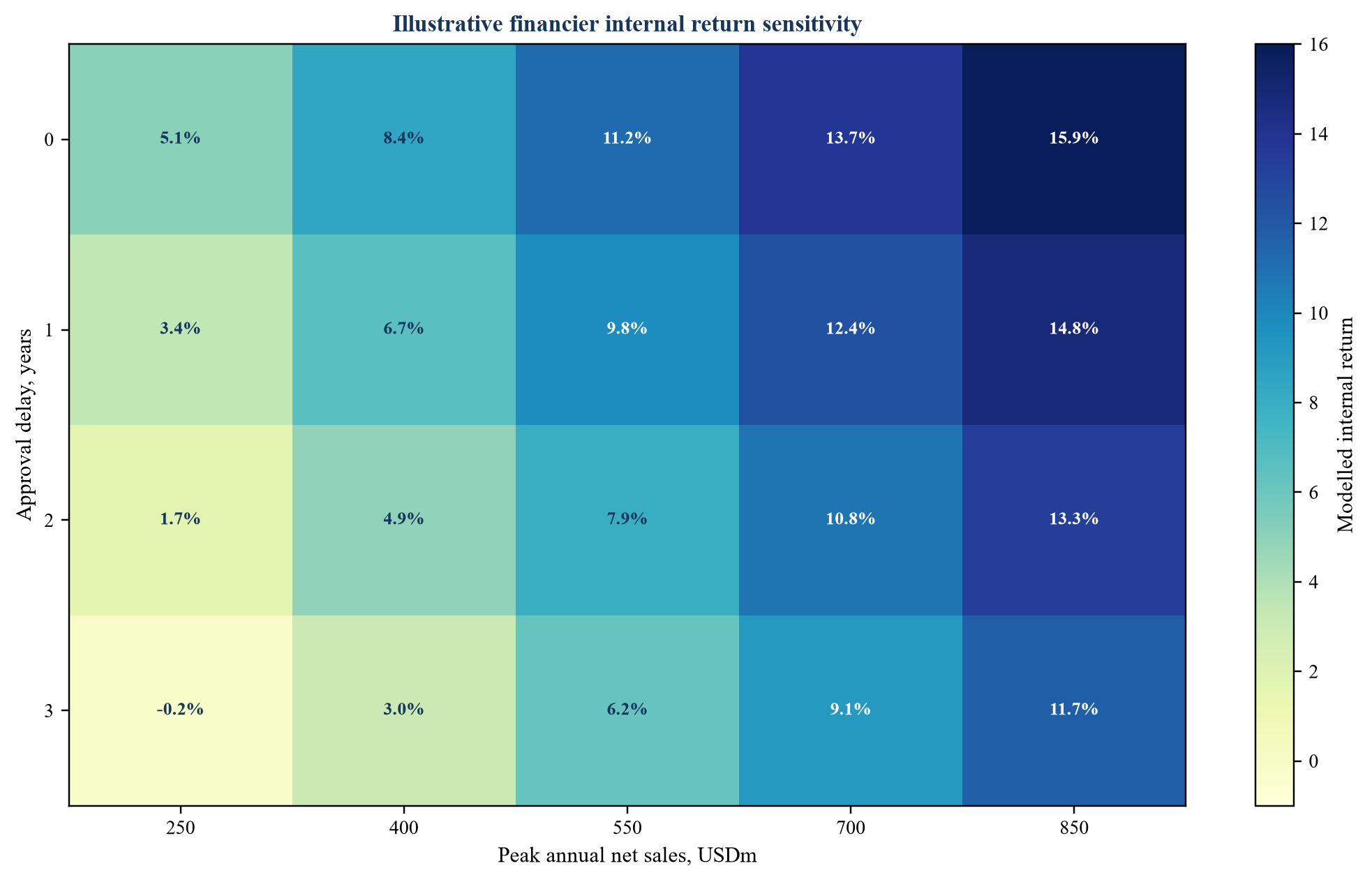
Returns are illustrative and derived from assumed approval delays and peak net sales. They do not represent a forecast or market quotation.
20. Design caps, steps and reversion carefully
A hard cap can terminate the financier's participation after cumulative receipts reach a stated amount. A soft cap can reduce the rate after a threshold. A time-based multiple can increase the maximum receipt if repayment is delayed. Each mechanism changes the allocation of timing and upside.
A sales shortfall step-up may protect the financier when launch is weak, although it increases the seller's burden precisely when product performance is below plan. Milestone Pharmaceuticals disclosed such a step-up in its royalty obligation [10]. The seller should test whether the mechanism reduces cash available for commercialization and whether it can create a negative feedback loop.
Reversion should be operational. The agreement should specify when payment rights end, how controlled accounts and notices are released, and how records and audits continue for prior periods. A cap without a deterministic calculation and release process can leave later financing uncertain.
21. Use tranches and conditions to match evidence
Tranches can align capital deployment with evidence and limit value transfer before risk falls. Conditions may include trial enrolment, data, regulatory acceptance, approval, manufacturing readiness or a financing match. The condition should be objective, within an appropriate party's control and achievable before cash is needed.
The seller should distinguish committed capital from optional capital. A financier option can leave the company exposed if the second tranche is unavailable when another investor would require time to complete diligence. Exclusivity, right-of-first-offer and most-favoured terms can restrict alternatives during that period.
Conditions should include long-stop dates and consequences. A missed condition can reduce funding, change the royalty or terminate the commitment. The operating plan should remain solvent under the expected decision timetable and a documented delay.
22. Allocate development and commercial control
Royalty financiers usually do not operate the product, yet their return depends on development and commercialization. They may seek covenants covering programme diligence, budgets, abandonment, licensing, sale, intellectual property, manufacturing and reporting. These controls should protect the cash-flow interest without preventing ordinary clinical and commercial decisions.
The company should retain authority to respond to safety, regulator and patient needs. Reserved matters should use materiality thresholds and defined decision periods. Consent rights over amendments to the underlying licence, settlement of audit disputes or disposal of the product can be appropriate when the financier's cash flow is directly affected.
Development plans should permit justified changes. A rigid covenant tied to an obsolete protocol can destroy value. The agreement can require notice, evidence and consultation, with consent limited to changes that materially impair the financed interest.
23. Determine recourse and security
The documents should state whether the financier has recourse to the company beyond the purchased cash flows. Representations, indemnities and fraud remedies can create exposure even in a transaction described as non-recourse. Minimum payments, repurchase obligations and events of default can also change the risk profile.
Security may cover the royalty receivable, collection account, underlying licence rights, intellectual property or broader assets. The company should assess priority, enforcement, intercreditor arrangements and the effect on future debt. A financier with control over payment flows may have practical priority even where legal characterisation remains an asset sale.
The buyer should analyse whether the transfer constitutes a true sale under governing law and how insolvency could affect collections. The board should obtain specialist legal advice. This paper does not determine legal characterisation.
24. Reconcile accounting presentation
Transaction economics and accounting presentation require separate analysis. A seller may record an asset sale, deferred income or a financing obligation depending on the retained risks, continuing involvement and applicable standards. Public biotechnology filings frequently describe royalty monetisations accounted for as obligations measured through an effective interest method [13].
Expected payment revisions can change interest expense when a financing obligation depends on future royalties. Better product forecasts can increase the carrying amount or effective cost. Poorer forecasts can reduce expected payments, subject to the applicable accounting treatment. These effects can make reported finance expense volatile.
The board should receive a pre-signing accounting memorandum covering classification, initial recognition, subsequent measurement, income-statement presentation, cash-flow classification, disclosure and sensitivity. The cash model used for the transaction should reconcile to the accounting model without assuming they produce the same metric.
25. Analyse tax, withholding and currency
Royalty payments can be subject to withholding tax, transfer-pricing rules and treaty conditions. The agreement should allocate withholding, documentation, gross-up, refund cooperation and changes in law. A percentage of net sales does not establish the financier's net receipt after tax.
Multi-currency royalties require a defined conversion source, rate date and payment currency. Currency exposure can arise between product sales, royalty calculation and cash settlement. The seller should identify whether hedging is permitted and who bears its cost.
Tax character can differ between an asset sale and financing. The company and financier may seek different treatment. Independent tax advice should assess jurisdiction, ownership chain, permanent-establishment exposure, indirect taxes and transfer of intellectual-property-related rights.
26. Protect information and auditability
The financier needs timely product and payment information. Reporting should include sales by product and territory, deductions, rates, adjustments, currency, cumulative cap status and cash reconciliation. Clinical and regulatory reporting should be proportionate to the asset state and confidentiality restrictions.
Audit rights should identify records, retention, notice, frequency, auditor independence, confidentiality, materiality thresholds and cost allocation. When the company receives royalty statements from a third-party marketer, it should pass through information and audit cooperation to the extent permitted by the licence.
Data quality should be tested before closing. A historical royalty statement should reconcile from underlying sales to cash. Unresolved differences should affect price, reserves, representations or closing conditions.
27. Build the diligence data room
The data room should contain the chain of title, licence and collaboration agreements, amendments, side letters, patent schedules, regulatory documents, clinical reports, manufacturing arrangements, commercialization plans, forecasts, historical sales, royalty statements, audits, disputes, tax analysis and existing financing documents.
Each forecast input should have a source, date and owner. The financier should be able to reproduce historical royalties and the seller should be able to reproduce the proposed purchase price or advance. Material redactions should be identified rather than silently treated as zero or immaterial.
A data-room index should show the relationship among documents. One folder for legal agreements and another for the model is insufficient when the royalty definition, product scope and cash-flow logic do not reconcile.
28. Negotiate the term sheet through economics
The term sheet should specify funding, tranches, funded asset, product and territory definitions, royalty base, rates, tiers, cap, term, reductions, payment timing, conditions, representations, covenants, information, audits, transfers, security, recourse, defaults, tax and expenses.
Every negotiated change should be translated into the model. A lower rate paired with a longer term can cost more. A larger cap paired with a reduced upfront payment can worsen both liquidity and economics. A broad product definition can transfer pipeline value that was absent from the initial forecast.
Delegated authority should set quantitative and qualitative limits. The transaction team should maintain a change log showing the term amended, model effect, control effect, approval owner and supporting evidence.
| Gate | Approval evidence | Minimum threshold | Decision owner |
|---|---|---|---|
| Funding purpose | Sources, uses, runway and contingency | Capital covers the approved period and next decision point | Board |
| Entitlement | Complete contract, title, assignment and consent map | Payment right is transferable and enforceable on specialist advice | Board |
| Product evidence | Clinical, regulatory, manufacturing and patent record | Model assumptions have controlled evidence and dated owners | Investment committee |
| Commercial case | Patient, access, price, competition and net-sales model | Central and downside cases reconcile to the contract base | Investment committee |
| Economics | Present value, return, cap, alternatives and retained value | Structure meets approved liquidity and value thresholds | Board |
| Control | Covenants, audit, security, recourse and future financing | Residual constraints remain within approved limits | Board on specialist advice |
Thresholds should be tailored to the company, product and proposed structure.
29. Execute through a controlled timetable
The transaction can be organised into six phases: mandate and financing need; evidence and entitlement; independent commercial and product diligence; model and structure; documentation and approvals; and closing and operational handover. Workstreams should converge on one assumptions register and one issues list.
The company should obtain indicative terms only after defining the asset and funding need. Competitive tension is meaningful when bidders underwrite the same cash-flow perimeter. A high headline advance can conceal a broader royalty, higher cap, more control or stronger recourse.
Confirmatory diligence should refresh clinical, regulatory, patent, commercial and financing facts immediately before signing and closing. Conditions, consents, payment instructions, controlled accounts, tax forms and legal opinions should be tracked to completion.
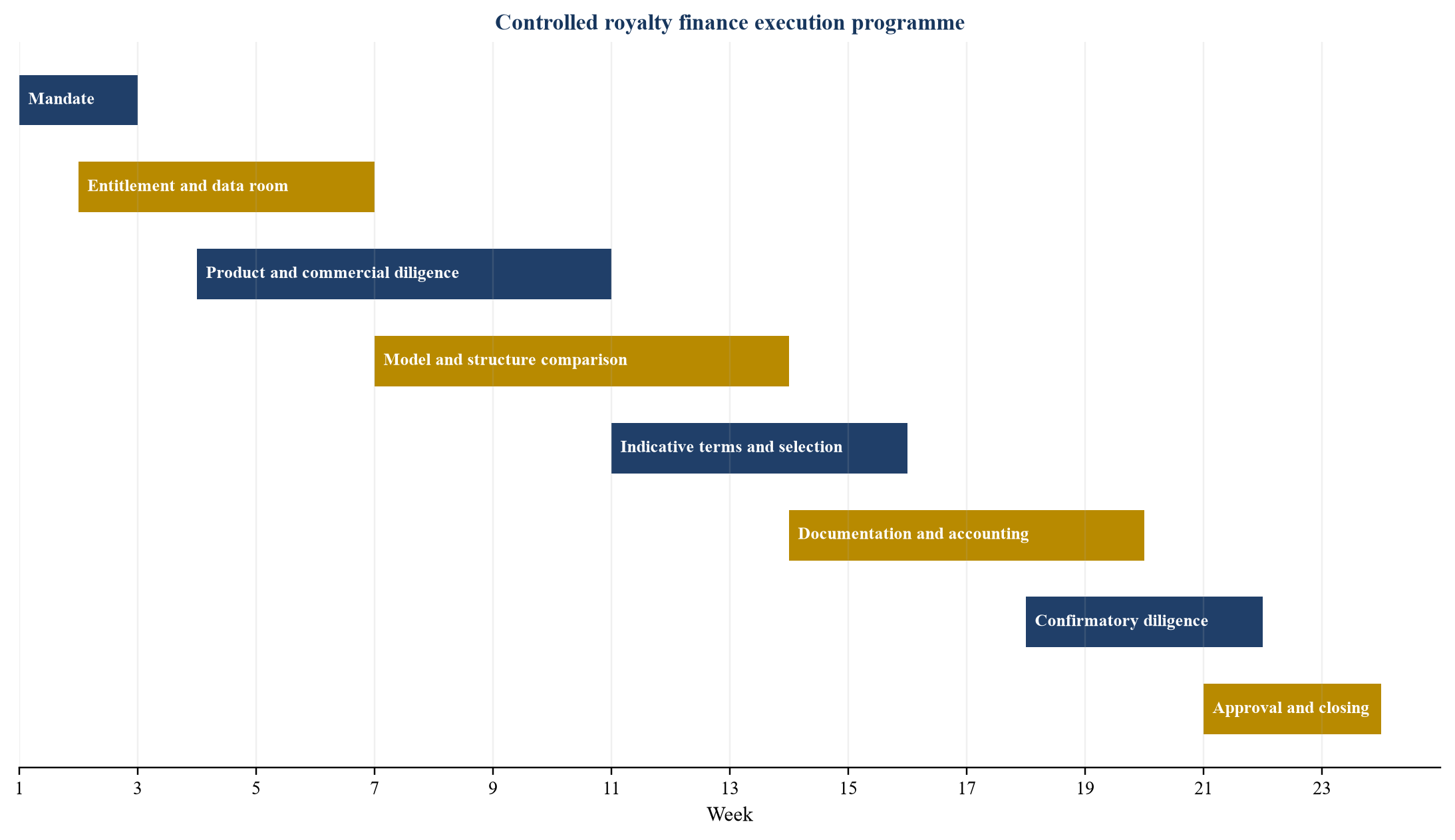
Timing is illustrative and depends on product maturity, data access, structure and regulatory or counterparty consents.
30. Monitor the transaction after closing
Closing begins the operating phase. Finance should reconcile royalty statements to cash, update cumulative cap and remaining term, and investigate differences. Clinical and regulatory teams should report events that can change probability, timing or the approved label. Commercial teams should update price, access, competition and supply assumptions.
The company should maintain a forecast-to-actual bridge. Changes in units, net price, deductions, timing and rate should be separated. The bridge supports liquidity planning, accounting updates, covenant compliance and refinancing decisions.
Governance should identify trigger events for corrective action. These can include trial delay, regulator action, manufacturing interruption, sales shortfall, patent challenge, audit dispute, counterparty downgrade, covenant breach or expected cap extension. Each trigger should have an owner and response deadline.
31. Make the board decision
The transaction should proceed when the funding need is defined, the cash-flow interest is legally supportable, product assumptions have controlled evidence, the structure preserves sufficient retained value, liquidity remains resilient and future financing constraints are acceptable.
The board should defer when the asset perimeter is uncertain, the product forecast cannot be reconciled to net sales, the funding commitment is conditional beyond the company's liquidity horizon, the royalty captures excessive upside, accounting or tax effects remain unresolved, or the control package prevents necessary development and commercial decisions.
The decision memorandum should begin with the requested authority, capital amount, use of proceeds, term, royalty perimeter, central and downside economics, principal constraints and expiry date of approval. It should include a route comparison using the same product cases and a schedule of unresolved issues.
The board should distinguish product value from financing proceeds. Royalty finance can transfer risk and secure capital, but the upfront cash does not increase the underlying product's value. The approved structure should convert only the cash-flow interest required to fund the plan and should preserve a measurable share of future value for the company.
The final agreement should remain consistent with the approved model. Changes to product scope, territory, rate, deductions, cap, conditions, security, recourse, information, consent or transfer should return to the model before execution. The company should record the cash, value and control effect of each change.
Royalty finance can be a useful part of a pharmaceutical capital structure. Its quality depends on precision. The parties should define the asset, model the entire payment waterfall, price uncertainty, compare alternatives, protect operating decisions and maintain auditable controls after closing.
The decision remains company and transaction specific. Clinical, regulatory, patent, commercial, legal, tax, accounting and financing advisers should assess the proposed terms and evidence.
Sources
- Royalty Pharma, Royalty Pharma and Zymeworks Enter Into USD 250 Million Royalty-Backed Note Financing, 2 March 2026. Read the primary source
- United States Food and Drug Administration, Development and Approval Process for Drugs, updated 2025. Read the primary source
- United States Food and Drug Administration, Accelerated Approval Program, updated 2026. Read the primary source
- United States Food and Drug Administration, Accelerated Approval and Considerations for Determining Whether a Confirmatory Trial is Underway, draft guidance, January 2025. Read the primary source
- European Medicines Agency, Conditional Marketing Authorisation, accessed 17 September 2026. Read the primary source
- United States Food and Drug Administration, How Can I Better Understand Patents and Exclusivity? Read the primary source
- United States Food and Drug Administration, Orange Book and Purple Book Drug and Biological Product Data. Read the primary source
- Centers for Medicare and Medicaid Services, Pharmacy and Dispensing Entity Resources, Medicare Drug Price Negotiation Program, updated 24 July 2026. Read the primary source
- Centers for Medicare and Medicaid Services, Selected Drugs and Negotiated Prices, updated 15 September 2026. Read the primary source
- Milestone Pharmaceuticals Inc., Quarterly Report for the Six Months Ended 30 June 2026, Note on Royalty Financing Obligation. Read the primary source
- uniQure N.V., Quarterly Report for the Three Months Ended 31 March 2025, Royalty Financing Agreement disclosure. Read the primary source
- Royalty Pharma, Transactions, including 2025 and 2026 development funding and royalty acquisitions. Read the primary source
- Royalty Pharma plc, Annual Report for the Year Ended 31 December 2025. Read the primary source
- BeOne Medicines Ltd., Royalty Purchase Agreement disclosure concerning Imdelltra, 25 August 2025. Read the primary source
- Ultragenyx Pharmaceutical Inc., Royalty Purchase Agreement dated 3 November 2025, Exhibit 10.20. Read the primary source
- Royalty Pharma, Second Quarter 2026 Results, 5 August 2026. Read the primary source
- Royalty Pharma, To Acquire Royalty Interest in Amgen's Imdelltra for Up to USD 950 Million, 25 August 2025. Read the primary source
- IFRS Foundation, IFRS 9 Financial Instruments and IFRS 15 Revenue from Contracts with Customers. Read the primary source
