

1. Revenue-linked capital is a contract design problem
Royalty and revenue-based finance convert operating receipts into a source of capital repayment. The defining feature is variable consideration: the amount and timing of payments depend on an agreed commercial measure rather than a fixed amortisation schedule alone. A company-wide revenue facility may claim a percentage of eligible monthly revenue. A royalty financing may purchase or secure cash flows attached to a drug, software licence, patent portfolio, media right or other identifiable asset. Hybrid structures can include minimum payments, fixed coupons, warrants, milestones, return caps and buyout options.
The instrument can fit a business that has demonstrable revenue, attractive gross margins and a clear use for growth capital, while lacking the collateral or profitability required for ordinary bank debt. Payments fall when revenue falls if the agreement contains no hard minimum. Existing shareholders avoid immediate voting dilution. The capital provider gains participation in growth without relying solely on a sale or public offering. These advantages depend on the contract's actual terms. A minimum return, legal maturity, default interest, security package or accelerated cap can make the downside behave like conventional debt.
The board's first question should concern the commercial obligation created. What revenue is captured, how quickly will cash leave the company, what events increase the claim, and when does the obligation end? Legal labels can obscure the answer. A document called a royalty may create a financial liability. A revenue-share agreement may transfer a receivable, grant security or create a participation interest. Accounting follows rights and obligations under the applicable standards, while regulation and tax follow jurisdiction-specific rules. Transaction counsel and auditors should assess the executed terms.
This paper treats the instrument as a cash-flow allocation contract. The analysis begins with the revenue perimeter, moves through cash capacity and risk allocation, then tests alternatives and documentation. It avoids assuming that non-dilutive means inexpensive or that a variable payment automatically protects the borrower. The appropriate structure is the one that finances a defined plan while preserving enough cash, control and strategic flexibility for the company to execute it.
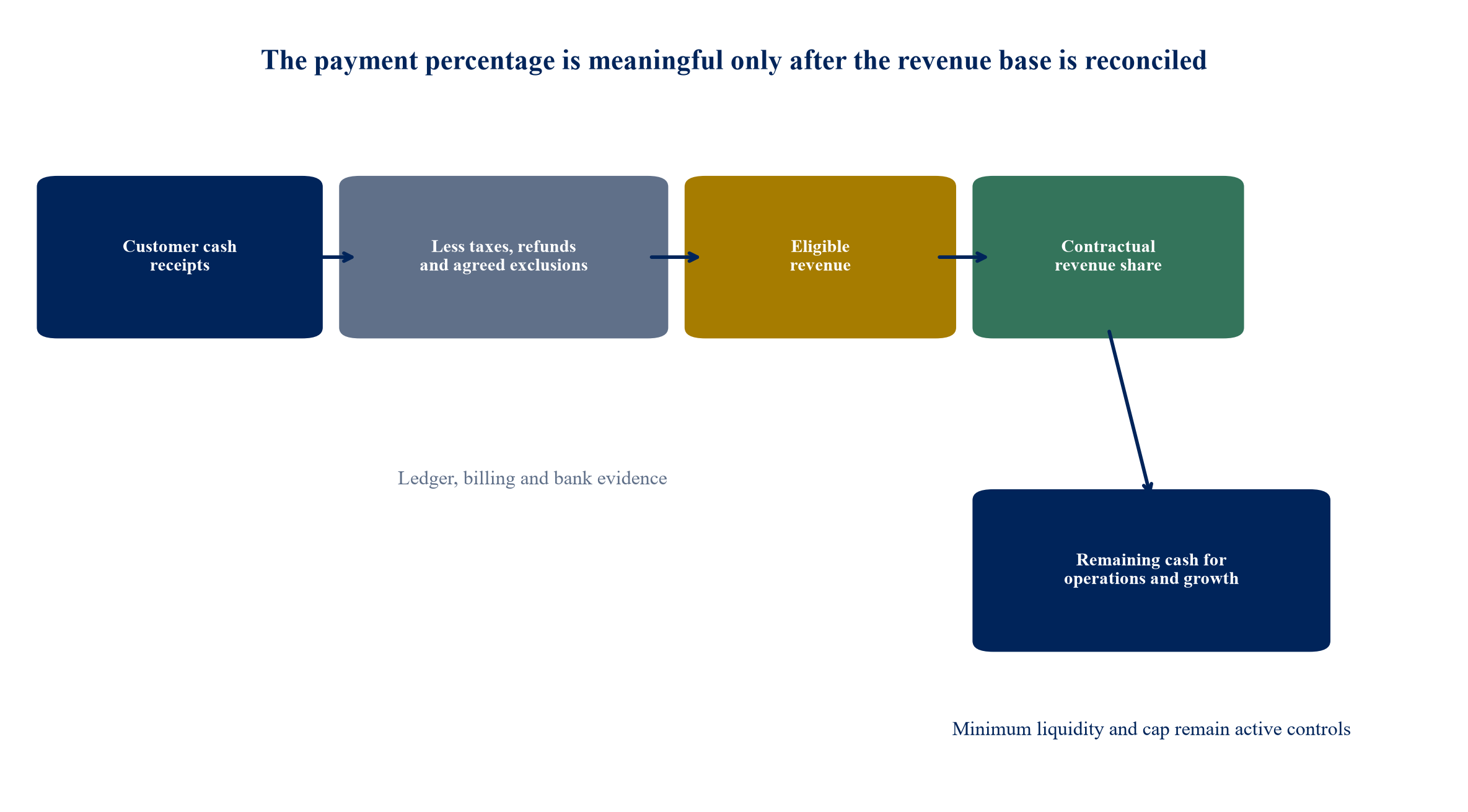
The waterfall is author-designed. Definitions, exclusions, timing and payment priorities must follow executed documents and applicable law.
2. The instrument family contains materially different claims
Company-wide revenue-based finance usually advances cash to an operating company and receives a percentage of defined revenue until a cap or maturity. The provider underwrites the whole business because all eligible receipts support payment. The arrangement may be unsecured or secured, senior or subordinated, and may include a fixed minimum return. It resembles growth debt when principal is advanced, repayment is obligatory and the company's general credit supports the claim.
Asset-specific royalty finance focuses on a defined product or intellectual-property cash flow. The provider may acquire an existing royalty, fund development in exchange for future royalties, or lend against contracted licence receipts. Performance depends on the underlying product, payer and legal rights. Royalty Pharma reports financial royalty assets at amortised cost using a prospective effective-interest method and identifies product growth and royalty duration as important valuation assumptions [8]. Its filings also describe reporting lags, competition, generic entry, development failure and possible impairment [8]. Those risks illustrate why a royalty stream cannot be underwritten as a simple percentage of forecast sales.
Receivables purchase and factoring are adjacent structures. They finance invoices already earned rather than uncertain future revenue. A forward-flow arrangement may repeatedly acquire eligible receivables. A securitisation isolates a pool and distributes collections through a priority waterfall. These instruments can be more appropriate when the company has long payment terms but limited forecast visibility. They require eligibility rules, concentration limits, true-sale analysis and servicing controls that differ from a broad revenue share.
Venture debt combines a contractual repayment claim with performance-linked remuneration such as warrants or fees. The European Investment Bank describes venture debt for commercial-stage innovation companies in life sciences, digital, deep technology and clean technology, and its programme requires a prior equity raise, a strong business model, governance and team [16]. The comparison matters because a company with predictable cash conversion may prefer fixed debt, while one with volatile but high-margin growth may value payments that flex with revenue.
Growth equity remains the benchmark for risk-bearing capital. It has no contractual cash repayment and can support pre-revenue development, regulatory trials or uncertain market creation. The cost is a share of future value and governance rights. Royalty or revenue-based finance should therefore be compared with the equity actually avoided, the debt capacity consumed and the strategic restrictions accepted. Instrument names do not establish the economic ranking.
Table 1. Economic distinctions among revenue-linked and adjacent financing instruments
| Instrument | Primary payment source | Typical endpoint | Main underwriting evidence | Principal company risk |
|---|---|---|---|---|
| Company-wide revenue-based finance | Percentage of defined enterprise revenue | Return cap, maturity or buyout | Revenue quality, gross margin, churn, concentration and cash conversion | Payments absorb cash during growth and may restrict later financing |
| Product royalty finance | Revenue or units from a named product or licence | Term, patent life, cap or perpetual contractual right | Ownership, validity, approvals, market adoption, payer and royalty duration | A valuable asset can be encumbered or monetised too early |
| Receivables finance | Collections on eligible invoices | Collection, facility expiry or borrowing-base termination | Invoice validity, dilution, ageing, concentration and debtor quality | Ineligible receivables and reserves reduce availability |
| Venture debt | General company cash flow with fixed or structured repayment | Scheduled maturity, prepayment or refinancing | Equity support, runway, recurring revenue, liquidity and enterprise value | Fixed service and covenants can force a financing event |
| Growth equity | Residual enterprise value | Sale, listing, dividend or secondary transfer | Market size, growth, unit economics, team and exit value | Permanent dilution and governance transfer |
The table describes common design features. Actual rights depend on transaction documents, accounting analysis and governing law.
3. Define eligible revenue before setting the percentage
The payment base governs the economics. Gross invoiced revenue, recognised accounting revenue and cash collected can diverge materially. An AI platform may invoice annually in advance while recognising revenue over the contract term. A HealthTech supplier may book revenue subject to rebates, denials or refunds. An IP owner may receive royalties after a licensee reports sales with a delay. The agreement should identify whether the calculation uses invoices, accounting recognition, cash receipts or another measure, and it should address cut-off and subsequent adjustments.
Cash collections often align payment with liquidity, yet they create classification and timing issues. Customers may pay deposits, taxes, pass-through expenses, implementation fees or amounts collected for third parties. Refunds and chargebacks may occur after a payment has been made to the capital provider. Foreign-currency receipts need a translation rule. Related-party sales can shift revenue between entities. Acquisitions and disposals can change the perimeter. A company should build a bridge from bank receipts and general-ledger revenue to eligible revenue every reporting period.
The definition should include permitted exclusions. Common candidates are value-added or sales taxes, refunds, credits, intercompany amounts eliminated on consolidation, reimbursed pass-through costs, interest income and proceeds from financing or asset sales. Exclusions should be objective and supported by source records. A broad management-discretion clause weakens auditability. A narrow definition that captures low-margin pass-through revenue can extract cash with no relation to economic capacity.
Recognition policies require particular care in intangible-intensive businesses. IAS 38 defines an intangible asset as an identifiable non-monetary asset without physical substance and distinguishes research expenditure, which is expensed, from development expenditure that meets specified recognition criteria [4]. The balance-sheet treatment does not prove that future revenue exists. IFRS 15 provides the framework for recognising revenue from customer contracts [6]. The financing agreement should state whether accounting-policy changes, principal-versus-agent conclusions, contract modifications or acquisition accounting alter the payment base.
The provider needs verification rights proportionate to the claim. Monthly certificates can reconcile eligible revenue, receipts and exclusions. Quarterly management accounts and annual financial statements provide broader control. Read-only access to payment or billing systems may improve timeliness when consent, security and data minimisation are addressed. Audit rights should define notice, frequency, confidentiality, cost allocation, dispute procedures and remedies for underpayment. The goal is reproducibility rather than unrestricted access to sensitive customer or patient data.
Table 2. Revenue-definition schedule for an auditable payment base
| Component | Proposed treatment | Evidence | Control question |
|---|---|---|---|
| Customer cash receipts | Include when cleared and attributable to in-scope contracts | Bank record, invoice and contract | Can each receipt be traced without manual estimation? |
| Taxes collected for authorities | Exclude | Tax invoice and ledger code | Is the tax amount separately identified and remitted? |
| Refunds, credits and chargebacks | Deduct in current or next calculation period | Credit note and payment record | Can management create unsupported offsets? |
| Pass-through costs | Exclude only when contractually identified and economically neutral | Customer contract and supplier invoice | Does exclusion remove genuine margin-bearing revenue? |
| Intercompany revenue | Exclude on a consistently defined consolidated perimeter | Consolidation records | Can revenue be shifted to an entity outside the covenant group? |
| Foreign-currency receipts | Translate using a named source and date | Bank statement and published rate | Does currency movement change the payment burden unexpectedly? |
| Acquired or disposed businesses | Include or exclude under a pre-agreed perimeter adjustment | Completion accounts and board approval | Who receives the economics of externally funded growth? |
| Non-cash consideration | Include only under an agreed valuation and collection rule | Contract and independent evidence | Is the company paying cash against value it has not monetised? |
The schedule is an illustrative drafting and diligence framework. Legal and accounting advisers should adapt it to the executed transaction.
4. The cash waterfall must protect operating continuity
A revenue share is paid near the top of the cash waterfall because it is calculated before most operating costs. This priority can be more demanding than a percentage of profit. A six percent claim on revenue consumes 12 percent of gross profit at a 50 percent gross margin and 30 percent at a 20 percent gross margin. The same headline rate therefore has different consequences for software, regulated devices, diagnostics, marketplaces and licensing businesses.
The model should begin with receipts and move through taxes, refunds and exclusions to eligible revenue. The contractual share is calculated next. The company then funds cost of delivery, payroll, cloud or laboratory spending, regulatory work, sales, working capital, tax, capital expenditure and existing debt. The board should assess minimum liquidity after all mandatory uses. A structure that appears affordable at annual scale can create monthly stress when receipts are seasonal or large customers pay late.
Gross margin is necessary but insufficient. An AI company may report high accounting gross margin while committing to minimum cloud spend or model-provider contracts. A HealthTech business may carry inventory, installation and support obligations. A licensor may fund patent prosecution, enforcement and further development. The cash model should include the costs required to preserve the revenue stream on which the provider relies.
The payment frequency should match data quality and cash volatility. Monthly payments reduce provider exposure and may increase operational noise. Quarterly payments allow natural fluctuations to net but increase accrued obligations. A trailing-period calculation can smooth seasonality, while a simple percentage preserves direct alignment. Floors, minimum returns and catch-up mechanisms should be modelled as separate fixed claims because they weaken downside flexibility.
Liquidity protections can include a minimum-cash threshold, a temporary payment holiday, a cumulative deferral account or a step-down in the share when gross margin falls for defined reasons. Each protection transfers risk and affects price. Deferral should have a finite treatment: forgiven, extended, capitalised or repaid under a catch-up. Ambiguous relief can defer a problem until the company faces a larger payment at the least suitable time.
5. A return cap controls quantum while time controls yield
The cash-return cap states the maximum nominal amount payable relative to funded capital. A 1.60 times cap on USD 5 million limits total contractual payments to USD 8 million before fees, taxes, default amounts or separate consideration. The cap provides a visible endpoint and allows comparison with dilution. It does not reveal the provider's annualised return because timing determines yield. Receiving USD 8 million in three years produces a different return from receiving the same amount in five years.
A legal maturity creates another endpoint. If cumulative payments remain below the cap at maturity, documents must state whether the unpaid amount becomes immediately due, converts into a term loan, extends, is written down or triggers a negotiated solution. A hard balloon can destroy the variability that justified the instrument. An uncapped extension can create an open-ended claim. The downside case should model both the contractual result and the realistic refinancing capacity.
The cap can step with time. An early buyout multiple may be lower because the provider receives cash sooner. A later cap may compensate for duration and risk. Step-ups should be transparent and should avoid cliffs around arbitrary dates. The company should know the exact payoff amount on each potential refinancing or sale date, including accrued fees and any minimum return. The provider should know whether prepayment protection preserves the expected economics.
Default economics need separate treatment. Default interest, accelerated caps, make-wholes and enforcement costs can exceed the ordinary return. A breach caused by late reporting should not automatically create the same remedy as diverted revenue or insolvency. Cure periods and materiality thresholds should reflect the harm. The parties can distinguish information defaults, payment defaults, covenant breaches, misrepresentation and insolvency events.
The board should compare nominal cost, annualised cost and option value. Revenue-linked payments provide operational flexibility when revenue falls and can become expensive when growth accelerates. That convexity is the commercial bargain. A cap limits the provider's upside and a buyout preserves the company's ability to refinance. The analysis should show how quickly the cap is reached under each revenue path and how much cash remains for growth.
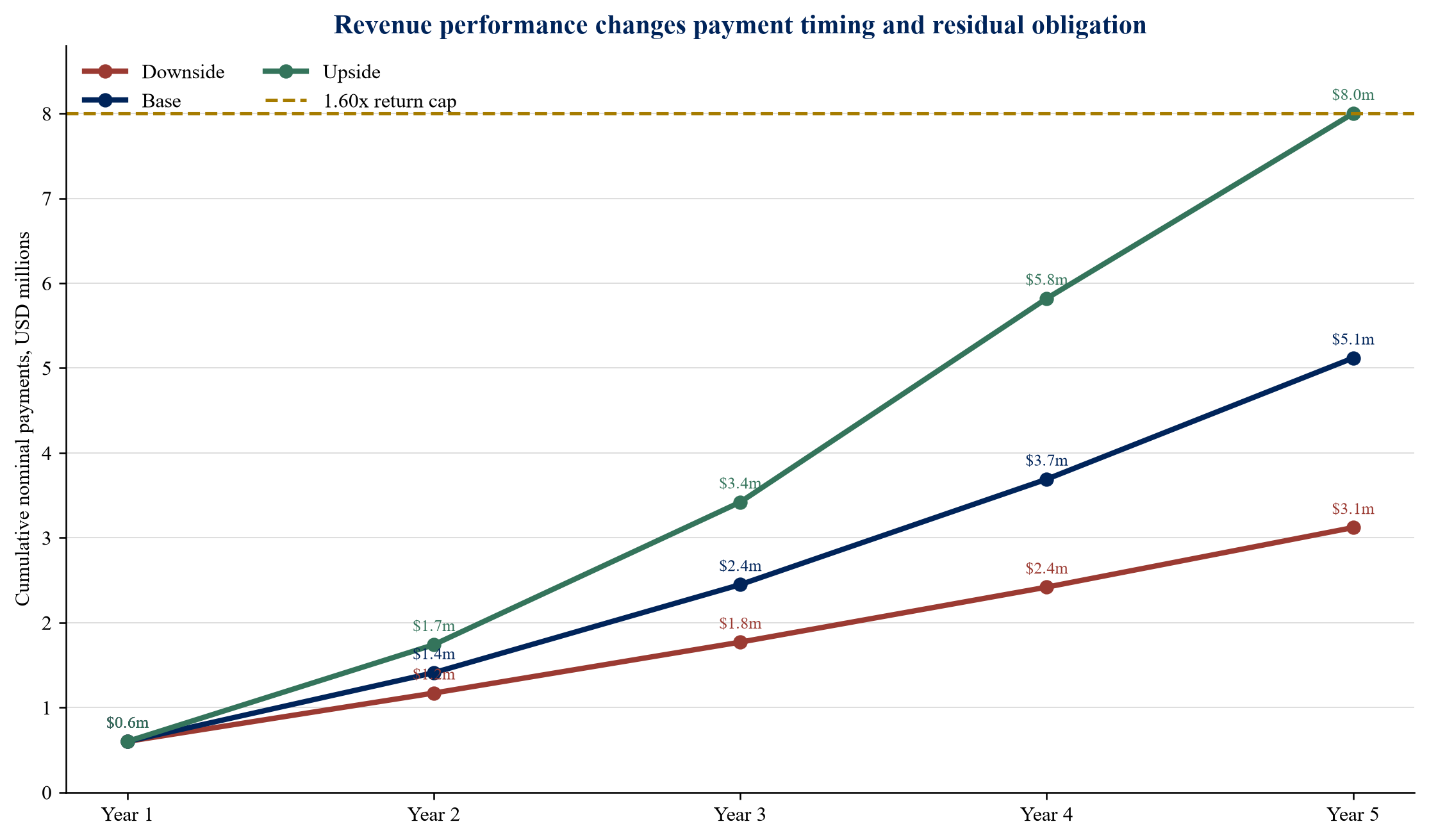
All revenues, growth rates, payment shares and return terms are hypothetical author assumptions. The chart is a decision model, not a market forecast or financing quote.
6. Compare the instrument with the equity actually avoided
Founders often describe revenue-based finance as non-dilutive. The comparison should quantify the equity that would otherwise be issued. If USD 5 million buys 15 percent of post-money equity, the future cash value transferred depends on the exit equity value. At USD 30 million, that stake is worth USD 4.5 million before distribution preferences and transaction costs. At USD 60 million it is worth USD 9 million, and at USD 120 million it is worth USD 18 million. A capped USD 8 million revenue obligation crosses the nominal equity cost at an exit equity value of approximately USD 53.3 million.
The break-even is only a starting point. Equity carries risk for longer, participates in losses and may add governance, customer access or follow-on capital. Revenue-based finance begins extracting cash during the plan and can reduce the growth that creates exit value. Time value, tax treatment, fees, warrants, liquidation preferences and follow-on dilution affect the comparison. The appropriate model discounts cash flows and uses the same operating plan under each capital structure.
Venture debt provides another reference. A fixed coupon and amortisation may cost less in a strong case and place more pressure on a weak case. A warrant can increase the provider's return. Debt may rank ahead of the revenue-based claim or require intercreditor terms. A company should compare the maximum debt service in each month, covenant headroom, refinancing exposure and recovery rights, in addition to the headline interest rate.
The comparison must account for financing capacity consumed. A secured revenue facility may prevent a later bank, venture-debt or working-capital provider from obtaining acceptable priority. A negative pledge or debt-incurrence covenant can reduce optionality. Equity can preserve borrowing capacity, while an unsecured subordinated revenue claim may coexist with senior facilities. Capital-stack position should therefore appear alongside cost.
Strategic flexibility has value. A product royalty may reduce the attractiveness of a future sale because the buyer acquires an encumbered cash stream. A company-wide share may complicate a carve-out or acquisition. A buyout formula and change-of-control mechanism can restore clarity. The board should model the financing against plausible next events, including a new equity round, acquisition, licensing partnership, refinancing and sale.
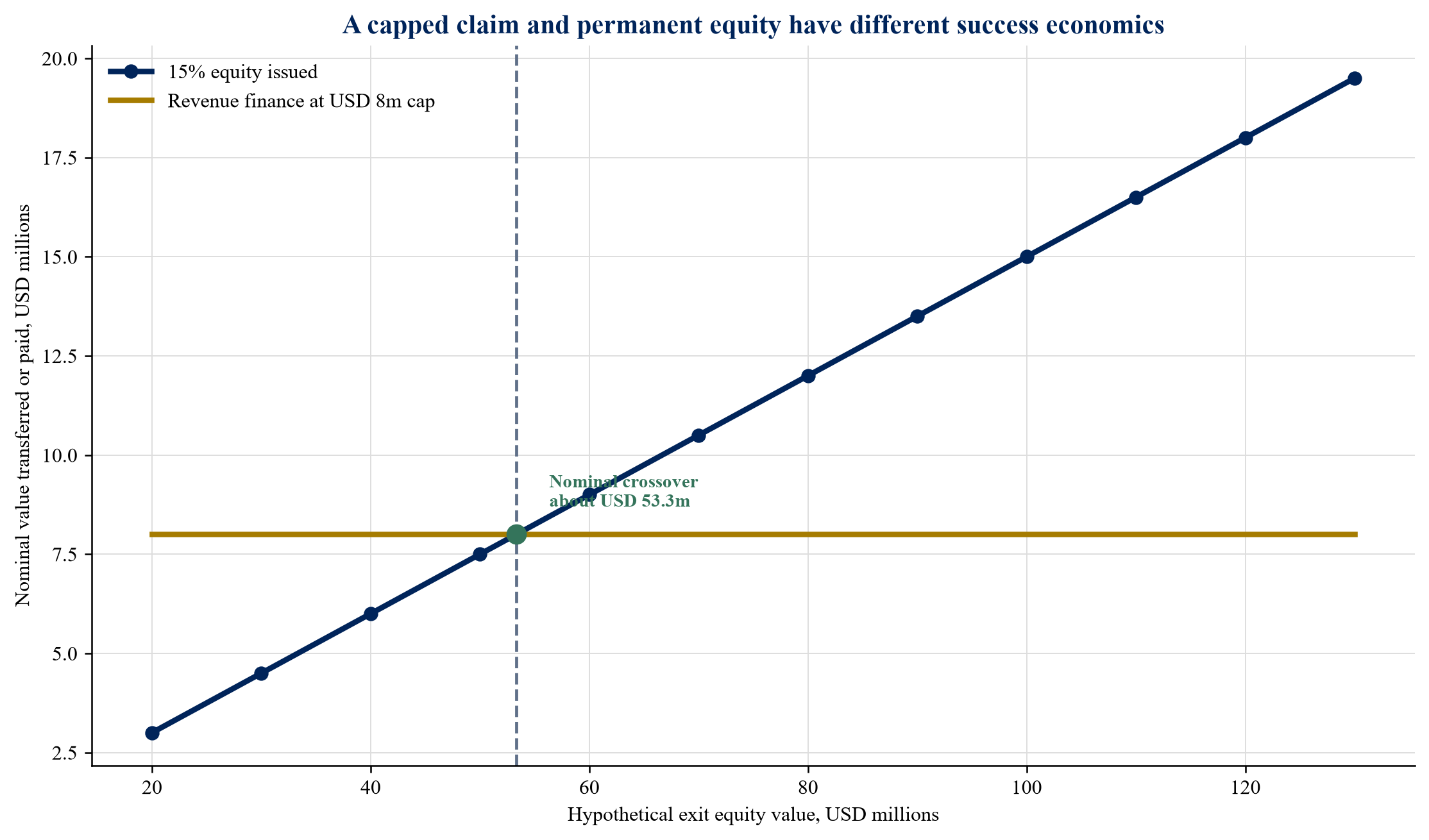
The comparison uses hypothetical author assumptions and excludes time value, tax, preferences, fees, warrants and operational effects.
7. AI businesses require revenue-quality and dependency underwriting
An AI business can present recurring subscription revenue while carrying unusual variability beneath it. Revenue may depend on usage, tokens, seats, transactions, inference calls or outcome-based pricing. Gross margin can move with model choice, hardware availability, customer behaviour, caching and negotiated cloud commitments. A revenue-share percentage applied to top-line receipts can remain fixed while unit economics deteriorate. Underwriting should reconcile contract revenue to usage drivers and variable cost.
Customer concentration and pilot conversion are central. A small number of enterprise contracts can produce rapid reported growth. Contracts may include termination rights, acceptance conditions, service credits, security reviews and data-processing obligations. Pilot revenue should be separated from repeatable production revenue. Expansion assumptions should be supported by usage, renewal and procurement evidence. A capital provider needs to understand whether growth increases contribution margin or simply passes more compute expenditure through the company.
Model and platform dependency can alter both cost and product durability. A company may rely on a third-party foundation model, cloud provider, data source or open-source licence. Pricing, rate limits, deprecation, geographic availability and usage policies can change. The company should document fallback architecture, contractual rights, data portability and the effort required to switch. NIST's AI Risk Management Framework organises risk work across govern, map, measure and manage functions [12]. Financing diligence can translate that lifecycle discipline into commercial evidence rather than treating AI governance as a separate compliance file.
Data rights affect revenue validity. Training, fine-tuning and retrieval may use customer, licensed, public or synthetic data. Contracts should allocate ownership, confidentiality, permitted use, outputs, improvement rights, deletion and indemnity. If the company cannot demonstrate lawful and durable access, the revenue stream may face interruption or claims. The European Union's Artificial Intelligence Act creates obligations across the AI value chain and treats certain systems as high risk [13]. Applicability depends on role, use and market, so the financing file should map jurisdictions and product functions.
The revenue-based structure should exclude pass-through cloud or hardware amounts when the company acts economically as an agent and retains little margin, subject to clear evidence. Covenants can monitor net revenue retention, gross margin, concentration, committed cloud spend, material model changes, security incidents and regulatory status. The provider should avoid controlling ordinary product decisions. Reserved matters should focus on actions that impair the payment stream, transfer core assets or materially increase senior claims.
8. HealthTech revenue carries approval, reimbursement and patient-safety risk
HealthTech covers software, devices, diagnostics, care delivery, clinical workflow and data infrastructure. The same financing structure cannot underwrite all of them. A workflow product sold to hospitals may resemble enterprise software. A diagnostic device may depend on regulatory clearance, reimbursement, consumables and channel inventory. A drug-development platform may have milestone and royalty economics without commercial revenue. The payment base should follow the actual route from product use to cash.
Regulatory status should be represented as a controlled evidence map. The US Food and Drug Administration provides a guidance navigator for medical-device software and maintains a list of authorised AI-enabled devices [10]. Its guidance on predetermined change-control plans addresses planned modifications to AI-enabled device software [11]. A financing committee should verify the product's intended use, classification, authorised claims, jurisdictions, change process and post-market obligations with qualified regulatory advisers. Forecasts should not treat a planned approval date as a contractual certainty.
Reimbursement and procurement can separate clinical adoption from cash generation. The economic buyer, payer and user may be different parties. Claims can be denied, repriced or paid slowly. Provider budgets and tender cycles can delay expansion. Revenue quality analysis should therefore distinguish contracted recurring fees, usage charges, reimbursed claims, implementation, hardware, consumables, grants and research collaboration income. Each category has a different margin, collection period and cancellation risk.
Patient safety, cybersecurity and privacy are value drivers because an incident can interrupt revenue and increase remediation cost. Diligence should examine quality systems, clinical evidence, complaint handling, vulnerability management, business continuity, insurance and data governance. A lender does not need to reproduce a regulator's technical review. It needs sufficient independent evidence to understand whether the company can continue delivering and collecting under plausible stress.
Royalty finance can suit a commercialised product with observable sales, durable rights and a credible payer. It is more difficult before approval or when commercialisation depends on one partner. Development funding linked to future royalties should model probability, timing, remaining exclusivity, competition and capital still required. Public life-science royalty investors disclose that development failure, marketer decisions, generic entry, reporting delay and revised forecasts can change expected cash flows materially [8][9]. The financing should allocate those risks explicitly.
9. Intellectual-property finance begins with chain of title
WIPO describes IP finance as using intellectual property or related cash flows to support funding and notes that security may need to be recorded in different jurisdictions [1]. The practical starting point is a chain-of-title schedule. It identifies each patent, trademark, copyright, design, database, domain, trade secret, software repository and licence that supports the revenue stream. It records the owner, inventor or author assignments, territories, term, renewals, encumbrances, licences, disputes and revenue relationship.
Ownership must be tested through employment, contractor, founder, university, joint-development and acquisition documents. A registered patent does not prove ownership of every improvement. Copyright in software can remain with a contractor if assignment formalities were incomplete. Open-source components may impose obligations. Data and know-how may create value without being registrable. The diligence file should connect legal rights to the operating capability that produces customer outcomes.
Validity, enforceability and freedom to operate are different questions. A right may be registered yet vulnerable to challenge. A company may own a patent while needing third-party licences to commercialise. Litigation can be expensive and uncertain. A royalty provider should assess the remaining legal and economic life of the rights, competitive alternatives and the cost of maintaining or defending them. The company should avoid promising enforcement outcomes it cannot control.
Valuation should connect rights to cash flow. WIPO's work on IP-backed finance highlights the need to move intangible-asset financing toward mainstream practice and the continuing challenges of valuation, information and lender capability [1][2]. IAS 38 also illustrates the accounting limits: some internally generated value is not recognised even when it matters economically [4]. Book value, registration cost and financing value can therefore differ substantially.
Security and transfer mechanics require jurisdiction-specific advice. The lender may take security over shares, receivables, bank accounts, contractual rights and registered IP, or acquire a defined royalty directly. Priority, perfection and enforcement depend on governing law, asset location and registry rules. The UNCITRAL Model Law on Secured Transactions offers a framework for security rights in movable assets, including intangible assets, while local implementation varies [15]. A cross-border portfolio needs an asset-by-asset perfection plan.
10. Sector underwriting should connect risk to a measurable control
Underwriting becomes useful when each risk has an evidence source, an owner, an indicator and an action. Generic statements about recurring revenue or proprietary technology do not meet that standard. The financing committee should see a sector scorecard that combines commercial, operational, legal and regulatory evidence. Scores can organise review; they should not average away a critical failure such as missing title, unlawful data use or insufficient liquidity.
AI revenue quality can be monitored through contracted annual recurring revenue, usage cohorts, renewal, gross retention, net retention, gross margin by workload, provider concentration and service-level performance. HealthTech can add authorisation status, claims acceptance, payer mix, clinical evidence, product complaints and regulatory milestones. IP businesses can add remaining right life, licensor and licensee concentration, territorial coverage, audit outcomes and dispute status.
The provider should identify hard gates separately from monitored variance. A missing assignment for core IP may prevent closing. A modest decline in net retention may trigger enhanced reporting. A major security incident may suspend new drawings and require a remediation plan. Clear classification reduces the temptation to treat every adverse result as a default, which would undermine the instrument's intended flexibility.
Evidence quality matters. Board-approved forecasts, signed contracts, billing-system extracts, bank receipts, regulatory records, IP registers and independent technical or legal reports carry different weight. Management estimates should be labelled and reconciled to source data. Modelled scenarios are decision tools rather than observed facts. The investment committee should record where evidence is incomplete and what condition, reserve or covenant addresses the uncertainty.
Table 3. Sector-specific underwriting scorecard for revenue-linked finance
| Dimension | AI business evidence | HealthTech evidence | IP or licensing evidence | Example financing response |
|---|---|---|---|---|
| Revenue durability | Contract term, renewal, usage cohort and procurement status | Authorised use, payer route, reimbursement and installation base | Licence term, territory, exclusivity and licensee performance | Adjust eligible revenue, share, reserve or tenor |
| Gross-margin resilience | Compute cost, provider commitments and workload mix | Hardware, consumables, clinical support and claims leakage | Administration, prosecution, enforcement and development cost | Exclude pass-throughs or set payment holiday trigger |
| Concentration | Customers, cloud, models and data sources | Customers, payers, distributors and clinical sites | Products, licensees, marketers and territories | Concentration covenant or cash reserve |
| Regulatory continuity | AI classification, data rights and market obligations | Approval, quality system, post-market and cybersecurity status | Registration, maintenance, competition and enforcement | Condition precedent or drawstop |
| Asset control | Source code, models, licences and portability | Device files, software, data and manufacturing rights | Chain of title, assignments, encumbrances and audit rights | Security, consent or excluded asset |
| Forecast verification | Contracted backlog, usage and unit economics | Patient or site cohorts, claims and launch milestones | Sales reports, royalty statements and market evidence | Scenario weighting and cap or tenor adjustment |
Indicators are illustrative. Thresholds require calibration to the company, product, jurisdiction and provider risk appetite.
11. The hypothetical base case makes the cash burden visible
The worked example assumes a company raises USD 5 million at the beginning of year one. Eligible revenue is USD 10 million in year one and grows by 35 percent, 28 percent, 20 percent, 15 percent and 10 percent across the five annual periods. The company pays six percent of eligible revenue monthly until cumulative payments reach USD 8 million, equal to a 1.60 times cash-return cap. There is no minimum payment in the model. Legal maturity is at the end of month 60, and any residual treatment would need to be negotiated in actual documents.
Under the base path, nominal annual payments rise with revenue. The provider reaches the cap when cumulative eligible revenue reaches approximately USD 133.3 million because six percent of that amount equals USD 8 million. If the five-year revenue path generates less than that amount, the cap remains unpaid at maturity unless a balloon, extension or buyout applies. The timing of the same cap changes the provider's annualised return and the company's liquidity burden.
The downside path assumes slower growth and margin recovery. Payments decline relative to the base case, preserving some cash, yet the company may still struggle because the revenue share ranks ahead of operating investment. The upside path reaches the cap earlier. That accelerates the provider's return and releases the company from future payments, provided the documents terminate the claim automatically and all reporting disputes are resolved.
The model should be built monthly even when results are presented annually. Annual averages hide renewal dates, reimbursement cycles, seasonal collections and large customer payments. The calculation needs opening cash, operating receipts, revenue share, cost of delivery, operating expenses, working capital, tax, capital expenditure, debt service and financing proceeds. Minimum liquidity should be tested each month under downside assumptions.
The scenario also needs a use-of-proceeds bridge. Product development, regulatory work, go-to-market investment, cloud commitments, working capital, acquisitions and refinancing have different cash profiles. A board should approve the capital amount against milestones that improve the next financing or self-sufficiency point. Funding a recurring operating deficit without a credible path to margin or follow-on capital can convert flexibility into delayed distress.
12. Break-even analysis should include value, time and lost growth
The nominal comparison in Figure 3 holds the capped revenue payment at USD 8 million and values 15 percent equity across possible exits. The lines cross at roughly USD 53.3 million of equity value. Below that point, the equity issued may transfer less nominal value than the full cap. Above it, the capped instrument may preserve more shareholder value. The calculation assumes both structures fund the same operating result, which is unlikely in practice.
Revenue payments reduce cash available for sales, product, clinical, regulatory and infrastructure investment. If that reduction slows growth, the exit value under revenue finance may be lower. Equity investors may also contribute strategic support or follow-on capital. Conversely, avoiding a priced round can prevent dilution at a temporary valuation trough and preserve governance. The scenario model should therefore link financing mechanics to the operating plan rather than treating exit value as independent.
Time value should be calculated using actual payment dates. The provider's internal rate of return rises when growth accelerates payments. The company's effective cost should include upfront fees, diligence expenses, monitoring fees, warrants, default amounts and buyout premiums. Tax deductibility or withholding treatment should be reviewed by advisers and should not be assumed from the instrument name. Cross-border royalty payments may raise treaty, withholding, transfer-pricing and permanent-establishment questions.
OECD transfer-pricing guidance distinguishes the transfer-pricing concept of intangibles from the definition of royalties under tax treaties and calls for functional analysis of identified rights and activities [14]. This distinction is important when related entities own IP, perform development or receive financing proceeds. A payment can have different accounting, legal and tax characterisations. The transaction model should show gross cash, tax leakage, net provider receipt and company deduction or non-deduction only after professional analysis.
Decision makers should see ranges rather than one break-even point. Exit timing, probability, valuation, dilution, payment timing, gross margin and reinvestment return can be varied. The board can then identify which assumptions change the preferred instrument. Sensitivity should produce an action, such as negotiating a lower share, adding a payment holiday, reducing the cap, staging draws or preserving a buyout window.
13. Covenants should protect the payment stream without managing the company
Covenants should address the provider's real risks: diversion of revenue, deterioration of liquidity, transfer of core assets, additional senior claims, loss of critical rights and unreliable reporting. They should not give the provider operational control over ordinary pricing, hiring, product design or customer selection. Overbroad consent rights can slow the business and may create governance or regulatory concerns depending on the jurisdiction and facts.
Information covenants can require a monthly revenue certificate, cash report and calculation statement, quarterly management accounts, annual financial statements, budgets and notice of material events. Definitions should align across the agreement, model and reporting template. The company needs a short dispute process because an unresolved calculation can affect default, buyout and refinancing amounts. Independent accountant determination may be suitable for accounting questions, while legal disputes follow the agreed forum.
Affirmative covenants can require maintenance of corporate existence, licences, insurance, material IP rights, books, tax compliance and security. Negative covenants can limit new debt, liens, distributions, asset transfers, related-party transactions and changes to the revenue perimeter. Baskets and thresholds preserve ordinary business flexibility. The covenant group should match the entities generating revenue and owning core assets.
Financial covenants should fit the variable structure. Minimum liquidity and reporting accuracy may be more relevant than a fixed debt-service ratio for a high-growth company. Gross-margin, concentration or recurring-revenue tests can provide early warning, but definitions must be stable and verified. A covenant based on annual recurring revenue can mislead if contracts have termination rights, usage falls or implementation remains incomplete.
Remedies should escalate. Enhanced reporting, a remediation plan, cash reserve, payment adjustment, drawstop and board observation can precede acceleration or enforcement. Fraud, diverted receipts, unauthorised asset transfer and insolvency may justify stronger remedies. The documents should preserve statutory rights and qualified-adviser conclusions while making the commercial sequence understandable to both sides.
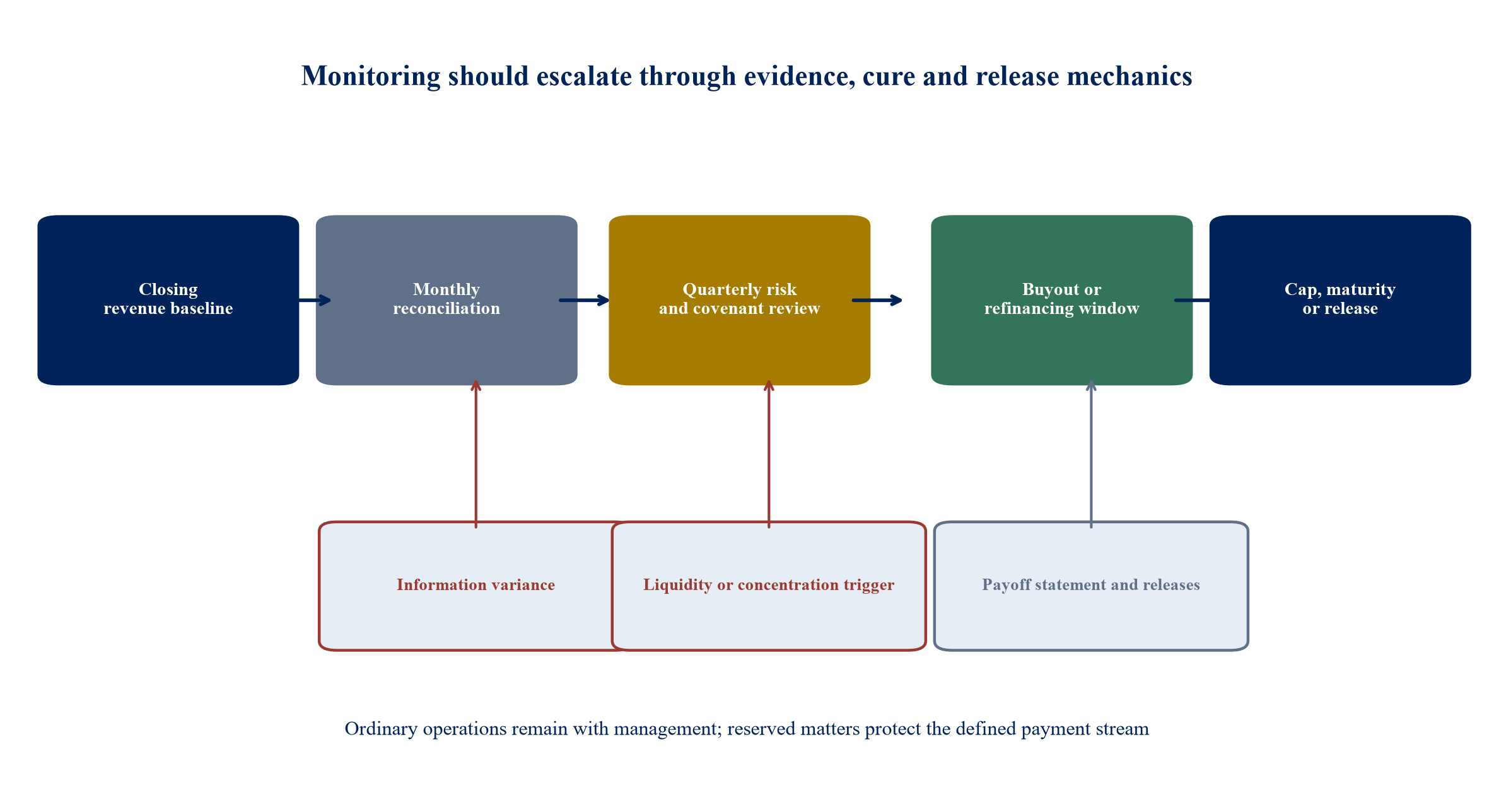
The sequence is an illustrative governance design. Actual rights, remedies and time periods depend on negotiated documents and applicable law.
14. Buyout design protects refinancing and strategic transactions
A buyout right allows the company to terminate the revenue claim by paying a defined amount. It supports a later equity round, senior refinancing, acquisition, product sale or change of control. Without a clear formula, the provider can become a holdout or the company can underestimate the cash required to release security and payment rights. The agreement should state when the option is available, how the amount is calculated and when releases become effective.
A simple formula can use the greater of a minimum return and the remaining amount to the contractual cap, with step-downs over time. Another structure can set fixed multiples at specified dates. The company may seek a lower multiple after early repayment because duration is shorter, while the provider may seek make-whole protection. The model should display the payoff on each potential transaction date and reconcile it to cumulative payments.
Change of control needs separate treatment. Automatic acceleration to the full cap can transfer substantial value even when the provider's risk period was short. A lower change-of-control multiple may balance the parties. Asset sales, exclusive licences, mergers, reorganisations and transfers of the revenue-generating subsidiary should be covered without capturing ordinary customer contracts. Counsel should align the definition with corporate and tax structure.
Partial releases matter when only one product or geography is sold. The agreement can allocate the cap among assets or use a formula based on the disposed revenue. Allocation should avoid giving the company an incentive to move attractive revenue out of scope while leaving weaker assets supporting the facility. The provider needs proceeds protection, and the company needs capacity to reshape the portfolio.
Release mechanics should be operational. Payoff statements require a response deadline, calculation date, per-diem amount, bank instructions and confirmation of taxes. Security releases, registry filings, account controls and notices to licensees or customers should occur against funds. A closing checklist prevents a completed financing from leaving stale encumbrances that impair the next transaction.
Table 4. Covenant, reporting and buyout architecture
| Control | Purpose | Evidence and frequency | Calibrated response |
|---|---|---|---|
| Revenue certificate | Verify eligible revenue and payment | Monthly ledger-to-bank reconciliation signed by finance lead | Correct calculation, cure underpayment and investigate recurring variance |
| Minimum liquidity | Preserve operating continuity | Weekly cash forecast and monthly certificate | Payment deferral, reserve or remediation before acceleration |
| Concentration monitor | Identify dependence on customers, payers, models or licensees | Monthly or quarterly concentration schedule | Enhanced reporting, reserve or consent for material change |
| Core-rights covenant | Protect IP, data, approvals and licences supporting revenue | Event notice plus annual rights schedule | Cure, substitute evidence or drawstop for material loss |
| Additional-debt and lien control | Preserve agreed priority and financing capacity | Before incurrence, with permitted baskets | Consent, intercreditor agreement or permitted senior basket |
| Buyout statement | Enable refinancing or strategic transaction | On request with defined response period | Pay agreed formula and deliver simultaneous releases |
| Change-of-control treatment | Allocate transaction proceeds and terminate claim | Transaction notice and funds-flow statement | Defined payoff multiple, cap and release process |
| Calculation dispute | Resolve differences without operational paralysis | Notice, supporting records and independent review | Pay undisputed amount and determine balance under agreed procedure |
Terms are illustrative author-designed controls rather than market quotations or legal advice.
15. Accounting and valuation need an instrument-specific conclusion
Accounting analysis begins with the executed rights and obligations. IFRS 9 addresses recognition and measurement of financial instruments [5]. The effective-interest method uses estimated contractual cash flows, and IFRS Interpretations Committee material illustrates how changes in estimated cash flows can affect amortised-cost measurement [7]. A revenue-linked liability may require estimates that are revised as performance changes. Embedded features, modification, derecognition and presentation require analysis under the actual contract.
Royalty assets can also involve complex cash-flow estimation. Royalty Pharma's public filing describes financial royalty assets measured at amortised cost using a prospective effective-interest method and highlights product growth and royalty duration in valuation [8]. That reporting is specific to the company's facts and policies. It demonstrates the need for controlled forecasts, revision governance and transparent sensitivity rather than providing an accounting template for another transaction.
IAS 38 governs recognition and measurement of intangible assets, while internally generated brands, customer lists and similar items may not be recognised [4]. A lender's economic view can therefore rely on assets that do not appear at comparable values on the balance sheet. The financing file should reconcile legal ownership, accounting carrying amounts, valuation evidence and forecast cash flows. Each serves a different purpose.
Fair-value work may use income, market and cost approaches, with method selection driven by the asset and available evidence. Royalty-relief methods, excess-earnings methods and scenario-weighted cash flows require assumptions about revenue, royalty rates, margins, tax, remaining life, attrition and risk. An independent valuation does not eliminate uncertainty. It makes assumptions and sensitivity reviewable.
The board should obtain auditor and adviser input before execution, especially when classification affects leverage, covenants, distributable reserves or future fundraising. Investor materials should describe the obligation consistently with financial statements. A financing presented as non-debt in a pitch deck while treated as a liability in accounts damages credibility and can create breaches in other agreements.
16. Documentation must connect legal rights to operational data
The core documents may include a financing agreement, royalty purchase or participation agreement, security documents, account-control arrangements, intercreditor agreement, IP assignments or licences, guarantees, board and shareholder approvals, legal opinions and reporting templates. The precise package depends on whether the transaction is a loan, asset acquisition, receivables sale or hybrid. The parties should settle characterisation early because it affects approvals, tax, accounting and perfection.
Conditions precedent should prove authority, ownership and readiness. They can include constitutional documents, resolutions, beneficial ownership and compliance information, financial statements, revenue data, material contracts, IP schedules, regulatory evidence, insurance, existing-debt consents, bank accounts and a funds-flow statement. A long list has little value if documents are stale or inconsistent. Each condition should have an owner, reviewer and acceptance standard.
The data architecture should support recurring calculations. Billing, ledger and bank fields need common identifiers. Revenue categories and exclusions should be mapped once, then controlled. System changes, acquisitions and new products require a change process. The provider needs enough access to verify the claim, while the company must protect customer confidentiality, patient information, trade secrets and security credentials.
Cyber and operational resilience are financing controls. A failure in billing, cloud infrastructure, clinical systems or royalty reporting can interrupt payment and damage customers. The continuity plan should identify critical services, recovery objectives, backups, incident communication and manual alternatives. NIST's risk-management resources emphasise continuous governance, mapping, measurement and management of AI risk [12]. Similar discipline can connect technology operations to financial reporting.
Closing should end with a single executed economics pack. It contains the agreed model, definitions, payment examples, cap and buyout schedule, covenant calculations, reporting calendar, security map and contacts. This pack reduces future disputes and supports refinancing diligence. It should reflect signed documents rather than an earlier term sheet.
17. A 120-day financing programme turns concept into an executable facility
Days 1 to 20 establish the financing perimeter. Management defines the capital need, use of proceeds, runway, products, entities, revenue streams, existing claims and strategic alternatives. Finance reconciles invoices, revenue recognition and cash receipts. Legal and technical teams create the IP, data, regulatory and material-contract maps. The board agrees decision criteria and stop conditions.
Days 21 to 45 build the evidence and scenarios. The team constructs monthly historical cohorts, gross margin by revenue stream, concentration, churn or renewal, claims and refunds, forecast drivers and downside cases. The revenue-definition schedule is tested against source transactions. The financing model compares revenue share, royalty, venture debt and equity under consistent operating assumptions.
Days 46 to 70 shape the instrument and approach providers. The company prepares a concise information memorandum, controlled data room, model and term-sheet request. It identifies the desired amount, draw structure, payment base, share, cap, maturity, liquidity protection, security, covenants and buyout. Provider outreach should target mandates with relevant sector, stage, geography and ticket-size fit. Commercial interest remains unverified until supported by written terms and completed diligence.
Days 71 to 95 run diligence and negotiate risk allocation. Management answers data questions through a controlled log. Advisers test legal characterisation, tax, accounting, regulation, security and intercreditor issues. Competing terms are normalised into monthly cash flows and rights. The board evaluates downside liquidity, provider return, dilution avoided, strategic restrictions and closing certainty.
Days 96 to 120 close and operationalise reporting. Documents, approvals, conditions, funds flow and releases are completed. Finance runs a parallel calculation before the first payment period. Owners are assigned for reporting, covenants, IP maintenance, regulatory events and buyout requests. The board receives a post-close dashboard with cash, eligible revenue, cumulative payments, remaining cap and forecast headroom.
The timetable should flex when evidence or approvals require more work. Quality gates matter more than an arbitrary date. The programme should stop or resize the transaction when revenue cannot be reconciled, gross margin cannot absorb the share, core rights are defective, regulatory continuity is uncertain or downside liquidity fails. A smaller staged facility, equity bridge or conventional debt may be more appropriate.
18. Conclusion
Royalty and revenue-based finance can fund the space between commercial proof and conventional debt capacity. Its value comes from aligning payment with an observable revenue stream and limiting the claim through a cap, maturity or buyout. Its risk comes from placing a contractual payment near the top of the cash waterfall while relying on definitions, forecasts and rights that may be complex.
The board should begin with four tests. Eligible revenue must be precisely defined and auditable. Gross margin and monthly liquidity must absorb the payment under downside conditions. The capital provider's protections must preserve ordinary operating authority and future financing capacity. The claim must have a clear economic and legal endpoint. Failure on any one test can turn apparent flexibility into a costly encumbrance.
Sector evidence determines the structure. AI companies need usage economics, model and cloud dependency, data rights and regulatory mapping. HealthTech companies need approval, reimbursement, quality, cybersecurity and payer evidence. IP businesses need chain of title, enforceability, remaining life, licence and reporting controls. A generic percentage cannot compensate for missing evidence.
The financing decision should compare the full cash flows and rights of revenue finance, royalty finance, venture debt and equity. A capped claim may preserve value in a strong exit and consume scarce cash during the build. Equity may cost more in success and carry risk without mandatory payments. Fixed debt may be cheaper when cash is stable and dangerous when it is not. Scenario modelling makes these trade-offs visible.
Execution rests on a controlled revenue waterfall, an instrument-specific accounting and legal analysis, calibrated covenants, a workable buyout, complete documentation and recurring reporting. These elements allow a company and provider to share growth economics while preserving the operating capacity that creates the revenue. The result is a financeable contract whose cost, risks and endpoint can be understood before capital is drawn.
References
- World Intellectual Property Organization. Intellectual Property Finance and report series. https://www.wipo.int/en/web/ip-financing
- World Intellectual Property Organization. Moving IP Finance from the Margins to the Mainstream. 2025. https://www.wipo.int/edocs/pubdocs/en/wipo-pub-rn2025-7-en-moving-ip-finance-from-the-margins-to-the-mainstream.pdf
- World Intellectual Property Organization and United Kingdom Intellectual Property Office. The United Kingdom's Journey on Unlocking IP-backed Finance. 2024. https://www.wipo.int/en/web/ip-financing/w/news/2024/report-launch-the-united-kingdom-s-journey-on-unlocking-ip-backed-finance
- IFRS Foundation. IAS 38 Intangible Assets. https://www.ifrs.org/issued-standards/list-of-standards/ias-38-intangible-assets/
- IFRS Foundation. IFRS 9 Financial Instruments. https://www.ifrs.org/issued-standards/list-of-standards/ifrs-9-financial-instruments/
- IFRS Foundation. IFRS 15 Revenue from Contracts with Customers. https://www.ifrs.org/issued-standards/list-of-standards/ifrs-15-revenue-from-contracts-with-customers/
- IFRS Interpretations Committee. IFRIC Update, February 2022: subsequent measurement at amortised cost and estimated contractual cash flows. https://www.ifrs.org/news-and-events/updates/ifric/2022/ifric-update-february-2022/
- Royalty Pharma plc. Annual Report on Form 10-K for the year ended 31 December 2025. US Securities and Exchange Commission. https://www.sec.gov/Archives/edgar/data/1802768/000180276826000003/rprx-20251231.htm
- XOMA Royalty Corporation. Annual Report on Form 10-K for the year ended 31 December 2025. US Securities and Exchange Commission. https://www.sec.gov/Archives/edgar/data/791908/000110465926030872/xoma-20251231x10k.htm
- US Food and Drug Administration. Medical Device Software Guidance Navigator. https://www.fda.gov/medical-devices/regulatory-accelerator/medical-device-software-guidance-navigator
- US Food and Drug Administration. Marketing Submission Recommendations for a Predetermined Change Control Plan for Artificial Intelligence-Enabled Device Software Functions. Final Guidance, 18 August 2025. https://www.fda.gov/medical-devices/digital-health-center-excellence/guidances-digital-health-content
- National Institute of Standards and Technology. Artificial Intelligence Risk Management Framework: Generative Artificial Intelligence Profile, NIST AI 600-1. 2024, updated 2026. https://www.nist.gov/publications/artificial-intelligence-risk-management-framework-generative-artificial-intelligence
- European Union. Regulation (EU) 2024/1689 laying down harmonised rules on artificial intelligence. https://eur-lex.europa.eu/eli/reg/2024/1689/oj
- Organisation for Economic Co-operation and Development. OECD Transfer Pricing Guidelines for Multinational Enterprises and Tax Administrations 2022. https://doi.org/10.1787/0e655865-en
- United Nations Commission on International Trade Law. UNCITRAL Model Law on Secured Transactions. https://uncitral.un.org/en/texts/securityinterests/modellaw/secured_transactions
- European Investment Bank. Venture Debt. https://advisory.eib.org/future-finance-programme/venture-debt
- International Private Equity and Venture Capital Valuation Board. International Private Equity and Venture Capital Valuation Guidelines. https://www.privateequityvaluation.com/valuation-guidelines
- International Valuation Standards Council. International Valuation Standards, including IVS 210 Intangible Assets. https://www.ivsc.org/standards/
- United Kingdom Companies House. Register a charge. https://www.gov.uk/government/publications/register-a-charge-mr01
- United Kingdom Intellectual Property Office. Intellectual Property Office Innovation and Growth Report 2023 to 2024. https://www.gov.uk/government/publications/intellectual-property-office-innovation-and-growth-report-202324
- United States Patent and Trademark Office. Assignments on the Web and patent assignment information. https://assignmentcenter.uspto.gov/
- World Intellectual Property Organization. Hands-on IP Finance: Securing Loans with Your IP Assets. 2024. https://www.wipo.int/en/web/ip-financing/w/news/2024/launch-of-hands-on-ip-finance
