

Introduction
Orbital refuelling promises to extend spacecraft life, recover missions constrained by propellant and support more capable in-space logistics. It can also create a coordination problem. A spacecraft operator may hesitate to install a refuelling interface until a credible servicer exists. A servicer may hesitate to commit capital until enough compatible spacecraft exist. A depot investor may require repeat demand before financing replenishment capacity. Propellant suppliers and launch providers need predictable volume to offer better terms. Each participant benefits from adoption by others, yet each can rationally wait.
That circular dependency resembles a network market, although the label can become misleading. A large theoretical fleet does not create network value when vehicles use incompatible couplers, propellants, pressures, thermal regimes or operating concepts. Announced memoranda do not equal bankable demand. A technically successful demonstration does not establish repeat economics. A depot in the wrong orbit can remain stranded even when total market forecasts are large.
A financing framework must therefore translate the network thesis into measurable evidence. It should identify the compatible installed base, mission-specific economic benefit, customer qualification process, contracted revenue, completed operations and repeat behaviour. It should also expose the capital required before density develops. This paper provides that framework for boards, investors, lenders, governments, insurers, satellite operators and service providers.
1. Define the service boundary
The decision concerns the physical and contractual service being offered, including propellant type, orbit, transfer quantity, interface, rendezvous mode, custody and post-transfer responsibility. Management should assemble current engineering, customer, contractual and financial evidence at a controlled valuation date. Each assumption requires an owner, source, confidence range and review trigger. The required output is a bounded service definition with one accountable configuration baseline.
A platform cannot be valued from the general concept of orbital refuelling. The decision record should state where the propellant begins, when the provider assumes custody, which interfaces are supported and what evidence constitutes a completed transfer. The valuation should show how the conclusion changes when one variable moves and when related variables move together. Interface adoption can affect customer conversion, mission density, delivered cost and competitive intensity at the same time.
A practical decision record states the evidence available, the evidence missing, the party responsible for closing the gap and the capital released when the gap closes. Sources and uses should remain funded through the next value-changing gate. This discipline keeps strategic option value visible without presenting prospective adoption as completed demand.
2. Separate technical markets
The decision concerns the different requirements of low Earth orbit, medium Earth orbit, geostationary orbit, cislunar space and transfer trajectories. Management should assemble current engineering, customer, contractual and financial evidence at a controlled valuation date. Each assumption requires an owner, source, confidence range and review trigger. The required output is orbit-specific customer, vehicle and replenishment cases.
Distance, inclination change, radiation, thermal conditions and communications affect vehicle design and mission duration. Aggregating every orbit into one market can conceal the capital and operating constraints of each service. The valuation should show how the conclusion changes when one variable moves and when related variables move together. Interface adoption can affect customer conversion, mission density, delivered cost and competitive intensity at the same time.
A practical decision record states the evidence available, the evidence missing, the party responsible for closing the gap and the capital released when the gap closes. Sources and uses should remain funded through the next value-changing gate. This discipline keeps strategic option value visible without presenting prospective adoption as completed demand.
3. Map the interface stack
The decision concerns mechanical capture, structural loads, fluid coupling, electrical power, data, command, authentication and safe separation. Management should assemble current engineering, customer, contractual and financial evidence at a controlled valuation date. Each assumption requires an owner, source, confidence range and review trigger. The required output is an interface-control matrix showing prepared, adaptable and unsupported configurations.
Compatibility requires more than a mating ring. Fluid cleanliness, seal design, pressure range, leak detection, electrical protocols and operational authority can each prevent service. The matrix should show which limitations are physical and which may be resolved through adapters or procedures. The valuation should show how the conclusion changes when one variable moves and when related variables move together. Interface adoption can affect customer conversion, mission density, delivered cost and competitive intensity at the same time.
A practical decision record states the evidence available, the evidence missing, the party responsible for closing the gap and the capital released when the gap closes. Sources and uses should remain funded through the next value-changing gate. This discipline keeps strategic option value visible without presenting prospective adoption as completed demand.
4. Measure the prepared installed base
The decision concerns spacecraft that already carry compatible passive hardware or documented accommodations. Management should assemble current engineering, customer, contractual and financial evidence at a controlled valuation date. Each assumption requires an owner, source, confidence range and review trigger. The required output is an asset-level register with operator confirmation and launch status.
Prepared interfaces can lower risk and shorten servicing time. NASA's technology programme and European interface work support preparation as a policy direction. Valuation should count verified installations rather than catalogue assumptions. The valuation should show how the conclusion changes when one variable moves and when related variables move together. Interface adoption can affect customer conversion, mission density, delivered cost and competitive intensity at the same time.
A practical decision record states the evidence available, the evidence missing, the party responsible for closing the gap and the capital released when the gap closes. Sources and uses should remain funded through the next value-changing gate. This discipline keeps strategic option value visible without presenting prospective adoption as completed demand.
5. Identify adaptable spacecraft
The decision concerns spacecraft that lack the preferred interface but can be served through an adapter, robotic operation or alternative transfer method. Management should assemble current engineering, customer, contractual and financial evidence at a controlled valuation date. Each assumption requires an owner, source, confidence range and review trigger. The required output is a qualified adaptation pathway with cost, time and mission risk.
Adaptation can enlarge the addressable fleet while adding complexity. Each adaptation route needs test evidence, customer consent and a clear allocation of failure risk. An unprepared vehicle should not be treated as economically equivalent to a prepared one. The valuation should show how the conclusion changes when one variable moves and when related variables move together. Interface adoption can affect customer conversion, mission density, delivered cost and competitive intensity at the same time.
A practical decision record states the evidence available, the evidence missing, the party responsible for closing the gap and the capital released when the gap closes. Sources and uses should remain funded through the next value-changing gate. This discipline keeps strategic option value visible without presenting prospective adoption as completed demand.
6. Build the addressable fleet waterfall
The decision concerns the conversion from observed spacecraft to completed and repeat missions. Management should assemble current engineering, customer, contractual and financial evidence at a controlled valuation date. Each assumption requires an owner, source, confidence range and review trigger. The required output is a six-stage funnel with dated evidence at each stage.
The tracked population should narrow through technical compatibility, mission economics, operator qualification, contracting and execution. A platform earns network value when conversion and repeat use improve as the compatible ecosystem grows. The valuation should show how the conclusion changes when one variable moves and when related variables move together. Interface adoption can affect customer conversion, mission density, delivered cost and competitive intensity at the same time.
A practical decision record states the evidence available, the evidence missing, the party responsible for closing the gap and the capital released when the gap closes. Sources and uses should remain funded through the next value-changing gate. This discipline keeps strategic option value visible without presenting prospective adoption as completed demand.
7. Quantify customer mission economics
The decision concerns the incremental value created by adding propellant to a specific spacecraft. Management should assemble current engineering, customer, contractual and financial evidence at a controlled valuation date. Each assumption requires an owner, source, confidence range and review trigger. The required output is a customer value bridge covering life extension, protected revenue, avoided replacement, recovered capability and risk.
Customer willingness to pay depends on the alternative. A satellite near end of life with strong revenue and healthy subsystems may have high refuelling value. A vehicle with obsolete payloads or other limiting components may have little economic life to recover. The valuation should show how the conclusion changes when one variable moves and when related variables move together. Interface adoption can affect customer conversion, mission density, delivered cost and competitive intensity at the same time.
A practical decision record states the evidence available, the evidence missing, the party responsible for closing the gap and the capital released when the gap closes. Sources and uses should remain funded through the next value-changing gate. This discipline keeps strategic option value visible without presenting prospective adoption as completed demand.
8. Price delivered propellant
The decision concerns launch cost, container mass, transfer losses, storage losses, depot operations, service-vehicle consumption, insurance and capital recovery. Management should assemble current engineering, customer, contractual and financial evidence at a controlled valuation date. Each assumption requires an owner, source, confidence range and review trigger. The required output is a delivered cost per usable kilogram by orbit and mission configuration.
Propellant price on Earth is a small component of delivered orbital cost. The model should include every mass and mission dependency between procurement and usable transfer. Replenishment cadence can lower unit cost only when demand uses the available capacity. The valuation should show how the conclusion changes when one variable moves and when related variables move together. Interface adoption can affect customer conversion, mission density, delivered cost and competitive intensity at the same time.
A practical decision record states the evidence available, the evidence missing, the party responsible for closing the gap and the capital released when the gap closes. Sources and uses should remain funded through the next value-changing gate. This discipline keeps strategic option value visible without presenting prospective adoption as completed demand.
9. Distinguish platform effects from scale effects
The decision concerns whether value improves because more participants join or because the provider spreads fixed cost across more missions. Management should assemble current engineering, customer, contractual and financial evidence at a controlled valuation date. Each assumption requires an owner, source, confidence range and review trigger. The required output is a decomposition of demand density, learning, purchasing and interoperability benefits.
A lower unit cost from a larger depot can be a scale effect. A compatible customer that improves route density for other users can create a network effect. The distinction matters because scale can remain proprietary while network effects often depend on interoperability. The valuation should show how the conclusion changes when one variable moves and when related variables move together. Interface adoption can affect customer conversion, mission density, delivered cost and competitive intensity at the same time.
A practical decision record states the evidence available, the evidence missing, the party responsible for closing the gap and the capital released when the gap closes. Sources and uses should remain funded through the next value-changing gate. This discipline keeps strategic option value visible without presenting prospective adoption as completed demand.
10. Test same-side and cross-side effects
The decision concerns how additional spacecraft, service vehicles, depots, launch providers and suppliers affect each participant. Management should assemble current engineering, customer, contractual and financial evidence at a controlled valuation date. Each assumption requires an owner, source, confidence range and review trigger. The required output is a network map with direction, strength and evidence for each effect.
More compatible spacecraft can attract service capacity. More servicers can reassure operators while intensifying competition. More depots can improve availability while fragmenting volume. The analysis should preserve these opposing mechanisms. The valuation should show how the conclusion changes when one variable moves and when related variables move together. Interface adoption can affect customer conversion, mission density, delivered cost and competitive intensity at the same time.
A practical decision record states the evidence available, the evidence missing, the party responsible for closing the gap and the capital released when the gap closes. Sources and uses should remain funded through the next value-changing gate. This discipline keeps strategic option value visible without presenting prospective adoption as completed demand.
11. Model interface standardisation paths
The decision concerns proprietary standards, bilateral adapters, coalition standards and open interfaces. Management should assemble current engineering, customer, contractual and financial evidence at a controlled valuation date. Each assumption requires an owner, source, confidence range and review trigger. The required output is four adoption scenarios with switching cost and time to critical mass.
Open standards may enlarge participation and reduce customer lock-in. Proprietary interfaces may accelerate early deployment when one sponsor controls a fleet. Coalition approaches can create an intermediate path. The valuation should show which party funds compatibility and who captures the resulting value. The valuation should show how the conclusion changes when one variable moves and when related variables move together. Interface adoption can affect customer conversion, mission density, delivered cost and competitive intensity at the same time.
A practical decision record states the evidence available, the evidence missing, the party responsible for closing the gap and the capital released when the gap closes. Sources and uses should remain funded through the next value-changing gate. This discipline keeps strategic option value visible without presenting prospective adoption as completed demand.
12. Define critical mass
The decision concerns the minimum contracted and repeat demand that supports safe operations, replenishment and capital service. Management should assemble current engineering, customer, contractual and financial evidence at a controlled valuation date. Each assumption requires an owner, source, confidence range and review trigger. The required output is a threshold expressed in missions, kilograms, route density and cash coverage.
Critical mass is programme-specific. It depends on mission duration, vehicle reuse, orbit, depot capacity, launch cadence and contract pricing. A global spacecraft count is not a substitute for the demand concentration available to one architecture. The valuation should show how the conclusion changes when one variable moves and when related variables move together. Interface adoption can affect customer conversion, mission density, delivered cost and competitive intensity at the same time.
A practical decision record states the evidence available, the evidence missing, the party responsible for closing the gap and the capital released when the gap closes. Sources and uses should remain funded through the next value-changing gate. This discipline keeps strategic option value visible without presenting prospective adoption as completed demand.
13. Design customer contracts
The decision concerns reservation, availability, minimum-volume, take-or-pay, mission, outcome and repeat-service arrangements. Management should assemble current engineering, customer, contractual and financial evidence at a controlled valuation date. Each assumption requires an owner, source, confidence range and review trigger. The required output is a contract ladder that increases commitment as technical evidence matures.
Early customers may pay for interface integration or capacity reservation. Debt capacity generally requires firmer obligations, defined acceptance and credible termination compensation. The contract should separate customer-caused delay from provider non-performance. The valuation should show how the conclusion changes when one variable moves and when related variables move together. Interface adoption can affect customer conversion, mission density, delivered cost and competitive intensity at the same time.
A practical decision record states the evidence available, the evidence missing, the party responsible for closing the gap and the capital released when the gap closes. Sources and uses should remain funded through the next value-changing gate. This discipline keeps strategic option value visible without presenting prospective adoption as completed demand.
14. Value prepayments and strategic capital
The decision concerns cash advanced by operators, manufacturers, launch providers or governments in exchange for access, pricing or capability. Management should assemble current engineering, customer, contractual and financial evidence at a controlled valuation date. Each assumption requires an owner, source, confidence range and review trigger. The required output is a funding instrument that prices exclusivity, priority and delivery risk.
Strategic cash can validate demand and reduce equity need. It can also restrict the platform, deter other customers or create repayment exposure. The model should show whether the contribution is revenue, refundable deposit, debt, equity or contingent consideration. The valuation should show how the conclusion changes when one variable moves and when related variables move together. Interface adoption can affect customer conversion, mission density, delivered cost and competitive intensity at the same time.
A practical decision record states the evidence available, the evidence missing, the party responsible for closing the gap and the capital released when the gap closes. Sources and uses should remain funded through the next value-changing gate. This discipline keeps strategic option value visible without presenting prospective adoption as completed demand.
15. Stage development capital
The decision concerns the sequence from interface qualification to demonstration, first commercial transfer, depot commissioning and repeat operations. Management should assemble current engineering, customer, contractual and financial evidence at a controlled valuation date. Each assumption requires an owner, source, confidence range and review trigger. The required output is a gate-based capital plan with stop, redesign and expansion decisions.
The platform should avoid funding the full network before the first bottleneck is resolved. Each tranche should buy evidence that changes the next financing decision, such as qualified transfer hardware, contracted demand or verified reuse. The valuation should show how the conclusion changes when one variable moves and when related variables move together. Interface adoption can affect customer conversion, mission density, delivered cost and competitive intensity at the same time.
A practical decision record states the evidence available, the evidence missing, the party responsible for closing the gap and the capital released when the gap closes. Sources and uses should remain funded through the next value-changing gate. This discipline keeps strategic option value visible without presenting prospective adoption as completed demand.
16. Size debt against contracted cash
The decision concerns cash available after mission operations, replenishment, reserves, insurance, tax and downside delay. Management should assemble current engineering, customer, contractual and financial evidence at a controlled valuation date. Each assumption requires an owner, source, confidence range and review trigger. The required output is a debt schedule based on enforceable payment rather than theoretical fleet value.
Senior lenders require predictable cash and control over drawdown. Early technical risk may require sponsor, strategic or public capital. Debt can increase after successful transfers and repeat contracts reduce uncertainty. The valuation should show how the conclusion changes when one variable moves and when related variables move together. Interface adoption can affect customer conversion, mission density, delivered cost and competitive intensity at the same time.
A practical decision record states the evidence available, the evidence missing, the party responsible for closing the gap and the capital released when the gap closes. Sources and uses should remain funded through the next value-changing gate. This discipline keeps strategic option value visible without presenting prospective adoption as completed demand.
17. Construct the payment waterfall
The decision concerns the order of launch and propellant procurement, mission operations, safety reserves, debt service, maintenance, decommissioning and sponsor distributions. Management should assemble current engineering, customer, contractual and financial evidence at a controlled valuation date. Each assumption requires an owner, source, confidence range and review trigger. The required output is controlled accounts and distribution tests linked to operational evidence.
Cash should remain available for safe completion, customer remedies and decommissioning. A distribution lock should activate when mission success, replenishment or liquidity falls below agreed thresholds. The valuation should show how the conclusion changes when one variable moves and when related variables move together. Interface adoption can affect customer conversion, mission density, delivered cost and competitive intensity at the same time.
A practical decision record states the evidence available, the evidence missing, the party responsible for closing the gap and the capital released when the gap closes. Sources and uses should remain funded through the next value-changing gate. This discipline keeps strategic option value visible without presenting prospective adoption as completed demand.
18. Plan depot replenishment
The decision concerns launch availability, container design, transfer scheduling, inventory policy, boil-off or leakage, buffer stock and emergency demand. Management should assemble current engineering, customer, contractual and financial evidence at a controlled valuation date. Each assumption requires an owner, source, confidence range and review trigger. The required output is a replenishment plan that reconciles physical inventory and contracted missions.
A depot can appear profitable while becoming operationally fragile if inventory arrives late or unusable losses are understated. The model should distinguish gross delivered mass, stored mass and transferable mass. The valuation should show how the conclusion changes when one variable moves and when related variables move together. Interface adoption can affect customer conversion, mission density, delivered cost and competitive intensity at the same time.
A practical decision record states the evidence available, the evidence missing, the party responsible for closing the gap and the capital released when the gap closes. Sources and uses should remain funded through the next value-changing gate. This discipline keeps strategic option value visible without presenting prospective adoption as completed demand.
19. Optimise service vehicle utilisation
The decision concerns travel time, docking time, transfer time, inspection, maintenance, contingency and repositioning. Management should assemble current engineering, customer, contractual and financial evidence at a controlled valuation date. Each assumption requires an owner, source, confidence range and review trigger. The required output is a mission calendar with realistic turnaround and reserve capacity.
Vehicle utilisation is constrained by orbital mechanics and safety, not simply annual demand. A high booking rate can reduce resilience when missions slip. The base case should retain schedule margin and show the cost of spare capacity. The valuation should show how the conclusion changes when one variable moves and when related variables move together. Interface adoption can affect customer conversion, mission density, delivered cost and competitive intensity at the same time.
A practical decision record states the evidence available, the evidence missing, the party responsible for closing the gap and the capital released when the gap closes. Sources and uses should remain funded through the next value-changing gate. This discipline keeps strategic option value visible without presenting prospective adoption as completed demand.
20. Allocate mission risk
The decision concerns rendezvous, docking, fluid transfer, contamination, leakage, collision, loss of control and safe separation. Management should assemble current engineering, customer, contractual and financial evidence at a controlled valuation date. Each assumption requires an owner, source, confidence range and review trigger. The required output is a risk matrix linking control owner, evidence, insurance and remedy.
Risk transfer should follow operational control and financial capacity. Customer spacecraft condition, provider execution and public regulatory direction may require different treatment. Caps and reserves should reflect credible loss pathways. The valuation should show how the conclusion changes when one variable moves and when related variables move together. Interface adoption can affect customer conversion, mission density, delivered cost and competitive intensity at the same time.
A practical decision record states the evidence available, the evidence missing, the party responsible for closing the gap and the capital released when the gap closes. Sources and uses should remain funded through the next value-changing gate. This discipline keeps strategic option value visible without presenting prospective adoption as completed demand.
21. Address liability and licensing
The decision concerns launching-state relationships, registration, authorisation, continuing supervision, fault, cross-waivers and third-party claims. Management should assemble current engineering, customer, contractual and financial evidence at a controlled valuation date. Each assumption requires an owner, source, confidence range and review trigger. The required output is a treaty-to-contract allocation supported by jurisdiction-specific legal analysis.
Private contracts do not replace state responsibility under international space law. Each mission should identify the relevant states, licence conditions, indemnities and recourse before financing closes. The valuation should show how the conclusion changes when one variable moves and when related variables move together. Interface adoption can affect customer conversion, mission density, delivered cost and competitive intensity at the same time.
A practical decision record states the evidence available, the evidence missing, the party responsible for closing the gap and the capital released when the gap closes. Sources and uses should remain funded through the next value-changing gate. This discipline keeps strategic option value visible without presenting prospective adoption as completed demand.
22. Protect cyber and command integrity
The decision concerns authentication, command authority, software update, telemetry access, data segregation and incident response. Management should assemble current engineering, customer, contractual and financial evidence at a controlled valuation date. Each assumption requires an owner, source, confidence range and review trigger. The required output is a security architecture that supports independent verification without exposing operational control.
A refuelling platform connects critical systems owned by different parties. Access rights should be limited, logged and tested. The customer, provider, verifier and authority require clearly separated permissions. The valuation should show how the conclusion changes when one variable moves and when related variables move together. Interface adoption can affect customer conversion, mission density, delivered cost and competitive intensity at the same time.
A practical decision record states the evidence available, the evidence missing, the party responsible for closing the gap and the capital released when the gap closes. Sources and uses should remain funded through the next value-changing gate. This discipline keeps strategic option value visible without presenting prospective adoption as completed demand.
23. Define data and learning rights
The decision concerns transfer performance, failure data, interface observations, mission telemetry and derived models. Management should assemble current engineering, customer, contractual and financial evidence at a controlled valuation date. Each assumption requires an owner, source, confidence range and review trigger. The required output is a data-rights schedule supporting verification, future improvement and protected know-how.
Repeat economics can improve through learning. Investors need evidence that the platform may use operational data lawfully while customers retain appropriate security and commercial protections. The valuation should show how the conclusion changes when one variable moves and when related variables move together. Interface adoption can affect customer conversion, mission density, delivered cost and competitive intensity at the same time.
A practical decision record states the evidence available, the evidence missing, the party responsible for closing the gap and the capital released when the gap closes. Sources and uses should remain funded through the next value-changing gate. This discipline keeps strategic option value visible without presenting prospective adoption as completed demand.
24. Plan insurance and retained risk
The decision concerns launch, in-orbit operations, contamination, collision, cyber events, third-party liability and unavailable cover. Management should assemble current engineering, customer, contractual and financial evidence at a controlled valuation date. Each assumption requires an owner, source, confidence range and review trigger. The required output is a coverage map with deductibles, exclusions and funded residual exposure.
Novel transfer operations may attract exclusions or pricing that differs from conventional satellite cover. The financing case should use current indications and show the capital consequence of unavailable or conditional insurance. The valuation should show how the conclusion changes when one variable moves and when related variables move together. Interface adoption can affect customer conversion, mission density, delivered cost and competitive intensity at the same time.
A practical decision record states the evidence available, the evidence missing, the party responsible for closing the gap and the capital released when the gap closes. Sources and uses should remain funded through the next value-changing gate. This discipline keeps strategic option value visible without presenting prospective adoption as completed demand.
25. Value options without double counting
The decision concerns future propellant types, additional orbits, inspection services, mobility services, life extension and logistics data. Management should assemble current engineering, customer, contractual and financial evidence at a controlled valuation date. Each assumption requires an owner, source, confidence range and review trigger. The required output is an option register with exercise cost, evidence trigger and separate probability.
Platform flexibility can have value, although future services should not be included in both the base cash flow and an additional option premium. Each option needs a technically feasible path and an identifiable customer problem. The valuation should show how the conclusion changes when one variable moves and when related variables move together. Interface adoption can affect customer conversion, mission density, delivered cost and competitive intensity at the same time.
A practical decision record states the evidence available, the evidence missing, the party responsible for closing the gap and the capital released when the gap closes. Sources and uses should remain funded through the next value-changing gate. This discipline keeps strategic option value visible without presenting prospective adoption as completed demand.
26. Apply scenario valuation
The decision concerns fragmented interfaces, coalition adoption and open-standard adoption. Management should assemble current engineering, customer, contractual and financial evidence at a controlled valuation date. Each assumption requires an owner, source, confidence range and review trigger. The required output is cash-flow and strategic value ranges tied to observable leading indicators.
The fragmented case should assume low conversion and expensive adaptation. The coalition case may support targeted density. The open-standard case can support broader compatibility, subject to competition and lower switching costs. The highest adoption case does not automatically produce the highest provider margin. The valuation should show how the conclusion changes when one variable moves and when related variables move together. Interface adoption can affect customer conversion, mission density, delivered cost and competitive intensity at the same time.
A practical decision record states the evidence available, the evidence missing, the party responsible for closing the gap and the capital released when the gap closes. Sources and uses should remain funded through the next value-changing gate. This discipline keeps strategic option value visible without presenting prospective adoption as completed demand.
27. Create an evidence dashboard
The decision concerns installed interfaces, qualified opportunities, contracts, missions, transfer success, repeat rate, depot turns, delivered cost and liquidity. Management should assemble current engineering, customer, contractual and financial evidence at a controlled valuation date. Each assumption requires an owner, source, confidence range and review trigger. The required output is one board and financing record with source, date, owner and confidence for each metric.
A disciplined dashboard prevents broad market forecasts from replacing operational evidence. It should reconcile engineering configuration, customer pipeline, contract status and financial model at the same cut-off date. The valuation should show how the conclusion changes when one variable moves and when related variables move together. Interface adoption can affect customer conversion, mission density, delivered cost and competitive intensity at the same time.
A practical decision record states the evidence available, the evidence missing, the party responsible for closing the gap and the capital released when the gap closes. Sources and uses should remain funded through the next value-changing gate. This discipline keeps strategic option value visible without presenting prospective adoption as completed demand.
28. Make the investment decision
The decision concerns whether the platform has enough compatible demand, technical proof, contractual support and capital discipline. Management should assemble current engineering, customer, contractual and financial evidence at a controlled valuation date. Each assumption requires an owner, source, confidence range and review trigger. The required output is approve, stage, resize, partner, redesign or decline with recorded conditions.
A credible approval identifies the service boundary, interface strategy, customer value, critical mass, capital path, risk allocation and exit from unsuccessful configurations. Management should state which evidence would change the decision. The valuation should show how the conclusion changes when one variable moves and when related variables move together. Interface adoption can affect customer conversion, mission density, delivered cost and competitive intensity at the same time.
A practical decision record states the evidence available, the evidence missing, the party responsible for closing the gap and the capital released when the gap closes. Sources and uses should remain funded through the next value-changing gate. This discipline keeps strategic option value visible without presenting prospective adoption as completed demand.
Conclusion
Satellite refuelling can support a valuable orbital logistics network when compatible interfaces, addressable missions, customer contracts and operating cadence reinforce one another. Early platforms remain exposed to coordination risk because capital arrives before broad interface adoption and before repeat demand is visible. Valuation should therefore begin with an asset-level fleet waterfall and proceed through contract quality, completed transfers, depot turns and repeat use.
The proposed framework recognises network value only when participation changes economics or availability for other users. It separates technical compatibility from willingness to pay and contracted demand from completed missions. It also distinguishes network effects from scale, learning and strategic option value. That separation allows boards and capital providers to identify the evidence supporting each component of value.
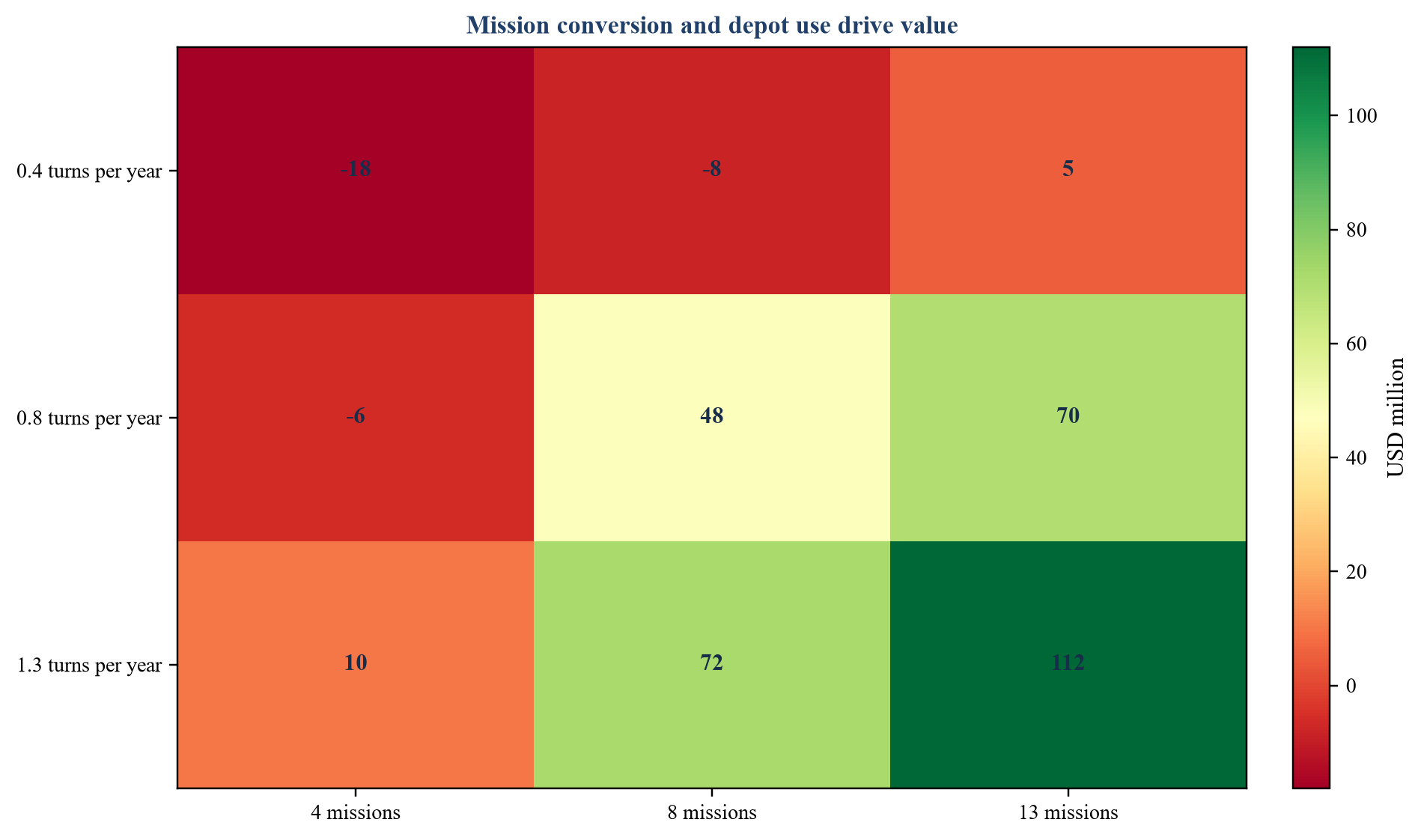
The hypothetical case illustrates a staged approach. USD 118 million of programme uses funds one depot and two reusable service vehicles. A tracked population of 160 spacecraft narrows to eight completed base-case transfers. Illustrative revenue of USD 146 million produces USD 48 million of platform contribution before financing and tax. The figures demonstrate mechanics. They are not a forecast or evidence for an unidentified programme.
Standardisation can enlarge the opportunity while changing competitive advantage. Open interfaces may accelerate customer adoption and reduce adaptation cost, although they may also lower switching costs and invite additional providers. A proprietary architecture may preserve control while limiting addressable demand. Coalition standards can concentrate early density among committed participants. Each path requires a different funding, partnership and valuation case.
Capital discipline is the final control. Sponsor, strategic and public capital should fund early technical and coordination risk. Debt should enter against contracted cash after evidence reduces uncertainty. Expansion should follow observed mission cadence and replenishment performance. A platform that advances through explicit gates can retain strategic upside while protecting liquidity and preserving the option to redesign or stop.
Appendix A. Hypothetical worked case
The model assumes one orbital depot and two reusable service vehicles. Total uses are USD 118 million: USD 24 million for interface engineering and qualification, USD 32 million for service vehicles, USD 22 million for the depot and transfer system, USD 18 million for launch and replenishment, USD 10 million for mission operations and customer integration, USD 7 million for insurance, licensing and verification, and USD 5 million for reserves and decommissioning. Sources comprise USD 28 million of sponsor equity, USD 30 million of customer and strategic prepayments, USD 36 million of senior or structured debt and USD 24 million of government milestone or availability payments.
The commercial funnel begins with 160 tracked spacecraft. Technical review identifies 72 spacecraft with compatible or adaptable configurations. Mission economics narrow the opportunity to 38 spacecraft. Operator qualification and timing reduce the actionable population to 18. Ten missions become contracted and eight transfers are completed in the base case. Illustrative revenue is USD 128 million from eight missions at an average USD 16 million and USD 18 million from availability, integration and data services. Illustrative deductions are USD 38 million for launch and replenishment, USD 24 million for operations, USD 10 million for customer acquisition and interface support, USD 8 million for insurance and licensing, USD 12 million for maintenance and reserves and USD 6 million for decommissioning. Platform contribution before financing and tax is USD 48 million.
Appendix B. Minimum diligence file
The diligence file should include spacecraft population data, operator confirmations, interface control documents, propellant specifications, transfer test evidence, mission concepts, orbital analysis, launch and replenishment plans, customer value cases, reservation and service contracts, pricing evidence, supplier agreements, licences, international-liability analysis, insurance indications, security architecture, data rights, sources and uses, downside funding, debt terms, reserve policy, decommissioning obligations and an independent verification protocol. Reconcile every item to the same technical configuration and valuation date.
Appendix C. Red flag tests
Red flags include a market forecast that counts all satellites as addressable; installed interfaces assumed without operator evidence; incompatible propellants aggregated; memoranda treated as contracted demand; refundable deposits presented as revenue; open standards assumed to create provider pricing power; debt sized against prospective network value; replenishment losses omitted; service-vehicle utilisation based on booking time rather than orbital mission time; insurance assumed without current indications; decommissioning unfunded; and option value counted inside both cash flow and a separate premium.
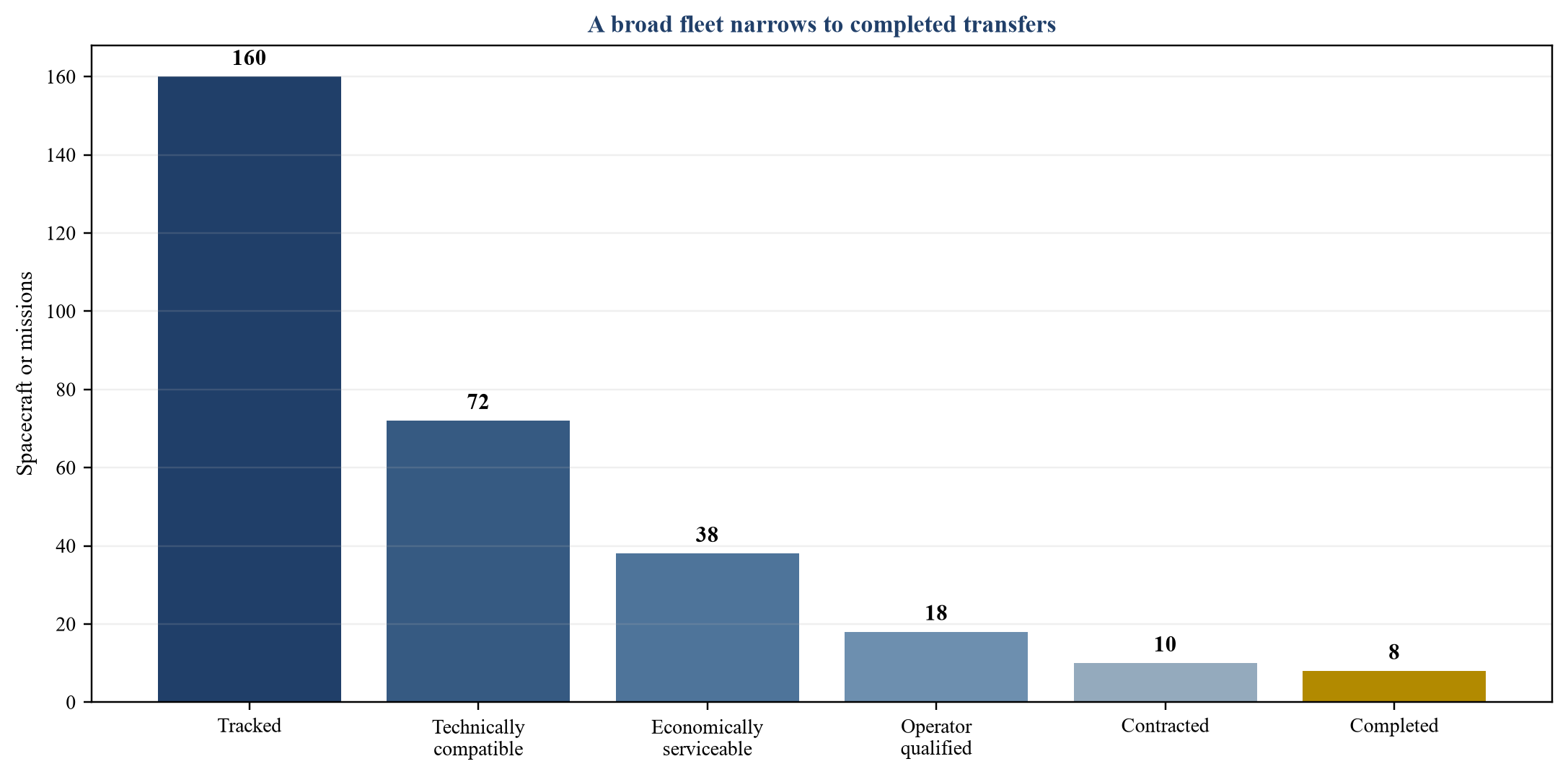
Hypothetical spacecraft counts; each stage requires separate evidence.
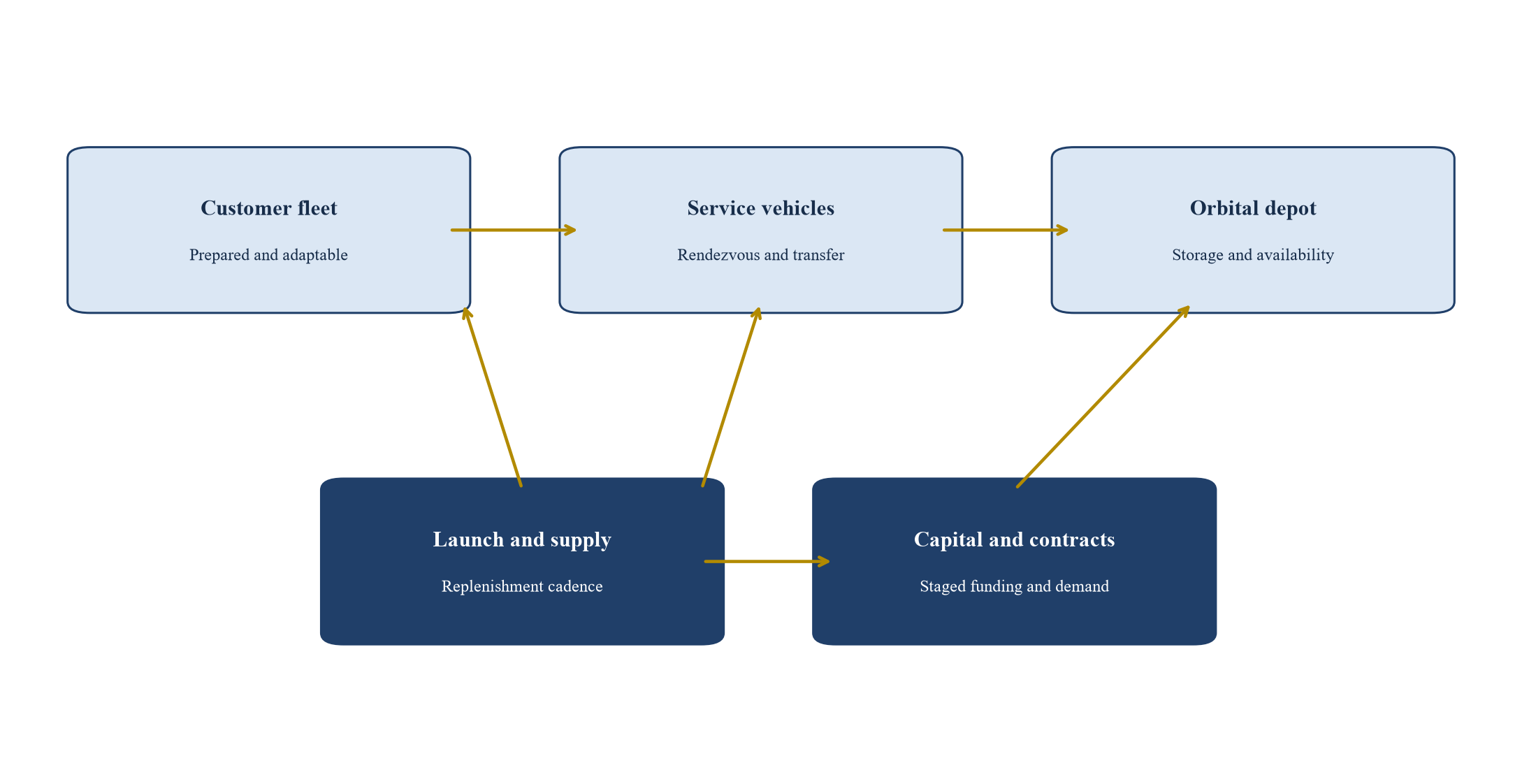
Proposed relationship between customers, vehicles, depot and replenishment.
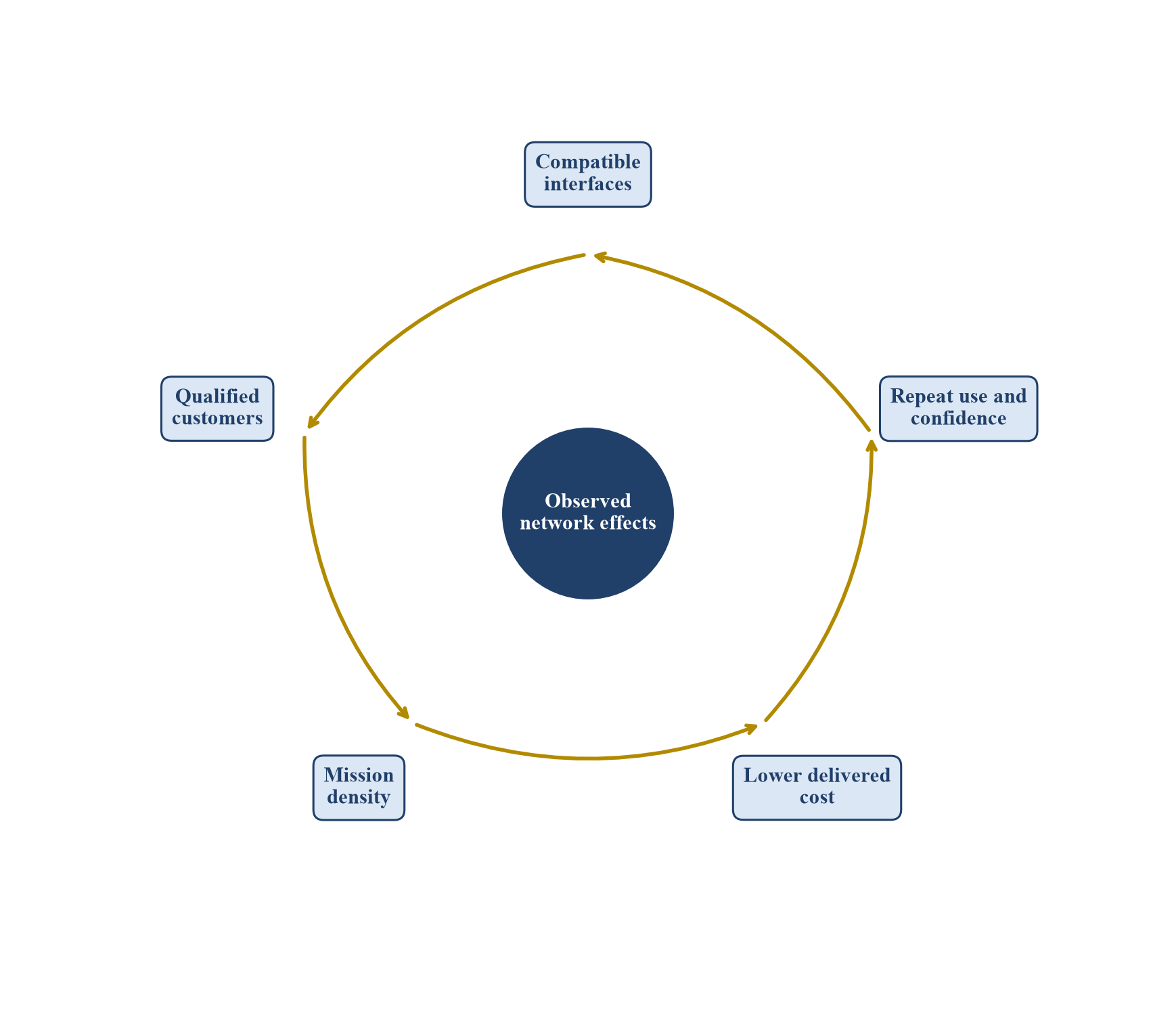
Proposed mechanism; each link requires observable evidence.
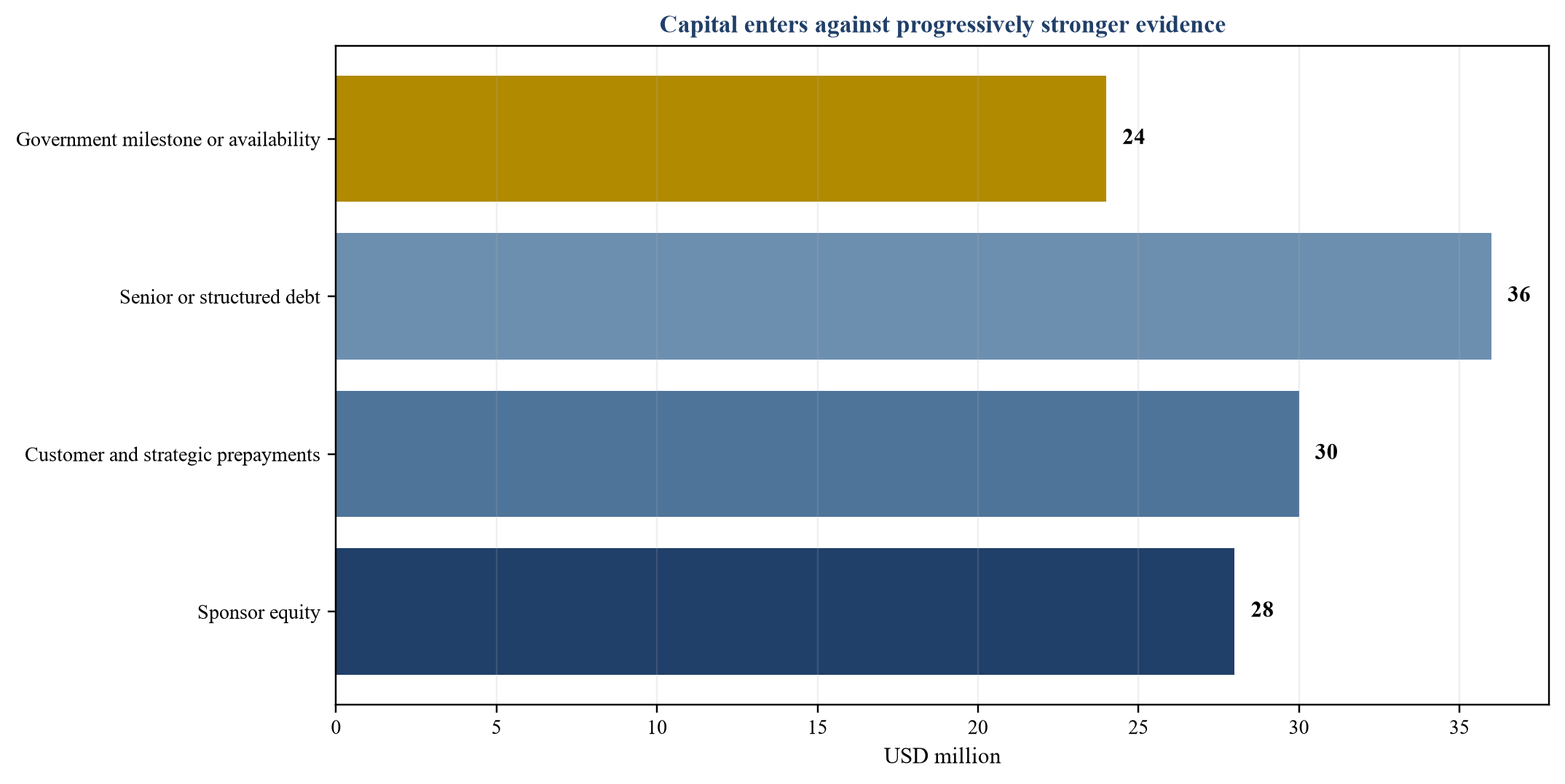
Illustrative USD millions; total programme uses USD 118 million.
Illustrative platform contribution before financing and tax in USD millions.
| Stage | Count | Evidence threshold | Primary exclusion |
|---|---|---|---|
| Tracked spacecraft | 160 | catalogue and operator population | outside target orbits |
| Technically compatible | 72 | interface and propellant review | unsupported configuration |
| Economically serviceable | 38 | customer value exceeds delivered cost | insufficient remaining value |
| Operator qualified | 18 | timing, authority and mission approval | schedule or risk mismatch |
| Contracted | 10 | enforceable service or capacity contract | unresolved commercial terms |
| Completed | 8 | independently verified transfer | delay or mission non-performance |
Hypothetical counts; live appraisal requires asset-level evidence.
| Dimension | Prepared configuration | Adaptable configuration | Unsupported configuration |
|---|---|---|---|
| Mechanical | qualified common interface | certified adapter | no safe capture or load path |
| Fluid | matched coupler and pressure | qualified conversion assembly | incompatible fluid or contamination risk |
| Electrical and data | documented protocols | tested gateway | no authenticated control path |
| Operations | approved cooperative sequence | additional robotic procedure | customer or regulator will not authorise |
| Evidence | flight or qualification record | programme-specific test | assumption only |
Proposed diligence structure.
| Sources | USD million | Uses | USD million |
|---|---|---|---|
| Sponsor equity | 28 | interface engineering and qualification | 24 |
| Customer and strategic prepayments | 30 | two service vehicles | 32 |
| Senior or structured debt | 36 | depot and transfer system | 22 |
| Government milestone or availability | 24 | launch and replenishment | 18 |
| operations and integration | 10 | ||
| insurance, licensing and verification | 7 | ||
| reserves and decommissioning | 5 | ||
| Total | 118 | Total | 118 |
Illustrative USD millions.
| Stage | Customer commitment | Cash treatment | Financing relevance |
|---|---|---|---|
| Technical study | data access and engineering fee | earned service revenue | validates problem and compatibility |
| Interface integration | funded hardware or design work | revenue or contribution | expands prepared base |
| Capacity reservation | dated mission window and deposit | assess refundability | supports planning with limited debt value |
| Minimum volume | enforceable quantity or payment | contracted revenue | may support debt subject to credit and termination |
| Completed transfer | accepted performance evidence | earned mission revenue | establishes operating history |
| Repeat programme | multiple missions and cadence | recurring contracted revenue | supports expansion finance |
Proposed progression from interest to bankable demand.
| Gate | Evidence | Capital purpose | Stop or redesign trigger |
|---|---|---|---|
| Interface qualification | completed transfer tests | demonstration hardware | unresolved leak, contamination or load issue |
| Demonstration readiness | licences, vehicle, customer and launch | first orbital mission | unfunded downside or missing authority |
| First successful transfer | independent mission evidence | commercial integration | failure without credible cure |
| Contracted fleet density | qualified customers and firm contracts | depot commissioning | demand remains non-binding |
| Repeat operations | completed missions and reuse data | fleet and depot expansion | delivered cost or cadence misses threshold |
Proposed evidence before each capital release.
| Scenario | Interface environment | Completed missions | Depot turns per year | Valuation implication |
|---|---|---|---|---|
| Fragmented | proprietary interfaces and costly adapters | 4 | 0.4 | negative contribution and continuing equity need |
| Coalition | committed group uses common passive interfaces | 8 | 0.8 | near threshold with selective expansion |
| Open standard | broad qualified interoperability | 13 | 1.3 | positive network value with stronger competition |
Illustrative outcomes; not a market forecast.
| Gate | Question | Evidence threshold |
|---|---|---|
| Service | is the exact mission and custody boundary defined? | controlled service specification |
| Compatibility | is the installed or adaptable base verified? | asset-level interface register |
| Customer value | does refuelling create surplus for identified missions? | customer-specific value cases |
| Demand | are commitments enforceable and timed? | contracts, credit and termination analysis |
| Delivery | can the platform replenish and complete missions safely? | qualified architecture and mission calendar |
| Finance | is capital funded through correlated downside? | sources, uses, reserves and covenants |
| Network value | does participation improve economics or availability? | observed conversion, cadence and repeat data |
Proposed minimum approval record.
Sources
- NASA, In-Space Servicing, Assembly and Manufacturing. Read the primary source
- NASA, Satellite Servicing Technologies. Read the primary source
- NASA, ISAM State of Play 2025, NASA Technical Reports Server, 1 October 2025. Read the primary source
- NASA, Robotic Refueling Mission 3. Read the primary source
- NASA Goddard Space Flight Center, In-Space Servicing, Assembly and Manufacturing. Read the primary source
- NASA, In-Space Robotic Servicing, updated 22 June 2026. Read the primary source
- European Space Agency, Spacecraft Servicing Interfaces Taskforce, Clean Space Days 2026. Read the primary source
- European Space Agency, InSPoC Standardised Multi-Mission Docking Interface, 2025. Read the primary source
- International Organization for Standardization, ISO 24330:2022 Space systems: Rendezvous and Proximity Operations and On Orbit Servicing. Read the primary source
- International Organization for Standardization, Aerospace standards catalogue. Read the primary source
- UK Government, UK Space Strategy, updated 15 September 2026. Read the primary source
- UK Space Agency, Annual Report and Accounts 2025 to 2026. Read the primary source
- UK Government, Space sustainability case study. Read the primary source
- UK Space Agency, Corporate Plan 2025 to 2026. Read the primary source
- Defense Innovation Unit, Companies Selected for DIU Orbital Logistics Vehicle Project Moving Forward, 8 January 2025. Read the primary source
- SpaceWERX, Orbital Prime. Read the primary source
- SpaceWERX, AFWERX and SpaceWERX Annual Report 2024. Read the primary source
- NASA, NASA Satellite Servicing Technologies Licensed by Northrop Grumman. Read the primary source
- NASA, OSAM-1 Independent Review Board Final Report, March 2024. Read the primary source
- NASA Technical Reports Server, OSAM-1 Propellant Transfer System Progress through Fiscal Year 2024. Read the primary source
- United Nations Office for Outer Space Affairs, Guidelines for the Long-term Sustainability of Outer Space Activities. Read the primary source
- United Nations Office for Outer Space Affairs, Registration Convention. Read the primary source
- United Nations Office for Outer Space Affairs, Liability Convention. Read the primary source
- U.S. Government, National In-Space Servicing, Assembly, and Manufacturing Implementation Plan, December 2022. Read the primary source
- U.S. Space Force, Space Mobility and Logistics related acquisition and research resources. Read the primary source
- NASA, Artemis In-Space Manufacturing and Servicing related technology portfolio. Read the primary source
- European Space Agency, Clean Space programme. Read the primary source
- European Space Agency, In-Orbit Servicing resources. Read the primary source
- UK Civil Aviation Authority, Space licensing and regulation. Read the primary source
- Federal Aviation Administration, Commercial Space Transportation. Read the primary source
- U.S. Federal Communications Commission, Space Bureau. Read the primary source
- International Telecommunication Union, Space services. Read the primary source
