

1. Define the acquisition mandate before approaching a target
A Saudi acquisition should begin with a written expansion mandate. The mandate states the customer problem, target market, products or services, required capabilities, capital envelope, control objective, return logic, risk limits and timing. It also identifies alternatives such as an internal build, branch, distributor, joint venture, minority investment or no action. This comparison keeps acquisition activity connected to the business objective.
The mandate needs evidence. Management should distinguish verified demand from ambition, contracted revenue from pipeline, regulatory feasibility from an adviser hypothesis, and available funding from a proposed financing plan. A signed and paid customer record carries a different evidential weight from an addressable-market estimate. The decision paper should label each input by source, date, owner and limitation.
The UAE buyer should appoint one accountable transaction sponsor and one programme lead. The sponsor owns the strategic decision. The programme lead maintains the critical path, evidence register, issues list, adviser outputs, approvals and decision papers. Commercial, finance, tax, legal, compliance, technology, people and integration leaders need named responsibilities. A transaction that crosses these workstreams without one reconciled record is vulnerable to conflicting assumptions.
The initial mandate should answer six questions:
1. Which Saudi capability or market position is faster or safer to acquire than build? 2. Which assets, contracts, people, licences and relationships create that capability? 3. Which liabilities and dependencies travel with each transaction route? 4. What level of ownership and decision power does the buyer require? 5. Which regulatory and financing conditions must be satisfied before control changes? 6. Which integration changes are required to realise value, and which local capabilities should remain autonomous?
The answers become acquisition criteria. A target can then be screened against customer quality, capability, licence scope, management depth, financial resilience, ownership, compliance, technology, integration fit and price. The buyer should define mandatory gates separately from weighted preferences. Unverified ownership, unavailable financial records, a critical licence that cannot continue, or an unresolved integrity concern may justify a pause regardless of an attractive weighted score.
2. Select the route through control, continuity and liability
The transaction form changes what the buyer acquires, what stays behind and which approvals, taxes and implementation steps arise. Four routes deserve early comparison.
A share purchase transfers ownership of the Saudi company while the legal entity generally continues to hold its assets, contracts, employees and liabilities. This can support operating continuity, subject to change-of-control clauses, licence requirements and regulatory approvals. It also leaves historical liabilities within the acquired entity. Diligence, warranties, indemnities, escrow or holdback, insurance where available, and post-closing controls address different parts of that exposure.
A business or asset transfer allows the buyer to select defined assets and assumed liabilities. It can require individual transfers, counterparty consents, employee steps, licence changes, data migration, property arrangements and tax analysis. ZATCA's current VAT guidance describes conditions under which a transfer of an operationally independent economic activity can fall outside taxable supply treatment. The recipient must be taxable or become taxable, continue the same activity, agree the treatment in writing and complete the required notification. A failure to meet the conditions can change the VAT result.[7]
A statutory merger combines companies under the Saudi Companies Law. Article 225 requires a merger proposal, terms and consideration, debt-paying capacity and asset valuation. Article 227 provides an announcement and creditor-objection process. The route may suit a strategic combination, yet it creates corporate, valuation, creditor and implementation requirements that need to be built into the timetable.[4]
A staged or minority investment can preserve optionality and allow capability testing. The buyer must examine whether its rights confer control, joint control, significant influence or a financial investment. Economic ownership, accounting control and legal veto rights can produce different conclusions. IFRS 10 uses power, exposure to variable returns and the ability to use power to affect returns as the elements of control.[16] The investment agreement should connect information, governance, funding, options, transfer rights and the path to greater ownership.
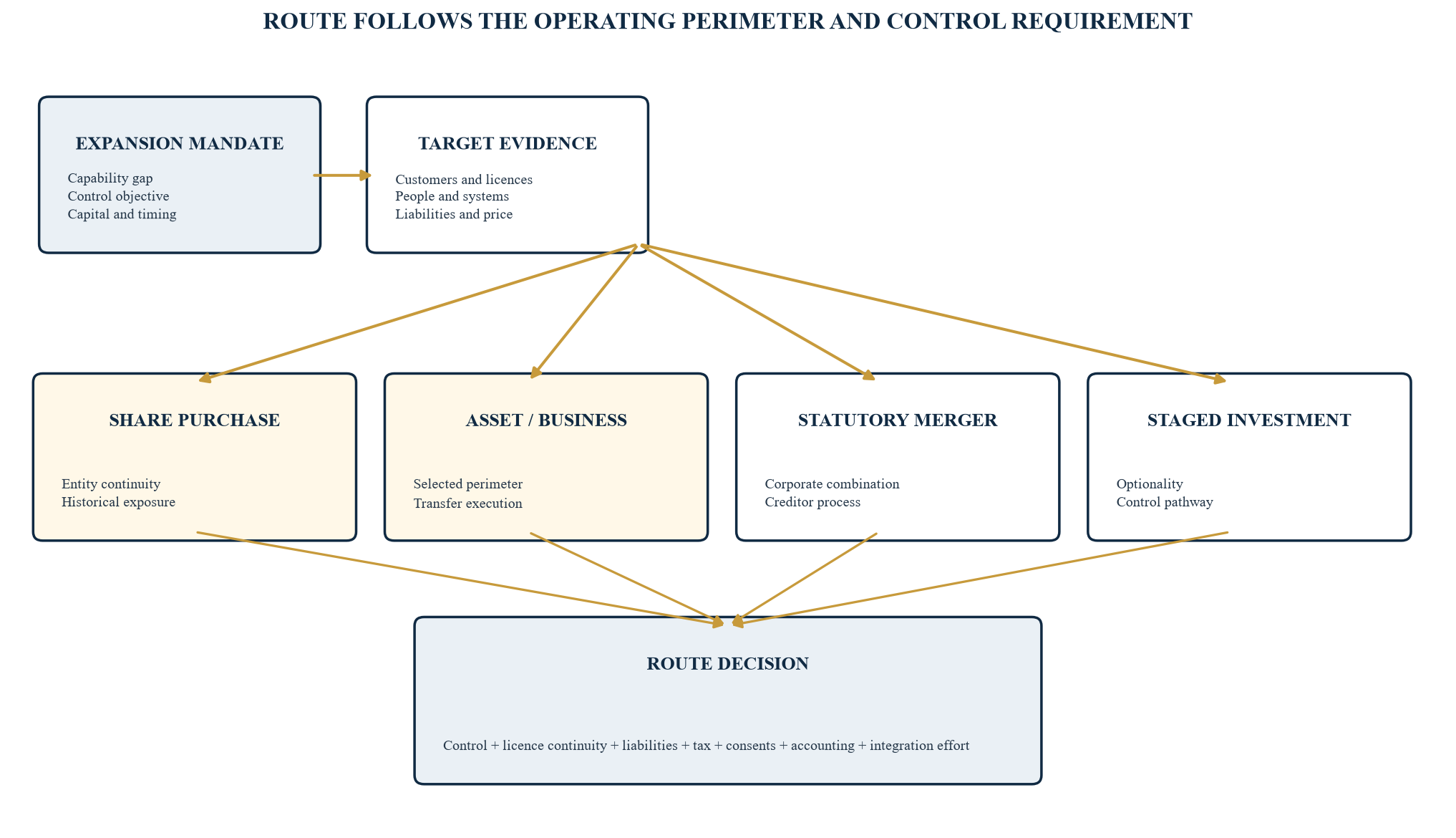
The route is selected after fact-specific legal, tax, regulatory, accounting and operating review. The map is a management sequence, not a legal conclusion.
The route paper should state the perimeter in operational language: customers, contracts, products, employees, facilities, data, technology, intellectual property, licences, permits, debt, guarantees, litigation and tax positions. It should identify each item that transfers automatically, needs consent, needs replacement or remains with the seller. This discipline prevents the legal form from obscuring the business that the buyer expects to control.
3. Put Saudi investment and ownership requirements on the critical path
Saudi Arabia's updated Investment Law applies a common framework to local and foreign investors while imposing registration requirements on foreign investors. Article 7 provides that a foreign investor registers with the Ministry of Investment before engaging in an investment, except for securities governed by the Capital Market Law. The Ministry's service centre can receive applications for licences and permits and coordinate with competent authorities.[1]
The Implementing Regulations require registration information covering the investment, ownership, control and ultimate beneficial owner. They also provide for periodic information updates.[2] The buyer should prepare its legalised corporate documents, group chart, beneficial-owner information, authorised signatories, activity description and source-of-funds evidence early. The precise filing pack and authentication route should be confirmed for the buyer, target and chosen structure.
Activities on the excluded-activities list require additional analysis. Article 8 of the Investment Law requires prior approval before a foreign investor engages in an excluded activity and before an ownership change affecting an investment in a restricted activity.[1] The Implementing Regulations also describe national-security review and consequences for unregistered or unauthorised investment.[2] The team should map every current and planned activity to licences, ownership restrictions and competent authorities before agreeing the perimeter.
Sector requirements can create separate approvals or ownership conditions. Banking, insurance, capital markets, telecommunications, transport, defence, healthcare, education, professional services and other regulated activities have distinct authorities and rules. A general commercial registration or investment registration does not replace a sector approval. The regulatory register should name each licence, issuing authority, holder, scope, expiry, change-of-control rule, required consent, lead time and business consequence.
Listed or public-company transactions create a separate branch. The Capital Market Authority's Merger and Acquisition Regulations apply to specified transactions involving listed securities and include offer, disclosure, adviser and shareholder requirements.[6] Private-company teams should avoid importing public-offer mechanics without checking the perimeter; listed-company teams need specialist capital-markets advice from the start.
4. Treat competition approval as a completion condition
The Saudi General Authority for Competition's current Economic Concentration Review Guidelines describe acquisitions and other changes of control within the economic-concentration regime. For an acquisition, the participating undertakings include the buyer group and target. The notification criteria in the Guidelines combine worldwide sales of the parties, target worldwide sales and Saudi sales thresholds. The current stated thresholds are combined worldwide annual sales above SAR 200 million, target worldwide annual sales above SAR 40 million, and combined Saudi annual sales above SAR 40 million.[3]
The Guidelines state that a notifiable economic concentration must be notified at least 90 days before completion. The period begins when GAC confirms that the notification is complete. The first act of implementation can constitute completion, and the period may be suspended in stated circumstances. The fee is calculated under the applicable formula and is capped at SAR 250,000 in the current Guidelines.[3]
The buyer should start with control, group perimeter, sales data and market facts. The filing analysis requires reconciled worldwide and Saudi revenue, target data, transaction documents, customer and competitor information, market definition and potential effects. Currency conversion and group attribution should follow the official method and counsel's advice. A buyer should avoid covenants, information exchange or operational conduct that could amount to early implementation.
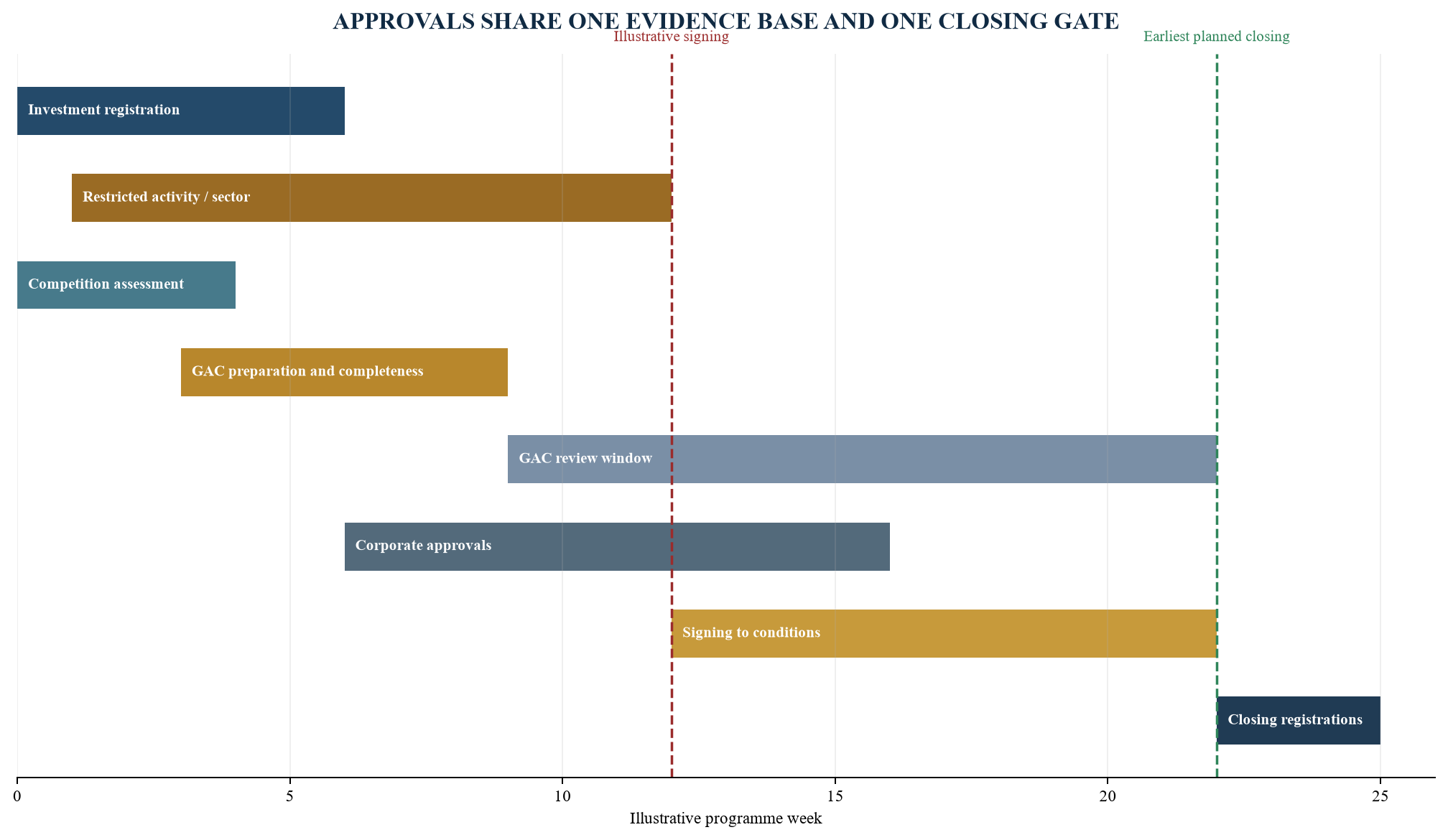
Week numbers are hypothetical planning assumptions. Authority review, completeness, information requests, sector facts and transaction complexity can change timing.
The critical path should distinguish preparation, submission, completeness and statutory review. Completion conditions should cover the actual approvals, absence of prohibition, acceptable remedies and expiry of any waiting period. Remedy authority within the buyer needs a limit. A commitment to divest a material business, change a route to market or accept a behavioural obligation can alter the acquisition thesis.
5. Build one diligence matrix that changes decisions
Diligence creates value when findings change a decision. Every material finding should be routed to one or more responses: price or working-capital adjustment, completion condition, seller cure, warranty, indemnity, escrow or holdback, insurance, covenant, integration action, governance control or walk-away decision. A long report with no decision linkage creates false comfort.
Commercial diligence should reconcile revenue by customer, product, channel, geography, contract and invoice. The team should test renewals, cancellations, rebates, returns, concentration, tender dependence, related-party activity and revenue outside licence scope. Customer interviews need a controlled protocol. Market estimates should show source, date, definition and uncertainty. The buyer should explain how the acquired platform changes customer access and why the expected growth is achievable.
Financial diligence should reconcile management accounts to audited statements, tax filings, bank records and the general ledger. Earnings quality requires examination of revenue recognition, cut-off, one-offs, owner costs, capitalised expenditure, provisions, related parties and non-recurring government or project income. Working capital should follow the business cycle. Net debt should capture bank debt, shareholder funding, leases, guarantees, overdue statutory amounts and debt-like exposures defined for the deal.
Legal and regulatory diligence should cover title, constitutional authority, ownership, material contracts, licences, litigation, claims, sanctions, anti-bribery controls, procurement, intellectual property, property, insurance and change-of-control provisions. The work should separate a missing document from an adverse fact. It should also identify which matters can be verified independently and which remain dependent on seller evidence.
Tax diligence should reconcile Zakat and income-tax status, VAT, withholding tax, transfer pricing, customs, payroll-related obligations, real-estate transaction tax and open audits. A UAE or GCC shareholder does not remove Saudi tax analysis. ZATCA's current FAQ states that a non-resident GCC company disposing of shares in a Saudi company is subject to capital-gains assessment at 20 percent under the cited rules.[9] Transaction-specific advice should confirm taxpayer, base, exemptions, filing and treaty questions.
People diligence should reconcile the employee list to Qiwa, GOSI, payroll, immigration records and contracts. It should cover roles, nationality, tenure, compensation, leave, benefits, disputes, key-person dependency, contractors, secondments, Saudization and planned organisational changes. HRSD announced that Saudi employees count in Nitaqat from 15 April 2026 based on electronically documented Qiwa contracts.[12] Contract documentation and classification therefore affect compliance and integration readiness.
Technology and data diligence should map systems, licences, administrators, hosting, interfaces, cyber incidents, backups, vendor dependencies, source-code rights and personal-data flows. Saudi PDPL requirements apply to processing and transfers based on the facts. Article 29 and the transfer regulation require conditions for transfers outside the Kingdom, including an adequate protection framework, data minimisation and applicable safeguards or exceptions.[13,14] A data room should use controlled access, purpose limitation and redaction appropriate to the transaction stage.
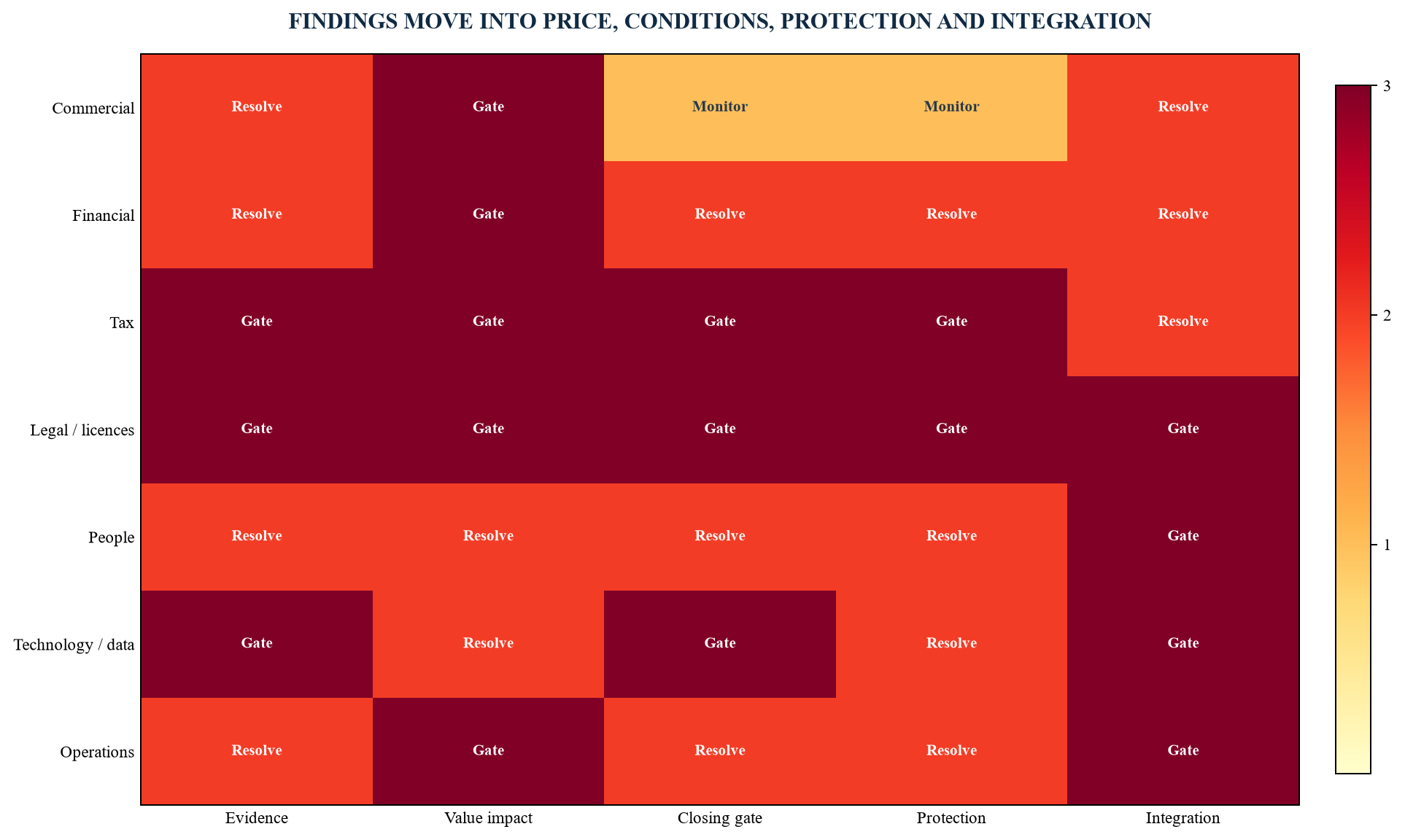
Scores are hypothetical. Red cells indicate a decision response and do not state that a risk is legally or commercially unacceptable.
Table 1. Diligence findings register
| Finding | Evidence and limitation | Value or risk effect | Transaction response | Operating response |
|---|---|---|---|---|
| revenue concentration | customer contracts, invoices and interviews; renewal intent remains uncertain | volatility and bargaining power | valuation sensitivity, warranty and closing update | account plan and retention owner |
| licence scope gap | licence and authority correspondence; approval outcome remains open | affected activity may need to pause | condition, covenant or perimeter change | compliant product and operating plan |
| unrecorded tax exposure | filings, ledger and adviser analysis; authority assessment remains open | cash, penalty and reputation exposure | specific indemnity, escrow or price | remediation and tax control |
| undocumented employment terms | Qiwa, payroll and personnel files; oral commitments need verification | claims, retention and compliance | seller cure and disclosure | contract documentation and communication |
| unsupported system licence | contracts and vendor confirmation; replacement timing uncertain | continuity and migration cost | consent, transitional service or price | Day One access and migration plan |
| related-party dependency | contracts, ledger and operating interviews; standalone cost is estimated | earnings and continuity adjustment | separation terms and transition support | replacement service and arm's-length policy |
The response must be approved by the accountable buyer function and reconciled to the documents and integration plan.
6. Make commercial diligence prove the Saudi growth thesis
The buyer should restate the investment thesis as a set of measurable drivers. Typical drivers include access to contracted customers, qualification for local tenders, an installed service network, sector licences, Saudi management capability, faster product localisation or a platform for adjacent offerings. Each driver needs a baseline, evidence, owner, implementation action and financial link.
Revenue should be separated into contracted backlog, recurring revenue, framework agreements without committed volume, active pipeline and market aspiration. Customer concentration requires analysis at group and end-customer level. Government-related or large-enterprise revenue can depend on vendor registration, localisation, performance bonds, certifications and tender cycles. The buyer should verify whether these requirements survive a change of control.
Pricing and margins should be tested by product, customer and channel. Rebates, free services, warranty work, commissions, freight, customs, credit losses and mobilisation costs can sit outside the reported gross margin. A sales bridge should reconcile volume, price, mix and one-off projects. The forecast should identify which growth comes from the target, the buyer's distribution, cross-selling, new capacity or price changes.
The commercial work should also test the buyer's contribution. A UAE relationship, brand or product portfolio does not automatically transfer to Saudi demand. The plan needs named customer segments, licence readiness, local delivery, product adaptation, sales ownership and expected conversion evidence. Management should retain downside cases for slower cross-selling, delayed approvals and customer loss.
7. Reconcile price, funding, accounting and tax before signing
The valuation should start from a reconciled historical base. Adjusted earnings, normal working capital, net debt, capital expenditure and cash taxes need definitions that agree with the purchase agreement. Forecast valuation should state volume, price, margin, investment, working-capital, tax and terminal assumptions. Sensitivities should connect to diligence findings.
Funding decisions belong inside the transaction timetable. The UAE buyer should document board authority, equity funding, acquisition debt, security, guarantees, currency exposure, covenant headroom and funds-flow mechanics. Financing conditions should agree with the purchase agreement. The team should test whether required Saudi registrations, bank accounts and signatories can be established by closing.
IFRS 3 requires the acquisition method for a business combination: identify the acquirer, determine the acquisition date, recognise and measure identifiable assets and liabilities and non-controlling interests, then recognise goodwill or a bargain-purchase gain.[15] The accounting workstream should decide whether the acquired set is a business, identify control, plan the purchase-price allocation, value identifiable intangible assets and gather opening-balance evidence. IFRS 10 control analysis should agree with governance rights.[16]
Tax and accounting models must be connected. Fair-value adjustments can create temporary differences under IAS 12.[17] Goodwill and indefinite-life intangibles in the scope of IAS 36 require annual recoverable-amount assessment, while other assets are tested when indicators arise.[18] The acquisition model should preserve the assumptions used for valuation, accounting and later impairment review.
Saudi tax analysis should cover the route and continuing operating model. For a business transfer, VAT treatment depends on the statutory conditions and notification.[7] Cross-border payments for services, royalties, interest or other items require withholding-tax analysis under ZATCA's May 2026 guideline.[8] Related-party transactions must follow the arm's-length principle under the transfer-pricing rules.[10] Real-estate transfers can fall within the 5 percent RETT framework, subject to transaction facts and available exemptions.[11]
Table 2. Hypothetical purchase-price and funding bridge
| Item | Illustrative amount | Evidence required | Decision use |
|---|---|---|---|
| enterprise value | 240 | valuation, forecast and approved multiple | negotiation anchor |
| less debt and debt-like items | (34) | facilities, leases, statutory and transaction definitions | equity-value bridge |
| add cash accepted under agreement | 12 | bank evidence and restricted-cash test | equity-value bridge |
| working-capital adjustment | (8) | completion accounts and normal level | settlement mechanism |
| illustrative equity price | 210 | reconciled bridge | funding requirement |
| fees, taxes and initial integration | 24 | adviser estimates and implementation plan | total sources and uses |
| total illustrative uses | 234 | approved funds flow | financing and liquidity |
| buyer equity | 154 | board approval and available cash | source certainty |
| acquisition debt | 80 | committed terms and covenant case | source certainty |
All values are illustrative management assumptions in AED millions. They do not estimate a Saudi target, tax result or achievable value.
The hypothetical bridge illustrates discipline rather than a recommended capital structure. The buyer should model currency, interest, covenant, downside liquidity and refinancing. An earn-out can bridge a valuation gap, yet it can also distort operating decisions and create measurement disputes. Deferred consideration, escrow and retention address different risks and require clear triggers, security and accounting treatment.
8. Convert diligence into transaction documents and closing evidence
The term sheet should establish the route, perimeter, price logic, exclusivity, diligence access, conditions, governance objective and timetable. It should identify which provisions are binding. Early tax, competition and regulatory advice can prevent a term sheet from committing the parties to an impractical structure.
The purchase agreement should allocate defined risks. Warranties disclose and support factual assumptions. Indemnities allocate specified exposures. Covenants govern conduct before and after closing. Conditions control whether completion can occur. Price mechanisms settle value under agreed definitions. Limitations, claims procedure, security and survival periods determine whether contractual protection is usable.
The buyer should maintain a conditions-precedent register with the condition, owner, evidence, authority, due date, dependency and acceptance status. The register should distinguish documents received from conditions satisfied. An approval letter may contain conditions that require operating changes. A seller certificate may need independent evidence.
Closing requires a funds-flow statement, signed documents, corporate approvals, regulatory evidence, releases, registrations, share or asset transfer evidence, bank confirmations, key access, licences, insurance and a Day One authority matrix. Each deliverable should have a named acceptor. The closing call should follow a pre-agreed sequence and avoid releasing funds before the required transfer and evidence steps.
9. Design ownership and governance around control and accountability
The governance architecture should match the acquisition thesis and accounting conclusion. A wholly owned target still needs an effective local board or manager framework, delegated authorities, bank mandates, reporting, risk ownership and reserved matters. A partial acquisition needs clear minority rights, related-party controls, funding rules, transfer provisions and dispute routes.
Reserved matters should protect enterprise-defining decisions. They can cover strategy, budget, capital, debt, acquisitions, disposals, related-party transactions, senior appointments, material contracts, litigation, dividends, intellectual property and changes to the business. Thresholds should be measurable. Information packs and decision periods should be defined. Ordinary operations should remain within delegated authority.
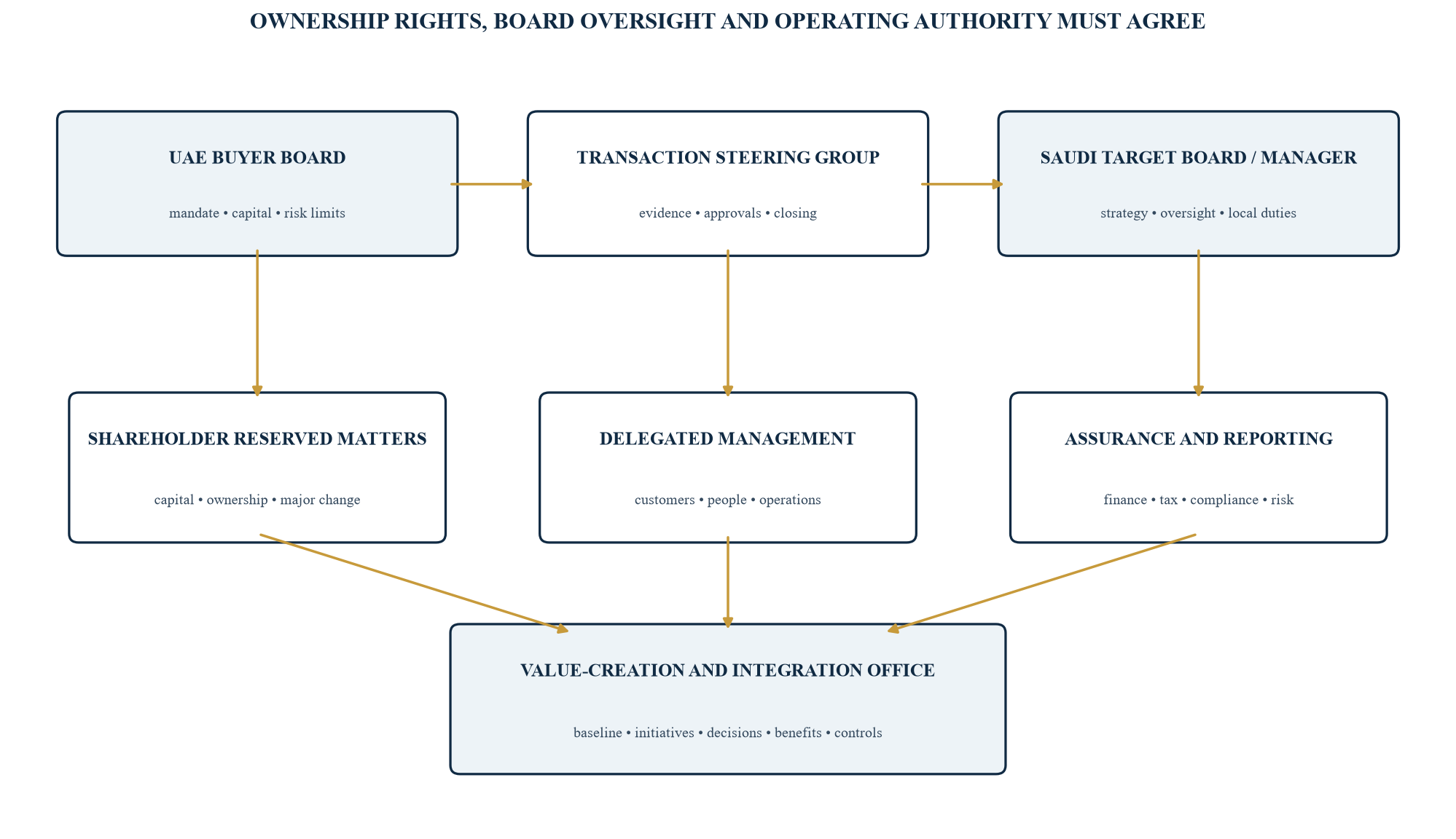
Percentages and approval layers are hypothetical. Legal ownership, accounting control and regulated-manager requirements need transaction-specific confirmation.
Table 3. Illustrative governance rights by decision layer
| Decision | Proposed owner | Evidence pack | Escalation |
|---|---|---|---|
| annual plan and budget | target board within shareholder parameters | forecast, capital, workforce, tax and risk | buyer board for material deviation |
| ordinary customer contract | delegated management within limits | margin, credit, licence and sanctions checks | board above value or risk limit |
| related-party service | disinterested approving body | scope, benchmark, conflicts and tax | shareholder review above threshold |
| senior management appointment | target board, subject to reserved rights | mandate, search, remuneration and succession | buyer sponsor if process stalls |
| new debt or security | target board or shareholder by limit | purpose, terms, covenant and liquidity | buyer finance and board |
| regulated activity change | board subject to authority approval | business case, licence and control impact | no implementation before approval |
| integration-system migration | integration steering group within approved plan | data, cyber, continuity and cutover evidence | board for material residual risk |
Rights and thresholds require Saudi legal advice, constitutional implementation and accounting review.
The governance documents must agree with systems. Bank mandates, procurement approval, system access, HR authority, contract signing and regulatory delegations should implement the approved matrix. A governance right that does not exist in operational access can fail during the first urgent decision.
10. Start integration design during diligence
Integration design should begin when the buyer understands the target's operating model. The buyer must decide the intended level of integration by function. Finance consolidation may be rapid. Customer relationships, local brand, regulated operations or specialist teams may require continuity. Technology migration can follow risk and dependency rather than a uniform deadline.
Empirical research supports a differentiated and temporal approach. Birkinshaw, Bresman and Håkanson studied three foreign acquisitions and separated task integration from human integration; their cases developed through phases in which human integration supported later interdependence.[20] Kroon and colleagues followed the Air France-KLM integration across eight units and found that combinations of structural and social integration evolved differently by unit and intended integration level.[19] Wang and Schweizer's 2026 survey study reports associations between message accuracy, communication structures, trust and perceived cross-border communication quality.[21]
These studies have defined samples, methods and boundary conditions. They do not establish a universal sequence for a UAE-Saudi acquisition. They support a practical conclusion: each function needs an explicit integration intent, dependency map, accountable owner and feedback mechanism.
The integration thesis should state which value sources require combination and which require preservation. Cost actions may include procurement, duplicate systems, property, support functions and financing. Revenue actions may include cross-selling, channel expansion, product extension and bid qualification. Capability actions may include management, technology, data, service quality and compliance. Each initiative needs a baseline, formula, investment, dependency, owner, timing and evidence.
11. Protect Day One as a continuity gate
Day One is the first day under the new control arrangement. The target should be able to trade lawfully, pay people, collect cash, protect data, serve customers and make authorised decisions. The closing checklist and Day One plan should be one reconciled record.
The minimum Day One scope covers legal ownership evidence, board and management appointments, delegations, bank access, payroll, customer and supplier communications, licence status, insurance, system access, cyber monitoring, data-room closure, incident escalation, tax registrations and regulatory notifications. Transitional services should have scope, service levels, access, security, charges, exit milestones and remedies.
Communication should distinguish verified decisions from matters still under review. Employees need to know reporting lines, pay continuity, benefits, workplace, customer responsibilities and where to raise questions. Customers and suppliers need factual information about contracts, invoicing, orders and contacts. Regulators and banks should receive the notices required by the approved plan.
12. Run a 180-day integration calendar with decision gates
The first 180 days should be organised around outcomes and gates. The calendar begins before closing because access, approvals and clean-team limits affect what can be prepared. Each workstream should identify actions permitted before control transfers.
Days 0 to 30 stabilise control and evidence. Management validates cash, payroll, customer service, licences, compliance, system access, critical suppliers and opening balances. The integration office confirms the initiative baseline and reports deviations from the signed model.
Days 31 to 90 implement approved control and operating changes. Finance closes under the new reporting calendar. Tax, compliance and people teams remediate priority findings. Commercial teams test customer plans. Technology teams complete security and architecture decisions. The board reviews the first forecast and risks.
Days 91 to 180 scale the initiatives that have evidence. Management decides which systems, services and teams to combine, retain or replace. Benefits are recognised only when the agreed evidence exists. A revenue initiative needs attributable sales and margin evidence. A cost initiative needs a baseline, implementation cost and confirmation that the cost has left the run rate.
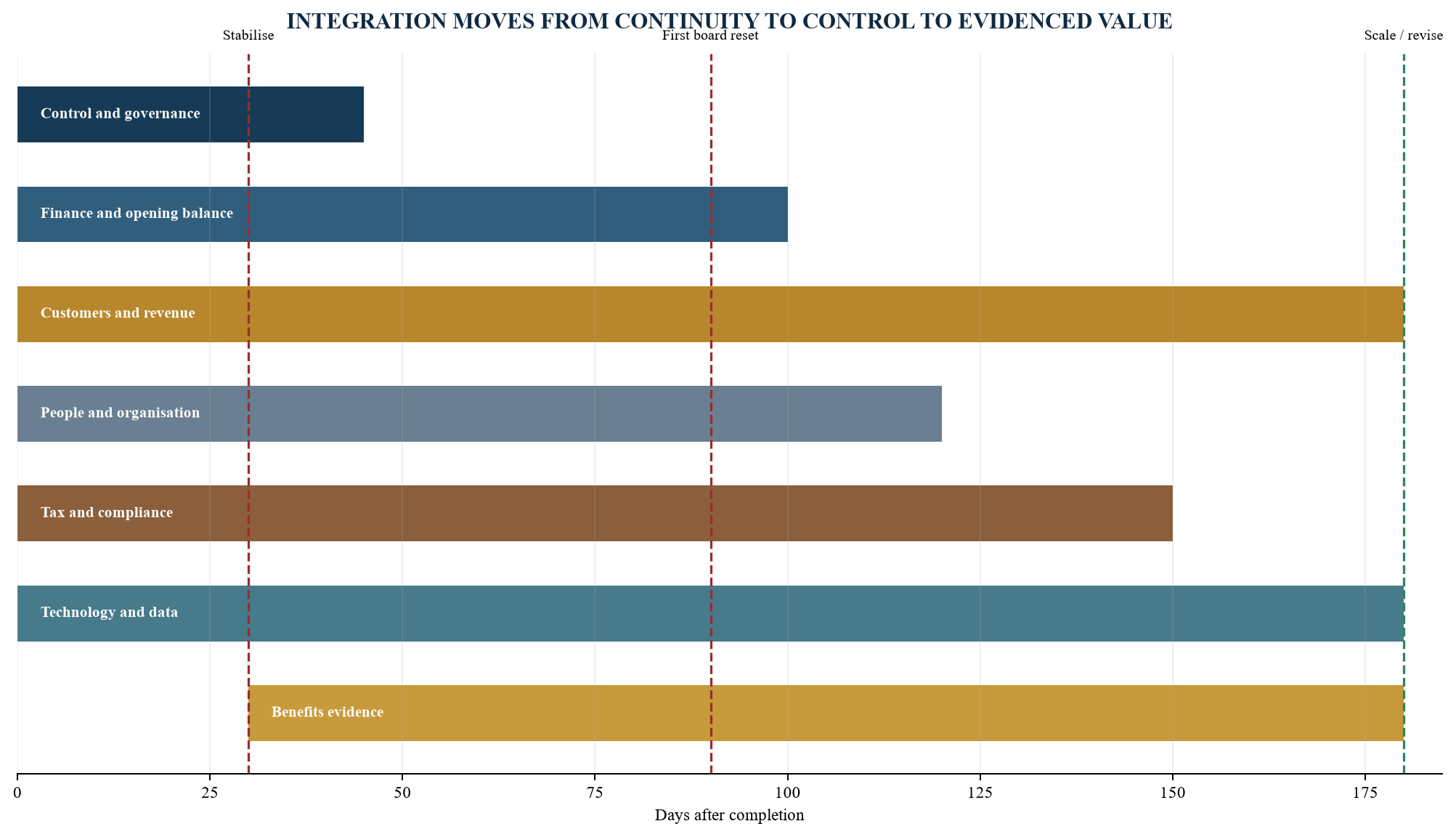
Timing is a planning case. Regulatory conditions, access restrictions, operational risk and target readiness can require a different sequence.
Table 4. Integration decision gates
| Gate | Required evidence | Decision |
|---|---|---|
| closing readiness | approvals, funds flow, ownership transfer, licences, access and Day One owners | complete, defer or stop |
| Day 10 stability | cash, payroll, customers, incidents, systems and authority functioning | stabilise or escalate |
| Day 30 baseline | opening facts, diligence actions, initiative baselines and first forecast | confirm or reset plan |
| Day 90 operating review | reporting, controls, customer retention, people, compliance and delivery | accelerate, revise or preserve autonomy |
| Day 180 value review | verified benefits, costs, investment, residual risks and capability | scale, redesign, hold or discontinue initiative |
Gate approval depends on verified evidence, residual risk and accountable acceptance.
13. Use a hypothetical scenario to test the playbook
Consider a hypothetical UAE industrial-services buyer evaluating a Saudi limited-liability company. The target has reported revenue of SAR 180 million and EBITDA of SAR 27 million for the latest year. Two customers represent 46 percent of revenue. Management expects cross-selling and procurement benefits after acquisition. These figures are invented for decision testing and do not represent a market benchmark or actual target.
The buyer proposes to acquire 80 percent through a share purchase and retain the founder with 20 percent for three years. The initial enterprise-value assumption is SAR 243 million, equivalent to nine times reported EBITDA before diligence adjustments. Financial diligence identifies SAR 3 million of non-recurring project income and SAR 2 million of underprovided warranty cost. The illustrative maintainable EBITDA becomes SAR 22 million before any buyer synergy.
Commercial diligence finds that the largest customer contract requires consent for a change of control. Regulatory review confirms that the target's activity needs updated investment-registration information, while counsel is still assessing a restricted sub-activity. Competition sales thresholds are exceeded under the hypothetical group data, so the timetable assumes a filing. The outcome remains unknown until the authority completes its review.
People diligence identifies incomplete Qiwa documentation for part of the workforce and dependency on three managers. Data diligence finds that customer records are accessible from a UAE group system without a documented transfer assessment. Tax diligence identifies uncertain withholding-tax treatment for historical related-party service payments. Each matter enters the decision matrix.
Table 5. Hypothetical scenario decisions
| Issue | Illustrative effect | Proposed response | Residual uncertainty |
|---|---|---|---|
| maintainable EBITDA adjustment | SAR 5m reduction | rebase valuation and price discussion | future earnings remain uncertain |
| largest customer consent | 18% of revenue exposed | completion condition and retention plan | customer decision remains open |
| restricted sub-activity | part of forecast affected | obtain authority advice and approval or remove activity | approval and timing remain open |
| competition filing | closing timetable extended | complete filing before implementation | authority outcome remains open |
| manager dependency | service continuity risk | retention, succession and knowledge-transfer plan | individual behaviour remains uncertain |
| data-transfer gap | compliance and access risk | transfer assessment, safeguards and access redesign | regulator interpretation is fact-specific |
| historical withholding tax | cash and penalty exposure | quantify, seek seller protection and remediate | assessment outcome remains open |
Figures and responses are illustrative. Legal and financial outcomes require verified facts and qualified advice.
The buyer's revised model uses maintainable EBITDA without unverified synergy in the headline price case. Cross-selling appears in a separately approved upside case with customer, product, timing, margin and investment assumptions. The purchase agreement makes customer consent and regulatory approvals conditions. A specific tax indemnity and escrow are considered subject to negotiation. The integration plan preserves the Saudi customer team while strengthening reporting, compliance and finance controls.
This scenario shows the role of the playbook. It does not produce a mechanical answer. It makes the facts, assumptions, decisions, owners and residual uncertainty visible before funds are committed.
14. Maintain professional boundaries and current-law checks
This paper is general research and a management framework. It is not legal, competition, tax, accounting, valuation, employment, data-protection, sector-regulatory or investment advice. The applicable position depends on the parties, transaction documents, activities, markets, customers, licences, assets, workforce, data and timing.
Saudi official English translations and guides can state that Arabic texts prevail. Qualified advisers should check current Arabic legislation, implementing rules, authority practice and filing requirements. The investment and competition sources cited are current as reviewed in August 2026. Regulatory pages and guidance can change after publication.
The route map, critical path, diligence matrix, governance architecture, integration calendar, thresholds, scores and numerical case are original hypothetical management tools. They have not been statistically validated. They do not estimate the probability of approval, completion, customer retention, integration success, tax recovery, synergy or return.
The academic evidence has boundaries. Birkinshaw and colleagues studied three Swedish multinational acquisitions.[20] Kroon and colleagues conducted a longitudinal single-acquisition case with embedded units.[19] Wang and Schweizer tested a model using a defined China-Europe survey sample.[21] Their findings inform questions about sequencing, differentiated integration and communication. A particular UAE-Saudi transaction requires its own evidence.
15. Implementation conclusion
Saudi expansion by acquisition becomes manageable when the UAE buyer runs one evidence-led programme from mandate through integration. Route selection establishes the operating perimeter and control objective. Investment, competition and sector reviews shape the critical path. Diligence converts source evidence into price, conditions, protection and operating actions. Governance implements the intended control. Integration connects the acquired platform to the value thesis while protecting local capability and continuity.
Five practical tools hold the programme together. The route map compares legal form through operational consequences. The regulatory critical path protects the closing sequence. The diligence matrix routes every material finding to a decision. The ownership and governance architecture reconciles shareholder rights, board oversight and delegated management. The integration calendar moves from continuity through control to evidenced value.
The buyer should maintain one decision record with the mandate, sources, assumptions, issues, approvals, transaction protections, closing evidence and integration actions. That record gives the board a traceable basis for committing capital and gives management a workable basis for operating after control changes.
References
- [1] Ministry of Investment of Saudi Arabia, Investment Law, Royal Decree No. M/19 dated 16/01/1446H. https://misa.gov.sa/app/uploads/2025/07/Investment-Law.pdf
- [2] Ministry of Investment of Saudi Arabia, Implementing Regulations of the Investment Law. https://misa.gov.sa/app/uploads/2025/06/THE-INVESTMENT-LAW-IMPLEMENTING-REGULATIONS.pdf
- [3] General Authority for Competition, Economic Concentration Review Guidelines. https://gacbep.gac.gov.sa/cms/b9376edc-79a1-4573-a36d-4f3effaba838.pdf
- [4] Ministry of Commerce, Companies Law, including Articles 225 to 227 on mergers. https://mc.gov.sa/ar/Documents/SEN.pdf
- [5] Ministry of Commerce, Companies Law merger procedures and conditions FAQ. https://mc.gov.sa/en/FAQ/pages/default.aspx?sid=300
- [6] Capital Market Authority, Merger and Acquisition Regulations, amended 2023. https://cma.org.sa/en/RulesRegulations/Regulations/Documents/Merger%20and%20Acquisition%20Regulations.pdf
- [7] Zakat, Tax and Customs Authority, Guideline for Amendments to the Implementing Regulation of VAT, including transfer of economic activity, 2026. https://zatca.gov.sa/en/HelpCenter/guidelines/Documents/Amendments-to-the-Implementing-Regulation-of-%28VAT%29.PDF
- [8] Zakat, Tax and Customs Authority, General Guideline for Withholding Tax, second version, May 2026. https://zatca.gov.sa/en/HelpCenter/guidelines/Documents/General-Guideline-for-Withholding-Tax-In-accordance-with-the-provisions-of-the-Income-Tax-Law-and-its-Implementing-Regulations.pdf
- [9] Zakat, Tax and Customs Authority, FAQ on capital gains of non-resident GCC companies disposing of Saudi company shares, updated 15 February 2026. https://zatca.gov.sa/en/HelpCenter/FAQs/Pages/FAQArchiveEservices.aspx?page=FAQ_181
- [10] Zakat, Tax and Customs Authority, Transfer Pricing rules and arm's-length principle. https://zatca.gov.sa/en/RulesRegulations/Taxes/Pages/transfer-pricing.aspx
- [11] Zakat, Tax and Customs Authority, Real Estate Transaction Tax Law. https://zatca.gov.sa/en/RulesRegulations/Taxes/Pages/RETTRegulation.aspx
- [12] Ministry of Human Resources and Social Development, Qiwa employment-contract documentation and Nitaqat calculation update, 15 March 2026. https://www.hrsd.gov.sa/fil/node/5580136
- [13] Saudi Data & AI Authority, Personal Data Protection Law. https://sdaia.gov.sa/en/SDAIA/about/Documents/Personal%20Data%20English%20V2-23April2023-%20Reviewed-.pdf
- [14] Saudi Data & AI Authority, Regulation on Personal Data Transfer Outside the Kingdom. https://dgp.sdaia.gov.sa/wps/portal/pdp/knowledgecenter/
- [15] IFRS Foundation, IFRS 3 Business Combinations. https://www.ifrs.org/issued-standards/list-of-standards/ifrs-3-business-combinations/
- [16] IFRS Foundation, IFRS 10 Consolidated Financial Statements. https://www.ifrs.org/issued-standards/list-of-standards/ifrs-10-consolidated-financial-statements/
- [17] IFRS Foundation, IAS 12 Income Taxes. https://www.ifrs.org/issued-standards/list-of-standards/ias-12-income-taxes/
- [18] IFRS Foundation, IAS 36 Impairment of Assets. https://www.ifrs.org/issued-standards/list-of-standards/ias-36-impairment-of-assets/
- [19] David P. Kroon, Niels G. Noorderhaven, Kevin G. Corley and Eero Vaara, Hard and Soft Integration: Towards a Dynamic Model of Post-Acquisition Integration, Journal of Management Studies 59(5), 2022. https://doi.org/10.1111/joms.12766
- [20] Julian Birkinshaw, Henrik Bresman and Lars Håkanson, Managing the Post-Acquisition Integration Process: How the Human Integration and Task Integration Processes Interact to Foster Value Creation, Journal of Management Studies 37(3), 2000. https://doi.org/10.1111/1467-6486.00186
- [21] Jean Wang and Lars Schweizer, Enhance Cross-Border Communication Quality: The Case of Chinese Cross-Border Mergers and Acquisitions Integration, SAM Advanced Management Journal, 2026. https://doi.org/10.1108/SAMAMJ-10-2025-0058
About the Author
Chennakeshav Adya is an independent researcher whose work focuses on corporate finance, value creation, private capital and transaction execution. His research translates financial, commercial and operating evidence into decision frameworks for boards, investors and management teams.
Appendix A: Acquisition mandate and route checklist
- State the Saudi customer problem, required capability, control objective, capital limit, timing and alternatives.
- Separate mandatory target gates from weighted preferences and record evidence for each conclusion.
- Compare share, business or asset transfer, merger and staged-investment routes through perimeter, control, continuity, liabilities, tax and implementation.
- Map every current and planned activity to investment registration, excluded activities, sector approvals and ownership requirements.
- Complete the competition assessment using verified group, target and Saudi sales data before agreeing the completion timetable.
- Reconcile the route, accounting-control conclusion, financing, tax and integration plan before signing.
Appendix B: Diligence, closing and integration checklist
- Route each material diligence finding to price, condition, protection, covenant, integration or walk-away decision.
- Maintain a conditions register with owner, evidence, authority, dependency, due date and acceptance.
- Confirm funds flow, transfer evidence, licences, bank access, delegations, payroll, systems, insurance and communications before completion.
- Set functional integration intent based on value, dependency, risk and local capability.
- Establish initiative baselines, formulas, investment, owners and evidence before recognising benefits.
- Review Day 10 stability, Day 30 baseline, Day 90 operations and Day 180 value through documented decision gates.
