

1. Define the financing decision
The lending decision is whether a particular manufacturing business can service the proposed facility while completing the customer approvals required for its intended work. A useful credit memorandum starts with the legal borrower, the plant, the machines to be financed and the customers expected to generate repayment. It should identify who owns each asset and who signs each sales contract. Group-level sales presentations can combine activities whose approvals, cash accounts and liabilities belong to different entities. The lender needs an operating and contractual perimeter that can be reconciled to the proposed security and repayment arrangements.
This paper considers a precision-engineering business purchasing machinery for customer-specific industrial components. The proposed method is relevant to equipment lenders and private-credit funds assessing such a business in Saudi Arabia. A Gulf family office investing through a lending vehicle can use the same diligence questions after obtaining advice on its permitted role. Precision engineering here means work whose commercial acceptance depends on specified dimensions, materials, processes or testing. The paper makes no claim that every machine shop supplies the same sector or follows the same approval pathway.
The worked example assumes USD 10 million of loan principal. All amounts are expressed in USD for comparability; no exchange-rate assumption or proposed transaction currency is embedded in the arithmetic. No borrower accounts, signed orders, equipment quotations, customer approvals or lender term sheets were supplied. Accordingly, every numerical input is hypothetical. The analytical task is to identify which records could justify a commitment, how delayed approval changes cash requirements and what evidence could support a decision to lend before repeat orders are collected.
Credit approval should record the risk accepted at each funding stage. Money advanced for equipment deposits may face delivery and completion risk. Money advanced after installation may still face customer qualification risk. Advances against accepted invoices face a different set of collection and contractual risks. A lender can consider all three exposures within one relationship, provided the facility documents and reporting explain which exposure exists at the time of each advance. A single percentage-complete certificate supplies insufficient detail for this proposed method.
2. Read customer and financing publications within their scope
Aramco's public supplier page distinguishes registration and qualification requirements by supplier location and type. It states that registering and qualifying creates no assurance of future business. The page lists corporate, licence and other documents for Saudi-based applicants. These statements support checking the exact applicant and its status. They establish neither a purchase commitment nor a qualification timetable for the hypothetical borrower. The lender should request the actual customer correspondence and approval record applicable to the factory and products in its credit case. [1]
Aramco's Engineering Requirements for Technical and Quality Approval handbook describes assessment of local manufacturers and the addition of materials at existing facilities. It covers quality systems, technical assessment, measurement controls and product traceability. It also states that purchase-order or procurement-agreement terms take precedence over understandings implied by the guide. This paper uses those categories to frame an original credit review. The applicable version, commodity requirements and actual contractual obligations must be confirmed for each transaction. No qualification of a specific plant is inferred from the handbook. [2]
SABIC's supplier portal describes profile creation and due diligence, technical qualification and supplier onboarding. Its onboarding description includes purchase-order and invoice activities, and its registration warning also excludes any assurance of business. Some surrounding portal text refers to an earlier corporate strategy period. The paper relies on the displayed process description as accessed on 10 September 2026; transaction teams should confirm the current requirements directly with the relevant customer. An old registration guide cannot establish a current customer's acceptance of a new product. [3]
SIDF's Project Financing page describes financial, technical and marketing evaluation and disbursement against project progress after conditions and documents are satisfied. Initial application acceptance is described as a step towards evaluation, without final approval. This provides context for separating application, commitment and availability in a financing plan. It establishes no SIDF participation, approval or terms for the example in this paper. Any proposed SIDF or other institutional financing must be supported by its own current documents before being included as available cash. [4]
3. Map each machine to a customer and product
The proposed underwriting unit is a product made at a specified facility using an identified production route. Begin with the proposed component, drawing revision, material specification and acceptance requirements. Connect these to the machine, tooling, inspection equipment and outside processes used to deliver the component. Record the legal customer and any intermediary through which orders arrive. This map helps the lender ask whether the financed machine supports the sales forecast being presented and whether a dependency elsewhere in the route could delay acceptance.
Equipment specifications should be translated into an operating case by a qualified engineer. A machine's stated operating envelope requires comparison with the dimensions, materials, tolerances and process sequence of the intended work. Ask for a witnessed demonstration using representative conditions where appropriate. The commercial case should identify setup time, tooling changes and the basis for saleable output. Until those matters are evidenced, use them as explicit assumptions in the model. A supplier brochure supplies information about the machine; the proposed underwriting test requires evidence about the borrower's intended production.
Create a separate entry for each material source of forecast receipts. Two component families can use the same machine while having different customer approvals and different payment conditions. Conversely, a single order can require machining, heat treatment, coating and independent inspection from different parties. Identify the step that constrains the delivery date and the party able to release it. Where the borrower proposes to subcontract a step, assess the actual subcontractor, lead time and customer acceptance of that arrangement before modelling a completed shipment.
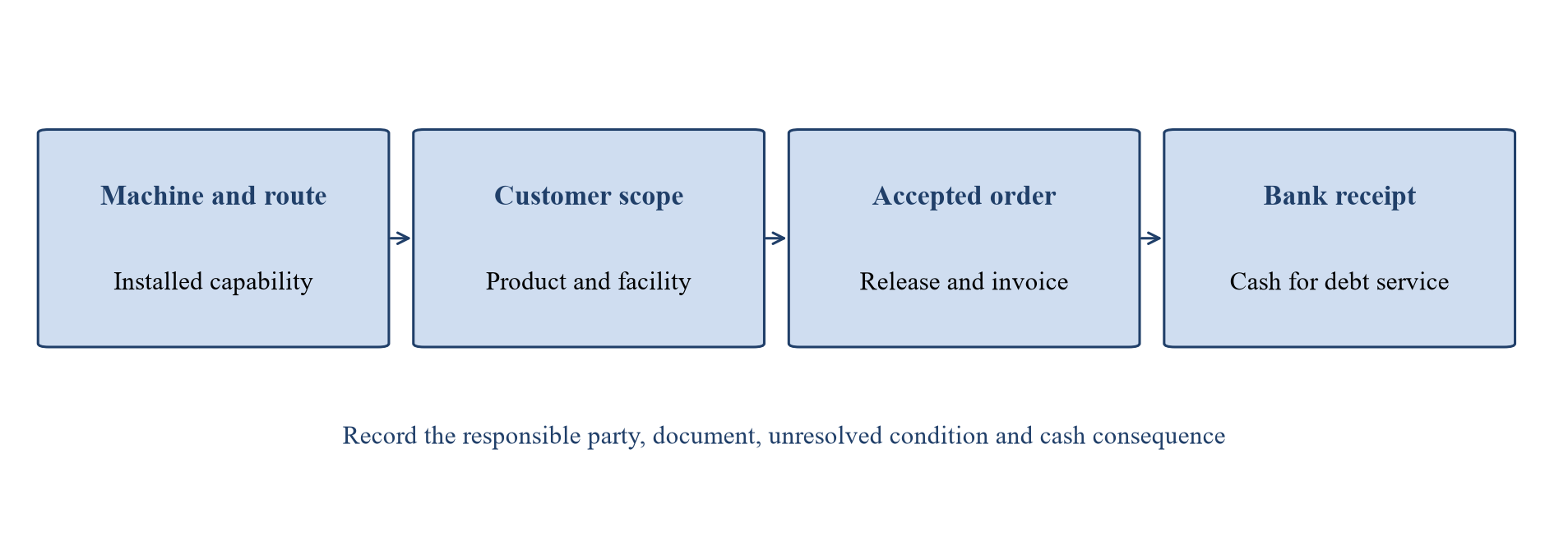
Original lender framework. Each arrow requires transaction-specific evidence; the sequence carries no assumed approval or payment date.
For the lender, the map also defines the evidence to refresh. Replacing a machine, changing a facility, revising a drawing or moving an outside process should trigger a review of the affected customer scope. The proposed reporting should identify the change and the confirmation required before related production is included in eligible cash flow. Avoid treating every change as automatically permissible or automatically disqualifying. Obtain the customer's actual requirements and record the resulting credit decision, including any time allowed to resolve an open question.
4. Separate technical readiness from commercial commitment
Use a qualification register with fields for the applicant entity, facility, product scope, submission status, open findings and customer decision. Attach the source documents behind each entry and record their dates. The lender should be able to determine which status was confirmed by the customer and which was reported by management. Descriptive labels such as under review need an explanation of the remaining tasks. A percentage probability of approval should appear only when its basis is stated and suitable for the decision being made.
An engineer can assess whether the plant is ready for the intended tests and whether unresolved findings have credible remedies. That work should produce a costed list of actions with responsible parties and evidence of completion. The customer retains its own approval authority. The proposed credit process therefore separates an adviser's readiness assessment from the customer's formal decision. Ask the engineer to identify assumptions requiring customer confirmation and to explain the consequences of a failed test, including additional materials, machine time and any repeat inspection.
Commercial commitment requires its own register. Record enquiries, quotations, tenders, framework agreements, purchase orders and binding releases according to their actual terms. The underwriting team should ask which document establishes a customer's obligation to buy a stated quantity and what conditions remain. A framework price list may be useful to estimate unit economics, but the forecast needs a separate basis for volumes. Any customer forecast used in the model should retain its non-binding character unless the contract establishes an enforceable commitment.
A borrower seeking funding before final qualification should explain why early spending is necessary and who bears the cost if approval is delayed or refused. Possible arrangements for evaluation include sponsor-funded trials, staged equipment commitments or a limited initial draw. Their feasibility depends on actual supplier and customer terms. The paper recommends comparing those arrangements through their cash consequences and contractual rights. It does not assume the equipment supplier will accept deferral, the customer will fund trials or a lender will offer an uncommitted extension.
5. Test the measurement and quality evidence
NIST's metrological-traceability guidance describes a documented calibration chain that contributes to measurement uncertainty. It also explains that traceability alone does not establish fitness for a particular purpose. The underwriting implication proposed here is to ask the technical reviewer whether the measurement method can substantiate the customer's acceptance criteria for the relevant component. A calibration certificate should be evaluated with the actual measurement task, including the uncertainty and operating conditions. No particular tolerance or test method is prescribed by this paper. [5]
The Saudi Accreditation Center's laboratory-accreditation page describes technical and managerial competence within defined fields. Its application requirements include scope, personnel, equipment and relevant quality-management information. This supports verifying the relevant laboratory's actual accredited scope when an accredited test is required. The presence of a laboratory name or certificate alone does not identify which measurement was covered at the necessary date. Obtain the applicable scope, test report and customer requirement before relying on a laboratory result in the credit file. [6]
The lender should ask for a representative production record that a technical reviewer can follow from input material through inspection to customer release. Include the drawing version, material identity, test results and the treatment of deviations. Request examples of rejected work as well as accepted work. The proposed purpose is to understand where cash can be spent without creating a collectible sale. The evidence should explain whether a defect can be repaired, requires a replacement or leads to a permanent reduction in the amount billed.
Review responsibility for quality costs in the actual contracts. The borrower may propose that a subcontractor pays for defects, but the lender needs the agreement, the claims procedure and evidence of recoverability. A disputed claim should be modelled separately from an immediate cash payment. Ask who funds rework while responsibility is investigated and whether the customer can withhold payment on other deliveries. Where those questions remain unresolved, present separate scenarios with clearly stated assumptions about cost, delay and receipt rather than assuming immediate reimbursement.
6. Connect orders to acceptance and payment
Follow the order through the customer's acceptance and invoicing process. Identify the event that permits dispatch, the event that establishes acceptance and the documents required for a valid invoice. Record who is authorised to confirm each event and how the borrower retains that confirmation. The proposed lender review should include a sample transaction from order to bank receipt where operating history exists. For a new product, obtain the intended process and treat the absence of demonstrated collections as an explicit underwriting limitation.
Payment terms require careful reading at the level of the executed agreement. Determine the starting point of the payment clock, the treatment of incomplete documentation and any right to reject, offset or dispute an invoice. A quoted number of days can conceal a prior acceptance period or a required portal submission. Build the model around the observed or contractually supported sequence. The worked example later assumes a fixed collection lag solely to isolate its effect; it makes no claim about customary Saudi payment terms.
Identify the paying entity and its relationship to the end user of the component. A machine shop supplying a contractor may have different credit exposure from a direct supplier to the project owner. Obtain the actual purchase order and payment obligation. Where management relies on the reputation of a parent or end customer, ask whether that party has assumed any enforceable obligation to pay the borrower. A logo in the sales presentation cannot establish the terms of that relationship or the lender's access to its cash.
For a concentration review, group exposures by the sources of approval and payment risk. Several invoices may rely on one product qualification, one customer procurement programme or one contractor. A dispute affecting that relationship can alter several projected receipts together. Present the amounts and shared dependencies explicitly. The lender can then choose a concentration limit or additional condition with knowledge of the exposure being accepted. This paper supplies no universal limit; a suitable threshold requires the lender's risk appetite and verified borrower information.
7. Establish what the collateral can support
An asset register should distinguish machines, tools, software licences, customer-owned items, work in progress and receivables. Record ownership evidence and any existing financing or other claimed rights. The legal review should establish what security can be created, registered, perfected and enforced in the applicable circumstances. The paper reaches no conclusion on the priority of a particular Saudi security interest or a cross-border lender's permissions. Those matters require current advice and transaction documents before the facility is approved or funded.
IFC's credit-infrastructure work includes secured-transactions and collateral-registry systems alongside credit reporting and insolvency frameworks. This is useful background for organising the legal and collateral diligence. It provides no valuation, recovery percentage or enforceability finding for a Saudi machine shop. The proposed rights matrix below is an original checklist for counsel and the technical appraiser. Its entries describe questions to resolve, with eligibility remaining subject to the actual evidence and the lender's approved documentation. [7]
| Asset or right | Evidence to obtain | Decision requiring verification |
|---|---|---|
| Financed machinery | Serial numbers, invoices, title and existing finance | Available security and priority |
| Installed tooling | Ownership terms and permitted removal | Recoverable sale or continued-use value |
| Customer-owned material | Custody and processing agreement | Exclusion from borrower-owned collateral |
| Manufacturing software | Licence, transfer and support terms | Ability to operate after transfer |
| Work in progress | Product status, costs and customer rights | Eligibility and recovery assumptions |
| Receivables | Accepted invoice, debtor and dispute record | Assignability, collections and deductions |
Original lender checklist. Security, eligibility and recoverability require transaction-specific legal and valuation evidence.
Value should be assessed under the circumstances of the proposed recovery. Ask an independent appraiser to distinguish an operating sale from removal and resale of individual assets. Include location, condition, documentation, marketability and the costs required to make an asset available to a buyer. A customer approval may depend on the existing operation. Any assumption that it survives a transfer needs separate customer and legal review. The lender should understand which elements of its collateral valuation rely on continuity of the business.
For arithmetic illustration only, suppose machines originally cost USD 12 million, a gross resale estimate is 75% of that amount, disposal costs are USD 1 million and prior-ranking claims consume USD 3 million. The remaining amount is USD 5 million, or 0.50 times the assumed USD 10 million loan. Every input is hypothetical and there is no appraisal or priority opinion behind it. The example shows the deductions that require evidence; it is not an estimate of recoveries or a second source of operating cash.
8. Build the cash calendar before setting amortisation
The proposed calendar begins with unrestricted cash after equipment installation and all costs incurred before the model start have been paid. It follows qualification expenditure, production payments, customer collections and contractual debt service by period. Equipment deposits, installation charges or unpaid taxes that remain outstanding must be added to an actual forecast. A lender should reconcile the opening balance to bank statements and identify any restricted amounts. Starting the model with gross account balances can conceal money that cannot support operations or debt payments.
The illustrative business starts month one with USD 3.00 million of unrestricted cash. Its USD 10 million equipment loan has already been drawn before that date. The model does not add that loan again to opening liquidity. It assumes contractual debt service of USD 0.25 million each month, including the aggregate interest and principal payment. This payment is an assumption supplied for the scenario, without an implied interest rate, quoted tenor or amortisation structure. Actual financing terms would need their own complete debt schedule.
During the assumed qualification period, the business pays USD 0.10 million each month for trial and approval-related activity. Fixed operating cash costs are USD 0.35 million monthly, and maintenance cash expenditure is USD 0.05 million monthly throughout the year. Regular production starts in the month after qualification ends. Each production month generates USD 2.00 million of assumed accepted shipments and incurs USD 1.20 million of same-month variable production payments. This variable-cost assumption covers the modelled production; qualification costs are accounted for separately.
Customer cash arrives two months after each accepted shipment in the base scenario. Thus, three full months of qualification lead to first shipments in month four and first collections in month six. The opening receivables balance is assumed to be zero. No customer advances, supplier credit, tax cash flows, distributions, additional capital expenditure or incremental financing charges are included. These deliberate simplifications isolate the approval and collection sequence. An actual credit decision must incorporate omitted flows and within-month payment dates before relying on the resulting minimum cash requirement.
9. Reproduce the first-year funding requirement
In the base scenario, nine production months create USD 18.00 million of accepted shipments during the first year. Seven months of collections produce USD 14.00 million of cash receipts. The difference is USD 4.00 million of closing receivables under the assumed fixed lag and complete subsequent collection. Variable production payments total USD 10.80 million. Fixed operating costs are USD 4.20 million, maintenance is USD 0.60 million and qualification expenditure is USD 0.30 million. Cash available for debt service over the year is therefore negative USD 1.90 million.
Annual debt service totals USD 3.00 million. Beginning with USD 3.00 million of unrestricted cash, the model finishes the year at negative USD 1.90 million before additional financing. A negative balance represents an unresolved funding requirement in the calculation. It is not an assertion that a borrower can operate an unauthorised overdraft. The lender must examine the timing within the year because the year-end deficit understates the maximum additional cash needed to keep the operation funded under these assumptions.
The lowest month-end balance is negative USD 2.95 million at the end of month five, immediately before the first assumed collection month. Maintaining a hypothetical minimum balance of USD 0.50 million requires USD 3.45 million of additional cash available by the necessary dates. The calculation is USD 0.50 million less negative USD 2.95 million. If supplied as an upfront cash injection, that amount lifts every modelled monthly balance by USD 3.45 million. The figure excludes any cost of raising the additional cash and any unmodelled intramonth shortfall.
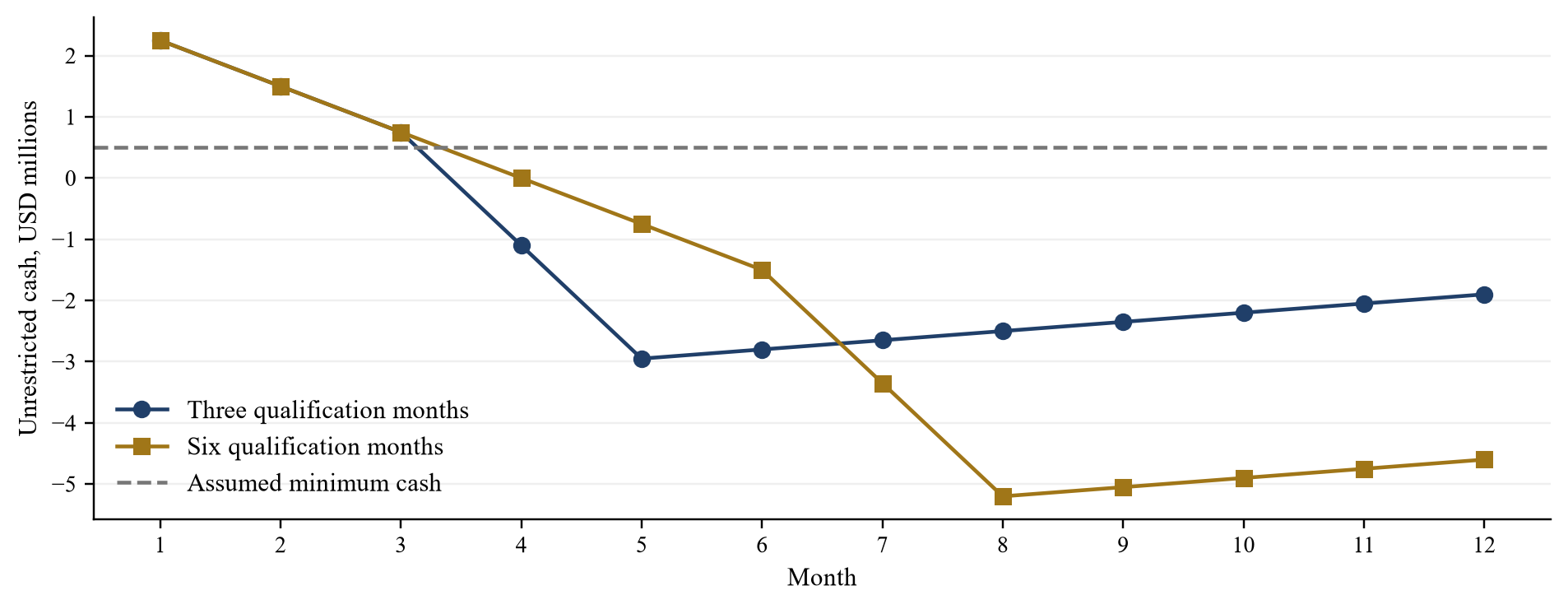
USD millions. All inputs are hypothetical. Negative balances identify unmet funding; the lines do not represent permitted overdraft facilities.
Once collections have caught up with the assumed production rate, monthly receipts of USD 2.00 million less USD 1.20 million of variable payments, USD 0.35 million of fixed costs and USD 0.05 million of maintenance leave USD 0.40 million for debt service. Dividing by the assumed USD 0.25 million payment gives 1.60 times coverage. That is a steady-state scenario metric. The first-year calendar remains essential because the business pays for qualification and production before that repeating collection pattern is established.
| Measure | Three qualification months | Six qualification months |
|---|---|---|
| Accepted shipments | 18.00 | 12.00 |
| Cash collected | 14.00 | 8.00 |
| Variable production payments | 10.80 | 7.20 |
| Fixed operating payments | 4.20 | 4.20 |
| Maintenance payments | 0.60 | 0.60 |
| Qualification payments | 0.30 | 0.60 |
| Cash available for debt service | -1.90 | -4.60 |
| Debt service | 3.00 | 3.00 |
| Lowest month-end cash before new funding | -2.95 | -5.20 |
| Additional cash to maintain 0.50 minimum | 3.45 | 5.70 |
All inputs are hypothetical. Opening unrestricted cash is 3.00 million; additional funding excludes its own financing costs and intramonth timing.
10. Stress qualification time and customer collection separately
Extending qualification to six full months moves first shipment to month seven and first collection to month nine. The lowest balance then occurs at the end of month eight, at negative USD 5.20 million. Additional cash of USD 5.70 million is required to maintain the same USD 0.50 million minimum. Compared with the base scenario, the model requires USD 2.25 million more cash. This difference follows from the defined cost and timing assumptions. It is not a measured cost of a typical Saudi approval delay.
Collection timing creates a separate exposure. With qualification fixed at three months, a one-month collection lag requires USD 1.60 million of additional cash, a two-month lag requires USD 3.45 million and a three-month lag requires USD 5.30 million. The longer lag increases the number of production months funded before receipts arrive. The model holds monthly accepted shipments and production payments constant to make that mechanism visible. In an actual case, late acceptance may also change shipment scheduling, costs or the amount ultimately collected.
The sensitivity below uses qualification periods of zero, three, six and nine months and collection lags of one, two and three months. A zero qualification period represents a hypothetical operation ready to ship in month one, with the same cost assumptions. Each cell calculates the largest cash injection needed to maintain the minimum at the twelve modelled month ends. The horizon is fixed at twelve months. Cases with later receipts would require a longer forecast to identify their complete funding requirement and eventual repayment capacity.
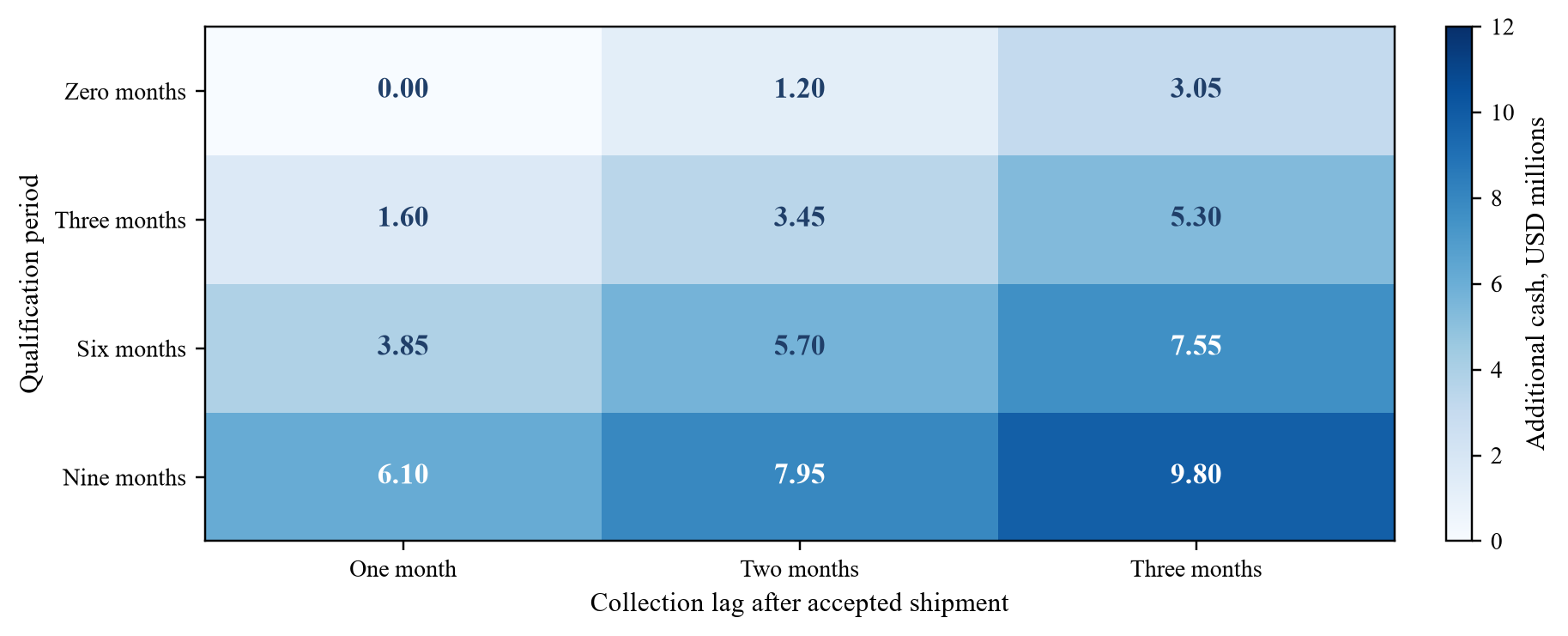
USD millions within a twelve-month horizon. Assumed minimum cash is 0.50 million. The cells vary only qualification duration and collection lag; they assign no probabilities.
The lender should use borrower evidence to select stress cases and identify how the events could occur together. A requalification following a process change could coincide with a customer payment dispute; the direction and size of those effects require investigation. The matrix supplies no probability-weighted expected loss and no value-at-risk estimate. Its purpose is to reveal the amount of cash dependent on timing assumptions, so the committee can require a funding source or decide that the unresolved exposure is outside its mandate.
11. Distinguish payment delay from permanent quality loss
A late payment and a permanent deduction require different forecast treatment. The collection-lag model assumes accepted invoices are ultimately paid in full. A rejected batch or agreed price deduction can reduce the amount collected permanently, while the borrower has already paid some or all of the production cost. The proposed credit file should separate unpaid accepted invoices, disputed invoices, credit notes and claims against suppliers. Combining them into one days-outstanding measure can obscure the cash consequences that need to be modelled.
For a separate steady-state sensitivity, assume permanent deductions of zero, 5% and 10% from the USD 2.00 million monthly gross shipment value. Hold variable payments at USD 1.20 million, fixed costs at USD 0.35 million and maintenance at USD 0.05 million. Monthly cash available for debt service becomes USD 0.40 million, USD 0.30 million and USD 0.20 million respectively. Against the unchanged USD 0.25 million debt-service payment, coverage is 1.60, 1.20 and 0.80 times. These are hypothetical deduction cases, with no asserted industry rejection rate.
This sensitivity deliberately assumes the costs of rejected output remain in the production payment figure and assigns no scrap proceeds, insurance receipts or supplier reimbursement. It also excludes the cost of replacement production. Those items should be added only when their contractual and operational basis is understood. If replacement work uses capacity otherwise available for new sales, model that displacement explicitly. A spreadsheet that deducts lost revenue, full replacement cost and the same lost capacity twice would overstate the loss and weaken the credit decision.
Ask the borrower to reconcile quality outcomes with accounts and bank receipts. A useful sample traces a disputed batch to its production cost, customer response, subsequent credit note and final cash settlement. The review should distinguish the date the issue became known from the date it affected the ledger. The proposed monitoring process records new disputes promptly enough for the lender to revise availability or liquidity requirements under agreed terms. Actual notification obligations and remedies belong in negotiated documents, with legal review of their application.
12. Structure drawdowns around evidenced progress
A staged facility can be evaluated by matching each draw to the exposure it creates and the evidence available at that stage. Before equipment payment, the lender should review the purchase agreement, supplier identity, delivery obligations, refund rights and responsibility for installation. At commissioning, independent evidence should address the specific machine and intended process. Before lending against forecast operating cash, the file should explain the remaining customer conditions and the funding available through qualification and collection. These are proposed underwriting conditions, not prescribed market terms.
The documents should distinguish a commitment ceiling from the amount presently available to draw. An undrawn facility may contain conditions that cannot be met during a stress event. The cash forecast should include funding only when its availability is evidenced under the relevant scenario. If customer approval is a drawdown condition, that same undrawn amount should not automatically fund a period in which approval is missing. The committee must decide how the pre-approval costs will be financed and record the party bearing that risk.
Sponsor support requires scrutiny of both obligation and capacity. A signed undertaking needs analysis of its enforceability, conditions, funding date and the sponsor's ability to perform. A statement of willingness provides a different basis from cash already contributed. In the hypothetical model, the additional USD 3.45 million or USD 5.70 million is a quantified requirement, with no committed provider. If new debt is proposed to meet it, its interest, fees and repayments must be added to the calendar before recalculating the requirement and coverage.
Where multiple lenders participate, reconcile their claims on assets and proceeds. Obtain the actual consent, security-sharing and intercreditor arrangements as applicable. Avoid counting the same unrestricted cash, machinery value or receivable as freely available to satisfy several independent funding requirements. The paper assumes no automatic coordination between SIDF, a bank, a leasing provider and a private-credit fund. The parties' current commitments and negotiated priorities are necessary evidence for a transaction-specific funding plan, including any conditions on distributions or additional borrowing.
13. Monitor the events that can change repayment
The reporting package should link operating events to the assumptions used at approval. A monthly report can show qualification findings, new customer decisions, accepted shipments, quality disputes, cash collections and debt payments. The lender should request supporting records for changes that materially affect availability or the forecast. A concise exception register helps identify what is unresolved, who is responsible and the date by which a decision is needed. It should retain the original forecast so later revisions remain explainable.
Technical monitoring should focus on the dependencies identified for the financed product. If the approval relied on an outside process, a particular inspection route or a specific facility, require notification when that dependency changes. The qualified technical reviewer should identify what additional testing or customer confirmation may be necessary. The lender should then assess the cash consequence and the contractual response. This proposed sequence allows an operating change to be evaluated without making an unsupported automatic conclusion about the status of every customer order.
Cash reporting should reconcile sales, invoices and receipts over consistent periods. Record disputed amounts separately from accepted overdue balances and identify material customer deductions. Compare the forecast collection date with the actual date and investigate persistent differences. A borrowing-base calculation, if the facility uses one, should follow its agreed eligibility definitions and concentration limits. The present model contains no revolving borrowing base, so no receivable advance rate or mandatory excess repayment should be inferred from its calculations.
The lender also needs timely evidence of liquidity outside normal monthly reporting. The proposed agreement should specify which forecast shortfalls or customer events require prompt notice. The parties can then evaluate a funded remedy, a revised draw or a controlled reduction of activity. The paper offers no universal cure period or automatic enforcement recommendation. Any response must consider the actual finance documents, customer obligations, available funding and applicable law. The analysis should record who can make the decision and the evidence on which it relies.
14. Evaluate a lender mandate and the limits of advisory work
A capital provider commissioning an initial screen should define the industrial subsectors, proposed transaction type, jurisdiction, loan size and evidence required before a borrower advances to full underwriting. The proposed first deliverable is a documented borrower map with reasons for inclusion and exclusion. The work can then progress to product-level customer qualification, machine-level diligence and a reconciled cash model for selected businesses. Screening should state where information comes from management and where it has been independently corroborated.
The proposed paid advisory scope can include industrial borrower mapping, coordination of commercial and technical diligence, cash-flow modelling and preparation of an investment-committee memorandum. Scope and fees would require a separate agreed engagement. This paper establishes no client mandate, retainer amount, available loan commitment or expected advisory revenue. Capital committed to a borrower and fees paid for professional work should be recorded separately in commercial reporting. A large loan principal provides no evidence of a correspondingly large consulting fee.
Regulated activities, legal opinions, independent asset valuations and engineering certifications require the appropriate professionals and permissions. A prospective lender should verify the provider's actual authorisation and engagement scope before relying on a deliverable. The proposed adviser role does not imply custody of client money, discretionary investment management, a commitment to arrange financing or authority to approve a manufacturer's products. A useful mandate assigns each specialist a defined question and integrates the resulting evidence into the lender's own decision process.
For a family office, equipment-finance fund or institutional investor, the first substantive discussion can begin with an actual deployment brief. It should state the capital available for consideration, the permitted structure, relevant experience requirements and acceptable risk before borrower selection begins. Any stated capital availability should be confirmed through the investor's authorised process. The advisory work should be evaluated by the quality and decision usefulness of its outputs. This paper makes no promise of a completed investment, customer introductions or a particular financial return.
15. Set a decision that can be revisited
The approval memorandum should distinguish conditions already evidenced from conditions expected to be satisfied later. For every deferred condition, identify the exposure outstanding before satisfaction and the party funding the downside. Include the machine-to-cash map, qualification and order registers, technical findings, cash calendar and legal conclusions. A reviewer should be able to connect the amount requested with the documents supporting repayment. Where an important connection is absent, present that absence directly and explain the resulting decision required from the committee.
One possible decision is to fund only the equipment stage after specified supplier and security conditions are met, with operating funding subject to a later review. Another is to wait for customer qualification and a demonstrated collection cycle. A lender may also accept a defined pre-qualification exposure with separately verified sponsor support. These are proposed alternatives for evaluation. Their suitability depends on the mandate, legal structure, commercial terms and evidence. The paper provides no ranking that applies to every borrower or every industrial sector.
The review should include a practical stopping point if the expected approval fails to materialise. Identify the expenses that can be deferred, contracts that can be terminated, machines that can be redeployed and amounts that remain payable. Verify the relevant rights before valuing the alternative. A management plan to sell equipment or seek a different customer should include its cost, timing and supporting evidence. The lender should assess how much cash is required while that plan is attempted and whether the relevant support remains available.
Keep the decision conditions measurable. A requirement to improve quality is difficult to test without an identified finding and acceptance criterion. A requirement to complete a named customer action or provide a specified engineering report is easier to verify. Even then, record who has authority to accept the evidence and whether it satisfies the loan condition. This proposed process helps maintain the link between credit approval and subsequent funding as the project evolves, while leaving the final risk decision with the authorised lender.
16. Research boundaries and conclusion
The evidence reviewed for this paper consists of selected public institutional publications accessed on 10 September 2026. They support specific statements about supplier processes, industrial-financing stages, measurement and credit infrastructure. They do not provide a sample of Saudi precision-engineering loan performance. No default probability, approval success rate, qualification duration, equipment recovery rate or market loan price is estimated. The original framework and numerical scenarios should be tested against actual borrower evidence before they are used in a commitment decision.
The model is deliberately limited to twelve month-end observations and a simplified operating pattern. It omits intramonth cash timing, taxes, incremental financing costs, exchange-rate movements, variable production capacity, customer advances and several other possible flows. It assumes full collection after a fixed lag in the timing cases and treats permanent deductions separately. Those choices make the arithmetic reproducible and its limits visible. A transaction model must extend the horizon and include the missing flows relevant to the borrower, with assumptions supported or explicitly proposed.
The central lending question is whether the funded operating company can reach collected customer revenue within its evidenced financial capacity. The hypothetical examples show how a business with positive steady-state coverage can require material additional cash before the collection cycle is established. The proposed response is a credit process that connects each machine and production route with its customer scope, commercial commitment and cash calendar. A defensible approval then states which risks the lender accepts, which conditions remain and how the financial requirement is funded.
Appendix A. Lender evidence checklist
| Review area | Record to request | Responsible review |
|---|---|---|
| Borrower perimeter | Entity, ownership, licences and borrowing documents | Legal and credit |
| Production route | Machines, drawings, materials and outside processes | Independent technical reviewer |
| Customer qualification | Scope, findings, dates and formal customer decisions | Commercial and technical |
| Sales commitment | Executed orders, releases and cancellation terms | Commercial and legal |
| Quality exposure | Rejections, rework, deductions and resolved claims | Technical and finance |
| Collections | Accepted invoices, portal records and bank receipts | Finance and credit |
| Collateral | Title, existing claims, valuation and security opinions | Appraiser and legal |
| Liquidity | Opening cash, monthly forecast and support commitments | Finance and credit |
The table assigns review questions; it makes no finding about a specific borrower or professional's appointment.
Use the checklist to request identifiable records, with the date and person responsible for each response. Management statements should be labelled as such in the internal evidence file until corroborated. A blank entry should remain an unresolved item. The lender should decide whether that item stops the proposed draw, reduces availability or is an explicitly accepted exposure. The paper makes no finding about an unnamed borrower's compliance or creditworthiness and supplies no substitute for the transaction team's formal approvals.
Appendix B. Reproducible model and committee questions
For each month, start with the previous month's cash. Add receipts from accepted shipments made the assumed number of months earlier. Deduct variable production payments when regular production occurs, fixed operating payments of USD 0.35 million, maintenance payments of USD 0.05 million, qualification expenditure of USD 0.10 million during each qualification month, and debt service of USD 0.25 million. Begin with USD 3.00 million and zero opening receivables. Use the lowest of the opening and twelve month-end balances to calculate the additional cash needed to maintain USD 0.50 million.
In the base case, the end of month five is USD 3.00 million less USD 1.75 million fixed operating payments, USD 0.25 million maintenance, USD 0.30 million qualification costs, USD 2.40 million variable production payments and USD 1.25 million debt service. That produces negative USD 2.95 million before new funding. In the six-month qualification case, the equivalent low point at month eight deducts USD 2.80 million, USD 0.40 million, USD 0.60 million, USD 2.40 million and USD 2.00 million respectively, producing negative USD 5.20 million.
The committee should ask which customer documents support the assumed production start and collection lag. What is the consequence of an unresolved finding, a rejected batch or an unavailable outside process? Which cash balances are unrestricted and which additional funding is committed under the stressed conditions? What does the proposed collateral valuation assume about continuing customer approval or transferring software and tooling? The answers should identify the evidence, the unresolved assumption and the specific credit decision required before money is advanced.
Sources
- Aramco. Become a supplier. Registration and qualification requirements and warning concerning future business. Accessed 10 September 2026. Read the primary source
- Aramco. Engineering Requirements for Technical and Quality Approval of National Manufacturers. Parts I and II, pages 4-16. Public handbook; applicable contractual version requires confirmation. Accessed 10 September 2026. Read the primary source
- SABIC. Register as a Supplier. Displayed profile, technical-qualification and onboarding stages and registration warning. Accessed 10 September 2026. Read the primary source
- Saudi Industrial Development Fund. Project Financing. Application evaluation and project-progress disbursement description. Accessed 10 September 2026. Read the primary source
- National Institute of Standards and Technology. Metrological Traceability: Frequently Asked Questions and NIST Policy. Sections 5.1.1 and 5.1.4 on traceability and fitness for purpose. Accessed 10 September 2026. Read the primary source
- Saudi Accreditation Center. Laboratories Accreditation. Defined accreditation fields and application evidence. Accessed 10 September 2026. Read the primary source
- International Finance Corporation. Credit Infrastructure. Secured transactions, collateral registries, credit reporting and insolvency context. Accessed 10 September 2026. Read the primary source
