

1. Entrepreneurship through acquisition is a sequence of capital decisions
A search fund starts with an individual or team seeking one company to acquire and operate. Capital is raised before the target is known, so investors initially underwrite the searcher's judgement, discipline, resilience and proposed process. The asset-level case arrives later. The searcher then asks investors and lenders to fund a specific purchase, while the seller assesses whether an unfamiliar buyer can close and protect the business. After completion, the searcher becomes an operating chief executive whose capital choices affect employees, customers, lenders and shareholders.
This sequence creates three underwriting events. The first determines whether the search is properly resourced and governed. The second determines whether the target, price, structure and financing can withstand diligence. The third determines whether the acquired company has enough liquidity and management capacity to deliver the operating plan. Each event needs its own approval, evidence threshold and stop conditions. A strong search thesis does not validate a particular deal, and a financeable acquisition does not guarantee a resilient first year.
IESE Business School's 2024 international study covers 320 known first-time core search funds outside the United States and Canada [1]. It reports 146 acquisitions, 38 concluded searches without an acquisition and 15 funds that deviated from the core model as of year-end 2023. The study also cautions against applying its findings automatically to self-funded, single-sponsor or hybrid routes because their capital needs and incentives differ. Stanford's 2024 study separately reports on the United States and Canada [2]. These datasets provide useful context while leaving large sampling, maturity and geography limits.
The capital plan should therefore avoid treating historical aggregate returns as a forecast. International outcomes are heterogeneous and the number of completed exits remains limited [1]. An investment committee should focus on evidence it can control: target selection, cash conversion, customer durability, transferability from the seller, price discipline, debt capacity, governance, liquidity and the searcher's ability to lead the company. Historic search-fund performance can inform priors; transaction-specific diligence must drive the decision.
The practical starting point is a capital journey map. It connects search expenses, broken-deal costs, exclusivity deposits, equity commitment, acquisition debt, seller instruments, opening working capital and post-close investment. It also identifies which party carries each risk and when that risk changes hands. This prevents a common failure in which the acquisition closes with balanced sources and uses while the company begins ownership with inadequate liquidity.
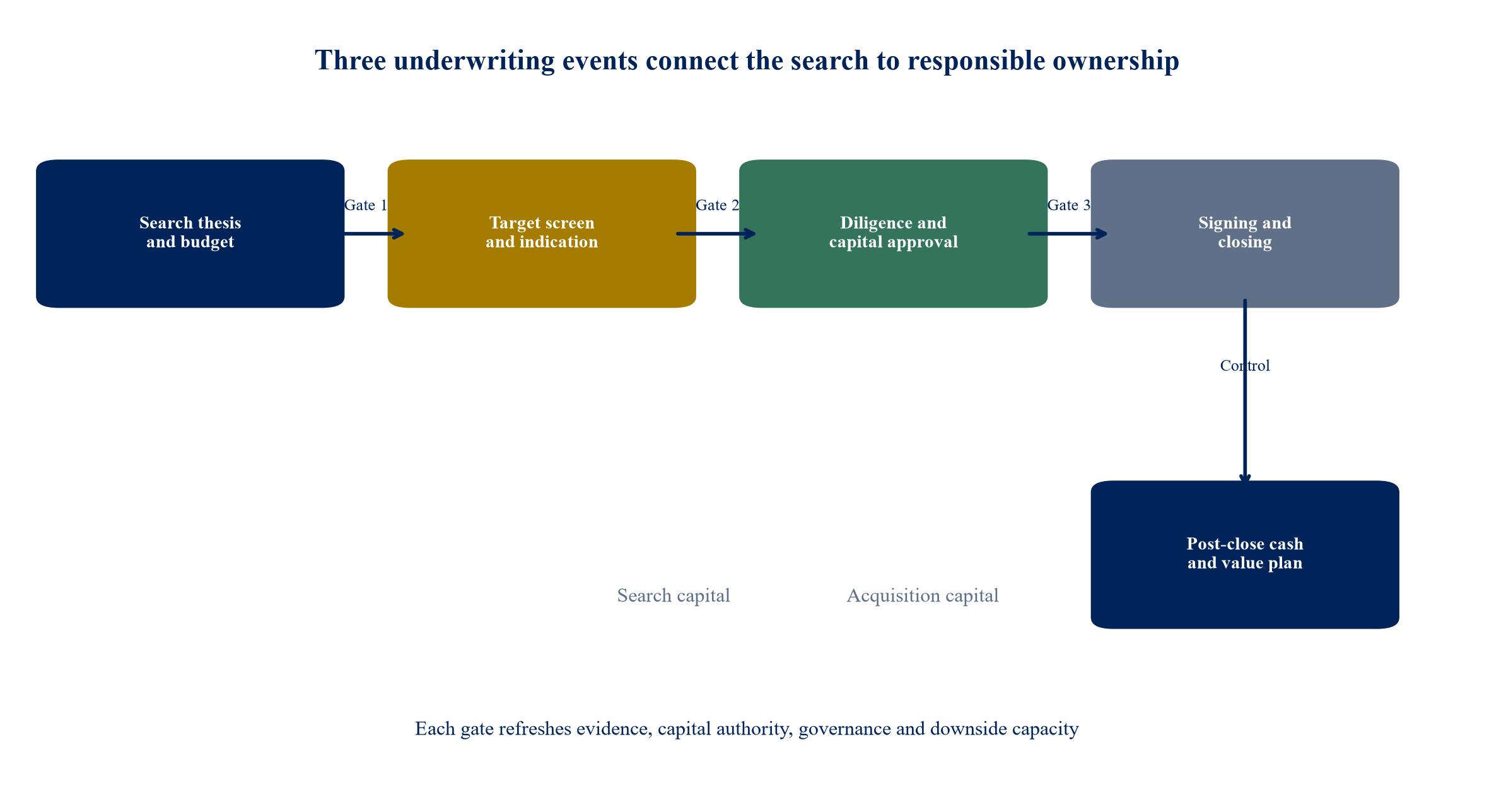
The framework is author-designed. Each gate requires fresh evidence and approval; capital committed at one gate should not imply automatic approval at the next.
2. Search capital buys a disciplined process rather than an asset
Search capital ordinarily funds compensation or living support, sourcing systems, travel, legal and accounting advice, diligence, office costs and broken-deal expenditure. Its economic value lies in expanding the searcher's ability to review opportunities without accepting the first plausible target. An underfunded search can create pressure to relax criteria, extend exclusivity before financing is credible or conceal the cost of failed diligence. Excessive funding can reduce urgency and encourage unfocused activity.
The budget should be built from a monthly operating plan and a transaction funnel. It should state the number of sectors and geographies covered, expected proprietary and intermediary channels, indicative diligence cost by stage, external-adviser triggers, travel needs, search duration and contingency. The plan should distinguish recurring search overhead from deal-specific costs. Investors can then assess whether the fund has enough runway to reject weak opportunities and whether the searcher can preserve capital for one or two serious diligence processes.
Governance before a target exists matters because the searcher controls the opportunity funnel while investors control follow-on capital. The subscription or investment documents should address duration, extensions, reporting, conflicts, outside activities, geographic changes, searcher departure, investor information rights and treatment of unspent cash. They should also define how search capital converts into acquisition economics, how investors elect whether to participate and what happens if the chosen opportunity is funded by a different group.
Broken-deal costs deserve explicit allocation. A failed diligence process may consume a material share of the budget. The approval matrix should define when the searcher can sign non-disclosure agreements, issue indications of interest, appoint advisers, pay deposits or commit third-party fees. Costs above thresholds can require investor approval. A reserve for one failed advanced process reduces the risk that a second, stronger opportunity cannot be investigated.
The searcher should maintain a monthly evidence pack. It includes funnel by source, target fit, reasons for rejection, conversations with sellers, adviser spending, cash runway, investor engagement and lessons that change the thesis. Activity counts alone can reward volume. A useful dashboard measures the quality and progression of opportunities, the preservation of cash and the consistency of rejection decisions.
3. The capital compact must align authority, economics and accountability
The capital compact is the agreement among the searcher, search investors, acquisition investors and any lead sponsor. It sets decision rights, economics and consequences across the journey. A poorly drafted compact creates uncertainty precisely when speed matters. The searcher may believe that investors are committed to the acquisition while investors retain full discretion. Investors may expect pro rata rights while a larger lead investor requires governance control. The seller sees the resulting delay as financing risk.
The compact should define the searcher's initial ownership and any additional equity earned at acquisition, through service or from performance. Vesting conditions should distinguish continued employment, time, operating milestones and investor returns. Good-leaver and bad-leaver provisions should state what happens to vested and unvested interests. Dilution from acquisition equity, management options, seller rollover and later growth capital should be modelled on a fully diluted basis.
Investor rights should be tied to the risks financed. Search-stage investors can receive priority access to the acquisition round without an unconditional obligation. A lead acquisition investor may negotiate board seats, reserved matters, information, anti-dilution protection, transfer rights and exit mechanisms. Minority investors need protections proportionate to ownership and governance. The searcher needs enough operating authority to run the company without seeking consent for ordinary decisions.
Sponsor economics should reward durable value creation. Front-loaded ownership granted at closing can pay for transaction completion while leaving limited incentive for a difficult operating period. A balanced design can allocate one part at acquisition, one part over time and one part against performance or investor-return thresholds. The terms should avoid a cliff that encourages a premature sale or excessive risk near a single threshold.
Transparency is more valuable than a headline percentage. The model should show ownership at signing, closing, full vesting, an employee-option issue, seller rollover, a down round and exit. It should also show cash invested by each party, distributions, liquidation preferences if any, debt and transaction fees. This is the only reliable way to understand who owns the outcome in each scenario.
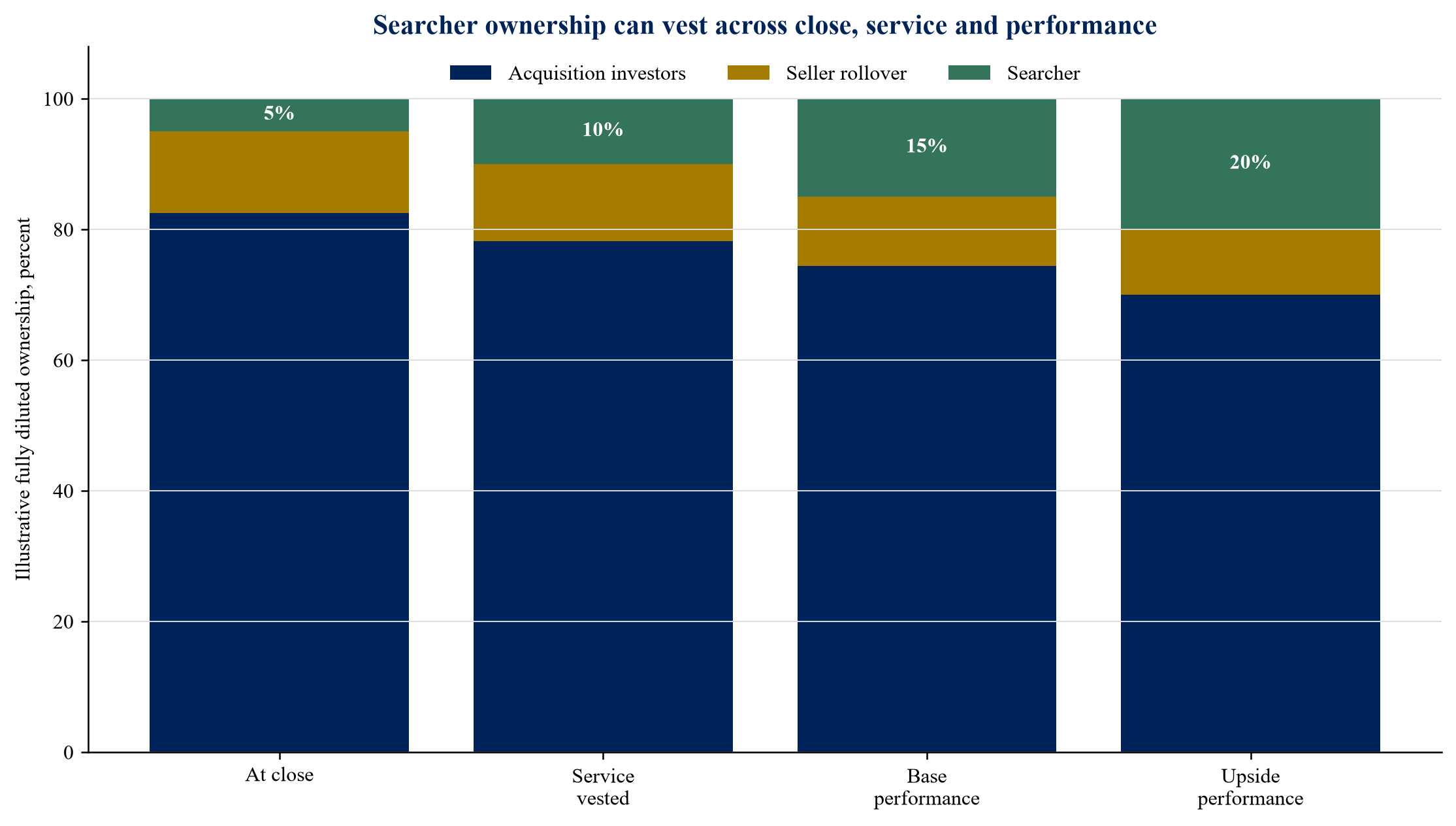
Percentages and vesting shown are hypothetical author assumptions. Actual rights depend on negotiated documents, law, tax and employment terms.
4. Target screening should begin with cash conversion and transferability
Search-fund target criteria often emphasise recurring revenue, attractive margins, fragmented markets and growth. These attributes need translation into cash that can support the acquisition structure. Reported earnings may not convert because receivables grow, customers pay late, inventory absorbs cash, maintenance capital expenditure is understated or taxes and leases are omitted. Debt capacity should be based on sustainable free cash flow after the investment required to preserve the business.
The quality-of-earnings bridge should reconcile reported profit to normalised earnings and cash. It removes one-off income, adds omitted recurring costs, normalises owner compensation, identifies related-party transactions and separates maintenance from growth spending. Working-capital analysis should use monthly data to reveal seasonality and closing manipulation. The acquisition model should test slower collections, customer loss, wage inflation, supplier tightening and delayed investment benefits together.
Transferability asks whether revenue, knowledge, licences and relationships will survive the seller's departure. Customer concentration can be manageable if contracts, switching costs and delivery capabilities are institutional. A broad customer base can still be fragile if sales depend on the founder's personal network. Key employees, technical licences, data rights, leases, regulatory permits, bank facilities and vendor terms should be mapped to change-of-control and continuity conditions.
Management depth matters because the searcher will inherit an operating system while learning the business. The diligence plan should identify who owns pricing, sales, delivery, cash collection, technology, regulatory compliance and key relationships. A single point of failure can be addressed through retention, documented processes, seller transition or additional hiring. Each solution has a cost and should appear in sources and uses or the operating plan.
Target fit should include personal and geographic reality. The searcher may need to relocate, work with a family shareholder group, operate across languages or manage regulated customers. A target can meet financial criteria while failing the leadership fit. Investors should test the searcher's willingness and capability before exclusivity, since changing the operating premise after signing weakens seller confidence and execution.
Table 1. Stage gates, evidence and stop conditions across the search-fund capital journey
| Gate | Capital at risk | Required evidence | Principal approval | Example stop condition |
|---|---|---|---|---|
| Search launch | Search budget and opportunity cost | Thesis, budget, sourcing plan, governance and runway | Search investors | Budget cannot support disciplined search duration |
| Initial target screen | Limited adviser and management time | Cash conversion, transferability, seller intent and valuation range | Searcher with investor consultation | Founder dependence cannot be transferred |
| Indicative offer | Reputation and preliminary costs | Normalised earnings, value range, financing outline and key conditions | Searcher and designated investor group | Price requires unsupported growth or leverage |
| Exclusivity | Deposits and material diligence spend | Data access, diligence plan, financing engagement and timetable | Investment committee | Financing or regulatory path lacks credible evidence |
| Signing | Committed equity and transaction liability | Completed diligence, final documents, approvals and funds certainty | Acquisition investors and boards | Downside case breaches minimum liquidity or covenants |
| Closing | Purchase price and funded debt | Conditions satisfied, funds flow, consents and verified accounts | Authorised signatories | Critical consent, funding or transfer evidence is missing |
| First 100 days | Working capital and execution capacity | Liquidity plan, governance calendar, retention and operating priorities | Board and management | Opening liquidity cannot fund essential commitments |
The decision architecture is author-designed. Thresholds should be calibrated to the actual search, investors, target and jurisdiction.
5. Valuation discipline should separate price from capital need
Enterprise value is only one component of the financing requirement. The acquisition may also require transaction fees, refinancing of existing debt, tax payments, seller leakage adjustments, working-capital support, integration expenditure and a minimum cash reserve. A searcher who negotiates an affordable headline multiple can still face an unfinanceable sources-and-uses statement. The capital requirement should be updated as diligence changes each line.
The valuation should triangulate methods rather than rely on one multiple. Comparable transactions and listed companies can provide a market frame when business quality, growth, geography and capital intensity are adjusted. A discounted cash-flow analysis makes assumptions visible. A debt-capacity analysis reveals what lenders may support. An investor-return model shows the entry price consistent with downside resilience and realistic operating outcomes. Each method should reconcile to the same normalised financial information.
The purchase agreement's price mechanism shifts risk between buyer and seller. Locked-box structures rely on a historic balance sheet and leakage protections. Completion accounts adjust price for actual cash, debt and working capital at closing. Earn-outs defer part of consideration against future performance but can create disputes over accounting, investment and operational control. The chosen mechanism should match information quality and the parties' ability to verify the result.
The investment committee should see a price walk from seller expectation to buyer value. It should isolate sustainable earnings, synergies available only to the buyer, control premium, tax attributes, required capital expenditure and liabilities. Search-fund returns should not depend on giving the buyer full credit for improvements it has yet to execute. A robust case creates value through operating delivery and debt repayment while preserving a credible downside.
The valuation file should also test exit assumptions without assuming multiple expansion. Exit timing, buyer universe, transaction costs, debt balance and working capital affect equity proceeds. A base case can hold the entry multiple constant. The downside should compress the multiple and reduce earnings. The upside can reflect evidenced growth and strategic value while maintaining a clear distinction between operational progress and market repricing.
6. The acquisition stack allocates risk among lenders, seller and equity
The acquisition stack can combine senior term debt, revolving working-capital facilities, asset-backed lending, subordinated or mezzanine debt, seller notes, deferred consideration, earn-outs, seller rollover and investor equity. Each instrument absorbs a different risk. Senior lenders seek priority, security, covenants and predictable repayment. Sellers may accept subordination or contingent value to bridge price. Equity carries the residual operating and valuation outcome.
Debt should follow cash-flow durability. Amortisation, interest, fees, mandatory prepayment and covenant headroom should fit the downside case. Acquisition debt can be placed at a holding company while cash is generated in an operating subsidiary, creating structural subordination and distribution dependence. The model must follow cash through entities, taxes, restricted payments and minority interests rather than assume consolidated cash is immediately available.
A revolving facility serves a different purpose from purchase-price debt. It supports seasonal working capital, letters of credit or short-term liquidity. Using the full revolver to close the acquisition removes the buffer required to operate the company. The opening capital plan should reserve adequate availability for ordinary and stressed needs. Conditions to drawing, borrowing-base rules and lender discretion should be modelled.
Subordinated debt or preferred equity can reduce common-equity need while increasing fixed or compounding claims. Its cash coupon, payment-in-kind accrual, redemption, participation and control rights should be compared with ordinary equity on a scenario basis. A low cash coupon can still create a large exit claim. The documents should define ranking, enforcement standstill, permitted payments and intercreditor rights.
The stack should remain financeable after a weak first year. If modest underperformance eliminates covenant headroom, blocks essential investment or forces an immediate equity injection, the structure is fragile. An investment committee should choose a capital mix that allows management to correct ordinary execution variance without transferring control to creditors.
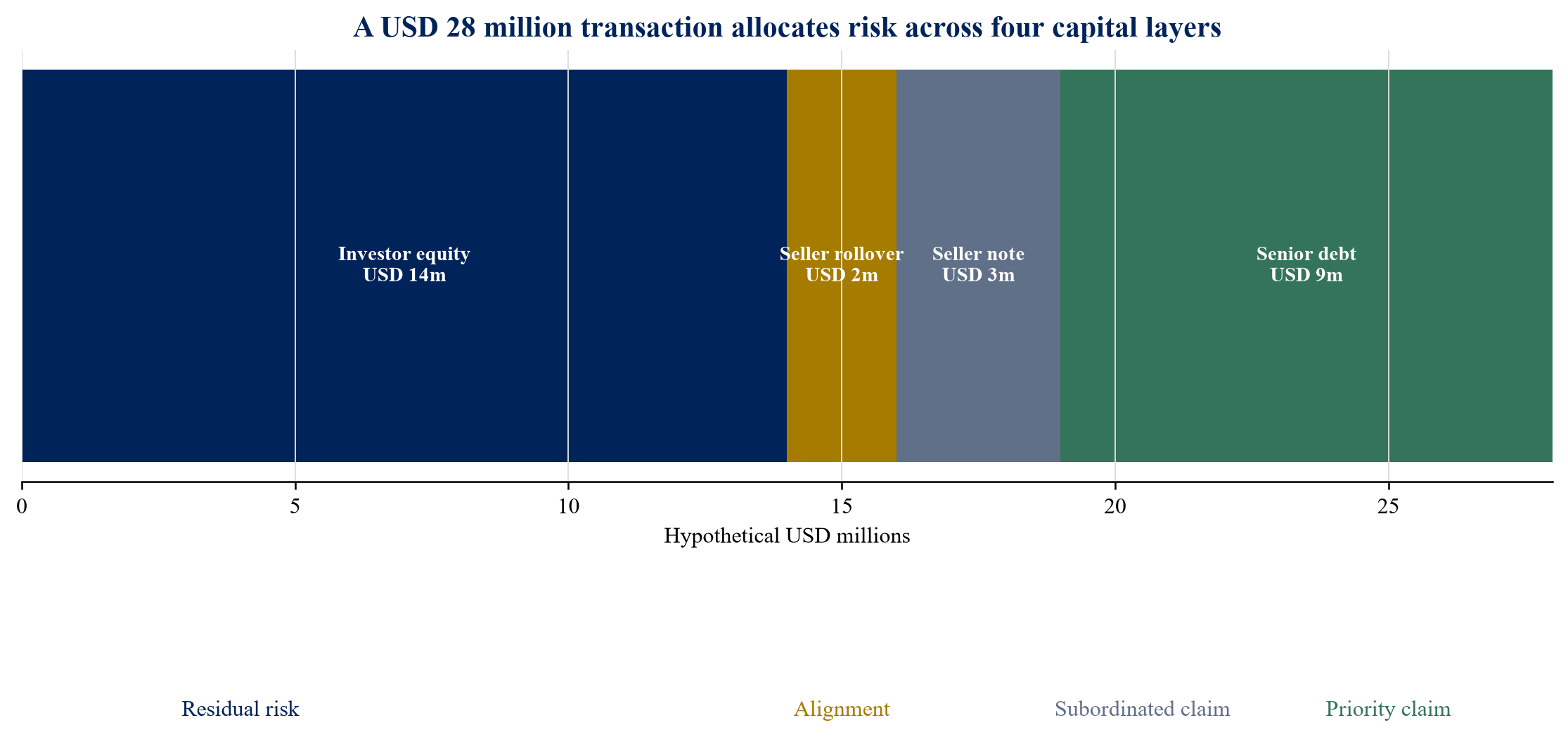
The USD amounts are hypothetical author assumptions. Ranking, security, pricing and control depend on negotiated terms and applicable law.
7. Seller rollover and vendor finance can bridge both value and trust
Seller rollover reinvests part of the seller's value in the acquiring structure. It can signal confidence, reduce the buyer's immediate equity need and preserve continuity. Its economic meaning depends on the security received. The seller may roll into the same ordinary shares as investors, a separate class, preferred equity or an interest with limited governance. The ownership and exit waterfall must be shown clearly.
A seller note defers cash consideration and creates a creditor claim. It can rank behind senior debt, carry cash or accrued interest, amortise or repay at exit. The seller must assess buyer credit, security, information and enforcement. Senior lenders may restrict payment or require standstill. The buyer should include seller-note service in the downside model and avoid treating subordination as forgiveness.
An earn-out links consideration to future performance. It can bridge disagreement over uncertain growth while transferring measurement and control disputes into the operating period. The agreement should define the metric, accounting policy, permitted actions, information rights, dispute mechanism, treatment on sale and consequences of management decisions. Revenue can be easier to observe than profit but may reward unprofitable sales. Profit can align economics but is sensitive to investment and allocation.
Rollover can be especially important in family-owned and relationship-led businesses. The UAE's Federal Decree-Law No. 37 of 2022 provides a framework for ownership, governance and generational continuity of registered family businesses [3]. A transaction involving family shareholders may need to reconcile liquidity, succession, family governance and ongoing roles. The buyer should map beneficial ownership, authority and family consent before assuming that one seller can bind the group.
Seller instruments should support a transition plan. Continuing advisory roles, employment, non-compete provisions, customer introductions and knowledge transfer need specific obligations and timelines. Payment should not be contingent on activities the seller cannot control. The design should preserve trust while giving the new chief executive clear operational authority.
8. Debt capacity should be underwritten through a cash waterfall
Debt-service analysis begins with cash generated by the business, not a leverage multiple. The model starts from normalised earnings and deducts cash tax, maintenance capital expenditure, working-capital investment, leases, mandatory pension or regulatory payments and essential restructuring costs. It then tests interest, amortisation and covenant calculations using the legal definitions in the proposed financing.
Cash sweeps can accelerate deleveraging but reduce flexibility. Mandatory prepayment from excess cash flow, disposals, insurance proceeds or new equity should be understood. A covenant based on leverage can tighten when earnings fall even if cash remains positive. A fixed-charge or debt-service measure can respond differently. The model should calculate every covenant from the term sheet and show headroom by quarter.
Interest-rate risk belongs in the acquisition case. Floating-rate debt exposes cash flow to reference-rate changes and credit margins. A cap or swap can limit the exposure while adding premium, mark-to-market or collateral considerations. The hedge should match the expected debt profile and allow for prepayment. The acquisition model should include fees and hedge costs in the effective financing burden.
Security and guarantees allocate downside control. Lenders may seek shares in the acquisition vehicle, guarantees from operating entities, bank accounts, receivables, material contracts or assets. Local law determines creation, perfection, priority and enforcement. The buyer should also identify change-of-control clauses in existing debt and material contracts. A lender's ability to enforce against operating assets can shape board decisions well before a payment default.
The company should maintain a minimum liquidity covenant of its own, even if lenders do not require one. Management can monitor unrestricted cash plus available committed facilities after near-term obligations. A board-approved threshold can trigger hiring restraint, slower discretionary investment, earlier customer collection or an equity call. This internal control protects operating continuity before a financial covenant is breached.
9. The GCC capital path needs seller, structure and regulatory evidence
The GCC is not one legal or financing market. An acquisition may involve a mainland company, financial free-zone entity, local family shareholders, regulated activities, government contracts or assets across several states. The buyer must identify the target's actual licences, ownership, assets, customers and cash flows. A holding vehicle in a financial free zone cannot remove approvals required where the operating business is located.
ADGM describes its special purpose vehicles as passive holding companies used to ring-fence assets and liabilities and requires an appropriate nexus to ADGM, the UAE or GCC [4]. It also states that an SPV cannot conduct operational business or hire staff. A searcher considering an ADGM vehicle should therefore map the acquisition holding structure to the operating company and confirm corporate, regulatory, tax, substance, beneficial-ownership and banking requirements.
UAE merger control should enter the timetable early. Federal Decree-Law No. 36 of 2023 regulates economic concentration [5]. Cabinet Resolution No. 3 of 2025 introduced notification thresholds linked to UAE relevant-market sales above AED 300 million or market share above 40 percent, effective from April 2025 according to the Ministry of Economy [6]. Application depends on the actual parties, market definition, control and exemptions, so counsel should confirm whether approval is required before completion.
Relationship-led sellers may value certainty, continuity and reputation alongside price. The searcher should present a credible equity group, financing path, governance model and transition plan at the indication-of-interest stage. Where seller rollover or vendor finance is proposed, the seller needs visibility on ranking, information rights, exit and downside. Institutional-quality materials can help a first-time buyer compete with a strategic or private-equity bidder.
Acquisition debt may come from local banks, international banks, private credit, family offices or seller financing. Availability depends on target cash flows, collateral, sponsor support, sector, jurisdiction and lender appetite. The searcher should maintain parallel financing routes and avoid exclusivity based on an untested leverage assumption. Term-sheet comparability requires a common cash model and explicit treatment of fees, covenants, security, guarantees and conditions.
10. The United Kingdom path combines mature finance with execution controls
The United Kingdom has a developed corporate-finance, private-equity and lending ecosystem, yet a small-company acquisition can still face concentrated funding risk. The British Business Bank explains that buyouts involve acquiring control and that leveraged buyouts use significant borrowing [7]. The searcher should distinguish guidance from financing availability: lender appetite depends on the target's cash generation, security, management and transaction structure.
The acquisition vehicle, tax structure, debt pushdown, distributable reserves and financial-assistance rules require transaction-specific advice. The Companies Act 2006 contains rules relevant to distributions, directors' duties, capital maintenance and financial assistance involving public companies [8]. The board of each company should document why guarantees, security, distributions and intra-group arrangements promote that company's success and satisfy applicable requirements.
National-security review can affect targets in sensitive areas. The National Security and Investment Act regime identifies 17 areas including artificial intelligence, data infrastructure, energy, quantum technologies and satellite and space technologies [9]. A notifiable acquisition completed without approval can be void, and control thresholds include movements above 25 percent, 50 percent and 75 percent in specified circumstances [10]. Screening should occur before a binding timetable is promised.
Merger-control analysis under the Enterprise Act and Competition and Markets Authority guidance may also be relevant [11]. Employment protections, pensions, data protection, sector licences and property matters can affect price and closing. A searcher should develop the regulatory workplan during initial diligence, with responsible adviser, filing trigger, information need, timetable, condition precedent and long-stop date.
UK sellers and advisers often expect evidence of funds and execution credibility before granting exclusivity. The searcher can prepare investor support letters, lender engagement, a funds-flow outline and a clear approval process. Competitive auction timetables may favour a concentrated decision group. The capital compact should therefore permit timely indications while preserving a formal investor decision after diligence.
11. The India path requires foreign-investment and cash-movement discipline
India offers a broad universe of founder- and family-owned companies, but acquisition structure depends on the buyer's residency, investor base, sector and instrument. The Reserve Bank of India's Master Direction on Foreign Investment in India explains that foreign investment is governed through the Foreign Exchange Management Act, the Non-Debt Instruments Rules and reporting regulations [12]. Sectoral caps, entry routes, pricing, payment and reporting should be confirmed for the actual target and investors.
Foreign acquisition finance needs careful entity mapping. Offshore debt, domestic borrowing, non-convertible debentures, compulsory convertibles, seller deferral and equity can have different eligibility, pricing, end-use, security, withholding and reporting consequences. Cash may not move freely among an offshore fund, acquisition vehicle and Indian operating company. The sources-and-uses model should follow permitted flows and required approvals.
Competition review should also be tested. The Competition Commission of India describes combinations as acquisitions, mergers or amalgamations meeting statutory financial thresholds and not covered by an exemption [13]. The Competition Act and 2024 combinations framework include a deal-value threshold and revised procedural rules [14]. Applicability depends on current thresholds, the parties, assets, turnover, substantial business operations and the transaction steps.
Indian businesses may have promoter relationships, related-party transactions, informal processes or working-capital patterns that require detailed normalisation. This is not a reason to discount an entire market. It is a reason to build evidence at account, contract and cash-flow level. The searcher should reconcile tax filings, bank statements, statutory accounts, management information, receivables, inventory and related parties before relying on reported earnings.
Management and cultural continuity can determine transferability. The seller may hold customer, employee, regulatory and supplier relationships. A structured transition should identify obligations, duration, authority and knowledge transfer. The post-close organisation needs a clear decision map that respects local management expertise while establishing the board and reporting system required by new investors and lenders.
Table 2. Jurisdiction-specific execution questions for GCC, UK and India acquisitions
| Decision area | GCC focus | United Kingdom focus | India focus |
|---|---|---|---|
| Acquisition vehicle | Operating licence, mainland or free zone, nexus and substance | Company structure, tax, distributions and group benefit | Residency, sector, permitted instrument and cash movement |
| Seller context | Family governance, authority, continuity and reputation | Auction process, evidence of funds and management transition | Promoter authority, related parties and operational transfer |
| Merger control | UAE economic concentration and relevant GCC regimes | CMA jurisdiction and transaction timetable | CCI thresholds, exemptions and interconnected steps |
| Investment screening | Sector and ownership restrictions | NSI mandatory sectors and control thresholds | FDI route, sectoral caps and government approvals |
| Debt | Local bank, private credit, security and guarantees | Cash-flow lending, asset-backed options and covenants | Domestic and offshore eligibility, end use and security |
| Diligence emphasis | Licences, government contracts, beneficial ownership | Pensions, employment, data and regulated activities | Tax, statutory filings, cash evidence and related parties |
| Post-close capital | Working capital, retention and banking continuity | Integration, covenant buffer and reporting | Working capital, systems, governance and permitted funding |
This is a screening framework, not legal or tax advice. Requirements depend on the transaction facts and law in force at signing and closing.
12. A hypothetical transaction connects the stack to investor returns
Consider a target with an assumed enterprise value of USD 24 million and entry earnings before interest, tax, depreciation and amortisation of USD 3 million, implying an 8.0 times entry multiple. The acquisition also requires USD 1.5 million of transaction fees and USD 2.5 million of opening liquidity and investment reserve. Total uses are therefore USD 28 million. These inputs are illustrative and do not describe an observed company or market quote.
The assumed sources comprise USD 9 million of senior debt, USD 3 million of subordinated seller note, USD 2 million of seller rollover and USD 14 million of investor equity. The seller note is assumed to accrue interest that is ignored in the simplified equity-return table, so a real model would produce lower equity proceeds unless the note is repaid from cash before exit. The seller rollover and investor equity share the common-equity pool before searcher incentive ownership.
The downside assumes year-five EBITDA of USD 2.7 million, a 6.5 times exit multiple and USD 8 million of net debt, producing USD 9.55 million of equity value. Searcher incentive ownership is assumed to vest only to 5 percent. The base assumes EBITDA of USD 4.2 million, an 8.0 times multiple and USD 4 million of net debt, producing USD 29.6 million of equity value and 15 percent searcher ownership. The upside assumes EBITDA of USD 5 million, a 9.0 times multiple, USD 1 million of net debt and 20 percent searcher ownership, producing USD 44 million of equity value.
Investor ownership after searcher dilution is assumed at 83.125 percent in the downside, 74.375 percent in the base and 70 percent in the upside. Applied to exit equity value, simplified gross investor proceeds are USD 7.94 million, USD 22.02 million and USD 30.80 million. Against USD 14 million of acquisition equity, gross multiples of invested capital are approximately 0.57 times, 1.57 times and 2.20 times. These outputs exclude dividends, follow-on capital, taxes, fees, interest on the seller note, management option dilution and transaction costs.
The case exposes the interaction among operating performance, exit valuation, leverage and incentives. In the downside, lower vesting does not protect investors from enterprise-value compression and residual debt. In the upside, increased searcher ownership reduces the investor percentage while rewarding the value created. The board should review absolute proceeds, cash-on-cash return, internal rate of return, debt service and liquidity rather than optimise a single output.
Table 3. Hypothetical acquisition sources, uses and five-year equity outcomes
| Item | Downside | Base | Upside |
|---|---|---|---|
| Entry enterprise value | 24.00 | 24.00 | 24.00 |
| Fees and opening liquidity | 4.00 | 4.00 | 4.00 |
| Senior debt at entry | 9.00 | 9.00 | 9.00 |
| Seller note at entry | 3.00 | 3.00 | 3.00 |
| Seller rollover at entry | 2.00 | 2.00 | 2.00 |
| Investor equity at entry | 14.00 | 14.00 | 14.00 |
| Exit EBITDA | 2.70 | 4.20 | 5.00 |
| Exit multiple | 6.5x | 8.0x | 9.0x |
| Net debt at exit | 8.00 | 4.00 | 1.00 |
| Exit equity value | 9.55 | 29.60 | 44.00 |
| Searcher ownership | 5% | 15% | 20% |
| Investor gross proceeds | 7.94 | 22.02 | 30.80 |
| Investor gross MoIC | 0.57x | 1.57x | 2.20x |
All amounts, multiples, ownership and outcomes are author assumptions in USD millions. They are uncalibrated, simplified and exclude several real-world costs and claims.
13. Return cases must remain linked to operating evidence
A return model should show how value is created. Revenue growth, pricing, gross margin, overhead leverage, working-capital improvement, capital expenditure and acquisitions should be separated. Each initiative needs an owner, investment, timing and leading indicator. The base case should include execution friction. The downside should combine plausible adverse events rather than reduce revenue uniformly.
Debt repayment is often a major source of equity value. It is also evidence of cash discipline rather than free financial engineering. The model should reconcile operating cash to mandatory amortisation and voluntary prepayment. A company that grows earnings while consuming cash may fail to deleverage. The board should measure cash conversion, receivable ageing, recurring revenue quality, customer concentration and capital expenditure alongside earnings.
Exit multiple assumptions should be linked to business quality at exit. A larger, more diversified and professionally governed company may attract a broader buyer universe. The model should state the evidence required to support a higher multiple, such as recurring contracted revenue, management depth, audit quality, lower concentration or proprietary technology. Without that evidence, multiple expansion is a market bet.
The searcher incentive should be tested in the same cases. If performance vesting depends on investor returns, the exact waterfall, timing and treatment of follow-on capital matter. A nominal internal-rate threshold can reward an early exit that reduces absolute value. A multiple threshold can ignore time. A combined or staged framework can balance duration and value, subject to tax and legal advice.
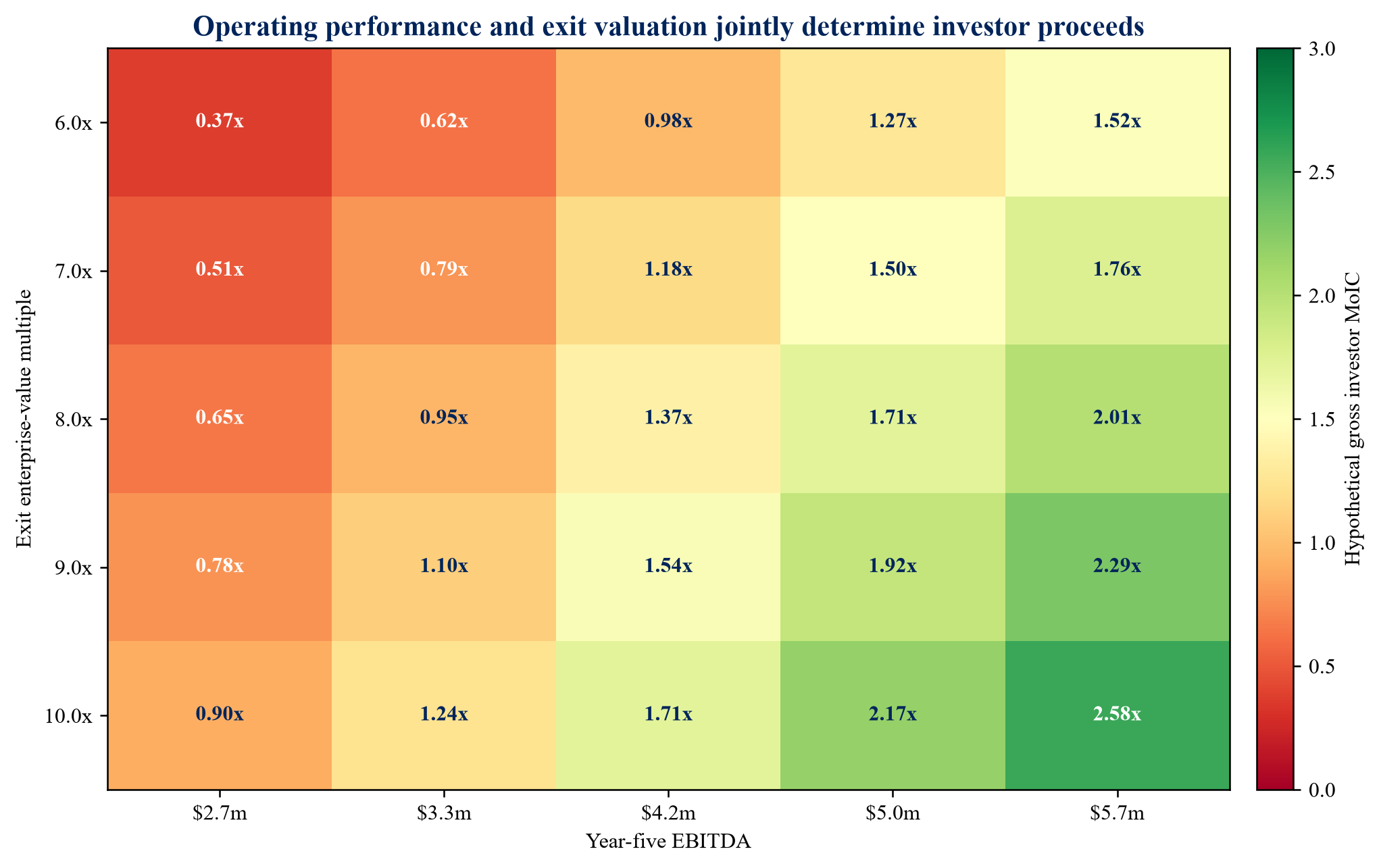
The heat map uses the paper's author-assumed capital structure and a simplified debt schedule. It excludes taxes, dividends, follow-on capital and transaction costs and is not a forecast.
14. Post-close liquidity is part of acquisition finance
The acquired company starts day one with obligations that may not appear in the purchase price. Payroll, supplier payments, customer refunds, tax, deferred maintenance, retention awards, systems upgrades and adviser bills can arrive before operating improvements produce cash. The sources-and-uses statement should include an opening reserve and a committed contingency route.
The first hundred days should protect cash and revenue continuity. Management confirms bank mandates, payments, collections, insurance, licences, customer contacts, supplier terms and employee retention. It establishes a thirteen-week cash forecast and reconciles the forecast to bank balances every week. Strategic initiatives can proceed when the company understands its immediate obligations and operating capacity.
Board reporting should separate value creation from transaction accounting. A closing balance-sheet adjustment, provision release or purchase-price allocation should not be presented as operating progress. The board needs comparable revenue, gross margin, cash conversion, working capital, customer retention, employee stability, capital expenditure and covenant headroom. Definitions should be fixed early.
The capital plan should include follow-on rules. Investors need to know whether additional equity is mandatory, pro rata or discretionary and how non-participation affects ownership. Lenders need to know when equity cures or sponsor support are available. Management needs authority to fund essential actions. Ambiguity about future capital can delay corrective measures and worsen the eventual need.
Post-close governance should be practical. Reserved matters protect investors from major changes, while the chief executive needs authority over ordinary operations. The board calendar should cover monthly performance, quarterly strategy and annual budget. A lead independent or experienced operating director can help the first-time chief executive separate board oversight from investor negotiation.
15. Technology should improve evidence without automating judgement
A modern search process can use data to identify companies, map ownership, score sector fit, monitor filings and manage outreach. Artificial intelligence can classify public information, extract contract terms, compare diligence documents and identify anomalies. These tools can expand coverage and speed review. Their outputs require source traceability, privacy controls, human review and a clear boundary around confidential information.
The opportunity system should preserve the reason each target entered or left the funnel. Scores should be explainable and tested for bias towards companies with richer public data. A business with limited digital presence may be attractive, while a well-indexed company may simply be easier to find. Human judgement should remain accountable for outreach, valuation and exclusion decisions.
During diligence, automated extraction can create a contract and obligation register. It can identify change-of-control clauses, renewal dates, pricing terms, data-processing obligations and unusual wording. The team should verify every material item against the source document. Models should not infer missing contractual rights. Access, retention and privilege protocols should be agreed before sensitive data is processed.
Post-close, a common data model can connect sales, delivery, cash, working capital and covenants. Early-warning indicators can surface faster than monthly financial statements. The searcher should avoid a broad transformation programme before data ownership and operating priorities are clear. A small set of reconciled measures is more valuable than an extensive dashboard built on inconsistent definitions.
Cybersecurity and access control are transaction risks. The buyer should inventory privileged accounts, administrator rights, backups, third-party access and critical systems before control transfers. Payment instructions should use dual approval and verified bank details. Seller and adviser access should be removed or retained according to the transition plan, with an auditable record.
16. Governance and early-warning indicators protect the capital stack
The board should adopt a decision ledger that links investment-case assumptions to observed performance. Material variances receive an owner, response and deadline. A recurring-revenue assumption can be tested through renewal and churn. Working-capital improvement can be tested through ageing and collection. Management depth can be tested through delegation and retention. This makes the original underwriting useful after closing.
Lender reporting should use the definitions in finance documents. The company should calculate covenants before the formal test date and reconcile them independently. Forecast breaches should be discussed early enough to pursue an operational correction, equity support, waiver or amendment. Late recognition reduces options and negotiating leverage.
Seller obligations should also be monitored. Deferred consideration, seller-note payments, earn-outs, transition services, warranties and indemnity claims can interact. A dispute over one item should not cause an accidental breach of another. The board should maintain a contractual calendar and obtain advice before set-off, withholding or enforcement.
Table 4. Early-warning indicators and board responses after a search-fund acquisition
| Indicator | Risk indicated | Immediate response | Board decision |
|---|---|---|---|
| Thirteen-week cash headroom falls below policy | Operating or collection pressure | Reconcile cash, receipts and committed facilities | Pace investment, raise capital or amend facilities |
| Receivable ageing increases | Earnings are not converting to cash | Segment customers and assign collections | Change terms, escalation and credit policy |
| Customer concentration rises | Revenue resilience weakens | Review pipeline and contract exposure | Fund diversification or protect key account |
| Covenant headroom falls | Debt may constrain operations | Recalculate definitions and downside forecast | Engage lender, cure, amend or deleverage |
| Seller transition milestones slip | Knowledge and relationship transfer is incomplete | Document missing actions and accountable parties | Extend support, enforce rights or replace capability |
| Key employee attrition exceeds plan | Transferability and execution are at risk | Conduct retention interviews and succession review | Adjust incentives, roles and recruitment |
| Board pack definitions change | Performance comparison is unreliable | Reconcile current and prior periods | Approve fixed definitions and independent checks |
| Growth investment misses leading milestones | Capital may be consumed without value creation | Stop additional spend pending review | Redesign, stage or terminate initiative |
Thresholds require calibration to the company, capital documents and operating plan.
17. A 100-day financing and operating plan
Days 1 to 15 should establish control of cash, commitments and authority. Management verifies bank access, payment approvals, payroll, taxes, insurance, customer collections, supplier obligations, debt, seller instruments and the closing funds flow. It builds a thirteen-week cash forecast and confirms covenant definitions. The board approves minimum liquidity and escalation thresholds.
Days 16 to 35 should stabilise revenue and people. The chief executive meets major customers and suppliers, confirms service continuity and reviews renewal risks. Key employees receive clear roles and retention decisions. Seller transition obligations are converted into a dated plan. Data access and cybersecurity controls are updated for the new ownership structure.
Days 36 to 55 should validate the investment case. Finance produces a normalised monthly bridge from underwriting to actual performance. Management tests pricing, margin, sales pipeline, working capital and maintenance capital expenditure. Every material difference is classified as timing, definition, diligence miss or operating variance. Corrective actions receive owners and cash implications.
Days 56 to 75 should sequence value creation. Initiatives are ranked by cash requirement, reversibility, evidence and strategic impact. Quick wins that improve collections, purchasing or pricing can fund later investment. Technology projects should begin with reconciled data and an operating owner. Hiring should follow a demonstrated capability gap and a funded plan.
Days 76 to 90 should refresh the capital structure. The company reforecasts debt service, covenants, seller payments and liquidity under downside scenarios. It reviews whether the revolver remains available and whether follow-on equity is needed. The board engages lenders and investors before a shortfall becomes urgent.
Days 91 to 100 should approve the operating standard. The board fixes reporting definitions, decision authorities, meeting cadence, risk register and annual planning process. Search-stage investor reporting transitions to company governance. The searcher's success is now measured through operating evidence, resilient cash flow and responsible stewardship of the acquired business.
18. Conclusion
Search-fund capital works when it respects the distinct risks of search, acquisition and operation. Search capital creates the time and discipline to find a suitable company. Acquisition capital allocates price and downside among investors, lenders and seller. Post-close capital protects the company's capacity to operate and improve. Each stage requires a fresh decision supported by current evidence.
The framework begins with cash conversion and transferability. It then builds a sources-and-uses statement that includes fees, opening liquidity and required investment. Sponsor economics are modelled through every dilution and exit case. Debt follows sustainable free cash flow. Seller rollover, vendor notes and earn-outs bridge value only when their ranking, governance and measurement are explicit.
The GCC, United Kingdom and India offer different combinations of ownership, financing, regulatory and seller dynamics. Vehicle selection should follow the operating business and capital path. Merger control, investment screening, foreign-exchange rules and change-of-control consents should enter the timetable before exclusivity. The capital stack is executable only when legal entities can receive, move and repay the required funds.
The hypothetical case shows that modest operating underperformance, exit-multiple compression and residual debt can overwhelm the protective effect of lower incentive vesting. A resilient acquisition therefore depends on price discipline, cash conversion, covenant capacity, opening liquidity and rapid post-close control. These are the foundations that turn an acquisition thesis into responsible ownership.
References
- IESE Business School. International Search Funds 2024: Selected Observations. September 2024. https://www.iese.edu/media/research/pdfs/ST-0658-E
- Stanford Graduate School of Business. 2024 Search Fund Study. 2024. https://www.gsb.stanford.edu/faculty-research/case-studies/2024-search-fund-study
- United Arab Emirates Ministry of Economy. Federal Decree-Law No. 37 of 2022 Concerning Family Companies. https://www.moec.gov.ae/documents/20121/0/family%2Bcompany%2Benglish%2Bversion%2Bexamined%2Band%2Bcorrecetd.pdf/5639a956-fe15-6de2-a04e-c8f8ecb6c2bf
- Abu Dhabi Global Market. Special Purpose Vehicles. https://www.adgm.com/business-areas/special-purpose-vehicles
- United Arab Emirates Ministry of Economy. Federal Decree-Law No. 36 of 2023 Regulating Competition. https://www.moec.gov.ae/documents/20121/0/Federal%2BDecree-Law%2BNo.%2B%2836%29%2Bof%2B2023%2BRegulating%2BCompetition.pdf/d5f2b12d-7688-5180-e63b-44a8dbe878d6
- United Arab Emirates Ministry of Economy. Cabinet Resolution No. 3 of 2025 thresholds and controls for economic concentrations. 20 February 2025. https://www.moec.gov.ae/en/-/-%D8%%D9%84%D8%%D9%82%D8%AA%D8%%D8%%D8%AF-%D8%AA%D8%%D8%AA%D8%%D8%%D8%-%D9%82%D8%%D8%%D8%-%D9%85%D8%AC%D9%84%D8%-%D8%%D9%84%D9%88%D8%%D8%%D8%%D8%-%D8%%D8%%D8%%D9%86-%D8%%D9%84%D9%86%D8%%D8%-%D9%88%D8%%D9%84
- British Business Bank. Guide to Private Equity. https://www.british-business-bank.co.uk/business-guidance/guidance-articles/finance/private-equity
- United Kingdom. Companies Act 2006. https://www.legislation.gov.uk/ukpga/2006/46/contents
- United Kingdom Cabinet Office. National Security and Investment Act: details of the 17 types of notifiable acquisitions. Updated 6 February 2024. https://www.gov.uk/government/publications/national-security-and-investment-act-guidance-on-notifiable-acquisitions/national-security-and-investment-act-guidance-on-notifiable-acquisitions
- United Kingdom Cabinet Office. Check if you need to tell the government about an acquisition that could harm national security. Updated 15 July 2026. https://www.gov.uk/guidance/national-security-and-investment-act-guidance-on-acquisitions
- Competition and Markets Authority. Mergers: guidance on the CMA's jurisdiction and procedure. https://www.gov.uk/government/publications/mergers-guidance-on-the-cmas-jurisdiction-and-procedure
- Reserve Bank of India. Master Direction: Foreign Investment in India, updated 20 January 2025. https://www.rbi.org.in/Scripts/NotificationUser.aspx/www.mastercirculars.rbi.org.in/Scripts/NotificationUser.aspx?Id=11200
- Competition Commission of India. Regulation of Combinations. https://cci.gov.in/regulation-of-combination
- Competition Commission of India. Competition Commission of India (Combinations) Regulations, 2024, General Statement. https://cci.gov.in/images/whatsnew/en/general-statement-combination-regulations1725954145.pdf
- Organisation for Economic Co-operation and Development. OECD Corporate Governance Factbook 2025. https://www.oecd.org/corporate/corporate-governance-factbook/
- International Private Equity and Venture Capital Valuation Board. International Private Equity and Venture Capital Valuation Guidelines. https://www.privateequityvaluation.com/valuation-guidelines
- IFRS Foundation. IFRS 3 Business Combinations. https://www.ifrs.org/issued-standards/list-of-standards/ifrs-3-business-combinations/
- IFRS Foundation. IFRS 13 Fair Value Measurement. https://www.ifrs.org/issued-standards/list-of-standards/ifrs-13-fair-value-measurement/
- Financial Action Task Force. International Standards on Combating Money Laundering and the Financing of Terrorism and Proliferation. https://www.fatf-gafi.org/en/publications/Fatfrecommendations/Fatf-recommendations.html
- International Labour Organization. ILO MNE Declaration: Principles concerning multinational enterprises and social policy. https://www.ilo.org/empent/areas/mne-declaration/lang--en/index.htm
- United Nations Commission on International Trade Law. UNCITRAL Model Law on Secured Transactions. https://uncitral.un.org/en/texts/securityinterests/modellaw/secured_transactions
- World Bank. Business Ready 2025. https://www.worldbank.org/en/businessready
