

1. Introduction
An investor can believe in private markets and still need liquidity. The tension becomes acute when capital calls, family distributions, operating expenditure, debt maturities, tax payments, acquisitions and new investment opportunities arrive before expected fund distributions.
The secondary market provides a route to sell an existing fund interest, portfolio of interests or exposure to private companies. It can also allow an existing limited partner to sell or roll an interest during a continuation-fund transaction. The instrument is transactional. The management problem is broader: how much cash is needed, when it is needed, which exposures can be sold, which risks should remain, what economics are acceptable and how the portfolio should be rebuilt after settlement.
The market has grown. Jefferies estimated global secondary transaction volume at USD 240 billion in 2025, 48 percent above 2024. Its estimates divided volume into USD 125 billion of LP-led transactions and USD 115 billion of GP-led transactions.[1] These figures describe Jefferies' market estimate rather than an audited universal dataset. BlackRock's 2026 outlook states that more investors are using secondaries for liquidity and regular portfolio management.[2]
Greater market depth does not make every interest liquid. Buyer appetite varies by manager, strategy, asset quality, vintage, geography, unfunded commitment, remaining duration, information access, transfer restriction and transaction size. Pricing evidence from one market segment may have limited relevance to another.
A treasury approach begins before a buyer is contacted. The investor defines the cash requirement, protects a reserve, maps all private-market obligations, tests alternatives and approves a transaction boundary. The sale process then serves an agreed balance-sheet objective.
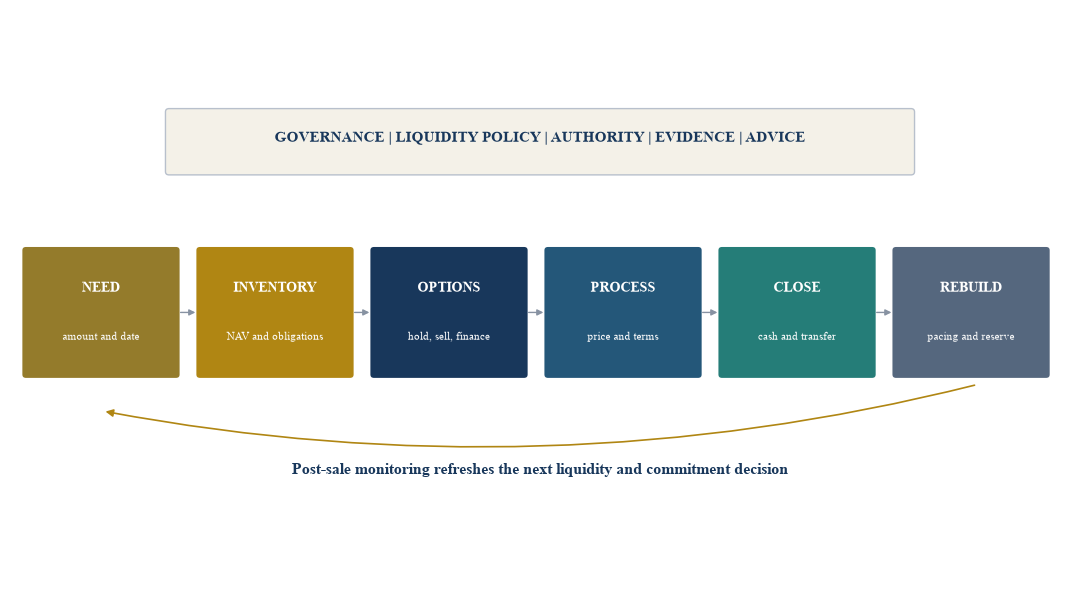
Author framework. A transaction begins with the balance-sheet objective and ends with portfolio rebalancing and evidence.
2. Define the treasury objective before the sale perimeter
The governing body should state the reason for liquidity in measurable terms. Examples include maintaining a minimum operating reserve, funding known capital calls, meeting family or foundation distributions, reducing an over-allocation, eliminating a concentrated manager exposure or creating capacity for a higher-conviction programme.
The objective records amount, currency, latest receipt date, minimum reserve after payment and acceptable sources. It distinguishes a permanent need from a timing gap. A short timing gap can support a different route from a structural over-allocation.
The institution should build a base case, downside case and severe but plausible case. Each case includes liquid assets, expected income, distributions, capital calls, recallable distributions, fees, operating costs, debt service, tax, family obligations and approved new commitments. Expected private-market distributions require a haircut when recent realisations are slow or manager guidance has weak forecasting value.
The governing body also states what the transaction should preserve. It can protect exposure to a strategy, key manager relationship, vintage profile, geography, co-investment right or future re-up allocation. This preservation list prevents a cash target from becoming an indiscriminate disposal.
A no-sale case remains part of the decision. It shows which expenditure, commitments or investments would be delayed, which liquid assets would be sold and whether financing is available. The economic comparison should include risks created by each route.
3. Build a complete private-market inventory
The sale decision depends on accurate records. A headline NAV schedule is insufficient. The inventory should link each interest to its legal holder, fund and side-letter documents, commitment, funded capital, unfunded amount, recallable distributions, latest NAV date, currency, cash flows, expected life, manager outlook, transfer provisions, tax basis and valuation evidence.
Valuation date matters. Private-fund NAV can be reported with a lag. Market developments, exits, capital calls and distributions between the reference date and pricing date can change the economic exposure. The investor should record post-period events separately and reconcile them through the purchase agreement.
IFRS 13 defines fair value as the price received to sell an asset or paid to transfer a liability in an orderly transaction between market participants at the measurement date.[3] It sets a measurement framework where another IFRS requires or permits fair value. The 2025 IPEV Guidelines provide current best-practice recommendations for private-capital investments reported at fair value.[4] Accounting fair value, the manager's reported NAV, an indicative secondary bid and the final cash proceeds are related measures with different purposes. The investor should avoid treating them as interchangeable.
Operational data belongs in the same register. The team records manager contacts, notice addresses, consent steps, buyer eligibility limits, rights of first refusal, confidentiality requirements, minimum transfer size, legal opinion needs and anticipated closing cycle.
Table 1. Minimum secondary treasury register
| Field | Required record | Treasury use | Evidence owner |
|---|---|---|---|
| Legal interest | holding entity, fund, class, commitment and ownership percentage | identifies seller, authority and scope | legal and operations |
| Value | latest NAV, date, currency, valuation policy and post-period events | establishes a dated reference point | finance and investment team |
| Obligations | unfunded, recallable distributions, fees and expected calls | measures future liquidity exposure | treasury |
| Cash flows | contributions, distributions and realised history | supports pacing and return analysis | fund accounting |
| Exposure | strategy, sector, geography, manager, vintage and underlying concentration | tests portfolio consequences | investment team |
| Outlook | expected life, exits, distributions and manager commentary | supports hold and sale scenarios | relationship owner |
| Transfer | consent, restrictions, eligibility, rights and minimum size | tests execution feasibility | legal counsel |
| Tax and accounting | basis, structure, reporting and advice status | identifies proceeds and reporting dependencies | tax and finance |
| Process status | approved, marketed, bid, diligence, consent, closing or withdrawn | controls information and decisions | transaction lead |
| Evidence | source, date, reviewer and unresolved difference | creates an auditable decision record | programme office |
The register should reconcile to manager statements, accounting records, legal documents and the cash forecast.
4. Connect the inventory to a rolling liquidity ladder
The liquidity ladder converts portfolio data into dated decisions. A useful horizon can extend over 24 to 36 months, with weekly or monthly detail in the near term and quarterly detail later. The appropriate horizon depends on the institution's obligations and private-market programme.
Cash sources receive confidence bands. Cash and short-dated deposits are highly visible. Public securities have market and execution risk. Private-fund distributions depend on asset exits, financing and manager decisions. Expected sale proceeds depend on buyer interest, price, diligence, consent and settlement.
Cash uses also receive priority and flexibility classifications. Contractual capital calls, debt service and payroll differ from optional commitments or discretionary acquisitions. The governing body defines which uses can move and which require a protected reserve.
The sale target should include a timing margin and transaction buffer. A process can slip. The final proceeds can differ from the initial indication. Foreign-exchange movement can alter cash in the required currency. A target equal to the exact forecast gap leaves no tolerance.
The ladder is refreshed after every material capital call, distribution, commitment, acquisition, financing change or transaction milestone. It is a control record rather than a one-off model.
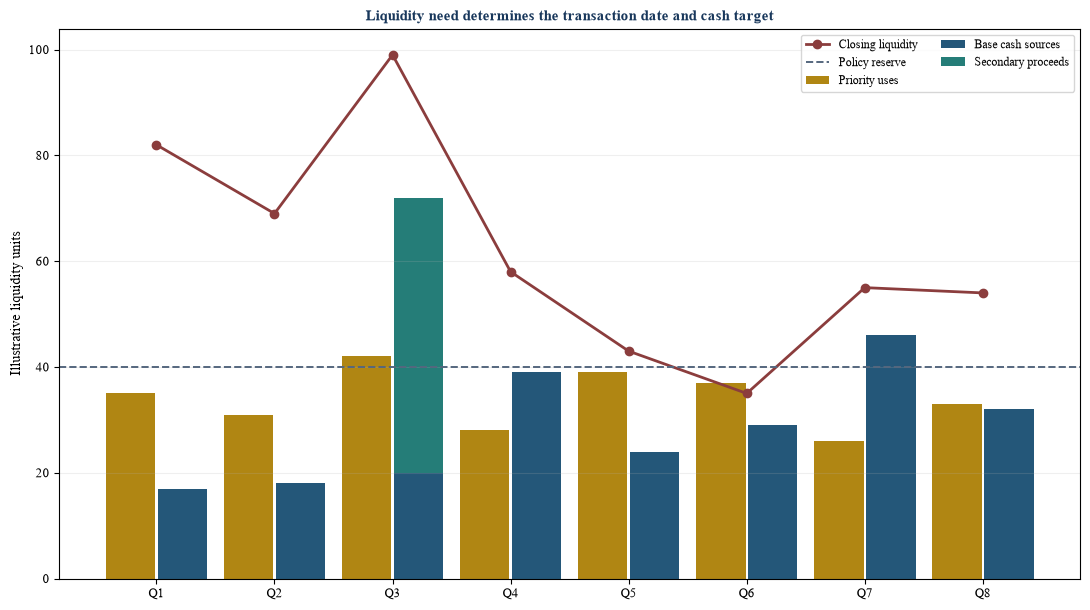
Author framework. Values shown are illustrative units and do not describe an investor.
5. Translate policy into an eligible sale universe
The investor can divide holdings into protect, review and potential-sale groups. Protected interests serve a current strategic purpose or would create unacceptable loss of access, diversification or manager relationship if sold. Review interests require more data. Potential-sale interests can contribute liquidity while improving portfolio design.
A scorecard should avoid a single mechanical ranking. A low-conviction mature fund with little unfunded exposure may be attractive to sell, yet its expected near-term distributions can make a rushed disposal poor treasury economics. A strong fund with buyer demand may command a better price, yet selling it can weaken the remaining portfolio.
Candidate assessment includes liquidity contribution, likely buyer depth, manager quality, underlying concentration, remaining life, unfunded commitment, expected cash flows, valuation confidence, transfer complexity, strategic fit and post-sale exposure. The team should identify correlated holdings and cross-fund positions because buyers can assess them differently as a package.
The sale perimeter can contain complete interests, partial interests, a diversified portfolio, a concentrated strip or selected assets. Partial sales can preserve upside and relationships, subject to fund documents and operational feasibility. Portfolio composition can influence competitive tension and price.
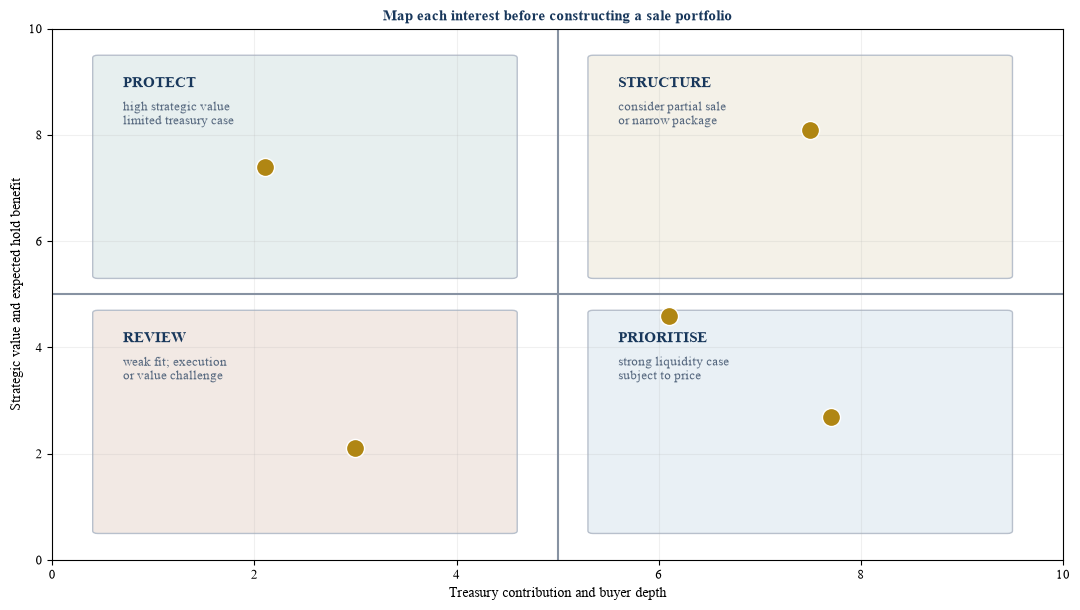
Author framework. Final selection requires qualitative judgement, legal feasibility and current market testing.
Table 2. Sale-candidate scorecard
| Dimension | Evidence | Favourable sale signal | Favourable hold signal |
|---|---|---|---|
| Liquidity contribution | indicative proceeds, settlement and currency | meaningful near-term reserve benefit | proceeds arrive after the required date |
| Strategic fit | investment policy and target allocation | redundant or outside future programme | core manager, strategy or access |
| Manager and asset quality | performance, attribution, portfolio and organisation | weak conviction or governance concern | high conviction with credible value-creation path |
| Remaining duration | fund term, extensions and exit plan | long uncertain tail with operating burden | near-term, well-supported realisation path |
| Unfunded exposure | commitment and call forecast | sale removes material future calls | little unfunded or valuable follow-on rights |
| Expected distributions | asset and exit schedule | low or distant distributions | credible near-term cash generation |
| Concentration | manager, asset, sector, geography and vintage | sale reduces an unintended concentration | sale would create a new concentration |
| Buyer depth | advisor soundings and comparable activity | broad relevant buyer set | narrow buyer set or information disadvantage |
| Transferability | LPA, side letter, consent and eligibility | clear and practical process | restriction, right or consent threatens execution |
| Total economics | price-to-cash analysis and hold scenario | proceeds improve risk-adjusted treasury position | discount and lost upside outweigh liquidity value |
Scores support discussion and should not replace investment judgement. Weightings require governing approval.
6. Design the route around the objective
An outright LP interest sale is one route. A targeted sale can remove selected exposures. A portfolio sale can increase scale and diversify buyer risk, although mixed quality can complicate bids. A partial transfer can release cash while preserving exposure. A structured sale can use deferred consideration. A continuation-fund process can offer a sell or roll election. Financing can bridge timing without transferring ownership.
Each route creates a different combination of cash timing, price certainty, residual exposure, future obligations, documentation, counterparty risk, governance and tax treatment. The governing body should compare routes on a common base.
Deferred consideration can improve a headline price or buyer capacity. It changes the treasury benefit because part of the proceeds becomes a receivable subject to timing, credit, documentation and potentially security risk. The institution should value the deferred component rather than adding it at face value to immediate cash.
An investor can also stage a programme. A small targeted transaction can meet an immediate need, preserve more attractive interests and establish process capability. A recurring review can prevent future forced selling.
Table 3. Comparison of private-market liquidity routes
| Route | Near-term cash | Exposure retained | Principal dependencies | Treasury question |
|---|---|---|---|---|
| Targeted LP sale | high if the interest attracts buyers | remaining portfolio | price, diligence, consent and settlement | does the selected interest meet the cash target without damaging portfolio design? |
| Portfolio sale | potentially high and diversified | assets outside perimeter | portfolio construction, buyer capacity and allocation of bids | does scale improve certainty and economics? |
| Partial interest sale | medium | direct residual interest | divisibility, buyer appetite, consent and operations | is preserved exposure worth the extra complexity? |
| Deferred consideration | lower at closing | no fund exposure after full transfer, plus buyer receivable | counterparty, discounting, security and payment dates | how much usable cash exists on each required date? |
| Continuation-fund sell | cash at transaction closing | none in transferred assets | conflict process, price, documents and election | is the cash option fair relative to hold and roll? |
| Continuation-fund roll | little or no sale cash | continued asset exposure | new economics, duration, governance and concentration | would the investor underwrite this vehicle as a new investment today? |
| Asset-backed or NAV financing | debt proceeds | portfolio ownership | borrowing capacity, covenant, cost, recourse and maturity | is the need temporary and is repayment visible? |
| Commitment or spending adjustment | preserves cash | portfolio ownership | flexibility and opportunity cost | can the institution solve the gap within policy without a transaction? |
The actual terms, risks and treatment require transaction-specific diligence and advice.
7. Convert the headline bid into usable cash
A bid expressed as a percentage of NAV is a starting point. The reference NAV date, purchase-price mechanics and subsequent cash flows determine consideration. Capital calls and distributions between the reference date and closing can accrue to the buyer or seller under agreed terms. Fund-level value changes may be addressed through pricing conventions, exclusions or adjustments.
The price-to-cash bridge begins with the applicable reference value. It applies the quoted percentage, then reconciles post-reference contributions, distributions, excluded assets, leakage, foreign exchange, deferred consideration, escrow, fees and tax. The model separates final economic consideration from cash available at closing.
Jefferies estimated average 2025 LP portfolio pricing at 87 percent of NAV, with buyout interests at 92 percent, venture and growth at 78 percent, credit at 91 percent and real estate at 70 percent.[1] These are Jefferies estimates across reported market activity. They do not establish a price for a particular interest. Age, quality, concentration, information, unfunded commitments, buyer competition and current market conditions can produce materially different outcomes.
The hold case should use the same valuation date and currencies. It includes expected distributions, calls, remaining duration, tail costs and a range of terminal outcomes. A sale discount can be economically rational when it removes future calls, concentration, duration and operating burden. A high headline price can be unattractive when deferred or exposed to leakage.
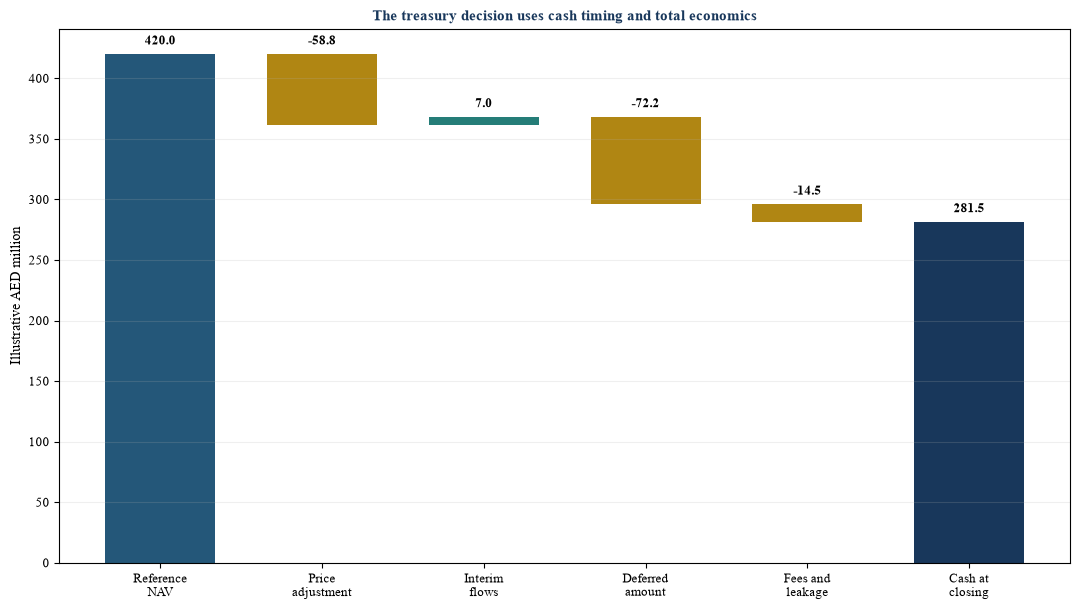
Values are illustrative management assumptions. Fees, tax and foreign exchange require transaction-specific analysis.
8. Underwrite the hold, sell and partial-sale cases
The investment committee should receive comparable scenarios. The hold case includes current NAV, expected calls, distributions, remaining duration, risk, concentration and exit ranges. The sell case includes bid range, probability, cash dates, forgone exposure, future-call relief and transaction costs. The partial-sale case includes both sets of effects.
Sensitivity analysis should focus on the variables that can change the decision: sale price, closing delay, expected distribution timing, underlying exit value, currency, deferred-payment credit, future calls and reinvestment return. A single internal-rate-of-return comparison can hide cash timing and reserve breaches.
The committee also tests regret. One form is selling a high-quality interest before a strong exit. Another is holding through a liquidity shortfall that forces a worse sale later. The decision record explains which regret the institution can absorb under its purpose and risk capacity.
Scenario probabilities should be clearly identified as management estimates. Manager forecasts, advisor indications and internal assumptions should remain separately visible. The model records source dates and a range rather than blending them into an apparently precise forecast.
9. Run a competitive and controlled market process
A transaction lead should prepare the approved perimeter, process strategy, confidentiality protocol, buyer universe, timetable, data room, bid instructions and decision calendar. An advisor can broaden access and support price discovery. The institution should assess advisor conflicts, relevant buyer coverage, fee structure and role.
The buyer universe should reflect strategy, geography, size, concentration, eligibility and appetite. Wider outreach can improve tension while increasing confidentiality and relationship exposure. A staged process can use anonymised or limited data before qualified bidders receive detailed materials.
Bid instructions should request price, reference date, payment timing, deferred terms, exclusions, diligence conditions, financing status, approvals, buyer identity, transfer assumptions and validity period. A high bid with many conditions may provide less certainty than a slightly lower executable bid.
The team maintains a bid comparison on a common cash basis. It records changes between initial, final and binding offers. Any package allocation, dropped interest or price re-trade receives approval under the authority matrix.
The GP relationship is managed deliberately. The seller should comply with confidentiality and transfer terms, give appropriate notice and avoid implying consent before it is received. The fund manager can provide transfer requirements and may have rights or concerns relevant to the buyer.
10. Treat legal transfer, tax and accounting as transaction workstreams
The legal review begins before marketing. It covers transfer restrictions, consent, rights of first refusal, buyer eligibility, minimum holdings, confidentiality, side letters, excuse rights, default, sanctions, anti-money-laundering requirements, representations, indemnities and continuing obligations.
The holding entity and authority must be exact. Board, trustee, foundation-council, investment-committee, protector, shareholder or financing approvals can differ. Signing authority and beneficial ownership records should be current.
Tax analysis identifies the seller, asset, jurisdiction, basis, gain or loss, withholding, transfer tax, indirect tax, permanent-establishment considerations and reporting. The treatment can vary across fund interests and holding structures. The treasury model should mark tax as pending until advice is complete rather than insert a generic rate.
Accounting analysis addresses derecognition, measurement, realised gain or loss, foreign exchange, deferred consideration, receivable impairment, fees and disclosure under the applicable framework. The transaction price can provide valuation evidence, yet its relevance to other holdings depends on comparability and facts.
The closing checklist aligns purchase agreement, consent, know-your-customer review, tax forms, wire instructions, fund records and accounting entries. Cyber controls independently verify payment instructions and changes.
Table 4. Secondary execution controls
| Stage | Control | Required evidence | Release authority |
|---|---|---|---|
| Perimeter | seller, interest and authority reconciled | ownership record, fund documents and approvals | legal and investment lead |
| Market preparation | disclosure and confidentiality boundaries approved | NDA, data-room index and buyer protocol | transaction lead and legal counsel |
| Bidding | offers compared on common terms | bid letters, assumptions and price-to-cash bridge | investment committee |
| Diligence | buyer questions and disclosures controlled | Q&A log, source documents and disclosure approvals | transaction lead |
| Transfer | consent and rights completed | GP consent, waiver or expiry evidence and eligibility | legal counsel |
| Tax and accounting | treatment and entries approved | current advice, basis schedule and accounting paper | finance authority |
| Closing | documents, identity and cash instructions verified | executed agreement, KYC, call/distribution allocation and dual verification | authorised signatories |
| Settlement | cash and transfer records reconciled | bank receipt, manager register and completion statement | treasury and fund accounting |
| Post-close | residual rights and obligations recorded | archive, tail obligations and portfolio update | programme owner |
The control owner should retain dated evidence and unresolved exceptions for each interest.
11. Make continuation-fund elections as new investment decisions
A continuation fund can transfer one or more assets from an existing fund into a new vehicle managed by the same sponsor. Existing limited partners can receive an option to sell, roll or combine the two, depending on the transaction.
The structure creates conflicts because the sponsor can influence the sale process, valuation, disclosure and new vehicle while continuing to manage the assets. ILPA's 2023 guidance calls for a process designed to maximise value for existing LPs, appropriate LP advisory committee engagement, timely information, conflict management and independent price validation.[5] ILPA recommends at least 30 calendar days or 20 business days for an election after complete information has been delivered, subject to the circumstances and documents.[5]
ILPA published a Continuation Fund Disclosure Template in January 2026 to consolidate key information for an LP's roll or sell analysis. ILPA states that the template does not replace definitive transaction materials or GP and advisor documents.[6]
The investor should underwrite a roll as a fresh commitment. It reviews assets, value-creation plan, downside, duration, governance, economics, leverage, follow-on capital, conflicts, manager commitment and exit routes. It compares the new vehicle with other uses of capital and tests concentration.
The sell election analyses price and cash certainty. A partial roll can balance liquidity and exposure. The governing record should identify information received, conflicts, independent evidence, advice, election authority and timing pressure.
Table 5. Continuation-fund roll or sell decision pack
| Question | Sell analysis | Roll analysis | Evidence |
|---|---|---|---|
| Transaction rationale | why is a cash exit offered now? | why does a new vehicle improve ownership? | sponsor memorandum and alternatives considered |
| Price and process | buyer competition, valuation date and fairness evidence | entry value and sensitivity | bids, valuation work and independent advice where obtained |
| Assets | forgone upside and downside | current underwriting and concentration | asset data, diligence and operating plan |
| Economics | cash, adjustments, tax and timing | fees, carry, rollover mechanics and costs | definitive terms and worked model |
| Governance | consent, disclosure and conflicts | LP rights, key-person and conflict process | LPA, side letter, LPAC materials and advice |
| Capital | future calls avoided | new unfunded and follow-on requirements | sources and uses, commitment schedule and downside case |
| Duration and exit | liquidity achieved at close | expected life, extensions and exit routes | base and downside timelines |
| Portfolio effect | allocation and reserve after sale | allocation, manager and asset concentration after roll | whole-portfolio model |
| Decision process | election validity and signing authority | new-investment authority and capacity | committee paper, minutes and election form |
This schedule complements current ILPA guidance, the definitive documents and transaction-specific advice.
12. Compare a sale with NAV-based financing
Financing can bridge a temporary gap while preserving ownership. It introduces interest, fees, covenants, collateral, maturity, refinancing and repayment risk. The borrower, recourse and collateral package matter. A fund-level NAV facility used by a GP has different economics and governance from financing arranged by an LP or family-office holding entity.
ILPA's 2024 NAV-Based Facilities Guidance addresses transparency, LP engagement, legal documentation and disclosures for fund-level facilities.[7] It highlights concerns about costs, risks and older LPAs that did not explicitly contemplate these facilities. The investor should understand how a manager's borrowing affects distributions, asset risk and fund economics.
The treasury comparison uses dated cash flows. A sale provides permanent liquidity and removes future calls on the transferred interest. Financing provides temporary liquidity and retains upside and calls. The repayment source should be credible under a downside case. Borrowing to fund recurring structural deficits can defer the decision while increasing risk.
The institution should avoid counting expected distributions twice: once as debt repayment and again as available liquidity. Covenants and collateral can constrain future portfolio actions. Current lender terms, legal capacity, tax and accounting require verification.
13. Establish decision rights and conflict controls
The governing body approves the liquidity policy, reserve, permitted routes, authority levels and conflict standard. Management prepares the inventory and scenarios. The investment committee approves portfolio consequences and transaction economics within delegated authority. Treasury controls cash timing. Legal, tax and accounting functions advise on their areas.
Conflicts can arise when an advisor represents buyers, receives contingent compensation or has relationships with fund managers. A family member can favour immediate distributions over long-term compounding. An investment professional can resist selling a manager they selected. A lender can prefer collateral protection over portfolio flexibility.
The conflict register names the interest, affected decision, mitigation and final authority. Recusal, independent advice, competitive process, separate review or governing-body approval can be appropriate. Disclosure alone may not manage a material conflict.
The decision paper separates verified facts, third-party estimates and management assumptions. It records rejected routes and conditions that would change the decision. Minutes capture the approved perimeter, minimum economics, delegated negotiation range, cash destination and post-close actions.
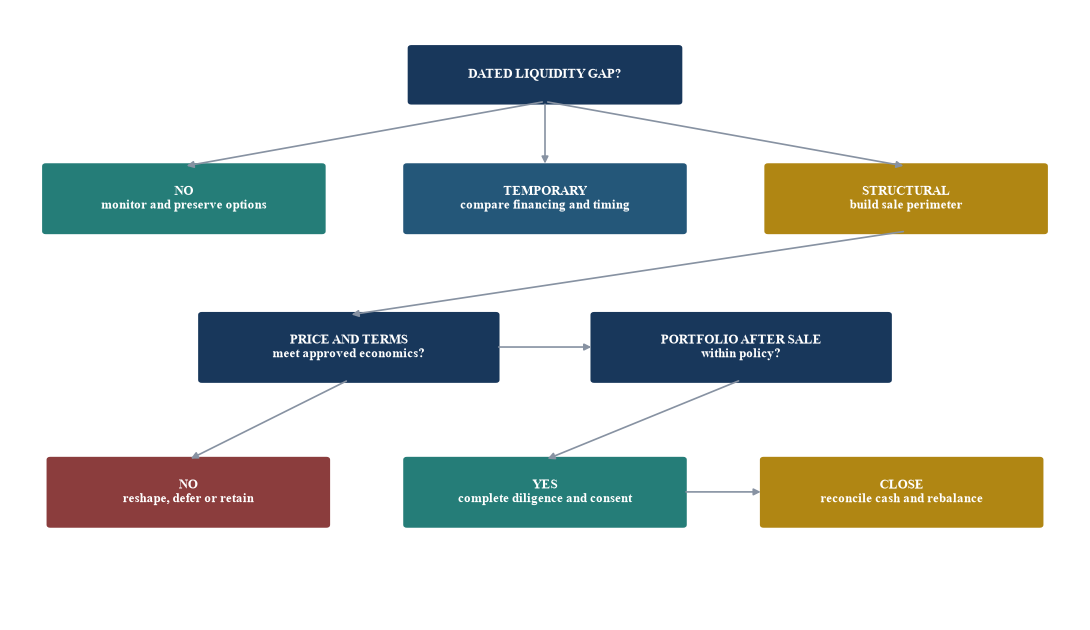
Author framework. Legal capacity, authority and current advice remain entry conditions.
14. Control closing and settlement
The period between signing and closing remains exposed to calls, distributions, valuation changes, consent, buyer conditions and operational error. The transaction team keeps an interest-by-interest schedule of economic ownership and cash allocation.
Capital-call responsibility should be clear. The seller may fund a call and receive a purchase-price adjustment, or the buyer may assume it after an agreed date. Distributions need equal clarity. Missed notices can create default or reconciliation disputes.
Wire instructions require independent verification through a known channel. A change received by email receives heightened review. Payment authority stays segregated from transaction negotiation and data-room administration.
At completion, treasury verifies receipt, currency and value date. Legal confirms transfer effectiveness. Fund accounting reconciles consideration, fees, distributions, calls and derecognition. The investment team updates exposures and unfunded commitments. The archive retains definitive documents, approvals, advice and evidence required by policy.
15. Rebuild the portfolio after liquidity is created
A secondary sale changes more than cash. It can change manager, strategy, sector, geography, vintage, currency and duration exposures. It can also reduce future calls and distributions. The post-sale model should be approved with the transaction.
Cash first restores the protected reserve and meets the stated obligation. Residual proceeds follow an approved allocation order. The institution can retain capacity for capital calls, repay financing, rebalance liquid assets or fund new commitments.
Commitment pacing should respond to the new cash-flow profile. Selling mature interests can remove near-term distributions, so immediate recommitment based only on lower NAV can recreate a liquidity mismatch. The pacing model includes future calls, conservative distributions and reserve thresholds.
The investor should assess manager access before selling. Some managers can consider a sale when allocating future funds. The relationship plan explains the treasury rationale, fulfils obligations and preserves professionalism without compromising the transaction.
The institution records realised economics against the original committee case. Price, closing date, leakage, fees, calls, distributions and cash use become evidence for the next review.
16. Demonstrate the framework with a hypothetical family office
Consider a hypothetical UAE family office with management-estimated total assets of AED 4.8 billion. Its private-fund NAV is AED 1.45 billion and unfunded commitments are AED 360 million. The 24-month treasury forecast contains AED 620 million of priority uses and a protected AED 70 million reserve.
Every number and circumstance in this example is a management assumption created solely to demonstrate the method. It does not describe a client, portfolio, transaction, market quote or recommendation.
The office identifies AED 240 million of cash and deposits, AED 135 million of approved public-market liquidity and AED 65 million of conservatively modelled private-market distributions over the required period. The aggregate sources of AED 440 million leave a forecast gap of AED 180 million before the protected reserve. The treasury target is therefore AED 250 million plus a transaction buffer.
The register contains 31 fund interests. The office protects nine core relationships and reviews the remainder. A candidate portfolio of seven interests has a reference NAV of AED 420 million and AED 74 million of unfunded commitments. The interests span older buyout, growth and real-estate vintages. These characteristics are illustrative assumptions.
The final illustrative offer equals 86 percent of reference NAV, or AED 361.2 million. Interim cash-flow adjustments add AED 7 million. Twenty percent of the headline consideration, AED 72.2 million, is deferred. Estimated fees and other leakage of AED 14.5 million remain management assumptions pending advice. Illustrative cash at closing is therefore approximately AED 281.5 million.
The immediate proceeds exceed the AED 250 million target. The committee tests a delayed close, a five-percentage-point price reduction and a larger capital-call case. It also compares a secured financing route. The financing case preserves all interests but creates a maturity before the downside distribution case produces sufficient repayment cash. Under these assumptions, the targeted sale provides the stronger treasury fit.
The residual portfolio remains within the management-approved strategy ranges, although the sale reduces mature buyout exposure. The office allocates initial proceeds first to the reserve and known calls. It delays new commitments until two quarterly forecasts confirm adequate headroom. The deferred receivable remains outside available liquidity until paid.
The example demonstrates the decision process. Current bids, legal terms, tax, accounting and advice would determine a real transaction.
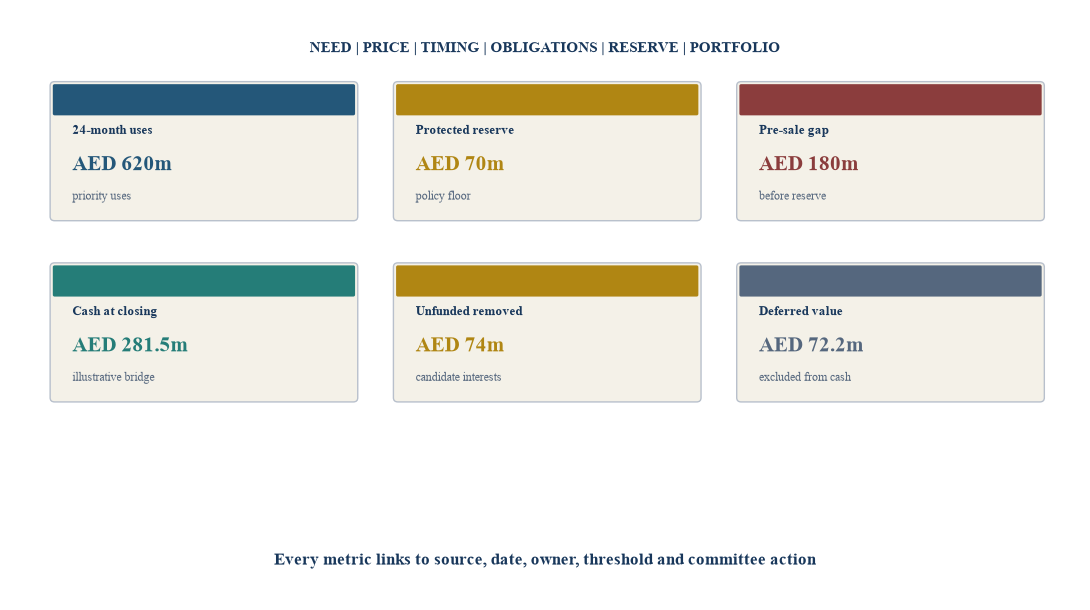
Every displayed value is an illustrative management assumption used solely to demonstrate dashboard design.
17. Monitor the programme as a treasury capability
The governing dashboard connects liquidity, transaction and portfolio measures. It shows forecast headroom by period, reserve coverage, forecast calls, expected distributions by confidence band, sale proceeds by date and deferred amounts.
Transaction measures include interests by stage, buyer coverage, bid range, conditions, consent status, expected close and unresolved tax or legal issues. A progress percentage without critical-path evidence can conceal risk.
Portfolio measures show private-market allocation, unfunded commitments, manager and vintage concentration, remaining duration and expected cash-flow profile before and after each proposed transaction. The committee can then see whether liquidity is being created by transferring unacceptable long-term risk.
Outcome measures compare the approved case with final price, cash at close, fees, leakage, calls, distributions and closing date. The team records which assumptions were inaccurate and updates forecasting methods.
Trigger points include a projected reserve breach, capital calls above the approved band, distributions below the downside case, a material valuation event, financing covenant pressure or a new family obligation. A trigger starts an options review before an emergency develops.
18. Implement the capability in 100 days
Days one to 20 establish the objective, authority and complete inventory. Treasury reconciles NAV, commitments, cash flows and documents with investment, finance, legal and operations teams.
Days 21 to 40 build the rolling liquidity ladder, scenario set and sale-candidate scorecard. The governing body approves the protected reserve, potential routes and decision rights.
Days 41 to 60 validate documents, transferability, tax and accounting workstreams for priority interests. The transaction team prepares the process, buyer universe, data room and bid instructions.
Days 61 to 80 run market soundings or a controlled process after approval. The team compares bids on a common cash basis and updates the hold, sale, partial-sale and financing cases.
Days 81 to 100 secure final approval, complete diligence, negotiate documents and prepare consent and closing. A transaction can require longer. The schedule is a capability-building sequence rather than a promise of completion.
Table 6. One-hundred-day secondary treasury implementation
| Days | Workstream | Controlled deliverable | Gate |
|---|---|---|---|
| 1 to 10 | governance | objective, reserve, authority, conflicts and advice plan | sponsor and decision rights confirmed |
| 11 to 20 | inventory | reconciled interests, NAV, unfunded, cash flows and documents | evidence gaps assigned |
| 21 to 30 | liquidity | base, downside and severe liquidity ladders | cash target and latest date approved |
| 31 to 40 | portfolio triage | protect, review and potential-sale groups | candidate perimeter approved for diligence |
| 41 to 50 | feasibility | transfer, tax, accounting, currency and operational review | no unresolved entry-condition blocker |
| 51 to 60 | process design | advisor decision, buyer universe, data room and bid rules | outreach and confidentiality approved |
| 61 to 75 | market process | comparable indications and updated scenarios | shortlist and negotiation range approved |
| 76 to 85 | final decision | binding economics, portfolio effect and funding plan | committee approval recorded |
| 86 to 95 | documentation | purchase agreement, consent, KYC and closing schedule | authorised signatories release execution |
| 96 to 100 | readiness | cash controls, accounting entries and post-sale pacing | close or continue under an approved extension |
Transaction timing depends on buyer diligence, manager consent, documentation, tax, regulation and market conditions.
19. Limitations and conclusion
Secondary-market conditions change. Jefferies' reported volumes and pricing are estimates for the periods and segments described.[1] They do not predict a future market or establish the value of an individual interest.
Manager-reported NAV can be dated and uses the applicable valuation policy. IFRS 13 and IPEV guidance address valuation within their respective scope, while a negotiated secondary price reflects the specific asset, information, transaction and participants.[3][4] Current accounting advice should determine recognition, measurement and disclosure.
Fund documents and side letters determine transfer requirements and continuing obligations. Legal, tax, regulatory, sanctions, privacy and accounting treatment depends on the parties, holding structure, jurisdiction and transaction. Current professional advice is required.
Forecast capital calls and distributions are uncertain. Manager guidance, internal estimates and market data should remain separately identified. Stress testing cannot capture every outcome.
Deferred consideration introduces counterparty and timing risk. Financing introduces leverage, covenant, maturity and refinancing risk. A continuation-fund election introduces a fresh underwriting and conflict decision. Each route requires a complete economic and governance review.
The hypothetical family office contains management assumptions solely for framework demonstration. It does not describe a client, actual market quote, expected outcome or recommended transaction.
A disciplined secondary programme begins with the liquidity objective and ends with a stronger balance sheet and deliberate private-market allocation. The investor maintains a complete inventory, links every interest to the liquidity ladder, protects strategic exposures, compares routes on total economics, runs a controlled process and records the result.
This capability can create cash without abandoning private markets. It allows the institution to retain high-conviction exposure, reduce unwanted concentration, remove selected future calls, preserve a protected reserve and recommit according to an updated pacing plan. The transaction becomes one part of an accountable treasury operating system.
References
- [1] Jefferies Private Capital Advisory, 2025 Global Secondary Market Review: Another Record-Breaking Year, 10 February 2026. Market volume, pricing and capital figures are Jefferies estimates. https://www.jefferies.com/insights/the-big-picture/2025-global-secondary-market-review-another-record-breaking-year/
- [2] BlackRock, Private Markets Outlook 2026: A New Continuum, published 2026 and accessed 12 August 2026. https://www.blackrock.com/institutions/en-global/institutional-insights/thought-leadership/private-markets-outlook
- [3] IFRS Foundation, IFRS 13 Fair Value Measurement, standard overview and issued standard, accessed 12 August 2026. https://www.ifrs.org/issued-standards/list-of-standards/ifrs-13-fair-value-measurement/
- [4] International Private Equity and Venture Capital Valuation Board, IPEV Valuation Guidelines, December 2025. https://www.privateequityvaluation.com/Valuation-Guidelines
- [5] Institutional Limited Partners Association, Continuation Funds: Considerations for Limited Partners and General Partners, May 2023. https://ilpa.org/resources-tools/resource-library/continuation-funds-considerations-for-limited-partners-and-general-partners/
- [6] Institutional Limited Partners Association, Continuation Fund Disclosure Template, 27 January 2026. https://ilpa.org/resources-tools/resource-library/continuation-fund-disclosure-template/
- [7] Institutional Limited Partners Association, NAV-Based Facilities: Guidance for Limited Partners and General Partners, 25 July 2024. https://ilpa.org/resources-tools/resource-library/nav-based-facilities-guidance/
- [8] Institutional Limited Partners Association, ILPA Principles and Best Practices, accessed 12 August 2026. https://ilpa.org/industry-guidance/principles-best-practices/
About the Author
Chennakeshav Adya is an independent researcher and Managing Partner of Matchpoint Partners. His research focuses on investment strategy, capital formation, transaction execution, governance and operating-model design across the Gulf and international markets.
