

1. Define the liquidity problem before choosing the transaction
Private-credit funds can appear liquid in an accounting sense while remaining unable to distribute cash when investors expect it. Reported net asset value represents an estimate of the value of underlying assets. It does not show when cash will arrive, whether that cash is available for distribution, or how much value would survive an accelerated sale. The first task is therefore to define the amount, timing, legal priority and purpose of the required liquidity.
Traditional closed-end private-credit structures reduce maturity transformation because investors commit capital for a term that broadly corresponds with the lives of the loans. The International Monetary Fund observes that this design can limit redemption pressure even though the underlying loans are illiquid and the secondary market is still developing [1]. The protection can erode when maturities extend, amendments defer cash interest, exits slow, follow-on funding consumes reserves or investor expectations diverge from contractual fund life. Semi-liquid vehicles introduce a further challenge because periodic liquidity features create recurring calls on a portfolio that may not generate comparable cash on demand [2].
The diagnosis should distinguish five needs. First, the fund may need cash to meet expenses, facility maturities or hedging obligations. Second, it may need capacity to protect or restructure borrowers. Third, investors may seek partial or full liquidity even though the vehicle remains solvent. Fourth, the legal fund term may be approaching its end while assets still have value beyond that date. Fifth, the manager may want strategic capital for a portfolio acquisition or a new investment programme. These needs cannot be treated as one generic funding gap.
The required output is a dated liquidity schedule rather than a headline amount. It should identify minimum operating cash, known obligations, prudent downside reserves, expected contractual receipts, assumptions about prepayment and extension, and the date by which each shortfall must be addressed. A transaction is suitable only if its cash certainty and execution timetable fit that schedule.
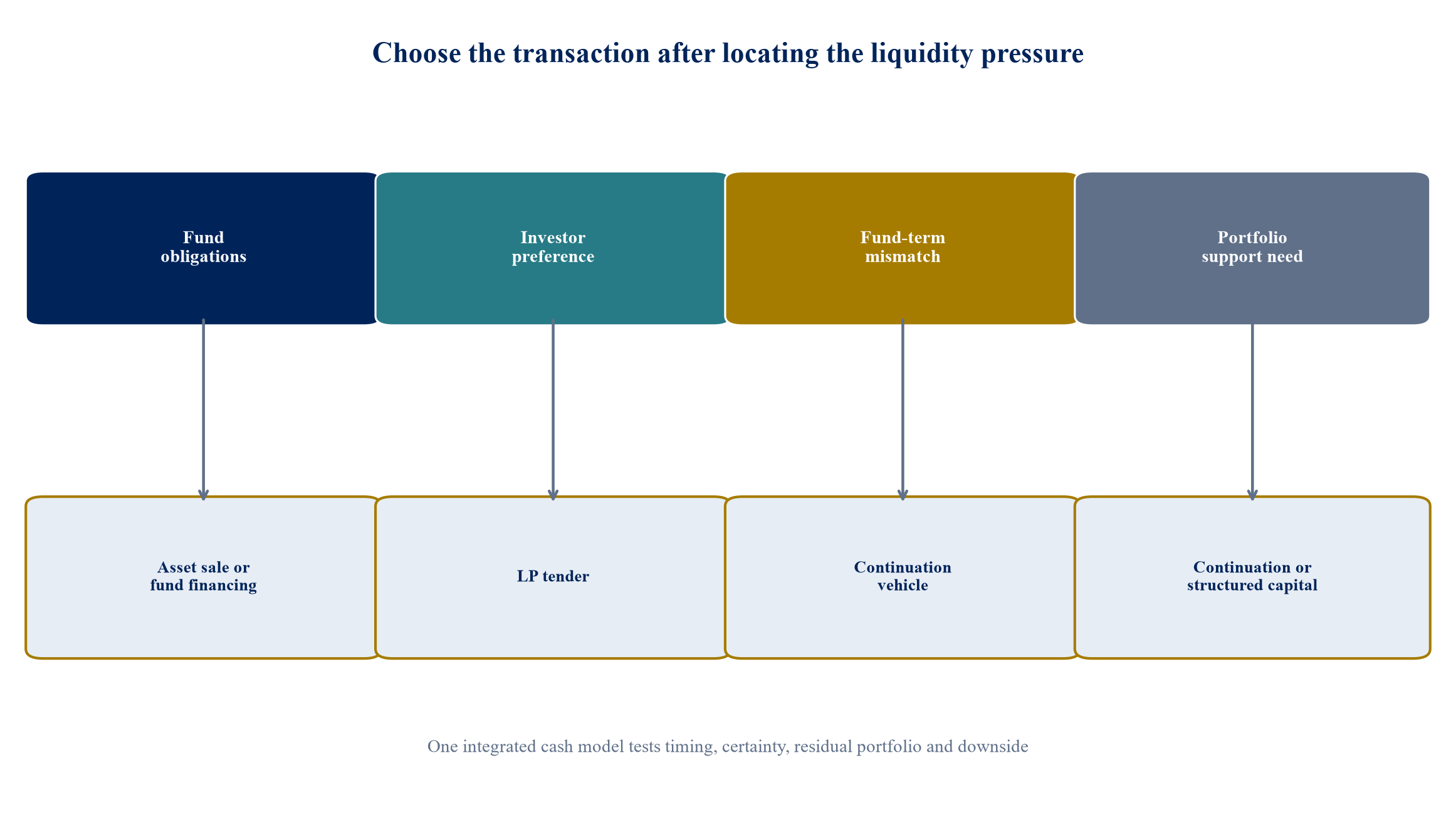
The route follows the decision need; several routes may be combined when pressures arise at different levels.
2. Build one integrated sources-and-uses model
Liquidity planning often fails because teams model assets, facilities and investor distributions separately. A fund-level solution needs one cash model that reconciles all three. Sources should include cash on hand, contractual interest, amortisation, likely prepayments, asset-sale proceeds, facility availability, investor subscriptions where permitted and capital contributed to a continuation vehicle. Uses should include operating expenses, management obligations, hedging and tax, facility interest and repayment, borrower follow-on commitments, workout funding, transaction costs and distributions.
Every source needs a confidence category. Contractual cash due from a performing borrower is different from a forecast refinancing. A signed asset sale with limited conditions is different from an indicative bid. Undrawn facility capacity is different from capacity that would disappear after a valuation decline or covenant breach. The model should show both gross availability and dependable availability after conditions, haircuts and reserves.
The Financial Stability Board has highlighted the growing connections among private-credit funds, banks, insurers and private-equity sponsors, together with vulnerabilities involving leverage, liquidity, concentration and data gaps [3]. These connections matter at the transaction level. A bank may provide fund leverage while also financing a purchaser. An insurer may be an existing limited partner and a prospective buyer. A sponsor may influence borrower amendments that affect valuation. The integrated model should therefore show counterparty concentration and conditionality, not only cash totals.
Stress cases should be designed around events that change liquidity decisions. Relevant cases include slower repayments, wider discount margins, non-accrual migration, covenant cures, a delayed secondary closing, reduced facility advance rates and higher hedging collateral. Management should be able to see which obligation becomes binding first, how much time remains and which transaction route preserves the best alternatives.
3. Segment the portfolio by cash behaviour and transferability
A private-credit portfolio should not be divided simply into performing and non-performing assets. Secondary liquidity depends on how each exposure behaves in cash, documentation and transfer. A loan can be creditworthy yet difficult to sell because of consent restrictions, confidentiality, small position size or bespoke economics. A challenged loan can attract specialist buyers if information, control rights and workout strategy are clear.
The portfolio should be segmented across four dimensions. Cash behaviour covers contractual yield, cash versus payment-in-kind interest, amortisation, expected prepayment and follow-on needs. Credit condition covers enterprise-value support, covenant headroom, sponsor behaviour, collateral, documentation and recovery path. Transferability covers assignment, borrower or agent consent, minimum holdings, voting thresholds, confidentiality and regulatory restrictions. Strategic value covers the manager's information advantage, workout capability, relationship value and potential upside from holding longer.
This segmentation supports a practical perimeter. Assets with strong price discovery and clean transfer mechanics may fit a competitive portfolio sale. Assets whose value depends on the incumbent manager's servicing, restructuring or sector expertise may fit a continuation structure. A concentrated exposure may justify a single-asset process. Assets that are sound but temporarily illiquid may support carefully structured fund-level financing, subject to leverage and conflict constraints.
The perimeter should also preserve portfolio integrity. Selling only the most liquid and highest-quality loans can leave existing investors with a smaller, weaker and more concentrated residual pool. Selling only challenged assets can produce an unacceptable discount. A transaction committee should test the residual fund against concentration limits, facility eligibility, expected cash generation, management capacity and the ability to treat remaining investors fairly.
Table 1. Portfolio segmentation for secondary-liquidity design
| Segment | Cash and credit profile | Transfer considerations | Likely route |
|---|---|---|---|
| Seasoned performing | Stable cash yield, demonstrated payment record, moderate remaining life | Standard assignment and reliable data tape | Competitive loan or portfolio sale |
| Long-duration performing | Sound credit, limited near-term amortisation, extension risk | Buyers require duration and refinancing analysis | Sale, continuation vehicle or structured liquidity |
| Amend-and-extend | Reduced current cash, sponsor support may continue, value depends on revised plan | Consent, intercreditor and control rights are central | Specialist sale or manager-led continuation |
| Concentrated strategic | Material share of fund value, information-intensive, upside depends on active management | Limited buyer universe and high diligence burden | Single-asset continuation or bespoke syndication |
| Workout | Non-accrual or impaired, uncertain timing, recovery depends on control and funding | Litigation, enforcement, confidentiality and servicing continuity | Specialist transfer or ring-fenced continuation |
| Restricted transfer | Credit may be sound, but assignment or disclosure is constrained | Borrower, agent, regulator or co-lender approval required | Tender at fund-interest level or delayed transfer structure |
The categories are decision fields rather than valuation conclusions.
4. Establish a transaction valuation bridge rather than relying on reported NAV
Reported NAV is a starting reference. A liquidity transaction requires an exit-price analysis for the precise asset, interest and timing being transferred. IFRS 13 defines fair value as the price received to sell an asset in an orderly transaction between market participants at the measurement date [4]. The valuation must reflect current market assumptions, including credit, liquidity, duration and non-performance risk. A fund's quarterly mark may use a consistent methodology while still differing from the price available for a block sale or a time-constrained process.
The bridge should reconcile reported value to transaction value in visible components. Those components can include movement in benchmark rates, credit spread, borrower performance, cash received since the valuation date, accrued interest, payment-in-kind balances, expected loss, optionality, transfer costs, concentration, size, information quality and the buyer's required return. A single unexplained discount to NAV hides where value is being transferred and makes governance harder.
The Financial Conduct Authority's 2025 review found that robust private-market valuation processes showed independence, expertise, transparency and consistency. It also identified conflicts connected with asset transfers, secured borrowing, redemptions and subscriptions, and encouraged firms to define triggers for ad hoc valuations [5]. A secondary process is precisely the kind of event that can require an ad hoc review. The valuation date, information set and responsibility should be fixed before bids are compared.
Private debt valuation requires attention to the unit of account. A whole-loan sale can change control and recovery economics. A minority participation may retain servicing or counterparty exposure. A fund-interest tender transfers a share of the entire vehicle, including reserves, liabilities and governance rights. A continuation structure can change fees, carry, term and concentration. Each route therefore needs a valuation bridge that matches the actual interest being transferred.
5. Route one: sell loans or a defined portfolio
An asset sale is the most direct route from illiquid credit to cash. It can deliver a clean reduction in duration and concentration, create observable price evidence and simplify an approaching fund wind-down. It works best when the perimeter is well documented, borrower information can be shared lawfully, transfer consents are manageable and sufficient buyers can assess the assets on the available timetable.
The process begins with an auditable data tape. Required fields usually include principal, cash and payment-in-kind interest, maturity, amortisation, covenants, collateral, guarantees, ranking, borrower and sponsor concentration, historic amendments, payment history, risk rating, internal valuation, cash-flow forecast and transfer restrictions. The data tape must reconcile to legal documents, servicing systems and financial reporting. Discrepancies should be explained before buyers price them.
Portfolio sales can be structured as whole-loan assignments, participations, sub-participations or transfers through an asset-holding vehicle. The form changes legal ownership, counterparty exposure, accounting, tax, regulatory capital and servicing obligations. Legal and regulatory analysis must be performed for the relevant jurisdictions. This paper does not prescribe a universal transfer form.
Bid comparison should go beyond headline price. A lower conditionality bid can be more valuable than a higher price subject to broad diligence, financing, consents or material adverse change. The manager should compare cash at close, deferred or contingent consideration, assumed liabilities, required representations, indemnities, servicing obligations, closing certainty and the residual portfolio effect. The decision record should show why the selected bid best serves the fund under the applicable mandate.
6. Route two: organise a tender for fund interests
A tender process creates liquidity for investors who choose to sell while leaving the portfolio intact. The purchaser acquires limited-partner interests rather than individual loans. This can avoid asset-level transfer restrictions and preserve the manager's servicing strategy. It also places greater weight on fund-level diligence, unfunded commitments, facility exposure, distribution timing and the rights attached to the transferred interests.
The tender may be initiated by a buyer, facilitated by the manager, or combined with a broader recapitalisation. The design should define eligible interests, minimum and maximum size, price or pricing mechanism, proration, conditions, representations, settlement mechanics and treatment of defaulting or excused investors. Existing fund documents may restrict transfers or give the manager discretion over consent. That discretion should be exercised through a recorded process that recognises conflicts.
Information parity is central. Selling investors need enough information to assess the price; rolling investors need to understand the effect on governance, concentration and future economics; buyers need an investable diligence package. The information given to one group can differ for legitimate confidentiality or legal reasons, but the decision process should explain those differences and avoid selective disclosure that distorts choice.
A tender can solve investor-level liquidity without producing new cash for the fund. If the vehicle also faces follow-on needs, expenses or facility maturity, the tender may need to be paired with a primary capital commitment, asset sale or fund-level facility. Management should keep these uses separate so that the tender price does not conceal the cost of financing the fund itself.
7. Route three: use a continuation vehicle when active management can preserve value
A continuation vehicle transfers selected assets from the existing fund to a new vehicle, typically with fresh capital and a renewed holding period. Existing investors may sell, roll or sometimes combine both choices. The route can preserve value when assets need time, capital or specialist management and a near-term sale would crystallise an avoidable discount. It also creates acute conflicts because the manager can influence both sides of the transaction and may receive new fees or performance economics.
The Institutional Limited Partners Association's continuation-fund guidance emphasises early engagement, conflict identification, a transparent process, disclosure of bids and economics, sufficient decision time and parity of information [6]. Its 2026 materials reflect the growing use of continuation vehicles and continuing investor focus on process quality [7]. These are industry governance standards rather than substitutes for applicable law or fund documents.
For private credit, the case for continuation should be asset-specific. Relevant reasons include a loan extension supported by credible enterprise value, a workout requiring capital and control, a portfolio whose cash flows are expected after the original fund term, or an opportunity to acquire adjacent debt at an attractive basis. A generic desire to defer loss recognition or preserve fee income is not a defensible investment case.
The continuation vehicle should have its own investment memorandum. It should state the transfer price, portfolio strategy, term, follow-on capacity, leverage, fees, carry, governance, conflicts, valuation policy, key-person protection, removal rights, reporting and exit routes. Selling and rolling investors should see the same core economic bridge. Any staple commitment, cross-fund allocation or special buyer right should be disclosed and assessed.
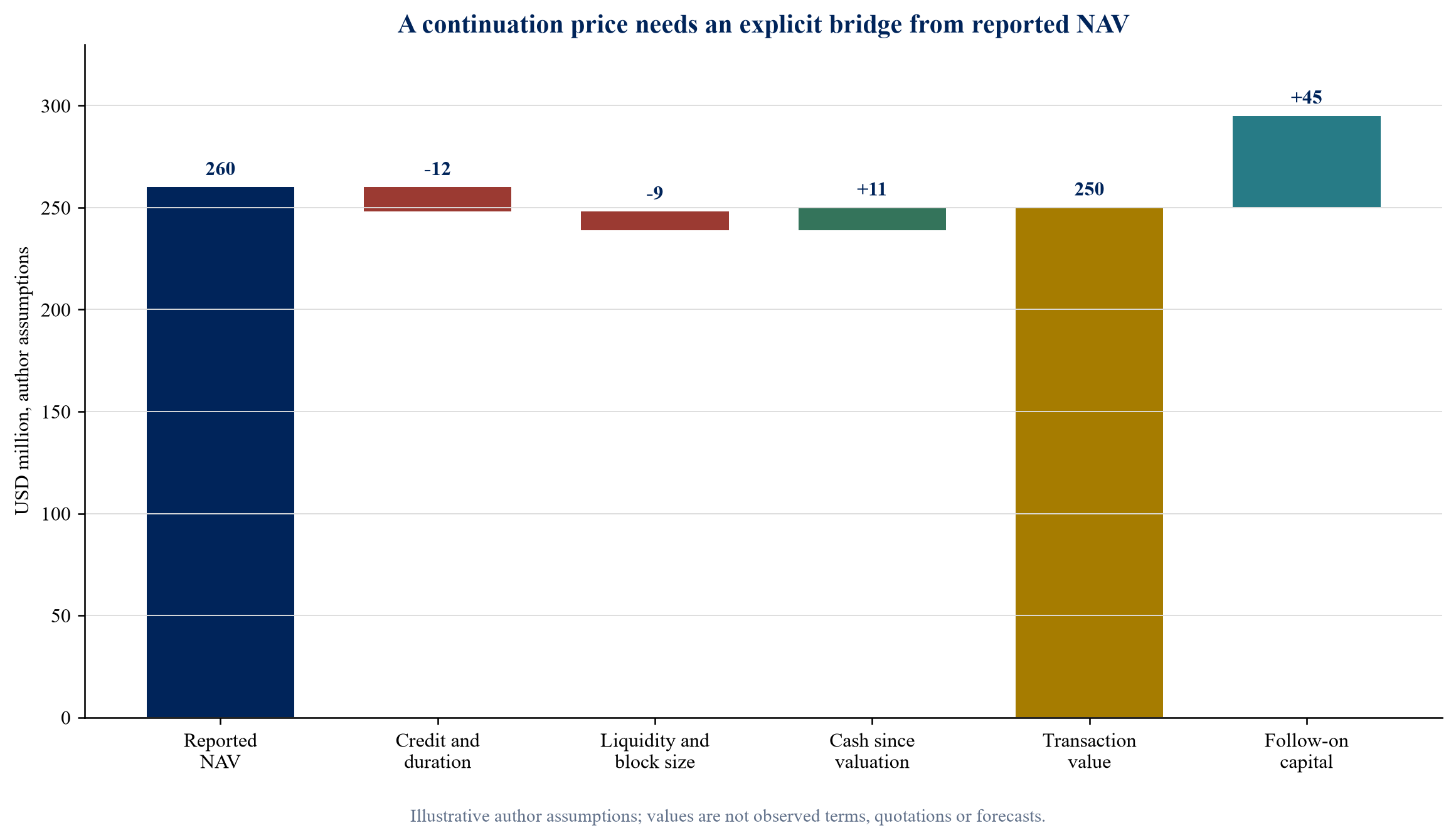
Illustrative author assumptions; values are not observed terms, market evidence or recommendations.
8. Route four: add structured fund liquidity with explicit repayment capacity
Fund-level liquidity can take the form of a NAV facility, preferred equity, hybrid capital, a distribution-support facility or financing against a defined asset pool. It can bridge timing without selling assets, support follow-on investments or fund a controlled distribution. It also adds senior claims, covenants, cash sweeps and refinancing risk to a portfolio whose values and cash dates are uncertain.
The structure should be underwritten to cash repayment, not reported NAV alone. A lender or preferred investor needs a base case showing contractual interest, amortisation, likely realisations, expenses and required reserves. The downside case should include credit migration, delayed exits, wider discount rates and lower advance values. The manager should show which assets can generate repayment, how cash is trapped or swept, and which actions require consent.
The FSB's work on non-bank leverage stresses the need to identify, monitor and disclose leverage and counterparty risks, especially where non-banks are connected to systemically important financing providers [8]. Fund-level leverage can be economically larger than the headline facility if portfolio companies are also leveraged, hedges require collateral, or guarantees and preferred claims sit elsewhere in the structure. The decision should therefore use a consolidated obligations map.
Structured liquidity is most credible when it buys time for identifiable cash events and leaves room for adverse variation. It is weak when it funds routine distributions without a realistic repayment source, subordinates investors without adequate consent, or relies on stable NAV despite rising credit risk. A maturity wall should never be replaced with a larger maturity wall merely because current liquidity is scarce.
9. Compare routes through a common decision matrix
Transaction routes are often evaluated by different teams using different language. The sale team discusses price and certainty; investor relations discusses LP preferences; the financing team discusses leverage; the legal team discusses consent. A common decision matrix turns these perspectives into comparable criteria.
The matrix should score net cash delivered, timing, price discovery, value retained, residual risk, new leverage, governance complexity, investor choice, servicing continuity, legal consent, tax, accounting and future optionality. Scores need explanation and sensitivity. A continuation vehicle may score well on value retention and poorly on conflicts. A tender may score well on investor choice and deliver no fund-level cash. A portfolio sale may deliver cash quickly but weaken the residual pool. Structured liquidity may preserve assets but reduce future distributions through senior claims.
The matrix should also include a do-nothing or extend-the-fund route where legally available. An extension may be the least costly answer when assets are performing, obligations are modest and investors support a revised timetable. It is unsuitable when liquidity pressure is immediate or confidence has deteriorated. Including it prevents the transaction process from assuming that complexity is itself a solution.
Table 2. Secondary-liquidity route comparison
| Route | Cash recipient | Principal strength | Principal value risk | Governance burden |
|---|---|---|---|---|
| Loan or portfolio sale | Fund | Direct cash and duration reduction | Sale discount and weaker residual pool | Medium |
| Fund-interest tender | Selling investors | Investor choice without asset transfer | Price may reflect fund opacity and unfunded obligations | Medium to high |
| Continuation vehicle | Existing fund and electing investors | Time and capital for active value preservation | Manager sits across transfer and new economics | High |
| NAV or preferred capital | Fund | Timing bridge without immediate asset sale | Senior claim, covenants and refinancing dependence | High |
| Fund extension | Fund through retained cash generation | Low transaction leakage | Delayed liquidity and continuing asset risk | Medium |
Qualitative assessment; actual outcomes depend on fund documents, portfolio condition, jurisdiction and market terms.
10. Control conflicts through process architecture
Conflicts are not cured by a broad disclosure that the manager has interests. The process should identify each economic incentive, who is affected, how it could change the decision, and which control addresses it. Relevant incentives include continuation fees, crystallised carry, new carry, transaction fees, retention of assets that support future fundraising, allocation of good and weak assets, use of affiliated financing, and the treatment of investors who cannot roll.
The SEC's 2019 fiduciary interpretation describes an investment adviser's duty of care and loyalty as applying to the entire advisory relationship [9]. The SEC's specific 2023 adviser-led secondaries rule was vacated by the U.S. Court of Appeals for the Fifth Circuit in June 2024, and the Commission states that the newly adopted rule is no longer in effect [10]. The vacatur does not make process discipline irrelevant. Applicable fiduciary duties, contractual obligations, antifraud standards and other laws still require jurisdiction-specific advice.
Controls can include a conflicts committee, independent valuation input, competitive price discovery, limited-partner advisory committee review, investor consent, independent legal advice, recusal, fee offsets and documented alternatives. Independence should be assessed in substance. A service provider paid by the manager may bring useful expertise while still having a commercial relationship that should be disclosed and overseen.
The decision record should preserve the alternatives considered, bids received, valuation bridge, committee materials, conflicts register, expense allocation, investor communications and basis for selecting the route. A well-run process makes the decision reproducible even if market conditions later change.
11. Give selling, rolling and remaining investors a usable choice
Investor choice is meaningful only when the options are economically comparable and supported by adequate information. A cash election should show price, accrued amounts, expenses, taxes, settlement timing and any holdback. A roll election should show the new vehicle's term, fees, carry, leverage, governance, concentration, follow-on capacity and exit plan. Remaining investors should understand how the transaction changes their residual portfolio and rights.
The timetable needs enough time for governance. Institutional investors may require investment committee approval, legal review, valuation assessment, tax analysis and documentation. A short election window can transfer negotiating advantage to parties with faster processes. Extensions should be governed by clear criteria and offered consistently.
Proration and allocation rules matter when demand exceeds available capital. The manager should state whether selling elections are accepted pro rata, by class, by timing or under another rule. Rolling investors should know whether their interests are scaled. Buyers should know whether minimum transaction size, concentration or financing conditions affect closing.
Communications should separate facts, management views and scenario assumptions. Valuation ranges should state their date and method. Forecast distributions should explain their dependence on borrower payments and exits. No investor should be led to treat a modelled outcome as a committed cash flow.
12. Design the liquidity waterfall before signing
Gross proceeds can be consumed by facility repayment, reserves, transaction expenses, taxes, indemnity holdbacks and follow-on obligations before investors receive cash. A transaction should therefore be assessed through a detailed waterfall. The waterfall identifies legal priority and makes the allocation of value visible.
For an asset sale, proceeds may first repay secured borrowings associated with the assets. For structured liquidity, cash may be trapped until tests are satisfied and then swept to the provider. For a continuation transaction, proceeds may fund selling investors while rolling interests receive units in the new vehicle. Transaction expenses may be borne by the existing fund, the new vehicle, the manager, the buyer or several parties. Each allocation creates a value transfer and should be justified.
The waterfall should be modelled under base, delay and downside cases. Delay can increase interest expense and reduce distributable cash. A downside valuation can change advance rates, covenant headroom and priority. A borrower default can redirect cash to a workout reserve. The governing documents should match the model so that there is no gap between the expected and legal waterfall.
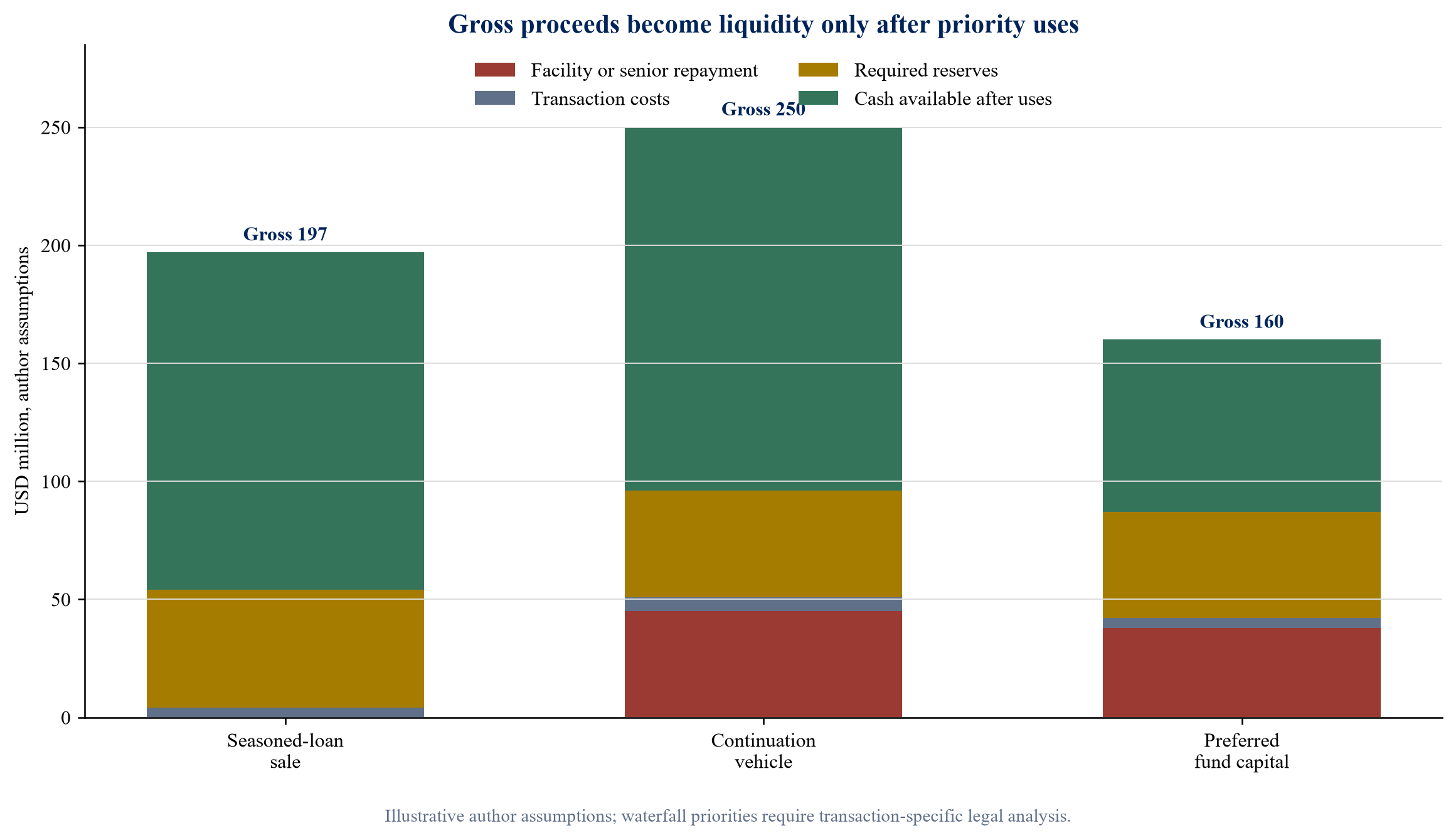
Author assumptions for method demonstration; amounts are not observed fund data, quotations or forecasts.
13. Preserve servicing, information and workout capability
Private credit is operationally intensive. Value depends on timely payment processing, covenant monitoring, borrower reporting, consent management, amendments, collateral control and workout decisions. A liquidity transaction that changes ownership without protecting these functions can destroy the value it seeks to realise.
The operating plan should state who services each asset before and after closing, how records transfer, which approvals are required, how borrower communications are handled, and how confidential information remains protected. If the incumbent manager continues servicing, the agreement should define scope, standard of care, authority, fees, termination, data access and conflict management. If servicing transfers, there should be a tested data and cash migration plan.
Workout assets require special attention. The buyer may need voting or enforcement control; the existing fund may retain exposure; other lenders may hold intercreditor rights. The parties should map decision thresholds, funding obligations, privilege, litigation control and recoveries. A price cannot compensate for an operating structure that prevents the buyer from implementing the underwritten recovery strategy.
Data quality is itself a pricing factor. A reconciled loan tape, complete document set and traceable valuation history reduce diligence uncertainty. Missing amendments, inconsistent balances or undocumented risk ratings increase conditions and discounts. Operational readiness should therefore begin before the formal process.
14. Apply the framework to a hypothetical fund
Consider a hypothetical closed-end direct-lending fund with reported NAV of USD 1.20 billion. The author assumes USD 90 million of cash, USD 60 million of undrawn facility capacity and USD 330 million of expected needs over eighteen months. Those needs comprise USD 120 million of desired investor liquidity, USD 85 million of facility maturity and expenses, USD 75 million of committed borrower support, and a USD 50 million downside reserve. Contractual portfolio cash receipts are assumed at USD 190 million during the period, although USD 70 million is exposed to extension or credit delay.
The portfolio is divided into USD 520 million of seasoned performing loans, USD 360 million of long-duration performing loans, USD 190 million of amend-and-extend exposures and USD 130 million of concentrated or workout assets. These values are assumptions used to demonstrate the decision process. They do not describe a real fund.
The immediate dependable sources are USD 150 million of cash and facility capacity plus USD 120 million of contractual receipts after applying a prudential timing haircut. That leaves a planning shortfall of USD 60 million against the stated needs. Investor liquidity is discretionary in this example, while facility maturity and borrower commitments are binding. Management therefore prioritises the binding uses and tests a transaction large enough to deliver at least USD 145 million of net cash, preserving a reserve above the minimum shortfall.
Four routes are modelled. A portfolio sale produces high cash certainty but transfers performing assets at an assumed discount. A tender satisfies selling investors but does not fund the vehicle. A continuation vehicle delivers cash and follow-on capital but requires extensive governance. Preferred fund capital closes faster in the assumed case but creates a senior claim and a cash sweep. The combined recommendation in the example is a competitive sale of a diversified seasoned pool plus a limited tender funded by a new buyer, with the continuation option retained for the concentrated assets if performance evidence supports a longer hold.
15. Quantify value transfer and downside through scenario analysis
Transaction comparison should show more than immediate cash. The relevant measure is the present and conditional value delivered to each stakeholder after fees, financing costs, retained risk and future distributions. The model should identify which assumptions are market-derived, which are borrower-specific and which are management estimates.
In the hypothetical case, the portfolio sale is assumed to transfer USD 210 million of reported value for USD 197 million of cash before costs. The tender is assumed at 91 percent of the applicable fund-interest NAV and is funded directly by the buyer. The continuation vehicle is assumed to acquire USD 260 million of assets at 96 percent of the transaction valuation, with USD 45 million of follow-on capacity. Preferred capital is assumed to provide USD 160 million with a contractual preferred return and cash sweep. None of these terms is presented as a market benchmark.
The delay case assumes six months of additional holding cost, slower receipts and lower facility headroom. The downside case assumes credit migration, lower recoveries and wider required yields. The sale route loses some upside but protects cash certainty. The continuation route preserves upside but exposes rolling investors to concentration and execution. Preferred capital creates the greatest claim on future cash in the downside case. The tender remains primarily an investor-level solution.
Table 3. Hypothetical route outcomes for the illustrative fund
| Route | Net fund cash at close | Investor cash choice | New senior claim | Principal downside exposure |
|---|---|---|---|---|
| Seasoned-loan sale | 193 | Indirect through later distribution | 0 | Discount crystallised; residual mix weakens |
| LP tender | 0 | 100 to electing sellers | 0 | Buyer price reflects opacity and duration |
| Continuation vehicle | 239 | Cash or roll election | 45 follow-on capital has new economics | Concentration, conflict and extended duration |
| Preferred fund capital | 160 | Possible distribution after required reserves | 160 plus preferred return | Cash sweep, covenant and refinancing pressure |
Author assumptions; USD millions except percentages. Figures are not observed data or market quotations.
16. Use a gated execution process
Execution should be divided into decision gates. Gate one confirms the liquidity diagnosis, authority and alternatives. Gate two approves the asset or interest perimeter, data readiness and valuation method. Gate three tests buyer appetite and transaction feasibility without committing to a conflicted outcome. Gate four approves final economics, conflict controls and investor communications. Gate five confirms closing readiness, consents, funds flow and operating transition. Gate six reviews post-close outcomes.
Each gate needs a named owner, evidence package and stop condition. A process should pause if the loan tape does not reconcile, valuation is stale, required consents are unavailable, a facility covenant would be breached, investors lack decision time or the selected route leaves the residual fund unviable. Stopping or resizing a transaction can preserve more value than closing on a weak basis.
Competitive tension should be proportionate to the assets and timetable. A broad auction may be suitable for a diversified performing portfolio. A concentrated workout may require a focused specialist process. A continuation transaction may use price discovery from third-party bids, a minority sale, an independent opinion or several methods. The decision committee should record why the chosen process is credible.
Closing should not be treated as the final gate. Management should compare realised price with prior marks, track expenses and leakage, monitor the residual portfolio, report election outcomes and test whether the transaction delivered the promised liquidity. Backtesting improves future valuation and transaction design. The FCA has identified backtesting and transparent value bridges as useful features of private-market valuation governance [5].
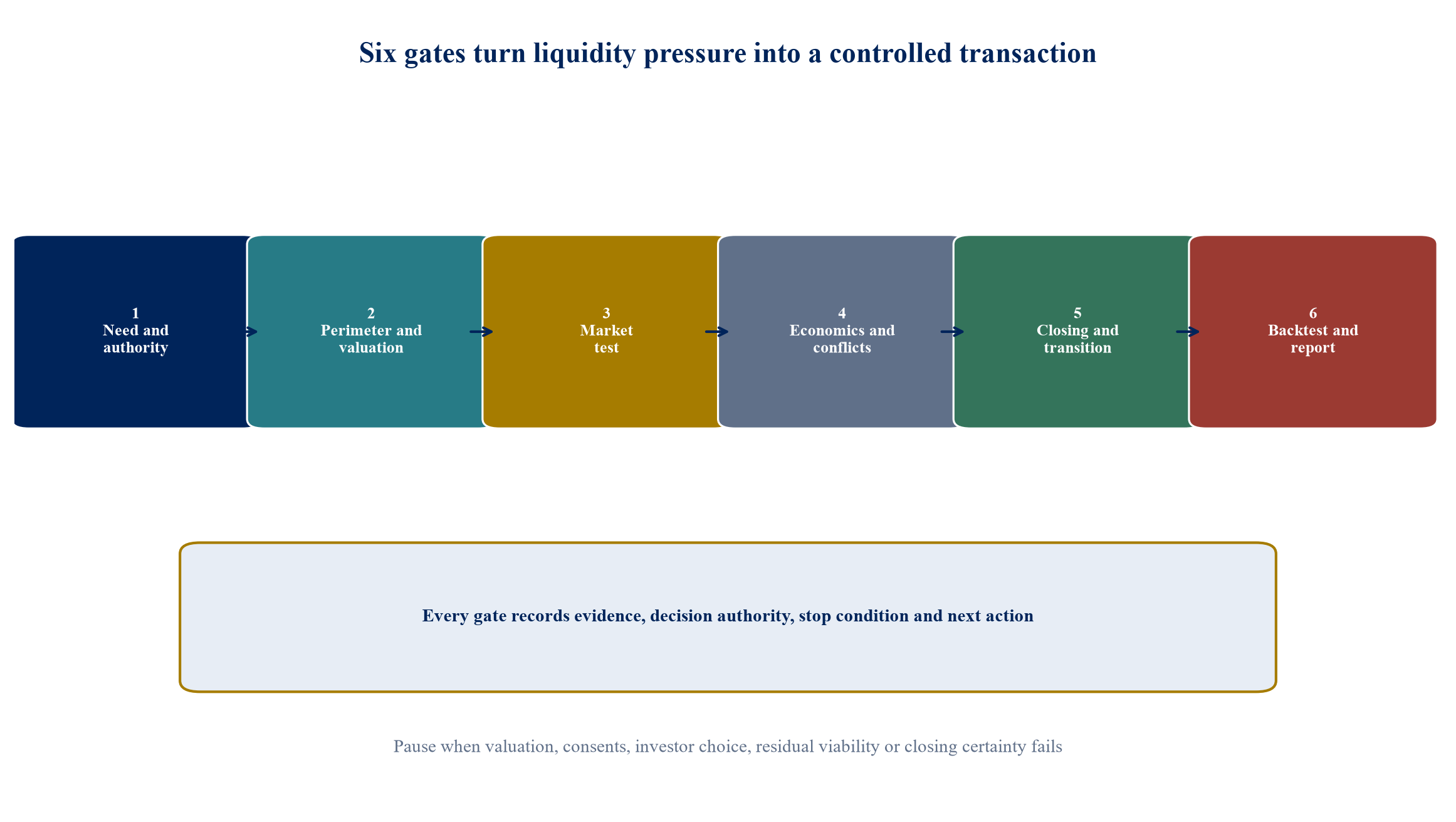
Every gate requires an evidence owner, decision authority and recorded outcome.
17. Prepare a 120-day liquidity-readiness programme
During the first thirty days, management should reconcile the portfolio tape, documents, cash ledger, facility terms and investor register. It should produce the eighteen-month sources-and-uses model, identify binding and discretionary uses, segment assets, map transfer restrictions and establish governance. The board or relevant committee should approve the decision need and permissible routes.
During days thirty-one to sixty, the manager should complete borrower and asset diligence, commission any independent valuation work, prepare the valuation bridge, draft the data room and identify buyer universes for each route. Legal advisers should review fund authority, conflicts, transfer, disclosure, tax and regulatory matters. Investor-relations teams should test information needs without implying that a transaction has been approved.
During days sixty-one to ninety, the manager should solicit and compare credible proposals. The comparison should use net cash, conditionality, value transfer, residual portfolio, leverage, investor choice and execution certainty. Draft documents, funds flow, servicing plans and consent paths should be developed in parallel. Conflicts and valuation committees should receive a complete record rather than isolated headline bids.
During days ninety-one to one hundred and twenty, final terms should be approved, investor materials issued, elections collected and consents completed. Closing readiness should include reconciled balances, settlement instructions, operational cutover and contingency plans. If the process cannot meet the fund's liquidity long-stop, management should activate the pre-agreed fallback before reserves become critical.
18. Convert liquidity pressure into a defensible capital decision
Secondary liquidity is a capital-allocation decision. It determines which assets remain, which investors receive cash, which risks are transferred, which claims become senior and how much future optionality survives. The quality of the result depends on diagnosis, valuation and governance before it depends on transaction form.
A portfolio sale is strongest when transferable assets can attract competitive price discovery and the residual fund remains viable. A tender is strongest when the principal problem is investor preference and the portfolio should stay intact. A continuation vehicle is strongest when active management, time and new capital can preserve value that an immediate sale would lose. Structured fund liquidity is strongest when identifiable cash flows support repayment under stress. A fund extension is strongest when obligations are manageable and investor support is real.
Managers should resist using NAV as both proof of value and proof of liquidity. Transaction value must be reconciled to current market assumptions; cash availability must be reconciled to legal priority and timing. Conflict controls need specific economic analysis. Selling, rolling and remaining investors need usable choices. Servicing and workout capability must continue across closing.
The practical standard is a transaction that can be explained in one chain: the liquidity need, alternatives considered, evidence used, value transferred, conflicts controlled, investor choices, cash waterfall, residual portfolio and post-close test. That chain supports a decision that remains credible when the market, portfolio or timetable changes.
Table 4. Board approval checklist for secondary liquidity
| Decision area | Evidence required | Approval question |
|---|---|---|
| Liquidity need | Dated sources and uses with stress cases | Is the amount, timing and priority of cash need established? |
| Portfolio perimeter | Reconciled tape, transfer map and residual-fund analysis | Does the perimeter preserve a viable remaining portfolio? |
| Valuation | Current bridge from reported NAV to transaction value | Are price, assumptions and value transfer independently challenged? |
| Alternatives | Common decision matrix including extension or no transaction | Is the selected route superior for the stated decision? |
| Conflicts | Incentive map, mitigants, recusals and committee record | Can affected investors understand and evaluate the conflicts? |
| Investor choice | Cash and roll economics, timetable and allocation rules | Is each election informed and operationally usable? |
| Financing | Consolidated obligations, covenants and downside capacity | Can all senior claims be met without relying on stable NAV? |
| Operations | Servicing, data, consent and workout transition plan | Can asset control and information continue through closing? |
| Closing | Conditions, funds flow, expenses and fallback plan | Is net cash certain enough for the liquidity long-stop? |
| Post-close | Backtest, reporting and residual monitoring | Will outcomes be measured against the approved case? |
The checklist supports governance and does not replace legal, regulatory, tax, accounting or investment advice.
References
- International Monetary Fund. Global Financial Stability Report, April 2024, Chapter 2: The Rise and Risks of Private Credit. 16 April 2024. https://www.imf.org/en/-/media/files/publications/gfsr/2024/april/english/ch2.pdf
- International Monetary Fund. Global Financial Stability Report, October 2025, Chapter 1: Shifting Ground Beneath the Calm. 2025. https://www.elibrary.imf.org/display/book/9798229023184/CH001.xml
- Financial Stability Board. Report on Vulnerabilities in Private Credit. 6 May 2026. https://www.fsb.org/2026/05/report-on-vulnerabilities-in-private-credit/
- IFRS Foundation. IFRS 13 Fair Value Measurement. https://www.ifrs.org/issued-standards/list-of-standards/ifrs-13-fair-value-measurement/
- Financial Conduct Authority. Private Market Valuation Practices. 5 March 2025. https://www.fca.org.uk/publications/multi-firm-reviews/private-market-valuation-practices
- Institutional Limited Partners Association. Continuation Funds: Considerations for Limited Partners and General Partners. May 2023. https://ilpa.org/wp-content/uploads/2023/05/Continuation-Funds-Considerations-for-Limited-Partners-and-General-Partners.pdf
- Institutional Limited Partners Association. Continuation Funds. 2026. https://ilpa.org/industry-guidance/principles-best-practices/continuation-funds/
- Financial Stability Board. Leverage in Nonbank Financial Intermediation: Final Report. 9 July 2025. https://www.fsb.org/2025/07/leverage-in-nonbank-financial-intermediation-final-report/
- U.S. Securities and Exchange Commission. Commission Interpretation Regarding Standard of Conduct for Investment Advisers. Release IA-5248. 5 June 2019. https://www.sec.gov/rules-regulations/2019/06/ia-5248
- U.S. Securities and Exchange Commission. Announcement Regarding the Private Fund Advisers Rules. 31 October 2024. https://www.sec.gov/announcement-regarding-private-fund-advisers-rules
- International Organization of Securities Commissions. Consultation Report on Valuing Collective Investment Schemes. 17 November 2025. https://www.iosco.org/news/pdf/IOSCONEWS780.pdf
- European Securities and Markets Authority. Final Report on the 2022 Common Supervisory Action on Asset Valuation. 24 May 2023. https://www.esma.europa.eu/sites/default/files/2023-05/ESMA34-45-1802_2022_CSA_on_Asset_Valuation_-_Final_Report.pdf
- European Securities and Markets Authority. EU Alternative Investment Funds 2023. January 2024. https://www.esma.europa.eu/sites/default/files/2024-01/ESMA50-524821-3095_EU_Alternative_Investment_Funds_2023.pdf
- European Union. Directive 2011/61/EU on Alternative Investment Fund Managers, Article 19 Valuation. 8 June 2011. https://eur-lex.europa.eu/legal-content/EN/TXT/PDF/?uri=CELEX:32011L0061
- Financial Conduct Authority. FUND 3 Requirements for Alternative Investment Fund Managers. https://handbook.fca.org.uk/handbook/fund3
- International Private Equity and Venture Capital Valuation Board. IPEV Valuation Guidelines 2025. 11 December 2025. https://www.privateequityvaluation.com/Valuation-Guidelines
- Bank for International Settlements. The Global Drivers of Private Credit. BIS Quarterly Review. March 2025. https://www.bis.org/publ/qtrpdf/r_qt2503.htm
- Bank for International Settlements. Annual Economic Report 2024, Chapter I: Laying a Robust Macro-Financial Foundation for the Future. June 2024. https://www.bis.org/publications/aer-2024/laying-robust-macro-financial-foundation-future
- Bank of England. The Bank of England's Private Markets System-Wide Exploratory Scenario Exercise. 2026. https://www.bankofengland.co.uk/financial-stability/boe-system-wide-exploratory-scenario-exercise/boe-private-markets-swes
- Financial Stability Board. Global Monitoring Report on Non-Bank Financial Intermediation 2024. 16 December 2024. https://www.fsb.org/2024/12/global-monitoring-report-on-non-bank-financial-intermediation-2024/
- Financial Stability Board. Global Monitoring Report on Non-Bank Financial Intermediation 2023. 18 December 2023. https://www.fsb.org/uploads/P181223.pdf
- U.S. Securities and Exchange Commission. Frequently Asked Questions Regarding Disclosure of Certain Financial Conflicts Related to Investment Adviser Compensation. 18 October 2019. https://www.sec.gov/rules-regulations/staff-guidance/division-investment-management-frequently-asked-questions/frequently-asked-questions-regarding-disclosure-certain-financial-conflicts-related-investment
- Financial Conduct Authority. Portfolio Letter: Asset Management and Alternatives Supervisory Strategy. February 2025. https://www.fca.org.uk/publication/correspondence/asset-management-alternatives-portfolio-letter-2025.pdf
- European Securities and Markets Authority. Fund Management and AIFMD Reporting. https://www.esma.europa.eu/esmas-activities/investors-and-issuers/fund-management
- Financial Stability Board. The Financial Stability Implications of Leverage in Non-Bank Financial Intermediation. 6 September 2023. https://www.fsb.org/2023/09/the-financial-stability-implications-of-leverage-in-non-bank-financial-intermediation/
