

1. Define the separation decision
A board choosing between a sale and a spin-off is deciding who should own a business, how value should be realised and which execution risks the group should retain. A sale transfers control to a buyer for cash, securities or a combination. A spin-off usually distributes shares in a separated company to the parent's existing shareholders. The shareholders then own interests in two independent companies and can change their exposure in the market.
The route affects more than transaction proceeds. It determines whether the parent captures a control premium, whether shareholders retain the separated business's future upside, how debt and liabilities are allocated, which tax provisions apply, and whether the business must attract an independent investor base. It also determines the separation perimeter, disclosure burden, regulatory approvals, transitional arrangements and governance model.
Management should define the decision before launching a process. The central question is whether the business can create more risk-adjusted value as a separately listed company than the parent can realise from a credible buyer. The answer depends on standalone earnings, capital requirements, market appetite, tax leakage, stranded cost, buyer synergies, transaction certainty and the value of time.
The board should preserve a third reference case: retain and improve. A sale or spin-off can look attractive against a weak status quo that management has not defined rigorously. The retained case should include the cost and investment required to improve the business within the group. It creates a common baseline for comparing the two separation routes.
The decision period should be explicit. A sale can create earlier liquidity but may spend value on tax and buyer protection. A spin-off can preserve ownership but may take longer to establish audited information, capital, governance and market readiness. The model should compare cash and value at consistent dates and show the cost of delay. It should also identify benefits that depend on management actions after completion, because those benefits remain exposed to delivery risk.
2. State the separation thesis
A separation thesis explains why ownership under the current group suppresses value or strategic performance. It should identify a specific constraint. Examples include incompatible capital intensity, different growth and margin profiles, conflicting investor expectations, limited management attention, regulatory ring-fencing, constrained partnerships or an inability to fund the business at an appropriate risk level.
The thesis should state the benefit expected for both the parent and the separated business. The parent may gain clearer strategy, lower leverage, more stable earnings or a more coherent investor proposition. The separated business may gain dedicated capital, a focused board, equity-based incentives, freedom to partner with former competitors or a valuation benchmark aligned with its sector.
A credible thesis identifies costs as carefully as benefits. Two companies require duplicated governance, finance, treasury, tax, legal, risk, audit, technology and public-company infrastructure. Shared procurement and insurance benefits may fall. The parent may retain stranded property, systems or staff. The separated company may lose the parent's credit support, customer relationships, brand or purchasing scale.
The thesis should contain disconfirming tests. If the business cannot produce reliable standalone accounts, fund its investment plan, recruit an independent board or operate without long transition services, readiness is weak. If buyer indications materially exceed the risk-adjusted standalone value available to shareholders, a sale may dominate. The board needs evidence that can reject the preferred route as well as support it.
3. Establish the strategic perimeter
The legal entity chart rarely defines the correct perimeter. Products, contracts, people, permits, technology, data and assets may cross entity boundaries. A business may depend on shared sales teams, central procurement, common manufacturing, group licences or guarantees. The board should define the operating perimeter before assigning a transaction structure.
The perimeter should include every capability required to deliver the separated business's plan. Missing functions create recurring transition-service dependence or force costly post-announcement transfers. Excess assets can burden the new company or reduce buyer interest. The perimeter must also allocate contingent liabilities, warranties, litigation, environmental obligations, pensions and historical tax exposures.
The same perimeter may not be optimal for both routes. A strategic buyer can integrate selected functions and may prefer an asset or share transaction. A spin-off needs a complete standalone company on the first day of independent trading. It therefore requires a broader management and operating infrastructure, even when some services are provided temporarily by the parent.
Perimeter decisions should be recorded in a controlled separation ledger. Each item should show current owner, proposed owner, legal transfer mechanism, consent, cost, timing, dependency and unresolved issue. This ledger should reconcile with the carve-out financial statements, tax model, valuation and separation programme.
| Decision dimension | Sale | Spin-off | Evidence required | Board question |
|---|---|---|---|---|
| Value realisation | Negotiated proceeds and possible control premium | Market value emerges after distribution and trading | Buyer indications, trading comparables and valuation ranges | Which route offers higher risk-adjusted value after leakage and cost? |
| Ownership | Buyer assumes future upside and risk | Existing shareholders retain both businesses initially | Shareholder profile and investor appetite | Do shareholders want direct exposure to both strategies? |
| Capital | Proceeds can reduce parent debt or fund investment | Debt and liquidity must be allocated between two companies | Capital plan, ratings analysis and covenant review | Can both companies fund their plans through the cycle? |
| Tax | Asset or share sale may create tax leakage | Relief may be available if conditions and purpose tests are met | Tax opinions, clearances and step plan | Which conditions could cause a material tax cost? |
| Execution | Buyer diligence, financing and approvals | Public-company readiness, distribution and market launch | Integrated timetable and critical consents | Which route has the stronger path to completion? |
| Post-close dependency | Buyer may integrate services after transition | Both companies need sustainable standalone operations | TSA inventory and exit plans | Can dependencies be removed within a credible period? |
Original framework. Legal, tax and regulatory treatment depends on jurisdiction and transaction facts.
4. Build the transaction map
The transaction map should connect corporate approvals, financial reporting, tax steps, financing, regulatory review, people transfers, operational separation and market communication. These workstreams interact. A tax step can change legal ownership. A financing condition can restrict distributions. A delayed system separation can extend transition services and alter valuation.
A sale usually moves through preparation, buyer outreach, bids, confirmatory diligence, contract negotiation, regulatory review and closing. Competitive tension can improve price, but disclosure to multiple bidders increases confidentiality risk. A bilateral process can move faster but provides weaker market evidence. Financing certainty, conditionality and buyer remedy obligations matter alongside headline price.
A spin-off usually requires formation or reorganisation of the separated group, audited financial information, registration or listing documents, capital allocation, board and management appointment, shareholder communication and operational readiness. In the United States, SEC guidance requires audited financial statements for the separate legal company used in a distribution and addresses carve-out reporting where full historical statements are impracticable. [2]
The board should identify route-specific irreversible steps. Signing a sale agreement can create exclusivity and public disclosure obligations. A spin-off announcement can affect employee retention, customer negotiations and market expectations. Decision gates should require evidence on value, readiness, tax, capital and execution before commitments become difficult to reverse.
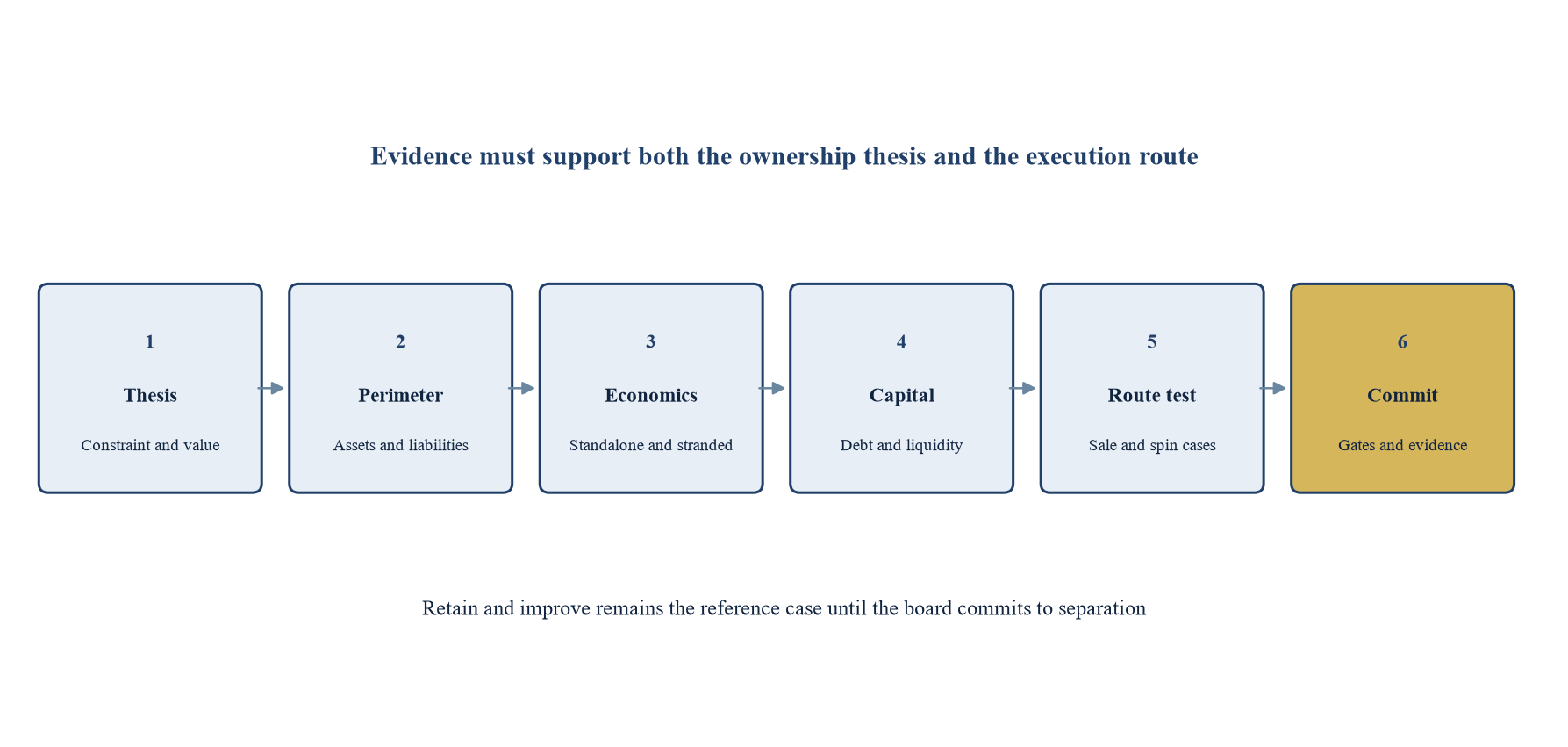
Original framework. The sequence should be adapted to applicable corporate, securities and competition rules.
5. Prepare standalone financial information
Standalone financial information should show the separated business as if it had operated independently. Historical segment reporting may omit balance-sheet items, financing, tax, shared functions and costs required outside the group. Management accounts can also reflect allocations designed for internal performance management rather than external reporting.
The SEC Financial Reporting Manual recognises carve-out financial statements when a discrete activity has identifiable assets and liabilities and there is a reasonable basis for allocating shared items. It also expects the statements to reflect the assets and liabilities of the business even when particular items are not transferred in an acquisition. [2] This distinction matters because transaction scope and accounting presentation can differ.
Pro forma information should bridge historical reporting to the transaction structure. SEC guidance explains that Article 11 adjustments include transaction accounting adjustments and autonomous entity adjustments needed when a registrant previously formed part of another entity. [10] Management adjustments have a different status and should not be blended with objectively supportable transaction effects.
The finance team should document allocation policies for central functions, shared assets, pensions, tax, debt, leases, insurance and cash. It should distinguish historical allocations from future standalone cost. Investors and buyers need both. A low historical allocation can overstate future earnings, while a high allocation can hide the separated business's ability to operate more efficiently.
6. Measure standalone and stranded cost
Standalone cost is the recurring expenditure required for the separated business to operate without the parent. Stranded cost is expenditure that remains with the parent after revenue and earnings leave. These are different problems and should have separate owners, baselines and removal plans.
Standalone cost commonly includes board and listing expense, audit, treasury, tax, legal, compliance, risk, cyber security, enterprise systems, insurance, investor relations and corporate management. Some functions may be bought through transition services initially. The end-state cost should reflect the service after exit, including scale loss and new controls.
Stranded cost arises when shared teams, property, contracts or systems cannot reduce at the same pace as the divested perimeter. A sale may permit a buyer to absorb more functions, while a spin-off may require duplication across both companies. The parent should estimate gross stranded cost, removal cost, implementation timing and residual cost after mitigation.
The board should avoid treating every allocation as avoidable. The parent will still need governance and control functions. The separated company will need capabilities it previously received informally. A function-by-function operating model provides stronger evidence than a top-down percentage of revenue.
7. Design two viable capital structures
A spin-off requires two companies to emerge with sufficient liquidity, covenant headroom and access to capital. The parent may allocate existing debt, arrange new facilities, cause the separated company to borrow and transfer proceeds to the parent, or retain liabilities that support credit quality. Each step affects valuation, ratings, tax and distribution capacity.
The separated company should fund its base plan and a credible downside. Working capital, seasonality, capital expenditure, acquisitions, pensions and contingent liabilities belong in the assessment. A growth business burdened with excessive debt may trade at a discount and lose strategic flexibility. A parent left with too much leverage may lose the very benefit the separation was intended to create.
A sale also requires capital planning. Net proceeds can reduce debt, fund investment, return capital or support acquisitions. The board should test how each use affects earnings, leverage, ratings and shareholder value. Gross sale value is not comparable with a spin-off equity value until debt, tax, transaction costs and retained liabilities are treated consistently.
Debt contracts can restrict disposals, distributions or reorganisations. The OECD Principles identify material debt terms and covenant risks as important investor information. [5] Management should map consents, make-whole costs, guarantee releases, security changes and cross-default consequences before selecting the route.
8. Compare value on a common basis
The sale case begins with enterprise value indicated by credible buyers. It then deducts tax, transaction cost, debt-like items, separation expenditure and value left in warranties, indemnities or retained liabilities. It also considers the value of time and the probability of closing. A high headline bid with material conditionality can have lower expected value than a firm lower offer.
The spin-off case begins with the expected standalone enterprise value of each business. It deducts net debt, one-time separation cost and the capitalised effect of incremental recurring cost. It may include a parent re-rating where evidence supports a change in investor perception, but this should be shown separately from operating value. Market value after distribution remains uncertain.
The retained case should use the same earnings definitions, capital requirements and valuation date. Management should avoid giving the separation cases the benefit of planned improvements while leaving those improvements out of the retained case. It should also avoid applying a peer multiple to earnings before standalone cost.
The comparison should show point estimates and ranges. Valuation multiples, buyer synergies, tax leakage, separation cost and market conditions can each move the result materially. A decision based on one precise number conceals the variables the board must control.
9. Recognise route-specific value
A strategic buyer may pay for synergies, market access, technology or scarce assets. The seller captures some of that value through competition and negotiation. A financial buyer may value operational improvement and leverage. Both can assume integration risk that public shareholders may not want to retain.
A spin-off can expose a business to investors who understand its growth, margin and capital cycle. Separate management incentives can become more direct. The business can issue its own equity for acquisitions or employee awards. The parent can remove strategic conflict and allocate capital to a narrower mandate.
These benefits are conditional. A small separated company may have limited index eligibility, research coverage, liquidity or institutional demand. Its cost of capital may rise. A business with volatile cash flow or concentrated customers may benefit from group support. A spin-off can also reveal a conglomerate discount that the market had not previously measured, without guaranteeing that either company re-rates.
Management should classify value by source: operating improvement, financing, tax, buyer synergy, investor segmentation, governance and market timing. Each source should have an evidence standard and owner. This prevents the same improvement from appearing in several parts of the model.
The value bridge should also distinguish transferable value from owner-specific value. A buyer may pay for synergies that existing shareholders cannot realise independently. Shareholders may value a growth option that a buyer refuses to price. The parent may gain a clearer rating profile even if the separated business trades conservatively. These effects belong in separate lines so the board can see which party captures them and which conditions must hold.
10. Test accounting presentation
IFRS 5 classifies a non-current asset or disposal group as held for sale when recovery will occur principally through a sale rather than continuing use and specified conditions are met. It requires measurement at the lower of carrying amount and fair value less costs to sell and separate presentation of discontinued operations where the criteria apply. [1]
The accounting route can affect timing and presentation before legal completion. A sale process and a distribution can both lead to discontinued-operation analysis, but classification depends on the facts and applicable standards. The accounting conclusion should follow the transaction plan rather than drive it without regard to economics.
SEC guidance requires pro forma information for a significant disposition by sale, abandonment, spin-off, split-up or split-off when the disposition is not fully reflected in historical statements. [10] The purpose is to show the continuing effect of the transaction. Autonomous entity adjustments can be especially important when the separated business has relied on group services.
Management should reconcile accounting perimeter, legal perimeter and valuation perimeter. Differences can be valid, but each difference needs an explanation. Audit work should begin early because delayed carve-out accounts can become the critical path for either route.
11. Test tax conditions and leakage
Tax can change the route ranking. A sale may create tax on gains, transfer taxes, withholding, recapture or indirect tax. The amount depends on asset and share basis, legal steps, jurisdiction, losses and buyer structure. A spin-off or demerger may qualify for relief when statutory conditions, business purpose and anti-avoidance provisions are satisfied.
In the United States, Section 355 can permit a qualifying distribution of controlled-company stock without recognition of gain or shareholder income. IRS Revenue Procedure 2025-30 sets out information and analysis for ruling requests concerning certain Section 355 transactions. [4] Qualification remains transaction-specific and should not be assumed from the label spin-off.
In the United Kingdom, HMRC guidance describes statutory demerger clearance under section 1091 of the Corporation Tax Act 2010 and the information required to show that conditions are met. [6] HMRC's 2026 consultation also records proposals to modernise the distributions and demerger framework, which means live advice should confirm the law and guidance in force when a transaction proceeds. [7]
The tax workstream should produce a step plan, quantified leakage range, clearance strategy, representations and post-close restrictions. Tax value should be risk-adjusted where relief depends on facts that can change before or after completion.
12. Assess market absorption
A spin-off needs an investor base willing to own both companies. Existing shareholders may have bought the parent for scale, income, geography or risk profile. Some may sell the separated company because of size, sector mandate, index treatment, liquidity or ESG restrictions. Forced or mandate-driven selling can affect early trading without resolving long-term value.
Management should segment the register and test likely ownership. It should identify natural holders, benchmark funds, active specialists, income investors and arbitrage capital. The analysis should consider free float, expected liquidity, research coverage, listing venue, disclosure quality and the clarity of the equity story.
The board should also test management capacity for public markets. The new company needs credible leadership, governance, controls, guidance policy and investor relations. Forecast quality and capital-allocation discipline affect how quickly investors form confidence in the standalone case.
Market readiness should be evidence based. Investor education and confidential testing can inform the analysis where permitted. A favourable peer multiple alone does not prove that the separated business will trade at that multiple on the first day or sustain it through a cycle.
13. Test sale certainty and buyer appetite
A sale needs buyers with strategic rationale, funding and regulatory capacity. The process should identify likely bidders, value drivers, diligence issues, antitrust overlaps, foreign-investment concerns and remedy risk. Management should distinguish an interested party from a bidder able to sign and close.
Competition review can affect timing and price. The European Commission requires notification of concentrations with an EU dimension and can clear, impose remedies or prohibit a transaction. [9] The UK CMA's September 2026 guidelines explain that merger analysis is case specific and addresses theories of harm, rivalry, efficiencies and consumer outcomes. [8]
A buyer may offer a high price while demanding extensive conditions, broad indemnities or a weak remedy commitment. The seller should compare reverse break protection, financing certainty, long-stop date, regulatory obligations and liability allocation. Expected proceeds should reflect closing probability and delay.
The process should preserve an alternative route until value and certainty are sufficient. A dual-track preparation can maintain leverage, but it increases cost, management distraction and disclosure complexity. The board should set explicit conditions for continuing or stopping each track.
14. Allocate governance and control
A spin-off creates two boards, committee structures, delegations, control environments and risk frameworks. Directors need the skills and independence appropriate to each company's strategy. Management succession and decision rights should be settled before the companies operate separately.
The OECD Principles emphasise transparent group structures, control arrangements, related-party transactions, foreseeable risks and governance responsibilities. [5] These issues are particularly relevant during separation because the parent and separated company may continue to share services, intellectual property, property or commercial arrangements.
Related-party agreements should be documented on terms that can be explained to both shareholder groups. Board conflicts must be identified. Directors serving both entities during transition need clear recusal and information protocols. The new company's policies should be operational before listing or distribution.
A buyer may absorb governance into its own structure, but the seller still needs controls through signing and closing. Leakage covenants, conduct-of-business provisions, separation decisions and information sharing should have named owners and escalation routes.
15. Protect people and operating continuity
Separation can create uncertainty for employees, customers and suppliers. Key people may face duplicated work, new reporting lines, retention risk or questions about pensions and benefits. Communications should align with legal consultation obligations and transaction confidentiality.
The talent plan should identify critical roles, duplicate roles, vacancies, transfer mechanisms and retention needs. The spin-off needs a complete leadership team and independent control functions. A sale needs a management team that can support diligence and integration without weakening current performance.
Compensation and equity awards require careful treatment. Existing awards may remain with the parent, convert, accelerate or be adjusted. New incentives should align management with the relevant company's strategy and capital structure. The cost belongs in the transaction model.
Operational continuity should be measured throughout the programme. Customer attrition, employee turnover, service levels, safety and compliance indicators can reveal value leakage before financial results do. The board should receive these indicators with the separation budget and timetable.
16. Separate technology data and intellectual property
Technology is often the longest operational dependency. Applications, infrastructure, identity, cyber controls, data, licences and vendor contracts may be shared. A legal transfer of a business does not create technical independence. The programme needs an application-by-application plan and a target architecture for both companies.
Data separation requires ownership, access, retention, privacy and migration decisions. Historic datasets may contain records relating to both businesses. Artificial-intelligence models, code repositories, patents and know-how may have mixed contributors or licences. Rights should support the commercial model after separation.
A buyer may migrate the business into its environment, but it still needs safe access and continuity between closing and integration. A spin-off normally needs a durable standalone platform. Long technology transition services can delay independence, weaken cyber accountability and increase cost.
The diligence record should connect each system to business processes, contracts, data, controls, cost and exit milestones. Cyber testing should verify that access paths, monitoring and incident response remain effective during migration.
17. Design transition services to end
Transition service agreements support continuity when shared functions cannot separate by closing. They should define service, volume, standard, price, governance, liability, security, change control, term and exit. A vague agreement can transfer operational risk into disputes after completion.
Every service should have an exit owner and destination. The destination may be the separated company's own capability, a third-party provider or a buyer platform. Exit cost and lead time should be funded in the base plan. Automatic extensions should be limited because they can remove pressure to complete separation.
The parent should assess its capacity to provide services while removing stranded cost. A service that depends on people scheduled to leave or systems scheduled to retire is not reliable. Pricing should reflect delivery cost and applicable tax or transfer-pricing rules.
The board should track service incidents, exit readiness, unresolved dependencies and cumulative cost. The separation is operationally complete when critical services end safely, not merely when shares are distributed or sale proceeds arrive.
18. Build the hypothetical case
The hypothetical group owns an industrial-services platform and a software-enabled asset-management division. The division reports USD 620 million of revenue and USD 82 million of EBITDA after USD 18 million of corporate allocations. A function-by-function assessment estimates that recurring standalone cost would be USD 26 million, reducing sustainable standalone EBITDA to USD 74 million before improvement initiatives.
The division requires USD 48 million of one-time separation expenditure. A spin-off would allocate USD 180 million of net debt to the new company. Management assumes an 11.5 times enterprise-value multiple in the central spin case and a USD 95 million re-rating benefit for the remaining parent. These are analytical assumptions, not market observations.
The central sale case assumes USD 850 million of enterprise value, USD 110 million of tax leakage, USD 25 million of transaction cost and USD 38 million of separation and stranded-cost mitigation. A high sale case assumes USD 920 million of enterprise value and higher tax leakage of USD 125 million. Buyer bids, tax outcomes and completion probabilities are unknown in a live process until evidenced.
The retained case values the division at USD 680 million of enterprise value within the group and allocates USD 180 million of net debt. It is a benchmark rather than a forecast. Management should update all cases with audited financial information, buyer evidence, investor feedback and tax advice.
| Input | Retained case | Spin-off case | Sale case | Decision relevance |
|---|---|---|---|---|
| Revenue | USD 620 million | USD 620 million | USD 620 million | Common operating perimeter |
| Reported divisional EBITDA | USD 82 million | USD 82 million | USD 82 million | Starting point before standalone adjustment |
| Sustainable standalone EBITDA | Not separately reported | USD 74 million | Buyer-specific | Reflects incremental recurring standalone cost |
| Allocated net debt | USD 180 million | USD 180 million | Settled through proceeds | Creates comparable equity-value view |
| One-time separation cost | None | USD 48 million | USD 38 million | Cash cost and execution burden |
| Central valuation | USD 680 million EV | 11.5 times standalone EBITDA | USD 850 million EV | Hypothetical reference values |
Original scenario. All values and multiples are assumptions used to illustrate the decision method.
19. Compare the hypothetical outcomes
At 11.5 times USD 74 million of standalone EBITDA, the spin-off enterprise value is approximately USD 851 million. After USD 180 million of net debt and USD 48 million of separation expenditure, the separated equity value is USD 623 million. Adding the assumed USD 95 million parent re-rating produces USD 718 million of combined incremental shareholder value in the analytical comparison.
The central sale case produces USD 677 million after deducting USD 110 million of tax, USD 25 million of transaction cost and USD 38 million of separation and mitigation cost from USD 850 million of enterprise value. The high sale case produces USD 732 million after USD 125 million of tax and the same other costs. These amounts are simplified cash-value measures and do not capture every balance-sheet or timing effect.
The retained benchmark produces USD 500 million of equity value after allocated net debt. The comparison therefore suggests that separation may create value under all central assumptions, while the preferred route changes with sale price, tax and spin valuation. A high sale exceeds the central spin case. A lower buyer price or greater sale leakage favours the spin-off if market absorption and execution remain credible.
The board should calculate expected value using route-specific completion probabilities and timing. It should show downside cases where standalone cost rises, the trading multiple falls, regulatory review delays a sale or tax relief is unavailable. The apparent advantage can reverse quickly.
| Route | Gross or implied EV | Principal deductions | Parent re-rating benefit | Indicative value | Main sensitivity |
|---|---|---|---|---|---|
| Retain | USD 680 million | USD 180 million net debt | None | USD 500 million | Delivery of internal improvement plan |
| Spin-off central | USD 851 million | USD 180 million net debt and USD 48 million separation cost | USD 95 million | USD 718 million | Trading multiple and standalone cost |
| Sale central | USD 850 million | USD 110 million tax, USD 25 million fees and USD 38 million separation cost | None | USD 677 million | Buyer price, tax and closing certainty |
| Sale high | USD 920 million | USD 125 million tax, USD 25 million fees and USD 38 million separation cost | None | USD 732 million | Ability to sustain premium through signing and review |
Original scenario. Results are simplified analytical outputs and are not forecasts or investment recommendations.
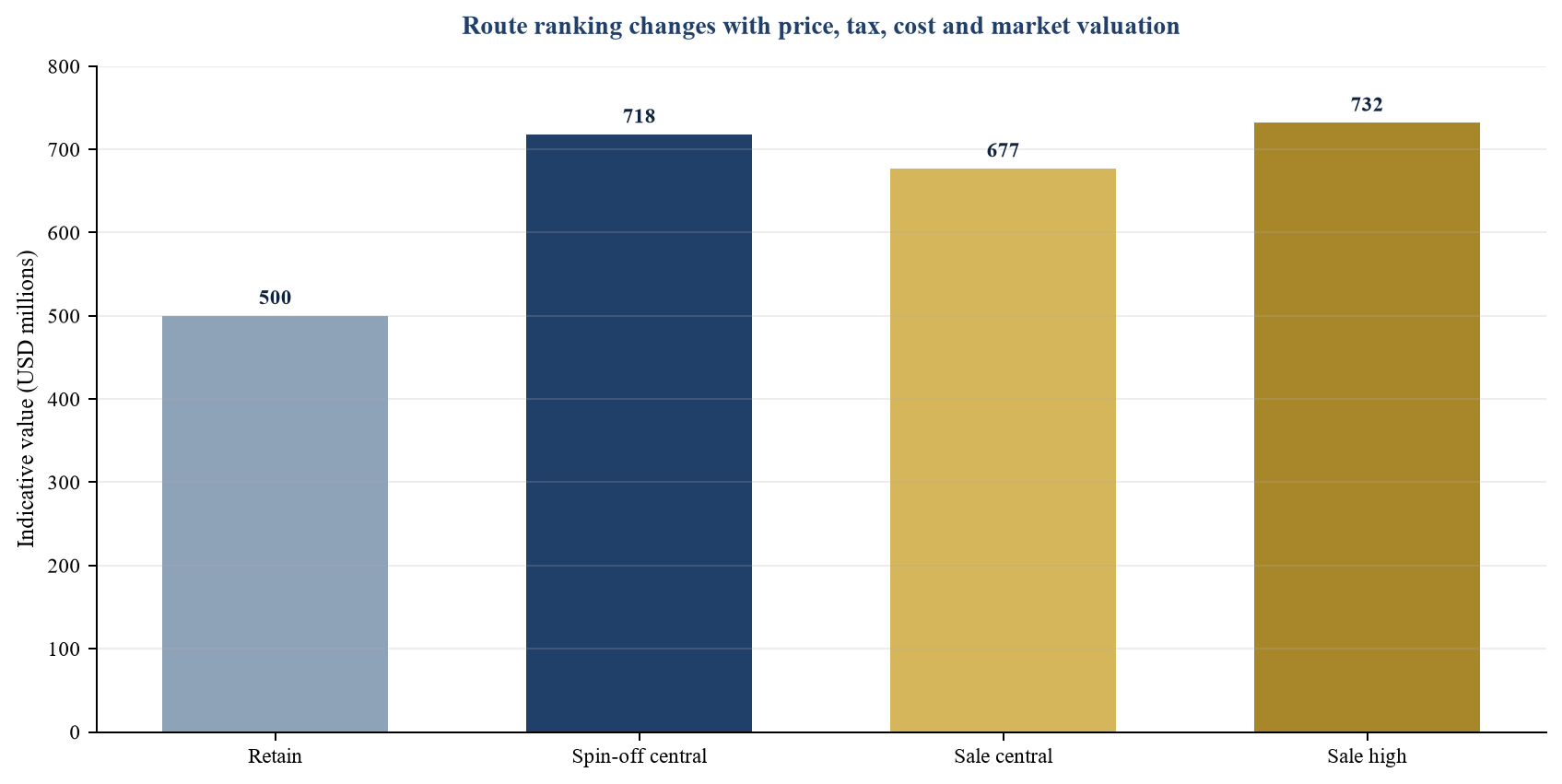
Original scenario. Values are assumed analytical outputs in USD millions and are not market estimates.
20. Test risk alongside value
The valuation comparison should sit beside a risk record. Spin-off risk includes market absorption, standalone cost, public-company readiness, debt capacity, operational separation and early trading volatility. Sale risk includes buyer withdrawal, financing, competition review, remedy burden, tax leakage and post-signing business deterioration.
Risks should be quantified where possible. A probability-weighted model can show expected value, but probabilities should be supported by process evidence rather than selected to validate management's preference. Timing should be discounted consistently. Downside cases should identify whether either company breaches liquidity, leverage or covenant limits.
Some risks are asymmetric. A failed sale can disclose sensitive information and disrupt the business. A postponed spin-off can leave the group with duplicated cost and uncertain employees. Tax failure can create a large irreversible charge. Competition remedies can remove assets that were central to buyer value.
The board should specify route-switch triggers. Examples include bids below an approved threshold, failure to obtain tax clearance, inability to establish audited standalone accounts, weak investor feedback or unresolved operational dependencies. A trigger should prompt a formal decision rather than an informal extension of the programme.
| Risk | Evidence required | Approval control | Monitoring indicator | Route-switch trigger |
|---|---|---|---|---|
| Standalone economics | Carve-out accounts and function-level cost model | Independent finance and audit review | EBITDA bridge and cost run-rate | Unresolved material gap in sustainable earnings |
| Capital structure | Integrated plan, ratings and covenant analysis | Board-approved debt and liquidity limits | Leverage, headroom and liquidity | Either company cannot fund the downside case |
| Tax leakage | Step plan, opinions and clearance status | No irreversible step before required advice | Open conditions and quantified exposure | Relief unavailable or leakage exceeds threshold |
| Market absorption | Register analysis and investor feedback | Minimum readiness and disclosure standard | Demand, liquidity and ownership | Insufficient support for viable public trading |
| Buyer certainty | Bids, financing, approvals and remedy commitments | Minimum contract and certainty terms | Conditions, timetable and value leakage | Risk-adjusted proceeds fall below alternative |
| Operational separation | Dependency ledger and TSA exit plans | Critical services proven before close | Incidents, milestones and exit readiness | Critical dependency lacks funded resolution |
Original framework. Owners and thresholds should be adapted to the company, route and jurisdictions.
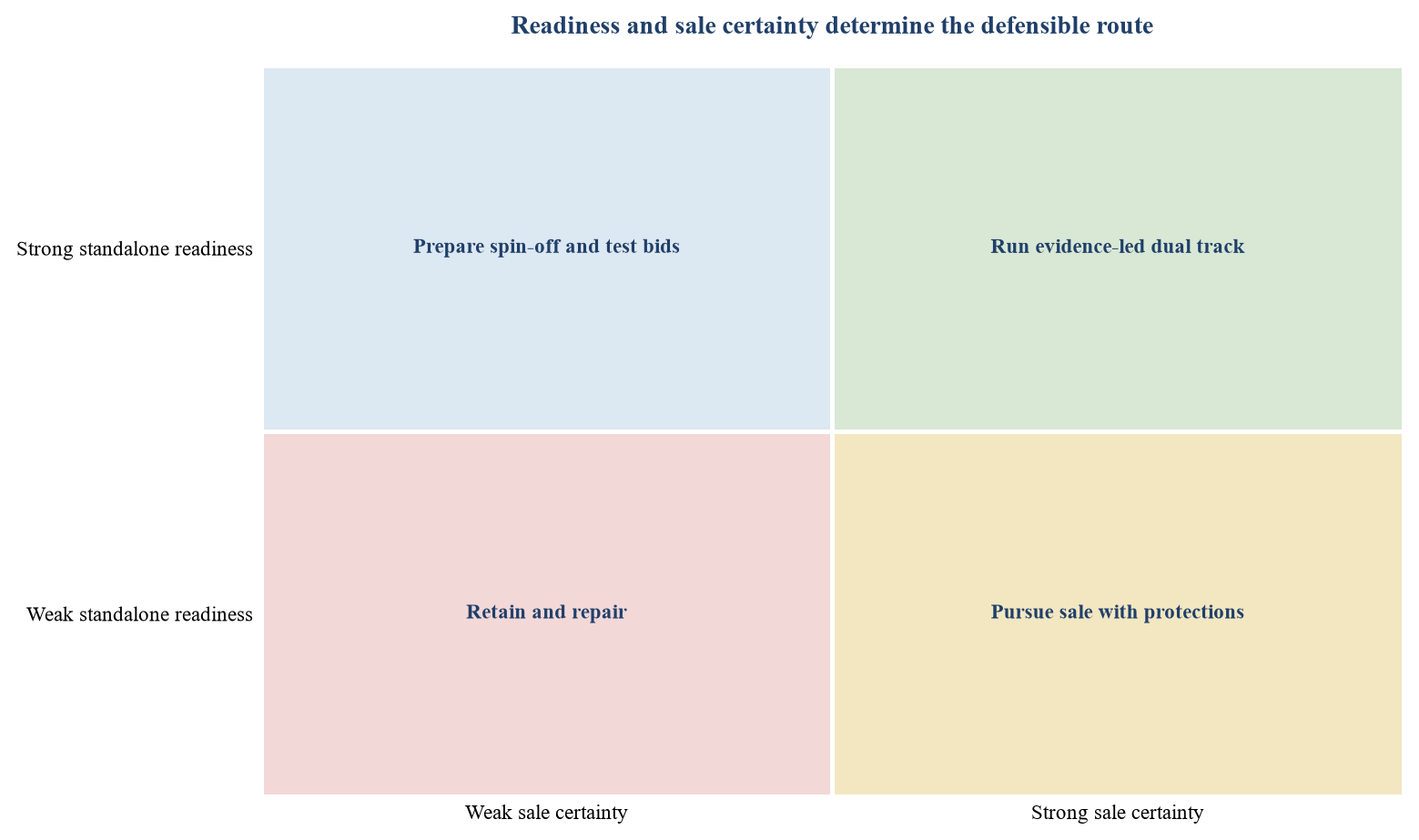
Original framework. The board should use company-specific evidence and approved thresholds.
21. Govern the route decision
The board should approve the decision criteria before receiving final bids or committing to a spin-off. Criteria should include risk-adjusted value, strategic fit, capital resilience, tax, stakeholder effects, execution certainty and timing. Pre-agreed criteria reduce the risk that one headline number dominates the decision.
Management should maintain one integrated model and evidence room. Sale and spin teams should use the same perimeter, historical financials, standalone-cost baseline, separation budget and liability record. Route-specific assumptions should be visible. Independent challenge can test allocation, valuation, tax and readiness.
The board paper should identify facts, assumptions and open items. It should explain which conditions are within management control and which depend on buyers, regulators, markets or tax authorities. It should record the consequences of delay and the last date on which a dual track remains practical.
Decision governance should continue after route selection. For a sale, the board should monitor value leakage, conditionality, regulatory risk and closing readiness. For a spin-off, it should monitor capital, operational independence, disclosure, investor readiness and distribution conditions.
22. Implement the separation
The first phase confirms thesis, perimeter, leadership and evidence standards. The second produces carve-out financials, standalone-cost and stranded-cost baselines, capital structures, tax steps and separation plans. The third tests routes through buyer evidence and investor readiness while preserving confidentiality.
The fourth phase selects and executes the route. A sale moves through contract, approvals and closing. A spin-off completes filings, financing, governance, distribution and listing. Both routes require operational cutover and day-one controls. The fifth phase exits transition services, removes stranded cost and delivers the stated capital-allocation plan.
An integrated programme should identify critical paths and interdependencies. Audit, tax, financing, regulatory review, technology and people consultation can each control timing. Workstream progress should be measured by evidence accepted at gates rather than by percentage-complete estimates.
The separation should close with an accountability record. The parent and separated business should know which assumptions underpinned the decision, which benefits remain to be delivered and who owns them. Post-close measurement should compare actual cost, capital, service continuity and value outcomes with the approved case.
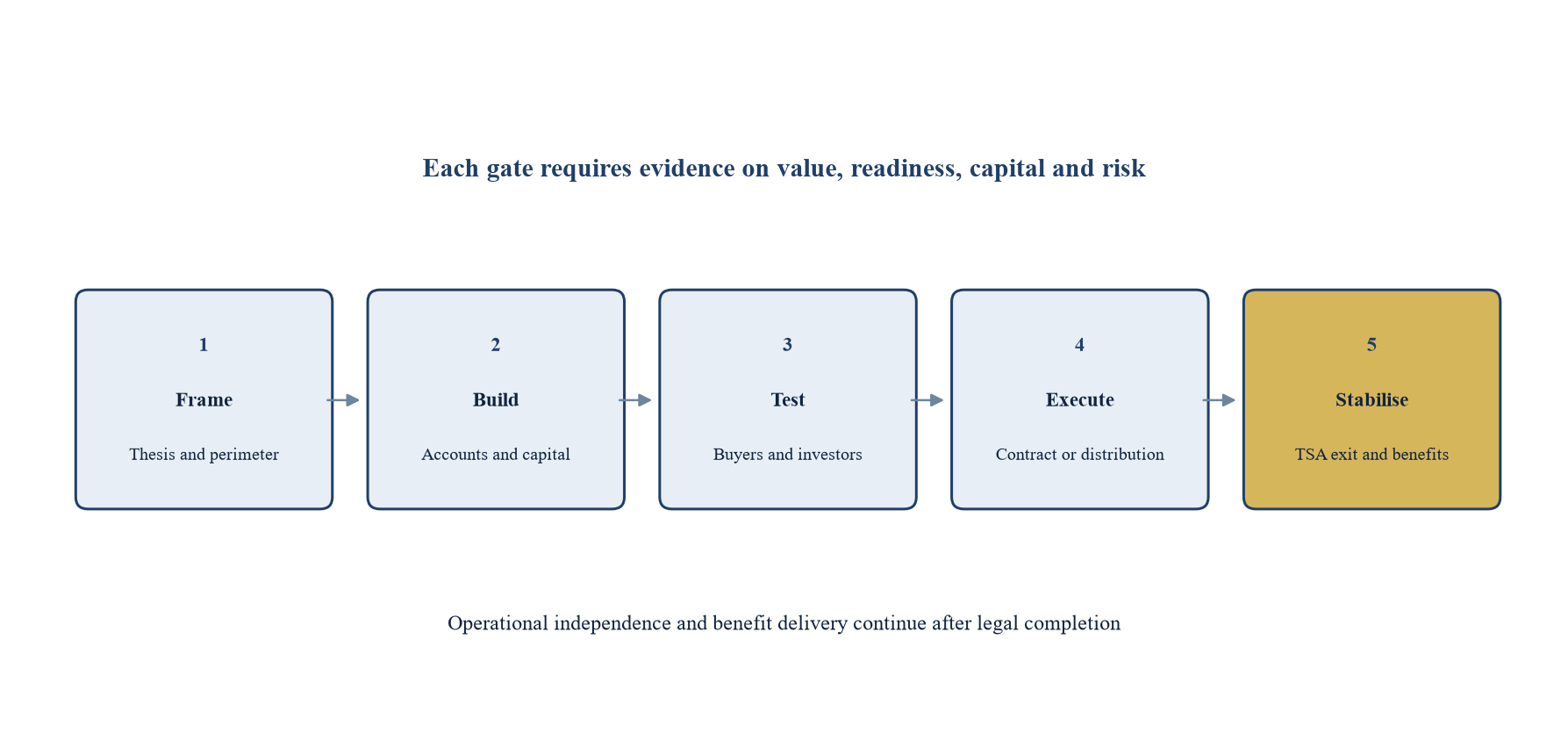
Original framework. Phase timing and regulatory gates depend on the selected route and jurisdiction.
23. Conclusion
A spin-off can create more value than a sale when the separated business has credible standalone economics, sufficient scale, a resilient capital structure, a natural investor base and future upside that shareholders value more highly than available buyer proceeds. A sale can create more value when a buyer pays for synergies, closing certainty is strong and tax and transaction leakage remain acceptable.
The route should follow evidence from a common perimeter and financial baseline. Standalone cost, stranded cost, debt, tax, separation expenditure and retained liabilities must be treated consistently. Headline enterprise values are not comparable until these items and timing are reflected.
Preparation creates option value. Reliable carve-out accounts, a controlled perimeter, capital plans, tax analysis, operational separation and clear governance improve both sale bids and spin-off readiness. A dual track is useful only while management can support both routes without damaging the business.
The board's final decision should identify the source of value, the conditions required to realise it and the risks retained by shareholders. The hypothetical case shows that a modest change in sale price, tax leakage or spin valuation can reverse the ranking. The framework therefore uses ranges, route-switch triggers and documented evidence rather than a single preferred narrative.
Sources
- IFRS Foundation, IFRS 5 Non-current Assets Held for Sale and Discontinued Operations, accessed 16 September 2026. Read the primary source
- US Securities and Exchange Commission, Financial Reporting Manual, Topic 2, carve-out financial statements and registering shares of a disposed business, last reviewed 29 June 2026, accessed 16 September 2026. Read the primary source
- US Securities and Exchange Commission, Financial Reporting Manual, Topic 3, pro forma financial information, accessed 16 September 2026. Read the primary source
- US Internal Revenue Service, Revenue Procedure 2025-30, procedures for ruling requests concerning Section 355 transactions, accessed 16 September 2026. Read the primary source
- OECD, G20/OECD Principles of Corporate Governance 2023, accessed 16 September 2026. Read the primary source
- HM Revenue & Customs, Apply for statutory clearance for a transaction, published 29 October 2024, accessed 16 September 2026. Read the primary source
- HM Revenue & Customs, Modernising the taxation of distributions and repayments of capital from companies, published 23 June 2026, accessed 16 September 2026. Read the primary source
- Competition and Markets Authority, Merger Assessment Guidelines, updated 3 September 2026, accessed 16 September 2026. Read the primary source
- European Commission, Mergers procedures under the EU Merger Regulation, accessed 16 September 2026. Read the primary source
- US Securities and Exchange Commission, Final Rule 33-10786, Amendments to Financial Disclosures about Acquired and Disposed Businesses, accessed 16 September 2026. Read the primary source
