

1. Define settlement as five distinct states
A signed private-share purchase agreement does not establish that cash and shares have settled. Signing records contractual commitment. Funding records that money reached the approved account. Release records that the escrow or payment agent acted under valid instructions. Registration records that the issuer or transfer agent updated the legally relevant ownership record. Finality records that the parties have received the expected assets, statements and post-close evidence without an unresolved reversal condition.
The transaction file should show each state independently. A single status field labelled closed can conceal that funds are held, conditions remain open or the buyer has no registered position. The operating dashboard should require evidence for every state and identify the person authorised to confirm it.
The closing sequence should be designed before money moves. The team identifies the security, legal and beneficial owners, transfer restrictions, required consents, buyer entity, tax and filing requirements, account chain, escrow agent, register operator, closing conditions, release mechanics and evidence package. A timetable should reflect the slowest required action rather than the fastest commercial promise.
The team should also define failure outcomes. A condition can fail before funding, after funding or after a partial release. The agreements and operating plan should state who returns money, who unwinds documents, how expenses are treated, which records are corrected and who communicates with the parties.
The five states should also carry timestamps. Signing time, value date, cleared-funds time, instruction time, bank execution time, register-update time and statement time can differ across time zones and systems. A closing that spans a weekend or public holiday can create a longer exposure than its calendar description suggests. The controller should report both the contractual date and the actual evidence time.
Status language should be controlled. "Ready to close" can mean that documents are agreed, conditions are satisfied or funds are expected. The dashboard should use defined terms and display the evidence missing from the next state. External communication should describe the same evidenced state so that buyer, seller and advisers work from one version.
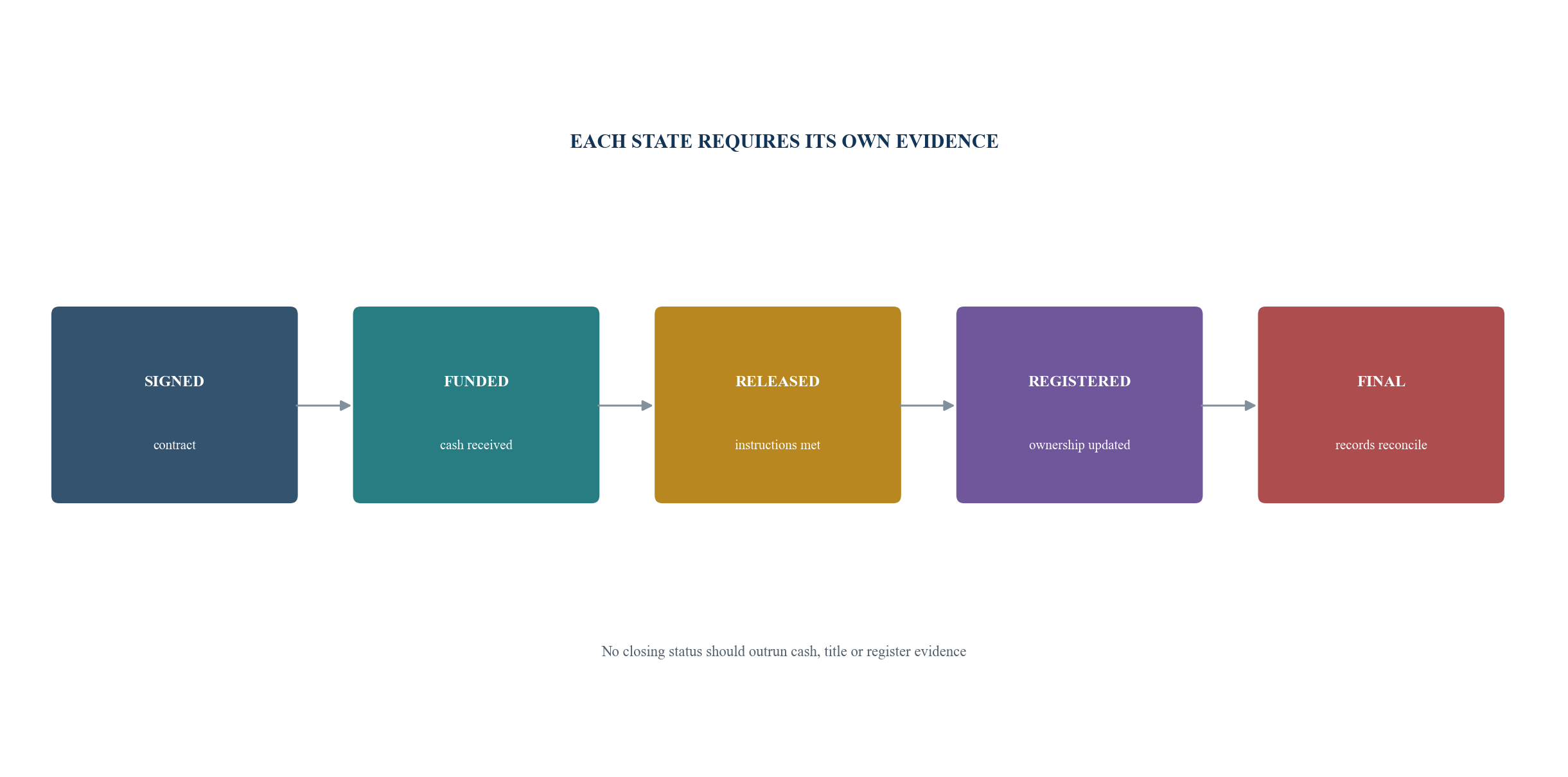
The states are an author framework; contractual and legal finality require transaction-specific advice.
Table 1. Settlement state record
| State | Minimum evidence | Decision owner | Reopen trigger |
|---|---|---|---|
| signed | executed agreement and authority | transaction counsel | amendment or invalid execution |
| funded | cleared receipt in approved account | escrow or finance owner | return, rejection or shortfall |
| released | valid instruction and disbursement evidence | escrow agent | disputed or conditional release |
| registered | issuer, registrar or transfer-agent record | company or transfer owner | rejection or record correction |
| final | cash, security, fees and statements reconcile | closing controller | unresolved exception or reversal |
Evidence requirements should reflect the actual security, contract and legal system.
2. Start with the asset and ownership chain
The transaction may involve a certificated share, an uncertificated registered position, a beneficial interest held through a nominee, an interest in an SPV or a contractual participation. These assets are economically and legally different. The buyer should know what is acquired, which rights attach, who appears on each register and which entity owes performance.
The ownership stack should begin with the issuer and security class. It records the authorised and issued capital where relevant, certificate or book-entry identifier, registered holder, nominee, custodian, SPV, beneficial owner and proposed buyer. Every link should have a source document and as-of date.
An SPV introduces its own governance. The file should include formation, good standing, constitutional documents, cap table, directors, authorised signatories, bank account, beneficial ownership, sanctions and tax profile. The SPV's ownership of the underlying asset should be evidenced independently from ownership of the SPV interests.
The team should identify encumbrances and competing claims. Pledges, liens, options, rights of first refusal, co-sale rights, court orders, marital claims, employee restrictions or prior sale agreements can affect delivery. A seller representation is part of the file and should be tested against available primary evidence and red flags.
Historical movements deserve review. A position assembled through several grants, purchases, exercises, conversions or transfers may contain different restrictions and tax attributes. The seller's total economic quantity may exceed the transferable quantity for the proposed route. Lot-level records can prevent the wrong certificates or interests from entering the closing package.
The buyer's acquisition entity should be fixed early. A late change from an individual to a trust, fund or SPV can reopen eligibility, KYC, tax, consent, rights-process, payment and registration work. The condition register should treat an entity substitution as a controlled change rather than an administrative edit.
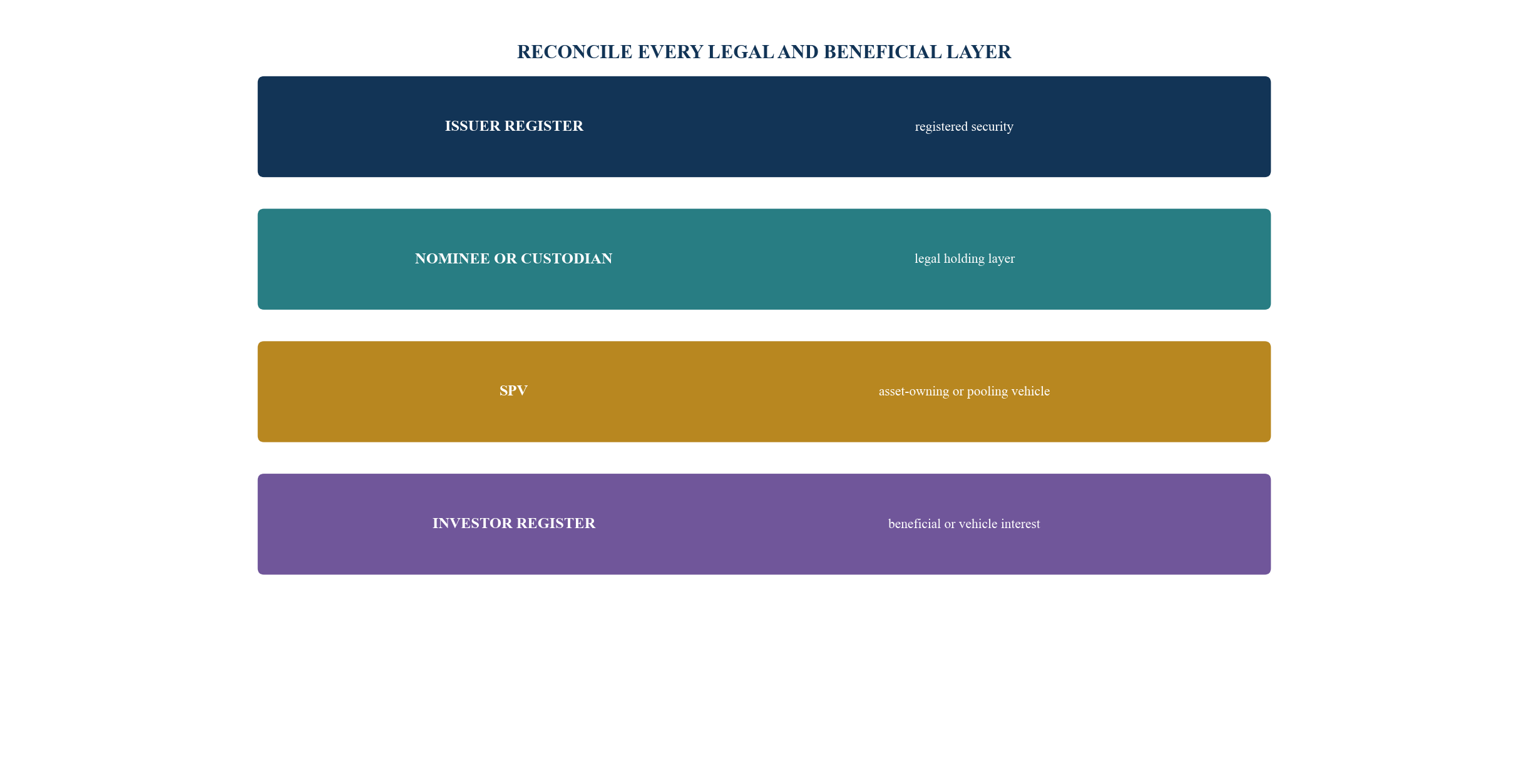
Each layer requires its own authority, record and transfer mechanics.
Table 2. Ownership-stack evidence
| Layer | Evidence | Control question | Failure response |
|---|---|---|---|
| issuer | register, certificate or transfer-agent record | what security legally exists? | pause title assertion |
| registered holder | identity and authority | who may instruct transfer? | obtain valid instruction |
| nominee or custodian | account and beneficial statement | whose interest is recorded? | reconcile underlying ledger |
| SPV | formation, cap table and asset evidence | does the vehicle own the asset? | remediate governance or title |
| investor | subscription or purchase record | what interest will buyer receive? | correct transaction description |
| encumbrance | lien, pledge and restriction searches | can the interest be delivered free as agreed? | release, consent or disclose |
Current counsel should determine which record establishes legal title.
3. Build a condition-precedent register before funding
Conditions should be translated from agreements into an operational register. Each condition needs exact wording, responsible party, evidence, reviewer, due date, dependency, waiver authority and status. A narrative closing checklist can miss which person has authority to declare a condition satisfied.
Common conditions include issuer consent, rights-process completion, board approval, transfer-document execution, buyer eligibility, regulatory or sanctions clearance, tax evidence, lien release, financing availability, minimum subscription, escrow agreement execution and delivery instructions. The actual list comes from the transaction documents and applicable law.
The register should distinguish documentary receipt from substantive satisfaction. Receiving a consent letter does not establish that the signer had authority or that conditions in the consent were fulfilled. The reviewer should record the conclusion and evidence relied upon.
Waivers require the same discipline. The file should identify who may waive, whether the condition protects one or several parties, whether law permits waiver, and whether the waiver changes price, risk or disclosure. A verbal statement should not be treated as an effective waiver without the required form and authority.
Dependencies should be explicit. Tax evidence may depend on a final consideration amount. The final consideration may depend on fees or foreign exchange. A transfer agent may wait for original documents or issuer consent. The register should identify predecessor conditions so that teams do not chase an action that cannot yet begin.
Conditions should also distinguish objective events from judgement. Receipt of a named document can be tested directly. Satisfaction with due diligence requires an authorised decision and may carry a contractual standard. The register should show which party holds that judgement and what evidence supports its exercise.
4. Design escrow around agency, account and release authority
Escrow is a governed arrangement rather than a generic bank account. The agreement should identify the agent, parties, beneficial interests, account title, permitted deposits, investment or interest treatment, fees, information rights, release conditions, instruction mechanics, disputes, return events, liability standard and termination.
The account should match the agreement. Finance should verify the bank, account holder, designation, currency, permitted payers and permitted beneficiaries through independent evidence. Payment instructions should use controlled exchange, callback and change procedures. A last-minute instruction change deserves enhanced verification.
US contingent offerings illustrate the importance of route-specific requirements. FINRA examination material asks whether firms promptly transmit funds to an escrow agent or separate bank account in compliance with Exchange Act Rule 15c2-4. The applicable structure and duties should be confirmed for the actual offering and intermediary.
The release certificate should cite every condition it relies upon and attach or link the evidence. Dual authorisation can reduce unilateral error. Where several releases occur, each tranche should have its own amount, recipients, conditions and reconciliation.
Escrow-agent appointment and banking-provider appointment should be distinguished. An administrator can coordinate documents while a bank or regulated provider holds money. The file should state which entity owes the safeguarding, instruction and return duties. Marketing names and platform interfaces should not obscure the legal account holder or agent.
Dispute mechanics require operational detail. The agreement should state whether the agent freezes the entire balance or only the disputed amount, which notices are valid, how long the agent waits and whether interpleader or another remedy is available. The controller should know who continues to bear fees and market risk while the dispute remains open.
5. Separate buyer cash, seller proceeds and transaction fees
One gross receipt may be allocated among seller proceeds, taxes, escrow costs, legal expenses, platform charges, intermediary compensation, reserves and refunds. The waterfall should identify the contractual basis, payer, recipient, calculation, currency, timing and approval for every flow.
Fees should not be deducted merely because an invoice exists. The closing file should show that the agreement authorises the deduction, the calculation is correct, the service and trigger occurred, tax treatment was reviewed and the recipient account was verified. Related-party and referral payments deserve explicit conflict and authority review.
Foreign exchange can change the amount delivered. The record should show the source currency, conversion provider, rate, spread, timestamp, fees and final amounts. The party bearing rate movement and failed-conversion risk should be defined.
Reserves require purpose, holder, permitted use, expiry and release mechanism. An undefined holdback can become a disputed balance. Residual amounts should be returned or released under documented authority and reconciled to the bank record.
The waterfall should be tested with several outcomes before closing. A full close, partial close, failed condition, overfunding, underfunding, currency shortfall and post-close adjustment can produce different cash movements. The model should identify which instructions are prepared in advance and which require a new approval.
Payment evidence should distinguish initiation from clearing. A screenshot of a payment order does not prove receipt. The bank or escrow ledger should show final credited value, currency, sender and reference. Any chargeback, recall or compliance hold should reopen funding status.
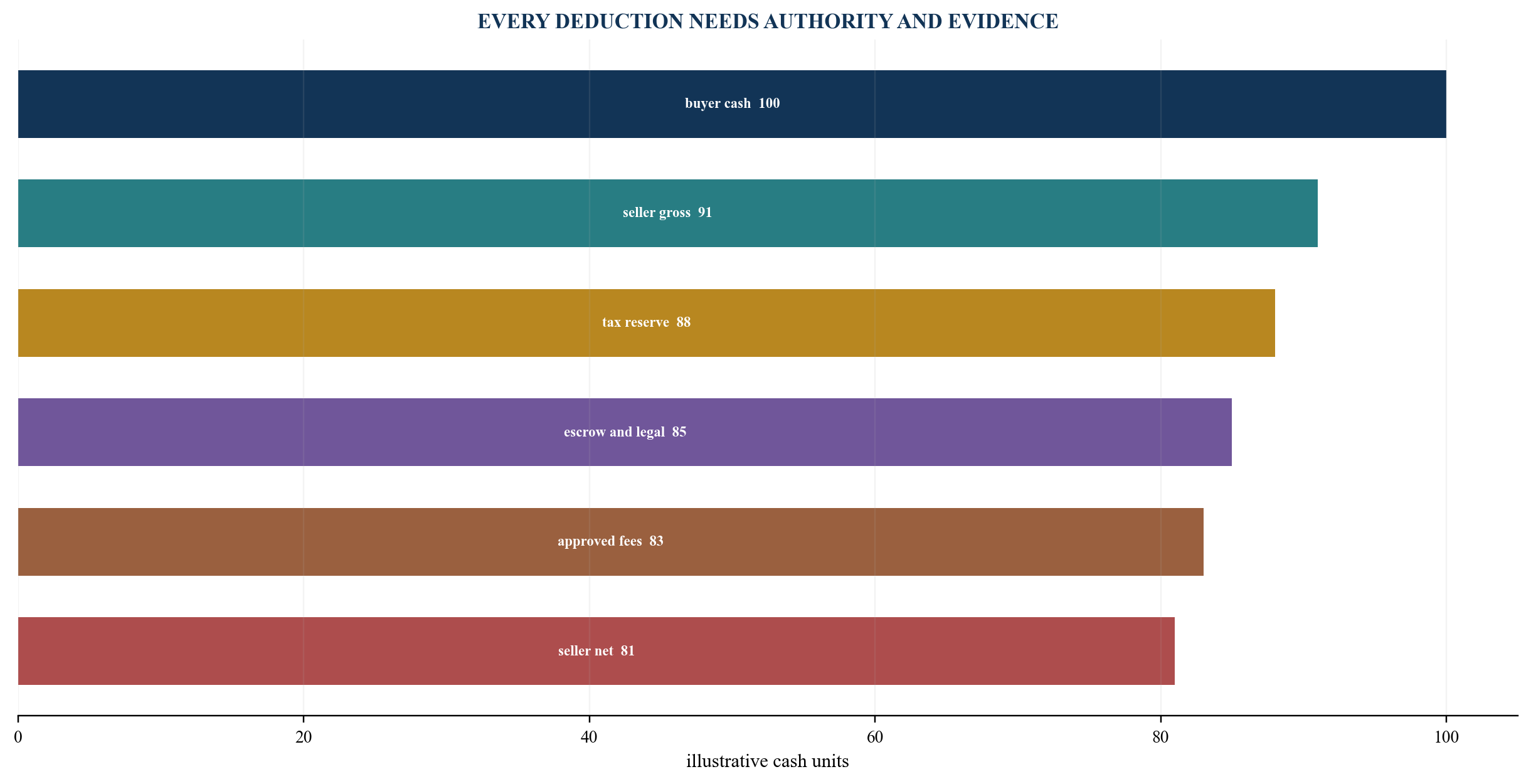
Values are illustrative management assumptions and exclude transaction-specific tax advice.
Table 3. Funds-waterfall control
| Flow | Required basis | Evidence | Approval gate |
|---|---|---|---|
| buyer funding | purchase or subscription obligation | cleared bank receipt | payer and amount match |
| seller proceeds | price and quantity | executed agreement | delivery condition met |
| tax | current advice and filing route | calculation and payment record | tax owner approves |
| provider cost | contract and invoice | service and amount evidence | deduction authorised |
| intermediary fee | mandate and trigger | calculation, invoice and role | lawful recipient confirmed |
| reserve | defined purpose and expiry | controlled account and ledger | release rule documented |
| refund | failure or excess event | beneficiary and return instruction | original source reconciled |
Amounts, taxes and payment permissions require transaction-specific confirmation.
6. Create delivery-versus-payment logic for an illiquid asset
Public markets use established settlement infrastructure for simultaneous or linked exchange. Private shares often require manual documents, issuer action and bank transfers. The control objective remains aligned delivery: neither party should bear an unintended period in which value has moved and the corresponding asset has not.
The closing design should identify the deliverable that permits cash release. It may be an executed transfer instrument, issuer acceptance, updated register, nominee statement, SPV issuance or another legally effective record. Counsel should determine whether the deliverable creates title, supports registration or merely begins a process.
The design should address sequencing risk. Funding can occur into escrow before all non-cash conditions are satisfied. Release can then be linked to evidence that the security is deliverable and the register update is ready. Where true simultaneity is unavailable, the agreement should allocate interim risk and define unwind mechanics.
FCA CASS rules provide a specific regulated framework for client money and delivery-versus-payment transactions within their scope. The relevant firm should confirm whether the exemption conditions apply and what happens when delivery does not occur within the specified period. Other jurisdictions and providers have their own safeguarding requirements.
The DvP design should identify the party exposed during each interval. Before funding, the seller bears the risk that buyer cash does not arrive. After funding into escrow, the buyer has transferred liquidity while awaiting delivery. After release and before registration, both parties may depend on issuer or transfer-agent performance. The agreement and controller should make these intervals visible and allocate remedies.
Where a nominee or custodian can update its own beneficial ledger faster than the issuer register changes, the parties should understand which record controls the acquired interest. An internal ledger entry may support economic allocation while leaving legal title unchanged. Counsel should determine the effect and the evidence required for release.
7. Control transfer instruments and registration evidence
The transfer package should identify the exact issuer, security, class, quantity, registered holder, transferee, consideration and execution authority. Certificates, powers, medallion or signature guarantees, tax evidence and issuer forms may be required depending on the jurisdiction and security.
Delaware UCC Article 8 section 8-401 describes conditions under which an issuer has a duty to register a transfer, including eligibility, effective instruction, assurance of authority, tax compliance, transfer restrictions and rightful transfer. The actual application depends on the security and facts.
For UK shares, Companies Act 2006 provisions address registration and transfer procedures. HMRC guidance explains current stock-transfer-form and Stamp Duty processes, including transaction details and submission timing where applicable. The registrar uses the relevant evidence to register new ownership.
The final evidence ladder should distinguish a signed form, accepted package, approved transfer, updated legal register, new certificate or statement, and beneficial-account update. Each step answers a different question. The dashboard should show the highest evidenced state.
Rejections should be structured data. The transfer agent or issuer may identify a missing signature, incorrect holder name, restriction, tax issue, certificate problem or authority gap. The controller should record the exact rejection, owner, cure document, resubmission date and revised timetable. A generic "registration pending" status hides the action required.
Original documents create custody and logistics risk. The chain should record who holds each certificate, form, power or guarantee; when it moved; courier tracking; receipt; and return. Copies support review while the legally required original remains controlled.
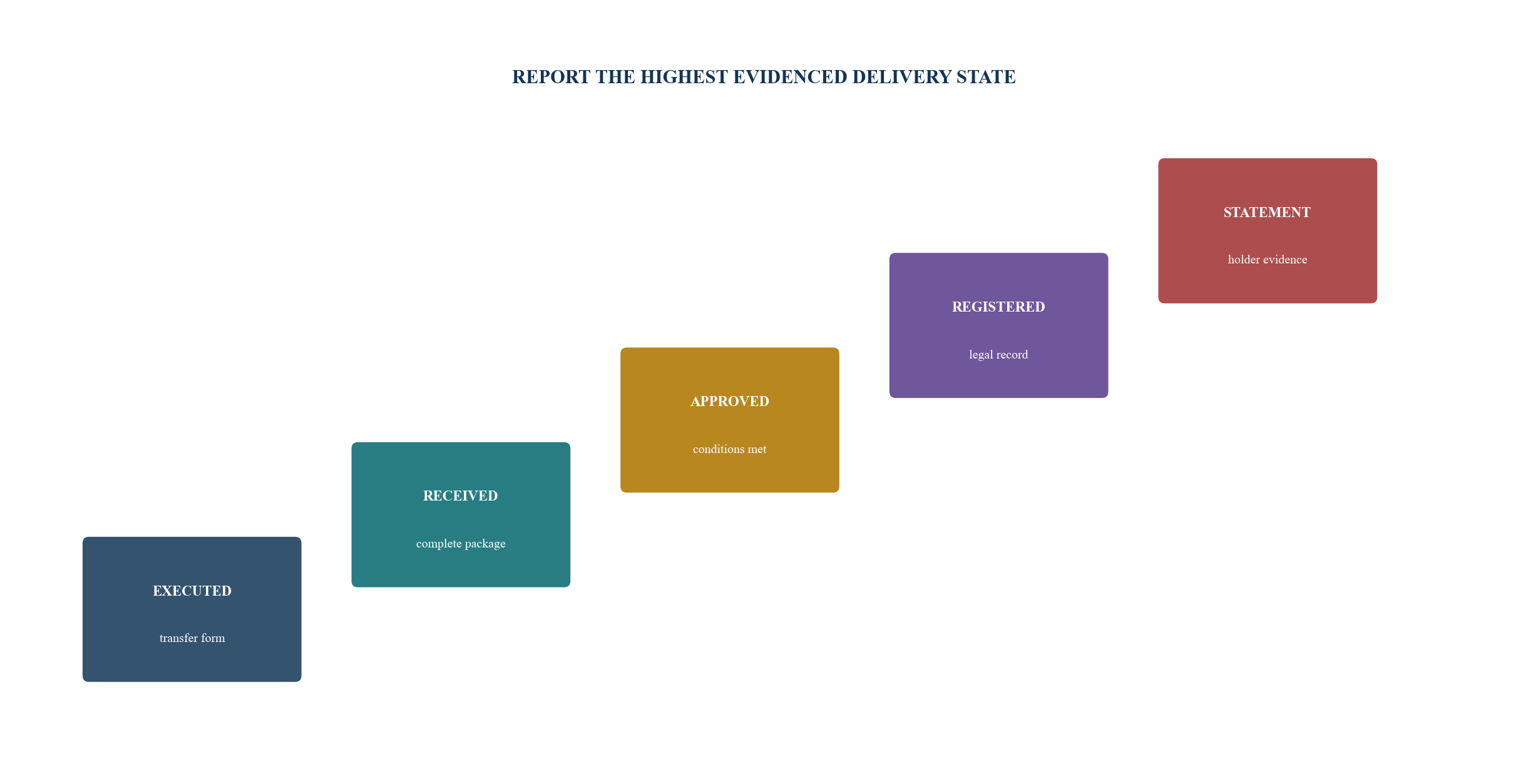
The legally decisive record varies by issuer, security, holding system and jurisdiction.
8. Govern SPV issuance and underlying-asset settlement separately
An SPV transaction can involve two closings: acquisition or transfer of the underlying asset into the vehicle, and issuance or transfer of interests in the vehicle to investors. The team should not assume that completion of one establishes the other.
The SPV should have a controlled capital ledger. It records authorised interests, issuances, transfers, cancellations, investor commitments, funded amounts, ownership percentages and voting or economic rights. The ledger should reconcile to executed documents and the vehicle's governing records.
Underlying-asset evidence should reconcile to the SPV's financial statements and investor reporting. If the SPV holds through a nominee, custodian or another vehicle, each intermediate record should be included. Asset quantity, class and restrictions should match the investor disclosure.
Expenses and reserves should follow the governing documents. Formation costs, administration, tax, legal, custody, insurance and management charges should have defined allocation rules. Investor capital should not be used for an undisclosed purpose.
The vehicle's liabilities matter to delivery. An investor acquiring an SPV interest may inherit exposure to unpaid expenses, tax, indemnities, borrowing or litigation within the vehicle. The closing file should include a current liability and commitment schedule, bank reconciliation and confirmation of obligations that survive transfer.
Governance changes should close with the economic transfer. Director appointments, reserved matters, voting proxies, information rights, distribution instructions and authorised signatories can require separate actions. The closing plan should identify which become effective at signing, release or registration.
9. Safeguard client money and securities through authorised providers
Holding or controlling client money or custody assets can create specific permissions and duties. The operating model should identify which entity receives funds, whose account is used, who controls instructions, who holds the security and which safeguarding regime applies.
The FCA states that firms holding or controlling client money or safe custody assets must follow applicable CASS rules. The DFSA describes client assets as a regulatory priority and requires relevant authorised firms to hold the appropriate endorsement and comply with client-money and safe-custody provisions. ADGM FSRA guidance for private-financing platforms addresses client-money and safe-custody arrangements within its framework.
The transaction adviser should avoid receiving funds or securities outside its permitted role. Instructions can route payments directly between approved parties or through a qualified escrow, custody or settlement provider. The mandate and client communications should accurately describe the adviser's role.
Provider diligence should cover authorisation, account structure, segregation, insolvency treatment, sub-custody, insurance, reconciliation, cyber controls, incident handling, reporting, business continuity and exit. Contractual labels should be compared with the provider's actual permission and operating process.
The provider's standard terms should be mapped against the transaction agreement. Liability limits, cut-off times, sanctions discretion, information requirements, return powers and termination rights can affect the intended closing. Any conflict should be resolved before the parties rely on the provider.
Ongoing monitoring applies during a long closing. A provider's permission, bank account, key contacts or operating condition can change. The controller should refresh critical evidence immediately before funding and again before release where the timetable or risk warrants it.
10. Build a settlement swim lane with named handoffs
The swim lane should show actions across buyer, seller, issuer, SPV, counsel, escrow, bank, custodian, transfer agent and transaction controller. Every handoff requires an input, owner, deadline, evidence and exception route.
The pre-close phase confirms parties, title, restrictions, conditions, accounts and document form. The funding phase confirms payer identity, cleared value and cash ledger. The release phase confirms instructions and conditions. The registration phase confirms legal records. The post-close phase reconciles statements, fees, taxes and open items.
Handoffs deserve service standards. A transfer agent may require a complete package before its review clock begins. A bank may impose cut-off times. Tax confirmation may follow a separate process. The timetable should capture these dependencies and avoid promising a closing date unsupported by provider capacity.
The controller should run a formal closing call only from the current register. Decisions, conditions and instructions should be read back and recorded. Material changes after the call should reopen the affected approval.
The call should distinguish information from authority. A participant can report that a document was received without having authority to declare a condition satisfied. The controller should address each decision to the named approver and preserve the response.
Time-zone ownership should follow the transaction through the full day. A handoff between teams should include the latest register, open conditions, expected receipts, escalation contacts and prohibited actions. No team should release on the basis of a stale overnight summary.
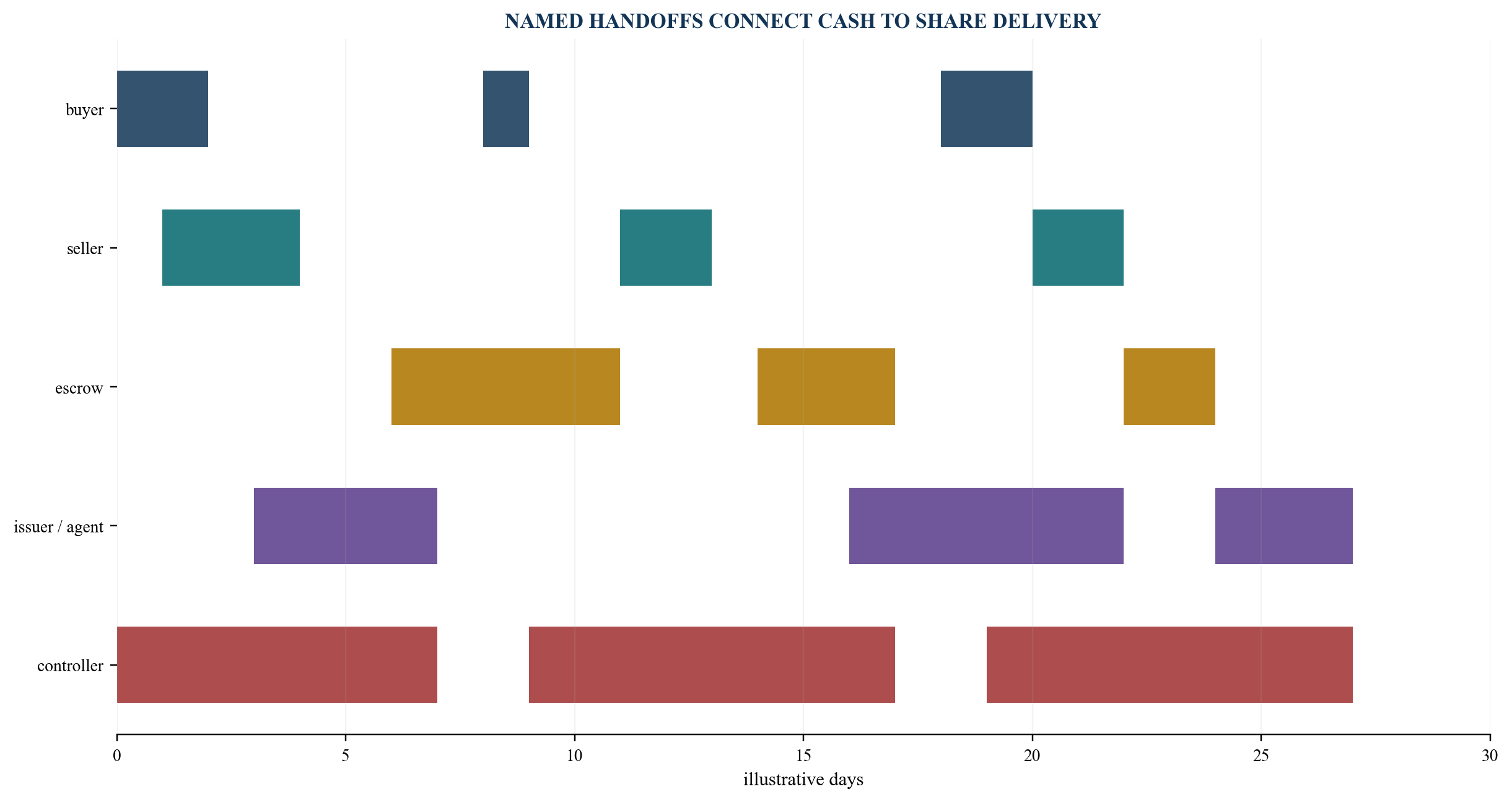
Timing is illustrative and should be adapted to provider processes and contractual requirements.
Table 4. Settlement handoff matrix
| Handoff | Input | Output | Acceptance test |
|---|---|---|---|
| seller to counsel | title and authority evidence | executable transfer package | security and signer match |
| buyer to escrow | approved payment instruction | cleared funds | payer, amount and reference match |
| controller to escrow | condition certificate | authorised release | every cited condition evidenced |
| escrow to beneficiaries | payment waterfall | bank confirmations | amounts and accounts reconcile |
| counsel to issuer | complete transfer package | registration decision | package accepted or exception stated |
| issuer to buyer | register or holder evidence | delivery confirmation | buyer entity, class and quantity match |
| providers to controller | statements and ledgers | final close file | zero unexplained difference |
The matrix should be populated with actual people, systems and provider cut-offs.
11. Reconcile six records after every close
The executed agreement states obligations. The escrow ledger states money held and released. The bank record states cleared cash. The issuer or transfer-agent record states registered ownership. The SPV or nominee ledger states beneficial interests. The accounting record states assets, liabilities, fees and taxes. Finality requires these records to agree or explain every difference.
The reconciliation should use stable identifiers for transaction, party, security, account and payment. Names alone can vary across documents. Quantity, class, currency, gross price, deductions, net proceeds and timestamps should be compared systematically.
Differences should enter an exception register with amount, affected party, cause, owner, ageing, financial exposure and resolution. An unexplained residual bank balance, unmatched share quantity or incorrect holder name should prevent final status.
The post-close pack should include executed documents, approvals, conditions, communications, payment evidence, register evidence, statements, fee invoices, tax records and final reconciliation. Access and retention should reflect confidentiality, privacy and legal requirements.
Reconciliation should be both transactional and aggregate. The transaction view confirms one close. The aggregate view confirms that escrow, nominee or SPV balances across all transactions equal bank, custody and accounting records. A difference can arise from a correctly closed deal recorded in the wrong account or vehicle.
Independent review can focus on material and unusual closes. Examples include manual instruction changes, partial delivery, delayed registration, related-party fees, cross-currency funding, reused SPVs and exceptions closed through judgement. The reviewer should reproduce the conclusion from retained evidence.
12. Control payment-instruction fraud and cyber risk
Private transactions can involve large payments, new counterparties and urgent changes. The control should use independently verified contact details, dual approval, callback, account-name checks where available, secure channels and a cooling-off or enhanced review for changed instructions.
Email alone should not establish a new beneficiary. The callback should use a number sourced independently from the change request. The reviewer should document who confirmed, when, through which channel and what details were read back.
Data-room and signature platforms should use named access, multi-factor authentication, least privilege, download controls and audit logs. Administrators should be separate from unilateral payment authority. Terminated participants should lose access promptly.
An incident plan should identify the bank, escrow, counsel, insurer, regulator and law-enforcement contacts relevant to the transaction. Rapid recall and freeze requests can be time-sensitive. The team should preserve evidence and avoid altering compromised records.
Staff should rehearse one realistic payment-change scenario before high-value closing activity. The exercise should test whether the team recognises social engineering, reaches the independently sourced contact, stops the instruction, alerts the bank and preserves messages. Completion evidence should include the identified gaps and corrective action.
Access logs should be reviewed for administrators as well as external users. A compromised administrator can change permissions, export files or create a convincing instruction trail. Privileged access should use separate credentials, strong authentication, monitoring and periodic recertification.
13. Establish an exception and failed-settlement protocol
The protocol should classify failures by cash, title, condition, document, registration, tax, account, sanctions, cyber or provider cause. Severity should reflect financial exposure, customer impact, legal status and time sensitivity.
Cash received without deliverable shares should remain in the approved safeguarded state under the applicable agreement and law. Shares registered without expected proceeds require immediate escalation. Partial release should follow express authority and a reconciled allocation.
The protocol should identify cure rights, deadlines, notices, return mechanics, interest, expenses and termination. Counsel should direct legal remedies. Operations should maintain the factual record and prevent unsupported completion statements.
Communication should be consistent across parties. The controller should state the evidenced status, open condition, responsible owner and next update time. Forecast resolution dates remain management estimates until the required third party confirms completion.
Table 5. Failed-settlement response matrix
| Failure | Immediate control | Evidence to preserve | Authorised next route |
|---|---|---|---|
| funding shortfall | hold release | bank and escrow ledger | cure, resize or terminate |
| invalid beneficiary change | stop payment | request and callback record | reverify or reject |
| condition failure | freeze affected action | condition and decision record | cure, waive if lawful or return |
| title defect | stop delivery claim | ownership and restriction evidence | remediate, substitute or terminate |
| registration rejection | preserve cash and documents | rejection and submitted package | correct and resubmit |
| sanctions or compliance hold | stop movement | screening and provider notice | specialist escalation |
| cyber incident | isolate access and contact bank | logs, messages and instructions | recall, investigate and restore |
| reconciliation variance | withhold final status | all six source records | correct, explain and approve |
Remedies and communications require transaction-specific legal and contractual direction.
14. Score closing readiness with critical overrides
A readiness score can organise evidence across title, conditions, cash, escrow, delivery, registration, tax, safeguarding, cyber and reconciliation. Critical failures remain binary. Missing title, invalid release authority, unverified beneficiary or absent lawful custody route should stop the close regardless of the average.
Scores should identify the evidence date and reviewer. A bank confirmation can become stale after an instruction change. A consent can expire. A register extract can be superseded. The dashboard should show refresh triggers.
Management should see both readiness and exposure. A low-value documentary issue differs from a material cash or title gap. The exception record should quantify affected cash, shares and parties where possible.
The dashboard should display ageing from the point the exception became actionable. It should also identify external dependencies and the date of the last third-party response. This helps management distinguish an internally delayed task from an issuer, bank or regulator dependency.
Readiness should be assessed immediately before funding and release. A score completed days earlier can miss an instruction change, expired consent or new restriction. Critical evidence should have a transaction-specific freshness rule.
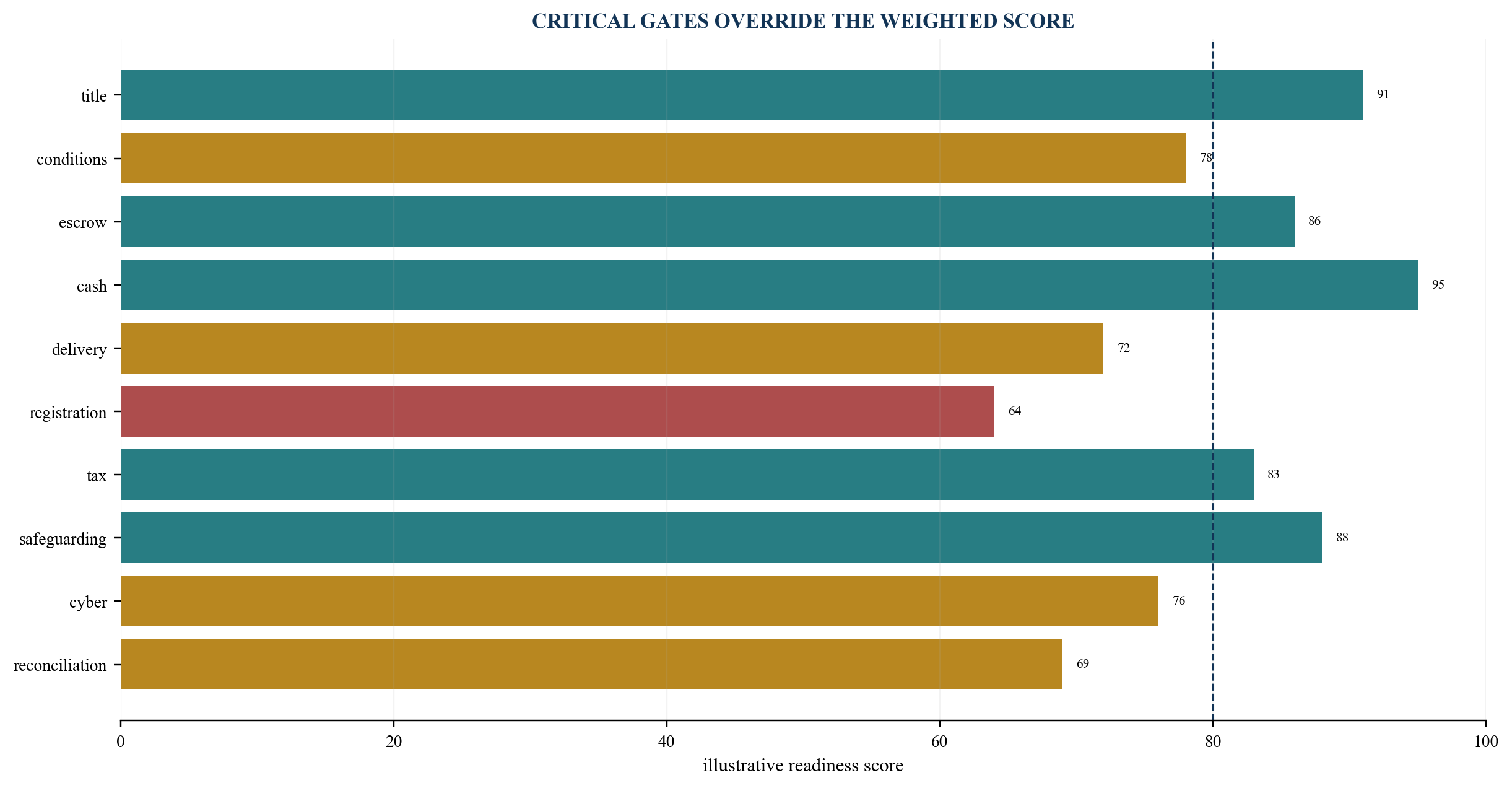
Scores and weights are management assumptions; critical closing gates remain binary.
Table 6. Settlement-readiness scorecard
| Module | Weight | Score | Open issue | Critical gate |
|---|---|---|---|---|
| title | 14% | 91 | none material | asset and seller authority confirmed |
| conditions | 12% | 78 | consent condition open | satisfaction or valid waiver |
| escrow | 10% | 86 | return template pending | agreement and account match |
| cash | 10% | 95 | none material | cleared value received |
| delivery | 12% | 72 | original form in transit | complete package accepted |
| registration | 13% | 64 | issuer review outstanding | legal record updated |
| tax | 7% | 83 | payment reference awaited | current treatment confirmed |
| safeguarding | 8% | 88 | none material | provider permission verified |
| cyber | 6% | 76 | callback test due | beneficiary independently verified |
| reconciliation | 8% | 69 | fee variance open | zero unexplained difference |
Illustrative scores do not replace legal, custody, compliance or provider decisions.
15. Run a ten-day settlement diagnostic
Days one and two inventory active transactions, securities, ownership routes, SPVs, escrow arrangements, accounts, providers, conditions and expected closing dates. The team identifies any transaction that has received money or documents without a complete control record.
Days three and four reconstruct representative closes from signing through registration. The review compares contract, condition register, cash, transfer package, issuer record, SPV ledger and accounting.
Days five and six test provider permissions, account structures, instructions, callbacks, safeguarding, cyber access and failed-settlement responses. Current counsel, compliance, tax and custody specialists review applicable requirements.
Days seven and eight design the state model, ownership stack, condition register, waterfall, swim lane, reconciliation and exception protocol. Test transactions include a failed condition, changed beneficiary and delayed registration.
Days nine and ten deliver the gap report, high-risk remediation, controlled closing templates, governance and thirty-day implementation plan. Unsupported completion statuses are corrected to the evidenced state.
16. Operate a thirty-day settlement-control office
Days one to five establish the transaction population, decision owners, provider map and critical stop list. The office prioritises funded or near-closing transactions.
Days six to ten reconcile asset and ownership evidence, restrictions, conditions, SPV governance and transfer packages. Exceptions receive owners and deadlines.
Days eleven to fifteen verify escrow agreements, bank accounts, release instructions, waterfalls, tax inputs and beneficiary controls. Representative callbacks and return scenarios are tested.
Days sixteen to twenty implement the settlement swim lane, state dashboard, evidence repository, version control and access model. Providers confirm cut-offs and required evidence.
Days twenty-one to twenty-five reconcile active and recently completed transactions across contracts, banks, registers, custody, SPV ledgers and accounts. Material differences are remediated or escalated.
Days twenty-six to thirty establish reporting, training, incident response, periodic assurance and archive standards. The governing owner accepts the operating model and unresolved risk.
17. Package the work around paid closing outcomes
Quality measures include evidenced title, current conditions, verified accounts, valid release authority, complete transfer packages, registration, accurate statements and zero unexplained reconciliation difference. Cycle measures include days from signing to funding, funding to release, release to registration and registration to final pack.
Commercial measures include paid diagnostics, signed settlement-control retainers, active closing offices, completed transactions, invoiced fees, collected fees and repeat mandates. Pipeline, projected fees and anticipated closes remain management estimates until supported by executed contracts, invoices, bank receipts and settlement evidence.
The service can be packaged as a settlement diagnostic, SPV and ownership reconciliation, escrow and waterfall design, closing-control office, failed-settlement remediation or portfolio-wide assurance programme. Reserved legal, regulatory, escrow, banking, custody, tax and accounting tasks should remain with qualified and authorised providers.
Engagement scope should define the decision rights. A settlement-control office can coordinate evidence, timetable, conditions, providers, dashboards and reconciliation. Legal opinions, custody, escrow, bank execution and registration decisions remain with the appointed qualified parties. This separation should appear in the mandate and client reporting.
Fees can reflect the operating burden: number of vehicles, security classes, jurisdictions, providers, closings, investors, accounts and exceptions. Any success-linked component requires current legal and regulatory review and an executed agreement. Collection reporting should identify the invoice, bank receipt and engagement to which cash relates.
The offer should be validated through signed and paid mandates. Management can connect each pain point to a defined deliverable, decision owner, closing milestone and collected fee. Contribution should be measured after provider, specialist, technology and delivery costs.
18. Conclusion
Private-share settlement becomes controllable when signing, funding, release, registration and finality remain separate evidenced states. The ownership stack establishes what is being delivered. The condition register establishes when it may close. The escrow and waterfall establish where money moves. The registration record establishes the recognised holder. The reconciliation establishes whether every record agrees.
SPVs, nominees and cross-border providers add layers that require explicit authority and evidence. A disciplined closing process gives each handoff an owner, each release a condition and each completion statement a source.
The final standard is operational: no cash without an approved route, no release without evidenced conditions, no delivery claim without the relevant record and no final close with an unexplained difference.
References
- US Securities and Exchange Commission. Transfer Agents. https://www.sec.gov/about/divisions-offices/division-trading-markets/transfer-agents
- Financial Industry Regulatory Authority. Private Placements: Regulatory Obligations and Related Considerations. https://www.finra.org/rules-guidance/guidance/reports/2022-finras-examination-and-risk-monitoring-program/private-placements
- Financial Industry Regulatory Authority. Rule 5122: Private Placements of Securities Issued by Members. https://www.finra.org/rules-guidance/rulebooks/finra-rules/5122
- Financial Industry Regulatory Authority. Private Placement Frequently Asked Questions. https://www.finra.org/rules-guidance/guidance/faqs/private-placement-frequently-asked-questions-faq
- Delaware Code. Title 6, Article 8, Part 4: Registration. https://delcode.delaware.gov/title6/c008/sc04/index.html
- UK Parliament. Companies Act 2006, Part 21: Certification and Transfer of Securities. https://www.legislation.gov.uk/ukpga/2006/46/pdfs/ukpga_20060046_en.pdf
- HM Revenue & Customs. Completing a Stock Transfer Form. https://www.gov.uk/guidance/stamp-duty-on-shares
- HM Revenue & Customs. Pay Stamp Duty on Shares. Updated 30 April 2026. https://www.gov.uk/guidance/pay-stamp-duty
- Financial Conduct Authority. Client Money and Assets. Updated 4 February 2026. https://www.fca.org.uk/firms/client-money-assets
- Financial Conduct Authority. CASS 7.11: Treatment of Client Money and Delivery-versus-Payment Transactions. https://handbook.fca.org.uk/handbook/cass7/cass7s18
- Financial Conduct Authority. CASS 6: Custody Rules. https://www.handbook.fca.org.uk/handbook/CASS.pdf
- Dubai Financial Services Authority. Client Assets. https://www.dfsa.ae/what-we-do/client-assets
- Dubai Financial Services Authority. Client Assets Thematic Supervision. https://www.dfsa.ae/download_file/521/453
- Abu Dhabi Global Market Financial Services Regulatory Authority. Guidance: Regulatory Framework for Private Financing Platforms. https://www.adgm.com/documents/legal-framework/guidance-and-policy/fsra/guidance-regulatory-framework-for-private-financing-platforms-ver-20231218.pdf
- Abu Dhabi Global Market Financial Services Regulatory Authority. Dealing and Advisory Supplement. https://assets.adgm.com/download/assets/das-form-v20-04-18.pdf/842a9aaeb15611efa48b7abe4a43d51d
About the Author
Chennakeshav Adya, Independent Researcher
