

1. The financing decision
The first commercial deployment of a small modular reactor is a programme-finance decision rather than a conventional single-asset loan. Capital must fund design completion, licensing, site preparation, long-lead equipment, factory and supplier qualification, construction, fuel readiness, commissioning and the creation of evidence that later units can reuse. Each expenditure moves the programme toward operation, but each stage has a different probability of success, recovery value and suitable provider of capital.
The decision for sponsors and public authorities is therefore how to place each risk with a party that can control, diversify or deliberately retain it. A commercial lender cannot repair an immature design or rewrite a licensing regime. A technology vendor cannot absorb unlimited sovereign policy risk. Consumers should not bear avoidable execution failures without transparent safeguards. Bankability begins with this allocation discipline.
2. Why the first unit is structurally different
A first-of-a-kind reactor carries the costs of proving more than electricity production. It must demonstrate that the design can be licensed, manufactured, constructed, fuelled, commissioned and operated within an integrated quality-assurance system. The first site may also finance common infrastructure, supplier tooling, workforce development and regulatory learning that supports a future fleet.
These costs can make the first unit look expensive when assessed as a stand-alone plant. A fleet case may be stronger because later units can reuse engineering, licensing and supply-chain capability. The financing structure should show which costs belong to the first asset, which belong to the programme and how later beneficiaries compensate the first project for shared capability.
3. Current evidence on finance readiness
The OECD Nuclear Energy Agency reported in its 2024 SMR finance findings that only a small subset of reviewed designs had fully financed first deployments, with still fewer showing progress toward financing repeat commercial units. This is evidence of a finance-readiness gap, even where technical development is active. The gap concerns commercial structure, government role, customer commitment and delivery evidence as much as reactor physics.
The IAEA's 2024 climate and nuclear publication identifies possible long-run benefits from lower initial capital, shorter construction and diversified outputs, while stating that SMRs continue to face material financing risks before commercial maturity. The investment thesis must therefore distinguish expected fleet attributes from evidence already achieved by the specific design and project.
4. The risk-conversion chain
The project converts early technical work into a licensed design, a ready site, an executable construction package, an operating plant and a replicable fleet product. Capital risk should fall as evidence accumulates. A stage-gated structure makes this conversion visible and avoids using low-cost senior debt to fund risks that remain closer to venture development.
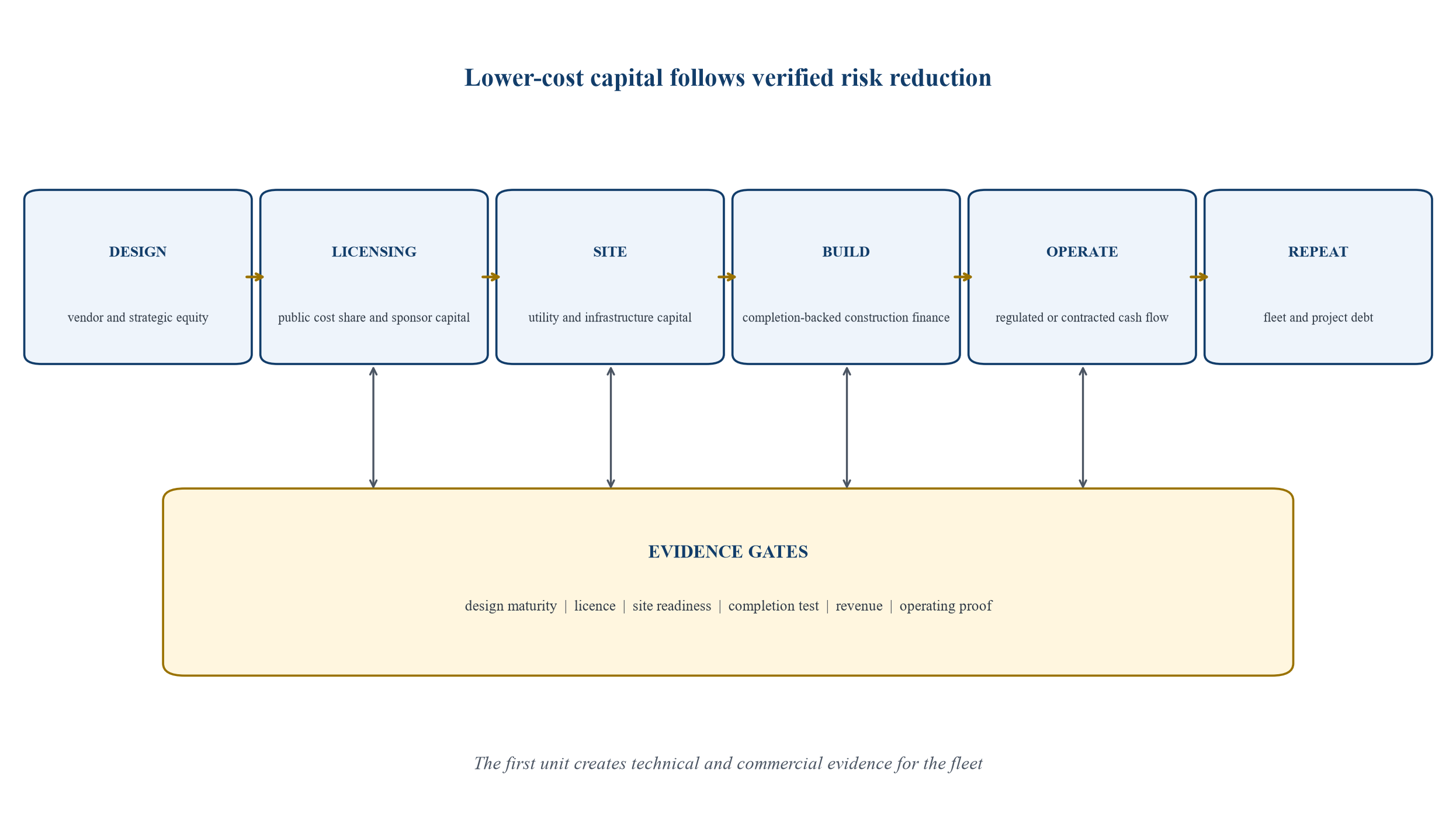
Generic financing architecture. Actual licensing stages, contractual gates and funding instruments depend on jurisdiction, design and sponsor.
5. Define the financed product
The project company should define the reactor design, thermal and electrical output, configuration, site, cooling system, fuel, operating model, target commercial-operation date and expected service life. It should also identify the common facilities that would support additional modules. A financing model cannot rely on the generic label SMR because designs differ materially in technology, module size, fuel, licensing status and supply chain.
The definition should extend to the commercial product. Some projects sell grid electricity; others may serve a data centre, industrial load, district heat, hydrogen production or a remote system. The revenue instrument and performance obligations should match the product actually delivered.
6. Separate project and programme costs
The first unit may pay for design certification, supplier qualification, factory tooling, training simulators and programme management that later units use. Charging every shared cost to the first project's tariff can undermine affordability and distort comparisons with mature technologies. Excluding those costs without a funding source understates the required capital.
A transparent allocation should classify costs as site-specific, first-unit-specific, fleet-enabling or public-good expenditure. Programme grants or strategic equity may fund reusable capability. Later projects can pay licence, technology or replication fees. The financing memorandum should reconcile these classifications to procurement contracts and public-support conditions.
7. Design maturity before construction
Construction should not begin with material design areas unresolved. Late design change can propagate through safety analysis, licensing, procurement, civil works and commissioning. The IEA identifies completion of design before construction and repetition of the same design as practical cost-reduction measures. A design-maturity index should therefore be a financing condition rather than an engineering dashboard only.
The index can track system design, safety classification, interface control, constructability, bills of materials, digital configuration and open licensing items. Independent technical advisers should test whether percentage-complete measures reflect approved deliverables and whether remaining work could change quantities, schedule or safety requirements.
8. Licensing risk
Licensing establishes whether the design and site may be constructed and operated under the jurisdiction's safety framework. It can involve vendor design reviews, site permits, construction licences, environmental approvals, security plans, safeguards and operating licences. Each step can generate conditions, requests for information and design change.
Capital should be released against defined regulatory evidence. Early funding may support application work and long-lead preparation. Major construction debt should require a licence or authorization sufficient for the financed scope, closure plans for material conditions and a controlled process for regulatory change. Regulatory engagement cannot be represented as approval.
9. Harmonisation and repeatability
SMR economics depend partly on repeating a standard design across sites and jurisdictions. The IAEA Nuclear Harmonization and Standardization Initiative supports cooperation and the use of prior regulatory assessments, while preserving national regulatory authority. Greater convergence can reduce duplicated work and design divergence, though it does not remove the need for local approval.
The project should identify which design features are fixed, which can be adapted and which local requirements could impair factory repetition. Financing for a fleet should include change-control rights, configuration governance and a cost allocation mechanism for jurisdiction-driven modifications.
10. Site readiness
A licensed design is insufficient where the site lacks land rights, geotechnical evidence, water, grid connection, transport access, emergency-planning arrangements or waste pathways. Site uncertainty can create delay while committed factory or construction capacity remains idle.
Site-readiness capital should complete surveys, enabling works, interconnection studies and key permits before full notice to proceed. The lender's site report should reconcile design assumptions with actual conditions. Contingency should reflect residual ground and interface risk rather than a generic percentage detached from evidence.
11. Long-lead procurement
Reactor vessels, forgings, pumps, control systems, fuel components and other safety-significant items may require early orders. Procurement before final licensing can protect schedule while creating stranded-cost exposure if the design or project changes. The IAEA SMR Regulators' Forum has examined regulatory considerations for long-lead items in evolving business models.
An early-procurement facility should define approved items, title, storage, inspection, cancellation rights, alternative use and step-in access. Vendor or government support can absorb items that serve the wider programme. Senior project debt should receive security and evidence that the item remains usable for the licensed configuration.
12. Factory investment and serial production
Modular construction requires qualified factories, repeatable processes and sufficient order visibility. A factory built for one uncertain order can create high unit cost and underutilisation. A project dependent on a future factory can face schedule risk if investment waits for final close.
The programme should coordinate factory finance with a credible order book. Government procurement, utility framework orders, capacity reservations and milestone payments can support investment. Factory lenders require visibility on customer concentration, cancellation compensation and the ability to serve other projects. The reactor project should avoid paying for uncommitted excess capacity without corresponding rights.
13. Supply-chain qualification
Nuclear suppliers must satisfy quality, traceability, documentation and regulatory requirements. A nominally available industrial component may not be qualified for safety-significant use. Supplier concentration and limited manufacturing slots can create single-point failure.
The sponsor should maintain a tiered supplier map covering technical qualification, financial capacity, capacity reservation, geographic exposure and replacement lead time. Contingency plans should address insolvency and non-conformance. Public support may be justified for shared supply-chain qualification where multiple projects benefit, provided accountability and access rules are explicit.
14. Fuel availability
Fuel design, enrichment, fabrication, transport, licensing and inventory can determine the commissioning date. Some advanced designs require fuel forms or enrichment levels with limited commercial supply. A reactor can be mechanically complete and still unable to operate if fuel is unavailable.
The financing base case should include binding fuel arrangements, regulatory permissions, delivery schedule, strategic inventory and alternative-supply analysis. Public fuel programmes can reduce systemic risk, but project documents should recognise only committed and legally available supply. Fuel delay belongs in construction-period liquidity and completion testing.
15. Contracting strategy
A single fixed-price turnkey contract may appear to transfer construction risk, yet a contractor cannot absorb unlimited uncertainty in an immature design. The price may contain a large premium, qualifications or termination rights. A fragmented multi-contract approach can reduce premiums while leaving interface risk with the project company.
The appropriate structure depends on design maturity, market capacity and sponsor capability. Contracts should allocate controllable scope, define interfaces, support open-book verification where public capital is used and maintain an integrated schedule. Risk labelled transferred should be tested against counterparty balance sheet, caps, exclusions and security.
16. Vendor obligations
The technology vendor controls design information, technical support, configuration management and often specialist commissioning knowledge. It should bear responsibility for design defects and agreed performance within a defined liability framework. Unlimited vendor liability can make the contract unfinanceable or drive the vendor into distress.
A balanced package can include milestone-linked fees, warranties, liquidated damages, rectification obligations, parent support, retention and contingent equity. Liability caps should be compared with credible downside, vendor financial capacity and available insurance. Fleet incentives can align the vendor with first-unit delivery and subsequent cost reduction.
17. Construction contractor obligations
The construction contractor controls site execution, labour, sequencing, productivity and subcontract management. Its contract should define scope, schedule, quality, change control, reporting and delay remedies. Nuclear-quality documentation is part of physical completion because missing records can prevent commissioning.
Contractor security can include performance bonds, parent guarantees, retention and milestone payment holdbacks. The project should avoid remedies that are large on paper and uncollectible in practice. A replacement plan should consider the scarcity of nuclear-qualified contractors and the time required to mobilise a successor.
18. Interface risk
SMR programmes can involve a vendor, architect-engineer, module factory, civil contractor, utility operator, fuel supplier and regulator. Each may perform its own scope correctly while the integrated plant fails schedule or performance. Interface risk is therefore a central completion risk.
The project company needs an authoritative interface register, systems-integration function, common data environment and integrated master schedule. Contract changes should be assessed across every affected package. Financing covenants can require reporting of critical interface decisions and prohibit material scope fragmentation without lender consent.
19. Schedule logic
First-unit schedules should be built from regulatory, design, procurement, civil, module, fuel and commissioning logic. A politically announced target date is not a critical-path analysis. Schedule contingency should reflect uncertainty in remaining tasks, correlation among delays and access to specialist resources.
The base case should identify float ownership and milestone definitions. Sensitivities should model delay before construction, during civil works and during commissioning separately because their monthly cash burn differs. Debt maturity and interest reserves should follow the downside schedule, with sponsor support for delays beyond the funded case.
20. Cost-estimate quality
An estimate based on vendor aspiration has a different evidential weight from firm quotations, completed design quantities and executed contracts. The project should grade each cost by estimate class, currency, escalation basis, tax treatment, contingency and commitment status.
Independent review should reconcile quantities, unit rates, indirect costs, owner's costs, financing fees and interest during construction. Contingency should not conceal excluded scope. Public authorities funding cost overruns require a pre-agreed process that separates approved change, external shock, sponsor failure and contractor underperformance.
21. Sources and uses
The capital plan should cover development, design, licensing, site, factory and equipment deposits, construction, owner's costs, fuel, commissioning, reserves, financing fees and interest. It should also identify recoveries, grants, tax credits and cost-sharing arrangements. The plan needs sufficient liquidity to reach a defined completion state, rather than the next expected refinancing.
Table 1. Illustrative first-unit sources and uses at financial close
| Uses | Amount | Sources | Amount |
|---|---|---|---|
| development, design and licensing | 650 | sponsor and strategic equity | 1,350 |
| site and common infrastructure | 900 | public cost-share capital | 1,500 |
| nuclear island and modules | 2,150 | utility balance-sheet funding | 1,100 |
| civil works and installation | 1,400 | construction facility | 1,650 |
| owner's costs, fuel and commissioning | 600 | customer prepayment | 350 |
| contingency and escalation reserve | 700 | contingent public facility | 450 |
| interest, fees and debt reserves | 600 | vendor contingent support | 200 |
| total | 7,000 | total | 6,600 |
| identified completion support | 400 | committed completion support | 400 |
Hypothetical monetary units for decision analysis only. Percentages and categories do not describe a named project.
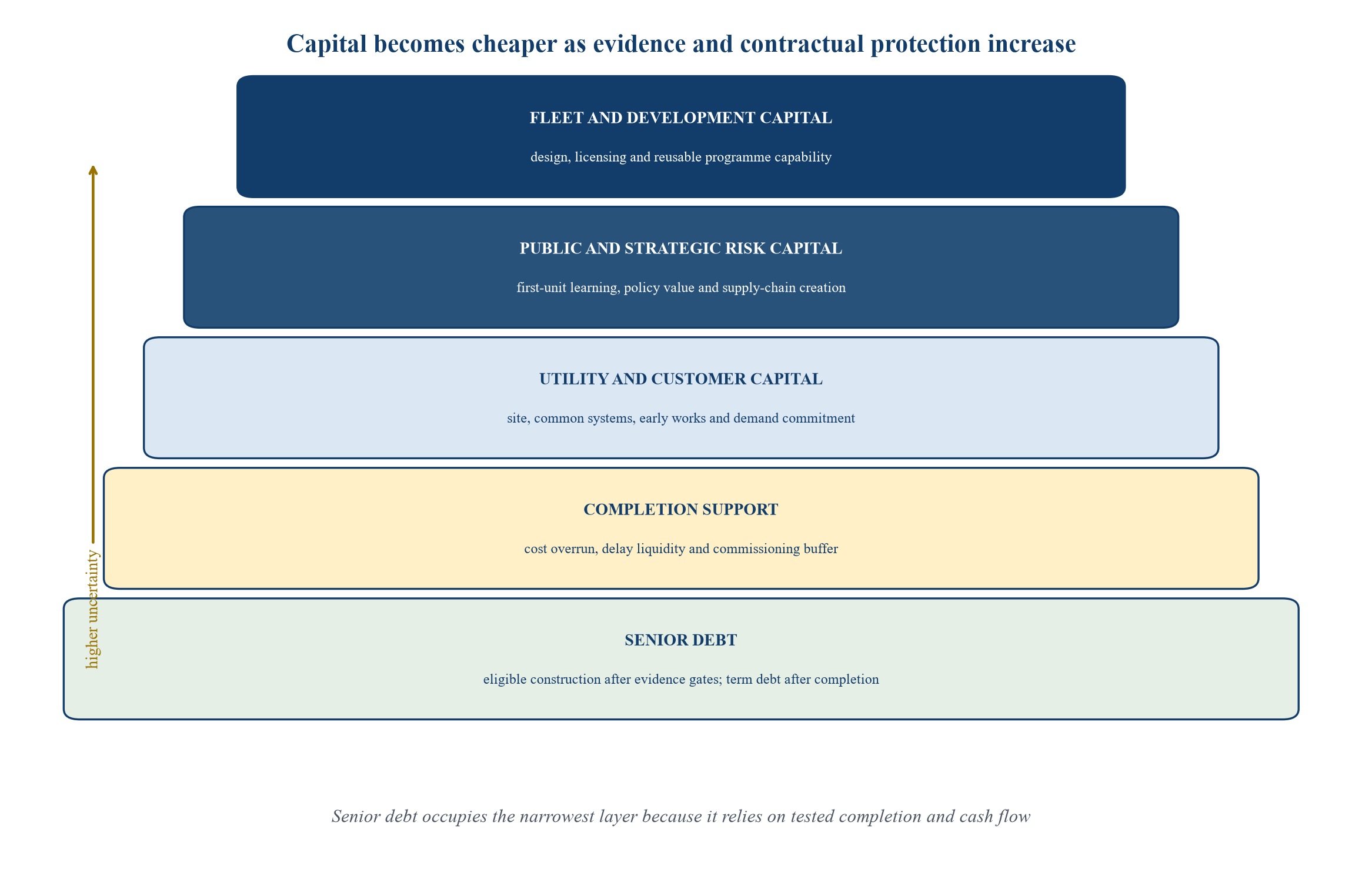
Illustrative allocation logic. Layer size and ranking require project-specific contracts, approvals and credit analysis.
22. Equity role
Equity should absorb development uncertainty, first-loss construction exposure and residual performance risk. Strategic equity from utilities, vendors, industrial customers or governments can add capability and long-duration commitment. Financial equity may enter when risk has been reduced and exit routes are credible.
The shareholder agreement should govern further funding, dilution, deadlock, information, reserved matters and transfer. A shareholder with a supply contract can face conflicts between project value and contract margin. Related-party terms need transparent approval and benchmarking.
23. Government capital
Government can provide grants, cost-shared awards, equity, loans, guarantees, tax incentives, site support or revenue contracts. Its role is strongest where it absorbs risks created by policy, early technology learning or strategic infrastructure value. Support should have measurable objectives and an accountable route to fleet learning.
The US Department of Energy announced up to USD 800 million of cost-shared funding for two initial advanced light-water SMR deployment teams in December 2025. The structure illustrates public funding directed at early deployment and supply-chain replication. Project-level terms, milestones and private contributions remain decisive for financeability.
24. Utility balance-sheet finance
A regulated or state-backed utility can finance early works and construction through its balance sheet, supported by the wider enterprise and rate framework. This can reduce reliance on non-recourse debt before completion. It also concentrates exposure with customers, taxpayers or the utility's creditors.
Governance should ring-fence project reporting and define cost-recovery rules. The utility should test the effect of delay and overruns on credit metrics, dividends and other capital programmes. Transfer to project debt after operation can recycle balance-sheet capacity if the revenue and performance record support refinancing.
25. Regulated asset base
A regulated asset base can allow eligible construction expenditure to earn an allowed return and be recovered from consumers before operation. This reduces the volume of capital accruing financing costs through a long build and can attract institutional investors. It transfers defined construction and timing risks to consumers under regulatory oversight.
The UK introduced a nuclear RAB framework through legislation, and Ofgem has implemented related economic-regulation arrangements for Sizewell C. Application to SMRs requires project-specific decisions. A credible RAB needs expenditure controls, efficiency tests, reporting, incentive mechanisms and treatment of abandonment.
26. Contract for difference
A contract for difference can stabilise post-completion revenue by paying or receiving the difference between a reference market price and a strike price. It supports debt service once generation begins but generally does not fund construction-period cash unless paired with stronger completion support.
The contract should define duration, indexation, reference price, availability, curtailment, negative prices and change in law. Lenders should model performance deductions and periods when the reference methodology produces unexpected outcomes. A long contract cannot compensate for an unfunded construction overrun.
27. Power purchase agreement
A long-term power purchase agreement can link an SMR to a utility, data-centre operator, industrial customer or public buyer. It can provide fixed, indexed or floor pricing and capacity payments. Customer credit and the strategic value of firm clean power can strengthen bankability.
The agreement should align commercial operation, availability, outage, grid, curtailment and change-in-law provisions with the reactor's technical regime. A customer should not receive an unrestricted termination right when the project has committed irreversible capital. Direct agreements can provide lender notice and cure rights.
28. Data-centre and industrial demand
Large electricity users may value round-the-clock supply, location, energy security and low-emissions attributes. They can contribute prepayments, capacity reservations, equity or long-term offtake. Their load growth and site schedule can also change faster than a nuclear development programme.
The project should test customer concentration, technology substitution and credit over the full debt tenor. A colocated structure must address grid backup, islanding, outage coverage and allocation of common infrastructure. Customer capital is strongest when payment obligations survive defined schedule variations and are supported by creditworthy entities.
29. Customer prepayment
A prepayment converts future energy or capacity into construction liquidity. Economically, it can resemble debt, deferred revenue or a secured advance depending on terms. It can reduce external financing while creating refund and delivery obligations.
The model should show how prepayment is recognised, secured and repaid through future deliveries. Refund exposure following delay or cancellation requires liquidity support and priority rules. The customer should receive protection without obtaining control rights that conflict with regulation, safety or lender enforcement.
30. Export credit and supply-chain finance
Export credit agencies can support equipment supplied from their home countries through direct loans, guarantees or insurance. This may provide long tenor and competitive pricing. Tied-content requirements, sovereign considerations and procurement rules can affect availability.
The project should map eligible contracts, local-content obligations and disbursement conditions. Export credit cannot solve unresolved design and completion risk by itself. Intercreditor arrangements must coordinate ECA rights with public facilities, commercial lenders and security trustees.
31. Multilateral finance
The World Bank Group and IAEA formalised cooperation in 2025 that includes knowledge development, life extension and advancement of SMRs. This creates a route for institutional capability and possible future financing engagement in developing economies. Any specific project support requires separate approval and should not be assumed.
Multilateral institutions can support policy frameworks, sovereign risk allocation, technical assistance and selected financing. Their environmental, social, procurement and disclosure requirements should be integrated early. A project that treats these conditions as late-stage documentation can create delay.
32. Green bonds and institutional capital
Green bonds can widen the investor base where the issuer, use of proceeds and taxonomy treatment qualify. The IEA reports that nuclear-related green debt has financed several billion dollars, mainly in operating or lower-risk contexts. Construction finance for a first unit remains more difficult because bondholders have limited capacity to manage completion.
A utility or sovereign can issue green bonds against its broader credit and allocate proceeds to eligible expenditure. Project bonds may become feasible after completion or substantial de-risking. Disclosure should distinguish environmental eligibility from credit quality.
33. Canadian first-unit financing evidence
Canada's Darlington programme provides a current example of layered public and utility finance. Federal sources report a CAD 970 million Canada Infrastructure Bank commitment for early development, a first-unit cost including common infrastructure of CAD 7.7 billion, and later public equity commitments. The project also uses a regulated utility context and federal clean-electricity policy tools.
These facts show how early low-cost finance, utility sponsorship, public equity and policy support can address a first-unit financing gap. They do not establish that another design or jurisdiction can replicate the same economics. Replication requires comparable institutions, revenue, licensing and sponsor capability.
34. Indigenous equity and shared ownership
Canada announced approximately CAD 715 million of federal and provincial loan-guarantee support in 2026 for First Nations participation in the Darlington New Nuclear Project. The structure illustrates how guarantees can lower financing costs for community equity and distribute long-term economic participation.
Shared ownership should be developed with informed governance, independent advice, transparent risk and durable cash-flow rights. The project model should show distribution priority, guarantee terms and downside exposure. Community participation should not be presented as a substitute for consultation, rights protection or environmental responsibilities.
35. United States cost-shared deployment
The US Department of Energy selected TVA and Holtec teams in 2025 for up to USD 400 million each under a cost-shared programme for initial advanced light-water SMRs. The announced objectives include early deployment, domestic supply chain and follow-on projects. The teams use different sponsor, site and commercial arrangements.
Cost sharing can fund activities with programme-wide learning value while requiring private commitment. A financeable structure still needs a complete project budget, schedule, licensing plan, revenue support and responsibility for excess cost. Award selection is not equivalent to project financial close.
36. United Kingdom programme approach
Great British Energy - Nuclear selected Rolls-Royce SMR through a competitive process and entered into contract in 2026, according to current UK guidance. The programme business case describes more than GBP 2.5 billion of public capital funding and states that a final funding model had not yet been decided at publication, with RAB under consideration.
This sequence highlights the distinction between technology selection, development funding and construction finance. Each creates evidence for the next decision. Investors should rely on executed support and approved project terms rather than policy ambition alone.
37. Construction facility design
Commercial construction debt should fund defined eligible costs after material design, licensing, contracting and support conditions are satisfied. Draws can be linked to certified progress, remaining-cost tests, contingency sufficiency and absence of material default. The facility needs a committed route to completion.
Interest can be capitalised during construction, supported by an interest reserve or serviced by regulated revenue. The structure should include a longstop date, cost-overrun waterfall, equity cure and public or sponsor standby arrangements. Disbursement should stop before remaining resources become insufficient to reach completion.
38. Completion support
Completion support covers the gap between committed project resources and the cost of achieving the agreed completion tests. It can come from sponsor guarantees, standby equity, contingent public facilities, letters of credit or capped vendor commitments. The provider's capacity and legal obligation matter more than the stated amount.
Support should be available when a forecast overrun becomes evident, not only after cash is exhausted. It should cover interest and essential operating readiness as well as physical work. Caps need comparison with downside scenarios. Uncapped obligations require a provider with genuine capacity and appropriate governance.
39. Completion testing
Mechanical completion alone does not establish an operating asset. Tests should address regulatory permission, fuel loading, grid connection, safety systems, thermal performance, net output, availability demonstration, documentation, operator readiness and acceptance under revenue contracts.
The test period should be long enough to reveal integrated-system performance without creating an impossible threshold. Provisional acceptance can release part of contractor security while final acceptance follows sustained operation. Debt conversion or term-out should occur only when the project can generate the cash flow used in sizing.
40. Debt sizing after completion
Post-completion debt capacity depends on contracted or regulated revenue, operating cost, fuel, outage assumptions, decommissioning and waste obligations, taxes, reserve funding and debt-service profile. A long asset life supports tenor, but lenders should avoid relying on distant uncontracted cash to justify near-term leverage.
Debt service can be sculpted to conservative cash available for debt service. Coverage tests should include normal outages and a stressed extended outage. Refinancing value belongs outside the core repayment case unless the facility explicitly relies on a credible mini-perm structure.
41. Illustrative financing assumptions
The model below uses hypothetical monetary units and does not describe a named project. It assumes a total initial requirement of 7,000, funded by 3,750 of equity-like and public capital, 1,600 of utility and customer funding, and a 1,650 construction facility. The model assumes a 400 committed completion-support layer outside initial sources.
The base case assumes scheduled completion, while delay cases add interest, owner's cost and escalation. No probability is assigned. The purpose is to identify which support layer absorbs each outcome and whether commercial debt remains fully funded through completion.
42. Debt-service sensitivity
Table 2. Illustrative construction and debt-service sensitivities
| Case | Additional cost | Commercial operation delay | First full-year cash available for debt service | Scheduled debt service | Coverage | Required response |
|---|---|---|---|---|---|---|
| base delivery | 0 | 0 months | 245 | 165 | 1.48x | ordinary reserve and covenant package |
| commissioning delay | 180 | 6 months | 218 | 171 | 1.27x | draw completion support and extend interest reserve |
| supplier replacement | 310 | 9 months | 205 | 176 | 1.16x | standby equity, schedule reset and cash lock-up |
| combined stress | 520 | 15 months | 188 | 183 | 1.03x | additional public or sponsor support and debt reprofile |
| performance shortfall | 220 | 9 months | 170 | 176 | 0.97x | vendor remedy, debt reduction and distribution stop |
Hypothetical decision model. Monetary units, delays, coverage and responses are illustrative and are not forecasts.
43. What the sensitivity reveals
The illustrative cases show two different risks. Construction delay increases funded cost and capitalised interest before revenue begins. Performance shortfall reduces recurring cash after completion. Completion support can address the first risk, but it cannot create sustainable operating cash. Performance guarantees, revenue adjustment and lower leverage are needed for the second.
The lender should therefore maintain separate remaining-cost and debt-service tests. A project can remain physically completable while becoming overleveraged. It can also retain strong long-run economics while suffering a temporary delay that requires liquidity rather than permanent debt reduction.
44. Cost-overrun waterfall
The cost-overrun waterfall should use contingency first only where the event falls within its purpose. Contractor or vendor remedies should follow where responsibility is established and collection is timely. Standby equity, utility support and contingent public facilities can then protect completion. Commercial lenders should not be required to fund an overrun automatically.
Disputes take time, so the project may need interim liquidity while preserving claims. The waterfall should avoid delaying critical work until liability is resolved. Recoveries received later can repay the supporting party under an agreed subordination and distribution regime.
45. Revenue-risk allocation
Post-completion price and volume risk can be allocated through regulation, a contract for difference, a long-term power purchase agreement, capacity payment or government offtake. The instrument should reflect the value of firm power and any clean-energy attributes. Merchant exposure can remain a limited upside layer.
The offtaker or regulator controls some risks, while plant availability remains with the project. Payment obligations should distinguish grid unavailability, customer curtailment, plant outage and force majeure. Lenders require direct rights and a predictable remedy for termination.
46. Performance-risk allocation
The vendor and contractors can support output, heat rate, availability and schedule through warranties and damages. The operator controls maintenance, staffing and operating discipline after handover. The project retains residual risk where guarantees expire or liability caps are reached.
A first unit may require a longer performance-support period and access to vendor specialists. The fleet agreement can link vendor economics to cumulative performance across units. Insurance can address selected physical events, but it does not replace contractual responsibility for design or execution.
47. Public-risk allocation
Government is best placed to control policy, licensing capacity, strategic site designation, certain market-design choices and public funding. It may also choose to retain early technology risk for energy-security or industrial-policy reasons. Support should state the public objective and the conditions for continuing it.
Independent oversight, transparent reporting and stage gates can protect taxpayers and consumers. An abandonment decision should be governed by forward-looking completion value rather than sunk cost alone. Support agreements should define treatment of assets, intellectual property and supplier capability if the project stops.
48. Risk-allocation matrix
Table 3. First-unit risk allocation and financing response
| Risk | Primary controller | Financial bearer before mitigation | Bankability instrument | Evidence gate |
|---|---|---|---|---|
| design completion | technology vendor and project integrator | vendor, strategic equity and public cost share | milestone funding, retention and contingent support | approved design baseline and closed critical interfaces |
| licensing | applicant, regulator and government framework | sponsor and public development capital | stage-gated cost share and schedule reserve | authorization sufficient for financed scope |
| site and grid | utility and project company | utility and sponsor | early-works facility and regulated recovery | land, permits, surveys and connection agreement |
| construction execution | contractor and project company | contractor within caps, then equity and support providers | performance security, contingency and completion support | certified progress and remaining-cost sufficiency |
| first-unit performance | vendor, operator and integrator | vendor within warranty, then project equity | performance tests, damages, reserve and debt sizing | sustained output and availability test |
| market revenue | regulator, offtaker and policy maker | consumer, offtaker or project under agreed instrument | RAB, contract for difference, PPA or capacity payment | effective revenue contract and direct agreement |
| fleet learning | programme owner and vendor | strategic/public programme capital | shared-cost allocation and replication rights | verified learning record and controlled configuration |
Generic framework. Actual allocation must follow enforceable contracts, regulation and jurisdiction-specific advice.
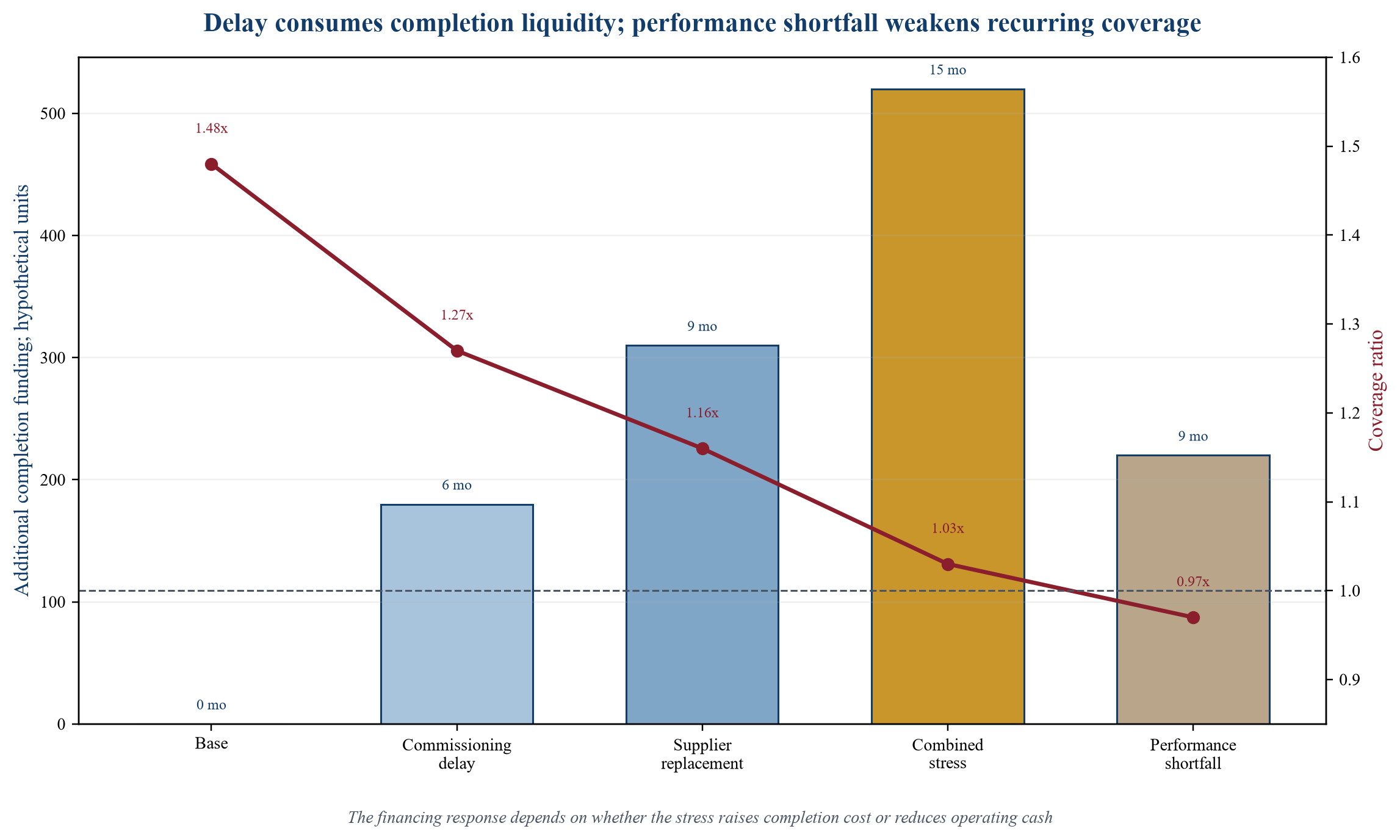
Hypothetical scenario display based on Table 2. It is a decision aid rather than a forecast or valuation.
49. Governance
A first-unit project needs governance capable of integrating safety, engineering, commercial and public-accountability decisions. The board should receive a single evidence set covering design, licensing, schedule, cost, risk and funding. Committees should have clear authority and avoid parallel baselines.
Reserved matters should cover design changes, major contracts, budget revisions, support draws, revenue amendments and additional modules. Public shareholders or funders may require audit and policy conditions. Governance should preserve the licensed operator's independent safety duties.
50. Information and controls
The common data environment should control drawings, requirements, interfaces, supplier records, non-conformances, schedule and cost. Financial reporting should reconcile commitments, actuals, estimate at completion, contingency and funding availability. Safety and commercial records should have appropriate access and retention.
Lenders and public funders need timely evidence without directing regulated operations. Reporting should distinguish forecast movement, approved change and emerging risk. Data quality failures can be early indicators of construction and commissioning problems.
51. Covenant design
Construction covenants should test remaining-cost coverage, minimum contingency, schedule milestones, contract maintenance, support availability and regulatory status. Information covenants should cover design maturity, licensing correspondence, critical-path movement, supplier events, safety-significant non-conformance and claims.
Operating covenants should cover debt-service coverage, reserves, insurance, material licences, fuel contracts, outage planning and decommissioning obligations. Distribution tests should require both financial compliance and absence of unresolved material safety or licence issues.
52. Insurance
Construction all-risks, delay-in-start-up, marine cargo, liability, property and business-interruption insurance may cover defined events. Nuclear liability follows specialised statutory and insurance regimes. Policy limits, exclusions and timing should be reviewed against the risk register.
Insurance generally does not cover ordinary cost escalation, design immaturity or every regulatory delay. The financial model should recognise proceeds only where coverage and timing are credible. Public indemnity or statutory pooling arrangements require jurisdiction-specific analysis.
53. Decommissioning and waste
The project must fund spent-fuel, waste-management and decommissioning obligations under applicable law. These costs occur over long periods but affect tariff, cash flow and licence compliance. A first-unit model should avoid treating them as remote residual items.
Funding mechanisms can include regulated allowances, segregated trusts, levies or sponsor obligations. Assumptions should match the licensed design, fuel cycle and national policy. Changes in waste pathway or decommissioning requirements should be included in long-run sensitivities and change-in-law provisions.
54. Fleet replication
The first unit creates value when its evidence can reduce risk and cost for subsequent units. The programme should capture actual quantities, labour productivity, supplier performance, licence findings, commissioning data and operating experience. Intellectual-property and data rights should permit authorised replication.
Follow-on projects should freeze a standard configuration and limit elective change. Order cadence matters because factories and trained teams lose learning when gaps occur. Financing commitments can be staged across units while preserving cancellation discipline and consumer protection.
55. Investment-committee decision sequence
The committee should first confirm strategic need and the defined energy product. It should then test design maturity, licensing pathway, site readiness, supply chain and fuel. Next it should assess contracts, cost estimate, schedule, completion support and governance. Revenue, debt capacity and fleet value follow from these foundations.
Each unresolved issue should have an owner, evidence requirement, funding consequence and decision date. A conditional approval should state what can be spent before the next gate. The committee should receive a bridge from total programme cost to first-unit cost and from gross revenue to cash available for debt service.
56. Conclusion
First-of-a-kind SMR finance becomes credible when the project separates development, construction, operation and replication into distinct risk periods. Early technical and programme risk requires sponsor, strategic and public capital. Construction debt requires mature design, sufficient authorization, executable contracts, integrated schedule and committed completion support. Long-term debt requires tested performance and durable revenue.
The strongest structure places each risk with the party able to control or deliberately retain it, uses evidence gates to release capital and preserves learning for repeat units. Governments, utilities, vendors, contractors, customers and lenders can participate within one architecture while carrying different risks. This approach supports transparent decisions about affordability, accountability and the transition from the first reactor to a financeable fleet.
References
- International Atomic Energy Agency. Climate Change and Nuclear Power 2024; section on SMR financing considerations and challenges. 2024. https://www-pub.iaea.org/MTCD/Publications/PDF/PUB9048_web.pdf
- International Atomic Energy Agency. Financing Nuclear Power in Evolving Electricity Markets. https://www.iaea.org/sites/default/files/18/07/financing-np-0418.pdf
- International Atomic Energy Agency. Nuclear Harmonization and Standardization Initiative; Regulatory Cooperation Toolkit. 2026. https://gnssn.iaea.org/regnet/nhsi-regulatory-cooperation-toolkit/Pages/home.aspx
- International Atomic Energy Agency. SMR Regulators' Forum publications and regulatory considerations. https://gnssn.iaea.org/regnet/SMR-Forum/Pages/Our-Publications.aspx
- OECD Nuclear Energy Agency. SMR Finance: Key Findings. 2024. https://www.oecd-nea.org/upload/docs/application/pdf/2024-11/brief_for_ministers_and_ceos_2024-11-07_18-32-8_349.pdf
- OECD Nuclear Energy Agency. Financing New Nuclear Power Plants: Minimising the Cost of Capital by Optimising Risk Management. 2022. https://www.oecd-nea.org/upload/docs/application/pdf/2022-12/7632_nea_financing_report.pdf
- OECD Nuclear Energy Agency. Financing, Market Design and Project Management in Nuclear New Build. 2024. https://www.oecd-nea.org/upload/docs/application/pdf/2024-11/7688_financing_market_design_and_project_management.pdf
- International Energy Agency. The Path to a New Era for Nuclear Energy; Financing Nuclear Projects. 2025. https://www.iea.org/reports/the-path-to-a-new-era-for-nuclear-energy/financing-nuclear-projects
- International Energy Agency. Nuclear Power and Secure Energy Transitions; Executive Summary. 2022. https://www.iea.org/reports/nuclear-power-and-secure-energy-transitions/executive-summary
- US Department of Energy. Energy Department Selects TVA and Holtec to Advance Deployment of US Small Modular Reactors. 2 December 2025. https://www.energy.gov/articles/energy-department-selects-tva-and-holtec-advance-deployment-us-small-modular-reactors
- US Department of Energy. FY 2026 Congressional Budget Request; Loan Programs Office. 2025. https://www.energy.gov/sites/default/files/2025-06/doe-fy-2026-vol-3-lpo.pdf
- Government of Canada Major Projects Office. Darlington New Nuclear Project. 2026. https://www.canada.ca/en/privy-council/major-projects-office/projects/national/darlington.html
- Canada Infrastructure Bank. Darlington Small Modular Reactor. https://cib-bic.ca/en/projects/clean-energy/darlington-small-modular-reactor/
- Department of Finance Canada. Government announces largest Indigenous loan guarantee in Canadian history to support Darlington New Nuclear Project. 23 June 2026. https://www.canada.ca/en/department-finance/news/2026/06/government-announces-largest-indigenous-loan-guarantee-in-canadian-history-to-support-darlington-new-nuclear-project.html
- Canadian Nuclear Safety Commission. Decision to authorize construction of one BWRX-300 reactor at the Darlington New Nuclear Project site. 4 April 2025. https://www.canada.ca/en/nuclear-safety-commission/news/2025/04/decision-by-the-commission-to-authorize-ontario-power-generation-inc-to-construct-1-bwrx-300-reactor-at-the-darlington-new-nuclear-project-site.html
- Government of the United Kingdom. Small modular reactor programme business case. 2026. https://assets.publishing.service.gov.uk/media/69df8a9f6c6ccf244be42d71/small-modular-reactor-summary-programme-business-case.pdf
- Government of the United Kingdom. Small Modular Reactors technology selection process. Updated 2026. https://www.gov.uk/guidance/small-modular-reactors-technology-selection-process
- Government of the United Kingdom. New finance model to cut cost of new nuclear power stations. 2021. https://www.gov.uk/government/news/new-finance-model-to-cut-cost-of-new-nuclear-power-stations
- Ofgem. Energy price cap methodology; Nuclear Regulated Asset Base. 2025. https://www.ofgem.gov.uk/consultation/energy-price-cap-methodology-nuclear-regulated-asset-base-rab
- Ofgem. Sizewell C Economic Guidance. 2025. https://www.ofgem.gov.uk/guidance/sizewell-c-economic-guidance
- World Bank Group and International Atomic Energy Agency. Partnership to collaborate on nuclear energy for development. 26 June 2025. https://www.worldbank.org/en/news/press-release/2025/06/26/world-bank-group-iaea-formalize-partnership-to-collaborate-on-nuclear-energy-for-development
About the Author
Chennakeshav (CK) is a corporate finance and investment banking executive with 25+ years of global experience in deal origination, structuring and execution across M&A, growth capital and corporate strategy. He has led value-creation mandates for founders, corporates and funds — bridging the boardroom view to hands-on execution and close.
His career spans Morgan Stanley, HSBC, Lloyds Banking Group, EWEC, ADQ portfolio companies and Emirates Growth Fund, across TMT, real estate, fintech, deeptech, cleantech, infrastructure and energy. He has partnered with C-suite leaders, private equity and venture funds, sovereign wealth funds and family offices to finance complex fund raises and scale-up ventures, and has led M&A due diligence, post-merger integration and business-transformation initiatives to create value.
At Matchpoint Partners he is Managing Partner, leading the firm's corporate finance, M&A and capital-raising practice. He holds an MBA from London Business School, an engineering degree from VTU and a Master of Laws (LLM, in progress) from UCL London.
An active start-up mentor, CK mentors at Techstars, DIFC FinTech Hive, Startup Grind, Founder Institute and IN5, serves as Entrepreneur Mentor in Residence (EMiR) at London Business School, and judges the Entrepreneurship World Cup.
LinkedIn: https://www.linkedin.com/in/ckadya/
Profile: https://www.matchpoint-partners.com/team/ck-adya.html
