

1. Treat the data room as an evidence system
A source-of-wealth data room should explain a financial history, not merely store files. A passport, bank statement, sale agreement and tax return can each be genuine while failing to answer the central question: how did the family accumulate its wealth, who owns it now, and why is the proposed activity consistent with that history? The data room becomes useful when documents are connected through a coherent narrative, ownership map, transaction trail and control process.
The regulatory starting point is institutional responsibility. UAE customer due diligence requires financial institutions to identify and verify customers and beneficial owners, understand the purpose and intended nature of the relationship, assess risk and monitor the relationship over time [1-3]. The DFSA framework similarly requires customer due diligence and, where enhanced measures apply, reasonable steps to establish source of funds and source of wealth [4-5]. A family cannot compel one institution to accept another institution's conclusion. A well-built evidence system can give each institution a complete, consistent and navigable starting point.
The data room should contain five linked records. The identity record establishes natural persons, representatives and authorised signatories. The ownership record shows legal title, beneficial ownership, control and the roles of settlors, trustees, protectors, council members, guardians and beneficiaries where relevant. The wealth record explains the economic events that created or materially increased net worth. The funding record traces money or assets into the specific account, investment or transaction. The compliance record addresses tax residence, automatic exchange of information, sanctions, politically exposed person status, adverse information, document validity and ongoing changes.
These records should be governed as a reusable system. Every important assertion needs an owner, evidence, date, jurisdiction, reliability grade, confidentiality class and refresh trigger. A document should never be uploaded without context. A narrative should never be approved without source evidence. A diagram should never be treated as proof of legal title. The output is a decision file that a relationship manager, onboarding analyst, compliance officer and senior approver can understand without reconstructing the family history from fragments.
2. Separate source of wealth, source of funds and identity
Source of wealth describes how a customer or beneficial owner accumulated total wealth. Source of funds identifies the origin of money or assets used for a particular account or transaction. Identity and beneficial ownership establish who the relevant people are and how they own or control the customer. The distinctions matter because a family can prove one and fail another.
The CBUAE states that source of funds is the direct source of money used to fund an account or transact through it, while source of wealth identifies the sources that generated or materially contributed to total net worth [2]. The DFSA guidance describes corroborating evidence for source of wealth such as share certificates, ownership registers, bank or brokerage statements, probate documents, audited accounts and financial statements [5]. Wolfsberg guidance also treats source-of-wealth and source-of-funds assessments as risk-based processes that help institutions understand a customer's background, financial history and expected activity [6].
A founder who sold a company may establish source of wealth through audited accounts, historical cap tables, investment agreements and the sale transaction. Funding a new account requires a narrower chain: completion statement, receiving-bank statement, transfers between accounts held in the appropriate name and the final remittance. A beneficiary of inherited assets may need probate, estate accounts, trust or foundation documents, distribution resolutions and custody evidence. A salaried executive may need employment contracts, remuneration records, tax returns and investment statements.
The data room should therefore hold separate conclusions. One conclusion states the principal sources of accumulated wealth and the proportion each source represents. Another identifies the direct source and route of the proposed funding. A third identifies every relevant natural person and control relationship. The family office may coordinate the evidence, yet the institution determines whether the information is sufficient for its risk assessment.
The evidence schedule should also distinguish fact, calculation and professional conclusion. A company register can establish recorded ownership. A reconciliation can calculate the net proceeds of a sale. A legal or tax memorandum can explain the effect of those facts under a stated law. Combining all three into a single management sentence makes review harder because the reader cannot see which element is independently sourced and which depends on analysis. The data room should label the role of each document in ordinary business language.
Materiality should be defined for the relationship under review. The largest wealth source usually deserves the strongest evidence, but a smaller source may carry greater risk because it involves cash, a public official, a high-risk jurisdiction, a complex legal arrangement or an unrelated third party. The family should prepare the full map and allow the institution to determine the depth of review. A percentage allocation of wealth sources should reconcile to a dated net-worth statement and identify whether values are cost, estimated market value or realised cash.
Table 1. Evidence questions by due-diligence objective
| Objective | Core question | Typical evidence | Common failure | Controlled output |
|---|---|---|---|---|
| identity | who is the customer or authorised person? | passport, Emirates ID, address evidence, digital verification | expired or inconsistent documents | identity sheet and validity register |
| beneficial ownership | who ultimately owns or controls the customer? | registers, constitutional documents, trust or foundation records | legal ownership shown without control analysis | signed ownership and control map |
| source of wealth | how was total wealth accumulated? | audited accounts, cap tables, sale records, probate, tax records | current assets listed without origin | wealth narrative and evidence index |
| source of funds | what generated the money for this activity? | completion statement, bank trail, dividend or loan documents | transfer route mistaken for economic source | transaction provenance schedule |
| expected activity | what should the institution observe? | investment plan, cash-flow forecast, account-purpose statement | broad purpose with no amounts or counterparties | expected-activity profile |
| ongoing monitoring | what changes require review? | ownership updates, new asset sales, residence changes, unusual transactions | static onboarding pack | event-driven refresh register |
Requirements vary by institution, product, risk rating and jurisdiction. The table is a management preparation guide.
3. Build one family, person and entity master
Repeated KYC often begins with inconsistent names and relationships. The same person may appear under different transliterations, passports, addresses or tax identifiers. A holding company may use a trade name in one document and a legal name in another. A trust, foundation or nominee arrangement may separate legal title, benefit and control. The master record should resolve these relationships before documents are distributed.
For each natural person, the master should record legal name, former names, transliterations, date and place of birth, nationalities, citizenships, current and former residences, tax residences, tax identification numbers, identity documents, occupation, public functions, family relationship and authorised roles. For each entity or legal arrangement, it should record legal name, jurisdiction, legal form, registration number, registered office, operating address, tax classification, ownership, control, directors, signatories, service providers, regulated status and key documents.
The 2025 UAE AML legislation defines beneficial owner by ultimate ownership or effective control and applies customer due diligence to the ownership and control structure [1]. Its Executive Regulations require adequate, accurate and up-to-date information for legal persons and legal arrangements, including the roles of trustees, settlors, protectors, beneficiaries and persons exercising ultimate effective control [3]. UAE beneficial-owner procedures separately require private registers and information on ownership and control [7]. The master should capture these legal roles without collapsing them into one generic "owner" field.
Every record needs a unique internal identifier that never appears in reader-facing material or bank correspondence. This prevents a renamed company, renewed passport or changed address from creating a duplicate person. The data room index can then generate a clean disclosure pack using legal names and relationships appropriate to the receiving institution. A controlled alias table resolves historic names while preserving an audit trail.
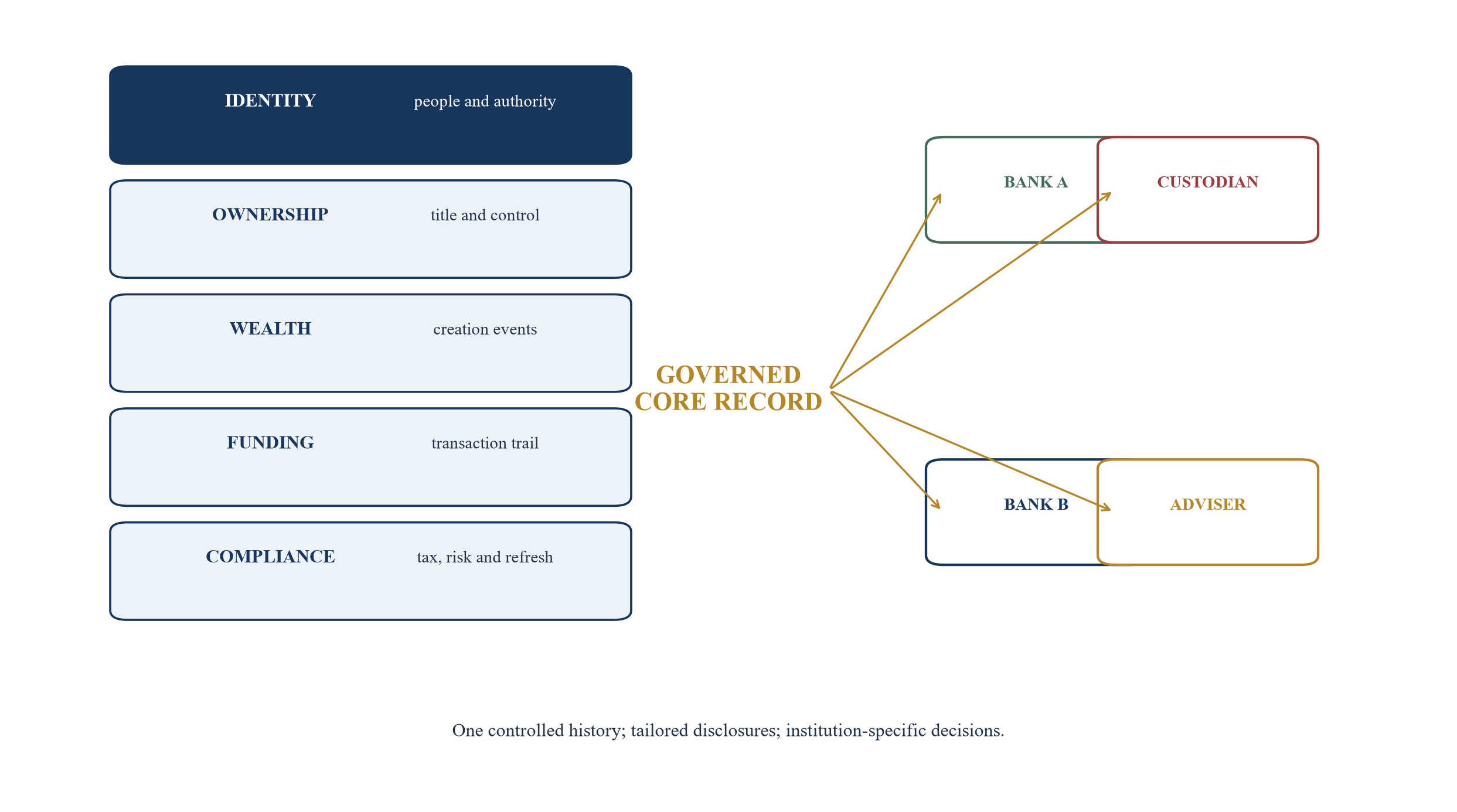
The core record supports institution-specific packs. Each institution retains responsibility for its own due diligence and acceptance decision.
4. Create a wealth chronology that explains cause and effect
A credible wealth narrative is chronological. It shows how education, employment, entrepreneurship, ownership, investment, inheritance and major liquidity events connect over time. The chronology should identify opening net worth, capital contributions, ownership changes, cash distributions, asset sales, reinvestment and current holdings. It should also explain discontinuities, such as a rapid increase in wealth, a transfer through several entities or a period for which records are incomplete.
The chronology should be event-led rather than document-led. For a founder, an event could be incorporating a company, receiving shares, completing a funding round, earning dividends, selling part of the stake and completing an exit. The evidence for one event may span a register, shareholders' agreement, audited financial statements, tax filings, sale agreement, completion statement and bank records. The data room links all of them to one event record.
For family wealth, the chronology may span generations. It should identify what was created by the current customer, what was inherited or gifted, what remains subject to another person's control, and what sits in legal arrangements. A probate document can prove a distribution, yet it may not explain how the deceased accumulated the wealth. A risk-based pack should extend the narrative far enough to make the current wealth plausible and evidence material origins.
The chronology also improves consistency. Account-opening forms frequently ask when wealth was accumulated, principal source, estimated net worth and expected activity. If each answer is prepared independently, amounts and dates can diverge. A single approved chronology provides the factual spine for all questionnaires. Institution-specific forms may use different categories, but their answers should reconcile to the same underlying record.
The chronology should show the currency used for each event and the method used to translate values into the reporting currency. Historic amounts should not be converted at today's rate without explanation. A sale completed in one currency, expenses paid in another and current assets held in several currencies can create apparent differences that are purely translational. The reconciliation should identify transaction-date exchange rates, current valuation rates and any hedging or conversion costs.
It should also distinguish wealth creation from wealth location. A founder can generate wealth through a UK company, receive proceeds into a European bank, transfer part of the cash to the UAE and invest through a DIFC vehicle. Listing the UAE account as the source confuses destination with origin. The chronological record follows the economic event first, the legal recipient second, the banking route third and the current asset last. This ordering allows a reviewer to test cause and effect.
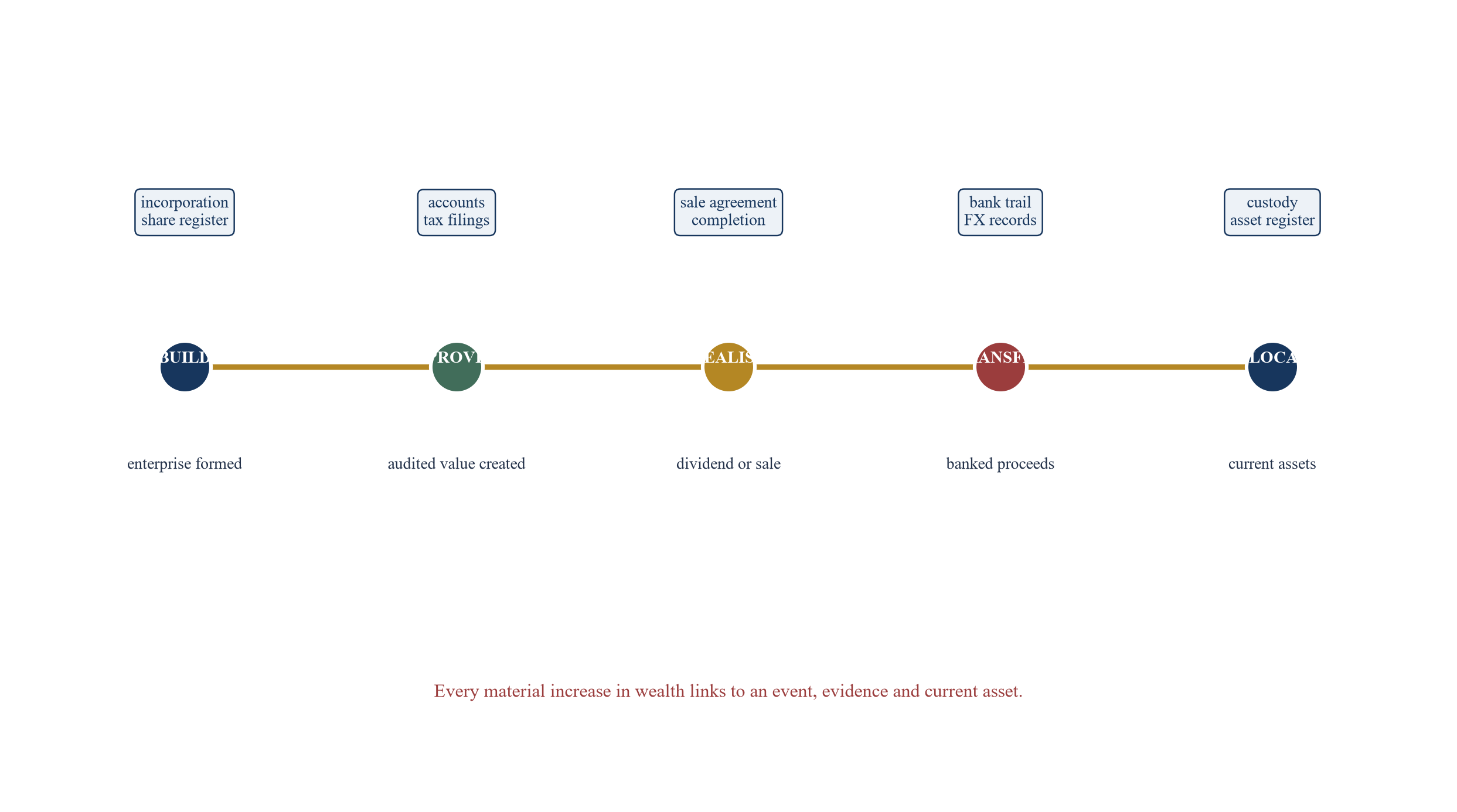
Dates and values are illustrative. The chronology should be rebuilt from the family's verified facts and reliable source documents.
5. Prove entrepreneurial and business-sale wealth
Business ownership is a common source of family wealth and one of the most document-intensive. A concise narrative should explain how the founder acquired the initial shares, what capital or work was contributed, how the business grew, what distributions were received and what happened at exit. The evidence should connect legal ownership to economic value and cash proceeds.
At formation, useful records include incorporation documents, founder agreements, share certificates, registers, subscription documents and proof of capital. During growth, audited accounts, tax returns, financing documents, dividend resolutions and bank statements can corroborate value creation and distributions. At sale, the pack may include the information memorandum, sale and purchase agreement, consideration schedule, escrow arrangements, completion statement, tax computation, professional-adviser completion letter and receiving-bank records.
The narrative should address non-cash and deferred consideration. Rollover equity, earn-outs, vendor loans, escrow, holdbacks and contingent payments can make the amount received differ from the headline enterprise value. Debt repayment, transaction costs and taxes also reduce proceeds. The source-of-wealth schedule should reconcile gross consideration to net cash, retained securities and later receipts. Amounts should match bank and custody records.
Private-company records can be incomplete, especially where the business began decades earlier or in a jurisdiction with limited digitisation. The family should document the gap and use independent corroboration such as historic audited accounts, registrar extracts, financing records, legal opinions and contemporaneous tax records. A reconstructed narrative should identify its basis and limitations in ordinary language. It should never create certainty that the documents do not support.
Table 2. Business-ownership and exit evidence hierarchy
| Wealth event | Primary evidence | Corroborating evidence | Reconciliation test | Escalation trigger |
|---|---|---|---|---|
| company formation | register, incorporation and share documents | proof of capital and founder agreements | legal ownership agrees to cap table | unexplained nominee or bearer interest |
| value creation | audited accounts and tax filings | financing records, contracts and board minutes | profit, dividends and valuation are plausible | value unsupported by operating evidence |
| distributions | dividend resolutions and accounts | payer and recipient bank statements | gross dividend, tax and net receipt reconcile | payment from unrelated account |
| partial sale | executed sale agreement and completion statement | adviser letter, cap table and tax records | shares sold agree to proceeds retained | consideration differs from contract |
| full exit | closing documents and receiving-bank evidence | escrow, FX and fee statements | enterprise value bridges to net wealth | unexplained intermediaries or cash |
| deferred value | earn-out, rollover or vendor-loan documents | later statements and valuation records | contingent amounts tracked separately | payment conditions cannot be evidenced |
The hierarchy is indicative. The receiving institution decides what evidence is reliable and sufficient for the relationship.
6. Document property, inheritance, gifts and family transfers
Property wealth requires a chain from acquisition to current value or disposal. The core record should show purchase agreement, title, mortgage, completion evidence, rental or operating income, capital improvements, valuation, sale documents, taxes and the bank trail. A valuation establishes an estimate at a point in time. It does not establish how the property was acquired or how sale proceeds reached the proposed account.
Inherited wealth requires a different chain. Relevant evidence may include the death certificate, will, grant of probate or equivalent authority, estate inventory, estate accounts, tax filings, distribution schedule, trust or foundation records, court orders and receipt into the beneficiary's account. Where wealth passed through several generations or legal arrangements, the narrative should identify each legal step and distinguish an expectation from a completed distribution.
Gifts should be treated as transactions with two sides. The recipient may need to explain the relationship, purpose, amount, date and legal character of the gift. The donor's ability to make the gift can also be relevant to the institution's risk assessment. A gift letter without evidence of the donor's wealth and bank trail may be insufficient. The pack should include the donor's identity, relationship, source-of-wealth summary, gift instrument, tax treatment where applicable and transfer evidence, subject to legal advice and proportionality.
Family transfers can also be loans, distributions, capital reductions, partnership withdrawals or settlements. The label should match the legal and economic substance. A loan needs executed terms, authority, purpose, repayment conditions and evidence of funding. A trust or foundation distribution requires the governing instrument, decision or resolution and records of the transfer. The ownership and tax effects should be confirmed by qualified advisers in each relevant jurisdiction.
7. Evidence employment, professional income and investment returns
Employment and professional income can be supported by contracts, employer confirmations, payroll records, bonus schedules, partnership accounts, tax returns and bank statements. The objective is to show an income history consistent with accumulated savings and current net worth. A high annual salary does not by itself explain a much larger asset base; the narrative should account for taxes, spending, investment returns and time.
Investment wealth should be decomposed into contributed capital, realised gains, unrealised gains, income and withdrawals. Custodian statements, broker records, capital-account statements, audited fund reports, tax records and bank transfers can establish the history. A current portfolio statement proves holdings on a date. It does not prove the origin of the initial capital or all intermediate transfers. The schedule should bridge the opening capital to current value without implying precision that older records cannot support.
Private investments require additional care. Subscription agreements, capital-call notices, distribution notices, valuation statements, shareholder registers and exit documents should be mapped to the relevant vehicle and beneficial owner. If securities were transferred in specie, the evidence should identify title, valuation basis, transfer date and receiving custodian. If assets were held through an SPV, the ownership and control map must connect the SPV to the family member.
Where the wealth includes carried interest, partnership allocations, management-company value or founder shares, the data room should separate current legal rights from contingent future value. A carried-interest award may be subject to vesting, hurdles, clawback and fund performance. An institution may accept the historic receipts as evidence while assigning limited weight to projected value. The narrative should distinguish received, vested, valued and contingent amounts.
8. Add a defensible digital-asset evidence path
Digital assets can create an evidence gap when the family can show current wallet balances but cannot establish acquisition history, beneficial ownership, exchange activity or conversion into bankable funds. The data room should create a chain from fiat funding or earned assets to wallets, exchanges, custody, transfers, disposals, taxes and current holdings.
The evidence pack may include exchange statements, account-ownership confirmations, transaction exports, wallet-address attestations, signed messages where technically and legally appropriate, custody statements, purchase records, token-allocation documents, mining or staking records, sale records, tax filings and blockchain-analysis reports. A blockchain transaction proves movement between addresses. It does not by itself prove the identity of the person controlling each address or the lawful economic source.
The family should maintain a wallet and account register that identifies owner, controller, custodian, purpose, supported networks, relevant addresses, opening date and status. High-risk privacy tools, self-hosted wallets, cross-chain bridges and decentralised protocols may require additional explanation. The FCA's financial-crime guidance highlights risk factors including privacy-enhancing techniques and self-hosted addresses [14]. The receiving institution determines the required diligence and may restrict or reject specific assets or transfer routes.
Future tax reporting also matters. The UAE Ministry of Finance has announced implementation of the updated Common Reporting Standard from 1 January 2027 and participation in the Crypto-Asset Reporting Framework [10-11]. The data room should therefore connect digital-asset ownership, residence, entity classification and reporting analysis. Technology can help extract and reconcile records, yet expert review remains essential for identity, control, tax and legal conclusions.
9. Map legal title, beneficial ownership and control
A relocated family may hold wealth through operating companies, holding companies, funds, partnerships, trusts, foundations, nominees and personal accounts across several jurisdictions. The ownership map should show legal title and every path to ultimate ownership or control. It should also show who can appoint directors, control bank accounts, amend governing documents, direct investments, receive distributions or remove fiduciaries.
FATF's strengthened beneficial-ownership standards emphasise adequate, accurate and up-to-date information for legal persons and arrangements [8-9]. The UAE Executive Regulations require information on natural persons exercising ultimate effective control and on the roles within legal arrangements [3]. DIFC foundations and family-office structures can be useful components of a family architecture, but their legal roles differ [17-19]. A foundation can own property as a separate legal person, while a family office may perform operating and administrative functions. The banking pack should explain each function without treating every participant as an owner.
The map should reconcile to formal records. Companies require current registers, licences, constitutional documents and board information. Trusts require the deed and amendments, letters of wishes where appropriate, trustee and protector details, beneficiary information and control analysis. Foundations require charter, by-laws, council and guardian details, founder information, qualified recipients and asset records. Nominee arrangements require declarations and the underlying principal.
Complexity can be legitimate. It still raises questions about purpose, tax, control and transparency. The pack should include a one-page structural rationale that explains why each vehicle exists, what it owns, who controls it and how it is administered. Dormant or obsolete vehicles should be identified. Unresolved ownership, inconsistent registers or unexplained intermediaries should enter an exception log before onboarding begins.
Table 3. Entity and legal-arrangement ownership map
| Structure | Legal title | Persons to identify | Control evidence | Banking concern |
|---|---|---|---|---|
| personal account | named individual | account holder, attorney and beneficial owner | mandate and power of attorney | third-party funding or informal control |
| company | company holds its assets | shareholders, controllers, directors and signatories | registers, constitution and resolutions | ownership chain stops at another entity |
| partnership | partnership or partners under applicable law | partners, managing partner and controllers | partnership agreement and registers | allocation and authority are unclear |
| trust | trustee holds under the trust terms | settlor, trustee, protector, beneficiaries and controllers | deed, amendments and fiduciary records | powers differ from economic benefit |
| foundation | foundation owns its property | founder, council, guardian, recipients and controllers | charter, by-laws and council records | founder influence is misstated as ownership |
| nominee arrangement | nominee holds legal title | nominee, nominator and ultimate principal | declaration, agency terms and registers | principal is obscured or evidence is stale |
| investment vehicle | fund or SPV holds investments | manager, GP, LPs, shareholders and controllers | offering, subscription and governance documents | role and look-through requirements vary |
The table separates legal title, benefit, control and administration. Qualified advisers determine the legal effect in each jurisdiction.
10. Build institution-specific request maps from one core
Banks and custodians ask similar questions in different forms. One institution may request a narrative and selected supporting documents. Another may require a detailed questionnaire, certified copies, translations, external intelligence or evidence for every material wealth source. Product, booking centre, customer type, ownership complexity, geography, PEP status, transaction pattern and internal risk appetite can all affect the request.
The family office should maintain a request map for each institution. Every request is linked to a core assertion and approved evidence. If a bank requests "proof of business wealth," the response should identify the relevant wealth event, evidence items, date, owner and any limitations. A response should not be copied from another form without checking the institution's definitions and scope.
A disclosure pack can have four layers. The executive layer contains the family overview, purpose of relationship, ownership map, wealth summary, funding plan and contact list. The evidence layer contains indexed supporting documents. The reconciliation layer contains schedules that bridge gross events to current wealth and proposed funding. The control layer contains certifications, translations, document-validity information, access logs and the response register.
The core record should support controlled redaction and disclosure. One institution may require full tax returns, while another may accept extracts or adviser confirmations subject to its policy. The data owner should approve each disclosure based on purpose, legal basis, confidentiality and necessity. Sending the complete archive to every institution increases privacy risk and makes review harder.
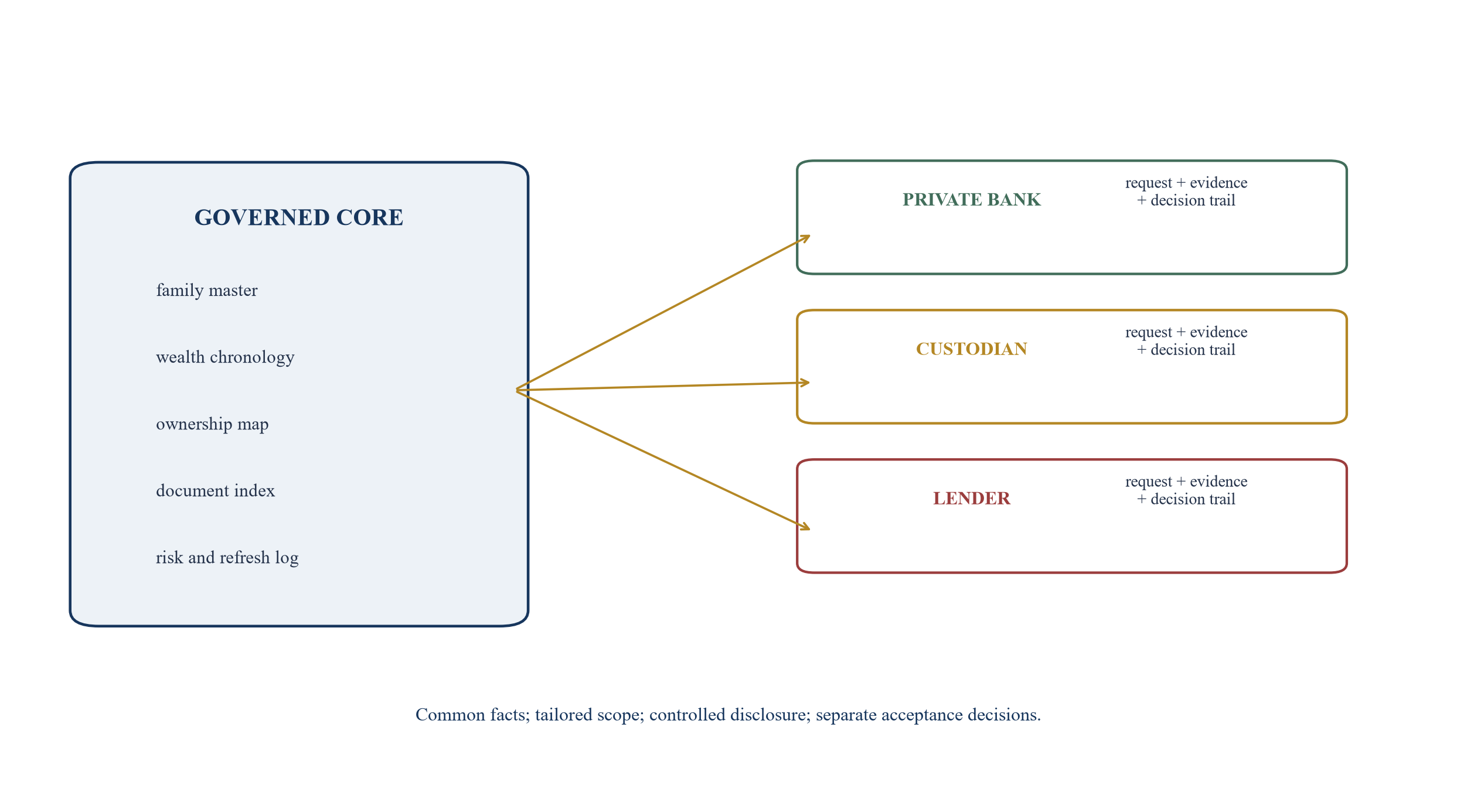
The institution-specific overlay records requests and decisions while the core evidence remains controlled and reusable.
11. Reconcile tax residence, CRS and FATCA classifications
Relocation changes facts that affect tax residence, reporting and account documentation. The data room should record the family's residence timeline, days present, homes, employment, business interests, visas, tax filings, certificates, departure or arrival positions and adviser conclusions. It should also identify the reporting classification of each entity and legal arrangement.
The UAE participates in automatic exchange of information under CRS and FATCA. UAE reporting financial institutions collect and report information on relevant accounts to the Ministry of Finance for exchange with competent authorities [10]. The pack should contain self-certifications, tax identification numbers, residence evidence and entity classifications that reconcile across institutions. A family should not use a bank form as the primary source of its tax conclusion. Qualified advisers should establish the position, and each form should be checked against that analysis.
CRS and FATCA can classify the same structure differently because the regimes use different definitions and tests. A foundation, trust, holding company, family investment company or personal investment vehicle may be a financial institution, active non-financial entity, passive non-financial entity or another category depending on its facts and applicable rules. Controlling-person analysis may require information on founders, trustees, protectors, beneficiaries, council members or other controllers.
The residence timeline should also connect to wealth events. A business sale, distribution, gift, dividend or asset transfer occurring near relocation may have tax and reporting consequences in more than one jurisdiction. The evidence room should store the facts, transaction documents and adviser analysis without presenting a management summary as legal advice. Open positions, elections and pending filings should be clearly recorded.
Table 4. Tax transparency and residence evidence register
| Record | Evidence | Account-opening use | Refresh trigger | Control owner |
|---|---|---|---|---|
| residence timeline | visas, travel, homes, employment and certificates | individual residence and address | move, new home, visa or day-count change | family tax lead |
| tax identifiers | official registrations and correspondence | TIN and jurisdiction fields | registration, cancellation or correction | tax compliance owner |
| entity classification | legal documents and adviser memorandum | CRS and FATCA status | activity, ownership or manager change | entity board and tax adviser |
| controlling persons | ownership and control map | passive-entity look-through | beneficiary, trustee or control change | governance owner |
| self-certifications | signed current forms | institution-specific onboarding | expiry, indicia conflict or fact change | authorised signatory |
| reportable-account history | filed returns and institution notices | consistency and remediation | filing, correction or authority enquiry | reporting institution or adviser |
Tax residence and reporting classifications require qualified advice. The register is designed to keep forms consistent with approved conclusions.
12. Establish document provenance and authenticity
The strongest narrative can fail if documents appear altered, incomplete or unauthorised. Each evidence item should have a provenance record: issuer, recipient, document type, issue date, effective period, jurisdiction, original format, source channel, certification status, translation status, digital signature, hash, confidentiality class and expiry date.
The hierarchy of reliability should be explicit. Government and court records, regulated-institution statements, audited financial statements and executed transaction documents generally carry greater evidential weight than self-authored summaries. Independent corroboration can strengthen a customer declaration. A screenshot without account identity, date or source may have limited value. A spreadsheet prepared by the family office can reconcile evidence, yet it remains an analysis rather than primary proof.
Certification and translation requirements differ. Some institutions require originals or certified copies. Documents may need notarisation, legalisation or an approved translation. The data room should keep the original, translated document, translator credentials and a link between them. It should also retain the complete document, not only the page that appears relevant, unless the receiving institution agrees to a controlled extract.
Files should have immutable versions. When a document is replaced, the prior version should remain in the archive with its status, reason and supersession date. File names should be generated from metadata rather than edited manually. A checksum can demonstrate that the distributed copy matches the approved version. The access log should identify who viewed or downloaded highly sensitive files.
The index should make the review path visible. Each document receives a stable evidence identifier, a short human-readable label and a link to the assertion or event it supports. A reviewer should be able to move from the wealth summary to the relevant event, from the event to the reconciliation and from the reconciliation to primary documents. The reverse link should also work: opening a bank statement should reveal which event, person, account and submission uses it.
Quality review should test completeness and integrity. Completeness asks whether all pages, schedules and annexes are present. Integrity asks whether names, amounts, dates, signatures and account identifiers agree across the evidence. Authenticity asks whether the source and certification meet the recipient's requirements. Usability asks whether a reviewer can understand the file without specialist knowledge of the family's internal archive. These checks should be recorded separately because one can pass while another fails.
13. Protect personal and financial data by design
A source-of-wealth room contains passports, addresses, family relationships, tax records, bank statements, transaction documents, signatures and legal arrangements. Its value to compliance teams makes it attractive to attackers. Security, privacy and usability should be designed together.
The DIFC Data Protection Law governs collection, handling and use of personal data within its scope, while the UAE has a federal personal-data protection framework and other jurisdictions may also apply [20-22]. The applicable controller, processor, lawful basis, purpose, retention period, data-subject rights and transfer mechanism should be established by qualified advisers. A family office should maintain a record of processing and contracts with administrators, technology providers and advisers.
Access should follow least privilege. Family principals, family-office staff, external counsel, tax advisers, compliance consultants and banks need different views. Highly sensitive identity and tax records should be segregated from general corporate evidence. Time-limited links, multifactor authentication, download controls, watermarking, encryption, approved devices and monitored administrator activity can reduce exposure. Control design should reflect the platform, legal requirements and threat model.
Data minimisation should operate at the disclosure-pack level. The receiving institution should receive the evidence necessary for its request and risk assessment. Irrelevant family records, unrelated accounts and unrequested personal data should remain outside the pack. A disclosure register records what was provided, to whom, for what purpose, under which authority, on what date and with what retention expectation.
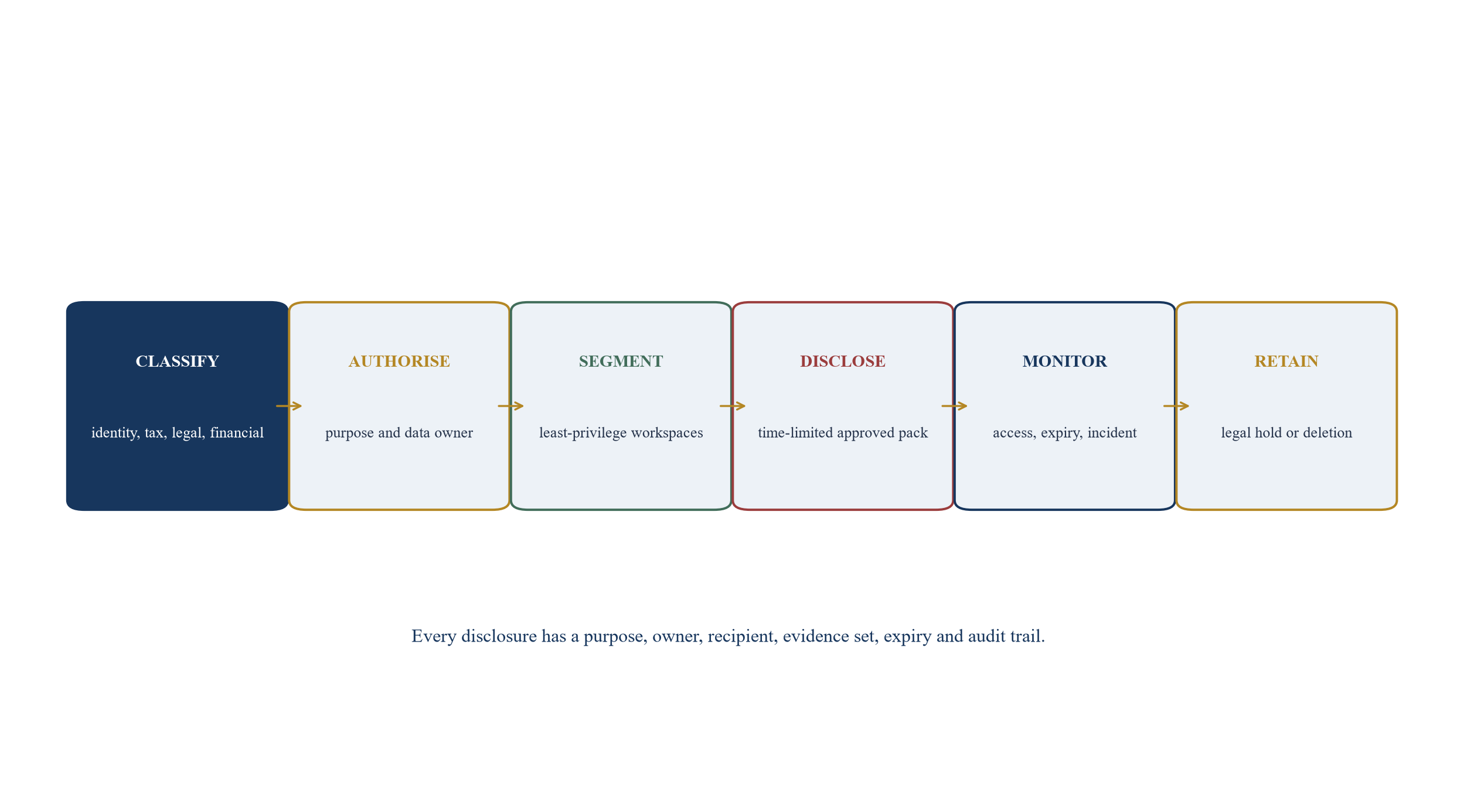
Technical controls require configuration, monitoring and legal governance. The diagram is an operating-model blueprint.
14. Apply risk-based packaging rather than blanket collection
Risk-based customer due diligence aligns the extent of information and corroboration with the customer, product, geography, ownership and transaction risk. The CBUAE and DFSA frameworks distinguish standard and enhanced measures and require more evidence where risk is higher [2-5]. FATF has reinforced proportionality in the risk-based approach [16]. A reusable data room should support that distinction.
The core record may be comprehensive, yet every pack should be scoped. A simple personal account funded from regulated-bank savings may require a narrower pack than a private investment company holding assets through several jurisdictions. A PEP, complex legal arrangement, digital-asset history, high-risk geography, unusual transaction or inconsistent wealth profile can require enhanced evidence, senior approval and closer monitoring.
The family office should maintain a risk-fact register rather than assign its own regulatory rating. It can record objective facts: countries of residence and business, public functions, ownership complexity, asset types, expected transfers, counterparties, product purpose and document gaps. The institution applies its policy and risk appetite. The family pack should answer the likely questions while avoiding assertions about how the institution must classify the relationship.
Blanket collection can reduce quality. Reviewers receive more files, contradictions are harder to find and sensitive data spreads further. The better sequence is to establish a complete core, identify the institution's request, select relevant evidence, perform a consistency review and preserve the response trail. Where an institution seeks additional evidence, the request enters the controlled tracker with owner, due date, response and decision.
15. Manage PEP, sanctions and adverse-information questions
Politically exposed person status does not imply wrongdoing. It creates heightened risk considerations and, under applicable rules, enhanced measures that can include senior management approval, source-of-wealth and source-of-funds work and enhanced monitoring [3, 15]. The family master should record current and former public functions, immediate family and close-associate relationships where required, dates and jurisdictions. Legal and compliance specialists should determine the applicable definitions.
Sanctions screening requires complete and accurate identifying information. Names, transliterations, dates of birth, nationalities, addresses, entity affiliations and ownership paths help distinguish true matches from false positives. The pack should preserve screening results, sources, date, reviewer and disposition. It should also record ownership and control changes because sanctions obligations can extend beyond named persons under applicable regimes.
Adverse information should be assessed for identity, credibility, recency, relevance and outcome. A news article may be useful corroboration, yet it is not automatically proof. Court judgments, regulator notices and official records generally carry different weight from anonymous allegations. The family should prepare factual explanations supported by primary records and qualified advice. It should avoid requesting deletion or suppression of legitimate information as a substitute for addressing it.
The issue log should separate resolved false matches, substantiated matters, ongoing proceedings, factual disputes and missing evidence. Each item needs an owner, legal review where appropriate, approved response and disclosure decision. A bank may reach a different conclusion from another bank. Consistency of facts and evidence improves the process without committing any institution to acceptance.
Table 5. High-risk issue and exception register
| Issue | Evidence required | Management response | Approval route | Refresh trigger |
|---|---|---|---|---|
| PEP connection | role, dates, family or associate relationship and wealth evidence | factual profile and enhanced evidence pack | compliance and senior relationship approver | role or relationship change |
| sanctions match | full identifiers, ownership and official-list evidence | documented true or false match analysis | sanctions specialist and legal counsel | list or ownership update |
| adverse information | source, identity match, official outcome and chronology | evidence-led response without unsupported denial | legal and compliance | new report, judgment or regulator action |
| complex structure | purpose, ownership, control, tax and administration | one-page rationale plus full structure map | entity board and advisers | new vehicle, power or beneficiary |
| evidence gap | missing item, reason, alternatives and materiality | remediation plan and transparent limitation | data owner and institution | document recovered or fact changes |
| unusual funding | economic source, transfer route, counterparties and purpose | transaction provenance file | treasury, compliance and bank | amount, route or counterparty changes |
The register supports preparation and escalation. Institutions apply their own legal obligations, policy and risk appetite.
16. Turn missing evidence into managed exceptions
Older wealth histories rarely have perfect records. The data room should make gaps visible and managed. An exception record states the missing evidence, affected assertion, reason, materiality, alternative corroboration, legal or compliance view, owner, action and status. It should not conceal uncertainty behind polished prose.
Evidence alternatives should be independent where possible. If an original share certificate is unavailable, a current registrar extract, historic audited accounts, financing records, tax filings and legal opinion may collectively support ownership. If an old bank statement cannot be retrieved, a completion statement, adviser client-account record, tax return and receiving-account record may establish part of the chain. The receiving institution decides whether alternatives are sufficient.
The exception process should distinguish inaccessible evidence from contradictory evidence. A missing old statement is different from two documents showing different owners or amounts. Contradictions require investigation and correction. The family office should freeze distribution of the affected pack until the inconsistency is resolved or transparently explained and approved.
Materiality should consider more than value. A small transaction can reveal an undisclosed controller, sanctioned connection or unexplained cash route. A large asset may be well documented and low complexity. The exception committee should consider risk, relevance to the proposed relationship, reliability of alternatives and the institution's request. Decisions and residual limitations should be recorded in plain language.
17. Design a reusable core with controlled bank overlays
The reusable core contains approved facts and evidence. It should remain independent of any single bank's questionnaire. Bank overlays translate that core into each institution's definitions, forms, certifications and required document set. This architecture reduces contradictory responses and keeps institution-specific judgments separate.
The core should have modules for people, entities, ownership, wealth events, assets, transactions, tax, risk facts, documents and disclosures. Each module has structured data and human-readable summaries. The summaries cite the evidence index. A bank overlay contains the request list, field mapping, selected documents, responses, open questions, approvals and outcome.
The overlay also records where a bank's category does not match the family's internal classification. One form may group business sale and dividends under entrepreneurship. Another may ask for separate percentages of net worth. The response mapping should show how the approved underlying schedule was transformed. Any rounding or estimate should be identified and reconciled.
The family should maintain a response library for stable factual questions, with a review date and owner. It should not use canned responses for institution-specific legal declarations or facts that may have changed. Each submission receives a final four-way check: identity and names, ownership and control, amounts and dates, and consistency with prior disclosures.
The response library should retain the exact wording submitted to each institution and the evidence version that supported it. If a later submission changes a fact, the reviewer should identify whether the underlying circumstances changed or the earlier response was inaccurate. Material corrections should follow an approved notification process. This history protects the family from accidental contradiction and helps the institution understand legitimate changes.
The architecture can also support parallel workstreams without uncontrolled copying. A bank, custodian and lender may each be onboarding at the same time. Their workspaces should point to approved core evidence while preserving separate request lists and access rights. A correction to a core record should trigger impact analysis across open packs. A bank-specific request should remain in its overlay unless it reveals a fact that belongs in the core.
18. Replace calendar refresh with event-driven refresh
Periodic review remains important, but a relocated family can change faster than an annual cycle. Event-driven refresh updates the data room when a fact changes that could affect ownership, control, wealth, funding, tax, risk or expected activity. The event register should connect family-office operations to compliance evidence.
Trigger events include passport or address changes, new tax residence, marriage or divorce, death or incapacity, inheritance, gifts, entity formation or liquidation, share transfers, new directors or signatories, trust or foundation amendments, asset sales, major distributions, new public functions, sanctions or adverse information, digital-asset activity and unusual funding routes. Product changes and new booking jurisdictions can also require a tailored review.
Each event should generate a task set. A share transfer may require updated registers, beneficial-ownership analysis, bank notifications, tax review, custody changes and refreshed diagrams. A relocation may require new address evidence, residence analysis, tax identifiers, CRS self-certifications and expected-activity updates. A business sale may require a complete wealth event and transaction provenance file.
The owner closes the event only after all dependent records are updated. Documents nearing expiry enter a separate validity queue. Banks and advisers should receive updates according to legal obligations, contractual terms and materiality. The disclosure register records what changed and what was sent.
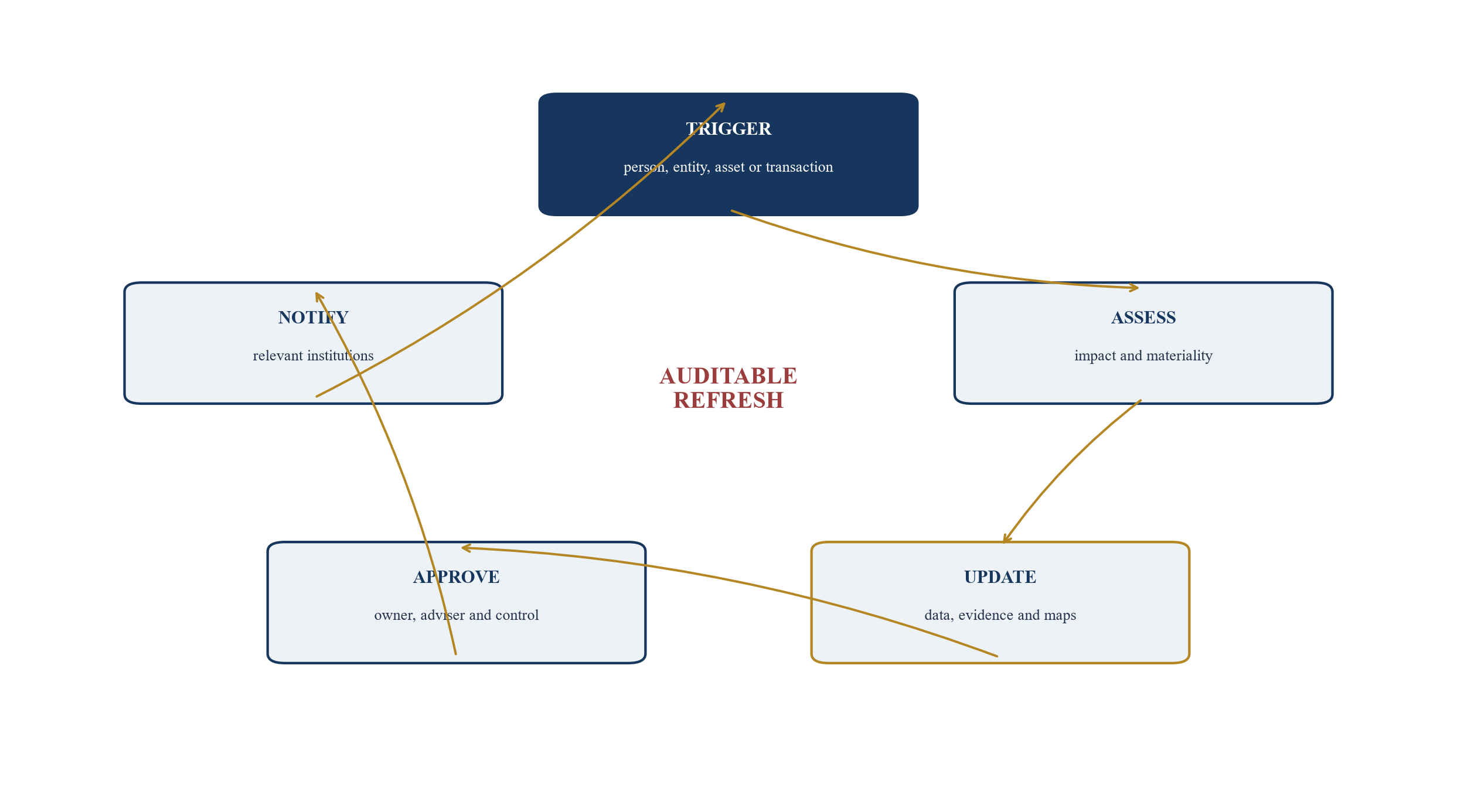
The loop converts a family or transaction event into controlled updates and institution notifications where required.
19. Assign an operating model and decision rights
The family principal should approve the purpose, risk appetite for disclosure and accountable executive. The family-office board or governance committee should oversee policy, resources, material exceptions and provider risk. A data owner maintains the master record. Legal and tax advisers approve their conclusions. Treasury owns funding routes. Information security controls access and incidents. Compliance specialists coordinate bank questions without claiming to replace the institution's decision.
A RACI matrix should cover identity updates, entity changes, wealth narratives, transaction files, tax classifications, document certification, disclosure, exceptions, bank responses and retention. The same person should not create, approve and distribute a material record where practical. High-risk packs deserve independent consistency review.
Service providers need written scope, confidentiality, security, data-location, incident, return and deletion terms. Administrators may collect documents. Lawyers may advise on legal ownership. Tax advisers may determine residence and reporting classification. Technology vendors may host or extract information. The family remains responsible for ensuring that the assembled record is coherent and authorised for disclosure.
The operating rhythm can include a weekly onboarding meeting, monthly exception review, quarterly governance dashboard and annual independent assurance. Material events should bypass the calendar and trigger immediate work. The meeting pack should focus on decisions: missing evidence, contradictions, high-risk questions, overdue requests, expiring documents, security incidents and upcoming transactions.
Decision rights should be written before a live onboarding creates time pressure. The data owner can approve routine updates that match primary evidence. Legal ownership changes, tax classifications, public-function disclosures, material adverse information and unexplained transaction paths require specialist or committee approval. The technology administrator can grant access only against an approved role and expiry. The relationship manager can coordinate questions but should not change core facts to make a form easier to complete.
Independent assurance should sample both the record and the process. A sample can begin with an assertion in a submitted pack and trace it back to evidence, then begin with a material source document and trace forward to every response that relied on it. Access logs, version history, exception closures and event-trigger performance should be tested. Findings should have named owners and deadlines, with material weaknesses reported to the governance body.
20. Implement the data room through a 120-day sequence
The build should begin with a controlled inventory, not a mass upload. In the first phase, appoint the sponsor, approve scope, select the secure platform, define data standards and identify the institutions and transactions that create immediate demand. Freeze destructive file operations and preserve original evidence.
The second phase builds the family, entity and document masters. It identifies duplicates, expired documents, inconsistent names and missing ownership links. The third phase reconstructs wealth events and funding chains, starting with sources that explain the largest or highest-risk portions of net worth. The fourth phase adds tax, sanctions, PEP, adverse-information, privacy and security controls.
The fifth phase produces a pilot pack for one institution or transaction. The pilot should test navigation, evidence sufficiency, reconciliation, redaction, approvals and response time. Questions from the institution should update the request map and exception log. The core record should change only where the question reveals a factual or evidence gap.
The final phase establishes business-as-usual ownership, service levels, event triggers, dashboards and assurance. The family should conduct a tabletop exercise for a major sale, new bank onboarding, residence change and security incident. Success means the team can assemble a controlled pack quickly and explain every material assertion.
Table 6. 120-day implementation and acceptance plan
| Phase | Days | Principal work | Gated output | Acceptance test |
|---|---|---|---|---|
| mobilise | 1-15 | sponsor, scope, platform, standards and preservation | approved charter and inventory | owners, permissions and no-overwrite controls confirmed |
| master data | 16-35 | people, entities, documents and identifiers | reconciled family and entity master | names, roles and ownership links agree to evidence |
| provenance | 36-65 | wealth chronology, asset map and funding chains | approved wealth-event files | material wealth bridges to current assets |
| compliance | 66-85 | tax, risk, privacy, security and exceptions | controlled compliance record | conclusions cite advisers and open issues are visible |
| pilot | 86-105 | one institution pack, Q&A and remediation | reviewed disclosure pack | every request maps to approved fact and evidence |
| operate | 106-120 | triggers, dashboard, assurance and training | business-as-usual handover | event drill completed and metrics assigned |
Timing and work effort are hypothetical management assumptions. Actual sequencing depends on family complexity, evidence availability and institution requests.
21. Govern outcomes through a board-ready decision file
The board-ready file should answer six questions. Is the family and entity perimeter complete? Can every material wealth source be explained and corroborated? Can proposed funding be traced from economic source to destination? Do tax residence and reporting forms reconcile? Are high-risk issues and gaps visible? Can the team update and disclose the record securely?
The dashboard should distinguish completeness from acceptance. Useful measures include the percentage of material wealth linked to approved evidence, ownership records reconciled, documents valid, high-risk exceptions resolved, requests answered by due date, pack preparation time, bank follow-up questions, contradictory responses detected, access exceptions and event updates completed. Bank acceptance and account activation are outcomes controlled by the institution and should be reported separately.
Management may use a readiness score, but the score should never hide a critical exception. A data room can be 95% complete while missing the evidence for one material sale or controller. The dashboard should therefore show both aggregate measures and red-flag gates. No pack should be released when identity, ownership, material provenance, tax classification or disclosure authority remains unresolved.
The decision file should include the approved family overview, ownership and control map, wealth chronology, source-of-wealth schedule, source-of-funds schedule for the proposed activity, tax and reporting matrix, risk-fact register, exception log, disclosure register, institution request map and adviser conclusions. It should identify the date and scope of each conclusion.
A reusable evidence architecture does not remove KYC or transfer responsibility from the bank. It gives the family a disciplined way to present the same facts, reconcile its history, respond faster, protect sensitive data and update records when circumstances change. That operating capability can support banking, custody, investment, credit and transaction execution across jurisdictions while preserving institution-specific review.
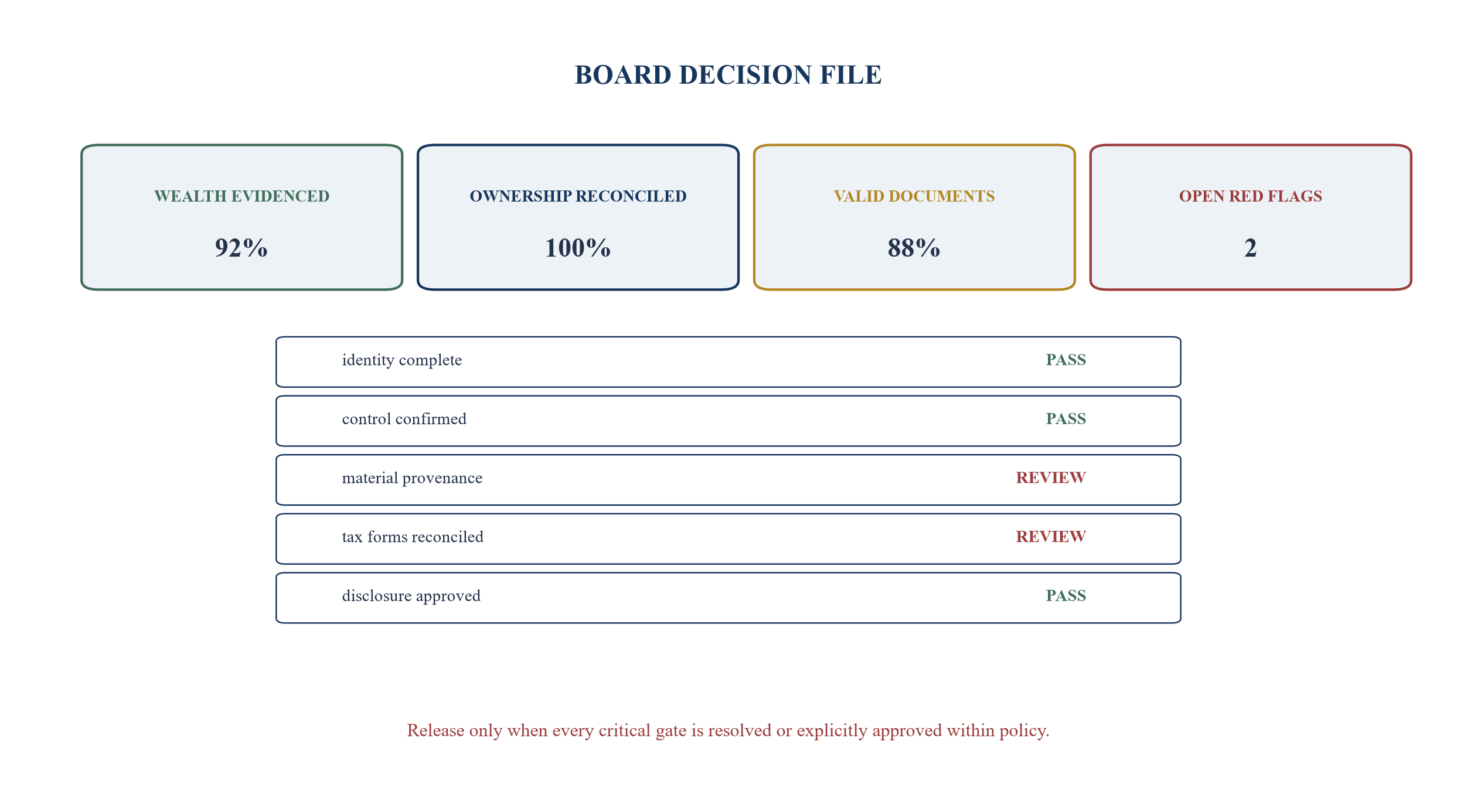
The dashboard combines aggregate readiness with non-negotiable red-flag gates. Values shown are illustrative.
Sources and further reading
- United Arab Emirates Government, Federal Decree-Law No. 10 of 2025 Regarding Anti-Money Laundering and Combating the Financing of Terrorism and Proliferation Financing Official source
- Central Bank of the UAE, Rulebook Section 3.3.2 Source of Funds and Source of Wealth Official source
- United Arab Emirates Government, Cabinet Resolution No. 134 of 2025 Executive Regulations of the AML Decree-Law Official source
- Dubai Financial Services Authority, Anti-Money Laundering Module version 30 April 2026 Official source
- Dubai Financial Services Authority, AML 7.4.1 Guidance on Enhanced Customer Due Diligence Official source
- Wolfsberg Group, Source of Wealth and Source of Funds FAQs for Private Banking and Wealth Management Official source
- United Arab Emirates Government, Cabinet Resolution No. 109 of 2023 Regulating Real Beneficiary Procedures Official source
- Financial Action Task Force, Guidance on Beneficial Ownership of Legal Persons Official source
- Financial Action Task Force, Guidance on Beneficial Ownership and Transparency of Legal Arrangements Official source
- UAE Ministry of Finance, Automatic Exchange of Information, FATCA and CRS Official source
- UAE Ministry of Finance, Commitment to Implement Updated CRS 2.0 Official source
- Financial Action Task Force, The FATF Recommendations Official source
- Basel Committee on Banking Supervision, Sound Management of AML and CFT Risks Official source
- Financial Conduct Authority, Financial Crime Guide Section 3.2 Official source
- Financial Conduct Authority, Customer Due Diligence Processes and Controls Findings 2026 Official source
- Financial Action Task Force, Methodology for Assessing Technical Compliance and Effectiveness Official source
- Dubai International Financial Centre, Family Arrangements Regulations 2023 Official source
- Dubai International Financial Centre, Foundations Law No. 3 of 2018 Official source
- Dubai International Financial Centre, Private and Family Wealth Offering Official source
- Dubai International Financial Centre, Data Protection Law No. 5 of 2020 Official source
- DIFC Commissioner of Data Protection, Data Protection Guidance and Assessment Tools Official source
- United Arab Emirates Government, Federal Decree-Law No. 45 of 2021 on the Protection of Personal Data Official source
- Central Bank of the UAE, Guidance on Digital Identification for Customer Due Diligence Official source
- Financial Action Task Force, Guidance on Digital Identity Official source
- European Banking Authority, Guidelines on Remote Customer Onboarding Official source
- HM Revenue and Customs, Source of Funds and Source of Wealth Guidance Official source
- HM Revenue and Customs, Guidance for All Sectors on Source of Funds and Source of Wealth Official source
- Basel Committee on Banking Supervision, Customer Due Diligence for Banks Official source
