

Introduction
Secure connectivity can carry commercial revenue and public-service value at the same time. A commercial user buys throughput, availability and coverage. A sovereign customer may also buy priority, control, assured access, security, national gateways, protected terminals, surge capacity and continuity during disruption. Those additional rights can be valuable, but the valuation treatment depends on funding, contractual enforceability, operational readiness and buyer-specific evidence.
The core discipline is separation. Contracted cash belongs in forecast cash flow. Funded availability or capacity-reservation payments belong in cash flow when performance obligations are measurable. Strategic access can support a separate value component when the buyer receives identifiable rights and the evidence supports both delivery and willingness to pay. Policy aspiration belongs in a decision memorandum until it becomes funded, contracted or otherwise demonstrably economic.
This paper builds that separation into one operating, contractual and financial model. It also prevents the same government demand from appearing simultaneously as backlog, higher utilisation, a strategic premium and a lower discount rate.
1. Define the valuation perimeter
The analysis begins with the entities, spacecraft, payloads, gateways, spectrum rights, terminals, software and contracts included in the transaction. This establishes the unit of account before value is attributed. The model should identify the payer, enforceable right, service standard, operating dependency and delivery date for every material line. A broad strategic narrative cannot substitute for those fields because the same constellation may provide several outputs with different funding, risk and duration.
The evidence set comprises an ownership map, licence register, fleet schedule, contract register and intercompany service map. Each item should be dated, owned and reconciled to the relevant asset, contract and model assumption. Missing support remains a visible gap. The financial model converts the verified record into which revenue, obligations and strategic rights transfer. The board should approve one perimeter shared by technical, commercial and financial workstreams, with every adjustment linked to one ledger and one accountable owner.
2. Separate the value ledgers
Decision usefulness requires a trace from contracted commercial cash, contracted government cash, funded resilience payments, evidenced strategic access and unfunded aspiration to capacity, contractual performance and cash. The trace should distinguish observed operations, executed obligations, funded options and management scenarios. It should also show whether a claimed resilience benefit is delivered by existing infrastructure, requires incremental investment or displaces commercial service during the period in which it is needed.
Diligence should obtain executed contracts, appropriations, procurement awards, service acceptances and decision records. The transaction team should test completeness, legal enforceability, operating readiness and cash conversion. Valuation then measures a value bridge with no overlap between cash and buyer-specific benefit. Decision makers should keep each value component in a separate ledger until final reconciliation; the assumption register should prevent the same right from appearing in revenue, a strategic premium and terminal value simultaneously.
3. Segment commercial service cohorts
The control question concerns retail, enterprise, mobility, maritime, aviation, wholesale and backhaul users. It should be answered through a repeatable operating and contractual record. Annual averages can hide concentration, priority conflicts, acceptance delays and unfunded programme ceilings. Cohort, counterparty, geography and mission identifiers allow the analyst to identify which component creates value and which component creates completion or funding risk.
Required support includes subscriber records, pricing, usage, churn, gross margin and service-level performance by cohort. Exceptions, changes, cancellations and failed tests deserve separate review. The model uses the evidence to calculate cohort revenue and contribution after acquisition, terminal and network costs. The investment committee should use observed cohort economics rather than a fleet-wide revenue multiple, retaining deductions for incomplete work and excluding benefits whose funding or delivery cannot be demonstrated.
4. Reconstruct the subscriber curve
The analysis begins with coverage activation, terminal availability, channel productivity, adoption, churn and price evolution. This establishes the unit of account before value is attributed. The model should identify the payer, enforceable right, service standard, operating dependency and delivery date for every material line. A broad strategic narrative cannot substitute for those fields because the same constellation may provide several outputs with different funding, risk and duration.
The evidence set comprises installed terminals, orders, activations, cancellations, capacity utilisation and cash collection. Each item should be dated, owned and reconciled to the relevant asset, contract and model assumption. Missing support remains a visible gap. The financial model converts the verified record into subscriber growth constrained by capacity and service readiness. The board should tie forecast adoption to evidence by geography and service class, with every adjustment linked to one ledger and one accountable owner.
5. Reconstruct government contract cash
Decision usefulness requires a trace from service fees, milestones, capacity reservations, availability payments, task orders and termination rights to capacity, contractual performance and cash. The trace should distinguish observed operations, executed obligations, funded options and management scenarios. It should also show whether a claimed resilience benefit is delivered by existing infrastructure, requires incremental investment or displaces commercial service during the period in which it is needed.
Diligence should obtain executed awards, funded ceilings, appropriations, acceptance evidence, invoices and collection history. The transaction team should test completeness, legal enforceability, operating readiness and cash conversion. Valuation then measures probability-weighted cash based on enforceable obligations. Decision makers should exclude unfunded ceilings and non-binding programme ambition from base cash flow; the assumption register should prevent the same right from appearing in revenue, a strategic premium and terminal value simultaneously.
6. Test backlog quality
The control question concerns the difference between funded backlog, unfunded options, framework ceilings and management pipeline. It should be answered through a repeatable operating and contractual record. Annual averages can hide concentration, priority conflicts, acceptance delays and unfunded programme ceilings. Cohort, counterparty, geography and mission identifiers allow the analyst to identify which component creates value and which component creates completion or funding risk.
Required support includes contract clauses, obligated amounts, ordering history, cancellations and remaining performance obligations. Exceptions, changes, cancellations and failed tests deserve separate review. The model uses the evidence to calculate cash conversion by contract and period. The investment committee should rank backlog by legal enforceability, funding and operational readiness, retaining deductions for incomplete work and excluding benefits whose funding or delivery cannot be demonstrated.
7. Identify the sovereign service bundle
The analysis begins with priority access, protected communications, national control, geographic coverage, surge capacity and mission assurance. This establishes the unit of account before value is attributed. The model should identify the payer, enforceable right, service standard, operating dependency and delivery date for every material line. A broad strategic narrative cannot substitute for those fields because the same constellation may provide several outputs with different funding, risk and duration.
The evidence set comprises requirements, service descriptions, acceptance tests, authority matrices and incident exercises. Each item should be dated, owned and reconciled to the relevant asset, contract and model assumption. Missing support remains a visible gap. The financial model converts the verified record into the specific rights delivered beyond ordinary commercial service. The board should value only rights that are defined, deliverable and attributable to the buyer, with every adjustment linked to one ledger and one accountable owner.
8. Price reserved capacity
Decision usefulness requires a trace from capacity held for government use during normal operations, crises and demand surges to capacity, contractual performance and cash. The trace should distinguish observed operations, executed obligations, funded options and management scenarios. It should also show whether a claimed resilience benefit is delivered by existing infrastructure, requires incremental investment or displaces commercial service during the period in which it is needed.
Diligence should obtain reservation schedules, pre-emption rules, utilisation records and displaced commercial traffic. The transaction team should test completeness, legal enforceability, operating readiness and cash conversion. Valuation then measures availability revenue less foregone commercial contribution and standby cost. Decision makers should test whether reservation creates incremental capacity or displaces higher-margin demand; the assumption register should prevent the same right from appearing in revenue, a strategic premium and terminal value simultaneously.
9. Price priority and pre-emption
The control question concerns the order in which government and commercial users receive constrained bandwidth. It should be answered through a repeatable operating and contractual record. Annual averages can hide concentration, priority conflicts, acceptance delays and unfunded programme ceilings. Cohort, counterparty, geography and mission identifiers allow the analyst to identify which component creates value and which component creates completion or funding risk.
Required support includes traffic policies, command rights, service logs, crisis exercises and customer terms. Exceptions, changes, cancellations and failed tests deserve separate review. The model uses the evidence to calculate expected commercial displacement, service credits and sovereign benefit. The investment committee should make priority rights explicit in both the contract model and capacity model, retaining deductions for incomplete work and excluding benefits whose funding or delivery cannot be demonstrated.
10. Value secure gateways and terminals
The analysis begins with national ground infrastructure, accredited terminals, key management and protected network interfaces. This establishes the unit of account before value is attributed. The model should identify the payer, enforceable right, service standard, operating dependency and delivery date for every material line. A broad strategic narrative cannot substitute for those fields because the same constellation may provide several outputs with different funding, risk and duration.
The evidence set comprises asset registers, certifications, throughput tests, maintenance, interoperability and replacement plans. Each item should be dated, owned and reconciled to the relevant asset, contract and model assumption. Missing support remains a visible gap. The financial model converts the verified record into incremental service capability, capital needs and buyer control. The board should separate reusable infrastructure from customer-specific equipment, with every adjustment linked to one ledger and one accountable owner.
11. Test multi-orbit resilience
Decision usefulness requires a trace from the ability to reroute service across low, medium and geostationary orbit assets and terrestrial links to capacity, contractual performance and cash. The trace should distinguish observed operations, executed obligations, funded options and management scenarios. It should also show whether a claimed resilience benefit is delivered by existing infrastructure, requires incremental investment or displaces commercial service during the period in which it is needed.
Diligence should obtain architecture diagrams, failover tests, latency, capacity, handover performance and common dependencies. The transaction team should test completeness, legal enforceability, operating readiness and cash conversion. Valuation then measures availability improvement after incremental network and terminal cost. Decision makers should admit resilience value only after end-to-end tests demonstrate usable service; the assumption register should prevent the same right from appearing in revenue, a strategic premium and terminal value simultaneously.
12. Test sovereign control
The control question concerns the legal and operational ability to direct capacity, keys, routing, data location and service restoration. It should be answered through a repeatable operating and contractual record. Annual averages can hide concentration, priority conflicts, acceptance delays and unfunded programme ceilings. Cohort, counterparty, geography and mission identifiers allow the analyst to identify which component creates value and which component creates completion or funding risk.
Required support includes governance rights, command authorities, hosting arrangements, technical controls and licence conditions. Exceptions, changes, cancellations and failed tests deserve separate review. The model uses the evidence to calculate buyer-specific control benefits and continuing obligations. The investment committee should distinguish ownership, contractual rights and operational control, retaining deductions for incomplete work and excluding benefits whose funding or delivery cannot be demonstrated.
13. Test cybersecurity and assurance
The analysis begins with the confidentiality, integrity and availability of spacecraft, ground, terminal and orchestration layers. This establishes the unit of account before value is attributed. The model should identify the payer, enforceable right, service standard, operating dependency and delivery date for every material line. A broad strategic narrative cannot substitute for those fields because the same constellation may provide several outputs with different funding, risk and duration.
The evidence set comprises accreditations, penetration tests, incident records, supply-chain controls and recovery exercises. Each item should be dated, owned and reconciled to the relevant asset, contract and model assumption. Missing support remains a visible gap. The financial model converts the verified record into required remediation, operating cost, delay and residual exposure. The board should deduct incomplete assurance work before recognising strategic value, with every adjustment linked to one ledger and one accountable owner.
14. Analyse supply-chain sovereignty
Decision usefulness requires a trace from dependence on foreign components, launch services, cloud, software, terminals and critical suppliers to capacity, contractual performance and cash. The trace should distinguish observed operations, executed obligations, funded options and management scenarios. It should also show whether a claimed resilience benefit is delivered by existing infrastructure, requires incremental investment or displaces commercial service during the period in which it is needed.
Diligence should obtain bill of materials, country-of-origin data, export controls, supplier capacity and substitution plans. The transaction team should test completeness, legal enforceability, operating readiness and cash conversion. Valuation then measures delay, replacement cost and strategic dependency. Decision makers should price resilience after testing realistic substitution time and funding; the assumption register should prevent the same right from appearing in revenue, a strategic premium and terminal value simultaneously.
15. Underwrite spectrum value
The control question concerns the licences, priority, coordination status and geographic rights supporting service. It should be answered through a repeatable operating and contractual record. Annual averages can hide concentration, priority conflicts, acceptance delays and unfunded programme ceilings. Cohort, counterparty, geography and mission identifiers allow the analyst to identify which component creates value and which component creates completion or funding risk.
Required support includes ITU filings, national licences, coordination agreements, milestones and interference records. Exceptions, changes, cancellations and failed tests deserve separate review. The model uses the evidence to calculate capacity and optionality attributable to usable spectrum rights. The investment committee should avoid valuing spectrum separately when its economics already appear in service cash flow, retaining deductions for incomplete work and excluding benefits whose funding or delivery cannot be demonstrated.
16. Test regulatory permissions
The analysis begins with authorisations for landing rights, gateways, security, export control, remote sensing and government service. This establishes the unit of account before value is attributed. The model should identify the payer, enforceable right, service standard, operating dependency and delivery date for every material line. A broad strategic narrative cannot substitute for those fields because the same constellation may provide several outputs with different funding, risk and duration.
The evidence set comprises licences, approvals, conditions, correspondence and renewal dates. Each item should be dated, owned and reconciled to the relevant asset, contract and model assumption. Missing support remains a visible gap. The financial model converts the verified record into cash timing and restrictions by market. The board should make unresolved permissions conditions rather than assumed value, with every adjustment linked to one ledger and one accountable owner.
17. Map service availability
Decision usefulness requires a trace from coverage, latency, throughput, uptime, restoration and performance by user class to capacity, contractual performance and cash. The trace should distinguish observed operations, executed obligations, funded options and management scenarios. It should also show whether a claimed resilience benefit is delivered by existing infrastructure, requires incremental investment or displaces commercial service during the period in which it is needed.
Diligence should obtain network telemetry, acceptance certificates, outage records and service credits. The transaction team should test completeness, legal enforceability, operating readiness and cash conversion. Valuation then measures billable capacity and contract compliance. Decision makers should forecast revenue from delivered service rather than theoretical design capacity; the assumption register should prevent the same right from appearing in revenue, a strategic premium and terminal value simultaneously.
18. Reconcile capacity conflicts
The control question concerns competition between commercial demand, government reservations, internal redundancy and maintenance. It should be answered through a repeatable operating and contractual record. Annual averages can hide concentration, priority conflicts, acceptance delays and unfunded programme ceilings. Cohort, counterparty, geography and mission identifiers allow the analyst to identify which component creates value and which component creates completion or funding risk.
Required support includes beam plans, traffic records, reservation schedules and peak-demand scenarios. Exceptions, changes, cancellations and failed tests deserve separate review. The model uses the evidence to calculate incremental revenue after displacement and resilience reserves. The investment committee should apply one capacity allocation rule across all value ledgers, retaining deductions for incomplete work and excluding benefits whose funding or delivery cannot be demonstrated.
19. Model fleet cohorts
The analysis begins with satellite age, payload capability, reliability, remaining life and replacement sequence. This establishes the unit of account before value is attributed. The model should identify the payer, enforceable right, service standard, operating dependency and delivery date for every material line. A broad strategic narrative cannot substitute for those fields because the same constellation may provide several outputs with different funding, risk and duration.
The evidence set comprises manufacturing lots, launch records, telemetry, anomalies and end-of-life plans. Each item should be dated, owned and reconciled to the relevant asset, contract and model assumption. Missing support remains a visible gap. The financial model converts the verified record into available capacity and replenishment capital by cohort. The board should link service obligations to the fleet capable of delivering them, with every adjustment linked to one ledger and one accountable owner.
20. Model replenishment capital
Decision usefulness requires a trace from the manufacture, launch, insurance, orbit raising and commissioning required to sustain service to capacity, contractual performance and cash. The trace should distinguish observed operations, executed obligations, funded options and management scenarios. It should also show whether a claimed resilience benefit is delivered by existing infrastructure, requires incremental investment or displaces commercial service during the period in which it is needed.
Diligence should obtain supplier contracts, production cadence, launch slots, acceptance history and contingency plans. The transaction team should test completeness, legal enforceability, operating readiness and cash conversion. Valuation then measures sustaining free cash flow rather than pre-replenishment cash. Decision makers should fund replacement before claiming perpetual service or terminal value; the assumption register should prevent the same right from appearing in revenue, a strategic premium and terminal value simultaneously.
21. Test launch access
The control question concerns dependence on providers, jurisdictions, manifests, export permissions and integration capacity. It should be answered through a repeatable operating and contractual record. Annual averages can hide concentration, priority conflicts, acceptance delays and unfunded programme ceilings. Cohort, counterparty, geography and mission identifiers allow the analyst to identify which component creates value and which component creates completion or funding risk.
Required support includes executed launch contracts, slots, deposits, alternatives and observed delays. Exceptions, changes, cancellations and failed tests deserve separate review. The model uses the evidence to calculate service-start timing, replacement delay and liquidity need. The investment committee should stress launch concentration alongside satellite production and contract milestones, retaining deductions for incomplete work and excluding benefits whose funding or delivery cannot be demonstrated.
22. Model government procurement timing
The analysis begins with budget cycles, approvals, competitive awards, protests, acceptance and payment. This establishes the unit of account before value is attributed. The model should identify the payer, enforceable right, service standard, operating dependency and delivery date for every material line. A broad strategic narrative cannot substitute for those fields because the same constellation may provide several outputs with different funding, risk and duration.
The evidence set comprises appropriations, procurement notices, award documents and collection history. Each item should be dated, owned and reconciled to the relevant asset, contract and model assumption. Missing support remains a visible gap. The financial model converts the verified record into cash timing and working capital. The board should avoid converting programme announcements directly into near-term revenue, with every adjustment linked to one ledger and one accountable owner.
23. Model termination and change rights
Decision usefulness requires a trace from government rights to cancel, suspend, reduce scope, direct changes or invoke security provisions to capacity, contractual performance and cash. The trace should distinguish observed operations, executed obligations, funded options and management scenarios. It should also show whether a claimed resilience benefit is delivered by existing infrastructure, requires incremental investment or displaces commercial service during the period in which it is needed.
Diligence should obtain contract clauses, historical actions, claims and compensation mechanisms. The transaction team should test completeness, legal enforceability, operating readiness and cash conversion. Valuation then measures downside cash, stranded assets and recovery. Decision makers should reflect enforceable remedies and practical collection timing; the assumption register should prevent the same right from appearing in revenue, a strategic premium and terminal value simultaneously.
24. Measure customer concentration
The control question concerns reliance on individual ministries, agencies, programmes, distributors or anchor customers. It should be answered through a repeatable operating and contractual record. Annual averages can hide concentration, priority conflicts, acceptance delays and unfunded programme ceilings. Cohort, counterparty, geography and mission identifiers allow the analyst to identify which component creates value and which component creates completion or funding risk.
Required support includes revenue, backlog, receivables and renewal dates by counterparty. Exceptions, changes, cancellations and failed tests deserve separate review. The model uses the evidence to calculate cash volatility, bargaining power and refinancing exposure. The investment committee should stress loss or delay of the largest funded customer, retaining deductions for incomplete work and excluding benefits whose funding or delivery cannot be demonstrated.
25. Build sustainable free cash flow
The analysis begins with commercial and government cash after operations, security, terminals, taxes, working capital and replenishment. This establishes the unit of account before value is attributed. The model should identify the payer, enforceable right, service standard, operating dependency and delivery date for every material line. A broad strategic narrative cannot substitute for those fields because the same constellation may provide several outputs with different funding, risk and duration.
The evidence set comprises reconciled accounts, contracts, fleet plans and capacity schedules. Each item should be dated, owned and reconciled to the relevant asset, contract and model assumption. Missing support remains a visible gap. The financial model converts the verified record into cash available to capital providers after maintaining service. The board should use the same service standard in the forecast and terminal period, with every adjustment linked to one ledger and one accountable owner.
26. Evidence strategic-access value
Decision usefulness requires a trace from the buyer-specific benefit of assured communications, autonomy, rapid restoration and protected national access to capacity, contractual performance and cash. The trace should distinguish observed operations, executed obligations, funded options and management scenarios. It should also show whether a claimed resilience benefit is delivered by existing infrastructure, requires incremental investment or displaces commercial service during the period in which it is needed.
Diligence should obtain decision records, alternatives, funded substitutes, avoided costs and explicit willingness to pay. The transaction team should test completeness, legal enforceability, operating readiness and cash conversion. Valuation then measures incremental buyer benefit outside ordinary seller cash flow. Decision makers should cap strategic value by evidence, deliverability and buyer capture; the assumption register should prevent the same right from appearing in revenue, a strategic premium and terminal value simultaneously.
27. Exclude unfunded policy aspiration
The control question concerns benefits described in policy statements without committed funding, executable rights or operating readiness. It should be answered through a repeatable operating and contractual record. Annual averages can hide concentration, priority conflicts, acceptance delays and unfunded programme ceilings. Cohort, counterparty, geography and mission identifiers allow the analyst to identify which component creates value and which component creates completion or funding risk.
Required support includes budget documents, procurement status, programme governance and delivery evidence. Exceptions, changes, cancellations and failed tests deserve separate review. The model uses the evidence to calculate a disclosed decision option with zero transaction value until converted. The investment committee should record the conditions that would move aspiration into a funded ledger, retaining deductions for incomplete work and excluding benefits whose funding or delivery cannot be demonstrated.
28. Avoid double counting
The analysis begins with overlap among backlog, utilisation, sovereign premium, strategic access, discount rate and terminal multiple. This establishes the unit of account before value is attributed. The model should identify the payer, enforceable right, service standard, operating dependency and delivery date for every material line. A broad strategic narrative cannot substitute for those fields because the same constellation may provide several outputs with different funding, risk and duration.
The evidence set comprises an assumption register linking each risk and benefit to one model location. Each item should be dated, owned and reconciled to the relevant asset, contract and model assumption. Missing support remains a visible gap. The financial model converts the verified record into one economic treatment for each effect. The board should reconcile the value bridge before approval, with every adjustment linked to one ledger and one accountable owner.
29. Build the hypothetical base case
Decision usefulness requires a trace from a mixed commercial and government constellation with contracted and funded service components to capacity, contractual performance and cash. The trace should distinguish observed operations, executed obligations, funded options and management scenarios. It should also show whether a claimed resilience benefit is delivered by existing infrastructure, requires incremental investment or displaces commercial service during the period in which it is needed.
Diligence should obtain illustrative inputs clearly separated from public evidence. The transaction team should test completeness, legal enforceability, operating readiness and cash conversion. Valuation then measures USD 5.60 billion of cash-flow value. Decision makers should use the case to demonstrate mechanics rather than represent an operator; the assumption register should prevent the same right from appearing in revenue, a strategic premium and terminal value simultaneously.
30. Build the hypothetical strategic ledger
The control question concerns assured access, national control, crisis capacity and alternative-cost evidence. It should be answered through a repeatable operating and contractual record. Annual averages can hide concentration, priority conflicts, acceptance delays and unfunded programme ceilings. Cohort, counterparty, geography and mission identifiers allow the analyst to identify which component creates value and which component creates completion or funding risk.
Required support includes illustrative buyer-specific assumptions and explicit capture limits. Exceptions, changes, cancellations and failed tests deserve separate review. The model uses the evidence to calculate USD 1.40 billion of admitted strategic-access value. The investment committee should exclude USD 2.10 billion of unfunded policy benefit, retaining deductions for incomplete work and excluding benefits whose funding or delivery cannot be demonstrated.
31. Apply completion and assurance deductions
The analysis begins with unfinished gateways, terminals, accreditation, interoperability and capacity-conflict remediation. This establishes the unit of account before value is attributed. The model should identify the payer, enforceable right, service standard, operating dependency and delivery date for every material line. A broad strategic narrative cannot substitute for those fields because the same constellation may provide several outputs with different funding, risk and duration.
The evidence set comprises executable budgets, schedules, owners, tests and contingencies. Each item should be dated, owned and reconciled to the relevant asset, contract and model assumption. Missing support remains a visible gap. The financial model converts the verified record into USD 0.80 billion of deductions in the worked case. The board should release deductions only after verified milestones, with every adjustment linked to one ledger and one accountable owner.
32. Structure financing
Decision usefulness requires a trace from the alignment of contract tenor, cash flow, replenishment, reserves, security obligations and debt service to capacity, contractual performance and cash. The trace should distinguish observed operations, executed obligations, funded options and management scenarios. It should also show whether a claimed resilience benefit is delivered by existing infrastructure, requires incremental investment or displaces commercial service during the period in which it is needed.
Diligence should obtain lender models, covenants, direct agreements, termination compensation and liquidity facilities. The transaction team should test completeness, legal enforceability, operating readiness and cash conversion. Valuation then measures debt capacity supported by durable cash rather than policy value. Decision makers should fund strategic optionality with risk capital until cash is contracted; the assumption register should prevent the same right from appearing in revenue, a strategic premium and terminal value simultaneously.
33. Design transaction diligence
The control question concerns the evidence needed across contracts, fleet, capacity, cyber, regulation, funding and strategic rights. It should be answered through a repeatable operating and contractual record. Annual averages can hide concentration, priority conflicts, acceptance delays and unfunded programme ceilings. Cohort, counterparty, geography and mission identifiers allow the analyst to identify which component creates value and which component creates completion or funding risk.
Required support includes a data room indexed by contract, asset, geography and value-ledger entry. Exceptions, changes, cancellations and failed tests deserve separate review. The model uses the evidence to calculate rapid reconciliation of value and risk. The investment committee should make material gaps conditions, price mechanisms or funded actions, retaining deductions for incomplete work and excluding benefits whose funding or delivery cannot be demonstrated.
34. Establish post-close governance
The analysis begins with authority for capacity allocation, security, sovereign priorities, commercial commitments and investment. This establishes the unit of account before value is attributed. The model should identify the payer, enforceable right, service standard, operating dependency and delivery date for every material line. A broad strategic narrative cannot substitute for those fields because the same constellation may provide several outputs with different funding, risk and duration.
The evidence set comprises board policies, escalation rules, dashboards, incident exercises and audit trails. Each item should be dated, owned and reconciled to the relevant asset, contract and model assumption. Missing support remains a visible gap. The financial model converts the verified record into accountable decisions during normal and crisis operations. The board should refresh value when funding, rights, readiness or fleet evidence changes, with every adjustment linked to one ledger and one accountable owner.
35. Reconcile market evidence
Decision usefulness requires a trace from differences in contract mix, government concentration, fleet maturity, spectrum, security and replenishment to capacity, contractual performance and cash. The trace should distinguish observed operations, executed obligations, funded options and management scenarios. It should also show whether a claimed resilience benefit is delivered by existing infrastructure, requires incremental investment or displaces commercial service during the period in which it is needed.
Diligence should obtain public filings, financings and observed operating measures. The transaction team should test completeness, legal enforceability, operating readiness and cash conversion. Valuation then measures a comparable range adjusted to the subject evidence. Decision makers should explain each adjustment before using market multiples; the assumption register should prevent the same right from appearing in revenue, a strategic premium and terminal value simultaneously.
36. Define the investment decision
The control question concerns the price, funding, conditions, governance and delivery actions supported by the evidence. It should be answered through a repeatable operating and contractual record. Annual averages can hide concentration, priority conflicts, acceptance delays and unfunded programme ceilings. Cohort, counterparty, geography and mission identifiers allow the analyst to identify which component creates value and which component creates completion or funding risk.
Required support includes the final cash model, strategic ledger, deduction schedule, downside liquidity and consent map. Exceptions, changes, cancellations and failed tests deserve separate review. The model uses the evidence to calculate an auditable decision range. The investment committee should approve, reprice, stage or decline through a dated decision record, retaining deductions for incomplete work and excluding benefits whose funding or delivery cannot be demonstrated.
Conclusion
Sovereign constellation value requires disciplined separation. Commercial users, government service customers and sovereign buyers can pay for different outputs. Their cash flows, rights, risks and evidence should remain distinct until the final value bridge.
The framework admits contracted commercial and government cash into the cash-flow model, recognises funded resilience payments when performance is measurable, and admits buyer-specific strategic-access value when the right is deliverable and supported by evidence. It excludes unfunded policy aspiration. This produces a transaction value that can be challenged, financed and governed.
For boards and public authorities, the decisive question is whether the proposed price reflects funded cash, operationally proven resilience and strategic rights that the buyer can capture. The answer determines price, financing, conditions and post-close investment.
Appendix A. Value-ledger register
The minimum register records value component, payer, legal right, service standard, funding status, acceptance test, capacity requirement, operating dependency, contract term, cash timing, responsible owner and evidence confidence. Every component must have one primary model location.
Appendix B. Sovereign-service evidence register
For each government requirement, record executed contract, funded amount, procurement authority, reservation or pre-emption right, acceptance status, security requirement, gateway and terminal dependency, service availability, change and termination rights, payment history and renewal path.
Appendix C. Investment checklist
The approval file should contain commercial cohorts, government contracts, funded backlog, capacity allocation, sovereign rights, spectrum, terminals, gateways, cybersecurity, supply chain, fleet replenishment, launch access, downside liquidity, completion plan and governance. Evidence should be dated and owned.
Appendix D. Worked-case figures and tables
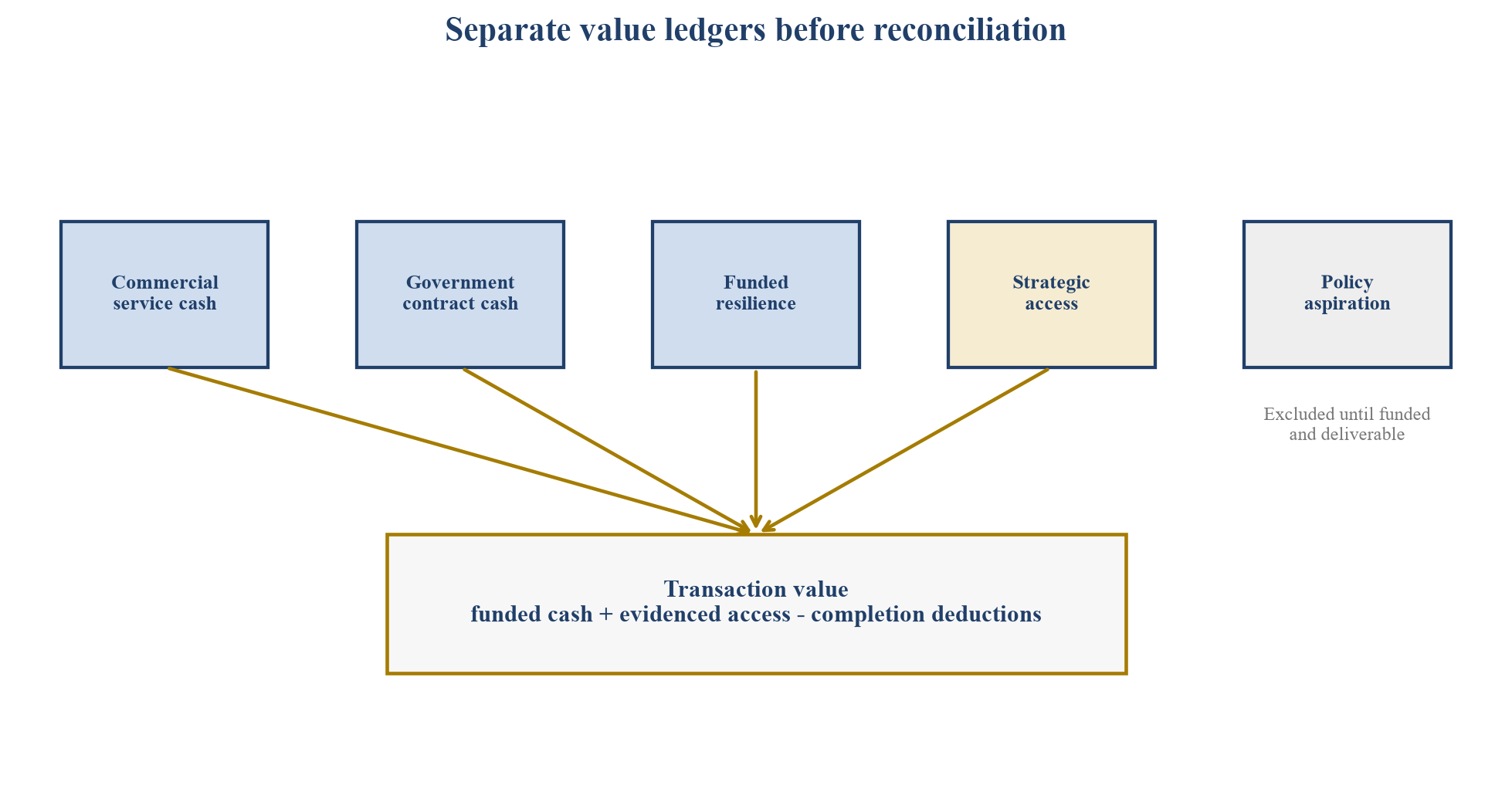
Proposed architecture separating commercial cash, government cash, resilience payments and strategic access.
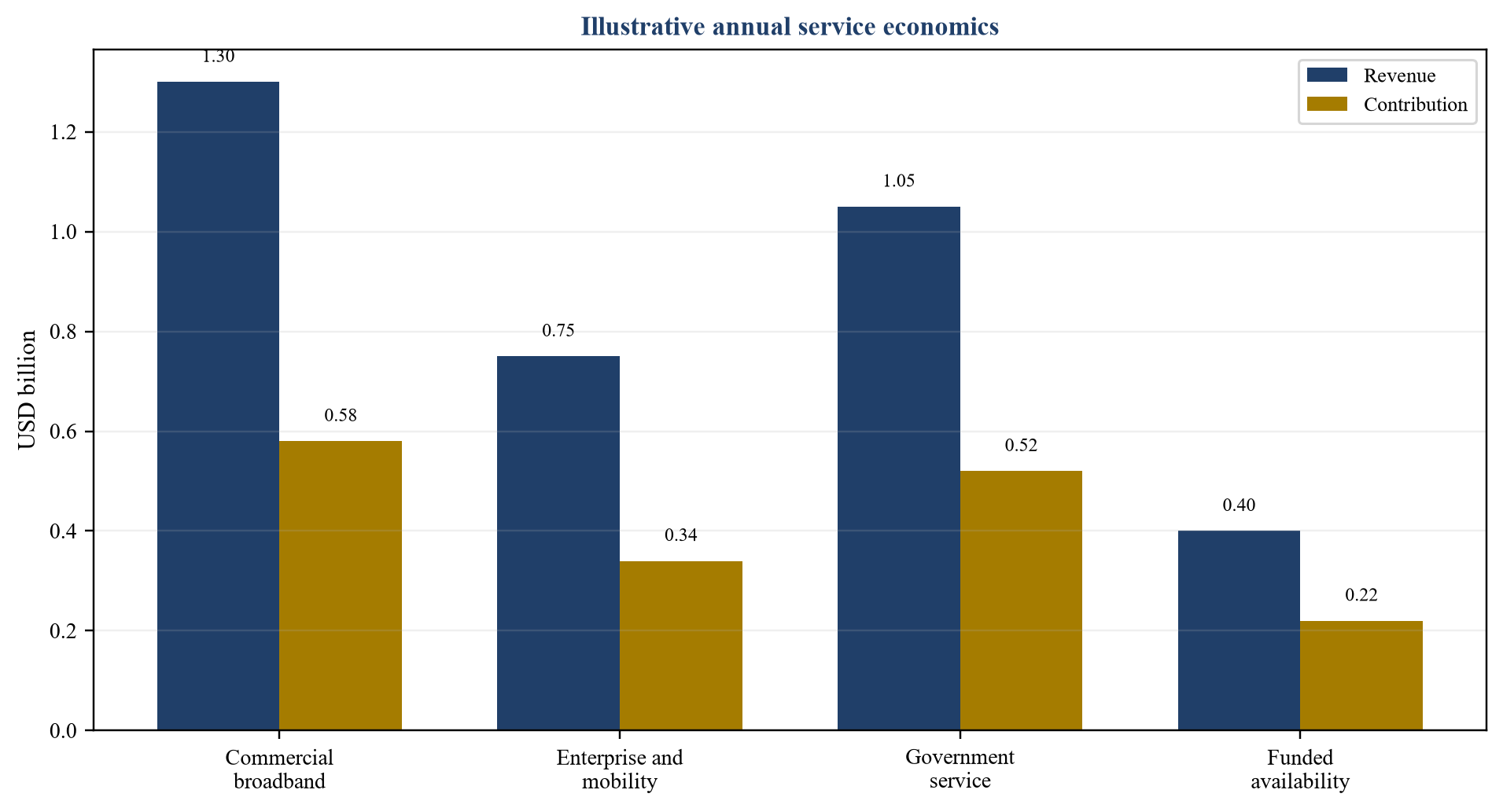
Illustrative contracted revenue and contribution by service cohort.
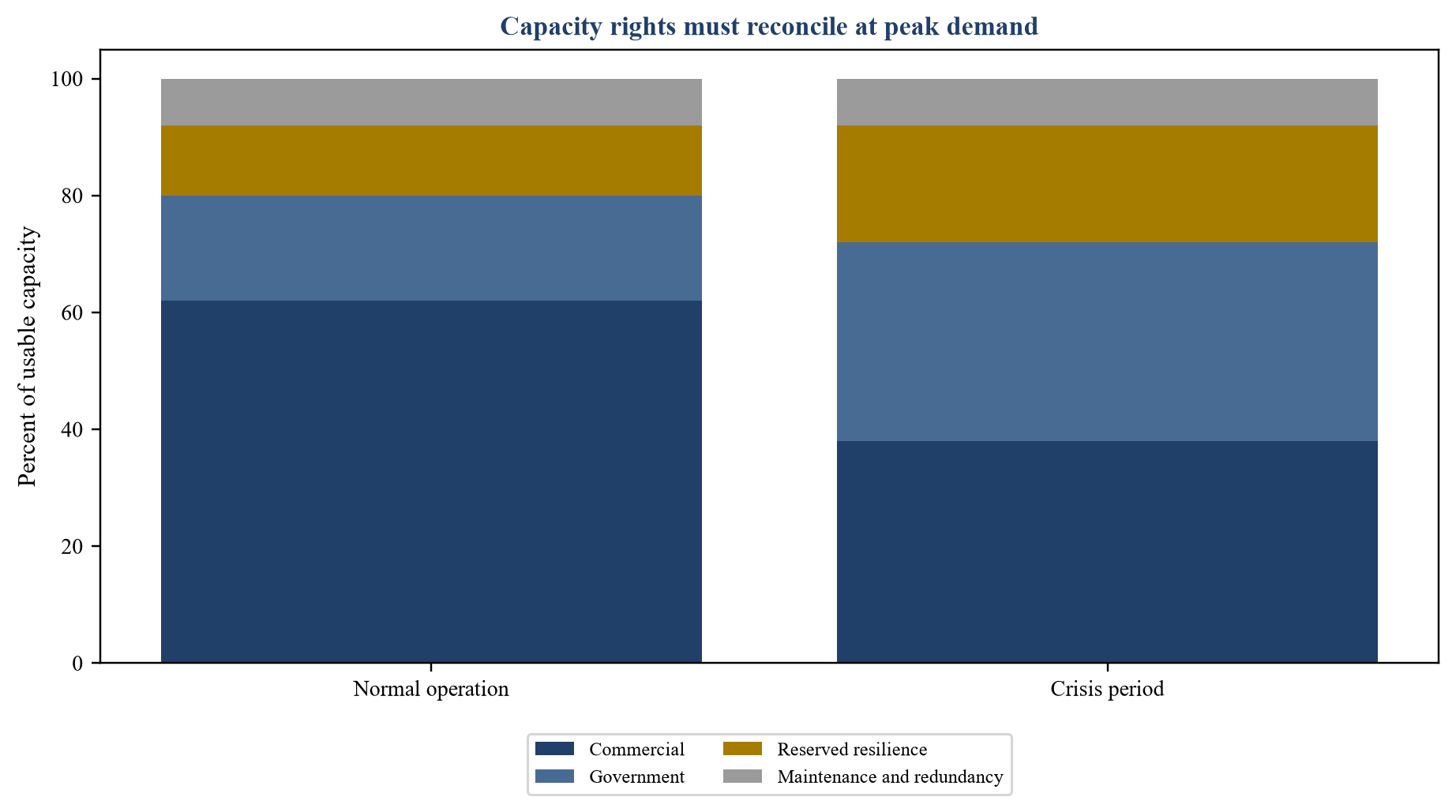
Illustrative comparison of normal and crisis-period capacity use.
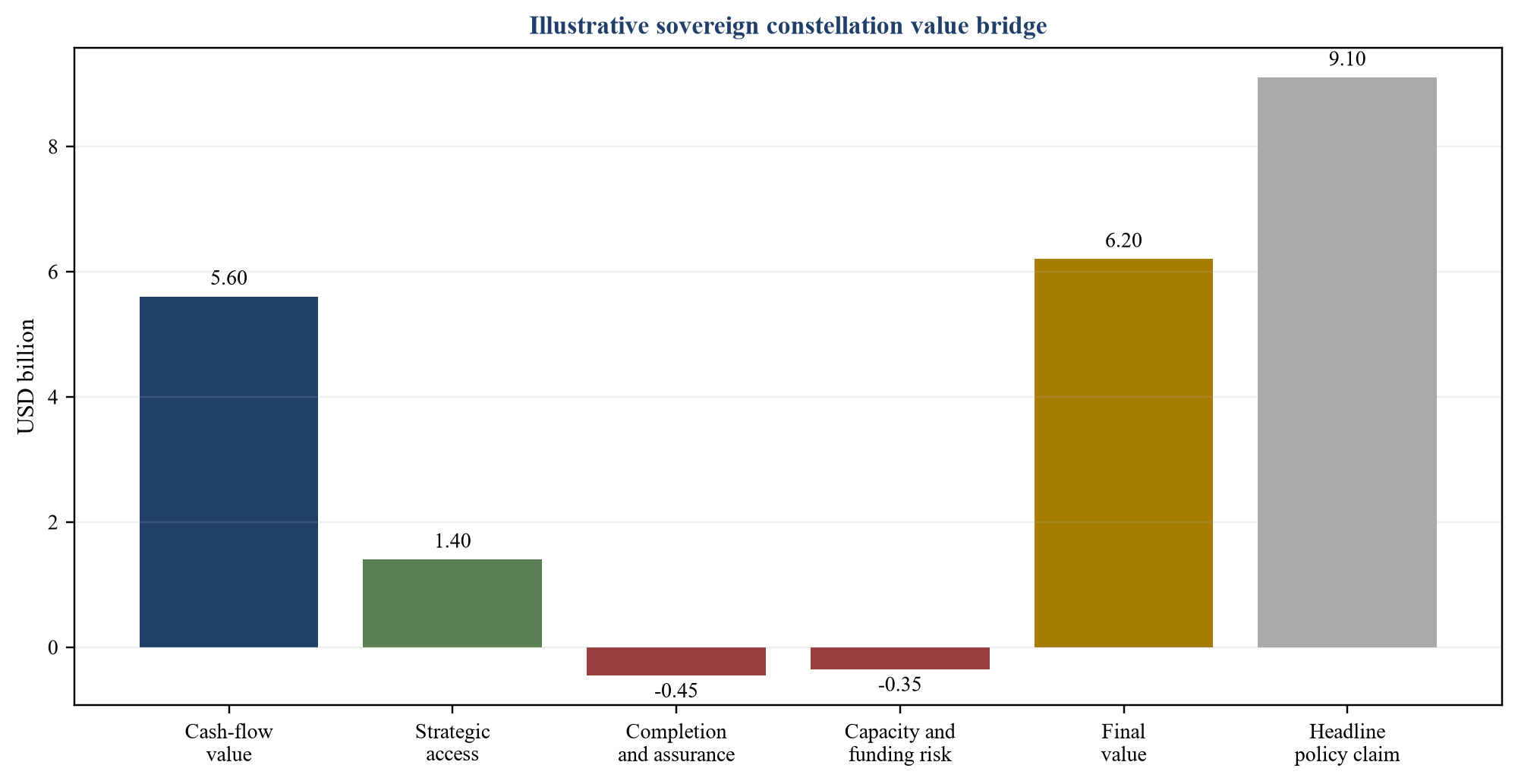
Illustrative bridge from cash-flow value and evidenced strategic access to final value.
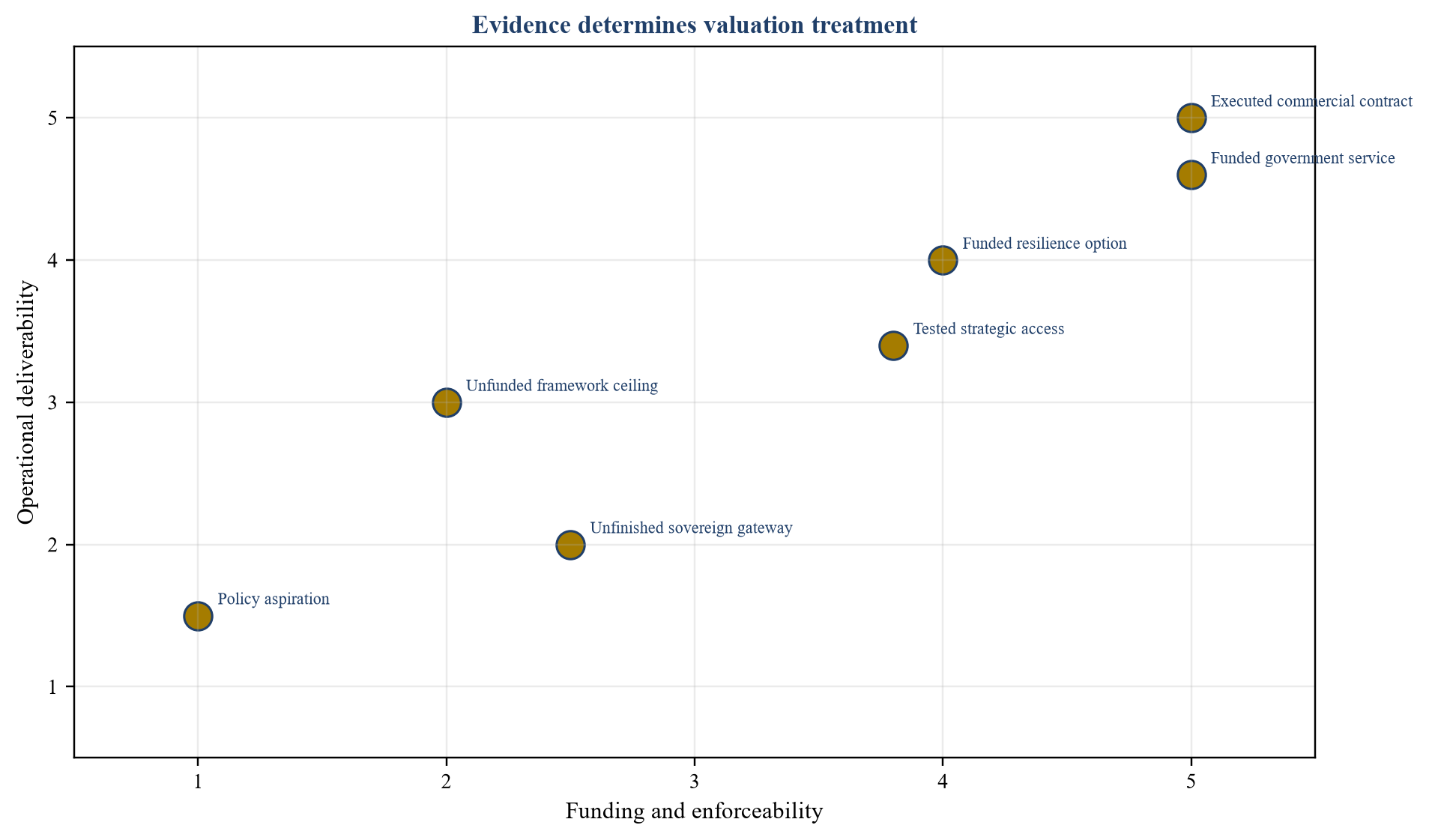
Proposed relationship between funding, deliverability and valuation treatment.
| Component | Minimum evidence | Valuation treatment |
|---|---|---|
| Commercial service | executed contracts and cohort cash | forecast cash flow |
| Government service | funded award and acceptance terms | forecast cash flow |
| Resilience availability | funded reservation and measurable performance | forecast cash flow |
| Strategic access | buyer-specific rights and demonstrated willingness to pay | separate evidenced component |
| Policy aspiration | statement without funding or delivery evidence | excluded from transaction value |
Proposed valuation treatment.
| Cohort | Revenue | Contribution | Principal evidence |
|---|---|---|---|
| Commercial broadband | 1.30 | 0.58 | subscribers price churn and collection |
| Enterprise and mobility | 0.75 | 0.34 | contracted sites usage and service levels |
| Government service | 1.05 | 0.52 | funded awards acceptance and invoicing |
| Funded availability | 0.40 | 0.22 | capacity reservation and performance |
| Total | 3.50 | 1.66 | reconciled service ledger |
All amounts are illustrative USD billions and describe no identified operator.
| Right | Operating evidence | Economic test |
|---|---|---|
| Priority access | tested allocation and authority | displaced cash and sovereign benefit |
| National gateway | accredited and accepted infrastructure | control benefit less capital and operation |
| Protected terminals | deployed interoperable estate | usable service and replacement cost |
| Surge capacity | demonstrated crisis routing | availability payment less standby cost |
| Data and key control | verified legal and technical control | buyer-specific value and continuing obligation |
Proposed diligence fields.
| Step | Amount | Evidence required |
|---|---|---|
| Cash-flow value | 5.60 | contracted commercial and government cash |
| Evidenced strategic access | plus 1.40 | buyer-specific rights and alternatives |
| Completion and cyber assurance | minus 0.45 | cost schedule and acceptance milestones |
| Capacity conflict and funding risk | minus 0.35 | peak allocation and funded backlog |
| Final illustrative value | 6.20 | integrated evidence set |
| Unfunded policy benefit excluded | 2.10 | no executable funding path |
| Rejected headline policy claim | 9.10 | cash plus all claimed public benefit |
All amounts are illustrative USD billions.
| Gate | Approval evidence | Stop condition |
|---|---|---|
| Cash | funded enforceable contracts | material unfunded forecast |
| Capacity | reconciled peak allocation | unresolved service conflict |
| Resilience | tested end-to-end delivery | unproven availability claim |
| Security | completed assurance and recovery | material control gap |
| Replenishment | funded fleet and launch plan | service life exceeds funded fleet life |
| Strategic value | buyer right and willingness to pay | policy narrative without capture evidence |
Proposed board control.
| Requirement | Potential instrument | Evidence gate |
|---|---|---|
| Contracted service expansion | project or asset-backed debt | durable funded cash and direct agreements |
| Fleet replenishment | corporate or project facility | launch and replacement reserve |
| Sovereign gateway completion | milestone equity or public funding | accepted design and executable budget |
| Strategic optionality | equity | verified buyer capture and delivery |
| Crisis restoration | committed liquidity | tested continuity plan |
Proposed risk allocation.
| Dimension | Core measure | Trigger |
|---|---|---|
| Commercial | subscribers churn price and contribution | cohort deterioration |
| Government | funded backlog acceptance and collection | award or payment delay |
| Capacity | utilisation reservation and displacement | unresolved peak conflict |
| Resilience | failover coverage and exercise outcomes | failed mission test |
| Security | incidents accreditation and remediation | material assurance gap |
| Fleet | availability remaining life and replenishment | capacity shortfall |
| Value | cash ledger strategic ledger and deductions | unsupported value migration |
Proposed monthly decision record.
Sources
- European Union Agency for the Space Programme, IRIS2 Secure Connectivity. Read the primary source
- European Union, Regulation (EU) 2023/588 establishing the Union Secure Connectivity Programme. Read the primary source
- European Commission, Union Secure Connectivity Programme and IRIS2 proposal materials. Read the primary source
- U.S. Government Accountability Office, DOD Satellite Communications: Reporting on Progress Needed to Provide Insight on New Approach, GAO-25-107034. Read the primary source
- U.S. Government Accountability Office, Commercial Satellite Communications and hybrid architecture reporting. Read the primary source
- U.S. Space Force, Commercial Space Strategy. Read the primary source
- U.S. Department of Defense, Commercial Space Integration Strategy. Read the primary source
- NATO, Overarching Space Policy. Read the primary source
- European Commission, IRIS2 concession contract announcement. Read the primary source
- European Investment Bank, Space sector financing and strategic autonomy. Read the primary source
- Satellogic, 2025 Annual Report. Read the primary source
- Spire Global, 2025 Annual Report. Read the primary source
- Kratos Defense and Security Solutions, 2025 Annual Report. Read the primary source
- BlackSky Technology, 2025 Annual Report and shareholder letter. Read the primary source
- Viasat, 2025 Annual Report. Read the primary source
- Globalstar, 2024 Annual Report. Read the primary source
- U.S. Federal Communications Commission, Space Bureau satellite policy and licensing. Read the primary source
- International Telecommunication Union, Radio Regulations and satellite spectrum framework. Read the primary source
- European Space Agency, Security for Space Systems. Read the primary source
- U.S. National Institute of Standards and Technology, Cybersecurity Framework 2.0. Read the primary source
- IFRS Foundation, IFRS 15 Revenue from Contracts with Customers. Read the primary source
- IFRS Foundation, IAS 36 Impairment of Assets. Read the primary source
- IFRS Foundation, IFRS 13 Fair Value Measurement. Read the primary source
- International Private Equity and Venture Capital Valuation Guidelines. Read the primary source
- International Valuation Standards Council, International Valuation Standards. Read the primary source
