

Introduction
The board decision is whether a proposed joint venture can deliver sovereign communications through disruption while earning an acceptable return on invested capital. The answer cannot be derived from share ownership alone. A shareholder may hold a majority interest while depending on another party for mission software, encryption modules, gateway access, specialist engineers, supply-chain support or priority capacity. Effective control therefore sits across legal documents, technical architecture, operating permissions, information access and crisis procedures.
The diligence perimeter should follow the end-to-end service. It begins with lawful spectrum and orbital use, continues through space and ground assets, and ends with delivery into an authorised user network. Every dependency should have an owner, an operating record, a replacement route and a documented consequence of failure. The same map should support valuation, transaction agreements, security accreditation and the post-close operating model.
Public sources establish useful reference points. The ITU records frequency assignments after national administrations complete applicable coordination and notification procedures. The European Union Secure Connectivity Programme uses a public-private structure with explicit governance, service-continuity and security-accreditation principles. UK investment-screening guidance identifies satellite communications links and operational-control facilities as sensitive activities. NIST has finalised three post-quantum cryptography standards, creating a practical migration reference for long-lived infrastructure. UAE data-protection legislation requires proportionate security measures and regulates cross-border transfers of personal data.
These sources do not produce one universal joint-venture model. National-security law, procurement rules, telecoms licensing, data protection and export controls vary by jurisdiction and service. The proposed framework is therefore a decision system. It identifies the questions, evidence and allocation mechanisms that boards can adapt with local legal, technical, tax and security advice.
1 Define the sovereign service before the company
The transaction should begin with a service statement that identifies authorised users, geographic coverage, traffic classes, minimum performance, continuity levels and crisis powers. A broad objective such as national connectivity is insufficient. The venture may serve government ministries, defence users, emergency services, critical-infrastructure operators, enterprises and retail customers through different networks and security domains. Each service class needs a defined route from terminal to satellite, gateway, terrestrial network and recipient.
The statement should distinguish availability from usable service. A satellite can be operational while a user lacks a compatible terminal, authorised frequency, cryptographic credential or domestic gateway. Capacity can exist while contractual priority belongs to another customer. A service can be technically available while a foreign support restriction prevents fault recovery. The minimum test is whether a named user can send and receive protected traffic under specified normal and degraded conditions.
The service definition becomes the reference for procurement, capital release and valuation. It allows the board to identify which assets are necessary, which can be shared, and which functions require sovereign control. It also prevents a venture from accumulating technology that does not improve an accepted service outcome. Every material investment should retire a service risk or expand a funded service.
2 Separate four forms of control
Four forms of control should be recorded separately. Corporate control concerns voting rights, board appointment, budgets, financing and distributions. Operational control concerns network configuration, capacity scheduling, mission commands, software deployment and incident response. Security control concerns accreditation, cryptographic policy, key custody, privileged access, classified information and audit. Continuity control concerns the ability to sustain or restore service when a partner, supplier, gateway or jurisdiction becomes unavailable.
These controls can sit with different parties. A state shareholder may hold reserved rights over sovereign capacity and security policy. An operator may manage commercial scheduling and routine network operations. An independent security authority may accredit the system and investigate incidents. A continuity operator may retain a tested capability to run specified functions from a national facility. The allocation should reflect competence as well as policy.
The joint-venture agreement should reference the technical controls that make each legal right effective. A veto over software changes has limited value when the state cannot inspect code, reproduce a build or prevent an unauthorised deployment. A right to crisis capacity has limited value without a scheduling interface, credential, terminal inventory and exercised operating procedure. Legal drafting and systems engineering should therefore proceed from one control matrix.
3 Establish the transaction perimeter
The perimeter should identify the assets, contracts, rights, people and obligations that transfer or become available at closing. The asset map should cover spacecraft interests, hosted payloads, gateway equipment, ground sites, terrestrial backhaul, network-management systems, security operations, user terminals, software, source code, intellectual property, spectrum filings, national licences, customer contracts, supplier agreements, insurance and programme records.
Shared assets require specific treatment. A global operator may use common satellites, network software and operations centres for several markets. The venture may receive service rights rather than ownership. Diligence should test capacity priority, term, renewal, price reset, termination, change of control, insolvency, force majeure and step-in rights. It should also identify which rights are enforceable against operating subsidiaries and critical suppliers.
Transferability is a valuation gate. A licence, filing, government contract or technology agreement may require consent. Export controls can restrict technical data, source code, hardware or support personnel. Security approval may depend on ownership, citizenship, facilities or information barriers. Any item that cannot transfer at closing should be excluded from the base value or addressed through a binding condition, replacement route or contingent payment.
4 Build the spectrum and orbital-rights ledger
Satellite communications depend on coordinated use of radio-frequency spectrum and associated orbital resources. ITU procedures operate through national administrations, while domestic authorities license operators, gateways, terminals and services. A venture should not describe spectrum as an owned asset. The diligence record should identify each filing, assignment, coordination status, responsible administration, bringing-into-use requirement, deployment milestone, national authorisation and renewal date.
The ledger should connect rights to the planned network configuration. It should record frequency bands, orbital characteristics, service direction, geographic coverage, earth stations, power limits and coordination obligations. It should identify harmful-interference exposure, unresolved coordination, priority status and dependencies on a parent operator's filings. A proposed change in satellite, beam, gateway or ownership may require regulatory action.
The economic model should include the time and cost required to secure, maintain and coordinate rights. It should also test a delayed or constrained case. Capacity that cannot lawfully be used in the target market is not commercial capacity. A contractual representation about spectrum should be supported by a filing and licence schedule, regulatory opinions where appropriate, and a post-close compliance owner.
5 Map national licences and market access
Domestic licensing can include satellite-service authorisations, landing rights, gateway licences, telecoms licences, equipment approvals, lawful-interception obligations, emergency-service duties and customer restrictions. The required approvals depend on the jurisdiction, service and architecture. The venture should maintain a country-by-country legal-operability matrix rather than rely on a global operator's general market presence.
Each market entry should have an accountable licence holder and operating entity. The model should record whether the venture, a shareholder, a distributor or a customer holds the relevant permission. It should identify fees, local presence, ownership limits, data-handling conditions, reporting, renewal and enforcement risk. Contracts should allocate responsibility when a licence is delayed, suspended or narrowed.
The board should connect revenue recognition to regulatory readiness. A sales pipeline in an unlicensed market is a strategic option. It becomes forecast revenue only after the service, customer, permission and delivery path are verified. The transaction should avoid paying full value for market-access claims that depend on future approvals or non-binding relationships.
6 Design reserved sovereign powers
Reserved powers should be narrow, explicit and exercisable. They may cover changes to sovereign service levels, encryption policy, key custody, gateway location, foreign privileged access, security-critical suppliers, transfer of sensitive assets, crisis capacity, classified information, material incidents and changes of control. Routine commercial decisions should remain with management within an approved operating plan.
The matrix should identify the decision threshold, evidence required, approving body, response time and deadlock route. Some matters may require state-shareholder consent. Others may require approval by a security committee, regulator or independent authority. Emergency powers should identify who can act first, how long the action remains valid and how commercial consequences are reviewed.
Reserved powers impose value and cost. They can protect the sovereign purpose and make government demand bankable. They can also slow procurement, constrain financing and create minority-protection issues. The shareholder agreement should therefore pair powers with process disciplines, objective triggers and information rights. Lenders and investors should understand which actions can affect revenue, costs, distributions and asset use.
7 Allocate board and committee authority
The board should have directors with commercial, technical, security, regulatory and finance competence. Appointment rights should reflect contribution and risk without creating an unworkable bloc. An independent chair or director can support decisions involving related-party services, transfer pricing, security incidents and capacity conflicts. Directors should receive sufficient cleared information to discharge their duties.
Specialised committees can reduce the risk that sensitive matters are decided through general governance. A security and resilience committee can oversee accreditation, key management, privileged access, continuity testing and incidents. A commercial committee can review pricing, customer concentration and related-party capacity. An audit and risk committee can reconcile service records, revenue, capital, compliance and assurance findings.
Committee authority should remain integrated with the board. Reports should state decisions, exceptions, owners and deadlines. Matters that affect both security and economics should reach both relevant committees. A technical waiver, for example, may increase service risk, insurance cost, customer liability and lifecycle capital. The decision record should preserve those connections.
8 Create sovereign key custody
Encryption sovereignty requires control over the cryptographic lifecycle, including generation, distribution, storage, use, rotation, revocation, recovery and destruction of keys. It does not require the venture to invent proprietary algorithms. The objective is to ensure that authorised national personnel and systems can control protected sovereign traffic without an unapproved external party exercising unilateral access.
The architecture should separate traffic encryption, command and control, identity, software signing and administrative credentials. Hardware security modules, split knowledge, dual control and offline recovery can reduce single-person and single-system risk. Key-management facilities should have defined physical, personnel, logical and procedural controls. Audit logs should be protected from alteration and available to the authorised security authority.
Long-lived space and ground assets require cryptographic agility. NIST's FIPS 203, 204 and 205 provide standardised post-quantum mechanisms for key establishment and signatures. A migration plan should identify where algorithms are implemented, which components can be upgraded, how hybrid modes are tested, and what happens when a spacecraft cannot receive a new cryptographic stack. Procurement contracts should require an inventory, supported algorithms, update rights and evidence of interoperability.
9 Protect telemetry tracking and command
Telemetry, tracking and command functions determine whether an operator can observe, configure and direct the space system. Compromise can affect service, safety and customer trust. The venture should identify every command path, control station, privileged role, authentication method, approval rule, software dependency and emergency procedure. It should separate commercial network management from spacecraft command authority where the risk case requires it.
Command operations should follow least privilege, strong identity, dual authorisation for critical actions, authenticated command loads, protected telemetry and independent monitoring. Remote support should be time-limited, approved, logged and technically constrained. Emergency access should be tested without creating a permanent bypass. The state should know which functions can be performed from national facilities and which require a foreign operations centre.
Transaction diligence should test practical control through a witnessed operating exercise. Documents and screenshots are weaker evidence than a controlled demonstration of credential issuance, command approval, configuration change, log review, failover and recovery. Any function that cannot be demonstrated should enter the remediation plan and valuation adjustment.
10 Define the data map before data residency
Data residency discussions often fail because the parties use the word data for different records. The venture should classify customer payload data, traffic content, metadata, network telemetry, spacecraft telemetry, security logs, identity records, billing data, support records, software repositories, cryptographic material, regulatory reports and backups. Each class has different confidentiality, operational and legal significance.
The data map should record collection point, controller, processor, purpose, legal basis, storage location, processing location, transit route, recipients, retention, deletion, encryption, key custodian and audit access. It should include cloud services, content-delivery networks, monitoring tools, ticketing systems and subcontractors. A national gateway does not create national data residency when management or backup systems replicate records elsewhere.
The map should distinguish policy preference from legal requirement. Personal-data transfer rules do not automatically require all operational data to remain in one country. National-security contracts may impose stricter requirements. Local counsel and the competent authorities should confirm the applicable rules. The technical design should implement the approved policy through routing, tenancy, access and monitoring controls.
11 Control cross-border data access
Cross-border risk includes remote access as well as physical storage. A foreign engineer may access a nationally hosted system. A global security platform may export logs for analysis. A software supplier may receive diagnostic records. The contract and architecture should therefore govern access purpose, scope, location, identity, duration, approval, logging and onward transfer.
UAE Federal Decree-Law No. 45 of 2021 provides a relevant example. It requires appropriate technical and organisational security measures and regulates cross-border transfers of personal data. Articles 22 and 23 address transfers where adequate protection exists and circumstances where it does not. The venture should apply the law to verified data classes and processing roles with local advice.
Access controls should support operating reality. Permanent prohibitions can make fault resolution impossible. An approved support model can combine national first-line capability, controlled escalation, masked data, session recording, dual approval and post-session review. The venture should test the model during commissioning and continuity exercises.
12 Segment sovereign and commercial networks
Network segmentation can allow shared infrastructure while limiting spillover between sovereign and commercial services. The design should identify trust zones for spacecraft command, sovereign traffic, commercial traffic, network management, security monitoring, development, suppliers and user access. Interfaces should have explicit protocols, authentication, content validation, logging and failure behaviour.
Segmentation should extend beyond logical network rules. It can include separate cryptographic domains, credentials, ground equipment, operations teams, cloud tenants, software pipelines and incident procedures. The appropriate degree depends on threat, service criticality, cost and the ability to operate during disconnection. The board should approve any shared component that creates a common failure mode.
The financial model should show the cost of separation. Secure gateways, national operations, independent monitoring, personnel clearance, duplicate tooling and testing can be material. These costs support a sovereign availability payment or minimum commitment when they are required for the public service. They should not be hidden inside an assumed commercial margin.
13 Define security accreditation
Security accreditation is the formal basis on which an authorised body accepts residual risk for a defined system and use. The programme should identify the accreditation authority, scope, classification, assurance standards, evidence, testing, exceptions, review cycle and conditions of operation. Accreditation should cover the actual service architecture, including suppliers and operational processes.
The European Union Secure Connectivity Programme demonstrates the importance of separate security governance. Regulation 2023/588 establishes principles for security accreditation and assigns authority for governmental infrastructure and services. It also emphasises distribution of responsibilities, service continuity and risk mitigation. A bilateral or national venture can adapt those principles without copying the institutional form.
The transaction timetable should include accreditation dependencies. A service cannot be treated as accepted sovereign capacity before the authorised body approves its intended use. Deferred consideration, capital drawdown and government payments can be linked to defined accreditation milestones. Exceptions should have owners, expiry dates and funded remediation.
14 Test supply-chain sovereignty
Sovereignty can fail through a supplier even when the venture owns its main assets. Critical dependencies may include payload components, modems, user terminals, operating systems, network software, cloud services, ground antennas, launch interfaces, cryptographic hardware and specialist support. The venture should rank suppliers by substitutability, lead time, jurisdiction, access, update authority and operational consequence.
Contracts should provide appropriate rights to technical information, security evidence, vulnerability notification, maintenance, source materials, escrow, spares, training and transition support. A right without an executable replacement path has limited continuity value. The operating plan should identify inventories, alternative suppliers, qualification time and capital required to replace a critical component.
Supply-chain diligence should address software as well as hardware. The venture should maintain a software bill of materials, signed releases, reproducible or independently verifiable builds where practical, vulnerability management and controlled deployment. It should know which external services are contacted during operation and what occurs when they are unavailable.
15 Design crisis capacity and priority
Crisis capacity should be defined as a contractual and technical service rather than an aspiration. The venture should specify the triggering authority, eligible events, capacity quantity, geographic scope, user classes, activation time, duration, pre-emption rules, restoration, price and compensation. The architecture should reserve or create the required capacity under credible demand conditions.
Normal commercial utilisation can conflict with sovereign priority. Pre-emption may affect enterprise customers, roaming partners or other governments. The venture should identify which contracts permit interruption, what service credits or liabilities arise, and how customers are informed. The economic model should reserve the expected cost of exercising priority.
The capacity plan should be exercised. A tabletop review cannot prove terminal readiness, routing, credentials, staffing and partner coordination. The venture should run periodic end-to-end tests involving authorised users, gateways, operations centres and relevant suppliers. Findings should enter a funded remediation plan and board dashboard.
16 Engineer independent continuity
Continuity requires more than redundant satellites. Common dependencies can affect several routes at once. Examples include shared software, identity systems, gateway power, fibre backhaul, cloud control planes, key-management infrastructure, supplier support and a single operations team. The architecture should identify correlated failure and geopolitical interruption.
The venture should define a minimum sovereign service that can operate when the international partner or a foreign jurisdiction becomes unavailable. The minimum may be narrower than the normal service. It should identify capacity, coverage, terminals, national staff, cryptographic material, software, runbooks, spares and funding. The state should understand how long this mode can be sustained.
Step-in rights should be supported by technical and human capability. Escrowed code without build tools, documentation, credentials and trained personnel is inadequate. A backup gateway without spectrum authority, backhaul and current configuration is also inadequate. Continuity evidence should include exercised failover, measured recovery and resolution of findings.
17 Allocate capacity through transparent rules
The venture needs a capacity ledger that reconciles technical capacity, scheduled capacity, reserved sovereign capacity, commercial commitments, maintenance margin and degraded-mode capacity. It should state the unit of measure and avoid adding incompatible throughput, beam, time and coverage metrics. Availability should be measured at the service boundary experienced by the user.
Allocation rules should identify priority tiers, booking, overcommitment, congestion management, pre-emption, restoration and reporting. Related-party capacity should be priced and approved through a transparent process. The venture should prevent either shareholder from extracting value through undisclosed priority, transfer pricing or cross-subsidy.
Capacity becomes economically valuable when it has lawful coverage, an accessible terminal population, accepted quality and a paying customer. The base forecast should use contracted or strongly evidenced demand. Unused technical capacity can support an option case after incremental sales cost, terminal deployment, regulatory work and operating cost are included.
18 Build the revenue and cost model
Revenue can include sovereign availability payments, reserved capacity, usage, enterprise connectivity, roaming or wholesale access, managed security, terminals and integration. The model should separate funded minimum commitments from optional usage and market development. Government contract ceilings, framework agreements and non-binding demand should not be treated as contracted revenue.
Cost should include satellite or capacity payments, gateways, terrestrial backhaul, network operations, security operations, accreditation, licences, spectrum, terminals, customer support, insurance, personnel, cloud services, lifecycle replacement and incident readiness. Related-party services should have observable scope, pricing, performance and audit rights.
Cash conversion matters. Government acceptance, invoicing, dispute, tax and collection terms can differ from commercial customers. Lifecycle reserves may be needed before distributions. Debt service should be tested after operating and sovereign obligations, with correlated downside across utilisation, cost, availability and collection.
19 Value strategic access separately
Commercial cash-flow value and sovereign-access value answer different questions. Commercial value reflects expected distributable cash from enforceable services. Sovereign-access value reflects the benefit of assured capability, resilience, national control or avoided disruption. Combining them into one unsupported premium reduces accountability.
The board should first value commercial cash flows using an evidence-linked forecast. It should then state any strategic-access value through a separate decision record. The record should identify the service, alternative, consequence, probability, funding source and period. It should exclude benefits that are already paid through availability revenue or embedded in cash flows.
Strategic value should follow tested rights and capability. A board may reasonably fund resilience before it produces normal commercial return. The decision should show the public-purpose output and the conditions under which further capital is released. This approach supports transparent allocation between commercial shareholders and the state.
20 Structure consideration around evidence
Cash at completion should reflect transferable assets, effective rights, funded contracts and accepted capability. Deferred consideration can address approvals, accreditation, migration, crisis-capacity tests, customer retention and collected cash. Seller rollover can align longer-term performance when governance and future funding are clear.
Conditions precedent should cover material licences, foreign-investment approvals, security agreements, spectrum consents, key contracts and financing. Covenants should preserve operations and information security between signing and closing. Termination and long-stop provisions should address delays outside either party's control.
Representations should be supported by schedules and evidence. Important topics include rights ownership, licences, filings, security incidents, software, encryption, data handling, export controls, customer commitments, supplier dependencies and government disclosures. Indemnities and escrow should address identified exposures. Transaction insurance should not substitute for diligence or specific remedies.
21 Address foreign-investment review
Space communications can fall within mandatory or voluntary investment-screening regimes. UK guidance under the National Security and Investment Act identifies satellite communications links, secure facilities and space-infrastructure operational-control facilities within the sensitive sector description. United States CFIUS jurisdiction can include control and certain non-controlling foreign investments involving sensitive technology, infrastructure or data.
The deal team should identify relevant entities, activities, investors, rights and jurisdictions before agreeing control terms. Review can consider access to technology, facilities, information, supply chains, government customers and operational capability. A minority investment may still raise issues when it grants board, information or technical rights.
The transaction model should include timing, remedies and a fallback structure. Possible mitigations include ring-fenced operations, national directors, security officers, access restrictions, proxy arrangements, data controls and government agreements. Their cost and operating effect should be reflected in value and financing.
22 Integrate export controls and technical assistance
Space hardware, software, encryption and technical data may be controlled for export or transfer. Restrictions can apply to nationality, destination, end use, re-export and technical assistance. The venture should classify relevant items and identify licence requirements with specialist counsel. Commercial timetables should not assume unrestricted movement of engineers or technology.
The operating model should define what information each party can access and where work can be performed. Product modularity, controlled interfaces and local capability may reduce unnecessary transfer while preserving service. Contracts should allocate responsibility for licences, record keeping, changes in law and denial risk.
Export-control restrictions can affect integration, maintenance and continuity. A state may invest in an asset that cannot be repaired locally. Diligence should identify this dependency and the time, cost and permission required to replace it. The valuation should deduct unfunded localisation and contingency capital.
23 Protect related-party economics
Joint ventures often buy capacity, technology and services from their shareholders. These arrangements can accelerate deployment, but they can also shift value through transfer pricing, bundled costs, priority rights and renewal terms. Each material related-party agreement should have a clear scope, price mechanism, service level, audit right, benchmarking process and termination route.
The board should distinguish shareholder contribution from ongoing commercial supply. Technology or spectrum access represented as equity value should not be charged again without explanation. Shared services should be allocated through observable drivers. Capitalised development should produce identifiable and usable outputs.
Independent review is important when a shareholder controls both the supplier and the venture approval process. The audit and risk committee should receive reconciled service, cost and market evidence. Disputes should not threaten operational continuity while the economic issue is resolved.
24 Finance the venture to the next accepted service gate
The capital plan should connect sources and uses to technical, regulatory, commercial and security gates. Equity is suited to development, approval and integration risk. Government milestone or availability payments can fund public-purpose requirements. Debt becomes more supportable when contracts, acceptance, cash collection and replacement obligations are understood.
The model should include contingency and liquidity through a delayed case. Accreditation, spectrum coordination, launch, gateway construction and customer integration can move together. A single schedule slip can defer revenue while engineering, security and financing costs continue. The board should approve a minimum cash floor and pre-agreed actions.
Distributions should follow reserve and service obligations. The venture may need lifecycle, security, incident, insurance and debt-service reserves. A distribution lock-up can apply when availability, accreditation, liquidity or covenant thresholds are breached. The state should avoid extracting cash that weakens the service it intends to protect.
25 Design lender protections without impairing sovereignty
Lenders require security, information and remedies. Sovereign services can limit enforcement over critical assets, licences, encryption and government contracts. The financing structure should identify bankable cash flows and permitted collateral at the start rather than discover restrictions after credit approval.
Direct agreements can establish cure, step-in and continuity procedures with key customers and suppliers. Step-in should respect security accreditation, ownership limits and operational competence. Lenders may receive economic protection through accounts, reserves, assignment of receivables and share pledges while sensitive operational powers remain restricted.
The downside model should test revenue reduction, pre-emption, service failure, regulatory delay and lifecycle capital. Debt size should follow cash that remains available after the venture meets sovereign obligations. Refinancing assumptions should be excluded from minimum liquidity.
26 Establish service acceptance and payment evidence
Acceptance should be defined for each service class. Measures can include geographic coverage, throughput, latency, availability, restoration, security controls, gateway delivery and user-terminal interoperability. The test method, data source, observation period, exceptions and approving authority should be agreed before service starts.
The operating record should connect performance to invoice and payment. It should show ordered capacity, delivered service, exclusions, deductions, accepted invoice and bank receipt. This chain supports revenue recognition, contract management, financing and transaction value. It also reduces dispute over related-party or government payments.
The venture should preserve raw and processed evidence with controlled access and retention. Metrics should be independently reproducible. Any manual adjustment should have a reason, approver and audit trail. Boards should receive exceptions and trends rather than only aggregate availability.
27 Create an incident and disclosure protocol
Space communications incidents can involve cyber compromise, interference, service outage, data exposure, command anomaly, supplier failure or physical damage. The protocol should define severity, response authority, evidence preservation, customer notification, regulator notification, shareholder reporting and public communication. It should address classified and commercially sensitive information.
The venture should establish one operational picture while respecting information compartments. Technical responders need sufficient evidence to contain and recover. The state needs timely awareness of sovereign-service impact. Commercial customers need contractual notification. Directors need information to oversee risk and disclosure.
Exercises should test decision speed and cross-border coordination. The lessons should update architecture, contracts, runbooks, training and reserves. Repeated findings should affect supplier status, management incentives and capital allocation.
28 Build the partner-selection matrix
Partner selection should assess more than technology and price. Relevant dimensions include spectrum and market access, network performance, security assurance, cryptographic agility, data-control fit, supply-chain transparency, exportability, local capability, government-customer record, financial capacity, continuity alignment and willingness to accept transparent governance.
The scoring model should identify threshold failures. A partner with excellent capacity may be unsuitable when the proposed architecture cannot meet national key-custody or access requirements. A local partner may improve market access while lacking operations capability. The preferred structure may combine an operator, state sponsor, security integrator and domestic network company with clearly separated roles.
Scores should be supported by evidence and verified through diligence. Management should identify the next proof required and the consequence of failure. The matrix should be refreshed before final commitment because ownership, regulation, sanctions, supplier status and technology can change.
29 Define exit and change of control
Exit should preserve service continuity and national-security protections. The documents should address permitted transferees, state consent, first-offer or first-refusal rights, valuation, deadlock, default, sanctions, insolvency and regulatory prohibition. A sale of a shareholder or critical supplier may need to be treated as an indirect change of control.
The venture should maintain an executable separation plan. It should identify ownership and portability of data, keys, software, licences, equipment, customer records and staff. Transition services should have scope, term, price and security conditions. The state should know how sovereign service continues during a dispute or exit.
Exit value should reflect these constraints. A buyer pool may be limited by investment screening, accreditation and technology restrictions. A partner contribution may have value only while the partner remains. The valuation should distinguish transferable enterprise value from relationship-dependent value.
30 Implement a 180 day transaction programme
The first thirty days should define the service, control perimeter, regulatory map, data classes, security authority and workplan. The parties should appoint accountable commercial, technical, legal, security and finance leads. The initial red-flag review should identify any condition that could make the proposed structure unlawful or operationally ineffective.
Days thirty to ninety should complete detailed diligence, architecture, financial modelling and term negotiation. The parties should test key custody, privileged access, command paths, data routing, capacity priority and continuity. Regulatory engagement should proceed in parallel. The value model should be updated as evidence matures.
Days ninety to one hundred and eighty should finalise transaction documents, financing, approvals, implementation plans and acceptance tests. The board should approve unresolved risks, funding and remedies. Closing should occur only when minimum lawful operability, governance and continuity conditions are met or are covered by enforceable and funded conditions.
31 Board decision framework
The board should approve the venture only when the sovereign service is defined, rights are effective, control is technically enforceable, data and encryption arrangements are approved, continuity is tested to the required stage, funding is sufficient and value reflects residual risk. Each positive conclusion should point to evidence, not presentation language.
The decision paper should show the central case, correlated downside, required capital, service consequences and executable responses. It should identify which assumptions are hypothetical management inputs and which are supported by contracts, licences, tests or receipts. It should also state where legal or security approval remains outstanding.
Approval should create a controlled programme rather than a static investment. Management should report progress through the same gates used in underwriting. Capital, consideration, distributions and strategic-access value should move only when the relevant evidence is accepted.
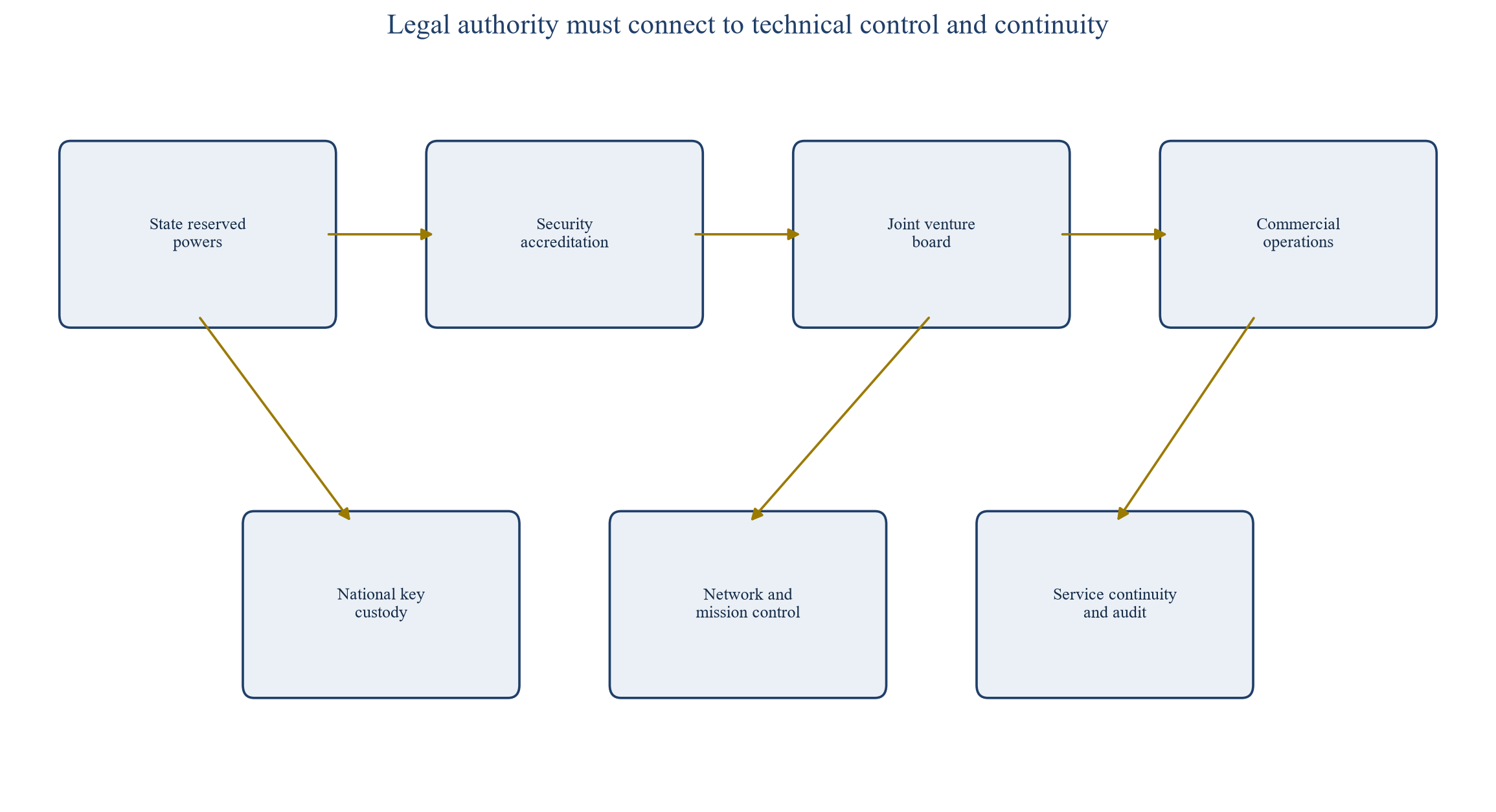
Proposed allocation of powers; local law and security authority determine the final design.
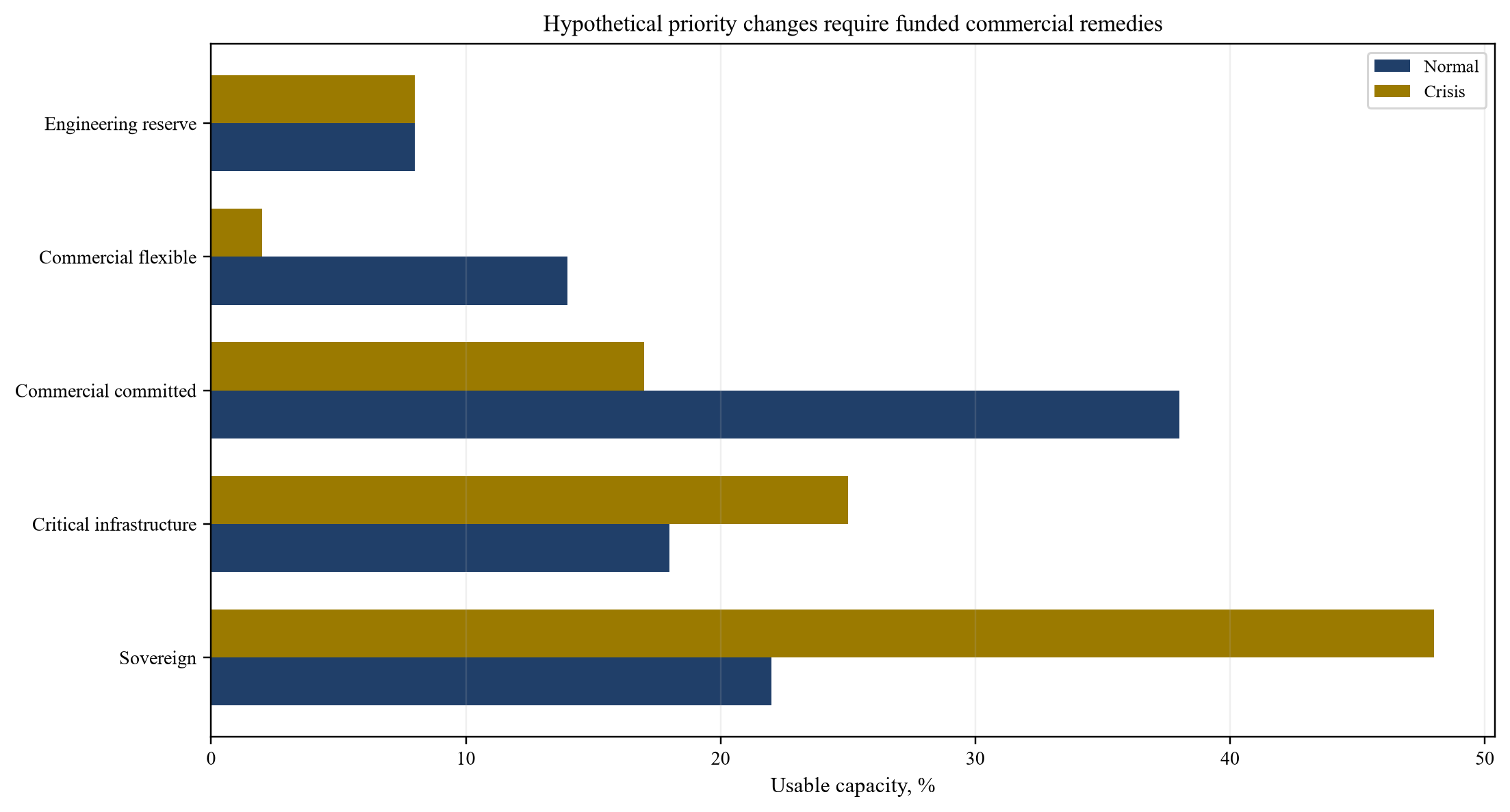
Illustrative percentage of usable capacity; no operator or government programme is represented.
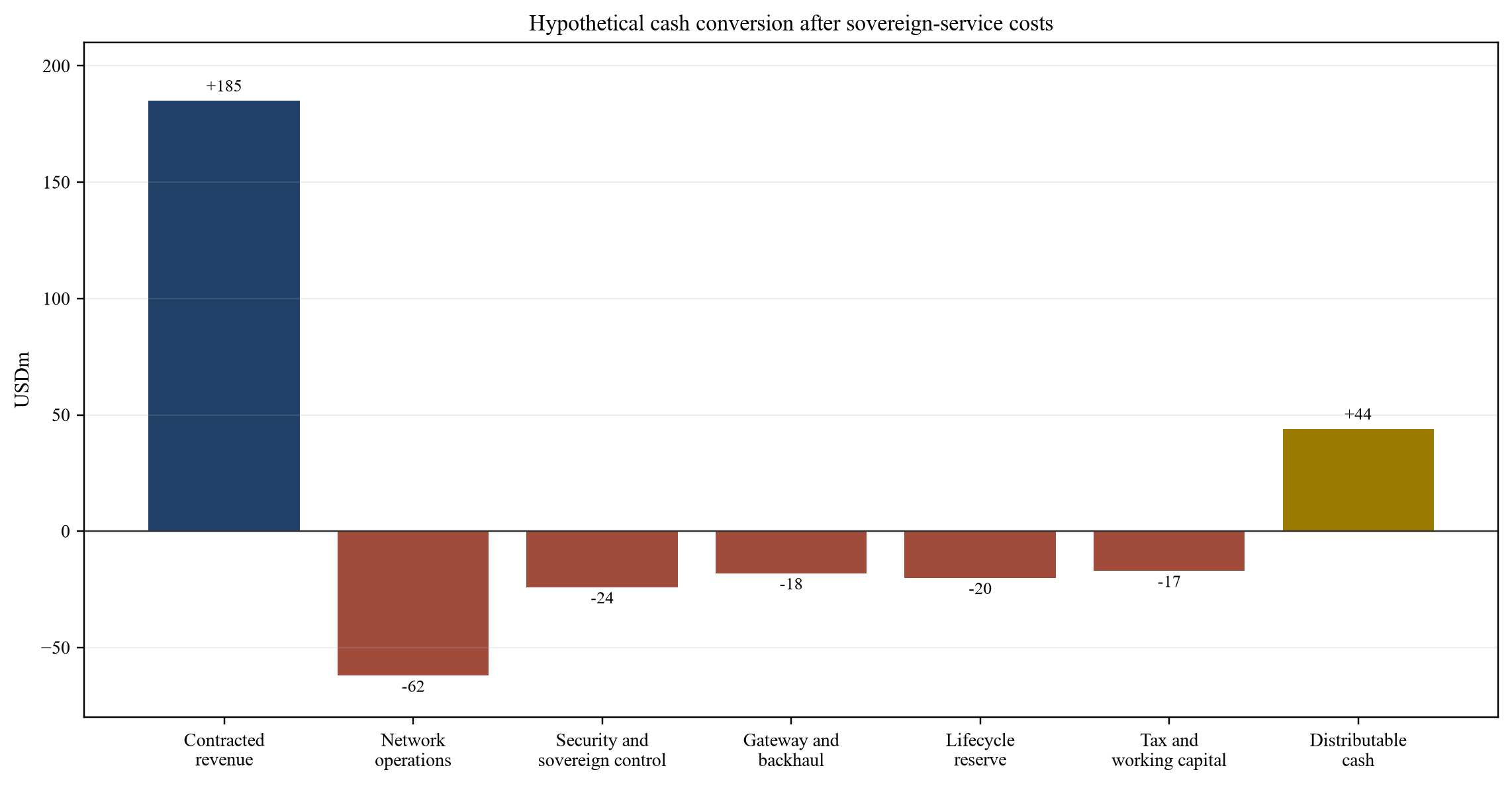
Illustrative USD millions; all figures are management assumptions used only to demonstrate the framework.
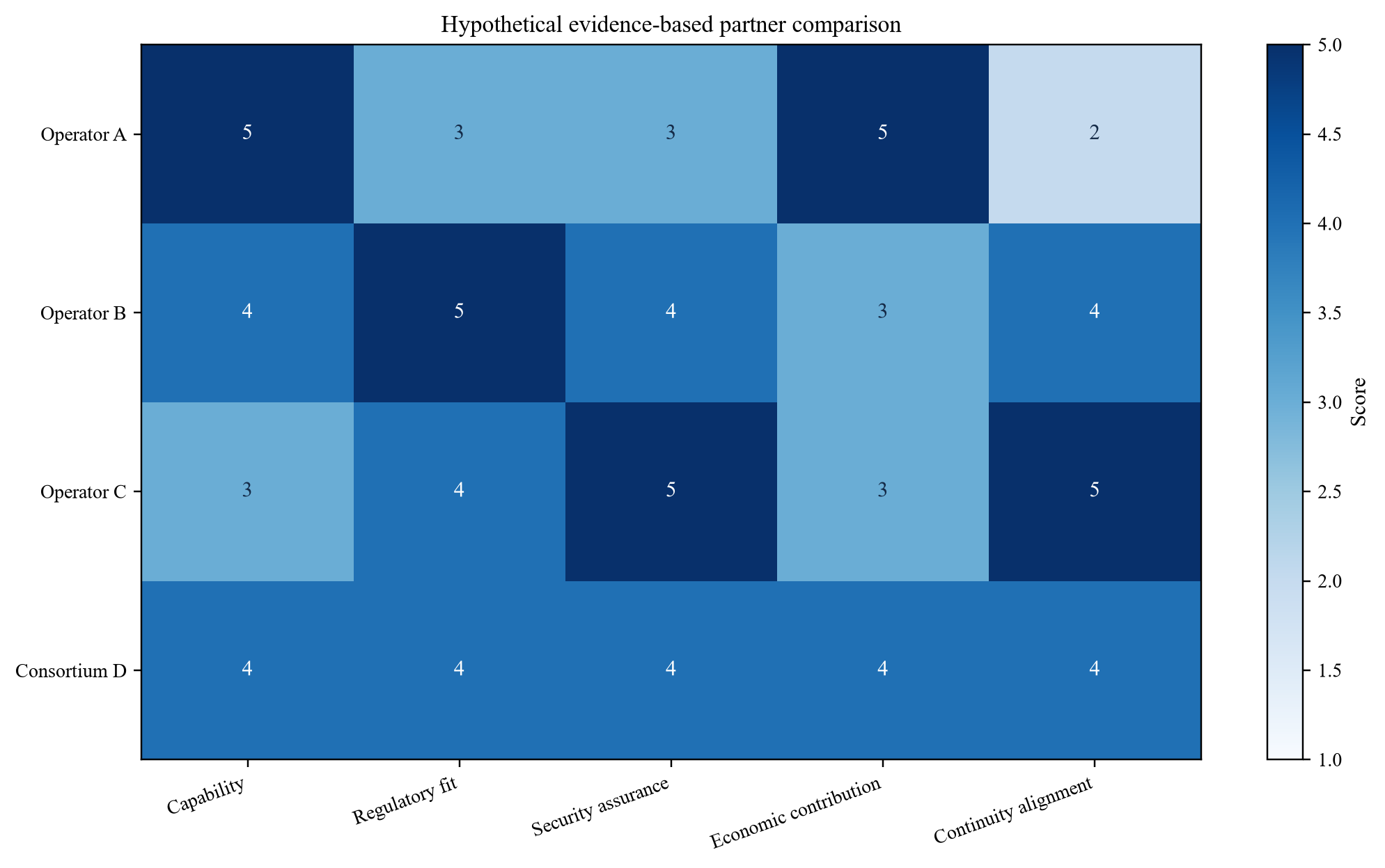
Illustrative scores from one to five; threshold security or regulatory failures override aggregate score.
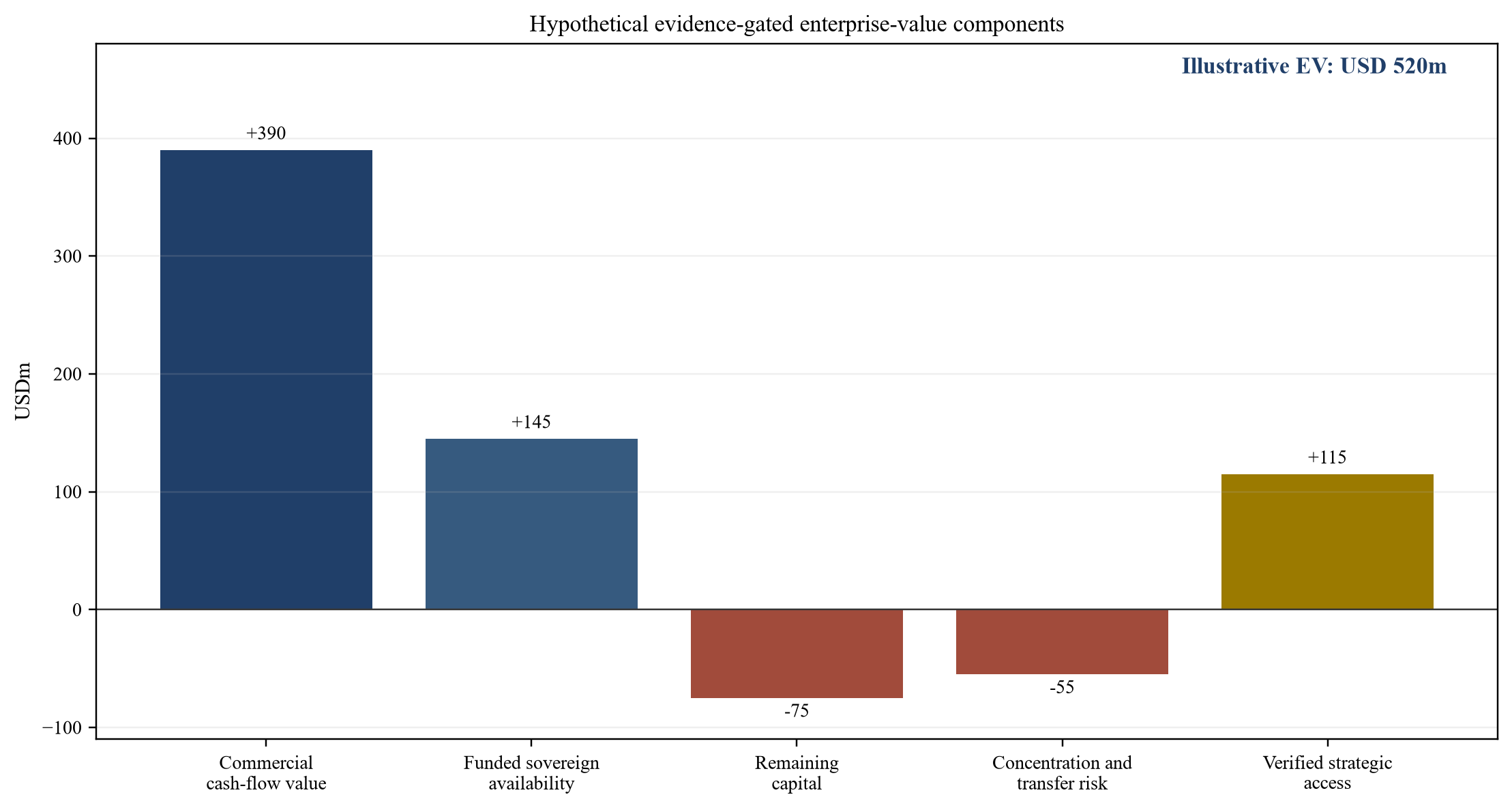
Illustrative USD millions; strategic access is included only after legal and technical verification.
| Control domain | State or security authority | Venture management | International operator | Minimum evidence |
|---|---|---|---|---|
| Sovereign service | Define users, priority and minimum continuity | Deliver and report | Supply contracted capability | Accepted service specification |
| Spectrum and licences | Approve national permissions | Maintain compliance ledger | Support filings and coordination | Effective authorisations |
| Cryptographic policy | Approve policy and custodians | Operate controlled processes | Provide interoperable technology | Key ceremony and audit |
| Network operations | Set sovereign constraints | Schedule and operate | Provide capacity and support | Operating demonstration |
| Incidents | Receive and direct sovereign response | Contain, recover and notify | Cooperate under agreed protocol | Exercised response plan |
| Crisis capacity | Trigger authorised priority | Execute allocation | Honour pre-emption and restoration | End-to-end exercise |
Proposed allocation; final authority depends on applicable law, contract and security accreditation.
| Data class | Typical purpose | Required decision | Principal control | Evidence |
|---|---|---|---|---|
| Customer payload | User communications | Routing, storage and authorised access | Encryption and traffic separation | Packet-path test |
| Traffic metadata | Operations and billing | Retention and lawful access | Restricted analytics and deletion | Processing register |
| Spacecraft telemetry | Safety and maintenance | Access and exportability | Segregated operations and logging | Role test |
| Security logs | Detection and investigation | Location, recipients and integrity | Protected collection and dual access | Log reconciliation |
| Identity records | Authentication | Controller, processor and transfer | Strong identity and minimisation | Access review |
| Cryptographic material | Protected services | Custody, backup and recovery | Hardware security modules and dual control | Witnessed key ceremony |
Proposed minimum fields for deciding residency, access and retention.
| Item | USDm | Evidence gate | Principal downside |
|---|---|---|---|
| Sovereign availability revenue | 80 | Funded minimum commitment and accepted service | Budget or acceptance delay |
| Critical-infrastructure capacity | 45 | Executed contracts and connected terminals | Concentration and churn |
| Enterprise and wholesale capacity | 50 | Committed service orders | Price and utilisation |
| Managed security and terminals | 10 | Accepted deliverables | Integration delay |
| Total contracted revenue | 185 | Reconciled contract ledger | Combined schedule risk |
| Distributable cash | 44 | Accepted invoices and reserves funded | Cost and collection stress |
Illustrative USD millions; every amount is a management assumption and describes no existing venture.
| Source or use | USDm | Purpose or condition |
|---|---|---|
| State sponsor equity | 170 | Sovereign facilities, control and initial liquidity |
| Operator contribution | 130 | Capacity rights, technology and cash contribution |
| Infrastructure investor equity | 90 | Growth and independent capital |
| Limited-recourse debt | 160 | Drawn after contracts, permits and acceptance gates |
| Total sources | 550 | Fully funded illustrative plan |
| Capacity and space-segment rights | 190 | Contracted multi-year access |
| National gateways and backhaul | 105 | Permitted and commissioned facilities |
| Security, key custody and operations | 80 | Accredited sovereign operating capability |
| Terminals and customer integration | 65 | Accepted user access |
| Fees, reserves and liquidity | 110 | Completion, lifecycle and downside protection |
| Total uses | 550 | Illustrative funding requirement |
Illustrative USD millions; financing terms and tax consequences require separate advice.
| Dimension | Threshold question | Scored evidence | Failure response |
|---|---|---|---|
| Regulatory fit | Can the structure lawfully operate and close? | Licence record and authority engagement | Restructure or stop |
| Security assurance | Can sovereign controls be accredited? | Architecture, tests and cleared capability | Remediate before commitment |
| Continuity | Can minimum service survive partner unavailability? | Exercised national operating mode | Fund localisation or stop |
| Capability | Does the partner deliver accepted performance? | In-service record and reference tests | Limit scope or stage value |
| Economics | Are contributions and related-party terms transparent? | Benchmarks, cash and audited services | Reprice and add controls |
| Alignment | Are crisis, investment and exit incentives workable? | Binding governance and funding terms | Renegotiate structure |
Proposed investment-committee screen; a threshold failure is not cured by a high aggregate score.
| Consideration | USDm | Release condition | Protection |
|---|---|---|---|
| Cash at completion | 335 | Transferable assets, effective rights and funded contracts | Warranties, escrow and conditions |
| Accreditation milestone | 45 | Authorised sovereign service | Independent acceptance |
| National continuity milestone | 40 | Exercised minimum service without foreign control plane | Defined test and remediation |
| Customer-retention milestone | 35 | Contribution retained after migration | Revenue and margin threshold |
| Collected-cash milestone | 25 | Reconciled third-party receipts | Set-off and clawback |
| Seller rollover | 40 | Continuing equity and funding alignment | Governance and dilution terms |
Illustrative USD millions linked to observable outcomes.
| Gate | Decision question | Minimum evidence | If evidence fails |
|---|---|---|---|
| Service | Is the sovereign output defined and funded? | Service specification and customer authority | Redefine scope |
| Rights | Can the network lawfully operate? | Spectrum, licences and approvals | Condition or stop |
| Control | Are reserved powers technically enforceable? | Control matrix and demonstrations | Redesign governance |
| Security | Can the system be accredited and keys controlled? | Architecture, test and authority record | Stage capital |
| Continuity | Can minimum service survive partner loss? | Exercised failover and funded remediation | Localise or resize |
| Economics | Does cash cover operations, reserves and financing? | Evidence-linked model and downside | Reprice or restructure |
| Transaction | Does consideration follow transferable value? | Value bridge and contingent terms | Defer payment |
Proposed decision sequence and evidence standard.
Sources
- International Telecommunication Union, Satellite regulation and coordination. Read the primary source
- International Telecommunication Union, Radio Regulations. Read the primary source
- International Telecommunication Union, Frequently Asked Questions on ITU Satellite Filings, March 2025. Read the primary source
- International Telecommunication Union, e-Submission of Satellite Network Filings. Read the primary source
- International Telecommunication Union, Space Services Department. Read the primary source
- European Union, Regulation (EU) 2023/588 establishing the Union Secure Connectivity Programme. Read the primary source
- European Commission, IRIS2 concession contract awarded to the SpaceRISE consortium, 7 November 2024. Read the primary source
- European Space Agency, ESA to support the development of the EU secure communication satellites system, 16 December 2024. Read the primary source
- United Kingdom Space Agency, Cyber Security Toolkit for space assets, 2021. Read the primary source
- United Kingdom Government, Cyber resilience in space, 2025. Read the primary source
- United Kingdom Government, Secure by Design: Cultivating a Culture of Information Security, 2025. Read the primary source
- United Kingdom National Cyber Security Centre, Cyber Assessment Framework, Principle B4 System Security. Read the primary source
- United Kingdom National Cyber Security Centre, Secure by Default. Read the primary source
- United Kingdom Government, National Security and Investment Act guidance on notifiable acquisitions in Satellite and Space Technology. Read the primary source
- United Kingdom Government, UK Space Strategy, 2026. Read the primary source
- United States Department of the Treasury, Committee on Foreign Investment in the United States. Read the primary source
- United States Government Accountability Office, DOD Satellite Communications: Reporting on Progress Needed to Provide Insight on New Approach, GAO-25-107034, 2025. Read the primary source
- United States Government Accountability Office, Critical Infrastructure Protection: Commercial Satellite Security Should Be More Fully Addressed, GAO-02-781. Read the primary source
- United States Government Accountability Office, Telecommunications: Competition, Capacity, and Costs in the Fixed Satellite Services Industry, GAO-11-777. Read the primary source
- United States National Institute of Standards and Technology, FIPS 203, Module-Lattice-Based Key-Encapsulation Mechanism Standard, 2024. Read the primary source
- United States National Institute of Standards and Technology, FIPS 204, Module-Lattice-Based Digital Signature Standard, 2024. Read the primary source
- United States National Institute of Standards and Technology, FIPS 205, Stateless Hash-Based Digital Signature Standard, 2024. Read the primary source
- United States National Institute of Standards and Technology, Zero Trust Architecture, SP 800-207, 2020. Read the primary source
- United States National Institute of Standards and Technology, Cybersecurity Framework 2.0, 2024. Read the primary source
- United Arab Emirates, Federal Decree-Law No. 45 of 2021 Concerning the Protection of Personal Data. Read the primary source
- Dubai International Financial Centre, Data Protection Law No. 5 of 2020. Read the primary source
- Consultative Committee for Space Data Systems, Security Working Group publications. Read the primary source
- European Union Agency for Cybersecurity, Space threat landscape. Read the primary source
- United States Federal Communications Commission, Space Bureau. Read the primary source
- United States Office of Space Commerce, Licensing of private remote-sensing space systems. Read the primary source
- United States Department of Justice and Federal Trade Commission, Merger Guidelines, 2023. Read the primary source
- European Commission, EU merger control. Read the primary source
- IFRS Foundation, IFRS 3 Business Combinations. Read the primary source
- IFRS Foundation, IFRS 13 Fair Value Measurement. Read the primary source
