

Introduction
Microgravity can change convection, sedimentation, mass transport, crystal nucleation, cell behaviour and tissue development. These effects support pharmaceutical research and may improve specific formulations or biological processes. The investment case begins only when the effect is connected to a defined sponsor decision. That decision may be to continue a drug programme, select a formulation, enter regulatory engagement, reserve future production capacity or purchase qualified material.
Space-pharma ventures operate across two regulated systems. Spaceflight rules govern launch, orbital operations, re-entry and recovery. Pharmaceutical requirements govern identity, purity, potency, stability, sterility, comparability, process control and the evidence supporting a product application. A venture can satisfy the first system and still lack a pharmaceutical product. It can also generate useful pharmaceutical knowledge without becoming a commercial manufacturer. Valuation must identify which role the company will perform and which obligations it accepts.
This paper provides a decision framework for founders, pharmaceutical sponsors, public agencies, strategic investors and venture or growth investors. Public programmes and published mission results are used to establish what has been demonstrated. Every commercial number in the worked case is hypothetical. Company valuation requires controlled technical reports, contracts, batch records, regulatory correspondence and cash evidence.
1 Define the pharmaceutical product and sponsor decision
The first diligence question is what the customer receives. The deliverable may be returned crystals, a seed crystal, a formulation dataset, process parameters, a validated analytical result, a research service, an intermediate material or a finished drug product. These items carry different manufacturing, ownership, quality and liability obligations. A broad statement that microgravity improves medicines does not define a revenue unit.
The sponsor decision should be described in operational terms. A research group may pay for evidence that clarifies protein structure. A formulation team may pay for a more uniform crystalline suspension that supports a delivery route. A manufacturing team may pay for a process that improves purification, stability or concentration. A clinical programme may use returned material only after additional terrestrial processing and regulatory review. Each case has a different willingness to pay and a different point at which value is realised.
The diligence file should name the molecule or modality, intended use, material owner, acceptance test, quantity, quality status, decision owner and alternative terrestrial route. It should state whether the company sells a service, licenses a process, supplies an intermediate or assumes responsibility for a regulated manufacturing step. This product boundary controls the forecast and prevents a research result from being capitalised as finished-drug revenue.
2 Build the science to CMC evidence chain
The evidence chain begins with a terrestrial benchmark and a controlled scientific question. The microgravity experiment should specify the hypothesised effect, comparator, sample size, process parameters, analytical methods and acceptance threshold before flight. Returned material then requires chain-of-custody evidence, environmental history and analytical comparison. A sponsor can decide whether the result is relevant to formulation, process development or manufacturing only after these records are complete.
Chemistry, manufacturing and controls readiness requires more than scientific significance. The venture needs a defined material, controlled inputs, reproducible process, calibrated equipment, deviation handling, batch genealogy and validated or qualified analytical methods appropriate to the development stage. Later stages may require stability, sterility, impurity, comparability and process-validation evidence. The applicable package depends on the product and jurisdiction; it should be mapped with the sponsor and regulator rather than assumed.
Each evidence transition should have an owner and valuation consequence. A returned sample can reduce technical uncertainty. An independently confirmed material attribute can support sponsor qualification. Incorporation into a sponsor development plan can create contractual value. Repeat batches produced within a controlled range can support manufacturing economics. The board should maintain a milestone register linking evidence, cash release, probability change and remaining capital.
3 Measure pharmaceutical yield through the mission
Gross payload mass is a poor proxy for saleable output. The yield model should begin with feedstock loaded, then deduct commissioning loss, process loss, off-spec production, storage loss, re-entry loss, recovery loss, testing samples, terrestrial finishing loss and customer rejection. The final measure is accepted output available for invoicing or downstream use.
Each loss factor should be linked to measurement. A process can show high on-orbit conversion while producing little customer-accepted material if the batch is damaged during return or requires destructive testing. Small development missions may also allocate a large share of output to validation. Scale assumptions should explain which losses decline with repetition and which remain physical or regulatory requirements.
Investors should monitor first-pass yield, recovered yield and customer-accepted yield separately. First-pass yield measures process control. Recovered yield measures the full space-to-Earth chain. Customer-accepted yield connects technical performance to revenue. The valuation model should use the narrowest measure consistent with the revenue forecast.
4 Separate scientific value from product value
In-space manufacturing may favour products with high value per kilogram because launch and return impose substantial fixed and mass-dependent costs. Value density alone remains incomplete. The product must also tolerate mission duration, packaging, radiation, vibration, temperature change, re-entry and recovery. A high-value material with a long qualification cycle may tie up capital and delay customer cash.
The model should calculate revenue per kilogram of accepted output, contribution per mission and contribution per calendar month. These views expose different constraints. Revenue per kilogram can appear attractive while mission contribution remains negative because payload mass is small. Contribution per mission can appear positive while annual economics remain weak because launch and return cadence is low.
Boards should compare the orbital route with terrestrial process improvement, contract manufacturing and alternative research methods. The relevant willingness to pay is the customer's incremental economic benefit after qualification and adoption costs. Market prices for finished products should not be applied to an intermediate orbital output unless the company controls the remaining value chain.
5 Price launch timing into the development plan
Launch cost includes more than the quoted ride to orbit. Payload developers incur safety review, interface engineering, qualification testing, documentation, transport, insurance, schedule management and contingency. Shared launches can reduce direct price while limiting orbit, timing and change control. A launch delay can increase working capital and push customer qualification into another budget cycle.
The financial model should separate committed launch payments, refundable deposits, integration costs and delay costs. It should show whether a payload can move to another provider without redesign. A dedicated mission may offer control at higher cost. A hosted payload may provide access to power, crew and laboratory infrastructure while creating platform dependency and constrained production time.
Scenario analysis should include on-time launch, moderate delay, missed window and mission loss. The company should fund operations through the next available window rather than assume an immediate reflight. Customer contracts should address schedule changes, substitute missions and acceptance timing.
6 Treat return and recovery as GMP relevant stages
Return capability is part of manufacturing because the customer cannot use a terrestrial product that remains in orbit. The return chain includes de-orbit authority, thermal protection, navigation, landing location, recovery, chain of custody, transport and environmental control. Each step can affect quality and timing. A platform that produces successfully in orbit but cannot return reliably has incomplete unit economics.
United States commercial re-entry requires FAA authorisation, and the licensing process covers concept of operations, safety, environmental review and compliance. The UK is funding reusable heat-shield development to support return of manufactured materials. ESA's Space Rider is designed as a reusable uncrewed system for access to and return from low Earth orbit. These programmes broaden potential return pathways while preserving operator-specific licensing and performance risk. [5][6][7][9]
The model should allocate return cost per mission and per accepted kilogram. It should also include the cash consequence of a delayed licence or unavailable landing window. Insurance, customer remedies and replacement rights should reflect which party controls each return step.
7 Define quality acceptance before flight
Quality acceptance should be agreed before payload integration. The protocol should specify identity, concentration, particle or crystal attributes, impurities, container integrity, environmental limits, sample allocation, analytical methods and decision thresholds. It should also define the terrestrial control and the statistical treatment. Post-flight selection of favourable measures weakens the commercial evidence.
The pembrolizumab research reported by NASA provides a useful distinction. Microgravity experiments produced more uniform crystalline suspensions and helped researchers refine ground processes for a subcutaneous formulation. NASA reported that the resulting formulation received FDA approval in 2025. The commercial outcome came through a chain of research, formulation work, terrestrial development and regulatory approval; the spaceflight result was an input to that chain. [3][29][30]
The company should preserve raw data, calibration records, flight telemetry, sample custody, laboratory reports and deviation records. Independent analysis may be required where the sponsor, regulator or investor cannot rely on company interpretation alone. A milestone is valuation-relevant when the evidence changes a controlled decision, not merely when the mission is described as successful.
8 Model formulation and crystallisation pathways
Protein and small-molecule crystallisation can support structure determination, purification, formulation and delivery. Microgravity can reduce sedimentation and convection, which may produce larger crystals or a more uniform particle population for some materials. The commercial benefit depends on the specific molecule, terrestrial control and downstream use. A better crystal image can support discovery, while a uniform crystalline suspension can affect concentration, viscosity, stability or route of administration.
The economic model should identify whether space produces the final commercial material or provides knowledge used in terrestrial manufacturing. The second route can create substantial value with little returned mass. It requires a defensible connection between the orbital result and the sponsor's later development decision. The contract should address ownership of process conditions, analytical data and improvements developed after return.
NASA's protein-crystal-growth portfolio and ISS National Laboratory reports document long-running pharmaceutical participation, including work by Merck and other companies. Varda reports that its W-1 mission grew Form III crystals of ritonavir in a commercial return capsule. These examples demonstrate different products: research insight, process demonstration and returned material. Their revenue and valuation treatment should remain distinct. [3][10][12][30]
9 Model biologics and monoclonal antibody pathways
Biologics present opportunities and demanding controls. Monoclonal antibodies and other proteins can be difficult to formulate at high concentration. Crystal size distribution, viscosity, aggregation, stability and injectability can influence the delivery route and patient experience. A space-based crystallisation step may create value when it produces a reproducible attribute that terrestrial processing cannot achieve economically.
The valuation model should trace that attribute into sponsor economics. Potential value may include avoided infusion time, lower cold-chain burden, improved dose concentration, a differentiated formulation or a faster experimental cycle. Each benefit requires sponsor evidence. Finished-drug sales should not be attributed to the space venture unless its contract and responsibilities support that share of value.
Biologics also require careful comparability and contamination control. Changes in hardware, input lot, process time, temperature or return environment may affect critical quality attributes. Repeat production therefore requires a control strategy rather than a succession of bespoke experiments. The board should require evidence that the process window can be reproduced across missions and linked to sponsor release decisions.
10 Model cell and gene therapy pathways
Cell, gene and tissue applications may use microgravity to expand cells, create tissue models, test medicines or manufacture biological structures. The output can be research data, a development model, a cellular intermediate or a therapeutic product. These outputs should not share one forecast. Their quality systems, shelf life, transport controls, clinical relevance and regulatory pathways differ materially.
NASA's InSPA portfolio includes stem-cell expansion, tissue engineering and biomanufacturing activities. NASA has also supported work on liver-tissue manufacturing and drug-delivery medical devices. These programmes establish technical activity and potential use cases. They do not by themselves establish viable yields, release specifications or commercial sponsor demand for an individual venture. [1][17][23][24]
The operating model should specify viability, phenotype, potency, contamination, storage, recovery time and maximum allowable delay. Returned biological material may lose value rapidly if recovery or laboratory transfer is late. The forecast should include destructive testing, rejected material and retained samples. A milestone valuation should recognise only the fraction of output that reaches the sponsor's defined analytical or development use.
11 Separate discovery experiments from commercial production
Discovery experiments seek information. Commercial production seeks a controlled output delivered repeatedly within specification. The hardware, documentation and economics can differ. An experiment may vary conditions across small samples and maximise learning. A production batch should operate within a defined process window, preserve genealogy and deliver enough accepted material to justify the mission.
The company should classify each flight as discovery, process-development, qualification, engineering or commercial production. Costs and probabilities should follow that classification. Research grants and sponsor studies can support early flights, though they do not prove recurring product demand. A paid study can still create valuable evidence when the contract grants the company reusable rights and the result changes the sponsor's next decision.
The transition to production requires configuration control. Hardware, software, consumables, analytical methods, launch interface, return vehicle and terrestrial finishing should have controlled versions. Deviations should be investigated and linked to product quality. A repeat-production valuation becomes credible when similar inputs and controls produce comparable accepted outputs across more than one mission.
12 Distinguish flight readiness from CMC readiness
Technology readiness measures whether a process or system works in a relevant environment. Manufacturing readiness addresses repeatability, quality systems, supply chain, throughput, workforce and cost. A flight demonstration can advance technology readiness while leaving manufacturing readiness low. This gap is material because commercial value depends on repeat production.
The diligence process should score payload hardware, process control, feedstock, return system, terrestrial finishing and quality systems separately. A single blended readiness label can conceal the weakest link. Manufacturing evidence should include batch records, configuration control, calibration, deviation handling and corrective action.
Capital should fund the next weak link rather than expand every component simultaneously. A company with proven process physics and unproven return may prioritise repeatable recovery. A company with reliable return and low accepted yield may prioritise process control and customer specification.
13 Build sponsor willingness to pay from product value
Customer willingness to pay should be derived from the economic benefit of the accepted output. That benefit may include higher product performance, lower downstream cost, faster development, improved reliability, new intellectual property or access to a product that cannot be made terrestrially. The analysis should identify who captures each benefit and when it becomes measurable.
The customer model should distinguish paid research, development funding, reservation payments, minimum purchase commitments and volume purchases. A research contract may validate engagement without proving recurring product demand. A reservation may improve scheduling confidence while remaining refundable. A minimum purchase agreement may support financing only after acceptance conditions and termination rights are understood.
The strongest evidence is a repeat order after the customer has tested returned output. Before that point, valuation should use probability-weighted cash flows tied to contractual and technical milestones.
14 Construct the pharmaceutical customer pipeline waterfall
Pipeline reporting should narrow from identified accounts to qualified use cases, paid studies, flight reservations, contracted batches, accepted output and repeat orders. Each stage should have a defined evidence threshold. Aggregate letters of interest should not be combined with binding purchase commitments.
The funnel should track customer concentration and use-case concentration. Several contracts with one pharmaceutical company may leave a large counterparty exposure. Several customers dependent on the same unproven return system may create correlated operational risk. Timing matters because customers can withdraw if qualification takes longer than their development programme.
The board should review pipeline value at the same cut-off date as technical readiness and mission schedule. A commercial forecast built on old customer interest and a current technical plan can create false precision.
15 Design development contracts around evidence and control
Contracts should specify payload configuration, launch window, process objective, return obligation, testing protocol, acceptance, data rights, intellectual property, refunds, liability and remedies. The allocation should follow control. The platform operator may control flight hardware and return, while the customer controls feedstock and downstream testing.
Milestone payments can fund development when they correspond to measurable completion. Availability payments may support reserved capacity. Product payments should depend on agreed acceptance. Termination rights, reflight obligations and refundability determine whether contracted amounts support debt or remain contingent liabilities.
The financing model should reproduce the contract waterfall. Cash receipts, revenue recognition and debt service may occur at different times. A customer prepayment can strengthen liquidity while increasing performance obligations.
16 Calculate programme contribution and cash conversion
Mission contribution should begin with cash revenue attributable to the flight. It should deduct payload hardware, launch, integration, platform service, return, recovery, testing, finishing, insurance, royalties, warranty and expected reflight cost. Shared corporate expense and continuing research should remain visible below mission contribution.
Working capital can be significant. Suppliers and launch providers may be paid before customers accept output. Testing and qualification can extend the cash cycle after recovery. A mission with positive accounting margin can consume cash for a long period. The model should show peak cash need and funding headroom under delay.
Investors should compare contribution per mission, per accepted kilogram and per calendar month. These metrics reveal whether value depends on yield, price or cadence.
The contribution bridge should distinguish committed cost from avoidable cost. A launch deposit may be non-refundable once a window is reserved, while testing, finishing or recovery expenditure may depend on successful return. This distinction matters when management decides whether to continue after an adverse result. The model should calculate the incremental cash needed to complete a mission, the expected cash recovered from completion and the value of the evidence produced. A decision to proceed can remain rational when the individual flight has negative contribution if the controlled experiment materially changes the probability or design of a valuable later programme. That research value should be stated separately from operating profit.
Cash conversion also depends on claim and remedy terms. The programme should identify which costs are recoverable after launch delay, mission loss, late return, damaged material or failed acceptance. Insurance proceeds, supplier credits, customer refunds and reflight rights may arrive at different times and may remain disputed. The liquidity case should fund the period before recovery rather than net expected remedies immediately against the loss. This treatment makes the cash model more conservative and gives the board a practical view of the capital required to preserve the next milestone.
17 Model repeat production cadence
Annual value depends on the number of completed cycles, not the number of announced payload opportunities. Cadence includes payload preparation, launch integration, orbit time, return scheduling, recovery, testing, refurbishment and the next mission. A bottleneck at any stage limits throughput.
The operating plan should identify parallel capacity. Multiple payloads may share a launch while competing for integration resources. Reusable return vehicles may reduce unit cost only after recovery and refurbishment are proven. Commercial stations may broaden access, though programme timelines and service terms remain platform-specific. [16][17][18]
The valuation should cap revenue at verified system capacity and apply utilisation assumptions separately. Expansion capital should follow evidence that demand and operational cadence support added capacity.
Cadence should be managed through a constraint register. Each mission should have a critical resource, maximum queue, expected service time and recovery plan. Examples include payload engineers, clean-room capacity, launch integration slots, licensed return windows, recovery teams and customer laboratories. Management can then separate demand backlog from executable production backlog. A customer order that cannot enter a qualified mission within its required delivery window contributes limited near-term value. Conversely, a reserved launch or return slot without a qualified customer creates cost exposure rather than assured revenue.
The board should monitor schedule variance by stage and by cause. A programme delayed by external launch availability has different remediation options from one delayed by unstable process hardware or incomplete customer testing. Repetition should shorten cycle time only where the underlying task becomes standardised. The forecast should preserve fixed regulatory, quality and recovery steps unless the company has evidence that those steps can run in parallel or be shortened. This approach converts cadence from an aspirational mission count into an operating-capacity model that can be reconciled to contracts and cash.
18 Apply milestone valuation
An early company can be valued using probability-weighted cash flow, comparable transactions, replacement cost and option analysis. Each method requires adjustment. Forecast cash flow needs explicit probabilities for technical, return, qualification and customer events. Comparables may combine spacecraft, research services and product businesses with different economics. Replacement cost does not establish customer value.
A milestone method can reduce false precision. The valuation starts with the current evidence state and models the value change if the company reaches the next state. The increase should reflect revised cash-flow probability, time and capital requirement. It should not be a predetermined markup assigned merely because a flight occurred.
The board should record the milestone, evidence required, independent reviewer, cost to reach it and financing implication. This creates a basis for staged equity, strategic investment and public co-funding.
Milestone valuation should also account for evidence decay. A technical result may lose relevance if hardware, process chemistry, launch environment or customer specification changes before the next mission. A customer indication may weaken when budgets, competing products or qualification requirements change. The model should therefore assign each evidence item an effective date, configuration boundary and refresh requirement. Reuse of prior evidence should be justified by documented similarity. This discipline limits the risk that old results are carried forward into a new configuration with materially different performance.
Financing negotiations can use the same milestone register. Investors may release capital in tranches, customers may make development payments, and public agencies may reimburse eligible costs after delivery. The company should model timing and conditions for each source. A headline commitment that depends on matching funds, accepted milestones or future appropriations is not equal to unrestricted cash. The valuation committee should compare the value created by the next milestone with dilution, control rights, liquidation preference, repayment obligations and the cost of delay if financing is not completed.
19 Structure the capital stack
Early technical and regulatory risk usually requires equity, strategic customer funding or public support. Customer development payments can align demand and reduce dilution when obligations are manageable. Equipment finance or structured debt may become viable when assets have alternative use, contracts provide dependable cash and downside reserves are funded.
Senior debt should not rely on uncontracted future product value. Lenders need enforceable cash flows, clear security, insurance and a funded path through delay. Convertible instruments may bridge milestones but can create valuation and governance complexity if several rounds stack before commercial proof.
The financing plan should fund the company through the next value-changing milestone plus a credible delay. Capital calls should reflect launch deposits and long-lead hardware rather than smooth monthly assumptions.
The capital structure should preserve decision flexibility. A mission-specific vehicle can isolate a defined payload, customer contract and return path, provided that intellectual-property rights, shared services and contingent liabilities are allocated clearly. A corporate facility can finance several programmes and diversify single-mission risk, though cross-default and security provisions may transmit a failure across the portfolio. Strategic capital can bring customer access, manufacturing capability or launch capacity; its information, exclusivity and governance rights require explicit valuation because they can affect other commercial relationships.
The downside case should identify a stop point before each material commitment. Management should show cash remaining after a failed test, delayed launch, lost mission, unsuccessful return and customer rejection. It should also identify the assets, data, licences and contractual rights preserved in each case. This recovery analysis supports staged commitments and prevents the full programme budget from being treated as unavoidable on day one. A financing plan is decision-ready when the board can see how much capital is at risk, what evidence that capital is expected to buy and which route remains available after an adverse outcome.
20 Protect process data intellectual property and regulatory rights
In-space manufacturing can create several kinds of intellectual property. Payload hardware may be patented or retained as trade secret. Process parameters, telemetry and failure data can improve later batches. Returned material may support new composition, formulation or device claims. Customer contracts may also create background and foreground intellectual-property rights. Valuation depends on which party owns and can exploit each layer.
The diligence team should map rights from feedstock through orbital processing and terrestrial finishing. Government and university funding terms may include licences, reporting duties or march-in provisions. Platform agreements may grant providers rights to operational data. Customer agreements may restrict disclosure, reverse engineering or use outside a named programme. A company that lacks the right to reuse learning can lose much of the value attributed to repetition.
The commercial model should distinguish product margin from licensing, data and platform revenue. Intellectual-property value should connect to an identifiable right, an enforceable territory and a plausible route to cash. The same future income should not appear both in the base cash flow and in a separate intellectual-property premium. Cybersecurity, export controls and access governance should protect sensitive process data throughout the mission chain.
21 Build the regulatory and quality pathway early
The applicable regulatory pathway depends on the product and jurisdiction. Spaceflight authorisation governs launch and return. Pharmaceutical and medical-device customers may impose additional quality, validation and traceability requirements. These obligations can shape payload design, sampling and data collection long before commercial production begins.
Management should prepare a regulatory matrix covering the vehicle, landing site, payload, biological or hazardous material, import and export, customer quality standard and downstream product. Each requirement should have an owner, lead time and evidence deliverable. A programme can finish its technical development and still wait for permission or customer-quality approval if these workstreams begin too late.
The valuation should include the time and cash required for compliant repeat production. A quality system can create value by reducing batch failure and qualification friction. It also creates fixed cost and may limit rapid configuration changes. The model should therefore show the customer segments that need regulated production and the price or volume required to recover those costs.
22 Test multi-product scale before assigning platform value
A manufacturing company may own both the product process and the orbital platform. These businesses should be modelled separately. The product case asks whether accepted output earns sufficient margin. The platform case asks whether several products can share launch, power, volume, crew support, return and ground operations without creating scheduling or contamination conflicts.
Shared infrastructure can reduce unit cost when utilisation rises and missions remain operationally compatible. It can also add coordination cost, change-control risk and customer concentration. One large customer may fill capacity while demanding exclusivity. Several small customers may diversify revenue while increasing integration work. Platform value therefore depends on observed utilisation, standardised interfaces, turnaround and contract quality.
Investors should calculate stand-alone economics for each priority product and consolidated economics for the platform. Intercompany assumptions should use explicit transfer prices. A platform premium becomes defensible when multiple customers use common assets, incremental payloads improve contribution and the operating record shows that shared capacity does not reduce accepted yield or schedule reliability.
23 Make the investment decision
Approval requires a defined product, a measured orbital advantage, an end-to-end return plan, a customer acceptance protocol and funding through the next milestone. The investment committee should identify the variables that dominate value and the evidence that can change them within the proposed capital period.
The decision can be approve, stage, resize, partner, redesign or decline. A staged approval can release capital against payload completion, launch, successful process, recovery, accepted quality and repeat order. A partnership may be preferable where a specialist controls return, finishing or customer qualification.
The final record should preserve downside actions. Management should know which programme can be paused, which assets retain value, what customer obligations survive and how data and intellectual property are protected if the next milestone fails.
Conclusion
Space-pharma companies can create value through scientific evidence, process knowledge, qualified material and repeat manufacturing. These sources of value emerge at different times and carry different probabilities. Valuation should follow the evidence that changes a sponsor, regulator or manufacturing decision.
The framework developed here uses six states: terrestrial benchmark, controlled microgravity effect, returned material, analytical comparability, sponsor-qualified output and repeat commercial production. It connects each state to cash, capital and a decision right. This structure prevents an orbital experiment from being treated as mature manufacturing and allows a genuine scientific result to receive value before full commercial scale.
The hypothetical case shows the practical consequence. A six-mission programme can produce USD 101 million of illustrative receipts and only USD 15 million of programme contribution before central overhead, financing, tax, clinical development and terminal obligations. Accepted yield, contract quality, re-entry timing and sponsor conversion determine whether the venture creates a repeatable business.
Public evidence shows meaningful momentum in pharmaceutical crystallisation, return vehicles, biological manufacturing and regulatory coordination. Company value still depends on controlled batch evidence and enforceable sponsor economics. Investors should fund the next decision-changing milestone and require a documented route from experiment to repeat production.
Appendix A Hypothetical worked case
The hypothetical programme covers six missions. Total uses are USD 112 million: USD 23 million for payload and pharmaceutical process development, USD 27 million for launch and integration, USD 22 million for orbital platform services, USD 16 million for return and recovery, USD 11 million for analytical testing and terrestrial finishing, USD 5 million for insurance and regulatory work, and USD 8 million for programme reserves and corporate support. Funding includes USD 38 million of sponsor equity, USD 27 million of pharmaceutical customer development payments, USD 22 million of strategic capital, USD 17 million of public milestone funding and USD 8 million of equipment or structured finance.
The yield waterfall begins with 144 kilograms of prepared input. Seventy-six kilograms are recovered, 46 kilograms pass analytical specification and 27 kilograms are accepted for the sponsor's defined use. Illustrative receipts total USD 101 million: USD 37 million of development payments, USD 48 million of milestone or accepted-output payments and USD 16 million of licence, data and process income. Direct programme operating costs total USD 86 million, leaving USD 15 million before central overhead, financing, tax, clinical development and terminal obligations.
Appendix B Minimum diligence file
The diligence file should include the terrestrial benchmark, molecule or modality definition, sponsor decision map, experimental protocol, payload and process configuration, input genealogy, launch and return plan, environmental record, chain of custody, analytical methods, raw results, deviations, comparability assessment, quality agreement, regulatory pathway, intellectual-property map, customer contracts, acceptance terms, milestone receipts, insurance, mission budget, cash runway and downside plan. Every forecast assumption should link to a controlled evidence item or be identified as hypothetical.
Appendix C Red flag tests
Red flags include valuing research activity as commercial manufacturing; using gross payload mass as accepted pharmaceutical output; applying finished-drug pricing to an intermediate; omitting terrestrial controls; changing the analytical protocol after seeing results; failing to preserve batch genealogy or chain of custody; treating a launch or re-entry licence as pharmaceutical approval; assuming a sponsor study is a repeat order; relying on letters of interest without acceptance and payment terms; omitting stability, impurity, sterility or comparability requirements; ignoring destructive testing and retained samples; counting public grants as product demand; and financing fixed debt service from uncontracted scientific option value.
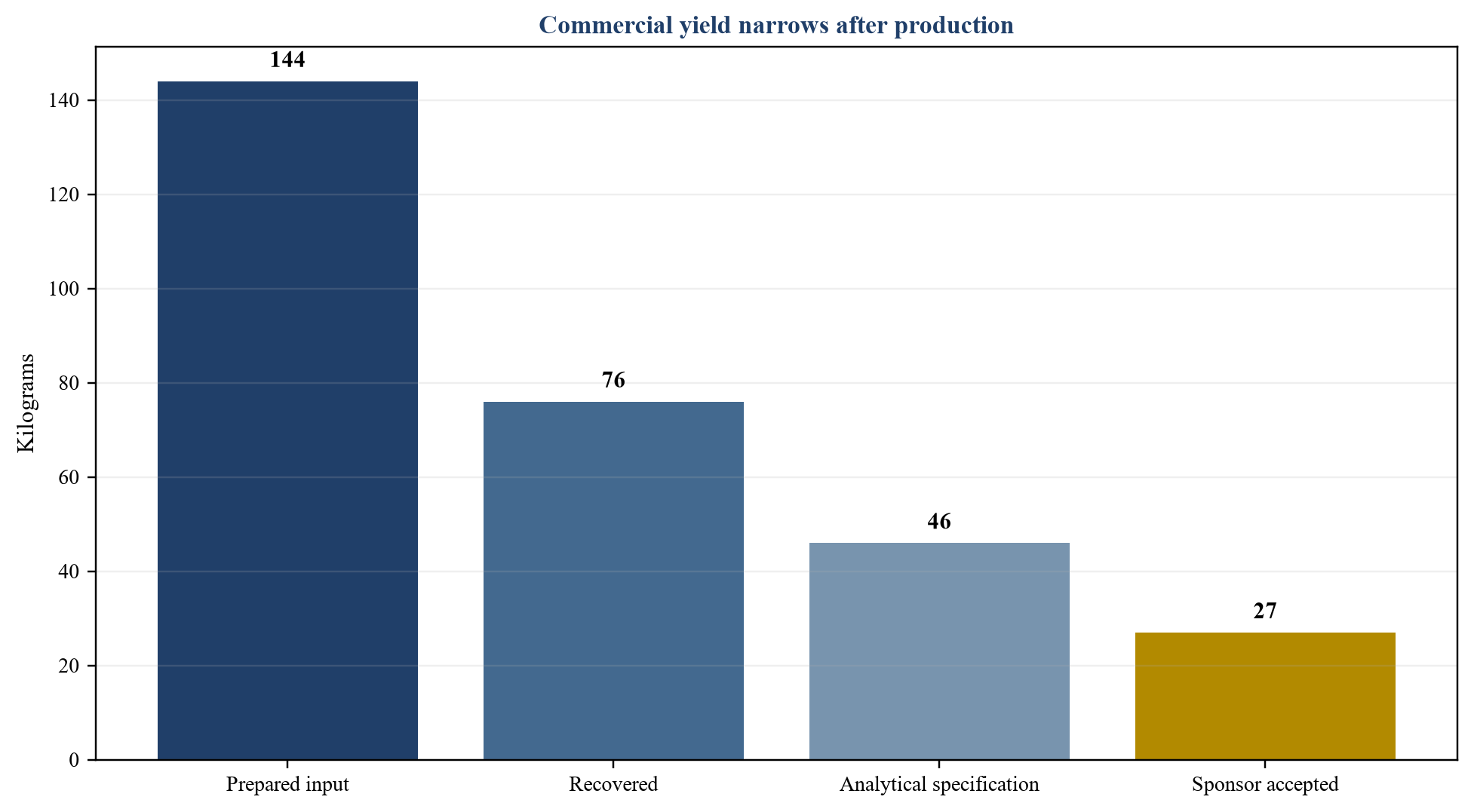
Hypothetical kilograms across a six-mission development programme.
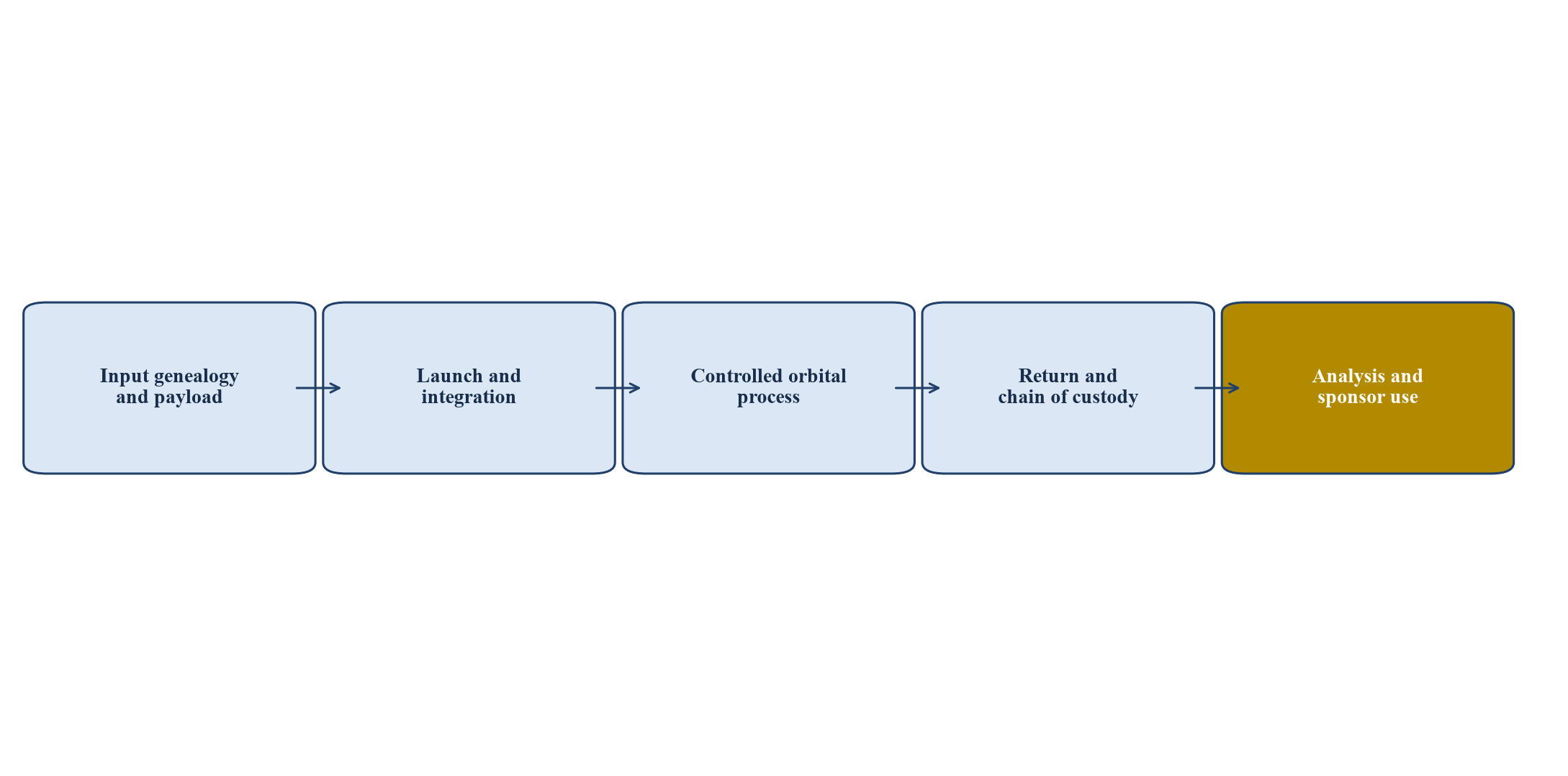
Proposed diligence architecture from controlled input to sponsor-qualified repeat production.
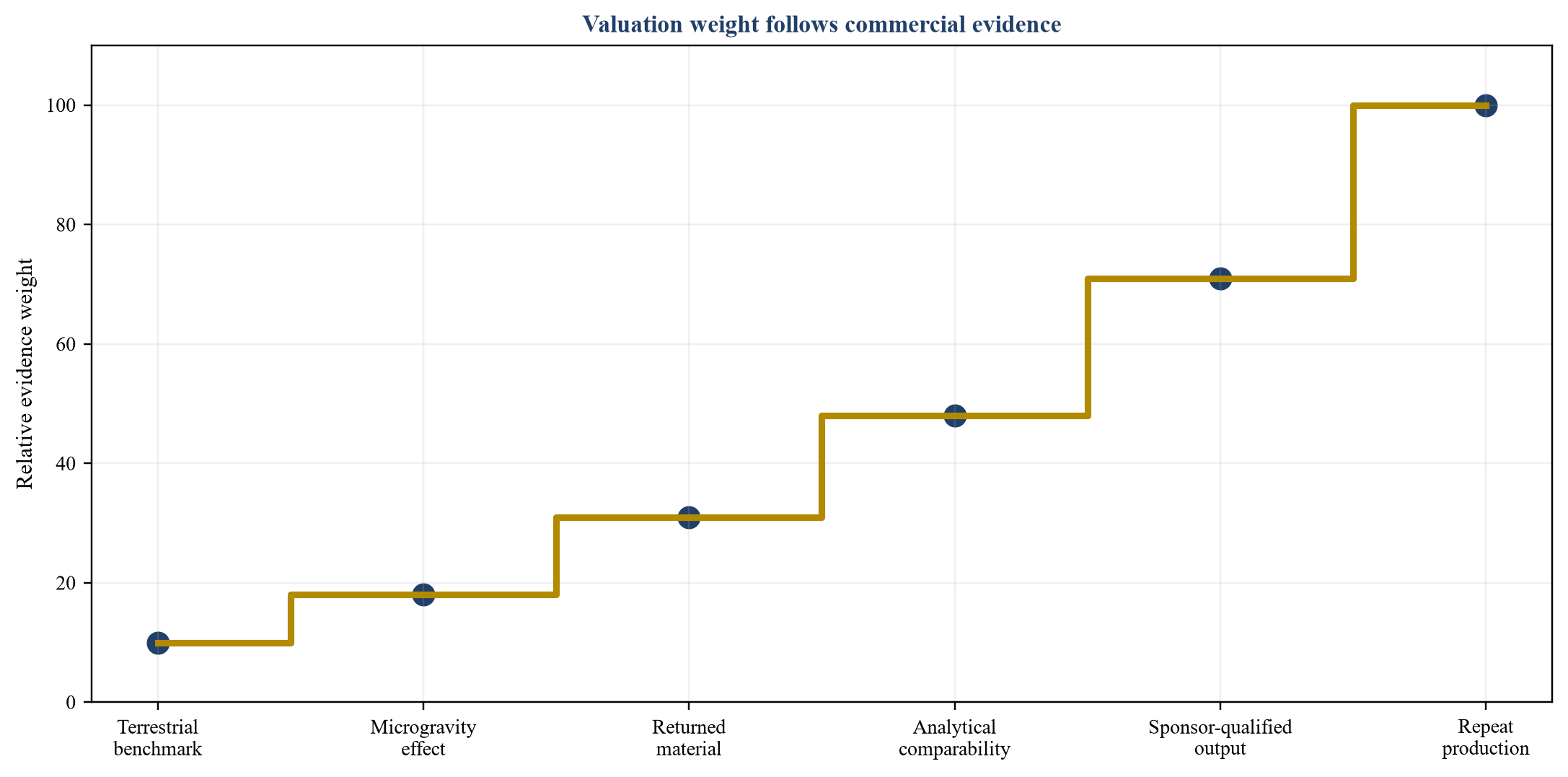
Proposed progression; each state requires controlled evidence.
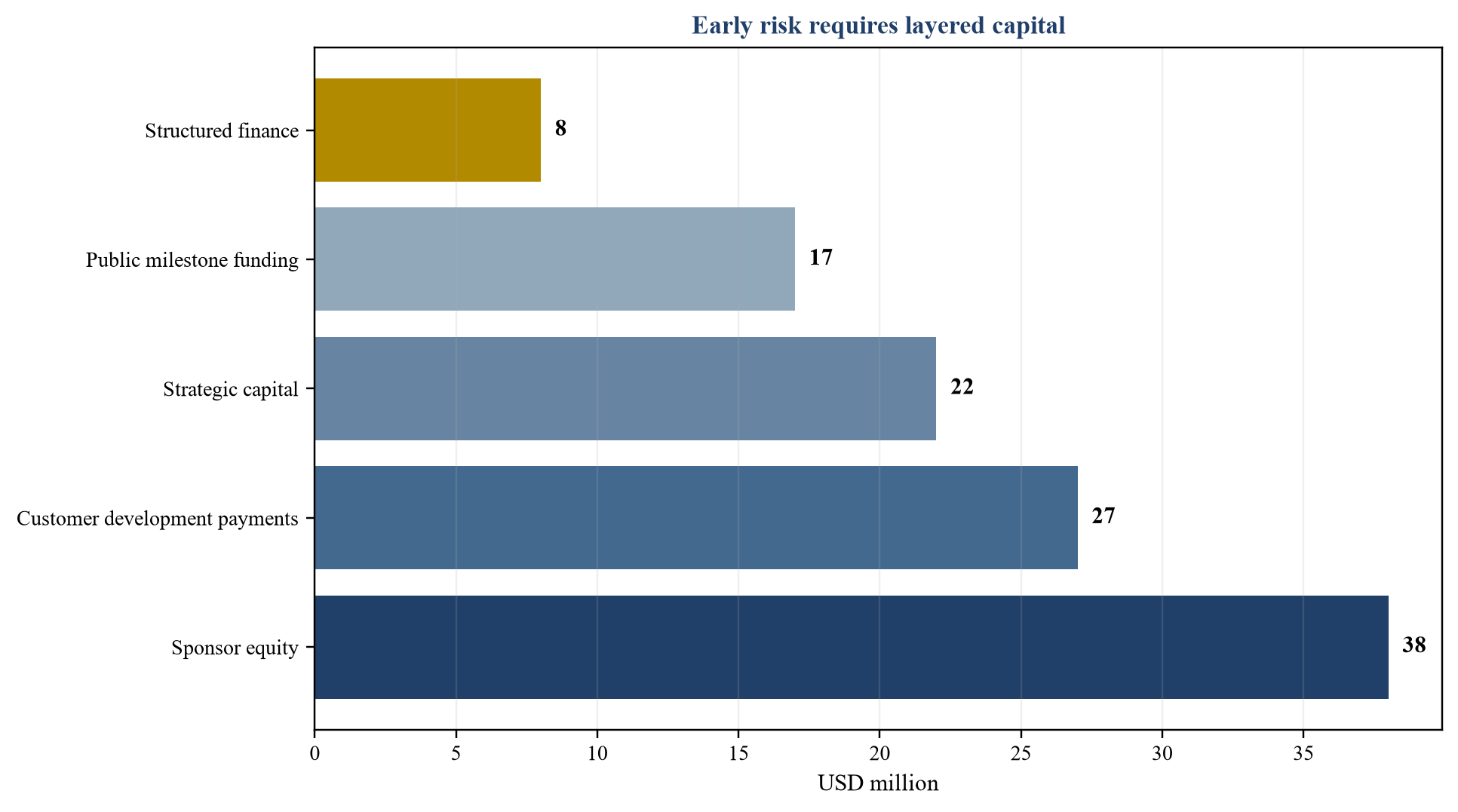
Illustrative USD millions; total programme uses USD 112 million.
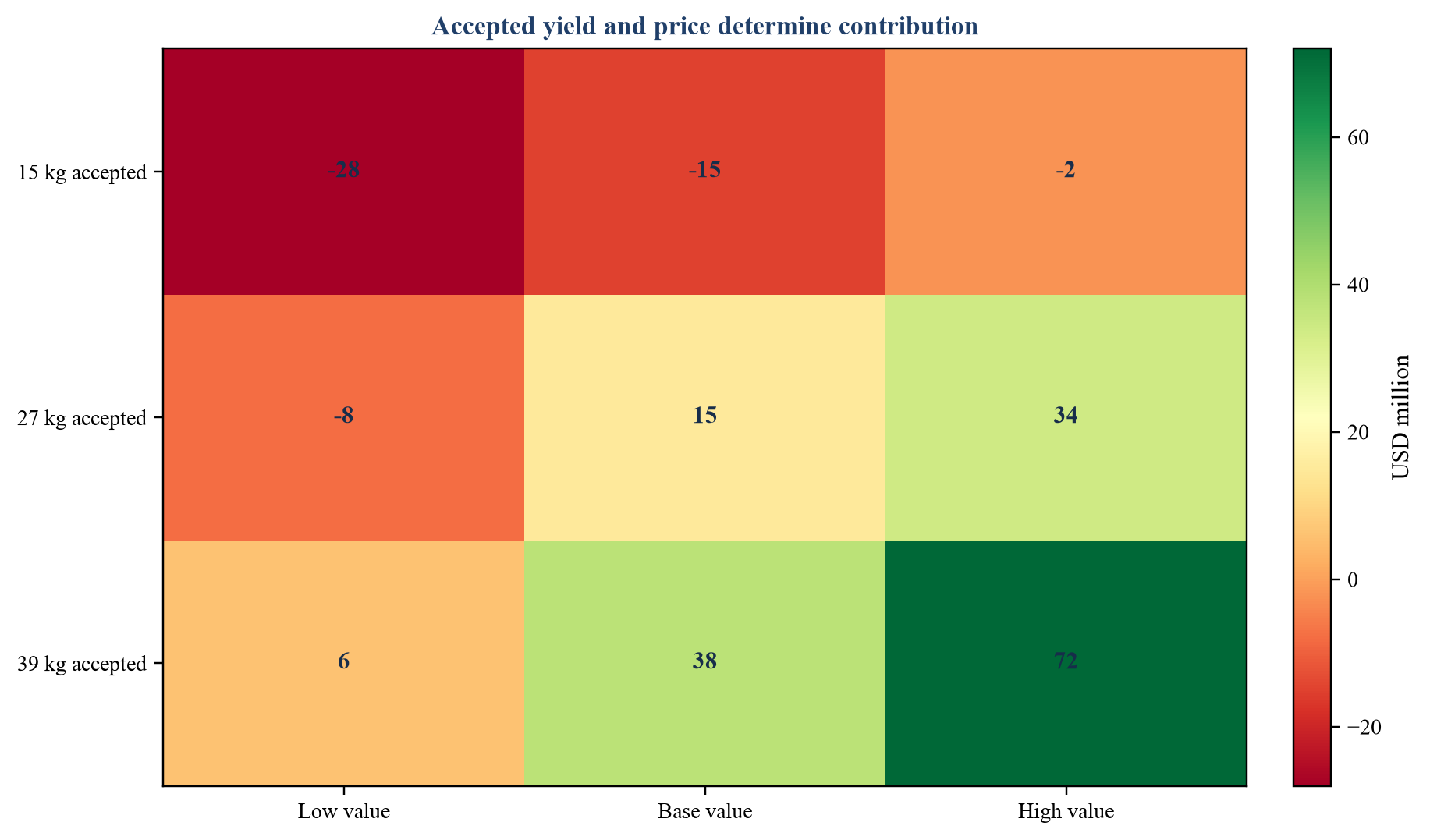
Illustrative USD millions before central overhead financing tax and terminal obligations.
| State | Required evidence | Valuation treatment |
|---|---|---|
| Terrestrial benchmark | controlled comparison and customer problem | base research option |
| Microgravity effect | repeatable measured difference | technical probability increase |
| Returned material | successful return and chain of custody | end to end probability increase |
| Analytical comparability | controlled testing and defined comparison | sponsor decision probability increase |
| Sponsor qualified output | documented sponsor acceptance | commercial probability increase |
| Repeat production | repeat order and stable contribution | operating business valuation |
Proposed valuation states.
| Stage | Kilograms | Conversion from prior stage | Evidence |
|---|---|---|---|
| Prepared input | 144 | n.a. | input genealogy and batch record |
| Recovered | 76 | 53 percent | recovery and custody record |
| Analytical specification | 46 | 61 percent | controlled laboratory test |
| Sponsor accepted | 27 | 59 percent | contractual acceptance |
Illustrative kilograms across six missions.
| Cost category | Unit basis | Main uncertainty |
|---|---|---|
| Payload and process | mission and batch | redesign and qualification |
| Launch and integration | mission and kilogram | timing and shared launch terms |
| Orbital platform | time power crew and volume | utilisation and service pricing |
| Return and recovery | mission and landing | licence and recovery cadence |
| Testing and finishing | sample and accepted kilogram | destructive testing and yield |
| Insurance and reserves | mission and programme | exclusions and reflight obligation |
Proposed model structure.
| Instrument | Evidence | Cash treatment | Financing relevance |
|---|---|---|---|
| Paid study | scoped research work | revenue as performed | engagement evidence |
| Reservation | capacity and window | deposit or deferred revenue | limited until refund terms clear |
| Development agreement | milestones and rights | milestone revenue | supports funded work |
| Purchase commitment | accepted output and price | product revenue on acceptance | supports forecast after conditions |
| Repeat order | tested output and new commitment | recurring product revenue | strongest commercial evidence |
Proposed classification and financing relevance.
| Sources | USDm | Uses | USDm |
|---|---|---|---|
| Sponsor equity | 38 | Payload and pharmaceutical process development | 23 |
| Customer development payments | 27 | Launch and integration | 27 |
| Strategic capital | 22 | Orbital platform services | 22 |
| Public milestone funding | 17 | Return and recovery | 16 |
| Structured finance | 8 | Testing insurance regulation and reserves | 24 |
Illustrative USD millions; total sources equal total uses.
| Scenario | Accepted output | Completed missions | Customer evidence | Valuation implication |
|---|---|---|---|---|
| Delay and low yield | 15 kg | 3 | paid studies only | continuing equity need |
| Base development | 27 kg | 6 | sponsor-qualified output | milestone valuation |
| Repeatable production | 39 kg | 8 | repeat orders | operating cash flow plus options |
Hypothetical outcomes; programme-specific evidence is required.
| Gate | Decision question | Minimum evidence |
|---|---|---|
| Product | what exact output is sold | specification and rights map |
| Effect | does orbit create a measured advantage | controlled comparative result |
| Yield | how much output reaches acceptance | end to end yield waterfall |
| Return | can product return on schedule | licensed vehicle and recovery plan |
| Customer | who pays and under what conditions | signed contract and acceptance protocol |
| Finance | is the next milestone fully funded | sources uses delay case and reserves |
| Scale | can contribution repeat at cadence | completed cycles and repeat order |
Proposed minimum approval record.
Sources
- NASA, In Space Production Applications. Read the primary source
- NASA, Applications Within Reach, 1 October 2023. Read the primary source
- NASA, Space Station Research Informs New FDA Approved Cancer Therapy, 6 January 2026. Read the primary source
- NASA, In Space Production Applications Overview, October 2023. Read the primary source
- Federal Aviation Administration, Getting Started with Licensing. Read the primary source
- Federal Aviation Administration, Varda Licence VOL 24-130. Read the primary source
- European Space Agency, Space Rider Programme. Read the primary source
- NASA, Low Earth Orbit Microgravity Strategy, 16 December 2024. Read the primary source
- Federal Aviation Administration, Varda Reentry Environmental Assessment. Read the primary source
- NASA, Creating New and Better Drugs with Protein Crystal Growth Experiments, 25 April 2023. Read the primary source
- Redwire Corporation, 2025 Annual Report. Read the primary source
- Varda Space Industries, W-1 Mission. Read the primary source
- UK Space Agency, National Microgravity Research Centre opens in Swansea, 6 March 2026. Read the primary source
- UK Space Agency, New studies for manufacturing advanced materials in orbit, 9 February 2026. Read the primary source
- UK Space Agency and partner regulators, UK sets out pathway for space manufactured drugs, 5 March 2026. Read the primary source
- NASA, Commercial Low Earth Orbit Economy. Read the primary source
- NASA, Northrop Grumman CRS-24 Mission Overview, 6 April 2026. Read the primary source
- NASA, Commercial Space Frequently Asked Questions. Read the primary source
- NASA, In Space Production Applications Overview, May 2022. Read the primary source
- NASA, Selected Microgravity Materials Manufacturing References, November 2024. Read the primary source
- NASA, Ames Partnerships Office Annual Report 2025. Read the primary source
- US Food and Drug Administration, Advancing Product Quality. Read the primary source
- NASA, Biomanufacturing in Space of Drug Delivery Medical Devices, 30 March 2026. Read the primary source
- NASA, In Space Liver Tissue Manufacturing Demonstration. Read the primary source
- US Food and Drug Administration, Q13 Continuous Manufacturing of Drug Substances and Drug Products, March 2023. Read the primary source
- NASA, Commercial Low Earth Orbit Destinations procurement. Read the primary source
- UK Space Agency, Annual Report and Accounts 2025 to 2026. Read the primary source
- UK Space Agency, MHRA, Regulatory Innovation Office and Civil Aviation Authority, Joint Statement, 5 March 2026. Read the primary source
- NASA, Merck Keytruda Study, 2024. Read the primary source
- ISS National Laboratory, Merck Research Laboratories Publishes Pembrolizumab Results. Read the primary source
