

Introduction
The development promise of a large data-centre site is usually expressed through ultimate megawatts, acres, buildings or total investment. A lender underwrites a narrower question: which expenditure can be recovered from a completed module supported by enforceable customer payments? The difference between ultimate capacity and financeable capacity becomes acute when a campus requires expensive shared substations, transmission works, roads, water systems, fibre routes and security infrastructure before the first customer enters service.
The scale and speed of demand make disciplined phasing material. The International Energy Agency estimated that data centres consumed approximately 415 TWh globally in 2024 and projected approximately 945 TWh in 2030 in its 2025 base case [1-4]. The US Department of Energy reported approximately 176 TWh of US data-centre electricity use in 2023 and estimated a range of 325 TWh to 580 TWh in 2028 [5-7]. These system-level estimates support the need for investment. They do not prove that a particular 60-megawatt module will obtain power on time, sign creditworthy customers or achieve its target price.
Recent public filings show how developers describe phased capacity, anchor contracts, tenant contributions and project-level finance. One 2026 SEC filing described a 40-megawatt anchor contract, a modular plan and potential expansion after the initial deployment; another described a staged process from power procurement and permitting through construction finance [34-43]. Such disclosures are transaction-specific and subject to their own assumptions and risks. They illustrate why funding eligibility should be based on documentary evidence rather than a broad market narrative.
Reliability authorities are also tightening the evidence around large loads. NERC's materials identify rapid load growth and forecasting uncertainty [11-13]. ERCOT applies dedicated requirements to large loads, while PJM has strengthened scrutiny of proposed data-centre additions [14-20]. A module cannot be treated as financeable power demand merely because it appears in a development pipeline. The relevant evidence includes binding service rights, funded network work, commissioning obligations and operating limits.
This paper is intended for sponsors, utilities, data-centre operators, infrastructure funds, banks, private-credit funds, customers and advisers. It provides a transaction and credit framework. It is not legal, tax, accounting, regulatory, engineering, environmental or investment advice. Each project requires current specialist analysis of its contracts, jurisdiction, assets and counterparties.
1 Define the module as the financeable unit
The financing process should begin with a module register rather than an ultimate-campus headline. Each module should have a defined IT load, gross power requirement, footprint, technical standard, customer allocation, cost, delivery date and acceptance route. Shared works should be shown separately. This structure makes it possible to determine which expenditure is required now and which expenditure preserves an option for future expansion.
The legal structure can then be placed over the module map. One special-purpose company may own the whole campus; another structure may place each phase in a separate borrower. Either approach should preserve the connection between the financed assets and their customer cash. Cross-defaults, shared security, intercompany charges and access rights should reflect physical dependence without allowing one speculative phase to drain a completed module.
The credit committee should identify the minimum module that can produce billable service. A powered shell can support a lease before customer computing equipment is installed, while a turnkey service requires additional platform and operating capability. The financed perimeter should match the promised product. Every upstream dependency and downstream collection right should appear in the gate record.
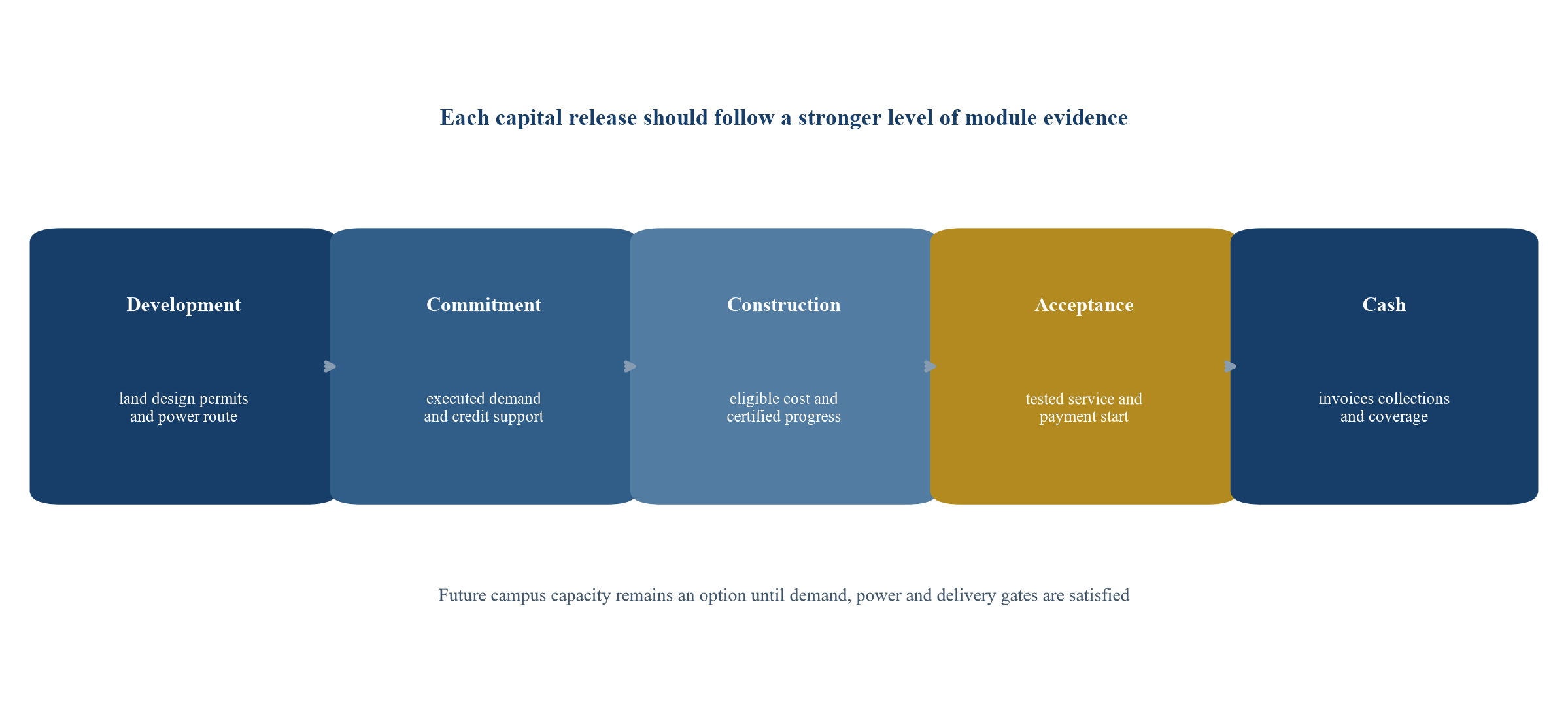
Proposed financing sequence; each transition requires project-specific evidence.
The map should be controlled as the transaction develops. A change in generation technology, grid route, campus phasing, equipment density or customer specification can alter multiple contracts and facilities. The change-control process should show its effect on capacity, schedule, cost, cash, security and lender conditions.
| Cost layer | Core evidence | Primary risk | Financing implication |
|---|---|---|---|
| development | land, design, permits, studies and power route | spend before a financeable module exists | sponsor equity or capped development facility |
| shared infrastructure | substations, roads, water, fibre and security | later modules do not proceed | allocate only supportable share to current module |
| direct module works | shell, cooling, electrical and fit-out | cost and completion | certified construction draw with remaining-sufficiency test |
| customer-specific works | executed specifications and change control | cancellation or bespoke recovery | customer contribution or protected advance |
| operating platform | staff, software, cyber, insurance and licences | continuity and transfer | term funding after service capability is demonstrated |
| later modules | approved concept and expansion rights | demand, timing and financing remain open | retain as equity-funded option until gate is met |
Proposed diligence structure; ownership and financing conclusions require executed evidence.
2 Establish dependable power for each module
The project should distinguish every stage of power access. Requested megawatts are not studied megawatts. Studied capacity is not reserved capacity. Reserved capacity is not a binding service obligation. A signed interconnection or service agreement can still depend on network upgrades, deposits, construction milestones, commissioning and operating conditions. Energised capacity can be interruptible, curtailable or limited by ramp and ride-through requirements.
The power register should record the measurement point, voltage, maximum import, export, ramp, power factor, reliability class, curtailment priority, commissioning sequence, network-upgrade responsibility, security deposit, recurring charges and long-stop date. It should identify which party owns each substation and line, who operates protective equipment, and how outages or grid instructions affect customer service.
Large-load processes are changing. ERCOT's approved revisions created specific study, modelling, verification and commissioning requirements for large loads [17-20]. PJM's 2026 materials show both significant long-term load growth and greater scrutiny of proposed data-centre additions [14-16]. NERC's work highlights the need to model collective behaviour, including rapid disconnection during transmission disturbances [11-13]. These developments support a conservative distinction between a project pipeline and power that can support debt.
The project should also identify the firm-power objective. A customer may require a stated service availability while the campus relies on grid power, dedicated generation, storage and backup with different failure modes. Firmness should be demonstrated through an operating study that covers normal dispatch, planned maintenance, forced outage, grid interruption, fuel constraint, extreme weather and black start. The study should state how much compute remains available in each condition and whether the customer contract permits curtailment.
Procurement should follow the evidence curve. Long-lead components for Module 1 may need early commitment, but construction debt should not be drawn solely against a future power expectation. Draw conditions can link purchase orders to achieved interconnection, customer and module milestones. A warehouse facility can carry refundable or secured deposits, while term debt waits for delivery, installation, energisation and acceptance.
3 Convert market interest into eligible contracted demand
The demand register should classify each customer expression by legal status, capacity, site, service specification, expected commencement, term, price, credit support, deposit, approval status and conditions. A marketing conversation and an executed lease cannot occupy the same line without a clear status field. The register should distinguish inquiry, non-binding indication, reserved capacity, executed contract, installed customer equipment, accepted service, billed service and collected cash.
Contracted megawatts should become eligible only after a bankability review. The customer must have authority to execute, a defined service and site, measurable capacity, a delivery window, an acceptance process, payment obligations, credit support and remedies. Termination rights, conditions precedent, ramp options, volume flexibility and service credits can reduce the amount or duration that supports debt. A contract with a large headline value may produce little eligible cash before acceptance.
The lender should test concentration by customer group, guarantor, workload, industry and expiry date. Several special-purpose customers can share one economic sponsor. A single hyperscaler can support long-term finance while creating renewal and bargaining concentration. A portfolio of smaller customers can diversify credit while increasing fit-out, sales, churn and collection costs. The relevant measure is risk-adjusted net cash rather than gross contracted capacity.
Demand evidence should be linked to the construction programme. A customer contract should specify the module, committed date, technical density, cooling method, network route and power treatment. Changes to rack density, liquid cooling, redundancy, security or connectivity can alter design and cost. A reservation should not open a full construction tranche when the customer's remaining conditions allow it to walk away before meaningful compensation becomes payable.
| Demand status | Evidence | Finance treatment | Principal control |
|---|---|---|---|
| inquiry | customer identity and stated requirement | exclude from debt sizing | retain for market planning only |
| non-binding indication | dated proposal or letter with capacity and timing | exclude or apply zero advance rate | track conversion conditions |
| capacity reservation | signed reservation, deposit and expiry | limited early-works support where deposit is at risk | restrict spend to recoverable scope |
| executed contract | binding capacity, price, term, acceptance and remedies | include after legal and credit haircuts | satisfy all conditions precedent |
| installed load | customer equipment installed and tested | recognise progress toward acceptance | protect title, access and interface evidence |
| accepted service | signed acceptance and payment commencement | include in term-debt base | monitor service levels and disputes |
| collected cash | reconciled invoice and bank receipt | include in historical cash test | maintain controlled accounts and ageing |
Proposed classification; enforceability and credit conclusions require transaction-specific review.
4 Build a module-level completion schedule
The critical path crosses shared and module-specific packages. Grid upgrades need studies, land rights, procurement and utility work. Shared infrastructure needs roads, substations, water, fibre and safety approvals. Module 1 needs shell, cooling, electrical systems and customer fit-out. Customer acceptance begins only after the contracted service can be demonstrated.
Each schedule line should identify owner, predecessor, contractual date, expected date, remaining duration, available float, evidence, remedy and latest safe date. The module schedule should identify shared milestones such as substation energisation, cooling-loop completion, network availability, customer installation and acceptance. It should also show when Module 2 commitments would compete for the same contractors, equipment or energisation window.
Completion should be defined at three levels. Asset completion confirms that a component meets its own technical and legal tests. Interface completion confirms that the component operates with adjacent systems. Commercial completion confirms that the system can deliver customer service and generate the cash assumed in the debt model. Term conversion should require commercial completion for the revenue used to size that term debt.
Delay responsibility should follow controllable obligations. The utility should address its contractual network work. The shared-infrastructure contractor should address common scope. The module contractor should address the shell and technical plant. The sponsor should retain residual interface risk that cannot be transferred effectively. Liquidated damages, performance bonds, parent guarantees, standby facilities and contingency should be sized against the cash effect of delay rather than a generic percentage of contract price.
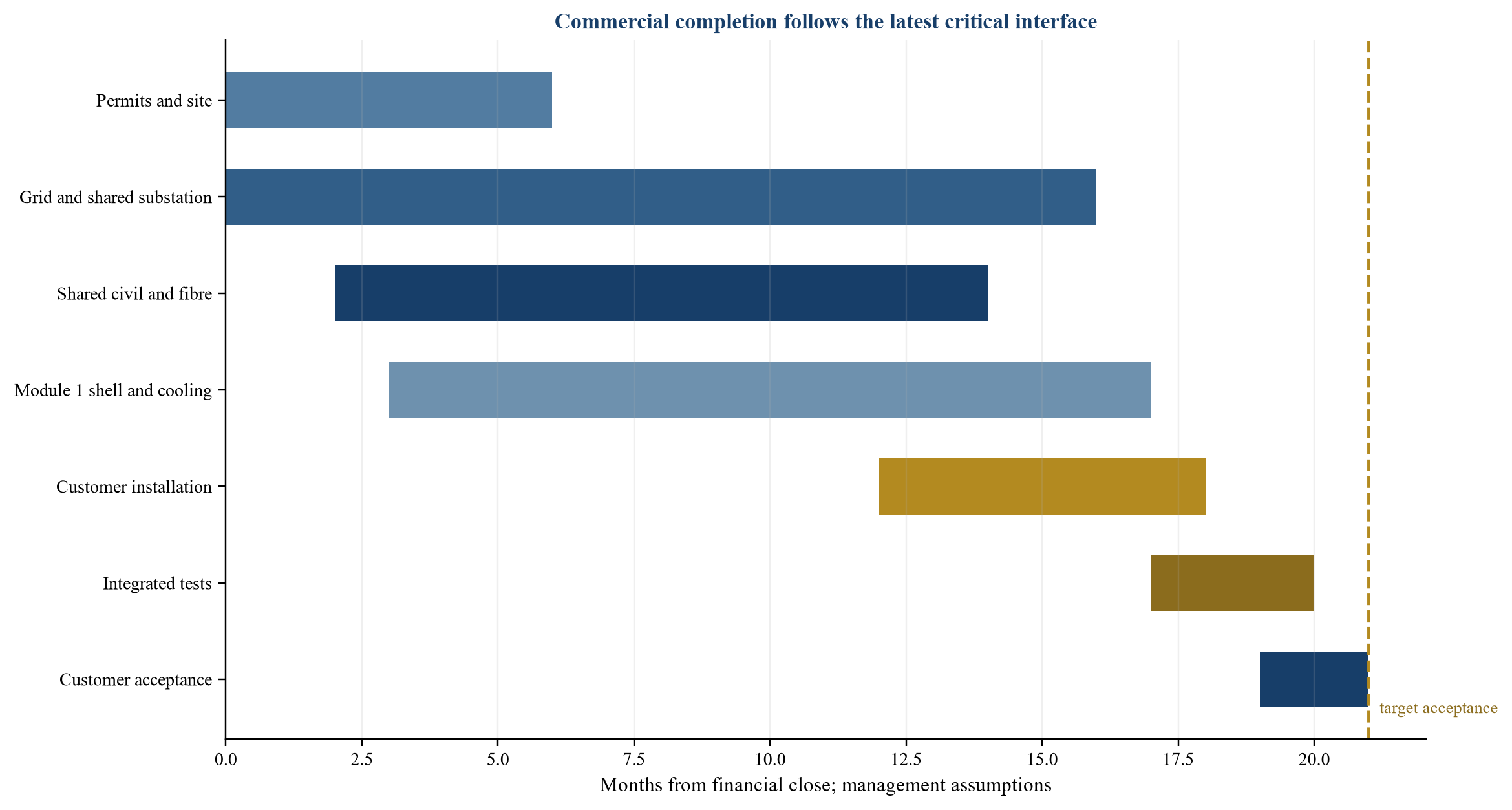
Illustrative sequencing; dates and durations are management assumptions.
The schedule should drive financing availability. Land and masterplanning can use equity. The construction facility can draw against certified Module 1 cost and its approved share of common works. Customer cash should follow its agreed use and refund protections. Module 2 expenditure should remain outside the draw base until its own gate is satisfied.
5 Separate shared infrastructure from direct module cost
Shared enabling works can create value for several modules while producing no stand-alone customer cash. The allocation model should identify the capacity, useful life and users of each shared asset. Initial substations, transmission works, roads, drainage, security and network routes may be sized for the masterplan. Their cost should be allocated to the first module only to the extent that the first module can support it; the balance remains sponsor risk or is recovered from later modules through a transparent contribution mechanism.
Direct module cost includes the shell, electrical and mechanical plant, cooling, fit-out, commissioning and customer-specific work needed for that defined capacity. The model should record committed, spent, certified and remaining cost by module. It should also identify cancellation value and alternative use. A long-lead transformer procured for Module 3 may be transferable to Module 1; a bespoke cooling configuration may have much lower recovery.
The illustrative campus comprises four 60-megawatt IT-load modules. Management assumes USD 420 million of shared enabling infrastructure and USD 900 million of direct cost for each module. For the allocation example, 40 per cent of shared cost is required for Module 1, 25 per cent for Module 2, 20 per cent for Module 3 and 15 per cent for Module 4. The percentages are management assumptions and should be replaced by engineering evidence.
Capital staging should compare cumulative eligible cost with cumulative contracted and accepted capacity. The comparison does not establish a universal ratio. It shows when the sponsor's fixed infrastructure exposure is growing faster than demand evidence. A decision committee can then reduce scope, increase equity, obtain stronger customer support or defer the next release.
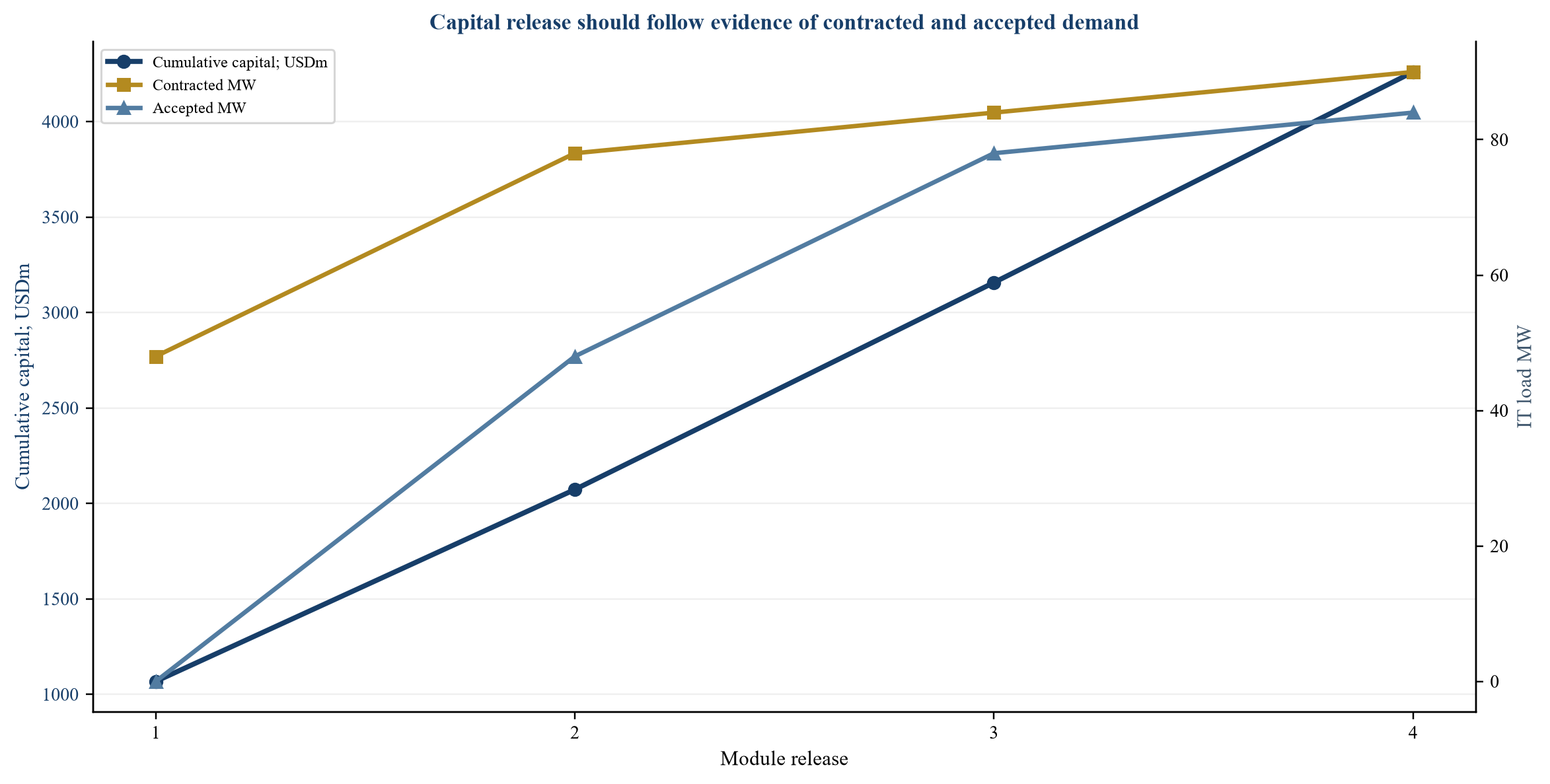
All amounts and capacity values are management assumptions; the chart demonstrates staging logic.
The allocation should be reconciled at every gate. If Module 2 is deferred, the project must identify which shared commitments remain unavoidable and who funds them. If a later customer accelerates, the project should test whether the existing shared assets can serve the revised sequence without compromising the first module. This treatment prevents future optionality from being presented as current collateral.
6 Allocate construction and interface risk by delivery stage
A single turnkey EPC contract can simplify responsibility where one capable contractor can control the scope. Large AI campuses often use multiple contractors and vendors because generation, substations, cooling, buildings and compute require different expertise. The sponsor then acts as system integrator and retains the gaps between packages.
The interface matrix should identify every handoff. It should cover design inputs, foundations, cable routes, energisation, control systems, water quality, heat rejection, rack density, network demarcation, cybersecurity, testing and documentation. For each interface, the matrix should identify deliverable, provider, receiver, acceptance evidence, required date, change process and consequence of failure.
Contract caps should be assessed against system exposure. A contractor's delay damages may cover only its contract price while the campus incurs interest, customer damages, idle equipment and generation capacity charges. Caps across contracts may overlap or leave gaps. The financial model should calculate the untransferred exposure and fund it through sponsor support, contingency, insurance or lower debt.
| Interface | Required evidence | Failure consequence | Financing control |
|---|---|---|---|
| utility to campus substation | approved design, protection study and energisation certificate | delayed or limited import | draw stop and funded schedule contingency |
| generation to grid and campus | synchronization, dispatch protocol and metering | unavailable or unbillable power | completion test and liquidated damages |
| building to cooling system | heat-load test and redundancy demonstration | compute cannot operate at contracted density | integrated load-bank test |
| cooling to compute equipment | temperature, flow, water quality and controls | warranty or performance failure | vendor acceptance and operating reserve |
| fibre to platform | diverse routes, latency and security tests | customer workload fails acceptance | route completion before customer test |
| platform to customer | workload benchmark, service level and evidence | payment deferral, credit or rejection | objective acceptance and cure period |
| shared controls | operating procedures, staff, cyber and emergency response | system-wide interruption | independent readiness review |
Proposed control framework; project contracts determine actual allocation.
Change orders should be tested for system impact. A higher rack density may reduce building area and increase cooling, electrical and water requirements. A generator substitution may change emissions permits, fuel supply and grid studies. A customer specification change may affect equipment, software and schedule. The change approval should identify cost, critical path, finance, contract and performance consequences.
7 Create a bankable contract for reserved and accepted capacity
The customer contract should define the service at the same level used by engineering and finance. Capacity can be stated in critical IT megawatts, accelerators, clusters, compute hours or another measurable unit. The contract should identify location, hardware or performance, commencement, acceptance, availability, price, escalation, power cost, term, renewal, service credits, termination, security and transfer rights.
A minimum payment supports debt only after the provider has met the conditions that make it payable. The model should identify each condition and customer defence. Acceptance can depend on objective benchmarks or customer discretion. Availability credits can reduce invoices. Chronic failure can permit termination. A delayed phase can create a refund or damages. Cybersecurity, regulatory restrictions and force majeure can affect service and payment.
Customer credit should be assessed at the legal-obligor level. A recognised corporate group may contract through a subsidiary without parent support. A customer can also provide prepayment, equity, equipment or a guarantee. Each item should be traced to its source and counted once. Reciprocal arrangements should be identified because the same group can be customer, investor, supplier and lender.
Public filings demonstrate several structures. CoreWeave states that it uses multi-year committed capacity contracts and asset-level debt, while also disclosing power, construction, customer and capital requirements [34-37]. Talen disclosed a long-term agreement to supply AWS with up to 1,920 MW from Susquehanna through 2042 under the revised arrangement [38-40]. Core Scientific and Galaxy disclosed long-term high-density-compute arrangements with phased capacity and significant construction obligations [41-43]. These examples show possible structures and risks. Their terms do not establish bankability for another transaction.
The finance documents should require a contract abstract and legal review. The abstract should connect every model input to the operative clause. Amendments, side letters, order forms and service schedules should be included. The legal review should address enforceability, assignment, set-off, termination payments, direct agreements, governing law and remedies.
8 Match funding instruments to each stage of development
The funding stack should distinguish development equity, customer-supported early works, construction debt, equipment facilities, term debt and later-module expansion capital. Each source should identify the module, borrower, eligible use, availability period, advance rate, tenor, security, guarantee and conversion test. A financing that can be drawn for any campus expenditure weakens the connection between debt and the revenue expected to repay it.
Development and unallocated shared infrastructure usually require equity or deeply subordinated capital. A limited early-works facility can become appropriate after a customer provides a non-refundable deposit or other meaningful support. Construction debt can fund certified eligible cost after power, permits, contracts and cost-to-complete conditions are satisfied. Term conversion should follow completion, acceptance and operating evidence. Equipment finance should remain tied to identifiable assets and supported contract life.
Management assumes Module 1 uses of USD 1.068 billion: USD 168 million of allocated shared infrastructure, USD 760 million of direct construction cost, USD 70 million of capitalised interest and fees, and USD 70 million of contingency and reserves. Management assumes funding from USD 520 million of construction and term debt, USD 120 million of customer cash and USD 428 million of sponsor equity. These are management assumptions.
| Source | Amount | Principal use | Availability control |
|---|---|---|---|
| construction and term facility | 520 | eligible shared allocation and direct module cost | equity contribution, certified progress and remaining sufficiency |
| customer cash | 120 | agreed customer-specific and capacity works | restricted use, milestone evidence and refund treatment |
| sponsor equity | 428 | development, shared works, contingency and first-loss capital | funded first or proportionately under an agreed ratio |
| total | 1,068 | complete Module 1 and required reserves | controlled sources equal approved uses |
All amounts are management assumptions in USD millions.
No source should receive multiple economic roles in the model. A customer prepayment can reduce future invoices or be refundable. It should not also be treated as unrestricted equity and free debt-service cash. A sponsor guarantee can support completion and remain contingent rather than funded liquidity. A tax credit or public incentive should be recognised only after eligibility, timing and transferability are evidenced.
9 Size debt from eligible cost and contracted utilisation
Debt sizing should use the lesser of eligible cost, supported project cash and approved leverage. Eligible cost should exclude speculative later-module expenditure, unsupported land value, unapproved change orders and duplicated shared allocations. Supported cash should include only the accepted service and executed commitments that satisfy credit, term, performance and concentration tests. The result should be compared with a valuation that recognises the module's actual completion and leasing state.
The cash waterfall should start with receipts attributable to the financed module. It should allocate taxes, essential power and operating cost, module maintenance, required reserves and debt service before distributions. Shared campus charges should follow an executed allocation policy and should not strip a financed module of the cash needed to operate. Later-module development expenditure should sit below debt service or outside the borrower unless lenders approve it.
The borrowing base can combine certified eligible cost during construction and net contracted cash after acceptance. Advance rates should fall when customer concentration increases, remaining contract term shortens, disputes arise or power availability weakens. A module with 80 per cent contracted capacity may support less debt than a 60 per cent contracted module if the first contract can terminate early or lacks credit support.
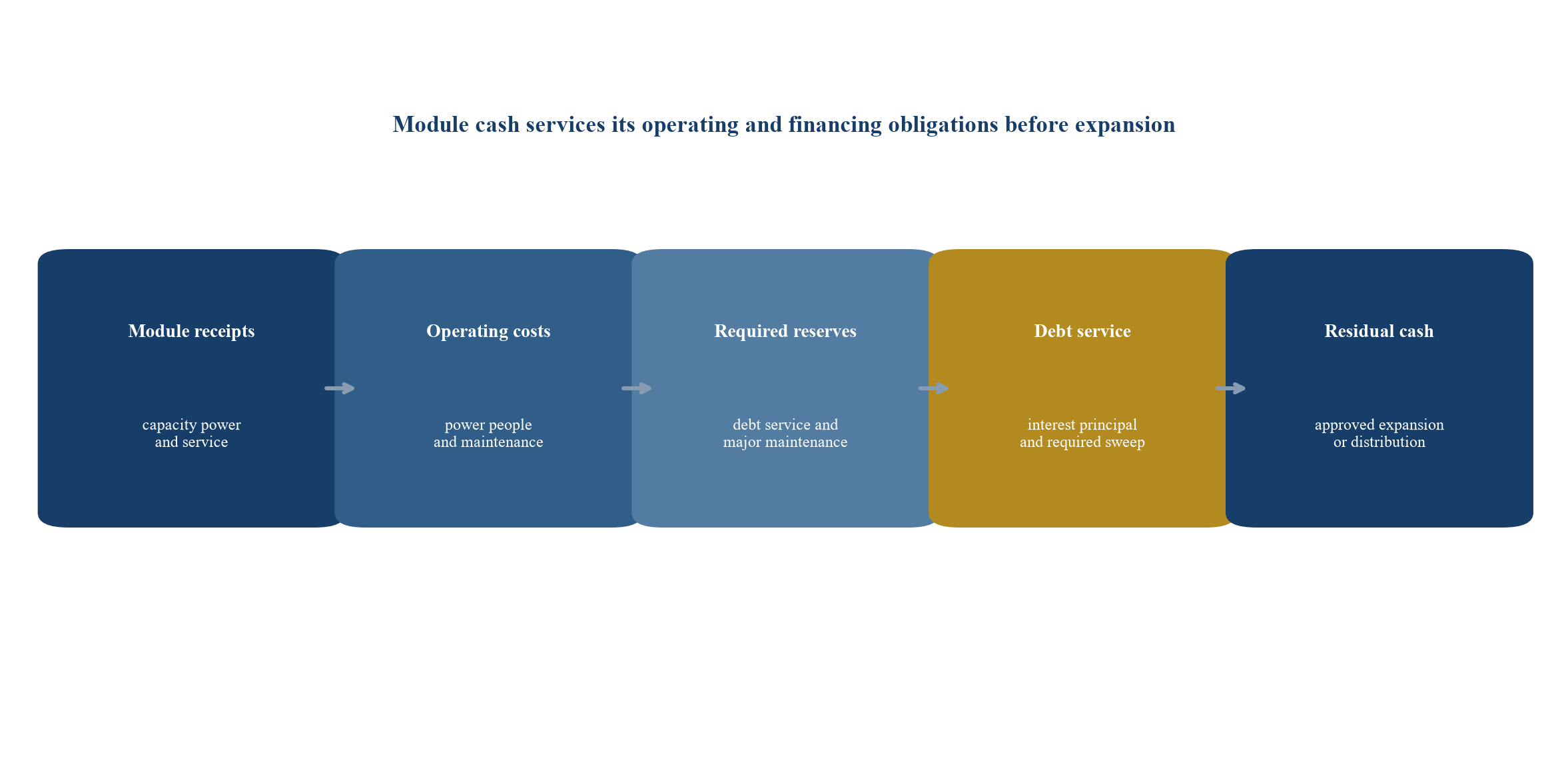
Proposed control sequence; actual priorities depend on finance and operating documents.
The illustrative central case assumes 48 MW of contracted capacity in Module 1, of which 36 MW is accepted at the first service date and the balance is accepted over six months. Management assumes a minimum module DSCR of 1.46 times after stabilisation. A six-month acceptance delay combined with a 12 per cent cost overrun produces minimum coverage of 0.88 times before reserves and sponsor support. The case demonstrates sensitivity and does not describe an identified project.
10 Use draw controls, reserves and covenants to enforce staging
The covenant package should monitor the physical and contractual variables that drive cash. Financial covenants alone can identify deterioration after the cause has emerged. Operating covenants can provide earlier warning through power, construction, acceptance, availability, customer credit and equipment measures.
Reserves should be assigned to defined risks. A debt-service reserve protects scheduled payments during temporary cash shortfalls. A completion reserve covers approved remaining cost and identified interface exposure. A major-maintenance reserve funds module work after operation begins. A customer-refund reserve protects restricted cash where delivery obligations remain outstanding. The model should prevent one reserve from being counted against several simultaneous risks.
| Control | Measurement | Early-warning trigger | Financing response |
|---|---|---|---|
| power readiness | dependable MW allocated to the financed module | milestone slip or reduced entitlement | stop construction draw and update schedule |
| contracted utilisation | eligible contracted MW versus released capacity | ratio below approved gate | defer the next module and increase equity |
| eligible cost | certified direct cost and approved shared allocation | ineligible cost or unsupported change order | exclude cost and require sponsor funding |
| customer acceptance | accepted MW versus schedule | failed test or delayed decision | defer term conversion and require support |
| eligible cash | collected net receipts by contract | credit, dispute, amendment or concentration | haircut borrowing base and prepay |
| DSCR | historical and forward cash versus debt service | ratio below lock-up | block distributions and sweep cash |
| liquidity | unrestricted cash and dedicated reserves | reserve below required amount | sponsor cure or draw stop |
| remaining sufficiency | undrawn debt, committed equity and contingency versus cost to complete | sources fall below remaining uses | stop draw and call sponsor support |
| interface risk | open critical-path items and claims | unresolved item beyond latest safe date | independent review and funded contingency |
Proposed structure; thresholds require project-specific modelling and documentation.
The borrowing base can recognise certified eligible cost during construction and eligible customer cash after delivery, acceptance, credit, performance, concentration and term haircuts. The campus advance rate can rise as completion and contracted occupancy improve, subject to a maximum leverage limit. The next module should remain outside the base until it independently satisfies its gate.
Information rights should include schedules, contracts, customer credit, invoices, collections, generation, grid events, power cost, service levels, equipment, incidents, insurance and reserves. Definitions should be consistent across operating systems and finance documents. Independent verification should apply to measurements that govern draw, conversion, distribution or default.
11 Model demand, delay and cost downside combinations
Single-variable sensitivities can understate the risk of modular development. A demand shortfall can coincide with a cost overrun after shared infrastructure has already been committed. A customer can delay acceptance while interest and minimum power charges continue. A later module can consume management attention and liquidity needed to complete the first. The downside model should combine events that share a plausible cause or timing.
The first case should delay Module 1 acceptance and calculate capitalised interest, customer remedies, contractor recovery and remaining contingency. The second should reduce contracted utilisation for Module 2 before its notice to proceed. The third should apply a cost overrun to shared and direct works. The fourth should combine delayed acceptance, lower contracted utilisation and higher financing cost. Each case should show whether the next module remains releasable.
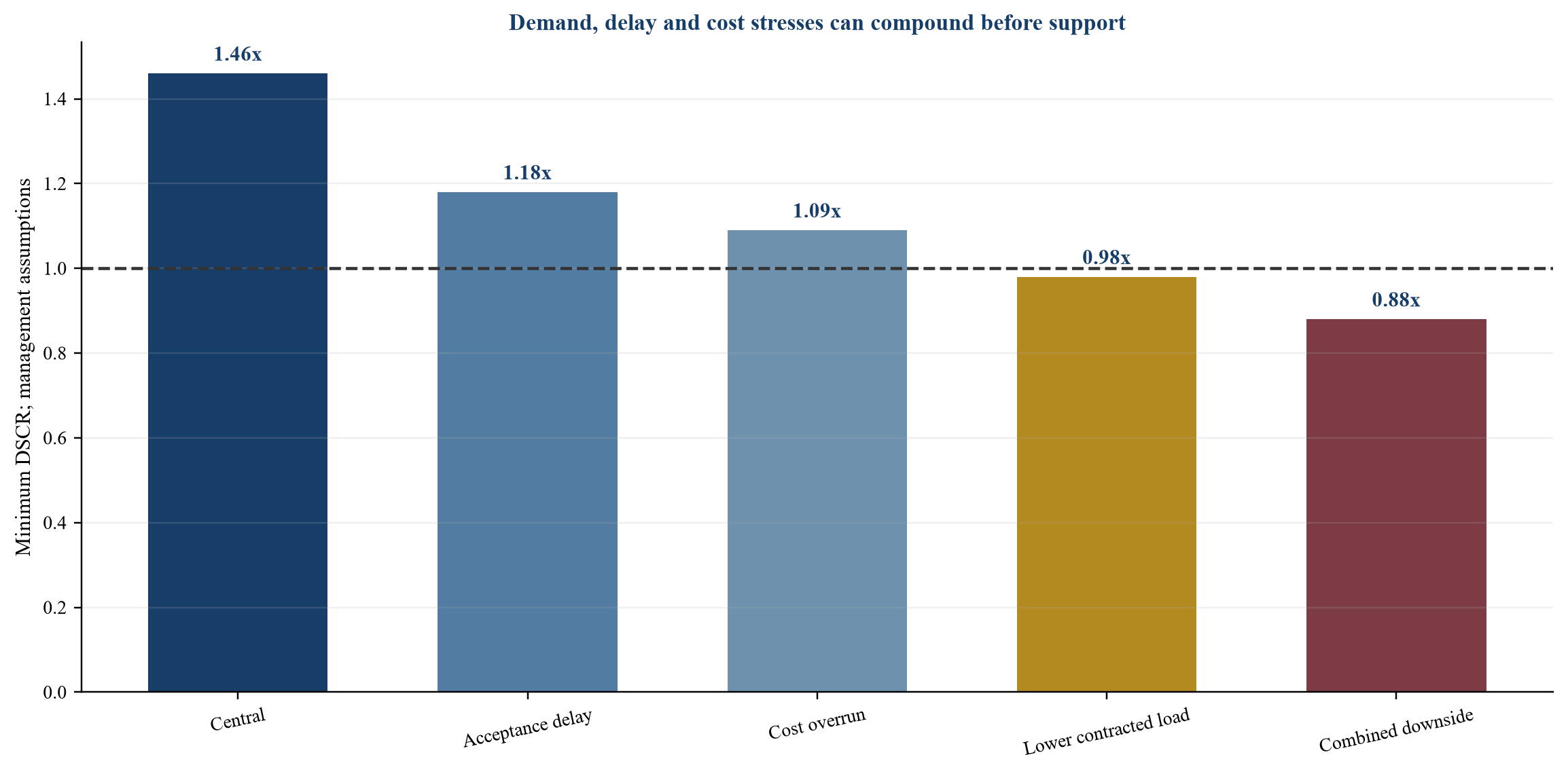
All ratios are management assumptions and do not describe an identified financing.
Each downside should state liquidity, cost to complete, covenant date, reserve use, support call, customer effect and recovery action. The model should identify the first binding constraint. A project can have positive long-term economics and fail because cash is unavailable during a delay. The liquidity bridge is therefore as important as the terminal valuation.
Stress actions should be executable. A draw stop protects uncommitted debt. Sponsor equity cures cost and delay where the sponsor has capacity and a binding obligation. Storage or grid optimisation can reduce operating cost within technical and contractual limits. Customer remedies can be negotiated only with consent. Asset sales and refinancing require time and market access. The credit case should not assume an action without authority, funding and lead time.
12 Align accounting, allocation and reporting with the module model
Accounting classifications should inform the model and remain separate from lender cash definitions. IFRS 15 requires identification of customer contracts, performance obligations, transaction price and the transfer of promised goods or services [44-45]. Variable consideration, service credits, modifications, prepayments and significant financing components can affect revenue timing. Revenue recognition does not establish cash availability under the financing waterfall.
Generation PPAs, campus leases, equipment facilities, guarantees and consolidation require review under applicable standards [44-48]. A dedicated asset or contract may create a lease or another accounting consequence. A special-purpose company can be consolidated by a sponsor or customer depending on control. The accounting conclusion should be documented without changing the underlying legal and credit analysis.
Tax can alter cash at several layers. The project should assess customs and import duties, value-added tax, withholding, property tax, fuel tax, transfer pricing, interest limitation, depreciation, incentives and loss use. Intercompany charges should be supported and consistent with the waterfall. Tax credits and incentives should enter the base case only after entitlement, timing and monetisation are supported.
Reporting should reconcile operations, contracts, accounting and cash. The project should bridge customer capacity to invoices, revenue, receivables and collections. It should bridge generation output and grid imports to power cost and customer reimbursement. It should bridge capital expenditure to assets, debt draws and remaining cost. Differences should be explained and carried into forecasts.
13 Integrate environmental and community obligations into module gates
Power-intensive campuses can affect land, water, noise, emissions, transmission and local infrastructure. The project should identify applicable permits, assessments, consultation, mitigation, monitoring and reporting. General sustainability claims should not replace site-specific evidence.
The power strategy may combine renewables, natural gas, nuclear, storage and grid electricity. The IEA projects that renewables meet a substantial share of incremental data-centre demand while dispatchable sources remain important [1-4]. Contractual procurement and physical supply should be distinguished. Environmental attributes, grid mix, backup generation and onsite sources can produce different claims and risks.
Water and cooling should be assessed under expected and extreme conditions. The design should state source, quantity, treatment, discharge, redundancy and restrictions. Air cooling, liquid cooling and hybrid systems can change power and water profiles. Higher rack density can change both. The environmental model should use the actual design and location.
Lenders using the Equator Principles, IFC Performance Standards or related policies can require defined environmental and social processes [30-33,49]. The scope, category and obligations depend on the financing and project. Compliance cost, schedule and monitoring should be included in sources and uses. A permit or stakeholder delay can become a completion and liquidity risk.
14 Preserve continuity, transfer and future expansion options
Downside value depends on preserving the operating system. Lenders should understand whether generation contracts, grid service, land, permits, equipment, software, customer contracts, data and staff can remain available after default. Security over one entity may be insufficient when essential rights sit in another.
Direct agreements can give lenders notice, cure, step-in and transfer rights. Their terms should align across customer, generation, utility, landlord, operator and key vendors. Cure periods should allow practical action without forcing a critical counterparty to continue indefinitely. Consent requirements, licence restrictions and regulatory approvals should be identified before closing.
The replacement plan should name the capabilities required to operate generation, grid interfaces, campus systems, computing equipment, networks, cybersecurity and customer service. A replacement operator may need vendor support and customer approval. Access credentials, source code, monitoring, spares, procedures and records should remain controlled and transferable where legally permitted.
Cybersecurity and operational resilience require specific attention. A default or transfer can increase access and continuity risk. NIST and CISA frameworks can inform governance, incident response and recovery [50]. The financing package should require prompt notice of material incidents, tested recovery, access control and preservation of customer obligations.
| Element | Evidence before funding | Downside action | Value risk if absent |
|---|---|---|---|
| controlled accounts | account agreements and waterfall | preserve operating cash and debt service | cash leakage or interruption |
| customer contract | assignment, notice, cure and direct agreement | maintain service or transfer provider | termination and lost revenue |
| generation and grid | security, consent and continued-service rights | preserve dependable power | stranded campus and compute |
| land and campus | mortgage or lease security and access | maintain physical control | inability to operate or sell |
| compute and software | title, licences, serial register and vendor rights | continue, redeploy or sell equipment | weak recovery and service failure |
| operator and staff | transition plan, records and key services | appoint replacement operator | prolonged outage and customer remedies |
| cyber and data | access, backup, incident and transfer controls | secure transition and recovery | breach, legal exposure and lost trust |
Proposed enforcement record; execution depends on law, contracts and operating capability.
15 Apply the next-module investment and credit decision
The board and credit committee should approve each module through staged gates. The initial development decision should confirm land, market, power route, customer strategy, preliminary design, development budget and sponsor risk capacity. Financial close for Module 1 should confirm permits, executed contracts, funded sources, cost to complete, security and support. Each draw should confirm progress and remaining sufficiency. The Module 2 notice to proceed should require its own demand and funding evidence.
The decision paper should separate verified facts, specialist opinions, management assumptions and unresolved matters. It should contain the module register, entity structure, interconnection evidence, customer contracts, schedule, cost-allocation policy, sources and uses, cash waterfall, debt sizing, stress cases, covenants, reserves and downside transfer plan.
Six questions govern approval. What capacity is legally and physically available to this module? Which customer commitments are enforceable and creditworthy? Which shared costs genuinely support the module? Who bears delay and cost overrun at each interface? Does the debt amortise within supported cash and contract life? Does releasing the next module weaken completion or liquidity for the current one?
The approval should state maximum commitments, required equity, support, reserves, advance rates, covenants, permitted distributions and conditions precedent. It should identify unacceptable downside cases and the events that require refreshed approval. A positive strategic view of AI demand does not replace these transaction controls.
Practical execution controls
The sponsor should maintain one controlled capacity register. It should show dependable power, gross facility load, critical IT capacity, reserved capacity, contracted capacity, installed load, accepted service and remaining headroom by module. Units, measurement points and losses should reconcile. The register should identify the evidence and date supporting each value.
The project should maintain a clause-level contract model. Each revenue, cost, milestone, remedy and transfer assumption should point to an executed clause or a clearly labelled management assumption. Amendments and side letters should be version controlled. The model should not use commercial summaries when the executed language differs.
The module schedule should be updated at least monthly during construction and more frequently during commissioning. It should identify critical path, float, latest safe date, responsible party, evidence and consequence. A delay notice should show effects on the financed module, shared works, customer delivery and later-module commitments.
Cost reporting should distinguish committed, incurred, certified, paid, forecast and remaining amounts. Contingency should be allocated by risk. The independent monitor should state physical progress, schedule progress, cost to complete and contingency sufficiency. Delivered equipment should not inflate completion when upstream power and cooling remain unfinished.
Procurement controls should track reservation, purchase order, design approval, manufacture, shipment, title, delivery, storage, installation, commissioning and warranty. Deposits should be protected through refund rights, guarantees, letters of credit or other approved support where commercially available. Serial records should connect equipment to insurance and security.
Generation commissioning should include mechanical completion, synchronization, dependable-capacity testing, efficiency, emissions, controls, protection and operating procedures. Campus commissioning should include substations, cooling, water, fire, fibre, security and load-bank tests. Integrated testing should demonstrate the customer service under normal and relevant failure conditions.
Customer acceptance should use the contractual workload, software, measurement period, performance threshold and evidence. Internal rehearsals can identify defects and do not replace contractual acceptance. Any customer dependency should be documented, notified and linked to schedule relief or deemed acceptance if the contract provides it.
Power-cost reporting should reconcile generation output, fuel, grid imports, exports, storage, losses, demand charges, network charges and customer reimbursement. Timing differences should be included in working capital. A pass-through formula should be tested against actual invoices before commercial operation.
Dispatch governance should define the control room, forecast, nomination, outage, curtailment and emergency processes. The generation operator, campus operator and customer should understand how load is reduced when supply is constrained. The finance model should use the same priority and compensation rules.
The customer-credit file should identify obligor, parent, guarantor, security, financial capacity, strategic dependence, disputes and reciprocal relationships. It should be refreshed after material changes. The borrowing base should respond to deterioration before a payment default where the documents permit.
Collections should be monitored by invoice. The report should show amount, issue date, due date, deductions, dispute, payment and controlled-account receipt. Power reimbursements and service credits should reconcile. Late or disputed cash should receive reduced eligibility until resolved.
Service reporting should use the contractual availability method. Excluded events, maintenance, utility outages, generator outages and customer-caused events should be classified consistently. Estimated credits should enter forward cash tests before invoice adjustment.
Technology planning should identify equipment cohorts, warranty, vendor support, workload compatibility, maintenance, spares, refresh date and residual route. Debt should decline before the supported economic life. A refresh needed to maintain contracted service should have a funded source.
Insurance should be mapped to construction and operation. Builder's risk, delay in start-up, property, machinery breakdown, business interruption, cyber and liability cover can respond to different events. Limits, deductibles, exclusions, loss-payee rights and reinstatement should be tested against the modelled exposure.
Fuel supply should be modelled where dedicated generation depends on fuel. The project should assess transport, pressure, capacity, price, nomination, imbalance, interruption and storage. Dual-fuel or backup arrangements should be recognised only after technical, permitting and contractual evidence.
Grid-event reporting should capture curtailment, outage, voltage, frequency, ramp and protection behaviour. Large computational loads can create reliability concerns when they disconnect rapidly [11-13]. The campus should meet applicable modelling and ride-through requirements and provide data required by the system operator.
The quarterly lender pack should include the capacity register, schedule, cost report, power performance, customer acceptance, invoices, collections, service levels, equipment, incidents, insurance, reserves, covenants and forecasts. Each report should name its data source and accountable owner. Prior periods should remain available for trend review.
Model governance should preserve approved versions, assumptions, formulas and audit logs. Scenario inputs should remain separate from observed results. The model should reproduce debt, reserve and distribution tests from source evidence. Material changes should require review under a defined authority matrix.
Distribution conditions should include historical and forward coverage, funded reserves, no default, current power and service performance, and a compliant borrowing base. A cash sweep can accelerate repayment when contract term, customer credit, equipment support or power rights weaken.
The refinancing calendar should show debt maturities, contract expiries, customer renewal windows, generation maintenance, grid renewal, permit dates and equipment refresh. Preparation should begin while remaining contract term and asset condition can support new credit. A maturity after customer termination or equipment obsolescence creates concentrated refinancing risk.
The sponsor should maintain a stop-funding rule. Additional debt should stop when a required power, permit, contract, schedule, cost, equipment, acceptance, credit or liquidity condition falls outside the approved limit. The rule should identify cure authority, period and capital source.
Related-party contracts require separate review. An affiliate can develop the site, supply power, operate the campus, own equipment or purchase service. Pricing, priority, termination, security, transfer and conflicts should be documented. Circular cash and guarantees should be removed from the independent credit case.
The data room should be organised by common works and module. Core folders should cover corporate structure, land, permits, environment, power, shared infrastructure, module engineering, construction, customer contracts, operations, cybersecurity, insurance, finance, tax, accounting, security and transfer. Every material model input should link to evidence or a named assumption.
Independent advisers should state scope, assumptions, reliance and open matters. The engineer can review design, schedule, cost, completion and performance. The model auditor can test formulas, timing, tax, reserves and covenants. Counsel can assess contracts, security, permits and transfer. Environmental, insurance, tax, accounting and cybersecurity specialists should address their respective exposures.
| Gate | Required evidence | Financing decision | Failure response |
|---|---|---|---|
| development | land, route, permits, preliminary design and budget | approve limited development capital | pause commitments and resolve evidence gap |
| customer | executed capacity, payment, credit and remedies | recognise eligible future cash | exclude, haircut or require support |
| power | dependable generation and grid route with funded works | open matching construction tranche | delay compute and reduce supported capacity |
| construction | integrated schedule, fixed scope and cost to complete | continue certified draws | stop draw and call support |
| commissioning | asset and interface tests | release completion support in stages | cure, retest and retain support |
| acceptance | customer confirmation, invoice and collection | convert relevant debt to term | defer conversion and trap cash |
| operation | performance, reserves, covenants and reporting | permit distributions | sweep cash and remediate |
| downside | direct agreements, transfer consents and operator plan | approve residual reliance | shorten tenor and increase amortisation |
Proposed approval record; each gate requires project-specific evidence.
In the illustrative case, a 1.46 times minimum Module 1 DSCR supports the proposed funding only within management's central assumptions. The combined downside falls below 1.00 times before reserves and support. The structure should therefore stage debt, preserve sponsor completion support and prevent Module 2 commitments from consuming Module 1 liquidity.
The next module should be financed after evidence demonstrates demand, power, delivery readiness and sufficient remaining funds. Modular development creates flexibility only when the financing documents preserve the right to defer. A disciplined structure makes every capital release a recorded decision tied to a defined module and an executable route to customer cash.
Sources
- International Energy Agency, Energy and AI, Read the primary source
- International Energy Agency, Energy and AI executive summary, Read the primary source
- International Energy Agency, Energy demand from AI, Read the primary source
- International Energy Agency, Energy supply for AI, Read the primary source
- US Department of Energy, 2024 United States Data Center Energy Usage Report announcement, Read the primary source
- Lawrence Berkeley National Laboratory, 2024 United States Data Center Energy Usage Report, Read the primary source
- US Department of Energy, Powering America's AI Future Data Center Resource Hub, Read the primary source
- US Energy Information Administration, Annual Energy Outlook 2026, Read the primary source
- US Energy Information Administration, Data center power demand and generation analysis, Read the primary source
- US Department of Energy, Electricity Demand Growth Resource Hub, Read the primary source
- North American Electric Reliability Corporation, 2025 Long-Term Reliability Assessment, Read the primary source
- North American Electric Reliability Corporation, Large Loads Action Plan, Read the primary source
- North American Electric Reliability Corporation, 2025 State of Reliability Overview, Read the primary source
- PJM Interconnection, 2026 Long-Term Load Forecast, Read the primary source
- PJM Interconnection, Load Forecast Development Process, Read the primary source
- PJM Interconnection, 2026 Load Forecast Supplement, Read the primary source
- Electric Reliability Council of Texas, Large Load Integration, Read the primary source
- Electric Reliability Council of Texas, Planning Guide, Read the primary source
- Electric Reliability Council of Texas, PGRR115 Large Load Interconnection, Read the primary source
- Electric Reliability Council of Texas, NPRR1234 Large Load Requirements, Read the primary source
- Federal Energy Regulatory Commission, PJM Susquehanna Co-Location Proposal order, Read the primary source
- Federal Energy Regulatory Commission, Commissioner Christie concurrence on ER24-2172, Read the primary source
- Federal Energy Regulatory Commission, Large load co-location proceeding EL25-49, Read the primary source
- Federal Energy Regulatory Commission, Order 2023 Interconnection Final Rule explainer, Read the primary source
- Federal Energy Regulatory Commission, Order 2023-A explainer, Read the primary source
- World Bank, Power Purchase Agreements and Energy Purchase Agreements, Read the primary source
- World Bank, A Guide to Power Purchase Agreements, Read the primary source
- Power Africa, Understanding Power Purchase Agreements, Read the primary source
- World Bank, Structuring Power Purchase Agreements to Lower Investor Risk, Read the primary source
- International Finance Corporation, Performance Standards, Read the primary source
- International Finance Corporation, General Environmental Health and Safety Guidelines, Read the primary source
- International Finance Corporation, Telecommunications Environmental Health and Safety Guidelines, Read the primary source
- Equator Principles Association, Equator Principles EP4, Read the primary source
- CoreWeave, 2025 Annual Report on Form 10-K, Read the primary source
- CoreWeave, 2025 Annual Report, Read the primary source
- Bitfarms, 2025 Annual Report and phased HPC development process, Read the primary source
- Fermi, 2025 Annual Report and phased tenant-supported infrastructure finance, Read the primary source
- Fermi, Project Matador phased development disclosure, Read the primary source
- Talen Energy, 2025 Annual Report on Form 10-K, Read the primary source
- Talen Energy, June 2025 Amazon power agreement announcement, Read the primary source
- Core Scientific, 2026 second-quarter report, Read the primary source
- Riot Platforms, 2026 phased AMD data-centre deployment materials, Read the primary source
- Galaxy Digital, 2025 Annual Report, Read the primary source
- IFRS Foundation, IFRS 15 Revenue from Contracts with Customers, Read the primary source
- IFRS Foundation, IFRS 15 issued standard, Read the primary source
- IFRS Foundation, IFRS 16 Leases, Read the primary source
- IFRS Foundation, IFRS 9 Financial Instruments, Read the primary source
- IFRS Foundation, IFRS 10 Consolidated Financial Statements, Read the primary source
- Office of the Comptroller of the Currency, Comptroller's Handbook Project Finance, Read the primary source
- National Institute of Standards and Technology, Cybersecurity Framework 2.0, Read the primary source
