

1. Frame the board decision around enterprise value
The choice of investor is a capital-allocation decision and an operating-strategy decision. The board is selecting a source of cash, a set of governance rights, a market signal and a future commercial relationship. Each element can change the company’s capacity to win customers, protect margins, raise later rounds and preserve strategic alternatives. Treating the cheque as the decision variable leaves a large part of the economics outside the approval paper.
Strategic capital usually comes from a corporation, corporate venture arm, sovereign-linked enterprise, industry platform, customer, supplier or distributor. The investor may possess assets the company cannot buy quickly: installed customers, procurement authority, regulated licences, distribution, data, technical infrastructure, manufacturing capacity or credibility in a conservative market. Venture capital usually comes from a financial investor whose return depends on portfolio appreciation. Its relevant assets can include financing judgement, governance experience, recruitment, syndication, later-stage investor access and independence from a specific commercial channel.
The board should define the outcome before inviting proposals. The target might be faster access to enterprise accounts, a regulated-market launch, lower customer-acquisition cost, more credible product validation, a stronger next financing or a route into an adjacent geography. The board should also specify the constraints it wants to preserve: customer neutrality, pricing freedom, data separation, non-exclusive distribution, freedom to sell the company and access to future capital. A proposal that does not address the defined outcome should not receive strategic value merely because the investor is a recognised corporation.
The correct comparison is probability-adjusted enterprise value after transaction and execution effects. This includes the financing runway, dilution, commercial gross profit, delivery investment, sales-cycle timing, concentration risk, governance burden, regulatory clearance, financing optionality and exit effect. A lower-priced strategic round can be superior when contracted commercial value is credible and constraints are bounded. A higher-priced strategic round can be inferior when the commercial promise is informal and the rights impair future competition or financing.
The board paper should therefore contain three linked cases: a capital case, a commercial case and an optionality case. The capital case tests funding certainty and shareholder economics. The commercial case tests who will do what, for which customers and by when. The optionality case tests whether the company remains financeable, partnerable and saleable. Approval should require all three cases to pass.
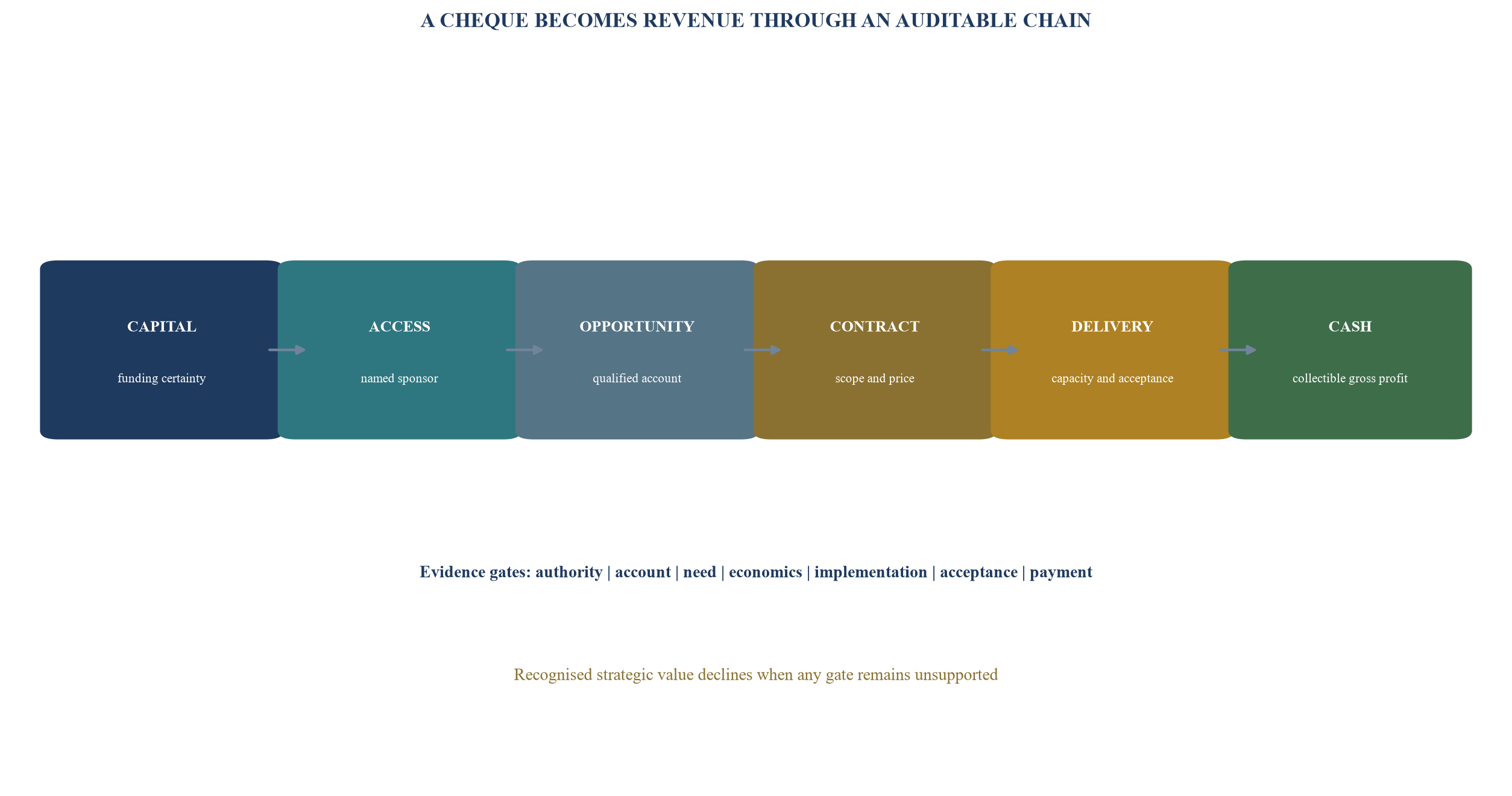
Strategic value is recognised only as commercial commitments move from access claims to collectible gross profit; every transition requires named evidence.
2. Separate the investor cheque from the commercial proposition
A strategic investor may negotiate the financing and the commercial relationship through different teams. The venture unit may sponsor the investment, while a business unit owns the customer problem, procurement controls vendor onboarding, information security approves data access and a regional team owns the budget. An investment committee’s enthusiasm is therefore not evidence that the operating organisation can or will buy.
The company should request two documents. The financing term sheet should cover price, instrument, funding, conditions, board rights, information rights, reserved matters, transfers, pre-emption, pro rata participation and exit provisions. The commercial value schedule should identify each proposed pathway to revenue: direct procurement, resale, referral, co-selling, embedded distribution, product integration, licensing, joint tendering, manufacturing or geographic market access. Each pathway needs a responsible executive, decision authority, budget source, target accounts, milestones and evidence date.
The two documents should be linked carefully. The company may make part of a funding tranche conditional on objective integration or commercial milestones. It should avoid making core funding dependent on targets controlled entirely by the investor, such as internal procurement timing or a discretionary sales forecast. The board should distinguish conditions that prove product-market execution from conditions that allow the investor to delay capital.
Commercial commitments need an enforceability grade. A signed minimum purchase agreement with defined pricing and acceptance is stronger than a non-binding memorandum. A committed integration budget is stronger than technical assistance described as available. Named customer introductions with accountable relationship owners are stronger than access to a network. A board observer who promises to help is not a substitute for the commercial organisation’s written commitments.
This separation protects both parties. The investor can assess the financial investment without embedding unpriced commercial obligations in governance rights. The company can test the commercial proposition without granting permanent control for a promise that may expire after the investment closes. The board can then compare proposals on a common basis.
Table 1. Strategic capital and venture capital decision comparison
| Decision dimension | Strategic capital question | Venture capital question | Board evidence |
|---|---|---|---|
| funding certainty | is the investment budget approved independently of procurement? | are commitments, reserves and syndicate participation confirmed? | signed terms, funds evidence, conditions and closing path |
| revenue access | which business unit, accounts and channel rights are committed? | which introductions and commercial resources are credible? | commercial schedule, named owners and stage evidence |
| governance | do strategic rights exceed minority protection? | do standard investor rights preserve operating flexibility? | rights matrix, thresholds and conflict protocol |
| information | could the investor receive competitively sensitive data? | is reporting proportionate to financial oversight? | clean-team design, reporting pack and exclusions |
| future financing | could the investor deter competitors or new investors? | can the investor support or syndicate later rounds? | investor map, consent analysis and signalling test |
| exit | do acquisition rights or commercial dependencies narrow buyers? | do preference and drag terms support an executable exit? | exit scenarios, transfer terms and change-of-control review |
The board should replace general descriptions with proposal-specific evidence and should not assume that either investor type has a uniform operating model.
3. Translate “unlock revenue” into a falsifiable claim
Revenue access should be expressed as a set of propositions that can be disproved. The investor may claim that its brand will accelerate enterprise trust, its sales force will introduce buyers, its product will create embedded distribution or its procurement will become an anchor account. Management should state what would have to occur for each claim to be true and what evidence would show failure.
A named-account model begins with the addressable customer list. For each account, record the investor’s relationship, sponsor seniority, identified need, product fit, current vendor or alternative, procurement route, data or security requirements, expected contract value, gross margin, implementation cost, decision date and collection profile. The model should assign a confidence stage based on external evidence, rather than management enthusiasm.
The funnel can use defined gates: sponsor identified, problem confirmed, buyer meeting held, technical fit validated, budget confirmed, procurement initiated, proposal issued, contract signed, service accepted and cash collected. Each gate should have a dated source. Probability weights are illustrative management assumptions and should be calibrated against the company’s own historical conversions. An investor’s introduction can advance an account to a meeting; it does not convert the account into revenue.
The model should also test incremental value. If management already has access to an account, the strategic investor may add little origination value. It may still add credibility, integration or faster procurement. Incrementality is the difference between the expected outcome with the investor and the expected outcome under a credible independent plan. The relevant economic benefit is incremental gross profit and enterprise capability, net of concessions, delivery costs and strategic restrictions.
The company should set a pre-close evidence sprint. During a defined period, the investor can arrange customer interviews, technical workshops, procurement scoping and channel planning under appropriate confidentiality. The results allow the board to update the funnel before permanent equity rights are granted. If the investor cannot mobilise its organisation during diligence, management should explain why post-close execution would be different.
4. Build a commercial commitment ladder
Commercial promises occupy different levels of commitment. At the lowest level, the investor offers brand association, general introductions or access to events. These activities can be useful, yet they do not create accountable revenue. The next levels include named executive sponsorship, account mapping, co-selling resources, integration support and preferred-vendor qualification. Higher levels include funded implementation, minimum purchases, volume commitments, resale obligations or a contracted launch plan.
The board should value each level differently. A warm introduction may reduce origination time. A completed vendor approval may shorten procurement. A funded integration may reduce product cost and improve adoption. A minimum purchase can provide contracted revenue subject to delivery, acceptance, termination and credit terms. The schedule should record the economic benefit, probability, cost, dependency and evidence for each item.
The company should avoid giving permanent financing rights in exchange for low-level commitments. A right of first refusal over a future sale can outlive the executive who made the introduction promise. Exclusivity can block a competing channel before the proposed channel has delivered. Broad information rights can expose customer pricing and product plans to a corporate investor with adjacent businesses. Rights should be proportionate to evidence and capable of narrowing or expiring when commercial milestones are missed.
Sunset clauses are central. A preferred channel can step down to non-exclusive status if a minimum pipeline, booking or revenue threshold is not achieved. A board observer’s access can exclude competitively sensitive matters. A pro rata right can remain a conventional financing right, while an acquisition right or commercial veto should have a short duration and objective expiry. The board should model the company after each sunset and after each failure scenario.
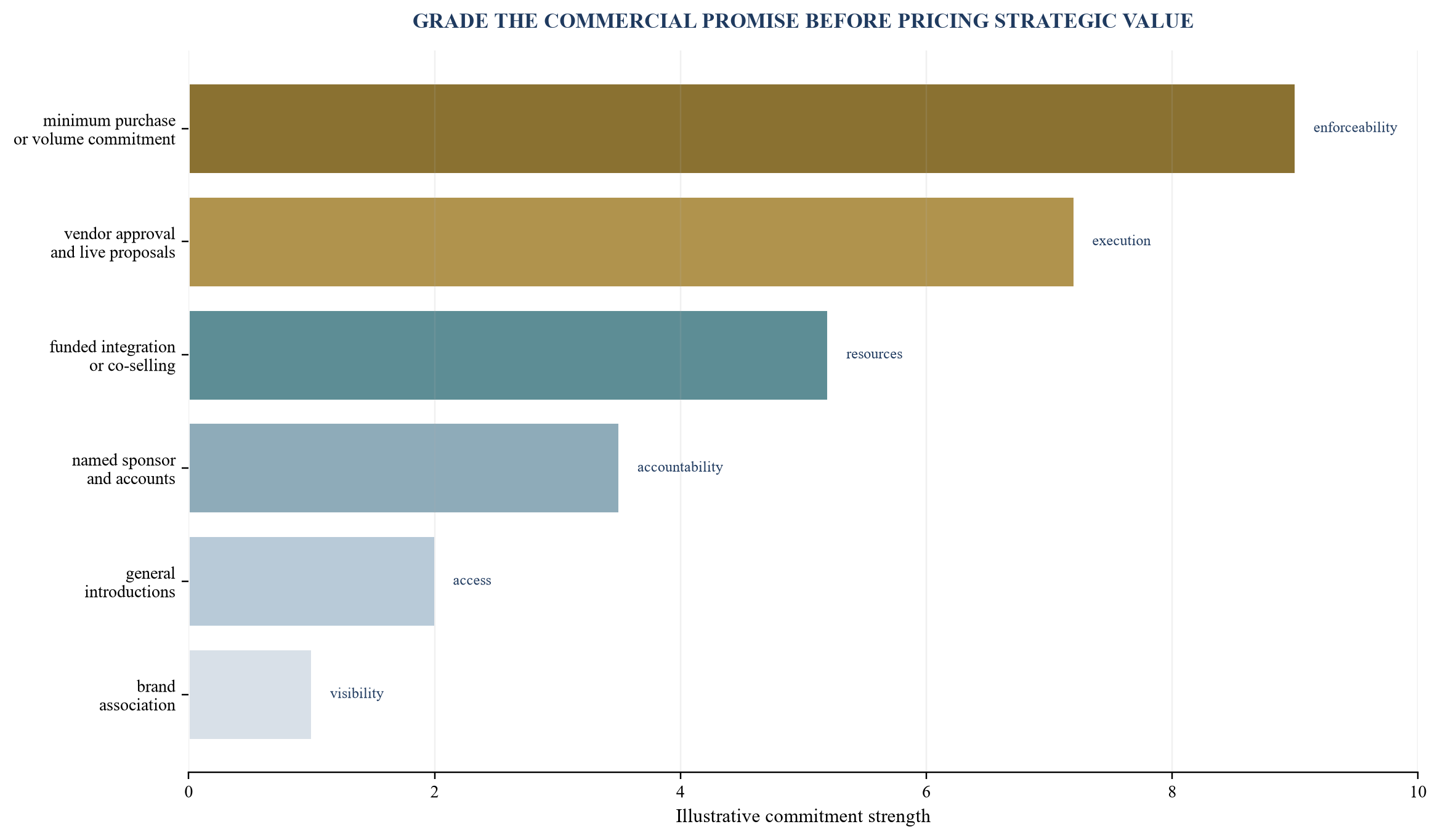
Strategic value rises with authority, resources and enforceability; long-duration investor rights should be matched to high-evidence commitments.
5. Measure revenue quality, not the headline pipeline
A strategic pipeline can be large and economically weak. The board should reconcile bookings, recognised revenue, gross profit and cash. It should test discounts, commissions, integration costs, customer-specific engineering, service credits, working capital, acceptance and renewal. A customer accessed through an investor may demand preferential pricing or bespoke delivery that reduces contribution.
Customer concentration is a separate risk. An anchor account can validate the product and fund scale. It can also shape the roadmap, consume management capacity and weaken negotiating leverage. The model should show the investor-linked customer group as a share of revenue, gross profit, receivables, backlog and product-development effort. Concentration limits can be set as management guardrails, with board escalation if the operating plan crosses them.
Channel conflict should be mapped before the round. Existing distributors, enterprise customers or technology partners may compete with the strategic investor. The investment announcement could change their willingness to share data, carry the product or consider an acquisition. Management should interview material partners under a controlled process where appropriate and record contractual change-of-control, exclusivity and confidentiality provisions.
Revenue quality also depends on collectability and persistence. A funded pilot can provide useful evidence, while recurring production revenue creates a different enterprise-value contribution. The board should test renewal, expansion, implementation dependency, termination for convenience, currency, credit risk and cash conversion. Strategic value should be adjusted when revenue ends with the commercial agreement or depends on subsidised economics.
The model should present a base case, protected downside and stretch case. The protected downside assumes the cheque closes and the commercial relationship underperforms. It tests whether the company still has sufficient runway and freedom to build an independent sales engine. The stretch case is useful for resource planning; it should not justify permanent rights unless the commercial obligations are correspondingly firm.
Table 2. Commercial evidence hierarchy
| Evidence stage | Minimum evidence | Value recognised in board case | Principal challenge |
|---|---|---|---|
| relationship claim | named contact and relationship owner | no committed revenue | access may not reach a budget holder |
| qualified need | buyer confirms problem, timing and fit | probability-weighted opportunity | need may lack budget or authority |
| funded evaluation | approved pilot, scope, budget and success criteria | expected pilot contribution and learning | pilot may not convert to production |
| procurement stage | vendor onboarding, security and commercial review active | probability-weighted contract economics | process can pause or change scope |
| executed contract | signed scope, price, acceptance and payment terms | contracted backlog adjusted for delivery risk | delivery and termination remain material |
| collected production revenue | accepted delivery and cash received | realised gross profit and renewal evidence | concentration and persistence require monitoring |
Values and probabilities are company-specific; the hierarchy distinguishes evidence quality without assigning market conversion rates.
6. Compare term sheets on a common economic basis
Headline valuation is one component of financing economics. The board should compare the amount funded at closing, security type, liquidation preference, participation, dividends, anti-dilution, option-pool treatment, milestone tranches, redemption, pay-to-play, pro rata rights, warranties, fees and conditions. It should model the proceeds to each class under several outcomes and dates.
The National Venture Capital Association’s current model legal documents provide a coherent reference set for US venture financings and were updated to address evolving terms, outbound-investment rules, bulk-data regulation and tranched financing mechanics. They are a starting point, not a substitute for transaction-specific drafting. A strategic investor may ask for additional commercial rights outside conventional minority protections; those rights should be isolated in the comparison.
The company should calculate an effective capital price. Start with the cash received. Adjust for transaction costs, required commercial discounts, exclusivity cost, development commitments, minimum cash reserves, delayed tranches and restrictions that change future financing or exit. The calculation is an internal decision tool and should avoid false precision. Its purpose is to reveal where an apparently favourable valuation transfers value elsewhere.
Tranches require special attention. A milestone under management’s control, such as delivering an independently testable product release, can align funding and execution. A milestone controlled by the investor’s procurement, internal approval or customer introductions can create funding uncertainty. The company should assess runway to each tranche, cure rights, independent verification, dispute mechanics and the consequences of a missed milestone.
The board should also model the next financing. A strategic investor may support the round and validate the market. Competing corporate investors may decline to participate if they view the company as aligned with a rival. Financial investors may ask whether the strategic relationship creates preferential rights, sensitive-information exposure or an acquisition overhang. The current round should preserve a credible path to the next one.
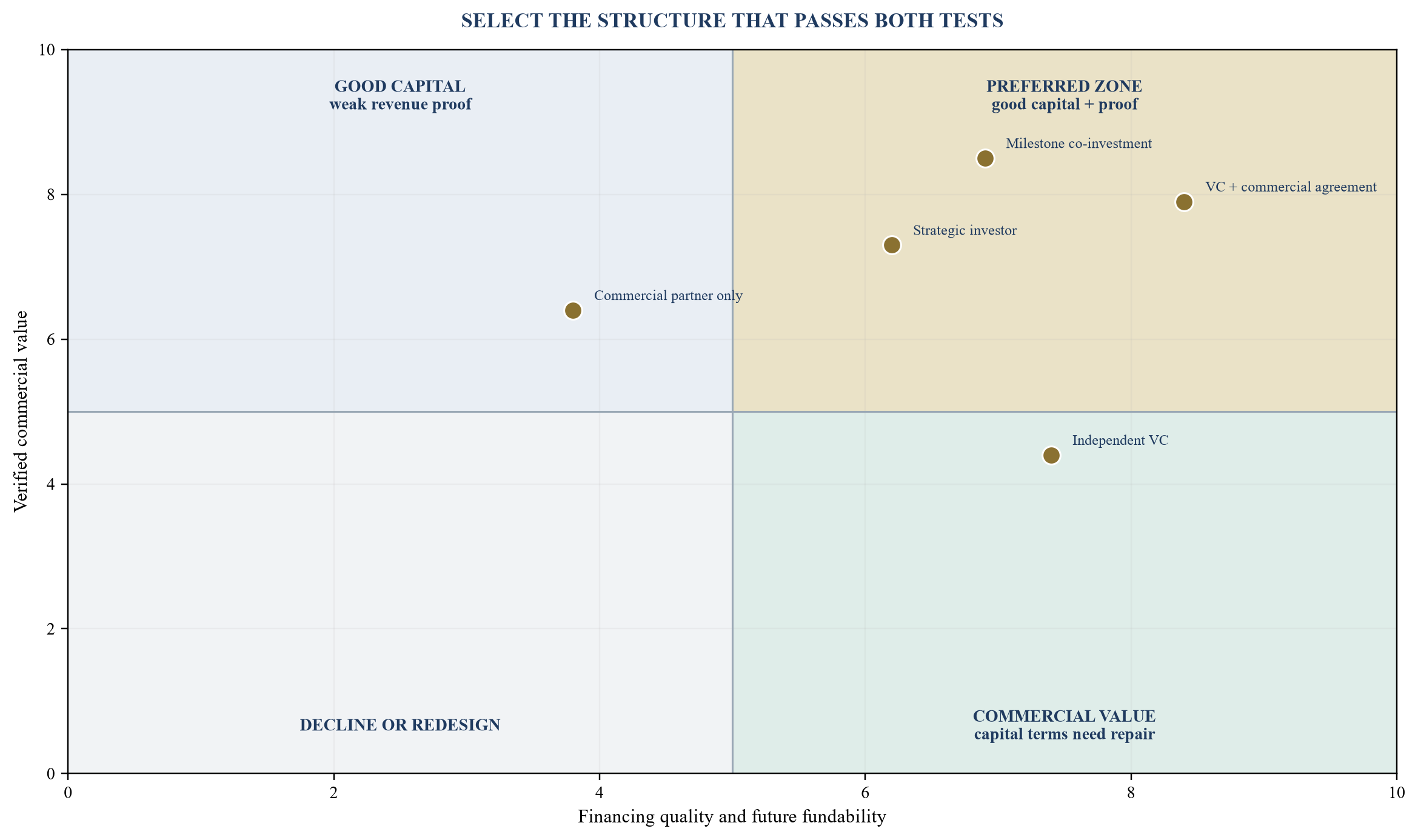
The matrix is a board classification tool; proposal positions must be based on diligence rather than investor type.
7. Design governance rights around protection, not operating leverage
Minority investors commonly seek information, board participation, consent rights, pre-emption, pro rata participation and transfer protections. The board should distinguish rights that protect the investment from rights that influence operating strategy. The distinction matters when the investor is also a customer, supplier or competitor.
Reserved matters should be specific, material and time-bounded where appropriate. Consent over a new share class or sale of substantially all assets can protect against fundamental changes. Consent over budgets, pricing, product design, customer contracts, hiring or ordinary financing can give a minority investor operating leverage. The rights matrix should show who decides, the threshold, the materiality limit, the response deadline and the consequence of silence.
Board participation creates fiduciary, confidentiality and conflict questions under applicable law. A director nominated by a strategic investor may receive information relevant to both entities. The company should define recusals, clean teams, restricted agendas, privilege, data rooms and information exclusions. An observer can still receive sensitive information and influence discussion, so the same risk analysis applies.
The US Department of Justice’s current merger guidance states that partial ownership can affect competition through influence, changed incentives and access to competitively sensitive information. The UK Competition and Markets Authority assesses material influence case by case and can consider board representation and other arrangements as well as voting rights. These sources show why minority status alone does not resolve competition or control analysis.
Rights should be stress-tested under disagreement. Assume the investor’s commercial division misses targets, the company wants to partner with a competitor, a down round is required, the investor declines to follow on and a third party proposes an acquisition. The governance package should allow the board to act for the company while respecting valid minority protections.
Table 3. Rights and red-flag matrix
| Proposed right | Legitimate purpose | Strategic-investor risk | Protection design |
|---|---|---|---|
| board seat or observer | oversight and informed governance | access to competitor, customer or pricing information | recusal, clean team, exclusions and privilege protocol |
| broad information right | monitor financial performance | data leakage or channel conflict | defined reporting pack, purpose limits and restricted data |
| reserved matters | protect against fundamental value changes | operational veto or de facto influence | materiality thresholds, narrow list and response deadline |
| exclusivity | justify channel investment | blocked customers, partners or geographies | scoped field, minimum performance and automatic sunset |
| right of first refusal | preserve acquisition opportunity | buyer deterrence and process delay | short notice, defined response and limited duration |
| pro rata participation | protect ownership in later rounds | financing delay or strategic signalling | conventional scope and clear election timetable |
Legal effect depends on governing law, documents and facts; the matrix is a diligence agenda rather than a legal conclusion.
8. Protect customer data, product roadmaps and intellectual property
Strategic collaboration often requires deeper information exchange than a financial investment. Integration teams may need application interfaces, security architecture, usage data, model performance, manufacturing specifications or customer requirements. The company should classify information before diligence and decide which data can be shared, with whom, for what purpose and under which technical controls.
The investment data room should be separated from the commercial integration room. Financial investors can receive the information required for diligence and governance. Commercial teams can receive the information required for the agreed evaluation. Competitively sensitive customer pricing, forward product plans and partner terms may require redaction, aggregation, external advisers or a clean team. Access logs and expiry dates should be retained.
Intellectual-property terms need a complete background and foreground map. Background intellectual property remains with the contributing party. Foreground intellectual property created during integration may be owned by one party, jointly owned or licensed. Joint ownership can create enforcement, licensing and exit complexity. The documents should address improvements, derivative works, data rights, model outputs, confidentiality, open-source components, sublicensing, termination and transition.
Commercial leverage can arise through technical dependency. A deeply embedded integration may create switching cost, roadmap dependence or a practical barrier to serving competitors. The architecture review should identify proprietary interfaces, hosting, model access, data portability, support obligations and disengagement cost. The company should price the benefit and preserve a documented exit path.
Bulk and sensitive data rules can also affect financing terms. The NVCA’s 2025 updates expressly noted US bulk-data regulation and outbound-investment developments. The company should obtain current advice when strategic investors, controlled affiliates, data sets or technologies engage national-security or data-transfer regimes.
9. Test exclusivity, most-favoured treatment and channel conflict
Exclusivity should have a defined economic purchase price. The board should estimate the opportunities the company gives up, the investment the partner commits and the minimum performance required. The clause should identify product, customer segment, territory, channel, duration and exceptions. A global or all-product restriction in exchange for a regional pilot creates an obvious mismatch.
Most-favoured pricing or commercial terms can propagate concessions to other contracts. The company should define the comparator, net economics, volumes, services, geography and term. It should exclude bespoke development, regulatory cost, promotional periods and materially different bundles where appropriate. The finance team needs a process to monitor compliance without freezing ordinary pricing.
Strategic-investor status can create perceived affiliation even without exclusivity. Competing customers may question confidentiality. Other distributors may reduce commitment. The announcement plan should describe the relationship accurately and preserve neutrality. Use of names, logos and joint claims should require approval and should not imply guaranteed customer adoption.
The board should maintain a channel-conflict register. For each current or target partner, it should record competitive overlap, contract restrictions, data sensitivity, revenue exposure, renewal date and mitigation. The register should be reviewed before the investment announcement and at each commercial expansion.
Performance-based release is the strongest protection. If the investor does not deliver agreed pipeline, integration resources or purchases by the measurement date, exclusivity narrows or ends. The mechanism should use data that both parties can audit and should avoid a discretionary certification by the investor.
10. Map competition and foreign-investment screening before signing
Minority investments can trigger competition or national-security review depending on ownership, rights, investor identity, sector, data, technology and jurisdiction. The analysis should begin during term-sheet design because changing governance rights after filing can alter economics and timing.
In the United Arab Emirates, Federal Decree-Law No. 36 of 2023 regulates competition and addresses restrictive agreements, abuse of dominance and economic concentration. The Ministry of Economy and Tourism describes economic concentration as an act that transfers ownership or rights and enables direct or indirect control. UAE counsel should assess the investment, related commercial agreements and any filing obligations under current implementing rules and thresholds.
In the United States, the Department of Justice’s 2023 Merger Guidelines state that partial ownership can create competition concerns through influence, incentives and information access. The Committee on Foreign Investment in the United States can review certain foreign-control transactions and certain non-controlling covered investments involving relevant US businesses. Treasury’s current guidance emphasises that transaction-specific requirements apply and that national-security mitigation can include effective, verifiable and monitorable measures.
In the United Kingdom, the CMA can assess material influence below legal control by considering voting rights, board representation and other arrangements. The National Security and Investment Act can apply to qualifying acquisitions, with mandatory notification in specified sensitive sectors. Contractual rights and practical influence need fact-specific analysis.
The European Union’s Regulation 2026/1386 creates an updated foreign-investment screening framework, including minimum screening requirements and coverage of sensitive areas. The Foreign Subsidies Regulation separately gives the European Commission powers concerning foreign subsidies and specified concentrations. A company should map ultimate ownership, public financial contributions, technology, sector and affected Member States early.
Singapore’s competition guidance recognises that minority shareholdings can create joint control in some circumstances. India’s Competition Commission addresses acquisitions of control, shares, voting rights and assets, with current rules and exemptions requiring case-specific assessment. Australia’s foreign-investment guidance states that foreign investors may need to notify the Treasurer before acquiring interests or taking actions in Australian businesses, with additional considerations for national-security businesses and foreign government investors. The board should maintain a jurisdiction matrix and critical-path filing schedule.
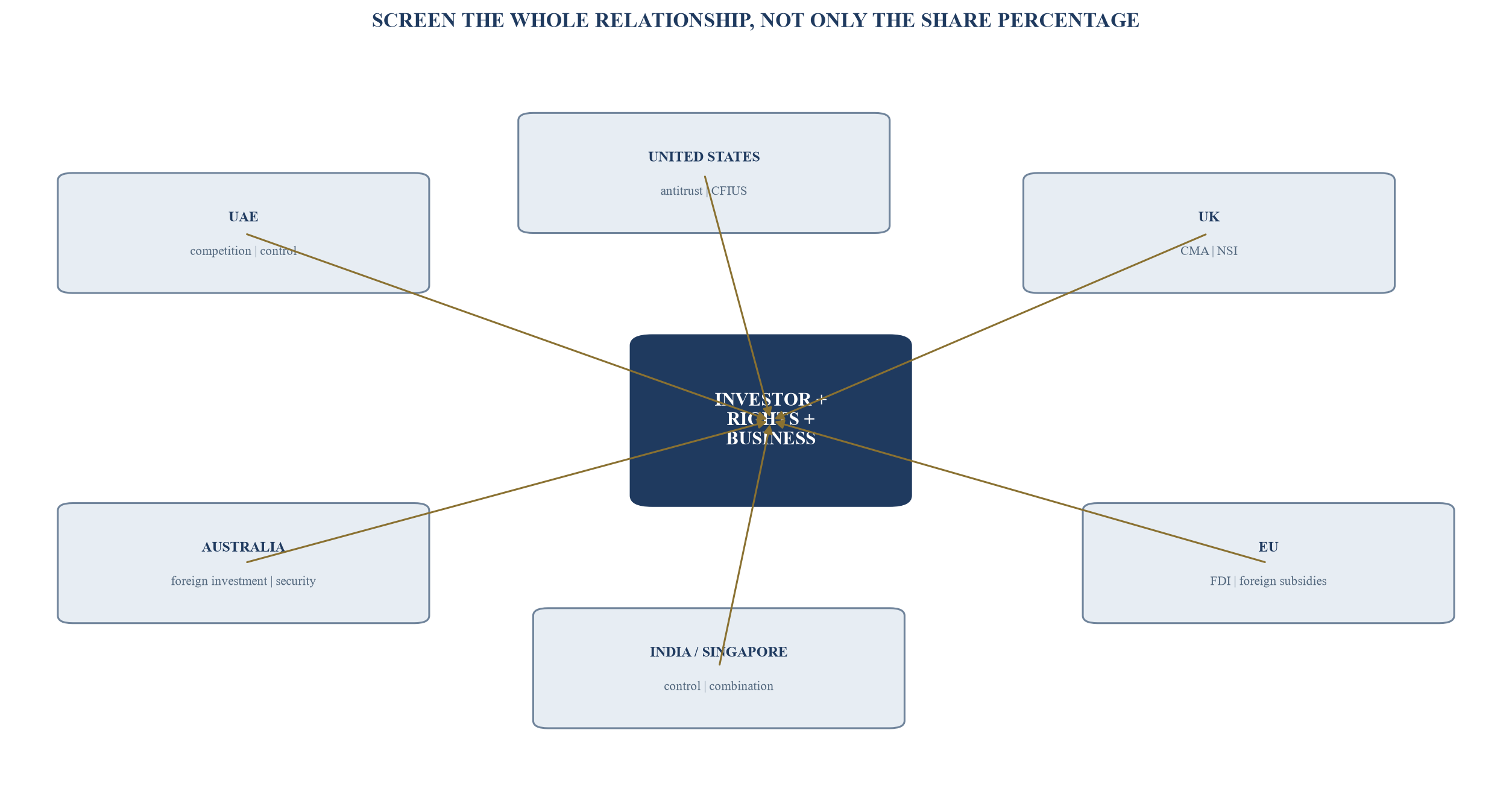
The map identifies screening questions; qualified advisers must determine actual jurisdiction, filing, timing and mitigation requirements.
11. Evaluate corporate venture incentives and strategic continuity
A corporate venture unit can pursue financial return, strategic learning, business-unit growth or a combination. The balance can change after leadership, budget or corporate strategy changes. The company should understand who controls investment decisions, follow-on reserves, commercial resources and exit decisions.
The OECD’s 2026 working paper on corporate venture capital and start-up innovation examines innovation outcomes associated with corporate investment and reports that innovation intensity can decline after investment relative to other venture-backed firms in parts of its analysis, particularly for corporates in high-digital-intensity sectors. The research does not determine the outcome of a specific transaction. It reinforces the need to test incentives, technology overlap, governance and post-investment behaviour rather than treating corporate affiliation as uniformly beneficial.
Management should conduct institutional diligence on the investor. Review the mandate, portfolio, cheque size, reserve policy, decision rights, holding period, commercial-integration process, conflicts, write-off behaviour and exits. Speak with founders whose commercial initiatives succeeded and founders whose initiatives stalled. Ask what happened after the sponsoring executive left or the corporation changed strategy.
The board should identify continuity protections. Named executives can be supplemented by role-based obligations. Commercial milestones can survive internal reorganisation. Access to a channel can be documented at the corporate level. Failure to provide agreed resources can release restrictions. A transition clause can preserve support during a business-unit transfer or sale.
Strategic continuity also affects signalling. If the corporate investor stops participating in a later round, external investors may interpret the decision as negative even when it reflects internal budgets. The financing narrative should establish independent performance evidence and should avoid making follow-on support a hidden premise of the operating plan.
12. Preserve future fundraising and syndication
Future investors will diligence the strategic relationship. They will ask whether customer data is protected, the product remains neutral, exclusivity constrains growth, the corporate investor can block financing, commercial revenue is concentrated and acquisition rights deter exit. The company should build a clean answer at the current round.
The cap table should allow an investable syndicate. A strategic investor can hold a meaningful minority position while independent investors and directors retain credible governance. Co-investment with a financial lead can combine commercial access and institutional financing discipline. Separate term sheets can keep commercial performance measurable and prevent strategic rights from becoming financing rights by default.
Pro rata participation can be conventional, but timing matters. A long election period can delay a financing. Rights that apply to debt, convertibles, employee equity or strategic partnerships can constrain ordinary capital management. The board should map every consent, notice and participation right against a future round timetable.
The information protocol should be designed for a larger investor base. Management reporting can use standard metrics and defined exceptions. Clean-team arrangements should be operational before competing strategics enter diligence. The company should document that the strategic investor cannot use commercial information to disadvantage a financing or partnership process.
The current investor should also understand the independent financing plan. Clear expectations reduce conflict when management approaches competitors, sovereign investors, financial sponsors or public markets. The company should avoid promising a privileged role in an undefined future process.
13. Preserve exit optionality and acquisition tension
Strategic capital can create a credible path to acquisition. It can also reduce competitive tension if other buyers believe the investor has privileged information, contractual blocking rights or a practical ability to match. The board should design the relationship for multiple outcomes.
Rights of first refusal, first offer, matching and negotiation have different effects. A right of first refusal can discourage a bidder that must reveal price and terms before the strategic investor decides. A short right of first offer may be less restrictive, depending on drafting and process. An acquisition discussion can be managed through a time-limited standstill or process letter without creating a permanent right.
Commercial agreements need change-of-control treatment. A buyer will assess whether a critical channel, licence, customer contract or integration terminates upon acquisition. A strategic investor may seek termination if a competitor buys the company. The company should model buyer categories and negotiate continuity, transition or buyout mechanisms that preserve value.
The board should run three exit simulations: a sale to the strategic investor, a sale to its competitor and a sale to a financial buyer. For each, identify consent, information, contract assignment, termination, pricing, data migration, regulatory filing and employee implications. The exercise reveals where the current deal creates an acquisition overhang.
Independent evidence of product value and customer demand preserves tension. Revenue outside the strategic ecosystem, transferable intellectual property, portable data and multiple financing relationships give buyers confidence that the company is not a captive asset.
Table 4. Cross-border screening and diligence questions
| Jurisdiction | Principal official framework considered | Term-sheet question | Evidence for the board |
|---|---|---|---|
| United Arab Emirates | Federal Decree-Law No. 36 of 2023 on competition | do equity and commercial rights create control or restrictive conduct concerns? | ownership, rights, market definition and filing analysis |
| United States | DOJ merger guidance and CFIUS rules | does minority influence, sensitive information or foreign investment create review risk? | investor identity, technology, data, rights and filing memo |
| United Kingdom | CMA jurisdiction guidance and National Security and Investment Act | could rights create material influence or a qualifying acquisition? | voting, board, contractual influence and sector assessment |
| European Union | Regulation 2026/1386 and Foreign Subsidies Regulation | are sensitive-sector screening or foreign-contribution rules engaged? | ultimate ownership, public support, sector and Member State map |
| Singapore and India | CCCS merger guidance and CCI combinations framework | do shareholding and veto rights amount to control or a combination? | rights analysis, thresholds, overlaps and notification path |
| Australia | foreign-investment business and national-security guidance | does the investor or action require Treasurer notification? | investor status, business type, interest and approval plan |
This summary is not a filing determination; current legislation, thresholds and facts must be reviewed by qualified advisers.
14. Choose the structure that matches the evidence
The board has more choices than a binary strategic-versus-venture decision. Independent venture capital can fund the company while management signs a separate commercial agreement with the corporation. A corporate investor and financial lead can co-invest. The corporation can invest a small first tranche and earn participation in a later tranche after defined integration milestones. A joint venture can govern a specific geography or product while the parent remains independent.
Independent venture capital is appropriate when the company values neutrality, needs a strong financing syndicate and can build commercial access through ordinary partnerships. A direct strategic minority investment is appropriate when the corporate relationship is central, the commercial evidence is strong and restrictions are bounded. A venture-led round plus separate commercial agreement is appropriate when both parties want to prove revenue before creating strategic governance.
Co-investment can create balance. The financial lead can benchmark financing terms and help preserve institutional governance. The strategic investor can provide operating assets. The documents should address information asymmetry and conflicts between the two investors. Neither should assume the other is responsible for commercial execution.
Milestone-tranched strategic capital can align evidence and ownership. The initial tranche funds the integration. The later tranche closes when objective product or commercial conditions are achieved. Funding certainty, runway and investor-controlled dependencies must be tested. The 2025 NVCA document update includes tranched-financing mechanics that can inform counsel’s drafting in relevant US transactions.
A joint venture can isolate a channel, market or regulated activity. It also creates governance, funding, transfer-pricing, intellectual-property, competition and exit questions. The company should use it when operational separation creates real value, rather than as a decorative compromise.
Table 5. Financing and partnership structure menu
| Structure | Best use | Main advantage | Main control requirement |
|---|---|---|---|
| independent VC round | neutrality and financing scale are primary | clean commercial optionality and syndication | credible standalone go-to-market plan |
| strategic minority investment | verified corporate access is central | aligned capital and operating relationship | bounded rights, clean information and milestone evidence |
| VC round plus commercial agreement | revenue thesis needs proof | separates funding from channel performance | independent agreements and no hidden cross-default |
| VC and strategic co-investment | both financing discipline and access matter | balanced investor capabilities | conflict protocol and clear lead responsibilities |
| milestone-tranched strategic round | integration can be objectively tested | capital follows evidence | adequate runway and no investor-controlled funding gate |
| market or product joint venture | activity benefits from ring-fenced assets and governance | dedicated resources and economic sharing | IP, control, funding, competition and exit design |
Suitability depends on commercial evidence, risk allocation, jurisdiction and future strategy.
15. Build the probability-adjusted commercial value bridge
The commercial model should start with named opportunities and end with incremental cash contribution. For each account, management estimates contract value, probability by evidence stage, gross margin, implementation cost, sales commission, working-capital requirement, collection timing and expected duration. The model then subtracts cannibalisation, discounts, exclusivity cost and customer-concentration reserve where management uses such a risk allowance.
The bridge should compare two cases. The strategic case reflects the investor relationship and documented commitments. The independent case reflects what management can credibly achieve with venture capital, ordinary partnerships and internal sales investment. Strategic value is the difference between the cases, adjusted for timing and risk. Existing pipeline should not be attributed to the investor unless the investor changes its probability, timing or economics with evidence.
Management should avoid double counting. A lower customer-acquisition cost and faster revenue may describe the same benefit. A funded integration and lower development cost may overlap. Brand credibility should not be valued separately if its effect is already captured in funnel conversion. The bridge should link each benefit to one operating driver.
The downside case assumes access is delayed, conversion is lower, pricing is discounted and implementation costs are higher. The company should remain viable under this case or size the financing accordingly. The model should reveal the runway required to build an independent channel if the strategic pathway stalls.
Every input should be tagged as contracted, externally evidenced, internally evidenced or illustrative. Illustrative management assumptions can support scenario design; they should not be presented as forecast certainty. The board should approve the evidence grade and identify the conditions that would cause management to revise it.
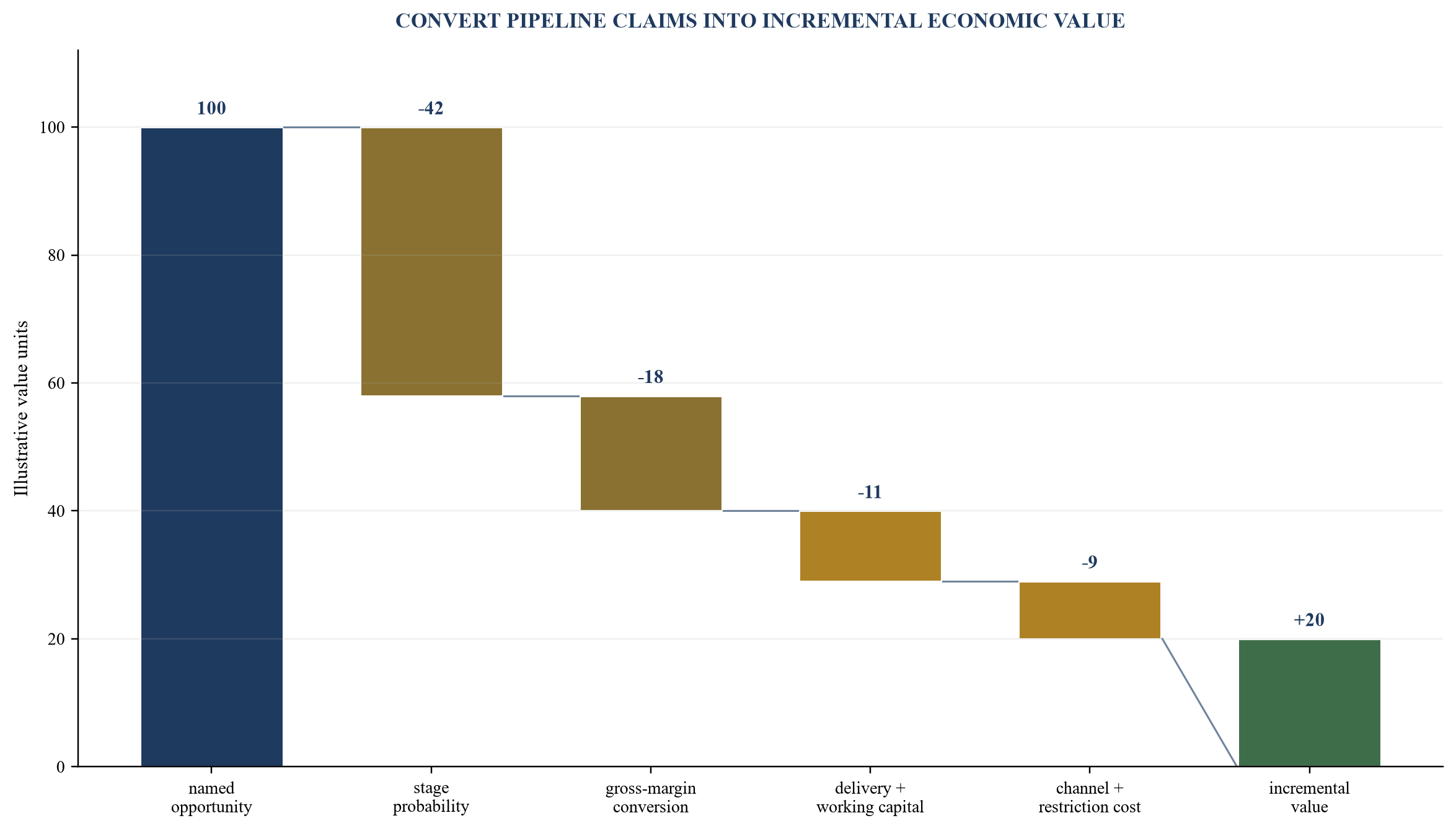
Amounts are illustrative management assumptions in arbitrary units and demonstrate mechanics rather than forecast or benchmark outcomes.
16. Run a disciplined investor diligence process
Investor diligence should be reciprocal. The investor examines the company’s product, market, team, financials, technology and compliance. The company examines the investor’s capital, incentives, commercial machinery, governance behaviour and regulatory profile. A recognised name does not remove the need for evidence.
The diligence workstream should cover fund or balance-sheet authority, final decision maker, investment vehicle, beneficial ownership, sanctions and integrity, reserve policy, follow-on process, portfolio conflicts, board practices, information security, commercial integration resources, procurement path and exits. References should include companies that received follow-on capital and companies that did not.
Commercial diligence should move beyond presentations. Ask the proposed business sponsor to identify accounts, budgets and internal resources. Hold workshops with sales, product, procurement, security and legal teams. Confirm whether the corporation can resell, refer, buy, integrate or certify the product. Document the approvals still required.
The company should also assess execution capacity. A strategic agreement can create demand faster than the company can deliver. Management should model product work, implementation staff, support, security, localisation, insurance, working capital and leadership attention. The financing should fund the operating burden of the commercial promise.
Findings should be captured in a red-flag log with owner, severity, proposed protection and closure evidence. Material open items should appear in the board paper and closing conditions. Diligence that remains in email threads is difficult to govern after executives change.
17. Negotiate one integrated documentation architecture
The transaction may involve a subscription or stock purchase agreement, shareholders’ or investors’ rights agreement, voting agreement, commercial agreement, data agreement, intellectual-property licence, distribution or referral agreement, services statement, board protocol and disclosure letter. The documents should be designed as one architecture.
Definitions must align. “Affiliate,” “competitor,” “customer,” “confidential information,” “change of control,” “field,” “territory,” “product” and “revenue” can have different meanings across documents. A broad affiliate definition in the commercial agreement can extend restrictions to companies acquired by the investor. A change-of-control clause can conflict with transfer and drag provisions.
Cross-default should be used carefully. A commercial dispute should not automatically create a financing default or repurchase right unless the consequence is proportionate and clearly intended. A missed revenue target should ordinarily change commercial rights, rather than reverse a completed equity investment. Material fraud or illegality can warrant different treatment.
The documents should establish hierarchy and dispute resolution. They should specify which agreement controls if provisions conflict, how experts determine technical or accounting questions, and which forum resolves broader disputes. Interim relief, confidentiality and continued service during disputes may be material.
Schedules are valuable. A commercial value schedule can list commitments and evidence. An information schedule can define permitted reporting and exclusions. A rights schedule can show sunsets. A regulatory schedule can allocate filing responsibilities. A single closing checklist should link each obligation to an owner and source document.
18. Govern execution through a joint operating cadence
Closing is the start of the strategic-capital programme. The company needs an operating cadence that connects investor relations, commercial execution and board oversight. Without it, the financing remains visible while the revenue thesis becomes diffuse.
A joint steering committee can meet monthly during launch. It should include accountable business owners, commercial leads, product or implementation leadership and a finance representative. Its dashboard should track named accounts, funnel stage, next action, integration milestones, resources, contract economics, delivery capacity, issues and decisions. The steering committee should not replace the company’s board or grant the investor operating authority beyond the documents.
The board should receive a quarterly strategic-capital scorecard. It should compare actual results with the approved base and downside cases. Measures can include meetings with qualified buyers, procurement progress, signed contracts, gross profit, cash collection, implementation cost, concentration, renewal, channel conflicts and financing effects. Each metric should have a source and owner.
Failure should trigger a predefined response. Management may narrow exclusivity, reallocate sales resources, activate an independent channel, revise the product plan or raise additional capital. The response should protect customer relationships and preserve evidence for future investors.
Success should also be governed. Rapid demand can create implementation failures or concentration. The company should sequence customers, protect service quality and avoid accepting loss-making custom work solely to validate the strategic narrative.
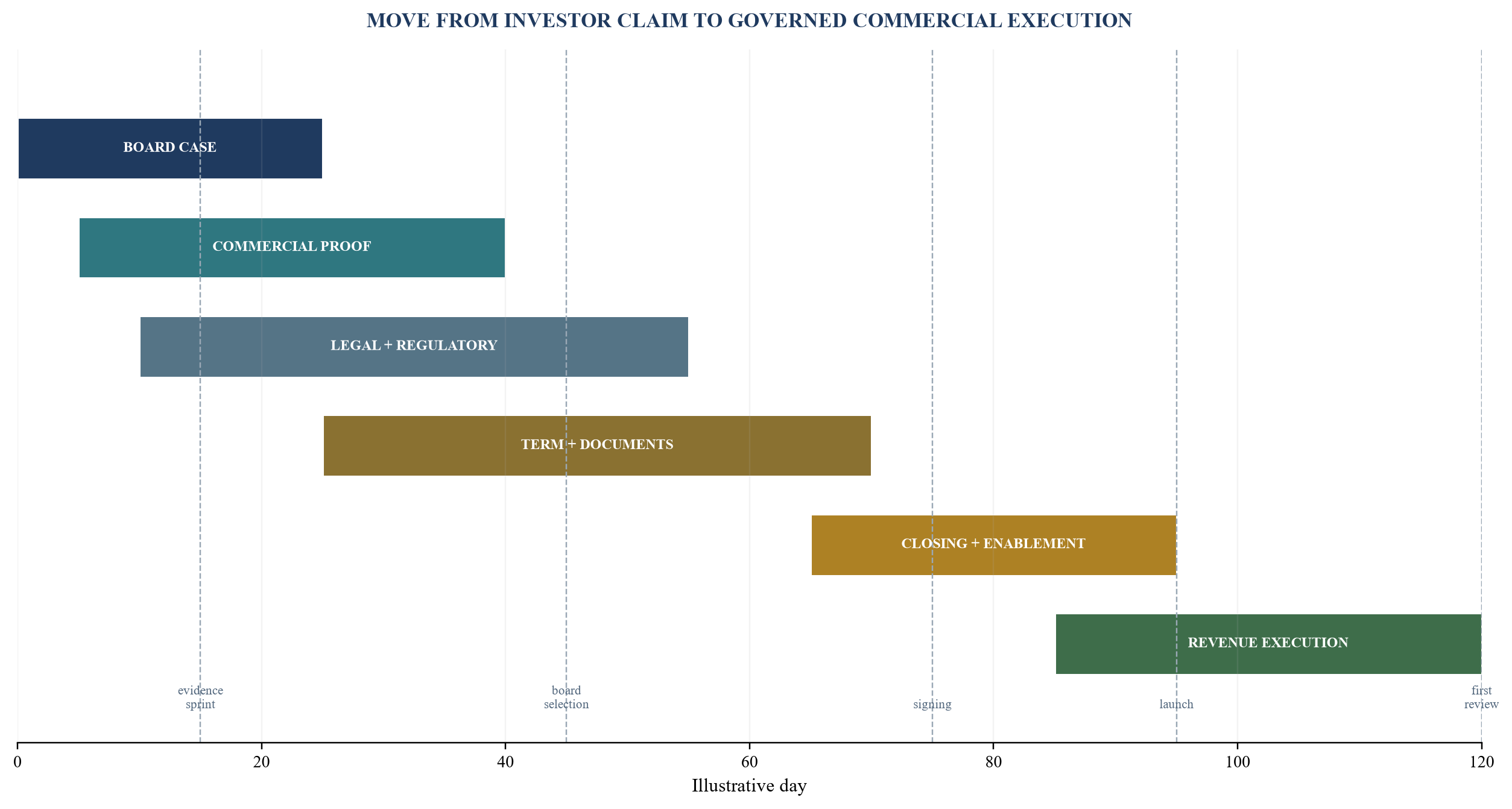
Timing is an illustrative management sequence and should be adapted to transaction complexity, regulatory review and company capacity.
19. Use a board close standard
The board should approve the transaction only when it can answer a compact set of questions. What outcome is the capital intended to fund? Which commercial benefits are contracted, externally evidenced, internally evidenced or illustrative? What is the effective financing price after restrictions and implementation cost? Which rights protect the investor and which influence operations? How are data, intellectual property and conflicts controlled? Which regulatory filings or clearances are required? What happens if the commercial relationship fails? What happens if it succeeds faster than planned?
The approval pack should include the capital comparison, commercial value schedule, probability-adjusted model, rights matrix, cap table, exit simulations, regulatory memo, conflict register, execution budget and 120-day plan. Legal documents should be substantially advanced before final approval. Open items need owners and conditions.
Directors should record the alternatives considered. These can include venture capital, strategic capital, debt, a smaller round, a commercial partnership without equity, co-investment or staged financing. The record should explain why the selected structure serves the company’s strategy and how material risks are protected.
The board should set post-close review dates and delegated authority. Management may operate within approved commercial and financing limits. Changes to exclusivity, data access, investor rights, material pricing or product scope should return to the appropriate decision body.
The close standard should remain reader-friendly. It supports decision quality; it does not replace legal duties, investor disclosure or professional advice. Management should distinguish verified facts, contracted commitments and illustrative management assumptions throughout the pack.
Table 6. Board close and post-close scorecard
| Gate | Close evidence | Post-close measure | Escalation trigger |
|---|---|---|---|
| capital | committed funds, conditions, cap table and waterfall | runway, tranche status and financing plan | funding delay or runway below policy |
| commercial | named accounts, owners, resources and signed obligations | funnel movement, contracts, gross profit and cash | missed milestones or unsupported pipeline |
| governance | final rights matrix, conflicts and information protocol | consents, recusals and reporting timeliness | operational veto or information breach |
| strategic freedom | exclusivity scope, sunsets and partner impact | concentration, channel conflict and new partnerships | restriction blocks qualified opportunity |
| regulatory | jurisdiction memo, filings and clearance plan | conditions, monitoring and compliance evidence | filing delay, remedy or scope change |
| exit and financing | buyer simulations and next-round timetable | investor interest, transfer constraints and data-room readiness | buyer deterrence or financing blockage |
The board should specify company-specific thresholds and retain dated evidence for every status.
20. Conclusion
Strategic capital can accelerate revenue when the investor has relevant assets, accountable operating sponsors and enforceable commitments. Venture capital can preserve neutrality, governance discipline and future financing access. The board should select the structure that converts the company’s defined objective into the highest probability-adjusted enterprise value while preserving control and strategic freedom.
The essential discipline is separation. The cheque belongs in a financing model. The revenue claim belongs in a commercial evidence schedule. Governance and restrictions belong in a rights architecture. Regulatory questions belong in a jurisdiction map. The decision brings the four workstreams together only after each has been tested.
The framework is executable. Define the outcome, build the independent case, grade the investor’s commitments, model incremental gross profit, compare complete financing economics, protect data and intellectual property, assess control and screening, select the appropriate structure and govern the first 120 days. This turns a strategic-capital story into a board-controlled programme.
The result is a financing that can be judged after closing. Investors and management can see which accounts progressed, which commitments were delivered, what economics were created and which rights remain justified. Future financiers and buyers can understand the relationship without assuming the company is captive. The company retains a credible path if the strategic promise underperforms and a scalable operating model if it succeeds.
References
- Organisation for Economic Co-operation and Development. Corporate venture capital and start-up innovation in the digital age. OECD Science, Technology and Industry Working Papers 2026/05. 3 April 2026. https://doi.org/10.1787/43604dfc-en
- National Venture Capital Association. Model Legal Documents. Current page accessed August 2026. https://nvca.org/model-legal-documents/
- National Venture Capital Association. NVCA Releases 2025 Updates to Model Legal Documents. 2 October 2025. https://nvca.org/press_releases/nvca-releases-2025-updates-to-model-legal-documents/
- United States Department of Justice, Antitrust Division. 2023 Merger Guidelines. 18 December 2023. https://www.justice.gov/atr/2023-merger-guidelines
- United States Department of Justice, Antitrust Division. Guideline 11: Partial Ownership or Minority Interests. https://www.justice.gov/atr/merger-guidelines/applying-merger-guidelines/guideline-11
- United States Department of the Treasury. The Committee on Foreign Investment in the United States. Current page accessed August 2026. https://home.treasury.gov/policy-issues/international/the-committee-on-foreign-investment-in-the-united-states-cfius
- United States Department of the Treasury. CFIUS Frequently Asked Questions. Current page accessed August 2026. https://home.treasury.gov/policy-issues/international/the-committee-on-foreign-investment-in-the-united-states-cfius/cfius-frequently-asked-questions
- United States Department of the Treasury. CFIUS Mitigation. Current page accessed August 2026. https://home.treasury.gov/policy-issues/international/the-committee-on-foreign-investment-in-the-united-states-cfius/cfius-mitigation
- UK Competition and Markets Authority. Mergers: Guidance on the CMA’s jurisdiction and procedure. Updated 2025. https://www.gov.uk/government/publications/mergers-guidance-on-the-cmas-jurisdiction-and-procedure
- UK Government. National Security and Investment Act 2021: guidance on acquisitions. Current page accessed August 2026. https://www.gov.uk/guidance/national-security-and-investment-act-guidance-on-acquisitions
- European Union. Regulation (EU) 2026/1386 on the screening of foreign investments in the Union. 17 June 2026. https://eur-lex.europa.eu/legal-content/EN/TXT/?uri=CELEX:32026R1386
- European Commission. Investment screening. Current page accessed August 2026. https://policy.trade.ec.europa.eu/enforcement-and-protection/investment-screening_en
- European Commission, Directorate-General for Competition. Foreign Subsidies Regulation: legislation. Current page accessed August 2026. https://competition-policy.ec.europa.eu/foreign-subsidies-regulation/legislation_en
- UAE Ministry of Economy and Tourism. Regulation of Competition. Current page accessed August 2026. https://www.moet.gov.ae/en/regulation-of-competition
- UAE Ministry of Economy and Tourism. Federal Decree-Law No. 36 of 2023 Regulating Competition. https://www.moet.gov.ae/documents/20121/0/Federal%2BDecree-Law%2BNo.%2B%2836%29%2Bof%2B2023%2BRegulating%2BCompetition.pdf/d5f2b12d-7688-5180-e63b-44a8dbe878d6
- Competition and Consumer Commission of Singapore. Guidelines on the Substantive Assessment of Mergers. https://www.cccs.gov.sg/-/media/custom/ccs/files/legislation/ccs-guidelines/revised-guidelines-jan-2022/4-cccs-guidelines-on-the-substantive-asessment-of-mergers.pdf
- Competition and Consumer Commission of Singapore. Merger Assessment Process. Current page accessed August 2026. https://www.cccs.gov.sg/get-in-touch/for-businesses/notify-a-merger/merger-assessment-process
- Competition Commission of India. Regulation of Combination. Current page accessed August 2026. https://cci.gov.in/regulation-of-combination
- Competition Commission of India. CCI Criteria of Combination Rules 2024. 9 September 2024. https://www.cci.gov.in/legal-framwork/rules/77/0
- Australian Government. Foreign investment: Business investments. Updated 1 July 2026. https://foreigninvestment.gov.au/guidance/types-investments/business-investments
- Australian Government. Foreign investment: Key concepts. Current page accessed August 2026. https://foreigninvestment.gov.au/guidance/general/key-concepts
- Abu Dhabi Global Market. Companies Regulations 2020. Current legislation page accessed August 2026. https://www.adgm.com/legal-framework/legislation
