

1. Treat closing as the start of a new execution baseline
A financing closes a transaction and opens an execution period. The company now has additional cash or committed funding, a revised capital structure, new or amended investor rights and an investment case that may contain explicit or implicit expectations about growth, product delivery, geographic expansion, profitability, governance and the next financing event. Those elements should be translated into a controlled baseline before operating activity accelerates.
The baseline should identify the cash actually received, transaction expenses, restricted amounts, committed tranches, foreign-exchange exposure, debt-like obligations, option-pool effects, shareholder rights and any conditions that continue after closing. It should also preserve the assumptions used in the approved plan: revenue drivers, hiring sequence, product releases, regulatory dependencies, capital expenditure, working capital, acquisition activity and the date at which another financing decision could become necessary.
The G20/OECD Principles of Corporate Governance describe corporate governance as the structures and systems through which objectives are set, performance is monitored and boards direct strategy while overseeing management, risk, controls and reporting.[1] The Principles also emphasise timely, accurate and comparable information on financial and operating results, material risks and governance. That logic applies with proportionate adaptation to a private company whose reporting obligations arise mainly from law, constitutional documents and investment agreements.
The baseline is not a promise that every assumption will occur. It is the reference against which management explains change. A reliable plan retains the financing case, the first approved operating plan and later revisions as separate versions. When market evidence changes, the board can then see whether the difference arises from execution, timing, a revised choice or an external event.
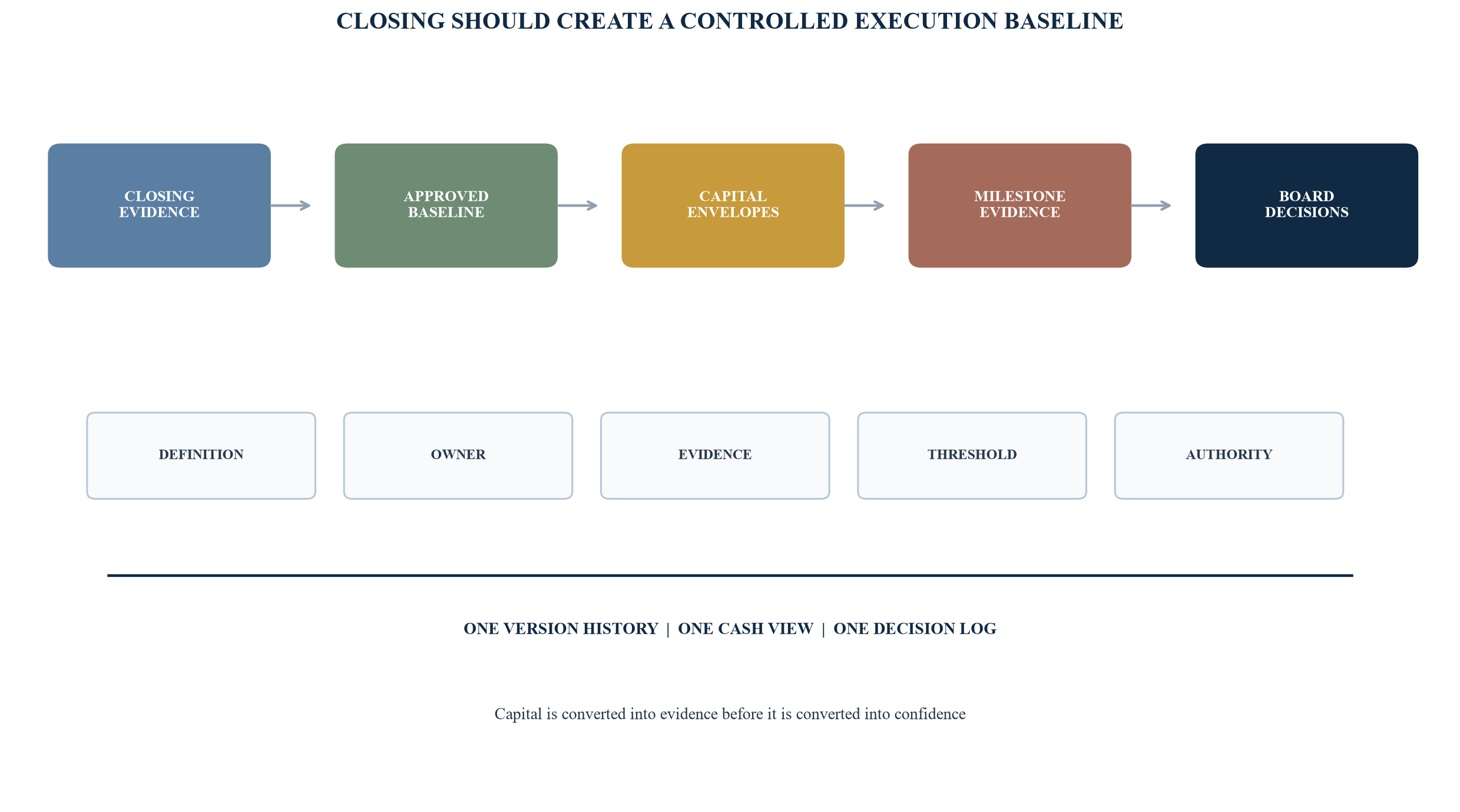
The architecture is a generic management model. Legal rights, approval authorities and reporting obligations should follow the executed documents and applicable law.
Table 1. Minimum content of the post-raise baseline
| Baseline component | Evidence | Management question | Control owner |
|---|---|---|---|
| net funding | bank evidence, completion statement and facility records | What capital is available, when and subject to which restrictions? | CFO or finance lead |
| ownership and rights | cap table, constitutional documents and executed agreements | Which approvals, information rights and reserved matters apply? | company secretary and legal adviser |
| approved plan | investment case, operating model and board approval | Which assumptions and outcomes supported the decision to raise? | CEO and CFO |
| committed obligations | contracts, purchase orders, payroll and financing documents | Which cash outflows are already difficult or costly to reverse? | functional owners and finance |
| decision horizon | cash runway, milestone dates and financing lead time | When must management choose to accelerate, correct, pause or finance? | executive team and board |
| reporting architecture | metric dictionary, close calendar and board timetable | Can every reported measure be reproduced and challenged? | CFO and data owners |
The fields are illustrative. Executed transaction documents and applicable requirements determine the legal baseline.
2. Convert use of funds from categories into outcome envelopes
Use-of-funds schedules commonly allocate percentages to product, sales, hiring, capital expenditure, acquisitions and working capital. Those categories explain where money may be spent. They do not establish what the spending should achieve or when it should stop. An outcome envelope adds five controls: objective, authorised capacity, release gate, evidence requirement and reallocation authority.
The envelope should connect expenditure to an operating mechanism. Product investment may be intended to deliver a validated release, reduce implementation time or meet a technical or regulatory requirement. Commercial investment may be intended to create qualified pipeline, improve conversion, reduce customer acquisition payback or enter a defined market. Capacity investment may be intended to remove a measured constraint. The causal claim should be stated before spending begins.
Each envelope should separate committed, conditionally approved and unallocated capital. Committed expenditure includes executed contracts, accepted offers and other obligations within their applicable terms. Conditional capital becomes available only after a milestone or board decision. Unallocated capital preserves optionality and should not be treated as an invitation to spend. The board can set the size and control of each category according to the company's stage, volatility and obligations.
The National Venture Capital Association's model legal documents include an Investors' Rights Agreement and related financing documents that illustrate information, governance and contractual rights used in US venture financings.[2] The documents are models rather than a substitute for transaction-specific advice, and practices differ across jurisdictions. Their relevance here is the need to map the operating plan to the actual rights, covenants and approval architecture created by the financing.
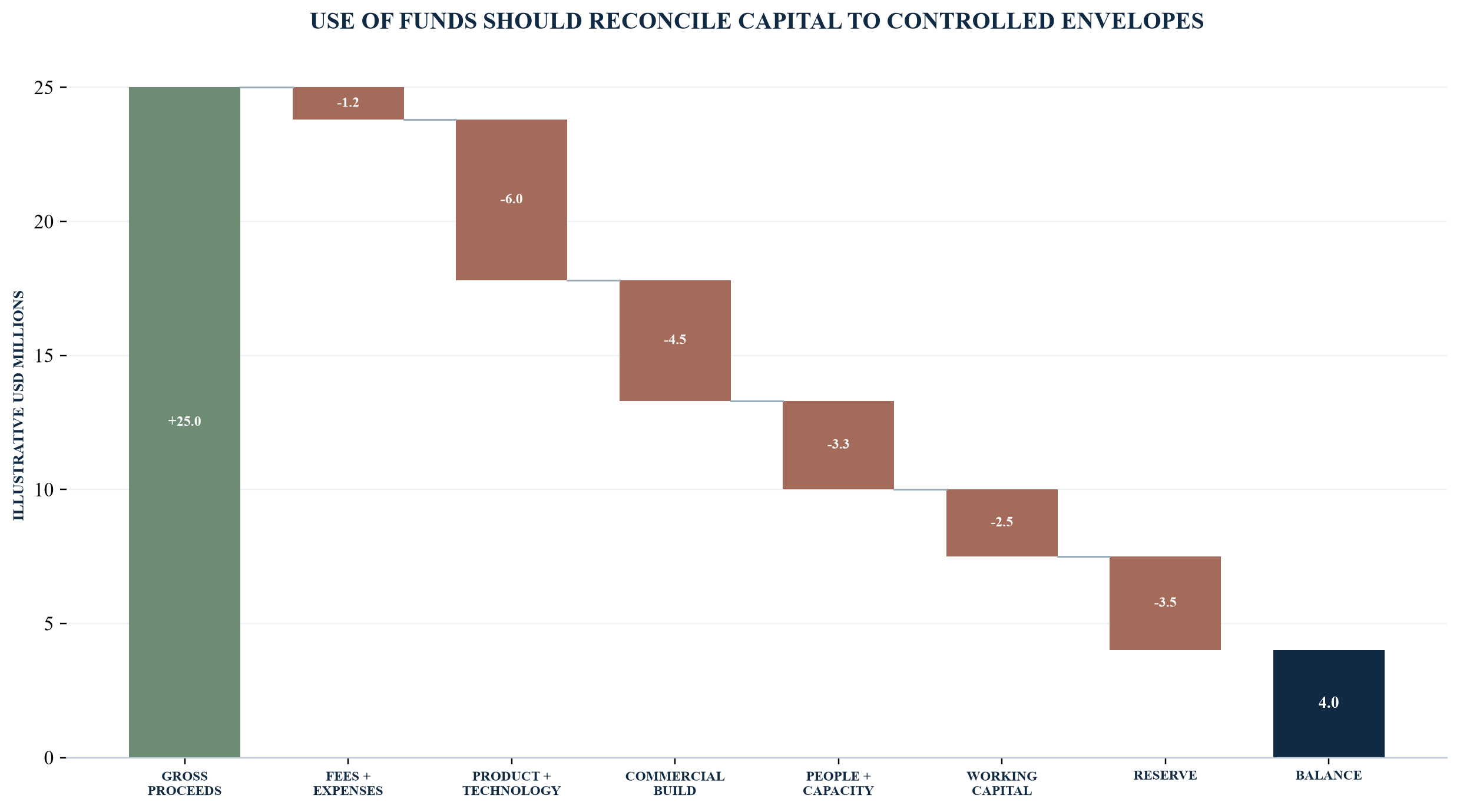
Values are hypothetical management assumptions in USD millions and do not describe an actual company or forecast performance.
Table 2. Outcome-envelope design
| Envelope | Intended outcome | Release evidence | Early-warning indicator | Decision on exception |
|---|---|---|---|---|
| product and technology | defined capability released and adopted | technical acceptance, security evidence and user adoption | defect backlog, delay or usage below threshold | product committee or board within authority |
| commercial build | repeatable qualified demand and controlled conversion | cohort pipeline, conversion and gross-margin evidence | rising acquisition cost or weak retention | CEO and board according to plan authority |
| people and capacity | capability added at required productivity | role scorecard, start date and output ramp | vacancy delay, cost drift or slow productivity | hiring owner and CFO within delegated limit |
| operations and infrastructure | constraint removed or service level improved | commissioning, throughput and quality evidence | delivery delay, utilisation gap or cost overrun | operating sponsor and board for reserved decisions |
| working capital | growth funded within cash and counterparty controls | collection, inventory and supplier evidence | ageing, concentration or forecast miss | CFO with executive escalation |
| strategic reserve | optionality preserved for identified uncertainty | board-approved trigger and updated scenario | runway compression or new opportunity | board |
Thresholds and authority levels are illustrative and require board approval within the applicable governance framework.
Reallocation should be explicit. A favourable underspend may reflect efficiency, delay or an unrealised objective. The same cash balance has different implications in each case. Management should explain the outcome status before asking to move the capital.
3. Build a milestone tree that connects activity to enterprise outcomes
A milestone is decision-useful when it changes what management or the board should do. Launching a feature is an activity milestone. Evidence that the feature works, is adopted, can be supported economically and contributes to a commercial or strategic objective is an outcome milestone. Both may be monitored, but they should not be confused.
The milestone tree should begin with the outcomes needed during the financed period. These may include product validation, regulatory approval, revenue quality, margin progression, operational capacity, leadership depth, data readiness, financing readiness or a strategic transaction. Each outcome then breaks into leading evidence, deliverables, dependencies, owner and decision date.
Milestones need entry criteria and completion criteria. A team should know what evidence permits work to start, what evidence demonstrates completion and who accepts it. Where completion depends on a regulator, customer or technical test, management should show the dependency and range rather than report a single deterministic date.
The UK Infrastructure and Projects Authority's Project Routemap describes governance, delivery planning, assurance and reporting practices for complex projects. Its governance module emphasises clear accountability, empowered decisions, alignment with strategy, evidence-based reporting, trigger conditions and proportionate assurance.[3] Although developed for projects, those principles are useful when a company converts a financing plan into a portfolio of interdependent initiatives.
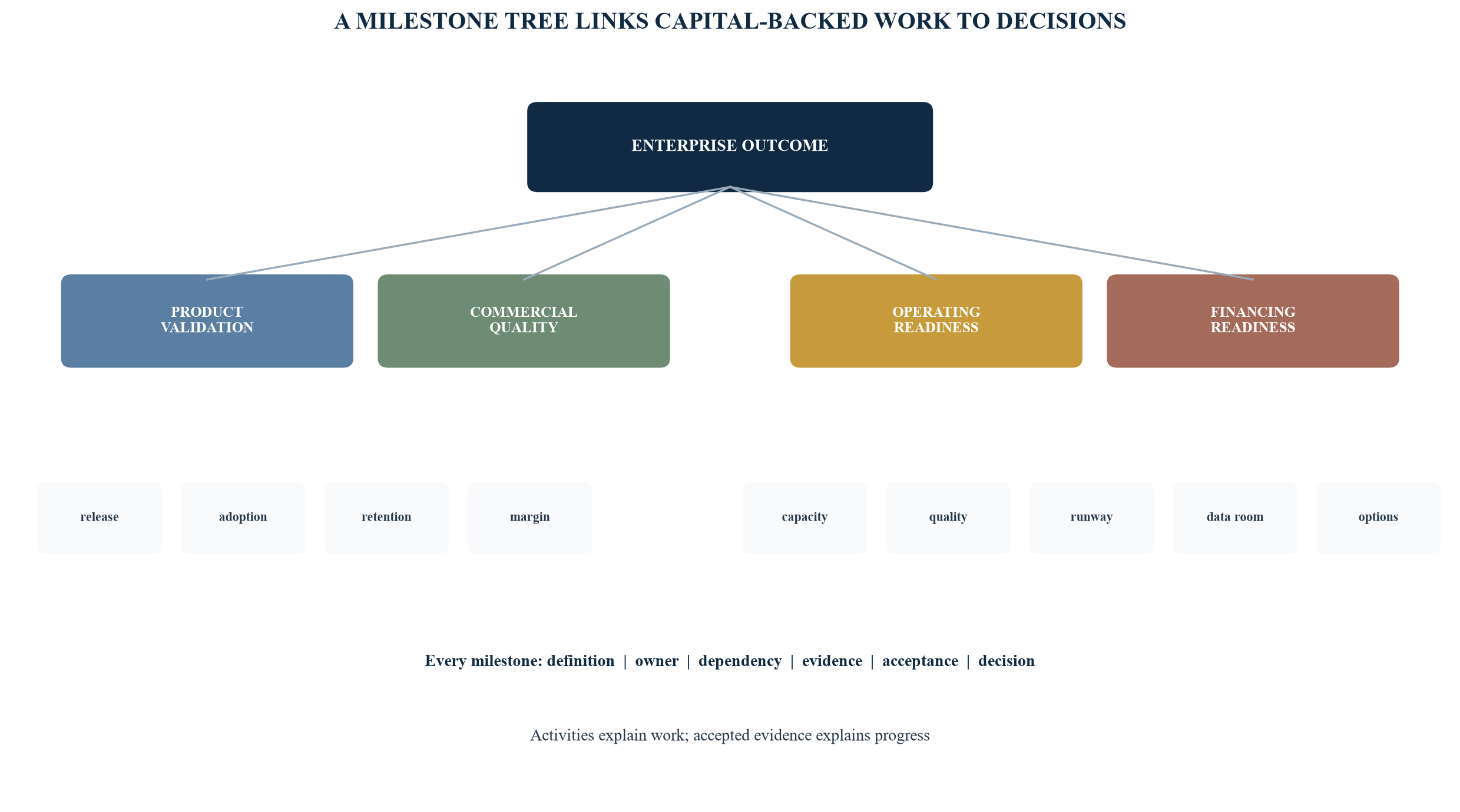
The tree is illustrative. Milestones, measures and acceptance authority should reflect the company's strategy and obligations.
Table 3. Milestone specification
| Field | Required content | Weak formulation | Decision-grade formulation |
|---|---|---|---|
| outcome | business state that should change | improve product | validated workflow adopted by a defined user cohort |
| measure | reproducible metric and perimeter | strong usage | active use measured from controlled event data |
| threshold | value, range or qualitative acceptance test | meaningful traction | approved threshold with confidence range and cut-off |
| dependency | external and internal prerequisites | on schedule | named regulatory, technical, hiring and supplier dependencies |
| evidence | source, owner and freshness | management believes | controlled source, calculation, owner and evidence date |
| acceptance | person or forum authorised to close the milestone | team complete | named accepting authority with recorded decision |
| consequence | action after pass, near miss or failure | review later | release, correct, pause, redesign or escalate |
Example evidence should be replaced with sector- and company-specific acceptance criteria.
A milestone register should retain changes. If management alters a threshold, date or definition, the record should show the rationale, evidence and approving authority. A justified reset can be a sound response to new information. An undocumented reset destroys comparability.
4. Sequence hiring through capacity, cost and productivity evidence
Fresh capital can create pressure to hire quickly. Headcount is a capacity decision, a cash commitment and an organisational design choice. The hiring plan should therefore start with the work, bottleneck and capability required. It should explain why recruitment is preferable to process change, automation, redeployment, partnership or temporary expertise.
Every role should carry a fully loaded cost and timing profile. Salary, employer costs, benefits, recruitment, equipment, workspace, travel, incentives, equity compensation and management overhead can differ across locations and employment models. The plan should model acceptance date, start date, notice periods, onboarding and expected productivity ramp. A vacant role may delay output while preserving cash; a filled role may consume cash before producing the intended result.
IFRS 2 specifies financial-reporting requirements for share-based payment transactions within its scope, including recognition of the effects of equity-settled and cash-settled arrangements.[4] The accounting cost, dilution, tax treatment, legal documentation and employee communication of equity incentives require specialist analysis. An operating plan should avoid treating equity as costless merely because it does not create the same immediate cash outflow as salary.
Hiring gates should reflect both business need and portfolio conditions. A commercial team may require product readiness and an approved market motion. An engineering team may require architecture and management capacity. A geographic team may require regulatory, tax, employment and data arrangements. An acquisition integration team may depend on transaction completion.
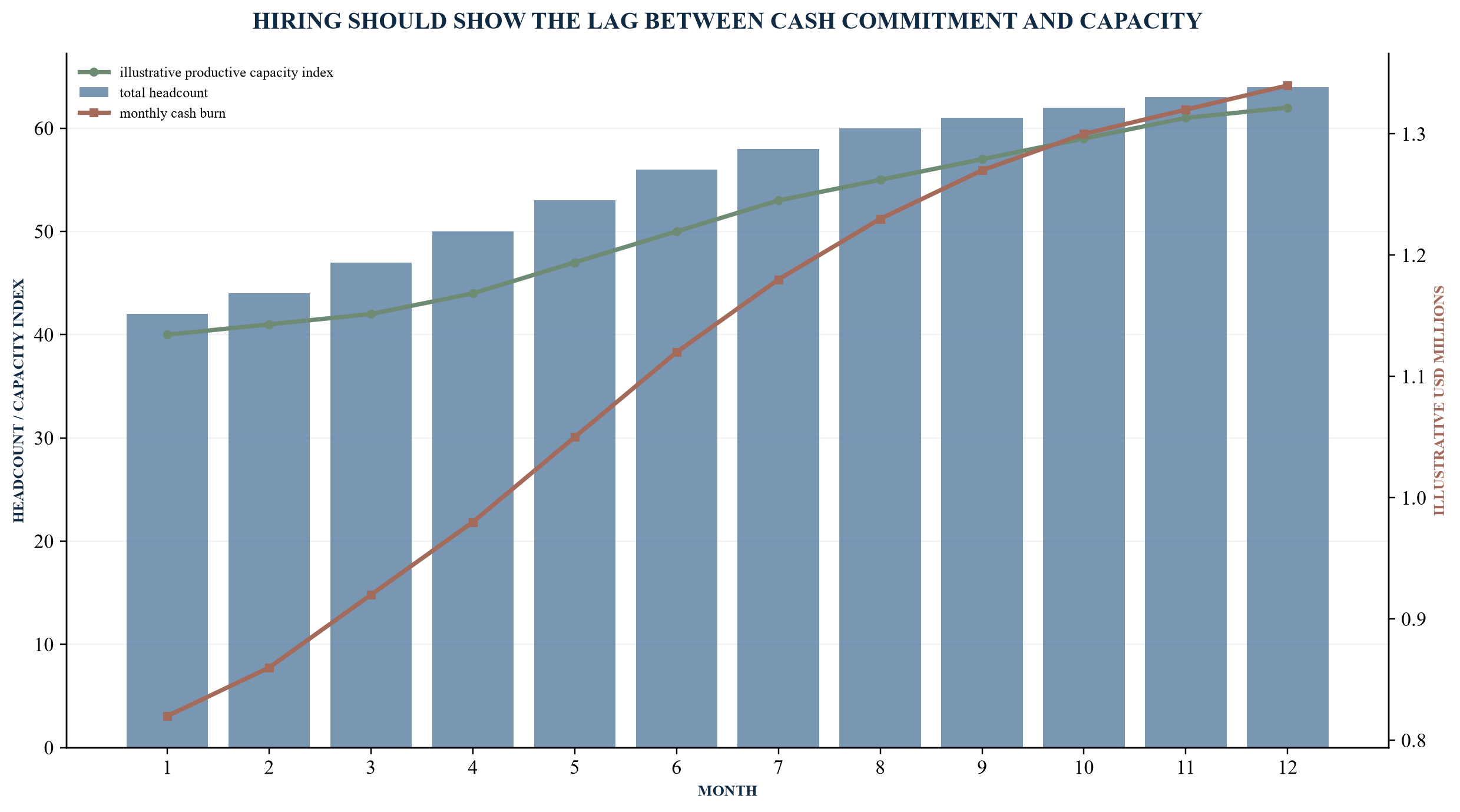
Values and timings are hypothetical management assumptions. They do not forecast employment cost, output or cash runway for any company.
Table 4. Hiring-gate controls
| Gate | Evidence required | Cash implication | Stop or delay condition |
|---|---|---|---|
| role approval | capacity gap, role scorecard, organisation design and budget | recruitment and compensation envelope | work can be removed, automated or reassigned |
| search launch | approved location, employment model and interviewer capacity | recruitment cost and management time | legal, tax or operating model unresolved |
| offer approval | candidate evidence, references, package and start date | committed compensation and potential equity cost | plan runway or dependency outside tolerance |
| onboarding | equipment, access, manager and initial outcomes | cash begins before full productivity | manager span or systems readiness inadequate |
| productivity acceptance | agreed output, quality and behaviour evidence | capacity should begin supporting milestone | persistent gap requiring support or role decision |
Role design and employment decisions require jurisdiction-specific legal, tax and human-resources advice.
5. Integrate burn, runway and financing lead time
Runway is a scenario output, not a single bank-balance calculation. It depends on opening liquidity, restrictions, receipts, payroll, operating costs, capital expenditure, debt service, working capital, taxes and management choices. A board should see a direct short-term cash forecast, a monthly operating forecast and a longer-range financing view with reconciled definitions.
IAS 7 requires a statement of cash flows and classifies cash flows as operating, investing and financing within its scope.[5] Internal forecasts can use more detailed categories, but finance should reconcile them to controlled accounting and treasury records. The company should distinguish cash, cash equivalents, available facilities, restricted cash and minimum operating reserves.
The financing decision date should precede the forecast cash-exhaustion date by enough time to evaluate options, prepare evidence, negotiate, complete diligence and absorb delay. Management should use ranges for revenue, collections, cost, hiring and transaction timing. It should also show the action needed under each scenario and the latest responsible decision date.
The base case should not carry every optimistic assumption simultaneously. Forecast governance should record the source, owner, sensitivity and invalidation condition for material assumptions. Forecast revisions should preserve prior versions so the board can distinguish new evidence from recurring bias.
Table 5. Illustrative financing-decision scenarios
| Scenario | Evidence pattern | Management action | Board decision window |
|---|---|---|---|
| controlled acceleration | milestones accepted, unit economics within range and cash ahead of plan | release conditional envelope and advance selected hiring | before commitments are made |
| base execution | progress within approved tolerance and runway above decision threshold | continue, correct local variance and retain reserve | routine meeting cycle |
| milestone delay | critical dependency slips while economics remain viable | resequence spend, protect bottleneck and reset evidence date | prompt review under delegated authority |
| commercial underperformance | conversion, retention or margin below threshold | diagnose cohort and proposition, slow contingent hiring and test corrective plan | before runway falls inside financing lead time |
| liquidity compression | collections, cost or financing conditions reduce headroom | activate cash actions, preserve options and evaluate financing or restructuring advice | immediate escalation under approved trigger |
Timings and thresholds are hypothetical. Financing availability, valuation and completion remain uncertain until legally committed and satisfied.
6. Create a governance calendar that follows decision risk
Governance should place decisions in the forums that have the authority, information and time to make them. The calendar should connect operating reviews, cash reviews, milestone acceptance, risk review, committee activity and board meetings. It should also state which events trigger an unscheduled decision.
The UK Corporate Governance Code 2024 applies to companies within its stated scope and includes principles concerning board leadership, division of responsibilities, composition, audit, risk, internal control and remuneration.[6] Provision 29 requires a declaration concerning material controls for financial years beginning on or after 1 January 2026. Private companies outside scope may use relevant principles proportionately while following their own applicable duties and agreements.
The IFC Corporate Governance Methodology provides progression matrices for listed, founder- or family-owned, fund, financial-institution and SME contexts.[7] The matrices recognise that governance should develop with company maturity and complexity. A recently financed company can use that concept to set a governance roadmap: reliable books and delegations first, then committee depth, assurance and more sophisticated reporting as scale and risk require.
Routine governance should minimise repetitive presentation. The operating team owns delivery and risk within authority. Finance and specialist control functions provide definitions, challenge and monitoring. The board receives concise evidence about performance, risk, decisions and exceptions. Independent assurance may be added as complexity and obligations justify it.
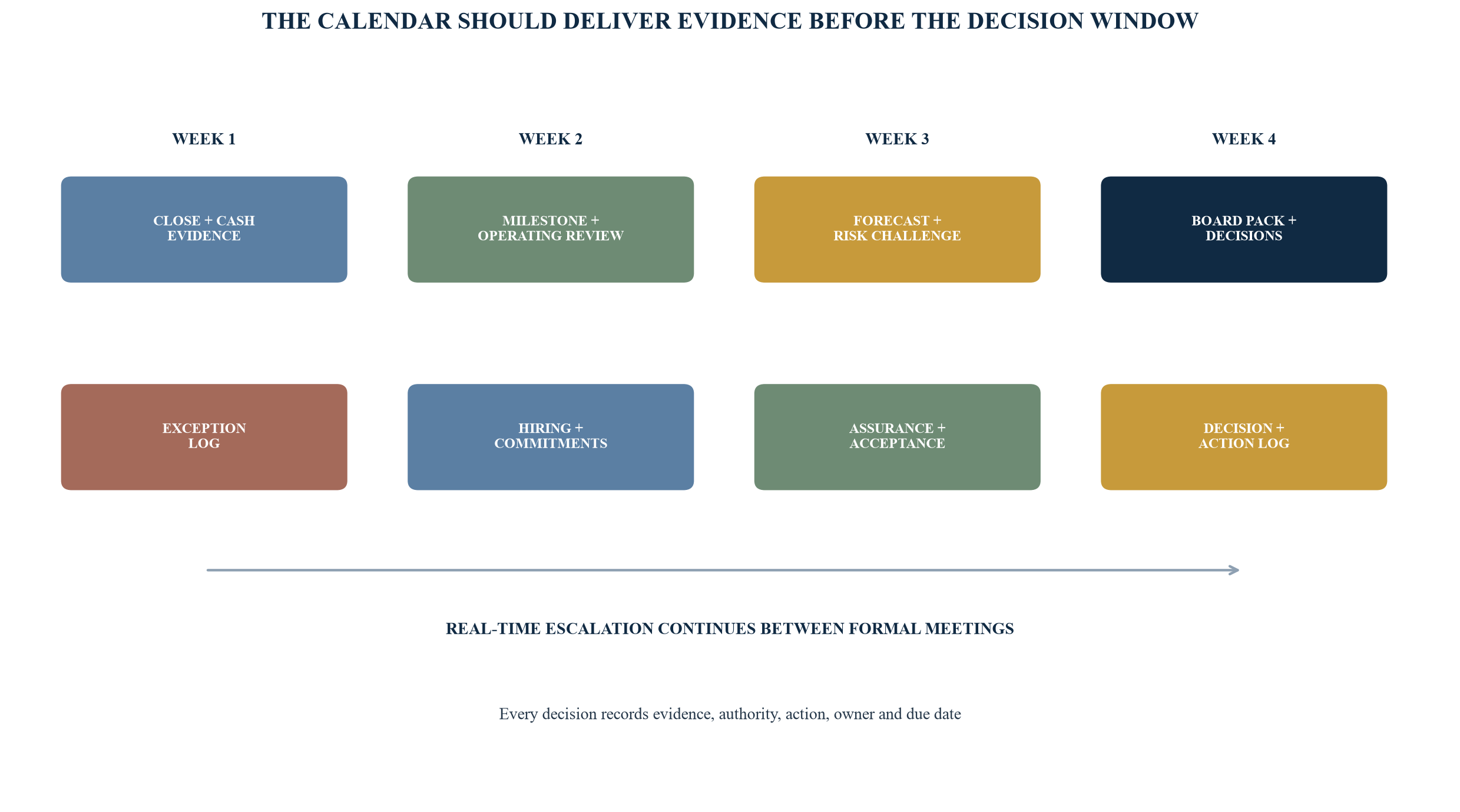
The sequence is illustrative. Meeting frequency and authority should reflect company needs, applicable law and executed agreements.
The Institute of Internal Auditors' Three Lines Model explains the relationships among the governing body, management, specialist support and monitoring roles, and independent internal audit.[8] A smaller company may not have a separate internal-audit function. It should still define who owns risk and controls, who monitors or challenges them and where independent assurance is necessary.
7. Use escalation rules that convert thresholds into timely choices
Escalation should begin with a condition and end with a decision. A red dashboard without a named action, authority and deadline reports concern rather than governs it. The rule should define the metric or event, evidence source, threshold, owner, immediate containment, escalation forum, decision options and required response time.
ISO 31000 provides principles and guidelines for identifying, analysing, evaluating, treating, monitoring and communicating risk, and for integrating risk management into governance, strategy and planning.[9] HM Treasury's Orange Book likewise emphasises integration with objectives, clear accountabilities, best available information, structured monitoring and timely reporting.[10] These sources support escalation rules that address uncertainty before it becomes a historical explanation.
Thresholds can be quantitative or event based. Quantitative examples include liquidity headroom, milestone delay, cost variance, concentration, quality failure, customer churn and forecast error. Event triggers include loss of a key licence, cyber incident, material litigation, covenant concern, founder incapacity, key-customer notice or an unsolicited strategic approach. Legal advice may be required to determine disclosure and response obligations.
Management should prevent threshold gaming. Splitting expenditure to stay below an approval limit, moving a milestone definition or delaying recognition of a known issue can defeat the governance purpose. Aggregation rules, change logs and independent challenge help expose the underlying decision.
Table 6. Escalation-rule architecture
| Trigger family | Evidence | Immediate response | Escalation output |
|---|---|---|---|
| liquidity and financing | bank, forecast, facility and covenant evidence | protect liquidity, verify exposure and update scenarios | financing, cost, working-capital or restructuring decision |
| milestone and delivery | accepted deliverables, dependencies and forecast | contain failure, preserve critical path and identify options | release, correct, pause, redesign or terminate |
| commercial quality | cohort revenue, margin, retention and concentration | isolate cause and stop unsupported scaling | proposition, pricing, channel or resource decision |
| people and organisation | vacancy, attrition, productivity and conduct evidence | protect continuity and investigate within applicable policy | hire, support, reorganise or succession decision |
| control and compliance | incident, reconciliation, legal and assurance evidence | preserve records, contain exposure and seek specialist advice | remediation, disclosure, investigation or authority decision |
| strategic opportunity | credible proposal, valuation range and capacity analysis | protect confidentiality and test strategic fit | diligence, negotiation, partnership, acquisition or rejection |
Trigger levels are illustrative. The board should approve entity-specific thresholds, aggregation rules and response authorities.
8. Design the board pack around evidence classes and decisions
The board pack should help directors understand the company's position, changes, risks, choices and required actions. It should distinguish actual results, contracted commitments, management forecasts, scenarios and aspirations. Combining those evidence classes in one chart can create false precision.
The pack should open with decisions and material changes. A concise executive page can list requested approvals, threshold breaches, revised scenarios and overdue actions. Supporting pages can then show cash and runway, milestone status, use-of-funds deployment, commercial and operational evidence, hiring, principal risks, governance matters and the decision log.
IFRS 18 introduces presentation and disclosure requirements, including defined subtotals and requirements for management-defined performance measures within its scope, for annual periods beginning on or after 1 January 2027, with earlier application permitted.[11] A private board pack is not automatically a public communication or an IFRS disclosure. Finance should still maintain clear definitions and identify measures that may later appear in public communications.
COSO's Internal Control Integrated Framework addresses control objectives concerning operations, reporting and compliance and identifies control environment, risk assessment, control activities, information and communication, and monitoring as connected components.[12] A board pack should therefore be supported by controlled sources, review, access, version and correction processes. Attractive presentation cannot compensate for unreconciled information.
The pack should preserve uncertainty. Forecast ranges, sensitivities and invalidation conditions can be more useful than a single number. Where data quality is incomplete, the pack should describe the limitation, action and decision effect in plain language.
9. Reconcile milestone progress to financial and accounting evidence
Operating milestones and financial results move on different clocks. A signed contract may precede revenue recognition and collection. A product launch may precede adoption. Hiring may precede output. Capital expenditure may precede commissioning. Management should show those timing differences rather than imply that activity has already produced financial value.
IFRS 15 establishes a five-step revenue-recognition model for contracts with customers within its scope.[13] IAS 34 specifies minimum content and recognition and measurement principles for interim financial reporting when an entity applies the standard.[14] These requirements do not determine internal milestone design, but they reinforce the importance of separating operating evidence from recognised revenue and controlled financial reporting.
A milestone-to-financial bridge should identify the expected mechanism, lag and range. It should also identify evidence that would disconfirm the assumption. For example, a completed release may be expected to improve conversion over several cohorts. The board should see actual cohort evidence before treating the change as established.
Working capital should be integrated into growth decisions. Strong bookings can consume cash through implementation, inventory, receivables or supplier deposits. A strategy that achieves its commercial milestone while exhausting liquidity has not produced a controlled outcome.
10. Apply scenario governance before capital becomes difficult to reverse
Scenario governance should focus on decisions that are expensive or slow to reverse: senior hiring, geographic entry, leases, infrastructure, acquisitions, long-term contracts and major product commitments. Before approval, management should show the base assumption, alternative scenarios, leading indicators, maximum exposure, exit route and decision date.
The scenario range should use operational mechanisms. A downside case should state which customers, conversion rates, delays, costs or collections change and why. An upside case should show the capacity and working-capital consequences of growth. A severe but plausible case should identify continuity and financing actions without presenting financing as certain.
IAS 37 addresses provisions, contingent liabilities and contingent assets within its scope and sets recognition and disclosure principles.[15] Scenario planning is broader than accounting for provisions or contingencies. Finance and legal advisers should determine when an operating risk creates an accounting, disclosure or legal consequence.
Management should pre-authorise reversible actions where practical. Slower hiring, phased procurement, shorter commitments and modular deployment can preserve choices. The cost of optionality should be visible; it may be justified when evidence is still developing.
11. Establish a ninety-day conversion programme
The first ninety days after closing should produce a working system rather than a large transformation programme. During days one to ten, management should confirm proceeds, obligations, decision rights, metric definitions, reporting dates and the approved baseline. It should also identify any difference between the executed transaction and the operating assumptions used before closing.
During days eleven to thirty, the company should build capital envelopes, milestone specifications, the hiring schedule, direct cash forecast, risk register and governance calendar. Owners should test whether source data can reproduce the intended measures. The first board pack should identify limitations rather than hide them.
During days thirty-one to sixty, management should operate the cycle, close early data gaps, challenge assumptions and test escalation rules. A tabletop exercise can examine a missed milestone, delayed customer receipt, cyber event or financing shock. The exercise should test authority, information and response time.
During days sixty-one to ninety, the board should review the system's usefulness. It should remove measures that do not inform decisions, strengthen weak evidence, reset delegated limits where justified and agree the next assurance priorities. The system should then improve through use rather than through periodic reinvention.
12. Avoid recurring failure modes
The first failure mode is treating use of funds as an entitlement. Budget availability does not prove that an outcome remains attractive. Conditional release and explicit reallocation keep capital connected to evidence.
The second is milestone theatre. Teams report activity, percentages complete or carefully selected indicators without acceptance evidence. Clear completion criteria, source controls and an accepting authority reduce this problem.
The third is uncontrolled hiring. Roles are approved because capital was raised, while dependencies, management capacity and productivity lag remain unmodelled. Capacity logic and staged gates make the commitment visible.
The fourth is a single runway number. Management combines optimistic collections, full growth and incomplete costs into one date. Scenario ranges, direct cash evidence and financing lead time make the decision window explicit.
The fifth is late escalation. A threshold breach is saved for the next meeting even when action is time sensitive. Event-based rules should allow immediate escalation between scheduled forums.
The sixth is board-pack overload. Large packs repeat operational detail and bury decisions. A decision-first structure, controlled appendices and clear evidence classes improve attention.
The seventh is silent rebasing. Dates, thresholds and definitions change without a record. Version history preserves learning and accountability.
13. Define the minimum viable post-raise control system
A smaller company can implement the framework without sophisticated software. It needs a controlled baseline, cash forecast, use-of-funds register, milestone register, hiring schedule, risk and escalation log, governance calendar, board pack and decision log. Each artefact should have an owner, version, source, reviewer and retention location.
The metric dictionary should remain short enough to govern. Every reported measure needs meaning, formula, perimeter, source, frequency, owner and change policy. The company should remove duplicate measures and reconcile the remaining ones.
Technology can then automate source ingestion, validation, workflow and presentation. Access controls, change history, backup, cybersecurity and data-protection requirements should be designed for the relevant systems and jurisdictions. Automation should preserve evidence and authority rather than obscure them.
14. Board and management diagnostic
The board can test the system through twelve questions:
1. Can net available capital be reconciled to completion and bank evidence? 2. Does every material envelope state the outcome it is intended to buy? 3. Which spending remains conditional, and who can release it? 4. Are milestone definitions, owners, dependencies and acceptance evidence explicit? 5. Does the hiring plan show fully loaded cash cost and productivity lag? 6. Can the direct cash forecast be reconciled to controlled balances and commitments? 7. Which assumption most influences the financing decision date? 8. Which events require escalation before the next board meeting? 9. Are actuals, commitments, forecasts and scenarios visibly separate? 10. Which measures have changed definition since closing? 11. Are overdue decisions and corrective actions tracked to closure? 12. What evidence would cause the board to accelerate, correct, pause or seek financing advice?
An inability to answer does not by itself prove poor execution. It identifies an evidence, ownership or governance gap that should be resolved in proportion to its decision impact.
15. Conclusion
Capital creates strategic capacity and a finite decision horizon. A disciplined post-raise system converts that capacity into controlled outcome envelopes, accepted milestones, sequenced hiring, visible cash consequences and timely board decisions. The system should preserve the original investment case while allowing management to respond to new evidence.
The central discipline is traceability. Every material deployment should connect to an intended outcome. Every milestone should connect to evidence and authority. Every forecast should connect to assumptions and cash. Every exception should connect to a decision and action. This architecture gives management room to execute while enabling the board to intervene before options narrow.
References
- OECD. G20/OECD Principles of Corporate Governance 2023. 2023. https://doi.org/10.1787/ed750b30-en
- National Venture Capital Association. Model Legal Documents. Current online resource accessed August 2026. https://nvca.org/model-legal-documents/
- Infrastructure and Projects Authority. Project Routemap: Governance. 2022. https://assets.publishing.service.gov.uk/media/62971fff8fa8f5039927d160/Governance_-_FINAL.pdf
- IFRS Foundation. IFRS 2 Share-based Payment. Current standard information accessed August 2026. https://www.ifrs.org/issued-standards/list-of-standards/ifrs-2-share-based-payment/
- IFRS Foundation. IAS 7 Statement of Cash Flows. Current standard information accessed August 2026. https://www.ifrs.org/issued-standards/list-of-standards/ias-7-statement-of-cash-flows/
- Financial Reporting Council. UK Corporate Governance Code 2024. 2024. https://www.frc.org.uk/library/standards-codes-policy/corporate-governance/uk-corporate-governance-code/
- International Finance Corporation. Corporate Governance Methodology Tools. Current online resource accessed August 2026. https://www.ifc.org/en/what-we-do/sector-expertise/corporate-governance/cg-methodology-tools
- Institute of Internal Auditors. Statements of Position: Three Lines Model. 2026. https://www.theiia.org/en/resources/statements-of-position
- International Organization for Standardization. ISO 31000:2018 Risk management: Guidelines. Confirmed current in 2023. https://www.iso.org/standard/65694.html
- HM Treasury. The Orange Book: Management of Risk, Principles and Concepts. Updated 2026. https://www.gov.uk/government/publications/orange-book/the-orange-book-management-of-risk-principles-and-concepts
- IFRS Foundation. IFRS 18 Presentation and Disclosure in Financial Statements. Issued 2024. https://www.ifrs.org/issued-standards/list-of-standards/ifrs-18-presentation-and-disclosure-in-financial-statements/
- Committee of Sponsoring Organizations of the Treadway Commission. Internal Control: Integrated Framework. Current online resource accessed August 2026. https://www.coso.org/guidance-on-ic/pages/default.aspx
- IFRS Foundation. IFRS 15 Revenue from Contracts with Customers. Current standard information accessed August 2026. https://www.ifrs.org/issued-standards/list-of-standards/ifrs-15-revenue-from-contracts-with-customers/
- IFRS Foundation. IAS 34 Interim Financial Reporting. Current standard information accessed August 2026. https://www.ifrs.org/issued-standards/list-of-standards/ias-34-interim-financial-reporting/
- IFRS Foundation. IAS 37 Provisions, Contingent Liabilities and Contingent Assets. Current standard information accessed August 2026. https://www.ifrs.org/issued-standards/list-of-standards/ias-37-provisions-contingent-liabilities-and-contingent-assets/
About the Author
Chennakeshav Adya is an independent researcher whose work focuses on corporate finance, value creation, private capital and transaction execution. His research translates financial, commercial and operating evidence into decision frameworks for boards, investors and management teams.
