

1. Define the combined succession and capital decision
The board decision is whether new capital can strengthen the business while transferring leadership and preserving family alignment. The transaction may include primary equity for expansion, secondary liquidity for one or more owners, refinancing, management incentives and a new governance system. These elements should be evaluated together because each changes control, cash and execution capacity.
The starting question is what the enterprise must achieve over the next five years. The answer may involve entering new markets, professionalising management, building digital capability, acquiring competitors, adding capacity or preparing for a later sale or listing. Succession is credible when leadership, authority and accountability follow this operating plan. A title change without decision authority leaves the company exposed.
The family should state what it wants to retain and what it is willing to share. Control can refer to voting rights, board composition, management appointments, strategic vetoes, dividends, brand stewardship or the ability to sell. These rights should be separated rather than compressed into a headline ownership percentage.
ASEAN's 2024 investment report states that nearly three quarters of conglomerates in Southeast Asia are family owned and identifies family offices as potential sources of cross-border investment.[1] The statistic establishes regional relevance. It does not demonstrate that a specific family company is investable or that Gulf capital will accept its terms.
2. Use the Succession and Growth Capital Framework
The framework connects eight decisions: enterprise strategy, family alignment, leadership succession, capital need, transaction structure, governance, implementation and exit. Each decision produces a defined evidence record, accountable owner, board conclusion and condition for proceeding. The framework treats continuity as an operating outcome rather than a ceremonial transfer.
Enterprise strategy determines what the company must fund. Family alignment establishes who wants control, employment, liquidity or separation. Leadership succession identifies the future chair, chief executive and senior team. Capital planning separates primary growth uses from secondary owner liquidity and refinancing.
Transaction structure allocates equity, debt, preferred rights, earn-ins, options and staged commitments. Governance translates ownership into decisions, information rights and conflict management. Implementation protects customers, employees, lenders and suppliers during the transition. Exit design explains how the family and investor may remain, sell or separate.
The board should reject any design in which one workstream depends on an assumption contradicted by another. A successor cannot be accountable for growth while the founder retains informal approval of every material decision. An investor cannot underwrite expansion when cash is diverted to excessive liquidity. A family cannot promise patient ownership while some branches require a near-term sale.
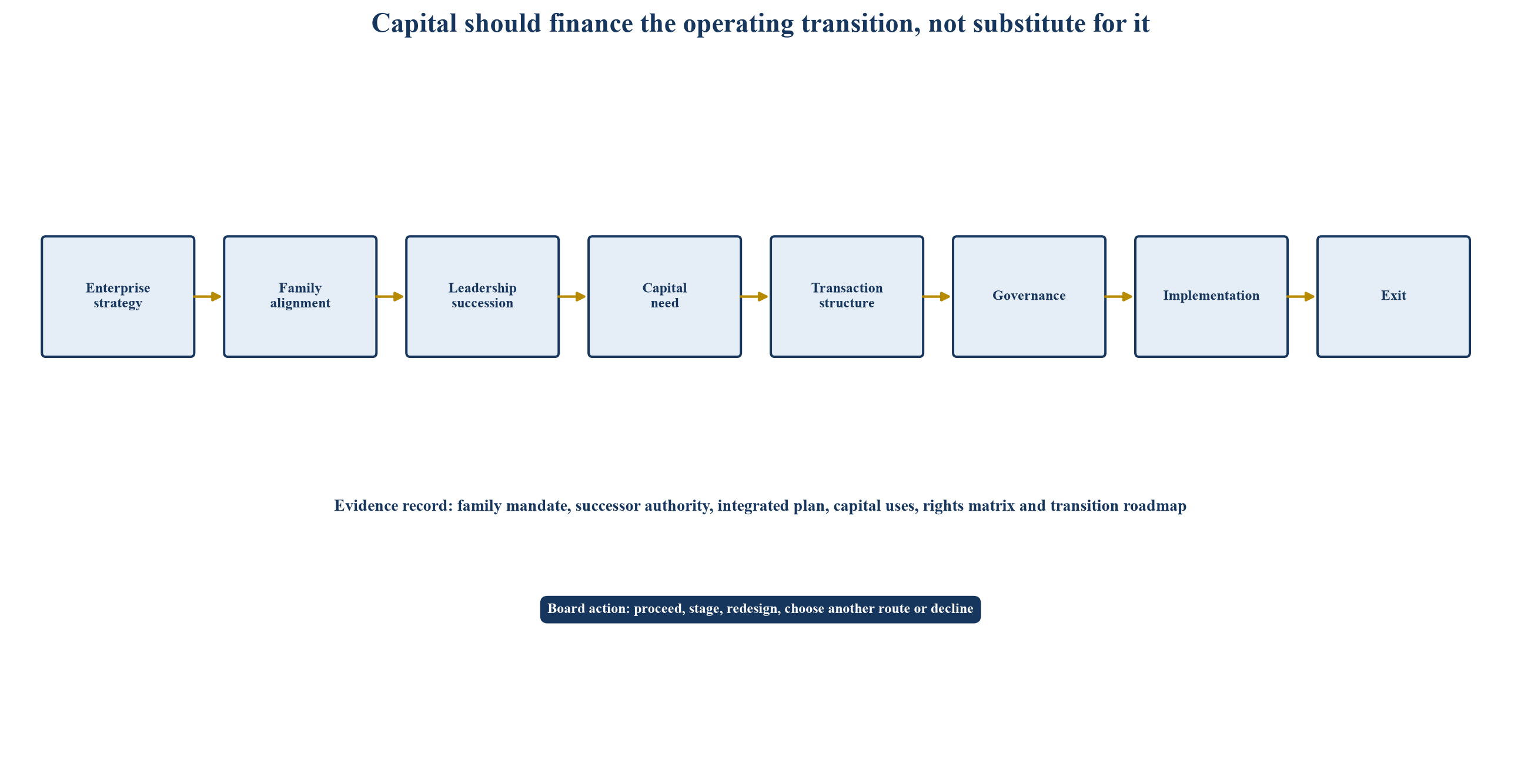
The framework is a proposed decision system and requires transaction-specific professional advice.
3. Establish the family mandate before approaching capital
The family mandate should record the objectives and boundaries that have genuine support. It should identify ownership branches, voting rights, trusts or holding companies, active and non-active family members, employment interests, dividend needs, liquidity expectations and views on control. Silence should not be treated as consent.
Different family members may value the business differently because they depend on it in different ways. An active successor may prefer reinvestment and control. A non-active shareholder may prefer predictable distributions or liquidity. A founder may value legacy, reputation and employee continuity. These are legitimate interests that require explicit prioritisation.
The process should distinguish the family forum from the company board. The family forum can discuss purpose, ownership and participation. The board must decide in the interests of the company, oversee strategy and protect all shareholders. Combining both forums can turn corporate decisions into unresolved family negotiations.
IFC's family-business governance guidance recommends structures that evolve as ownership moves from a founder to sibling and cousin groups.[6][7] The transaction team should use a family constitution, shareholder agreement or family council only when it clarifies authority and conflict resolution. A document without adoption, operating routines and consequences will not create alignment.
The mandate should also record what the family will contribute after closing. These contributions may include customer relationships, technical knowledge, reputation, land, licences or continuing executive time. Each contribution needs an owner, duration and evidence standard. An investor cannot underwrite an unwritten expectation that the founder will remain available indefinitely. Where a family contribution is essential, it should appear in the operating plan, governance calendar and succession milestones. Where it is optional, the valuation should avoid treating it as contracted value.
Alignment requires a controlled method for changing the mandate. A proposed acquisition, major distribution or new family appointment can alter the original bargain. The family forum should identify the ownership preference; management should quantify the business effect; the board should decide within its authority; and reserved matters should be used only at the agreed threshold. This sequence keeps family purpose connected to corporate evidence and gives a prospective investor a reviewable decision record.
4. Translate strategy into a fundable growth plan
The company should present an operating plan that is independent of the proposed investor. It should identify target markets, products, customer segments, capacity, talent, technology, working capital and acquisitions. Each growth initiative needs an owner, investment amount, timing, operating milestone and decision rule.
Growth plans often mix maintenance, catch-up investment and true expansion. Maintenance capital protects current earnings. Catch-up investment repairs systems, compliance or management capacity that should already exist. Expansion capital creates new revenue or capability. Investors will price these categories differently because they carry different evidence and risk.
The model should connect capital to operating drivers. New capacity should be linked to contracts, utilisation and margin. Market entry should be linked to permissions, channels, customer acquisition and local management. Digital investment should be linked to measurable changes in cost, revenue, resilience or control. Acquisitions should include integration cost and management capacity.
The ADB Asia SME Monitor emphasises resilient MSME ecosystems and access to finance across Asia and the Pacific.[11] ADB's Frontier programme also combines flexible risk capital with technical support for growth companies.[12] These sources support the principle that finance and capability development should be designed together.
A fundable plan should identify the earliest evidence that can disprove each growth thesis. For a new market, this may be a licence, contracted distributor and first paying customer. For a new plant, it may be permitted capacity, qualified product and committed offtake. For a digital programme, it may be adoption, unit cost and control performance. Capital can then be released against observable milestones. A missed milestone should trigger review of scope, timing and management capacity before additional money is committed.
The board should also distinguish enterprise value creation from geographic expansion for its own sake. Revenue can grow while cash conversion, return on invested capital and resilience deteriorate. The plan therefore needs contribution margin, working-capital days, capital intensity, customer concentration and cash conversion by initiative. These measures allow the board to compare a regional expansion with reinvestment in the core business, an acquisition, a distribution partnership or a return of capital.
5. Design the succession architecture
Succession has three layers: ownership, board leadership and executive management. They may transfer at different times. A founder can remain a shareholder while leaving executive management, or remain chair while a professional chief executive runs the business. The design should state who holds each role, when authority changes and how performance is assessed.
The successor should have a written mandate covering budget, people, customers, capital allocation and strategy execution. Retained founder rights should be documented and limited to defined matters. Informal intervention can weaken accountability, cause executives to seek parallel approvals and make the investor unsure who can bind the company.
The nomination process should test competence, commitment and legitimacy. Family membership alone is not evidence of readiness. The company may use external assessment, a development plan, interim roles and an independent nomination committee. A professional manager can provide continuity when no family successor is ready, provided ownership and board authority remain clear.
The transition should include an emergency plan. Illness, death, incapacity or sudden departure can occur before the planned date. Bank mandates, signing authorities, key relationships, digital access, powers of attorney and board procedures should permit the company to act. The plan should be tested rather than stored.
6. Separate primary capital, owner liquidity and refinancing
Primary capital enters the company and funds growth, working capital, acquisitions or resilience. Secondary capital pays existing owners for shares. Refinancing replaces existing debt or shareholder balances. The sources and uses schedule should show each category separately so that the board can see how much cash strengthens the enterprise.
Owner liquidity can support succession when it allows a retiring founder or non-active branch to reduce exposure. It can also weaken the transaction if liquidity absorbs capital needed for growth. The design should establish a minimum primary-capital amount before secondary proceeds are released.
Liquidity may be staged through partial sales, redemptions, dividends, deferred consideration, vendor instruments or options. Each mechanism has different tax, solvency, creditor and governance consequences. A company-funded redemption can transfer risk to remaining shareholders and lenders. Investor-funded secondary purchases do not increase company cash.
Refinancing should be evaluated on its own economics. Paying down expensive or restrictive debt may create capacity, while repaying patient family loans may reduce liquidity. The board should compare maturity, cost, security, covenants, guarantees and cash sweep terms before treating debt reduction as value creation.
| Capital use | Evidence required | Decision test | Typical control |
|---|---|---|---|
| Primary growth equity | Integrated plan, milestones and peak cash | Creates capacity or measurable revenue | Staged release and performance reporting |
| Owner liquidity | Family mandate and independent valuation | Supports transition without weakening resilience | Cap, holdback or deferred payment |
| Debt refinancing | Facility terms, security and covenant model | Improves cash capacity or risk profile | Lender consent and closing condition |
| Acquisition funding | Target case, diligence and integration plan | Adds capability at an acceptable downside | Ring-fenced approval and stop trigger |
| Management incentive pool | Role map and performance measures | Retains leaders and aligns value creation | Vesting, leaver and change-of-control terms |
| Contingency reserve | Correlated downside and response plan | Covers identified shocks before distress | Restricted use and board release |
Every use should have evidence, an owner and a measurable operating consequence.
7. Draw the ownership and value-flow map
The transaction map should show family holding vehicles, operating companies, subsidiaries, the GCC investor, lenders, management incentive vehicles and any acquisition special-purpose companies. It should distinguish legal ownership, voting control, dividend flow, debt service, guarantees and management authority.
Family ownership may be held directly, through trusts, foundations or holding companies. The transaction team should identify the natural persons who ultimately own and control each vehicle, the rights of trustees or protectors and the restrictions on transfer. Beneficial ownership evidence must remain accurate and current.[21]
The map should also show where value is generated and where cash can move. A profitable subsidiary may be unable to distribute because of minority rights, debt covenants, local capital requirements or tax. Management fees, royalties and intercompany loans can transfer value away from the entity in which the investor owns shares.
Every arrow needs an agreement, approval route, pricing basis, term and termination effect. Informal family support should not be treated as committed funding. Informal use of brands, land or intellectual property should be converted into enforceable rights before the investor prices the company.
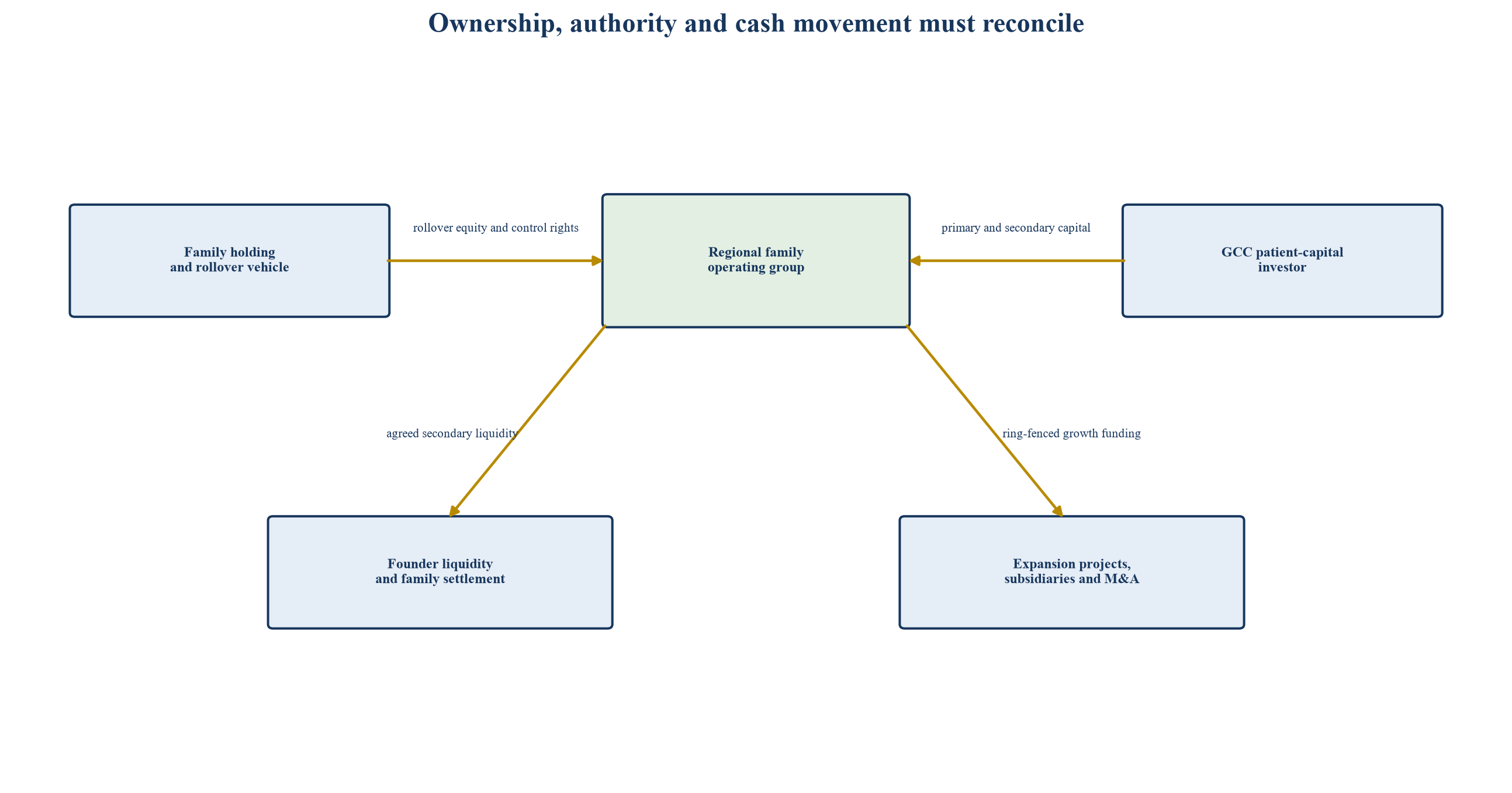
Entities, ownership and amounts are hypothetical management assumptions.
8. Select the capital instrument around the risk
Ordinary equity is simple when investors share the same horizon and economics. Preferred equity can protect downside through liquidation preference, dividend priority, conversion and anti-dilution rights. Shareholder debt can provide repayment priority, though excessive leverage may reduce growth capacity and create tax or solvency issues.
The instrument should match the uncertainty. A business with strong cash flow but uncertain expansion may use staged equity plus a committed facility. A company with volatile working capital may need a revolving line. A family seeking limited dilution may combine primary equity with debt, provided the downside model supports fixed obligations.
Preferred rights should be translated into actual cash waterfalls. A participating preference, compounding return or redemption right can transfer more value than the headline percentage suggests. The board should model exit outcomes across valuation ranges, timing and funding cases.
The investor's return should depend mainly on enterprise value creation. Guaranteed returns, mandatory redemptions and broad security can shift risk back to the company or family. The structure should preserve enough operating freedom to execute the plan and comply with local company, foreign-investment and financial-assistance rules.
9. Value the business and the control package separately
Valuation should begin with maintainable earnings, cash conversion, growth investment and risk. Family businesses may contain owner expenses, related-party transactions, surplus assets, informal arrangements or customer relationships tied to individuals. Normalisation requires evidence and should avoid assuming that every adjustment becomes cash after completion.
The base enterprise value should be distinguished from the value of control, liquidity and contractual rights. A minority stake with strong protection, information and exit rights may be more valuable than an illiquid minority without them. A controlling stake may carry obligations to fund growth or manage regulated activities.
The valuation bridge should reconcile historical results, management forecasts, transaction multiples, discounted cash flow and asset value where relevant. Scenario weights should reflect operating evidence rather than negotiation positions. A family premium for legacy or control is an objective, not an independently verified market value.
The board should review dilution on a fully converted basis, including management options, ratchets, earn-outs and preferred securities. It should also model the value retained by each family branch after primary investment, secondary sales and future funding rounds.
10. Build an integrated base case and correlated downside
The model should start with operational drivers: customers, volume, price, gross margin, capacity, sales productivity, people, working capital, capital expenditure and acquisition timing. It should separate existing operations from growth initiatives so the board can see which value depends on new capital.
The downside should combine events that can occur together. A leadership transition can slow decisions while market expansion increases cost. A delayed licence can postpone revenue while new management and systems remain in place. Customer concentration can reduce cash at the same time that debt covenants tighten.
The model should calculate peak cash, covenant headroom, funding calls, dilution, dividend capacity and exit value. It should show what can be stopped, which costs remain committed and what funding is available before distress. A high valuation does not remove liquidity risk.
Probability-weighted outputs can help comparison, yet they should not create false precision. The board should focus on evidence grades, triggers and actions. The investment should return for approval when key assumptions move outside the agreed range.
11. Test the hypothetical recapitalisation
Assume a second-generation Southeast Asian industrial-services group is preparing regional expansion and a leadership transition. A GCC investor considers patient capital. The family wants partial liquidity, continued strategic influence and capital for two new markets. The successor is scheduled to become chief executive at completion.
The balanced case has total transaction sources of USD 80 million: USD 50 million of investor preferred equity, USD 20 million of family rollover equity and USD 10 million of senior debt. Uses are USD 40 million of primary growth capital, USD 20 million of owner liquidity, USD 10 million of refinancing and USD 10 million of fees and reserve. Year-four revenue is assumed at USD 180 million and EBITDA at USD 30 million. Peak funding is USD 80 million.
The correlated downside delays two market launches, loses a major customer and requires extra working capital. Year-four revenue is assumed at USD 130 million, EBITDA at USD 14 million and peak funding at USD 95 million. The structure therefore requires a committed recovery tranche, covenant headroom and a board-approved response plan.
The staged case closes with USD 55 million and releases a further USD 15 million after leadership, customer and market-entry milestones. Year-four revenue is assumed at USD 160 million, EBITDA at USD 24 million and peak funding at USD 70 million. All figures are hypothetical management assumptions and do not describe an actual company.
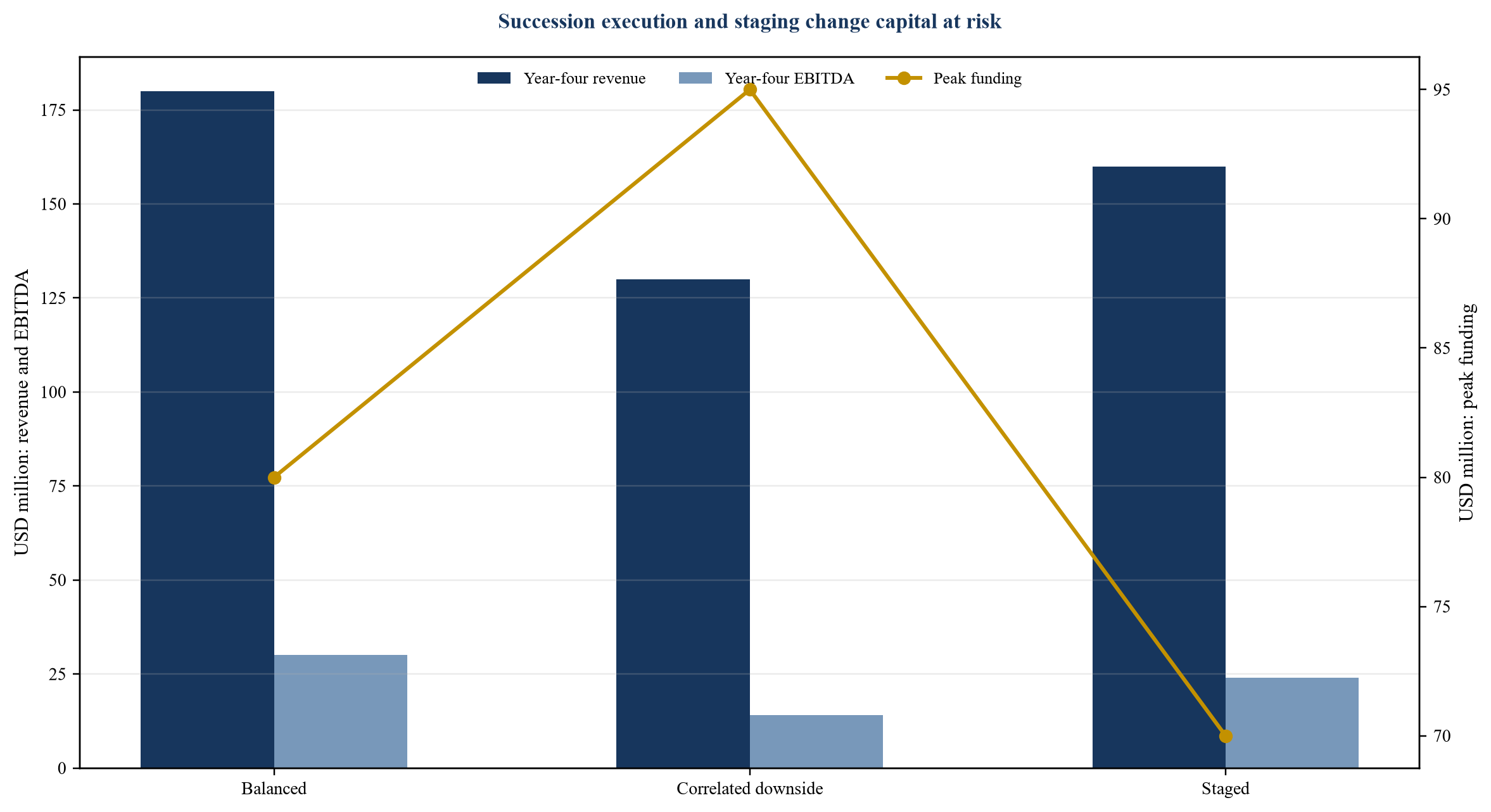
All amounts are hypothetical management assumptions and do not describe an actual transaction.
12. Design governance for the next operating model
The board should represent the company rather than operate as a negotiation forum between family and investor. Its composition should reflect strategy, ownership, independence and skills. A balanced board may include family nominees, investor nominees and independent directors selected jointly against an agreed skills matrix.
Reserved matters should protect material value without requiring shareholder approval for routine execution. They may include changes to business scope, capital, major acquisitions, borrowing, related-party transactions, dividends, senior appointments and asset sales. Thresholds should be calibrated to the approved plan and increase as the business grows.
The successor needs delegated authority. Annual budgets, hiring bands, contract limits and capital-allocation rules should allow management to act. Emergency authority should cover customer incidents, cyber events, safety, regulatory reporting and liquidity protection. Waiting for family consensus can create legal and commercial damage.
The G20/OECD Principles identify strategy, budgets, performance, capital expenditure, acquisitions, divestitures, risk and succession among core board responsibilities.[10][14] Independent directors can be particularly important where controlling shareholders, related-party transactions and leadership succession create conflicts.
| Decision | Management authority | Board authority | Shareholder protection |
|---|---|---|---|
| Approved-plan execution | Act within budget and delegated limits | Monitor performance and exceptions | Information rights |
| Senior leadership | Propose appointments and succession needs | Appoint, evaluate and remove executives | Reserved approval for chief executive where agreed |
| Capital allocation | Prepare cases and execute approved spend | Approve material projects and acquisitions | Veto only above defined strategic thresholds |
| Related-party transaction | Disclose interest and obtain benchmark | Independent review and approval | Enhanced consent for material conflicted matters |
| Funding and dividends | Maintain liquidity and covenant model | Approve facilities and distribution capacity | Rights against dilution or value leakage |
| Exit or change of control | Prepare diligence and continuity plan | Recommend transaction | Tag, drag, pre-emption and agreed approval rights |
Thresholds and voting rules should be calibrated to the company and jurisdiction.
13. Protect minority investors without paralysing control
Minority protection should address dilution, value leakage, strategic change and unfair exits. It should not allow an investor to approve every customer contract or management decision. Broad vetoes can create negative control, delay execution and make future financing harder.
Protection can include pre-emption, anti-dilution, information, board representation, related-party controls, consent for fundamental changes and exit rights. The agreement should state thresholds, response periods, deemed outcomes and emergency exceptions. Rights should reduce as the investor exits or falls below agreed ownership levels.
The family also needs protection. A preferred investor may have information, funding and legal resources that exceed those of individual family branches. The documents should prevent coercive funding calls, opportunistic dilution and exit mechanisms that transfer the company at an artificial value.
The board should model every protection in the central and downside cases. Rights that appear balanced at signing can become asymmetric during distress. Fair treatment, disclosure and accountable board judgement remain necessary even where the constitution permits a particular outcome.[13][15]
14. Align the founder, successor and management team
The founder's post-completion role should have a purpose, duration and authority. Possible roles include chair, senior adviser, customer ambassador or head of a defined strategic initiative. The title should not imply executive power that has been delegated elsewhere. Access to staff, systems and external communications should match the role.
The successor's incentives should reflect enterprise performance and transition outcomes. Measures may include revenue quality, cash conversion, return on invested capital, leadership depth, customer retention and delivery of expansion milestones. Measures should avoid encouraging growth that weakens cash or controls.
Key non-family executives need a credible place in the new model. A management incentive plan can reward value creation through options, growth shares, phantom equity or cash plans. Vesting, leaver treatment, dilution, tax, voting and change-of-control terms should be understood before grants are promised.
The team should plan for talent risk during the transaction. Employees may fear family conflict, investor cost-cutting or loss of identity. Communication should state what is decided, what remains under review and who can answer questions. Retention awards should focus on roles that protect customers and implementation.
15. Govern related-party transactions and family assets
Family businesses may use property, brands, vehicles, procurement companies, service entities or shareholder loans owned outside the operating group. These arrangements can be commercially valid and still complicate valuation, financing and governance. The diligence process should identify every material dependency and economic owner.
The company should decide whether each asset is transferred, leased, licensed, refinanced or replaced. Terms should be documented, benchmarked and approved through a conflicts process. A critical factory on a short family lease can weaken debt capacity. An undocumented brand licence can undermine expansion and exit.
Related-party policies should cover disclosure, pricing, approval, abstention, monitoring and renewal. Independent directors or committees can review material transactions. The policy should also address opportunities that could be diverted to other family entities.
Transfer-pricing analysis should follow actual functions, assets and risks.[24] The board should review the consolidated economic effect of royalties, rent, management fees, interest and procurement margins. Reported operating profit can overstate or understate value when related-party terms do not reflect the future structure.
16. Secure intellectual property, data and brand continuity
The company should inventory trademarks, patents, software, processes, designs, databases, domains and know-how. It should identify legal owner, creator, registration, territory, employee assignment, supplier rights and operating dependency. Family or founder ownership outside the group requires an explicit transfer or licence.
The growth plan may create new intellectual property through product adaptation, digital systems and acquisitions. Ownership should support future financing and exit. Investors will assess whether the company can use, modify, protect and transfer the assets needed to operate.
Brand governance matters during succession because reputation may be linked to the founder. The company should define who approves use, quality standards, crisis communication and new-country registration. The founder's personal name or image should be governed separately where it is commercially important.
WIPO guidance explains that assignment transfers ownership while licensing grants defined use rights.[22] The agreement should address scope, exclusivity, territory, improvements, sublicensing, termination and post-exit continuity. Operational access to documentation, credentials and source materials should match the legal rights.
17. Finance regional expansion through evidence gates
Expansion capital should be released against evidence that reduces risk. Formation of a subsidiary is not evidence of market demand. Useful gates include regulatory permission, signed customers, qualified pipeline, local management, supply readiness, unit economics and working-capital controls.
Country plans should be ring-fenced in the model. The board should be able to stop one market without destabilising the group. Shared systems, guarantees and procurement can create dependencies that need explicit limits. Capital should follow verified readiness rather than a calendar alone.
The ASEAN Comprehensive Investment Agreement seeks a liberal, transparent and competitive investment environment, while reservations and domestic rules remain activity-specific.[14][15] The ASEAN-GCC cooperation framework and 2025 declaration support greater trade, investment and business engagement.[3][4] These policy developments do not replace country-level permission analysis.
The investor may contribute relationships, market knowledge or access in addition to cash. These contributions should have deliverables and acceptance tests. Introductions should not be valued as contracts, and political access should not be treated as a transferable asset.
18. Build debt capacity after governance transition
Debt capacity depends on cash generation, asset quality, security, covenants, ownership stability and lender confidence in management. A succession transaction can improve debt capacity through stronger governance and reporting, or reduce it if liquidity and preferred obligations weaken cash.
The financing plan should cover revolving credit, term debt, acquisition facilities, trade instruments and shareholder funding. It should identify currency, maturity, amortisation, security, guarantees and financial covenants. Expansion in several countries can create trapped cash and mismatched obligations.
Lender consents may be required for ownership changes, dividends, asset transfers, related-party transactions and new debt. These conditions should be mapped before signing the equity transaction. A capital structure that cannot close simultaneously can expose the company to interim risk.
The board should model covenant headroom under correlated downside. Distributions and owner liquidity should remain subordinate to solvency, working capital and committed growth. The investor's rights should not force redemption when the company lacks lawful or prudent capacity.
19. Conduct diligence around continuity risks
Diligence should test whether the company can perform without the founder's daily intervention. The team should identify customer relationships, supplier negotiations, bank access, licences, technical knowledge and management decisions dependent on one person. Each dependency needs evidence and a transition action.
Financial diligence should reconcile revenue quality, margins, cash conversion, working capital, capital expenditure, debt and related-party balances. Commercial diligence should test customer retention, market position, price and expansion assumptions. Operational diligence should review capacity, systems, people, safety and cyber resilience.
Legal diligence should cover title, contracts, disputes, corporate records, permissions, employment, intellectual property, data, tax and beneficial ownership. Family arrangements outside formal records should be surfaced before valuation and documentation. Unwritten understandings can create claims after completion.
The diligence report should distinguish issue, evidence, financial effect, operating effect, remedy, owner and deadline. Red flags should connect directly to price, conditions precedent, indemnity, holdback, governance or implementation. A long issue list without transaction consequences does not support a decision.
20. Sequence the first two hundred days
Days one to thirty should complete the authority transfer, bank mandates, board and committee formation, management appointments, employee communication, capital funding and issue-register ownership. The company should reconcile every closing obligation to the operating plan.
Days thirty-one to seventy-five should validate customer retention, successor authority, management reporting, working-capital control and related-party services. The board should receive the first integrated forecast and confirm that growth funding remains matched to evidence.
Days seventy-six to one hundred and thirty should execute market-entry milestones, recruit critical roles, remediate diligence findings and test risk controls. Funding release should depend on verified milestones and updated peak-cash need.
Days one hundred and thirty-one to two hundred should evaluate unit economics, leadership effectiveness, employee retention, customer outcomes and covenant headroom. The board should decide whether to release expansion capital, redesign the plan or stop a market before further commitment.
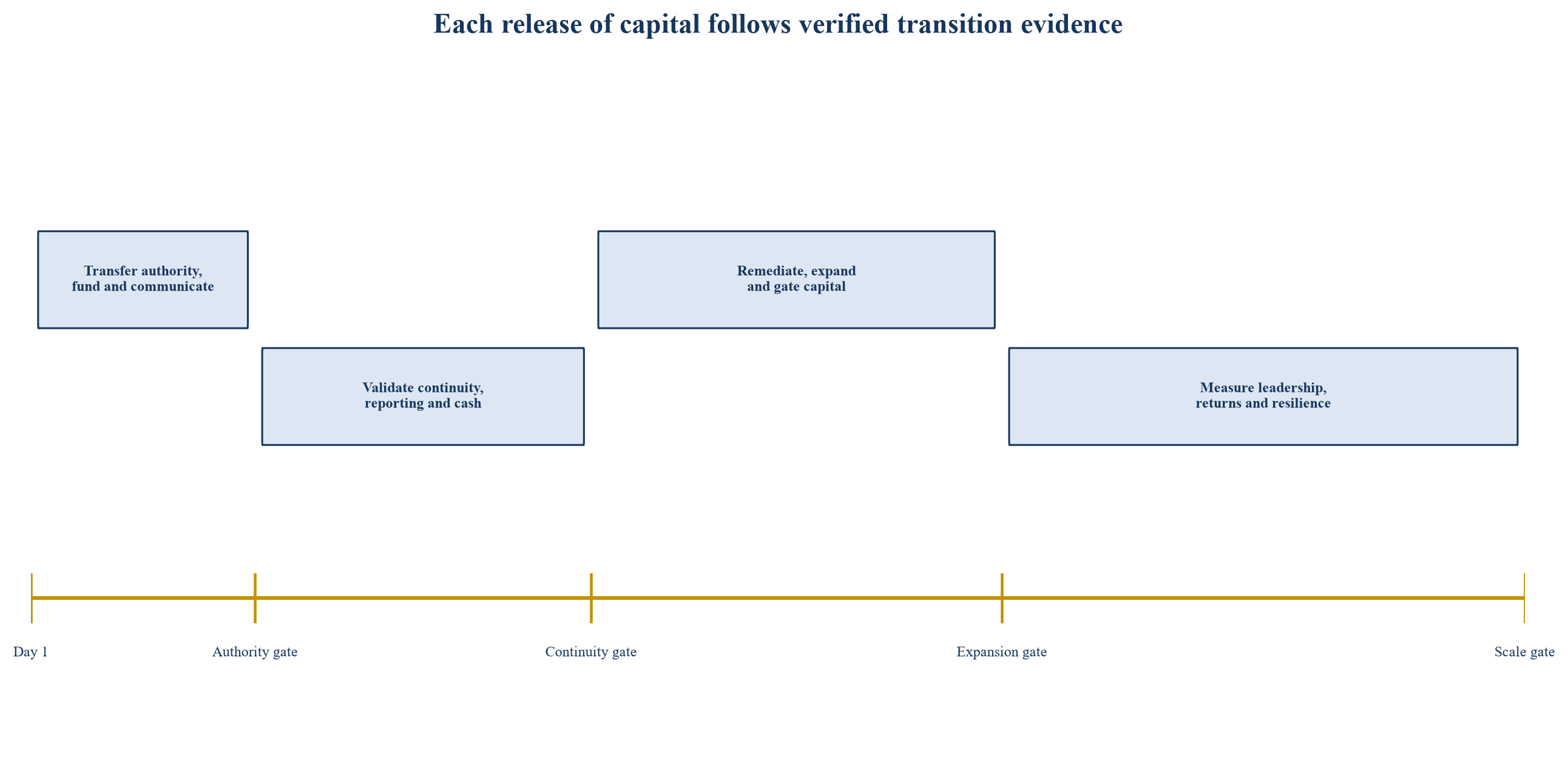
The timetable is illustrative and should be adapted to the company and jurisdictions.
21. Build the risk register around value at risk
The risk register should connect probability, severity, timing, evidence, mitigation and transaction response. Succession risk can affect customers, talent, lenders and permissions at once. Capital risk can intensify family conflict when a downside requires more funding or dilution.
High-priority risks may include founder dependency, successor readiness, family disagreement, customer concentration, related-party assets, growth execution, funding shortfall and exit conflict. Each risk needs an owner who can act before the trigger becomes a loss.
The transaction response should match the risk. A valuation uncertainty may require a staged investment. A customer dependency may require retention conditions. A family claim may require settlement before completion. A funding uncertainty may require a committed tranche or reduced liquidity.
The board should review risk movement after completion. A risk accepted at signing can become unacceptable as facts change. Reporting should distinguish mitigation activity from reduced exposure. Completion of a policy does not prove that operating risk has fallen.
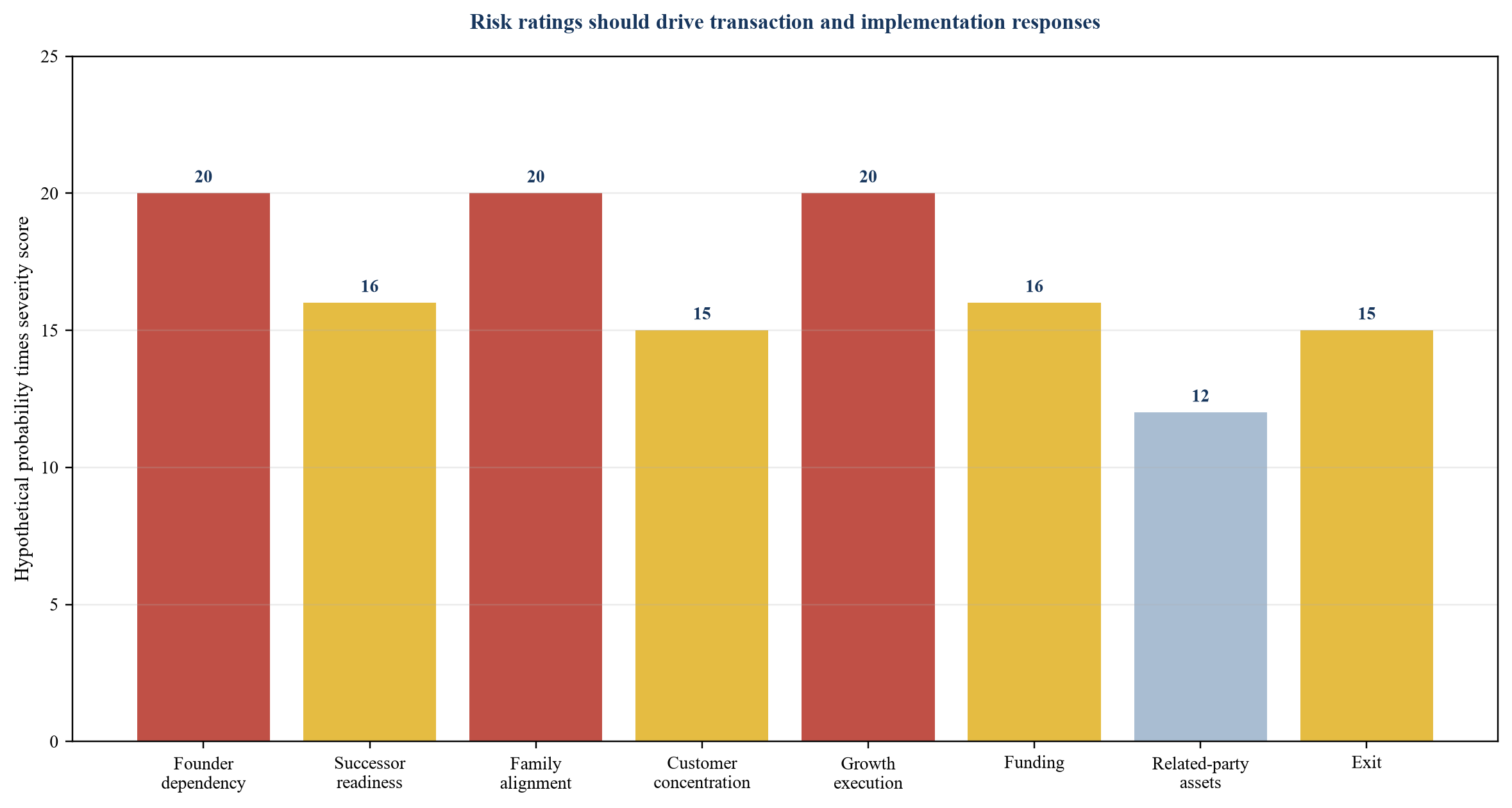
Scores are hypothetical and should be replaced with verified evidence.
22. Design exit, transfer and family separation before closing
Exit rights should address investor liquidity, family continuity and business resilience. The documents may include pre-emption, tag-along, drag-along, initial-public-offering cooperation, put or call options and sale processes. Each mechanism should define trigger, timing, valuation, eligible buyer, funding and regulatory approval.
A family may want to preserve long-term ownership while accepting an investor with a finite horizon. The solution can include a structured liquidity window, family buyback right, continuation fund, strategic sale or listing path. The company should not promise a buyback that it cannot lawfully or financially perform.
Family separation also needs a mechanism. Different branches may want dividends, liquidity or control at different times. A holding-company agreement can govern transfers, valuation and dispute resolution. The operating company should be protected from repeated ownership negotiations.
Cross-border disputes require enforceable governing law and dispute resolution. The New York Convention supports recognition and enforcement of arbitration agreements and awards across contracting states.[26] The team should still obtain current advice on interim relief, corporate matters and enforcement in every relevant jurisdiction.
Exit design should be tested against adverse conditions before signing. The investor may reach its expected liquidity date when public markets are closed, strategic buyers are absent or the family cannot finance a repurchase. The documents should specify what happens when valuation is disputed, regulatory approval is delayed, debt prevents a distribution or only part of the stake can be sold. A staged sale, extended holding period or third-party process may preserve value better than an automatic remedy that forces the company to fund liquidity during stress.
The same discipline applies to family transfers. Death, divorce, incapacity, creditor action or a decision by one branch to leave can introduce an unplanned shareholder. Transfer rules should define permitted transferees, information rights, valuation date, funding timetable and treatment of voting rights during a dispute. Insurance or an external liquidity facility may support the mechanism, subject to legal, tax and credit advice. The operating company should retain enough cash to run its business and execute the approved growth plan.
23. Present a falsifiable investment committee case
The approval paper should state the combined decision, alternatives, family mandate, successor authority, primary and secondary capital, valuation, governance, downside funding, implementation and exit. Each material assumption should have an owner, evidence grade and consequence if it fails.
The committee should see balanced, downside and staged cases with peak cash, dilution and stop triggers. It should know which assumptions depend on family behaviour, investor discretion, customer retention or regulatory approval. Sensitivities should reflect the operating system rather than arbitrary percentage changes.
Conditions precedent should include family approvals, authority transfer, corporate records, financing, key contracts, related-party assets, intellectual property, management appointments and regulatory permissions. Deferred items should have dates, owners and remedies.
The committee should decline when succession remains informal, family objectives conflict with the plan, growth funding is insufficient, liquidity weakens the business, control rights prevent management action or exit depends on an unfunded company redemption.
| Decision area | Evidence required | Committee decision |
|---|---|---|
| Strategy and capital need | Integrated plan, alternatives and peak cash | Approve purpose, amount and staging |
| Family and succession | Signed mandate, authority map and emergency plan | Approve transition conditions |
| Valuation and liquidity | Normalisation, rights-adjusted value and sources and uses | Approve price and liquidity cap |
| Governance and incentives | Board, reserved matters, delegation and management plan | Approve control system |
| Expansion and funding | Country milestones, facilities and downside response | Approve tranches and stop triggers |
| Exit and continuity | Transfer rights, valuation and separation plan | Approve terminal mechanisms |
Approval conditions should be tied to evidence, owners and consequences.
24. Use a board action plan
First, define the five-year enterprise decision and compare capital alternatives. Second, build the family mandate and map every ownership interest. Third, define the successor, founder role, board and executive authority. Fourth, build the integrated plan, downside and peak-cash analysis.
Fifth, separate primary capital, secondary liquidity and refinancing. Sixth, select the instrument and model the complete rights and cash waterfall. Seventh, diligence continuity, related-party assets, intellectual property, customers, people and permissions. Eighth, bind funding release to evidence.
Ninth, execute the first two hundred days through one accountable transition office. Tenth, review strategy, leadership, cash and risk at every board meeting until the operating model stabilises. The company, family and investor should use one reconciled evidence pack rather than separate narratives.
Patient capital creates value when it arrives before the business needs it, supports a successor who can act, preserves enough cash for growth and establishes governance that survives disagreement. Those outcomes require transaction design and disciplined implementation.
| Stage | Required output | Evidence gate | Board action |
|---|---|---|---|
| Family mandate | Ownership, role and liquidity map | Signed alignment and unresolved issues | Proceed, mediate or stop |
| Strategy and succession | Five-year plan and authority transfer | Successor readiness and executable organisation | Approve operating transition |
| Transaction design | Valuation, sources and uses, rights and downside | Fundable structure and accepted conditions | Approve terms |
| Completion | Financing, governance, key assets and permissions | Day-one continuity | Authorise closing |
| Expansion | Market milestones and unit economics | Verified performance and cash cover | Release capital or redesign |
| Exit or continuation | Buyer, valuation, funding and separation plan | Executable transition | Sell, refinance, list or continue |
The plan should remain live from family alignment through investor exit.
Sources
- ASEAN Secretariat, ASEAN Investment Report 2024: ASEAN Economic Community 2025 and Foreign Direct Investment. Read the primary source
- ASEAN Secretariat, ASEAN Investment Report 2025: Foreign Direct Investment and Supply Chain Development. Read the primary source
- ASEAN Secretariat, ASEAN-Gulf Cooperation Council Framework of Cooperation 2024-2028. Read the primary source
- ASEAN Secretariat, Joint Declaration on Economic Cooperation Between ASEAN and the GCC. Read the primary source
- ASEAN Secretariat, ASEAN and GCC Chart Future Direction of Partnership, 14 August 2026. Read the primary source
- International Finance Corporation, Family Business Governance Handbook. Read the primary source
- International Finance Corporation, Family Business Governance. Read the primary source
- OECD, Business Transfer as an Engine for SME Growth. Read the primary source
- OECD, Corporate Governance of Non-Listed Companies in Emerging Markets. Read the primary source
- OECD, G20/OECD Principles of Corporate Governance 2023. Read the primary source
- Asian Development Bank, Asia Small and Medium-Sized Enterprise Monitor 2024. Read the primary source
- Asian Development Bank, ADB Frontier Seed Facility. Read the primary source
- Asian Development Bank, Exacta Asia Investment III. Read the primary source
- Invest ASEAN, ASEAN Comprehensive Investment Agreement. Read the primary source
- ASEAN Secretariat, Fifth Protocol to Amend the ASEAN Comprehensive Investment Agreement. Read the primary source
- Invest ASEAN, ASEAN Regional Investment Promotion Action Plan 2025-2030. Read the primary source
- ASEAN Secretariat, Investment and the ASEAN Investment Facilitation Framework. Read the primary source
- ADGM Academy, Family Office Governance and Succession Planning. Read the primary source
- World Bank, Enterprise Surveys. Read the primary source
- World Bank, Small and Medium Enterprises Finance. Read the primary source
- Financial Action Task Force, Guidance on Beneficial Ownership of Legal Persons. Read the primary source
- World Intellectual Property Organization, IP Assignment and Licensing. Read the primary source
- World Intellectual Property Organization, Enterprising Ideas: A Guide to Intellectual Property for Startups. Read the primary source
- OECD, Transfer Pricing Guidelines for Multinational Enterprises and Tax Administrations. Read the primary source
- National Institute of Standards and Technology, Cybersecurity Framework 2.0. Read the primary source
- UNCITRAL, International Commercial Arbitration and the New York Convention. Read the primary source
